Showing posts with label hound. Show all posts

Friday, July 03, 2020

America's Founding Terrier


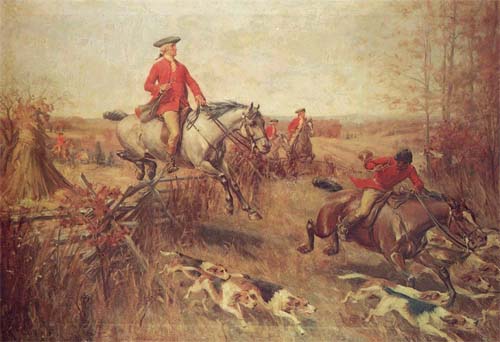
George Washington fox hunting in Virginia.

The case can be made that America might not exist today were it not for "our Founding Terrier."

Robert Brooke of Maryland introduced foxhunting to the United States in 1650, and imported the first pack of foxhounds from Great Britain.

Dr. Thomas Walker of Virginia (who discovered the Cumberland Gap and for whom the Walker Coon Hound is named) imported another pack to Virginia in 1742. The first fox hunting pack maintained for the benefit of a group of foxhunters rather than for a single owner, was instituted by Thomas, Sixth Lord Fairfax, in 1747 in northern Virginia.

Walker and Washington were good friends and business partners, and were co-owners (along with Washington's brother-in-law) of the "Dismal Swamp Land Company" (1763) which was to develop land near present-day Norfolk, Virginia. Walker was probably the person that got Washington started in fox hunting.

Washington moved to Mount Vernon, on the Potomac River just below Washington, D.C., after marrying Martha Dandridge Custis in 1759. It was at Mount Vernon, while still in his 20s, that George Washington first began fox hunting in earnest, setting up a rather lavish set of kennels and carefully breeding a new line of American foxhounds that were faster, lighter and less pack-centered than their English brethren.

In 1768, Washington was appointed as a delegate to the Continental Congress in Philadelphia and managed to fill his need for fox hunting at the Gloucester Hunting Club across the River from Philadelphia in New Jersey near present-day Haddonfield.

It was largely because of social and political connections made while fox hunting that Washington's social prominence rose, and in 1775 George Washington was Congress's unanimous choice as commander of the new Continental Army that was to lead the American forces against the British.

In truth, Washington did not have the forces and equipment to wage a successful fight and hold ground, and his chief battle-field opponent, General William Howe of Great Britain, was a master tactician.

Howe defeated Washington time and time again. In August of 1776 Howe landed on Long Island, captured New York City and defeated Washington at White Plains.

In 1777 Howe defeated Washington again, this time at the Battle of Brandywine (near present-day Chadds Ford, Pennsylvania) and took Philadelphia.

In October of 1777, the Battle of Germantown was waged. This battle took place near Philadelphia, and it too was a defeat for American forces, but it was a turning point in the war.

The turning point occurred when a small fox terrier was found wandering between the battle lines. The little dog was scooped up by American soldiers and the dog's collar identified it as belonging to none other than General Howe.

The dog was brought to Washington as a war prize -- a taunt to use against the British -- but Washington was having none of it.

A true dog-man, who missed his own fox hounds and terriers at Mount Vernon, Washington personally wiped the little terrier clean and brushed its coat. He then dictated a short note to his aide-de-camp, Alexander Hamilton, and secretly tucked a private note of his own tight under the collar of the dog. The dog, and both notes, were then returned to General Howe under a flag of truce.

Washington's private note has not survived, but Howe was extremely pleased by it. The public note, a copy of which has survived (see picture below), reads: "General Washington's compliments to General Howe. He does himself the pleasure to return him a dog, which accidentally fell into his hands, and by the inscription on the Collar appears to belong to General Howe."

After his terrier's return Howe praised Washington's actions as an "honorable act" and historians note that although he continued to win his battles, he never pursued Washington with quite the same vigor.

In fact, when ordered to fight harder and show the rebels no compassion, Howe resigned in protest.

Howe was replaced by General Henry Clinton, who was a poor tactician, and General Charles Cornwallis, who was a poor field commander.

In the end, the United States won the war and Washington returned to his beloved Mount Vernon where he continued breeding fox hounds and chasing foxes at least once a week.

Shortly after returning to Mount Vernon, Washington imported massive hounds from France with the help of his friend the Marquis de Lafayette. American hounds were crossed with these new French imports, and some of the progeny were sent to the Gloucester Foxhunting Club, outside of Philadelphia, where they proved extremely popular due to their speed.

In 1787 Washington headed the Virginia delegation to the Constitutional Convention in Philadelphia, and again his friends at the Gloucester Foxhunting Club lobbied for his election as the first President of the new country.

After the Constitution was ratified, Washington was unanimously elected President and in time the new Capitol was constructed just down river from his Mount Vernon estate.


Draft of note from George Washington to Howe, in the handwriting of aide-de-camp Alexander Hamilton.
.

Tuesday, October 24, 2017

The Always New and Continuing Evolution of Dogs


A repost from this blog, circa February 2007.

A lot of people want the undifferentiating affection of a dog, but are not entirely willing to pay the price: forced awakenings at 7 am, expensive fencing, veterinary care, shedding coats, barking, and strange smells in the living room.

Dogs are small tyrants that crap on your rug, chew up your glasses and steal your sandwiches.

If you own a dog, you can still ride off into the sunset, but you better be back by 8:30 to feed it, and by midnight to put it to bed for the evening.

In the era of schooners and candles, when people lived on large farms with slow traffic, things were probably a little bit easier. Back then a large dog could sleep in the barn and roam more-or-less at will.

Now a lot of folks live in condominiums and multi-story apartment buildings surrounded by six-lanes of traffic. Others are retirees looking for less work. The result is a growing market for small dogs that are as easy to take care of as a cat.

In fact, what is wanted today is a dog that acts like a cat, and a cat that acts like a dog.

Towards that end breeders on both ends of the spectrum are working towards a middle ground, with cats that have affectionate personalities and legs too short to jump up on the furniture, and dogs that do not shed, rarely bark, and are so small they can be tucked inside a handbag.

I suppose all of this is simply a logical extension of Robert Bakewell's earlier efforts to control sires in order to produce animals for a particular function.

Cats, of course, were slow to domesticate as prior to the rise of the "indoor" cat, felines were free to roam and cross-breed at will.

Dogs, on the other hand, have been the product of controlled breeding for so long that most Kennel Club breeds now seem to specialize in two or three genetic defects. As a consequence, more and more prospective pet owners are are now looking at cross breeds in some hope of avoiding expensive veterinary work to "fix" defective canine hips, eyes, knees and teeth.

Another factor, of course, is that a lot of the small "toy" breeds are so fru-fru that no self-respecting heterosexual man is eager to be seen walking one. A Toy Poodle? A Papillon? Please.

A cross-bred small dog at least offers the potential dignity of being something a little "outside the box."A small dog described as a "little mutt" or "attack rat" by the husband, can be described by the wife as a Shitpoo (a Shih Tzu crossed with a Toy Poodle), a Cockapoo (a Cocker Spaniel crossed with a Toy Poodle), a Schnoodle (a Schnauzer crossed with a poodle), a Bagel (a Beagle crossed with a Bassett Hound) or a Puggle (a Pug crossed with a Beagle).

Pardon me if I do not join the Kennel Club crowd which clucks and moans about "little mongrels" being cranked out by puppy millers and "back yard breeders".

How, I would ask, does that differentiate these new dogs from most Kennel Club breeds? After all, most of the dog breeds on earth today are less than 140 years old, and most were invented by puppy peddlers doing their business between 1860 and 1900.

The harsh truth is that most canine breeds were not forged by honest field work, but by professional breeders seeking to sell dogs for the pet trade.

In short, the true history of most dog breeds is one of "backyard breeders" creating contrived names and fake histories for their dogs and producing enough of the dogs in a short enough period (a puppy mill by any name) to create a "class" of dogs to fill a Kennel Club ring.

And it's not like Kennel Club breeds cannot be improved by a little outcrossing!

The Yorkie has such serious teeth problems that they invariably require attention from expensive veterinary dentists.

The Pug's bulging eyes make it prone to eye injury, and nearly every one of them is born caesarian.

The Toy Poodle is a barker and often mentally unbalanced.

Dachshunds are prone to serious back and joint problems.

Papillons and Chihuahuas have all kinds of health problems, not the least of which are that their bones may be so light they can break jumping off the couch.

The Lhasa Apso is a walking mop requiring more grooming than a Hollywood starlet, and is often a mental case as well.

Of course, most cross-breeds are not all that successful, and only a very few show a marked advantage over a common pound dog.

That said, enough crosses are working out that a few crosses are developing into regular replicable breeds. The most obvious candidate for "new breed" distinction is the "Labradoodle" -- a cross between a Labrador Retriever and a Standard Poodle. In Australia, this very tractable dog has been standardized and now breeds true after more than 15-years of focused work. In the U.S., however, most "Labradoodles" remain hybrids which, when crossed with each other, throw a wide array of very different-looking pups.

Contrary to what many hybrid dog advocates will tell you, a hybrid dog is not always healthier that its purebred cousin. Genetic loads are never revealed in one breeding, and "hybrid vigor" is not a perfect curative for all canine ills.

A final note is that when dogs are combined, the positive characteristics of a breed are not necessarily those that are transfered.

The tale is told of the time when Marilyn Monroe met Albert Einstein and coyly mewed, "Professor Einstein, we should get together. With my looks and your brains, think of the wonderful babies we could produce."

To which Einstein is supposed to have replied: "Yes, but what if they have my looks and your brains? That too is an equal possibility."
.

Friday, July 01, 2016

America's Founding Terrier


George Washington fox hunting in Virginia
A repost from this blog, circa 2004.


The case can be made that America might not exist today were it not for "our Founding Terrier."

Robert Brooke of Maryland introduced foxhunting to the United States in 1650 and imported the first pack of foxhounds from Great Britain.

Dr. Thomas Walker of Virginia (who discovered the Cumberland Gap and for whom the Walker Coon Hound is supposedly named) imported another pack to Virginia in 1742. The first fox hunting pack maintained for the benefit of a group of fox hunters rather than for a single owner, was instituted by Thomas, Sixth Lord Fairfax, in 1747 in northern Virginia.

Walker and Washington were good friends and business partners, and were co-owners (along with Washington's brother-in-law) of the "Dismal Swamp Land Company" (1763) which was to develop land near present-day Norfolk, Virginia. Walker was probably the person that got Washington started in fox hunting.

Washington moved to Mount Vernon, on the Potomac River just below Washington, D.C., after marrying Martha Dandridge Custis in 1759. It was at Mount Vernon, while still in his 20s, that George Washington first began fox hunting in earnest, setting up a rather lavish set of kennels and carefully breeding a new line of American foxhounds that were faster, lighter and less pack-centered than their English brethren.

In 1768, Washington was appointed as a delegate to the Continental Congress in Philadelphia and managed to fill his need for fox hunting at the Gloucester Hunting Club across the River from Philadelphia in New Jersey near present-day Haddonfield.

It was largely because of social and political connections made while fox hunting that Washington's social prominence rose, and in 1775 George Washington was Congress's unanimous choice as commander of the new Continental Army that was to lead the American forces against the British.

In truth, Washington did not have the forces and equipment to wage a successful fight and hold ground, and his chief battle-field opponent, General William Howe of Great Britain, was a master tactician.

Howe defeated Washington time and time again. In August of 1776 Howe landed on Long Island, captured New York City and defeated Washington at White Plains.

In 1777 Howe defeated Washington again, this time at the Battle of Brandywine (near present-day Chadds Ford, Pennsylvania) and took Philadelphia.

In October of 1777, the Battle of Germantown was waged. This battle took place near Philadelphia, and it too was a defeat for American forces, but it was a turning point in the war.

The turning point occurred when a small fox terrier was found wandering between the battle lines. The little dog was scooped up by American soldiers and the dog's collar identified it as belonging to none other than General Howe.

The dog was brought to Washington as a war prize -- a taunt to use against the British -- but Washington was having none of it.

A true dog-man, who missed his own fox hounds and terriers at Mount Vernon, Washington personally wiped the little terrier clean and brushed its coat. He then dictated a short note to his aide-de-camp, Alexander Hamilton, and secretly tucked a private note of his own tight under the collar of the dog. The dog, and both notes, were then returned to General Howe under a flag of truce.

Washington's private note has not survived, but Howe was extremely pleased by it. The public note, a copy of which has survived (see picture below), reads: "General Washington's compliments to General Howe. He does himself the pleasure to return him a dog, which accidentally fell into his hands, and by the inscription on the Collar appears to belong to General Howe."

After his terrier's return Howe praised Washington's actions as an "honorable act" and historians note that although he continued to win his battles, he never pursued Washington with quite the same vigor.

In fact, when ordered to fight harder and show the rebels no compassion, Howe resigned in protest.

Howe was replaced by General Henry Clinton, who was a poor tactician, and General Charles Cornwallis, who was a poor field commander.

In the end, the United States won the war and Washington returned to his beloved Mount Vernon where he continued breeding fox hounds and chasing foxes at least once a week.

Shortly after returning to Mount Vernon, Washington imported massive hounds from France with the help of his friend the Marquis de Lafayette. American hounds were crossed with these new French imports, and some of the progeny were sent to the Gloucester Foxhunting Club, outside of Philadelphia, where they proved extremely popular due to their speed.

In 1787 Washington headed the Virginia delegation to the Constitutional Convention in Philadelphia, and again his friends at the Gloucester Foxhunting Club lobbied for his election as the first President of the new country.

After the Constitution was ratified, Washington was unanimously elected President and in time the new Capitol was constructed just down river from his Mount Vernon estate.

My house is about 20 minutes away from Mount Vernon and sits on what would once have been Lord Fairfax's estate. Family legend (via Annie Walker Burns, founder of the Kentucky Mountain Laurel Festival), is that Dr. Thomas Walker is a relation of ours. It might be true too -- in Kentucky, anything is possible.


Draft of note from George Washington to Howe, in the handwriting of aide-de-camp Alexander Hamilton.

Tuesday, December 17, 2013

Word Origins and Hunting

A repost from 2005.

Anything that has been around a long time will generate a few words and phrases, and that's true for hunting as much as sailing ("posh", "pay the devil", etc.) or market trading ("pig in a poke", "cat out of the bag", etc.).

A few phrases derived from hunting in general and fox hunting in particular:

  • To be "in the pink" originally meant to be in the swankest possible fox hunting gear, designed by the London clothier, Mr. Pink.
  • The term "flying start" originally referred to a horse speeding up after the fox was spotted, with the idea that the horse was already going at some speed before it switched into an even higher gear to keep up with the hounds.
  • "Staying power" is a term used to describe a hound that will pick up a scent, not lose the scent, and stay up with the fox.
  • "To toe the line" meant a hound following a hot scent and not casting about too far while looking for it.
  • "Red Herring" is a term for deliberate misdirection and may come from poaching and/or dog training. One story is that poachers were said to rub herring on their feet to mislead dogs put on their trail by game keepers. Another, perhaps related story, is that a red herring was chosen because dog trainers often used the pungent fish to create a trail when training their hounds. A "red" herring, by the way, is simply a smoked version of the fish.
  • "Soho" a section of London, is named after a term derived from a cry once used in rabbit hunting. The term dates to around 1307 and was yelled when the hunters had sighted the rabbit, equivalent to "Tally Ho" in fox hunting. The areas where Soho now occupies was once pastureland where hunting took place. The place name, which dates to 1632, derives from this hunter's cry. The "Soho" section of New York City is a mimic of the London place-name area, but is actually shortened version of "South of Houston Street. North of Houston street, of course, is called "Noho."
  • "A Fast Woman" is a woman who did not ride side-saddle, but straddled the saddle like a man.
  • "Hello" has only been used as a common greeting since the advent of the telephone. The first recorded use is from 1883. It does, however, have earlier origins in other senses. It is a variant of hallo, which dates to 1840 and is a cry of surprise. That in turn is related to halloo, a cry to signal that exclamation used by a hunter to signify that a fox has been seen breaking into the open. Halloo dates to about 1700, but a variant, aloo, appears in Shakespeare's King Lear about 100 years before that.
  • "The brush off" refers to removing a fox's tail as a trophy at the end of hunt -- a signal that it was time to pack it up and head back to the barn.
  • "A Majority Whip" is a term that originated in Parliament in the mid-19th century and is a shortening of ‘whipper-in,’ who is the huntsman’s assistant in charge of keeping the hounds from straying by driving them back with the whip into the main body of the pack.
  • "Go to Ground" refers to a fox that takes to a hole to avoid the hounds that are pursuing it.
  • Corduroy is derived from the French ‘cord du roi’, and was once woven from silk and was used exclusively by the kings of France as part of their hunting costumes
.

Tuesday, August 28, 2012

The Beast of Exmoor and Other Nonsense

A repost from February 2009

Stories of feral "beasts" lurking in the darkness of the English countryside have been around for hundred of years, and were already old when Sir Arthur Conan Doyle used such a tale as the basis of The Hound of the Baskervilles.

The stories persist, of course.

Here are a few contemporary descriptions of various U.K. beasties:
  • Beast of Muchty: "I was travelling to my work at 04:30 when a cat the size of a Lurcher, jet black, small head, very slim with a long tail ran in front of my car (about fifty yards). The whole incident was over in 2 seconds ... "
  • Beast of Bont: "The main evidence for the existence of these sharp-clawed, but mysterious stalkers has been the death toll among vulnerable herds of sheep."
  • Beast of Barford: "It is twice the size of a dog print and clearly shows three huge claws and a large pad at the back. Wildlife experts believe the print is the most conclusive evidence yet that big cats are roaming Warwickshire."
  • The Beast of Gloucester and The Black Beast of Inkeberrow: "A 'huge black beast' ran in front of Ray Lock's car on the other side of the river near Lydney... one evening near Monmouth where it was described as 'jet black and about the size of a large dog.'"
  • Beast of Burford: "A £5,000 reward has been offered for the capture of a 'big cat' which has been terrorising a farming community ..... Pc Ray Hamilton, wildlife crime officer at Thames Valley Police, admitted there had been several sightings - but said this was not unusual. 'We've had sightings of everything you could imagine - pink flamingos, lions, dingos, wolves and even a giant ant-eater in Pangbourne.'"

The human desire to create imaginary "beasts" seems to have some correlation to the loss of large predators and true wilderness.

With the extinction of the bear and the wolf, the U.K. has lost all large predators and now has to suffice with two rather unimpressive meso-predators, the fox (average weight 15 pounds and living almost entirely off of mice) and the badger (average weight around 25 to 30 pounds and living almost entirely off of worms, beetle grubs, and small bulbs).

So what are these large feral "beasts" seen in the English countryside, and why is it that they are never actually found?

The short answer is that these "beasts" are nothing more than large escaped lurchers (coursing dog crosses) that have taken to livestock-worrying. As an article on the Beast of Osset notes:

"On a parkland estate in rural Yorkshire a poacher's lurcher (a fast greyhound-like hunting dog) was at large for six months but was sighted only once during that period. The gamekeepers knew it was there because they found the roe deer that it had killed, but it took a concerted effort with volunteers to flush it out of the wood."


In fact, sheep worrying is a serious problem
in the U.K., and while any dog can end up attacking sheep, it is the larger dogs such as Lurchers and Bandogs (mastiff crosses) that do the damage that lead some to think a large cat or lion is loose in the English countryside.


Sheep worrying by lurcher.


In fact, a lurcher really does look like a large cat if seen in the dark or fog, and especially if it is seen only briefly from a moving car, as most "big cat" sightings are.

A Bandog (what the Hound of the Baskervilles was) really does look like a lion if seen under the same circumstances.

What is amazing about the "big cat" stories in the U.K., however, is how easy they are disprove, and yet how utterly resistant people are to having their bubbles burst.

Take the issue of "big cat footprints". Most of these footprints are clearly large dog prints. How can we be sure? Simple -- all the footprints show claw marks. All the large cats, except the cheetah, however, walk with retracted claws, otherwise they would quickly dull


This foot print of the "Beast of Barford"
is held up by a young hopeful.


The other issue has to do with hounds -- the U.K. is crawling with fox packs, and yet none has ever chased and cornered a large cat other than the now very rare native Scottish Wildcat, which is not much larger than a tabby.

You can be sure that if the big cats were out there, British fox hounds would have found them by now! In the U.S., small teams of less experienced hounds manage to track down marauding farm-country cougars in only a few hours time.

Finally, we come to the issue of rub strips -- bits of carpet and tacks impregnated with a mixture of catnip and beaver castoreum -- that have failed to turn up any positive large cat hits in the U.K.

Wherever these rub strips are used -- whether in North America, South American, Europe, Africa, or Asia -- they are quickly found and rubbed against by large cats and other predators.

A DNA analysis of fur caught on the hooks of the carpet tacks can not only identify what species of animal has left it behind, it can identify what specific animal has come by in the night.

Rub strips are so accurate they are now routinely used to survey population densities of such elusive large cats as leopard, lynx, cougar, and jaguar, as well as badger, wolverine, bear, wolf, coyote and bobcat.

Of course, "Beast of" stories are not unique to the U.K.

Here in the United States we have Sasquatch and some local tales of little green men, swamp creatures, and even a werewolf or two (all delivered with a wink to small children).

In truth, however, we have far fewer fantasy "Beast" stories than the U.K. for a simple reason: we have more real top end predators.

In states like Minnesota, Wyoming, Idaho, Montana and North Carolina we really do have wolves prowling the remote sections.

In Florida, Louisiana and South Carolina we really do have 12 foot lizards slithering out of drainage ditches and quite capable of eating an old lady alive.

Mountain lions really do prowl the remote sections of Idaho, Wyoming, Montana, New Mexico, Colorado and even Texas, and are now being found as far east as Iowa.

Black bears number well over 400,000 in the lower 48 states, and there are over 100,000 more in Alaska.

Bobcats are everywhere, as are coyotes -- the later so common that there are bounties on them, including in my home state of Virginia.

No one living in a large America city today lives more than two hours away from a major top-end predator of some kind.

This is a glorious thing, and something we should count among our greatest national treasures.

But a "Beast of Bondwynn?" No, we don't have that.

In a world in which top-end predators are still common, there is no reason to invent ghost stories.

.

Monday, October 26, 2009

The Mummified Raccoon Hunting Dog


This post is recycled from June 2005.

Back in January I recounted the story of my dog, Mountain, climbing up inside a standing hollow tree (picture above) chasing after the scent of a raccoon.

Now comes the story of another dog that did the same thing -- and did not live to hunt again (though it did achieve a bizarre kind of immortality).

This story begins along the Cleburne-Haralson County line between Georgia and Alabama sometime in the 1960s. It seems a raccoon-hunting dog, accompanying its owner on a hunt, ran off and followed the critter up into a hollow chestnut oak tree.

The hound got stuck inside the tree and died. Rather than decaying as it would if buried underground, the dog simply dried out inside its natural wood "chimney". The rotting scent of the dead dog went up the "flue" of the trunk, and so predators and insects never got wind of the dog. Nor did the corpse get rained on.

Excellent ventillation inside the trunk eventually left the dog desicated (perhaps "freeze dried" during the winter) and mummified.


Sometime in the 1980s, loggers cut down the tree with the dog still inside it. The tree was actually loaded on to the logging truck before the loggers looked up into the hollow and saw the mummified dog inside.

Rather than send the tree and mummified dog off to the sawmill, the loggers donated the dog and its tree coffin to the Southern Forest World Museum in Waycross, Georgia, where it can be seen to this day.

The dog has been x-rayed and is believed to have been about four years old when it died.

The Southern Forest World Museum is located at 1440 N. Augusta Ave. in Waycross, Georgia, and is open from 10 a.m. to 3 p.m. Tuesday through Saturday. The "mummy dog" is their chief attraction, from what I gather.

The dog, by the way, has been named "Stuckie" by its fans.

Only in America.

Friday, October 16, 2009

Artificial Dens, Big Dogs and Fair Chase


Concrete liners wait to be assembled into an artificial fox earth in Germany. This is an "in and out" design where the barking dog comes down the right section of pipe and bolts the fox into the left section of the pipe. The two sections are connected at the notches seen in the foreground. The left section then feeds back into into the main pipe stem and the fox bolts out.

In an article entitled The Rabbit and the Go to Ground Tunnel, I detailed the 20th-Century rise of artificial fox earths in the UK.

These artificial fox dens have their origin in ancient rabbit "burries" created by the Romans who introduced the rabbit to the UK about 1,000 years ago.

The artificial fox earths of the UK served as the model for the over-large "Go to Ground" tunnels we see at American Kennel Club, Jack Russell Terrier Club of America, and American Working Terrier Association trials.

Go-to-ground trials are not close approximations of field work (a caged rat is the only "quarry," and it only has to be "worked" for a minute or two) but people who do not own a deben collar or a decent shovel often think a 9" by 9" square den liner is approximately the same size as a real fox den. This misperception helps fuel a common belief held by portly matrons at dogs shows that a red fox is as big as a coyote or small wolf. As I have noted:

A large dog is almost always a liability. While a small dog can enter and work a large den, a large dog cannot enter a small earth. If a large dog is able to squeeze itself into the den pipe at all, it will find it has little room to maneuver away from the slashing jaws of the fox, raccoon or groundhog, and that it is nearly impossible to get behind the quarry in order to bolt it out of the den.

Despite this liability, some large terriers in Britain continue to find success bolting fox due to the prevalence of artificial dens or "drains" created by the mounted hunts as a way to keep fox populations stable on hunt lands. These artificial fox dens are typically 9 inches square, brick-lined, and slate-topped with two or three possible entrances.

While the construction of artificial dens or “drains” was sufficiently common at the turn of the century that Sir Jocelyn Lucas provided tips on their construction in his 1931 book, Hunt and Working Terriers, they became even more prevalent after the introduction of the myxoma virus in Great Britain in the early 1950s.

Myxomatosis was purposefully imported from South America as a way of "controlling" the U.K.’s rabbit population, which was considered a major agricultural pest. The myxoma virus was a frightfully efficient killer, wiping out 98 percent of all rabbits in Great Britain within a decade of its introduction. One result of this unhappy turn of events was that the ancient rabbit warrens that had once served as natal dens -- and sources of food -- for breeding fox simply vanished.

In order to help out Mother Nature, and improve the chance that a fox would take up residence on hunt land, many hunts constructed new artificial dens out of bricks or 9-inch drainage pipes.

At about the time that the very first artificial fox dens were being constructed in the 1920s, Kennel Club dog shows began to grow in popularity. New terrier breeds were admitted to Kennel Club rosters with some frequency, and old breeds were regularly "improved" for coat color, the set of the ear, the length of the leg, the shape and size of the head, the set of the tail, and a dozen other characteristics that barely matter in the hunt field.


The rest, as they say, is history.

It is with some interest -- and alarm -- that I note that the use of artificial dens seems to be growing in Germany. Here we find concrete and PVC pipes used in the construction of artificial fox earths. These earths are hunted about once a month in season, with the dog being entered in the pipe, and the fox easily bolted out due to the design of the artificial den.

The bolted fox is then blasted with a shotgun.

This is pretty far from genuine terrier work in my opinion, and is only a little bit better than a canned hunt. Woodcraft does not have to be very high to find a fox in this manner -- just visit the artificial dens you have previously constructed (and perhaps stocked). The dog is then entered, and the fox bolts. The dog is unlikely to face much of a fight since the fox has an easy exit. Nor does the terrier owner have to dig to the dog. These are 5 minutes affairs, not three-hour digs. As for shooting a fox with a shotgun as it exits a pipe -- could there be anything easier?

I am at a loss to understand this permutation of terrier work which is so very different from what we do in the U.S.

If we set aside the ethics of this kind of hunting and ask only what might be happening to the dogs, more alarm bells sound.

Are the Germans turning to artificial dens because their dogs are too large to work tight and twisting natural earths?

That may, in fact, be part of the impetus behind the rise of artificial earths in Germany. While the German standard for a working dachshund (teckel) calls for a dog with a small chest, the Germans insisted on creating their own brand of terrier during the strange period leading up to the rise of Nazi Germany.

I have documented the true history of the German Hunt terrier (the Jagdterrier or Jagd terrier) in previous posts and noted that this "all rounder" is too small to easily retrieve bird, and often too big to easily go to ground on fox. It is a dog that, when bred to the middle of the standard, is "betwixt and between".

You know there are problems with Jagd Terrier size when the problem becomes institutionalized in the form of a cartoon Jagd Terrier struggling to exit an artificial earth. Cartoons require an audience to "get the joke" -- to say out loud that which is widely known, even if seldom stated.


The Germans have always been an engineering and industrious people, and so it is no surprise to find they have put a lot of effort into "improving" the old "three-brick-high with a slate roof" design that characterize so many artificial earths in the UK.

Modern German earths are often made of cast concrete or even plastic pipe assembled in sections and attached to special "bedding kettles". Though there are various designs for these earths, they all feature ready exits so that a barking dog can easily bolt the fox.

Carefully designed earths mean the dog may never come face-to-face with a fox at all -- a good way to keep a dog injury-free, but also a set-up that prevents a dog from ever being in a situation where it has to demonstrate locating abilities in a complicated sette, staying power while it is being dug to over several hours, or the drive and "bottle" needed to hold a fox in a stop-end.

In fact, these German earths are designed so well that I suspect a barking Tea-cup Poodle could bolt a fox!


Artificial dens are simply not used in the United States. One reason for this is that our mounted hunts are not in the business of killing foxes -- once a fox goes to earth, the hounds are praised and the field rides off until another fox is found, and then the chase is on again. This is not drag hunting, but it is not vermin control either. Perhaps it is game management. A fox caught by the hounds above ground is a very rare thing, and such a stupid, slow or sick fox is best weeded from the gene pool.

Another reason we do not have artificial earths in the U.S. is that in the Eastern U.S., where red fox are most common, there are so many groundhog holes that an artificial den is unlikely to be used by a fox, no matter how well it is located.

Perhaps the most important reason we do not have artificial dens in the U.S., however, has to do with our concept of "fair chase".

"Fair chase" is a modern idea and has been framed in response to a fixed amount of wildlife and a rising tide of people and technology.

In pre-historical time you took game any way you could, but with the development of modern weapons, mankind found it could shoot out all the game and "bleed the land white" in just a few years time.

As amazing as it sounds, for example, the people of the United States killed off almost every type of large wildlife in this country between 1850 and 1900 when ethics and common sense failed to keep pace with rapid improvements in gun technology and traps.

Bison, elk, wolf, white tail deer, pronghorn, moose, turkey, eagles, beaver, and many species of ducks, geese and crane were nearly wiped off the American landscape.

In response to this devastation, the U.S. developed the concept of "fair chase". Artificial bird-calling machines were banned, as were live decoys, and the commercial sale of wild game was prohibited. Hunting of most species was limited to clear seasons and defined bag limits, and some types of hunting (such as canons loaded with shrapnel designed to kill whole flocks of geese with a single shot) were banned outright.

Today, thanks to sane wildlife laws, ethical hunters, and the finest game management professionals in the world, most forms of American wildlife can now be found in record abundance.

Other countries have set in place their own laws, regulations and customs governing "fair chase". In the UK, for example, leghold traps are considered a horror, in no small part because the British have no experience with modern off-set-jaw traps, and in part because the mounted hunts have demonized traps and poison which proved to be so efficient during Victorian times that fox were often rare and many mounted hunts were reduced to chasing stag and rabbit.

In fact, the demonization of traps, poison and guns for fox control reached such a frothy state that a legal term was coined for the crime -- Vulpicide -- which means the killing of fox by any method other than horse, hound, and terrier.

Will Germany and other countries develop their own sense of fair chase, and will it include the rejection of artificial dens or -- perversely -- their embrace?

Time will tell, but so far artificial dens seem to be gaining ground in Germany. One "sales point" for these contraptions is that they are safe for the dog, which is unlikely to tangle with the fox in any serious way. In addition, the dog can always be easily located and cave-ins are an impossibility.

It should be noted, of course, that the real reason artificial dens may be finding favor in Germany is that they are a profit center on hunting-club and farm lands in much the same way that pen-raised pheasants are a profit center at other locations.

There is clearly a demand in Germany for simple and easy "sport" among those who want to "test" their dogs and show that their dogs still have what it takes. Never mind that the test is somewhat rigged and the dogs may be a bit too big to do the job in a natural fox earth.

A red fox running free in a concrete pipe, is certainly a better test than a white rat in a welded cage at the end of a wooden tunnel! Who are we -- Americans who invented the white rat "test" -- to disagree?

Of course there are still some of us who like the other option -- the slow slogging hunt for natural dens and the back-breaking labor of digging to the dogs through marl, root and rock. This is fair chase, and it is what terrier work is really all about.


For more pictures of German artificial fox den construction, see
>> http://www.jaeger-wesermarsch.de/sonstiges/kunstbau.html
.

Tuesday, July 07, 2009

Maryland Fox Trapping

A repost from this blog, circa February 2005.

The picture, above, is from a trapper who lives about 12 miles north of where I typically hunt. In a 53-day trapping period this fellow brought in 1,220 fox.

Any question about whether Maryland and Virginia have the best fox country in the nation?

Regulated fox trapping does no harm to fox populations, as the fox populations compensate by having slightly larger litters, while mortality due to mange and starvation tends to decrease due to an abundance of food and less back-to-back den occupation.

That said, most fox do very little harm, as free-range poultry is increasingly rare, and the primary diet of fox is not farm stock, but mice, voles, berries, roadkill, gut-shot deer, beetles, bugs, and the occassional rabbit, rat, nesting bird and baby groundhog. For more about fox, see the review of David MacDonald's exellent book, read the squibs about both Gray and Red fox, and see the Fox Year page

Maryland and Virginia were the first states to import red fox to the U.S. and also were the first states to import fox hounds.

The state dog of Virginia is the fox hound, and the Master of Foxhound Association of America is located in Northern Virginia about 45 minutes from my house.

Monday, October 06, 2008

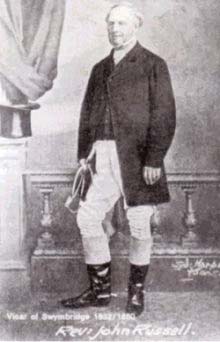
The Rev. John Russell's Obituary

The obituary that follows was published in the Swymbridge Parish Magazine of June 1883 following the death of the Reverend John Russell. The original article is framed and hangs in the Jack Russell Inn in Swimbridge (both spellings are used and both are correct).

This obituary is notable in that it does not mention horse, hound or terrier at all, and makes mention only of "his fame in the hunting field."

It has never been clear to me exactly when the term "Jack Russell Terrier" was first coined. It apparently was put forth shortly after his death, perhaps by dog dealers interested in capitalizing on the flurry of fame surrounding his death, but I find no evidence it was a term used while he was actually alive.

In an earlier post I put together a fairly detailed chronology of Rev. John Russell's life and that of Arthur Heinemann as well. The important point here is that Heinemann (an American by birth) and Russell had nothing to do with each other, and in fact the two gentlemen not only hunted in a different manner (Russell on horseback, Heinemann on foot), but different quarry as well (Russell hunted stag and fox, while Heinemann founded the Devon and Somerset Badger Digging Club).


Rev. John Russell

The illness from which the Rev. John Russell had long been suffering, ended fatally on Saturday the 28th of April. The sad event had been expected, and many who had seen him in our Parish Church on Sunday, 4th of March, realized the fact that the end could not be very far off.

Mr. Russell was born at Dartmouth, on December 21st 1795, his father just previously having been appointed to the Rectory of Iddesleigh, near Okehampton. He was the first sent to school at Plympton, and sometime after he was removed to Blundell’s School at Tiverton, where he succeeded in obtaining an exhibition of £30 a year, tenable at Exeter College, Oxford. Soon after having taken his degree at Oxford, Mr Russell was nominated to the curacy of Georgenympton, was ordained deacon in 1819, and priest in the following year by the Bishop (Pelham) of Exeter.

That Mr. Russell entered on the work of the ministry with a due sense of the sacred office, and of his own responsibility is unknown by many, who have only heard of his fame in the hunting field. But Mr. Russell showed a readiness to visit the sick and weary; to relive the wants of his poorer brethren, however poor himself; to preach God’s word earnestly; to plead in many a neighbouring pulpit, the cause of hospitals and kindred institutions. If such things be of good report, and carry any weight, no human being can say of him that his life had been altogether that of an unprofitable servant.

Soon after his appointment to George Nympton, he became Curate of South Molton in addition. Towards the end of 1825, or the beginning of 1826, an event, affecting the happiness of his life happened, namely, his marriage with Miss Penelope Bury, daughter of Admiral Bury of Dennington.

In the Autumn of 1874, a heavy sorrow awaited Mr. Russell – the heaviest he had known through life – by the serious illness of Mrs. Russell, and her subsequent death on New Years Day, 1875. In a letter to an old Curate of his, he alludes thus to the event: “I am at home again, though it no longer seems like home to me; for there is a vacant chair in every room, never again to be filled by her, the dear old soul, to whom I was united forty-nine years ago, come Sunday”.

Mr. Russell removed to Swymbridge, after six years residence at Iddesleigh, in the year 1832. In the following year the Perpetual Curacy of Swymbridge and Landkey became vacant, to which he was appointed, remaining in charge for nearly fifty years. Of his consideration and kindheartedness an instance is given in his treatment of the wandering tribes of gypsies, that were accustomed to sojourn awhile on the waste spots in his parish. Instead of persecuting them as trespassers by impounding their donkeys, compelling them to strike their tents at a moment’s notice, driving them and their children from pillar to post and treating them more like wolves than human beings, he never failed to befriend and protect them when-ever he though they were unfairly used. In return for this kindness they took active steps to protect his house when they had very good reason to believe it was threatened by a gang of thieves.

It was also recorded that when the King of Gypsies Edward Boswell, fell ill, and felt that his earthly hours were drawing to a close, he expressed a last wish that a charm he had long worn and prized greatly – a Spanish Silver Coin, of the date of Charles III – should be given to Mr. Russell, in token of the sympathy he had ever shown to him and his tribe. At the same time he requested that he might be buried in Swymbridge Churchyard, and by Mr. Russell himself.

It is quite unnecessary that any attempt should be made at a description of Mr. Russell’s characteristics. The best qualities of a kindly hearted man were present in him in a remarkable degree, and wherever his name has become familiar it has always associated with all that is honourable and chivalrous, and withal with recollections of innumerable kind attentions to those with whom his position brought him into close contact. By the poor he was always looked upon as one to whom their concerns were of importance, and who was near to them in heart in the troubles of their lot; and by the rich, from the Prince of Wales downwards, he was always welcomed, as much on account of the air of cheerfulness which always marked his presence; as for the wonderful number of anecdotes with which he sustained the life of the conversation in which he was an animated partaker. By his death the poor and lowly lose a kindly helper, while those in other stations will undoubtedly feel that in their circles a blank, which will never be filled up, has been created.

The change to the Black Torrington Rectory, brought about by the force of circumstances, he never ceased to regret. It could not be otherwise after having forty eight years of his life here.

After three short years in his new home he was brought back here to be laid by the side of her who for nearly fifty years shared his joys and sorrows. The enormous crowd that gathered from all parts of the country to his funeral testified to the esteem in which he was held by all classes of society. They felt that there lay one dead whose kindly actions, whose cheery words and genial smile had endeared him to them: and so they stood round his grave and paid him the last tribute of love.

Any may we say that the lesson his life teaches is this: To be kind one towards another, to be ready to assist each other in the many trials and difficulties of life, and to try and lead honest upright, temperate lives.


The picture to the left is Penelope Incledon Bury, aka "Mrs Jack Russell." She married the Reverend John Russell in 1826, and they had two sons, only one of which survived.

The dog pictured to the left of Mrs. Russell is presumably one of her husbands. If that is the case, it is the only photograph that I know of one of the Reverend's dogs. The famous painting of Trump, of course, is a complete fabrication painted more than 40 years after the dog died by a man who never saw the dog at all.

It should be said that Russell was apparently a bit of a dog dealer, and that many terriers and hounds passed through his hands. Russell gave up his hounds at least twice due to poverty -- he did not have a kennel of terriers in the end as some have suggested. At the end of his life there were only four old arthritic terriers named "Rags", "Sly", "Fuss" and "Tinker," and none were of breeding age.
.

Sunday, September 28, 2008

David Hancock on Dog Breeding


"Uncle Sam," a St Bernard at the 1908 Westminster Kennel Club Dog Show, Click to enlarge.

This article by Col. David Hancock first appeared in the The Countryman's Weekly back in July 14, 2000:
The Way Breeding Standards Used to Be

"Most of the change we think we see in life is due to truths being in and out of favour."

THESE WORDS of Robert Frost could so easily describe the relationship between some dog breeders and the wording of the Kennel Club standards laid down as the blueprint for each recognised breed.

Ignoring the true meaning of the intentional misreading of the written design criteria for any breed is a form of wickedness. Such an act suits the humans involved but rarely the dog. But can any genuine dog lover truly want to produce a Bulldog that cannot breath, an Old English Sheepdog that cannot see and a Bloodhound, which not only drools saliva over every item within range, but has discomfort from sunken eyes and an over-abundance of loose skin?

Can any breeder producing a Basset Hound which steps on its own ears and has chronic eye problems claim to love the breed?

Respect for the standard

An exaggeration, claimed Kahlil Gilbran, is a truth that has lost its temper. Being true to any breed involves respect for the standard and respect for the dogs of that breed.

Exaggerating the physical features of a subject creature, to its subsequent discomfort, to me indicates disrespect both for the breed design and, more importantly for the dogs themselves.

Less well-informed members of the public have come to think of exaggerations in some pedigree breeds of dog as being typical, traditional and not affecting the animal's quality of life. Not so. None of these is true.

Contemporary breeds like the Bull terrier, Basset Hound, Bloodhound, Bulldog and St. Bernard are now quite unlike their own ancestors. They defy their own breed heritage and mock their distinguished lineage. Man has deformed each of these breeds.

Broad-mouthed "holding" dogs like the mastiff breeds predate the much-mentioned Molossian dogs. They were valued by Assyrians, Scythians and the Sarmatians as heavy hounds over 2000 years ago. The Bullmastiff as a breed-type existed long before S.E. Moseley stabilised the modern breed from his Farcroft Kennels.

The English Mastiff was much more like a heavy hound before the advent of pedigree dog shows. The Bulldogs of the baiting contests were much more like Pit Bull terriers than the Bulldog.

And, if you look at portrayals of the prototypal Bullmastiffs and consult the official Kennel Club breed standard, you are struck at once by the incorrect skull conformation in so many specimens in the breed today. The breed MUST have a muzzle!

Yet time and time again in today's show rings I see pug-faced, apple-headed Bullmastiffs exhibited, with hyper-abbreviated muzzles -- in clear breach or the breed blueprint, and they win! And they win at the World Dog Show!

The early examples of the breed also had tight mouths. Now we are seeing loose-lipped drooling specimens quite unlike their forebears. It is bad enough when Bulldog, Bloodhound and St Bernard breeders produce such caricatures. But tradtionally Bullmastiff breeders have had more sense and kept faith.

However, unless contemporary Bullmastiff fanciers become responsible, realistic and reverse these tendencies, we are going to end up with giant drooling pugs - a complete travesty of the breed ideal and an insult to those distinguished pioneers who handed on the custody of this superb breed of dog for us to protect in our lifetime.

The sad fact is, however, that if you allow small exaggerations into a breed, then those small exaggerations soon exaggerate themselves. And, with a closed gene pool, the exaggerations get more pronounced with each generation.

The working Basset Hound fraternity has out crossed to the Harrier to remedy the problem of exaggerations exaggerating themselves in that breed.

Edwin Brough, the greatly respected pioneer-breeder of purebred Bloodhounds, recommended an outcross every fifth generation to retain virility and type. An outcross to the big black and tan Dumfriesshire Foxhound was used some 50 years ago. Now an outcross to one of the packs of hunting Bloodhounds is being mooted.

The St Bernard of today is revealing far too much of the Mastiff blood utilised by breeders a century ago and is not only quite unlike its own hospice ancestors, but markedly different from its native companion breeds, also bred to operate in the high pastures, the Bernese Mountain Dog, the Great Swiss Mountain Dog, the Appenzeller and the Entlebucher.

The pursuit of "great bone" and great size in the breed to the detriment of soundness, strength and virility, has not been wise.

Neither has the imposition of the rugger-ball for a head in the Bull terrier, in pursuit of the dreaded "down face," nor the strange desire to make the lovable Basset Hound more like the cartoon character in a national newspaper than is good for a living creature.

Dog breeders have a huge moral responsibility, magnified by the increasing loss of role for breeds which once worked. Function once decided design. Now the whim of man all too often distorts a design originally drawn up by knowledgeable people who worked their dogs.

Pastoral breeds were never intended to possess coats, which would hamper them at work. Working Bloodhounds do not display the degree of wrinkle seen in the breed in the show rings of today. Working Bassets, or English Bassets as they have now become known, do not display the over-long backs and under-length legs found in their show ring counterparts.

The pursuit of undesirable and harmful exaggerations in breeds of dog tells you more about the moral shortcomings of man than about the faults in individual dogs.Of what possible benefit to the dog are sunken eyes and ears this long?

The Kennel Club is looking all the time at the wording of breed standards, which result, for whatever reason, in harmful effects in dogs. As the holders of the copyright of the breed standards, the Kennel Club has the ultimate responsibility for undesirable words in them.


Tendentious interpretation

But, in the end, less honourable people will misuse any wording presented to them. The promotion of "their" type and their own tendentious interpretation of the standard will be their preference, whatever the regrettable long-term penalties for their breed.

It just needs one influential but misguided breeder or a dissident clique to put at risk over 100 years of devoted work by generations of worthier breed enthusiasts.

It would not be difficult to restore the historically correct head to the Bull terrier, a more athletic anatomy to our beloved Bulldog, a healthier physique to the appealing Basset Hound or to reduce the excess of skin on the admirable breed of Bloodhound.

The dogs suffer in silence. The public usually accept a breed as it's presented to them. A handsome but slab-sided Irish Setter or pointer is not exposed as a pet to the penalties such a feature would bring to a working dog on a grouse moor.

But the ratio of depth of chest to breadth has been shown to be a factor in the incidence of bloat, a dangerous disease. The amount of haw in the eye of a Basset Hound or Bloodhound might not be life-threatening but the considerable discomfort of constantly having foreign bodies irritating the eyeball is avoidable and surely must therefore be avoided by the custodians of any breed.

The critiques of judges sometimes reveal the failures of breeders when they describe poor movement, inadequate structure or lack of type. But I know of no breed council that sits down either to review judges? comments or consider the sate of their particular breed.

The dentition in Staffordshire Bull terriers, the movement in Mastiffs, the structure of Bearded Collies, the too-heavy coats in Rough Collies and the inability of breeds like the Clumber Spaniel, the Scottish terrier and the Bulldog to give birth naturally would all receive attention in any humane breed council, truly devoted to the best interests of its breed.

As a direct result of breeds being abandoned by their own clubs and councils, enlightened individuals are coming together out of despair and out of a genuine love of their breed.

The situation in the breed of the Bulldog illustrates this most vividly. Pip Nobes in Australia, Lolly Wilkinson in Canada, Jan Dirk van Ginneke in Holland, David Leavitt in America and Ken Mollett in the UK have separately been striving to produce a healthier, more athletic and more historically correct version of the Bulldog.

Pip Nobes has bred an "Aussie Bulldog" with a smaller head and chest, broader hips and a longer muzzle, good news for any Bulldog anywhere.

Ken Mollett has formed the Victorian Bulldog Society, composed of a dedicated group of Bulldog lovers with a difference -- they prefer healthier Bulldogs and breed them to prove it.

In Canada, using stock imported by earlier settlers, Lolly Wilkinson produces athletic and authentic Bulldogs, more like the famous prototypal Bulldogs "Rosa" and "Crib" than our show ring specimens allegedly inspired by them. Her dogs live a long time and give birth naturally. Ours do not.

It is to me shaming that an overseas breeder should have to show our breeders the way to breed the best examples of our most famous native breed of dog.

Change may well depend on the truth being in and out of favour, as Robert Frost declared.

Exaggeration may well be, as Gilbran considered, the truth having lost its temper.
Change is often needed and welcome, but changes in breeds that are harmful or alter breed type unacceptably are neither needed nor welcome, whether in or out of favour.


Needless handicaps

Harmful exaggerations should make us lose our tempers with those who inflict needless handicaps on subject creatures. Pedigree dogs are particularly vulnerable, sadly especially in Britain, where we have produced some of the most regrettable exaggerations displayed in the domestic dog.

Going back to the breeding of a number of breeds "the way they were" is neither sentimental nor regressive, it is sorely needed. Before we are humiliated by an edict from Brussels, we have work to do.

Tuesday, January 29, 2008

Darwin Approved, and As Natural As It Gets

Hunting with hounds 'mimics nature'

By Charles Clover, Environment Editor,
Telegraph (U.K.) 1/17/2008

Hunting with hounds is more "natural" than shooting or snaring as it mimics the way wolves work in the wild, according to a study by vets.

It is the healthiest form of predator control for populations of prey species, such as foxes and deer, because hounds, like wolves, use scent to select the weakest and easiest to catch, the study says.

Snaring, shooting and trapping, on the other hand, interfere with evolution and make prey species, such as the fox, more vulnerable to the spread of disease, according to the study which is based on scientific literature mostly published since the Burns Inquiry into hunting in June 2000.

The study by the Middle Way Group of MPs and peers and the Veterinary Association for Wildlife Management was intended to provide new arguments for a repeal of the Hunting Act on the grounds of animal welfare and wildlife management.

"The Natural Chase," a report by Katie Colvile, a vet, which is based on peer reviewed scientific literature, argues that rather than being cruel, hunting mimics natural processes that animals have evolved to cope with, whereas "artificial" forms of control undermine wildlife populations.

James Barrington, a consultant to the Middle Way Group, said: "The perception is that hunting is something that is a barbaric activity, that is cruel to the individual animal.

"This study shows that hunting, on the contrary, is selective, something that the quarry can cope with and that humans are almost insignificant in it.

"Hunting is nature's way of taking out the old, the sick and those with high parasite burdens - which mankind's forms of control do not. In framing the Hunting Act, the Government has produced a law that is in many ways unnatural."

The Middle Way Group, which is in favour of hunting under a statutory code to protect the welfare of the hunted animal, believes that a future Tory government would need positive arguments for the abolition of the Hunting Act if it came to power and the report was commissioned to fill that gap.
. .

Monday, December 10, 2007

Land of the Free


Warenton, Virginia Fox hounds and riders.


The piece below has been vandalized by the title writer. "Tally Ho Dude?" No one outside of the California surfer community, circa 1990, uses terms like "dude". That said, and with one other small caveat, it is a nice piece.

The other caveat has to do with the power of the animal rights movement in the U.S. The notion that the Humane Society of the the U.S. or PETA could put a stop to hunting of any kind is laughable.

Virginia has an expressed constitutional right to hunt, spends money encouraging more people to hunt, and keeps expanding the hunt season (and the limits) for deer and many other species.

PETA may be headquartered in Virginia, but those over-reaching gas bags don't make a peep in this state. They may be able to push around Kentucky Fried Chicken, but ESPN runs hunting shows every day, every magazine rack in American has hook-and-bullet publications on it, and the conservation community values hunters and anglers above all others.

In the state of Virginia we shoot well over 200,000 deer a year, and more than a 1,000 bear. Last year trappers took 35,000 red and gray fox and another 85,000 raccoon, and the population of everyything is on the rise. In fact nuisance widlife is such an issue in most of the U.S. that it is now illegal to move a beaver -- you are required to kill it rather than move it in most states. In Virginia the state pays a bounty in oder to encourage people to kill coyote (numbers are on the rise anyway), and there is talk of requiring hunters to shoot a doe in order to be able to be get a permit to shoot a buck; a kind of population-control-through-hunting that was unimaginable only 40 years ago.

_ _ _ _ _ _ _ _ _ _ _ _ _ _ _ _

Sunday Times of London, December 26, 2004

Tally ho, dude! The hunt rides to America
by : Jonathan Green

_ _ _ _ _ _ _ _ _ _ _ _ _ _ _ _

A foxhunters' exodus is under way from Britain to the land of the free
_ _ _ _ _ _ _ _ _ _ _ _ _ _ _ _


Tomorrow morning Dennis Downing, splendid in his scarlet coat, will be up early to oversee the hounds -particularly his old favourites Gossip and Gorgeous. About 70 people will join the meet, including his wife Sue and 19-year-old daughter Emma, and a further 30 will come to see off the hunt, armed with the customary offering of port.

The Boxing Day meet, the biggest on the hunt calendar, is being held a day late as it has fallen on a Sunday, but otherwise everything will be done in accordance with the hunt's long tradition, which stretches back to 1888.

It could be the scene in any British village. The difference is that Downing left England in 1998 and now works for the Blue Ridge hunt in Virginia, 50 miles west of Washington DC.

Instead of the patchwork of Worcestershire fields he surveyed as master of the Croome hunt, he now rides through the spectacular Shenandoah valley with the Blue Ridge mountains in the background. His companions will be airline pilots, lawyers and doctors rather than the working farmers in England he once hunted with.

The decision by the government to ban hunting with dogs -which was set to come into force on February 18 -means that Downing, 50, has made a move that many of those who rely on hunting for a living are considering emulating. There still may be a temporary reprieve -the announcement last week that the attorney-general will not fight any application for an injunction against the ban from the Countryside Alliance means that hunting is likely to continue for several months yet.

But the uncertainty means Ireland, other European countries and America are becoming increasingly attractive as a new home for huntsmen and women. First choice for many is America, because the two communities have long hunted with each other.

When an advertisement for a whipper-in at the Blue Ridge hunt was placed in Horse & Hound recently, the hunt received 44 applications. Of those, two were from Americans, five from Ireland and the other 37 from British hunt staff.

"When we advertised a similar post four years ago we only got two people applying from England," says Linda Armbrust, the master of the Blue Ridge hunt. "It's incredible."

So Downing, it seems, was merely ahead of the pack when his family left Britain.

The strain caused by his job had become too much: the taunts Emma, then 12, endured; the ostracism Downing experienced; the industrial developments that made it increasingly difficult to keep hounds off building sites, busy roads and railway tracks.

"I thought, 'Stuff this'," says Downing and he started to scour job advertisements. In May 1998 the family --including foxhounds Glider (since deceased), Gossip and Gorgeous -- packed up and moved to Huntsville, Alabama, where Downing had been appointed master of foxhounds.

"Suddenly we were somewhere where you could ride hard for 25 miles and not see a single car," says Downing. "And our standard of living shot up -for the first time in my life I lived in a centrally heated house. It was difficult being in the Deep South -- at first no one could understand what I said and I couldn't understand them but the people were so warm and welcoming." They moved to the Virginia hunt a couple of years later.

Indeed, foxhunting has a long and rich history in America. Foxhounds were first imported in 1650 by British colonists and the first organised hunt was held in 1747 by Lord Fairfax, an English landowner, who introduced George Washington to the joys of hunting.

Currently there are foxhound hunts in 35 states -hunting over vastly different terrains and for different quarries. In the pinewoods of Alabama, Georgia and Tennessee they hunt red and grey foxes and coyotes. In New England the deciduous growth is good cover for the red fox, as is the landscape in Virginia, Pennsylvania and Delaware. On the Great Plains of the Midwest and the Rocky Mountains in California, coyotes are the main quarry.

However, there is one very distinct difference between the American and English form of hunting. American hunts will chase a fox but not kill it when it goes to ground. "We don't have the same problems with foxes as you do in the UK so they are not vermin here," says Joseph T Murtagh, of the Rose Tree Fox Hunting Club in Brogue, Pennsylvania, the oldest hunt in America. "We chase them and when they go to ground we account for them and they live to fight another day. In fact, I don't think our hounds even know how to kill a fox."

The one thing that Downing does miss is the atmosphere he remembers surrounding a British hunt, despite the protesters. "It used to be exceptional. I remember 1997, my last Boxing Day in England. When we met in the centre of Pershore in Worcestershire we were surrounded by hundreds of people cheering us, lining the streets. You'd also get loads of people following the hunt in their cars. That's just not something that happens in the United States."

It was that atmosphere that had attracted Armbrust to leave America in 1980 and act as master of two British hunts -the Mendip Farmers and then the High Peak Harriers. "Here in the US if you are arranging a meet you just call everyone up on the phone," she says. "In England I would drive around from farm to farm, talk to them and get to know them -their children, who'd died, who'd got married. I really enjoyed it.

"For people in England hunting is a way of life -it's very different to that in America. I had friends in England that once the cubbing season started their whole social life revolved around it. Here in the US if you are hunting you might go shopping in the morning, then perhaps go hunting for three to four hours and then go off for a game of tennis or golf afterwards."

Armbrust spent more than a decade happily here but increasingly she felt public opinion was turning against hunting. "When John Major won in 1992 I went out to buy a second-hand horse lorry to celebrate because I knew hunting would be around for at least another five years," she recalls. "But by 1995 I realised that it was not going to survive much longer."

She decided to go back to the US, partly for personal reasons but also because she was weary of the protests. "It wasn't fun being in boots and breeches and having people spit on you at the local garage while calling you 'fox killer'. And it wasn't fun either having 50 or 60 people in black balaclavas using filthy language in front of your children. But you know what we say in the US? 'What the hell!'"

So she returned to Virginia in 1995.

She and other members of the American foxhunting set are concerned that the British move could encourage similar calls in the US, led by the Humane Society of the United States. "The entire animal rights movement in the United States reacted with unfettered glee at the ban in England," says Wayne Pacelle, its chief executive. "We view this act of parliament as one of the most important actions in the history of the animal rights movement. This will energise our efforts to stop hunting with hounds."

"I am sickened and disgusted by what they have done in the UK," retorts Lieutenant-Colonel Dennis Foster, executive director of the Masters of Foxhounds Association of America, which represents 20,000 huntsmen and women. "England is the mecca of foxhunting. It's your heritage and was exported over here. If this happened in America, I and many like me would go to war against a government that does not represent all its citizens."

Plans are already in place to ensure that the bonds between American and British hunting remain, and that British huntsmen and women do not have to put away their scarlet coats. For three years Carla Hawkinson, master of foxhounds at the Tennessee Valley hunt, has been running Goneaway Tours. It is a specialist hunting travel agency, taking American hunters to England to fulfil an ambition and vice-versa.

"I hate to say it but I think business is going to pick up for us bringing English hunters to the US," she says. Her next big excursion is to take a group of 10 American hunters to Exmoor, Dartmoor and Wiltshire in mid-February. "Hunting is integral to the lifestyle loved by country people of all classes and occupations.

We are prepared to return to the homeland of hunting and to stand up for the rights of all hunters. If hunting dies in Great Britain, we have more to fear than the law."

Downing thinks more will choose to visit America to hunt and predicts an exodus of hunt staff from Britain. "My hunt friends are calling all the time about jobs over here," he says. "But there are only so many jobs to go round."

Downing and his family have no desire to go back -they hope to get American citizenship soon and trips to England are becoming rare. When he rides out tomorrow there will be nothing but satisfaction.

"I've never once regretted what we did -- even when we go back to England on visits," says Downing. "In fact, each time we go there and see how the country has changed, I feel less and less like going back."

.
Tuesday, November 06, 2007

An Ancient Breed of Dog?


Genetic research has given legs to something most canine historians knew was true: most breeds are not very old, never mind what Kennel Club breed enthusiast may claim. The supposedly "ancient" Ibizan hound and Pharaoh hound, for example, turn out to have been made up within the last 100 years or so -- no doubt bred to look like the drawings and sculptures of sleek, slender-necked canines with pointy ears and long snouts that were seen on the Pharaonic tombs whose discovery were all the rage at the time of Carter. As for the Norwegian elkhound, which supposedly dated back to Vikings dog, it turns out to have originated no farther back than the past few hundred years. 

Using 96 distinct patterns in the genes called "microsatellites," genetic researchers compared dogs within breeds, and breeds with one another. In the May 21, 2004 issue of the journal Science, the team concluded that almost every breed was surprisingly distinct genetically. A few suprising gleanings:
  • Ancient dogs included a very motley assortment of dogs found all over the world: the Alaskan malamute, the Siberian husky, the Samoyed, basenji, Saluki, Afghan, Lhasa apso, Pekingese, Shar-Pei, Shih Tzu and Akita.
  • German shepherds, which might have been expected to be in the either the ancient group (due to their resemblance to wolves) or the herding group were found to actually be more closely related to to mastiff-type dogs, such as the bull mastiff, the bulldog and the Rottweiler.
  • Herding dogs, included such obvious members as the collie and the sheepdog, but also the greyhound.
  • Terriers and scent-tracking hounds, such as spaniels and setters and were deemed to be of relatively recent European origin. This should hardly surprise anyone -- almost all of the terrier "breeds" were created after 1800 and most after 1860 and the beginnings of the Kennel Club and livestock shows. For a detailed pictorial history of terriers, see A Pictorial History of Terriers.

For more information on canine genetic research, see the >> Genome News Network's Dog Page

.

Tuesday, July 03, 2007

Coonhounds, Ego and the Dog Show Circuit


The Washington Post has a front page story this morning about a fellow and his daughter who raise, hunt and show coonhounds. The piece is part of a series on why folks compete in things, and the title of this one is: Ego

In my opinion, that single word does not entirely sum up why folks attend dog shows, but it's a pretty good one word try, nonetheless.

The reporter details the trophy room:

More than 500 trophies were displayed on the floor, forming a sea of oak and metal that covered all but a four-foot-wide sliver of speckled tile in the middle of the room. The trophies ranged in height from six inches to six feet, and they all bore the names of dog shows held in the last eight years. More than 300 ribbons, plaques and certificates decorated the walls. A year earlier, Amanda had hired a cleaning crew to dust and shine each award.


How did all these gleaming trophies and ribbons come into being? Well, it involved a wealthy father and a LOT of money. A whole lot of money.

To their credit, the Alexanders are not puppy peddlers, and do not breed a lot of dogs, and they take unbelievably good care of the dogs that they have.

Also to their credit, the Alexanders DO work their dogs, though it should be said that with 60 dogs in the kennels, no one dog may see much action in a year.

The Alexander's hounds sometimes chased down possum, deer, bobcats or bears. Other times, like tired athletes, Curt said the dogs gave up and barked at the base of a random tree, just so the hunt would end and they could go home. On the worst nights, the hounds injured themselves while tearing through the woods at 15 mph. A dog once ran out of the woods with a porcupine quill poking into the center of his eyeball -- a wound fixed, by veterinarian recommendation, with Krazy Glue. Another dog tripped and slipped a disk in his back, necessitating 12 trips to a specialist in Columbus, Ohio.


The Washington Post story is ostensibly about competition and what motives people to success in their respective sports. Whatever it is (and let's set aside whether showing dogs is a sport), it appears to be a powerful internal force.

Amanda, 27, spends all but two weekends each year driving to dog shows in places such as Brazil, Ind., and Saluda, N.C. Bob has spent more than $400,000 purchasing dogs and then lavishing them with accoutrements generally reserved for elite athletes: truckloads of performance-enhancing food; a heated indoor swimming pool for winter cross-training; personal drivers to shuttle dogs to distant appointments with nationally renowned veterinarians.


You can do the math: $400,000 for 60 dogs, 500 trophies and 300 ribbons. That works out to about $6,600 per dog, or about $800 per trophy. In fact, those numbers are not too far out of sync; some folks spend more than $100,000 a year campaigning a single dog.

In the dog show world, of course, one chooses both a breed and a registry, and young Amanda seems to have chosen the American Kennel Club. I have little doubt that the reason she saddled up with the AKC is that a young female "pay to play" show dog person found the new AKC coonhound cartel more socially promising than the older, more male, and more experienced coonhound club at the UKC. Apparently, it did not hurt a whit that the AKC encourages exhibitors to dress up in nice clothes and put makeup on their dogs.

In her grooming shop a few days earlier, Amanda spent 90 minutes readying the four Plott coonhounds. She trimmed and filed their nails, shaved surplus hair from their underbellies and rubbed the inside of their ears with Q-tips. But as she stepped out of her camper and looked around the infield, Amanda wondered if she'd prepared enough. All around her, groomers sprayed dogs with hair color, lined their eyes with mascara, whitened their toenails with chalk and smoothed their coats with flat irons.


Of course the UKC has had coonhounds forever, and the AKC only came to the show when they needed to bolster their sagging finances. So how do you explain abandoning the UKC for the AKC without it reflecting on the pure ego of a young campaigner who wants to be a big-and-rich fish in a smaller pond? Simple: you blame it on something defective with the UKC.

Until recently, Amanda had competed almost exclusively in the United Kennel Club, a less formal, less prestigious organization popular among coonhound owners. At UKC events, she said dog feces blanketed the ground and hound owners spat chewing tobacco in the show ring. At AKC events, including the renowned Westminster Kennel Club dog show, professional handlers wear three-piece suits in the show ring.


Dog feces blanketed the ground? That's not a description of any UKC event I have ever been to, and it's not one anyone else seems to recognize either. But never mind. What's truth got to do with it? The message here is that there's a "civilized" club for people who put party dresses on themselves and makeup on their dogs, and an "uncivilized" club for tobacco chewing, shit-flinging rednecks who drink corn whiskey from a mason jar. I get it.

On The Washington Post web site, a commentator on the article notes that:

"Coonhounds are uniquely American. Dr. Thomas Walker was one of the first breeders of coonhounds in this country. Hence the name, Treeing Walker Coonhound. Walker also introduced horse racing and was one of the first settlers of Kentucky to go through the Cumberland Gap."


Well yes, that is all true ... maybe.

Without a doubt Walker was one of the first breeders of fox hounds in America, but there's some question poas to whether the Walker Coonhound is named after him or another Walker that came many years later.

For anyone interested in reading more about Dr. Thomas Walker and his discovery of the Cumberland Gap, I suggest "Gateway: Dr. Thomas Walker and the Opening of Kentucky," by my father, David M. Burns. It's not about dogs, but then (surprisingly) not everything is.
'