Showing posts with label fox. Show all posts

Monday, July 04, 2022

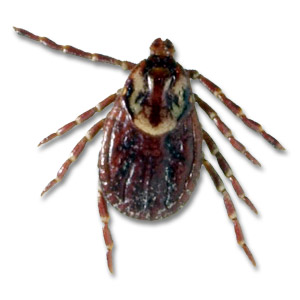
The Dog Tick Life Cycle

This is a repost from July 2006

Summer is here, which means tick season is hard upon us. American Dog Ticks are known as "three-host ticks," because they have three different host animals in their lifetime.

First, the larva hatch out from the eggs, which may have been deposited in a groundog den frequented by fox, raccoon, possum or groundhogs. Larvae only have six legs, like an insect, and are white.


The larva will stay on the ground or climb up a plant or shrub to wait for a host to pass by. The larva will wait with their front claws outstretched to grab the first small mammal that comes by -- at this stage it is called a "Questing Tick."

The first animal to go by is is usually a mouse, rabbit, squirrel, or chipmunk. The larva will drink its fill of blood on this first host animal (a period of about four days) and then drop off.

Next the larva will shed its skin and become a larger eight-legged nymph tick. These nymph ticks are still very small, and will look for a new host which is likely to be another small mammal such as a possum, raccoon, groundhog or fox.

Once the nymph has grabbed on to a new host, it will again drink more blood (this time for a period of about six days) before it drops off again and molts a second time.

During this third stage of a tick's life, male and female ticks will look for a larger mammal to serve as a host. This mamaml might be a raccoon, possum, fox, skunk, woodchuck, deer, dog, or even human. The male will not feed at this terminal stage of its lifecycle, but will mate with the female as she feeds on the host animal.

After mating, the male will die and the female tick will engorge herself before droping off the host animal to lay her eggs -- many as 4,000 of them -- on the ground.

If a tick falls off a groundhog, fox, raccoon or possum in an earth den, the larva may hatch out, with thousands of little white tick larvae waiting to latch on to your dog. These "seed tick" infestations will require several flea and tick dips and very systematic work with a flea comb to clear from a dog's fur follicles.
.

Tuesday, May 24, 2022

Fox Hunting Over the Globe

The United States has more mounted fox hunting packs than any other country (including the U.K.), but fox are rarely killed by U.S. mounted hunts, in part because a fox can generally find a groundhog hole to scoot into, and also because fox are simply not considered an economic problem even in sheep country. Fox are never dug out -- the hounds are praised and the field rides on to find another fox.

Coyote are another matter, and when they are hunted the goal is termination. Unlike fox, which will generally circle back and stay within a defined home territory, coyote will run straight across country and may take hounds and horses across roads and out of hunt-permission territory. Unlike fox, coyote are considered a fairly serious pest as they may, on occasion, prey on cats, small dogs, sheep, and ducks.

Friday, December 25, 2020

Christmas Dinner in the Yellowstone


A red fox in Yellowstone National Park dives for mice it can hear, but not see. It takes quite a few head-first dives to score dinner! .

Friday, July 03, 2020

America's Founding Terrier


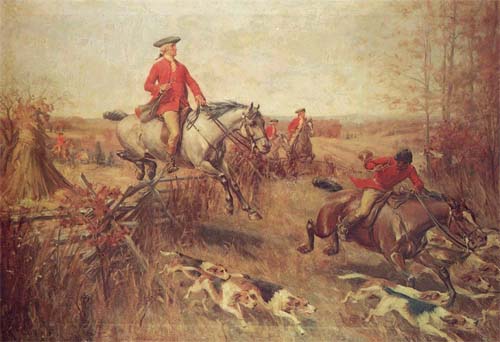
George Washington fox hunting in Virginia.

The case can be made that America might not exist today were it not for "our Founding Terrier."

Robert Brooke of Maryland introduced foxhunting to the United States in 1650, and imported the first pack of foxhounds from Great Britain.

Dr. Thomas Walker of Virginia (who discovered the Cumberland Gap and for whom the Walker Coon Hound is named) imported another pack to Virginia in 1742. The first fox hunting pack maintained for the benefit of a group of foxhunters rather than for a single owner, was instituted by Thomas, Sixth Lord Fairfax, in 1747 in northern Virginia.

Walker and Washington were good friends and business partners, and were co-owners (along with Washington's brother-in-law) of the "Dismal Swamp Land Company" (1763) which was to develop land near present-day Norfolk, Virginia. Walker was probably the person that got Washington started in fox hunting.

Washington moved to Mount Vernon, on the Potomac River just below Washington, D.C., after marrying Martha Dandridge Custis in 1759. It was at Mount Vernon, while still in his 20s, that George Washington first began fox hunting in earnest, setting up a rather lavish set of kennels and carefully breeding a new line of American foxhounds that were faster, lighter and less pack-centered than their English brethren.

In 1768, Washington was appointed as a delegate to the Continental Congress in Philadelphia and managed to fill his need for fox hunting at the Gloucester Hunting Club across the River from Philadelphia in New Jersey near present-day Haddonfield.

It was largely because of social and political connections made while fox hunting that Washington's social prominence rose, and in 1775 George Washington was Congress's unanimous choice as commander of the new Continental Army that was to lead the American forces against the British.

In truth, Washington did not have the forces and equipment to wage a successful fight and hold ground, and his chief battle-field opponent, General William Howe of Great Britain, was a master tactician.

Howe defeated Washington time and time again. In August of 1776 Howe landed on Long Island, captured New York City and defeated Washington at White Plains.

In 1777 Howe defeated Washington again, this time at the Battle of Brandywine (near present-day Chadds Ford, Pennsylvania) and took Philadelphia.

In October of 1777, the Battle of Germantown was waged. This battle took place near Philadelphia, and it too was a defeat for American forces, but it was a turning point in the war.

The turning point occurred when a small fox terrier was found wandering between the battle lines. The little dog was scooped up by American soldiers and the dog's collar identified it as belonging to none other than General Howe.

The dog was brought to Washington as a war prize -- a taunt to use against the British -- but Washington was having none of it.

A true dog-man, who missed his own fox hounds and terriers at Mount Vernon, Washington personally wiped the little terrier clean and brushed its coat. He then dictated a short note to his aide-de-camp, Alexander Hamilton, and secretly tucked a private note of his own tight under the collar of the dog. The dog, and both notes, were then returned to General Howe under a flag of truce.

Washington's private note has not survived, but Howe was extremely pleased by it. The public note, a copy of which has survived (see picture below), reads: "General Washington's compliments to General Howe. He does himself the pleasure to return him a dog, which accidentally fell into his hands, and by the inscription on the Collar appears to belong to General Howe."

After his terrier's return Howe praised Washington's actions as an "honorable act" and historians note that although he continued to win his battles, he never pursued Washington with quite the same vigor.

In fact, when ordered to fight harder and show the rebels no compassion, Howe resigned in protest.

Howe was replaced by General Henry Clinton, who was a poor tactician, and General Charles Cornwallis, who was a poor field commander.

In the end, the United States won the war and Washington returned to his beloved Mount Vernon where he continued breeding fox hounds and chasing foxes at least once a week.

Shortly after returning to Mount Vernon, Washington imported massive hounds from France with the help of his friend the Marquis de Lafayette. American hounds were crossed with these new French imports, and some of the progeny were sent to the Gloucester Foxhunting Club, outside of Philadelphia, where they proved extremely popular due to their speed.

In 1787 Washington headed the Virginia delegation to the Constitutional Convention in Philadelphia, and again his friends at the Gloucester Foxhunting Club lobbied for his election as the first President of the new country.

After the Constitution was ratified, Washington was unanimously elected President and in time the new Capitol was constructed just down river from his Mount Vernon estate.


Draft of note from George Washington to Howe, in the handwriting of aide-de-camp Alexander Hamilton.
.

Sunday, March 03, 2019

The Strange Fruit of Class Warfare


In The Animal Estate: The English and Other Creatures in the Victorian Age, author Harriet Ritvo [Harvard University Press, 1989] points out that the Dog Show crowd and the Animal Rights crowd spring from the same root-stock of sentiment, and in both cases the animals are the side-show, not the main event.

Ritvo writes that in the Victorian era and into the 20th Century dog show folks "elevated standards that had no basis in nature or aesthetics but reflected the ignorant, self-interested caprices of fanciers who wished to boost the prestige of their own stock in order to associate themselves with people of good breeding."

And, of course, it paid, with show winners being sold for cash -- a quick way for people of low rank to buy themselves up the social ladder. If one had a dog that was "best of breed," then surely the owner must be of similar worth, right??

Ritvo notes that terriers were particularly singled out for attention by the show ring preeners and pretenders, and that “The Fox Terrier Chronicle, the only 19th Century periodical devoted to a single breed of dogs, covered the terrier elite the way that newspapers and other periodicals covered human high society."

Ritvo notes that dog fanciers projected "an obsessively detailed vision of a stratified order, which sorted animals and, by implication, people into snug and appropriate niches" with dog shows offering "a dizzying range of classes and then abstracted from them a carefully calibrated hierarchy of animals, ranging from those who did not place even in their sub-breed category to the best in show."

In short, the attraction of dog shows was that people who themselves were as common as a turnip top could now fancy that they were among the social elite. They did not have to have real knowledge of animals, or have an important job or title or large estate -- they just had to purchase a dog from a "reputable" show breeder and put on airs.

As one Victorian periodical noted, "nobody now who is anybody can afford to be followed about by a mongrel dog." Ritvo notes that "Specialist clubs were supposed to defend their breeds against the vicissitudes of fashion, but they had few other guides in their attempts to establish standards for breeds and judges."

Even in the Victorian era, almost no one walking into the ring with a "working" breed actually worked their dogs. After almost half a century of formal shows, the author of a manual for dog owners noted that "the sportsman will, as a rule, have nothing to do with the fancier's production."

All of the above is from the Second chapter of Ritvo's book. The Third chapter is about the rise of the Animal Rights movement, and here we see the same class issues popping up that we did in the previous chapter.

Just as honest working dogs were labeled "mongrels best for the dustbin," so too were the people that owned them. The analogies made were simple and direct: Course people had course dogs and engaged in course behavior. Show people had "pedigree" dogs and they did not engage in course behavior. Of course, not everything was quite as simple as this in the real world. No matter -- the goal of the RSPCA was not entirely about animals anyway -- it was in no small part about putting down the poor and the rural and castigating them for having "undisciplined" values. Towards this end, Ritvo notes that the tracts of the RSPCA "implicitly identified the lower classes as the source of brutality," even as this same organization gave "the big wink" to fox hunting and grouse hunting which were common pastimes of the rich and landed.

Today, of course, the people you see at a PETA rally and the folks that you see trotting their dogs around a show ring are not all that different demographically. In his book "In Defense of Hunting," James A. Swan notes that the Animal Rights crowd is dominated by people that are "white, urban, predominantly female, nicely dressed" and that many of them are "people who have gone through painful divorces or have had traumatic childhoods or have otherwise been hurt by the norms of society."
.

Wednesday, January 09, 2019

Finding Your First Fox

A repost from 2010.

So you want to go digging on fox .... Well, good luck with that!

You have, of course, been digging on the dogs before?

If not, fox hunting is not (yet) for you.

Instead, take the time to collect the proper tools (including a locator collar and box, a decent shovel and digging bar, a proper vet kit, and a copy of American Working Terriers).

Spend at least a season working your terrier to groundhog and learning how to use a bar, shovel, posthole digger and locator box.

If you have spent the last spring, summer and fall working groundhogs and have found a possum or raccoon or two, you may be thinking you are now ready for fox.

And perhaps you are!

I consider fox easier than groundhog in many ways.

For one, a fox cannot dig away from you!

And, to be honest, no matter how eager you are to find a fox that first season, there's a very good chance you will come up blank.

Which is not necessarily a bad thing. Both dogs and humans can learn a lot by spending more quality time in the field observing.

A blank day is not a wasted day, provided you have kept your eyes opened. At the very least, you are learning to appreciate the craft of finding wild game. The sport is called hunting (and not finding) for a reason!

But let me try to be helpful.

What is it that you should be looking for, and how do you go about improving your odds?

Well, to start with, let's talk about those odds.

In fertile corn and soybean country in the Middle Atlantic (some of the very best red fox country in the U.S.A.) fox densities are about one for every square mile or so (600-700 acres).

It is true that in the rolling hills of suburbia, fox densities can be higher than this, but it is also true that it is exceedingly hard to get permission to dig in people's suburban yards. And as for the notion of digging in suburban park land bordering a housing development -- this is strictly verboten unless you want to make unpleasant acquaintance with local officials eager for their own story to tell!

Then, there is the little matter of the weather. If you are looking for fox, you want it really cold and preferably windy as well.

If the weather is above 35 degrees and not blowing, the chance of finding a fox to ground plummets, as most fox will lie out on top rather than go to ground.

Was there a massive ice storm last night? Is it now blowing 20 miles per hour? Perfect! Now if only the roads were safe enough for you to get out to the farms ....

The bottom line is that even successful fox hunting promises a long walk in fairly unpleasant weather carrying heavy tools. No surprise then to find that this activity is not quite a growth sport!

Fox work in my area runs from the first of January to the end of February and, for the record, I do not dispatch fox but let them bolt off unharmed. Unlike groundhogs, fox are not a pest unless free-range chickens and ducks are around, and most of the time they are a very powerful force for good, as they reduce white-footed deer mice populations (which are the primary host of Lyme disease).

OK, you have some experience working your terriers to other quarry, and you have made peace with walking a couple of miles in rotten weather while carrying heavy tools. Now what?

Think about the farms you have hunted on in the last year.

As a general rule, fox like to den within a few hundred yards from a water source. That water source may be very slight -- something as small as a permanent puddle in the lowest part of a field swale. If there is no water anywhere on a farm, however, you are not likely to find a fox den -- or at least that has been my experience.

Now think about drainage and soil quality. Fox demand dens that are dry, and so they tend to prefer areas with good drainage. A small slope is good. If the den is on flat ground, it will probably be in a cut-over corn field where previous plowing has made the soil relatively friable and free of stone. Expect dens on flat ground to be deeper than most of the groundhog dens you have dug this year -- four or five feet is a good guess, but six or seven is not out of the question.


OK, so you have thought about your farms and picked a few likely prospects in your mind. Now what?

Well, the first thing is to shut the hell up -- no slamming of truck doors, banging of tools, loud talking or calling the dogs. As much as possible, communicate with hand signs.

Why is this? Simple: even in bad weather, fox are often jungled up at the edge of their holes, nose out, and only lightly dozing. A loud noise is just enough to let them know you are coming down the hedgerow or across the field -- more than enough time for them to slide out of the hole and disappear into a thicket.

Once you have found a hole, how do you know if it is a fox den or not?

Well, it helps a hell of a lot if the terrier enters and begins to bay!

That said, not all fox dens are occupied, and no matter how quiet you try to be, you will often come across a fox den that has been abandoned only a few minutes before.

How can you tell?

Well, for one thing, in December, January and the first week or two of February, an active fox den will smell slightly skunky. This is the musky scent of the female fox, and it serves both to attract the male and to stake out the territory from rival females.

This foxy scent will fade off rather abruptly in mid-February, and by the time the pups are born around the second week of March , there will be no scent whatsoever.

Look for scat at the edge of a fox den. A fox will typically leave a little souvenir as his or her "calling card" at the edge of the den.

What's a fox turd look like? Well, they are tapered on both ends, and are about at thick as your little finger or ring finger, and just about as long as well. If you look closely at the ends, or break it open, you will see numerous mouse hairs inside.

The most obvious sign of a fox den, of course, is that there has been recent digging.

Raccoon and possum do not dig their own dens, and in January all of the groundhogs will be hibernating. Those few groundhogs that might wake up for a quick "latrine dump" in early February will just push their dirt "clean out" plug to the lip and no farther.

A fox, on the other hand, will kick dirt behind it in a rather vigorous plume extending some distance from the hole.

A fox digs just like a dog, and there will be no attempt to pack down the earth. In fact if you have had the presence of mind to leash up the dogs before actually getting to the hole, you may find fox tracks in the kickout dirt itself.

If you check a fox den and there is no one home, do not come back for two weeks; you want the scent of the dog to disappear and the fox to feel comfortable with this den location.

That said, be aware that a fox will not necessarily occupy all the dens excavated. Some dens are "safety" dens dug in case a primary den floods, collapses, or becomes flea-infested. Yes, it's true; fox have a "lair and a spare" plan for life.

Beginning in mid-January the chance of finding a fox to ground will rise as pregnant females become less eager to travel and spend longer and longer periods to ground.

If you have followed directions, and kept quiet while approaching a fox den, I advise you to continue to keep quite while fox nets are set. Then release a single terrier to go to ground.

Most of the time, a fox will bolt to the nets pretty quickly if it hears a working terrier behind it, and nothing chattering away topside.

If the fox bolts to the net, be careful freeing the fox, working from the back feet towards the head while keeping a boot firmly on the body if you are doing this alone. It helps to have another pair of hands, but it can be done alone without losing a finger provided you are careful and hold firmly to A tight neck scruff while dislodging the last bit of net at the head.

If you are digging, remember to make the hole big enough. The rule is simple: as big around on at least one side as the dig is deep (up to about 7 feet). Keep the sides square and the bottom flat. If the hole is deeper than four feet, I personally prefer a square hole about five feet on a side, as it gives me room to move.

When you get down to the dog, pull it and stake it out of the wind if you can, being careful to put in a shovel to prevent the fox from bolting. The dog's job is done when it has found the fox and bottled it in a stop end. Protecting the dog from unnecessary injury is the very essence of sound terrier work.

At this point, you will probably have to dig a bit more up the pipe to get a good view of the fox. When that is done, you can then net the hole and drive a bar behind the fox encouraging it to to bolt (this will not always work), walk away from the hole and wait for the fox to bolt on its own (this will not take long if you are at least 30 feet back and remain quiet), or you can dig down to where you can see the fox clearly and then let it bolt to a pole snare.

In the U.K, some brave souls will reach in and scruff a fox out by hand, but in my area, where rabies is very common, I do not consider this "best practice."

All intentional fox work should cease on March 1st.

Fox cubs are generally whelped in early- to mid-March, at which point a vixen will generally move her cubs from an open-field den to a smaller, less conspicuous den in a hedgerow. This den may be nothing more than an old groundhog hole without any significant dirt kick-out at all. There will be no fox smell -- the pheromones will have long since fallen away.

If you are digging on groundhogs in March and April, a sure-sign that you have a fox den, and should back away, is that along with a little fox scat at the den hole, you may also have a few dead voles, a bird wing or a few feathers, an old bone, or a piece of deer hide or two.

These are the remnants of food brought back from the field, and some pieces, such as bits of hide, bone, and an old bird wing, may serve as toys for the fox pups. I have actually found a pet store dog chew toy at a fox den located near a farm house -- stolen from the neighborhood dog no doubt!

If you dig down and find fox pups, simply roll them back into the den unharmed and cover the den over as best you can with pieces of bark and brush. The vixen is not far off and is watching, and as soon as she is sure you have left, she will return and move the pups to another groundhog den nearby.

Fox mortality is naturally high, with an average of 4-5 pups born per vixen, and only three making it to the age of six months, and only two making it to the age of nine months. Starvation, disease (such as distemper and mange), and vehicle impact are the three primary killers of fox, and annual mortality is about 60 percent.

Dog foxes will be driven out of their natal areas by the age of nine months, while young vixens will generally be allowed to stay in the area as "satellite vixens" to help out in the next year -- if they do not go off on their own with a "just passing through" male.

Satellite vixens will not mate or have pups; only the alpha female and the dog fox will do that.

If the alpha vixen is killed or dies of disease, a satellite vixen may take her place, but since male fox rarely live past age four, there is very little deep inbreeding in wild fox populations as the gene pool is always rolling forward and moving out.
.

Saturday, August 25, 2018

The American Enclosure Movement


Female bluebird on barbed wire.


The Enclosure Movement in the U.K. had a profound impact on the land, farms, and people in that country, and set the stage not only for the mounted fox hunts, but also for the social strife that surrounds fox hunting in Great Britain to this day.

For a pictorial history of terriers and their relationship to the Encloser Movement, click here.

The U.S. also had an Enclosure Movement, which was no less dramatic.

Land enclosure in the eastern U.S. was accomplished with split rail fences and stone walls, but when settlers reached the vast open plains of the American west, there were no trees or field stones for fencing. The result was free range cattle and sheep.

The situation was hardly ideal. Cattle were easily rustled or lost, and many fell prey to wolves and cougars. Sheep were "meals on heals" for coyotes and were easily lost as well.

Another problem was that open grazing meant open competition between sheep and cattle, with sheep cutting the grass down too far for the cattle to forage (the U.S. had huge sheep spreads in the second half of the 19th Century).

Finally, there was the problem of what to do about tick fever. Cattle in the far south west, below Oklahoma, were immune to tick fever, but the northern herds were not, and the practice of driving livestock north to Kansas City, Montana and Wyoming brought the scourge of disease into once-clean herds.

Two things changed it all: the rapid demise of the American Buffalo, and the rapid rise of barbed wire.

The buffalo were shot out over an incredibly short period of time, with railroads bringing in marksmen to shoot and skin anything that moved. Vast mountains of skinned flesh and bones were left for feral Indian dogs to consume.

In fact, most of the "wolves" of the Plains were not wolves at all, but feral Indian dogs (they looked just like wolves, but with curved tails) abandoned by a people now being rapidly decimated by war and disease.

With the demise of the buffalo, came the importation of its smaller cousin, the beef cow.

With the cow came the cowboy, many of them ex-Civil War soldiers moving West for opportunity and fortune. This was the brief tenure of the "Wild Wild West," and the thing that brought it to a dragging halt was the rise of barbed wire.

In 1873, Joseph Glidden the 60-year old sheriff of DeKalb, Illinois, attended a county fair where he saw a demonstration of a wooden rail with sharp nails protruding from it hanging inside a smooth wire fence. The design was supposed to keep cattle and horses inside a small perimeter fence, and perhaps help keep dogs and other predatory creatures out.


Joseph Glidden, mutton chops and all.


Glidden was inspired by the board-and-nail device and the potential for cheap and movable fencing. He began to experimented with the idea, and eventually came up with the idea of using a jerry-rigged coffee bean grinder to make spiral points of wire which were then strung at intervals along a smooth wire, with another wire twisting around the first to hold the barbs in a fixed position.

Barbed wire was born.

Glidden applied for a patent, and it was granted, though the patent was later contested. The legal battle that ensued lasted three years, and went all the way to the Supreme Court. Before the smoke cleared, however, there were over 570 patented forms of barbed wire!

From the perspective of many small land owners in the West, barbed wire was a wonderful invention: it was relatively inexpensive, would not rot, was practically unaffected by grass fire, was strong and long-lasting, and was easily erected.

In very short order, thousands of miles of barbed wire fencing were strung -- so much that fence posts were a major export from both the East and West coasts.

Between 1875 and 1885, the national consumption of barbed wire jumped from 300 tons to 130,000 tons.

The arrival of barbed wire in the American West was of immense historical importance, for it ended the era of the Great American Commons of "free grazing". Now people could own land and keep others off it. Equally important, they could control access to water, and keep livestock out of crops, such as wheat and corn.

Barbed wire also meant that sheep and cattlemen could now improve the quality of their herds by stringing barbed wire to keep inferior bulls from mating with their cows.

Fencing disputes pitted cattlemen against farmers and sheep men, and free-grass cattle ranchers against fenced-range cattle raisers.

These conflicts became fierce during times of drought when access to water and grass (green or not) meant the difference between bankruptcy and fortune.

Cattlemen used to driving herds across vast distances to known water and feed pastures would simply cut fences when they found them, and in some areas open warfare broke out.

In the end, of course, common grazing died across most of the American West, just as it had in Great Britain beginning 100 years earlier.

But barbed wire did not stay in the West -- it became a global product stretched around farms, ranches, buildings, prisons, and borders the world over.

In the Eastern United States, where hedge rows are not layed, as they are in Great Britain, barbed wire proved as useful as it was in the West.

Hedges in the Eastern U.S. are little more than strips of uncut forest and secondary growth, often dominated by rapidly-growing weedy trees, such as black cherry, black locust, and black walnut. These trees shade thin tangles of poke berry and wild grape, multiflora rose, kudzu, and honeysuckle. The result is not substantial enough to keep livestock out of crops.

Prior to barbed wired, farmers had to construct stone walls or erect split rail or plank fencing. These kinds of fencing are expensive and enormously labor- and material-intensive, and they also require a lot of maintenance.

With the invention of barbed wire, however, a farmer could simply stretch wire from tree to tree or post to post. The savings, in time and money, was enormous. Maintenance was virtually eliminated, as galvanized wire does not rust, rot, burn, need paint, or fall apart from frost heaving.

The ease of fence construction after the invention of barbed wire meant that new fences lines were easily created. Large farms that had once been open fields were now cut and carved with posts and barbed wire. Along these fence lines weedy strips soon took hold. Over time, many of these weedy strips have been colonized by small trees, bushes and vines, and in many instances full hedgerows have developed, almost always attended by population of groundhogs, fox, raccoon and possum.

Truly, barbed wire is the "Devils' Rope," and yet it is also part of the story of working terriers in America, for barbed wire has created and protected much of the hedgerow habitat where so much of our quarry dens.

If you work terriers in the Eastern United States, you will eventually find your yourself crawling over and under barbed wire. The dogs themselves may occasionally get ripped running over it, and most folks eventually lose the bottom out of one seat of pants or another.

In the end, however, there is very little doubt that without barbed wire we would not have the quality of terrier work we have today.

And so next time we are in a jungle of thick hedge and the dog has just slipped into a hole under a jumble of broken down barbed wire fencing, let us remember that the fence is more than an obstruction -- it is construction that is vital to the habitat we hunt. Barbed wire is our friend.
      :: This is a repost from 2004.
.

Thursday, May 17, 2018

Non-Extinct Terriers & Other Mysteries


Many of the terrier breeds that people now lament the "extinction" of never actually existed except in the minds of Victorian picture book makers.

In "The Welsh Terrier Leads the Way," Bardi McLennan recounts the relatively recent origins of the Welsh Terrier.

"In 1800 there were only 15 designated breeds of dogs, and 50 years later there were only 50."

That is of ALL dogs, not just terriers. As late as 1850, a lot of breeds were still not very distinct and several "breeds" were known by different names. For example, in 1851, the Yorkshire Terrier was also known as "the broken-haired scotch terrier." Only in 1870 was a Yorkshire Terrier firmly designated as a breed and breed name. Before then litter mates were often shown in different breed categories -- a situation that occurred with the first prize-winning Jack Russell, which had previously won shows as a "white Lakeland."

The Welsh Terrier and Old English Black and Tan terriers were the same dog -- a type of rough-stock Lakeland dog used in Wales and in the North. These dogs had a fair amount of variation in terms of size and shape, but generally had more color than the "white foxing terriers" preferred in the South.

These rough-coated terriers existed without too much conformity in name or shape (as they still do in the working terrier community in the U.K.), but conformity and a brand name were essential characteristics of Kennel Club registration, and an intrepid history (however fanciful) certainly did not hurt sales.

With the rise of dog shows in the 1860s, the race was on to give every odd-looking dog a name and "improve" them, and terriers were at the top of the list.

One group of Kennel Club breeders decided to embrace a rather ponderous name and an incredible assertion for the brown and black dogs.  They were, they asserted, "the root stock" of all terriers in the British Isles, and they were to be called the "Old English Broken-Haired Black and Tan."

The assertion that these dogs were the root stock of all terriers in the UK is rather laughable -- no one know what the "root stock" was, and in any case there probably was no single "tap root," but instead a fine net of "rootlets" that spread far and wide and included a lot of dogs that were not terriers at all -- dachshunds, whippets, beagles, and lap dogs, for example.

In any case, the Welsh were somewhat outraged to have the English bring down a few of "their" dogs and claim they were an "Old English" anything. These were Welsh dogs, and the Welshmen moved quickly to establish that fact. The Welsh got organized quickly, and in 1884 they held the first dog show with classes just for Welsh Terriers in Pwllheli, North Wales with 90 dogs in attendance -- a rather impressive opening shot in this little "terrier war."

For their part, proponents of the "Old English Black and Tan" moniker could not seem to coalesce into a real club; in fact they could not even agree on a name for their supposedly "Old English" breed. Some called it the Old English Broken-Haired Black and Tan Terrier, some the Old English Wire Haired Black and Tan, some the Broken-Haired Black and Tan, and some just "Black and Tan" -- a color-descriptive name that had been used about as often as "white dog" or "yellow hound".

Whatever they might have called the dogs, this new Kennel Club "breed" was in fact a put-up job comprised of a mix of terrier types and they had difficulty breeding true.

In 1885 a survey of the winning dogs in the ring found that all of them were, in fact, first generation dogs, i.e. not Black and Tans out of Black and Tan sires and dams, but Black and Tans produced out of crosses with other breeds. For example, the winner of the first show in 1884 was a dog named Crib that was a cross between a blue-black rough terrier and a famous smooth fox terrier owned by L.P.C. Ashley called Corinthian.

In 1885, the Kennel Club took a Solomonic approach to the name and breed standard for the dog, featuring both dogs at their 1885 show. On April 5, 1887, however, because the English could not get organized, they were dropped from Kennel Club listings, and the new "Welsh Terrier" breed was born, perhaps propelled forward in popularity a bit by the rise of David Lloyd George, the son of a Welsh cobbler, who himself has risen from humble origins to stand should-to-shoulder with the gentry.

The "Black and Tan" terrier is not the only breed that either never existed (or still exists today, depending on how you look at it).

At the same time that one faction was pushing for the introduction of the "Old English Black and Tan Terrier" another faction was pushing for the introduction of the "English White" terrier which, it should be said, has nothing to do with the old English White molosser dog used as a butcher's dog 150 years earlier.

In fact this new dog was really a toy breed created by crossing a small smooth-coated white foxing terrier with some sort of lap dog, which left the resulting progeny with a propensity towards deafness and a bulging "apple head" like that of many modern Chihuahuas.

Both the "Black and Tan" terrier and the "English White" terrier live on in the fevered minds of the breed-obsessed thanks to a book by Vero Shaw entitled "The Illustrated Book of the Dog."

Printed in 1881, right in the middle of the "terrier wars," this book contains about 100 chromo-lithograph plates and engravings of dog breeds that were being put forth as distinct entities at that time. Shaw rather optimistically included the "Black and Tan" as well as the "English White," betting that the political machinations of English Kennel Club dog breeders would prevail.

He was wrong, which is how two "ancient" breeds of terriers, that in fact never exited, managed to appear on the scene for less than 20 years and then disappear altogether.

Thursday, May 03, 2018

Digging a Well Were We?


The vixen at the bottom of the hole was released for another day.  This picture is from some years back, but I'm pretty I still have those pants!

Notice the snare --  a handy tool to save both the terrier and the fox from any damage.

Thursday, April 26, 2018

Bill Cosby is Dog Show People


Back in February of 2007, I posted this missive on the blog. 

It seems like a good time for a re-post as, luck would have it, I posted a bit about Dandie Dinmonts earlier in the day and Mr. Cosby just got convicted for serial rape.

Fru Fru Fidos In the Terrier Ring at Westminster


The latest news out of the Westminster Kennel Club show in New York City is that a Dandie Dinmont won the terrier class. I cannot help but laugh, as this is a breed so far from it's origins and so far from being a true terrier as to be a joke on four legs.

Of course, this Dandie Dinmont will now get a lot of press coverage since it is co-owned by comedian Bill Cosby. Does anyone else think Bill Cosby's ownership might have been a small (or large) consideration in the judge's mind? What a great way to launch a small ring judge into the spotlight -- and get a picture with a celebrity as well! Plus the folks at Westminster will love you for it -- star power publicity is always good for business.

Cosby has been showing terriers for years, of course. Or, should I say, he has has been paying people to breed dogs and show them for him. He is neither the breeder nor the handler; he is the person with a lot of money, if not much time. Of course, neither Cosby, his handler, nor his breeder has ever heard of a locator collar. Who has in the world of show ring terriers? These folks are involved in a different "sport" -- the sport of writing checks, deciding which dog has sex with which dog, and parading the resulting progeny around a ring. How this is a sport is a bit of a mystery to me, but that's what they call it.

For those of you who are regular readers of this blog, you might remember that I wrote about Dandie Dinmont's back in November ("Danger: Market Forces at Work") and that I promptly received emails from two show-ring Dandie Dinmont breeders in the UK (Hilary Cheyne and Paul Keevil) who said their breed of dog was not wrecked by the ring, and of course it still worked.

This is complete hogwash, of course, and everyone who digs on their dogs knows it. And to underscore the point, I extended a small challenge to Ms. Cheyne and Mr. Keevil:

".... to find even one picture of a Kennel Club Dandie Dinmont that was dug to in the last 50 years. I want a photograph of a Dandie (wearing a locator collar) and his fox or badger standing next to a hole freshly dug. No roadkill photos now!"

Three months later and I am still waiting. Mr. Keevil sent me old illustrations of dogs standing in the counryside, etc. but he did not even have an illustration of a Dandie being dug to or working a fox -- an amazing thing since he is in the graphics arts business. I suggested to Mr. Keevil that he might try to get a picture from Alf Rhodes' family, but in truth Rhodes (who is dead) only claimed to have ever dug six foxes with a single Dandie Dinmont he had back in the 1970s. So much for Dandie's as a working breed!

As I have often note, there are more pictures of Sasquatch and the Loch Ness Monster than there are of most Kennel Club terrier breeds at work, and the Dandie Dinmont is no exception.

Thursday, January 11, 2018

Aldo Leopold on Gadgets and Fox Hunting


Aldo Leopold

Aldo Leopold, who was born on this day in 1887, was one of the most important people in the history of U.S. conservation. A 1909 graduate of the Yale Forestry School, Leopold wrote the first book on Game Management (it is still in print and it is still used at a text book), and was the first person to predict that the widespread extirpation of wolves through poison and trapping would result in an explosion in the deer population that, in turn, would wipe out much of the understory of American forests. Most famous for his eco-philosophical journal A Sand County Almanac, about his Wisconsin farm, Leopold also explored the role of wilderness and hunting in American culture.

In an early essay entitled Wildlife in American Culture, Leopold noted that even in the era before World War II, "the gadgeter, otherwise known as the sporting-goods dealer," was dominating the sporting press and warping America's understanding of the outdoors.

The phenomenon is very easy to see today, with hunting and fishing magazines centered less on wildlife and wild places than on the Quad Bikes, scent sprays, lures, bait, and expensive guns, rods, and reels that we are told we will need before we even think about going into the woods.

This ethos has now expanded into the world of camping and hiking, where everything has to be rip-stop, multi-fuel, Goretex, and composite construction. Not only must everything be lighter weight, there must be more luxury and options than ever before. As Leopold noted in this 1940-era essay, describing the beginning of the modern ethos:

"Then came the gadgeteer, otherwise known as the sporting-goods dealer. He has draped the American outdoorsman with an infinity of contraptions, all offered as aids to self-reliance, hardihood, woodcraft, or marksmanship, but too often functioning as substitutes for them. Gadgets fill the pockets, they dangle from neck and belt. The overflow fills the auto trunk, and also the trailer. Each item of outdoor equipment grows lighter and often better, but the aggregate poundage becomes tonnage. The traffic in gadgets adds up to astronomical sums, which are soberly published as representing 'the economic value of wildlife.' But what of cultural values?"

The great thing about fox hunting and terrier work is that, with the exception of the locator collar, the equipment we use to today would need no explanation to Jaques Du Fouilloux (1560) or Sir Walter Scott (1810). Nothing much has changed, and very little has gone "high tech," in large part because the intervening variable -- the dog -- is immune to mechanical intervention.

At its core, the fox hunter is a primitive hunter and the dog is a primitive animal. As Leopold noted about mounted American fox hunting (which has never included killing the animal being chased):

"Fox-hunting with hounds, backwoods style, presents a dramatic instance of partial and perhaps harmless mechanized invasion. This is one of the purest of sports; it has real split-rail flavor; it has man-earth drama of the first water. The fox is deliberately left unshot, hence ethical restraint is also present. But we now follow the chase in Fords! The voice of Bugle-Anne mingles with the honk of the flivver! However, no one is likely to invent a mechanical foxhound, nor to screw a polychoke on the hound's nose. No one is likely to teach dog-training by phonograph, or by other painless shortcuts. I think the gadgeteer has reached the end of his tether in dogdom."
.

Friday, August 11, 2017

Horses for Courses, But Fox Are the Same All Over

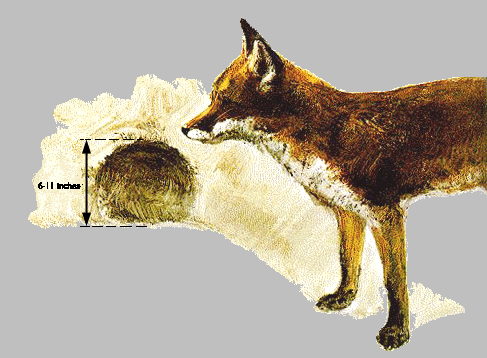
Red Fox Taxidermy manikin with 12.75" chest. Source.
A repost from 2011

Armas writes from Finland about a post I put up some years back about the history of Jagd Terriers.

To refresh, the Jagd Terrier was a dog created as part of the völkisch thought paradigm which suggested Germany needed its own working terrier which would, of course be an uber hund which could do it all -- retrieve shot birds, go to ground on fox, bolt boar from thickets, and perhaps brew a mean cup of espresso as well.

The dog that was created is certainly game enough, but it turns out that a dog that is big enough to return shot birds is too big to easily go to ground in most tight settes, while a dog that is small enough to go to ground may not have the weight or size needed to bust Russian Boar out of a thicket.  Yes, there is a reason dogs are specialized!

Amras, however, says his Jagd Terrier is doing fine for him in Finland.  He writes:

I wonder do you have smaller foxes there? Because here in Finland Jagds represent 25-35% share of the dogs used for underground hunting. I have a 16-inch tall male Jagd, weight about 11 kilos (24.25 pounds), and it manages on its job fairly well. But we do have a little different species here too. 75% of our catch are raccoon dogs, 15% badgers and the last 10% foxes. My opinion is that dachshund are really the ones that are really too big for underground work; their chest size has grown in recent decades mainly because of the impact of dog shows. You might want to visit German and the Central Europe first, before you announce the German Hunt Terrier isn't that much in use there, because it really is.

Armas is asking a good question, and the answer is interesting enough that I break it out here in its own post.    I wrote back last evening:

We have, more-or-less, the same-sized red fox all over the world.  See the links under the terrier-spanning post I put up on the blog this morning for more general information on fox size.

So what's the difference?  The difference is in the animal that actually digs the holes in which your fox are denning!

In Finland, you do not have European rabbits outside of a small population of recent escapees around Helsinki, so the holes in which your fox are going to ground are, for the most part, dug by badger, as your native hares den above ground.

In England, most fox dens are lightly excavated rabbit burrows, as badger dens are generally given a pass due to a rather unforgiving law.  In the Eastern U.S., where our rabbits den above ground (in scrapes) as your hares do, fox generally use old groundhog dens which, like U.K. rabbits dens, are very lightly excavated if expanded at all.

Fox are not very good diggers and rarely excavate a long or deep den on their own, preferring to tuck into an existing den of some kind (badger, rabbit or groundhog), or else den under a natural structure (a tree that has blown over, a farm trash pile, an out building, a rock crevice).

Raccoons and raccoon-dogs (Tanuki) do not dig their own holes, and neither do our "third" quarry species here in the United States, the opossum.

Our Grey fox (not related to the red fox) will generally den in trees (this is a species of fox that can climb) or rock cracks, but will also be found, on rare occassion, in groundhog dens.

With dachshunds, chest size is largely determined by breeding. The very badly bred standard dachshunds of the U.K. and the U.S. have large chests, as you note, but working dachshunds (also known as "Teckels") have a very clear emphasis on chest size. See >> Teckels that are "Gebraushund" for more information about these true working dogs.

The bottom line:  there is a very real reason that working terriers are spanned at the chest, and why most working terriers around the world hover a shade over 12 inches in height, and with chests of 14-15 inches in span (the same chest size as that of working dachshunds).

A dog that stands 16 inches tall at the shoulder is going to have a span of 18 to 19 inches, which is larger than any normal fox anywhere in the world.  That dog may work in Finland, where most fox are found to ground in old badger settes, but it will have a limited utility in those parts of the world where red fox, raccoon, or Tanuki (raccoon-dog) are using holes made by rabbit and groundhog.

As for how Jagd Terriers are doing in Germany and Central Europe, I think the rise of artificial earths, and cartoons showing Jagd Terriers barely squeezing through these artificial settes, says quite a lot.  A dog at the very lowest end of the Jagd Terrier standard (13" tall and with a small chest) is a good prospect for fox work, but at the taller end, I would simple say that there is a reason why terriermen harp about chest size the world over.

A dog, no matter how much it may have "the fire called desire" cannot hope to excavate a 20-foot pipe or follow a fox down a tight tube that is half-blocked by root or rock, unless it has a chest size comparable to the quarry it is chasing.

Once the larger dog does get there, it will find itself jammed in tight, with little room to move to avoid the slashing teeth of the fox.

And what is the point? A larger dog brings little that is useful to the table, and quite a lot that is a burden.

A fox cannot dig away from the dog, and even with animals that dig, size is not the answer as larger size slows passage through the sette and increases the chance that the badger or groundhog will have dug away. A smaller dog can get through a sette faster and "box" at the end more easily (and less damage) and with more oxygen as well. There is a reason small dogs are valued more than larger ones in the world of working terriers!


This is how a taxidermy manikin becomes a mount.
. .

Sunday, July 09, 2017

The Good Stuff

A repost from this blog, circa 2004.

Eddie Chapman writes in The Real Jack Russell Terrier (1993) that:

The hunter terrier man [on reaching a nice rambling earth with twenty entrances that run 10 feet deep], when hounds have marked there, will be told either to bolt the Fox or kill it, and in either case he must get the job done as quickly as possible, for his services may be required again, even in minutes sometimes. . . .

With everyone away from the earth, the terrier man picks a really small chested eleven inch dog that he knows can, and will, get right up to the Fox very quickly, and with luck, bolt it out in a matter of minutes. ... [T]he hunt terrier man would not have achieved the quick bolt of the hunt has he used a much bigger terrier, as it would not have been able to negotiate the tight holes so quickly, so forcing the Fox to bolt so fast.

The next situation confronted by the hunt terrier man is a Fox that has been marked in a six inch, one hundred yard field drain, that is running hard with water.

Common sense will tell you immediately that no terrier much over 12 inches will even be able to get into a six inch pipe, and with it running hard with water, an eleven inch one won't fair much better. So the smallest terrier possible will be needed to have any hope at all of pushing Mr. Fox back out again."


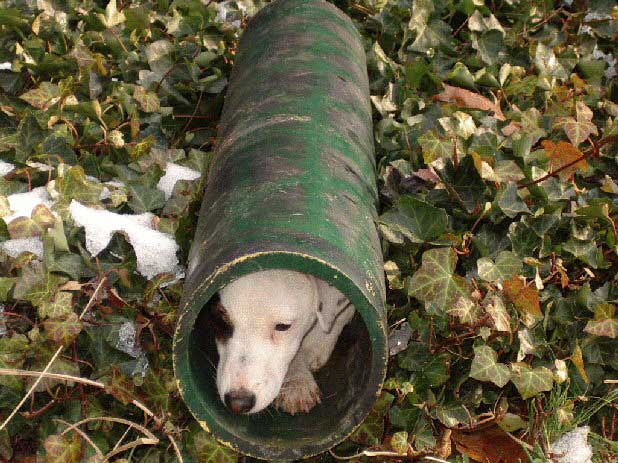
The picture, at top right, is Mountain (12 inches tall) going through a six-inch hard PVC pipe. She was a bit younger then, and could do twenty or thirty feet like this, but I do not think she would have much cared for a hundred yard drain with water flowing in it!

Eddie Chapman's point, however, is that small dogs are what you really want in the field and for a simple reason: a fox is not a coyote.

People who have never dug to a fox and spanned it with a tape measure assume a 14" tall dog has the same chest size as a 14" tall fox.

It does not.

A fox is built more like a cat than a dog, and a 14" tall fox will have a chest of 12 or 13 inches, while a dog of the same height will have a chest of 16, 17, 18 inches, or more.

It says something that red fox taxidermy mannequins start at 11 inch chests and go to 14" chests.

Eddie Chapman knows the value of a small dog, as does anyone who digs on fox, groundhog, raccoon or possum here in the United States.

Some years back, I did a survey of 355 American working terriers and the average size was just over 12 inches tall.

Of the workers surveyed, 200 were bitches and 155 dogs were male dogs -- a skew to female due to the fact that getting a really small male working terrier is very hard to do.

Of all the working dogs counted, only 37 males were 12 inches tall or smaller.

A look at the 2007 Stud Book of the Jack Russell Terrier Club of America finds a continuation of this pattern -- nice looking stud dogs, but only one male under 12" in height, and only two that are 12" tall -- all the other stud dogs listed are taller (some as tall as 15" at the shoulder!)

Chest size of course, is the most important physical attribute of a working terrier, and it is chest size at age 2 or 3 years of age that is really important, not just chest size at 7 months.

The reason for this is simple; chests tend to bow out a bit and get less springy as a dog gets older. A dog that has an acceptable chest at 10 months, may add an inch or two to its circumference in old age. You want a terrier that will go the distance, which is to say you want a small dog if you are interested in digging more than a few times a year for years into the future.

What about folks who say a larger dog will "get there" if it has the will?

Caveat emptor!

Yes, "the fire called desire" is no small thing, and yes a dog is expected to move some earth if needed, but no dog can excavate stone, no dog can excavate root, and no dog can excavate 15 feet of hard packed soil. Anyone who has dug dogs in difficult country knows this.

And let us remind ourselves where all this excavated soil goes to ... behind the dog, and into the pipe where it works to cut off the air supply the dog needs to breathe.

Caveat emptor! No one has ever wanted a bigger dog, but most have wanted a smaller one!

What about the larger dog that is said to have a "disappearing" chest?

There are such things. I have been surprised by good looking taller dogs (12.5 inches is a tall dog in my book) with small chests that still looked smart and fit. But a note of caution; there are sensible limits here.

A large dog (13" or over in height) and a small chest (14") rarely go well together. Such a dog will be reedy-looking and have the feel of an Italian Greyhound about it.

A dog should have a little bone on which it can hang its muscles! A day in the field is not always a walk in the park.
.

Saturday, July 08, 2017

A Well Written Book With Something to Say

RIP Eddie Chapman.  A re-post from 2005

Eddie Chapman's book, The Working Jack Russell Terrier, is one of the best books written on working terriers.

It is a very short book -- just over 100 pages long including 35 illustrations -- but it is enough because Chapman has something to say, and says it plain and without a lot of wind-up.

A key theme of the book is that a useful dog has to be small in the chest. Chapman writes:

"There is one point of a study dog's anatomy which is more important than any other and that is the size of the chest, or rib diameter if you like. The standard states that a Jack Russell should be capable of being spanned by the hands behind the shoulder blades. This, to my mind, is extremely misleading as any adult man and most women have a hand span which is bigger than the chest of an average fox. I am a small man and have reasonably small hands, but in more than 20 years in which I have handled well over 1000 foxes, I have never handled a full grown fox which came anywhere near the span of my hands.... It therefore follows that if I pick up a dog and can only just span him with a squeeze, then the dog cannot get to a fox in a tight place and a dog that cannot get to a fox in a tight place cannot be considered a Jack Russell. Either you are breeding a dog that is suitable to work fox or, if he is too big to get to a fox, you are just breeding for looks. This, of course, is what happened to the pedigree Fox Terrier and look where that has got him!"

Chapman writes later on in the book:

"[The Rev. Jack Russell] hunted the Exmoor area and was master of the North Devon Hounds. I know the country well and have worked my terriers in most of the Exmoor Earths off and on for nearly twenty years and at one time I was there professionally. So I think I can claim to know what sort of terrier is needed to work those earths efficiently. The earths in Exmoor are the same as those in which Mr. Russell worked his dogs. . . .

There are many hunt countries that have earths similar to the Exmoor and so they find it necessary to use the standard, small-chested Russell Terrier. I do not think I would be wrong if I spoke for all their men and said that good small dogs have a definite advantage over good big dogs in their bigger earths. They have more manoeuvreability in the bigger earths and the big dogs are useless in the small earths because of the size of their chests, so they are very limited in their use .... On the working side, I think if we look at the country as a whole, I think we will find that the most used size is between 10 and a half inches and twelve and a half inches."

The Working Jack Russell Terrier can be ordered from Coch-Y-Bonddu Books in Wales. This book is well worth the price, with nice chapters on handling fox, a chapter on locators/bleepers (I find it amazing that so many recent books never even mention them!) and hints on how to breed a proper-sized dog.

For other books on working terriers see Read Country Books. For the only practical book written on American working terriers, go here.
.

Sunday, April 09, 2017

The Natural History of Fox


Natural History, January, 1985

___________________________________
THE LITTLE FOXES by J. David Henry
___________________________________

They may look endearing, but young red foxes fight violently and, when necessary, steal food from one another.


It happens during the coldest part of the year -- a time when northerners bundle up against twilight days and -- 40 degree air with parka and wind pants, gauntlet and mukluk. It is a time when darkness pervades the forest, when everything seems brittle.

Yet, during this inhospitable period in late January or early February, while most animals are simply trying to survive the frozen wastes of a boreal winter, red foxes begin to court. It is not difficult to know when the foxes are feeling amorous; a musky odor begins to emanate from the urine they leave in the snow. This scent is particularly strong in the urine of males. In Prince Albert National Park in northern Saskatchewan, where I do my research, foxes develop this breeding odor over the course of a week or so. Then, for the next month or six weeks, a skunky fragrance permeates the woods wherever a red fox and his vixen have established their territory, the area they use for hunting and scavenging and defend against other foxes. After studying foxes for years, I can say with confidence that it is my nose, more than anything, that first tells me the foxes are courting.

During this amatory interlude, the dog fox and vixen, both of which have been leading solitary lives on the territory, now begin to seek one another out. They travel together for several weeks, becoming increasingly confident about touching one another, until they finally breed. During the courtship period, the vixen visits and cleans out several lairs on the territory, one of which she will choose as her whelping den.

Why does a vixen choose to give birth to her pups in one place rather than another? What does she see in a particular piece of earth? After surveying thirty-five whelping dens, I found that they have certain typical characteristics. The den is usually located on a hillside in sandy loam. It is often in the forest but close to a meadow or open slope. And it usually has multiple entrances, the largest one about ten inches in diameter. Finally, the den retreat is normally within one hundred yards of a water source, although this source can be anything from a large lake to a humble pool in a muskeg. With these requirements, vixens have to be selective about where they bear and raise their cubs.

Certain features, such as the nearby drinking water, have obvious advantages; but I was not sure I understood the others. Why are they so common? After reflecting about them, I feel that vixens probably select sandy loam because they can dig into it more easily, but it could also be that this soil, combined with the hillside location and nearby open area, may make for a site where snow melts early, frost leaves the ground quickly, and drainage is always good. Vixens use the surrounding forest for shelter and escape; they can sun themselves in the adjacent meadow and their rambunctious pups can play there.

A vixen may use the same whelping den year after year, and when she dies, the site may be passed on to one of her daughters. One fox lair near my cabin, for instance, has been active for nine of the last twelve years. Since adult foxes in the wild usually live only three to seven years, this den was probably occupied by several different fox families. On the other hand, abandoned lairs that deteriorate may be renovated by foxes after a long vacancy. The first den I ever studied in detail, in 1972, was active until 1974. After that, it lay vacant until a young fox couple reoccupied it and raised a family there during the spring of 1980.

Foxes never seem to rely on just the whelping den, however. In my area, they always have other, smaller burrows hidden away on their territory. If disturbed or threatened at the whelping site, the vixen or dog fox will simply move the pups to a new location. Frequently, the vixen initiates the move, which sometimes leaves her mate in a quandary.

I remember one such experience when, for an extended period, I was observing foxes at a den twenty-four hours a day in order to document how the six-week-old pups were being raised. One afternoon, in an attempt to get some photographs, I unwittingly crossed an invisible but important vulpine boundary, and the vixen reacted as if she had decided enough was enough. She waited until the middle of the night and then moved the pups, not carrying them as other canids do but marching them along behind her. About first light the dog fox returned to the den with a rabbit in his mouth. He went to the main entrance and called the pups with the rapid "wuk . . . wuk . . . wuk" chortle that foxes use, but no one came forth. Setting the rabbit down, he began to smell around the area. He apparently was able to figure out what had happened by the odors that remained on the ground. Sniffing the site thoroughly, he finally detected the trail that the vixen and four kits had taken through the forest. He returned to the den, hid the rabbit, and then began to track down his family, following their scent through the bush. On the other hand, I, not being blessed with the nose of a fox, spent the next seven days searching in vain for the new den site.

But I am getting ahead of myself. Let me backtrack and follow the pups through their eventful early life. After a gestation period of fifty-two days, the kits are born; in my study area this occurs during late March or early April. The average litter comprises five whining, hungry mouths, but a litter of nine cubs is not uncommon. Regardless of the size of the litter at birth, some cubs usually die. The number that survive depends, among other things, upon the amount of food the adult foxes can find on their territory.

When the kits are born, they are helpless and weigh less than a quarter of a pound. Except for their smaller size, they are remarkably similar to newborn coyote and wolf pups--with one important exception. Even at birth, most young foxes have a curious white tip on the tail. Red foxes retain this white tag throughout their lives, and they are the only North American canid species to show this distinctive marking.

During their first month of life, young foxes do not possess the brilliant red coat that is the hallmark of the species; instead, their coats are charcoal gray. Foxes are not the only canids with this feature. At birth, the whelps of coyotes, wolves, and other species of wild canids are also cloaked with dark gray fur. As far as I can determine, this special natal fur does not have any physiological function. It may serve as camouflage while the young canids remain in the darkness of the den.

Fox kits grow slowly during their first few weeks; their eyes do not open until they are ten or twelve days old. During early life, the vixen constantly attends them. In many areas, the vixen may venture out of the den after only two days, but in northern Saskatchewan she remains inside constantly from a few days prior to birth until the kits are approximately ten days old. She is completely dependent on the male for her food during this period. This he provides with regularity.

Why is the vixen unwilling to leave the kits? David Macdonald, who has studied red foxes extensively in Britain, suggests that the kits are so small and vulnerable during early life that the vixen must surround them with her warm body if they are to survive. This maternal protection becomes increasingly important the farther north one goes. At the time the kits are born, the ground in northern Saskatchewan is still frozen and covered with snow. The den is damp, and the air temperature inside is a chilly 32 degrees Fahrenheit or colder. The vixen acts literally as a thermal blanket, protecting the cubs in their frosty underground chamber. One could almost say the incubates them. By then they are well furred and large enough to maintain their own body temperature. She now spends more and more time away from the lair hunting for prey for herself, but she continues to receive some food from her mate. And she does return to the den at regular intervals to nurse the kits. While in the den, she attends to her other maternal duties as well. She plays or naps with the cubs and then grooms them--cleaning out their ears, licking their groin regions, and eating their waste products. She maintains this routine until they are five weeks old, when she begins to wean them.

The early life of a kit fox is not the care-free, leisurely existence that one might imagine. It is business from an early age. During their second week, the kits begin to grow faster and their milk teeth start to come in--canines first, followed by incisors, and finally, premolars. During their third week, they begin to experiment with their teeth. They chew and suck on meat that the parents have brought them and learn to enjoy the juices found in a freshly killed rabbit. Now they enter an important phase of their development.

At this time, the fox kits are far from fully coordinated and have been above ground only for short periods. Yet at about twenty-five days of age, they begin to fight viciously; they clash with each other in short, serious, and sometimes fatal contests. (Fatalities are rare, however.) Fox kits do not act like cute, cuddly puppies such as those of the domestic dog; rather, they have always seemed to me to have a slightly demonic character about them. They are tough, month-old thugs, little street fighters that initiate fights and, over a period of ten days, establish a strict dominance hierarchy. The alpha (or dominant) member of the little establishes itself, and the process continues all the way down to the weakest animal.

Evidence suggests that these dominance relationships among the cubs remain stable and have a great bearing on their survival. If the adults are bringing the kits only a limited supply of food, competition for it is keen. By establishing a hierarchy, the kits determine who can steal food from whom. The largest member of the litter, whether male or female, usually becomes the alpha pup. Using either intimidation or direct attack, this animal steals food from its litter mates. Each pup steals food from littermates below it in the hierarchy. It is a blunt fact of a fox's life that the dominant pups get a larger portion of the food and have the best chance of surviving, while smaller and submissive ones may perish. The runt of the litter usually dies first, then the second lowest in the hierarchy, and so on. It is a brutal process; but given the constraints of the hierarchy, it is the only way healthier kits can survive. Nor have parent foxes evolved to interfere with this sibling rivalry, since the competition results in a litter composed of the healthiest whelps. Pared down, the litter size is also now in balance with the food resources of the territory.

By early May the fox kits in my area begin to come above ground for longer periods of time. At this point, the hierarchy is solidly established and, with that crucial matter out of the way, the aggressiveness of the cubs actually diminishes. Gradually, they become more social, playful, and puppylike. It is at this time that most people first see young foxes. How much has happened in their lives before we are even aware of them!

When a parent fox returns to the den during early May and chortles for the pups, they stumble out--unsteady on their feet, blue eyed, and still dark coated. But at about this time an important change takes place: at about five weeks of age, they start to lose their dark natal coat and get a new pelage. Once again it is not the brilliant red of an adult fox, but a sandy-colored juvenile coat that almost perfectly matches the sandy soil of the den site. This coat helps to camouflage the pups around the den and protect them from occasional predators, such as hawks, owls, and coyotes.

Reflecting on the sandy-colored coat, I began to realize that this juvenile pelage had come about from an interesting series of events. I can imagine it evolving something like this: At first the vixen tended to dig her whelping den in sandy loam simply because it afforded good digging. But over time, the fur of the kits slowly evolved to match the soil's color. Evolutionary theory states that, if the sandy-colored pups have even a slightly better chance of surviving, all fox kits will eventually develop this coloration. As this happened, there was great pressure on the vixen to locate her den in sandy-colored soil. Consequently, the selection of the den by the vixen and the juvenile pelage of the kits are co-adapted to protect the young during their vulnerable first month outside the den.

This buff coat of the young foxes is actually a specially colored underfur (the underwool of adult foxes is a dark gray). The kits keep this juvenile coat for approximately five weeks, but starting in early June, outer red guard hairs begin to grow through. By the end of June, kits display the bright red coats normally associated with adult foxes.

When the kits are five weeks old, they begin the transition that will launch them into adult life. The pups now begin eating solid food, and the vixen starts to wean them. Weaning fox pups is an uncomplicated procedure. If the kits try to nurse, the vixen rolls over on her stomach. If they persist, she threatens them and runs off a short distance. She becomes increasingly unreceptive to their suckling, and by the time they are eight weeks old, the pups are completely weaned. But being weaned doesn't mean being cut off. The parents continue to hunt and scavenge at different times of the day and night in order to supply the kits with sustenance. These adults bring in an assortment of prey and present it to their pups. For example, in one week the menu included rabbits, mice, voles, squirrels, groundhogs, songbirds, grouse, and a spawning long-nosed sucker.

Distributing this food is a household ritual in a fox family and always happens in the same way. Carrying the item in its mouth, the adult fox arrives at the den, chortles, and one or more of the pups rush out to greet it. The first pup to reach the parent crouches low and beats its tail about wildly. The kit whines and creeps toward the adult and then reaching up, it smells, licks, bites at the corners of the adult's mouth.

There seems to be a consistent rule in fox families that the adult will give the food to the first pup that begs for it. This way, supplies are more or less evenly distributed. Basically, the hungriest pup keeps the best watch, gets to the parent first, and is given the food. However, once it has received its ration, the kit still has to defend its prize against litter mates, either by running off or by threatening any siblings that come near. As I explained earlier, a dominant pup will frequently challenge and steal the provision from its subordinate litter mate.

Food-begging behavior, by the way, also appears many months later but in a completely different context--as part of the submissive behaviors shown by adult foxes. When two full-grown animals meet, the subordinate fox often acts as if it were a young pup, begging to be fed. It crouches low, whines, and beats its tail madly in every direction. This keeps the white tip of the tail in constant motion (much like waving a white handkerchief) and lets it function as an attention-getting device. The subordinate fox slowly creeps up to the dominant fox and carefully reaches up to smell and lick the corner of its mouth. This use of infantile behavior by adults is not unique among red foxes. Embracing among adults, which is used as a greeting and reassuring gesture not only among humans but also chimpanzees and baboons, may be derived from infantile grasping. People in love sometimes coo and baby-talk to each other; we sometimes stammer or show shy juvenile behaviors when introduced to famous people.

The role of the dog fox in raising the kits has been debated among naturalists and field biologists. Some state that the male fox is never seen around the den, while others conclude that he supplies most of the food for the pups. There must be considerable variation among red foxes of different areas. The causes of these differences are not fully understood. But in Prince Albert National Park, an area where the foxes are almost completely protected from hunting and trapping, I have consistently observed male foxes bringing food to the pups until they are approximately ten weeks old.

In addition to the parents, other foxes will occasionally feed the pups. These "helper" foxes are an interesting phenomenon. Most often the assistant appears to be a daughter from the previous year's litter that has stayed on the family territory but not given birth to pups of her own. When she is present, she makes a definite contribution to rearing.

This helper illustrates an important point about evolution. Evolutionary theory states that individuals of a species that are most physically and behaviorally fit will leave the greatest number of offspring. But twenty years ago, British biologist W.D. Hamilton stressed that an individual's relatives are also important. For example, red fox helpers are as closely related to their full siblings as they would be to their own offspring. If an assistant increases the survival rate of her younger brothers and sisters, she helps some of her own genes survive into future generations.

Foxes that aid in raising their younger brothers and sisters may also derive other benefits. For example, they may gain experience that will help them rear their own offspring more successfully. In a few cases, they may also inherit part of their parents' territory.

Hamilton's theory makes another prediction about these young vixens. It states that if food is scarce, the daughter will help raise and feed her mother's litter. However, if food is abundant, the male fox will breed with both the older vixen and his daughter, and both vixens will raise litters on the family territory. The male will bring food to both litters, and the vixens, instead of competing, will tolerate each other. Why does the theory predict these events? Because when food is abundant--considering the genetic relationships involved--each fox will pass on more of his or her genes to the next generation if multiple litters are reared on the territory.

My field observations tentatively seem to support these predictions. In my study area, during years when prey was abundant (one year, for example, there was a peak in the snowshoe hare population), I have occasionally observed two vixens raising separate litters several hundred yards from each other, and once, within the same den. In both cases the vixens got along amicably and one dog fox brought food to all the pups. These observations suggest that the vixens were acquainted and may have been related. These preliminary data are interesting, but before we draw any final conclusions about this aspect of the fox's family life, more detailed research is needed.

During middle and late June, the pups' transition to adult life continues. They have grown to be nearly two-thirds the size of adults; they are fully coordinated and exhibit a bright red coat. During this period the parents start to visit the den less frequently, and the amount of food they bring starts to diminish.

At this point, as in many species, a classic conflict between parent and offspring arises. The fox kits appear perfectly content to remain at the den, play continually, and be fed by the parents. However, the adult foxes, which have been run ragged, seem to have some other arrangement in mind. And fortunately for them, they control the situation.

During June the pups wait endlessly for the adults to arrive with food. When an adult finally does appear, one pup gets the food, which he quickly consumes. Then the adult often takes one or several of the pups on exploratory trips away from the site. At first the parents lead the kits away and later accompany them home. But after a few of these excursions, the kits return on their own. I wish I could have gone along, but the parent foxes never tolerated me on the expeditions, and this aspect of fox life has always eluded me.

The kits, while hanging around the den, begin to eat wild fruit and to hunt insects and whatever other prey they can find. Gradually they become more confident, venturing forth slightly farther each day and spending less time at the lair. Thus it seems that a combination of boredom and hunger eventually drives the kits away from the den site, whereupon they start a predatory, scavenging life of their own.

At first the pups travel in twos or threes. However, since the prey they hunt are small and quick, to capture one, the fox must hunt in a stalking, catlike manner using a surprise attack. These constraints slowly force the young foxes to become solitary predators.

Occasionally, the vixen and pups will rendezvous on the territory during late summer and early fall. When this happens, the foxes greet, play, and generally enjoy each other. By this point, however, the dog fox is intolerant of his cubs. During September, the male kits begin to mature sexually, and this increases the competition between father and son.

No one is certain what causes the kits to finally leave the territory altogether. Adult foxes have not been seen aggressively driving their young away, but they may exclude them from the best hunting and scavenging sites. Whatever the cause, during late September or October, the kits begin to disperse. Males leave first and travel the farthest. Each tends to travel in one direction until he has found an available territory. Once male kits have left their birthplace, they usually don't return. Female kits may remain on the family territory into December, and if food is plentiful, one or several female offspring may stay on.

Such is the way it happens. Each spring, kits are born; as helpless as embryos, they would freeze without their mother's constant attention. In the course of six short months, these tiny, helpless creatures grow into self-sufficient, graceful, flame-colored predators that leave their families and seek out their own part of the forest. When a young fox leaves, it becomes self-reliant and takes on the ways and manners of adults. It claims a territory and inhabits it with another fox--its prospective mate. During the frozen darkness of winter, the pair set up the territory and court, and the cycle inherent in a fox's life completes itself.
.