Showing posts with label chest size. Show all posts

Wednesday, April 18, 2018

Dog Dealers Hate German Engineering


American and British dog dealers love to toss around the word "span" when it comes to working terrier chest size.

It's a term descended from the world of horses, where “hand” height is defined as 4 inches.

But span?  It’s not defined as an actual measurement.  It refers to placing your hands around a dog's chest at its widest part, front feet off the ground, with thumbs touching and middle fingers at least touching. 

The problem is that "span" is so vague and undefined that it covers far too much sin when it comes to terrier size. 

Whose span? 

A small woman's? 

Wilt Chamberlin's??

When a dog cannot be spanned, the dog dealers always mumble that they have small hands!

The good news is that the Germans are not vague.  Known for precise engineering and quality construction, they define the proper chest size of their native working dog, the Teckel or working Dachshund, with considerable precision.

The Germans are precise about chest measurements because they understand that for a dog to be a "gebrauchshund" (i.e. a "useful" utility or hunting dog), it cannot be too big to fit into a tight den.

The FCI chest-size standard for Teckels (working Dachshunds) in Germany spans from just under 14 inches in circumference (35 cm. or 13.78 inches) to as much as 18.5 inches. 

The bigger chest size is fine for badger (dachshund means badger dog), while the smaller chest size is fine for a natural-dug fox den.

The chest size of a miniature Dachshund (often used to work fox) is set at 30-35 cm (11.81 inches to 13.78 inches).  

A third working Dachshund, for rabbiting, is even smaller in chest circumference.

The 35 cm chest size, where miniature and standard dachshunds chest sizes meet, was not invented whole-cloth; it is about the size of the average red fox chest found the world over and it is the same 14-inch chest measurement defined as ideal for working terriers by Barry Jones in the UK and by Ken James in the U.S.

Does that mean European Badgers cannot come a great deal larger than 14" in the chest?  They can! 

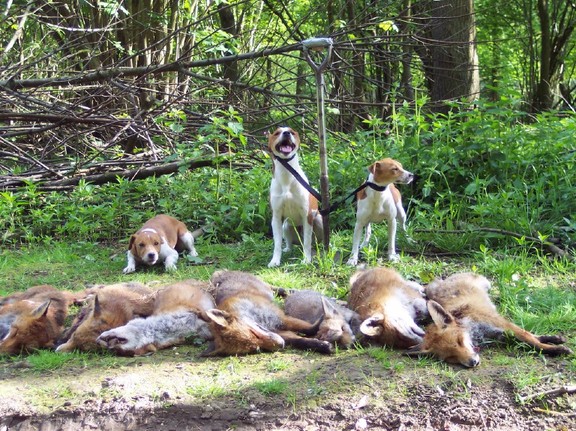
The picture below is of five well-trained German Teckels doing a down-stay next to two just-dug European badgers. Quite a shot!

And what is the chest size of these dachshunds, owned by Frank J. in Germany?  35 centimeters.

When digging, no one ever wishes for a larger dog.

Friday, August 11, 2017

Horses for Courses, But Fox Are the Same All Over

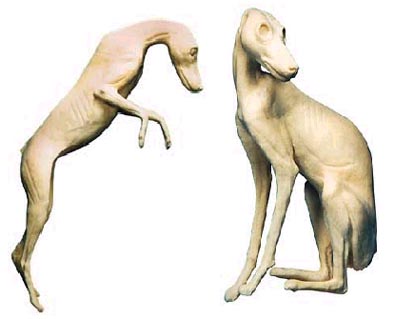
Red Fox Taxidermy manikin with 12.75" chest. Source.
A repost from 2011

Armas writes from Finland about a post I put up some years back about the history of Jagd Terriers.

To refresh, the Jagd Terrier was a dog created as part of the völkisch thought paradigm which suggested Germany needed its own working terrier which would, of course be an uber hund which could do it all -- retrieve shot birds, go to ground on fox, bolt boar from thickets, and perhaps brew a mean cup of espresso as well.

The dog that was created is certainly game enough, but it turns out that a dog that is big enough to return shot birds is too big to easily go to ground in most tight settes, while a dog that is small enough to go to ground may not have the weight or size needed to bust Russian Boar out of a thicket.  Yes, there is a reason dogs are specialized!

Amras, however, says his Jagd Terrier is doing fine for him in Finland.  He writes:

I wonder do you have smaller foxes there? Because here in Finland Jagds represent 25-35% share of the dogs used for underground hunting. I have a 16-inch tall male Jagd, weight about 11 kilos (24.25 pounds), and it manages on its job fairly well. But we do have a little different species here too. 75% of our catch are raccoon dogs, 15% badgers and the last 10% foxes. My opinion is that dachshund are really the ones that are really too big for underground work; their chest size has grown in recent decades mainly because of the impact of dog shows. You might want to visit German and the Central Europe first, before you announce the German Hunt Terrier isn't that much in use there, because it really is.

Armas is asking a good question, and the answer is interesting enough that I break it out here in its own post.    I wrote back last evening:

We have, more-or-less, the same-sized red fox all over the world.  See the links under the terrier-spanning post I put up on the blog this morning for more general information on fox size.

So what's the difference?  The difference is in the animal that actually digs the holes in which your fox are denning!

In Finland, you do not have European rabbits outside of a small population of recent escapees around Helsinki, so the holes in which your fox are going to ground are, for the most part, dug by badger, as your native hares den above ground.

In England, most fox dens are lightly excavated rabbit burrows, as badger dens are generally given a pass due to a rather unforgiving law.  In the Eastern U.S., where our rabbits den above ground (in scrapes) as your hares do, fox generally use old groundhog dens which, like U.K. rabbits dens, are very lightly excavated if expanded at all.

Fox are not very good diggers and rarely excavate a long or deep den on their own, preferring to tuck into an existing den of some kind (badger, rabbit or groundhog), or else den under a natural structure (a tree that has blown over, a farm trash pile, an out building, a rock crevice).

Raccoons and raccoon-dogs (Tanuki) do not dig their own holes, and neither do our "third" quarry species here in the United States, the opossum.

Our Grey fox (not related to the red fox) will generally den in trees (this is a species of fox that can climb) or rock cracks, but will also be found, on rare occassion, in groundhog dens.

With dachshunds, chest size is largely determined by breeding. The very badly bred standard dachshunds of the U.K. and the U.S. have large chests, as you note, but working dachshunds (also known as "Teckels") have a very clear emphasis on chest size. See >> Teckels that are "Gebraushund" for more information about these true working dogs.

The bottom line:  there is a very real reason that working terriers are spanned at the chest, and why most working terriers around the world hover a shade over 12 inches in height, and with chests of 14-15 inches in span (the same chest size as that of working dachshunds).

A dog that stands 16 inches tall at the shoulder is going to have a span of 18 to 19 inches, which is larger than any normal fox anywhere in the world.  That dog may work in Finland, where most fox are found to ground in old badger settes, but it will have a limited utility in those parts of the world where red fox, raccoon, or Tanuki (raccoon-dog) are using holes made by rabbit and groundhog.

As for how Jagd Terriers are doing in Germany and Central Europe, I think the rise of artificial earths, and cartoons showing Jagd Terriers barely squeezing through these artificial settes, says quite a lot.  A dog at the very lowest end of the Jagd Terrier standard (13" tall and with a small chest) is a good prospect for fox work, but at the taller end, I would simple say that there is a reason why terriermen harp about chest size the world over.

A dog, no matter how much it may have "the fire called desire" cannot hope to excavate a 20-foot pipe or follow a fox down a tight tube that is half-blocked by root or rock, unless it has a chest size comparable to the quarry it is chasing.

Once the larger dog does get there, it will find itself jammed in tight, with little room to move to avoid the slashing teeth of the fox.

And what is the point? A larger dog brings little that is useful to the table, and quite a lot that is a burden.

A fox cannot dig away from the dog, and even with animals that dig, size is not the answer as larger size slows passage through the sette and increases the chance that the badger or groundhog will have dug away. A smaller dog can get through a sette faster and "box" at the end more easily (and less damage) and with more oxygen as well. There is a reason small dogs are valued more than larger ones in the world of working terriers!


This is how a taxidermy manikin becomes a mount.
. .

Saturday, July 08, 2017

The Nonsense of Pull Dogs

.

This is a repost from this blog, circa Feb 2005:


In "The Working Jack Russell Terrier," Eddie Chapman writes:

"Something that makes my blood boil is when I hear terrier men talk about dogs they call Caesar dogs. They will show you a Russell type that has been bred too big and say, 'I use him as a Caesar dog'. If I ask what a Caesar dog is, they say it is a dog which will hold the badger, he won't let go,' they say. I have never heard such rubbish in my life. Besides being unnecessary, it is invariably cruel to the dog and more often than not he will be badly bitten for his pains. Besides that, it is unnecessarily cruel to the badger and the sort of behavior that got badger digging banned. I have tried to explain how to remove badgers from a sett without injury to dog or badger. There is nothing clever about getting a hard dog smashed up by a badger. On the contrary, it shows ignorance and a lack of responsibility and feeling. Bravery in a terrier should never be exploited."

I found it quite refreshing to read this passage, as I have often noted that there is is little reason to own a "pull dog" if you actually know how to handle things at the end of a dig. The use of "pull dogs" damages dogs and quarry alike and is wasteful as it often necessitates time out of the field and expensive veterinary work.

In the U.S., the use of pull dogs (what Chapman and some others call "Caesar" dogs) is due to the prevalence of too many over-large terriers that cannot go to ground in a real earth. To say you have a "good pull dog," is to say you do not have a dog capable of actually going to ground.

If you have followed the Kennel Club dictates, and embraced a 14 inch tall dog with a 17" or 18" chest (or larger!), you are forced to rationalize a job for it. No matter that it is a stupid job forged in pain. Most people would rather see their dog injured than swallow their pride and admit they have drunk the Koolaid offered up by the Kennel Club know-nothings who think a fox den is as big around as a go-to-ground tunnel.

Another factor is that many people simply have no idea of how to handle quarry and so use the dog to to do the job. Having gotten to the end of a dig, they do not know how to get the animal out of the pipe, nor do they know how to dispatch it. In such a situation, the use of a "pull dog" is ignorance in motion.

The simplest way for a novice to handle quarry is with a snare. You can make your own for about $5, or else buy a pig snare from a feedstore. An alternative is a "coon tong" available from Bill Boatman's raccoon hunting supply catalogue.

Groundhogs can also be tailed out alive -- it is not hard if the groundhog's tail is presented, as it so often is. If very much of the pipe is remaining, however, you may find yourself in a tug-of-war with the groundhog who can jamb up inside a pipe so tightly that even a large man can have difficulty pulling one free.

Always use a snare for raccoons -- they can twist all the way around on their short fat bodies. They can grab you with their hands and have crushing bites. Rabies is not uncommon in raccoons, especially on the East Coast.

If you have entangled a fox in a net, be carefully when extricating the fox. The best advice is to pin the animal to the ground under your boot while removing the net. Work the net off the fox in sections, and then release it to hunt another day.
.

A Well Written Book With Something to Say

RIP Eddie Chapman.  A re-post from 2005

Eddie Chapman's book, The Working Jack Russell Terrier, is one of the best books written on working terriers.

It is a very short book -- just over 100 pages long including 35 illustrations -- but it is enough because Chapman has something to say, and says it plain and without a lot of wind-up.

A key theme of the book is that a useful dog has to be small in the chest. Chapman writes:

"There is one point of a study dog's anatomy which is more important than any other and that is the size of the chest, or rib diameter if you like. The standard states that a Jack Russell should be capable of being spanned by the hands behind the shoulder blades. This, to my mind, is extremely misleading as any adult man and most women have a hand span which is bigger than the chest of an average fox. I am a small man and have reasonably small hands, but in more than 20 years in which I have handled well over 1000 foxes, I have never handled a full grown fox which came anywhere near the span of my hands.... It therefore follows that if I pick up a dog and can only just span him with a squeeze, then the dog cannot get to a fox in a tight place and a dog that cannot get to a fox in a tight place cannot be considered a Jack Russell. Either you are breeding a dog that is suitable to work fox or, if he is too big to get to a fox, you are just breeding for looks. This, of course, is what happened to the pedigree Fox Terrier and look where that has got him!"

Chapman writes later on in the book:

"[The Rev. Jack Russell] hunted the Exmoor area and was master of the North Devon Hounds. I know the country well and have worked my terriers in most of the Exmoor Earths off and on for nearly twenty years and at one time I was there professionally. So I think I can claim to know what sort of terrier is needed to work those earths efficiently. The earths in Exmoor are the same as those in which Mr. Russell worked his dogs. . . .

There are many hunt countries that have earths similar to the Exmoor and so they find it necessary to use the standard, small-chested Russell Terrier. I do not think I would be wrong if I spoke for all their men and said that good small dogs have a definite advantage over good big dogs in their bigger earths. They have more manoeuvreability in the bigger earths and the big dogs are useless in the small earths because of the size of their chests, so they are very limited in their use .... On the working side, I think if we look at the country as a whole, I think we will find that the most used size is between 10 and a half inches and twelve and a half inches."

The Working Jack Russell Terrier can be ordered from Coch-Y-Bonddu Books in Wales. This book is well worth the price, with nice chapters on handling fox, a chapter on locators/bleepers (I find it amazing that so many recent books never even mention them!) and hints on how to breed a proper-sized dog.

For other books on working terriers see Read Country Books. For the only practical book written on American working terriers, go here.
.

Tuesday, April 14, 2015

My Teachers: Mountain, Sailor and Trooper


Two true workers. Reposed from 2010.

Mountain and Sailor. Mountain, at left, is 12" tall. Sailor, at right, 11" tall.

You would not think a one inch difference in height (and about the same in chest size) would make a lot of difference in the field, but it does in our very tight earths.

On this day, these two dogs had worked raccoon, groundhog and possum. Once washed off, they were as good as new.

Sailor taught me most of what I know. She will never be forgotten.

Below is a picture, taken from above, of Trooper my 15" tall Border Terrier who recently went to the Great Kennel in the Sky, and Sailor, my 11" tall Jack Russell who preceeded him by a few years.

Both dogs are dead now, but in this picture they can still do a bit of teaching. Size is fundamental, and with true working terriers bigger is not better.


.

Tuesday, January 13, 2015

Reality Comes to the Rally


The 2005 Monetpelier border terrier rally. This is a repost from 2005.

I have done the Border Terrier Rally at Montpelier every year for the last 21 years (one of only two organized events I attend) and in recent years they have put me to work as a rat rangler since I do not show, and Trooper has been banned from racing (after he did it only once and ripped through the welded mesh at the front of the racing box, grabbed the fox tail, and would not let go).

This time I decided to do a little education of the show ring set and I very quietly brought along a hard 6-inch tube about 5-feet long. I set up the "Rally Ratting" event so that at one of the eight stations the dog would have to go at least 18-inches or more down a heavy-duty 6-inch tube (staked hard to the ground and totally immoveable) in order to get at the rats which were in another 4-inch PVC tube drilled with air holes.

Not a dog could do it!

After a dog proved that it could not do it, and before the owner started to explain or complain too much, I pulled out the pictures (below) of a December fox.

First I showed them this picture. Many "oooohs and ahhhs" about how big the fox looked (actually it's a pretty small vixen)


Then I showed them this picture and noted that the woman spanning the fox has completely overlapped her thumbs. Since I dig with this woman quite a lot (I dug this fox with her) I know she is no giant (maybe 5' 6"). This fox was 40 inches from tip of nose to tip of tail, but was only 11.5 inches in the chest.


Then, to put a little icing on the cake, I noted that Camilla Moon (the organizer of the rally) and I had bolted a fine red vixen out of a hole that was no bigger than this pipe just six days earlier.

Almost any vixen in the world can get through a 6-inch pipe if pressed by a dog, but almost no border terrier in America today can negotiate that pipe. People got this lesson one-on-one in a little patch of woods, and I tried to be very relaxed about it and noted (prior to getting to the pipe) that most dogs failed this part of the test. If a dog was anywhere close to being able to get into the pipe (even half its chest!) I said very nice things about it.

Nonetheless, the point was made, and it was a hard landing for some folks who had been on an extended flight of fancy about how they had "working" border terriers even though their dog has never even seen a fox. Some of these folks think a 9" square go-to-ground tunnel is what a fox den looks like!

Was bringing reality to these people a bastardly thing to do? Probably, but if you love the dogs (and I really do love border terriers) someone has to give an occasional lecture in REAL working terrier conformation and a brutal beating about chest size is more than called for at this point.

The fellow in the show ring judging the show dogs, by the way, was a "leading professional handler." Say no more!

I do not breed dogs, but if I did I think my program would depend on two 10-foot sections of 6 inch pipe. The bitch would have to go down the tube to get her food every day. When it came time for breeding, an adult dog (two years of age or over) would have to go down the tube to get to the bitch in order to do the job. No young stud dogs!

I'm absolutely serious about the pipe thing -- it's a tough test but anything too subjective and these breeders will gimmick it to death (as they have).

I am convinced that the human has to be take out of the test, and the fox put back in it. The 6-inch pipe does that job if a fox is not readily about (and how convenient for most breeder that it is not!).


The pipe used at the Border Terrier rally. This is my 12" Jack Russell and she is red-lining for size. I prefer a dog that is a little smaller, as chests tend to spring out and get a little harder in old age. This dog can still get down the pipe at age three and a half, but it is tougher than it used to be.


Same dog pushing through
in a shallow field pipe loaded with roots. The real world is tougher than a smooth pipe, though I had once nice lady trying to tell me otherwise!


Same dog exiting a sette. Fox settes can be quite large or quite small -- sometimes in the same sette! A small dog can get anywhere, while a larger dog is limited to only the largest settes or else has to be dug to at the tight turns. Since prime fox season is only eight weeks long, and there is unlikely to be more than one occupied fox sette in any given 500 acres area, you want to be able to work every fox sette you can find. The goal is to get the dog up to the fox and have the dog have enough room or maneuver. If the dog is getting knackered, it may be because it cannot maneuver!

Monday, January 12, 2015

Cracking Tired Chestnuts About Form and Function


Red fox taxidermy mannequins. There is no red fox taxidermy mannequin anywhere in the world that has a chest span of greater than 14 inches.


At the side of every show ring, there is always some well-dressed individual talking about "the standard" and how "form follows function."

It all sounds good, of course -- wonderful rhetorical chestnuts -- but it's pretty much nonsense.

I mean think about it. A working dachshund is a great little animal in the field and does the same work as a terrier, but it does not look like a terrier, does it?

By the same token, a Patterdale Terrier does not look too much like a Jack Russell, which does not look too much like a Border Terrier. Smooth coats and rough do equally well in the field, as do coats of black or white, red or brown, or any combination in between. A folded ear is the same as a prick ear, a black nose the same as a liver-colored nose. Every working earth dog breed has a different head shape, and many have different tails as well. A perfect scissors bite is not necessary for work.

So when people say "form follows function," what the hell are they talking about?

Let us hope they are not talking about movement. Movement is one of those words show people toss around with a wink and a nod as if they have the secret knowledge of a wine connoisseur.

It is pure bunk. "Movement" may be important to a greyhound, a pulling dog, or even a border collie, but it is not much of a concern as it relates to a working terrier. So long as a dog can walk well, and has decent muscle mass, it can work fine. Hocks in or out hardly matters a whit.

Which is not to say that movement is irrelevant to terrier work. In fact, it is critical. But the important movement is .... wait for it .... an owner that will move off the couch, and move out of the car, and move into a hedgerow, and move a lot of dirt while digging down to a dog that is in full voice with rising adrenaline. That's the only important part of movement that matters. After you have done that a few dozen times, you will know a little more about movement, and terriers in particular.

We hear a great deal of nodding nonsense from folks who talk a good game about "protecting" their breed. But protect it from what? And by what right or qualification do these people think they are particularly well chosen to protect the bred? And what do they intend to protect it with?

In almost every case they are people who do not dig, and who seek to "protect" the terrier with nothing but a scrap of paper proclaiming a show dog "up to the standard."

And who do these people hope to protect the breed from? Why, show ring breeders, of course!

It is all laughable nonsense. And it becomes nonsense on stilts when people begin to talk about "the standard" as if it were a sacred text delivered to Moses on the Mount.

In fact, is there anything standard about "the standard?" I defy you to find a single canine standard that is more than 20 years old that has not been changed at least once.

And then there is the little matter that the standard is not the same from one country to another, or one registry to another. So what is so "standard" about the standard?

Ironically, what is NOT part of any standard in the UK or the US, is a requirement that the dog actually be a proven worker in the field. That, apparently is not "the standard." That function is not required for the rosette. A black nose, is a "Yes," but working a dozen fox, raccoon, badger, or groundhog in the field, is a "No."

The one issue of any importance in "the standard" as it relates to "form follows function," is chest size. Yet on this point, "the standard" is awfully vague, isn't it?

We are told a chest span is a man's hands. Yes, but whose hands? We do not measure a house in cubits, so why are we measuring dogs in "hand spans"? Who but the puppy peddler profits by keeping chest measurements this vague?

The Germans are not so coy and facile about chest size. A standard working dachshund (a "Teckel" in German) has a chest of just under 14 inches. The measurement is precise -- 35 cm -- and it reflects the chest size of the average red fox. The Germans are not ones to shave dice when it comes to working dogs.

It is interesting that the same 14" chest size is named not only by fox biologists, but also by such terriermen as Barry Jones, Ken James, and Eddie Chapman. In fact, if any one thing separates the digger from the rosette chaser, it's clarity on chest size.

The rosette chaser is always a bit vague about what a "span" actually means. A digger knows it means his fingers better well overlap, and if he is working fox in a natural fox-dug earth, it is best if his fingers overlap by more than one joint!

And so we come back to the real meaning of "form follows function" as used by academics in the dog world.

For these folks the "form" being referred to seems to be a paper form showing the pedigree of the animal being displayed. And "the function" is either the rosette from a show judge, or the cash to be gotten from a prospective dog-buyer.

Form follows function, indeed!

The Geometry of Canine Weight

Example


Dog weights go up a lot with a very little increase in size, due to some very basic geometry.
  • A dog with a chest span of 14 inches has a chest that takes up 15.59 square inches of space.
  • A dog with a chest of 16 inches, however, is a dog that is taking up 20.37 square inches of space.
  • A dog with an 18 inch chest circumference is a dog that is taking up 25.78 square inches of space in the pipe.
  • A go-to-ground tunnel has an interiour space of 81 square inches!
  • Barry Jones, professional terrierman to the Cotswold Foxhounds in Andovers Ford, and a former Chairman and President of the Fell and Moorland Working Terrier Club, and the founding Chairman of the National Working Terrier Federation, spanned an average of 300 foxes a year and said "I have not encountered a fox which could not be spanned at 14 inches circumference."

This is just square area. Cubic area gives you even more impressive numbers. For example, something that is one yard on each side (height, length, depth) is one cubic yard, but something that is 3 yards on each side is 27 cubic yards (3 by 3 by 3). The same thing happens with dogs; as height increases, so to does length and width, and these dimensions compound each other.

In the end, it is not weight or height that determines a terrier's ability to work so much as chest size -- and of course a strong dose of desire, a big shot of nose, and a willingness to use its voice.

No matter how much desire a dog has, however, it cannot overcome too large a chest size. Flexability has nothing to do with except at the margins. Nothing is more plastic than water, and yet you still cannot put a half gallon of water in a pint bottle.

A den pipe is anywhere from 10 to 40 feet long -- far too long for a dog to excavate except, perhaps, at a few tight spots. A dog that is digging a lot to get to the quarry arrives at his or her destination exhausted, oxygen depleted due to dirt pushed behind it, and unable to properly maneuver to avoid the slashing teeth of the quarry. It is a disaster waiting to happen.

Few dogs are too little or too smart to work, but many are too large and too dumb.

Wednesday, December 31, 2014

What Flint Can Tell Us About Working Terriers


Flint and Fury, about 1900

One of the reasons to stay clear of show ring theorists is that they do not know enough to know about working dogs to know what is true and what is not.

For example, in British Dogs: Their Points, Selection And Show Preparation, we find this line about the Border Terrier:

They stand about 14 in. high, are narrow in front, not more than 15 in. round the girth, and weigh about 15 lb.

Those numbers are not possible in a working dog. Even a very well-built, very thin and narrow-chested 14-inch tall working terrier will have a chest bigger than that and will weigh more than that too.

Yes, a fox will stand 14 inches tall with those measures, but a fox is not a terrier is it? A fox is built like a cat, not like a dog. This is simple and basic, but it comes as new information to those that have never spanned a fox, living or dead.

The picture, at top, is of Flint and Fury, two of the very first Border Terriers.

This is what the dog looked like before it was drawn into the Kennel Club and ruined. This is what the dog looked like when it still worked!

Flint, the dog on the right, was whelped in 1894 by Jacob Robson's Rock out of Tom Robson's Rat. Fury, the bitch on the left, was sired by Flint and whelped in 1898 out of bitch by the name of Vene.

An earlier Flint (a different dog, it should be said) was described in C.M. Ferguson's Border Sport and Sportsmen (1932):

The famous terrier Flint, weighing 12 pounds, could bolt foxes out of holes which had hitherto been considered impossible places. (My brother once saw him put three foxes out of the Little Done.) [Flint] is often mentioned in my brother's diary. He is without doubt the best terrier ever seen in the Borders....

This second Flint (the earlier one) was lost to ground, which was far more common in the era before locator collars than it is today.

John Dodd, who along with John Robson founded the Border Hunt in Northumberland in 1857, describes what happened:

Flint was lost one January during severe weather, along with a young dog by him. They went off rabbiting on their own account, and were never seen or heard of again; they must have got into some strong fox-earth and been unable to get out again. Friends and others searched the whole district for them. Fancying that barking was heard in one hole, willing helpers set to work digging, and after working a few hours and getting the hole fairly opened out, it was found that there was room for a man to creep in thirty or forty yards; but the hole was too narrow to proceed farther. The task was given up as hopeless, and whether the dogs were in the hole or not remains a mystery. On the following day, however, when out with hounds and again looking for them, a fox was found by the same hole very badly bitten, and nearly dead.

Back in the day, a terrier to brag about here was a dog that weighed 12 pounds and stood no more than 12 inches tall. Not many Border Terriers look like that today! Of course, as a direct consequence of that over-large size, there are not many Borders in the field today.

And why not? Simple: the Kennel Club theorists over-value the size of heads, and with too big a head comes too big a chest and a dog that can no longer get up to its quarry in a tight hole.

An inch or two extra in the chest may not seem like much, but in the field it makes a world of difference. A dog cannot excavate 20 feet of pipe, nor can it dig past root and rock. Sorry, but not all the world is made of soft earth!

On page 30 of Walter J. F. Gardner's excellent book About the Border Terrier he notes:

Borders in those earlier days were somewhat different from the current show version. The earlier Border, who was bred for work rather than exhibition, was certainly smaller than many borders we see winning today, who can reach 16-18" at the withers and weigh 20-24 pounds. Ivo Roister, for instance, Mr. T. Hamilton Adams' famous Border is recorded to have weighed 14.5 pounds and to stand 12.5 inches at the withers. Jacob Robson's Flint weighted 12 pounds.

Right.

Borders are getting too big and that's why, even though they are a Top Ten breed in the U.K., so very few are found in the field today.

The average show Border stands 14.3 inches tall, while the average true working terrier stands just 12.6 inches.

That 1.7 inch difference may not sound like much, but it is too often the difference between success and failure in the field. I myself would not want a dog as big as 12.6 inches tall, much preferring a dog that stands just 11-12 inches at the shoulder, with a chest of 13-14 inches at one year of age, knowing full well that by the time that same dog comes into its own as an experienced working dog at age 4 or 5, it will most likely have seen its ribs spring out another half inch to an inch.

As I noted in an earlier post entitled The Thin Portfolio of the Working Border Terrier:

The Border Terrier Club of Great Britain lists only 190 working certificates for all borders from 1920 to 2004 -- a period of 84 years. Considering that there were over 250 mounted hunts operating in the UK during most of this period (there are about 185 mounted hunts today), this is an astoundingly small number of certificates for a period that can be thought of as being over 15,000 hunt-years long.

Is there hope for the Border? Maybe. But if a turnabout is going to occur, it will not come from the Kennel Club which has never made a working breed, but from the field, which is the true rootstock of every working dog. And in the field, it has been said, the judge never looks up the leash.

.

Monday, February 24, 2014

A Wrench that Doesn't Fit


Dog histories are always an interesting thing, as are breed standards and the all-breed dog books.

I have found that all of these things seem to copy each other, with one bit of idiocy begating another, so that now about half of the all-breed books say a border terrier is 10 inches tall.

I suppose we will soon discover that John Russell bought a dog named "Milkman" from a man named Trump, and that a Border Terrier was named after the "South of the Border" franchise!

In that vein, I was on the web site of the breeders association for the AKC "Parson" Russell Terrier, and found an interesting history that made me laugh. There are several poorly phrased bits in this history, but I will not quibble with the small parts, but focus on the main.

The PRTAA breed history begins, "The Parson Russell Terrier was first bred in the south of England in the mid-1800's to hunt European red fox ..."

Good up to there, I suppose, though the dog predates John Russell (he had no problem finding a white foxing terrier to mate to Trump!) and was not called a "Russell" terrier (of any type) until after the Reverend was stone dead. In the mid 1800s they were fox terriers or foxing terriers until the Kennel Club ruined the breed and disgraced the name.

I suppose that one should also note that there is not such thing as a "European" red fox; there is only a red fox, and it is the same animal all over the world, from Israel to England, and from Canada to California. The fact that the American red fox is the same as the "European " variety will no doubt come as a surprise to the theorists in the Kennel Club.

The history goes on to note that "Rev. Russell was a founding member of England's Kennel Club in 1873, and in 1874 he judged fox terriers for The Kennel Club."

There is a bit more to say there isn't there? Russell was 78 years old when the Kennel Club was created -- an old man broken by poverty who had been forced to sell off his pack of hounds because he could no longer afford to keep them. He judged one of the very first Kennel Club shows, but his remarks at that show are notable. As he somewhat humorously described his own terriers after going to the show and seeing the Transvestite dogs being paraded around the ring: "True terriers [my dogs] were, but differing from the present show dogs as the wild eglantine differs from a garden rose."

Russell never did register his own terriers with the Kennel Club, noting that the things selected for at shows (color of the nose, placement of the ear, etc.) were of no use to a working terrier in the field. As far as I can tell, he judged only one show, found it an amusing disgrace, and never repeated the mistake!

The PRTAA history goes on: "The first breed Standard was drafted in 1904 by Arthur Heinemann, who founded the Parson Jack Russell Terrier Club in 1914."

In fact what Heinemann founded was the Devon and Somerset Badger Digging Club, and he founded it in 1902, the same year he bought the Cheriton Otterhounds. Heinemann never met Russell (he was only 12 when Russell died) and his dogs were not descended from Russell's dogs (Russell had only only four very old terriers at the end).

The PRTAA web site goes on: "The JRTAA standard was based upon the Heinemann standard and was written to represent the Parson Russell Terrier as a working terrier to red fox and red fox alone."

Really? A digging club called the "Devon and Somerset Badger Club" wrote a breed standard for an animal they were not working??? What an odd thing.

In fact it is pure bunk invented by people who do not dig, and who have have conveniently cut down the history to fit their nonworking dogs.

In the world of show dogs, fantasy feeds more than substance, and more dirt is thrown with a computer keyboard than with a shovel in the field.

The world of the working terrier allows for different sized dogs for different earths, situations and quarries. Different wrenches for different nuts, so to speak.

A badger sette and a fox pipe are not the same size, nor are the animals that dig them. A fox may put up in a badger earth, in which case a larger dog can be used, or it may put up in a drain, in which case a larger dog can be used if the drain is big enough, but a European badger earth and a natural fox den are not the same size. If you are hunting fox you need a dog capable of following an animal with a 14" chest -- it's that simple.

The true history of the AKC breed standard seems to be that they have a breed standard written by a badger digging club that they are now presenting as a breed standard for working red fox in a natural earth.

No wonder there are so few Kennel Club dogs found in the field! It's a bit like an American mechanic showing up at a Volvo factory and wondering why none of his wrenches fit!
.

Monday, March 05, 2012

A 38 Pound Fox? Maybe Not


BBC Scotland is saying a fellow shot a 38 pound fox, and yes there actually is a picture (see above)!

Alan Hepworth, 69, from Rothiemay, Aberdeenshire said, "I could only hold it for a while because it was so heavy and was nearly as big as a roe deer." He added: "I'm 5ft 7in, and it was 4ft 9in. When I held it up, it was almost the same size as me."

Jonathan Reynolds, senior research scientist at the Game and Wildlife Conservation Trust (GWCT), said: "A 38lbs fox would have been unthinkable a few years ago.  We don't know why they are getting bigger, but one possible explanation is that they are getting better fed in urban areas."

Actually, no.  There is no actual evidence this giant fox was what is claimed.

There was no independent weighing of the fox and the story itself is not credible.  For starters, a fox of this size could be sold for thousands of pounds as a taxidermy curiosity to any bar in Britain.  And yet Mr. Hepworth told the newspaper:  “If I’d have thought more about it at the time I’d have maybe taken it to a taxidermist, and kept it as a memento, but we just buried it like all the other foxes we shot.”

Right.  A man who routinely shoots foxes thought next to nothing about a fox three times normal size?  Not a chance.

And this just-buried fox was not dug up to at least mount the bones?  Nope.

What about the picture?  Simple forced perspective of the kind done every day by fisherman presenting 5-pound fish as 10-pounders.  Want to see what that looks like in a famous "giant pig" hoax  Click here.
______________________________
.
Note that of the 6,283 fox weighed here, the largest male foxes in Scotland weighed, on average, 7,380 grams (16.27 pounds) and the largest in Denmark weighed, on average, weighed 7,600 grams (16.75 pounds).

Sunday, October 30, 2011

Rare as a Tiger and as Useless as a Shih Tzu


The last man to dig with a Kennel Club Sealyham was Jocelyn Lucas in the 1930s.


The Daily Mail has a piece on the Sealyham Terrier:

They look so cute it is almost impossible to believe these dogs have had their day.

But the Sealyham terrier, once beloved of Hollywood stars and royalty, is now ‘rarer than a tiger’ and on the verge of extinction.

The staggering decline in the popularity of the little white dogs is highlighted in the latest edition of Country Life magazine...

Right.

The Sealyheam is a rare terrier
, while Jack Russells are everywhere, and it's not hard to find a good Patterdale is it?

Why is that?

You will not get a useful answer from The Daily Mail who went to a Kennel Club spokesperson looking for an answer.  Her reply?  It was all due to the ban on tail docking and the rise in the popularity of Shih Tzus!

Nonsense.  Do they make up these answers whole cloth as they stumble out of the drinks tent?  It sure seems like it!  The Sealyham was as rare as frog hair long before the tail docking ban, and if the Kennel Club thinks a Shih Tzu and a Sealyham are interchangeable then they really have told us they think a Sealyham is a toy poodle.

In fact, the reason there are so few Kennel Club registered Sealyham's is that the Kennel Club Sealyham is useless as a working dog and undifferentiated (except by price) as a pet dog.

A working terrier cannot be thick in the chest, but that's exactly what has happened to the Kennel Club Sealyham terrier which is why there are no working versions of this terrier. 

Look at the picture, below, of a recent Cruft's winner. The dog is as big as a sofa cushion!


Terrierman Eddie Chapman has said it about as well as anyone when it comes to the small chest size needed for a working terrier:
"On the working side, I think if we look at the country as as whole [the U.K.], I think we will find that the most used size is between ten and a half inches and twelve and a half inches ... I have never seen a Russell of fourteen inches that was as small in the chest as a vixen.... I am a small man and have reasonably small hands, but in more than twenty years during which time I have handled well over 1000 foxes, I have never handled a full grown fox which came anywhere near the span of my hands. The biggest I can remember was a South Hereford fox that was one and a half inches smaller than my hand and that was without squeezing him."
-- Eddie Chapman,  "The Working Jack Russell Terrier"

Jack Russell Terriers and the Patterdale Terriers remain popular all over the world because they are true terriers, which is to say that they are small enough to get to ground to find their quarry, and they are tough enough to stay once is is found.   No, most Jacks are not hunted, but everyone wants a dog that could hunt and there are not many candidates in the terrier world any more.  A Sealyham?  It's a big Shit-zoo -- the Kennel club lady herself said as much! 
..

Saturday, November 13, 2010

Finding the Right Dog

I wrote this post in August 2005, and it's still true today.

Jack Russells come in all sorts of strange shapes and sizes. Some have ears that are erect, some down, some are longer than they are tall, some are pure white, some are as colored as a beagle.

There are smooth coats, broken coats and dogs hairier that a Wookie straight out of Star Wars.

A Jack Russell's legs may be straight as sticks or as ornately curved as those of a Queen Anne bench. Its chest may be as small around as a lady's bracelet, or as big around as a bowling ball.

How do you sort it out?

Simple: Get a dog registered with the Jack Russell Terrier Club of America, and accept no substitutes.

I do not breed dogs, I do not show dogs, and I do not judge dogs. My reason for recommending the JRTCA gene pool is solely practical: The JRTCA records the size of dogs and also offers working certificates. The result is a documented track record of work and size that can be tracked across a five-generation pedigree.

When you are looking for a working terrier, nothing is more valuable.

Buyer beware, of course. Most JRTCA dogs are show dogs or pets, and only about 5% hunt. That said, a disproportionate number of the dogs being bred have hunted, and most terriers you are going to to be interested in have solid workers in their immediate past.

The good news is that with a JRTCA dog you can look through a pedigree and see whether there is a track record of work and what the size of that dog's dam, sire, grand-dam and grand-sire were. With hundreds of well-documented working JRTCA dogs in America, the chance of finding an acceptable working terrier is higher in the JRTCA gene pool than anywhere else.
.

Wednesday, August 04, 2010

A Question of Breed

This is a repost from October 2005


The quarry does not care what breed a dog is so long as it is doing the job.

Yet breeds do matter to humans for the simple reason that the more we know about breeds, and lines within breeds, the more likely we are to get a dog that is of real use to us in the field. There is always a chance we will get a dud, of course, but we can reduce that risk if we pick the right breed, select the right breeder, go slow, and use a modicum of common sense.

There are more than 28 types of terrier, but only six working breeds worth talking about, and even fewer worth considering if you are looking for a dog in America, as of this writing (2005).

There are two closely-related white breeds (the Jack Russell Terrier and the Plummer Terrier), two closely-related black breeds (the Patterdale Terrier and the Jagt Terrier), and two closely-related red breeds (the Border Terrier and the Fell Terrier).

Of these six breeds, only three are real options for U.S. earth work. Let us dispose of the generally unsuitable dogs first.

The Plummer Terrier is simply a color variant of the Jack Russell Terrier. I like the look of this dog, but in truth a good terrier does not come in a bad color, and breeding for coat markings has always been a dangerous thing.

The Plummer Terrier started off as a genetic mess — a point well documented by Brian Plummer himself. The good news is that thanks to culling and out-cross breeding, most of the serious genetic problems have been worked out of the gene pool.

The bad news is that a new problem has worked its way in: the dogs are generally too large, standing 13-15 inches tall, with 14- and 15-inch dogs very common.

Of course size is not a problem if you are ratting, which was Brian Plummer’s specialty and passion and mostly what the dogs are use for to this day. If you intend to dig to groundhog, raccoon, and fox in the U.S., however, a 14-inch dog is simply too big for our tight earths. The issue is moot, in any case; as of 2005, Plummer Terriers simply do not exist as a working terrier breed in this country.

The Jagt Terrier is another breed that fails the American working terrier size test. The Jagt Terrier was created in Germany in the 1930s with the idea of being an “all purpose” hunting terrier able to flush rabbits and wild boar from dense brush, retrieve shot birds, blood track gutshot deer, and go to ground on fox and badger.

Unfortunately, dogs are specialized for a reason, and the Jagt Terrier is, at best, a second choice in all of these tasks. When it comes to fox work, the standard for the Jagt Terriers (13" to 15" tall) calls for a dog that is simply too big for our tight American earths. There are some very small Jagts that do well, but the gene pool is dominated by larger dogs, and Jagts should only be considered, in my opinion, if it is a full-grown adult and significantly smaller than the standard.

The red Fell Terrier is a type of non-pedigree Lakeland Terrier found in the north of England. This dog would have much to recommend it if small versions of this breed could be found in the U.S. Unfortunately, as of 2005, there are only a handful of red fells in the U.S., and even fewer that are sized for our tight earths. If you can find a small dog, go for it, but the chances of locating such an animal are slim to none.

We now come to the three types of working terriers available in the U.S. which also have some hope of being the right size: the Border Terrier, the Patterdale Terrier, and the Jack Russell Terrier.

Border Terriers are wonderful dogs, but finding one that is the correct size and has a small chest is very difficult in the U.S. Few Kennel Club Border Terrier owners keep size records going back generations, and the chance of being able to select a small one out of a gene pool dominated by large dogs is about as likely a picking the trifecta at Belmont Raceway. The chance of finding one that has worked three types of quarry is close to zero.

Unfortunately, the other alternative — buying a small adult dog — is also virtually impossible as Border Terriers are not common in the U.S., and most dogs are placed as pups and never relinquished (hardly surprising after a sum of more than a $1000 has changed hands). As for finding a small adult working dog for sale -- forget it.

Border Terriers have wonderful winter coats, but these same coats tend to result in an overheated dog in summer when so much groundhog work is done. The dog that never gets cold in winter, simply flops over in summer heat.

Finally, it is worth mentioning that Border Terriers are, as a rule, slow to start. While a Jack Russell or Patterdale will usually start to work between 10 months and one year of age, Borders Terriers seem to start a full year later. There are exceptions to the rule, to be sure, but I have spent a fair amount of time around Border Terriers, and it’s best to plan on a late starter and be surprised than depend on an early starter, and be disappointed. Borders are not the “One Minute Rice” dogs so popular with young terrier enthusiasts today — one reason they may have experienced a decline in popularity in the field.

Patterdale Terriers are rapidly rising in popularity in the U.S. and they have much to commend them. Unfortunately, as Patterdales have grown in popularity, they have also grown in size. This is particularly true in America, I am afraid to say, where Patterdale Terriers have suffered a terrific genetic beating at the hands of young want-to-bes who have crossbred them with small pit bulls. Large numbers of these overlarge black dogs have been cranked out to be sold off on places like “Bay Dogs Online.” Here the ads read “will hunt anything.” “Has hunted nothing” is more likely the story. Pictures of chained out “yard dogs” may be offered at referring web sites, and dogs are sometimes swapped for auto parts or sold in groups by get-rich-quick failures who are now having “Kennel Reduction” sales.

Having raised a caution about size and breeders, it should be said that if you can find a nice small Patterdale, 12 inches tall or smaller, and with a nice tight chest of 14 inches or less, these dogs generally make exceptional workers. Caveat emptor, as with all terrier purchases, but if are flinty and properly focused on getting a small enough dog, you can do very well with a Patterdale.

Finally, we get to the Jack Russell Terrier. What a divergent mess of registries and types this breed has become! Some Jack Russellls have ears that are erect, some down, some are longer than they are tall, some are pure white, some are as parti-colored as a beagle. There are smooth coats, broken coats and dogs hairier that a Wookie straight out of Star Wars. A Jack Russell’s legs may be straight as sticks or as ornately curved as those of a Queen Anne bench. Its chest may be as small around as a lady’s bracelet, or as big around as a bowling ball.

How do you sort it out?

Simple: Get a dog registered with the Jack Russell Terrier Club of America, and accept no substitutes if you are looking for a working Jack Russell. Let is be said that I am not affiliated with the JRTCA in any way. I do not breed dogs, I do not show dogs, and I do not judge dogs. My reason for recommending the JRTCA is solely practical: The JRTCA records the size of dogs and also offers working certificates. The result is a documented track record of work and size that can be tracked across a five-generation pedigree. When you are looking for a working terrier, nothing is more valuable.

Buyer beware, of course. Most JRTCA dogs are show dogs or pets, and only about 5 percent hunt. The good news, is that with a JRTCA dog you can look through a pedigree and see whether there is a track record of work, and also ascertain the size of the dog’s dam, sire, grand-dam and grand-sire. With hundreds of well-documented working JRTCA dogs in America, the chance of finding an acceptable working terrier is higher in the JRTCA gene pool than anywhere else.
..

Wednesday, May 05, 2010

The Limits of Flexibile Chests


Apologists for over large terriers will sometimes argue that their animals have flexible chests and a great deal of desire, and can "eventually get there".

Perhaps, but some skepticism is in order.

Yes a flexible chest is important, but only at the margins of correct size. If a dog has a 17 inch chest, it is not going to find 3 inches of flex in its rib cage. Nothing is more plastic than water, but you cannot put a gallon of water in a pint bottle, no matter how hard you pound!

Desire and gameness is important, of course, but if a dog is too large for the earth, it is not going to be able to excavate a 20 foot length of pipe to get to its groundhog, fox or raccoon.

Dogs at the very margin of correct size in youth, are likely to be less useful as old age (and perhaps pregnancy and added weight) result in the chest springing out a little more and getting stiffer as well.

Start with a dog that has a chest under 14 inches, and you will never regret it.
.

Thursday, April 15, 2010

Terriers at the Tar Pit


Dogs from the early 1980s were decidedly smaller than the Plummers seen today. 

Like all working terriers, a Plummer Terrier is a composite animal. The Plummer is made mostly out of Jack Russell, with a strong dash of beagle (added for nose, voice and coat color), and bull terrier (added for toughness and head size). A fell terrier was mixed in to improve the overall appearance. 

This strain of terriers, first created by Brian Plummer in the late 1970s and 80s, started out -- by Plummer's own admission -- as genetic wrecks with shot jaws, an ugly appearance, foul tempers, and a tendency to be mute.

For anyone with a lick of sense, a caution flag should now pop up: Who in their right mind begins to breed from such a canine mess?

Brian Plummer did. After a long period of outbreeding and culling, obvious genetic problems were worked out of the breed, but a new problem worked its way in -- today's dogs are often too big for truly tight underground work. Perhaps that is not a problem if you are developing a dog just for ratting, but was a new ratting dog actually needed?

In fact, is any new terrier breed needed? Is it too much to ask people to simply preserve and work the terrier breeds we already have?

It is not a question Plummer asked, and now the point is moot. The dog that has been created is attractive, and they certainly have their fans. The question now is whether the breed will make it as a worker among workers, will remain a generalized ratting terrier, or will be pulled into the Kennel Club to be little more than another show-ring trotter.

If salvation is to be had, it is in the hands of those few genuine diggers and dedicated ratters that are trying to size down the breed and keep it working (to one thing or another) on a regular basis. A proper nod to such people -- they certainly exist even if there are not too many of them.

If doom is to rear its head, it is in the form of internecine rivalries between breed clubs, hump-and-dump breeders, and rosette chasers that do not work their own dogs.

In fact, this is a threat to all working dogs of all breeds, and the Plummer terrier is no different.

As for Brian Plummer himself, he is dead, and presumably not too concerned with critics of his dogs, his books, or himself.

His books live on, and continue to be very fun reads, and deserve their spot in the lexicon of terrier literature.

They are certainly no worse than any others, and quite a bit better than most.

There seems to be universal agreement that Brian Plummer himself was a little odd. He liked to bait others into intemperance, and he was said — without any evidence I have heard— to lift stories from others and present them as his own. He wrote an entire book, under a pseudonym, in which he variously quoted and criticized his own books -- a decidedly odd thing to do.

Plummer suffered from both depression (a true illness) and very marginal finances, and cranked out Cavalier King Charles Spaniels for cash even as he dabbled in recreating "lost" breeds like the Lucas Terrier and the Alaunt -- breeds that had slid into extinction in generations past because they no longer had a rational reason for existence or preservation. Today Plummer's "Lucas Terrier" is a scruffy show ring dog, while his "Alaunt" appears to be little more than a variation of the pig-working pitbull so common in the American South.

While he was alive, Plummer was drowning in dogs -- Bearded Collies, Alaunts, Lurchers, Plummer Terriers, Cavalier King Charles Spaniels, fell terriers, and White German Shepherds, to name just a few. He could not possibly have had time to work so many dogs, and those who visited his kennels reported they were often in a disgraceful state of upkeep.

That said, Plummer's books and dogs remain. Plummer terriers continue to rat and even work fox to ground if placed in the right hands.

The fact that some dogs do indeed work to ground seems to cause some distress to people that despised the man for his pretensions and slights. The fact that relatively few dogs work to ground, is similarly distressing to the other side. No matter. The dogs are what they are, same as the books.

The trouble ahead for the Plummer terrier appears to be a rush, by a foolish few, to usher the Plummer terrier into the tar pit of the Kennel Club, from which no other working breed has ever emerged intact and still working.

Tar pits look benign -- cool water tends to pool on top -- but nothing has ever come out of them but bones.

In the case of the Kennel Club, what has emerged, time and time again, are exaggerated dogs devoid of working instinct, nose, and common sense, with coats inappropriate for the job, and skeletal structures that are often inadequate for a day in the field.

No one who courses dogs looks to a Kennel Club dog to do the job, and the same is true for working sled dogs, herding dogs, cart dogs, pointers, setters, and retrievers.

Terriers are not an exception to the rule.

The key and recurring problem with working terriers drawn into the Kennel Club-- from Fox terriers to Sealyhams, Borders, Jack ("Parson") Russells to Fell ("Welsh") Terriers -- is size.

Why do working terrier breeds always seem to get too big in the chest after being listed on Kennel Club roles? 

The answer is to be found in an inherent defect of the show ring, and a basic understanding of canine anatomy.

The essential elements of a working terrier are small chest size, strong prey-drive, a loud voice, a sensitive nose, and a clever kind of problem-solving intelligence.

Aside from size, none of these attributes can be judged at ringside.

In a judging field of 20 or 30 dogs, a selection filter of size alone does not provide the gradients required to articulate a reason for choosing a single dog or bitch as a winner.

The breed club solution has been to generate pages of cosmetic criteria which effectively devalue the only important attribute of a working terrier that can be judged in the ring — a small chest.

And it is no small matter that chest size is defined rather vaguely -- the span of a man's hand. Whose hand? Wilt Chamberlain's? In a world of micrometers, surely there is solid research on the true size of fox chests all over the world? Yet it is not used, because Kennel Club pretenders with hulking dogs find it easier to breed good-looking large dogs than small well-proportioned working dogs.

In the Kennel Club, head size and shape are deemed to be very important by theorists who assign a great number of points to this feature (see the Border Terrier for an example). It is head shape, after all, that gives each breed its distinctive look. It is the head that faces the quarry in the hole.

Surely the shape and size of a terrier's head is important?

In fact, when it comes to working terriers, head shape is only important to the extent that it leaves space for brains, produces a strong enough jaw to grip, and allows for unobstructed breathing.

Most crossbred mongrel terriers have heads shaped well enough to do the job.

As for size, in the world of working terriers, a bigger head is not necessarily better -- a point that is often overlooked by theorists who have spent far more time listening to show ring judges than they have their own dogs working their way through a tight den pipe.

Larger heads tend to be attached to larger chests — the latter being necessary to support the former. When terriers are bred for the "bully heads" that Kennel Club judges favor, the resulting dog is often large-chested as well.

It does not take too much gain in the chest for a dog to have quickly diminishing use in the field -- a point easily overlooked if you spend more hours at shows than you do with a shovel in the field.

Paths to destruction are often well-worn. The Plummer terrier is apparently sliding straight down the Kennel Club chute that so many other terrier breeds have gone down before.

The current rage is now to "out cross" Plummer terriers with bull terriers in order to "improve" and "strengthen" the head, which a few show ring breeders claim has grown "snipey."

Whatever. It is their dog to breed and do with as they see fit. Each to his or her own, etc.

The fact that terrier breed after terrier breed has fallen into the Kennel Club trap of exaggerated heads and overlarge chests will not stop others from following on, any more than the predicament of a trapped Mastodon at the La Brea tar pits served as a warning to the Dire Wolf and Saber Tooth that followed.

Will the entire breed disappear into the tar pit? Time will tell. The tar is cunning, powerful and above all patient. It waits. Time will tell if it is fed.


  A dire wolf and a saber tooth at the tar pit. "It looked like a good idea at the time." . This post is recycled from April 2006.

Wednesday, February 17, 2010

Scotties: The Working Dog That Never Was


Scottish Terrier Club of America, 1915

Most people do not know that the Cairn Terrier, the West Highland White and the Scottie were considered the same breed of dog until the last two decades of the 19th Century. As late as 1900 it was said that these three "breeds" could, in fact, be found in the same litter.

Until the last decade of the 19th Century, the term "Scottish terrier" was less of a description of a specific breed of dog than it was a geographical suggestion of where a wide array of dogs was said to originate from.

Within the "Scottish terrier" umbrella, were Cairns, Westies, Skye, and "Aberdeen" terriers. It was this last dog that was transformed into the "Scottie" we know today.

The Scottish Terrier was registered by the American Kennel Club in 1885 and the first "Scottish Terrier Club" was created in England in 1887, and in Scotland in 1888.

Yes, those dates are correct -- the Scottish terrier breed name was recognized in the U.S. before England, and in England before Scotland. Clearly this was a breed made in the ring and not in the ground!

In fact, it was not until 1917 that the Kennel Club of Great Britain prohibited interbreeding between Scotties, Westies and Cairns -- the first step toward true breed recognition.

By 1917 few Scotties were being worked, and for a very simple reason: the dogs were too big.

Today's breed description for the Scottie is of a dog with a chest that is "very deep & broad" -- the exact opposite of what one wants in a working terrier!

Due to large heads, enormous chests, and excessive body weight, many of today's Scotties are born Cesarean. It is hard to imagine a clearer indication of how much show-ring breeders have distorted this dog to the point of ruination.

This post is recycled from February of 2009.
.