Showing posts with label canned hunt. Show all posts

Sunday, July 24, 2016

Hunting Ethics and Terriers


A repost from June 2005.

The hunting community has given a LOT of serious thought to ethical hunting and perhaps this is a topic over-due for discussion in the arena of working terriers.

As the folks at Boone and Crockett note:
"We live in a democracy where in the rules by which we live are determined by majority vote. For those who value hunting, it is fortunate that the majority of the population who do not hunt tolerate or accept hunting. If hunting is to survive to be practiced by future generations, we must preserve, enhance, and protect the image of hunting, hunters, and land stewards as a positive force in wildlife conservation."


Every person will come to their own place when it comes to ethical hunting. I do not like canned bird shoots, for example, while others may find nothing wrong with them. Each to his own.

I broach the topic of ethical hunting, not so we reach the same place, but so people will think about this topic a bit more. How do we represent our sport? How do we do right by the dogs and by the quarry?

As stewards for a type of hunting that is hundreds of years old, how do we make sure terrier work is passed down, intact, to the next generation?

There should always be respect for honest differences of opinion, of course, but opinion should be grounded in thought and information.

I am always amazed that so few people in the U.S. know the history of hunting and wildlife management in this country. A small start at education can be had by visiting the "Fair Chase" web site which notes that:

"As hunters and land managers, we are in the 'image business' - even more so now than at the turn of the century when 'fair chase' was proposed as the underlying foundation for hunter ethics. For sportsmen to continue to be the dominant force in setting wildlife resource policies we must, and foremost understand our role as conservationists. We should take pride in accomplishments and recognize, and assume the responsibilities that have been passed to us by our hunting forefathers. If we don't stand up for wildlife and its habitats, who will? We are, in the end, a 'band of brothers and sisters' in that what we do individually affects us all."

Standing up for wildlife and habitats is not something we hear much about in the terrier world for some reason. Perhaps knowledge of quarry and habitats is what is missing.

Perhaps it is what should be added.

I am always amazed to find hunters
who have never taken the time to learn about the animals they hunt. For these people, terrier work is not a commune with nature, but a proxy for dog fighting or a paper certificate. A deer is nothing but a target and a trophy. A duck is just a feathered clay pigeon.

The true hunter knows the difference between a rat and a raccoon, a squirrel and a fox, a groundhog and a possum. They know what each animal eats, how often they breed, their population densities in various habitats, and their natural mortality rates.

A true hunter knows that you cannot hunt out all the rats on a dairy farm or shoot out all the squirrels in a 200-acre oak woods, but that you can knock all the raccoon or fox off a farm in a single weekend.

An ethical hunter does not bleed the land white.

A smart hunter thinks twice before dispatching a fox or a raccoon. Is it really necessary to terminate this animal? What harm is this animal really doing? If it is a nuisance animal for some reason, make dispatch swift and offer no apologies. But think it through. A released raccoon and fox can be hunted again. If the animal is not a true pest, and it otherwise unscathed, releasing it is more than good ethics -- it is also good hunting.

A lot of ethical hunting is just good manners -- close fences you open, don't trespass, fill holes you dig in the fields, park out of the way, don't rut the fields, and keep a low profile.

Ethical hunting is mostly about respect -- respect for the farm and the farmers, respect for the crops and the livestock, and even respect for people that do not hunt (waving a bloody shirt is no way to preserve hunting).

Respect extends to dogs and quarry. Respect for the dogs means that you work to reduce the incidence of injury to the animal. Once you get down to the quarry and it can be reached, you pull the terrier and do the job YOU are supposed to do, which is swift dispatch or quick release.

A seriously injured dog is not treated as a "red badge of courage" but as a failure of either the dog or the digger to work in a sustainable manner. Routine injury is not a sustainable way to hunt -- and the goal of the serious digger is to hunt next week, as well as this.

Respect for the quarry means you dispatch it as quickly and humanely as possible, and if pictures are taken for posterity, they are tasteful. Remember that killing the enemy is part of war, but displaying disrespectful pictures of the dead and wounded is a war crime. There is a lesson there, and the ethical hunter gets it.

An ethical hunter is the opposite of the slob hunter. The slob hunter drives his truck down the middle of the field and mows down the hedgerow. He leaves gates open and drives into the 7-Eleven with a bleeding doe in full view in the back of his pickup truck. The slob hunter does not know the difference between a gray fox and a red fox, and does not spend more than 30 minutes tracking his gut-shot deer.

Ethical hunters tend to be better hunters than slob hunters for the same reason that people who handicap themselves in golf tend to be better players than people who want a "gimme" at every hole.

I am happy to report that ethical hunting is on the ascendancy in the U.S. As wildlife has roared back from the edge of extinction and finding game has become easier, more and more people are affirming the hunting experience by turning to black powder and bow. When Colorado decided to ban hunting bear over bait (steel drums filled with jelly donuts and pizza), bear hunting increased because it was no longer seen as "slob shooting" but real hunting that required wood craft and skill.

Those that fish will understand. When we were five years old our fathers or grandfathers took us to a stocked trout pond and we were guaranteed a catch (paid per pound). A few years later we were mad fishermen killing everything we caught. As over-enthusiastic youth, we used live bait, tail-snagged fish during Spring runs, and bought packages of hooks with multiple barbs.

As we got better at fishing, most of us turned to catch-and-release and artificial lures. The best of us crushed the barbs off our hooks. We may have turned to fly fishing. No one bought a fish finder.

There is nothing wrong with killing -- it's part of hunting, but as we get older and better at wood-craft we realize that killing is not hunting in and of itself. We do not say a slaughterhouse worker is hunting, though we say a man who returns without a buck has been out hunting hard and "better luck tomorrow".

Those of us who love this land and the creatures on it recognize that hunting is a necessary part of game management and an important economic and political engine protecting America's wild places and farms. That said, we also need to recognize that just as it is important to protect the land and the streams, so too is it important to instill in the next generation a sense of hunting history and hunting ethics, and a sense of decorum when dealing with the non-hunting public.

It is sad, but true, that honorable minority communities are often scandalized and victimized by ugly and criminal elements within their midst. That is true for immigrant communities and racial minorities, but it also true for hunters.

It has been said that a minority community knows it has come of age when the worst acts of a few can no longer be used to characterize the larger whole. The good news is that we may be there with hunting in general. It remains to be seen as to whether we will get there with terrier work in particular.

Wednesday, December 14, 2011

And The Pathetic Politician Award Goes To...

And the Pathetic Pandering Politician Award goes to...

Oklahoma Governor Mary Fallin.

Last month Governor Fallin went on an elk "hunt" at a 6,800-acre high-fence ranch where she shot a massive bull Elk that reportedly scored 425 inches and weighed 1,000 pounds.


Elk in Oklahoma?

No, not generally. There's a herd at the Wichita Mountain Wildlife Refuge, and some at Fort Sill and at the Pushmata Wildlife Management Area, but that is all.

But if you go to a pay-to-shoot canned hunt place, of course, you can shoot ANYTHING in this country.

The folks over at the Outdoor Life blog ginned up the idiot train by asking for comments without telling the lazy Internet-izens the full scope of this "high fence hunt" operation, so I did the incredibly heavy lifting of actually Googling "Wildcat Springs Ranch" in Stonewall, Oklahoma.

As I posted on the Outdoor Life blog:

Come on Ladies, DO THE RESEARCH.

This place is only 10 square miles and it says it has "hundreds of deer" elk, bison, hog and turkey.

Hundreds?

This is a CANNED HUNT with trucked in critters that are fed.

This place says it has "over 35 miles of 8 foot high fencing" and "cross fencing for separate pastures."

Pastures?

We are shooting animals in fenced pastures??!!!!

CANNED HUNT!

Along with HUNDREDS of deer and elk, pigs, bison and turkey, this place says it has "Monster White-Tail Deer" that are "supplemented via protein and food plots."

That means they have trucked-in farm animals they feed at specific locations for easy shooting when they are in the "pastures."

Oh, and the "hunting blinds are heated and insulated" so no worries about the slightest bit of discomfort. You can watch TV from your IPAD while drinking a capucino!

Oh and along with all of those trucked in deer and elk and pigs and bison and turkeys in pastures, this place also has Watusi cattle, Oryx, and Ibex.

Oryx?

Ibex?

Watusi cattle?!

CANNED HUNT of non-native species.

How SAD is it that the nature of this place is even being debated for one second.

This country is FULL of Pittman-Robertson land, National Forest land, BLM land, and private land. It is running deep with whitetail, turkey, elk, pig and coyote to say nothing of rabbits, squirrels, duck, geese, and a dozen other small and big game species.

If you cannot find them, you are not very interested in hunting.

Is it too much to ask that we demand that people return to hunting and fishing like adults?

Here's a hint: If your hunting place comes with an "Entertainment Pavilion" then maybe you're not hunting at all.

Friday, March 12, 2010

How to Train a Scent Hound


Gone to Earth by Thomas Woodward.


Over at Field & Stream's excellent Field Notes blog, Chad Love put up a post about South Carolina "fox pens" which are large multi-acre enclosures where fox and coyote are released in order to (supposedly) train hounds.

Chad is a little uneasy about fox pens, but he readily admits he is not a houndsman, and he wonders where to draw the line on using live critters for training purposes.

Where I’m stuck is this: Is it inherently more "cruel" to use live coyotes to train a coyote dog than it is to use live birds to train bird dogs? Rabbits for beagles? Coons for coon hounds? Where do you draw the line?


There was some palaver from people who do not hunt fox or coyotes with dogs, and who were trying to fit the fox pen question into some sort of "us versus them" hunters-versus-animal-rights-lunatics frame.

Then I weighed in, noting that while I hunted fox with dogs:

Surely we can say no to canned hunts of a predator in a fenced enclosure? Surely American sportsmen have not come down to this.

Has it ever been easier to hunt in the last 100 years? We have better cars and trucks, more free time, better weapons, and more game than our fathers, grandfathers or great grandfathers did. More public lands too, thanks to Pittman- Robertson.

And yet we still have folks who think we need PENS to "teach" a hound to hunt? We do not! They do not use such nonsense in the crowded U.K. or in France or anywhere else in the world where they hunt with hounds, and that includes most of America. And NO we do not need them here in Virginia, North Carolina or South Carolina.


Of course there was a bit more palaver.

Some folks did not seem to know that most of these "training" facilities operate as canned hunts at least some of the time.

Some folks too quickly embraced the notion that "a-pigeon is-a-rabbit-is-a-fox-is-a-coyote," seemingly unaware that this is the same "a chicken-is-a-pig-is-a-dog-is-a-child" line warmly embraced by Ingrid Newkirk of PeTA.

Mostly, however, folks seemed flummoxed. If you did not have a fox or a coyote in a pen, how would you train a dog?

And then it occurred to me: No one reading this fox pen story actually knew how to train a scent hound! They think this is how it is done.

No problem. I do know how to train a scent hound. And this is NOT how it's done. So let me set it right.

To start with, let me point out that working terriers operate as diminutive scent hounds.

In fact, the work of a terrier is indistinguishable in the field from that of a dachshund (a true scent hound).

Both dogs find their quarry by sniffing the air and the ground until they happen to cut across a "hot" trail leading to a hot hole.

Most folks who work terriers find they do not have to do too much to actually get their dogs operational.

The same is true for most scent hound hunters. Scent is a powerful stimulus for dogs, and they will naturally follow a "sweet" scent out of curiosity, or some small hope of food, sex, or excitement.

So how do you amplify and channel this natural trait?

For starters, get a bottle of fox, raccoon or coyote pee from a mail-order vendor like Bill Boatman Supply or Mark Junes' Lures & Trapping Supplies. Most hunting stores also carry fox, raccoon and coyote pee -- ask a salesman.

Next you need to make a drag out of an 18" inch square piece of heavy cloth or leather chamois (available at any auto-supply store).

Tie a 15-foot piece of cord to your scent drag, and slide a small stack of metal washers or fishing weights down the cord so the drag now has a small amount of weight attached to it.

Now load some of your store-bought critter pee into a cheap spray bottle, being sure not to get any on your hands.

Finally, obtain a package of hot dogs.

Got it all?

Good. Now we are almost ready to go train the dog!

Before we do that, however we want to get your dog well-motivated, and the secret here is to not feed the dog for a full 24 hours. You want that dog sharp! A hungry dog is a brilliant dog.

Now load everything into your truck or car and go out to a farm area where a grassy field or meadows borders a forest.

Leave your dog crated up in the car or truck while you walk down the edge. You should have the leather drag with you, along with the hot dogs, and the spray bottle with the critter pee in it.

About 200 feet from the vehicle, stop and spray the leather drag with critter pee, coating it well, but not getting any on yourself.

Now drop the drag in the middle of the trail (you can spritz the trail itself if you want) and walk perpendicular to the edge habitat, heading up into the grassy field.

As much as possible, you want to make an obvious trail in the grass, dragging the pee-scented leather or cloth behind you.

At the end of a straight 30-foot drag, stop and leave half a hot dog right in the middle, where it is quite clearly visible.

Pick up the drag and walk back the way you came to the exact spot where you took off perpendicular to the path.

From this spot, continue down the edge another 150 feet and then drop the drag and cut across the trail again, this time going 40 feet going into the woods side, dragging the pee-scented leather or cloth behind you as before.

Scuff logs and break a little brush as you go. An easily visible trail with a lot of scent is not a bad thing to have early on in the training process.


At the end of this straight 40-foot drag, leave the other half of the hot dog in plain site.

Continue down this math, making scent trails this way until you have run out of hot dogs, each time making the distance to the hot dog a little longer, curving the trail, and perhaps making the trail a little less obvious.

Now take the dog out on a leash and walk down the path you started. You can slow down a little at the spot where the first "trail" goes off into the grass. Give the dog a chance to succeed, but do not shove the dog or make suggestions. Be calm and mellow. The scent is supposed to do the work, not you.

Once the dog starts down the path (you will wait at this spot until it does), quietly encourage the dog. When the hot dog has been found, and after it has been gobbled up, make a big happy production out of it with a little play and a scratch behind the ears. Good dog!

Now let's see if we can do that again another 150 feet down the hedge.

Repeat this process a dozen times an outing over the next few weeks, extending the trail, curving the trail and even cutting off at sharp angles.

Instead of a hot dog, you can also use a favorite toy, such as a ball, or even a piece of fur.

In only a few outings, your dog will quickly "get it." The smell of a critter means hot dogs and play! Critter smells are FUN to follow.

Now you have a dog that follows scent trails. Be aware, however, that your dog may not be too discerning and may end up following any type of animal scent they find in the woods. In fact that is not a problem for a working terrier, and most fox hounds are not trained beyond this point either. But they can be.

To do that you need to get the dog to follow fox and never follow raccoon. The instruction here is simple: one type of smell is "good" and the other type of smell is "bad".

How do you do that?

With several kinds of pee. After your dog is following fox pee well, start making some "false trails" with raccon pee. Make sure your dog never finds food when it follows a raccoon scent, but always finds food at the end of a fox scent.

Do that often enough, and your dog may stop responding to raccoon scent at all, choosing instead to only follow fox. This is what is called "extinguishing" a behavior in operant conditioning.

A note of caution here, however. Is a few rounds of extinguishing going to stop a dog from having all interest in the smell of raccoons?

No, probably not.

The reason for this is that animal scent reaches deep into the hidden recesses of the canine brain. Scent is one of the most powerful of canine stimuli.

Because scents are such a powerful stimulus for a dog, there is a very real chance that even if there is no known "payoff" at the end, your dog will still want to follow a raccoon scent at least some of the time. If your dog does that often enough, he or she will eventually find a live raccoon at the other end of the trail, and a live raccoon is a massive "jackpot" reward for any dog. It is the very definition of FUN on four legs. Big problem.

So what can you do, right at the start, to make sure your dog never follows raccoon scent?

The answer is that you get the dog to associate raccoon smell with a negative consequence -- a hard "whoa" on a check cord, or a small tap on an e-collar.

If either correction is used on a dog that has previously learned that raccoon scent never means food at the end of the trail, the dog is very likely to stay on the straight and narrow rather quickly, and you will end up with a dedicated fox hound.

Now, are you looking for a simple summary of what I have presented here?

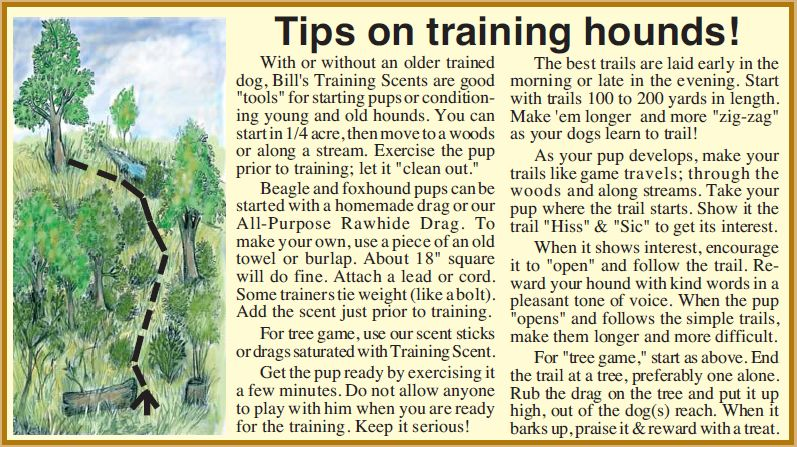
If so, the good news is that the 2010 Bill Boatman catalogue has a nice short training summary, which I have clipped out just for you. Enjoy!

Of course, none of this will stop the lazy and incompetent from wanting their fox pens. These are the guys with one or two dogs, who have no horse, and who have no access to land because they have never gone out and gone door to door at farms.

They have not trained their dogs at all -- they keep them in a kennel behind the house and pretty much ignore them 50 weeks out of the year.

In short these folks are just like the pay-and-shoot bird gunners who take their shotgun and barely trained birds dog out to some place where a fellow releases a few chickens pheasant out into a field to be blasted by the pay-to-shoot guy an hour or two later. We're hunting now! Look at my excellent bird dog.

Of course this is how they hunt birds in England, isn't it? If you are going to import a non-native tropical bird to hunt, like a pheasant, then you are going to have to stock them. You cannot release them into the wild to thrive on their own, any more than you can let a chicken "return to the wild".

But a fox? No, not even in England would they think to put a fox in a big pen with a hound and call it hunting. Or training. Or anything but a fat slob, without the proper tools, trying to do a job on the cheap that he should not have started to begin with.


.

Sunday, February 14, 2010

400 Pheasants an Acre?


Reposted from 2006.

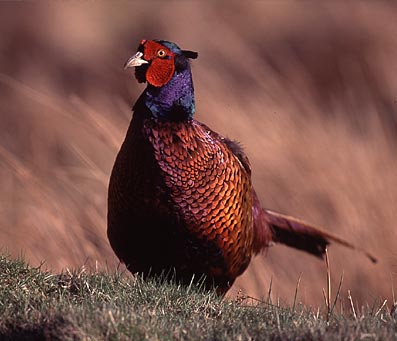
A new report from the Game Conservancy Trust (a very good conservation group in the UK) notes that the release of up to 35 million pen-raised pheasants and 10 million partridges a year in that country can have a "negative impact" on some vegetation. Their recommendation: release "no more than 400 pheasants ... per acre of woodland."

Ugh .... right. More than 400 pheasants per acre would be wrong. I have always thought so.

It turns out some estates release as many as 1,000 pheasants per acre. Yow! Can this be true? We don't have densities like that at the average chicken farm.

Of course, here in the U.S. we generally do not hunt pen-raised birds. Most serious bird hunters sneer at canned hunts. You find a little bit of this kind of thing going on in Texas and near some East Coast cities, but most of our shooters are going into real nature and are content with smaller bags.

What's the purpose of shooting 200 or even 40 pheasants in a day?

In the Dakota's, a man and his dog will work large open fields all day long for a bag of three. That's real hunting.

In my mind, a bunch of over-dressed men and women walking a line to shoot pen-raised birds is a chicken shoot. There is no field craft, and there is no chance you will go home empty-handed. It's not hunting, because it does not entail skill or chance or expertise of any kind.

We do not say a butcher has gone hunting, and yet we say a person has gone hunting even if he or she has spent three days in the woods and shot nothing. Hunting is not a chicken shoot and it is not entirely about killing, is it?

Each to his own, of course. We kill a billion chickens a year in this country and I am not wringing my hands over that, so I am not going to rip out my own beating heart to protest canned pheasant, quail and partridge shoots in a country where I do not even live.

I am just glad to be an American. I am glad we (mostly) do it differently.
.

Friday, October 16, 2009

Artificial Dens, Big Dogs and Fair Chase


Concrete liners wait to be assembled into an artificial fox earth in Germany. This is an "in and out" design where the barking dog comes down the right section of pipe and bolts the fox into the left section of the pipe. The two sections are connected at the notches seen in the foreground. The left section then feeds back into into the main pipe stem and the fox bolts out.

In an article entitled The Rabbit and the Go to Ground Tunnel, I detailed the 20th-Century rise of artificial fox earths in the UK.

These artificial fox dens have their origin in ancient rabbit "burries" created by the Romans who introduced the rabbit to the UK about 1,000 years ago.

The artificial fox earths of the UK served as the model for the over-large "Go to Ground" tunnels we see at American Kennel Club, Jack Russell Terrier Club of America, and American Working Terrier Association trials.

Go-to-ground trials are not close approximations of field work (a caged rat is the only "quarry," and it only has to be "worked" for a minute or two) but people who do not own a deben collar or a decent shovel often think a 9" by 9" square den liner is approximately the same size as a real fox den. This misperception helps fuel a common belief held by portly matrons at dogs shows that a red fox is as big as a coyote or small wolf. As I have noted:

A large dog is almost always a liability. While a small dog can enter and work a large den, a large dog cannot enter a small earth. If a large dog is able to squeeze itself into the den pipe at all, it will find it has little room to maneuver away from the slashing jaws of the fox, raccoon or groundhog, and that it is nearly impossible to get behind the quarry in order to bolt it out of the den.

Despite this liability, some large terriers in Britain continue to find success bolting fox due to the prevalence of artificial dens or "drains" created by the mounted hunts as a way to keep fox populations stable on hunt lands. These artificial fox dens are typically 9 inches square, brick-lined, and slate-topped with two or three possible entrances.

While the construction of artificial dens or “drains” was sufficiently common at the turn of the century that Sir Jocelyn Lucas provided tips on their construction in his 1931 book, Hunt and Working Terriers, they became even more prevalent after the introduction of the myxoma virus in Great Britain in the early 1950s.

Myxomatosis was purposefully imported from South America as a way of "controlling" the U.K.’s rabbit population, which was considered a major agricultural pest. The myxoma virus was a frightfully efficient killer, wiping out 98 percent of all rabbits in Great Britain within a decade of its introduction. One result of this unhappy turn of events was that the ancient rabbit warrens that had once served as natal dens -- and sources of food -- for breeding fox simply vanished.

In order to help out Mother Nature, and improve the chance that a fox would take up residence on hunt land, many hunts constructed new artificial dens out of bricks or 9-inch drainage pipes.

At about the time that the very first artificial fox dens were being constructed in the 1920s, Kennel Club dog shows began to grow in popularity. New terrier breeds were admitted to Kennel Club rosters with some frequency, and old breeds were regularly "improved" for coat color, the set of the ear, the length of the leg, the shape and size of the head, the set of the tail, and a dozen other characteristics that barely matter in the hunt field.


The rest, as they say, is history.

It is with some interest -- and alarm -- that I note that the use of artificial dens seems to be growing in Germany. Here we find concrete and PVC pipes used in the construction of artificial fox earths. These earths are hunted about once a month in season, with the dog being entered in the pipe, and the fox easily bolted out due to the design of the artificial den.

The bolted fox is then blasted with a shotgun.

This is pretty far from genuine terrier work in my opinion, and is only a little bit better than a canned hunt. Woodcraft does not have to be very high to find a fox in this manner -- just visit the artificial dens you have previously constructed (and perhaps stocked). The dog is then entered, and the fox bolts. The dog is unlikely to face much of a fight since the fox has an easy exit. Nor does the terrier owner have to dig to the dog. These are 5 minutes affairs, not three-hour digs. As for shooting a fox with a shotgun as it exits a pipe -- could there be anything easier?

I am at a loss to understand this permutation of terrier work which is so very different from what we do in the U.S.

If we set aside the ethics of this kind of hunting and ask only what might be happening to the dogs, more alarm bells sound.

Are the Germans turning to artificial dens because their dogs are too large to work tight and twisting natural earths?

That may, in fact, be part of the impetus behind the rise of artificial earths in Germany. While the German standard for a working dachshund (teckel) calls for a dog with a small chest, the Germans insisted on creating their own brand of terrier during the strange period leading up to the rise of Nazi Germany.

I have documented the true history of the German Hunt terrier (the Jagdterrier or Jagd terrier) in previous posts and noted that this "all rounder" is too small to easily retrieve bird, and often too big to easily go to ground on fox. It is a dog that, when bred to the middle of the standard, is "betwixt and between".

You know there are problems with Jagd Terrier size when the problem becomes institutionalized in the form of a cartoon Jagd Terrier struggling to exit an artificial earth. Cartoons require an audience to "get the joke" -- to say out loud that which is widely known, even if seldom stated.


The Germans have always been an engineering and industrious people, and so it is no surprise to find they have put a lot of effort into "improving" the old "three-brick-high with a slate roof" design that characterize so many artificial earths in the UK.

Modern German earths are often made of cast concrete or even plastic pipe assembled in sections and attached to special "bedding kettles". Though there are various designs for these earths, they all feature ready exits so that a barking dog can easily bolt the fox.

Carefully designed earths mean the dog may never come face-to-face with a fox at all -- a good way to keep a dog injury-free, but also a set-up that prevents a dog from ever being in a situation where it has to demonstrate locating abilities in a complicated sette, staying power while it is being dug to over several hours, or the drive and "bottle" needed to hold a fox in a stop-end.

In fact, these German earths are designed so well that I suspect a barking Tea-cup Poodle could bolt a fox!


Artificial dens are simply not used in the United States. One reason for this is that our mounted hunts are not in the business of killing foxes -- once a fox goes to earth, the hounds are praised and the field rides off until another fox is found, and then the chase is on again. This is not drag hunting, but it is not vermin control either. Perhaps it is game management. A fox caught by the hounds above ground is a very rare thing, and such a stupid, slow or sick fox is best weeded from the gene pool.

Another reason we do not have artificial earths in the U.S. is that in the Eastern U.S., where red fox are most common, there are so many groundhog holes that an artificial den is unlikely to be used by a fox, no matter how well it is located.

Perhaps the most important reason we do not have artificial dens in the U.S., however, has to do with our concept of "fair chase".

"Fair chase" is a modern idea and has been framed in response to a fixed amount of wildlife and a rising tide of people and technology.

In pre-historical time you took game any way you could, but with the development of modern weapons, mankind found it could shoot out all the game and "bleed the land white" in just a few years time.

As amazing as it sounds, for example, the people of the United States killed off almost every type of large wildlife in this country between 1850 and 1900 when ethics and common sense failed to keep pace with rapid improvements in gun technology and traps.

Bison, elk, wolf, white tail deer, pronghorn, moose, turkey, eagles, beaver, and many species of ducks, geese and crane were nearly wiped off the American landscape.

In response to this devastation, the U.S. developed the concept of "fair chase". Artificial bird-calling machines were banned, as were live decoys, and the commercial sale of wild game was prohibited. Hunting of most species was limited to clear seasons and defined bag limits, and some types of hunting (such as canons loaded with shrapnel designed to kill whole flocks of geese with a single shot) were banned outright.

Today, thanks to sane wildlife laws, ethical hunters, and the finest game management professionals in the world, most forms of American wildlife can now be found in record abundance.

Other countries have set in place their own laws, regulations and customs governing "fair chase". In the UK, for example, leghold traps are considered a horror, in no small part because the British have no experience with modern off-set-jaw traps, and in part because the mounted hunts have demonized traps and poison which proved to be so efficient during Victorian times that fox were often rare and many mounted hunts were reduced to chasing stag and rabbit.

In fact, the demonization of traps, poison and guns for fox control reached such a frothy state that a legal term was coined for the crime -- Vulpicide -- which means the killing of fox by any method other than horse, hound, and terrier.

Will Germany and other countries develop their own sense of fair chase, and will it include the rejection of artificial dens or -- perversely -- their embrace?

Time will tell, but so far artificial dens seem to be gaining ground in Germany. One "sales point" for these contraptions is that they are safe for the dog, which is unlikely to tangle with the fox in any serious way. In addition, the dog can always be easily located and cave-ins are an impossibility.

It should be noted, of course, that the real reason artificial dens may be finding favor in Germany is that they are a profit center on hunting-club and farm lands in much the same way that pen-raised pheasants are a profit center at other locations.

There is clearly a demand in Germany for simple and easy "sport" among those who want to "test" their dogs and show that their dogs still have what it takes. Never mind that the test is somewhat rigged and the dogs may be a bit too big to do the job in a natural fox earth.

A red fox running free in a concrete pipe, is certainly a better test than a white rat in a welded cage at the end of a wooden tunnel! Who are we -- Americans who invented the white rat "test" -- to disagree?

Of course there are still some of us who like the other option -- the slow slogging hunt for natural dens and the back-breaking labor of digging to the dogs through marl, root and rock. This is fair chase, and it is what terrier work is really all about.


For more pictures of German artificial fox den construction, see
>> http://www.jaeger-wesermarsch.de/sonstiges/kunstbau.html
.

Friday, July 17, 2009

Badger Baiting Is Not Badger Hunting


Back in March of this year, I wrote a piece on this blog entitled Lie Down With Dogs, Get Up With Fleas in which I bemoaned the inevitable ruin that comes when the world of working terriers is invaded by wannabe dog fighters and badger baiters.

That post noted that some 17 months earlier I had written a piece entitled Honey Pots and Trolls in the Land of Eire in which I had noted that someone in Ireland had gotten on the boards to bash a piece I had written two years earlier (now more than four years ago) about the old Irish "strong dog" tests and the potted histories that you commonly find for all Kennel Club dogs, including the Glen of Imaal terrier.

I warned what I suspected: a "honey pot" operation was in operation, and it was designed to harm the legitimate world of the working terrier by trying to associate it with dog fighting and badger baiting.

Sadly, I was right, and the result has not only been busts in Ireland, but also bad press on the international front as well.

Perhaps now is a good time to review my original March 2005 post, in which I quite succinctly noted that Baiting Dogs Are Not Hunting Dogs.

It seems this is a point that still needs to be stressed and underlined.

The confusion in some minds stems from the fact that shortly after the turn of the 20th Century, some show-ring pretenders in Ireland tried to suggest that Ireland's overlarge turnspit, fighting, and cart-guarding dogs were once used for genuine field work.

That's not quite true, is it?

Those Irish Kennel Club dogs were always far too large to actually go to ground, and so "artificial" work had to be cocked up for them.

And the work, to put a point on it, was a joke.

But don't take my word for it: You can see for yourself by watching this 1923 video clip. Here is the famous (or infamous) Teastas Beg and Teastas Mor in action!

At the "minor trial," we see a couple of rabbits released, and a bunch of confused dogs sniffing around on the ground. Some terrier trial!

At the "major trial," we see the true "work" of these over-large Irish dogs: Badger baiting with a live badger in a smooth wooden den liner or barrel.

This is pretty far from genuine terrier work, isn't it?

And what does genuine terrier work of that era look like?

The good news here is that we do not have to guess, as here too we have a film clip, also from 1923, this time of properly-sized working terriers going to ground.

The dogs go in, the badger is dug to, and in the end it is bagged to be moved to a new location where it can do no harm.

Are the dogs wrecked? No.

Is the badger maimed? No.

Is their confusion and chaos at the dig? No.

This is real terrier work, and you will notice there is no "strong dog," "pull dog" or "hard dog" nonsense in evidence.

These men are not show-ring pretenders, get-rich-quick dog dealers, or wanna be tough guys displaced from the world of fighting dogs. These are real terriermen, and this is what real terrier work looked like in 1923 -- and what it still looks like today, albeit with a much smaller entourage and clothes that are not quite so fancy.

Saturday, January 03, 2009

Hunting and Fishing Like Adults

This is a recycled post from August 18, 2006 prompted by a recent discussion, in the comments section to a post about mounted Maryland fox hunting.


I got a couple of emails on my post about stocking 400 pheasants an acre in the UK.

Matt M. in Idaho correctly notes that canned birds hunts are becoming more popular in the U.S., and canned deer hunts as well. Though he lives in one of the wildest states in the U.S., there are at least four commercial bird shoots with an hour or two of where he lives.

Matt writes:

"When I was living in Pennsylvania, a local hunting preserve somehow heard I had traveled to hunt big game, so the owner assumed I was rich and would be interested in his trophy deer operation. Both assumptions are false, but I accepted his invitation to tour the place he called 'Deerassic Park.' During my two hours, I had huge trophy deer parade by me 20 yards away. The guide told me 'Five thousand dollars may seem like a lot for a deer now, but in the second week of deer season, when all your coworkers are asking if you got your deer, it won't seem so much.' He was wrong again. The deer were raised in carefully controlled pens, like cattle, to ensure the best genetics. The bucks were then periodically released. I cringed when I read purple-prose stories by 'famous outdoor writers' who embarked on the challenge of hunting deer at this place. Shooting one of my father-in-law's dairy cows would be just as challenging, and as fun."


On the other side of the coin, and on the other side of the Atlantic, Lyndsey H. writes to note that: driven bird shoots are an important part of the rural economy in the UK; that not all shoots are intensely stocked; that on those shoots that are heavily stocked the land can generally support the bird populations that have been placed on them; that the pheasants are well cared for, and that income from shoots supports the upkeep of large estates (to say nothing of game keepers and the like).

Let me begin by saying that my earlier squib on pen-raised birds and driven shoots was not intended to be the beginning of a book on canned hunts. This is a topic far outside my expertise or knowledge base.

That said, the ethics of "guaranteed hunts" has sparked considerable debate in the hunting community, and so perhaps it is (pun intended) "fair game."

Let's see if I can fence in the debate a bit. Sometimes when we define terms and try to put a fine point on things, we can find common ground.

First, let us dispense with the notion that there is an absolute right and wrong. The issues here are too big for such neat box fitting.

As with so many things, there are degrees of good and bad, and there is also the matter of perspective, which is so often shaped by economics, class, social convention, and geography, to say nothing of human population densities, biology and history.

One man's sacred cow is another man's hamburger.

Hunting is a red-hot topic so let me start by talking about something different -- fishing.

To the best of my knowledge and memory, the first fish I ever caught was a trout pulled from a large blue plastic kiddy pool set up at the Washington Boat show.

The fish were hatchery-fed trout, plainly seen against the bright blue bottom through crystal clear water. The fish had been brought in by truck from a hatchery, and the fish and cane poles were designed to attract people to a nearby boat display.

It worked. For a couple of dollars, kids could toss in a hook with a small bit of canned corn on the end, and pull out a wet and wriggling trout while their parents perused the boats.

Even at age four I knew this was not fishing. I remember feeling a little embarrassed at the artifice of the situation.

And yet, looking back on it now, what harm did it do? Trout are raised to be eaten, and we do not belabor the point when Trout Almandine is served at a restaurant.

This was not "real" fishing, of course, but at age 4 or 5 could I be expected to have memorized "Fishing With Ray Bergman"? It was fun.

And yet I no longer think kiddy pool trout fishing is a good thing.

It is not that I am against fun (I'm always for that!). I am simply against bluring the line between true fishing and slaughterhouse taking.

Yes, we want activities for children to be fast and easy. Perhaps, however, fishing is the wrong activity to satisfy this niche.

Fishing may have other lessons to teach young people – lessons about food and habitat, skill and delayed gratification, for example.

No self-respecting adult would stand in line to yank a trout from a plastic pool at an indoor boat show. Yet (and much to my amazement) adults DO show up for "pay lake" trout and catfish. What are we to make of adults that fish in such a childish manner?

Only one step up from pay-pond fishing are the folks who follow hatchery trucks to the stream in order to "get a jump" on their fellow anglers at the start of trout season. Is this "real" fishing? Not in my book.

But what I think hardly matters. Within 72-hours of opening day, half the trout placed in East Coast streams are gone - stripped from the water by "put and pull" anglers.

I will not belabor the point, nor will I venture further through the cosmology of fishing in America (catfish bait-ballers, top water bass-pluggers, crappie jiggers, surf casters, fly fishermen, tuna trollers). Suffice it to say that there are many fish, many tribes of fishermen, and many methods of fishing. Each to his own.

Let's move up the evolutionary ladder to birds.

Here too we have hunting in a variety of manifestations from "tower shoots," where captive pen-raised birds are tossed into the air from a tower while gunners blast away, to "plant and shoot" releases of birds into a field the night before, to stocked and "naturalized" birds released at the start of a shooting season.

The parallels to "kiddy pool" fishing, over-stocked pay-lakes, and "wild stocked" streams and ponds is obvious.

Again, where do we draw the line?

In my opinion, tower shoots are pathetic, and so too is any form of stocked shooting where a man or woman can plink more birds in a day than he can put in his freezer at night.

At some point, you are not "hunting," you are just killing chickens.

The issue here is not "animal rights." The issue is fakery and debasement of a true set of skills. Shooting brain-addled pen-raised birds under the umbrella of "hunting" debases the art of true hunting. When we snap-trap a few mice in the garage, we do not talk about a "holocaust of mice" -- to do so would be to cheapen the horror of the Holocaust while dramatically inflating the status of rodents and denigrating the lives of millions of once-vital human being.

Language matters.

And so it is with guaranteed bird shoots and pay-pond fishing. Angling is an art, and hunting assumes an element of field craft not evident when birds are purchased as units like Chicken McNuggets.

Hunting is about the experience over the day, not the number of fish boated or birds bagged.

But, as noted earlier, not everything is quite so simple, is it?

What are we to make of the 3,000-acre scrub farm were 1,000 pheasants and quail at a time are released into the wild three times a year?

At this population density, and at this bird-release interval, there is a fair chance that more than a few birds will die of natural causes, and some birds may even die of old age.

On a “natural" farm that is “wild-stocked,” the land may be kept not only free of development, but also free of pesticides and herbicides. Brush rows and mottes may be planted and maintained, enhancing the survivability not only of planted game birds, but also of rabbits, deer, and native songbirds.

Surely, such a bird shoot farm is morally and environmentally superiour to a "Roundup Ready" corn field or cow pasture?

More birds are shot on such a farm than are being naturally replaced, of course, but if the bags are low and a "successful" hunt still requires both a skilled dog and a skilled shot, is it really so bad a thing?

Low-stock shoots of field-acclimated birds is a bit different from a driven bird shoot where 400 to 1,000 pheasants are being stocked per acre-year. It's not entirely natural, no, but it's not entirely awful either.

Of course, some may disagree.

Let us leave bird hunting, for a moment, and now think about "big game".

On one extreme we have lions and tigers and other large and rare exotic animals that are released into 10-acre enclosures to be shot by "sportsmen."

It's easy to be outraged by this kind of activity, and no one I know thinks this is actually hunting.

That said, it's worth noting that canned big game shoots of exotic animals are a natural outgrowth of the public's fascination with "zoo babies".

Zoos routinely over-breed animals because tiger cubs and baby zebras boost attendance and generate profits. Cute baby animals quickly grow up, however, and that's a problem. It turns out that the world has more caged lions, tigers and zebras than it knows what to do with.

What to do? Answer: canned shooting preserves in Texas. It's not an accident that at one point nine board members of the San Antonio Zoo owned hunt preserves.

Not all exotic animals used in canned hunts come from large zoos. Many come from small zoos and private breeders of large exotic animals. If you have a checkbook in this country, you can buy anything from a lion to a bear, and from a bobcat to a gemsbok.

And if you have ever bought a wildife magazine with amazing shots of baby cougars, lynx, red fox, black bear and wolf, you are a small part of the problem. Most of those pictures were taken in private "photography zoos," and at least some of those baby animals were later sold, as adults, to canned hunts.

An example is as current as this morning's headlines:


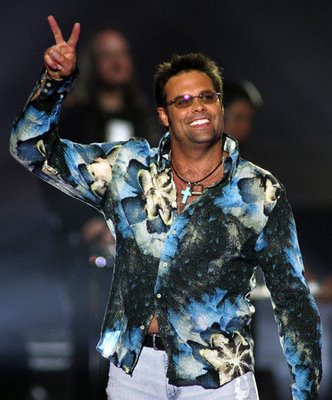
"Country music star Troy Lee Gentry (one half of popular duo Montgomery Gentry) is facing charges for shooting a tame, captive bear and then trying to mask the killing as a proper hunt.... Indictment documents made public this week showed that Gentry paid $4,650 U.S. to kill a 'trophy-caliber' bear named Cubby. The incident took place two years ago at the Minnesota Wildlife Connection, a company that claims to offer photographers a chance to capture wild animals on film. ... Gentry killed the bear using a bow and arrow while the animal was in its pen."

I think most people would agree that shooting a large, rare, exotic or tame animal in a small enclosure is several time zones removed from true hunting.

But what if the animal is less rare -- such as a Russian Boar -- and the enclosure is quite a bit bigger -- a few hundred acres?

Where do we draw the line?

Is it OK to shoot an exotic animal, such as a Fallow or Axis deer, in a very large fenced parcel of ground provided the countryside is more-or-less natural, and the animal actually runs when stalked? Is it OK to shoot it when it is pressed against the fence?

Does it matter if the animals are not exotics, but are native elk, moose, whitetail or mule deer? Is that better or worse?

What if the animals are not fenced in, but are fed every day from an automatic corn-dispensing bait station set on a timer?

Does it matter if the person shooting the animal over such a feeder is hunting for meat or hunting for trophy or sport?

If you decide it's OK to shoot wild whitetail deer on an open farm over a broadcast corn feeder, why is it not OK (as a matter of law) to do the same thing with birds?

If a mechanical caller is OK for fox and coyote, why is it illegal to use it on ducks and elk?

A lot of people will find some of these questions easy to answer, but will pause at others.

The brain dead Vegan and the knuckle-dragging slob-hunter will find all of these questions easy to answer.

So too will the older, thoughtful, skilled hunter who hunts only wild lands and who only fishes wild waters. He knows what he chooses and why.

This last point needs to be stressed.

The types of questions and dilemmas I have posed here are relatively new. Our grandfathers did not have canned hunts and potted bird shoots. This is not part of the American hunting tradition most of us grew up with.

So what has changed?

To some extent, population growth is part of the problem. Though the percentage of hunters may be less than it was in years past, the absolute number is higher than it was 50 years ago due to rapid U.S. population growth. With increasing population density and suburban sprawl has come greater distance to suitably large farms, forests and fields.

More important than suburban sprawl and hunter density, however, is the fact that America has become a land of rapidly rising expectations and a rapidly declining ability to delay gratification.

The American public wants everything it can imagine, and it wants it NOW, and it wants it “super-sized.” We want fast food, fast cars, and instant communication. We want bigger houses, more money and early retirement.

In short, we have become a nation of spoiled, rich and demanding children. The rise of commercial shooting preserves is simply an outgrowth of that phenomenon. Canned hunt operators are, in effect, telling their client base:


"We know you have zero knowledge of field craft or wildlife and that everything has to be easy for you or you will pout. So, just like your Daddy did when you were 6 years old, we are going to rig every game you play so you will always win. And when you do manage to kill some brain-addled, food dependent, hand-tamed creature, we will slap you on the back and say, 'Look what a BIG boy you are!'"

This type of canned shoot is to real hunting what peroxide-blonde hookers are to marriage: a sad charade that debases the individual and jeopardizes the institution.

Just as we have the Playboy channel and Hustler magazine selling the fantasy that every woman is a lesbian-curious nymphomaniac waiting to be unbound, so we have TV hunting shows and magazines selling the idea that every foray into the field should result in a trophy buck, a monster bear, and a bucket-mouth bass. In this sense, "Rack "Em Up" and "Antler King" feed supplements are to the game farm industry what silicone implants are to porn producers.

Just as "sexual service" ads can be found at the back of girly magazines, so too can ads for canned hunts be found at the back of hunting magazines.

It's not an accident that every episode of ESPN's "Hunting the Country" closes with a nod to the outfitter on whose land the “monster buck” was shot.

An “outfitter? What the hell is an an "outfitter"? And how can these people hunt bull elk while trailing a camera crew and talking?

The answer is that you are watching a canned hunt. In the context of television hunting shows, an "outfitter" is a fellow who trains ranch-raised elk to come to a corn-spewing time-released bait station.

"Start feeding them in the spring, and shoot 'em dead in the fall." That’s the business plan, and it’s one that hunting show producers, who need to film a new trophy kill every week, are loathe to criticize.

There are about 1,000 "canned" or potted hunts in the U.S. catering to about 500,000 hunters a year.

That may sound like a lot to folks at the Humane Society, but in fact this represents less than three percent of the 20,000,000 Americans that hunt in this country every year.

For better or worse, you can find an "idiot three percent" in almost every endeavor.

Of course, hunting is not just any sport.

Unlike skate boarding, mountain biking, or motor boating, hunting is under attack from groups like the Humane Society and PETA.

Ironically, the folks at PETA and the Humane Society are just as childish as the slob hunters.

Raised on Bambi cartoons and "Wind in the Willows" stories, the typical Animal Rights lunatic has not spent a single second considering the fact that everything that lives will also die, and that death in the wild is generally slow, painful, violent and miserable.

When a deer dies in the woods, it does not expire with a morphine drip and a Mozart concerto in the tape deck.

The alternative to hunting is not perpetual life - it is vehicle impact, wasting disease, starvation or predation.

Hunting your meat is certainly more ethical than buying it in a store. Childish Americans seem to think cows are raised pre-sectioned, wrapped in plastic, and frozen.

In fact, most feedlot cows never know one tenth the freedom of a deer. For a steer, the last hour or two of its life is typicaly spent in a crowded and lurching truck on the interstate. The last minute of its life is spent slipping on a blood-wet floor in an alien metal-clanging slaughterhouse.

A mature adult does not shrink from death -- he recognizes that life is short and red in tooth and claw.

This is the way it has always been. God did not make a mistake when He created the cycle of life and gave humans canine teeth and molars.

If you spend enough time in the woods, you will eventually see a predator kill something. A hawk or fox does not always kill quickly. In fact, it may play with its food and then eat it alive and screaming. Compared to that, a cow dies with some grace.

On the opposite end of the spectrum from the infantalized slob hunter and the anthropomorphic PETA member are serious adult hunters and anglers.

These folks know where meat comes from, and they respect both the life lived and the life taken.

While the slob hunter and the cringing Animal Rights reactionary are obsessed with the kill, the hunter is focused on the experience of hunting.

It’s almost a universal truth that if you do something for very long, you get good at it, and if you get real good at it, you begin to handicap yourself in order to prolong the experience and keep it interesting.

This not only occurs in golf and chess, it also occurs in hunting and fishing.

If you start fishing at age 5, as I did, you stop using bait by age 12. By age 15, your hooks no longer have barbs, and you are snapping the trebles off the back of your plugs. Your leader line gets thinner, and more and more fish are returned to the water.

There is nothing wrong with killing a few fish, but if you have ever caught so many you had to bury some in the backyard to get rid of them, you try to stay clear of embarrassing abundance. A great deal of dignity can be found in simple moderation.

It is perhaps a little too easy to focus on the idiocies of slob hunters. In truth, they represent a small minority, and their numbers may be in decline, rather than in ascendency. There are some small signs that America may be maturing.

Let me give you one example. When the state of Colorado banned shooting bears over bait a few years back, the number of bear hunters in the state did not decrease, it increased.

It turned out that more people were willing to hunt bear provided that the onerous stain of hunting over bait was lifted.

The trend can be seen outside of Colorado, too. The fastest growth area in hunting today is the rise of bow hunting and the increasing use of black powder. Granted many bow and black powder hunters are also going forth in shotgun and rifle season as well. But not all are.

In a day and age when whitetail deer populations are at record levels, and elk populations are holding steady or increasing over much of their range, more and more hunters are embracing the challenge of bow and blackpowder in order to keep in contact with the elements of skill and chance that are at the core of the true hunting experience.

Of course not everyone is so conscientious.

There’s always Ted Nugent. Ted Nugent, for those who do not know, is the loud adolescent faded rock-star who now holds forth on right-wing radio. He is all blood and guts, tough talk and feisty belligerence. He likes to accuse everyone else of being a weak-knee'd “pastrami-breath" liberal, and a cut-and-run chicken.

What his fans do not know is that Ted himself was a Vietnam draft dodger who got himself cut loose from service by showing up for his physical covered in his own feces and after not showering in weeks. He had a child out of wedlock and only ponied up support when the court forced him to. Real family values. A Great American.

But never mind that. He’s a hunter, right?

Well maybe not.


It turns out that Ted Nugent is not just a sunshine patriot, he is also a canned hunter. In fact, Ted runs his own canned hunt facility in Michigan called Sunrize Acres where, for a hefty fee, you can shoot tame buffalo that have been trucked to his 340-acre spread.

Along with buffalo, Ted's farm is a pay-shoot for whitetail deer ($2,000 for a doe!), wild boar, “exotic ram” (that would be farm goats for you who are wondering), and Sika and Fallow deer.

These are not wild animals -- they are trucked-in farm stock. The bison are no better than glorified farm cows, the Russian boar are no better than glorified farm pigs, the "exotic rams" are just farm goats, and the deer are corn-fed dependents.

Cartoon buffoons like Ted Nugent and his canned hunt farm are, I am sad to say, the loud and ugly public face of hunting in America today.

Last year, in my little state of Virginia, we shot 220,000 deer, and we did it without drama, canned hunts, or a peep from PETA, which is headquartered in this state.

Deer hunting in Virginia reduces crop damage, reduces deer-vehicle impacts, feeds poor hungry families, saves our forests and hedgerows from being over-browsed, stems Lyme Disease, and generates jobs and economic benefits across the state.

But the big "hunting story” told in my state last year was not about the ecological or economic benefits of open-farm natural deer hunting. It was about how Dick Cheney shot his buddy in the face in Texas. Nearly every story also mentioned his canned bird hunting exploits in Pennsylvania.

As for today's newspaper hunting story -- the one about how Troy Gentry was caught shooting a tame black bear in an enclosed pen in Michigan -- my bet is that the hunting TV shows will be silent about the travesty. After all, they engage in canned hunts themselves.

The hunting magazines will be silent because they do not want to lose advertisers from their back pages.

Ted Nugent will be silent, because he sells canned hunts and participates in them too.

Troy Gentry's buddy, Hank Williams Jr., will be silent as he participates in canned hunts himself.

And so, through silence, America’s hunting community will apparently signal acceptance of the ugliest thing going on in the hunting community today.

As noted before, hower, canned and potted hunts are NOT part of America's hunting tradition. This perversion has only risen up in the last 20 or 30 years.

And yet peversion and silence often go hand-in-hand, don't they?

Look at Islam. I grew up in a host of Muslim countries, and I can assure you that radical psychotic violence was not part of that world 30 years ago.

Yet it is today, and in the face of that radical hate-spewing violence, what do we see from the Muslim community?

Silence.

There have been no "Million Muslim Marches" for peace and love in London, Paris, New York or Washington.

Instead, we get terrorists beheading people on TV, suicide bombers trying to kill innocents on airplanes, and car bombs going off everyday.

Muslims sit in silence and wonder why the world does not "understand" them. In fact their silence has become their message to the world.

People that stand silent while others defile and define their culture and community are taking action.

That is how Islam -- once a religion of peace -- has come to be see as a religion of seeminlgy unending violence and irrational extremism.

Are we going in the same direction in the world of hunting?

Time will tell.

All I know for sure is that if you are a hunter willing to stand up and fence off right from wrong, you are sure to get a missive from someone advising you to be quiet.

"We are all in this together," you will be told.

Right. We are. That's why 97 percent of hunters in this country need to stand up and roar against the likes of Troy Gentry -- the three percent morons.

It's time we defined what we are about -- and what we are NOT about as well.

"I ain't gonna spare the rod
Cuz that ain't what my daddy did
And I sure know the difference between wrong and right
You know, to me it's all just common sense
A broken rule, a consequence
You do your thing, I'll do mine"

- Lyrics from the Montomery-Gentry song "You Do your Thing" in which Troy Genry drives through suburbia with a dead deer strapped on the hood of this car.


Friday, June 01, 2007

The Incredible Shrinking Hogzilla II Is a Pet Pig


Is Hogzilla II a hoax, a tall tale gone out of control, or simple wishful thinking?
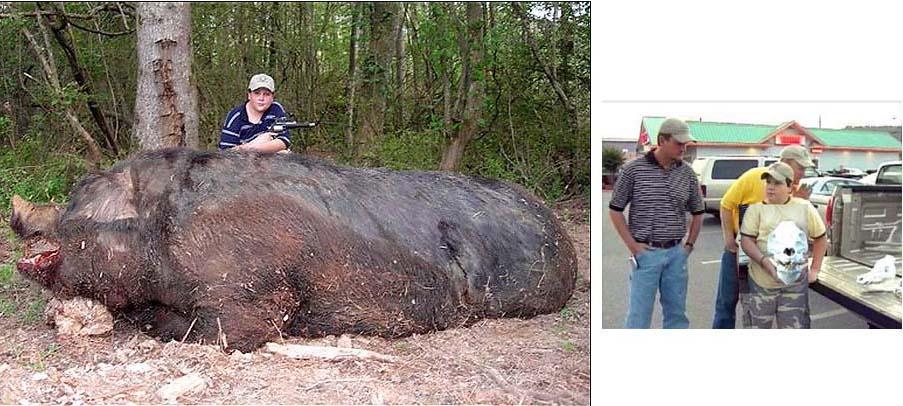
To see a larger version of the top two pictures >>
Click Here


The folks at NBC News in Oxford, Alabama put up a slide show of what the Stone family says is the skull of their "giant hog."

The last photo in the series shows young Jamison Stone holding the giant pig skull. By clipping that picture and pasting it on another photo of Jamison (wearing the same shirt) that can be found earlier in the series, we can get some sense of scale for the skull.

By comparing the much-circulated picture of Jamison and the "giant hog" with a picture of Jamison holding the hog's skull, we can get some idea of how much "forced perspective" was at work in the original hog photo widely circulated on the internet. The folks at
StinkyJournalism.com are clearly right -- this is some type of photographic hoax.

One way to look at the photo is to simply move the pig skull from the right photo to the left and then move it up close to the top of the pig's head (since no animal has very much flesh over the top of its cranium due to the need to cool off the brain quickly when overheated). The gap below the bottom of the jaw bone and the bottom of the photo of the pig's head gives some some idea of the degree of artifice in the photograph.


Photo shows real skull of hog properly sized (facing forward) next to pig.
The pig looks so large because the boy is standing many feet
behind the pig -- a type of photographic forced perspective.


Bottom line:
This was a big hog, but it was no bigger than any really large farm pig of the type commonly made available (for a price) at other canned hunts. And let's note, once again, that this WAS a canned hunt. The pig, it turns out, was penned in a 150-acre fenced enclosure and it had been trucked in from somewhere else in the not-too-distant past.


Quote of Note from The Los Angeles Times:

Eddy Borden, owner of the spread where the hunt occurred, declined to comment on how the hog got into the 150-acre area where it was killed by Jamison Stone of Pickensville, Ala.

Borden said he was getting tired of questions about the hog, which Jamison's father said weighed 1,051 pounds and measured 9 feet, 4 inches from the tip of its snout to the base of its tail. The kill drew international attention.

"I didn't ask for the publicity. I just want it to all go away," said Borden, whose Lost Creek Plantation is in eastern Alabama.


Woops! A public relations stunt gone bad. Ouch. One thing is for sure: Mr. Borden knows how much he paid for that hog, and that price was based on weight, and there is probably a receipt of sale somewhere. Another thing for sure: that hog was not in that 150-acre pen for very long, as a big hog can wreck a lot of ground pretty quickly. This hog was taken out of this kill pen dead at about the weight he was put in alive.

Hogzilla Update:

OK, it's all over. This was a pet pig, and a hat tip to the always-readable J.R. Absher over at the Outdoor Life Newshound blog who has the full story gleaned from the Anniston Star, the local Alabama newspaper. The long and short of it is that "Fred" was a pet pig and a gentle swine that played with the previous owner's grandchildren. I hate it when I'm right. Honestly, it's a burden.
  • For those who are interested in reading about the limits of ethical hunting (and why this kind of "Hogzilla" nonsense is very bad for real hunting, see a blog post from last year entitled (all too appropriately) : "Hunting and Fishing Like Adults."
.

Wednesday, May 30, 2007

Hogzilla II: Terrific Hunting Story or Sad Artifice?


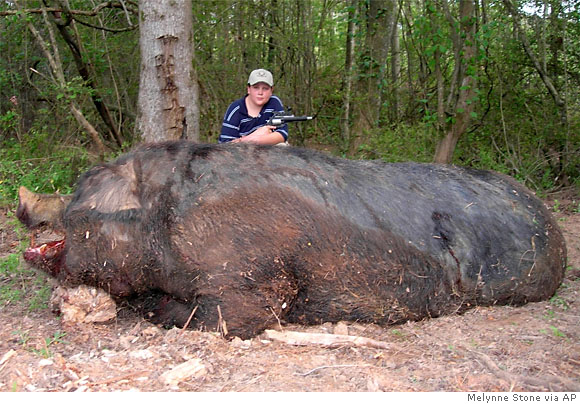
The "pig in a poke" story that is circulating on the internet is that on May 3, 2007, an 11-year old boy by the name of Jamison Stone killed an 1,051 lb. wild feral hog. The pig was supposedly over 10' 7" long and was shot with a .50 caliber Smith & Wesson revolver shooting 350 grain bullets. Killing the hog, we are told, took 3 hours and 8 bullets.

A lot of skepticism was expressed right from the beginning. First of all, the pictures were clearly staged to make the pig look as large as possible -- a common trick done by all hunters and anglers.

Adding fuel to the fire, it turns out no one in authority was actually there when the pig was weighed. You would think that would be required if you were claiming a world record feral hog. Yet, it seems no one thought of that. Hmmm. . . .

Another oddity to the story is that the scale to which the pig was hitched does not actually weigh things by the pound -- it is marked off in 10-pound increments. A weight of 1,051 pounds was technically not possible. The boy's father now says the pig was over 1,050 pounds, and they assumed the little mark above that was for 1 pound. He now says the pig must have weighed 1,060 pounds. OK, but in truth this man aparently had no idea how that scale worked, and neither did anyone else at the weigh-in with him.

That's not a small problem.

Another wrinkle in the story is the gun itself. Who the hell gives a .50 caliber handgun to an 11-year old kid? And does anyone think an 11-year old boy is going to be able to fire off 8 rounds from a .50 caliber and still have a wrist that can work? It might be true, but one wonders . . . .

Here's the most interesting bit: this pig was shot at a pay-to-shoot game farm. If you look at the price list at the entirely fenced Lost Creek Plantation, you find that large boars are priced at $2 a pound on the hoof, while commercially-sold farm hogs are normally sold for about $50 per cwt (i.e. per 100 pounds of pig on the hoof). That means this pig cost about $500 to buy (assuming no major premium was paid for its size) and could be sold for over $2,000 at a canned hunt. So there's the business math for you business majors.

But wait, there's more. Lost Creek Plantation was opened up just one-year ago. Hmmm . . . . Yep, I'm thinking the same thing too. This is a simple artifice. What we might call a "stock and shoot public relations" stunt.

Here's how you do it: Go out and get the biggest dam pig (or deer or elk) you can from a commercial breeder of such things. Raise it up in a pen a little bit more (and maybe feed it steroids), and then release into "the wild" of a large fenced compound. Get the animal used to coming to a scatter-feed bucket so you can be sure where it will be at least twice a day.

A few months after you have placed the pig in the wild, get the animal killed in the most sensationalistic way possible. A kid with a .50 caliber handgun would be great. So too would be a woman archer, or a guy with nothing but a spear and a dog. Ooga-Ooga. The Walter Mitty crowd will go ape-shit on this story, and bingo: Instant clients for your canned-hunt franchise.

Want to bet that this is exactly what happened? There's a reason this pig was not frozen or properly weighed -- it would put a crimp in the story. An examination of the ears and the hide might reveal the absence of the type of rips and gashes you would expect to find on a feral hog that had fought its way to the top in the woods among other wild pigs. An examination of the skull might reveal this "feral hog" to be nothing more than a domestic pig of the type to be found in any slaughter house. A look at the hooves might tell you if this pig once spent a lot of time on concrete. A look at the tusks and teeth might tell you how much of its food came out of the forest, and how much came out of a bucket.

So was this pig over 1,000 pounds? Who knows, and more importantly who cares?

The largest pig ever raised was not 1,000 pounds, but a 2,552 pound China Poland monster by the name of "Big Bill." A 1,000 pound pig is a very big pig, but it's not a world record by any stretch.

Bottom line: What you have here is a very nice "pig-in-a-poke" story concocted by a brand new "pay-to-shoot" game farm that (surprise, surprise) managed to get an 11-year old kid to shoot the stocked animal.

Did the kid shoot the pig all by himself? Maybe. But again, who cares? This not a "wild" pig, and this was not hunting.

As for the hog's size, no one will ever know as the photos are designed to obscure the truth, and the pig was never properly measured.

Was it a very big pig? For sure. But if you have the money, you can shoot a pig just as big or even bigger, and you can even call it "Hogzilla III" if you want -- just put your money down, and try to forget that that giant animal now running between the fences was called "Rosie" just 6 months ago and was trained to come to a slop bucket.
_ _ _ _ _ _ _ _ _ _ _ _ _

Hogzilla II Update #1:
It seems that Alabama Fish and Game officials have a few questions about that monster pig as well. They want to know how this huge hog miraculously got into a 150-acre fenced pay-to-shoot hunting place (of all the places for a giant pig to show up on its own), and whether anyone broke Alabama state law prohibiting the transportation and release of live feral swine. They also want to know if the hunt complied with the state's "fair chase" law which requires that animals on hunting plantations have a reasonable chance of escape. I'm sure some interesting stuff is going to reveal itself. So far we've learned this pig was in a 150-acre pen. Hmmm. . . .

Hogzilla Update #2:

It looks like Hogzilla was not that large. See my analysis based on the pictures of the skull and photos of Jamison Stone holding the same.

Hogzilla Update #3:
OK, it's all over. This was a pet pig, and a hat tip to the always-readable J.R. Absher over at the Outdoor Life Newshound blog who has the story gleaned from The Anniston Star (a pretty good Alabama newspaper). The long and short of it is that "Fred" the pig was a gentle swine that played with the previous owner's grandchildren. Now the story has slid into sick. I hate it when I'm right. Honestly, it's a burden.

  • For more on the limits of ethical hunting, see >> Hunting and Fishing Like Adults, an essay sparked by another pathetic and stupid canned hunt, this time by a country-music star.