Showing posts with label Hunting Act. Show all posts

Wednesday, May 05, 2010

Conservatives Win in the U.K

I am predicting the future again.

How do I do that?

There is a method, and it's simple enough: You go to "Intrade" and see how the betting folks are putting down their coin. This is how they count it on the eve of the election:
  • Conservatives to win next UK General Election: 91.4

  • Labour to win next UK General Election: 8.6

  • Liberal Democrats to win next UK General Election: 2.5

Having played Intrade, I then go to look at RealClearPolitics to read the headlines:
  • Labour Candidate Slams Gordon Brown as Worst PM in History

  • Poll: Cameron Needs 14 Seats

  • RCP Average: Conservatives +6.4

Then I head over to RealClearWorld where I find everyone has the conservatives winning the election, albeit narrowly.

Bottom line: Cameron will win, Gordon Brown will disappear into a monastery, and Clegg will become a popular gadfly who will be given the reins to moderate Cameron so that the widows and orphans in the U.K. will not be sold off to the cannibal islands to balance off the foreign trade losses.

In short, the world will trim its sails and carry on, moving forward, in a slightly different direction.
.

Tuesday, January 29, 2008

Darwin Approved, and As Natural As It Gets

Hunting with hounds 'mimics nature'

By Charles Clover, Environment Editor,
Telegraph (U.K.) 1/17/2008

Hunting with hounds is more "natural" than shooting or snaring as it mimics the way wolves work in the wild, according to a study by vets.

It is the healthiest form of predator control for populations of prey species, such as foxes and deer, because hounds, like wolves, use scent to select the weakest and easiest to catch, the study says.

Snaring, shooting and trapping, on the other hand, interfere with evolution and make prey species, such as the fox, more vulnerable to the spread of disease, according to the study which is based on scientific literature mostly published since the Burns Inquiry into hunting in June 2000.

The study by the Middle Way Group of MPs and peers and the Veterinary Association for Wildlife Management was intended to provide new arguments for a repeal of the Hunting Act on the grounds of animal welfare and wildlife management.

"The Natural Chase," a report by Katie Colvile, a vet, which is based on peer reviewed scientific literature, argues that rather than being cruel, hunting mimics natural processes that animals have evolved to cope with, whereas "artificial" forms of control undermine wildlife populations.

James Barrington, a consultant to the Middle Way Group, said: "The perception is that hunting is something that is a barbaric activity, that is cruel to the individual animal.

"This study shows that hunting, on the contrary, is selective, something that the quarry can cope with and that humans are almost insignificant in it.

"Hunting is nature's way of taking out the old, the sick and those with high parasite burdens - which mankind's forms of control do not. In framing the Hunting Act, the Government has produced a law that is in many ways unnatural."

The Middle Way Group, which is in favour of hunting under a statutory code to protect the welfare of the hunted animal, believes that a future Tory government would need positive arguments for the abolition of the Hunting Act if it came to power and the report was commissioned to fill that gap.
. .

Sunday, December 30, 2007

Unintended Consequences: It's the Law!

From today's Yorkshire Post comes this article by Bill Carmichael:


"THE law of unintended consequences is the curse of well-meaning lawmakers around the globe.

You set out with high ideals of achieving some lofty goal – and end up doing precisely the opposite.

So it is with the banning of hunting with dogs. Almost three years after the ban was imposed in 2005, the sport of fox hunting has never been healthier.

This Boxing Day more than 250,000 hunt supporters gathered at over 300 meets around the UK – the numbers apparently swollen by people who previously had no interest in hunting, but who now turn out in protest at what they see as an illiberal and nanny-statist law.

So those people who set out to destroy fox hunting have succeeded only in invigorating it. Those who wanted to save foxes from the hounds have engineered a situation where more of them are killed than ever before.

You'd need a heart of stone not to laugh."

.

Saturday, December 01, 2007

First Hunting Act Case Reversed


The first U.K. conviction under the Hunting Act has been tossed. Tony Wright, huntsman for the Exmoor Foxhounds, was found guilty in August of last year of having used two hounds to flush foxes to be shot in February of 2005, and he was to have been fined £500 for his supposed transgressions.

The case was reversed this week, however, as Judge Graham Cottle said the law that forbids the hunting of animals with dogs was "far from simple to interpret or apply" and that Wright had clearly made a good faith effort to work within the law.

Since the Exmoor is one of only two fox hunts to have ever been prosecuted successfully, this reversal is a real blow to the nitwits, halfwits and fools at the League Against Cruel Sports who brought the action. To see the wildlife management theories of the League in practice, see >> "Animal Right Groups Starving for Logic".

Meanwhile, as the Countryside Alliance notes, "More people have been convicted of hunting rats under the Act than have been found guilty of illegal fox hunting."

So what now? Time to repeal the law ladies and gentlemen.

A law that only make a mockery, while doing ill, is a travesty. A legal travesty is a threat to Democracy, as it debases the coin of law and the state. Strike the law!

.

Saturday, November 03, 2007

The U.K. Hunting Ban Is Not Helping Foxes

Say what you want about Professor Stephen Harris of Bristol University, author of The Mammal Society's little 24-page monograph on the Red Fox (1994), but the man is at least brave enough to look at the data and state the obvious, which is that the ban on fox hunting with dogs in the U.K. has been a shambles and has not improved the lifespan of fox one iota.

And why has it not worked? Simple: Because, as Rudyard Kipling observed, the true "blood sport" of England is not chasing fox, but driving too fast on the narrow roads. The thing that kills the most fox in the UK is the automobile, followed by disease and starvation.

And why should this be a surprise? The same was true before the "ban" on hunting fox. Fox are at biological capacity in the U.K.

What this means is pretty simple: fox are going to die from something, one way or another. They can die from starvation (often as cubs in the den), or mange, or distemper, or from vehicle impacts. What is not an option is for vixens to have five kits a year forever, and all of them live to ripe old ages.

It has never happened, it cannot happen due to the laws of physics and demographics, and it will never happen.

As premier fox biologist David MacDonald has noted in the past, mounted fox hunting and fox hunting with dogs has never made a tinker's damn worth of difference to fox numbers across a wide area anywhere in the world.

In fact, argues MacDonald, no one has been more beneficial to the fox than the mounted hunts which work to protect habitat across the United Kingdom. The mounted hunts, in fact, were the reason poison and leghold traps (gins) were banned in the U.K. -- to keep fox numbers up for the mounted hunts and dog men. Even before the so-called "ban" on hunting with dogs went into effect, fox were at maximum biological capacity in the U.K.


EARTHtimes, Fri, 02 Nov 2007

Hunting Ban Not Helping Foxes in Britain

LONDON, Nov. 2 A controversial hunting ban in Britain apparently has failed to accomplish its purpose of extending the lifespan of foxes.

The country's leading expert on the animals, Professor Stephen Harris of Bristol University, said motorists remain the No. 1 killers of foxes in Britain with some 100,000 dying under the wheels of cars and trucks each year, The Independent reported Friday.

Harris said his studies show that more than 75 percent of foxes are dead by their second year of life with 1.5 percent living as long as six years."

Only one in every thousand makes it to a decade," Harris told The Independent.

Supporters of the fox hunting ban now entering its third year had hoped it would extend the lifespan of the average fox."

A fox is lucky to get passed its first birthday and even luckier to pass its second," wildlife expert John Bryant told The Independent. "It is a combination of factors, chiefly motor vehicles. They are also being shot by farmers, caught in snares and still hunted, despite the ban."

Thursday, August 02, 2007

Dickens Had It Right: The Law is an Ass

J.R. Absher sent me a link from Horse and Hound in the U.K. which notes that "a terrierman for the Flint and Denbigh hunt in Wales has been fined £200 after pleading guilty to hunting a wild animal with a dog."

To give you an idea of the nature of the transgressions: The U.K. terrierman used a .22 pistol to dispatch a fox by placing the gun next to the animal's brain-pan and firing the bullet into the fox's cranium. While trying the case, the prosecutor described a .22 pistol shot to the head as being “entirely inappropriate” to dispatch a fox.

Really? So this prosecutor -- a Mr. Preston -- has killed a fox or two and knows what is what? I bet not! For the record, the Hunting Act says a shotgun must be used. More on that in a second.

Another transgression made by the terrierman is that he shot the fox in the hole where it was more-or-less immobile and the shot could be placed with precision. The Hunting Act says the the fox must be allowed to bolt free from the den and must be shot while it is running away.

Now let me put the question to you, eh? Which way would you want to go? Would you rather be shot with a .22 pressed firmly up against your brain pan, or would you rather be winged in the gut by a shotgun fired from a distance of 20 yards while you are running away?

One method is the quickest, surest and most humane method of firearms dispatch there is. The other guarantees the occassional maiming of hounds and hunters milling about, as well as the regular non-fatal wounding of bolted fox which will be riddled with shot but which will still manage to escape into the brush or rocks where they will die of sepsis or starvation over many days.

Not a hard call, is it?

No thinking or knowledgeable person would ever consider enforcing the Hunting Act as written. And that is a problem for the animal rights lunatics in the U.K. You see, though they are spending vast sums of money to drum up make-weight prosecutions to justify the end-result of their 50-year campaign of idiocy, there have been only three or four prosecutions. Not much of a bang! And while the Hunting Act was supposed to signal the end of fox hunting in the U.K., polls and surveys show the sport is as popular as ever and that even more people are in attendance. Woops!

It's all pretty laughable really. As I said in a quick note to J.R.:


"I think the total fines collected under the Hunting Act might total 50 pence a day for all of the U.K. Meanwhile, 10 times more fox are being killed by cars than by hunting with dogs, and the Times of London is calling fox in that city a 'plague,' while the Mammal Society reports that there are even more badgers in the U.K. than there are fox -- so many that the Government is now gassing them in their dens and billing taxpayers for the work. Amazing!

To say that the U.K. is a basketcase when it comes to wildlife management, is an understatement. It is truely an embarassment, and if they were smart they would bulldoze all of their current laws and management plans into a heap and set them on fire.

When push comes to shove, every American (whether they are a hunter or not) should fall on their knees and give thanks to folks like Teddy Roosevelt, George Bird Grinnell, John Lacey and Aldo Leopold. These gentlmen created a land and wildlife management legacy in this country that has resulted in more wildlife in the U.S. today than at any time in the last 100 years.

The British, on the other hand, have raised themelves up on a toxic mixture of 'Wind in the Willows' romanticism mixed with the bile of ancient class conflict.

The best thing a thinking subject of Her Majesty can do today is emigrate to America."


But of course, you don't have to take my word for how stupid and ill-informed The Hunting Act is.

Read what former officials of the so-called League Against Cruel Sports have to say about the law >> here. A former official of the RSPCA has chimed in as well.

After you have read that, go here to see how the animal rights lunatics in the U.K. are managing their own wildlife. A truely shocking disgrace, and a great sadness to boot!

For those who want to read more about the twisted history of terrier work in the U.K,. I devote an entire chapter to this issue in American Working Terriers, along with a second chapter on the history of American terrier work.

While there are some obvious parallels (we both have a Kennel Club, and we both have animal rights lunatics), there are important differences as well, and those differences are why we are not likely to slip down the road to insanity quite as quickly as the British.

Bottom line: Though we get a lot of things wrong in America (please feel free to list them all in the comments section), we have got one thing right in the last 100 years or so: wildlife management. And wildlife management in America will always have room for the hunter and trapper.

For those that want more light reading, see:

Thursday, January 04, 2007

For Fox Sake, Repeal the Hunting Act


Here's a nice bit of BBC video worth watching if you can get it to play (right click, and after the link opens up, click on the link next to the photo on the far right).

It's James Barrington, former Executive Director of the so-called "League Against Cruel Sports" in the U.K. saying that the Hunting Act is a sham and needs to be repealed and replaced with a common-sense law that regulates hunting a bit, but which otherwise keeps it entirely legal.

Barrington is just one of four former high-placed LACS officials (including another former Executive Director and Chairman of LACS), who say LACS is on the entirely wrong path.

In the past Barrington has written that he came to the League Against Cruel Sports concerned about animal welfare, but almost entirely ignorant about the true trade offs in the world of wildlife management and protection:

"At the end of a long, slow learning-curve, I was convinced that a ban on hunting would have a serious and negative effect on animal welfare. Moreover, I concluded that properly-regulated hunting can justify its place in Britain’s countryside as a relatively effective, humane and ecologically positive form of wildlife management."

Barrington is not alone.

Another former chief officer of the League Against Cruel Sports, Graham Sirl, says that he too has a complete 180 degree turn from where he started on the fox hunting issue, and now opposes the agenda of those trying to end hunting:

"I think hunting offers a balance in the countryside — if I could see it being done effectively as a management tool, I'd be happy."


Former LACS Public Relations director Miles Cooper has also had a change of opinion on fox hunting. As he noted in an interview last year

"I think 'cult' is a very accurate description [of LACS] ... The anti-hunt movement was never very big, it was based on a small core group of animal rights people — many of whom never understood what they were doing, or why they were there. I became concerned that we were shoehorning evidence to suit our own political agenda and I think we were misleading people ... There were a lot of people, particularly in the memberships of these organisations [LACS and IFAW], who rely solely on PR departments to tell them what hunting is without actually going out, seeing it and talking to people. Inevitably, there is a massive gap in terms of real understanding — of course you can mount the most fantastic, well-organised, glossy campaign on the basis of ignorance and I think that's basically what we did. We were not entirely honest with people and weren't giving them the whole picture."
People actually trained in animal welfare issues consistently say the same thing -- that hunting is not antithetical to doing the right thing for animals, and that by standing up for habitat protection hunters actually benefit wildlife. Animal welfare expert also note that hunting is generally more humane than "natural" ways of wildlife management, such as vehicle impact, starvation, disease and the agonizing infirmaties that accompany old age.

As over 500 member of the Royal College of Veterinary Surgeons noted in a statement of support for hunting in the U.K. put it:


"Hunting by hounds is the most natural and humane way of controlling the population of all four quarry species - fox, deer, hare and mink - in the countryside."


Friday, November 03, 2006

More on Dandie Dinmonts -- and a Small Challenge

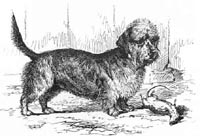
In yesterday's post, I noted that the Dandie Dinmont was sliding over the abyss of extinction with more Giant Pandas born last year than these once-upon-a-time working dogs.

I suggested that the cause for the demise of this dog was that market forces were at work: the Dandie Dinmont was no longer a working dog and no longer satisfied a need, and so had lost whatever constituency it once had.

Forced to compete head-to-head with other poodle-coated mops, this dog found few customers due to a high initial expense, an odd-looking sway back, and poor movement. If the Dandie had ever been bred for work in the last 100 years, it might have a client base today; it would certainly have much better structure. Instead, one of the oldest terrier breeds is about to go all the way throught the fanciers pipe and into the dustbin of extinction. Or at least that is the fear of some.

In short order I was inundated by lengthy emails ... from two people (a small joke). The first post was from Hilary Cheyne (quoted in the first article) who runs the Caledonian Dandie Dinmont Terrier Club. She wrote to say they were not trying to market the dog -- did I get that impression from their press release?

She went on to say that there were almost no Dandie puppies being born and that in her Club they were now running coefficients of inbreeding on the remaining dogs "so hopefully we will realise that what we call 'linebreeding' is just another name for 'inbreeding'." She then went on to say that "Outcrossing has and will be considered but it isn't needed at the moment" and then, a few sentences later, she observed that "Everyone now knows that Dandies can have Cushings, Glaucoma and Hypothyroidism" and that the dog also sometimes has "narrow angle glaucoma that is unique to Dandies."

OK. Good to know. A very small gene pool with serious health problems and even unique health problems? No reason to outcross then! Carry on!

Ms. Cheyne then went on to let me know that there were a lot of working Dandies -- look at all those American earthdog trials. At this point, I have to tell you, I started to chortle a little bit. So it's come down to this, has it -- fake work against a caged rat in a foreign country (and not many Dandies showing up even for that). Nothing wrong with earthdog trials (I have a section on the web site and in the book on earthdog trials, and I have written articles for magazines in favor of them), but let's not confuse a go-to-ground trial with real work, please.

The next letter in the email box was from Paul Keevil who wanted me to know that "it is actually against the law to hunt with dogs here in the United Kingdom, just as it is against the law to own firearms," so I was completely off the mark to suggest the Dandie might yet be saved if it ever saw a bit of honest work underground.

Of course, Paul is simply wrong. It's NOT illegal to hunt with terriers in the UK -- many thousands of fox are being dug to legally every year under the brand-new Hunting Act thanks to the exception for fox abatement on private bird-shooting lands.

And, ironically, the new law requires that any fox that is dug be shot with a gun -- you cannot move it to a new location as before.

In fact, guns and hunting fox with terriers is regulated in the UK, but neither is banned, as anyone who hunts with terriers in the UK can affirm. BASC alone has 120,000 gun-toting members, and somewhere between 10,000 and 20,000 fox a year are being dug to today.

The funny thing here is that the Hunting Act is just one year old and the Dandie Dinmont has been sliding into the abyss for 100 years due to the fact that the shape of the dog has been seriously distorted by show ring breeders.

Mr. Keevil and Ms. Cheyne were not digging on the dogs when it was wide-open to them; and neither was almost anyone else in the incredible shrinking Dandie Dinmont community.

Mr. Keevil upbraided me for only quoting Rawdon Lee, asking me if that was "the best terrier book you have?" Well, no, I have quite a few more books. So let's quote a few of the ones that are actually about working terriers and are not all-breed books or historical novels:


  • Mark Giles in "Working Terriers" (1988): "I don't know anyone who has a Dandie Dinmont that works."

  • Jocelyn Lucas in "Hunt and Working Terriers" (1931) does not mention the breed as a worker.

  • David Harcombe in "The World of the Working Terrier" (1989): Mentions Dandie Dinmonts in a single sentence list of 20 Kennel Club breeds, which is followed by "There, I have mentioned them and now we can forget about them. All, for various reasons, including size and temperament are not suitable to be considered for earth work. Any working terrierman who outcrosses his stock to such animals, and hopes to improve the working qualities, quite simply needs his head examined."

  • Brian Plummer in "The Working Terrier" (1978): "[T]he Dandie can scarcely be regarded as a force to be reckoned with as a working terrier. I find them far too slow to suit my requirements, and their very shape indicates a fundamental lack of agility that is essential in working terriers...."

  • John Broadhurst, et. al. in "Terriers and Terriermen" (2002): Not one of the 51 terriermen interviewed works this type of dog or even mentions the breed.

  • Sean Frain in "The Traditional Working Terrier" (2001): Does not mention the breed at all.


And, of course, there are two books on American working terriers, neither one of which mentions the breed as a worker.

In a friendly exchange of emails, I extended a challenge to Mr. Keevil who says he has no interest in working his terriers but is very well-connected in the picture world (he runs a canine graphics-art business).

My challenge is for him to find even one picture of a Kennel Club Dandie Dinmont that was dug to in the last 50 years. I want a photograph of a Dandie (wearing a locator collar) and his fox or badger standing next to a hole freshly dug. No roadkill photos now! I noted that "It's very easy for show ring fanciers to drift into fantasy and spend their days mooning over paintings and standards. The end result is what you have with the Dandie Dinmont today -- a dog teetering on the edge of extinction and as far from its roots as a (theoretical) working dog can get."

The challenge is not yet very old yet (made yesterday), and I hope a photograph of a working Dandie will arrive and I can post it. That said, I am not all that hopeful. The first flurry of activity from Mr. Keevil produced five illustrations of Dandie Dinmont's (none of the illustrations showing a dog working fox or badger). I am confident we can do better than this. Even the Loch Ness monster and Sasquatch have real action photographs of themselves!

Perhaps we shall yet get an old picture of Alf Rhodes who the Caledonian Dandie Dinmont Terrier Club itself describes as "the last man going to ground with Dandies." Rhodes went to the Great Hunting Ground in the Sky in 2003 at the age of 81 or so. He did not work his dogs in his later years, but he did have a working Dandie or two in the mid-1970s. Since that's only 30 years ago, and well within my 50-year challenge, we may yet see a picture of a working Dandie.

A picture, of course, will not save the dog anymore than will pets-and-rosettes promotion of the breed. The last Dandie Dinmont owner on earth will talk of the "3rd Duke of Buccleuch" on the day he or she slides that last dog into the ground, but in fact, if past is prologue (and it so often is) the grave is the first and last hole that that Dandie Dinmont will have ever seen. There is some irony in that. Perhaps that will be the Last Great Dandie Dinmont Story. Sadly, I may yet be around to hear it.

Tuesday, October 31, 2006

The Mounted Hunts, One Year On

One year after the ban on hunting with dogs, a new poll done by the Countryside Alliance shows that 34 percent of packs consulted reported an increase in subscribers, two new hunts have been created, and 90 percent of the hunts report the same support or better since the Hunting Act became law.

About 130 of the 185 hunts in England and Wales have switched to drag hunting in which hounds follow a lure doused in fox urine, but the rest are using hounds to flush foxes from cover to be (theoretically) killed by birds of prey such as Golden Eagles and Eagle Owls.

Terrier work is still allowed, provided the hunting is done on land with the owners written permission and to protect game bird populations. Only two terriers are allowed in the field at a time, and only one dog, with locator collar, is allowed below ground at a time. Only fox can be legally hunted by terriers; badger work remains illegal despite such an abundance of badger that the Government is now using gas to kill thousands every year in an effort to control bovine tuberculosis.

New Bristol University shows that there has been no change in the fox population since the ban. Its two-year nationwide study, to be published early next year, shows the number of adult foxes has remained stable at around 250,000. About 425,000 cubs are born each year, and the same number are killed by disease or cars (most fox mortality in the UK), are shot, or are snared. In short, the ban has not saved a single fox life, it has only meant an alternative death. Prior to the ban fox hunting with hounds accounted for just 20,000 fox deaths a year.

For more information:

Saturday, September 09, 2006

Putting a Point on the Absurdity


From The Daily Telegraph

Hunt Man Turns Himself in After Dog Kills Mouse by Paul Stokes

A retired police officer has admitted twice flouting the new hunting law by allowing his terrier dog to chase and kill a mouse and a mole.

George Morrison, 51, reported himself to former colleagues but he was not prosecuted over either incident.

In the first case, the dog, named Chip, flushed a mole from beneath a horse trailer before swiftly killing it in June last year.

advertisement
Two months later, Chip chased a mouse from behind the washing machine at the family home and went on to make another kill.

Mr Morrison served with Northumbria Police for 30 years before retiring as a detective inspector three months after the Government's Hunting Act came into force in February last year.

He turned himself in to the police on both occasions to demonstrate that the 2004 Hunting Act was a "ridiculous law".

Under the legislation, moles and mice are classed as mammals that cannot be killed by dogs, although they can be shot by a competent huntsman.

Mr Morrison said he was not taken seriously when he reported himself, but was eventually cautioned. He was later told no further action would be taken.

When Chip repeated the offence, the matter was again brought to police attention and a sergeant and constable conducted a second interview.

Again the Crown Prosecution Service did not bring proceedings.

Mr Morrison, who lives with his wife Karen in the Tyne Valley, Northumberland, said: "I knew they wouldn't take me to court because there would have been a media frenzy. Putting myself in a police officer's role, this Act is a nightmare and something they didn't want to enforce."

Since retiring from the police service, he has remained as secretary of the 137-year-old Border Hunt, which was set up to control foxes over a large area of Northumberland and Roxburghshire.

He has gone public on the issue ahead of the second season of hunting since the ban came into effect to draw attention to the state of the law. Mr Morrison stressed that the hunt, which he will head out with next week, operated within the law.

"This law was not about animal welfare, it was about trying to get so-called toffs and red jackets," he said. "But it is rural communities it is affecting."

Chief Insp Simon Packham, of Northumbria Police, said: "We did refer two cases to the CPS regarding this individual, but no further action was taken."

The only material available to police against Mr Morrison were his own admissions in his statements.

A CPS spokesman said: "There was insufficient evidence for a realistic prospect of a conviction."

Richard Dodd, the regional director of the Countryside Alliance, said: "George is helping to make the point that this law is not about foxes, but is about revenge from the Government about things such as the miners' strikes."


Meanwhile, out in the farm country, the veterinarians and the farmers have joined hands to try to get DEFRA (the Department for Environment, Food and Rural Affairs) in the UK to tackle a proliferation of badgers which are believed to be spreading bovine tuberculosis, which is now appearing even in closed herds.


From Farmers Weekly Interactive of 06/09/2006

Industry call for DEFRA to allow badger cull to reduce bovine TB risk

Farming and veterinary organisations in the UK have presented a joint statement to DEFRA detailing how the government should tackle bovine tuberculosis.

At a meeting last Thursday (24 August) the group agreed several points, the main being that badgers in areas heavily affected by TB should be culled.

The government, they say, should approve applications for culling licences as permitted under the Protection of Badgers Act 1992.

But the group does not suggest farmers carry out the culling. Instead they should employ suitably trained individuals to do it.

Crucially, the proposals give industry control of the operation while minimising the cost to the government. They also allow DEFRA to remain distant from the issue, other than the approval of licences and provision of suitable maps.

In accordance with the Independent Scientific Group's conclusions of the Randomised Badger Culling Trial, the group also advocates culls are carried out across areas of at least 300sq km by urging farmers to collaborate with their neighbours.

Initially, the culling method would be cage trapping followed by shooting (as used in the RBCT). But it suggests carbon monoxide and, possibly, stop-snares be adopted as first choice methods once approved.

Meurig Raymond, deputy president of the NFU, said: "We've done all we can here. We've agreed a position which will involve farmers continuing to put up with cost and inconvenience, but as part of a partnership approach with government.

"This agreement has now been issued to the minister, Ben Bradshaw. This places the ball very firmly in the government's court. We're prepared to play our part, are they prepared to play theirs?"

British Veterinary Association president Freda Scott-Park endorsed Mr Raymond's comments saying the time had come for some joined-up thinking.

"We're very much supportive of the NFU and its mature approach. As a dairy farmer I know how challenging farming is. With TB it's even worse. As a veterinary surgeon it is quite distressing to see the disease expanding year on year. We are particularly concerned by the number of closed herds going down with TB."

Dr Scott-Park added that she often hoped to achieve consensus across all groups involved in the TB debate, including conservationists, if only they would listen to reason.

DEFRA is understood to be reviewing the statement.

Sunday, April 30, 2006

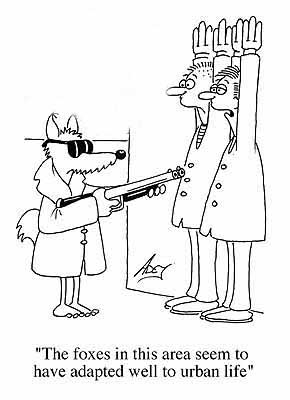
Urban Fox Now a Problem in London


WALL STREET JOURNAL - April 26, 2006; Page A1
Thousands of Foxes Are Living in London And Making a Mess
City Dwellers Fend Them Off, But Not Very Effectively;

By Cassell Brylan-Low,
LONDON -- Londoners are being outfoxed by foxes.

Long associated with Britain's leafy countryside, foxes now have become a common sight here. The creatures, which can trash gardens and leave a foul scent, can make unwelcome neighbors and have prompted some city folk to arm themselves with water jets and traps.


Gillian Alman has raised her fences, sprinkled pepper-laced repellents and even thrown water to scare off the fox that tears up her lawn, destroys her plants and steals shoes left outside. "He's a little demon," says Mrs. Alman, 61 years old, who lives on a street of Victorian houses in Balham, a residential district in south London. "He's so daring, he comes right up to the window and looks at us."
Robert Harris spent more than $2,000 on a new fence for his garden to keep out foxes. But they burrowed under it and continue to tear up his garden as well as gnaw through the television cable and cause Mr. Harris's West Highland terrier to bark at night. "The dog sits by the window and goes berserk," says the 80-year-old Mr. Harris, the former chairman of a theater-makeup supplier called Charles Fox. "It really is a nuisance."

For his next attack, Mr. Harris is eyeing a water-jet device that attaches to a garden hose pipe and fires water when an animal approaches.

Experts say foxes and humans increasingly are brushing up against one another as heaps of urban garbage act as a tasty lure and the city limits spread. It's too early to tell what, if any, effect a recent law limiting fox hunting is having on London's foxes. The fox has become a common feature of the city's landscape like the gray squirrel and the pigeon, both also considered by many to be urban pests.

There are an estimated 10,000 foxes living in the London area, some of them very near the financial district, Buckingham Palace, and No. 10 Downing Street, the prime minister's residence.

Opportunistic omnivores, foxes feed on pet rabbits and guinea pigs, as well as on worms, beetles, birds, rats and fruit. And they can get into spats with cats. Gardens are a particular problem.

A few years ago, Peter Craggs spent two weeks manning night vigils to catch the vandals that were repeatedly ripping out the underwater lights from his new garden pond and cutting the cables. He called the police twice before he caught the bushy-tailed culprits.

Mr. Craggs, a semiretired university administrator, bought a house in the countryside six months ago and says he has yet to see a fox there. He jokes the government should reach a compromise on fox hunting, which is now prohibited: ban it in the country but allow it in the towns. "You could have your Hackney hunt," he says, referring to one of London's inner-city boroughs.

The 2004 Hunting Act bans the hunting of foxes, or any wild animal, with packs of dogs. Traditionally, hunters on horseback or foot have followed packs of dogs that chase and kill foxes. It still is permitted to use up to two dogs to flush out wild animals, which can then be shot. Parliament took up the issue because it deemed the pack-dog chase cruel to animals. Hunters marched in protest arguing that the sport helps keep the fox population in check.

Shooting foxes by licensed gun owners remains legal under British law, as do most forms of trapping, says a spokeswoman for the government's Department for Environment, Food and Rural Affairs. Hiring a pest-control company to trap or shoot a fox can cost as much as $900. Poisoning is forbidden, however. The British government at one time tried to stem the rise of the urban fox population and as early as the 1940s started killing foxes in cities. But it phased out the policy by the 1980s because it was costly and largely ineffective.

Moreover, killing foxes is an emotional issue in the U.K., which has a strong animal-rights tradition, as Charlton Athletic Football Club has discovered. After a newspaper reported that the professional soccer team had hired County Pest Control Services Ltd. to dispatch the foxes that dig large holes in the field at its London stadium, it received a mailbag full of complaints, says operations director, Mick Everett.

Before that, Mr. Everett had hired someone to trap and relocate the foxes outside the city, but animal-welfare advocates argued that that, too, was inhumane because urban foxes can't fend for themselves in the country.

Now, Mr. Everett is getting advice from a wildlife consultant, who has recommended the soccer club block gaps under the fences and have a dog walk the perimeter to leave its scent.

Responsibility for dealing with foxes now falls to the local councils that govern London's 33 districts, mostly known as boroughs. But they typically just offer advice about securing garbage and reinforcing fences.

Many obvious alternatives, including the Royal Society for the Prevention of Cruelty to Animals and large pest-control companies like Rentokil Initial PLC won't routinely deal with foxes. The RSPCA says it intervenes only if a fox is injured or ill, and Rentokil says that it's company policy not to deal with foxes because they are such a touchy issue. "It's easier not to deal with that particular banana skin," a Rentokil spokesman says.


The buck-passing has been a source of frustration for London residents, including Lesley Aaronson, a 46-year-old mother of four who recently discovered a pair of trapped fox cubs under the stairs to her cellar that had entered the house through a broken air vent leading to the garden. She tried the RSPCA twice, as well as her local council and two pest-control firms, but no one could help her.

"It's a complete spiral of ever-descending madness," says Mrs. Aaronson, who meanwhile had to cope with whimpering cubs that sounded like crying puppies. "It was very distressing."

She finally found John Bryant, a wildlife consultant who charges $90 to $125 a visit and generally advises clients to tie up garbage, use repellents, remove compost heaps and fence off ponds. Still, it's very difficult to get rid of foxes for good, says the 63-year-old, who shuttles between jobs in a dark green station wagon plastered with wildlife-society stickers. He also concedes that displacing foxes from one garden means they'll probably end up in another.

In Mrs. Aaronson's case, Mr. Bryant enlisted the help of a builder to punch a hole in the wall. Then Mr. Bryant, sporting protective overalls and gloves, fished out the six-week-old cubs. He left the cubs in the garden shed with the door ajar and figured their mother would likely return for them and move them elsewhere. She did.


Friday, December 30, 2005

Hunt Numbers are Up, Up, Up


Yorkshire Post, December 27, 2005

Outlawed - But Hunting is More Popular Than Ever

Massive crowds expected to show support at Boxing Day meets
by Simon McGee, Political Editor

HUNTING with hounds is more popular now than before it was outlawed - and today's Boxing Day meets are expected to be the busiest in the history of Yorkshire's hunts.

Membership across the county has risen by about 10 per cent, although in some areas hunt rolls are up by 20 per cent, the Countryside Alliance (CA) says.

A year ago there were widespread fears that the Hunting Act, which came into effect on February 18, would lead to the disbanding of packs, retirement or destruction of dogs and loss of thousands of countryside jobs.

But masters of hunts and organisers say the ban and the controversy surrounding it have galvanised support for the pursuit and acted as a recruiting sergeant for people who had previously no links or interest in the sport until the political furore made it front-page news.

It is now so popular that at least one Yorkshire hunt has had to take the almost un-heard of decision to cap the numbers of riding members turning up on meet days, because of concern for the farmland they ride across.

Hunts say the law, which took eight years of Parliam-entary wrangles and hundreds of hours of debate in Westminster, has so many loopholes and so much scope for interpretation that they can continue going out with hounds and killing foxes.

The law allows packs of hounds to be exercised, and absolves huntsmen from blame if dogs catch a scent and kill a fox, so long as they do not set out to go fox hunting and do everything they can to stop the chase and a kill taking place.

Dogs can also be used to flush out underground foxes that are considered a danger to game or livestock, so they can be shot.

Yorkshire's hunts are killing about 15 foxes a week, the same number as before the ban, the CA has previously estimated, and to date the Crown Prosecution Service (CPS) has not proceeded with a single prosecution anywhere under the Act.

The CA's Yorkshire regional chairman John Haigh said: "Everyone said last year's Boxing Day hunt would be the last, but as it happens we're now looking forward to massive crowds of support at every meet across the county.

"We've shown we can stick together in the face of the Hunting Act and we're determined to carry on and keep everything in place for when the Act is one day repealed".

In North Yorkshire Glaisdale Hunt says subscriptions are up 20 per cent, while the Bedale has not only reported a 10 per cent rise but also a limit on meet days because of concern about the potential damage to farmland by too many horses.

Hurworth Hunt has also seen a 10 per cent boost in members.

Subscriptions to the Badsworth and Bramham Moor Foxhounds, which meets across the middle of Yorkshire, are up by eight per cent.

Barlow Hounds, which hunts in South Yorkshire and North East Derbyshire, has seen the number who turn up to ride regularly rise from about 50 to 60 and a clear increase in subscriptions.

Hunt secretary Caroline Excell-Thomas said: "We have more subscribers and members coming along twice a week than ever before. And we have all these people coming along who had no connection with hunting before the ban gave it so much publicity.

"Overall, we're well up on last year and are expecting our biggest Boxing Day meet ever. We're going great guns".

The Holderness and York/Ainsty South hunts said membership was as strong as it was a year ago.

Ryedale's Tory MP John Greenway, who vigorously opposed the ban, said the popularity of hunting with dogs had shown that the Act had been "a complete and utter waste of time".

"The law is unworkable and defective. It's as simple as that and we said so at the time. You only have to look at how it's boosted hunting. I'm not surprised that membership is up - it's what I'm hearing all the time. As many people as ever, if not more, will be turning up today".

One of many Yorkshire Labour backbenchers who supported the ban, Selby MP John Grogan, said: "So long as everyone is obeying the law I'm happy that the spectacle of horses riding across the countryside continues.

"If they are not staying within the law, as some people allege, then no doubt there'll be a prosecution at some stage".

The CA's new chairman, pro-hunt Labour MP Kate Hoey, will be at Riley-Smith Hall, Tadcaster, on Thursday, January 12, as part of a regional tour to meet members and supporters.

Saturday, September 17, 2005

Ex-RSPCA boss: bring back fox hunting with dogs


Woops -- the people were right. Again.


From The Birmingham Post:

A former chairman of the RSPCA has attacked the organisation for supporting the fox hunting ban.

John Hobhouse said shooting foxes was crueller than hunting with hounds which should be allowed under licence with extra legal protection for wild animals.

In a letter to The Times, John Hobhouse, who was a member of the RSPCA council for 20 years and its chairman for seven, said: "Recent peer-reviewed research demonstrating high levels of wounding in shot foxes, shows that more animals will suffer for weeks before gangrene finally causes a painful death.

"It must bring many people to accept the irksome truth that shooting creates greater cruelty for the fox than hunting with hounds.

" The Hunting Act is severely flawed and unworkable. It should be amended as a matter of urgency. For an Act of Parliament, purporting to relieve animal suffering, to do exactly the opposite is very sad.

"That the RSPCA, which does immensely important work on so many animal welfare fronts, has been party to this fiasco is a tragedy for the many animals the Act sought to protect.

"It was also a mistake to give the impression that hunting hounds could be taken in by the RSPCA kennels.

"These animals if they can be re-homed at all, will require far more attention than other dogs and the RSPCA will not be able to cope. For every hound saved, four or five other dogs will be denied help."

Lembit Opik, Liberal Democrat MP and co-chair of the Middle Way Group of MPs which wants licensed hunting, said: "I am encouraged but not surprised that Mr Hobhouse has taken this view."


"Now, here's the deal, we only have room at the RSPCA for one of you."

Tuesday, July 05, 2005

UK Terrierman Part of Legal Challenge to Hunt Ban


Horse & Hound Online, July 5, 2005

This morning two new legal challenges to the Hunting Act got underway at the Royal Courts of Justice in London

This morning saw two new appeals against the validity of the Hunting Act begin at the Royal Courts of Justice in London.

The first appeal is on human rights grounds with 10 claimants appealing against the Hunting Act, claiming that it breaches four articles of the Human Rights Act: the right to property and the uses of that property; the right to respect for private and family life; freedom of assembly, and association and prohibition of discrimination.

The barristers acting for these claimants will also argue that the restrictions imposed by the Hunting Act cannot be justified and that no legitimate aim has been clearly identified by the proponents of a ban.

The barristers acting for the claimants are Richard Gordon QC and Richard Lissack QC. The claimants are Donald Summerskill, a huntsman with the Devon and Somerset Staghounds, Lesley Drage, who owns a livery yard, Roger Bigland, a terrierman with the North Cotswold Hunt, Colin Dayment, a farrier, Kim Gooding a hare coursing trainer, Joe Cowen, a landowner and Master of Foxhounds, Ken Jones, a Welsh sheep farmer, Richard May, a beagle pack owner, Giles Bradshow, a farmer, and Jason Vickery, a tenant dairy farmer.

The second challenge is on European Community law grounds, and the main thrust of this case is to argue that the hunting ban is having a major and practical impact on cross border economic activity, which is a fundamental right enjoyed by all citizens of EU member states.

John Jackson of the Countryside Alliance said outside the Courts today: "We maintain that the Hunting Act is a bad Act and it was passed in a bad way. Our first challenge to the validity of this Act is going to be considered next week at the Highest Court in the Land, but we are continuing to challenge the nature of this Act in different ways because it infringes upon the basic freedoms protected by the Human Rights Act.

"There is simply no case for arguing that hunting acts against the public interest, so we have high hopes that the basic freedoms we are all entitled to will be recognised," he added.

Colin Dayment, a farrier, and one of the claimants on the Human Rights challenge said he was inspired to get involved with the case because it is not just his business under threat but his whole way of life.

"What I am here for is not just to try and save my business, but to save my community and my social life. Hunting is tied up with the entire way I live, and if it remains illegal I will be out of a job, and the structure of my life will fall apart," he said this morning.

These new challenges are set to take a week to be heard, while the House of Lords is due to hear the appeal of the Alliance's original challenge to the Parliament Act next Wednesday and Thursday (13 and 14 July).

Tuesday, April 05, 2005

"The Ban" So Far: 800 Fox in 1000 Hunt Days


THE JOURNAL (Newcastle, UK), March 25, 2005
800 foxes killed since hunt ban

Fox-hunters across England and Wales have tallied up more than a thousand days of hunting between them and killed around 800 foxes since the pursuit was banned last month.

Despite the implementation of the Hunting Act on February 18, which has outlawed the use of hounds, other methods have included flushing out foxes to waiting guns and terrier work to protect game birds.

Although hunting in the North-East has been largely slowed by the weather since the ban came into force, last night the Countryside Alliance said the figures showed the controversial legislation did not protect foxes.

Chief executive Simon Hart said: "It is a huge morale boost to see hunts determined to retain their infrastructure until this temporary ban is repealed.

"Hunts around the country have shown just how impossible it would be for already overstretched police forces to enforce the legislation.

"The support for hunting in the wake of the ban has been outstanding, and hunts will be looking forward to next season with increased determination." Martin Claxton, huntsman with the Percy Hunt in Alnwick, said last night: "This legislation has never been about protecting wildlife."

Mr Hart added that the Hunting Handbook, produced by the Alliance in conjunction with the Council of Hunting Associations, had been instrumental in providing a way forward for the hunting community until the Hunting Act is erased from the Statute Book.

A new edition will be published soon, as will a strategy for hunting in the future. He added: "We are confident of both of our legal challenges, which return to the courts later this year."

Northumbria Chief Constable Crispian Strachan is due to say the hunting ban is difficult to enforce this weekend. In a television interview to be broadcast on Sunday, he adds: "It's not a high priority because it is not a recordable offence.

"There are no human victims and I'm sorry, there will be people watching this who feel very strongly but I am bound to put human victims before animal victims and then deal according to resources."

Friday, February 18, 2005

Gamekeepers' Code Of Practice For Terrier Work


In the UK, a legally enforceable code of conduct strictly regulating the use of dogs underground has been published.

The Code, drawn-up by the British Association for Shooting and Conservation (BASC) and approved by Defra, has effect as part of the Hunting Act which came into force today.

Under the "gamekeeper's exemption" in the Act, a single dog can be used below ground to flush out a wild mammal if this is to protect birds for the purpose of their being shot. This is to allow pest control necessary for shooting to continue unaffected by the Hunting Act.

The strict conditions in the exemption and the Code are designed to prevent abuse and to protect the welfare of the wild mammal and the dog. Failure to abide by the Code is a criminal offence and can lead to a fine of up to £5,000. It may also result in disciplinary action or expulsion by organisations endorsing the Code.

The Code, produced following a consultation with shooting groups and animal welfare organisations, is supported by a Good Practice Guide prepared by BASC.

Some bits and piece from the Code:

  • "The terrier's role must be to locate the wild mammal underground and cause it to ‘bolt’ (leave the earth or den) as soon as possible so that it can be shot by a competent person and humanely dispatched. It should not be intended that a terrier will fight the wild mammal. "
  • "Only terriers that are ‘soft’ (those that habitually stand off and bark at the wild mammal) must be used. Terriers that are ‘hard’ (those that habitually fight) must not be used. "
  • "The terrier being used must always be fitted with an electronic locator so that its exact position underground can be tracked. "
  • "There are circumstances where, by virtue of public safety, avoidance of risk to other wildlife and practicality, it is preferable to use an experienced terrier to locate a fox in its earth and enable it to be killed humanely. "

Friday, January 28, 2005

Ban in England and Wales Upheld by Court


The ban on hunting foxes with dogs in England and Wales is legal, a London court has ruled. The High Court rejected a challenge to the Hunting Act by members of pro-hunting group Countryside Alliance, which argued the legislation wasn't validly adopted by Parliament. The Parliament Act of 1949 allows the elected Commons to pass laws that the House of Lords has rejected in two successive parliamentary sessions. A previous 1911 version of the Act required three unsuccessful tries through the unelected upper chamber.

The Parliament Act has been used to pass only three other laws -- the law equalizing the age of consent between heterosexuals and homosexuals; the War Crimes Act in 1991, which extended the jurisdiction of British courts to cover acts committed on behalf of Nazi Germany during the Second World War; and a law that introduced a proportional representation voting system for elections to the European Parliament.


Friday, November 19, 2004

UK Bans Fox Hunting -- Court Challenges Now

.
From The News Letter of Northern Ireland, Nov, 19. 2004:

Fury As Hunting Ban Finally Becomes Law


A ban on fox hunting will be in place by February 2005 causing outrage among Ulster's Countryside Alliance.

Commons Speaker Michael Martin last night told MPs the Parliament Act was being used for only the fourth time since 1949 - a move sparked by peers who earlier rejected a ban on hunting with dogs.

The bill was then given Royal-Assent, bringing to an end years of wrangling.

Countryside Alliance Ireland Chief Executive, Ronan Gorman, said the Prime Minister and the Government have allowed MPs to enact prejudiced,-discriminatory and divisive-legislation to ban hunting.

"The Labour Party has refused to accept a sensible solution to this issue and has abandoned its stated position that legislation would only be based on principle and evidence.

"It is imperative that people do not see this as the end of the campaign in England and Wales. It is not. It is the beginning of stage two. The Alliance-will now launch its challenge-to the validity of the 1949 Parliament Act. Our case centres on the argument that the 1949 Act was not properly passed and the Hunting Act is therefore unlawful.

"Mr Gorman said the second legal case will contend that the Hunting Bill infringes human rights under the European Convention.

As well as fox hunting, deerhunting and hare-coursing with dogs will now be outlawed in England and Wales.