Showing posts with label trapping. Show all posts

Thursday, January 11, 2018

Vicious: Wolves and Men in America


Despite a lot of talk and unfounded rumor, there is only one record of a non-rabid wolf killing a human in North America since the arrival of Europeans.

Yet humans have killed wolves wholesale, using poison, traps, clubs, rifles, and even laying out mackerel hooks inside lumps of meat and fat. Nothing was too brutal in the quest to exterminate the wolf, and by 1880 a large part of America was wolf-free.

The wolf hung on into the 20th Century, however, in large part because the bounty system did not pay enough for people to spend months tracking down the last western wolves which were smarter and more trap-shy than most. When the Government began paying a professional cadre of wolfers to exterminate the last of their kind, however, the fate of the wolf was sealed.

Ironically, one of the last Government wolfers was Aldo Leopold, whose birthday it is today.  Aldo was a wolfer when he was a young man working for the U.S. Forest Service in New Mexico. Leopold went on to write the first book on Game Management in the U.S., and became, posthumously, an icon of the modern environmental movement with his memoir, A Sand County Almanac.

Buried in that little book is an essay called "Thinking Like a Mountain," and within it a section in which Leopold observes the dying of a "fierce green fire" within a wolf as it bleeds out on on rock after being shot.

Up until that hunt, Leopold had thought what he had been doing was good for deer and the mountain, but after seeing the wolf die he suspected neither the deer nor the mountain agreed with that view.


In time, as deer overgrazed sections of the West and East, Leopold began to fully understand the importance of keeping top predators in the eco-system. "A thing is right," he wrote "when it tends to preserve the integrity, stability, and beauty of a biotic community. It is wrong when it tends otherwise."

But Leopold came to this conclusion many decades after shooting out the last wolves of New Mexico, and in his youth he was among the cadres of Government wolfers who told stories about wolf hunts in order to help raise cash to support the public extermination effort.

Government-sponsored wolfers created traveling displays of wolf pelts and wolf skulls. These displays and stories memorialized the last of the western wolves and gave them names: The Custer Wolf, Old Three Toes, Old Lefty, and Old Rags the Digger, among them.

By giving individual wolves names and personalities, Government trappers helped break down the wall between wolf myth and wolf reality. The wolf, which had once seemed threatening, dangerous and mysterious, now became the outlaw hero of the story, and an emblem of the last days of the romantic (and dying) American frontier.

This is the essential plot structure of Jon T. Coleman's book "Vicious: Wolves and Men in America."

The book is not a text on wolf biology, but a history book that analyzes the gaps and nexus between wolf myth and wolf reality. Though well-written, it is more than a little burdened by the weight of being overly-academic and spending perhaps too much time on folklore and not enough on basic wolf biology. No matter -- if you have ever wondered how the wolf went from pariah to paragon in the space of 50 years, this book tells the tale.

Coleman suggests that the wolf reintroduction efforts of the 1990s (which have been quite successful) occurred because America is now mostly urban and has little contact with farm animals which now come from protected feed lots rather than the free-range forests and fields where wolf, ranchers, farmers and livestock once battled.

"Human predation has become so technical and abstract [in the lat 20th Century] that the consumers of animal protein no longer feel emotionally connected to the beasts they ingest...
Reintroduced wolves have thrived in a cultural environment that accepts the scientific extermination of millions of domestic animals but rejects violence towards a handful of wild creatures."

Would the wolf have been reintroduced if Americans still lived on grass-fed beef?

Perhaps not.

Did cows have to fatten in feed lots in order for America to returns its large predators to their spot on the ecological ladder?

Perhaps.

It is an uncomfortable kind of tradeoff.


Friday, November 18, 2011

Friday, September 16, 2011

Eye Ulcerations from Underground Skunk Spray


It's that time of year -- more terriers being hunted with the cool weather, and more skunks being found to ground for the same reason.

Skunk toxic shock is the major worry (see here for notes about that), but corneal damage and eye uclerations from the acid in skunk spray is another issue. 

A quick feview of the "eye facts" as I know them (and all of my dogs have been skunked multiple times underground):
  1. It is probably a myth that skunk spray can cause permanent blindness. When gotten into the eyes the spray often causes temporary blindness, and burns like crazy, but there are no documented cases of skunk spray alone causing permanent blindness in a dog.
    .
  2. If your dog does end up with ulcerations of the cornea, crate the dog for several days and load it up on antibiotics (cephalexin is fine). The only thing to fear is infection. The important thing is to let the eye rest and heal.  Where to get cephalexin and at what dose?  See here for information about basic antibiotics for working dogs.
    .
  3. After your dog is sprayed, expect your dog to have small blisters and ulcers around sensitive areas such as lips and ears -- this is normal and will go away. It is caused by the extreme acidity of skunk spray.
    .
  4. Feed and water your dog well and keep it warm and rested for at least a week after a skunk encounter.
    .
  5. Road flares placed in a skunk den are said to kill the animal, but if your dog has just been sprayed and stink is pouring out of the hole, you may just want to get the hell out of there.

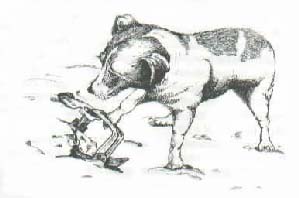
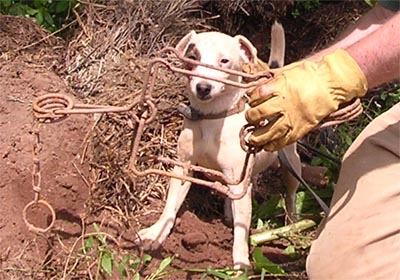
While you are thinking about Fall and Winter hunting with your terriers or other dogs, you might as well read, circulate, and even print out a copy of this page on Releasing Your Dog From a Trap.  Remember,the dog you save may be your own!
.

Tuesday, December 14, 2010

Variability in Size & Law and Among Wild Canids

A 104-pound coyote or a wolf with a little coyote in it?


I got a question earlier today about variability in the size of red fox.

My response was the same as it always is:

[F]ox size are variable all over, just as wolves are, and coyotes are, but they "bell out" at an average weight of around 15 pounds +/- two pounds, and that's true all over.

Yes, across broad regions there is some variation in size, but this seems to be mostly due to the length of the body. Italian dog foxes average two pounds lighter than their English kin, and Italian vixens averaged one pound lighter than their English counterparts. Though you would think this might make for an English fox with a slightly larger chest, this does not appear to be the case -- body length seems to be the determinant variable.

In my experience, Maryland fox are about 12-15 pounds, but I have handled some smaller (11 pounds) and a few that were considerably larger. I do not kill fox, but I have friends who do, and they have booked a few as big as 22 pounds. Still a small chest though. A fox is mostly fur! It says a lot that there are no fox taxidermy manikins with chests larger than 14" around.

Wolves and coyotes, of course, are another matter altogether.

Both are extremely variable in size, reflecting the fact that they are true dogs (Canis) with the extreme plasticity we see in that genus, rather than merely a canidae which includes the fox (Vulpes) genus.

How variable are coyotes in size?

Western coyotes seem to average around 22-30 pounds or so, with Eastern Coyotes weighing in at 30-40 pounds. That said, in some places, such as New York's Adirondacks National Park, the coyotes are very large (50-60 pounds) and DNA testing shows a lot of wolf blood running just below the surface.

Coyotes and wolves will interbreed if they cannot find a mate, and both species will, on rare occasion, naturally hybridize with domestic dogs.

The "Red Wolf," which was once common all along the East Coast, and has since been reintroduced into North Carolina, is simply a stable wolf-coyote hybrid.

So how big and how small can a coyote get?

On the small side of the stick, the answer is about 18 pounds -- well within the bell curve for a large red fox.

On the large side, however, the question is a little harder to answer, as it depends on what you want to call a coyote.

In Maine there are "coyotes" that weigh more than 70 pounds, but most of these really large animals are at least half wolf.  In fact, about one out of every five Maine "coyotes" is actually at least 50 percent wolf.

The biggest allegedly pure coyote ever shot appears to be a "coyote" shot in Carroll County, Missouri on the opening day of the deer season this November 13th.

On the web site of the Missouri Department of Conservation they say:

DNA tests show that a 104-pound canine shot by a hunter in Carroll County Nov. 13 was an unusually large coyote.

The hunter shot the big canine on opening day of Missouri’s November firearms deer season, thinking it was a coyote. Coyotes are legal game during deer season. However, when the hunter saw the animal’s size, he wondered if he had mistakenly shot a wolf. He reported the kill to Conservation Agent Marc Bagley.  Bagley took possession of the animal and turned it over to the Missouri Department of Conservation’s (MDC) Resource Science Division for identification.

Resource Scientist Jeff Beringer said the MDC staff took measurements and collected tissue and hair samples for DNA analysis. The test showed the animal was a coyote.

According to Beringer, the coyote was a male approximately 3 years old. It had no tattoos, microchip or evidence of ear tags that would indicate it might have escaped or been released from captivity.

Do I actually believe this animal is 100 percent coyote? 

Not for a minute. 

But I am prepared to be wrong.  I suppose it's possible that this animal had a brain tumor that made its pituitary glands go wild. 

But I am a natural skeptic, and so far I note that there are no full-bodied pictures of this animal next to something which provides scale.   No video either, that I can find.

I think that's odd.  

You would think a 104-pound coyote would have more pictures and video taken of it than Anna Nicole Smith just back from the dead and parading topless on Wall Street. 

So where are the pictures?    Where is the video?  The one head-shot picture we have shows an animal with wolf ears.

And please, no nonsense about there being no pictures because someone, somewhere, is worried about "the antis."   The antis???   Flush that nonsense, please!  

This is America, and we hunt and fish and trap without apology.  We have hunting shows on TV every night, and politicians stepping on themselves to be filmed blasting away at Caribou, Geese and Dove.   In this country, we're not squeamish about showing pictures of any animal, dead or alive!

So where are the pictures and video tape
of this 104-pound coyote?  What's the name of the outfit that did the DNA work? 

Inquiring minds want to know! 

And perhaps I will get an answer... I just shot an email to the dedicated state wildlife personnel in Missouri asking a few questions.  I hope they have time to shoot an answer back!  They might not, of course -- it's the middle of every kind of hunting season under the sun, and there's a lot of work to be done out in the field, I imagine.   But stay tuned!
_ _ _ _ _ _


UPDATE:   Wow!  Not only did I get an answer back from Jeff Beringer, resource scientist and conservation biologist for the State of Missouri, but I got it back almost instantly.  Someone give this man a raise, or at least a valuable first edition copy of Aldo Leopold's book on Game Management!  Mr. Beringer clarifies that:
  • Early test results showed coyote DNA was present in the sampled animal
  • Follow up tests are planned using DNA from wolves from nearby great lake states to see if their wolves also have coyote DNA.
  • It is possible for this animal to be a wolf or wolf hybrid and carry coyote DNA

Bingo. 


So, back to the question:  When is a wolf a wolf, and when is a coyote a coyote?   Does a single drop of coyote blood in an animal make it a coyote, or are we going to snap a line and say that every animal over 70 pounds is a wolf, and no DNA testing needed at all?

The reason this question is important, is that while the coyote is not protected anywhere, the wolf is protected almost everywhere. 

A deer hunter shooting a 30-pound coyote has done nothing wrong. 

A deer hunter shooting a 104-pound wolf (three times larger and with very different ears, as can be seen in the photo at top) has just shot a protected animal.

One question that naturally springs to mind is this:  Is Missouri trying to blur the distinction between wolves and coyotes for a larger political purpose, or perhaps just this once to give this particular shooter a break for making an "honest mistake?"

Time will tell as we see what is said, and how it is messaged, and how the information is used. 

Remember, according to the biologists, a Red Wolf (Canis rufus) is just a wolf-coyote hybrid, identical in every way to the animal shot in Missouri in terms of size and looks.   In addition, the Red Wolf is the wolf that was once native to this area, so eventual return to the area is not entirely unexpected. 

But Red Wolves are entirely protected, and anyone shooting one is punishable by up to a year in jail and a $100,000 fine under the Endangered Species Act.

Which beggars the question.  Is the Red Wolf a species or a hybrid, or can a species be (as I would argue) a stable hybrid?  

This is the question that I think is about to get launched with a little more urgency.... and which no doubt will burn up the keyboards of arm chair pundits on both sides of the debate.

Monday, December 13, 2010

Trap Line Dog


This story of dogs, dog training, and dog respect is ripped straight from the pages of Hunting Dogs by Oliver Hartley, printed in 1909 and now in the public domainEnjoy!

Several years ago I had a partner who had a dog, part stag hound and the other part just dog, I think.

One day he (my partner) asked if I would object to his bringing the dog to camp, saying that his wife was going on a visit and he had no place to leave the dog. I told him that if he had a good dog I would be glad to have him in camp. In a day or two pard went home and brought in the dog. Well, when he came the dog was following along behind his master with tail and ears drooping, and looking as though he never heard a kind word in his life. I asked if the animal was any good and he replied that he did not know how good he was. I asked the name of the dog. He said, "Oh, I call him Pont." I spoke to the dog, calling him by name. He looked at me wistfully, wagging his tail. The look that dog gave me said to me as plainly as words that this was the first kind word he had ever heard.

We went inside and the dog started to follow, when his master in a harsh voice said, "get out of here." I said, "where do you expect the dog to go?" I then took an old coat that was in the camp, placed it in the corner and called gently to Pont, patted the coat and told him to lay down on the coat, which he did. I patted him saying that is a good place for Pont, and I can see that wistful gaze the dog gave me, now. After we had our supper I asked my partner if he wasn't going to fix Pont some supper. "Oh, after a while I will see if I can't find something for him." I took a biscuit from the table, spread some butter on it, called the dog to me, broke the biscuit in pieces, and gave it to the dog from my hand; then I found an old basin that chanced to be about the camp and fixed the dog a good supper.

After the dog had finished his supper I went to the coat in the corner, spoke gently to Pont, patted the coat, and told him to lay down on the coat. That was the end of that, Pont knew his place and took it without any further trouble.

The next morning when we were about ready to start out on the trap line I asked Pard what he intended to do with Pont. He said that he would tie him to a tree that stood against the shanty close to the door. We were going to take different lines of traps. I said, "What is the harm of Pont's going with me?" "All right, if you want him, I don't want any dog with me." I said, Am, (that was Pard's given name, for short) I don't believe the dog wants to go with you any more than you want him to. Am's reply was that he guessed he would go all right if he wanted him. I said, Am, just for shucks, say nothing to the dog and see which one he will follow. So we stepped outside the shack and the dog stood close to me.

I said, "Go on Am, and we will see who the dog will follow." He started off and the dog only looked at him. Am stopped and told the dog to come on. The dog got around behind me.

Am said, "If I wanted you to come, you would come or I would break your neck." I said, "No, Am, you won't break Pont's neck while I am around; it would not look nice."

I started on my way, Pont following after I had gone a little ways. I spoke to Pont, patting him on the head and told him what a good dog he was. He jumped about and showed more ways than one how pleased he was, and from that day until we broke camp, Pont stayed with me. He showed plainly the disgust he had for his master.

It so happened that the first trap I came to was a trap set in a spring run, and it had a 'coon in it. I allowed Pont to help kill the 'coon, and after the 'coon was dead, I patted Pont and told him what great things he had done in capturing the 'coon. Pont showed what pride he took in the hunt, so much so that he did not like to have Am go near the pelt. I saw from the very first day out that all that Pont needed was kind treatment and proper training to make a good help on the trap line.

I was careful to let him know what I was doing when setting a trap, and when he would go to smell at the bait after a trap had been set, I would speak to him in a firm voice and let him know that I did not approve of what he was doing. When making blind sets, I took the same pains to show and give him to understand what I was doing. I would sometimes, after giving him fair warning, let him put his foot into a trap. I would scold him in a moderate manner and release him. Then all the time I was resetting the trap I would talk trap to him, and by action and word teach him the nature of the trap. Mr. Trapper, please do not persuade yourself to believe that the intelligent dog cannot understand if you go about it right.

In two weeks Pont had advanced so far in his training that I no longer had to pay any attention to him on account of the traps. The third day Pont was with me he found a 'coon that had escaped with a trap nearly two weeks before. My route called me up a little draw from the main stream. I had not gone far up this when Pont took the trail of some animal and began working it up the side of the hill. I stood and watched him until the trail took him to an old log, when Pont began to sniff at a hole in the log. He soon raised his head and gave a long howl, as much as to say he is here and I want help. After running a stick in the hole I soon discovered that the log was hollow. I took my belt axe and pounded along on the log until I thought I was at the right point and then chopped a hole in the log, and as good luck would have it, I made the opening right on to the 'coon, and almost the first thing I saw on looking into the log was the trap. Pont soon had the 'coon out, and when I saw it was the 'coon that had escaped with our trap, I gave Pont praise for what he had done, petting him and telling him of his good deed, and he seemed to understand it all.

Not long after this Am came into camp at night and reported that a fox had broken the chain on a certain trap and gone off with the trap, saying that he would take Pont in the morning and see if he could find the fox. In the morning when we were ready to go Am tried to have Pont follow him, but it was no go, Pont would not go with him. Then Am put a rope on to him and tried to lead him, but Pont would sulk and would not be led. Then Am lost his temper and wanted to break Pont's neck again. I said that I did not like to have Pont abused and that I would go along with him. When we came to the place where the fox had escaped with the trap Am at once began to slap his hands and hiss Pont on. Pont only crouched behind me for protection. I persuaded Am to go on down the run and look at the traps down that way while I and Pont would look after the escaped fox.

As soon as Am was gone I began to look about where the fox had been caught and search for his trail, and soon Pont began to wag his tail. I merely worked Pont's way and said, "Has he gone that way?" Pont gave me to understand that the fox had gone that way and that he knew what was wanted. The trail soon left the main hollow and took up a little draft. A little way up this we found where the fox had been fast in some bushes but had freed himself and left and gone up the hillside. Pont soon began to get uneasy, and when I said hunt him out Pont, away he went and in a few minutes I heard Pont give a long howl and I knew that he had holed his game. When I came up to Pont he was working in a hole in some shell rocks. I pulled away some loose rocks and could see the fox, and we soon had him out, and Pont seemed more pleased over the hunt than I was. There was scarcely a week that Pont did not help us out on the trap line.

Not unfrequently did Pont show me a 'coon den. I had some difficulty in teaching Pont to let the porcupines alone, but after a time he learned that they were not the kind of game that he wanted, and he paid no more attention to them.

I have had many different dogs on the trap line with me, and I can say to any one who can understand dog's language, has a liking for a dog and has a reasonable amount of patience and is willing to use it, will find a well trained dog of much benefit on the trap line, and often a more genial companion than some partners one may fall in with. But if one is so constituted that he must give his dog a growl or a kick every time he comes in reach, and perhaps only give his dog half enough to eat and cannot treat a dog as a friend, then I say, leave the dog off the trap line.

Thursday, December 02, 2010

Fall Means the Return of the House Mouse


If it's Fall, it means mice are about to find their way into garage and probably kitchen. It's never more than one or two, but even in our solid stone house they manage to find a way in.

The simplest way to catch a displaced mouse is with a "Tin Cat" mouse trap available from Gempler's or any other farm or pest control catalogue or store.

Though I'm more than a little skeptical about the claim that a trap can catch 30 at a time before rebaiting, there is no doubt that multiple catches are common. A glass panel in the lid lets you know if you have been successful, and the still-alive mice can either be let go or (in our house) tossed out alive for the dogs to chase. The dogs nail most of them, but I always make sure the mice have a fighting chance by releasing them on the edge of a very large ivy patch. If the mice can make a weaving dash for three or four feet, they're as good as gone in the thicket.
.

Saturday, March 20, 2010

Getting the Public to Subsidize Your Terrier Work

Mike Hotard, of Hotard Wildlife Control has a nice little thing going on. He's apparently charging the Bayou St. John Neighborhood Association in Louisiana a $1,000 for three hunts to get rid of nutria in their levee.

The problem is that, due the flatness of the land, the nutria cannot be shot with a bullet for fear a bullet will travel into a home, while regular kill traps present a danger to pets and pedestrians. And so, Mr. Hotard decided to call up the Neighborhood Association and offer his services and those of his patterdale terriers -- for a fee, of course.

I have to say I am a bit amused. You see, there's a very simple way to kill Nurtia that involves neither wild shooting, nor land traps, nor poison. As a professional wildlife control man, surely Mr. Hotard knows this. But why tell anyone when you can can get someone to subsidize your terrier work? Got it!

For those who want to get it done quickly and on the cheap, however, see this USDA handout on how to construct a simple bait raft which can be used to concentrate nutria for shooting (the bullets or shot goes into the water) or for trapping or snaring (drown traps and drown snare sets can be placed in holes in the middle of the raft). In addition, floating log drown traps (with or without an exclusion cage) work very well.
.

Wednesday, January 13, 2010

Terrierman in the Minneapolis Star-Tribune

A hat tip to outdoor columnist Bill Marchell who mentioned the trap release page we have on the Terrierman.com web site in his recent column in the Minneapolis Star-Tribune.

It's still trapping season out there folks, so if you are walking over unknown farms, keep a close eye on your dog and know how to get your dog out of both a leghold AND a conibear trap.

Friday, October 09, 2009

How to Set -- and Release -- a Conibear Trap


Mountain and an old Conibear found at the entrance to a sette the dogs entered.


Let's begin with the most important thing: Conibear traps kill a lot of dogs and cats, and they can take your fingers off.

To repeat: Conibear traps can easily kill a small dog and cat and maim you.

Read that again. Do it once more. Got it? Good!

Now for some knowledge. Did you know that Conibear traps were invented by the animal rights folks as an alternative to the far safer leghold trap?

True!

Conibear traps were first designed by Frank Conibear in the 1950s in Canada, and were the first substantive improvement in traps since the leghold trap was invented in 1823.

The development of this type of trap was paid for by an animal rights group, and the trap was designed to kill very fast. This sure-kill trap design was subsequently approved by the International Humane Society.

Ironically, because this type of trap kills almost instantly, and is very difficulty to release even if you are standing right there when it fires off, this trap is a very serious threat to cats and small dogs which might otherwise be unharmed if entangled in a modern leghold trap or a snare.

In my opinion, a Conibear should only be used in a water set on muskrat (#110 Conibear) or beaver (#330 Conibear) or in a tree set for coon. If you are looking to get rid of a nuisance raccoon, consider a cuff-type trap (sometimes called an egg trap) as there is zero by-catch with these devices.

Having said my peace about Conibear traps, if you have a groundhog problem they are a very good fix, especially if the problem is in a location where there are no cats and small dogs around (do not presume -- know).

The right sized Conibear trap for groundhog is the same used on raccoon and fox -- a #220. The setup is described below, with the trap fixed to a stake right at the burrow entrance.

There is no cheaper source for traps than ebay; just make sure the things are not rusted, have good springs, etc.


A simple dirt den set, as shown above, is very easy with a Conibear, but it is not as safe as it might be.

To improve on safety for small dogs and cats, rig up a "bucket set" or "pipe set" as pictured below.

This is a simple #220 Conibear inside a square plastic bucket or PVC pipe, with slots for the the spring ears, as shown.


For groundhog, cut both ends off the bucket so that the groundhog has to exit his den through the bucket, with the trap close to the dirt side of the hole and dirt mounded up around it to keep the bucket in place, and the light out.

To see how the trap is set up in a round paint bucket (and how safety can further be improved by putting the bucket up a tree if you are trapping raccoon), click here).

If you are trapping anything, you will need a trapping license and your traps need to be tagged, and there may be other restrictions as well, especially on Conibears. See your state wildlife agency or Department of Natural Resources web site for more details. Do it right!

Never trap near a road or path, never use bait with a ground set Conibear, and remember that barns and outbuildings attract cats as well as racoons and groundhogs.

Since we're about to enter trapping season, those who do not trap but who take dogs out into the woods should know how to get their dogs out of a trap if it comes to that. Click here for simple instructions.

The previous link was cited by The Anchorage Daily News who went on to use it to develop the very nice graphic, below, on how to get your dog out of a Conibear trap. Remember, that if there are no safety catches on the trap itself (there generally are), your shoelaces are a tool that is always with you in the woods!


.

Tuesday, July 07, 2009

Maryland Fox Trapping

A repost from this blog, circa February 2005.

The picture, above, is from a trapper who lives about 12 miles north of where I typically hunt. In a 53-day trapping period this fellow brought in 1,220 fox.

Any question about whether Maryland and Virginia have the best fox country in the nation?

Regulated fox trapping does no harm to fox populations, as the fox populations compensate by having slightly larger litters, while mortality due to mange and starvation tends to decrease due to an abundance of food and less back-to-back den occupation.

That said, most fox do very little harm, as free-range poultry is increasingly rare, and the primary diet of fox is not farm stock, but mice, voles, berries, roadkill, gut-shot deer, beetles, bugs, and the occassional rabbit, rat, nesting bird and baby groundhog. For more about fox, see the review of David MacDonald's exellent book, read the squibs about both Gray and Red fox, and see the Fox Year page

Maryland and Virginia were the first states to import red fox to the U.S. and also were the first states to import fox hounds.

The state dog of Virginia is the fox hound, and the Master of Foxhound Association of America is located in Northern Virginia about 45 minutes from my house.

Thursday, June 25, 2009

The Cull of the Wild


This book set out the tenets of wildlife management still in use today.


This post is reprinted from this blog circa June, 2005


Despite a three-fold increase in U.S. population since 1900, the U.S. now has more bear, cougar, buffalo, turkey, geese, duck, fox, raccoon, possum, alligator, groundhog, bald eagle, pronghorn, wolf, coyote, bobcat, and deer than at any time in the last 100 years. Beaver, turkey and river otter have been reintroduced into areas where they were wiped out, and wolf, elk and cougar are beginning to return to the east.

Though animal rights organizations decry sport hunting, the truth is that organizations such as Ducks Unlimited, the Rocky Mountain Elk Foundation, Trout Unlimited, Pheasants Forever, Quail Unlimited, and the National Wild Turkey Federation are the backbone of true wildlife protection in the United States. These organizations, and their state and local affiliates, work to protect and improve habitat across the U.S., as well as fund wildlife reintroduction and research campaigns.

For their part, groups such as the Humane Society of the United States and People for the Ethical Treatment of Animals (PETA) are little more than direct mail mills. Both organizations are entirely absent from all habitat protection efforts in the U.S., and neither organization runs even a single animal shelter in the U.S. despite the scores of millions of dollars they collect from the public. Instead these organizations send out millions of pieces of direct mail every year -- all of it highly emotional and designed to get suburban matrons to part with their "most generous gift of $10, $20 or even $50".

One of the perennial topics of animal rights direct mail campaigns is a push to outlaw trapping. Carefully staged photos and antique traps are used to pluck at the heartstrings, but donor beware! It should serve as a warning that blue-chip environmental organizations such as the National Audubon Society have sued the Humane Society (and won) in order to preserve the use of leghold traps as a wildlife management tool. All of the wolves now in the Yellowstone, for example, are routinely caught in leghold traps in order to inoculate them against rabies and distemper and to switch out the batteries on their radio-tracking collars. Modern leghold traps, properly set, are far more selective and less brutal than those that existed 100 or even 50 years ago -- a fact conveniently omitted from the direct mail literature of animal rights advocates.

Trapping for pelts in the U.S. is now largely independent of wildlife numbers -- when trapping numbers go down it is not because of a dip in the target species population, but because of a dip in pelt prices.

As of this writing, green (untanned) fox or raccoon pelts sell for between $8 and $12 dollars apiece -- not much considering the time and effort it takes to boil, dye and and wax a trap, set it out, check it daily, and skin and flesh the resulting catch.

That said, a surprising number of fox and raccoon are still trapped in the U.S. In the winter of 1999-2000, for example, when pelt prices were quite low, 29,739 fox were trapped in the state of Virginia (15,632 red fox and 14,107 Gray Fox), as well as 83,369 raccoon, 3,304 coyote, and 3,050 bobcat. In Pennsylvania that same year, 63,654 fox were taken (26,794 Gray fox and 36,860 red fox), as well as 107,407 raccoon, 9,508 coyote, and 58 bobcat.

For comparison purposes, the state of Virginia is 42,700 square miles in size, and Pennsylvania is 46,058 square miles in size as compared to England, which is 50,800 square miles and all of the UK which is 94,200 square miles in size.

.

Saturday, January 03, 2009

Hunting and Fishing Like Adults

This is a recycled post from August 18, 2006 prompted by a recent discussion, in the comments section to a post about mounted Maryland fox hunting.



I got a couple of emails on my post about stocking 400 pheasants an acre in the UK.

Matt M. in Idaho correctly notes that canned birds hunts are becoming more popular in the U.S., and canned deer hunts as well. Though he lives in one of the wildest states in the U.S., there are at least four commercial bird shoots with an hour or two of where he lives.

Matt writes:

"When I was living in Pennsylvania, a local hunting preserve somehow heard I had traveled to hunt big game, so the owner assumed I was rich and would be interested in his trophy deer operation. Both assumptions are false, but I accepted his invitation to tour the place he called 'Deerassic Park.' During my two hours, I had huge trophy deer parade by me 20 yards away. The guide told me 'Five thousand dollars may seem like a lot for a deer now, but in the second week of deer season, when all your coworkers are asking if you got your deer, it won't seem so much.' He was wrong again. The deer were raised in carefully controlled pens, like cattle, to ensure the best genetics. The bucks were then periodically released. I cringed when I read purple-prose stories by 'famous outdoor writers' who embarked on the challenge of hunting deer at this place. Shooting one of my father-in-law's dairy cows would be just as challenging, and as fun."


On the other side of the coin, and on the other side of the Atlantic, Lyndsey H. writes to note that: driven bird shoots are an important part of the rural economy in the UK; that not all shoots are intensely stocked; that on those shoots that are heavily stocked the land can generally support the bird populations that have been placed on them; that the pheasants are well cared for, and that income from shoots supports the upkeep of large estates (to say nothing of game keepers and the like).

Let me begin by saying that my earlier squib on pen-raised birds and driven shoots was not intended to be the beginning of a book on canned hunts. This is a topic far outside my expertise or knowledge base.

That said, the ethics of "guaranteed hunts" has sparked considerable debate in the hunting community, and so perhaps it is (pun intended) "fair game."

Let's see if I can fence in the debate a bit. Sometimes when we define terms and try to put a fine point on things, we can find common ground.

First, let us dispense with the notion that there is an absolute right and wrong. The issues here are too big for such neat box fitting.

As with so many things, there are degrees of good and bad, and there is also the matter of perspective, which is so often shaped by economics, class, social convention, and geography, to say nothing of human population densities, biology and history.

One man's sacred cow is another man's hamburger.

Hunting is a red-hot topic so let me start by talking about something different -- fishing.

To the best of my knowledge and memory, the first fish I ever caught was a trout pulled from a large blue plastic kiddy pool set up at the Washington Boat show.

The fish were hatchery-fed trout, plainly seen against the bright blue bottom through crystal clear water. The fish had been brought in by truck from a hatchery, and the fish and cane poles were designed to attract people to a nearby boat display.

It worked. For a couple of dollars, kids could toss in a hook with a small bit of canned corn on the end, and pull out a wet and wriggling trout while their parents perused the boats.

Even at age four I knew this was not fishing. I remember feeling a little embarrassed at the artifice of the situation.

And yet, looking back on it now, what harm did it do? Trout are raised to be eaten, and we do not belabor the point when Trout Almandine is served at a restaurant.

This was not "real" fishing, of course, but at age 4 or 5 could I be expected to have memorized "Fishing With Ray Bergman"? It was fun.

And yet I no longer think kiddy pool trout fishing is a good thing.

It is not that I am against fun (I'm always for that!). I am simply against bluring the line between true fishing and slaughterhouse taking.

Yes, we want activities for children to be fast and easy. Perhaps, however, fishing is the wrong activity to satisfy this niche.

Fishing may have other lessons to teach young people – lessons about food and habitat, skill and delayed gratification, for example.

No self-respecting adult would stand in line to yank a trout from a plastic pool at an indoor boat show. Yet (and much to my amazement) adults DO show up for "pay lake" trout and catfish. What are we to make of adults that fish in such a childish manner?

Only one step up from pay-pond fishing are the folks who follow hatchery trucks to the stream in order to "get a jump" on their fellow anglers at the start of trout season. Is this "real" fishing? Not in my book.

But what I think hardly matters. Within 72-hours of opening day, half the trout placed in East Coast streams are gone - stripped from the water by "put and pull" anglers.

I will not belabor the point, nor will I venture further through the cosmology of fishing in America (catfish bait-ballers, top water bass-pluggers, crappie jiggers, surf casters, fly fishermen, tuna trollers). Suffice it to say that there are many fish, many tribes of fishermen, and many methods of fishing. Each to his own.

Let's move up the evolutionary ladder to birds.

Here too we have hunting in a variety of manifestations from "tower shoots," where captive pen-raised birds are tossed into the air from a tower while gunners blast away, to "plant and shoot" releases of birds into a field the night before, to stocked and "naturalized" birds released at the start of a shooting season.

The parallels to "kiddy pool" fishing, over-stocked pay-lakes, and "wild stocked" streams and ponds is obvious.

Again, where do we draw the line?

In my opinion, tower shoots are pathetic, and so too is any form of stocked shooting where a man or woman can plink more birds in a day than he can put in his freezer at night.

At some point, you are not "hunting," you are just killing chickens.

The issue here is not "animal rights." The issue is fakery and debasement of a true set of skills. Shooting brain-addled pen-raised birds under the umbrella of "hunting" debases the art of true hunting. When we snap-trap a few mice in the garage, we do not talk about a "holocaust of mice" -- to do so would be to cheapen the horror of the Holocaust while dramatically inflating the status of rodents and denigrating the lives of millions of once-vital human being.

Language matters.

And so it is with guaranteed bird shoots and pay-pond fishing. Angling is an art, and hunting assumes an element of field craft not evident when birds are purchased as units like Chicken McNuggets.

Hunting is about the experience over the day, not the number of fish boated or birds bagged.

But, as noted earlier, not everything is quite so simple, is it?

What are we to make of the 3,000-acre scrub farm were 1,000 pheasants and quail at a time are released into the wild three times a year?

At this population density, and at this bird-release interval, there is a fair chance that more than a few birds will die of natural causes, and some birds may even die of old age.

On a “natural" farm that is “wild-stocked,” the land may be kept not only free of development, but also free of pesticides and herbicides. Brush rows and mottes may be planted and maintained, enhancing the survivability not only of planted game birds, but also of rabbits, deer, and native songbirds.

Surely, such a bird shoot farm is morally and environmentally superiour to a "Roundup Ready" corn field or cow pasture?

More birds are shot on such a farm than are being naturally replaced, of course, but if the bags are low and a "successful" hunt still requires both a skilled dog and a skilled shot, is it really so bad a thing?

Low-stock shoots of field-acclimated birds is a bit different from a driven bird shoot where 400 to 1,000 pheasants are being stocked per acre-year. It's not entirely natural, no, but it's not entirely awful either.

Of course, some may disagree.

Let us leave bird hunting, for a moment, and now think about "big game".

On one extreme we have lions and tigers and other large and rare exotic animals that are released into 10-acre enclosures to be shot by "sportsmen."

It's easy to be outraged by this kind of activity, and no one I know thinks this is actually hunting.

That said, it's worth noting that canned big game shoots of exotic animals are a natural outgrowth of the public's fascination with "zoo babies".

Zoos routinely over-breed animals because tiger cubs and baby zebras boost attendance and generate profits. Cute baby animals quickly grow up, however, and that's a problem. It turns out that the world has more caged lions, tigers and zebras than it knows what to do with.

What to do? Answer: canned shooting preserves in Texas. It's not an accident that at one point nine board members of the San Antonio Zoo owned hunt preserves.

Not all exotic animals used in canned hunts come from large zoos. Many come from small zoos and private breeders of large exotic animals. If you have a checkbook in this country, you can buy anything from a lion to a bear, and from a bobcat to a gemsbok.

And if you have ever bought a wildife magazine with amazing shots of baby cougars, lynx, red fox, black bear and wolf, you are a small part of the problem. Most of those pictures were taken in private "photography zoos," and at least some of those baby animals were later sold, as adults, to canned hunts.

An example is as current as this morning's headlines:


"Country music star Troy Lee Gentry (one half of popular duo Montgomery Gentry) is facing charges for shooting a tame, captive bear and then trying to mask the killing as a proper hunt.... Indictment documents made public this week showed that Gentry paid $4,650 U.S. to kill a 'trophy-caliber' bear named Cubby. The incident took place two years ago at the Minnesota Wildlife Connection, a company that claims to offer photographers a chance to capture wild animals on film. ... Gentry killed the bear using a bow and arrow while the animal was in its pen."

I think most people would agree that shooting a large, rare, exotic or tame animal in a small enclosure is several time zones removed from true hunting.

But what if the animal is less rare -- such as a Russian Boar -- and the enclosure is quite a bit bigger -- a few hundred acres?

Where do we draw the line?

Is it OK to shoot an exotic animal, such as a Fallow or Axis deer, in a very large fenced parcel of ground provided the countryside is more-or-less natural, and the animal actually runs when stalked? Is it OK to shoot it when it is pressed against the fence?

Does it matter if the animals are not exotics, but are native elk, moose, whitetail or mule deer? Is that better or worse?

What if the animals are not fenced in, but are fed every day from an automatic corn-dispensing bait station set on a timer?

Does it matter if the person shooting the animal over such a feeder is hunting for meat or hunting for trophy or sport?

If you decide it's OK to shoot wild whitetail deer on an open farm over a broadcast corn feeder, why is it not OK (as a matter of law) to do the same thing with birds?

If a mechanical caller is OK for fox and coyote, why is it illegal to use it on ducks and elk?

A lot of people will find some of these questions easy to answer, but will pause at others.

The brain dead Vegan and the knuckle-dragging slob-hunter will find all of these questions easy to answer.

So too will the older, thoughtful, skilled hunter who hunts only wild lands and who only fishes wild waters. He knows what he chooses and why.

This last point needs to be stressed.

The types of questions and dilemmas I have posed here are relatively new. Our grandfathers did not have canned hunts and potted bird shoots. This is not part of the American hunting tradition most of us grew up with.

So what has changed?

To some extent, population growth is part of the problem. Though the percentage of hunters may be less than it was in years past, the absolute number is higher than it was 50 years ago due to rapid U.S. population growth. With increasing population density and suburban sprawl has come greater distance to suitably large farms, forests and fields.

More important than suburban sprawl and hunter density, however, is the fact that America has become a land of rapidly rising expectations and a rapidly declining ability to delay gratification.

The American public wants everything it can imagine, and it wants it NOW, and it wants it “super-sized.” We want fast food, fast cars, and instant communication. We want bigger houses, more money and early retirement.

In short, we have become a nation of spoiled, rich and demanding children. The rise of commercial shooting preserves is simply an outgrowth of that phenomenon. Canned hunt operators are, in effect, telling their client base:


"We know you have zero knowledge of field craft or wildlife and that everything has to be easy for you or you will pout. So, just like your Daddy did when you were 6 years old, we are going to rig every game you play so you will always win. And when you do manage to kill some brain-addled, food dependent, hand-tamed creature, we will slap you on the back and say, 'Look what a BIG boy you are!'"

This type of canned shoot is to real hunting what peroxide-blonde hookers are to marriage: a sad charade that debases the individual and jeopardizes the institution.

Just as we have the Playboy channel and Hustler magazine selling the fantasy that every woman is a lesbian-curious nymphomaniac waiting to be unbound, so we have TV hunting shows and magazines selling the idea that every foray into the field should result in a trophy buck, a monster bear, and a bucket-mouth bass. In this sense, "Rack "Em Up" and "Antler King" feed supplements are to the game farm industry what silicone implants are to porn producers.

Just as "sexual service" ads can be found at the back of girly magazines, so too can ads for canned hunts be found at the back of hunting magazines.

It's not an accident that every episode of ESPN's "Hunting the Country" closes with a nod to the outfitter on whose land the “monster buck” was shot.

An “outfitter? What the hell is an an "outfitter"? And how can these people hunt bull elk while trailing a camera crew and talking?

The answer is that you are watching a canned hunt. In the context of television hunting shows, an "outfitter" is a fellow who trains ranch-raised elk to come to a corn-spewing time-released bait station.

"Start feeding them in the spring, and shoot 'em dead in the fall." That’s the business plan, and it’s one that hunting show producers, who need to film a new trophy kill every week, are loathe to criticize.

There are about 1,000 "canned" or potted hunts in the U.S. catering to about 500,000 hunters a year.

That may sound like a lot to folks at the Humane Society, but in fact this represents less than three percent of the 20,000,000 Americans that hunt in this country every year.

For better or worse, you can find an "idiot three percent" in almost every endeavor.

Of course, hunting is not just any sport.

Unlike skate boarding, mountain biking, or motor boating, hunting is under attack from groups like the Humane Society and PETA.

Ironically, the folks at PETA and the Humane Society are just as childish as the slob hunters.

Raised on Bambi cartoons and "Wind in the Willows" stories, the typical Animal Rights lunatic has not spent a single second considering the fact that everything that lives will also die, and that death in the wild is generally slow, painful, violent and miserable.

When a deer dies in the woods, it does not expire with a morphine drip and a Mozart concerto in the tape deck.

The alternative to hunting is not perpetual life - it is vehicle impact, wasting disease, starvation or predation.

Hunting your meat is certainly more ethical than buying it in a store. Childish Americans seem to think cows are raised pre-sectioned, wrapped in plastic, and frozen.

In fact, most feedlot cows never know one tenth the freedom of a deer. For a steer, the last hour or two of its life is typicaly spent in a crowded and lurching truck on the interstate. The last minute of its life is spent slipping on a blood-wet floor in an alien metal-clanging slaughterhouse.

A mature adult does not shrink from death -- he recognizes that life is short and red in tooth and claw.

This is the way it has always been. God did not make a mistake when He created the cycle of life and gave humans canine teeth and molars.

If you spend enough time in the woods, you will eventually see a predator kill something. A hawk or fox does not always kill quickly. In fact, it may play with its food and then eat it alive and screaming. Compared to that, a cow dies with some grace.

On the opposite end of the spectrum from the infantalized slob hunter and the anthropomorphic PETA member are serious adult hunters and anglers.

These folks know where meat comes from, and they respect both the life lived and the life taken.

While the slob hunter and the cringing Animal Rights reactionary are obsessed with the kill, the hunter is focused on the experience of hunting.

It’s almost a universal truth that if you do something for very long, you get good at it, and if you get real good at it, you begin to handicap yourself in order to prolong the experience and keep it interesting.

This not only occurs in golf and chess, it also occurs in hunting and fishing.

If you start fishing at age 5, as I did, you stop using bait by age 12. By age 15, your hooks no longer have barbs, and you are snapping the trebles off the back of your plugs. Your leader line gets thinner, and more and more fish are returned to the water.

There is nothing wrong with killing a few fish, but if you have ever caught so many you had to bury some in the backyard to get rid of them, you try to stay clear of embarrassing abundance. A great deal of dignity can be found in simple moderation.

It is perhaps a little too easy to focus on the idiocies of slob hunters. In truth, they represent a small minority, and their numbers may be in decline, rather than in ascendency. There are some small signs that America may be maturing.

Let me give you one example. When the state of Colorado banned shooting bears over bait a few years back, the number of bear hunters in the state did not decrease, it increased.

It turned out that more people were willing to hunt bear provided that the onerous stain of hunting over bait was lifted.

The trend can be seen outside of Colorado, too. The fastest growth area in hunting today is the rise of bow hunting and the increasing use of black powder. Granted many bow and black powder hunters are also going forth in shotgun and rifle season as well. But not all are.

In a day and age when whitetail deer populations are at record levels, and elk populations are holding steady or increasing over much of their range, more and more hunters are embracing the challenge of bow and blackpowder in order to keep in contact with the elements of skill and chance that are at the core of the true hunting experience.

Of course not everyone is so conscientious.

There’s always Ted Nugent. Ted Nugent, for those who do not know, is the loud adolescent faded rock-star who now holds forth on right-wing radio. He is all blood and guts, tough talk and feisty belligerence. He likes to accuse everyone else of being a weak-knee'd “pastrami-breath" liberal, and a cut-and-run chicken.

What his fans do not know is that Ted himself was a Vietnam draft dodger who got himself cut loose from service by showing up for his physical covered in his own feces and after not showering in weeks. He had a child out of wedlock and only ponied up support when the court forced him to. Real family values. A Great American.

But never mind that. He’s a hunter, right?

Well maybe not.


It turns out that Ted Nugent is not just a sunshine patriot, he is also a canned hunter. In fact, Ted runs his own canned hunt facility in Michigan called Sunrize Acres where, for a hefty fee, you can shoot tame buffalo that have been trucked to his 340-acre spread.

Along with buffalo, Ted's farm is a pay-shoot for whitetail deer ($2,000 for a doe!), wild boar, “exotic ram” (that would be farm goats for you who are wondering), and Sika and Fallow deer.

These are not wild animals -- they are trucked-in farm stock. The bison are no better than glorified farm cows, the Russian boar are no better than glorified farm pigs, the "exotic rams" are just farm goats, and the deer are corn-fed dependents.

Cartoon buffoons like Ted Nugent and his canned hunt farm are, I am sad to say, the loud and ugly public face of hunting in America today.

Last year, in my little state of Virginia, we shot 220,000 deer, and we did it without drama, canned hunts, or a peep from PETA, which is headquartered in this state.

Deer hunting in Virginia reduces crop damage, reduces deer-vehicle impacts, feeds poor hungry families, saves our forests and hedgerows from being over-browsed, stems Lyme Disease, and generates jobs and economic benefits across the state.

But the big "hunting story” told in my state last year was not about the ecological or economic benefits of open-farm natural deer hunting. It was about how Dick Cheney shot his buddy in the face in Texas. Nearly every story also mentioned his canned bird hunting exploits in Pennsylvania.

As for today's newspaper hunting story -- the one about how Troy Gentry was caught shooting a tame black bear in an enclosed pen in Michigan -- my bet is that the hunting TV shows will be silent about the travesty. After all, they engage in canned hunts themselves.

The hunting magazines will be silent because they do not want to lose advertisers from their back pages.

Ted Nugent will be silent, because he sells canned hunts and participates in them too.

Troy Gentry's buddy, Hank Williams Jr., will be silent as he participates in canned hunts himself.

And so, through silence, America’s hunting community will apparently signal acceptance of the ugliest thing going on in the hunting community today.

As noted before, hower, canned and potted hunts are NOT part of America's hunting tradition. This perversion has only risen up in the last 20 or 30 years.

And yet peversion and silence often go hand-in-hand, don't they?

Look at Islam. I grew up in a host of Muslim countries, and I can assure you that radical psychotic violence was not part of that world 30 years ago.

Yet it is today, and in the face of that radical hate-spewing violence, what do we see from the Muslim community?

Silence.

There have been no "Million Muslim Marches" for peace and love in London, Paris, New York or Washington.

Instead, we get terrorists beheading people on TV, suicide bombers trying to kill innocents on airplanes, and car bombs going off everyday.

Muslims sit in silence and wonder why the world does not "understand" them. In fact their silence has become their message to the world.

People that stand silent while others defile and define their culture and community are taking action.

That is how Islam -- once a religion of peace -- has come to be see as a religion of seeminlgy unending violence and irrational extremism.

Are we going in the same direction in the world of hunting?

Time will tell.

All I know for sure is that if you are a hunter willing to stand up and fence off right from wrong, you are sure to get a missive from someone advising you to be quiet.

"We are all in this together," you will be told.

Right. We are. That's why 97 percent of hunters in this country need to stand up and roar against the likes of Troy Gentry -- the three percent morons.

It's time we defined what we are about -- and what we are NOT about as well.

"I ain't gonna spare the rod
Cuz that ain't what my daddy did
And I sure know the difference between wrong and right
You know, to me it's all just common sense
A broken rule, a consequence
You do your thing, I'll do mine"

- Lyrics from the Montomery-Gentry song "You Do your Thing" in which Troy Genry drives through suburbia with a dead deer strapped on the hood of this car.


Monday, December 29, 2008

Modern Scientific Trapping

In Management by Majority Ted Williams writes in Audubon magazine that:

"When legholds are used by people who know and care about what they're doing, the animals rarely suffer serious injury.

The wolves now thriving in Yellowstone National Park, for example, are routinely caught with leghold traps so they can be outfitted with radio collars.

More than 2,000 river otters have been caught in legholds in the South and released virtually unscathed in midwestern states where the species had been extirpated. Of 14 otters captured last year by graduate student Tasha Belfiore of the University of California, Davis, none suffered more than a slight bruise or abrasion. Belfiore had spent three years designing the study, which was to have assessed genetic damage to otters from pesticides used in the Sacramento Valley. Her study might have helped preserve otters and other species, but because of the trap ban she has had to abandon it. 'If all the facts are out on the table and we still disagree, that's fine,' she told me. 'But to be making a decision based on misinformation isn't fair.'"
.

Tuesday, December 02, 2008

Make Your Own Rat Trap

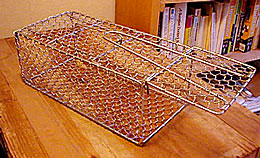
If you're looking to trap rats in order to train a young dog, you can use a very small Havahart trap, or you can make your own.

  • Click here to read how this very effective Chinese rat traps works.

  • Click here for a complete set of instruction on how to build your own.

A very similar trap is often sold on Ebay for about $16 and, if you are in the market for training rats, or would like to breed your own wild rats (pet store feeder rats are very passive) it is a good deal.

Measuring 12" x 6" x 4", the trap is made of a strong steel wire frame, covered with 1/2-in. wire mesh, with a spring-loaded door, and a baited trigger.

And yes, for you hawkers, it will catch small hawk food too, including sparrows.
..

Wednesday, May 28, 2008

More Than 100,000 Active Trappers in the U.S.

While drilling on the Internet for the lastest bobcat trapping statistics for Virginia (I did not find them), I came across a 2005 report that might be of interest to some: "Ownership and Use of Traps by Trappers in the United States in 2004.″

This 121-page report was commission by the Association of Fish and Wildlife Agencies, and has a lot of information in it, including:


  • In 2003-2004 there were 103,051 active trappers in the US

  • The average trapper used 39 traps per day.

  • The average trapper owned 112 foothold traps, 50 bodygrip traps, 3 padded foothold traps, 3 cage traps and 36 snares

  • The primary species targeted for trapping was raccoon, followed by red fox, coyote, muskrat, beaver, mink, bobcat and grey fox

  • In 2004, 35% of trappers targeted coyote, 35% red fox, 34% muskrat, 25% mink, 17% bobcat, and 14% grey fox.

  • 60% of trappers surveyed had been contacted to trap nuisance wildlife

For the record: fox, raccoon, coyote, and beaver populations are at 100-year record numbers in the U.S., and populations of these animals are continuing to grow as they move out beyong their historical ranges. Trapping at current rates has no impact on state or regional wildlife numbers.

    Steve - append your email address to the comments here -- I have lost your email address!

    Monday, March 31, 2008

    Otter Ironies


    One of the ironies of wildlife management is that the very devices that pushed so much wildlife to the edge of extinction -- guns and traps -- are the very things that are now working to bring wildlife back.

    The difference between today and 120-years ago is the rise of hunter-conservationists who understand the value of hunting seasons, the need for limits, and the necessity of wildlife habitat conservation and reclamation.

    In earlier posts, I have detailed the history behind the return of the wild turkey which, in the space of 50 years, went from teetering on the edge of extinction to a population of 5.5 million birds distributed over a greater range than occurred even in pre-Columbian times.

    Wild turkey hunting is now a billion-dollar-a-year industry, with 2.6 million hunters harvesting about 700,000 birds a year.

    The article below is about the return of the river otter to Middle America. As Audubon magazine noted just a few years ago, "More than 2,000 river otters have been caught in legholds in the South and released virtually unscathed in Midwestern states where the species had been extirpated."

    Back in the 1990s, when the river otter was being reintroduced in Ohio, Audubon was not only defending the use of leghold traps as necessary for the reintroduction of species like the river otter, but also for management of such species as the wolf and nuisance abatement of other species such as beaver, raccoon, and red fox.

    For those interested in the foundation history of wildlife management in America, Aldo Leopold's book on Game Management is still in print more than 70 years after its first publication. Chapter 10 is on predator control. >> Click here to buy


    January 21, 2005

    Ohio wildlife officials consider allowing otter trapping after success of reintroduction programs

    By: Carrie Spencer, Associated Press

    _____________________

    The wily and playful river otter was once on the verge of extinction in Ohio. Now they're thriving - and causing so much damage that wildlife officials are considering allowing hunters to trap them.

    It's a situation other states have had with other animals. In Florida and New Jersey, it's the black bear. The Rockies and Alaska have the gray wolf. Nearly everywhere else, it's the white-tailed deer and Canada goose.

    "In a human-dominated landscape, it's really tough to keep wildlife in the numbers we feel are appropriate," said Greg Butcher, a zoologist with the Washington-based National Audubon Society. "We have affected the environment so much that a lot of natural checks and balances are gone."

    The otter's numbers have soared in just two decades - from 123 to about 4,300 - and Ohio wildlife officials are proposing a permit-only two-month trapping season. The Ohio Wildlife Council will vote on the proposal in April.

    The U.S. Department of Agriculture estimates that wildlife causes US$1 billion ([euro]770 million) in crop and livestock damage each year, while deer collisions injure about 29,000 motorists a year and cost another $1 billion ([euro]770 million). Bird collisions cost the aviation industry $740 million ([euro]572 million) annually.

    The otter's story is familiar. Fur trapping drove the native species from Ohio by the early 1900s, but their reintroduction - starting in 1986 and lasting seven years - has been so successful that farmers are starting to complain. A family of otters can eat half the fish in a privately stocked pond before the owner gets wind of their visits.

    "If they find a nice trout farm, they're pretty happy with that," said C. Greg Anderson, assistant biology professor at the University of the Pacific in Stockton, Calif.

    Otters used to be in every U.S. state except Hawaii but were wiped out over 70 percent of their range, Anderson said. Reintroduction programs began in the 1980s in 21 states, all successes. Missouri, one of the first with 19 otters released in 1982, now has more than 10,000 and allows trapping, he said. Kentucky began its first otter season this winter, running through February.

    Government-sanctioned hunting of all kinds of animals is proliferating across the country.

    Starting in February, private landowners in Montana and Idaho won't need written approval to kill gray wolves harassing livestock, while Wyoming is suing the federal government to get its wolf management plan approved. From about 30 wolves introduced 10 years ago, 825 or more now live in the three states.

    Florida wildlife officials reported a record number of sightings of threatened black bears in 2004 because of sprawling development and busier roads. The state is studying the bear population and could lift its protected status this year.

    New Jersey's second annual bear hunt was called off this year amid a dispute over the state's management plan. New Jersey has more than 3,000 bears, up from fewer than 100 in the 1970s.

    Hunting groups once feared the disappearance of white-tailed deer, but management encouraging reproduction worked too well. Last fall, the Cleveland suburb of Solon became the latest Ohio community to hire sharpshooters to cull the prolific landscape munchers.

    Few success stories compare with that of the giant strain of Canada goose, which was nearly extinct in the 1960s because of hunting and lack of their preferred grassland habitat.

    In the Midwest, restrictions on hunting coincided with the explosion of office parks with manicured lawns and lush golf courses. The birds, with their 6-foot wingspans, are now fouling picnic spots and hissing and nipping at golfers. States from North Dakota to Pennsylvania have expanded hunting allowances.

    While some see overpopulation as triumph over extinction, the Animal Protection Institute sees it as failure on the part of wildlife officials. Reintroduction of a native animal requires planning to prevent an overrun, said Barbara Schmitz of the Sacramento, California-based institute.

    "A lot of times, lethal solutions are looked at first," Schmitz said. "It is possible for them to become part of the balance of nature again."
    .

    Monday, March 03, 2008

    Thriving in America

    Example


    European naturalists occassionally come over to the U.S. just to see animals that once existed on their side of the Atlantic, but are now extinct over there. For example:


    • Beaver existed in the UK until about 1200, but were then extirpated until very recently when a handful were reintroduced. In the U.S., however, there are so many beaver it is now illegal in most states to trap and move them; they must be killed where found rather than relocated.

    • Bear may have existed in the UK as late as Roman times, but probably disappeared around 500 AD. The bear population of the United States, however, is thriving and now numbers over 500,000 individuals, with the population continuing to rise by about 3% a year (a population doubling time of about 24 years).

    • The last wolf in England was reportedly killed in the 14th Century at Humphrey Head, Cumbria, but wolves survived in Scotland up until 1700 and in Ireland until 1760. The wolf is doing so well in the U.S. today that the Grey wolf was recently removed from the U.S. list of endangered and threatened species. There are about 2,500 Grey Wolves in Minnesota alone, and others in Wyoming, Idaho, Montana, and Michigan, as well as "red" wolves in North Carolina. The red wolf is a naturally occuring hybrid between the gray wolf and the coyote. The coyote (once called the Plains Wolf) is doing so well that it is now found in every mainland state, and their numbers are expanding despite the fact that 500,000 animals a year are shot, trapped or poisoned.
      .

    Tuesday, October 30, 2007

    New $5 Fur Bearer Permit Required in Maryland


    Beginning in the 2006-2007 season, the Maryland Department of Natural Resources (DNR) has required that folks that "hunt, chase, trap, or pursue furbearers" have a new "Furbearer Permit". The cost is only $5 in addition to a hunting license, and it appears to be a way a way of keeping track of the number of fox and coon hunters in the state -- a necessary thing if wildlife populations are to be well-managed. Since Maryland has a surplus of both fox and raccoon, I think science is likely to result in an expanded season, not a more restricted one. Note that along with a Fur Bearer permit, you will also have to have a regular hunting license. >> For more information For the record, groundhog, are not considered furbearers, and are specifically exempt from all limits, Sunday hunting restrictions, and seasons. In short, they are treated as a pest and regulated as such.

    .

    Thursday, August 23, 2007

    Trapping and the Cull of the Wild


    Phil Brown's 1,202 red fox.


    Over at Mike Hackenback's blog for Outdoor Life
    he posted a picture (above) of 1,202 red foxes caught by Pennsylvania trapper Phil Brown, and wondered if this was a record.

    The short answer is, "not quite," but maybe close. I have no idea who actually has the record (or even if there is such a thing for a less-than-60-day trapping season), but one contender would have to be Pete Leggett who used to live in Maryland (he died in 2004 at the age of 79), who took 1,220 fox in a 53-day trapping season in 2003. Mr. Leggett regularly pulled in over 1,000 fox a year. Pete's son, Ron, now runs the business. And yes, this is the Leggett's of the "Leggett's K-9 Exciter" fame. A picture of the fox trapped in the 2003 season can be found below.


    Regulated fox trapping does no harm to fox populations, as the fox populations compensate by having slightly larger litters, while mortality due to mange and starvation tends to decrease due to an abundance of food and less back-to-back den occupation.

    What's fascinating to me is how many people are horrified when they see the picture of so many dead fox pelts .

    Why are you horrified, I ask? Well fox are rare.

    They are not. In fact, it's only possible for one person to trap so many fox in less than 60 days because they are so common. The number of red fox in the U.S. is large and growing everywhere except where the coyote population is keeping them down.

    But they're just killing them for fur and profit! So? It's not my method of making a living, but killing a wild animal for fur and profit is morally superior to killing them for mere meat. Most people -- including you and I -- are OK with eating meat, aren't we? So too is the fox.

    How is killing for fur superior to killing for meat? Well, just think about it for a minute: We raise chickens, cattle and pigs in cages and feed lots for no higher purpose than a few calories and a good bowel movement a few hours later. How is that morally superior to the folks who value the freedom of wild animals and who kill them, in season, for a fur coat that may last 20 years or more? A fur coat may last a lifetime; a hamburger is gone with the flush of a commode.

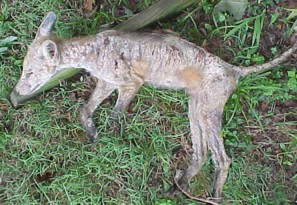
    But killing fox is cruel. Actually, trapping a fox is really no worse than what Mother Nature has in mind for this same animal. The harsh reality is that wild animals do not die in hospital infirmaries with a morphine drip, and soft music playing in the background. Mother Nature and the modern world kill old and adolescent, prime and aged, with almost equal vigor. These "natural" deaths are rarely quick or painless. The real world is not a Disney production. Remember that the alternative to trapping is not immortality; it is often a prolonged and miserable death from disease such as mange (pictured at left) or distemper, starvation, poison, a gut shot, predation by coyote or dog, or (most common of all) vehicle impact (also pictured at left).

    But traps are so painful. Again, not really. The modern leghold trap is quite different from the trap used 50 years ago, and the law requires that all traps be checked at least once every 24 hours. A modern leghold trap has offset jaws, and as a result the paw of the animal is caught firmly, but generally with very little serious damage. In fact, leghold traps are routinely used by wildlife biologists to trap, tag, radio-collar, and move wild animals all over America. Every transplanted wolf in the Yellowstone, for example, was first caught in a leghold trap, and the ones that are wearing radio collars today are routinely caught in leghold traps by scientists who have to switch out the batteries in those collars.

    Bottom line: Fox trapping does no real harm to fox populations, and may do quite a bit of good in some circumstances where overcrowding might lead to more painful methods of death or culling. Trapping is also a valuable intervention when it comes to the protection of native bird populations; so important, in fact that the National Audubon Society has successfully sued to keep fox trapping legal.

    .