Showing posts with label Working Dog. Show all posts

Sunday, March 10, 2019

Victorian Snobbery on the Animal Estate


A book worth reading is The Animal Estate: The English and Other Creatures in the Victorian Age by Harriet Ritvo [Harvard University Press, 1989].

Ritvo points out that the Dog Show crowd and the Animal Rights crowd spring from the same root-stock of sentiment and snobbery, and in both cases the animals are the side-show, not the main event.

Ritvo writes that in the Victorian era, and into the 20th Century, dog show folks:

... elevated standards that had no basis in nature or aesethics but reflected the ignorant, self-interested caprices of fanciers who wished to boost the prestige of their own stock in order to associate themselves with people of good breeding.

And, of course, it paid, with show winners being sold for cash -- a quick way for people of low rank to buy themselves up the social ladder. If one had a dog that was "best of breed," then surely the owner must be of similar worth, right??

Ritvo notes that terriers were particularly singled out for attention by the show ring preeners and pretenders, and that:

The Fox Terrier Chronicle, the only 19th Century periodical devoted to a single breed of dogs, covered the terrier elite the way that newspapers and other periodicals covered human high society.

Ritvo notes that dog fanciers projected:

... an obsessively detailed vision of a stratified order, which sorted animals and, by implication, people into snug and appropriate niches" with dog shows offering "a dizzying range of classes and then abstracted from them a carefully calibrated hierarchy of animals, ranging from those who did not place even in their sub-breed category to the best in show.

In short, the attraction of dog shows was that people who themselves were as common as a turnip top could now fancy that they were among the social elite.

They did not have to have real knowledge of animals, or have an important job or title or large estate -- they just had to purchase a dog from a "reputable" show breeder and put on airs.

As one Victorian periodical noted,

Nobody now who is anybody can afford to be followed about by a mongrel dog.

Ritvo notes that:


Specialist clubs were supposed to defend their breeds against the vicissitudes of fashion, but they had few other guides in their attempts to establish standards for breeds and judges.

Even in the Victorian era, almost no one walking into the ring with a "working" breed actually worked their dogs.

After almost half a century of formal shows, the author of a manual for dog owners noted that,

The sportsman will as a rule have nothing to do with the fancier's production.

All of the above is from the second chapter of Ritvo's book. The third chapter is about the rise of the Animal Rights movement, and here we see the same class issues popping up that we did in the previous chapter.

Just as honest working dogs were labeled "mongrels best for the dustbin," so too were the people that owned them. The analogies made were simple and direct: Course people had course dogs and engaged in course behavior. Show people had "pedigree" dogs and they did not engage in course behavior.

Of course, not everything was quite as simple as this in the real world.

No matter -- the goal of the RSPCA was not entirely about animals anyway -- it was in no small part all about putting down the poor and the rural and castigating them for having "undisciplined" values.

Towards this end, Ritvo notes that the tracts of the RSPCA "implicitly identified the lower classes as the source of brutality," even as this same organization gave "the big wink" to fox hunting and grouse hunting which were common pastimes of the rich and landed.

Today, of course, the people you see at a PETA rally, and the folks that you see trotting their dogs around a show ring are not all that different demographically, and the general sentiment is still toward unalloyed snobbery.

Sunday, March 03, 2019

The Strange Fruit of Class Warfare


In The Animal Estate: The English and Other Creatures in the Victorian Age, author Harriet Ritvo [Harvard University Press, 1989] points out that the Dog Show crowd and the Animal Rights crowd spring from the same root-stock of sentiment, and in both cases the animals are the side-show, not the main event.

Ritvo writes that in the Victorian era and into the 20th Century dog show folks "elevated standards that had no basis in nature or aesthetics but reflected the ignorant, self-interested caprices of fanciers who wished to boost the prestige of their own stock in order to associate themselves with people of good breeding."

And, of course, it paid, with show winners being sold for cash -- a quick way for people of low rank to buy themselves up the social ladder. If one had a dog that was "best of breed," then surely the owner must be of similar worth, right??

Ritvo notes that terriers were particularly singled out for attention by the show ring preeners and pretenders, and that “The Fox Terrier Chronicle, the only 19th Century periodical devoted to a single breed of dogs, covered the terrier elite the way that newspapers and other periodicals covered human high society."

Ritvo notes that dog fanciers projected "an obsessively detailed vision of a stratified order, which sorted animals and, by implication, people into snug and appropriate niches" with dog shows offering "a dizzying range of classes and then abstracted from them a carefully calibrated hierarchy of animals, ranging from those who did not place even in their sub-breed category to the best in show."

In short, the attraction of dog shows was that people who themselves were as common as a turnip top could now fancy that they were among the social elite. They did not have to have real knowledge of animals, or have an important job or title or large estate -- they just had to purchase a dog from a "reputable" show breeder and put on airs.

As one Victorian periodical noted, "nobody now who is anybody can afford to be followed about by a mongrel dog." Ritvo notes that "Specialist clubs were supposed to defend their breeds against the vicissitudes of fashion, but they had few other guides in their attempts to establish standards for breeds and judges."

Even in the Victorian era, almost no one walking into the ring with a "working" breed actually worked their dogs. After almost half a century of formal shows, the author of a manual for dog owners noted that "the sportsman will, as a rule, have nothing to do with the fancier's production."

All of the above is from the Second chapter of Ritvo's book. The Third chapter is about the rise of the Animal Rights movement, and here we see the same class issues popping up that we did in the previous chapter.

Just as honest working dogs were labeled "mongrels best for the dustbin," so too were the people that owned them. The analogies made were simple and direct: Course people had course dogs and engaged in course behavior. Show people had "pedigree" dogs and they did not engage in course behavior. Of course, not everything was quite as simple as this in the real world. No matter -- the goal of the RSPCA was not entirely about animals anyway -- it was in no small part about putting down the poor and the rural and castigating them for having "undisciplined" values. Towards this end, Ritvo notes that the tracts of the RSPCA "implicitly identified the lower classes as the source of brutality," even as this same organization gave "the big wink" to fox hunting and grouse hunting which were common pastimes of the rich and landed.

Today, of course, the people you see at a PETA rally and the folks that you see trotting their dogs around a show ring are not all that different demographically. In his book "In Defense of Hunting," James A. Swan notes that the Animal Rights crowd is dominated by people that are "white, urban, predominantly female, nicely dressed" and that many of them are "people who have gone through painful divorces or have had traumatic childhoods or have otherwise been hurt by the norms of society."
.

Tuesday, February 20, 2018

Science Remakes the Dog


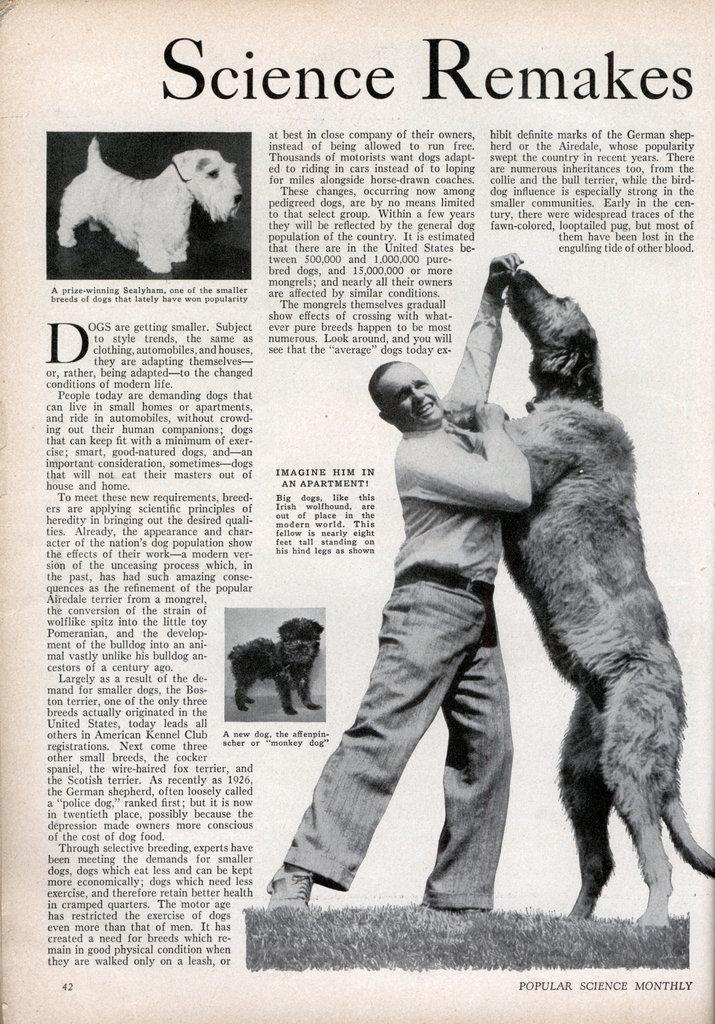
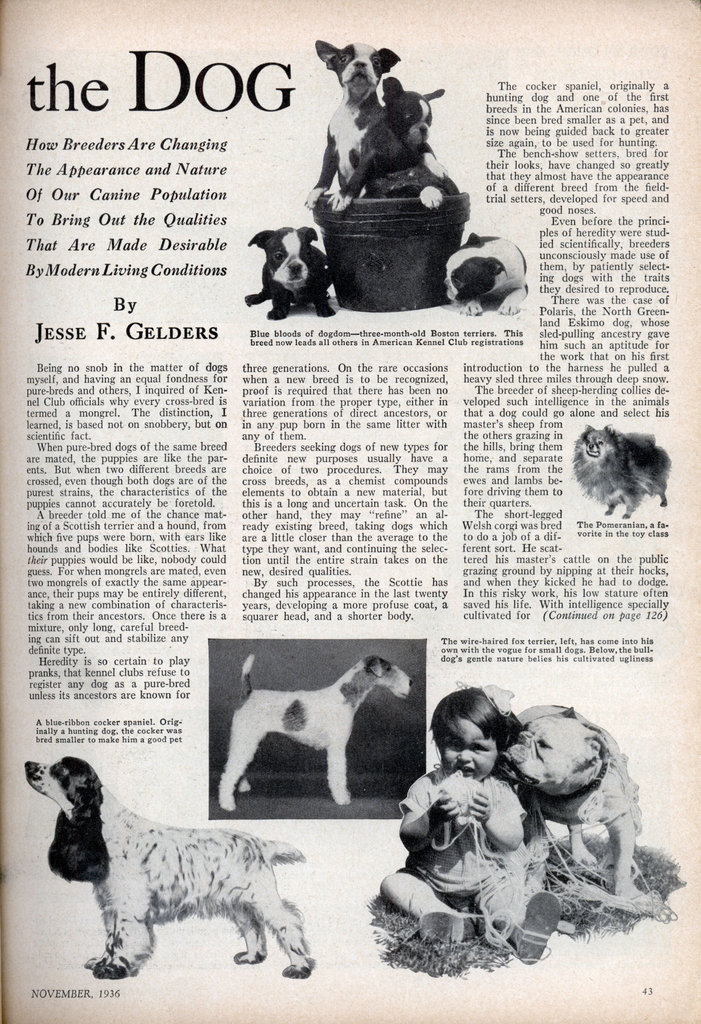
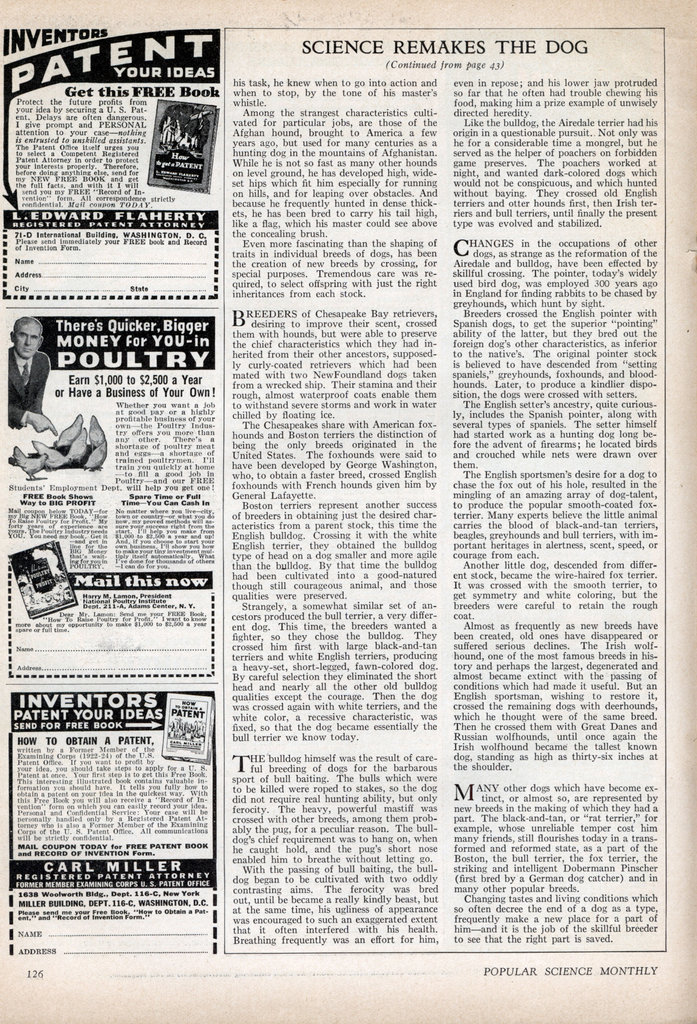
An article, from the November 1936 issue of Popular Science magazine is a good representative of the kind of congratulatory back-patting that went on during this period, as show ring and hobby breeders worked overtime to draw more and more working dogs into the Kennel Club.

Not the tone of the article: "Science" is improving dogs so they will be better suited to the modern world of cars, apartments, and limited time for their care and feeding.

In fact, these market forces continue to this day, as I have noted in an earlier post entitled "Robert Bakewell's Apartment."

This Popular Science article was written when the Kennel Club was just 65 years old, but problems already seem to be cropping up.

Notice that the Cocker Spaniel seems to have been "improved" to the point that it no longer hunts.

The Scottish terrier's morphology has been transformed with the "improved" dog having a shorter back, a larger head, and a longer coat -- improvements that made the dog incapable of going down a hole after quarry, ruining it as a true working terrier.

Then you have the various types of setters where bench and field animals had already diverged to the point that they appeared to be different breeds.

Finally, the Afghan is mentioned as a new and exotic breed brought to America. How long before the show-ring variant was wrecked as a coursing dog? Not long!

It should also be noted that some of the "history" given here is Kennel Club bunk. The Airedale, for example, is a modern creation derived from the Otter hound, and bred specifically for the show ring. It was never a "night poacher's dog," being too slow and heavy for rabbit, fox, or deer. Hunting otter is not done at night; it is tough enough to see the things in the daylight!

Similarly, the English Bulldog has very little of the old bull-baiting dog in it, and quite a lot of the monstrous pug to which it is much more closely-related!

As for fox terriers, by the time this article was written, almost no one was using a Kennel Club dog for anything other than a companion dog, as a close reading of Jocelyn Lucas's book Hunt and Working Terriers (published in 1931) will reveal.

Fox-working dogs have not been "improved" by science or show ring breeders; they have only been ruined by the rosette chasers.

The original art for this article can be seen here >> Page 1, Page 2, Page 3


Science Remakes the Dog
How Breeders Are Changing The Appearance and Nature Of Our Canine Population To Bring Out the Qualities That Are Made Desirable By Modern Living Conditions

By Jesse F. Gelders


DOGS are getting smaller. Subject to style trends, the same as clothing, automobiles, and houses, they are adapting themselves— or, rather, being adapted—to the changed conditions of modern life.

People today are demanding dogs that can live in small homes or apartments, and ride in automobiles, without crowding out their human companions; dogs that can keep fit with a minimum of exercise; smart, good-natured dogs, and—an important consideration, sometimes—dogs that will not eat their masters out of house and home.To meet these new requirements, breeders are applying scientific principles of heredity in bringing out the desired qualities.

Already, the appearance and character of the nation’s dog population show the effects of their work—a modern version of the unceasing process which, in the past, has had such amazing consequences as the refinement of the popular Airedale terrier from a mongrel, the conversion of the strain of wolflike spitz into the little toy Pomeranian, and the development of the bulldog into an animal vastly unlike his bulldog ancestors of a century ago.

Largely as a result of the demand for smaller dogs, the Boston terrier, one of the only three breeds actually originated in the United States, today leads all others in American Kennel Club registrations. Next come three other small breeds, the cocker spaniel, the wire-haired fox terrier, and the Scotish terrier. As recently as 1926, the German shepherd, often loosely called a “police dog,” ranked first; but it is now in twentieth place, possibly because the depression made owners more conscious of the cost of dog food.

Through selective breeding, experts have been meeting the demands for smaller dogs, dogs which eat less and can be kept more economically; dogs which need less exercise, and therefore retain better health in cramped quarters. The motor age has restricted the exercise of dogs even more than that of men. It has created a need for breeds which remain in good physical condition when they are walked only on a leash, or at best in close company of their owners, instead of being allowed to run free. Thousands of motorists want dogs adapted to riding in cars instead of to loping for miles alongside horse-drawn coaches.

These changes, occurring now among pedigreed dogs, are by no means limited to that select group. Within a few years they will be reflected by the general dog population of the country. It is estimated that there are in the United States between 500,000 and 1,000,000 purebred dogs, and 15,000,000 or more mongrels; and nearly all their owners are affected by similar conditions.

The mongrels themselves gradually show effects of crossing with whatever pure breeds happen to be most numerous. Look around, and you will see that the “average” dogs today exhibit definite marks of the German shepherd or the Airedale, whose popularity swept the country in recent years. There are numerous inheritances too, from the collie and the bull terrier, while the bird-dog influence is especially strong in the smaller communities. Early in the century, there were widespread traces of the fawn-colored, looptailed pug, but most of them have been lost in the engulfing tide of other blood.

Being no snob in the matter of dogs myself, and having an equal fondness for pure-breds and others, I inquired of Kennel Club officials why every cross-bred is termed a mongrel. The distinction, I learned, is based not on snobbery, but on scientific fact.

When pure-bred dogs of the same breed are mated, the puppies are like the parents. But when two different breeds are crossed, even though both dogs are of the purest strains, the characteristics of the puppies cannot accurately be foretold.

A breeder told me of the chance mating of a Scottish terrier and a hound, from which five pups were born, with ears like hounds and bodies like Scotties. What their puppies would be like, nobody could guess. For when mongrels are mated, even two mongrels of exactly the same appearance, their pups may be entirely different, taking a new combination of characteristics from their ancestors. Once there is a mixture, only long, careful breeding can sift out and stabilize any definite type.

Heredity is so certain to play pranks, that kennel clubs refuse to register any dog as a pure-bred unless its ancestors are known for three generations. On the rare occasions when a new breed is to be recognized, proof is required that there has been no variation from the proper type, either in three generations of direct ancestors, or in any pup born in the same litter with any of them.

Breeders seeking dogs of new types for definite new purposes usually have a choice of two procedures. They may cross breeds, as a chemist compounds elements to obtain a new material, but this is a long and uncertain task. On the other hand, they may “refine” an already existing breed, taking dogs which are a little closer than the average to the type they want, and continuing the selection until the entire strain takes on the new, desired qualities.

By such processes, the Scottie has changed his appearance in the last twenty years, developing a more profuse coat, a squarer head, and a shorter body.

The cocker spaniel, originally a hunting dog and one of the first breeds in the American colonies, has since been bred smaller as a pet, and is now being guided back to greater size again, to be used for hunting.

The bench-show setters, bred for their looks, have changed so greatly that they almost have the appearance of a different breed from the field-trial setters, developed for speed and good noses.

Even before the principles of heredity were studied scientifically, breeders unconsciously made use of them, by patiently selecting dogs with the traits they desired to reproduce. There was the case of Polaris, the North Greenland Eskimo dog, whose sled-pulling ancestry gave him such an aptitude for the work that on his first introduction to the harness he pulled a heavy sled three miles through deep snow. The breeder of sheep-herding collies developed such intelligence in the animals that a dog could go alone and select his master’s sheep from the others grazing in the hills, bring them home, and separate the rams from the ewes and lambs before driving them to their quarters.

The short-legged Welsh corgi was bred to do a job of a different sort. He scattered his master’s cattle on the public grazing ground by nipping at their hocks, and when they kicked he had to dodge. In this risky work, his low stature often saved his life. With intelligence specially cultivated for his task, he knew when to go into action and when to stop, by the tone of his master’s whistle.

Among the strangest characteristics cultivated for particular jobs, are those of the Afghan hound, brought to America a few years ago, but used for many centuries as a hunting dog in the mountains of Afghanistan. While he is not so fast as many other hounds on level ground, he has developed high, wide-set hips which fit him especially for running on hills, and for leaping over obstacles. And because he frequently hunted in dense thickets, he has been bred to carry his tail high, like a flag, which his master could see above the concealing brush.

Even more fascinating than the shaping of traits in individual breeds of dogs, has been the creation of new breeds by crossing, for special purposes. Tremendous care was required, to select offspring with just the right inheritances from each stock.

BREEDERS of Chesapeake Bay retrievers, desiring to improve their scent, crossed them with hounds, but were able to preserve the chief characteristics which they had inherited from their other ancestors, supposedly curly-coated retrievers which had been mated with two New Foundland dogs taken from a wrecked ship. Their stamina and their rough, almost waterproof coats enable them to withstand severe storms and work in water chilled by floating ice.

The Chesapeakes share with American foxhounds and Boston terriers the distinction of being the only breeds originated in the United States. The foxhounds were said to have been developed by George Washington, who, to obtain a faster breed, crossed English foxhounds with French hounds given him by General Lafayette.

Boston terriers represent another success of breeders in obtaining just the desired characteristics from a parent stock, this time the English bulldog. Crossing it with the white English terrier, they obtained the bulldog type of head on a dog smaller and more agile than the bulldog. By that time the bulldog had been cultivated into a good-natured though still courageous animal, and those qualities were preserved.

Strangely, a somewhat similar set of ancestors produced the bull terrier, a very different dog. This time, the breeders wanted a fighter, so they chose the bulldog. They crossed him first with large black-and-tan terriers and white English terriers, producing a heavy-set, short-legged, fawn-colored dog. By careful selection they eliminated the short head and nearly all the other old bulldog qualities except the courage. Then the dog was crossed again with white terriers, and the white color, a recessive characteristic, was fixed, so that the dog became essentially the bull terrier we know today.

THE bulldog himself was the result of careful breeding of dogs for the barbarous sport of bull baiting. The bulls which were to be killed were roped to stakes, so the dog did not require real hunting ability, but only ferocity. The heavy, powerful mastiff was crossed with other breeds, among them probably the pug, for a peculiar reason. The bulldog’s chief requirement was to hang on, when he caught hold, and the pug’s short nose enabled him to breathe without letting go.

With the passing of bull baiting, the bulldog began to be cultivated with two oddly contrasting aims. The ferocity was bred out, until be became a really kindly beast, but at the same time, his ugliness of appearance was encouraged to such an exaggerated extent that it often interfered with his health. Breathing frequently was an effort for him, even in repose; and his lower jaw protruded so far that he often had trouble chewing his food, making him a prize example of unwisely directed heredity.

Like the bulldog, the Airedale terrier had his origin in a questionable pursuit.. Not only was he for a considerable time a mongrel, but he served as the helper of poachers on forbidden game preserves. The poachers worked at night, and wanted dark-colored dogs which would not be conspicuous, and which hunted without baying. They crossed old English terriers and otter hounds first, then Irish terriers and bull terriers, until finally the present type was evolved and stabilized.

CHANGES in the occupations of other dogs, as strange as the reformation of the Airedale and bulldog, have been effected by skillful crossing. The pointer, today’s widely used bird dog, was employed 300 years ago in England for finding rabbits to be chased by greyhounds, which hunt by sight.

Breeders crossed the English pointer with Spanish dogs, to get the superior “pointing” ability of the latter, but they bred out the foreign dog’s other characteristics, as inferior to the native’s. The original pointer stock is believed to have descended from “setting spaniels,” greyhounds, foxhounds, and bloodhounds. Later, to produce a kindlier disposition, the dogs were crossed with setters.

The English setter’s ancestry, quite curiously, includes the Spanish pointer, along with several types of spaniels. The setter himself had started work as a hunting dog long before the advent of firearms; he located birds and crouched while nets were drawn over them.

The English sportsmen’s desire for a dog to chase the fox out of his hole, resulted in the mingling of an amazing array of dog-talent, to produce the popular smooth-coated fox-terrier. Many experts believe the little animal carries the blood of black-and-tan terriers, beagles, greyhounds and bull terriers, with important heritages in alertness, scent, speed, or courage from each.

Another little dog, descended from different stock, became the wire-haired fox terrier. It was crossed with the smooth terrier, to get symmetry and white coloring, but the breeders were careful to retain the rough coat.

Almost as frequently as new breeds have been created, old ones have disappeared or suffered serious declines. The Irish wolfhound, one of the most famous breeds in history and perhaps the largest, degenerated and almost became extinct with the passing of conditions which had made it useful. But an English sportsman, wishing to restore it, crossed the remaining dogs with deerhounds, which he thought were of the same breed. Then he crossed them with Great Danes and Russian wolfhounds, until once again the Irish wolfhound became the tallest known dog, standing as high as thirty-six inches at the shoulder.

MANY other dogs which have become extinct, or almost so, are represented by new breeds in the making of which they had a part. The black-and-tan, or “rat terrier,” for example, whose unreliable temper cost him many friends, still flourishes today in a transformed and reformed state, as a part of the Boston, the bull terrier, the fox terrier, the striking and intelligent Dobermann Pinscher (first bred by a German dog catcher) and in many other popular breeds.

Changing tastes and living conditions which so often decree the end of a dog as a type, frequently make a new place for a part of him—and it is the job of the skillful breeder to see that the right part is saved.
.

Friday, July 07, 2017

If John Russell Were Alive Today ...


A lot of time and energy is spent by people on the show ring circuit culling through pedigrees counting the number of "champions" they can find listed. This is called "selective breeding," by the Kennel Club folks, but what is it they are selecting for?

Among show ring aficionado's working ability is never the primary selection. Since, in the world of working dogs in which John Russell lived, the second slot is selection by size, and the third slot is selection by gender, the show ring breeder is (at best) promoting fourth-string characteristics to prime. This is a recipe for ruin, and it's a recipe the Reverend John Russell watched with concern during the early years of the British Kennel Club. As he noted about his own dogs:

"True terriers they were, but differing from the present show dogs as the wild eglantine differs from a garden rose."

If you do not work your dogs underground often, you have no idea of what you are breeding for when it comes to work.

It is not a matter of working a few weekends. A dog's working qualities and abilities are not made in a day. Nor should yours be, if you are a serious breeder. You need to dig quite a while to know the value of voice, the value of nose, and the nature of the balance point between having a dog that is too hard and too soft. It takes a few dogs and a few winters to fully appreciate the value of a good coat, and to understand the value of a small well-muscled dog.

The people in the AKC like to talk a lot about John Russell, but they manage to leave off the fact that he did not create his dogs in the show ring, but in the field and by testing them in the ground and under a spade. Though he occasionally judged dog shows, he did not register his own dogs as he feared dog shows would be the ruin of working terrier. He was not wrong!

If John Russell were alive today, most of the people who own Jack Russell terriers -- including many of those with working certificates -- could not show him a day in the field with the dogs. I think Russell would be rather embarrassed by that fact, and he would certainly by saddened.

A repost from 2009

Thursday, April 20, 2017

When Breeds are Failures


Art by Kevin Brockbank for Dogs Today (May 2010 issue)


Is it time to thin the herd?

It's been said that the dog is the most successful wolf in the world -- the wolf that got man to adopt it, house it, feed it, and protect it.

Relatively docile wolves were fed and bred until, slowly, imperceptibly, they evolved into something different -- the domestic dog.

For 12,000 years, that's about as far as it progressed.


An Explosion of Breeds

Two hundred and fifty years ago, there were only about a dozen broad types of dogs.

Breeds, as we know them today with narrow written standards, were not yet known.

Your breed claims an ancient lineage?

Unless it's a greyhound, I can assure you it's almost certainly nonsense.

The Pharaoh Hound? Invented in the 20th Century to look like the dogs found on the side of the Egyptian tombs opened at the time of Carter.

The Chinese Crested? Not Chinese! Invented in America in the 1930s and popularized by burlesque stripper Gypsy Rose Lee.

Terriers? Retrievers? Setters? Spaniels? Pointers? Shepherds?

Analysis of Mitochondrial DNA shows that while the type may be old, the breed is -- almost invariably of relatively modern origin.

It's not like we created just a few breeds in the blink of an eye, is it? No, we created hundreds.

How did we do that? Mostly by selecting for odd types and then inbreeding to "fix" those types until they bred true.

The first breeds, of course, were created by merely tweaking Mother Nature's process. Herding dogs, for example, were selected because of function rather than looks. Ditto for running dogs, pulling dogs, bird dogs, guarding dogs, and terriers.

Dogs that were best adapted to function prospered, while those that did poorly were culled from the pool. The only difference was that the hand of man was now engaged in unnatural selection -- replacing Mother Nature, which had previously been employed in the task of natural selection.

Form Trumps Function

With the rise of dog shows, however, function took a back seat to form. Now the primary value celebrated was variability. And, of course, to get maximum variability, you had to green-light more and more breeds that were extreme, and in many cases maladaptive, including dogs that were brachycephalic (flat faced) and could not breath well, and dogs that were achondroplastic (dwarfs) and had joint and heart problems.

Added to these dogs were other extreme examples -- massive giants that had weak hearts and intestines prone to twist and bloat, tiny tea cup breeds prone to hydrocephalia and broken bones, hairless breeds prone to dental and skins issues, dogs with extreme skin wrinkles, ear length, and coats, and dogs with various spinal oddities such as over-long backs, roached backs, and spines that ended in a tight mass of twisted vertebrae.

And, of course, through it all you had to inbreed and line-breed in order to set type, and you had to invent ancient histories in order to speed the sales of these new creations.

The result has been a mixed bag. Some breeds have managed to stay healthy, and a few have even managed to be useful for work.

Most, however, have come down with one or more serious health problems, and most have devolved from working dog to mere pets.

There is nothing wrong with pets. There is, of course, something wrong with breeding dogs with serious health problems. Even here, however most genetic problems are manageable and most breeds are salvageable

But is that always the case? Are there dog breeds that are not salvageable?

This is not a small question.

When humans began breeding dogs, we began to act as Gods, but we failed to accept the full mantle of the Gods.

God culls misfits; man puts his in the Kennel Club.

Canine Failures

Let's talk about canine failures. They are not hard to find.

The Dandie Dinmont is a good example of a dog that has simply failed in the marketplace. Last year, more Pandas were born in captivity than Dandie Dinmonts were registered by the Kennel Club.

Named after a fictional character in a novel, and forced to compete head-to-head with other poodle-coated mops, this dog has found few customers due to its odd-looking sway back, poor movement, and complete uselessness in the field.

Add in the health problems suffered by Dandies -- cushings, hypothyroidism, and a narrow-angle glaucoma that is unique to Dandies -- and you stand at the cusp of a question.

Factor in the fact that more than 40% of dogs are born cesarean, and the case is made for intervention.

The old working terrier from which the modern Dandie claims descent was not a product of the Kennel Club and did not suffer these indignities.

Perhaps now is the time to release this breed from the inbreeding mandated by a tiny gene pool wedded to a closed registry system.

Perhaps now is the time to release this dog from the bondage of contrived show dog standards.

Yes, let us release this dog "back to the wild" of its working roots. It has not done well in "captivity". De-list this dog from the Kennel Club's roles, and move on.

Other breeds should also be delisted, and for much the same reason -- the Skye Terrier, the Clumber Spaniel, the Sussex Spaniel, the Glenn of Imaal Terrier, the Manchester Terrier, and the Sealyham Terrier.

None of these dogs were created in the Kennel Club -- they have only been deformed, emasculated, and inbred since their arrival. Release these dogs "back to the wild". They have not done well in "captivity", and they have failed in the marketplace.

And what about those breeds that are true genetic wrecks beyond salvation?

There are not many, but let's face the problem head on, and end the nonsense.

There is no reason to try to repair a Disney castle built on sand, with a blown foundation, rotten roof, walls riddled with termites, and a dangerous boiler about to explode in the basement.

Take the Cavalier King Charles Spaniel. This was a breed invented at the Crufts dog show in response to a prize offered up by an American by the name of Roswell Eldridge.

Thanks to a bad gene pool at the start, and the incredible inbreeding that followed, more than 80 percent of today's dogs end up with serious heart problems, while more than a third have a genetic brain disorder affecting the nervous system.

With this level of defect, and this thin history, why not sweep it all aside and start again?

Ditto for several other breeds with serious health problems -- the Miniature Bull Terrier (50% cesarean, dead at 6 years), the English Bull Dog (90% cesarean, dead at 6 years), the Scottish Terrier (60 percent cesarean, 45% cancer rate), the Dogue De Bordeaux (dead at less than six years).

Are there other breeds that might be "returned to the wild" through delisting and/or delisting and recreation (i.e. starting again with a healthy gene pool, scientific breeding, and a commonsense standard)?

Sure, but I think I have been controversial enough for one day, don't you?!

The question stands: Is it time to thin the herd? Is it time to end the Kennel Club's preservation of defect and failure?
.

Wednesday, February 15, 2017

Pretenders and Fantasists at Westminster


What you see, in the picture above, is true inbred thinking.

This German Shepherd -- the winner of the Westminster Dog Show -- is standing on its own hock -- a serious structural defect caused by a deformed back and hip structure.

This is a herding dog, that has never seen a sheep, being celebrated by people who have spent a lifetime ruining dogs, and who have never once wondered why the U.S. Secret Service will not use a U.S.-bred German Shepherd to do anything.

Max von Stephanitz suspected it might come to this.  Over a hundred years ago, the creator of the German Shepherd wrote:

"The breeding of Shepherd dogs must be the breeding of working dogs, this must always be the aim or we shall cease to produce working dogs.

In contradistinction to working and utility breeding is "sport" breeding, which produces a temporary advance but is always followed by deterioration, for it is not done for the sake of the DOG, nor does it make him more useful, it is done for the vanity of the breeder and the subsequent purchaser."

Of course, the deterioration of the German Shepherd was assured as soon as the dog was pulled into the show ring.  Look at the skeletal differences between true herding dogs and the wrecked American German Shepherd Dog.


Tuesday, December 06, 2016

Terriers for Sale: Pets, Rosettes and Workers All


Legendary terriermen? Certainly! Were they selling legendary dogs? Perhaps. Perhaps not.

If a dog is excellent at age two and half, you have to wonder why it is being sold. As for puppies, they are more of an optimistic hope than a proven reality.

Both adverts could be offering very good things ... and they could also have been offering something that ended up being a little less than was required or wanted, depending on the throw of the dice and the nature of the homes they were placed in.

What is not in dispute is that both of these ads were placed by legendary terriermen about 45 years ago.

Bert Gripton and Frank Buck were the real deal. They lived to hunt their dogs and bred dogs as a supplement to their hunting activities. That said, both men were known to breed quite a few dogs and sell them off too -- mostly to people who did far less digging than the dogs deserved -- and almost certainly less than these legendary men themselves did.

In fact, dog breeding seems to be a common thread among the "famous" terriermen of the past. If you have heard of almost any terrierman now dead -- John Russell, Arthur Heinemann, Frank Buck, Cyril Breay, Bert Gripton, etc. -- you can be sure they were moving a lot of dogs, and not just a lot of dirt.

To say this is to take away nothing from Gripton or Buck, Breay or Heinemann (and several other good and worthy gentlemen still living and left unnamed). They deserve their excellent reputations. It is simply to say that just as we sing a paean to "foxes yet unseen," so too should we give a nod and pour a dram for the hundreds of unknown working terrier enthusiasts, game keepers and huntsmen who have done at least as much to preserve and protect working terriers over the years. They may be unknown, but they are the core of the cable that is the working terrier tradition.

Today, we commonly see people advertising puppies as being "sired by WHATEVER" and bought directly from So-and-So HIMSELF.

Fair enough, but have you seen the legendary WHATEVER in the field? Has HIMSELF actually dug on a dog any time in the last 20 or 30 years? Or is this just name-dropping and pedigree paper-chasing -- the very same thing we see with show ring breeders?

The situation becomes comical when people order dogs from people they have never met in countries they have never visited. Perhaps they traded a few emails with a Great Man. Perhaps they have even toured the kennel. Excellent.

One has to wonder about those forty terriers barking in the back of the Great Man's place, however. Even if a person digs every week, it's hard to find enough work for four or five terriers. Forty? Impossible. Yes, yes, dogs can be loaned out for work to the hunts, but that's not going on too much, is it? A hunt terrierman wants a dog that is reliable (and small), not a parade of green reeds that do not know their job. And no one in the U.S. is loaning out dogs at all; if the breeder is not working them his or her self, you can be sure they are not being worked at all.

Yet young and foolish dog buyers continue to drive the business of puppy sales, don't they? There has never been a shortage of puppy peddlers. That is true in the world of working dogs as well as the world of pets-and-rosettes.

The working boards are full of people that have never dug on a dog themselves, but who have a kennel full of puppies for sale. "Bred from THIS line out of WHATEVER" they proclaim, as if this line of nonsense tells you anything.

Just ask for pictures of the dam and sire working. "Oh I never thought to take a camera into the field ... I don't share pictures because the Animal Rights people might get a-hold of them."

Right!

Any variation on this nonsense, and it's best to keep moving. People that work their dogs in the modern world have pictures of their dogs working and (in America at least) they can take you out on any given weekend and show you their dogs doing their stuff in the ground. We are a hunting society, and there is nothing unethical about terrier work as we practice it.

As for all this focus on "lines" of working terriers, it is taken to a level of absurdity by the puppy peddlers. Anyone who knows anything about working terriers knows no true working dog is a "pure" anything, and genes are quickly diluted. "Descended from So-and-So" tells you almost nothing, especially if you never saw the dog work yourself. A first generation dog is only half that gene pool, and a second generation dog is a quarter or less. In the end you are buying a pig in a poke.

Yes, a cross between between Mike Tyson and Robin Givens might get you super-model looks with a boxer's hooks, but it is just as likely to give you an ugly, stupid, scrawny and foul-tempered kid who has small hands, a thin frame, and an irritating lisp. Cross Albert Einstein and Marilyn Monroe and you are just as likely to get Einstein's looks and Marilyn's brains as the other way around!

Breeding, of course, is important. Working dogs are more likely to descend from two working dogs than not, and the best practice remains, as always, to get dogs that have solid working sires and dams.

Just remember, however, that there are two sides to every breeding, and much of what is being crossed from one generation to another is entirely unknown even when someone has had a "line" of terriers for two or three generations. Not every cross is a success.

In any case, a working terrier is not all about genetics is it? How many good dogs have been ruined by young fools that over-matched a dog too young? How many people have heard people proclaim a dog "worthless" when it was only 14 months old? How many people leave their dogs caged and pacing in a kennel for 12 months out of the year and then expect the dog to work like a practiced veteran the three or four times a year it is let out to see forest or field?

If only these examples were rare! Sadly, they are not.

What made the dogs of people like Frank Buck and Bert Gripton exceptional was not just breeding -- it was that these dogs saw a lot of experience in the field and were raised by people who understood how dogs thought. These MEN were as legendary as the dogs. Sadly, their experience and knowledge does not convey with the pedigree.

The ads these genuine digging men men wrote for their dogs should be read. They speak volumes in a few words: "parents small," ; "trial if necessary," ; "parents can be seen at work six days a week."

Compare these small printed advertisements to the folks who now post elaborate graphics-filled web sites offering puppies for sale. Some web sites are all about ribbons and rosettes, while others show pictures of dogs chained out in dirt yards with photos shot through rusting wire mesh.

Different ends of the social spectrum, to be sure, but what both types of web sites have in common is that neither one mentions actual terrier work.

For puppy peddlers, taking dogs out into the field to work, weekend after weekend, is too close to real work. Dogs in the field might get injured and veterinary care and tools cut into profit margins. Field work time is in direct competition with show ring trial dates.

Besides digging on the dogs a couple of times a month is suspiciously like labor. For puppy peddlers, the bottom line is the bottom line, and it is all about cash and ego, not true terrier work.

Compare the size of the genuine earth dogs offered by people like Gripton, with the hulking dogs offered up for barn and brush pile work here in the U.S.

These over-large dogs are not true terriers. Terrier means "earth dog" in French. A terrier is a dog that is capable of going to earth and to which you dig to when you are hunting.

These over-large barn-and-brush pile dogs might be called "grangier" (a possible french world for "barn dogs") or even "arbrier" (a possible french name for "tree dogs") or "bidonier" (a possible french name for "trash-pile dogs") or "batimentiere" (a possible french word for "building crawl-space" dogs), but they are not true terriers if they cannot go to ground in dirt . . . . and do so in most of the settes they encounter in their area.


Bert Gripton used to advertise that his dogs could be seen at work six days a week. Not many can say that now (and, truth be told, not many could say it back then either).

Working six days a week? Think about what that means. Regular work, day in and day out, week after week, is hardly possible with a very hard dog that goes in and gets punch-drunk with bites and rips every time it goes to ground.

Yes, the folks who dig three days a year will tell you they value a hard dog. What they will not tell you, of course, is how little time they actually spend digging.

The more you dig on the dogs, the more you come to value brains, voice, balance, and a touch of discretion in a dog, and the quicker you are to sort things out at the end of a dig. A dog that is laid up for three weeks with a ripped lip is a bad outcome if you really serious about getting out and amassing field time. Not everyone is, of course.


Bert Gripton knew the value of a small dog!
.

Friday, September 30, 2016

The Cesky Terrier: Another Failed Breed


The Cesky terrier was created by a
 Czechoslovakian dog breeder with an experise in the genetics of inherited coat colors and types. The Cesky terrier was recognized by the FCI in 1963.

Frantisek Horak supposedly wanted to breed a working terrier that did not quarrel with other terriers, but in fact this was largely an excuse. After all, plenty of working terriers already existed, and very few ever fought in the field -- why breed a new type of dog?

The real story is that Horak's had fallen in love with an essentially non-working breed -- the Scottish Terrier -- after seeing one on the cover of a magazine in 1928. After getting his first scottie in 1932, he quickly discovered the dog was really too big and too short in the body for fox settes, and often too quarelsome with other terriers in the field to boot.

Instead, of moving on to a more suitable working terrier breed, or being happy with just a companion dog, Horak decided to cross-breed his Scottie with a Sealyham with the idea that the resulting dog would be sized-down a bit, and be a little less fiery to boot.

Truly this was a bizarre cross! After all, if you were really interested in creating a better working dog, why would you cross two breeds that no longer worked?

And if you were trying to breed a smaller dog, why would you cross two breeds of dog that were already too big?

Though the Sealyham might once have been a working dog, by 1949 (when Horak created his first cross) that was no longer the case. Even Jocelyn Lucas had given up on the Sealyham, crossing his own stock with Norfolk terriers in another futile attempt to size down the dog.

What Horak got out of the Scotties-Sealyham cross was a dog that was low to the ground, but not very light weight.

Though not as fiery in temperament as a Scottie, the coat of the Cesk terrier is entirely unsuited to work -- a walking mop of soft silky hair that would be a disaster going through brambles, mud, rock and dirt.

Horak hunted his Cesky terriers to gun but also did some digging, though he seems to be among the last Cesky terrier owner to do so. Today some Cesky terrier web sites talk about artificial earth dog trials, but none talk about actual work in the field. Ironically, the dog also appears to be getting too big, with the breed clubs moving to soften limits on weight to allow dogs that weigh well over 20 pounds.

Monday, January 12, 2015

Cracking Tired Chestnuts About Form and Function


Red fox taxidermy mannequins. There is no red fox taxidermy mannequin anywhere in the world that has a chest span of greater than 14 inches.


At the side of every show ring, there is always some well-dressed individual talking about "the standard" and how "form follows function."

It all sounds good, of course -- wonderful rhetorical chestnuts -- but it's pretty much nonsense.

I mean think about it. A working dachshund is a great little animal in the field and does the same work as a terrier, but it does not look like a terrier, does it?

By the same token, a Patterdale Terrier does not look too much like a Jack Russell, which does not look too much like a Border Terrier. Smooth coats and rough do equally well in the field, as do coats of black or white, red or brown, or any combination in between. A folded ear is the same as a prick ear, a black nose the same as a liver-colored nose. Every working earth dog breed has a different head shape, and many have different tails as well. A perfect scissors bite is not necessary for work.

So when people say "form follows function," what the hell are they talking about?

Let us hope they are not talking about movement. Movement is one of those words show people toss around with a wink and a nod as if they have the secret knowledge of a wine connoisseur.

It is pure bunk. "Movement" may be important to a greyhound, a pulling dog, or even a border collie, but it is not much of a concern as it relates to a working terrier. So long as a dog can walk well, and has decent muscle mass, it can work fine. Hocks in or out hardly matters a whit.

Which is not to say that movement is irrelevant to terrier work. In fact, it is critical. But the important movement is .... wait for it .... an owner that will move off the couch, and move out of the car, and move into a hedgerow, and move a lot of dirt while digging down to a dog that is in full voice with rising adrenaline. That's the only important part of movement that matters. After you have done that a few dozen times, you will know a little more about movement, and terriers in particular.

We hear a great deal of nodding nonsense from folks who talk a good game about "protecting" their breed. But protect it from what? And by what right or qualification do these people think they are particularly well chosen to protect the bred? And what do they intend to protect it with?

In almost every case they are people who do not dig, and who seek to "protect" the terrier with nothing but a scrap of paper proclaiming a show dog "up to the standard."

And who do these people hope to protect the breed from? Why, show ring breeders, of course!

It is all laughable nonsense. And it becomes nonsense on stilts when people begin to talk about "the standard" as if it were a sacred text delivered to Moses on the Mount.

In fact, is there anything standard about "the standard?" I defy you to find a single canine standard that is more than 20 years old that has not been changed at least once.

And then there is the little matter that the standard is not the same from one country to another, or one registry to another. So what is so "standard" about the standard?

Ironically, what is NOT part of any standard in the UK or the US, is a requirement that the dog actually be a proven worker in the field. That, apparently is not "the standard." That function is not required for the rosette. A black nose, is a "Yes," but working a dozen fox, raccoon, badger, or groundhog in the field, is a "No."

The one issue of any importance in "the standard" as it relates to "form follows function," is chest size. Yet on this point, "the standard" is awfully vague, isn't it?

We are told a chest span is a man's hands. Yes, but whose hands? We do not measure a house in cubits, so why are we measuring dogs in "hand spans"? Who but the puppy peddler profits by keeping chest measurements this vague?

The Germans are not so coy and facile about chest size. A standard working dachshund (a "Teckel" in German) has a chest of just under 14 inches. The measurement is precise -- 35 cm -- and it reflects the chest size of the average red fox. The Germans are not ones to shave dice when it comes to working dogs.

It is interesting that the same 14" chest size is named not only by fox biologists, but also by such terriermen as Barry Jones, Ken James, and Eddie Chapman. In fact, if any one thing separates the digger from the rosette chaser, it's clarity on chest size.

The rosette chaser is always a bit vague about what a "span" actually means. A digger knows it means his fingers better well overlap, and if he is working fox in a natural fox-dug earth, it is best if his fingers overlap by more than one joint!

And so we come back to the real meaning of "form follows function" as used by academics in the dog world.

For these folks the "form" being referred to seems to be a paper form showing the pedigree of the animal being displayed. And "the function" is either the rosette from a show judge, or the cash to be gotten from a prospective dog-buyer.

Form follows function, indeed!

Monday, February 24, 2014

A Wrench that Doesn't Fit


Dog histories are always an interesting thing, as are breed standards and the all-breed dog books.

I have found that all of these things seem to copy each other, with one bit of idiocy begating another, so that now about half of the all-breed books say a border terrier is 10 inches tall.

I suppose we will soon discover that John Russell bought a dog named "Milkman" from a man named Trump, and that a Border Terrier was named after the "South of the Border" franchise!

In that vein, I was on the web site of the breeders association for the AKC "Parson" Russell Terrier, and found an interesting history that made me laugh. There are several poorly phrased bits in this history, but I will not quibble with the small parts, but focus on the main.

The PRTAA breed history begins, "The Parson Russell Terrier was first bred in the south of England in the mid-1800's to hunt European red fox ..."

Good up to there, I suppose, though the dog predates John Russell (he had no problem finding a white foxing terrier to mate to Trump!) and was not called a "Russell" terrier (of any type) until after the Reverend was stone dead. In the mid 1800s they were fox terriers or foxing terriers until the Kennel Club ruined the breed and disgraced the name.

I suppose that one should also note that there is not such thing as a "European" red fox; there is only a red fox, and it is the same animal all over the world, from Israel to England, and from Canada to California. The fact that the American red fox is the same as the "European " variety will no doubt come as a surprise to the theorists in the Kennel Club.

The history goes on to note that "Rev. Russell was a founding member of England's Kennel Club in 1873, and in 1874 he judged fox terriers for The Kennel Club."

There is a bit more to say there isn't there? Russell was 78 years old when the Kennel Club was created -- an old man broken by poverty who had been forced to sell off his pack of hounds because he could no longer afford to keep them. He judged one of the very first Kennel Club shows, but his remarks at that show are notable. As he somewhat humorously described his own terriers after going to the show and seeing the Transvestite dogs being paraded around the ring: "True terriers [my dogs] were, but differing from the present show dogs as the wild eglantine differs from a garden rose."

Russell never did register his own terriers with the Kennel Club, noting that the things selected for at shows (color of the nose, placement of the ear, etc.) were of no use to a working terrier in the field. As far as I can tell, he judged only one show, found it an amusing disgrace, and never repeated the mistake!

The PRTAA history goes on: "The first breed Standard was drafted in 1904 by Arthur Heinemann, who founded the Parson Jack Russell Terrier Club in 1914."

In fact what Heinemann founded was the Devon and Somerset Badger Digging Club, and he founded it in 1902, the same year he bought the Cheriton Otterhounds. Heinemann never met Russell (he was only 12 when Russell died) and his dogs were not descended from Russell's dogs (Russell had only only four very old terriers at the end).

The PRTAA web site goes on: "The JRTAA standard was based upon the Heinemann standard and was written to represent the Parson Russell Terrier as a working terrier to red fox and red fox alone."

Really? A digging club called the "Devon and Somerset Badger Club" wrote a breed standard for an animal they were not working??? What an odd thing.

In fact it is pure bunk invented by people who do not dig, and who have have conveniently cut down the history to fit their nonworking dogs.

In the world of show dogs, fantasy feeds more than substance, and more dirt is thrown with a computer keyboard than with a shovel in the field.

The world of the working terrier allows for different sized dogs for different earths, situations and quarries. Different wrenches for different nuts, so to speak.

A badger sette and a fox pipe are not the same size, nor are the animals that dig them. A fox may put up in a badger earth, in which case a larger dog can be used, or it may put up in a drain, in which case a larger dog can be used if the drain is big enough, but a European badger earth and a natural fox den are not the same size. If you are hunting fox you need a dog capable of following an animal with a 14" chest -- it's that simple.

The true history of the AKC breed standard seems to be that they have a breed standard written by a badger digging club that they are now presenting as a breed standard for working red fox in a natural earth.

No wonder there are so few Kennel Club dogs found in the field! It's a bit like an American mechanic showing up at a Volvo factory and wondering why none of his wrenches fit!
.

Tuesday, February 12, 2013

The Transvestite Terriers of Westminster

"No working terrier has ever been created
by the Kennel Club, but every working
terrier breed that has been drawn in,
has been destroyed there."


This is a repost from February 2008

People who care about working terriers are generally dismissive of the Kennel Club, for the simple reason that they know what the Kennel Club has done, through either omission or commission, to the working terriers they care about.

The simple fact is that no working terrier has ever been created by the Kennel Club, but every working terrier breed that has been drawn in, has been destroyed there.

The Reverend John Russell noted the negative impact of dog shows on working terriers -- he judged only one show (when he was a very old man), and he swore he would never do it again!

Though the destruction of working terriers started with the Allied Terrier Shows run by Charles Crufts in the U.K. (Crufts was a dog food salesman who never even owned a dog himself!), the Americans quickly got into the game as well.

A quick historical tour of "Best in Show" winners at the Westminster Kennel Club Show in New York City suggests the intense attention given to terriers at the turn of the 20th Century.

  • The first "Best in Show" winner at Westminster in New York City was in 1907. This first "Best in Show" winner was a smooth fox terrier that looked a little bit like today's Jack Russell.

  • Fox terriers won again in 1908, 1909, 1910, 1911, 1915, 1916, 1917, 1926, 1928, 1930, 1931, 1934, 1937 and 1942.

  • A Sealyham (another working breed ruined by the show ring) won in 1924, 1927 and 1936.

  • Airedales made Best in Show in 1912, 1919, 1920, 1933, and 1936.

  • A bull terrier went Best In Show in 1918, and a Welsh Terrier in 1944.

As you can see, almost all the early winners were terriers, and most of them were fox terriers.

It was during this period that the face of the fox terrier was elongated and the chest enlarged by show ring breeders.

Prior to World War II, if you were really intent on wining the top award at a dog show, you went into fox terriers.

Probably no breed could have survived such intense attention without being wrecked by fad, and the fox terrier certainly did not.

A popular line of rhetoric within the Kennel Club crowd is that individual breeders ruin the dogs, not the Kennel Club itself. This rhetoric is designed to absolve the Kennel Club of its responsibility for the genetic decline of working dogs.

In fact, the rules and selection bias of the Kennel Club are a very large part of the problem -- every much a part of the problem as individual breeders (who have no power to reform the Kennel Club itself).

The genetic destruction of working dogs begins with the fact that the Kennel Club mandates that each breed club "close" its registry after an initial influx of "pure bred" dogs.

In fact most breed clubs start with a very small base of dogs, and then move to close breed roles as quickly as possible in order to create economic value for the breeders that are "in" the club.

A closed genetic registry results in increasing levels of inbreeding and increased concentrations of genetic faults.

In fact, Kennel Club dogs are so deeply inbred and rich with genetic defects that mapping the genome of Kennel Club dogs was one of the first tasks undertaken by genetic scientists eager to crack the human genetic code in order to eradicate diseases.

If you are looking for the gene associated with genetic deafness, it is rather hard trait to find in a random-bred human, cat or chimpanzee, but thanks to Kennel Club inbreeding, there are entire lines of deaf dogs, with deafness common to 25% or more of all puppies from some breeds. Genetic defects associated with ataxia, cataracts, dysplasia, and dwarfism are similarly easy to find by simply comparing one breed, or line of dogs, with another.

Along with a requirement that breed registries be closed, the Kennel Club rejects the notion that there should be a morphological continuum within the world of dogs.

In fact, "speciation" of dogs based on looks alone is what the Kennel Club is all about.

Under Kennel Club rules and "standards," a cairn terrier cannot look too much like a Norwich terrier, which cannot look too much like a Norfolk terrier, which cannot look too much like a Border terrier, which cannot look too much like a Fell terrier, which cannot look too much like a Welsh terrier, which cannot look too much like a Lakeland terrier, which cannot look too much like a Fox terrier, which cannot look too much like a "Parson Russell" terrier (the non-hunting, show-ring version of the Jack Russell Terrier).

The show ring is all about "breeds," and all about differentiating one breed from another.

In the world of the working terrier, of course, the fox or raccoon or groundhog does not care too much what breed the dog is! In fact, the fox or raccoon cannot even see the dog it faces underground, as there is no light inside a den pipe.

What the fox cares about is whether the dog can actually reach it at the back of the sette.

The good news (at least as far as the fox is concerned!) is that a Kennel Club dog often cannot get very close to the quarry . The reason for this? A Kennel Club dog is likely to have too big a chest.

The overlarge chests you find on so many Kennel Club terriers are a byproduct of putting too much emphasis on head shape and size. By requiring all the terriers to be morphologically distinct from each other, the Kennel Club puts tremendous emphasis on heads.

People who do not dig much (if at all) imagine that a big head is important to work. In fact, it really is not; most small cross-bred working terriers have heads big enough to do the job, and are well-enough shaped to boot.

An over-emphasis on terrier head size almost invariably leads to a larger chest size on the dog -- a bigger chest size is needed to counterbalance the larger head, since one is attached to the other.

A large chest size, in turn, results in a dog that cannot easily get to ground in a tight naturally-dug earth.

The end result is what we see in the Kennel Club show ring today -- transvestite terriers. These dogs may LOOK like they can do the part (and they are so eager!), but when push comes to shove, most of them lack the essential equipment to do the job, whether that is chest size, nose, voice, brain, or a game and gritty character.
.

Friday, October 14, 2011

American Working Terriers on Kindle and Nook

American Working Terriers
Price:$15.00
Support independent publishing: Buy this e-book on Lulu.
Download immediately and feel free to Facebook it!
.
Practical, common sense, terrier work for the beginner, laid out in a clear no-nonsense style with chapters on the history of working terriers in Europe and America, along with sections on introducing young dogs to work, tools, technique, American terrier quarry, hazards, and veterinary care for working dogs.

The sections on veterinary care and tools alone will save most people more money than the cost of this book, while the tips on digging, locator collars, skunk toxic shock, and handling quarry at the end of a dig, may save you more than money.
This book is about working terriers, but if you show, breed or judge any type of terrier, you will find this book an eye-opener.

275+ pages, with 80 photos and illustrations.  Want the paperback version?  Get that here.  Also available at the Apple I-store for I-PAD and Barnes and Noble for the Nook.
.

Thursday, October 13, 2011

Heinemann and Russell

Some people assert their dogs are "descended directly from the reverend John Russell's Trump through Arthur Heinemann."

In fact, this is simply not possible as Heinemann and Russell never met. Russell did not own dogs continuously (he went broke at least twice), and he was, in the words of Dan Russell, his biographer, "a dog dealer" who would "buy or scrounge any terrier that he thought looked like work, make it, and sell it on."

In fact, Arthur Heinemann and the Rev. John Russell generally hunted different quarry. Heinemann was mainly interested in badger, and Russell was mainly interested in fox.

Heinemann, like Russell before him, moved a lot of dogs through his kennels. Dan Russell, who knew Heinemann very well says "he sold a hell of a lot [of dogs], they all went to work, many going overseas to all parts of the world." A fact most people do not know is that Heinemann was born in America and was, as his name would suggest, Jewish.

A few key dates in the lives of Russell and Heinemann:

1795: John Russell is born in Devon, England on December 21st.

1819, May: Russell buys a bitch by the name of "Trump" from a milk man that traveled the route between Oxford and Marston. Russell bought the dog without seeing it work, and judged it solely on looks.

1819: John Russell was ordained a Deacon. His yearly pay was 60 Pounds.

1826, May 30: John Russell marries Penelope Incledon Bury and they move to Iddelsleigh. They have 2 sons, the first dies at birth. The second son (Bury Russell by name) had financial problems for a greater part of his early life but eventually becomes the bank manager of Swymbridge.

1827-1832: Russell finds that before he can fox hunt around Iddelsleigh he first has to teach the locals not to kill all the fox. Fox are rare on the ground due to trapping and poisoning, and so Russell is forced to mostly hunt hare.

1832: Russell moves his family to Swymbridge, near Barnstaple.

1835: Russell is invested as Provincial Grand Chaplain of Freemasons.

1845: Russell and other "Masters of Hounds" found a fox hunting club at South Molton.

1871: Arthur Heinemann is born in Essex, England. This same year, John Russell -- very low on money, and now 76 years old -- gives up his hounds for the last time. Poverty had forced him to this point at least once before. Russell's hounds are purchased by Mr. Henry Villebois through whom Russell later meets the Prince of Wales.

1873: Russell becomes one of the founding members of the London Kennel Club. He remains a member until his death and accepts judging appointments but refuses to register his own dogs (he has only a few terriers left) as he believes working dogs should be judged solely by how they work.

1873: Russell meets the Prince of Wales (Edward VII) at the home of Mr. Henry Villebois. The Prince invites the Rev. Russell to a ball at Sandringham House. He dances until 4 am, and is invited back for Christmas Week. He charms Princess Alexandra and dances in the New Year (1874) with her.

1875: Russell's wife, Penelope, dies unexpectedly. It is about this time that the painting of Trump is painted -- a work commissioned by the Prince of Wales as a sign of friendship to the now old Reverend. The picture of Trump still hangs at Sandringham. The artist, of course, never saw Trump who was long dead. In fact, Russell had given up his hounds entirely at least four years before the picture of Trump was painted.

1879: The Prince of Wales (Edward VII) and Russell go stag hunting, with 2,000 riders and 9,000 foot followers. The Prince wades into a bog to cut the exhausted deer's throat. This same year Russell, in dire financial straights on an income of just 220 Pounds a year, takes a post at Black Torrington and leaves Swymbridge for the last time. He is 84 years old.

1883, April 24: John Russell dies at the age of 88. More than a thousand people attend his funeral. After his funeral, the few remaining dogs with him at Black Torrington (four very old terriers by the name of "Rags", "Sly", "Fuss" and "Tinker") are given away. On the day of his funeral his old sermons and other papers are found blowing around in the farm yard. Little or no written record of Rev. John Russell survives to the present day.  His obituary does not mention his terriers at all.

1902: Arthur Heinemann founds the Devon and Summerset Badger Club and buys the Cheriton Otterhounds. He claims the pedigrees of his dogs can be traced back to 1890.

1905: Heinemann sells off the Cheriton Otterhounds .

1930: Arthur Heinemann dies at the age of 60 after catching pneumonia while out coursing his dogs on a cold and miserable January day. Almost all of his kennel records and pedigrees are lost.

This is a repost from this blog, circa December 2004.
.

Tuesday, May 17, 2011

Working Terriers at the Tar Pit


The article, below, is my submission for the June issue of Dogs Today.
The art by the always wonderful Kevin Brockbank

It seems that most dog owners want “their” breed to be of an ancient and storied lineage, and never mind if that’s actually true. In the rush to embrace contrived histories, however, the true story of breeds is often obscured, and with it a tale of canine caution.

The story could be told with almost any type of dog, but terriers will do. In the last 150 years, British working terriers have been schismed and morphed into a variety of dogs variously called Fox, Jack Russell, Parson Russell, Border, Lakeland, and Welsh terriers.

Terriers, of course, go back several hundred years. Since the beginning, they have come in a variety of sizes, shapes, and coat colors. Most were farm and family pets of no purpose. Others served as all-purpose ratters, bushing dogs, cart guardians, or turnspit dogs.

The true working terrier, however, is a dog that goes to ground on fox or badger. Though a dachshund-like version of these dogs is mentioned as early as 1500, the true advent of working terriers began with mounted hunts at the end of the 18th Century.


The Schisms Begin

The first discernible ”breed” of working terrier was the Fox Terrier. A predominantly white dog, it came in rough, broken and smooth coats. Alongside this dog, there have always been various types of colored dogs, now called “fell” types.

Working terriers of all colors have always been judged on the quality of their work. Though a dog may be called a “Jack Russell” if it is predominantly white, or a “Border” if if is grizzle, or a “Patterdale” if it is black, this is a gauze-thin classification system.

Digging dogs are best evaluated through the color-blind eye of the fox which, in the darkness of the den pipe, only cares if the dog has found, if it can reach, if it will bay, and if it has the heart to stay when its adversary puts in a tooth.

With the start of dog shows in 1859, however, the world of working terriers took a hind leg to appearance. By 1900, the working Fox Terrier had been “improved” to the point it was nearly useless in the field, and digging men were now advertising “Jack Russell” terriers to signal that their stock had nothing to do with show ring failures.

The colored working terriers were also being gussied up for the show ring, but here, where there had once been a single broad type, three different breeds were now forming.

First up was a dog initially called the “Old English Black and Tan” terrier. But the dog was not English at all, was it? No, it was Welsh, and after howls of protest the terrier was renamed.

Next up was the Border terrier which was added to the Kennel Club’s fold in 1920, after nearly three decades of dog dealers pounding on the door for its entrance.

Why was the Kennel Club slow to admit this breed? A big issue was that the old working “Borders” were not very uniform in appearance. In order to be admitted, working Borders had to be “improved” so that they could hunt rosettes, and never mind if they never hunted fox again.

The Lakeland was added to the Kennel Club’s roles in the mid 1930s, but in truth it was not much of an addition. The visual standard for the dog can best be summarized as being “exactly like a Welsh terrier, but lighter in color.”

When working dogs began to be selected for appearance rather than work, they got less steady in the field until at last they passed a tipping point where no knowledgable working man would take the risk of investing two years bringing on a dog with a higher-than-necessary risk of failure.

A good example can be seen with the Border terrier. Now a Top Ten breed in the U.K., it’s almost impossible to find a registered Border terrier working in the field, and never mind if the Chairman of the Kennel Club’s family goes back three generations as breeders!


The Tar Pit Ahead

So where are we now? What trouble lies ahead?

As always, the threat to working dogs is the tar pit of the Kennel Club from which no breed has ever emerged intact and still working.

Tar pits look benign -- cool water tends to pool on top -- but nothing has ever come out of them but bones.

In the case of the Kennel Club, what has emerged, time and time again, are exaggerated dogs devoid of working instinct, nose, and common sense, with coats inappropriate for the job, and skeletal structures that are often inadequate for a day in the field.

No one who courses dogs looks to a Kennel Club dog to do the job, and the same is true for working sled dogs, herding dogs, cart dogs, pointers, setters, or retrievers.

Terriers are not an exception to the rule.

The key and recurring problem with working terriers drawn into the Kennel Club is size. Why do small working terriers always seem to get too big in the chest after being listed on Kennel Club roles?

The answer is to be found in an inherent defect of the show ring, and a basic understanding of canine anatomy.

The essential elements of a working terrier are small chest size, a strong prey-drive, a loud voice, a sensitive nose, and a clever kind of problem-solving intelligence. Aside from size, none of these attributes can be judged at ringside.

In a judging field of 20 or 30 dogs, a selection filter of size alone does not provide the gradients required to articulate a reason for choosing a single dog or bitch as a winner. The breed club solution has been to generate pages of cosmetic criteria which effectively devalue the only important attribute of a working terrier that can be judged in the ring — a small chest.

Another factor is that in the Kennel Club, head size and shape are deemed to be very important by theorists who assign a great number of points to this feature. It is head shape, after all, that gives each breed its distinctive look. It is the head that faces the quarry in the hole. Surely the shape and size of a terrier's head is important?

In fact, when it comes to working terriers, head shape is only important to the extent that it leaves space for brains, produces a strong enough jaw to grip, and allows for unobstructed breathing. Most crossbred mongrel terriers have heads shaped well enough to do the job.

In the world of working terriers, a bigger head is not necessarily better. Larger heads tend to be attached to larger chests — the latter being necessary to support the former. When terriers are bred for the kind of “strong heads" that Kennel Club judges favor, the resulting dog is often large-chested as well.

It does not take too much gain in the chest for a dog to have quickly diminished use in the field. But what does that matter if your dog is never in the field? Kennel Club dogs are not made for hunting fox, are they? They are made for hunting rosettes!

The Kennel Club has not been content with merely drawing the Fox terrier into the tar pit. Now they have drawn in the Jack Russell under the name of the “Parson Russell” terrier. Already the dogs are getting too large and the coats too linty. Every year fewer registered dogs of this breed are found in the field. Georges Santayana was not wrong when he said “those who do not learn the lessons of history are doomed to repeat them”!

Of course Jack Russells can still be found working and work free of the Kennel Club system. Fell terriers exist as working dogs unencumbered by a show ring standard.

I would raise a caution flag, however when it comes to the hard-working little dog called the Patterdale terrier. At some point in the not-too-distant future, the Kennel Club is likely to reach out for this breed. It takes only a handful of pretenders and dog dealers to make a breed club under whose auspices the Kennel Club can raise its flag.

Will the Patterdale terrier be the next breed to disappear into the Kennel Club’s tar pit? Time will tell. One things for sure, is that the Kennel Club tar pit is cunning and powerful.  Above all, however, it is patient.
.