Showing posts with label AKC. Show all posts

Tuesday, July 19, 2022

God Hates Facts ... and So Does the AKC


The Kennel Club world wants us all to operate by Faith Alone -- faith that they are stewards of health (and never mind the disease), stewards of the standards (and never mind that standards are routinely changed).  

They do not want us to question breeding dogs in a closed registry (and never mind that neither "your" breed nor "mine" was created in a closed registry), and they do not want to make field work a requirement for a working breed (and never mind the romantic tales told to a gullible public).

Above all, the Kennel Club hates Google and the very notion that anyone would question their core theology, which is that dogs should be judged on looks alone -- not on health, not on temperament, not on work.

The Kennel Club does not want folks to watch Pedigree Dogs Exposed, or go to dog insurance data bases to read about breed health.  

The Kennel Club does not want anyone to raise questions about contrived histories hammered together out of dust and feathers, or to ask why racing greyhounds are not Kennel Club greyhounds, or Alaska sled dogs are not Kennel Club huskies, or why shepherds say the test is on the hill.

The Kennel Club world does not want anyone to look up the AKC's relationship with puppy mills and pet shops, nor does it want anyone to question how show ring judges can be experts on 40 breeds and judge them all at with just 15 seconds given to any one dog.

The Kennel Club does not want anyone to ask why the newspapers are full of puppies and the kill shelters are full of dogs, or how it is that coat color, racial purity, sterilization and gas chambers came to replace the notion that a good working dog is never the wrong color. 

The Kennel Club does not want you to question.  No one does really.  

In that sense, priests, politicians, and puppy pushers are all alike.  Shut up and pay up.  Shovel out the money and the shovel in the dog.  Next!  Step this way to see The Egress!  No pictures please, and no footnotes either.  Facts are not needed.  A True Believer will requires faith alone.
..

Friday, March 08, 2019

Cruft: The Man That Never Owned a Dog


Charles Cruft was born in 1852 into a family of jewelers. Charles had no interest in his family's business, and upon graduation from college in 1876, took a job with American James Spratt who had set up a new venture in Holborn, London selling "dog cakes".

Charles Cruft did not own a dog, but he was an ambitious dog food salesman, and traveled around England and Scotland drumming up business for Spratt. Cruft's travels brought him in contact with large estates, sporting kennels and the first commercial dog breeders in the UK.

While traveling to Europe in 1878 hawking Spratt's dog biscuits, a group of French dog breeders invited the young Cruft (just two years out of college) to organize and promote the canine section of the Paris Exhibition, which he did.

Upon returning to England in 1886, Crufts took up the management of the Allied Terrier Club Show at the Royal Aquarium at Westminster, with an eye towards making money.

The first formal "Cruft's Show" was booked into the Royal Agricultural Hall, Islington in 1891. This was the first in a long series of dog shows that Crufts held there, each of them making an appealing profit for Cruft, who still did not own a dog himself.

In 1938 Charles Cruft died (still having never owned a dog!) and his widow ran the 1939 Crufts Dog Show. Three years later Mrs Cruft felt the responsibility for running the show too demanding and, in order to perpetuate the name of the show her husband had made world famous, she asked the Kennel Club to take it over and it was sold to them.

The 1948 Crufts Dog Show was the first under the Kennel Club auspices.

Tuesday, February 12, 2019

When Did Your Breed Show Up at Westminster?


American Kennel Club registrations have declined 75 percent over the last 30 years, even as the population of the U.S. has increased and the number of dogs (both total and per capita) have also increased. 

The AKC has added dozens of new breeds in an attempt to pad out its sagging membership numbers, but these breeds tend to be rare, and so things are not much improved.

  1. Bull Terrier (Colored) 1877
  2. Bull Terrier (White) 1877
  3. Dandie Dinmont Terrier 1877
  4. Fox Terrier (Smooth) 1877
  5. Manchester Terrier (Standard) 1877
  6. Scottish Terrier 1877
  7. Skye Terrier 1877
  8. Pointer 1877
  9. Retriever (Chesapeake Bay) 1877
  10. Setter (English) 1877
  11. Setter (Gordon) 1877
  12. Setter (Irish) 1877
  13. Spaniel (Cocker) Black 1877
  14. Spaniel (Field) 1877
  15. Spaniel (Irish Water) 1877
  16. Beagle 12 In. 1877
  17. Beagle 15 In. 1877
  18. Dachshund (Smooth) 1877
  19. Foxhound (American) 1877
  20. Greyhound 1877
  21. Harrier 1877
  22. Scottish Deerhound 1877
  23. Great Dane 1877
  24. Mastiff 1877
  25. Newfoundland 1877
  26. Saint Bernard 1877
  27. English Toy Spaniel (B&PC) 1877
  28. English Toy Spaniel (KC&R) 1877
  29. Italian Greyhound 1877
  30. Japanese Chin 1877
  31. Pug 1877
  32. Bulldog 1877
  33. Dalmatian 1877
  34. Poodle (Standard) 1877
  35. Collie (Rough) 1877
  36. Spaniel (Clumber) 1878
  37. Bloodhound 1878
  38. Yorkshire Terrier 1878
  39. Irish Wolfhound 1879
  40. Chihuahua (Smooth) 1879
  41. Maltese 1879
  42. Airedale Terrier 1881
  43. Irish Terrier 1881
  44. Fox Terrier (Wire) 1883
  45. Chow Chow 1883
  46. Bedlington Terrier 1884
  47. Basset Hound 1884
  48. Pomeranian 1886
  49. Welsh Terrier 1888
  50. Collie (Smooth) 1888
  51. Old English Sheepdog 1888
  52. Borzoi 1891
  53. Foxhound (English) 1891
  54. Schipperke 1891
  55. Whippet 1893
  56. Spaniel (Sussex) 1895
  57. Boston Terrier 1895
  58. French Bulldog 1897
  59. Spaniel (Cocker) A.S.C.O.B. 1899
  60. Spaniel (Cocker) Parti-Color 1899
  61. Poodle (Toy) 1900
  62. Brussels Griffon 1902
  63. West Highland White Terrier 1906
  64. Papillon 1906
  65. Samoyed 1907
  66. Pekingese 1907
  67. Belgian Sheepdog 1907
  68. German Shepherd Dog 1908
  69. Otterhound 1909
  70. Wirehaired Pointing Griffon 1911
  71. Doberman Pinscher 1911
  72. Sealyham Terrier 1912
  73. Cairn Terrier 1914
  74. Boxer 1914
  75. Spaniel (English Springer) 1916
  76. Kerry Blue Terrier 1922
  77. Retriever (Labrador) 1923
  78. Norwegian Elkhound 1925
  79. Standard Schnauzer 1925
  80. Manchester Terrier (Toy) 1925
  81. Retriever (Curly-Coated) 1926
  82. Retriever (Flat-Coated) 1926
  83. Miniature Schnauzer 1927
  84. Afghan Hound 1927
  85. Shetland Sheepdog 1927
  86. Retriever (Golden) 1928
  87. Saluki 1928
  88. Briard 1929
  89. Border Terrier 1930
  90. Dachshund (Wirehaired) 1930
  91. Giant Schnauzer 1930
  92. Miniature Pinscher 1930
  93. Dachshund (Longhaired) 1931
  94. Keeshond 1931
  95. Bouvier des Flandres 1931
  96. Poodle (Miniature) 1932
  97. Siberian Husky 1933
  98. Bullmastiff 1934
  99. Great Pyrenees 1934
  100. Lakeland Terrier 1935
  101. Brittany Spaniel
  102. Pointer (German Shorthaired) 1935
  103. Kuvasz 1935
  104. Rottweiler 1935
  105. Welsh Corgi (Pembroke) 1935
  106. Alaskan Malamute 1936
  107. Lhasa Apso 1936
  108. Welsh Corgi (Cardigan) 1936
  109. American Staffordshire Terrier 1937
  110. Norwich Terrier 1937
  111. Spaniel (English Cocker) 1937
  112. Puli 1937
  113. Affenpinscher 1938
  114. Komondor 1940
  115. Weimaraner 1943
  116. Bernese Mountain Dog 1943
  117. Spaniel (American Water) 1945
  118. Basenji 1946
  119. Black and Tan Coonhound 1947
  120. Chihuahua (Long) 1951
  121. Spaniel (Welsh Springer) 1953
  122. Rhodesian Ridgeback 1957
  123. Pointer (German Wirehaired) 1960
  124. Silky Terrier 1960
  125. Australian Terrier 1961
  126. Belgian Tervuren 1961
  127. Vizsla 1962
  128. Belgian Malinois 1967
  129. Shih Tzu 1970
  130. Soft Coated Wheaten Terrier 1974
  131. Akita 1974
  132. Bichon Frise 1974
  133. Tibetan Terrier 1974
  134. Staffordshire Bull Terrier 1976
  135. Bearded Collie 1978
  136. Norfolk Terrier 1979
  137. Ibizan Hound 1980
  138. Australian Cattle Dog 1981
  139. Pharaoh Hound 1985
  140. Portuguese Water Dog 1985
  141. Tibetan Spaniel 1985
  142. Finnish Spitz 1989
  143. Petit Basset Griffons Vendeen 1992
  144. Chinese Crested 1992
  145. Miniature Bull Terrier 1993
  146. Chinese Shar-pei 1993
  147. Shiba Inu 1994
  148. Australian Shepherd 1994
  149. Greater Swiss Mountain Dog 1996
  150. American Eskimo Dog 1996
  151. Border Collie 1996
  152. Cavalier King Charles Spaniel 1997
  153. Canaan Dog 1998
  154. Anatolian Shepherd Dog 2000
  155. Havanese 2000
  156. Lowchen 2000
  157. Parson Russell Terrier 2001
  158. Spinone Italiano 2001
  159. Polish Lowland Sheepdog 2002
  160. Retriever (Nova Scotia Duck Tolling) 2004
  161. German Pinscher 2004
  162. Toy Fox Terrier 2004
  163. Glen of Imaal Terrier 2005
  164. Black Russian Terrier 2005
  165. Neapolitan Mastiff 2005
  166. Plott 2008
  167. Tibetan Mastiff 2008
  168. Beauceron 2008
  169. Swedish Vallhund 2008
  170. Dogue de Bordeaux 2009
  171. Bluetick Coonhound 2009
  172. Boykin Spaniel 2009
  173. Irish Red & White Setter 2009
  174. Norwegian Buhund 2009
  175. Pyrenean Shepherd 2009
  176. Redbone Coonhound 2010
  177. Cane Corso 2010
  178. Icelandic Sheepdog 2010
  179. Leonberger 2011
  180. Cesky Terrier 2011
  181. Entlebucher Mountain Dog 2011
  182. Finnish Lapphund 2011
  183. Norwegian Lundehund 2011
  184. Xoloitzcuintli 2012
  185. Russell Terrier 2012
  186. Treeing Walker Coonhound 2013
  187. Chinook 2013
  188. Portuguese Podengo Pequeno 2013
  189. Rat Terrier 2014
  190. Coton de Tulear 2014
  191. Wirehaired Vizsla 2015
  192. Bergamasco 2015
  193. Berger Picard 2015
  194. Boerboel 2015
  195. Cirneco dell’Etna 2015
  196. Lagotto Romangnolo 2015
  197. Miniature American Shepherd 2015
  198. Spanish Water Dog 2016
  199. American Hairless Terrier 2016
  200. Pumi 2016
  201. Sloughi 2018
  202. Grand Basset Griffon Vandeen 2018
  203. Nederlandse Kooikerhondje 2019
  204. Azawakh - 2019
.

Wednesday, January 23, 2019

Pretenders in the World of Hunting Dogs


The world of dogs is full of pretenders and fantasists, as I have noted in the past, and these folks always bubble to the surface whenever the issue of hunting and working dogs is raised.

The first squawk is from the lady who says of course her Kennel Club dogs work.

By "work" she means over-large terriers participating in go-to-ground trials, or greyhounds chasing plastic bags tied to a string, or perhaps a Corgi chasing sheep in a half acre pen, or perhaps it's a golf cart pulled by dogs who come to the "meet" in the back of an air-conditioned GMC Yukon truck.


To be clear, I am all for folks having fun with the dogs, and there is no doubt some of this "work" explodes the code within the dog and gives it exercise, and is entertaining and instructive for the owner.  All good there.  But let's not confuse Boot Camp with real war, or dancing the Nutcracker in elementary school with what Tchaikovsky and Petipa had in mind!

The second type is the one who says of course she would work her dogs, but the Humane Society of the U.S. has "almost banned hunting with hounds" in the U.S., don't-cha-know

Eh?  

The Humane Society of the U.S. has almost banned hunting with hounds? 

Really?

Wow.  That's going to be news to the Master of Foxhounds Association just up the road from me

It's going to be astounding information to all the mounted fox and coyote hunts that will saddle up this weekend all over the U.S.


It's going to be a shock to the three national television shows that feature pig hunting with dogs every week.


My friends who hunt bear in North Carolina and West Virginia, and those who hunt lion in Idaho and Arizona, say they had no idea!

Those of us who dig on terriers every weekend are ASTOUNDED to learn of this development. 

Likewise the folks who hunt rabbit, fox, and coyote from California to Virginia.

The raccoon hunters are going to shit a brick, I can tell you that!  

The folks who run beagles, and those who hunt pheasant, duck, quail, and squirrel are going to freak out!


Of course, it's a complete nonsense. Pretenders gotta pretend, parrots gotta squawk.  

And it's not hard to see the motivation for the lie.

There HAS to be a ban on hunting with dogs for these people, otherwise there is no excuse for the fact that they have no pictures of their "working" dogs in the field.

And far be it from me to point out that they also have no Garmin, Innotek, or Deben locator collars. 

They have no whistles, crooks, harnesses, or long guns. 

They have no veterinary box, no stories, no hunting buddies, and no boots.


You want to know the truth about hunting with dogs in the U.S.?

Here it is, plain and simple: It’s legal in every state and always will be.

Is it legal for every critter, all the time, anywhere?

Nope.

As the Bible puts it, there is a season to every thing, and so there is a hunting season for most animals.

Laws and limits also change from state to state, and within states too.

If you want to shoot deer in Virginia or Maryland, for example, you better pay attention to the map, as well as the calendar.  You also better know what kind of gun you can use where, what you should be wearing in the field, what kind of loads you have in your gun, and where roads and houses are located.

You want to fish in Maryland or Virginia? Great, but we don't allow gill netting in our rivers, the dynamiting of our lakes, or the use of electro-shock or poisons. For some fish there are size restrictions, and even seasons. Some types of fish you cannot take at all.

Hunting with dogs also comes with limits and rules. While hunting with dogs is allowed in every state, it is not allowed everywhere on every critter.

For example in Maryland, fox and raccoon hunting with dogs is perfectly legal, in season, but you better read up on fox hunting as the rules change from County to County, same as it does for deer, and there is no bear hunting with dogs at all. 

You want to hunt raccoon, grey fox, pig, or rabbits with dogs in California?

No problem.

All that is legal, but again check season and local ordinances and set-asides, same as in Maryland, and every other state.

Do state and local game laws change from time to time?

Oh sure.  

We manage our game in the United States, and part of that management is making sure hunters do not put too much pressure on wild game, and that a sensible nod is given to civility, safety, and sportsmanship. All four factors enter into the equation of deciding what gets hunted, where, and how.  Nothing is set in stone.

For example, if a group of ribbon-chasers shows up to course rabbits and drags a vegan television producer along for the ride, there might be a backlash that results in that particular County banning the coursing of Jack Rabbits, despite the fact that it is legal everywhere else in the state.  Yep, that happened once in California. But whose fault was that? Coursing rabbits with dogs is still legal in California except where the "expert" ribbon-chasers showed up and made a mockery of hunting because they actually were not hunting, they were ribbon-chasing.

But can you still course rabbits with dogs in California?  Yep.  You can also chase pig, raccoon, coyote, gray fox, and squirrel with dogs in that state. 

Every state has different rules when it comes to hunting. That's how it's always been, and every true hunter knows it. What is considered the right gun or the right way in Idaho, has never been how they do it in Maryland. Virginia and West Virginia are right next to each other (and they used to be one state!), but they have different rules when it comes to hunting bears with dogs.  No problem, and no whining about it.

By the same token, states that have gone to the trouble to import and restock certain kinds of wildlife may turn around, after a period of time, and allow the hunting of that wildlife and may even allow the use of dogs in that hunt.

An example, as fresh as this morning's orange juice, can be found in Wisconsin where the fish and game folks have just green-lit the use of up to six dogs at a time to hunt wolves.  Do I favor this law?  I do not. Not only does it put too much pressure on the wolves, but it's also going to be very maladaptive for a certain number of dogs. You see, wolves are not like Mountain Lions, which are solitary hunters and which will tree if chased by two baying beagles and a Jack Russell. Wolves are pack animals, and even a very small pack of wolves is likely to turn, at some point. What happens next may not be fun and games. We already have lion hunters whining when their dogs are eaten by wolves. Now we are sure to see more of that, and a predictable backlash as a result.

But hey, if you have Borzois and you are one of those AKC folks who sniffs that their dogs were meant to course WOLVES, not coyotes, please go right ahead. 

This should be a laugh riot!

Original post from 2013.
  

Sunday, May 27, 2018

Sick Puppies and Broken Dogs

Steve Dean is the new Chairman of the Kennel Club.
Art by Kevin Brockbank, for the August 2011 issue of  Dogs Today

It's Time To Stop Praying
at the Church of the Kennel Club.

I have a low tolerance for whiners and professional victims, and it comes out two ways in the world of dogs.

The most common way is in a kind of “compassion fatigue” for people who do not do serious research when it comes to buying dog.

If you bought a dog at a pet store or from an ad out of the back of a newspaper, and everything did not work out for you, please do not come complaining to me!

Ditto if you are the kind of person who got a Boston terrier or an English bulldog that cannot breathe, a dachshund with a back problem, or a show line German shepherd that walks like a drunk exiting a bar after midnight.

What part of “read a book,” “be a consumer,” and “this is an important decision” did you not understand?

On the other end of the stick, are the folks breeding and selling diseased and defective dogs with fabricated histories and contrived standards.

The world is no longer saluting your nonsense? Boo hoo! Let me pour you a big pot of pity and never mind the dogs!


Where Do Dogs Come From?

The good news is that the world is not chock full of fools.

In the U.S., more than half of all dogs are mixed breeds of some kind, and almost none of these are overly extreme in appearance or deeply inbred genetically.

Of the 47 percent of American dogs that are purebred, only 25 percent are registered with the American Kennel Club — the rest are not registered at all, are registered with a breed-specific registry, or hold paper from some other registry.

To put it another way, 87 percent of American dogs are not registered with the AKC

In the United Kingdom, two-thirds of all dogs are said to be purebred, but this number is a bit deceptive as the number two and number three breeds, in terms of popularity, are the Jack Russell terrier and the border collie.

These two “breeds” are really types, bred for function rather than for show. The owners of these dogs have never been too finicky about closing the gate on their respective gene pools.

If the dog works like a Jack Russell terrier or a border collie, and looks like one, then it’s pure enough. Oh, you have a piece of paper? Excellent, but I am not sure the fox or the sheep much care!

If you add the border collie and the Jack Russell terrier to the “not bred within a closed registry” tally, the non-pedigree population of dogs in the U.K comes within striking distance of what we see in the United States.

What about dogs bred within the closed registry systems of the Kennel Club?

The story here is mixed.

Some breeds, such as beagles, are quite healthy. Others are burdened by genetic problems, such as skin allergies, which may cause a lifetime of misery. Many have decent, if somewhat shortened, lives up until a few weeks or months prior to their death due to cancer, liver, or kidney disease. Quite a large number of Kennel Club dogs live to ripe old age with grey muzzle and rheumy eyes. In truth, most Kennel Club dogs are reasonably healthy, and only about two dozen breeds are so wrecked as to require a caution flag under any and all circumstances. What’s amazing is that these broken breeds still sell!


Failed Consumers Buy Defective Corporate Products

To be clear, there’s no shortage of crap breeds being produced by the Kennel Club. On this score I pull no punches. If you are buying a Pekingese, a pug, a cavalier, a Dogue De Bordeaux, an English bulldog or any of about two dozen other breeds I can rattle off in short order, you are simply a fool the same as someone buying a model of car famous for shoddy workmanship and dodgy design. You would never buy a car based solely on a dealer’s brochure, would you?

Yet people buy dogs all the time after doing little more than reading a Kennel Club sales brochure or an all-breed picture book, somehow oblivious to the fact that Kennel Club breeds are simply corporate products manufactured under license and with approved (if defective) standards.

It is sad, but true, that most folks spend more time planning their vacations than they do reading up on the health, training, temperament and exercise needs of a dog they hope to spend the next 15 years with.

And yet how often do we give these shoddy consumers a pass when they get a dog that is diseased, defective or unsuitable?

Too often!

Why? Has extending sympathy to such people helped the dogs? Not from what I can tell; in fact, quite the opposite. Too often these same people turn around and simply buy another dog of the same breed.

Is there a better definition of insanity than doing the same thing again and again and expecting a different result? If so, I have not heard it!

The time has come for a new approach – a kind of tough love. The simple truth is that stupid consumers and willful ignorants are not victims, they are participants in systematic canine abuse.

We are supposed to pity poor Harriet because she bought a Pekingese that cannot breath and now has to pay for expensive soft palette surgery for her dog? How about if we shun her instead?


Pedophiles and Puppies

In fact, how about if we treat everyone who owns a Kennel Club dog a bit like someone who announces they are Catholic?

You are Catholic, eh?

There is a pause. Both sides know what is being thought; now the only question is whether it will actually be said.

“What are your thoughts on the pedophilia?” you might ask. “Have you thought about changing churches, especially now that you have children?

How rude, some may say.

Really?

You think it rude to ask how -- in a world where there are a thousand ways to salute God -- someone would choose to stand shoulder-to-shoulder with a church hierarchy that winks at child buggery and has shied away from naming the problem and finding solutions for hundreds of years?

I guess we differ there!

But is it any different in the world of dogs?

When pressed about the physical abuse and pain heaped on dogs by extreme standards, and the systematic inbreeding of dogs within a closed registry system, the Kennel Club is quick to blame “the Victorians.” There is little they can do to change things quickly, they explain. It will take time. Reform will be slow. But good news; they have created an advisory committee of show dog breeders to point the way forward!

Right. And the Vatican has also put the question of what to do about pederasty to a group of celibate old men who think it perfectly fine to wear dresses to the office.

What? You are making a parallel between the Kennel Club and the Vatican? That’s outrageous!

Really? Which side have I offended?

And, of course the parallels go on.

When asked about pedophilia, the Catholic Church routinely claims such problems are quite localized. Yes, Saint Anthony’s church had “that problem,” but the Church is in “this world” and “not immune” from “such things.”

Now we know the truth: child buggery in the Catholic Church is a global problem and has gone on for centuries.

In fact, it has been so chronic and systematic that the Vatican has had a “pedophile referee” at the Vatican for decades.

That man is now the Pope.

But again, is any of this different from what we see at the Kennel Club?

The problems associated with extreme exaggeration or “selection for defect” are not new and neither are the diseases and illnesses associated with inbreeding.

These problems are not confined to one breed or one country, but cut across many breeds and many countries.

And who is the new Pope at the Kennel Club? What faces are we to see in the College of Cardinals choosing the way forward for the Church of the Kennel Club?

Why, none other than an unbroken phalanx of show dog breeders!


Vote With Your Feet… and Your Wallet

Do I think change is possible?

Absolutely.

In fact, I know change is possible for both the Kennel Club and the Catholic Church.

But neither side will see the light until they have first felt the heat.

Things will not change until the pews are bare and the collection plates are empty.

The way forward is not just to yell at the Kennel Club or to yell at the Church: it’s to vote with your feet and your wallet.

If you are buying a Kennel Club dog or attending a dog show, you are part of the problem, same as the Catholic Church parishioner who throws his fiver into the plate every Sunday morning, and who marches his child to alter boy practice on Tuesday and Thursday.

A victim? I think not. A participant!

_ _ _ A version of this piece appears in the August issue of Dogs Today
. 

Wednesday, May 16, 2018

The Missing Part of a Cairn Terrier


I like Cairn Terriers. When my brother called me to ask what kind of terrier he should get as a pet for himself and his three children, I recommended a Cairn. It was a good choice, and the dog and his family are ecstatically bonded.

That said, if someone asked me to recommend a working terrier, a Cairn would be far down the list.

The reason is not an obvious defect in the dog. A Cairn is a handsome and sturdy animal. Though some have over-large chests, many small bitches are well-built for work.

So what’s the problem? I am afraid it is at the other end of the leash!

Truth be told, the Cairn Terrier is a dog created in the show ring, and it has never rolled very far from that tree, and is almost never found in the field today.

The first Cairn Terrier appeared on the Kennel Club scene in 1909, when a Mrs, Campbell marched into a ring at Crufts with what she described as a “short-haired Skye Terrier.”

The taxonomic battle that ensued revolved around whether a “real” Skye Terrier was long-coated or not, and whether a short-haired dog was “defective” or not.

There is no reason to re-fight this linguistic mudsling. Suffice it to say that the battle was resolved in 1910 when a “new” (but allegedly old) breed was named a “Cairn Terrier” and given its own class at Crufts, and in the Kennel Club.

The battle between the two factions of Skye Terrier owners was not fought between men who owned shovels and digging bars and hunted fox and otter in the field. Like so many Kennel Club fights, this battle was between matrons and old men who claimed that someone (somewhere) had once owned a short- or long-coated version of the dog.

Some members of these factions claimed their father or grandfather had worked their version of the dog – and perhaps they did, though we have more evidence for the existence of the Yetti and the Lochness Monster (pictures!) than we do that this breed ever worked.

Whatever the truth about some antecedent of the Cairn Terrier and Skye terrier having seen true field work sometime in the distant past, it is a true fact that neither breed has seen much, if any, work since enlisted on the Kennel Club roles almost 100 years ago.

There is no question why this is so for the Skye Terrier – a dog with an over-long coat which seems better suited for mopping the floor than working its way through a hedgerow.

The Cairn Terrier, on the other hand, seems to have the basic physical requirements needed for work. Sure, some dogs are big in the chest, but some smaller dogs seem right sized. The coat is generally fine, if a little long for serious brush and mud.

So is there some other defect? Is there a weakness of noise or voice? Is there a timidity of character that becomes pronounced when the dog faces something larger than a rat?

Perhaps. In truth, however, the real problem is as likely to reside up the leash as down.

The most important requirement of a working terrier is not found in a Kennel Club conformation standard; it is having an owner that will take it out in the field and give it the opportunity to work. This, above all, appears to be the missing part of a Cairn Terrier.

In the world of the Cairn Terrier, there seems to be no shortage of people that will drive across three states in order to win a rosette, but few if any that will brave the winds of winter to find a fox. Own a locator collar? Treat a ripped muzzle? Dig down four feet through frozen soil and marl? Surely you are joking! A Cairn Terrier owner cannot imagine his or her little dog (much less themselves!) doing such work. Fantasy ends where a whipping wind and a sharp shovel begins.

The result of this missing part of the Cairn Terrier, is that today’s dogs must make do with the work they are given: scouring the kitchen floor for lost cookie dough, chasing squirrels in the back yard, catching a stray rat or possum by the wood shed (brave dog!) or perhaps attending an AKC go-to-ground trial.

Like so many Kennel Club breeds, this is one that "once was" or "used to be, if it ever was."

No matter. They are nice enough dogs and excellent pets. When people who have no interest in working their dog ask me to recommend a small dog for their family, a Cairn Terrier generally makes the list. I am glad to have a nice dog to recommend that is not a working breed.

Friday, March 09, 2018

Charles Crufts Never Owned a Dog


An owner prepares her Chihuahua for the Crufts judges.

Charles Cruft, pictured below, was born in 1852 into a family of jewelers. Charles had no interest in his family's business, and upon graduation from college in 1876, took a job with American James Spratt, who had set up a new venture in Holborn, London selling "dog cakes".


Charles Cruft did not own a dog, but he was an ambitious dog food salesman, and traveled around England and Scotland drumming up business for Spratt. Cruft's travels brought him in contact with large estates, sporting kennels and the first commercial dog breeders in the U.K.

While traveling to Europe in 1878 hawking Spratt's dog biscuits, a group of French dog breeders invited the young Cruft (just two years out of college!) to organize and promote the canine section of the Paris Exhibition, which he did.

Upon returning to England in 1886, Crufts took up the management of the Allied Terrier Club Show at the Royal Aquarium at Westminster, with an eye towards making money.

The first formal "Cruft's Show" was booked into the Royal Agricultural Hall, Islington in 1891. This was the first in a long series of dog shows that Crufts held there, each of them making an appealing profit for Cruft who still did not own a dog himself.

In 1938 Charles Cruft died, still having never owned a dog, and his widow ran the 1939 Crufts Dog Show. Three years later Mrs Cruft felt the responsibility for running the show too demanding and, in order to perpetuate the name of the show her husband had made world famous, she asked the Kennel Club to take it over and it was sold to them.

The 1948 Crufts Dog Show was the first under the Kennel Club auspices.

Tuesday, February 20, 2018

Science Remakes the Dog


An article, from the November 1936 issue of Popular Science magazine is a good representative of the kind of congratulatory back-patting that went on during this period, as show ring and hobby breeders worked overtime to draw more and more working dogs into the Kennel Club.

Not the tone of the article: "Science" is improving dogs so they will be better suited to the modern world of cars, apartments, and limited time for their care and feeding.

In fact, these market forces continue to this day, as I have noted in an earlier post entitled "Robert Bakewell's Apartment."

This Popular Science article was written when the Kennel Club was just 65 years old, but problems already seem to be cropping up.

Notice that the Cocker Spaniel seems to have been "improved" to the point that it no longer hunts.

The Scottish terrier's morphology has been transformed with the "improved" dog having a shorter back, a larger head, and a longer coat -- improvements that made the dog incapable of going down a hole after quarry, ruining it as a true working terrier.

Then you have the various types of setters where bench and field animals had already diverged to the point that they appeared to be different breeds.

Finally, the Afghan is mentioned as a new and exotic breed brought to America. How long before the show-ring variant was wrecked as a coursing dog? Not long!

It should also be noted that some of the "history" given here is Kennel Club bunk. The Airedale, for example, is a modern creation derived from the Otter hound, and bred specifically for the show ring. It was never a "night poacher's dog," being too slow and heavy for rabbit, fox, or deer. Hunting otter is not done at night; it is tough enough to see the things in the daylight!

Similarly, the English Bulldog has very little of the old bull-baiting dog in it, and quite a lot of the monstrous pug to which it is much more closely-related!

As for fox terriers, by the time this article was written, almost no one was using a Kennel Club dog for anything other than a companion dog, as a close reading of Jocelyn Lucas's book Hunt and Working Terriers (published in 1931) will reveal.

Fox-working dogs have not been "improved" by science or show ring breeders; they have only been ruined by the rosette chasers.

The original art for this article can be seen here >> Page 1, Page 2, Page 3


Science Remakes the Dog
How Breeders Are Changing The Appearance and Nature Of Our Canine Population To Bring Out the Qualities That Are Made Desirable By Modern Living Conditions

By Jesse F. Gelders


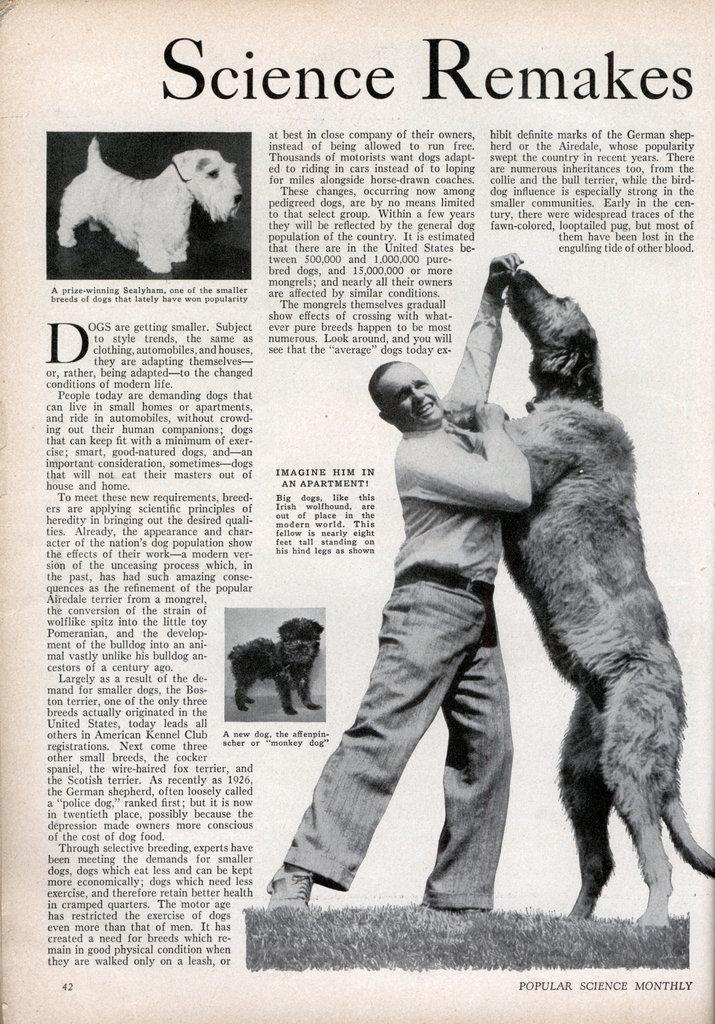
DOGS are getting smaller. Subject to style trends, the same as clothing, automobiles, and houses, they are adapting themselves— or, rather, being adapted—to the changed conditions of modern life.

People today are demanding dogs that can live in small homes or apartments, and ride in automobiles, without crowding out their human companions; dogs that can keep fit with a minimum of exercise; smart, good-natured dogs, and—an important consideration, sometimes—dogs that will not eat their masters out of house and home.To meet these new requirements, breeders are applying scientific principles of heredity in bringing out the desired qualities.

Already, the appearance and character of the nation’s dog population show the effects of their work—a modern version of the unceasing process which, in the past, has had such amazing consequences as the refinement of the popular Airedale terrier from a mongrel, the conversion of the strain of wolflike spitz into the little toy Pomeranian, and the development of the bulldog into an animal vastly unlike his bulldog ancestors of a century ago.

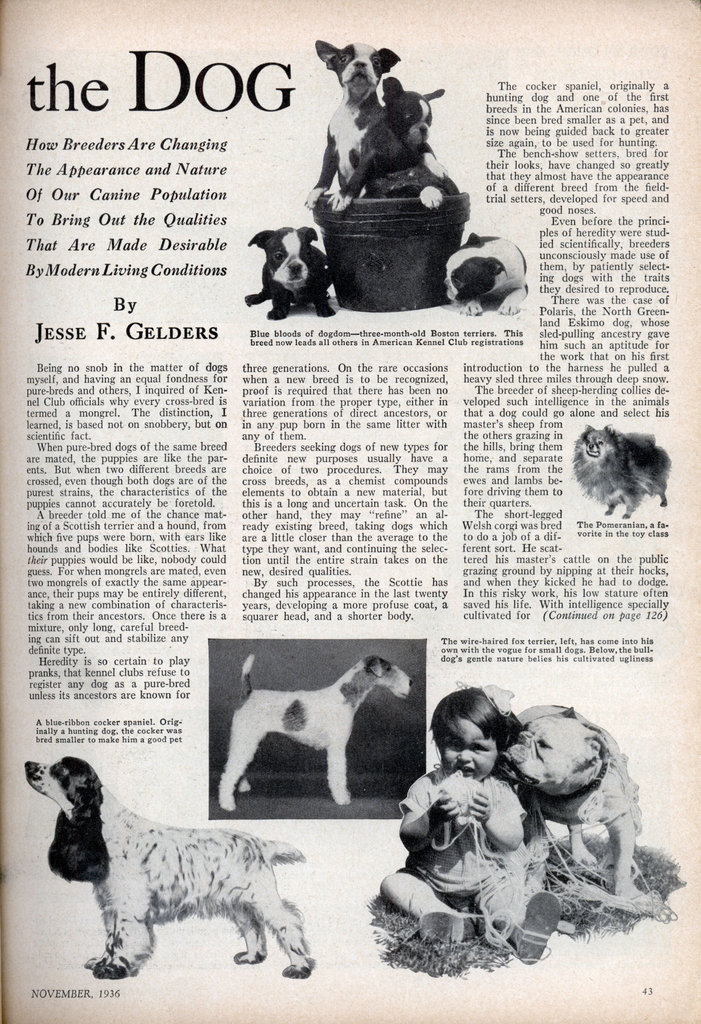
Largely as a result of the demand for smaller dogs, the Boston terrier, one of the only three breeds actually originated in the United States, today leads all others in American Kennel Club registrations. Next come three other small breeds, the cocker spaniel, the wire-haired fox terrier, and the Scotish terrier. As recently as 1926, the German shepherd, often loosely called a “police dog,” ranked first; but it is now in twentieth place, possibly because the depression made owners more conscious of the cost of dog food.

Through selective breeding, experts have been meeting the demands for smaller dogs, dogs which eat less and can be kept more economically; dogs which need less exercise, and therefore retain better health in cramped quarters. The motor age has restricted the exercise of dogs even more than that of men. It has created a need for breeds which remain in good physical condition when they are walked only on a leash, or at best in close company of their owners, instead of being allowed to run free. Thousands of motorists want dogs adapted to riding in cars instead of to loping for miles alongside horse-drawn coaches.

These changes, occurring now among pedigreed dogs, are by no means limited to that select group. Within a few years they will be reflected by the general dog population of the country. It is estimated that there are in the United States between 500,000 and 1,000,000 purebred dogs, and 15,000,000 or more mongrels; and nearly all their owners are affected by similar conditions.

The mongrels themselves gradually show effects of crossing with whatever pure breeds happen to be most numerous. Look around, and you will see that the “average” dogs today exhibit definite marks of the German shepherd or the Airedale, whose popularity swept the country in recent years. There are numerous inheritances too, from the collie and the bull terrier, while the bird-dog influence is especially strong in the smaller communities. Early in the century, there were widespread traces of the fawn-colored, looptailed pug, but most of them have been lost in the engulfing tide of other blood.

Being no snob in the matter of dogs myself, and having an equal fondness for pure-breds and others, I inquired of Kennel Club officials why every cross-bred is termed a mongrel. The distinction, I learned, is based not on snobbery, but on scientific fact.

When pure-bred dogs of the same breed are mated, the puppies are like the parents. But when two different breeds are crossed, even though both dogs are of the purest strains, the characteristics of the puppies cannot accurately be foretold.

A breeder told me of the chance mating of a Scottish terrier and a hound, from which five pups were born, with ears like hounds and bodies like Scotties. What their puppies would be like, nobody could guess. For when mongrels are mated, even two mongrels of exactly the same appearance, their pups may be entirely different, taking a new combination of characteristics from their ancestors. Once there is a mixture, only long, careful breeding can sift out and stabilize any definite type.

Heredity is so certain to play pranks, that kennel clubs refuse to register any dog as a pure-bred unless its ancestors are known for three generations. On the rare occasions when a new breed is to be recognized, proof is required that there has been no variation from the proper type, either in three generations of direct ancestors, or in any pup born in the same litter with any of them.

Breeders seeking dogs of new types for definite new purposes usually have a choice of two procedures. They may cross breeds, as a chemist compounds elements to obtain a new material, but this is a long and uncertain task. On the other hand, they may “refine” an already existing breed, taking dogs which are a little closer than the average to the type they want, and continuing the selection until the entire strain takes on the new, desired qualities.

By such processes, the Scottie has changed his appearance in the last twenty years, developing a more profuse coat, a squarer head, and a shorter body.

The cocker spaniel, originally a hunting dog and one of the first breeds in the American colonies, has since been bred smaller as a pet, and is now being guided back to greater size again, to be used for hunting.

The bench-show setters, bred for their looks, have changed so greatly that they almost have the appearance of a different breed from the field-trial setters, developed for speed and good noses.

Even before the principles of heredity were studied scientifically, breeders unconsciously made use of them, by patiently selecting dogs with the traits they desired to reproduce. There was the case of Polaris, the North Greenland Eskimo dog, whose sled-pulling ancestry gave him such an aptitude for the work that on his first introduction to the harness he pulled a heavy sled three miles through deep snow. The breeder of sheep-herding collies developed such intelligence in the animals that a dog could go alone and select his master’s sheep from the others grazing in the hills, bring them home, and separate the rams from the ewes and lambs before driving them to their quarters.

The short-legged Welsh corgi was bred to do a job of a different sort. He scattered his master’s cattle on the public grazing ground by nipping at their hocks, and when they kicked he had to dodge. In this risky work, his low stature often saved his life. With intelligence specially cultivated for his task, he knew when to go into action and when to stop, by the tone of his master’s whistle.

Among the strangest characteristics cultivated for particular jobs, are those of the Afghan hound, brought to America a few years ago, but used for many centuries as a hunting dog in the mountains of Afghanistan. While he is not so fast as many other hounds on level ground, he has developed high, wide-set hips which fit him especially for running on hills, and for leaping over obstacles. And because he frequently hunted in dense thickets, he has been bred to carry his tail high, like a flag, which his master could see above the concealing brush.

Even more fascinating than the shaping of traits in individual breeds of dogs, has been the creation of new breeds by crossing, for special purposes. Tremendous care was required, to select offspring with just the right inheritances from each stock.

BREEDERS of Chesapeake Bay retrievers, desiring to improve their scent, crossed them with hounds, but were able to preserve the chief characteristics which they had inherited from their other ancestors, supposedly curly-coated retrievers which had been mated with two New Foundland dogs taken from a wrecked ship. Their stamina and their rough, almost waterproof coats enable them to withstand severe storms and work in water chilled by floating ice.

The Chesapeakes share with American foxhounds and Boston terriers the distinction of being the only breeds originated in the United States. The foxhounds were said to have been developed by George Washington, who, to obtain a faster breed, crossed English foxhounds with French hounds given him by General Lafayette.

Boston terriers represent another success of breeders in obtaining just the desired characteristics from a parent stock, this time the English bulldog. Crossing it with the white English terrier, they obtained the bulldog type of head on a dog smaller and more agile than the bulldog. By that time the bulldog had been cultivated into a good-natured though still courageous animal, and those qualities were preserved.

Strangely, a somewhat similar set of ancestors produced the bull terrier, a very different dog. This time, the breeders wanted a fighter, so they chose the bulldog. They crossed him first with large black-and-tan terriers and white English terriers, producing a heavy-set, short-legged, fawn-colored dog. By careful selection they eliminated the short head and nearly all the other old bulldog qualities except the courage. Then the dog was crossed again with white terriers, and the white color, a recessive characteristic, was fixed, so that the dog became essentially the bull terrier we know today.

THE bulldog himself was the result of careful breeding of dogs for the barbarous sport of bull baiting. The bulls which were to be killed were roped to stakes, so the dog did not require real hunting ability, but only ferocity. The heavy, powerful mastiff was crossed with other breeds, among them probably the pug, for a peculiar reason. The bulldog’s chief requirement was to hang on, when he caught hold, and the pug’s short nose enabled him to breathe without letting go.

With the passing of bull baiting, the bulldog began to be cultivated with two oddly contrasting aims. The ferocity was bred out, until be became a really kindly beast, but at the same time, his ugliness of appearance was encouraged to such an exaggerated extent that it often interfered with his health. Breathing frequently was an effort for him, even in repose; and his lower jaw protruded so far that he often had trouble chewing his food, making him a prize example of unwisely directed heredity.

Like the bulldog, the Airedale terrier had his origin in a questionable pursuit.. Not only was he for a considerable time a mongrel, but he served as the helper of poachers on forbidden game preserves. The poachers worked at night, and wanted dark-colored dogs which would not be conspicuous, and which hunted without baying. They crossed old English terriers and otter hounds first, then Irish terriers and bull terriers, until finally the present type was evolved and stabilized.

CHANGES in the occupations of other dogs, as strange as the reformation of the Airedale and bulldog, have been effected by skillful crossing. The pointer, today’s widely used bird dog, was employed 300 years ago in England for finding rabbits to be chased by greyhounds, which hunt by sight.

Breeders crossed the English pointer with Spanish dogs, to get the superior “pointing” ability of the latter, but they bred out the foreign dog’s other characteristics, as inferior to the native’s. The original pointer stock is believed to have descended from “setting spaniels,” greyhounds, foxhounds, and bloodhounds. Later, to produce a kindlier disposition, the dogs were crossed with setters.

The English setter’s ancestry, quite curiously, includes the Spanish pointer, along with several types of spaniels. The setter himself had started work as a hunting dog long before the advent of firearms; he located birds and crouched while nets were drawn over them.

The English sportsmen’s desire for a dog to chase the fox out of his hole, resulted in the mingling of an amazing array of dog-talent, to produce the popular smooth-coated fox-terrier. Many experts believe the little animal carries the blood of black-and-tan terriers, beagles, greyhounds and bull terriers, with important heritages in alertness, scent, speed, or courage from each.

Another little dog, descended from different stock, became the wire-haired fox terrier. It was crossed with the smooth terrier, to get symmetry and white coloring, but the breeders were careful to retain the rough coat.

Almost as frequently as new breeds have been created, old ones have disappeared or suffered serious declines. The Irish wolfhound, one of the most famous breeds in history and perhaps the largest, degenerated and almost became extinct with the passing of conditions which had made it useful. But an English sportsman, wishing to restore it, crossed the remaining dogs with deerhounds, which he thought were of the same breed. Then he crossed them with Great Danes and Russian wolfhounds, until once again the Irish wolfhound became the tallest known dog, standing as high as thirty-six inches at the shoulder.

MANY other dogs which have become extinct, or almost so, are represented by new breeds in the making of which they had a part. The black-and-tan, or “rat terrier,” for example, whose unreliable temper cost him many friends, still flourishes today in a transformed and reformed state, as a part of the Boston, the bull terrier, the fox terrier, the striking and intelligent Dobermann Pinscher (first bred by a German dog catcher) and in many other popular breeds.

Changing tastes and living conditions which so often decree the end of a dog as a type, frequently make a new place for a part of him—and it is the job of the skillful breeder to see that the right part is saved.
.

Wednesday, November 01, 2017

What the Hell Is a Congo Terrier?


Click to enlarge. Art work by Kevin Brockbank (note dog in a pot at right!)

This piece is from the July 2010 issue of Dogs Today.

Out of Africa
A single breed - the Congo Terrier - sums up the history of dogs.

Have you noticed that in the world of dogs, names and places never quite line up?

Look at Welsh Terriers.

I know digging men in Wales, but none that use a Kennel Club Welsh Terrier to hunt fox to ground.

I know digging men in Scotland, but none that use a Scottish terrier.

Afghans?

There are no Kennel Club Afghan dogs coursing in South Central Asia.

Show line German Shepherds?

Not too many of those herding sheep in Germany!

And in central Africa, the locals are not using "Congo Terriers" that have Kennel Club papers.

A Congo terrier?

What on earth is that?


The Kennel Club's Pariah Dog

The “Congo terrier” was discovered by explorer Georg Schweinfurth on an expedition to Africa in 1869.

He called the dogs "Niam-niam dogs," which described the tribal region where they were found, and he noted they were often quite fat, as the Niam-niam people loved dogs so much they thought nothing of tossing them into the stew pot for dinner!

The dogs themselves were spitz-like and barkless, with erect ears and curled tails, as is often the case with primitive dogs. Where the Niam-niam dogs were different was in their relatively small size, their short coat, and the fact that they often featured a white band of fur around their neck.

Though Schweinfurth called them Niam-niam dogs, similar animals were found across a wide belt of central Africa, stretching from Liberia in the West, to Sudan in the East.

Like many other primitive landrace pariah dogs, the Niam-niam dog had only one estrus a year and rarely barked, but instead vocalized with howls, yodels, and whines similar to those of the wolf, coyote, dingo, or jackal.

Of course, a largely silent dog in thick cover is not necessarily an asset. No matter; this deficit was corrected by African hunters who attached a wooden "bell" or clapper to the necks of their dogs so they could more easily drive small game out of thick cover.

In 1895, the Niam-niam dog was displayed at the Crufts dog show as the "Congo terrier."

The name did not last too long.

In the late 1930s, the Congo Terrier was formally brought into the Kennel Club and renamed the "Basenji" -- a Bantu name that meant "village dog."

The first order of Kennel Club business was to craft a narrow appearance-based "standard" for the Basenji. This was not hard to do, as only seven dogs were initially admitted.

Clearly these seven dogs were perfect specimens of their type!


Inbreeding to Failure
Seven dogs, of course, is not much of a gene pool. In fact, the gene pool of the Basenji never grew much bigger than this. Over the course of the next 60 years, no more than 30 dogs comprised the entire founding stock of the breed in the U.K., the U.S., and Europe.

Inbreeding within this small stock of foundation dogs quickly led to a crushing genetic load and a rise in disease.

The first issue to raise its head was Hemolytic Anemia. When testing was started, twenty percent of all Basenjis carried this recessive gene. What to do?

The answer: Cull.

And cull they did, with about 18 percent of Basenjis weeded out of the American Kennel Club gene pool over the course of a decade.

Of course, this deep reduction in an already narrow gene pool sped up the inbreeding merry-go-round.

Within a decade, another health problem had popped up: Fanconi syndrome, a type of kidney failure. A health survey found 10 percent of all American Basenjis had Fanconi syndrome, and of these dogs, 76 percent were being bred.

What to do?


The Outcross Solution
The solution, of course, was an outcross.

The good news was that there were was no shortage of excellent dogs in Africa. After a 1988 visit to the Congo, AKC judge Damara Bolte reported that:

"In five days and 800 kilometers of driving, we saw at least 200 dogs of which only three were not Basenjis."


Could anyone driving down the road see the same number of Welsh Terriers in Wales, or Scottish Terriers in Scotland? Impossible!

In 1990 the Basenji Club of America successfully petitioned the American Kennel Club to open the AKC registry to African dogs, and 12 were admitted.

The addition of 12 African imports helped, but it was not enough. With popular sire selection, inbreeding within the Basenji gene pool continued. And how could it not, with less than a dozen dogs comprising over 95% of the Y chromosomes in Kennel Club dogs across the U.S., Europe and the U.K.?


Form, Function and Fantasy

As noted earlier, Basenjis have always been found across a wide swath of central Africa. The early dogs came from the Sudan, Sierra Leon, Liberia, the Cameroon, and the Congo.

In 1998, an American Peace Corps worker in Benin reported the country was awash in Basenjis, and that they could be acquired for as little as a dollar.

In 2004, an American imported six of these dogs, and they were shown at the 2004 Basenji Club of America Nationals. By then, however, the AKC registry had once again closed.

The Basenji Club petitioned the AKC to reopen the registry. This was done in January 2007, with a new closing scheduled for 2013.

Will opening the AKC Basenji registry a second time really matter?

Yes and no.

It will not matter to the Basenjis in Africa, which have never needed saving.

The hunting dogs of Africa are protected by those who hunt them. In this regard, they are no different from the working terriers of Wales and Scotland, the coursing dogs of South Central Asia, or bird dogs the world over.

But the Basenji community will not be dissuaded. They insist they are "saving" a breed.

But what is it that they saving, and who are they saving it from?

One thing is clear: Basenji enthusiasts are not trying to save hunting dogs in Africa.

You cannot save dogs in Africa by removing them from the continent, and you cannot save a hunting breed by not hunting them at all.

So what are the Kennel Club enthusiasts really trying to save?

Mostly, they are working to preserve a romantic notion of their own making.

For their breed to be special, a Basenji has to be more than another village dog, even if the word "Basenji" means just that in the Lingala language of the Congo.

And so, Basenji owners tighten down on what they see as the “special essentials” of their breed.

They insist no Basenji should ever bark, and never mind if some always have, and that a barkless dog is such a liability that the Africans themselves bell their dogs when they hunt.

And, of course, all Basenjis must have a tightly curled tail, and no matter that a tightly curled tail serves no function in the field.

Function? The American and European Basenji is not about function! This dog is about form and fantasy.

Hunting? What does hunting have to do with the Basenji? Nothing!

Why should Basenjis be held to a working standard when the Kennel Club Welsh Terrier and Scotty are not? This is the Kennel Club, not the African bush. Form trumps function; everyone knows that. And form is maintained by inbreeding right up to the edge of genetic failure. Why should the Basenji be any different in this regard?

And so Kennel Club Basenji enthusiasts hold tightly to a breed standard invented in England based on seven dogs. And when shown pictures of small hunting dogs in central Africa that do not quite conform to every aspect of "the standard,” they sniff disdainfully.

“Those aren’t Basenjis. Those are nothing more than village hunting dogs."

Right. No irony there!

Just ask any Welshman with mud on his boots, calluses on his hands, and a terrier at his heels. What does he know of Welsh terriers? Not a thing!

And so we come to the ultimate irony: What are Basenji enthusiasts trying to protect their American and European dog from?

Why inbreeding within the closed registry system of the Kennel Club, of course!
.

Friday, August 18, 2017

Howard Galton's Bloodhounds


I have written before about the intellectual history behind the the Kennel Club's theories, tracing them from Robert Bakewell to Erasmus Darwin to Charles Darwin and finally to Francis Galton (Charles Darwin's nephew) who was the father of eugenics.

Along the way, and without interruption, the talk was of dogs as well as other breeds of animals, including humans.

One of the more interesting notes is a letter from W.D. Fox to Charles Darwin about the effects of inbreeding in blood hounds owned by Howard Galton, who was Sir Francis Galton's uncle.

W.D. Fox quotes Howard Galton as saying:

"I have found from breeding in & in that there is considerable difficulty in keeping up the breed. Many of the females have never exhibited any sexual appetite & those which do so at all, very rarely.

The Knot in the tail appeared by accident in one of the finest Dog puppies I had, so fine that I kept it, notwithstanding this imperfection, and all his descendants had it until at last I got a cross with one of Lord Aylesfords' Bloodhounds, since which time it has disappeared.

The knot was always in the same part of the tail. Another consequence of breeding in and in is that the animals become prematurely old."

There is nothing new here, of course.

The deleterious effects of inbreeding have been known for as long as man has been alive, which is why there is a ban on it in all religions (one of the very few commonalities across the religious spectrum).

What is only notable here is the provenance of the observation: Darwin's inquiry into the effects of inbreeding in Howard Galton's blood hound pack dates back to 1838, more than 20 years before the first formal dog show in the U.K., and 35 years before the start of the Kennel Club.
.

Wednesday, July 26, 2017

Vets Invested in Defect, Deformity and Disease


A while back, in a post entitled For Veterinarians, Silence Has Been Golden, I noted the complicity vets have in the diseased, deformed and defective pedigree dogs that we see today:

Pencil it out, and the big money in veterinary care is not in once-a-lifetime vaccines, but in the big stuff: shot hips, wrecked eyes, recurring skin conditions, Cesarean births, and mounting rates of cancer.... The vets are nearly silent about the litany of pain, suffering, shortened life, and rising expense...

For those who think my post was too cynical, I recommend going over to the Purina Care blog, where veterinarian Larry McDaniel writes about the recent New York Times piece on English Bulldogs (for my take on that, see here).  McDaniel writes

I vividly remember a conversation I had with an established Veterinarian when I was starting out in practice in Montana. He told me that one sure fire way to get my practice going was to help establish the Bulldog as a breed in Western Montana. I thought he was joking, but he was serious. All the Bulldog people in the Western Part of the state saw him as the expert and brought their dogs to him. He told me that much of his success was based on the Bulldog.

Is this kind of advice rare in the veterinary field?

Apparently, not at all.   Veterinarian Emma Milne, in the U.K., once gave a presentation about health problems in pedigree dogs to the British Veterinary Association when an opthamological veterinarian stood up and said, point blank:  Why would I want a healthier dog when it's the wrecked Kennel Club dogs that bring in the money? 

Was this being said as a joke?  At the time, some thought so, but maybe not! 

One things for sure, as I noted in my earlier piece:

Just go to your vet and ask if he or she has a written list of breeds they actively caution against.

It's not going to be there.

Fact sheets on heartworm? Check. Even vets in Maine will have that in hope of maybe making a sale to a gullible customer.

But a fact sheet that says "avoid these breeds which are walking cancer bombs?"

A brochure that says "just say no to anchondroplastic dogs and brachycephalic breeds?"

Not there.

Nope.  Still not there.  Some things never change.
A re-post from November, 2011.
.

Friday, July 07, 2017

If John Russell Were Alive Today ...


A lot of time and energy is spent by people on the show ring circuit culling through pedigrees counting the number of "champions" they can find listed. This is called "selective breeding," by the Kennel Club folks, but what is it they are selecting for?

Among show ring aficionado's working ability is never the primary selection. Since, in the world of working dogs in which John Russell lived, the second slot is selection by size, and the third slot is selection by gender, the show ring breeder is (at best) promoting fourth-string characteristics to prime. This is a recipe for ruin, and it's a recipe the Reverend John Russell watched with concern during the early years of the British Kennel Club. As he noted about his own dogs:

"True terriers they were, but differing from the present show dogs as the wild eglantine differs from a garden rose."

If you do not work your dogs underground often, you have no idea of what you are breeding for when it comes to work.

It is not a matter of working a few weekends. A dog's working qualities and abilities are not made in a day. Nor should yours be, if you are a serious breeder. You need to dig quite a while to know the value of voice, the value of nose, and the nature of the balance point between having a dog that is too hard and too soft. It takes a few dogs and a few winters to fully appreciate the value of a good coat, and to understand the value of a small well-muscled dog.

The people in the AKC like to talk a lot about John Russell, but they manage to leave off the fact that he did not create his dogs in the show ring, but in the field and by testing them in the ground and under a spade. Though he occasionally judged dog shows, he did not register his own dogs as he feared dog shows would be the ruin of working terrier. He was not wrong!

If John Russell were alive today, most of the people who own Jack Russell terriers -- including many of those with working certificates -- could not show him a day in the field with the dogs. I think Russell would be rather embarrassed by that fact, and he would certainly by saddened.

A repost from 2009

Monday, May 01, 2017

Disney Dog Training with Contrived Controversy


Fifty-five years ago, Walt Disney filmed a movie called Big Red featuring a show-bred Irish Setter that wanted to hunt, and a contrived crisis about dog training between an older English-speaking Canadian (played by Walter Pigeon) and a younger French-speaking orphan who wanted to teach the dog using "gentler" methods.

The movie begins at a dog show at the Montreal Kennel Club where Big Red wins first prize and Walter Pigeon's "kennel man" is instructed to spend as much as $5,000 to acquire Big Red -- a cash equivalent of over $35,000 in today's dollars.

In the next scene we see the improbable situation where a show dog has been bought by a shooting dog man, and the shooting man with show dogs also has many breeds rather than specializing in just one.

We then get introduced to the orphan, dressed in beautiful clothes and dripping in pancake makeup, who slurs grade-school French.  Welcome to the wonderful world of Disney!

Finally, we learn that just one month after being acquired, Big Red is supposed to go to the Westminster Dog Show in New York where, if he wins, he will be "the best dog in North America, perhaps in the whole world" and his cash-value will then double.

As the movie rolls forward, we see the horror of aversive training techniques -- Walter Pigeon cuffs the dog under the jaw so that it will hold its head unnaturally high in the show ring.

Of course the boy is shocked -- this is abuse!

But Walter Pigeon explains, setting up the essential conflict of the movie, that "a dog is an animal, he is governed by conditioned reflexes.  Dogs are not people, they do not have human reactions, and the only way to handle them is with a firm voice and tight lead."

And with that -- all of two seconds of training done with horrible timing -- Walter Pigeon gives up on the dog for the day. "We'll try again tomorrow" he tells the kennel man.


Walter Pigeon explains to the Orphan that Big Red is a "bench dog" and that "his kind are not used for any practical purposes any more" because they were bred for looks rather than work.

This little scene is designed to reinforce our dislike of the older man, who has just said he bought a useless dog at an extravagant price solely to make money.  This is, quite obviously, the antithesis of  good red-blooded American values.  And besides, Big Red is not useless!

Welcome to Disney, where every story is a morality tale.

The movie takes obvious plot twists and turns as it progresses, with the poor Orphan Boy somehow becoming an expert trainer in less than a month (a miracle!), and the fellow with the expensive shotguns and kennel full of dogs, somehow not knowing his ass from his elbow.  And yes there is the obligatory run-in with a mountain lion, with Big Red and the Orphan Boy saving the day.


What's interesting about this story, from a historical point of view, is that it shows how long the  battle between "abusive" trainers and "gentle" trainers has been going on.

In fact, working dog men like Montague Stevens were training dogs with food long before the parents of Karen Pryor or Victoria Stilwell were born. 

Food rewards as a dog training method are older than Jesus, and it's hard to find a 19th Century book on dog training that does not talk about the practice. 

But you cannot train everything with a food reward, which is why God gave porcupines their quills, and skunks their spray.  The real world is full of consequences of all kinds, and they are not all positive, are they?

The dog trainer who was actually used in this movie is none other than William Koehler, who is often demonized as an abusive trainer simply because he did not shower his dogs with biscuits and then turn around to whine that they were now all fat. 

This is not to say that all of of William Koelher's techniques would be saluted today.  Long lines?  Yes. Tossing a light choke chain at a dog?  OK.  But Koehler also saluted the idea that with some dogs a very powerful aversive, done once, was less cruel that mincing about with half measures for months.  Was Koelher right?  The bull in the pasture that does not test his electric fence says "maybe."  But do most dog trainers really need to use strong aversives?  The answer is no.  Most dog owners are pet owners who will never see their dog running free off leash, and most are training dogs starting as puppies, before bad behaviors have been deeply ingrained because they were (unintentionally) rewarded for years.

Koelher, of course, did run his dogs off-leash and unlike so many in the world of dog training, he did not start by training fat suburban dogs owned by owners too lazy to walk them. 

Like so many dog trainers of his era, Koehler started off in the military in World War II where the dogs acquired were almost all large adults and given (read abandoned) to the military because they often already had discipline and temperament issues. And yet, in the military, a dog that does not obey a command can cost lives, both human and canine.  To this day, the U.S. military uses very strong aversives for certain parts of its training regime.  When a bomb-detecting dog is told to "stop" this is not to be taken as a suggestion!  A dog that barks while on patrol can kill an entire platoon.

Yes, most military dogs "will work for Kong" and other toys and small rewards, but these dogs have also learned  that there are certain never acts, and some of those (such as barking on patrol) may be counter to their internal code.

The year that Big Red came out, William Koehler published The Koehler Method of Dog Training which became a staple of AKC obedience competitors.

A variation of the "Koehler method" of dog training was brought to television in the late 1970s by Barbara Woodhouse, who featured basic Koehler methods in her own book, "No Bad Dogs."

Of course, most people who opine about Koehler today have never actually read a Koehler book, and have no idea that he trained dogs in Hollywood or that he trained dogs for this "anti-abuse" movie in particular.   When they do look to defame Koheler, they generally do so by quoting from the very end of one of his books -- and leaving out the fact that this section is very clearly labeled as one that is only to be consulted when all else has failed and the next stop for the dog is the gas chamber. 

Death before discomfort?  That's the rallying cry of a lot of "pure positive" dog trainers today, who are only too willing to declare a dog untrainable if they cannot get it to changes it ways with nothing more than a few cubes of cheese.

Did William Koehler believe in unearned rewards, or effusive baby talk to dogs?  No, but neither do most sensible trainers.

Did William Koehler prance about in a dominatrix outfit while showering dogs with biscuits and screaming at their owners?  No, but neither do most sensible trainers. 

William Koehler was a balanced trainer.  He knew dogs needed exercise (as can be seen in this movie), and that for a working dog there were few more powerful forces at work than the code that explodes (as can be seen when Big Red pings on birds when out in the field with the Orphan Boy). 

Koehler also knew that in the real world of off-lead dog work, a dog that obeyed only some of the time had a higher-than acceptable chance of ending up dead. 

That's still true today, whether the dog is an explosives detection dog in the Army, a police dog in Detroit, or a companion dog that escapes the yard in California.

William Koehler worked with dogs for 50 years, was employed by Walt Disney for 20 years, and over the course of his life he trained more than 25,000 dogs according to his obituary.

Compare his record with anyone else, and you are likely to find his credentials and experience without peer. 

Does that mean you have to train your dog the Koelher way?  Of course not!.  Train your dog any way you want.  But do everyone a favor, eh?  Admit that William Koehler had a long and remarkable career training very happy dogs (as did other Hollywood dog trainers, such Rudd Weatherwax, the trainer of Lassie), and that William Koehler was dealing with a lot of dogs that were not Labrador retrievers, that were not puppies, and which required a performance standard a little bit higher than "sometimes he'll do it if he feels like it and I have his toy or a chunk of cheese."