Showing posts with label cats. Show all posts

Wednesday, February 07, 2018

Curiosity Kills the Rat

Example
Rat hunting, 1850.


One of the many diseases harboured by rats is toxoplasmosis.

Toxoplasmosis is a major livestock disease and is a serious problem for humans. In the U.S., it is said that toxoplasmosis causes more congenital abnormalities than rubella, syphilis and herpes combined.

The Toxoplasma gondii parasite (a protozoan) passes from rats to cats to humans. It has long been known that toxoplasmosis changes rat behavior and makes them more susceptible to predation by domestic cats, which are the parasite's definitive host.

Dr. David Macdonald's team from the Wildlife Conservation Research Unit at Oxford looked into how toxoplasmosis effects rat behaviour. They found that compared with healthy rats, infected rats were more active (and hence more prone to cat predation), more curious (even approaching humans), and more likely to overcome their innate fear of cat odour. Some infected rats even preferred areas scented with predator odors!

Obviously, a disease that makes rats lose fear of predators must have some adaptive benefit for the microrganism. And it does. Since infected rats are more likely to be killed by cats, the Toxoplasma cunningly helps move itself on to its final cat host.

Ironically, curiosity kills the rat, not the cat.

In most other respects, rats infected by Toxoplasma behave normally. They are not totally deranged and their social status within their warrens is unchanged. However, infected rats are less phobic of novel foods and are also more easily trapped. So, in addition to tempting fate with respect to predation, these unfortunate rats are also more susceptible to control measures.

Toxoplasmosis is very rarely carried by dogs. It is theoretically possible for a dog to get toxoplasmosis, but this is so rare (only occuring in dogs with seriously compromised immune systems that are already fighting off some other type of disease) that dogs are not considered a vector.
. .

Tuesday, October 24, 2017

The Always New and Continuing Evolution of Dogs


A repost from this blog, circa February 2007.

A lot of people want the undifferentiating affection of a dog, but are not entirely willing to pay the price: forced awakenings at 7 am, expensive fencing, veterinary care, shedding coats, barking, and strange smells in the living room.

Dogs are small tyrants that crap on your rug, chew up your glasses and steal your sandwiches.

If you own a dog, you can still ride off into the sunset, but you better be back by 8:30 to feed it, and by midnight to put it to bed for the evening.

In the era of schooners and candles, when people lived on large farms with slow traffic, things were probably a little bit easier. Back then a large dog could sleep in the barn and roam more-or-less at will.

Now a lot of folks live in condominiums and multi-story apartment buildings surrounded by six-lanes of traffic. Others are retirees looking for less work. The result is a growing market for small dogs that are as easy to take care of as a cat.

In fact, what is wanted today is a dog that acts like a cat, and a cat that acts like a dog.

Towards that end breeders on both ends of the spectrum are working towards a middle ground, with cats that have affectionate personalities and legs too short to jump up on the furniture, and dogs that do not shed, rarely bark, and are so small they can be tucked inside a handbag.

I suppose all of this is simply a logical extension of Robert Bakewell's earlier efforts to control sires in order to produce animals for a particular function.

Cats, of course, were slow to domesticate as prior to the rise of the "indoor" cat, felines were free to roam and cross-breed at will.

Dogs, on the other hand, have been the product of controlled breeding for so long that most Kennel Club breeds now seem to specialize in two or three genetic defects. As a consequence, more and more prospective pet owners are are now looking at cross breeds in some hope of avoiding expensive veterinary work to "fix" defective canine hips, eyes, knees and teeth.

Another factor, of course, is that a lot of the small "toy" breeds are so fru-fru that no self-respecting heterosexual man is eager to be seen walking one. A Toy Poodle? A Papillon? Please.

A cross-bred small dog at least offers the potential dignity of being something a little "outside the box."A small dog described as a "little mutt" or "attack rat" by the husband, can be described by the wife as a Shitpoo (a Shih Tzu crossed with a Toy Poodle), a Cockapoo (a Cocker Spaniel crossed with a Toy Poodle), a Schnoodle (a Schnauzer crossed with a poodle), a Bagel (a Beagle crossed with a Bassett Hound) or a Puggle (a Pug crossed with a Beagle).

Pardon me if I do not join the Kennel Club crowd which clucks and moans about "little mongrels" being cranked out by puppy millers and "back yard breeders".

How, I would ask, does that differentiate these new dogs from most Kennel Club breeds? After all, most of the dog breeds on earth today are less than 140 years old, and most were invented by puppy peddlers doing their business between 1860 and 1900.

The harsh truth is that most canine breeds were not forged by honest field work, but by professional breeders seeking to sell dogs for the pet trade.

In short, the true history of most dog breeds is one of "backyard breeders" creating contrived names and fake histories for their dogs and producing enough of the dogs in a short enough period (a puppy mill by any name) to create a "class" of dogs to fill a Kennel Club ring.

And it's not like Kennel Club breeds cannot be improved by a little outcrossing!

The Yorkie has such serious teeth problems that they invariably require attention from expensive veterinary dentists.

The Pug's bulging eyes make it prone to eye injury, and nearly every one of them is born caesarian.

The Toy Poodle is a barker and often mentally unbalanced.

Dachshunds are prone to serious back and joint problems.

Papillons and Chihuahuas have all kinds of health problems, not the least of which are that their bones may be so light they can break jumping off the couch.

The Lhasa Apso is a walking mop requiring more grooming than a Hollywood starlet, and is often a mental case as well.

Of course, most cross-breeds are not all that successful, and only a very few show a marked advantage over a common pound dog.

That said, enough crosses are working out that a few crosses are developing into regular replicable breeds. The most obvious candidate for "new breed" distinction is the "Labradoodle" -- a cross between a Labrador Retriever and a Standard Poodle. In Australia, this very tractable dog has been standardized and now breeds true after more than 15-years of focused work. In the U.S., however, most "Labradoodles" remain hybrids which, when crossed with each other, throw a wide array of very different-looking pups.

Contrary to what many hybrid dog advocates will tell you, a hybrid dog is not always healthier that its purebred cousin. Genetic loads are never revealed in one breeding, and "hybrid vigor" is not a perfect curative for all canine ills.

A final note is that when dogs are combined, the positive characteristics of a breed are not necessarily those that are transfered.

The tale is told of the time when Marilyn Monroe met Albert Einstein and coyly mewed, "Professor Einstein, we should get together. With my looks and your brains, think of the wonderful babies we could produce."

To which Einstein is supposed to have replied: "Yes, but what if they have my looks and your brains? That too is an equal possibility."
.

Tuesday, March 19, 2013

Rats Like Cats and Dogs That Work


It's always amusing to me to read the hunting stories of others.

The rats are always as big as cats, the fox as big as coyotes.

Pictures? Didn't think to bring a camera.

A scale? No, never had one of those.

A tape measure? No, never had one of those either.

Of course, the same is said about various breeds of dogs.

A lady in Ireland posted on the Internet that she had working Glen of Imaal terriers.

Really? Registered dogs and not Jack Russell crosses?

I sent her an email, noting that if she had pictures of her dogs with locator collars on, and a fox at a sette, I would send her a copy of my book for FREE, as I would be thrilled to see such a thing. I was not interested in posting the pictures -- just interested in seeing them.

Bottom line: I am still waiting for those pictures.

She said she never allowed pictures when hunting. Really? Odd. It's completely legal to hunt fox with dogs in Ireland, and I have a hard drive full of such things sent to me by my Irish friends who have no fear of sending them around.

Surely she knew hunting fox was legal in Ireland? Silence on that question.

Instead, the response back was a slide off into the ether. It seems someone "owed her a day out" and she would send me pictures then. Eh?? OK.

But I'm still waiting. Maybe one day they will come. That said, I did find it an odd choice of words. Someone has to take her out? Why? Does she not own her own tools? Can she and her dogs not locate their own fox? Is her idea of a working dog a "one and done" kind of thing in which a working dog is made in a single dig?

And why do all my Irish friends use Patterdales and Jack Russells? Even in European countries where Badger digging is entirely legal, no one is using a Glen of Imaal terrier! In fact, hardly anyone in the world, digging or not, has any interest in owning this nearly useless and not very attractive breed whose true history is that of a left-over turnspit dog. No wonder they are one of the rarest breeds on earth.

Perhaps this person in Ireland is genuine, but you will pardon me if I profess some skepticism. You see, I have never met anyone who actually hunts with dogs but who has no hunting pictures. I have, however, heard a lot of "fish stories" in my day, and more than a few dog yarns from pretenders as well. I am always eager to be proved wrong, but with some breeds I have yet to have that pleasure.

Speaking of which, if anyone is really good at PhotoShop, I need some help illustrating the story of how my dogs bagged an 80-pound fox, a 75-pound raccoon, and a 40-pound groundhog. It would be especially nice if a Super Model could be slipped in standing next to me as well.

Now, to be clear there's nothing at all going on between me and the Super Model. It's just that Claudia Schiffer really likes to hunt. We are just good friends.
.

Monday, October 29, 2012

The Architecture of Burrows

A repost from 2005

The list of animals that hibernate in underground burrows, live in burrows or nest in burrows is astounding: fox, badger, turtles, some owls and parrots, ground squirrels and marmots, some penguins and puffins, European rabbits, bears, wolves and dogs, otter, some wild pigs, some wild cats, many snakes and lizards, possums, wombats, frogs and toads, moles, mice and rats, nutria, crayfish, armadillos, skunks, muskrats, meerkats, some large spiders, and several types of bees.

Many of these animals spend a fair amount of time constructing, maintaining, and modifying their den systems which, in turn, are structured in response to changing external circumstances and changing internal needs.

Anatomy, behavior, and distribution of wild animals are all greatly affected by the burrow environment, with temperature, humidity, oxygen, living space, availability of food, and protection from flooding and predation all being influenced by burrow architecture.

Despite this, the burrow structure of almost all subterranean mammals is barely known, and data and descriptions of den structures as they relate to soil composition, drainage, external defenses (rock, wire fences, farm buildings), proximity to food and water sources, is almost entirely non-existent.

All of this make understanding burrow architecture as an adaptive tool a difficult task, but it nonetheless clear, among humans digging to their terriers, that burrows are designed with a reason and that certain "tricks" keep popping up. A few I have noticed in the construction of groundhog and fox dens:

  • Water and the phreatic zone: Dens of fox and groundhogs are designed to keep the animals dry, yet fox in particular like to locate their dens very near water. Shallow dens are sometimes found carved into the sides of small humps or rises in marshy areas, but these are rarely natal dens. The deeper natal dens of fox are generally found on the rises above the flood plains -- on well-drained hillsides near a creek or pond or water-filled ditch. The ideal spot for a pipe is deep enough to be dry from surface water, but not so deep as to be encountering the water table -- the so-called "phreatic zone".

  • The "plumbers pipe" opening: In these settes the pipes run down for two or three feet before rising again and then dropping again. This createa an earthen "water stop" not so very different from the plumbers p-pipe you will find under your kitchen sink. This is a common feature in many animal burrows, from rat to fox.

  • Depth is determined by soil: This is near-truth. The softer the earth and the easier it drains, the deeper the den is likely to be. One of the chief functions of a den is to keep the animal dry, and in soils that are very light, dryness tends to be achieved with some depth. You may cut through very soft stuff for three or four feet, but below that will be the harder stuff -- a layer of hard sand below the soft, or a layer of hard dry clay below much softer and friable soil. The pipe is likely to be in the softer soil just below the hard vein. The hard vein works to structurally support the pipe and to keep out the last bits of water. The one exception that I would note is where a ridge is made almost entirely of small cherts, flints or flaked slate. Here digging by a fox or groundhog is so hard, and the drainage is so rapid, that the den pipe may be very shallow since water runs through the den as fast as it falls. These shallow and breezy loose-rock dens will not be used in winter, but are likely spots in summer.

  • Rocks, roots and barbed wire at the entrance: This is so common that it is clearly a planned design feature. It is not uncommon to find dens exiting inside a stump or hollow tree, or to have a strand or two of barbed wire running along the lip. Groundhog dens frequently start on one side of a barbed wire fence and exit out another. If there is an abandoned vehicle on the edge of a farm, a groundhog will invariably makes its home under the chassis -- a nice shelter from the rain, but also from predators who will have to slow down to a crawl to avoid beaning themselves on the I-beam and suspension. Hard structures not only makes digging out more difficult, it makes a mad dash at the den hole a dangerous and maladaptive strategy for large predators. In addition to hard structures at den entrances and exits, there are "soft structures" such as thickets of multi-flora rose, bramble, poison ivy, and thick wild grape vine.

  • The hard turn after the den entrance: This is a frequent feature of groundhog den entrances and serves two purposes: 1) it makes it difficult for predators to enter, and; 2) water entering the entrance will tend to follow the straight line of gravity and soak into the ground at the end of the pipe rather than run sideways with the turn of the pipe. I have encountered some rather incredible animals that took this "hard turn at the entrance" technique to absurd levels as they never stopped turning -- they corkscrewed their dens in full circles all the way down in a spiral that went four or five feet deep.

  • The pocket room close to the entrance: This is a common feature of groundhogs dens, and I believe these serve as "loafing parlors" where the animal can tuck in out of danger between feeding forays. If you are quiet, and the dog is too, you can often bottle a groundhog in one of these little rooms before it goes deeper into the sette.

  • Right angle turns inside the den pipe: These are very frequent features of groundhog and fox dens and seems to serve two purposes. The first purpose is that they help keep the den dry, as water running down a pipe will tend to follow gravity rather than take a sudden turn to the left or right. The second purpose is clearly defensive; a groundhog or fox can take a stand at a hard corner and slash out at anything coming down the pipe, inflicting considerable damage if the corner is tight, as it invariably is. Often a sette will have several right-angle turns, each providing additional elements of security, like doors on a hallway. A human digging on a dog will often break into a pipe where the dog and quarry are at a standoff at one of these turns, at which point all hell will break loose as the animals grab each other, or else the fox or groundhog will manage to retreat to the next hard corner in the pipe system -- a kind of running battle that can be very frustrating to the digger!

  • Side pipes and stop-end branches: These are common features of both groundhog pipes and fox dens. Some of these represent unfinished den digging, but for a fox they also provide a place where one animal can scoot into in order to let another pass by, where one animal can lay up without getting overheated from the warmth of its mate and where it can get a better supply of air. Earth dens are all about keeping dry, maintaining the right temperature, keeping the air flowing, and staying secure. Side passages increase the options on all counts.

  • Field settes are generally deeper and larger than hedgerow settes, and often harder for the human to dig as a consequence: I believe this is due to a conflux of opportunity and necessity. The opportunity for larger and deeper settes is due to the lack of obstructions like roots and rocks. The necessity is that plowed fields with friable soils require deeper dens to remain dry, while larger more complex settes are an element of security, allowing a groundhog or fox to escape danger in one part of the sette by going to another -- or even bolting out of one entrance into another.

  • Large "race track" settes are fairly common in fields. These large settes circle back on themselves several times and may have several layers of pipe. More commonly they are simply four-, five-, or six-eyed settes with connecting pipes. A groundhog can run around in these large settes, shoveling dirt behind it to block the dog, and effectively preventing the dog from bottling it in a stop end. The solution I employ is to earth stop the den at two or three spots (generally at exits where the pipe goes left and right). If needed I will also allow two experienced dogs that know each other well to enter opposite sides of the settes and work the animal to the middle. This generally prevents the groundhog from digging in and gets the animal pinned against one of the newly-minted stop-ends in short order. Putting two dogs to ground should be left to people who know their dogs well and who are experienced diggers. It is better to lose quarry than a dog. Two very hard dogs to ground, or two dogs in a den occupied by a skunk, could be a disaster! Never enter two dogs on a fox -- it is simply not necessary, as the fox cannot dig away.

  • Winter "fox porches": A fox will often dig out the first three or four feet of a groundhog den and create a kind of "loafing porch" where it can tuck in out of the wind but still not be fully underground. Fox can easily overheat inside the earth, and this "porch" area allows for easy temperature regulation -- go a little deeper if it is very cold, stay right at the entrance if it is warm. The breezeway allows the fox two excellent avenues of escape if danger approaches -- into the nearby woods or thicket, or deeper underground.

  • An observation on what does not dig: Raccoons and possums do not dig earth dens -- they occupy holes made by other animals or find hollow trees, brush piles, rock crevices, hay bales, barns or crawlspaces. Neither animal is equipped to move dirt beyond a little scratching for worms and beetle grubs. Neither animal will modify a den in a significant way (though both will pull plastic bags and other debris into a den in order to improve insulation and provide bedding).


Tuesday, August 28, 2012

The Beast of Exmoor and Other Nonsense

A repost from February 2009

Stories of feral "beasts" lurking in the darkness of the English countryside have been around for hundred of years, and were already old when Sir Arthur Conan Doyle used such a tale as the basis of The Hound of the Baskervilles.

The stories persist, of course.

Here are a few contemporary descriptions of various U.K. beasties:
  • Beast of Muchty: "I was travelling to my work at 04:30 when a cat the size of a Lurcher, jet black, small head, very slim with a long tail ran in front of my car (about fifty yards). The whole incident was over in 2 seconds ... "
  • Beast of Bont: "The main evidence for the existence of these sharp-clawed, but mysterious stalkers has been the death toll among vulnerable herds of sheep."
  • Beast of Barford: "It is twice the size of a dog print and clearly shows three huge claws and a large pad at the back. Wildlife experts believe the print is the most conclusive evidence yet that big cats are roaming Warwickshire."
  • The Beast of Gloucester and The Black Beast of Inkeberrow: "A 'huge black beast' ran in front of Ray Lock's car on the other side of the river near Lydney... one evening near Monmouth where it was described as 'jet black and about the size of a large dog.'"
  • Beast of Burford: "A £5,000 reward has been offered for the capture of a 'big cat' which has been terrorising a farming community ..... Pc Ray Hamilton, wildlife crime officer at Thames Valley Police, admitted there had been several sightings - but said this was not unusual. 'We've had sightings of everything you could imagine - pink flamingos, lions, dingos, wolves and even a giant ant-eater in Pangbourne.'"

The human desire to create imaginary "beasts" seems to have some correlation to the loss of large predators and true wilderness.

With the extinction of the bear and the wolf, the U.K. has lost all large predators and now has to suffice with two rather unimpressive meso-predators, the fox (average weight 15 pounds and living almost entirely off of mice) and the badger (average weight around 25 to 30 pounds and living almost entirely off of worms, beetle grubs, and small bulbs).

So what are these large feral "beasts" seen in the English countryside, and why is it that they are never actually found?

The short answer is that these "beasts" are nothing more than large escaped lurchers (coursing dog crosses) that have taken to livestock-worrying. As an article on the Beast of Osset notes:

"On a parkland estate in rural Yorkshire a poacher's lurcher (a fast greyhound-like hunting dog) was at large for six months but was sighted only once during that period. The gamekeepers knew it was there because they found the roe deer that it had killed, but it took a concerted effort with volunteers to flush it out of the wood."


In fact, sheep worrying is a serious problem
in the U.K., and while any dog can end up attacking sheep, it is the larger dogs such as Lurchers and Bandogs (mastiff crosses) that do the damage that lead some to think a large cat or lion is loose in the English countryside.


Sheep worrying by lurcher.


In fact, a lurcher really does look like a large cat if seen in the dark or fog, and especially if it is seen only briefly from a moving car, as most "big cat" sightings are.

A Bandog (what the Hound of the Baskervilles was) really does look like a lion if seen under the same circumstances.

What is amazing about the "big cat" stories in the U.K., however, is how easy they are disprove, and yet how utterly resistant people are to having their bubbles burst.

Take the issue of "big cat footprints". Most of these footprints are clearly large dog prints. How can we be sure? Simple -- all the footprints show claw marks. All the large cats, except the cheetah, however, walk with retracted claws, otherwise they would quickly dull


This foot print of the "Beast of Barford"
is held up by a young hopeful.


The other issue has to do with hounds -- the U.K. is crawling with fox packs, and yet none has ever chased and cornered a large cat other than the now very rare native Scottish Wildcat, which is not much larger than a tabby.

You can be sure that if the big cats were out there, British fox hounds would have found them by now! In the U.S., small teams of less experienced hounds manage to track down marauding farm-country cougars in only a few hours time.

Finally, we come to the issue of rub strips -- bits of carpet and tacks impregnated with a mixture of catnip and beaver castoreum -- that have failed to turn up any positive large cat hits in the U.K.

Wherever these rub strips are used -- whether in North America, South American, Europe, Africa, or Asia -- they are quickly found and rubbed against by large cats and other predators.

A DNA analysis of fur caught on the hooks of the carpet tacks can not only identify what species of animal has left it behind, it can identify what specific animal has come by in the night.

Rub strips are so accurate they are now routinely used to survey population densities of such elusive large cats as leopard, lynx, cougar, and jaguar, as well as badger, wolverine, bear, wolf, coyote and bobcat.

Of course, "Beast of" stories are not unique to the U.K.

Here in the United States we have Sasquatch and some local tales of little green men, swamp creatures, and even a werewolf or two (all delivered with a wink to small children).

In truth, however, we have far fewer fantasy "Beast" stories than the U.K. for a simple reason: we have more real top end predators.

In states like Minnesota, Wyoming, Idaho, Montana and North Carolina we really do have wolves prowling the remote sections.

In Florida, Louisiana and South Carolina we really do have 12 foot lizards slithering out of drainage ditches and quite capable of eating an old lady alive.

Mountain lions really do prowl the remote sections of Idaho, Wyoming, Montana, New Mexico, Colorado and even Texas, and are now being found as far east as Iowa.

Black bears number well over 400,000 in the lower 48 states, and there are over 100,000 more in Alaska.

Bobcats are everywhere, as are coyotes -- the later so common that there are bounties on them, including in my home state of Virginia.

No one living in a large America city today lives more than two hours away from a major top-end predator of some kind.

This is a glorious thing, and something we should count among our greatest national treasures.

But a "Beast of Bondwynn?" No, we don't have that.

In a world in which top-end predators are still common, there is no reason to invent ghost stories.

.

Tuesday, June 05, 2012

Why Anti-Hunt Vegans Should Get Sterilized


A repost from December of 2004.

Most animal rights activists do not spend much time thinking about how animals die in the woods.

Here are the options: starvation, disease, poison, ripped apart while living by a predator, and vehicle impact.

The harsh reality of the wild is that no wild animal dies quickly without human help.

In the wild animals starve due to food shortages, or they die with broken bones in ditches and pipes, or they expire curled up under bushes, their insides riddled by fever, parasites and sickness.

Cars already kill far more fox than all the mounted hunts, lurchers, and terriers combined, yet there are no major national campaigns to fund millions of wide and brushy culverts for fox to use while traversing from stream to field.

The fox "saved" from the hunt will likely die from a vehicle impact.

By the same token, the people that pale at the idea of fox hunting, seem to have no compunction about ripping up ocean ocean bottoms in order to put a few more flounder and shrimp on their already groaning plates.

"I'm a vegetarian" they say, "except for fish."

These are the folks who own free-roaming cats and think nothing of the carnage these animals inflict on baby birds, rabbits, and chipmunks.

These are the folks who give to organizations that run massive direct mail campaigns decrying hunting, oblivious to the fact that the bright-white paper used in all those mailings is derived from clearcut old-growth forests being chainsawn with abandon.

You really want to help nature?

Great!

Here's how to do that: Get yourself sterilized.

Nothing you can do will do more to save the enviroment this generation, and for a hundred years to come. Nothing you will ever do will prevent more misery to animals.

Nothing.

Saturday, December 24, 2011

Predator Fear, Alone, Results in Fewer Birds


Fear of meso-predators, and fear alone, results in fewer successful clutches according to a paper by Liana Zanette entitled "Perceived Predation Risk Reduces the Number of Offspring Songbirds Produce per Year" that appears in the December 8th edition of Science
.

Thursday, June 02, 2011

Coyotes are a Birds Best Friend


Researchers have found that areas with the most coyotes had the fewest cats and the most songbirds.

The reason for this is pretty simple: Coyotes prey on cats, raccoons and possums, all of which prey on songbirds and songbird nests. Feral and domestic cats alone kill over three billion birds and small mammals each year in the U.S.!
.

650,000 Feral Cats in Detroit?


From The Detroit Free Press comes this little gem about feral cats in the city of Detroit:

By one calculation cited by the Petsmart Charities, there are approximately 657,000 homeless cats in the area. The Humane Society of the United States estimates the nation's free-roaming cat population at 50 million, while another study published by Best Friends Animal Society estimates 87 million feral cats nationwide -- 22 cats for every square mile of land and water in the U.S.

Of course the "data" is complete nonsense. I have no idea how many feral cats are in Detroit or in America (lots!), but I can assure you that feral cats are fairly rare in most of American because most of America is in deep woods or near-desert far from humans where you will never find a feral cat.

In fact, feral cats are like cockroaches and brown rats -- they simply do not exist absent the presence of man, and most depend on humans to supply at least some of their food resources. Yes, you may find a feral cat as far as a mile or two from a farm house, but without that farm, house that cat would simply disappear.  "Feral Cats of the Yellowstone" is a blank book, as is "Feral Cats of the Boundary Waters" and "Feral Cats of Western Kansas."  Feral cats are not wildlife any more than a brown rat or a cockroach is wildlife.  They are man-made pests, pure and simple.
.

Saturday, October 23, 2010

Skunks: When You May Need to Breathe for Two

For all the discussion and advice written about terriers skunked underground, it's odd that almost no one talks about the most common emergency, and how to address it.

That problem is lack of oxygen.

This is not a small point. Despite what has been written, most underground skunk sprayings do not end in tragedy -- they end in stink. The ones that end in tragedy most often end in immediate respiratory failure.

First, a little background. If a dog is skunked underground, most dogs will manage to get out of the hole on their own, and most will do fine afterwards.

Only a small percentage of dogs that are skunked underground express evidence of skunk toxic shock two or three days after the event. These dogs are animals whose kidneys are having trouble pushing the toxin out of their system, and there is some indication that this problem has a genetic component, as it seems to run in some terrier lines.

An underground skunking is a serious thing. But -- and this point is too rarely made -- if your dog dies, it's most likely to die either underground or right at the hole.

What you do immediately at the hole, then, is pretty important. And yet, on this issue, there is too often silence.

A Quick Review: Most skunked dogs die because the dog cannot get out of the hole quick enough and the dog is overwhelmed by skunk spray.

Skunk spray is pretty toxic stuff, as it contains a mixture of thioacetates and thiols (the stuff that stinks), mercaptans, and almost pure sulphuric acid (the stuff that will burns a dog's eyes and leave blisters on its snout).

If your dog is able to exit the ground quickly and on its own, you are likely to be in good shape. Skunk spray does not kill except underground, and though a dog may get chemical burning of the outer layers of the cornea, application of Mycitracin eye ointment, a running dose of antibiotics like cephalexin, and a week's rest away from the other dogs, will probably put everything right.

No dog has ever been rendered permanently blind by skunk spray alone, and all a vet will do is stain the eye a lot and bill you for the trouble. Staining a cornea does not promote healing -- it generally delays it. If you focus on preventing infection, the eye will take care of itself.

If your dog is pulled limp from the ground, and it is not breathing, your problems are very serious, and immediate action is required. What has happened is obvious -- your dog has succumbed to the skunk fumes and passed out. In fact, the dog may have more than passed out -- it may have suffocated due to the lack of oxygen in the sette.

If your dogs has passed out, or if it has suffocated and stopped breathing, you need to administer immediate mouth-to-snout artificial respiration.

Here are the basic steps:
  • Put the dog on its side on the ground, or cradle it in your arms, making sure the neck is straight and there is nothing in the mouth or throat obstructing breathing.
    .
  • Close the dog's mouth entirely, with your thumb and top fingers holding the snout LIKE A BEER CAN.
    .
  • Put your entire mouth over the NOSE of the dog, and puff a short breath into your dog's nose through its nostrils. Remember your dog is small -- you are not trying to blow up a hot water bottle, you are trying to get air into its lungs.
    .
  • Blow air into the dog's nose four or five times, and then release the snout and massage the chest at the point where the front elbows of the dog normally rest against its body. A terrier's chest should compress about a half inch (i.e. about half the width of your thumb).
    .
  • Continue to do mouth-to-nose artificial respiration on your dog at a rate of one breath every 3 or 4 seconds (about 15-20 breaths per minute), and do a chest massage/compression between every third or four breath.
    .
  • Continue doing mouth-to-snout artificial respiration for at least 20 minutes past when the dog stopped breathing.
    .
  • If the dog starts to breathe on its own, and begins to rally, stop -- a dog coming up out of a fog or comma may be very disoriented and bite, especially if it cannot see well.

If your dog begins to breath on its own, that's obviously a pretty good sign. If the dog is able to stand, let it do so. It may vomit, and if it does so, that is not a bad thing. If the dog starts to roll around on the ground to get the stink off of it, count yourself lucky.

You are not in the clear yet, however. Stake your dog far from the hole and in a comfortable location. Your goal right now should be to get the dog fully hydrated and urinating. The reason for this is simple -- skunk toxin is most easily expressed through the kidneys, and the more water you can get into the dog's system, the more the dog will pee and the less likely the kidneys are to shut down.

If your dog is alert and resistant (a good sign), but not interesting in drinking water, try to pour a slug or two of water down its throat. If you have an eyewash bottle with you in the field (and you should), use this to jet water down the dog's throat. Go slow -- but load up the dog with as much water as you can.

Every 10 minutes, check the color of your dog's gums. If the gums are getting pale or white, that's a very bad sign -- it means your dog is growing rapidly anemic as the skunk toxin chelates and explodes the dog's red blood cells (i.e. Heinz body anemia). You need to get the dog to a vet quickly. There are a limited number of things a vet can do, but here is the general protocol:

  • The dog needs to be fully hydrated. That means a simple IV with a bag of lactated ringers solution. Putting an IV on a dog is not difficult -- a hydrating IV can be administered subcutaneous and in the field. In fact, having a lactated ringers kit with you in the field is probably a good idea if you dig a lot (gotta order one!).
    .
  • Mucomyst (the same medication used to treat cats for Tylenol overdose) will help clear toxins from the dog’s system.
    .
  • An oxygen tent may be needed in extreme cases.


A final note: most veterinarians know nothing about skunks, skunk toxic shock or bite wounds
. What this means is that if you are working your terriers a lot, both you and your dogs will be better off if you learn to do basic veterinary care yourself.

In your vehicle, you should have a well-thought out veterinary box with antibiotics and VetBond (or SuperGlue), ProvIodine, triple-antibiotic ointment, a space blanket, a large irrigation syringe, an extra gallon of distilled water, a razor blade for trimming away fur, a canine nail cutter, gauze, tape, Mycitracin eye ointment, benadryl (for yellowjacket and copperhead snake bites), and a muzzle. My vet kit also includes a hypodermic set, a Percocet-5 (with dosage notes), a rectal thermometer (added after a black widow Spider run-in), a veterinary stapler, quick stop styptic powder, and a small bottle of epinephrine (with dosage notes). In the field I always have several small squirt bottles with distilled water in them -- useful to wash out an eye, irrigate a wound, or administer oral hydration to a skunked dog.

Working a terrier is not risk-free for the dog. Of course, neither is the drive to the farm or a dog show. All things have risks. That said, your job -- as owner -- is to reduce those risks as much as possible. That means having a pretty complete vet box with you in the field as well as a credit card, a cell phone, and the number of a near-by vet.

Above all, however, it means reading, researching and committing to memory some basic knowledge to avoid mistakes. One of those bits of basic knowledge is how to administer canine respiratory assistance.

As for getting rid of skunk stink, well good luck with that!   Skunk stink lasts and lasts because the thioacetates in skunk spray break down into stinky thiols over time, resulting in the stink coming back, especially after the dog gets wet. The thiols can only be eliminated by repeated application of a soap-and-oxygenater combination, such as peroxide and hand soap. No matter what you do, the stink will be with you for 30 days.

For more information on skunk spray odor remedies (and a little more information on toxic-shock syndrome in terriers), see >> http://www.terrierman.com/skunk.htm
.

Saturday, October 31, 2009

Fantasy Creatures and Halloween


This post is recycled from 2004.

People seem to have a need for fantasy. I have written in the past about "fantasty diggers" but perhaps something should be said about fantasy creatures as well.

There is the fellow who claims to be an expert in wildlife who says he hunts blue fox, which he describes as a cross between a red fox and a Gray fox. That would be a fascinating cross (!) as these two animals are not remotely related to each other and cannot mate (nor do they wish to).

The same fellow chimed in that American rabbits den underground and that there are rabbit warrens in America. In fact no American rabbit dens underground. All of our native rabbits are cottontails (which is a genus, not a species) or hares and they nest in the shallowest of scrapes in the dirt. The pygmy rabbit, which lived in a small section of the West and was no bigger than a rat, was the one exception, but it is now believed to be extinct in the wild.

America runs rife with fantasy animals. There is Big Foot and Sasquatch, but also the Chupacabra, the Mothmen of Ohio, the Ozark Howler, various types of vampire dogs and Werewoves, and "Chessie" the Lake Champlain version of the Loch Ness Monster.

The U.K. has the same phenomenon, where loose, sem-feral lurchers and sheep-worrying dogs are described as the "Beast of Bonndwyyn" or some other interesting-sounding place.

Tracks are carefully photographed, and the brave locals point to the big claw marks as proof that a large feral cat (a black panther or jaguar or American cougar) is running loose in the allotmments.

In fact, the claw marks are proof that it is not a big cat -- all cats except cheetahs retract their claws when walking or running. If you see claw marks in a track, you have a dog. A dog that looks a lot like a large wild cat is most probably a lurcher. There may be a few feral swamp cats in the UK (as well as Scottish wild cats) but if you have ever seen one of either species, you will not worry about much livestock being lost -- both are hardly bigger than a large house cat.

Tonight, when you see monsters running through your streets, try to remember it's Halloween, and not Chupacabra hunting season. Fantasy is a fine thing -- so long as it's not confused with reality.

Wednesday, October 28, 2009

Crazy Cat Ladies Deny They Are Crazy Cat Ladies


Put out a press release: "Crazy Cat Ladies Deny They Are Crazy Cat Ladies."

Where is the edge of crazy? Ten cats? Twenty? Thirty? One hundred?

Does it start with having the smell of cat urine all over the house, or are you only crazy when the feces are piled deeper than two inches in the kitchen?

And what do you do about hoarders?

It's not enough to say "it's a mental illness."

So what if it's mental illness? That's descriptive, not curative. Does that mean we cannot prosecute? Are we supposed to whistle pass the misery of these animals and say it's OK because the person is crazy? If so, then we really owe an apology to Jeffrey Dahmer and heck of a lot of other crazy people too.

You say we should institutionalize these people? Really? How do we do that? Under what legal theory? At what cost?

You say we should require these folks to take medication for obessive-compulsive disorder? Really? You think that will work? You do realize these people are CRAZY right? Mental illness is the disease that says you haven't got it, the same as alcoholism. Yes, that's right: If you deny you are a crazy drunk that's proof you are one!

So what do we do? Nothing? Something?

The comments section is open.


.

Sunday, October 11, 2009

A Vulgarity of Starlings?


A hawk hunts a flock of panicked starlings.


What, exactly, do we call the massive flocks of starlings we see so often this time of year?

Surely such a thing already has a poetic phrase attached to it? After, all almost every group of animals does:

  • It's a paddle of ducks and a flock of seagulls.
  • It's a skulk of foxes and a cry of hounds.
  • It's a lamentation of swans and a charm of hummingbirds.
  • It's an unkindness of ravens and a murder of crows.
  • It's a mob of kangaroos and a pride of lions.
  • It's a school of fish and a pod of whales.
  • It's an aerie of eagles and a wake of buzzards.
  • It's a flight of cormorants and a mob of emus.
  • It's a mischief of rats and a clutter of cats.
  • It's a charm of finches and a hedge of herons.
  • It's a husk of hares and a trip of goats.
  • It's a band of gorillas and a troop of monkeys.
  • It's a deceit of lapwings and an ascension of meadow larks.
  • It's a burden of mules and a drove of ox.
  • It's a descent of woodpeckers and a kettle of hawks.
  • It's an ambush of tigers and a gang of weasels.
  • It's a bale of turtles and a knot of toads.
  • It's a dray of squirrels and a surfeit of skunks.
  • It's a business of ferrets and an array of hedgehogs.
  • It's a rookery of albatrosses and a tiding of magpies.
  • It's a coalition of cheetahs and a leap of leopards.
  • It's a route of coyotes and a packs of wolves.
  • It's a cast of merlins and a scold of blue jays.
  • It's a ridicule of mockingbirds and an ostentation of peacocks.
  • It's a labor of moles and a richness of martens.
  • It's a raft of pelicans and a covey of pheasants.
  • It's a bloat of hippopotamus a crash of rhinoceros.
  • It's a cackle of hyenas and a shiver of sharks.
  • It's a flight of pigeons and a wing of plovers.
  • It's a clan of badgers and a nursery of raccoons.
  • It's a cloud of flies and a swarm of bees.
  • It's a circus of puffins and a flush of quail.
  • It's a regiment of flamingos and a huddle of penguins.
  • It's a sounder of boar and an army of frogs.
  • It's a congregation of plovers and a walk of snipes.
  • It's an intrusion of cockroaches and smack of jellyfish.
  • It's a piteousness of doves and an exaltation of larks.


So what is a huge group of Starlings called?

I would propose a vulgarity of starlings -- a term lifted wholecloth from their Latin name -- Sturnus vulgaris.
.

Monday, September 21, 2009

Roadkill Blues

Roadkill is a 20th Century phenomenon, which is to say that we did not have it in the 19th Century when the roads were populated by horses and carriages.

Oh sure, we had some train kills -- deer and moose and cows and buffalo, but that's trackkill, not roadkill. And, of course, some horses died on the road from exhaustion or being shot, but they too were not roadkill as we define it here -- animals dying from vehicle impact on the road.

In fact, roadkill is probably the wrong term, even if it is the one we use. Carkill is what this really is; the road, after all, is simply a passive observer.

The problem with the term "carkill," is that it puts us in the picture. Roadkill, however, is a term that conveniently assigns millions of drive-by deaths to an inanimate object. It is a comforting term that obsolves us of guilt.

Today, the Mercury Cougar (Automobilus detroitus) does some of the pruning work once done by the wolf (Canus lupus). Which is not to say Ford, Chevy, Toyota, Volvo, Mack Truck, and all the rest are not doing their part as well. They are.

Roadkill is not a small biological phenomenon, it is a big one. In my small state of Virginia, there are over 35,000 deer-car impacts a year. In Michigan, deer impacts are so pervasive (over 55,000 a year), that they use deer roadkill data to determine the deer population in the woods. In Pennsylvania, another 40,000 deer a year fall under the wheel. What's the national tally? Who know? The number 350,000 is tossed around, but that seems low. That said, not all states have as many deer as Virginia, Pennsylvania and Michigan, or as many drivers on dark or twising roads. So who knows? Whatever the number, it's clear that it is a lot.

Though I have no doubt that Darwinian forces are slowly playing out between animals and cars, the time-frame is still far too short. As a result, as brilliant as a squirrel is at figuring how to get to, and jimmy open, a bird feeder, it is still completely flummoxed by squealing tires and 4-cylinders. As a result, squirrels die in droves from vehicle impacts -- perhaps 40 million a year according to one back-of-the-napkin bean counter.

A few more sobering roadkills numbers, and some descriptive reasons as to why some animals are more likely to die on our highways than others:

  • Dogs: 1.2 million dogs are killed on U.S. roads every year. Most of these dogs are killed in the daylight while chasing a ball, child, cat, or squirrel. Fences and leashes keep dog alive. No fence and no leash, and the result is predictable.

  • Cats: Cars kill about 5.4 million cats per year -- more cats than are killed in all U.S. animal shelters. Most cats are hit by cars at night.

  • Snakes: Snakes are cold-blooded and will warm themselves on asphalt, especially on poorly-traveled rural roads. Because snakes are small and easily obliterated by tires, there are no good numbers, but they are huge.

  • Opossums: Opossums feast on roadkill, a habit that results in about 19 million opossums a year getting squashed. Possums are naturally slow, come out at night, and will often freeze in the headlights of a car.

  • Skunks: When threatened, a skunk's natural defense is to turn its back and spray -- a technique that does not work too well with cars. Most skunks are hit at night.

  • Groundhogs: An estimated 5 million groundhogs or woodchucks get hit by cars every year. Groundhogs are diurnal, but because so many den along roadside embankments in order to take advantage of soft dirt, good drainage, fewer predators, and good forage, they are often living just yards from traffic. Sure this is maladaptive, but groundhogs have not been programmed with cars in mind.

  • Raccoons: Raccoons frequently scavenge in roadside water ditches, are not too fast, are fairly belligerent, sometimes travel in trailing family groups, and hunt at night. Which is a nice way to say their are a lot of vehicle-raccoon impacts -- perhaps 10 million a year, maybe more.

  • Fox: Red fox are field-and-edge creatures, and are much more likely to be hit be a vehicle than a Gray fox which will generally be found in deeper woods and rocky areas. That said, both Red and Gray fox are night time scavengers, and as such are prone to being struck on the road while feeding on the carcass of a snake, possum, rabbit or squirrel previously struck by traffic. The saving grace of a fox is that they are very fast and extremely wary -- the two chief reasons you see fewer dead fox and coyote than you do dead raccoons and possums.

.

Tuesday, August 18, 2009

Certified Pre-Owned


What, no cash for clunkers program? Hat tip to Paul H. for this one.
.

Tuesday, July 07, 2009

What Happens When a Cat Meets a Coyote?

What happens when a cat meets a coyote?

Most of the time, it's lunch, according to The Journal of Wildlife Management which abstracts a new paper entitled: Observations of Coyote–Cat Interactions:

Coyotes (Canis latrans) pose a risk to domestic cats (Felis catus). We captured, radiocollared, and tracked 8 coyotes from November 2005 to February 2006 for 790 hours in Tucson, Arizona, USA. We observed 36 coyote–cat interactions; 19 resulted in coyotes killing cats. Most cats were killed in residential areas from 2200 hours to 0500 hours during the pup-rearing season. Single coyotes were as effective killing cats as were groups (>1) of coyotes. Documented cases of predators killing cats could encourage cat owners to keep their cats indoors and assist wildlife managers in addressing urban wildlife issues
.

Thursday, October 16, 2008

Cats as Predators


In his excellent book, Running With the Foxes, wildlife biologist David MacDonald writes that "foxhunting is of minor significance to foxes in particular, or amongst wildlife issues generally," and that almost any other environmental issue or impact is more important to fox welfare than foxhunting.

MacDonald also notes that there is nothing morally repugnant about fox hunting. He notes that "people's gastronomic enjoyment outweighs their concern for the consequences of harvesting billions of fish annually, as their enjoyment of their cat's companionship outweighs regret at the deaths of millions of hedgerow birds annually."

In their campaigns and protests, Animal Rights folks seem to overlook the domestic cat as a wildlife killing machine that does far more mayhem in the countryside than anyone hunting with dogs.

The article below come from the LaCrosse Tribune of August 15, 2004:

One of Wisconsin's main predators can be regularly observed curled up on the front porch or strolling through the barn.  Studies have indicated free-roaming cats — from wandering household pets to skittish, semi-wild farm felines — are responsible for killing millions of birds and small mammals in the state each year.

"That's what cats do. They're a very efficient predator and you can't breed that out of them or make them stop doing it," said Dave Matheys, wildlife biologist for the Wisconsin Department of Natural Resources office in Viroqua, Wis.

In parts of south central Wisconsin, "cats are unquestionably the most abundant mammalian predator, outnumbering fox, skunks and raccoons combined," said Stanley Temple, a professor of wildlife ecology and environmental studies at the University of Wisconsin.

In 1996, Temple published results of a study on the effects of cat predation. Over five years, he and his team monitored free-ranging cats with the same methods as in other wildlife studies — tracking by radio collars, analysis of cat feces and stomach contents to determine what they ate — and came up with some disturbing figures.

Small mammals, such as young rabbits and rodents, accounted for about 70 percent of the cats' diet, Temple said. But the study concluded that, even at only 20 percent of their kills and the most conservative estimates for cat numbers and predation, at least 7.8 million birds were falling prey to felines in Wisconsin each year.

It's not feral cats, either, those that have reverted to living completely wild. In the five-year study, Temple said they never found a true feral cat — all maintained at least some regular contact with human-provided shelter and food — perhaps because of the state's harsh winters.

No, the majority of the felines stalking through the countryside are someone's barn cat or house pet, Temple said. Often they are fed and have some immunizations against disease, which gives them a competitive advantage over other predators.

Coyotes were thought to be a possible predator of cats, but Temple said his research didn't show significant losses to coyotes. Disease and vehicles were the main population controls on free-range cats.

The cats were not above going after other predators, either. Young snakes were a part of the diet, Temple said. And Matheys said he's had at least two reports, one this year, from cat owners whose pet brought home a dead weasel.

"Weasels are great predators," Matheys noted. "To have a cat kill them says something about the ability of cats."

Not surprisingly, grassland and ground-nesting birds were particularly hard-hit, Temple said. Cats were found to consume a number of young pheasant, even turkey chicks.

"We had all of Wisconsin's game birds show up in the diet," Temple said.

Which is why hunters and landowners sometimes will take matters into their own hands and shoot trespassing cats. But DNR officials warned it's illegal even for property owners to kill cats.

So what can be done? First and foremost, Temple said, is to convince people to keep their cats indoors. Measures such as declawing or placing a bell or other noisemaking collar had only limited success.

A life indoors not only keeps the cats away from wildlife, but also protects them from accidents, attacks by other animals and disease. Free-ranging cats often "lead short, miserable lives," Temple said.

Farmers should be encouraged to at least spay and neuter barnyard cats, so they are less likely to roam and won't continue to boost the roaming feline population. From his study, Temple recommended farms keep spayed females, as they had the smallest range and would be the most likely to hunt among the barns rather than the countryside.

But getting people to change their attitudes about cats is a major hurdle, DNR officials said. "So often people think, ‘I have a cat, it has to roam,'" said Thompson.

"It's kind of an accepted norm, that the cat goes out and does its thing. Dogs, too, to some extent in rural areas," Matheys said. "It's a slow process, to change human behavior and get people to restrain their dogs and cats."
.

Tuesday, September 30, 2008

The Epidemiology of Rabies in the U.S.


In any given year about 7,500 cases of rabies in nonhuman animals are reported to the Centers for Disease Control and Prevention. Wild animals account for approximately 93% of all cases of rabies reported -- most of the rest are in domestic/feral cats, dogs and farm animals.

The average human in the U.S. is FAR more likely to be struck dead by lightning than to come down with rabies, much less die from it. That said, most Americans are not encountering (much less handling) raccoons, fox, skunks, groundhogs, possum and feral cats on a regular basis.

Raccoons continued to be the most frequently reported rabid wildlife species (37.2% of all animal cases during 2001), followed by skunks (30.7%), bats (17.2%), foxes (5.9%), and other wild animals, including rodents and rabbits (2.3%).

Raccoons have been recognized as a reservoir for rabies in the southeastern states since the 1950s. An outbreak that began during the late 1970s in the mid-Atlantic states has been attributed to the translocation by hunters of infected raccoons from Florida.

Raccoon rabies is now found in all of the eastern coastal states as well as Alabama, Pennsylvania, Vermont, West Virginia, and Ohio.

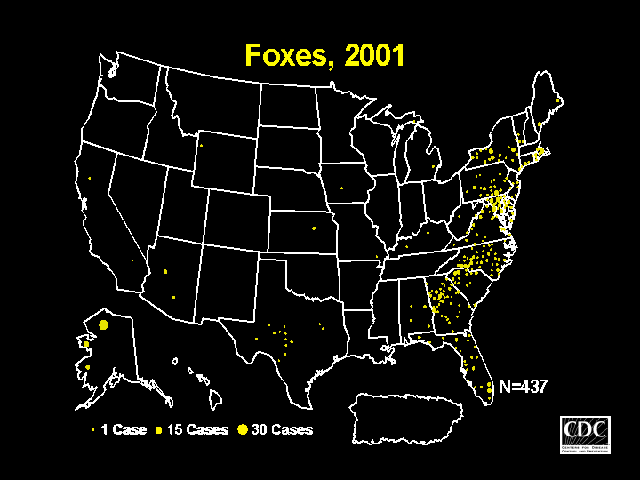
Foxes (mainly Vulpes vulpes) accounted for 5.9% of all cases of rabies in animals reported in 2001. The majority of cases of rabies in foxes (360 out of 437 cases) were reported by states affected by the raccoon-associated variant of the rabies virus. In 2001 Alaska reported 45 cases of rabies in fox, Maryland reported 38 cases, and North Carolina reported 56 cases.

During the past 2 decades, more than 100 million doses of vaccine-laden bait have been distributed over 6 million square kilometers in Europe, with promising results for controlling the disease in red foxes. The use of oral vaccination in Switzerland during the past 20 years resulted in a declaration of rabies-free status in 1998, and a similar declaration was made by France as of the end of 2000.

Air-dropped rabies-vaccine baits are now being dropped in many parts of the Eastern and mid-Western United States, and good-to-excellent results are being observed.

To see a larger view of the CDC incidence map of rabies in fox (2001) >> click here

Saturday, August 09, 2008

Dog Food Secrets "They" Don't Want You To Know


This stuff costs $34 for 4 pounds -- more than prime steak. What's in it? A lot of stuff a wolf never ate. Stuff like sweet potato (the #1 ingredient), carrot, apple, barley greens, broccoli, almonds, watercress, alfalfa, etc. etc. Plus something mysteriously listed as "fiber". Is this stuff "better" than Purina? Nope. And it's not nearly as well tested either.


DUMP 60 MILLION POUNDS OF TOXIC PET FOOD on to America's shelves, kill a few thousand dogs and cats, and what do you get out of it? Lawsuits and chest-thumping food fadists.

This piece is not about the lawsuits -- it's about the food fadists.

To tell you the truth, I could care less what anyone feeds their dog. I figured out a long time ago that a lot of people are pretty silly, and there's no stopping them, even if you wanted to.

The good news is that most Americans are pretty sensible and moderate, and give their dogs decent bagged food with perhaps a few low-salt table scraps. In almost all cases, the dogs thrive. How could they not? As Tony Buffington, a veterinary professor at Ohio State University, told The Wall Street Journal back in March when the dog food story was still about fat dogs and price-gouging companies ripping off the rubes:

"The nutritional requirements of neutered, sedentary adult animals are so low that they could be met by anything."


And yet, we DO have a lot of crackpots on either end of the pet food debate, don't we?

On the one hand we have the Vegans who want to raise their cats and dogs on tofu and barley sprouts. Good luck with that.

On the other side we have the folks that lecture everyone that dogs are wolves and should be eating raw meat or some other concoction that they've come up with. Good luck with that too.


Of course, both sides are espousing pure nonsense. A dog is not a wolf any more than it is a cow. A vegan who wants his dog or cat to eat only tofu has not accepted a dog for what it truly is. By the same token, anyone who thinks their dog is a wolf has also not accepted what their animal really is. A dog is not a wolf. A dog is a dog.

As I have noted before, most dogs and most wolves do not have the same estrus cycles, do not have the same pack hierarchies, and do not communicate the same way.

A wolf and a dog will not interbreed except under the most artificial of conditions. When a pack of wolves meets a dog, what occurs next is called lunch, and the dog is served up as the main course.

What seems to confuse people is that a dog is a carnivore, a pack animal and a canid.

But so what? A bear is carnivora too. So too is a raccoon, a skunk and a coatamundi. Not all carnivores live on pure meat diets.

As for being a pack animal, a lot of animals are "pack" animals, from bees and birds, to humans and lions.

Being a canidae does not tell you much either -- most canids are foxes of one kind or another, and a fox is a true omnivore that will readily eat bread, berries, potatoes, and corn, as well as field mice and baby bunny rabbits.

At this point in the conversation someone is sure to point out that dogs are classified by some taxonomists as a type of wolf -- Canis Lupus, familiaris.

But again, so what? Taxonomy is a system invented by humans, and humans are hardly the experts on what an animal is or is not.

A taxonomer, for example, will tell you that a barred owl and a spotted owl are two different species, but in fact these two birds are not very fussy about this distinction, and will readily interbreed and produce fecund young.

Meanwhile, a wolf and a dog are quite certain they do not belong to the same family and will attack each on sight. Who is the expert here?

It is axiomatic, among true dog people, that the dog is the expert and not the theoretician. And a dog will tell you that while it is a canid and a pack animal, it is not a wolf.

It is not Canis lupus familiaris, as some taxonomists would have it, but Canis familiaris -- it's own distinct species that not only looks different, but acts different at the most basic levels of sexual reproduction and communication.

Yet, if you listen to the dog food theorists, they would have you believe that packs of poodles once roamed the earth.

Here's a hint: it never happened.

You can take 200 dogs of all breeds, toss them into a large pen, and let them go at it for 100 years, but what you will get out of the other end is not a wolf, but a dog.

And it will not be a large dog, but a "pyedog" or pariah dog about the size of a jackal, but with a rounder body and face.

Such animals can be found all over the world, scavenging on the edges of dumps, from the Philippines to Oaxaca, from Algeria to Romania, from South Africa to South America.

What do pariah dogs eat?

They eat what dogs have eaten since the beginning of time: whatever it is we put in front of them.

And in most cases, the dogs do quite fine. After all, it's not like a wild dog lives very long.

Pyedogs die at epic rates from starvation -- same as fox and wolves. Fox kit mortality is about 50 percent and wolf cub mortality is about the same. A wolf that manages to make it into adulthood can be expected to be dead by age 7 or 8, a fox by age three or four.

This is one of the great ironies missed by the food fadists: If you feed your dog the cheapest store-bought food you can find, it will eat much better that any wolf in the wild.

But of course food fadists are not really selling common sense and good nutrition, are they? Food fadists are selling "secret knowledge."

In this sense, food fadists are a bit like Kennedy assassination buffs, UFO junkies and convicted felon Kevin Trudeau who constantly pops up on late-night television selling you "health food secrets that the doctors don't want you to know about."

Food fadist are to nutrition what "phrenologists" are to neurologists, "astrologers" are to astronomers, and "aromatherapists" are to psychiatrists -- the quack end of the spectrum.

A food fadist may toss around words like "holistic" and "homeopathy" but these words are meaningless semantic gloss designed to dress up weak philosophies in the trappings of pseudo-science. Go ahead and put rouge on the pig, but don't expect folks not to laugh out loud if you're silly enough to take it to the dance.

Holistic medicine and homeopathy proponents are, for the most part, inventing potions and mixing them with wild claims and leavening the whole mixture with a little common sense. They are offering nothing that a Nigerian witch doctor will not sell you for a packet of cigarettes and a few naira. When push comes to shove, however, if you get sick in Africa, you had better ditch the witch and get a real medical doctor with access to serious antibiotics. Ditto for your dog.

The funny thing about a lot of self-styled holistic food experts is that right after they lecture you about how a dog is really just a wolf, they will often turn around and tell you that they feed their own dog a diet of rice and chicken, or rice and lamb, or a mixture of rice, potatoes, peas and carrots.

What, no mice and rats? No roadkill? Wow -- we sure did leave that "natural" diet behind pretty darn quick.

In fact, rice is not a "natural" food for a wolf any more than a chicken is. Both are products of tropical Asia. What rice and lamb have got going for them is that they are two of the least reactive foods when it comes to skin allergies in dogs.

And so now we come to it: skin allergies in dogs.

Now here's the joker in the deck when it comes to skin allergies: 1) Most skin allergies in dogs have a genetic component, and; 2) The most common type of food allergy is an allergy to beef and milk.

Beef and milk? Woops -- so much for that "wolf diet" stuff.

In fact, the main reason we are seeing such a quick rise in skin allergies in dogs is that the genetic base of most dog breeds is now exceedingly narrow and the result is a weaker immune system. That's what happens when you start off with a very limited number of dogs in a closed registry system like we have in the AKC, and then continue to boil down the stock through dominant sire selection.

This is a topic I have written about before, but it's a topic that the holistic dog folks generally stay away from for fear of alienating their core client base -- folks that are in love with purebred dogs that have skin problems. Shooting the dog is not an option that their client base wants to hear, nor do their clients want to be told that they "bought a lemon" and should have stayed away from the AKC. It's much easier -- and much more lucrative -- to talk about the problems with dog food.

And so, instead of talking about genetics, the holistic food folks say it's all about diet secrets. How very "Kevin Trudeau" of them! You don't have cancer because of your genetic predisposition -- you have cancer because you didn't buy my book or my diet.

The good news here, is that most dogs do not have skin allergies, and most dogs do really well on any kind of commercial food given to them.

The main problem facing dogs in America today is not poor nutrition caused by a lack of calories or essential vitamins and minerals, but obesity caused by too much food and too little exercise.

Rather than too few vitamins and minerals in the dog food, the problem -- especially in large breed dogs -- is too many vitamins and minerals (especial calcium) which produce too rapid a growth pattern which can exacerbate underlying hip dysplasia and other joint issues.

So what should dog owners do when it comes to feeding their dogs?

Whatever they want. That's the point of this post. Read up and look around and use common sense. Billions of dogs have been fed bagged food for more than 100 years, and most seem to have done fine with it.

That said, if you want to cook up a special meal for your dog every night for the rest of your life, go ahead and do that. If you are a vegan and want to feed your dog only seitan and rice, it will probably live as long as any wolf in the wild. Ditto if you want to feed your dog nothing but fresh deer meat shot in your backyard.

For those who REALLY want answers, however, I encourage you to order: "Dog Food Secrets "They" Don't Want You To Know About". Operators are standing by, and all proceeds will be donated to help poor children.

.