Showing posts with label history. Show all posts

Sunday, June 12, 2022

Westminster & the Death of the Fox Terrier

Example
A repost from July 2004


I came across an interesting book in the stacks -- "The Dog Show" By William Stifel (2003, Westminster Kennel Club).
 
This is a very well-done coffee table book celebrating the 125th anniversary of the Westminster Kennel Club, the biggest dog show in the U.S.  
 
I did not buy the book, but I read a bit and discovered an amazing thing that helps explains the very rapid degeneration of the fox terrier between 1900 and World War II. 
 

  • The first "Best in Show" winner at Westminster in New York City was in 1907. This first "Best in Show" winner was a smooth fox terrier that looked very much like today's Jack Russell.

  • Fox terriers won again in 1908, 1909, 1910, 1911, 1915, 1916, 1917, 1926, 1928, 1930, 1931, 1934, 1937 and 1942.

  • A Sealyham (another working breed ruined by the show ring) won in 1924, 1927 and 1936.

  • Airedales made Best in Show in 1912, 1919, 1920, 1933, and 1936.

  • A bull terrier went Best In Show in 1918, and a Welsh Terrier in 1944.

As you can see, almost all the early winners were terriers, and most of them were fox terriers.

It was during this period of time that the face of the fox terrier was elongated and the chest enlarged by show ring breeders.

Prior to World War II, if you were really intent on wining the top award at a dog show, you were into fox terriers.

Probably no breed could have survived such intent attention without being wrecked by fad.

The fox terrier certainly did not. 


Friday, March 08, 2019

Cruft: The Man That Never Owned a Dog


Charles Cruft was born in 1852 into a family of jewelers. Charles had no interest in his family's business, and upon graduation from college in 1876, took a job with American James Spratt who had set up a new venture in Holborn, London selling "dog cakes".

Charles Cruft did not own a dog, but he was an ambitious dog food salesman, and traveled around England and Scotland drumming up business for Spratt. Cruft's travels brought him in contact with large estates, sporting kennels and the first commercial dog breeders in the UK.

While traveling to Europe in 1878 hawking Spratt's dog biscuits, a group of French dog breeders invited the young Cruft (just two years out of college) to organize and promote the canine section of the Paris Exhibition, which he did.

Upon returning to England in 1886, Crufts took up the management of the Allied Terrier Club Show at the Royal Aquarium at Westminster, with an eye towards making money.

The first formal "Cruft's Show" was booked into the Royal Agricultural Hall, Islington in 1891. This was the first in a long series of dog shows that Crufts held there, each of them making an appealing profit for Cruft, who still did not own a dog himself.

In 1938 Charles Cruft died (still having never owned a dog!) and his widow ran the 1939 Crufts Dog Show. Three years later Mrs Cruft felt the responsibility for running the show too demanding and, in order to perpetuate the name of the show her husband had made world famous, she asked the Kennel Club to take it over and it was sold to them.

The 1948 Crufts Dog Show was the first under the Kennel Club auspices.

Saturday, February 16, 2019

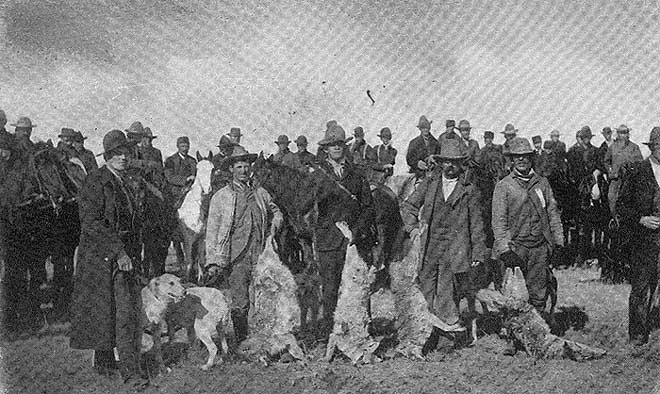
Old Pictures of Coyote Lurchers


My notes on this one say: "Coyotes and wolf, 1910, in Montanta."


My notes on this one only say: "Greeley, 1908." I am assuming this is Greeley, Colorado.
.


Tuesday, February 12, 2019

When Did Your Breed Show Up at Westminster?


American Kennel Club registrations have declined 75 percent over the last 30 years, even as the population of the U.S. has increased and the number of dogs (both total and per capita) have also increased. 

The AKC has added dozens of new breeds in an attempt to pad out its sagging membership numbers, but these breeds tend to be rare, and so things are not much improved.

  1. Bull Terrier (Colored) 1877
  2. Bull Terrier (White) 1877
  3. Dandie Dinmont Terrier 1877
  4. Fox Terrier (Smooth) 1877
  5. Manchester Terrier (Standard) 1877
  6. Scottish Terrier 1877
  7. Skye Terrier 1877
  8. Pointer 1877
  9. Retriever (Chesapeake Bay) 1877
  10. Setter (English) 1877
  11. Setter (Gordon) 1877
  12. Setter (Irish) 1877
  13. Spaniel (Cocker) Black 1877
  14. Spaniel (Field) 1877
  15. Spaniel (Irish Water) 1877
  16. Beagle 12 In. 1877
  17. Beagle 15 In. 1877
  18. Dachshund (Smooth) 1877
  19. Foxhound (American) 1877
  20. Greyhound 1877
  21. Harrier 1877
  22. Scottish Deerhound 1877
  23. Great Dane 1877
  24. Mastiff 1877
  25. Newfoundland 1877
  26. Saint Bernard 1877
  27. English Toy Spaniel (B&PC) 1877
  28. English Toy Spaniel (KC&R) 1877
  29. Italian Greyhound 1877
  30. Japanese Chin 1877
  31. Pug 1877
  32. Bulldog 1877
  33. Dalmatian 1877
  34. Poodle (Standard) 1877
  35. Collie (Rough) 1877
  36. Spaniel (Clumber) 1878
  37. Bloodhound 1878
  38. Yorkshire Terrier 1878
  39. Irish Wolfhound 1879
  40. Chihuahua (Smooth) 1879
  41. Maltese 1879
  42. Airedale Terrier 1881
  43. Irish Terrier 1881
  44. Fox Terrier (Wire) 1883
  45. Chow Chow 1883
  46. Bedlington Terrier 1884
  47. Basset Hound 1884
  48. Pomeranian 1886
  49. Welsh Terrier 1888
  50. Collie (Smooth) 1888
  51. Old English Sheepdog 1888
  52. Borzoi 1891
  53. Foxhound (English) 1891
  54. Schipperke 1891
  55. Whippet 1893
  56. Spaniel (Sussex) 1895
  57. Boston Terrier 1895
  58. French Bulldog 1897
  59. Spaniel (Cocker) A.S.C.O.B. 1899
  60. Spaniel (Cocker) Parti-Color 1899
  61. Poodle (Toy) 1900
  62. Brussels Griffon 1902
  63. West Highland White Terrier 1906
  64. Papillon 1906
  65. Samoyed 1907
  66. Pekingese 1907
  67. Belgian Sheepdog 1907
  68. German Shepherd Dog 1908
  69. Otterhound 1909
  70. Wirehaired Pointing Griffon 1911
  71. Doberman Pinscher 1911
  72. Sealyham Terrier 1912
  73. Cairn Terrier 1914
  74. Boxer 1914
  75. Spaniel (English Springer) 1916
  76. Kerry Blue Terrier 1922
  77. Retriever (Labrador) 1923
  78. Norwegian Elkhound 1925
  79. Standard Schnauzer 1925
  80. Manchester Terrier (Toy) 1925
  81. Retriever (Curly-Coated) 1926
  82. Retriever (Flat-Coated) 1926
  83. Miniature Schnauzer 1927
  84. Afghan Hound 1927
  85. Shetland Sheepdog 1927
  86. Retriever (Golden) 1928
  87. Saluki 1928
  88. Briard 1929
  89. Border Terrier 1930
  90. Dachshund (Wirehaired) 1930
  91. Giant Schnauzer 1930
  92. Miniature Pinscher 1930
  93. Dachshund (Longhaired) 1931
  94. Keeshond 1931
  95. Bouvier des Flandres 1931
  96. Poodle (Miniature) 1932
  97. Siberian Husky 1933
  98. Bullmastiff 1934
  99. Great Pyrenees 1934
  100. Lakeland Terrier 1935
  101. Brittany Spaniel
  102. Pointer (German Shorthaired) 1935
  103. Kuvasz 1935
  104. Rottweiler 1935
  105. Welsh Corgi (Pembroke) 1935
  106. Alaskan Malamute 1936
  107. Lhasa Apso 1936
  108. Welsh Corgi (Cardigan) 1936
  109. American Staffordshire Terrier 1937
  110. Norwich Terrier 1937
  111. Spaniel (English Cocker) 1937
  112. Puli 1937
  113. Affenpinscher 1938
  114. Komondor 1940
  115. Weimaraner 1943
  116. Bernese Mountain Dog 1943
  117. Spaniel (American Water) 1945
  118. Basenji 1946
  119. Black and Tan Coonhound 1947
  120. Chihuahua (Long) 1951
  121. Spaniel (Welsh Springer) 1953
  122. Rhodesian Ridgeback 1957
  123. Pointer (German Wirehaired) 1960
  124. Silky Terrier 1960
  125. Australian Terrier 1961
  126. Belgian Tervuren 1961
  127. Vizsla 1962
  128. Belgian Malinois 1967
  129. Shih Tzu 1970
  130. Soft Coated Wheaten Terrier 1974
  131. Akita 1974
  132. Bichon Frise 1974
  133. Tibetan Terrier 1974
  134. Staffordshire Bull Terrier 1976
  135. Bearded Collie 1978
  136. Norfolk Terrier 1979
  137. Ibizan Hound 1980
  138. Australian Cattle Dog 1981
  139. Pharaoh Hound 1985
  140. Portuguese Water Dog 1985
  141. Tibetan Spaniel 1985
  142. Finnish Spitz 1989
  143. Petit Basset Griffons Vendeen 1992
  144. Chinese Crested 1992
  145. Miniature Bull Terrier 1993
  146. Chinese Shar-pei 1993
  147. Shiba Inu 1994
  148. Australian Shepherd 1994
  149. Greater Swiss Mountain Dog 1996
  150. American Eskimo Dog 1996
  151. Border Collie 1996
  152. Cavalier King Charles Spaniel 1997
  153. Canaan Dog 1998
  154. Anatolian Shepherd Dog 2000
  155. Havanese 2000
  156. Lowchen 2000
  157. Parson Russell Terrier 2001
  158. Spinone Italiano 2001
  159. Polish Lowland Sheepdog 2002
  160. Retriever (Nova Scotia Duck Tolling) 2004
  161. German Pinscher 2004
  162. Toy Fox Terrier 2004
  163. Glen of Imaal Terrier 2005
  164. Black Russian Terrier 2005
  165. Neapolitan Mastiff 2005
  166. Plott 2008
  167. Tibetan Mastiff 2008
  168. Beauceron 2008
  169. Swedish Vallhund 2008
  170. Dogue de Bordeaux 2009
  171. Bluetick Coonhound 2009
  172. Boykin Spaniel 2009
  173. Irish Red & White Setter 2009
  174. Norwegian Buhund 2009
  175. Pyrenean Shepherd 2009
  176. Redbone Coonhound 2010
  177. Cane Corso 2010
  178. Icelandic Sheepdog 2010
  179. Leonberger 2011
  180. Cesky Terrier 2011
  181. Entlebucher Mountain Dog 2011
  182. Finnish Lapphund 2011
  183. Norwegian Lundehund 2011
  184. Xoloitzcuintli 2012
  185. Russell Terrier 2012
  186. Treeing Walker Coonhound 2013
  187. Chinook 2013
  188. Portuguese Podengo Pequeno 2013
  189. Rat Terrier 2014
  190. Coton de Tulear 2014
  191. Wirehaired Vizsla 2015
  192. Bergamasco 2015
  193. Berger Picard 2015
  194. Boerboel 2015
  195. Cirneco dell’Etna 2015
  196. Lagotto Romangnolo 2015
  197. Miniature American Shepherd 2015
  198. Spanish Water Dog 2016
  199. American Hairless Terrier 2016
  200. Pumi 2016
  201. Sloughi 2018
  202. Grand Basset Griffon Vandeen 2018
  203. Nederlandse Kooikerhondje 2019
  204. Azawakh - 2019
.

Friday, November 09, 2018

Custer's Long Dogs


George A. Custer, 1862, Peninsula Campaign, Virginia. Click to enlarge.


In the past, I have, written a bit about jack rabbits out west as well as coyotes and the use of lurchers to hunt coyotes , but I have yet to talk too much about one of the most famous of American dog men -- George Armstrong Custer.

Custer found particular solace with the dogs. A border-line manic-depressive, Custer found that when he was manic he could go riding and running with them, and when he was despondent, they were perfect company to lie down with.

And Custer did "lie down with dogs," never once feeling a moment of shame as he cuddled up next to them, their large bodies wrapped around his to keep him warm on the cold Plains.


George A. Custer with the Sioux-Ree warrior Bloody Knife
(pointing) and the Crow warrior Curly (standing), with
staghound and greyhound. Montana, Spring 1876.


Custer's dogs were greyhound crosses -- what later came to be called the "American Staghound."

A Staghound, of course is simply a large American longdog -- a cross between two sighthounds such as a Greyhound or Scottish Deerhound, though Borzoi, Saluki, Afghan, or Irish Wolf Hound could theoretically be crossed in there as well. Today, most American Staghounds are multi-generation Staghound crosses.

It's possible that some of Custer's dogs may have been lurchers. A lurcher is a cross between a sighthound (such as a Deerhound, Greyhound or Whippet) and a herding dog (such as a rough collie) or perhaps a larger terrier (such as a Aierdale or Bedlington). If some of Custer's dogs were lurchers, they are likely to have been Greyhound or Deerhounds crossed with a collie or some other large herding dog.

Too much can be made of breed and terminology, especially when talking about historical dogs. Custer was running in the West where dogs were intact their whole lives, found their own mates, and designed themselves as Nature saw fit.

Custer's first longdogs dogs, acquired sometime after the end of the Civil War in 1866 were killed (one in a firearms mishap and the other -- Blucher-- in 1868 at the Battle of the Washita River against the Cheyenne).

Custer got other dogs, and always seemed to have four or five with him, including a pair that reportedly came from Queen Victoria through Lord Berkeley Paget, the man who supplied Custer (in 1869) with the revolver he had with him during the last stand at the Battle of the Little Bighorn.

The fate of Custer's dogs after his demise at The Litttle Bighorn is not too well documented. Dutch Salmon, who has looked into it, reports that:

"One hound, Cardigan, went to a clergyman in Minneapolis, who later had the dog mounted on display in a public building."

An ignoble fate, I suppose, but if there a noble use for a dog after death, I am unaware of it. Come to think of it, being stuffed and remembered and awed over by school kids is about as good as a dog can hope for after death. Carry on Cardigan!

.

Saturday, November 03, 2018

Who Is the Man? Who is the Dog?


Who is this Man? Who is this dog?


And what does any of it have to do with hunting and fishing?

Answer: That's Teddy Roosevelt, one of three honorary terriermen on Mount Rushmore (Who are the other two?)

The dog is Skip, a mutt terrier cross (or feist) owned by legendary bear hunter John Goff. Goff gave Teddy the dog after Skip charged a bear, much to Teddy's delight.

As I note in a previous post entitled Rat Terrier Origins:
In 1905 Goff was hired as a bear hunting guide by President Theodore Roosevelt. During the trip Roosevelt was enchanted by the boisterous bravery of a small black and tan terrier that joined the bear-hunting fray. The dog was named "Skip," and for the remainder of the trip he managed to find himself in Roosevelt's lap or on his saddle.

Goff gave the terrier to Roosevelt at the end of his stay, and Roosevelt brought the dog back to the White House where it found work chasing rats in the basement and served as progenitor of the breed we know today as the American Rat Terrier.

Skip died the year before Roosevelt left the White House and was buried on the back lawn. The dog was so loved, however, that when Roosevelt left he had the dog exhumed and the body reinterred at Sagamore Hill, the family's New York estate.


I give a more detailed accounting of Skip and another terrier called Jack, noting the differences between the two and showing pictures of them each at the White House, in a longer post on Teddie Roosevelt's Terriers. Links are also given in this post to contemporaneous Roosevelt correspondence which showed that Skip was Archie's dog just as Jack Was Kermit's.

The importance of Teddy Roosevelt in the history of American hunting and fishing is not due to his legendary prowess in the field, or the fact that that this man left the Presidency to go on a year-long hunting trip in Africa. No, the importance of Roosevelt is in the fact that he helped establish America's land ethic (one later strengthened by Aldo Leopold) and did it by simply drawing boundaries on a map in order to create 150 new national forest areas in 21 states, four national game preserves, 51 federal bird sanctuaries, and 18 national monuments. No other President, before or since, has done as much to protect the heart and soul of America as Teddy Roosevelt did. For the back story here, read the post entitled Shooting Out the Land.

So who are the other honorary terriermen on Mount Rushmore? Read about one of them here >> Feists: From Washington to Lincoln to Faulkner. Yes, here at Terrierman, we give a hat tip to Old Abe if for no other reason than he wrote a long poem about bear hunting with terriers.

The other honorary terrierman on Mount Rushmore, of course, is George Washington, who helped win a war and forge a nation by a small kindness to a dog and its owner. I write a bit about that in the post entitled America's Founding Terrier.

Bottom Line: All that is great and good about this nation is connected to hunting with terriers. Let us never forget that!
.

Saturday, August 25, 2018

The American Enclosure Movement


Female bluebird on barbed wire.


The Enclosure Movement in the U.K. had a profound impact on the land, farms, and people in that country, and set the stage not only for the mounted fox hunts, but also for the social strife that surrounds fox hunting in Great Britain to this day.

For a pictorial history of terriers and their relationship to the Encloser Movement, click here.

The U.S. also had an Enclosure Movement, which was no less dramatic.

Land enclosure in the eastern U.S. was accomplished with split rail fences and stone walls, but when settlers reached the vast open plains of the American west, there were no trees or field stones for fencing. The result was free range cattle and sheep.

The situation was hardly ideal. Cattle were easily rustled or lost, and many fell prey to wolves and cougars. Sheep were "meals on heals" for coyotes and were easily lost as well.

Another problem was that open grazing meant open competition between sheep and cattle, with sheep cutting the grass down too far for the cattle to forage (the U.S. had huge sheep spreads in the second half of the 19th Century).

Finally, there was the problem of what to do about tick fever. Cattle in the far south west, below Oklahoma, were immune to tick fever, but the northern herds were not, and the practice of driving livestock north to Kansas City, Montana and Wyoming brought the scourge of disease into once-clean herds.

Two things changed it all: the rapid demise of the American Buffalo, and the rapid rise of barbed wire.

The buffalo were shot out over an incredibly short period of time, with railroads bringing in marksmen to shoot and skin anything that moved. Vast mountains of skinned flesh and bones were left for feral Indian dogs to consume.

In fact, most of the "wolves" of the Plains were not wolves at all, but feral Indian dogs (they looked just like wolves, but with curved tails) abandoned by a people now being rapidly decimated by war and disease.

With the demise of the buffalo, came the importation of its smaller cousin, the beef cow.

With the cow came the cowboy, many of them ex-Civil War soldiers moving West for opportunity and fortune. This was the brief tenure of the "Wild Wild West," and the thing that brought it to a dragging halt was the rise of barbed wire.

In 1873, Joseph Glidden the 60-year old sheriff of DeKalb, Illinois, attended a county fair where he saw a demonstration of a wooden rail with sharp nails protruding from it hanging inside a smooth wire fence. The design was supposed to keep cattle and horses inside a small perimeter fence, and perhaps help keep dogs and other predatory creatures out.


Joseph Glidden, mutton chops and all.


Glidden was inspired by the board-and-nail device and the potential for cheap and movable fencing. He began to experimented with the idea, and eventually came up with the idea of using a jerry-rigged coffee bean grinder to make spiral points of wire which were then strung at intervals along a smooth wire, with another wire twisting around the first to hold the barbs in a fixed position.

Barbed wire was born.

Glidden applied for a patent, and it was granted, though the patent was later contested. The legal battle that ensued lasted three years, and went all the way to the Supreme Court. Before the smoke cleared, however, there were over 570 patented forms of barbed wire!

From the perspective of many small land owners in the West, barbed wire was a wonderful invention: it was relatively inexpensive, would not rot, was practically unaffected by grass fire, was strong and long-lasting, and was easily erected.

In very short order, thousands of miles of barbed wire fencing were strung -- so much that fence posts were a major export from both the East and West coasts.

Between 1875 and 1885, the national consumption of barbed wire jumped from 300 tons to 130,000 tons.

The arrival of barbed wire in the American West was of immense historical importance, for it ended the era of the Great American Commons of "free grazing". Now people could own land and keep others off it. Equally important, they could control access to water, and keep livestock out of crops, such as wheat and corn.

Barbed wire also meant that sheep and cattlemen could now improve the quality of their herds by stringing barbed wire to keep inferior bulls from mating with their cows.

Fencing disputes pitted cattlemen against farmers and sheep men, and free-grass cattle ranchers against fenced-range cattle raisers.

These conflicts became fierce during times of drought when access to water and grass (green or not) meant the difference between bankruptcy and fortune.

Cattlemen used to driving herds across vast distances to known water and feed pastures would simply cut fences when they found them, and in some areas open warfare broke out.

In the end, of course, common grazing died across most of the American West, just as it had in Great Britain beginning 100 years earlier.

But barbed wire did not stay in the West -- it became a global product stretched around farms, ranches, buildings, prisons, and borders the world over.

In the Eastern United States, where hedge rows are not layed, as they are in Great Britain, barbed wire proved as useful as it was in the West.

Hedges in the Eastern U.S. are little more than strips of uncut forest and secondary growth, often dominated by rapidly-growing weedy trees, such as black cherry, black locust, and black walnut. These trees shade thin tangles of poke berry and wild grape, multiflora rose, kudzu, and honeysuckle. The result is not substantial enough to keep livestock out of crops.

Prior to barbed wired, farmers had to construct stone walls or erect split rail or plank fencing. These kinds of fencing are expensive and enormously labor- and material-intensive, and they also require a lot of maintenance.

With the invention of barbed wire, however, a farmer could simply stretch wire from tree to tree or post to post. The savings, in time and money, was enormous. Maintenance was virtually eliminated, as galvanized wire does not rust, rot, burn, need paint, or fall apart from frost heaving.

The ease of fence construction after the invention of barbed wire meant that new fences lines were easily created. Large farms that had once been open fields were now cut and carved with posts and barbed wire. Along these fence lines weedy strips soon took hold. Over time, many of these weedy strips have been colonized by small trees, bushes and vines, and in many instances full hedgerows have developed, almost always attended by population of groundhogs, fox, raccoon and possum.

Truly, barbed wire is the "Devils' Rope," and yet it is also part of the story of working terriers in America, for barbed wire has created and protected much of the hedgerow habitat where so much of our quarry dens.

If you work terriers in the Eastern United States, you will eventually find your yourself crawling over and under barbed wire. The dogs themselves may occasionally get ripped running over it, and most folks eventually lose the bottom out of one seat of pants or another.

In the end, however, there is very little doubt that without barbed wire we would not have the quality of terrier work we have today.

And so next time we are in a jungle of thick hedge and the dog has just slipped into a hole under a jumble of broken down barbed wire fencing, let us remember that the fence is more than an obstruction -- it is construction that is vital to the habitat we hunt. Barbed wire is our friend.
      :: This is a repost from 2004.
.

Thursday, May 17, 2018

Non-Extinct Terriers & Other Mysteries


Many of the terrier breeds that people now lament the "extinction" of never actually existed except in the minds of Victorian picture book makers.

In "The Welsh Terrier Leads the Way," Bardi McLennan recounts the relatively recent origins of the Welsh Terrier.

"In 1800 there were only 15 designated breeds of dogs, and 50 years later there were only 50."

That is of ALL dogs, not just terriers. As late as 1850, a lot of breeds were still not very distinct and several "breeds" were known by different names. For example, in 1851, the Yorkshire Terrier was also known as "the broken-haired scotch terrier." Only in 1870 was a Yorkshire Terrier firmly designated as a breed and breed name. Before then litter mates were often shown in different breed categories -- a situation that occurred with the first prize-winning Jack Russell, which had previously won shows as a "white Lakeland."

The Welsh Terrier and Old English Black and Tan terriers were the same dog -- a type of rough-stock Lakeland dog used in Wales and in the North. These dogs had a fair amount of variation in terms of size and shape, but generally had more color than the "white foxing terriers" preferred in the South.

These rough-coated terriers existed without too much conformity in name or shape (as they still do in the working terrier community in the U.K.), but conformity and a brand name were essential characteristics of Kennel Club registration, and an intrepid history (however fanciful) certainly did not hurt sales.

With the rise of dog shows in the 1860s, the race was on to give every odd-looking dog a name and "improve" them, and terriers were at the top of the list.

One group of Kennel Club breeders decided to embrace a rather ponderous name and an incredible assertion for the brown and black dogs.  They were, they asserted, "the root stock" of all terriers in the British Isles, and they were to be called the "Old English Broken-Haired Black and Tan."

The assertion that these dogs were the root stock of all terriers in the UK is rather laughable -- no one know what the "root stock" was, and in any case there probably was no single "tap root," but instead a fine net of "rootlets" that spread far and wide and included a lot of dogs that were not terriers at all -- dachshunds, whippets, beagles, and lap dogs, for example.

In any case, the Welsh were somewhat outraged to have the English bring down a few of "their" dogs and claim they were an "Old English" anything. These were Welsh dogs, and the Welshmen moved quickly to establish that fact. The Welsh got organized quickly, and in 1884 they held the first dog show with classes just for Welsh Terriers in Pwllheli, North Wales with 90 dogs in attendance -- a rather impressive opening shot in this little "terrier war."

For their part, proponents of the "Old English Black and Tan" moniker could not seem to coalesce into a real club; in fact they could not even agree on a name for their supposedly "Old English" breed. Some called it the Old English Broken-Haired Black and Tan Terrier, some the Old English Wire Haired Black and Tan, some the Broken-Haired Black and Tan, and some just "Black and Tan" -- a color-descriptive name that had been used about as often as "white dog" or "yellow hound".

Whatever they might have called the dogs, this new Kennel Club "breed" was in fact a put-up job comprised of a mix of terrier types and they had difficulty breeding true.

In 1885 a survey of the winning dogs in the ring found that all of them were, in fact, first generation dogs, i.e. not Black and Tans out of Black and Tan sires and dams, but Black and Tans produced out of crosses with other breeds. For example, the winner of the first show in 1884 was a dog named Crib that was a cross between a blue-black rough terrier and a famous smooth fox terrier owned by L.P.C. Ashley called Corinthian.

In 1885, the Kennel Club took a Solomonic approach to the name and breed standard for the dog, featuring both dogs at their 1885 show. On April 5, 1887, however, because the English could not get organized, they were dropped from Kennel Club listings, and the new "Welsh Terrier" breed was born, perhaps propelled forward in popularity a bit by the rise of David Lloyd George, the son of a Welsh cobbler, who himself has risen from humble origins to stand should-to-shoulder with the gentry.

The "Black and Tan" terrier is not the only breed that either never existed (or still exists today, depending on how you look at it).

At the same time that one faction was pushing for the introduction of the "Old English Black and Tan Terrier" another faction was pushing for the introduction of the "English White" terrier which, it should be said, has nothing to do with the old English White molosser dog used as a butcher's dog 150 years earlier.

In fact this new dog was really a toy breed created by crossing a small smooth-coated white foxing terrier with some sort of lap dog, which left the resulting progeny with a propensity towards deafness and a bulging "apple head" like that of many modern Chihuahuas.

Both the "Black and Tan" terrier and the "English White" terrier live on in the fevered minds of the breed-obsessed thanks to a book by Vero Shaw entitled "The Illustrated Book of the Dog."

Printed in 1881, right in the middle of the "terrier wars," this book contains about 100 chromo-lithograph plates and engravings of dog breeds that were being put forth as distinct entities at that time. Shaw rather optimistically included the "Black and Tan" as well as the "English White," betting that the political machinations of English Kennel Club dog breeders would prevail.

He was wrong, which is how two "ancient" breeds of terriers, that in fact never exited, managed to appear on the scene for less than 20 years and then disappear altogether.

Friday, March 09, 2018

Charles Crufts Never Owned a Dog


An owner prepares her Chihuahua for the Crufts judges.

Charles Cruft, pictured below, was born in 1852 into a family of jewelers. Charles had no interest in his family's business, and upon graduation from college in 1876, took a job with American James Spratt, who had set up a new venture in Holborn, London selling "dog cakes".


Charles Cruft did not own a dog, but he was an ambitious dog food salesman, and traveled around England and Scotland drumming up business for Spratt. Cruft's travels brought him in contact with large estates, sporting kennels and the first commercial dog breeders in the U.K.

While traveling to Europe in 1878 hawking Spratt's dog biscuits, a group of French dog breeders invited the young Cruft (just two years out of college!) to organize and promote the canine section of the Paris Exhibition, which he did.

Upon returning to England in 1886, Crufts took up the management of the Allied Terrier Club Show at the Royal Aquarium at Westminster, with an eye towards making money.

The first formal "Cruft's Show" was booked into the Royal Agricultural Hall, Islington in 1891. This was the first in a long series of dog shows that Crufts held there, each of them making an appealing profit for Cruft who still did not own a dog himself.

In 1938 Charles Cruft died, still having never owned a dog, and his widow ran the 1939 Crufts Dog Show. Three years later Mrs Cruft felt the responsibility for running the show too demanding and, in order to perpetuate the name of the show her husband had made world famous, she asked the Kennel Club to take it over and it was sold to them.

The 1948 Crufts Dog Show was the first under the Kennel Club auspices.

Thursday, January 11, 2018

Vicious: Wolves and Men in America


Despite a lot of talk and unfounded rumor, there is only one record of a non-rabid wolf killing a human in North America since the arrival of Europeans.

Yet humans have killed wolves wholesale, using poison, traps, clubs, rifles, and even laying out mackerel hooks inside lumps of meat and fat. Nothing was too brutal in the quest to exterminate the wolf, and by 1880 a large part of America was wolf-free.

The wolf hung on into the 20th Century, however, in large part because the bounty system did not pay enough for people to spend months tracking down the last western wolves which were smarter and more trap-shy than most. When the Government began paying a professional cadre of wolfers to exterminate the last of their kind, however, the fate of the wolf was sealed.

Ironically, one of the last Government wolfers was Aldo Leopold, whose birthday it is today.  Aldo was a wolfer when he was a young man working for the U.S. Forest Service in New Mexico. Leopold went on to write the first book on Game Management in the U.S., and became, posthumously, an icon of the modern environmental movement with his memoir, A Sand County Almanac.

Buried in that little book is an essay called "Thinking Like a Mountain," and within it a section in which Leopold observes the dying of a "fierce green fire" within a wolf as it bleeds out on on rock after being shot.

Up until that hunt, Leopold had thought what he had been doing was good for deer and the mountain, but after seeing the wolf die he suspected neither the deer nor the mountain agreed with that view.


In time, as deer overgrazed sections of the West and East, Leopold began to fully understand the importance of keeping top predators in the eco-system. "A thing is right," he wrote "when it tends to preserve the integrity, stability, and beauty of a biotic community. It is wrong when it tends otherwise."

But Leopold came to this conclusion many decades after shooting out the last wolves of New Mexico, and in his youth he was among the cadres of Government wolfers who told stories about wolf hunts in order to help raise cash to support the public extermination effort.

Government-sponsored wolfers created traveling displays of wolf pelts and wolf skulls. These displays and stories memorialized the last of the western wolves and gave them names: The Custer Wolf, Old Three Toes, Old Lefty, and Old Rags the Digger, among them.

By giving individual wolves names and personalities, Government trappers helped break down the wall between wolf myth and wolf reality. The wolf, which had once seemed threatening, dangerous and mysterious, now became the outlaw hero of the story, and an emblem of the last days of the romantic (and dying) American frontier.

This is the essential plot structure of Jon T. Coleman's book "Vicious: Wolves and Men in America."

The book is not a text on wolf biology, but a history book that analyzes the gaps and nexus between wolf myth and wolf reality. Though well-written, it is more than a little burdened by the weight of being overly-academic and spending perhaps too much time on folklore and not enough on basic wolf biology. No matter -- if you have ever wondered how the wolf went from pariah to paragon in the space of 50 years, this book tells the tale.

Coleman suggests that the wolf reintroduction efforts of the 1990s (which have been quite successful) occurred because America is now mostly urban and has little contact with farm animals which now come from protected feed lots rather than the free-range forests and fields where wolf, ranchers, farmers and livestock once battled.

"Human predation has become so technical and abstract [in the lat 20th Century] that the consumers of animal protein no longer feel emotionally connected to the beasts they ingest...
Reintroduced wolves have thrived in a cultural environment that accepts the scientific extermination of millions of domestic animals but rejects violence towards a handful of wild creatures."

Would the wolf have been reintroduced if Americans still lived on grass-fed beef?

Perhaps not.

Did cows have to fatten in feed lots in order for America to returns its large predators to their spot on the ecological ladder?

Perhaps.

It is an uncomfortable kind of tradeoff.


Sunday, January 07, 2018

A Brief History of Dog Food


The first commercial dog food was introduced in England about 1860. James Spratt, an electrician from Ohio, was in London selling lightning rods when he saw miserable street dogs ganged up along the piers waiting to being tossed mouldy hardtack biscuits and scraps of rotten food.

This was a very old type of feeding called "trencher feeding" that had existed in the U.K. since before there were dinner plates. A "trencher" was a flat piece of bread once commonly used as a plate or underneath a rough wooden plate. Food was served on this bread and the bread and the table scraps (along with spoiled food and boiled knuckle bones) were then "tossed to the dogs."

Spratt decided he could do better than bread and hard-tack biscuits, and he came up with a biscuit, shaped like a bone, made of wheat, vegetables, beetroot and beef blood. Spratt's dog food company thrived, and around 1890 he took it to the U.S. where it became "Spratt's Patent Limited" which eventually diversified into other feed stocks (such as fish food) as well as veterinary medicines.

In the 1950s Spratt's became part of General Mills, and in 1960 it was bought by "Spillers" dog food company (a UK subsidiary of Purina which is owned by General Mills). Today Spillers makes "
Bonio" bone-shaped biscuits which are very similar to those once manufactured by James Spratt.

Other dog food companies sprang up, many with paid endorsements from veterinarians who shilled for them just as veterinarians shill for Hill's "Science Diet" today. Right from the beginning pet food manufacturers discouraged their clients from supplementing with anything but food out of the box. A culture of dependence was being forged.

In 1907, F.H. Bennett introduced Milkbone dog biscuits as a complete dog food and a direct competitor to Spratt.
Milkbone and Spratt's Dogs Food and Cake dominated pet food manufacturing until the 1920's when canned dog food was first introduced by Ken-L-Ration.

Canned horsemeat was cheap after World War I as huge numbers of horses and mules were being replaced by cars and tractors. The growth in canned dog food really shot up in the 1930s, and by 1941, canned dog food represented 91% of the dog food market in the U.S.

Canned dog food fell out of favor (and supply) during World War II when a shortage of tin made canning difficult and expensive, and as the horse surplus dried up. By 1946, dry dog food was king once again, and it has remained so to this day.

The production of enormous bags of "kibbled" dog foods began in earnest in 1957 when the Purina company began marketing extruded dry dog "chow" through grocery store chains. Purina followed on with cat chow in 1962. Today most grocery stores in the U.S. devote more shelf space to canned and kibbled dog food than they do to breakfast cereal or baby food.

Ralston Purina created the soft-moist pet food category in 1971, and this category now includes such foods as
Purina ONE and Pro Plan.

The rise in kibbled dog food in the U.S. seems to coincide with a rise in canine skin problems arising from canine allergies to corn, wheat and perhaps other additives to dry dog food such as preservatives, coloring, and stabilizers.


Perception is not necessarily reality, of course. In fact, not all canine allergies are due to food. At the same that pet owners were switching to bagged dog food, they were also washing their dogs more (causing dry skin) and bringing them indoors where they came in contact with carpet cleaners, laundry soaps, room fresheners, and a host of other chemicals.

In addition, the aggressive line-breeding of dogs to create new types (almost all of which were created between 1850 and 1930), served to concentrate genetic defects in certain lines of dogs -- including genetic predispositions to skin allergies.

If you think your dog may have a food allergy, the only true test is to switch foods. This is a process, however, not an event. It may take several weeks on a new diet for a dog's skin condition to improve, so it's best to start an "elimination diet" right at the beginning. This can be as simple as feeding your dog table scraps for a few weeks (no salt, no bread) which will increase variety in the diet. Once your dog's skins problems have abated, introduce a new type of food and watch for any recurrence of skin problems.

Price, quality of food and skin allergies are not closely related. Dogs can be allergic to very high-quality ingredients. In fact, the most common food allergy in dogs is an allergy to beef! Whatever food you use, I recommend that all bagged foods be bought from supermarkets or other venues with high-volume sales so that they remain fresh as long as possible.

Above all, be wary of food fads, which are always more about the human than the dog. Your goal should be a balanced diet, a dog that has healthy stools, no allergies, sound teeth, and is on the thin side.

A great deal of what you read on bulletin boards and list-servs about dog food is nonsense. Today's pet food companies and executives are not going to risk their brands, reputations and personal credibility by knowingly putting horrific ingredients in dog food.

Remember, we are talking about companies that are producing 12 million pounds of food an hour (a real number).
This food has to look and taste the same every time that it is produced, which requires a great deal of regimentation, paperwork, inspection and quality control. Dog food companies are not using road kill for ingredients (as some hysterics have claimed), but entire train loads of cheap and readily available corn, wheat, rice, potatoes, soy and beef parts, as well as breathtaking amounts of lamb, chicken and "meal" made from ground up beef, chicken, lamb and turkey (including bones). To this mixture are added vitamins and various additives for color (to please you) and preservatives (because people prefer to buy dog food in big bags that will last several weeks).

For most dogs, bagged kibble supplemented with vegetables and a few special scraps from the kitchen (a few scrambled eggs, a bit of sausage, a few carrots) works fine. Most dogs do not have skin problems of any kind, and most canine skin problems are not food related. I prefer kibbled dog food over semi-soft because I think it is better for the dog's teeth, and because the heat of the extruding process helps sterilizes the ingredients, while the dryness of the product discourages spoilage.

.

Friday, November 03, 2017

Laika's Ashes


Laika in training.

A recycled post from 2007

Beginning in the early 1950s, small female stray dogs were gathered from the streets of Moscow and taken to a nearby Russian research center for experiments in suborbital space flight. Dogs were chosen for these experiments because they were cheap and scientists felt they would be able to endure long periods of inactivity better than most other animals.

Females were chosen because they did not have to stand and lift a leg to urinate. The female dogs used in the "space race" experiments were trained to stay still for long periods of time (they spent 15-20 days at a time in small boxes) and wear such pieces of clothing as a pressurized suit and helmet.

From 1951 through 1952, nine unnamed dogs successfully flew suborbitally in R-1 series rockets. Three of these dogs flew two missions each.

A dog named "Laika" was launched into space in Sputnik 2 on November 3, 1957. Laika, whose real name was Kudryavka (Little Curly), is often described as a "huskie-mix" but pictures show a small dog that looks very much like a fox terrier. The fact that Laika weighed only 13 pounds supports a fox terrier taxonomy -- even the smallest of huskies would weight much more. American newspapers of the time called her "Muttnik".

Laika was the first living creature ever to be launched into earth orbit, and Laika was the only animal Russian scientists knowingly sent into space to die. At the time there was no recovery method for true orbital flights.

At the World Space Congress in Houston in November of 2003, Dimitri Malashenkov of the Institute for Biological problems in Moscow finally revealed what happened to Laika. According to Malashenkov, medical sensors recorded that immediately after the launch, Laika's capsule reached speeds of nearly 18,000 miles per hour. As the pressure in the capsule increased, Laika's pulse rate increased to three times its normal level, presumably due to overheating, fear and stress. Five to seven hours into the flight, no further life signs were received from the dog.

Sputnik 2 fell back to earth on April 14, 1958 -- four and a half months after leaving earth -- and burned up on re-entry.

In 1998, 79-year-old Oleg Gazenko, one of the lead scientists on the Soviet animals-in-space program, expressed his deep regrets during a Moscow news conference: "The more time passes, the more I'm sorry about it. We shouldn't have done it.... We did not learn enough from this mission to justify the death of the dog."

.
.

Wednesday, November 01, 2017

What the Hell Is a Congo Terrier?


Click to enlarge. Art work by Kevin Brockbank (note dog in a pot at right!)

This piece is from the July 2010 issue of Dogs Today.

Out of Africa
A single breed - the Congo Terrier - sums up the history of dogs.

Have you noticed that in the world of dogs, names and places never quite line up?

Look at Welsh Terriers.

I know digging men in Wales, but none that use a Kennel Club Welsh Terrier to hunt fox to ground.

I know digging men in Scotland, but none that use a Scottish terrier.

Afghans?

There are no Kennel Club Afghan dogs coursing in South Central Asia.

Show line German Shepherds?

Not too many of those herding sheep in Germany!

And in central Africa, the locals are not using "Congo Terriers" that have Kennel Club papers.

A Congo terrier?

What on earth is that?


The Kennel Club's Pariah Dog

The “Congo terrier” was discovered by explorer Georg Schweinfurth on an expedition to Africa in 1869.

He called the dogs "Niam-niam dogs," which described the tribal region where they were found, and he noted they were often quite fat, as the Niam-niam people loved dogs so much they thought nothing of tossing them into the stew pot for dinner!

The dogs themselves were spitz-like and barkless, with erect ears and curled tails, as is often the case with primitive dogs. Where the Niam-niam dogs were different was in their relatively small size, their short coat, and the fact that they often featured a white band of fur around their neck.

Though Schweinfurth called them Niam-niam dogs, similar animals were found across a wide belt of central Africa, stretching from Liberia in the West, to Sudan in the East.

Like many other primitive landrace pariah dogs, the Niam-niam dog had only one estrus a year and rarely barked, but instead vocalized with howls, yodels, and whines similar to those of the wolf, coyote, dingo, or jackal.

Of course, a largely silent dog in thick cover is not necessarily an asset. No matter; this deficit was corrected by African hunters who attached a wooden "bell" or clapper to the necks of their dogs so they could more easily drive small game out of thick cover.

In 1895, the Niam-niam dog was displayed at the Crufts dog show as the "Congo terrier."

The name did not last too long.

In the late 1930s, the Congo Terrier was formally brought into the Kennel Club and renamed the "Basenji" -- a Bantu name that meant "village dog."

The first order of Kennel Club business was to craft a narrow appearance-based "standard" for the Basenji. This was not hard to do, as only seven dogs were initially admitted.

Clearly these seven dogs were perfect specimens of their type!


Inbreeding to Failure
Seven dogs, of course, is not much of a gene pool. In fact, the gene pool of the Basenji never grew much bigger than this. Over the course of the next 60 years, no more than 30 dogs comprised the entire founding stock of the breed in the U.K., the U.S., and Europe.

Inbreeding within this small stock of foundation dogs quickly led to a crushing genetic load and a rise in disease.

The first issue to raise its head was Hemolytic Anemia. When testing was started, twenty percent of all Basenjis carried this recessive gene. What to do?

The answer: Cull.

And cull they did, with about 18 percent of Basenjis weeded out of the American Kennel Club gene pool over the course of a decade.

Of course, this deep reduction in an already narrow gene pool sped up the inbreeding merry-go-round.

Within a decade, another health problem had popped up: Fanconi syndrome, a type of kidney failure. A health survey found 10 percent of all American Basenjis had Fanconi syndrome, and of these dogs, 76 percent were being bred.

What to do?


The Outcross Solution
The solution, of course, was an outcross.

The good news was that there were was no shortage of excellent dogs in Africa. After a 1988 visit to the Congo, AKC judge Damara Bolte reported that:

"In five days and 800 kilometers of driving, we saw at least 200 dogs of which only three were not Basenjis."


Could anyone driving down the road see the same number of Welsh Terriers in Wales, or Scottish Terriers in Scotland? Impossible!

In 1990 the Basenji Club of America successfully petitioned the American Kennel Club to open the AKC registry to African dogs, and 12 were admitted.

The addition of 12 African imports helped, but it was not enough. With popular sire selection, inbreeding within the Basenji gene pool continued. And how could it not, with less than a dozen dogs comprising over 95% of the Y chromosomes in Kennel Club dogs across the U.S., Europe and the U.K.?


Form, Function and Fantasy

As noted earlier, Basenjis have always been found across a wide swath of central Africa. The early dogs came from the Sudan, Sierra Leon, Liberia, the Cameroon, and the Congo.

In 1998, an American Peace Corps worker in Benin reported the country was awash in Basenjis, and that they could be acquired for as little as a dollar.

In 2004, an American imported six of these dogs, and they were shown at the 2004 Basenji Club of America Nationals. By then, however, the AKC registry had once again closed.

The Basenji Club petitioned the AKC to reopen the registry. This was done in January 2007, with a new closing scheduled for 2013.

Will opening the AKC Basenji registry a second time really matter?

Yes and no.

It will not matter to the Basenjis in Africa, which have never needed saving.

The hunting dogs of Africa are protected by those who hunt them. In this regard, they are no different from the working terriers of Wales and Scotland, the coursing dogs of South Central Asia, or bird dogs the world over.

But the Basenji community will not be dissuaded. They insist they are "saving" a breed.

But what is it that they saving, and who are they saving it from?

One thing is clear: Basenji enthusiasts are not trying to save hunting dogs in Africa.

You cannot save dogs in Africa by removing them from the continent, and you cannot save a hunting breed by not hunting them at all.

So what are the Kennel Club enthusiasts really trying to save?

Mostly, they are working to preserve a romantic notion of their own making.

For their breed to be special, a Basenji has to be more than another village dog, even if the word "Basenji" means just that in the Lingala language of the Congo.

And so, Basenji owners tighten down on what they see as the “special essentials” of their breed.

They insist no Basenji should ever bark, and never mind if some always have, and that a barkless dog is such a liability that the Africans themselves bell their dogs when they hunt.

And, of course, all Basenjis must have a tightly curled tail, and no matter that a tightly curled tail serves no function in the field.

Function? The American and European Basenji is not about function! This dog is about form and fantasy.

Hunting? What does hunting have to do with the Basenji? Nothing!

Why should Basenjis be held to a working standard when the Kennel Club Welsh Terrier and Scotty are not? This is the Kennel Club, not the African bush. Form trumps function; everyone knows that. And form is maintained by inbreeding right up to the edge of genetic failure. Why should the Basenji be any different in this regard?

And so Kennel Club Basenji enthusiasts hold tightly to a breed standard invented in England based on seven dogs. And when shown pictures of small hunting dogs in central Africa that do not quite conform to every aspect of "the standard,” they sniff disdainfully.

“Those aren’t Basenjis. Those are nothing more than village hunting dogs."

Right. No irony there!

Just ask any Welshman with mud on his boots, calluses on his hands, and a terrier at his heels. What does he know of Welsh terriers? Not a thing!

And so we come to the ultimate irony: What are Basenji enthusiasts trying to protect their American and European dog from?

Why inbreeding within the closed registry system of the Kennel Club, of course!
.

Thursday, October 26, 2017

Hitler's Jack Russell


Hitler is under the "X". The Jack Russell was his. For another picture.


In World War I, it was common to find terriers in the trenches where they served three purposes: messengers (this was before radios, walkie-talkies and telephones), mortar detectors (a dog can hear an incoming shell long before a human can), and gas detectors (a dog can smell a drifting cloud of mustard or chlorine gas long before a human can).

The picture above shows one of the most famous and infamous veterans of World War I -- Adolph Hitler who was gassed despite the Jack Russell dog to the far right. Young Adolph is the fellow with the ridiculous mustache under the "X". In a later picture, Hitler insisted the dog be photographed sitting at his side.

Hitler's terrier apparently had been the mascot of English soldiers and ventured out into "No Man's Land" sometime in late January or early February of 1915 while chasing a rat. The dog jumped into a German trench where Adolf (himself a messenger) caught the Jack Russell terrier and decided to keep it. Hitler named the dog "Fuchsl" or Little Fox.

Adolph fed and taught Fuchsl tricks, and the Jack Russell terrier never left Adolf's side until August of 1917 when the dog was stolen at a train station, apparently by a railroad official who earlier that day had offered Hitler 200 Marks for the terrier. Hitler said he would not take 200,000 Marks for the dog. "I can look at him like I look at a human being," Adolph had written about the dog. "I am crazy about him."

In 1918, in an incident that might have been avoided had his terrier remained with him, Hitler was temporarily blinded by a British gas attack in Flanders.

Though Hitler's maniacal hatred, paranoia and obsession were already becoming self-evident during WWI, the loss of his dog and subsequent gassing may have contributed to his desire to scapegoat others for his -- and his country's -- failures and defeats.

Thursday, June 29, 2017

A History of NYC Rats (with Two Free Chapters)


I will be in New York City tomorrow and for the next few days.

In honor of that, let me offer up a free read from "Rats: Observations on the History & Habitat of the City's Most Unwanted Inhabitants" by Robert Sullivan.

This is a book about the rats of New York City, including profiles of rat catchers, rat biology, rat history, and other odd bits. A good read, if not quite a complete history of one the world's most important animals.

The first two chapters of the book can be readhere. This is a 12-page PDF.

Order the book new from amazon.com hereor from www.abebooks.com if you are looking for a used edition.

Friday, June 02, 2017

Before the Era of Dog Shows....

From Rawdon Lee, The Fox Terrier, circa 1902:
Our old terriers, before the era of dog shows, were strong and healthy, perhaps even more so than they are now; at any rate they were not pampered pets, as many are to-day; and they were only kept because they were muscular, hardy, and game. The delicate and puny were consigned to the water barrel, the canal, or to the tan pit; there was no demand for them because of their long pedigree and aristocratic connections, for they had neither.

Nowadays, so long as a terrier is elegant in form, pleasant in face, and well-bred, he is worth keeping; and, however delicate his constitution may be, should he prove good enough to win prizes, he is used at the stud, and so transmits his "blue blood'' and delicacy to further generations. The former is well enough, the latter bad enough, and it is because of this carelessness in mating that so few modern terriers are as hardy in appearance as the two ferocious-looking mongrels in the "tail-piece" below.


Eh? Ferocious looking mongrels? They appear to be nothing more than working fell terriers, albeit rather large ones with massive chests, and entering a hole the size of a bear den.

Welcome to dog book illustrations, where owning a dog is not required to put pen to paper.

Of course, the same can be said for those writing dog books!

Rawdon Lee, for example, has written a book on Fox Terriers, but he himself does not appear to dig himself.

A close read of this 300-page book (available here as a complete PDF from Terrierman.com) reads like the begats section of the Bible. What's that about?

It finally occurred to me: the more people and dogs you name in your book, the more books you are going to sell! Some business model!

Did I mention that I talked all about you in American Working Terriers? True! Oh the stories I told about your dogs and their many wins in the show ring. Check it out.

Sunday, April 09, 2017

The Natural History of Fox


Natural History, January, 1985

___________________________________
THE LITTLE FOXES by J. David Henry
___________________________________

They may look endearing, but young red foxes fight violently and, when necessary, steal food from one another.


It happens during the coldest part of the year -- a time when northerners bundle up against twilight days and -- 40 degree air with parka and wind pants, gauntlet and mukluk. It is a time when darkness pervades the forest, when everything seems brittle.

Yet, during this inhospitable period in late January or early February, while most animals are simply trying to survive the frozen wastes of a boreal winter, red foxes begin to court. It is not difficult to know when the foxes are feeling amorous; a musky odor begins to emanate from the urine they leave in the snow. This scent is particularly strong in the urine of males. In Prince Albert National Park in northern Saskatchewan, where I do my research, foxes develop this breeding odor over the course of a week or so. Then, for the next month or six weeks, a skunky fragrance permeates the woods wherever a red fox and his vixen have established their territory, the area they use for hunting and scavenging and defend against other foxes. After studying foxes for years, I can say with confidence that it is my nose, more than anything, that first tells me the foxes are courting.

During this amatory interlude, the dog fox and vixen, both of which have been leading solitary lives on the territory, now begin to seek one another out. They travel together for several weeks, becoming increasingly confident about touching one another, until they finally breed. During the courtship period, the vixen visits and cleans out several lairs on the territory, one of which she will choose as her whelping den.

Why does a vixen choose to give birth to her pups in one place rather than another? What does she see in a particular piece of earth? After surveying thirty-five whelping dens, I found that they have certain typical characteristics. The den is usually located on a hillside in sandy loam. It is often in the forest but close to a meadow or open slope. And it usually has multiple entrances, the largest one about ten inches in diameter. Finally, the den retreat is normally within one hundred yards of a water source, although this source can be anything from a large lake to a humble pool in a muskeg. With these requirements, vixens have to be selective about where they bear and raise their cubs.

Certain features, such as the nearby drinking water, have obvious advantages; but I was not sure I understood the others. Why are they so common? After reflecting about them, I feel that vixens probably select sandy loam because they can dig into it more easily, but it could also be that this soil, combined with the hillside location and nearby open area, may make for a site where snow melts early, frost leaves the ground quickly, and drainage is always good. Vixens use the surrounding forest for shelter and escape; they can sun themselves in the adjacent meadow and their rambunctious pups can play there.

A vixen may use the same whelping den year after year, and when she dies, the site may be passed on to one of her daughters. One fox lair near my cabin, for instance, has been active for nine of the last twelve years. Since adult foxes in the wild usually live only three to seven years, this den was probably occupied by several different fox families. On the other hand, abandoned lairs that deteriorate may be renovated by foxes after a long vacancy. The first den I ever studied in detail, in 1972, was active until 1974. After that, it lay vacant until a young fox couple reoccupied it and raised a family there during the spring of 1980.

Foxes never seem to rely on just the whelping den, however. In my area, they always have other, smaller burrows hidden away on their territory. If disturbed or threatened at the whelping site, the vixen or dog fox will simply move the pups to a new location. Frequently, the vixen initiates the move, which sometimes leaves her mate in a quandary.

I remember one such experience when, for an extended period, I was observing foxes at a den twenty-four hours a day in order to document how the six-week-old pups were being raised. One afternoon, in an attempt to get some photographs, I unwittingly crossed an invisible but important vulpine boundary, and the vixen reacted as if she had decided enough was enough. She waited until the middle of the night and then moved the pups, not carrying them as other canids do but marching them along behind her. About first light the dog fox returned to the den with a rabbit in his mouth. He went to the main entrance and called the pups with the rapid "wuk . . . wuk . . . wuk" chortle that foxes use, but no one came forth. Setting the rabbit down, he began to smell around the area. He apparently was able to figure out what had happened by the odors that remained on the ground. Sniffing the site thoroughly, he finally detected the trail that the vixen and four kits had taken through the forest. He returned to the den, hid the rabbit, and then began to track down his family, following their scent through the bush. On the other hand, I, not being blessed with the nose of a fox, spent the next seven days searching in vain for the new den site.

But I am getting ahead of myself. Let me backtrack and follow the pups through their eventful early life. After a gestation period of fifty-two days, the kits are born; in my study area this occurs during late March or early April. The average litter comprises five whining, hungry mouths, but a litter of nine cubs is not uncommon. Regardless of the size of the litter at birth, some cubs usually die. The number that survive depends, among other things, upon the amount of food the adult foxes can find on their territory.

When the kits are born, they are helpless and weigh less than a quarter of a pound. Except for their smaller size, they are remarkably similar to newborn coyote and wolf pups--with one important exception. Even at birth, most young foxes have a curious white tip on the tail. Red foxes retain this white tag throughout their lives, and they are the only North American canid species to show this distinctive marking.

During their first month of life, young foxes do not possess the brilliant red coat that is the hallmark of the species; instead, their coats are charcoal gray. Foxes are not the only canids with this feature. At birth, the whelps of coyotes, wolves, and other species of wild canids are also cloaked with dark gray fur. As far as I can determine, this special natal fur does not have any physiological function. It may serve as camouflage while the young canids remain in the darkness of the den.

Fox kits grow slowly during their first few weeks; their eyes do not open until they are ten or twelve days old. During early life, the vixen constantly attends them. In many areas, the vixen may venture out of the den after only two days, but in northern Saskatchewan she remains inside constantly from a few days prior to birth until the kits are approximately ten days old. She is completely dependent on the male for her food during this period. This he provides with regularity.

Why is the vixen unwilling to leave the kits? David Macdonald, who has studied red foxes extensively in Britain, suggests that the kits are so small and vulnerable during early life that the vixen must surround them with her warm body if they are to survive. This maternal protection becomes increasingly important the farther north one goes. At the time the kits are born, the ground in northern Saskatchewan is still frozen and covered with snow. The den is damp, and the air temperature inside is a chilly 32 degrees Fahrenheit or colder. The vixen acts literally as a thermal blanket, protecting the cubs in their frosty underground chamber. One could almost say the incubates them. By then they are well furred and large enough to maintain their own body temperature. She now spends more and more time away from the lair hunting for prey for herself, but she continues to receive some food from her mate. And she does return to the den at regular intervals to nurse the kits. While in the den, she attends to her other maternal duties as well. She plays or naps with the cubs and then grooms them--cleaning out their ears, licking their groin regions, and eating their waste products. She maintains this routine until they are five weeks old, when she begins to wean them.

The early life of a kit fox is not the care-free, leisurely existence that one might imagine. It is business from an early age. During their second week, the kits begin to grow faster and their milk teeth start to come in--canines first, followed by incisors, and finally, premolars. During their third week, they begin to experiment with their teeth. They chew and suck on meat that the parents have brought them and learn to enjoy the juices found in a freshly killed rabbit. Now they enter an important phase of their development.

At this time, the fox kits are far from fully coordinated and have been above ground only for short periods. Yet at about twenty-five days of age, they begin to fight viciously; they clash with each other in short, serious, and sometimes fatal contests. (Fatalities are rare, however.) Fox kits do not act like cute, cuddly puppies such as those of the domestic dog; rather, they have always seemed to me to have a slightly demonic character about them. They are tough, month-old thugs, little street fighters that initiate fights and, over a period of ten days, establish a strict dominance hierarchy. The alpha (or dominant) member of the little establishes itself, and the process continues all the way down to the weakest animal.

Evidence suggests that these dominance relationships among the cubs remain stable and have a great bearing on their survival. If the adults are bringing the kits only a limited supply of food, competition for it is keen. By establishing a hierarchy, the kits determine who can steal food from whom. The largest member of the litter, whether male or female, usually becomes the alpha pup. Using either intimidation or direct attack, this animal steals food from its litter mates. Each pup steals food from littermates below it in the hierarchy. It is a blunt fact of a fox's life that the dominant pups get a larger portion of the food and have the best chance of surviving, while smaller and submissive ones may perish. The runt of the litter usually dies first, then the second lowest in the hierarchy, and so on. It is a brutal process; but given the constraints of the hierarchy, it is the only way healthier kits can survive. Nor have parent foxes evolved to interfere with this sibling rivalry, since the competition results in a litter composed of the healthiest whelps. Pared down, the litter size is also now in balance with the food resources of the territory.

By early May the fox kits in my area begin to come above ground for longer periods of time. At this point, the hierarchy is solidly established and, with that crucial matter out of the way, the aggressiveness of the cubs actually diminishes. Gradually, they become more social, playful, and puppylike. It is at this time that most people first see young foxes. How much has happened in their lives before we are even aware of them!

When a parent fox returns to the den during early May and chortles for the pups, they stumble out--unsteady on their feet, blue eyed, and still dark coated. But at about this time an important change takes place: at about five weeks of age, they start to lose their dark natal coat and get a new pelage. Once again it is not the brilliant red of an adult fox, but a sandy-colored juvenile coat that almost perfectly matches the sandy soil of the den site. This coat helps to camouflage the pups around the den and protect them from occasional predators, such as hawks, owls, and coyotes.

Reflecting on the sandy-colored coat, I began to realize that this juvenile pelage had come about from an interesting series of events. I can imagine it evolving something like this: At first the vixen tended to dig her whelping den in sandy loam simply because it afforded good digging. But over time, the fur of the kits slowly evolved to match the soil's color. Evolutionary theory states that, if the sandy-colored pups have even a slightly better chance of surviving, all fox kits will eventually develop this coloration. As this happened, there was great pressure on the vixen to locate her den in sandy-colored soil. Consequently, the selection of the den by the vixen and the juvenile pelage of the kits are co-adapted to protect the young during their vulnerable first month outside the den.

This buff coat of the young foxes is actually a specially colored underfur (the underwool of adult foxes is a dark gray). The kits keep this juvenile coat for approximately five weeks, but starting in early June, outer red guard hairs begin to grow through. By the end of June, kits display the bright red coats normally associated with adult foxes.

When the kits are five weeks old, they begin the transition that will launch them into adult life. The pups now begin eating solid food, and the vixen starts to wean them. Weaning fox pups is an uncomplicated procedure. If the kits try to nurse, the vixen rolls over on her stomach. If they persist, she threatens them and runs off a short distance. She becomes increasingly unreceptive to their suckling, and by the time they are eight weeks old, the pups are completely weaned. But being weaned doesn't mean being cut off. The parents continue to hunt and scavenge at different times of the day and night in order to supply the kits with sustenance. These adults bring in an assortment of prey and present it to their pups. For example, in one week the menu included rabbits, mice, voles, squirrels, groundhogs, songbirds, grouse, and a spawning long-nosed sucker.

Distributing this food is a household ritual in a fox family and always happens in the same way. Carrying the item in its mouth, the adult fox arrives at the den, chortles, and one or more of the pups rush out to greet it. The first pup to reach the parent crouches low and beats its tail about wildly. The kit whines and creeps toward the adult and then reaching up, it smells, licks, bites at the corners of the adult's mouth.

There seems to be a consistent rule in fox families that the adult will give the food to the first pup that begs for it. This way, supplies are more or less evenly distributed. Basically, the hungriest pup keeps the best watch, gets to the parent first, and is given the food. However, once it has received its ration, the kit still has to defend its prize against litter mates, either by running off or by threatening any siblings that come near. As I explained earlier, a dominant pup will frequently challenge and steal the provision from its subordinate litter mate.

Food-begging behavior, by the way, also appears many months later but in a completely different context--as part of the submissive behaviors shown by adult foxes. When two full-grown animals meet, the subordinate fox often acts as if it were a young pup, begging to be fed. It crouches low, whines, and beats its tail madly in every direction. This keeps the white tip of the tail in constant motion (much like waving a white handkerchief) and lets it function as an attention-getting device. The subordinate fox slowly creeps up to the dominant fox and carefully reaches up to smell and lick the corner of its mouth. This use of infantile behavior by adults is not unique among red foxes. Embracing among adults, which is used as a greeting and reassuring gesture not only among humans but also chimpanzees and baboons, may be derived from infantile grasping. People in love sometimes coo and baby-talk to each other; we sometimes stammer or show shy juvenile behaviors when introduced to famous people.

The role of the dog fox in raising the kits has been debated among naturalists and field biologists. Some state that the male fox is never seen around the den, while others conclude that he supplies most of the food for the pups. There must be considerable variation among red foxes of different areas. The causes of these differences are not fully understood. But in Prince Albert National Park, an area where the foxes are almost completely protected from hunting and trapping, I have consistently observed male foxes bringing food to the pups until they are approximately ten weeks old.

In addition to the parents, other foxes will occasionally feed the pups. These "helper" foxes are an interesting phenomenon. Most often the assistant appears to be a daughter from the previous year's litter that has stayed on the family territory but not given birth to pups of her own. When she is present, she makes a definite contribution to rearing.

This helper illustrates an important point about evolution. Evolutionary theory states that individuals of a species that are most physically and behaviorally fit will leave the greatest number of offspring. But twenty years ago, British biologist W.D. Hamilton stressed that an individual's relatives are also important. For example, red fox helpers are as closely related to their full siblings as they would be to their own offspring. If an assistant increases the survival rate of her younger brothers and sisters, she helps some of her own genes survive into future generations.

Foxes that aid in raising their younger brothers and sisters may also derive other benefits. For example, they may gain experience that will help them rear their own offspring more successfully. In a few cases, they may also inherit part of their parents' territory.

Hamilton's theory makes another prediction about these young vixens. It states that if food is scarce, the daughter will help raise and feed her mother's litter. However, if food is abundant, the male fox will breed with both the older vixen and his daughter, and both vixens will raise litters on the family territory. The male will bring food to both litters, and the vixens, instead of competing, will tolerate each other. Why does the theory predict these events? Because when food is abundant--considering the genetic relationships involved--each fox will pass on more of his or her genes to the next generation if multiple litters are reared on the territory.

My field observations tentatively seem to support these predictions. In my study area, during years when prey was abundant (one year, for example, there was a peak in the snowshoe hare population), I have occasionally observed two vixens raising separate litters several hundred yards from each other, and once, within the same den. In both cases the vixens got along amicably and one dog fox brought food to all the pups. These observations suggest that the vixens were acquainted and may have been related. These preliminary data are interesting, but before we draw any final conclusions about this aspect of the fox's family life, more detailed research is needed.

During middle and late June, the pups' transition to adult life continues. They have grown to be nearly two-thirds the size of adults; they are fully coordinated and exhibit a bright red coat. During this period the parents start to visit the den less frequently, and the amount of food they bring starts to diminish.

At this point, as in many species, a classic conflict between parent and offspring arises. The fox kits appear perfectly content to remain at the den, play continually, and be fed by the parents. However, the adult foxes, which have been run ragged, seem to have some other arrangement in mind. And fortunately for them, they control the situation.

During June the pups wait endlessly for the adults to arrive with food. When an adult finally does appear, one pup gets the food, which he quickly consumes. Then the adult often takes one or several of the pups on exploratory trips away from the site. At first the parents lead the kits away and later accompany them home. But after a few of these excursions, the kits return on their own. I wish I could have gone along, but the parent foxes never tolerated me on the expeditions, and this aspect of fox life has always eluded me.

The kits, while hanging around the den, begin to eat wild fruit and to hunt insects and whatever other prey they can find. Gradually they become more confident, venturing forth slightly farther each day and spending less time at the lair. Thus it seems that a combination of boredom and hunger eventually drives the kits away from the den site, whereupon they start a predatory, scavenging life of their own.

At first the pups travel in twos or threes. However, since the prey they hunt are small and quick, to capture one, the fox must hunt in a stalking, catlike manner using a surprise attack. These constraints slowly force the young foxes to become solitary predators.

Occasionally, the vixen and pups will rendezvous on the territory during late summer and early fall. When this happens, the foxes greet, play, and generally enjoy each other. By this point, however, the dog fox is intolerant of his cubs. During September, the male kits begin to mature sexually, and this increases the competition between father and son.

No one is certain what causes the kits to finally leave the territory altogether. Adult foxes have not been seen aggressively driving their young away, but they may exclude them from the best hunting and scavenging sites. Whatever the cause, during late September or October, the kits begin to disperse. Males leave first and travel the farthest. Each tends to travel in one direction until he has found an available territory. Once male kits have left their birthplace, they usually don't return. Female kits may remain on the family territory into December, and if food is plentiful, one or several female offspring may stay on.

Such is the way it happens. Each spring, kits are born; as helpless as embryos, they would freeze without their mother's constant attention. In the course of six short months, these tiny, helpless creatures grow into self-sufficient, graceful, flame-colored predators that leave their families and seek out their own part of the forest. When a young fox leaves, it becomes self-reliant and takes on the ways and manners of adults. It claims a territory and inhabits it with another fox--its prospective mate. During the frozen darkness of winter, the pair set up the territory and court, and the cycle inherent in a fox's life completes itself.
.