Showing posts with label ethical hunting. Show all posts

Thursday, January 11, 2018

Aldo Leopold on Gadgets and Fox Hunting


Aldo Leopold

Aldo Leopold, who was born on this day in 1887, was one of the most important people in the history of U.S. conservation. A 1909 graduate of the Yale Forestry School, Leopold wrote the first book on Game Management (it is still in print and it is still used at a text book), and was the first person to predict that the widespread extirpation of wolves through poison and trapping would result in an explosion in the deer population that, in turn, would wipe out much of the understory of American forests. Most famous for his eco-philosophical journal A Sand County Almanac, about his Wisconsin farm, Leopold also explored the role of wilderness and hunting in American culture.

In an early essay entitled Wildlife in American Culture, Leopold noted that even in the era before World War II, "the gadgeter, otherwise known as the sporting-goods dealer," was dominating the sporting press and warping America's understanding of the outdoors.

The phenomenon is very easy to see today, with hunting and fishing magazines centered less on wildlife and wild places than on the Quad Bikes, scent sprays, lures, bait, and expensive guns, rods, and reels that we are told we will need before we even think about going into the woods.

This ethos has now expanded into the world of camping and hiking, where everything has to be rip-stop, multi-fuel, Goretex, and composite construction. Not only must everything be lighter weight, there must be more luxury and options than ever before. As Leopold noted in this 1940-era essay, describing the beginning of the modern ethos:

"Then came the gadgeteer, otherwise known as the sporting-goods dealer. He has draped the American outdoorsman with an infinity of contraptions, all offered as aids to self-reliance, hardihood, woodcraft, or marksmanship, but too often functioning as substitutes for them. Gadgets fill the pockets, they dangle from neck and belt. The overflow fills the auto trunk, and also the trailer. Each item of outdoor equipment grows lighter and often better, but the aggregate poundage becomes tonnage. The traffic in gadgets adds up to astronomical sums, which are soberly published as representing 'the economic value of wildlife.' But what of cultural values?"

The great thing about fox hunting and terrier work is that, with the exception of the locator collar, the equipment we use to today would need no explanation to Jaques Du Fouilloux (1560) or Sir Walter Scott (1810). Nothing much has changed, and very little has gone "high tech," in large part because the intervening variable -- the dog -- is immune to mechanical intervention.

At its core, the fox hunter is a primitive hunter and the dog is a primitive animal. As Leopold noted about mounted American fox hunting (which has never included killing the animal being chased):

"Fox-hunting with hounds, backwoods style, presents a dramatic instance of partial and perhaps harmless mechanized invasion. This is one of the purest of sports; it has real split-rail flavor; it has man-earth drama of the first water. The fox is deliberately left unshot, hence ethical restraint is also present. But we now follow the chase in Fords! The voice of Bugle-Anne mingles with the honk of the flivver! However, no one is likely to invent a mechanical foxhound, nor to screw a polychoke on the hound's nose. No one is likely to teach dog-training by phonograph, or by other painless shortcuts. I think the gadgeteer has reached the end of his tether in dogdom."
.

Sunday, July 24, 2016

Hunting Ethics and Terriers


A repost from June 2005.

The hunting community has given a LOT of serious thought to ethical hunting and perhaps this is a topic over-due for discussion in the arena of working terriers.

As the folks at Boone and Crockett note:
"We live in a democracy where in the rules by which we live are determined by majority vote. For those who value hunting, it is fortunate that the majority of the population who do not hunt tolerate or accept hunting. If hunting is to survive to be practiced by future generations, we must preserve, enhance, and protect the image of hunting, hunters, and land stewards as a positive force in wildlife conservation."


Every person will come to their own place when it comes to ethical hunting. I do not like canned bird shoots, for example, while others may find nothing wrong with them. Each to his own.

I broach the topic of ethical hunting, not so we reach the same place, but so people will think about this topic a bit more. How do we represent our sport? How do we do right by the dogs and by the quarry?

As stewards for a type of hunting that is hundreds of years old, how do we make sure terrier work is passed down, intact, to the next generation?

There should always be respect for honest differences of opinion, of course, but opinion should be grounded in thought and information.

I am always amazed that so few people in the U.S. know the history of hunting and wildlife management in this country. A small start at education can be had by visiting the "Fair Chase" web site which notes that:

"As hunters and land managers, we are in the 'image business' - even more so now than at the turn of the century when 'fair chase' was proposed as the underlying foundation for hunter ethics. For sportsmen to continue to be the dominant force in setting wildlife resource policies we must, and foremost understand our role as conservationists. We should take pride in accomplishments and recognize, and assume the responsibilities that have been passed to us by our hunting forefathers. If we don't stand up for wildlife and its habitats, who will? We are, in the end, a 'band of brothers and sisters' in that what we do individually affects us all."

Standing up for wildlife and habitats is not something we hear much about in the terrier world for some reason. Perhaps knowledge of quarry and habitats is what is missing.

Perhaps it is what should be added.

I am always amazed to find hunters
who have never taken the time to learn about the animals they hunt. For these people, terrier work is not a commune with nature, but a proxy for dog fighting or a paper certificate. A deer is nothing but a target and a trophy. A duck is just a feathered clay pigeon.

The true hunter knows the difference between a rat and a raccoon, a squirrel and a fox, a groundhog and a possum. They know what each animal eats, how often they breed, their population densities in various habitats, and their natural mortality rates.

A true hunter knows that you cannot hunt out all the rats on a dairy farm or shoot out all the squirrels in a 200-acre oak woods, but that you can knock all the raccoon or fox off a farm in a single weekend.

An ethical hunter does not bleed the land white.

A smart hunter thinks twice before dispatching a fox or a raccoon. Is it really necessary to terminate this animal? What harm is this animal really doing? If it is a nuisance animal for some reason, make dispatch swift and offer no apologies. But think it through. A released raccoon and fox can be hunted again. If the animal is not a true pest, and it otherwise unscathed, releasing it is more than good ethics -- it is also good hunting.

A lot of ethical hunting is just good manners -- close fences you open, don't trespass, fill holes you dig in the fields, park out of the way, don't rut the fields, and keep a low profile.

Ethical hunting is mostly about respect -- respect for the farm and the farmers, respect for the crops and the livestock, and even respect for people that do not hunt (waving a bloody shirt is no way to preserve hunting).

Respect extends to dogs and quarry. Respect for the dogs means that you work to reduce the incidence of injury to the animal. Once you get down to the quarry and it can be reached, you pull the terrier and do the job YOU are supposed to do, which is swift dispatch or quick release.

A seriously injured dog is not treated as a "red badge of courage" but as a failure of either the dog or the digger to work in a sustainable manner. Routine injury is not a sustainable way to hunt -- and the goal of the serious digger is to hunt next week, as well as this.

Respect for the quarry means you dispatch it as quickly and humanely as possible, and if pictures are taken for posterity, they are tasteful. Remember that killing the enemy is part of war, but displaying disrespectful pictures of the dead and wounded is a war crime. There is a lesson there, and the ethical hunter gets it.

An ethical hunter is the opposite of the slob hunter. The slob hunter drives his truck down the middle of the field and mows down the hedgerow. He leaves gates open and drives into the 7-Eleven with a bleeding doe in full view in the back of his pickup truck. The slob hunter does not know the difference between a gray fox and a red fox, and does not spend more than 30 minutes tracking his gut-shot deer.

Ethical hunters tend to be better hunters than slob hunters for the same reason that people who handicap themselves in golf tend to be better players than people who want a "gimme" at every hole.

I am happy to report that ethical hunting is on the ascendancy in the U.S. As wildlife has roared back from the edge of extinction and finding game has become easier, more and more people are affirming the hunting experience by turning to black powder and bow. When Colorado decided to ban hunting bear over bait (steel drums filled with jelly donuts and pizza), bear hunting increased because it was no longer seen as "slob shooting" but real hunting that required wood craft and skill.

Those that fish will understand. When we were five years old our fathers or grandfathers took us to a stocked trout pond and we were guaranteed a catch (paid per pound). A few years later we were mad fishermen killing everything we caught. As over-enthusiastic youth, we used live bait, tail-snagged fish during Spring runs, and bought packages of hooks with multiple barbs.

As we got better at fishing, most of us turned to catch-and-release and artificial lures. The best of us crushed the barbs off our hooks. We may have turned to fly fishing. No one bought a fish finder.

There is nothing wrong with killing -- it's part of hunting, but as we get older and better at wood-craft we realize that killing is not hunting in and of itself. We do not say a slaughterhouse worker is hunting, though we say a man who returns without a buck has been out hunting hard and "better luck tomorrow".

Those of us who love this land and the creatures on it recognize that hunting is a necessary part of game management and an important economic and political engine protecting America's wild places and farms. That said, we also need to recognize that just as it is important to protect the land and the streams, so too is it important to instill in the next generation a sense of hunting history and hunting ethics, and a sense of decorum when dealing with the non-hunting public.

It is sad, but true, that honorable minority communities are often scandalized and victimized by ugly and criminal elements within their midst. That is true for immigrant communities and racial minorities, but it also true for hunters.

It has been said that a minority community knows it has come of age when the worst acts of a few can no longer be used to characterize the larger whole. The good news is that we may be there with hunting in general. It remains to be seen as to whether we will get there with terrier work in particular.

Monday, November 24, 2014

A Quote of Note


"A peculiar virtue in wildlife ethics is that the hunter ordinarily has no gallery to applaud or disapprove of his conduct. Whatever his acts, they are dictated by his own conscience, rather than by a mob of onlookers. It is difficult to exaggerate the importance of this fact."
-
Aldo LeopoldA Sand County Almanac

Sunday, March 25, 2012

Killing Bison to Kill Off the Native Population


When the story is told of the death of the North American buffalo, the subtext is often eliminated, with the story often reduced to a tale of unbridled "market hunting" as if poor regulation alone was at work (Full disclosure:  I have been guilty of "shorting the true tale" myself).

In fact, what was going on in the American West (both in the U.S. and Canada) was something far more sinister and planned: the systematic annihilation and extermination of the indigenous population of Native Americans.

As Timothy Egan notes in his excellent book, The Worst Hard Time The Untold Story of Those Who Survived the Great American Dust Bowl:

"For the sake of a lasting peace," General Sheridan told the Texas Legislature in 1875, the Anglos should "kill, skin and sell until the buffaloes are exterminated. Then your prairie can be covered with speckled cattle and the festive cowboy ... forerunner of an advanced civilization."

... Within a few years of the signing [of the Medicine Lodge Treaty of 1867], Anglo hunters invaded the treaty land. They killed bison by the millions, stockpiling hides and horns for a lucrative trade back east. Seven million pounds of bison tongues were shipped out of Dodge City, Kansas, in a single two-year period, 1872–1873, a time when one government agent estimated the killing at twenty-five million. Bones, bleaching in the sun in great piles at railroad terminals, were used for fertilizer, selling for up to ten dollars a ton. Among the gluttons for killing was a professional buffalo hunter named Tom Nixon, who said he had once killed 120 animals in forty minutes.

The last bison were killed within five years after the Comanche Nation was routed and moved off the Llano Estacado.

Just a few years earlier, there had been bison herds that covered fifty square miles. Bison were the Indians' commissary, and the remnants of the great southern herd had been run off the ground, every one of them, as a way to ensure that no Indian would ever wander the Texas Panhandle

Wyoming, Bison and Elk

Saskatchewan, Canada

Saskatcheewan, Canada

And what was America going to do with the plains? Why, plough it up and turn it into farms and catttle ranches of course!

What could go wrong?

.

Thursday, February 09, 2012

Fair Chase for the Fox


Sometimes someone says the right thing and I am pretty thrilled.

An example is Lt. Col. Dennis Foster, executive director of the Master of Foxhounds Association and Foundation, quoted in this excellent editorial in the Fredericksburg, Virginia Star:

THE BOND between man and dog has existed for thousands of years. Forged initially from mutually beneficial survival activities, the link has evolved into a satisfying symbiosis involving food, love, protection, care, and, sometimes, sport, including, from time immemorial, hunting and chasing game. But when does "sport" cross the line and become cruelty? Right at the gate of the fox pen.

The foxhound is the Virginia state dog, a noble breed born and bred for one thing: to chase foxes. Watching a fox hunt over free and open countryside with riders on galloping horses and hounds baying is a beautiful thing. Ol' Reynard is often crafty enough to find a tree stump, a hole, or a small nook in which to hide, and hounds return without prey, tongues lolling, happy just for the chase.

In years past, some people would train foxhounds on public lands, with a permit. This evolved into a different sport, foxhound field trials, in which the numbered dogs would be judged by their ability to find and chase the fox.

But public lands have begun disallowing this use, and in the last few decades another practice has grown: Private acreage is fenced, foxes are trapped and placed inside, and the hounds are released. Although the practice is regulated by the Virginia Department of Game and Inland Fisheries, and hiding places are mandated, the deck is ultimately stacked against the fox, which generally ends up at the mercy of a pack of exhilarated dogs. This cannot be called "sport."

Lt. Col. Dennis Foster, executive director of the Master of Foxhounds Association and Foundation, draws a firm line between fox-hunting and fox-penning. "We don't consider [fox-penning] a sport," he said. "We forbid our hunts" to hold meets at fox pens. He points out that in fox-hunting, "chasing them is the point, not killing them."

Legislation in the General Assembly would ban fox-penning in the state. In fairness to the fox, that's a good idea.

The legislation is shelved for this year, but will be back.

It's principle problem is not that a ban on fox pens is not a good idea, but that the Humane Society of the U.S. is the entity pushing it.

Most knowledgeable people in the world of dogs and hunting have a reflexive loathing of HSUS as it is little more than a direct mail mill that will use any emotionally volatile issue as an excuse to separate little old ladies from their wallets. No one who really knows how HSUS works thinks for one second that they care a whit about wildlife or about hunting ethics of even canine welfare.   They care about direct mail returns, period.

That said, the fact that HSUS stinks like a dead fish on the beach does not make fox pens an idea worth defending. Fox pens are NOT part of America's fox hunting tradition and they need to be put out of business, and the people to lead that charge in Virginia should be traditional mounted fox hunters who have a legitimate interest in keeping their sport clean and above-board.  Time to saddle up and ride for this just cause.  If folks want to kick HSUS in the ass while they go about that, I will only applaud!

.

    Friday, December 23, 2011

    22,963 Ducks Land in Laurel, Maryland

    Duck wings.

    National Georgraphic explains all, in a piece entitled: Hunters: For Love of the Land.  A brief squib:

    The great irony is that many species might not survive at all were it not for hunters trying to kill them. All the wings provided to Norman Saake and his colleagues throughout the country come from hunters, who fold them into prepaid envelopes, record the date and place of harvest, and mail them in. It is but one example of how the nation’s 12.5 million hunters have become essential partners in wildlife management. They have paid more than 700 million dollars for duck stamps, which have added 5.2 million acres to the National Wildlife Refuge System since 1934, when the first stamps were issued. They pay millions of dollars for licenses, tags, and permits each year, which helps finance state game agencies. They contribute more than 250 million dollars annually in excise taxes on guns, ammunition, and other equipment, which largely pays for new public game lands. Hunters in the private sector also play a growing role in conserving wildlife.

    Read the whole thing.  Excellent.
    .

    Wednesday, December 14, 2011

    And The Pathetic Politician Award Goes To...

    And the Pathetic Pandering Politician Award goes to...

    Oklahoma Governor Mary Fallin.

    Last month Governor Fallin went on an elk "hunt" at a 6,800-acre high-fence ranch where she shot a massive bull Elk that reportedly scored 425 inches and weighed 1,000 pounds.


    Elk in Oklahoma?

    No, not generally. There's a herd at the Wichita Mountain Wildlife Refuge, and some at Fort Sill and at the Pushmata Wildlife Management Area, but that is all.

    But if you go to a pay-to-shoot canned hunt place, of course, you can shoot ANYTHING in this country.

    The folks over at the Outdoor Life blog ginned up the idiot train by asking for comments without telling the lazy Internet-izens the full scope of this "high fence hunt" operation, so I did the incredibly heavy lifting of actually Googling "Wildcat Springs Ranch" in Stonewall, Oklahoma.

    As I posted on the Outdoor Life blog:

    Come on Ladies, DO THE RESEARCH.

    This place is only 10 square miles and it says it has "hundreds of deer" elk, bison, hog and turkey.

    Hundreds?

    This is a CANNED HUNT with trucked in critters that are fed.

    This place says it has "over 35 miles of 8 foot high fencing" and "cross fencing for separate pastures."

    Pastures?

    We are shooting animals in fenced pastures??!!!!

    CANNED HUNT!

    Along with HUNDREDS of deer and elk, pigs, bison and turkey, this place says it has "Monster White-Tail Deer" that are "supplemented via protein and food plots."

    That means they have trucked-in farm animals they feed at specific locations for easy shooting when they are in the "pastures."

    Oh, and the "hunting blinds are heated and insulated" so no worries about the slightest bit of discomfort. You can watch TV from your IPAD while drinking a capucino!

    Oh and along with all of those trucked in deer and elk and pigs and bison and turkeys in pastures, this place also has Watusi cattle, Oryx, and Ibex.

    Oryx?

    Ibex?

    Watusi cattle?!

    CANNED HUNT of non-native species.

    How SAD is it that the nature of this place is even being debated for one second.

    This country is FULL of Pittman-Robertson land, National Forest land, BLM land, and private land. It is running deep with whitetail, turkey, elk, pig and coyote to say nothing of rabbits, squirrels, duck, geese, and a dozen other small and big game species.

    If you cannot find them, you are not very interested in hunting.

    Is it too much to ask that we demand that people return to hunting and fishing like adults?

    Here's a hint: If your hunting place comes with an "Entertainment Pavilion" then maybe you're not hunting at all.

    Friday, March 12, 2010

    How to Train a Scent Hound


    Gone to Earth by Thomas Woodward.


    Over at Field & Stream's excellent Field Notes blog, Chad Love put up a post about South Carolina "fox pens" which are large multi-acre enclosures where fox and coyote are released in order to (supposedly) train hounds.

    Chad is a little uneasy about fox pens, but he readily admits he is not a houndsman, and he wonders where to draw the line on using live critters for training purposes.

    Where I’m stuck is this: Is it inherently more "cruel" to use live coyotes to train a coyote dog than it is to use live birds to train bird dogs? Rabbits for beagles? Coons for coon hounds? Where do you draw the line?


    There was some palaver from people who do not hunt fox or coyotes with dogs, and who were trying to fit the fox pen question into some sort of "us versus them" hunters-versus-animal-rights-lunatics frame.

    Then I weighed in, noting that while I hunted fox with dogs:

    Surely we can say no to canned hunts of a predator in a fenced enclosure? Surely American sportsmen have not come down to this.

    Has it ever been easier to hunt in the last 100 years? We have better cars and trucks, more free time, better weapons, and more game than our fathers, grandfathers or great grandfathers did. More public lands too, thanks to Pittman- Robertson.

    And yet we still have folks who think we need PENS to "teach" a hound to hunt? We do not! They do not use such nonsense in the crowded U.K. or in France or anywhere else in the world where they hunt with hounds, and that includes most of America. And NO we do not need them here in Virginia, North Carolina or South Carolina.


    Of course there was a bit more palaver.

    Some folks did not seem to know that most of these "training" facilities operate as canned hunts at least some of the time.

    Some folks too quickly embraced the notion that "a-pigeon is-a-rabbit-is-a-fox-is-a-coyote," seemingly unaware that this is the same "a chicken-is-a-pig-is-a-dog-is-a-child" line warmly embraced by Ingrid Newkirk of PeTA.

    Mostly, however, folks seemed flummoxed. If you did not have a fox or a coyote in a pen, how would you train a dog?

    And then it occurred to me: No one reading this fox pen story actually knew how to train a scent hound! They think this is how it is done.

    No problem. I do know how to train a scent hound. And this is NOT how it's done. So let me set it right.

    To start with, let me point out that working terriers operate as diminutive scent hounds.

    In fact, the work of a terrier is indistinguishable in the field from that of a dachshund (a true scent hound).

    Both dogs find their quarry by sniffing the air and the ground until they happen to cut across a "hot" trail leading to a hot hole.

    Most folks who work terriers find they do not have to do too much to actually get their dogs operational.

    The same is true for most scent hound hunters. Scent is a powerful stimulus for dogs, and they will naturally follow a "sweet" scent out of curiosity, or some small hope of food, sex, or excitement.

    So how do you amplify and channel this natural trait?

    For starters, get a bottle of fox, raccoon or coyote pee from a mail-order vendor like Bill Boatman Supply or Mark Junes' Lures & Trapping Supplies. Most hunting stores also carry fox, raccoon and coyote pee -- ask a salesman.

    Next you need to make a drag out of an 18" inch square piece of heavy cloth or leather chamois (available at any auto-supply store).

    Tie a 15-foot piece of cord to your scent drag, and slide a small stack of metal washers or fishing weights down the cord so the drag now has a small amount of weight attached to it.

    Now load some of your store-bought critter pee into a cheap spray bottle, being sure not to get any on your hands.

    Finally, obtain a package of hot dogs.

    Got it all?

    Good. Now we are almost ready to go train the dog!

    Before we do that, however we want to get your dog well-motivated, and the secret here is to not feed the dog for a full 24 hours. You want that dog sharp! A hungry dog is a brilliant dog.

    Now load everything into your truck or car and go out to a farm area where a grassy field or meadows borders a forest.

    Leave your dog crated up in the car or truck while you walk down the edge. You should have the leather drag with you, along with the hot dogs, and the spray bottle with the critter pee in it.

    About 200 feet from the vehicle, stop and spray the leather drag with critter pee, coating it well, but not getting any on yourself.

    Now drop the drag in the middle of the trail (you can spritz the trail itself if you want) and walk perpendicular to the edge habitat, heading up into the grassy field.

    As much as possible, you want to make an obvious trail in the grass, dragging the pee-scented leather or cloth behind you.

    At the end of a straight 30-foot drag, stop and leave half a hot dog right in the middle, where it is quite clearly visible.

    Pick up the drag and walk back the way you came to the exact spot where you took off perpendicular to the path.

    From this spot, continue down the edge another 150 feet and then drop the drag and cut across the trail again, this time going 40 feet going into the woods side, dragging the pee-scented leather or cloth behind you as before.

    Scuff logs and break a little brush as you go. An easily visible trail with a lot of scent is not a bad thing to have early on in the training process.


    At the end of this straight 40-foot drag, leave the other half of the hot dog in plain site.

    Continue down this math, making scent trails this way until you have run out of hot dogs, each time making the distance to the hot dog a little longer, curving the trail, and perhaps making the trail a little less obvious.

    Now take the dog out on a leash and walk down the path you started. You can slow down a little at the spot where the first "trail" goes off into the grass. Give the dog a chance to succeed, but do not shove the dog or make suggestions. Be calm and mellow. The scent is supposed to do the work, not you.

    Once the dog starts down the path (you will wait at this spot until it does), quietly encourage the dog. When the hot dog has been found, and after it has been gobbled up, make a big happy production out of it with a little play and a scratch behind the ears. Good dog!

    Now let's see if we can do that again another 150 feet down the hedge.

    Repeat this process a dozen times an outing over the next few weeks, extending the trail, curving the trail and even cutting off at sharp angles.

    Instead of a hot dog, you can also use a favorite toy, such as a ball, or even a piece of fur.

    In only a few outings, your dog will quickly "get it." The smell of a critter means hot dogs and play! Critter smells are FUN to follow.

    Now you have a dog that follows scent trails. Be aware, however, that your dog may not be too discerning and may end up following any type of animal scent they find in the woods. In fact that is not a problem for a working terrier, and most fox hounds are not trained beyond this point either. But they can be.

    To do that you need to get the dog to follow fox and never follow raccoon. The instruction here is simple: one type of smell is "good" and the other type of smell is "bad".

    How do you do that?

    With several kinds of pee. After your dog is following fox pee well, start making some "false trails" with raccon pee. Make sure your dog never finds food when it follows a raccoon scent, but always finds food at the end of a fox scent.

    Do that often enough, and your dog may stop responding to raccoon scent at all, choosing instead to only follow fox. This is what is called "extinguishing" a behavior in operant conditioning.

    A note of caution here, however. Is a few rounds of extinguishing going to stop a dog from having all interest in the smell of raccoons?

    No, probably not.

    The reason for this is that animal scent reaches deep into the hidden recesses of the canine brain. Scent is one of the most powerful of canine stimuli.

    Because scents are such a powerful stimulus for a dog, there is a very real chance that even if there is no known "payoff" at the end, your dog will still want to follow a raccoon scent at least some of the time. If your dog does that often enough, he or she will eventually find a live raccoon at the other end of the trail, and a live raccoon is a massive "jackpot" reward for any dog. It is the very definition of FUN on four legs. Big problem.

    So what can you do, right at the start, to make sure your dog never follows raccoon scent?

    The answer is that you get the dog to associate raccoon smell with a negative consequence -- a hard "whoa" on a check cord, or a small tap on an e-collar.

    If either correction is used on a dog that has previously learned that raccoon scent never means food at the end of the trail, the dog is very likely to stay on the straight and narrow rather quickly, and you will end up with a dedicated fox hound.

    Now, are you looking for a simple summary of what I have presented here?

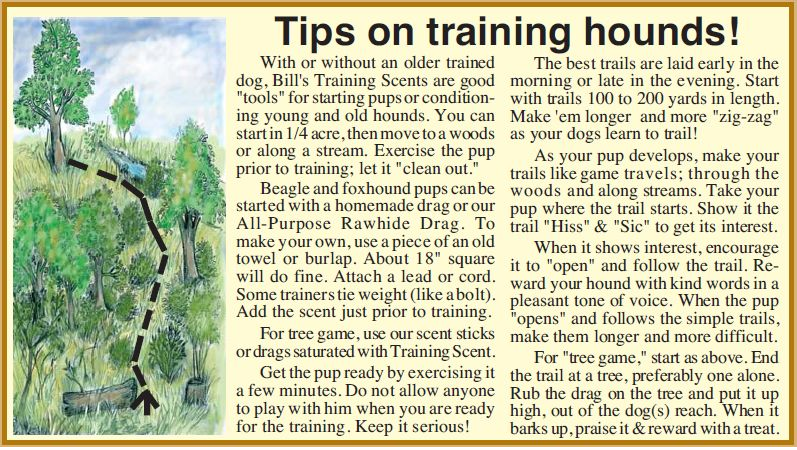
    If so, the good news is that the 2010 Bill Boatman catalogue has a nice short training summary, which I have clipped out just for you. Enjoy!

    Of course, none of this will stop the lazy and incompetent from wanting their fox pens. These are the guys with one or two dogs, who have no horse, and who have no access to land because they have never gone out and gone door to door at farms.

    They have not trained their dogs at all -- they keep them in a kennel behind the house and pretty much ignore them 50 weeks out of the year.

    In short these folks are just like the pay-and-shoot bird gunners who take their shotgun and barely trained birds dog out to some place where a fellow releases a few chickens pheasant out into a field to be blasted by the pay-to-shoot guy an hour or two later. We're hunting now! Look at my excellent bird dog.

    Of course this is how they hunt birds in England, isn't it? If you are going to import a non-native tropical bird to hunt, like a pheasant, then you are going to have to stock them. You cannot release them into the wild to thrive on their own, any more than you can let a chicken "return to the wild".

    But a fox? No, not even in England would they think to put a fox in a big pen with a hound and call it hunting. Or training. Or anything but a fat slob, without the proper tools, trying to do a job on the cheap that he should not have started to begin with.


    .

    Friday, October 16, 2009

    Artificial Dens, Big Dogs and Fair Chase


    Concrete liners wait to be assembled into an artificial fox earth in Germany. This is an "in and out" design where the barking dog comes down the right section of pipe and bolts the fox into the left section of the pipe. The two sections are connected at the notches seen in the foreground. The left section then feeds back into into the main pipe stem and the fox bolts out.

    In an article entitled The Rabbit and the Go to Ground Tunnel, I detailed the 20th-Century rise of artificial fox earths in the UK.

    These artificial fox dens have their origin in ancient rabbit "burries" created by the Romans who introduced the rabbit to the UK about 1,000 years ago.

    The artificial fox earths of the UK served as the model for the over-large "Go to Ground" tunnels we see at American Kennel Club, Jack Russell Terrier Club of America, and American Working Terrier Association trials.

    Go-to-ground trials are not close approximations of field work (a caged rat is the only "quarry," and it only has to be "worked" for a minute or two) but people who do not own a deben collar or a decent shovel often think a 9" by 9" square den liner is approximately the same size as a real fox den. This misperception helps fuel a common belief held by portly matrons at dogs shows that a red fox is as big as a coyote or small wolf. As I have noted:

    A large dog is almost always a liability. While a small dog can enter and work a large den, a large dog cannot enter a small earth. If a large dog is able to squeeze itself into the den pipe at all, it will find it has little room to maneuver away from the slashing jaws of the fox, raccoon or groundhog, and that it is nearly impossible to get behind the quarry in order to bolt it out of the den.

    Despite this liability, some large terriers in Britain continue to find success bolting fox due to the prevalence of artificial dens or "drains" created by the mounted hunts as a way to keep fox populations stable on hunt lands. These artificial fox dens are typically 9 inches square, brick-lined, and slate-topped with two or three possible entrances.

    While the construction of artificial dens or “drains” was sufficiently common at the turn of the century that Sir Jocelyn Lucas provided tips on their construction in his 1931 book, Hunt and Working Terriers, they became even more prevalent after the introduction of the myxoma virus in Great Britain in the early 1950s.

    Myxomatosis was purposefully imported from South America as a way of "controlling" the U.K.’s rabbit population, which was considered a major agricultural pest. The myxoma virus was a frightfully efficient killer, wiping out 98 percent of all rabbits in Great Britain within a decade of its introduction. One result of this unhappy turn of events was that the ancient rabbit warrens that had once served as natal dens -- and sources of food -- for breeding fox simply vanished.

    In order to help out Mother Nature, and improve the chance that a fox would take up residence on hunt land, many hunts constructed new artificial dens out of bricks or 9-inch drainage pipes.

    At about the time that the very first artificial fox dens were being constructed in the 1920s, Kennel Club dog shows began to grow in popularity. New terrier breeds were admitted to Kennel Club rosters with some frequency, and old breeds were regularly "improved" for coat color, the set of the ear, the length of the leg, the shape and size of the head, the set of the tail, and a dozen other characteristics that barely matter in the hunt field.


    The rest, as they say, is history.

    It is with some interest -- and alarm -- that I note that the use of artificial dens seems to be growing in Germany. Here we find concrete and PVC pipes used in the construction of artificial fox earths. These earths are hunted about once a month in season, with the dog being entered in the pipe, and the fox easily bolted out due to the design of the artificial den.

    The bolted fox is then blasted with a shotgun.

    This is pretty far from genuine terrier work in my opinion, and is only a little bit better than a canned hunt. Woodcraft does not have to be very high to find a fox in this manner -- just visit the artificial dens you have previously constructed (and perhaps stocked). The dog is then entered, and the fox bolts. The dog is unlikely to face much of a fight since the fox has an easy exit. Nor does the terrier owner have to dig to the dog. These are 5 minutes affairs, not three-hour digs. As for shooting a fox with a shotgun as it exits a pipe -- could there be anything easier?

    I am at a loss to understand this permutation of terrier work which is so very different from what we do in the U.S.

    If we set aside the ethics of this kind of hunting and ask only what might be happening to the dogs, more alarm bells sound.

    Are the Germans turning to artificial dens because their dogs are too large to work tight and twisting natural earths?

    That may, in fact, be part of the impetus behind the rise of artificial earths in Germany. While the German standard for a working dachshund (teckel) calls for a dog with a small chest, the Germans insisted on creating their own brand of terrier during the strange period leading up to the rise of Nazi Germany.

    I have documented the true history of the German Hunt terrier (the Jagdterrier or Jagd terrier) in previous posts and noted that this "all rounder" is too small to easily retrieve bird, and often too big to easily go to ground on fox. It is a dog that, when bred to the middle of the standard, is "betwixt and between".

    You know there are problems with Jagd Terrier size when the problem becomes institutionalized in the form of a cartoon Jagd Terrier struggling to exit an artificial earth. Cartoons require an audience to "get the joke" -- to say out loud that which is widely known, even if seldom stated.


    The Germans have always been an engineering and industrious people, and so it is no surprise to find they have put a lot of effort into "improving" the old "three-brick-high with a slate roof" design that characterize so many artificial earths in the UK.

    Modern German earths are often made of cast concrete or even plastic pipe assembled in sections and attached to special "bedding kettles". Though there are various designs for these earths, they all feature ready exits so that a barking dog can easily bolt the fox.

    Carefully designed earths mean the dog may never come face-to-face with a fox at all -- a good way to keep a dog injury-free, but also a set-up that prevents a dog from ever being in a situation where it has to demonstrate locating abilities in a complicated sette, staying power while it is being dug to over several hours, or the drive and "bottle" needed to hold a fox in a stop-end.

    In fact, these German earths are designed so well that I suspect a barking Tea-cup Poodle could bolt a fox!


    Artificial dens are simply not used in the United States. One reason for this is that our mounted hunts are not in the business of killing foxes -- once a fox goes to earth, the hounds are praised and the field rides off until another fox is found, and then the chase is on again. This is not drag hunting, but it is not vermin control either. Perhaps it is game management. A fox caught by the hounds above ground is a very rare thing, and such a stupid, slow or sick fox is best weeded from the gene pool.

    Another reason we do not have artificial earths in the U.S. is that in the Eastern U.S., where red fox are most common, there are so many groundhog holes that an artificial den is unlikely to be used by a fox, no matter how well it is located.

    Perhaps the most important reason we do not have artificial dens in the U.S., however, has to do with our concept of "fair chase".

    "Fair chase" is a modern idea and has been framed in response to a fixed amount of wildlife and a rising tide of people and technology.

    In pre-historical time you took game any way you could, but with the development of modern weapons, mankind found it could shoot out all the game and "bleed the land white" in just a few years time.

    As amazing as it sounds, for example, the people of the United States killed off almost every type of large wildlife in this country between 1850 and 1900 when ethics and common sense failed to keep pace with rapid improvements in gun technology and traps.

    Bison, elk, wolf, white tail deer, pronghorn, moose, turkey, eagles, beaver, and many species of ducks, geese and crane were nearly wiped off the American landscape.

    In response to this devastation, the U.S. developed the concept of "fair chase". Artificial bird-calling machines were banned, as were live decoys, and the commercial sale of wild game was prohibited. Hunting of most species was limited to clear seasons and defined bag limits, and some types of hunting (such as canons loaded with shrapnel designed to kill whole flocks of geese with a single shot) were banned outright.

    Today, thanks to sane wildlife laws, ethical hunters, and the finest game management professionals in the world, most forms of American wildlife can now be found in record abundance.

    Other countries have set in place their own laws, regulations and customs governing "fair chase". In the UK, for example, leghold traps are considered a horror, in no small part because the British have no experience with modern off-set-jaw traps, and in part because the mounted hunts have demonized traps and poison which proved to be so efficient during Victorian times that fox were often rare and many mounted hunts were reduced to chasing stag and rabbit.

    In fact, the demonization of traps, poison and guns for fox control reached such a frothy state that a legal term was coined for the crime -- Vulpicide -- which means the killing of fox by any method other than horse, hound, and terrier.

    Will Germany and other countries develop their own sense of fair chase, and will it include the rejection of artificial dens or -- perversely -- their embrace?

    Time will tell, but so far artificial dens seem to be gaining ground in Germany. One "sales point" for these contraptions is that they are safe for the dog, which is unlikely to tangle with the fox in any serious way. In addition, the dog can always be easily located and cave-ins are an impossibility.

    It should be noted, of course, that the real reason artificial dens may be finding favor in Germany is that they are a profit center on hunting-club and farm lands in much the same way that pen-raised pheasants are a profit center at other locations.

    There is clearly a demand in Germany for simple and easy "sport" among those who want to "test" their dogs and show that their dogs still have what it takes. Never mind that the test is somewhat rigged and the dogs may be a bit too big to do the job in a natural fox earth.

    A red fox running free in a concrete pipe, is certainly a better test than a white rat in a welded cage at the end of a wooden tunnel! Who are we -- Americans who invented the white rat "test" -- to disagree?

    Of course there are still some of us who like the other option -- the slow slogging hunt for natural dens and the back-breaking labor of digging to the dogs through marl, root and rock. This is fair chase, and it is what terrier work is really all about.


    For more pictures of German artificial fox den construction, see
    >> http://www.jaeger-wesermarsch.de/sonstiges/kunstbau.html
    .

    Thursday, October 01, 2009

    Bio-Engineered Widllife and Artificial Hunting


    Nine year ago trout that were genetically engineered to grow extra-big escaped from a fish farm and entered Lake Diefenbaker, a man-made lake in Southern Saskatchewan, Canada.

    The trout, raised by an aquaculture company called CanGro, are Steelhead X Rainbow crosses (a Rainbow and a Steelhead are the same fish, with one stuck in freshwater and the other migrating into fresh water from salt), and are triploid female.

    A triploid fish is made by putting the eggs in a pressure cooker so that the resulting fish end up with three, rather than two, sex chromosomes.

    As the sages at The Trout Underground ask:

    In other words, the “pending” world record (IGFA) was raised in a pen, genetically manipulated to grow huge, and regularly fed. Not exactly in line with the “spirit” of the rules, and it raises some pretty interesting questions — which I expect you to answer.

    Can anything raised (and fed) in a pen be a “real” world record?


    The fact that this question is even being asked tells us what a sad state of affairs we are in.


    Where we do draw the line? Where do we begin to fence out the fakery? In a land groaning with wildlife and public lands, is it too much to ask that people actually get off their asses and go hunt and fish like adults?
    .
    .

    Friday, July 17, 2009

    Badger Baiting Is Not Badger Hunting


    Back in March of this year, I wrote a piece on this blog entitled Lie Down With Dogs, Get Up With Fleas in which I bemoaned the inevitable ruin that comes when the world of working terriers is invaded by wannabe dog fighters and badger baiters.

    That post noted that some 17 months earlier I had written a piece entitled Honey Pots and Trolls in the Land of Eire in which I had noted that someone in Ireland had gotten on the boards to bash a piece I had written two years earlier (now more than four years ago) about the old Irish "strong dog" tests and the potted histories that you commonly find for all Kennel Club dogs, including the Glen of Imaal terrier.

    I warned what I suspected: a "honey pot" operation was in operation, and it was designed to harm the legitimate world of the working terrier by trying to associate it with dog fighting and badger baiting.

    Sadly, I was right, and the result has not only been busts in Ireland, but also bad press on the international front as well.

    Perhaps now is a good time to review my original March 2005 post, in which I quite succinctly noted that Baiting Dogs Are Not Hunting Dogs.

    It seems this is a point that still needs to be stressed and underlined.

    The confusion in some minds stems from the fact that shortly after the turn of the 20th Century, some show-ring pretenders in Ireland tried to suggest that Ireland's overlarge turnspit, fighting, and cart-guarding dogs were once used for genuine field work.

    That's not quite true, is it?

    Those Irish Kennel Club dogs were always far too large to actually go to ground, and so "artificial" work had to be cocked up for them.

    And the work, to put a point on it, was a joke.

    But don't take my word for it: You can see for yourself by watching this 1923 video clip. Here is the famous (or infamous) Teastas Beg and Teastas Mor in action!

    At the "minor trial," we see a couple of rabbits released, and a bunch of confused dogs sniffing around on the ground. Some terrier trial!

    At the "major trial," we see the true "work" of these over-large Irish dogs: Badger baiting with a live badger in a smooth wooden den liner or barrel.

    This is pretty far from genuine terrier work, isn't it?

    And what does genuine terrier work of that era look like?

    The good news here is that we do not have to guess, as here too we have a film clip, also from 1923, this time of properly-sized working terriers going to ground.

    The dogs go in, the badger is dug to, and in the end it is bagged to be moved to a new location where it can do no harm.

    Are the dogs wrecked? No.

    Is the badger maimed? No.

    Is their confusion and chaos at the dig? No.

    This is real terrier work, and you will notice there is no "strong dog," "pull dog" or "hard dog" nonsense in evidence.

    These men are not show-ring pretenders, get-rich-quick dog dealers, or wanna be tough guys displaced from the world of fighting dogs. These are real terriermen, and this is what real terrier work looked like in 1923 -- and what it still looks like today, albeit with a much smaller entourage and clothes that are not quite so fancy.

    Friday, July 03, 2009

    Laughing and Cringing at Foolish Americans


    Some year back, I wrote a piece that openly laughed at folks who bought terriers from countries they had never been to, and from people they had never met in person. Now there's a plan!

    Well, it seems, I am not the only one laughing.

    According to The London Times the folks in the U.K. are laughing too. One Mick Sheed, who seems to be a dog dealer who talks a great deal, said he had sent 26 Patterdale terrier puppies to America.

    “The fellas in America have loads of money. They seem to pay mad for what they want. I have sent 26 over to them. I sent one bitch and she didn’t work, because they tried her too young. But I could say nothing, so I said ‘kill her’, and I sent them another one instead. That’s the story with them.”


    Eh? Who is "them?"

    No one I know is wrecking dogs by working them too young, nor are they killing dogs that don't work out, nor are they baiting animals of any kind.

    Anyone who knows their ass from a turnip seed knows how to start a terrier off slowly and how to start it off right. No one I know is baiting animals.

    Nor is anyone with a lick of common sense paying any more for a working terrier than they would for any other kind of hunting dog.

    But of course, not everyone has sense, do they? If we are to believe The London Times (and I am not saying I do):

    One dog, called Booth’s Bruiser 2, was sold for €10,000 in January to Barnburner Patterdales Kennels in Iowa, America.


    It was? Really? You mean this battered old dog was sold to someone in America for €10,000 ($14,000)?

    Well, I have no direct knowledge, but I have a hard time believing anyone would be silly enough to pay that amount of money for a working terrier.

    Surely that is a typo? Or perhaps Mick Sheed -- the man selling the dogs in Ireland -- is so full of crap he is spouting it for breakfast? That must be it. After all, perfectly good Patterdales and Jack Russells can be had from good breeders right here in America -- genuine earth dogs with good drive, excellent noses, and common sense with real field experience.

    If you want to go overseas for a dog, go right ahead, but for €10,000 or even $10,000 you could go to England and Ireland for a month, get everyone you meet dead drunk, and buy a box full of good dogs for souvenirs. And if you did it that way, you might even know what you had bought and who you had bought it from!

    Of course, if you did it that way, you also might not get laughed at in the London Times by the very dog dealers you were frequenting. Nor would you have to post pictures on your own web site of six dogs (six!) mauling a live raccoon on a barn floor.

    That's terrier work? Really? Not where I come from.

    That's something entirely different I think, and it's the kind of ugly stuff that imperils real terrier work where ever (and whenever) it is done.

    And here's the most incredible thing: Someone thought this was such a great representation of their dogs in action that they featured it on their web site. Wooeeeee!

    Fence up people! Does this really need to be said at this late date?

    Do we really need a weatherman to tell us which way the wind blows?

    Thursday, May 14, 2009

    John Russell's Bagged Fox

    From Alys Serrell's 1904 book, With Hound and Terrier in the Field , we learn that the famous Rev. John Russell was not above using bagged foxes.

    That makes me feel a bit better about my own efforts, on foot, to locate a fox to ground (and without hounds!) on a cold winters day with the wind howling down around my ears.

    How much easier terrier work must be if you are, in essence, engaging in a canned hunt -- and probably with paid diggers too!

    It was through his friend Mr Yeatman that my father made the acquaintance of the Rev. John Russell, of Devonshire fame, another choice spirit of the clerical circle whose interests were not bounded by their parochial duties. My father was staying at Stock House when he heard his host lamenting that, owing to his hunting establishment being very short of hands, he did not know how to get some hounds to the Rev. Jack Russell, which he had promised by a certain day.


    Being young and always eager where hounds were in question, my father volunteered to take the draft to Iddesleigh, in Devonshire, and to deliver them within the time specified. This meant a long and weary journey by road. But, nothing daunted, my father was off at daybreak with a large piece of cheese in his pocket, with which he coaxed the hounds along till they grew accustomed to him, and he accomplished the odd eighty miles on horseback in the stipulated time.

    This was the sort of thing to appeal to Mr Russell. He was very pleased, and gave my father the warmest of welcomes. That night as the two men were sitting at dinner my father expressed his regret that the next day was not one of Mr Russell's hunting days, as he had to go off early in the morning of the day after to enable him to keep his term at Oxford. He expressed so much disappointment at not seeing the famous hounds in the field, that at last Mr Russell exclaimed, " Look here, my boy, you shall see them, if you don't mind turning out at day-break. There is a fox shut up in the saddleroom that was brought me to-day, and we will see if we can't dust his jacket for him." It was in the early spring, and a move was made to the stables the following morning before it was light. The men being roused, the horses were soon saddled, and all was ready for departure. The kennel lad was sent off on a rough pony with the fox in a bag, which he was ordered to let out at a certain spot, and then hounds were unkennelled and they started in pursuit. A glorious spin over a fine wild country followed, at the end of which the fox made good his escape, and the two sportsmen returned home in good time, as hounds had to Innit the next day. From that time Mr Russell and my father often met, both in Devon and in Dorset.

    .

    Monday, April 13, 2009

    Canned Hunts Shame Us All

    The latest news out of Kentucky and West Virginia brings more shame to the world of hunting. As the NBC-affiliate TV station in Lexington, KY notes:


    Kentucky and West Virginia conservation officers arrested six people, served summonses on two others and seized eight illegally possessed coyotes Friday after an investigation into a coyote and fox trafficking ring that has been underway for almost two years.

    In all, the suspects face at least 831 counts of illegally buying, selling or possessing wild-caught foxes and coyotes, and in one case, cruelty to animals....

    ....For the past 20 months, Kentucky undercover officers say they witnessed the illegal buying, selling and possession of live foxes and coyotes. They also witnessed Creech cutting the tails off live coyotes destined for use in chase pens.

    "Officers in other states have heard of that practice, but this is the first time someone has actually demonstrated it to an officer," said a Kentucky undercover officer who witnessed the mutilation. "The tail is the first thing the hounds grab, so cutting it off makes it harder for the dogs to catch the coyote and extends the chase."

    ....The trade in foxes and coyotes stems from the practice of turning packs of fox hounds loose inside fenced enclosures ranging in size up to several hundred acres to chase foxes or coyotes. The chases may begin about sundown and may continue through noon or so the next day.

    Officers say some chase pen operators need a continuous supply of foxes and coyotes and will pay as much as $100 or more for each animal.

    That sets off alarms for wildlife biologists concerned about creating a commercial black market in Kentucky for the sale of coyotes and foxes to running pens


    I have not been shy about my position on canned hunts.

    To read several longer posts on the issue of ethical hunting, see:


    Back in January, in the comments section of this blog, I noted that fox pens were a very dangerous slippery slope, as the need for fenced training areas was relatively small, and the economic pressure to turn these things into canned hunts was pretty great. My bottom line conclusion:


    The single greatest threat to hunting in American remains unethical sportsmen who can too easily give us all a bad name. Hunting ethics are not a "nicety," they are a necessity.

    If the only hunting you can do is a canned hunt, then give it up. Ditto for "pay and pull" fishing and "pay and pull" bird hunting.


    I stick by those statements. This country is running riot with wild game. If folks cannot find a couple of thousand acres to run their dogs on, then they are either not trying very hard, or need to give it up. Penned fox is not the answer to whatever question is being asked.

    The good news is that this stuff is so rare that most people have never heard of it. You can run hounds your whole life and hunt fox every weekend and never even hear of one of these fox pen operations. The bad news, in my opinion, is that they exist at all. They are not part of the American tradition, and they need to be wiped out. End of story.
    .

    Monday, March 16, 2009

    If You Come Across a Fox Sette This Time of Year


    You can never be too careful this time of year, as fox can sometimes be found in groundhog settes that otherwise have little or no evidence of fox occupation.

    While a fox in estrus will emit a stink, natal dens often barely smell at all -- a chemical change in the fox, and a natural protective defense after she whelps.

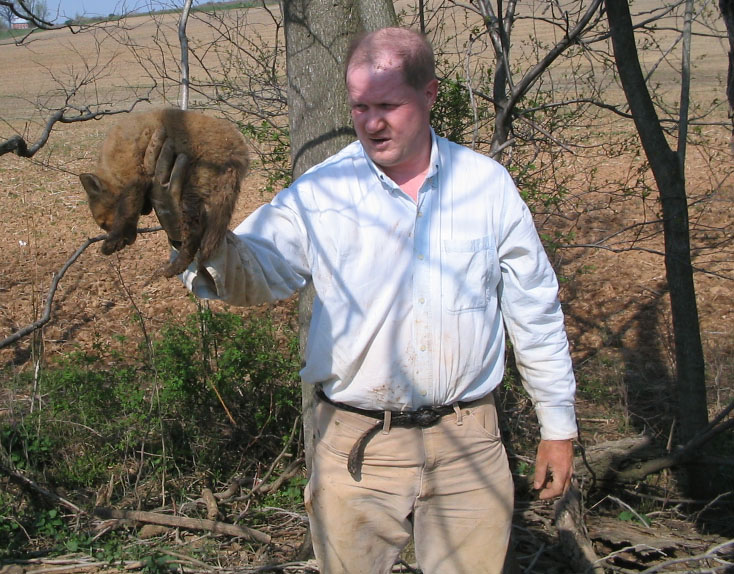
    If you do come across a natal den, handle the kits as little as possible and put them back in the den. The mother fox will return very soon and move them, provided you clear out.

    You can rest assured she has dug several dens close by, as fox will often move their litters two or three times even if undisturbed -- a way to lose flea and parasite infestations, and also to reduce run marks that might lead a dog, coyote, bobcat or human to the site of the den.

    If a kit is harmed by a dog, humanely dispatch it and remove it from the area of the den after returning the unharmed kits to the den. Fox mortality is naturally higher than 50% in the first year, and the loss of one kit, while regrettable, will actually improve the odds of the remainder.

    The kit, above, was an accidental run-in at a groundhog sette a few years back. There were five kits inside, and this one was removed unharmed by the dog. She was scooted back inside the sette without a mark on her, and she tumbled back down the pipe. The sette was carefully repaired with a bit of scrap rug found in the hedge, and the cubs were later spotted several weeks later and just one field over.
    .

    Monday, March 02, 2009

    Starvation is the Predator that Never Sleeps


    From The Well-Dressed Ape by Hannah Holmes:

    For many ... species, starvation is the predator that never sleeps. In Sweden, one study found that a staggering one in five roe deer dies of hunger. On Isle Royale, a national park in Lake Superior, wolves perish of starvation and violence (which biologists link to food shortages) at a rate ranging from 18 percent to 57 percent in a year. The snowy owls of Alberta, Canada, do little better, with starvation killing just 14 percent of the dead owls in the province. But among Wyoming's female moose, malnutrition accounts for 60 percent of deaths. Starvation happens. It qualifies, in the view of wildlife biologists, as "death by natural causes.'

    .... The causes of starvation in humans are identical to those in other animals, although we don't consider them "natural." One is meteorological. One year the rains simply don't arrive on schedule, and the humans who depend on grain suddenly find themselves in the same boat as the rabbits who depend on grass and the herons who depend on tadpoles. Territorial conflict is another cause: In the Sudan, the Arab Janja Weed push the Black Africans off their traditional territory, and the Black Africans promptly begin starving. In Yellowstone National Park, the same fate awaits a weak wolf that a stronger pack bullies away from the elk herd. And both of these catalysts, meteorology and conflict, burn hotter when they spark in a dense population. In Ethiopia, the human reproduction rate has been growing since 1960. Each generation of females is producing more offspring than the generation before. The population is rising faster than almost anywhere on Earth, and it's also bumping up against some of the world's most erratic weather. Ethiopia's droughts have become legendary, and as more and more Homo sapiens crowd the unstable habitat, the starvation risk soars."
    To order the book click here.
    .

    The Working Terrier Federation Now on the Web


    Barrie Wade, Chairman of the National Working Terrier Federation, writes to say that to mark its 25th year the NWTF has at long last set up its own website (they were too busy fighting the Hunting Act before). Hopefully some of the content may assist others faced with similar battles at some time in the future.

    The site can be found at www.terrierwork.com.

    I have added it to the blog roll, at right, just below the JRTCA. Nice job Barrie!
    .

    Lie Down With Dogs, Get Up With Fleas


    Some 17 months ago, I wrote a piece entitled Honey Pots and Trolls in the Land of Eire in which I noted that some gas bag in Ireland had gotten on the boards to bash a piece I had written two years earlier about the old Irish "strong dog" tests and the potted histories that you commonly find for all Kennel Club dogs, including the Glen of Imaal terrier. 

    This guy wanted to talk about badgers, and badger-bating trials, and what great badger dogs they had in Ireland. 

    Eh? I was a bit confused, as this fellow seemed detached from any logical mooring. 

    He had, of course, not so much as dropped me a line. 

    I suspected he did not want to provide a real name and a real email address. 

    As I wrote at the time:
    A two-year old post? Did someone just get their first dog, or did they just get their first computer? No mind. Now here's the funny thing about this kerfuffle -- the "strong dog" tests once given by the Irish Kennel Club have not been done since 1968! And when they were given, they weren't much of a test of a working dog were they? The Teastas Mor lasted for all of 5-minutes. Five minutes? Five minutes. In this Kennel Club test the dog was not required to find the quarry at all, and if the terrier bayed it was summarily disqualified. Since the Kennel Club rules for this "test" were knitted up prior to the invention of locator collars, one has to wonder how the dog was supposed to be found underground. Telepathy? Dowsing rod? But of course the dog did not need to be located, did it? The Teastas Mor was nothing more than a timed badger-baiting trial in a short artificial earth made to look "natural."
    So what was this poster on about, I wondered? 

    I had an idea.
    Well, it could be a simple matter of another Internet Troll on the boards. Such people are common enough, and I have written about them before. But perhaps in this case it is something else. Think about it -- a person with an anonymous name shows up less than a year ago on a working terrier board, and now he wants to talk about badger baiting in a country where that practice is quite illegal? Hmmmm. Sounds like a honey pot operation to me. What's a honey pot? A honey pot is an old trick. You put down bait (preferably under cover of dark) and then stand back and shoot anything that comes in to feed on it. I have written before about how these Internet bulletin boards might be a problem in this regard, and more people should probably be aware of how these honey pot schemes work if they want to stand clear of real trouble themselves, especially in the U.K. In the old days, law enforcement "honey pots" were store-front fencing operations manned by the police, or a buy-and-bust drug corners where undercover cops replaced the local dealers which had been rounded up a half hour before. Nowdays, thanks to the Internet, cops never have to leave their chair to make a bust -- they just go online to find the folks they want to arrest. Whether they are looking for wildlife poachers or illegal aliens, terrorists or pedophiles, neo-Nazis or stolen property, the Internet is the new hunting ground for law enforcement. Are wildlife officials and animal rights lunatics using the Internet this way? Believe it. It has been tried on me (though I do nothing illegal with my dogs), and it has been tried on others. Right now the Roller Pigeon community is in a bit of a pinch and a bulletin board had to be closed down for a week so that it could be scrubbed of all mention of hawk and falcon killing. Falconers have similarly been nailed for illegal bird sales overseas. Heads up and fair warning. Those in the U.K. who ignore this caution can go to page 30 of the June issue of Earth Dog-Running Dog magazine to find the telephone number of the Hunting Lawyer they may soon need. Those who want to see what the working terriers of Ireland actually look like, however, can go to page 29 of that same magazine. A little irony there, eh?
    Well, of course, it turned out I was as right as rain. 

    Just six weeks later, a major bust went down in Ireland -- a fact I noted in a post entitled As Predicted: Fools Get Stung at Irish Honey Pot. And behind this bust was some bald-headed poseur showing up at the dog shows, and even trading dogs.  

    Of course, anyone with a brain and a sense of smell could have sensed this was coming. 

    You did not need to be a dyed-in-the-wool backwoodsman to see the sign. As I wrote:
    The spoor was obvious to me, and so too was the scent. When you see such things, just sit down and keep quiet -- the game will reveal itself in time. The funny thing is that genuine digging folks know the score, and have nothing to fear. We aren't going out to bait animals, we are going out to hunt. And we sure as hell aren't using turnspit dogs or fighting dogs to get the job done, are we? We are using terriers, yes, but the terriers used in Ireland to hunt are the same as those used all over -- Jack Russells, Patterdales, Fells and (perhaps) a few Borders. There is no shame or artifice in the world of true working terriers who are being worked by folks who actually know what they are doing. And the job being done is not complex, is it? It's to locate and terminate the quarry, as quickly and painlessly as possible, and to shepherd the safety of the terrier so it can be used again next week.
    So what's the latest news? 

    Well, it comes to me via way of an email which directed me back to the same before-mentioned bulletin-board where the folks there are all atwitter again because there have been more raids in Ireland. More are supposedly in the works for "known blood sports enthusiasts in Ireland, and as far afield as France and the USA." 

    Eh? Come again? 

    I am no expert on French law, but I am quit certain that hunting badger is legal in France, and I know for a fact that it is legal in most of the U.S.A. where badger are actually found. 

    So there will no arrests, as no laws have been broken -- that is just fanciful bunk cocked up by an ignorant press corps trying to sensationalize things as much as possible. 

    As for "baiting," I know no one who does that. Not a one. 

    But then, I do not claim to know everyone lurking on the margins of the world of working terriers, even in this country. 

    I have noted in the past that there are a few wanna-be pit-dog fighters about, but I will have nothing to do with them, and neither will anyone else with an ounce of brain or a real interest in working terriers. 

    These knuckle-draggers are to true working terriers what jack-lighting deer poachers are to real hunters -- an outrage and an embarrassment. 

    That said, I have always suspected that most of these loud mouths are nothing more than wannabe tough-guys who do not hunt very much, and who simply talk big to get attention. 

    I have written about these fools and fantasy diggers before, and I have noted that their rich fantasy life is every bit as detrimental to real terrier work as the nonsense spouted by Kennel Club matrons.
    Does fantasy do any real harm? Generally, no, but at times yes. The fantasy digger who thinks a go-to-ground tunnel is the size of a real den pipe is spreading a lie forged in ignorance that allows the "big wink" of over-large dogs to continue unabated. The preening pretender who prattles on about the glories of brain-dead "hard dogs" in order to compensate for his own male shortcomings glorifies a canine characteristic which, in excess, is too often a serious liability in the field. The show ring breeder whose fantasy fox is as large as a coyote is what led to the Kennel Club fox terrier -- a dog whose chest is as deep as the keel of a war ship. The young enthusiast who thinks a mute dog is a fine thing glorifies a serious nuisance and a potentially fatal liability in a working dog, while the "blue-blazer rosette chaser" who cares more about the color of a dog's nose than it's ability to scent does no better. When push comes to shove, the thing that has killed working terriers over the course of the last 50 years is the creep of fantasy, and the slow but steady erosion of real diggers in the hedgerow. The simple truth is that you cannot protect working dogs without working them. And working a dog is not easy -- it is suspiciously like work for the human as well as the dog. There is equipment to be gotten -- spades, bars, posthole diggers, tie-outs, locator collars, machete, yo-ho, veterinary first aid equipment, and a decent pack in which to carry it all. There are farm permissions to get, and there are the dogs which have to be raised up and given the experience -- experience which can only be gotten by driving out to the country and walking hedgerows and fields for many, many weekends. This is to say nothing of the reality of digging in freezing cold, howling winds, sucking mud, pounding sun, and swarming bugs.
    And so, I was not too surprised when I turned on the computer this morning to find someone had sent me another news article from The Sunday Times of London about the badger-baiting arrests in Ireland. Only in this article, two Americans were named -- the owner of Deadgame Kennels in West Virginia, and the owner of Barnburner Patterdales in Iowa. It seems these two gentlemen had imported dogs from Robert Booth, formerly of Ireland and now living in France. 

    Booth is a dog-dealer, and part of his business plan has been selling dogs to wanna-be tough guys in America who then go on Internet Bulletin Boards, list-servs, and web sites like "Bay Dogs Online" to claim that their dogs are descended from "Booth's So-and-So" and will "hunt anything." 

     Right. Hunted nothing is more likely. 

    As for badger baiting by either of the two named Americans, I seriously doubt it.

    You see, neither of these gentlemen live in an area known for badger, and in fact it seems one of them even has to go out of state to hunt groundhog! 

    The other fellow seems to "hunt" only a few times a year, and this is generally done by shooting large numbers of raccoon that flee the treeless fields of Iowa in winter only to jungle up in barns and silos where their feces damage vast loads of hay and feed. 

    I do not consider this hunting; it is extermination. 

    And, let the record show, it is perfectly legal, even if it is not genuine terrier work in my book. 

    The United States, thank God, is not the U.K. Not only are guns legal here, but so too are steep-jawed traps. In fact, there are more than 100,000 active trappers in the U.S., and these trappers are trapping (and mostly exporting) over 2,500,000 raccoons a year, along with many hundreds of thousands of wild fox and coyote pelts. 

    This trapping does no harm to wildlife numbers; raccoon, red fox, groundhog, and coyote numbers are at historical records. 

    As for North American badgers, which are not related to their European counter-parts in any way, they are not protected in most of the states where they occur in any appreciable number. 

    If you want to hunt badger in Idaho, Wyoming, Utah, or North Dakota, for example, go right ahead; it is an unprotected nongame species. The states of Nebraska, Wyoming and Missouri, very helpfully suggests using #3 traps. Kansas has a season that stretches from Nov. 12th to Feb. 15th, while Iowa's stretches from Nov. 3rd to Jan. 31st. 

    And so it goes. . . . . 

    Which is not to say that there is any excuse for stupidity or brutality. 

    The oldest adage in the world is both true and poignant: "Lie down with dogs, and get up with fleas." 

    If you rub up against dog dealers, dog-fighters, badger-baiters, and wanna-be-tough guys, do not be surprised if their mud ends up being splattered on you, whether it is deserved or nor. 

    And if, by chance, you are the kind of person who does not respect both the wildlife and the dogs, please get the hell out of terrier work all together. 

    Terrier work does not need thugs and numbskulls. And, if you want my opinion, it does not need any of these Internet bulletin boards at all. As I wrote on this blog back in 2005:
    When was the last time you read something useful or interesting or new about fox, raccoon, weasel, groundhog, badger or even ducks on one of these boards? When was the last time you got a bit of practical advice about shifting rocks, closing a wound, or finding permission? When was the last time someone even wrote a well-written story about their day in the field with the dogs? Instead, what you find on the Boards are a great number of very young or immature people who seem to get most of their attention in this world by being combative, or otherwise wanting to work out their manhood issues (and yes there are some women doing that too!). Most of these people seem to know very little about wildlife and not too much about dogs, either. It is ironic, but true, that in the dog world the most common animal is the parrot -- people quick to repeat what others have said or scratched out. The parrot offers no new information or expanded point of view. They have little experience of their own. Think for themselves? Go their own way? Dig their own dog? Parrots don't do that -- they are bird-brained and can only mimic. They do not own a library card and cannot hold a shovel. Starting a bulletin board is certainly easy nowdays, isn't it? These things are now offered up as free services, the code is easy and can be set up in an hour or two, and the only trick is to get people to keep coming back. No committment or investment is needed. Just erect an electronic wall and let the graffitti spraying begin. And graffitti spraying is exactly what you get about 95 percent of the time. In fact, this is the chief product of the bulletin boards -- not information but fighting, not shared experience, but name-calling. It is like a Drunken Night at O'Malleys, except that the drunks are a thousand miles apart and hiding behind fake names. The folks that run bulletin boards are big on "free speech," but it is pure posture to hide true poverty. The sad truth is that if civility were maintained on these bulletin boards, the real truth would come out pretty quickly -- no one has very much to say. In the end, bulletin boards have not created a working terrier community so much as destroyed it. The pictures on "anti" web sites are all culled from bulletin boards. Educated people who might educate, motivate and represent the best of working terriers soon turn away from these boards, leaving the loud, stupid, very young, and unemployed to dominate the boards and represent us all. It is reverse Darwinism -- a devolution to the unfit and the unsound. I think history has shown that nothing has harmed the world of working terriers more than weakly moderated bulletin boards. Mud and slander has been slung on established breeders, 30-year diggers, working judges, and respected authors. At times I have wondered if these things were Animal Rights honey pots -- bait stations set out to poison the working dog community. Whether intended or not, that is what most of them have become. What a sad thing the internet has done to working terriers!
    Was I right? I think time has proven it so! .