Showing posts with label breeding. Show all posts

Tuesday, May 24, 2022

George Bernard Shaw at the Pound

George Bernard Shaw made his own blinders.

There is a general tendency for those on the political left to assume eugenics is an expression of right-wing fanaticism.  In fact, eugenics is an apolitical idea and it was embraced by such diverse names as Theodore Roosevelt, Woodrow Wilson, Winston Churchill, Alexander Graham Bell, Konrad Lorenz, Oliver Wendell Homes, Margaret Sanger, Luther Burbank, John Maynard Keynes, Bertrand Russell, Leland Stanford, and H. G. Wells, among others. 

To say there was widespread support for eugenics in the first few decades before and after the turn of the 20th Century is not to say there were not some controversies!

Hitler, for example, was bent on sterilizing and killing Jews, but many opposed this plan, not because they were against forced sterilization or state-sponsored murder, but because they thought the Jews were absolutely the wrong group.  A lot of Jews were smart and industrious!  Keep them!   The folks you wanted to round up to sterilize kill were the lazy, the crazy, the "unfit", and the old, sick and broken.

And who pushed this school of thought?  One vocal advocate was none other than liberal Fabian George Bernard Shaw, author of both Pygmalion and Man and Superman fame, and winner of the 1925 Nobel Prize for literature.


What most people do not know about G. B. Shaw is that he was not only a writer, but also an economist who was a co-founder of the London School of Economics. 

Shaw was also a vocal proponent of eugenics.  At the back of Man and Superman, he penned a section on "Good Breeding" and "Property and Marriage" where he synthesized and homogenized a new form of eugenic socialism in which he advocated all production as being put forward for the collective good.

Shaw was in the thick of the eugenics movement, and a leading thinker and vocal advocate.  At a meeting of the Eugenic Education Society on March 3, 1910, Shaw suggested the need to create  a "lethal chamber" to solve "the problem" of poor producers dragging down society, and he also called for the creation of a "deadly" but "humane" gas for the purpose of killing many "unfit" people at a time.  Sound familiar? 

This kind of talk was not idle chatter or ironic polemicism or satire -- sterilization and gas chambers were put forth by Shaw as very serious "solutions" to the "quality of people" problem and were seen as the inevitable way forward by many others.

Where did this idea come from? 

Why from the animal breeders of course, and the dog breeders in particular.  To this day, sterilization, gas chambers and closed canine breeding pools are the back bone of the Kennel Club systems in the U.S., the U.K., and around the world.

Which is not to say that the Kennel Club invented all this.  The push to "improve" animals through selective breeding at the hand of man can be traced back to Robert Bakewell and earlier.

No less a luminary than Charles Darwin noted that with humans, the healing hand of natural selection was being interfered with by medicine and social institutions that protected the weak, and it was thought that not much good could come from that!   As Darwin wrote in The Descent of Man (1882):

With savages, the weak in body or mind are soon eliminated; and those that survive commonly exhibit a vigorous state of health. We civilised men, on the other hand, do our utmost to check the process of elimination; we build asylums for the imbecile, the maimed, and the sick; we institute poor-laws; and our medical men exert their utmost skill to save the life of every one to the last moment. There is reason to believe that vaccination has preserved thousands, who from a weak constitution would formerly have succumbed to small-pox. Thus the weak members of civilised societies propagate their kind. No one who has attended to the breeding of domestic animals will doubt that this must be highly injurious to the race of man. It is surprising how soon a want of care, or care wrongly directed, leads to the degeneration of a domestic race; but excepting in the case of man itself, hardly any one is so ignorant as to allow his worst animals to breed.

Of course, this was all pseudo-science to justify social position, and to monumentalize the selfish desire to avoid taxation to help the poor. Why spend money feeding and housing poor people (or abandoned dogs) when for less than the price of a bullet, you could "humanely" gas them wholesale?

Today, of course, to note that the Kennel Club and the eugenics movement spring from common roots and were self-reinforcing, is a heresy. Simple history is omitted, redacted or swept under the rug. As author Micheal Crichton has noted:

After World War II, nobody was a eugenicist, and nobody had ever been a eugenicist. Biographers of the celebrated and the powerful did not dwell on the attractions of this philosophy to their subjects, and sometimes did not mention it at all.

Right. The Kennel Club practice eugenics with sterilization, gas chambers, and closed breeding pools? Well yes, but that's not eugenics -- that's dog breeding! 

As for George Bernard Shaw, many of his supporters have attempted to suggest his support for eugenics was a kind of Irish irony, along the lines of Jonathan Swift's Modest Proposal Perhaps.  There is no question Shaw was a kind of linguistic Lady Gaga, willing to say anything to get attention and in love with his own voice and self-fanning fame.  That said, Shaw did attend meetings of the Eugenic Education society, did praise Adolph Hitler, and did it all without too much irony being in self-evidence


.

Sunday, March 10, 2019

Victorian Snobbery on the Animal Estate


A book worth reading is The Animal Estate: The English and Other Creatures in the Victorian Age by Harriet Ritvo [Harvard University Press, 1989].

Ritvo points out that the Dog Show crowd and the Animal Rights crowd spring from the same root-stock of sentiment and snobbery, and in both cases the animals are the side-show, not the main event.

Ritvo writes that in the Victorian era, and into the 20th Century, dog show folks:

... elevated standards that had no basis in nature or aesethics but reflected the ignorant, self-interested caprices of fanciers who wished to boost the prestige of their own stock in order to associate themselves with people of good breeding.

And, of course, it paid, with show winners being sold for cash -- a quick way for people of low rank to buy themselves up the social ladder. If one had a dog that was "best of breed," then surely the owner must be of similar worth, right??

Ritvo notes that terriers were particularly singled out for attention by the show ring preeners and pretenders, and that:

The Fox Terrier Chronicle, the only 19th Century periodical devoted to a single breed of dogs, covered the terrier elite the way that newspapers and other periodicals covered human high society.

Ritvo notes that dog fanciers projected:

... an obsessively detailed vision of a stratified order, which sorted animals and, by implication, people into snug and appropriate niches" with dog shows offering "a dizzying range of classes and then abstracted from them a carefully calibrated hierarchy of animals, ranging from those who did not place even in their sub-breed category to the best in show.

In short, the attraction of dog shows was that people who themselves were as common as a turnip top could now fancy that they were among the social elite.

They did not have to have real knowledge of animals, or have an important job or title or large estate -- they just had to purchase a dog from a "reputable" show breeder and put on airs.

As one Victorian periodical noted,

Nobody now who is anybody can afford to be followed about by a mongrel dog.

Ritvo notes that:


Specialist clubs were supposed to defend their breeds against the vicissitudes of fashion, but they had few other guides in their attempts to establish standards for breeds and judges.

Even in the Victorian era, almost no one walking into the ring with a "working" breed actually worked their dogs.

After almost half a century of formal shows, the author of a manual for dog owners noted that,

The sportsman will as a rule have nothing to do with the fancier's production.

All of the above is from the second chapter of Ritvo's book. The third chapter is about the rise of the Animal Rights movement, and here we see the same class issues popping up that we did in the previous chapter.

Just as honest working dogs were labeled "mongrels best for the dustbin," so too were the people that owned them. The analogies made were simple and direct: Course people had course dogs and engaged in course behavior. Show people had "pedigree" dogs and they did not engage in course behavior.

Of course, not everything was quite as simple as this in the real world.

No matter -- the goal of the RSPCA was not entirely about animals anyway -- it was in no small part all about putting down the poor and the rural and castigating them for having "undisciplined" values.

Towards this end, Ritvo notes that the tracts of the RSPCA "implicitly identified the lower classes as the source of brutality," even as this same organization gave "the big wink" to fox hunting and grouse hunting which were common pastimes of the rich and landed.

Today, of course, the people you see at a PETA rally, and the folks that you see trotting their dogs around a show ring are not all that different demographically, and the general sentiment is still toward unalloyed snobbery.

Sunday, March 03, 2019

The Strange Fruit of Class Warfare


In The Animal Estate: The English and Other Creatures in the Victorian Age, author Harriet Ritvo [Harvard University Press, 1989] points out that the Dog Show crowd and the Animal Rights crowd spring from the same root-stock of sentiment, and in both cases the animals are the side-show, not the main event.

Ritvo writes that in the Victorian era and into the 20th Century dog show folks "elevated standards that had no basis in nature or aesthetics but reflected the ignorant, self-interested caprices of fanciers who wished to boost the prestige of their own stock in order to associate themselves with people of good breeding."

And, of course, it paid, with show winners being sold for cash -- a quick way for people of low rank to buy themselves up the social ladder. If one had a dog that was "best of breed," then surely the owner must be of similar worth, right??

Ritvo notes that terriers were particularly singled out for attention by the show ring preeners and pretenders, and that “The Fox Terrier Chronicle, the only 19th Century periodical devoted to a single breed of dogs, covered the terrier elite the way that newspapers and other periodicals covered human high society."

Ritvo notes that dog fanciers projected "an obsessively detailed vision of a stratified order, which sorted animals and, by implication, people into snug and appropriate niches" with dog shows offering "a dizzying range of classes and then abstracted from them a carefully calibrated hierarchy of animals, ranging from those who did not place even in their sub-breed category to the best in show."

In short, the attraction of dog shows was that people who themselves were as common as a turnip top could now fancy that they were among the social elite. They did not have to have real knowledge of animals, or have an important job or title or large estate -- they just had to purchase a dog from a "reputable" show breeder and put on airs.

As one Victorian periodical noted, "nobody now who is anybody can afford to be followed about by a mongrel dog." Ritvo notes that "Specialist clubs were supposed to defend their breeds against the vicissitudes of fashion, but they had few other guides in their attempts to establish standards for breeds and judges."

Even in the Victorian era, almost no one walking into the ring with a "working" breed actually worked their dogs. After almost half a century of formal shows, the author of a manual for dog owners noted that "the sportsman will, as a rule, have nothing to do with the fancier's production."

All of the above is from the Second chapter of Ritvo's book. The Third chapter is about the rise of the Animal Rights movement, and here we see the same class issues popping up that we did in the previous chapter.

Just as honest working dogs were labeled "mongrels best for the dustbin," so too were the people that owned them. The analogies made were simple and direct: Course people had course dogs and engaged in course behavior. Show people had "pedigree" dogs and they did not engage in course behavior. Of course, not everything was quite as simple as this in the real world. No matter -- the goal of the RSPCA was not entirely about animals anyway -- it was in no small part about putting down the poor and the rural and castigating them for having "undisciplined" values. Towards this end, Ritvo notes that the tracts of the RSPCA "implicitly identified the lower classes as the source of brutality," even as this same organization gave "the big wink" to fox hunting and grouse hunting which were common pastimes of the rich and landed.

Today, of course, the people you see at a PETA rally and the folks that you see trotting their dogs around a show ring are not all that different demographically. In his book "In Defense of Hunting," James A. Swan notes that the Animal Rights crowd is dominated by people that are "white, urban, predominantly female, nicely dressed" and that many of them are "people who have gone through painful divorces or have had traumatic childhoods or have otherwise been hurt by the norms of society."
.

Monday, July 16, 2018

Pedigree Dogs Not as Healthy as Mutts & Mixes


In a comment to an earlier post, a reader writes to suggest that one reason folks may think mutts are healthier than pedigree dogs is "because vets don't attribute specific problems to their breeding - how could they? It's a mix!"

An interesting point, but actually, that's not the reason.

We think mutts are healthier than pure-breeds because they actually are healthier!

And the research, as I noted in an earlier post entitled Pet Insurance Data Shows Mutts ARE Healthier!, is not closely held.

When it comes to warranties and insurance, predictive values are important, and fortunes are made by determining the correct digits to place to the right of a point mark.

What does this have to do with dogs?

Quite a lot.

You see, pet insurance companies are in a competitive business to get your dollar. If they get the numbers wrong, and price a premium too high, potential customers may forgo pet insurance altogether or else sign up with a competitor's plan. On the other hand, if the company routinely prices insurance premiums too low, they may push themselves into bankruptcy.

And so, pet insurance companies have collected data on hundreds of thousands of dogs and analyzed that data, in order to assign correct premiums to predictive risks.


And what do the insurance records show? As I note, by way of example:

Embrace Pet Insurance... will insure a mixed breed dog up to 8 years of age, but the cut-off for purebred dogs is 6 years.

What's that about?

Simple: Taken as a whole, there is a "health gap" between cross-bred and pedigree dogs, and that gap is about two years. The insurance industry is simply mirroring in policy, what has been proven true on the ground.

Of course, there is more data. Over at the Cold Wet Nose blog, Beverley Cuddy has put up some of the citations from Jemima Harrison's current piece in Dogs Today which reviews some of the literature. Citations, with a summary "kicker" quote line to encapsulate the piece, follow:

  • B.N. Bonnett, A. Egenvall, P. Olson, A. Hedhammar, Mortality in Swedish dogs: rates and causes of death in various breeds, The Veterinary Record, 1997. ("Mongrels were consistently in the low-risk category.")
  • P.D. McGreevy & W.F. Nicholas, Some Practical Solutions to Welfare Problems in Pedigree Dog Breeding, Animal Welfare, 1999. ("Hybrids have a far lower chance of exhibiting the disorders that are common with the parental breeds. Their genetic health will be substantially higher.")
  • A. Egenvall, B.N. Bonnett, P. Olson, A. Hedhammar, Gender, age, breed and distribution of morbidity and mortality in insured dogs in Sweden during 1995 and 1996, The Veterinary Record, 2000. ("Mongrel dogs are less prone to many diseases then the average purebred dog.")
  • A. R. Michell, Longevity of British breeds of dog and its relationship with sex, size, cardiovascular variables and disease, Veterinary Record, 1999. ("There was a significant correlation between body weight and longevity. Crossbreeds lived longer than average but several pure breeds lived longer than cross breeds, notably Jack Russell, miniature poodles and whippets.”)
  • G.J. Patronek, D.J. Walters, L.T. Glickman, Comparative Longevity of Pet Dogs and Humans: Implications for Gerontology Research, Journal of Gerontology, Biological Sciences, 1997. ("The median age at death was 8.5 years for all mixed breed dogs and 6.7 years for all pure breed dogs. For each weight group, the age at death of pure breed dogs was significantly less than for mixed breed dogs.")
  • H.F. Proschofsky et al, Mortality of purebred and mixed breed dogs in Denmark, Preventive Veterinary Medicine, 2003. (Higher average longevity of mixed breed dogs. Age at death when split into three age bands: mixed breeds 8,11,13, purebreds 6, 10, 12.)
  • Marta Vascellar et al, Animal tumour registry of two provinces in northern Italy: incidence of spontaneous tumours in dogs and cats. BMC Veterinary Research 2009. (“In both dogs and cats, purebreds had an almost two-fold higher incidence of malignant tumours than mixed breeds.”)
  • Agneta Egenvall et al, Mortality in over 350,000 Insured Swedish Dogs from 1995–2000; Breed-Specific Age and Survival Patterns and Relative Risk for Causes of Death. Acta Veterinaria Scandinavica, 2005. (No difference overall, but mongrels low-risk for locomotor problems and heart disease.)

Of course, not all pure breed dogs are a complete mess, and not all mongrels or mixes are the picture of health. "Hybrid vigor" does not quite live up to its hype either. Mix two genetic messes, and you may not get gold out of the opposite side.

That said, all things being equal, mongrels and mixes ARE healthier than pure breeds. Fancy that! And yes, the pun is intended.
.

Sunday, May 27, 2018

Sick Puppies and Broken Dogs

Steve Dean is the new Chairman of the Kennel Club.
Art by Kevin Brockbank, for the August 2011 issue of  Dogs Today

It's Time To Stop Praying
at the Church of the Kennel Club.

I have a low tolerance for whiners and professional victims, and it comes out two ways in the world of dogs.

The most common way is in a kind of “compassion fatigue” for people who do not do serious research when it comes to buying dog.

If you bought a dog at a pet store or from an ad out of the back of a newspaper, and everything did not work out for you, please do not come complaining to me!

Ditto if you are the kind of person who got a Boston terrier or an English bulldog that cannot breathe, a dachshund with a back problem, or a show line German shepherd that walks like a drunk exiting a bar after midnight.

What part of “read a book,” “be a consumer,” and “this is an important decision” did you not understand?

On the other end of the stick, are the folks breeding and selling diseased and defective dogs with fabricated histories and contrived standards.

The world is no longer saluting your nonsense? Boo hoo! Let me pour you a big pot of pity and never mind the dogs!


Where Do Dogs Come From?

The good news is that the world is not chock full of fools.

In the U.S., more than half of all dogs are mixed breeds of some kind, and almost none of these are overly extreme in appearance or deeply inbred genetically.

Of the 47 percent of American dogs that are purebred, only 25 percent are registered with the American Kennel Club — the rest are not registered at all, are registered with a breed-specific registry, or hold paper from some other registry.

To put it another way, 87 percent of American dogs are not registered with the AKC

In the United Kingdom, two-thirds of all dogs are said to be purebred, but this number is a bit deceptive as the number two and number three breeds, in terms of popularity, are the Jack Russell terrier and the border collie.

These two “breeds” are really types, bred for function rather than for show. The owners of these dogs have never been too finicky about closing the gate on their respective gene pools.

If the dog works like a Jack Russell terrier or a border collie, and looks like one, then it’s pure enough. Oh, you have a piece of paper? Excellent, but I am not sure the fox or the sheep much care!

If you add the border collie and the Jack Russell terrier to the “not bred within a closed registry” tally, the non-pedigree population of dogs in the U.K comes within striking distance of what we see in the United States.

What about dogs bred within the closed registry systems of the Kennel Club?

The story here is mixed.

Some breeds, such as beagles, are quite healthy. Others are burdened by genetic problems, such as skin allergies, which may cause a lifetime of misery. Many have decent, if somewhat shortened, lives up until a few weeks or months prior to their death due to cancer, liver, or kidney disease. Quite a large number of Kennel Club dogs live to ripe old age with grey muzzle and rheumy eyes. In truth, most Kennel Club dogs are reasonably healthy, and only about two dozen breeds are so wrecked as to require a caution flag under any and all circumstances. What’s amazing is that these broken breeds still sell!


Failed Consumers Buy Defective Corporate Products

To be clear, there’s no shortage of crap breeds being produced by the Kennel Club. On this score I pull no punches. If you are buying a Pekingese, a pug, a cavalier, a Dogue De Bordeaux, an English bulldog or any of about two dozen other breeds I can rattle off in short order, you are simply a fool the same as someone buying a model of car famous for shoddy workmanship and dodgy design. You would never buy a car based solely on a dealer’s brochure, would you?

Yet people buy dogs all the time after doing little more than reading a Kennel Club sales brochure or an all-breed picture book, somehow oblivious to the fact that Kennel Club breeds are simply corporate products manufactured under license and with approved (if defective) standards.

It is sad, but true, that most folks spend more time planning their vacations than they do reading up on the health, training, temperament and exercise needs of a dog they hope to spend the next 15 years with.

And yet how often do we give these shoddy consumers a pass when they get a dog that is diseased, defective or unsuitable?

Too often!

Why? Has extending sympathy to such people helped the dogs? Not from what I can tell; in fact, quite the opposite. Too often these same people turn around and simply buy another dog of the same breed.

Is there a better definition of insanity than doing the same thing again and again and expecting a different result? If so, I have not heard it!

The time has come for a new approach – a kind of tough love. The simple truth is that stupid consumers and willful ignorants are not victims, they are participants in systematic canine abuse.

We are supposed to pity poor Harriet because she bought a Pekingese that cannot breath and now has to pay for expensive soft palette surgery for her dog? How about if we shun her instead?


Pedophiles and Puppies

In fact, how about if we treat everyone who owns a Kennel Club dog a bit like someone who announces they are Catholic?

You are Catholic, eh?

There is a pause. Both sides know what is being thought; now the only question is whether it will actually be said.

“What are your thoughts on the pedophilia?” you might ask. “Have you thought about changing churches, especially now that you have children?

How rude, some may say.

Really?

You think it rude to ask how -- in a world where there are a thousand ways to salute God -- someone would choose to stand shoulder-to-shoulder with a church hierarchy that winks at child buggery and has shied away from naming the problem and finding solutions for hundreds of years?

I guess we differ there!

But is it any different in the world of dogs?

When pressed about the physical abuse and pain heaped on dogs by extreme standards, and the systematic inbreeding of dogs within a closed registry system, the Kennel Club is quick to blame “the Victorians.” There is little they can do to change things quickly, they explain. It will take time. Reform will be slow. But good news; they have created an advisory committee of show dog breeders to point the way forward!

Right. And the Vatican has also put the question of what to do about pederasty to a group of celibate old men who think it perfectly fine to wear dresses to the office.

What? You are making a parallel between the Kennel Club and the Vatican? That’s outrageous!

Really? Which side have I offended?

And, of course the parallels go on.

When asked about pedophilia, the Catholic Church routinely claims such problems are quite localized. Yes, Saint Anthony’s church had “that problem,” but the Church is in “this world” and “not immune” from “such things.”

Now we know the truth: child buggery in the Catholic Church is a global problem and has gone on for centuries.

In fact, it has been so chronic and systematic that the Vatican has had a “pedophile referee” at the Vatican for decades.

That man is now the Pope.

But again, is any of this different from what we see at the Kennel Club?

The problems associated with extreme exaggeration or “selection for defect” are not new and neither are the diseases and illnesses associated with inbreeding.

These problems are not confined to one breed or one country, but cut across many breeds and many countries.

And who is the new Pope at the Kennel Club? What faces are we to see in the College of Cardinals choosing the way forward for the Church of the Kennel Club?

Why, none other than an unbroken phalanx of show dog breeders!


Vote With Your Feet… and Your Wallet

Do I think change is possible?

Absolutely.

In fact, I know change is possible for both the Kennel Club and the Catholic Church.

But neither side will see the light until they have first felt the heat.

Things will not change until the pews are bare and the collection plates are empty.

The way forward is not just to yell at the Kennel Club or to yell at the Church: it’s to vote with your feet and your wallet.

If you are buying a Kennel Club dog or attending a dog show, you are part of the problem, same as the Catholic Church parishioner who throws his fiver into the plate every Sunday morning, and who marches his child to alter boy practice on Tuesday and Thursday.

A victim? I think not. A participant!

_ _ _ A version of this piece appears in the August issue of Dogs Today
. 

Tuesday, February 20, 2018

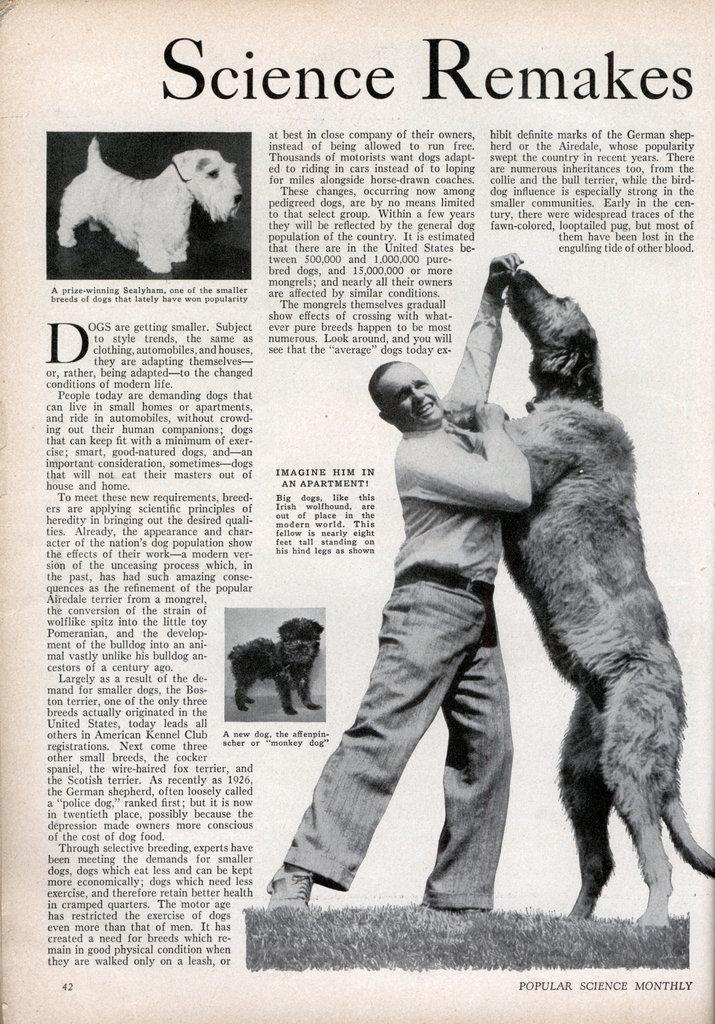
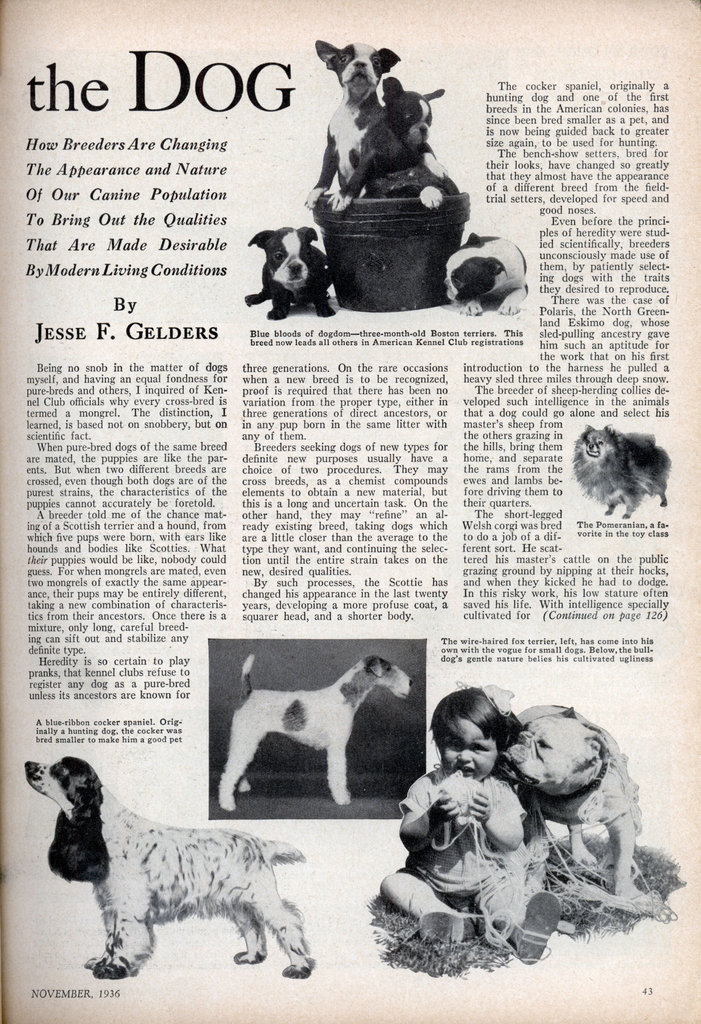
Science Remakes the Dog


An article, from the November 1936 issue of Popular Science magazine is a good representative of the kind of congratulatory back-patting that went on during this period, as show ring and hobby breeders worked overtime to draw more and more working dogs into the Kennel Club.

Not the tone of the article: "Science" is improving dogs so they will be better suited to the modern world of cars, apartments, and limited time for their care and feeding.

In fact, these market forces continue to this day, as I have noted in an earlier post entitled "Robert Bakewell's Apartment."

This Popular Science article was written when the Kennel Club was just 65 years old, but problems already seem to be cropping up.

Notice that the Cocker Spaniel seems to have been "improved" to the point that it no longer hunts.

The Scottish terrier's morphology has been transformed with the "improved" dog having a shorter back, a larger head, and a longer coat -- improvements that made the dog incapable of going down a hole after quarry, ruining it as a true working terrier.

Then you have the various types of setters where bench and field animals had already diverged to the point that they appeared to be different breeds.

Finally, the Afghan is mentioned as a new and exotic breed brought to America. How long before the show-ring variant was wrecked as a coursing dog? Not long!

It should also be noted that some of the "history" given here is Kennel Club bunk. The Airedale, for example, is a modern creation derived from the Otter hound, and bred specifically for the show ring. It was never a "night poacher's dog," being too slow and heavy for rabbit, fox, or deer. Hunting otter is not done at night; it is tough enough to see the things in the daylight!

Similarly, the English Bulldog has very little of the old bull-baiting dog in it, and quite a lot of the monstrous pug to which it is much more closely-related!

As for fox terriers, by the time this article was written, almost no one was using a Kennel Club dog for anything other than a companion dog, as a close reading of Jocelyn Lucas's book Hunt and Working Terriers (published in 1931) will reveal.

Fox-working dogs have not been "improved" by science or show ring breeders; they have only been ruined by the rosette chasers.

The original art for this article can be seen here >> Page 1, Page 2, Page 3


Science Remakes the Dog
How Breeders Are Changing The Appearance and Nature Of Our Canine Population To Bring Out the Qualities That Are Made Desirable By Modern Living Conditions

By Jesse F. Gelders


DOGS are getting smaller. Subject to style trends, the same as clothing, automobiles, and houses, they are adapting themselves— or, rather, being adapted—to the changed conditions of modern life.

People today are demanding dogs that can live in small homes or apartments, and ride in automobiles, without crowding out their human companions; dogs that can keep fit with a minimum of exercise; smart, good-natured dogs, and—an important consideration, sometimes—dogs that will not eat their masters out of house and home.To meet these new requirements, breeders are applying scientific principles of heredity in bringing out the desired qualities.

Already, the appearance and character of the nation’s dog population show the effects of their work—a modern version of the unceasing process which, in the past, has had such amazing consequences as the refinement of the popular Airedale terrier from a mongrel, the conversion of the strain of wolflike spitz into the little toy Pomeranian, and the development of the bulldog into an animal vastly unlike his bulldog ancestors of a century ago.

Largely as a result of the demand for smaller dogs, the Boston terrier, one of the only three breeds actually originated in the United States, today leads all others in American Kennel Club registrations. Next come three other small breeds, the cocker spaniel, the wire-haired fox terrier, and the Scotish terrier. As recently as 1926, the German shepherd, often loosely called a “police dog,” ranked first; but it is now in twentieth place, possibly because the depression made owners more conscious of the cost of dog food.

Through selective breeding, experts have been meeting the demands for smaller dogs, dogs which eat less and can be kept more economically; dogs which need less exercise, and therefore retain better health in cramped quarters. The motor age has restricted the exercise of dogs even more than that of men. It has created a need for breeds which remain in good physical condition when they are walked only on a leash, or at best in close company of their owners, instead of being allowed to run free. Thousands of motorists want dogs adapted to riding in cars instead of to loping for miles alongside horse-drawn coaches.

These changes, occurring now among pedigreed dogs, are by no means limited to that select group. Within a few years they will be reflected by the general dog population of the country. It is estimated that there are in the United States between 500,000 and 1,000,000 purebred dogs, and 15,000,000 or more mongrels; and nearly all their owners are affected by similar conditions.

The mongrels themselves gradually show effects of crossing with whatever pure breeds happen to be most numerous. Look around, and you will see that the “average” dogs today exhibit definite marks of the German shepherd or the Airedale, whose popularity swept the country in recent years. There are numerous inheritances too, from the collie and the bull terrier, while the bird-dog influence is especially strong in the smaller communities. Early in the century, there were widespread traces of the fawn-colored, looptailed pug, but most of them have been lost in the engulfing tide of other blood.

Being no snob in the matter of dogs myself, and having an equal fondness for pure-breds and others, I inquired of Kennel Club officials why every cross-bred is termed a mongrel. The distinction, I learned, is based not on snobbery, but on scientific fact.

When pure-bred dogs of the same breed are mated, the puppies are like the parents. But when two different breeds are crossed, even though both dogs are of the purest strains, the characteristics of the puppies cannot accurately be foretold.

A breeder told me of the chance mating of a Scottish terrier and a hound, from which five pups were born, with ears like hounds and bodies like Scotties. What their puppies would be like, nobody could guess. For when mongrels are mated, even two mongrels of exactly the same appearance, their pups may be entirely different, taking a new combination of characteristics from their ancestors. Once there is a mixture, only long, careful breeding can sift out and stabilize any definite type.

Heredity is so certain to play pranks, that kennel clubs refuse to register any dog as a pure-bred unless its ancestors are known for three generations. On the rare occasions when a new breed is to be recognized, proof is required that there has been no variation from the proper type, either in three generations of direct ancestors, or in any pup born in the same litter with any of them.

Breeders seeking dogs of new types for definite new purposes usually have a choice of two procedures. They may cross breeds, as a chemist compounds elements to obtain a new material, but this is a long and uncertain task. On the other hand, they may “refine” an already existing breed, taking dogs which are a little closer than the average to the type they want, and continuing the selection until the entire strain takes on the new, desired qualities.

By such processes, the Scottie has changed his appearance in the last twenty years, developing a more profuse coat, a squarer head, and a shorter body.

The cocker spaniel, originally a hunting dog and one of the first breeds in the American colonies, has since been bred smaller as a pet, and is now being guided back to greater size again, to be used for hunting.

The bench-show setters, bred for their looks, have changed so greatly that they almost have the appearance of a different breed from the field-trial setters, developed for speed and good noses.

Even before the principles of heredity were studied scientifically, breeders unconsciously made use of them, by patiently selecting dogs with the traits they desired to reproduce. There was the case of Polaris, the North Greenland Eskimo dog, whose sled-pulling ancestry gave him such an aptitude for the work that on his first introduction to the harness he pulled a heavy sled three miles through deep snow. The breeder of sheep-herding collies developed such intelligence in the animals that a dog could go alone and select his master’s sheep from the others grazing in the hills, bring them home, and separate the rams from the ewes and lambs before driving them to their quarters.

The short-legged Welsh corgi was bred to do a job of a different sort. He scattered his master’s cattle on the public grazing ground by nipping at their hocks, and when they kicked he had to dodge. In this risky work, his low stature often saved his life. With intelligence specially cultivated for his task, he knew when to go into action and when to stop, by the tone of his master’s whistle.

Among the strangest characteristics cultivated for particular jobs, are those of the Afghan hound, brought to America a few years ago, but used for many centuries as a hunting dog in the mountains of Afghanistan. While he is not so fast as many other hounds on level ground, he has developed high, wide-set hips which fit him especially for running on hills, and for leaping over obstacles. And because he frequently hunted in dense thickets, he has been bred to carry his tail high, like a flag, which his master could see above the concealing brush.

Even more fascinating than the shaping of traits in individual breeds of dogs, has been the creation of new breeds by crossing, for special purposes. Tremendous care was required, to select offspring with just the right inheritances from each stock.

BREEDERS of Chesapeake Bay retrievers, desiring to improve their scent, crossed them with hounds, but were able to preserve the chief characteristics which they had inherited from their other ancestors, supposedly curly-coated retrievers which had been mated with two New Foundland dogs taken from a wrecked ship. Their stamina and their rough, almost waterproof coats enable them to withstand severe storms and work in water chilled by floating ice.

The Chesapeakes share with American foxhounds and Boston terriers the distinction of being the only breeds originated in the United States. The foxhounds were said to have been developed by George Washington, who, to obtain a faster breed, crossed English foxhounds with French hounds given him by General Lafayette.

Boston terriers represent another success of breeders in obtaining just the desired characteristics from a parent stock, this time the English bulldog. Crossing it with the white English terrier, they obtained the bulldog type of head on a dog smaller and more agile than the bulldog. By that time the bulldog had been cultivated into a good-natured though still courageous animal, and those qualities were preserved.

Strangely, a somewhat similar set of ancestors produced the bull terrier, a very different dog. This time, the breeders wanted a fighter, so they chose the bulldog. They crossed him first with large black-and-tan terriers and white English terriers, producing a heavy-set, short-legged, fawn-colored dog. By careful selection they eliminated the short head and nearly all the other old bulldog qualities except the courage. Then the dog was crossed again with white terriers, and the white color, a recessive characteristic, was fixed, so that the dog became essentially the bull terrier we know today.

THE bulldog himself was the result of careful breeding of dogs for the barbarous sport of bull baiting. The bulls which were to be killed were roped to stakes, so the dog did not require real hunting ability, but only ferocity. The heavy, powerful mastiff was crossed with other breeds, among them probably the pug, for a peculiar reason. The bulldog’s chief requirement was to hang on, when he caught hold, and the pug’s short nose enabled him to breathe without letting go.

With the passing of bull baiting, the bulldog began to be cultivated with two oddly contrasting aims. The ferocity was bred out, until be became a really kindly beast, but at the same time, his ugliness of appearance was encouraged to such an exaggerated extent that it often interfered with his health. Breathing frequently was an effort for him, even in repose; and his lower jaw protruded so far that he often had trouble chewing his food, making him a prize example of unwisely directed heredity.

Like the bulldog, the Airedale terrier had his origin in a questionable pursuit.. Not only was he for a considerable time a mongrel, but he served as the helper of poachers on forbidden game preserves. The poachers worked at night, and wanted dark-colored dogs which would not be conspicuous, and which hunted without baying. They crossed old English terriers and otter hounds first, then Irish terriers and bull terriers, until finally the present type was evolved and stabilized.

CHANGES in the occupations of other dogs, as strange as the reformation of the Airedale and bulldog, have been effected by skillful crossing. The pointer, today’s widely used bird dog, was employed 300 years ago in England for finding rabbits to be chased by greyhounds, which hunt by sight.

Breeders crossed the English pointer with Spanish dogs, to get the superior “pointing” ability of the latter, but they bred out the foreign dog’s other characteristics, as inferior to the native’s. The original pointer stock is believed to have descended from “setting spaniels,” greyhounds, foxhounds, and bloodhounds. Later, to produce a kindlier disposition, the dogs were crossed with setters.

The English setter’s ancestry, quite curiously, includes the Spanish pointer, along with several types of spaniels. The setter himself had started work as a hunting dog long before the advent of firearms; he located birds and crouched while nets were drawn over them.

The English sportsmen’s desire for a dog to chase the fox out of his hole, resulted in the mingling of an amazing array of dog-talent, to produce the popular smooth-coated fox-terrier. Many experts believe the little animal carries the blood of black-and-tan terriers, beagles, greyhounds and bull terriers, with important heritages in alertness, scent, speed, or courage from each.

Another little dog, descended from different stock, became the wire-haired fox terrier. It was crossed with the smooth terrier, to get symmetry and white coloring, but the breeders were careful to retain the rough coat.

Almost as frequently as new breeds have been created, old ones have disappeared or suffered serious declines. The Irish wolfhound, one of the most famous breeds in history and perhaps the largest, degenerated and almost became extinct with the passing of conditions which had made it useful. But an English sportsman, wishing to restore it, crossed the remaining dogs with deerhounds, which he thought were of the same breed. Then he crossed them with Great Danes and Russian wolfhounds, until once again the Irish wolfhound became the tallest known dog, standing as high as thirty-six inches at the shoulder.

MANY other dogs which have become extinct, or almost so, are represented by new breeds in the making of which they had a part. The black-and-tan, or “rat terrier,” for example, whose unreliable temper cost him many friends, still flourishes today in a transformed and reformed state, as a part of the Boston, the bull terrier, the fox terrier, the striking and intelligent Dobermann Pinscher (first bred by a German dog catcher) and in many other popular breeds.

Changing tastes and living conditions which so often decree the end of a dog as a type, frequently make a new place for a part of him—and it is the job of the skillful breeder to see that the right part is saved.
.

Monday, October 23, 2017

What's Wrong With Working Dogs as Pets?


A commercial breeder of Jack Russell terriers for pet buyers writes to ask a question.

She says she is very sincere about breeding for health and that she tries to get her hands on as much information as she can, and tests her dogs "for everything available."

She goes on to note that "Temperament is important too... this is what means the most to me."

She writes that she saw a TV segment (ABC's Nightline) in which I said that if people want to breed dogs that don't work, that's fine, but at least they should be breeding healthy dogs.

But she's a bit puzzled.

She always had the impression that I disliked the breeding of "working dogs" for the pet trade.

From her end of the stick, however, it has always seemed to her that in this day and age most dogs are not wanted for work, and most dogs are merely companions.

She concludes:


"I love the JRT and everything about them. And my passion is to genuinely breed proper dogs and skillfully match them up with families. I try to take what I know and apply it to raising nice family terriers. I just do not believe I should be ashamed for breeding them for pets and breeding them as best I know how. Do you have any thoughts for me on what I can and should be doing better?"


A genuine question: What do you need to do to breed a healthy dog? And if a breeder is producing physically healthy dogs, isn't that enough?

Here is my answer ....

There are two aspects to health:


  1. Physical health
  2. Mental health


I will not go into physical health. I have written a lot about that in the past, and there is a search engine on this blog.

That said, I have not talked too much about mental health, and it is the brain that is the most important part of the dog, especially the working dog.

To begin with, let me say that I want all dogs to be self-actualized.

Self-actualized? What do I mean by this?

Simple. I want the dog to live up to its full potential, to be in harmony with its place and circumstances, and to to be free of self-loathing, fear, and long-term psychological conflict.

Step One on this road is to make sure the dog is properly socialized. How do you do this?

Well, look at the word -- there's a hint there.

Socialized.

No dog can be properly socialized without being in society at least a few hours a day, especially during the first 9 months of its life.

What this means is that good breeders do not have 50 breeding dogs in their kennels because they know they cannot properly socialize the progeny of 50-dogs, even if they can feed and water them and keep the kennel clean.

Step Two involves respecting the code that is within the breed.

This is where so many pet breeders -- and buyers -- fall down.

You see, what makes a working dog is not the color of its coat, the lay of its tail, or the shape of its head -- it's the frantic morse-code of stimulus and impulse that is firing off within the dog.

A border collie is not a border collie because of the way it looks, but because of that code.

This is elementary. It is fundamental. It is basic.

The code inside a working collie is different from that inside a working pointer or setter, and it is different from that inside of a working terrier.

A scent hound and a sight hound are not just different looking -- the code inside them is different too.

What does this mean for dog breeders and dog owners?

It means that a dog that has been bred for generations to point birds in tall grass and brush should not be placed in a world of parking lots and city streets far from forest and field.

It means that a working terrier should not be placed in a home with a hamster running endlessly on a tread mill and a caged parrot that squaks and flaps its wings in an inviting manner.

It means that the code inside every working breed of dog should be acknowledged, respected and valued for what it is.

And yet, how many breeders of working dogs are doing this?

By definition, none that are breeding solely for pet homes.

And in that disconnect is a lot of canine misery.

The code inside herding dogs like the Border Collie, the Sheltie, and the Corgi tells them to "gather up the herd" and keep outsiders at bay.

The code inside the Jack Russell tells them to kill the hamster, bark at all squirrels, dig up the yard, and kill the cat which looks and acts amazingly like a red fox.

And yet if these dogs obey these instincts, they get into trouble!

Yet if they ignore these instincts, they are repressing everything they are, and are ever meant to be.

For the dog, it is a lose-lose situation.

The result is predictable: Boat loads of Border Collies, Corgis and Shelties with free-floating anxiety. Flotillas of Jack Russell terriers waiting in rescue for anyone to give them a good home.

Yes, surrogate work can be found for Border Collies and Jack Russell terriers.

I have known collie owners to buy ducks and chickens for their dogs to herd, and for terrier owners to keep pet rats in their garage for their dogs to chase in go-to-ground tunnels buried in the back yard.

More commonly, working terrier and collie owners turn to fly-ball, frisbee and agility to bleed off the steam building up inside their dogs.

There is nothing wrong with fly-ball, frisbee or agility. Excellent stuff and good for the dogs. But let's be honest here, eh? Any dog can do these activities.

What makes a border collie special is not frisbee or flyball -- it is what happens when sheep, cattle, or goats, or ducks are turned loose for them to herd.

What makes a working terrier special is not that it will retrieve a ball -- it is what happens in the field, at the hole, when fomiddable quarry is found at the other end of the pipe.

I am not against dog companion dogs, but if folks are looking for a companion dog, then get a companion dog!

Please.

There are scores of breeds, and millions of mixed breeds, suitable for no other purpose than companionship.

Get one of those. I will not object.

What I do object to is getting a highly charged hunting dog or herding dog and then expecting it to be something else.

That's going to be about as successful as a bridesmaid going to Gay Pride Day in order to find the Man of Her Dreams.

"They are all so handsome," she thinks, "and I KNOW I can convert one of them to my side, if only I love him enough."

Right.

That's a program for misery
, isn't it?

And yet that happens all the time in the world of dogs (and humans too from what I can gather from reading the tabloids) .

Bottom line: It's important for us to accept dogs for what they are.

They are not surrogate children (see this post on that point), nor are they inanimate objects -- mere property.

They are sentient beings, and we have a duty to them. That duty is not simply take care of their bodies while ignoring their minds.

And to repeat and undescore the core point of this piece: The minds of all dogs are not alike.

It's important for us to accept that different breeds of dogs come with different genetic codes, and that those genetic codes deserve to be unleashed.

In short, the duty to dogs is not just to make sure dogs have physical health, but to make sure that they have mental health as well.

In order to be able to deliver on that, we need to accept each breed of dog for what it is, and to not try to change it.

Try not to change it.

This last point is fundamental.

It is about RESPECT.

You cannot tell me you respect America in one breath, and then tell me you want America to give up all its values and history and cultural ideosyncracies in the next.

You cannot tell me you respect Gay people in one breath, and then tell me you want to make them all Straight in the next.

And you cannot tell me that you respect Jack Russell Terriers or Border Collies in one breath, but that you want to breed out everything that is their essence and reason for being on earth.

To Hell with that.

That's where I come from.

That's where I stand.

And that's how I identify my duty to the dogs.

  • Related Links:
** Bad Dog Talk from the JRTCA
** Robert Bakewell's Apartment
** The Real Jack Russell Terrier: A Complete History
** Ten Reasons to Join the JRTCA
** Bad Dog: An Article for Prospective Terrier Owners
** A Question of Breed
** The Transvestite Terriers of Westminster
** Canine Achondroplastic Dwarves
** No, You May Not Pet My Dog

.

Friday, August 18, 2017

Howard Galton's Bloodhounds


I have written before about the intellectual history behind the the Kennel Club's theories, tracing them from Robert Bakewell to Erasmus Darwin to Charles Darwin and finally to Francis Galton (Charles Darwin's nephew) who was the father of eugenics.

Along the way, and without interruption, the talk was of dogs as well as other breeds of animals, including humans.

One of the more interesting notes is a letter from W.D. Fox to Charles Darwin about the effects of inbreeding in blood hounds owned by Howard Galton, who was Sir Francis Galton's uncle.

W.D. Fox quotes Howard Galton as saying:

"I have found from breeding in & in that there is considerable difficulty in keeping up the breed. Many of the females have never exhibited any sexual appetite & those which do so at all, very rarely.

The Knot in the tail appeared by accident in one of the finest Dog puppies I had, so fine that I kept it, notwithstanding this imperfection, and all his descendants had it until at last I got a cross with one of Lord Aylesfords' Bloodhounds, since which time it has disappeared.

The knot was always in the same part of the tail. Another consequence of breeding in and in is that the animals become prematurely old."

There is nothing new here, of course.

The deleterious effects of inbreeding have been known for as long as man has been alive, which is why there is a ban on it in all religions (one of the very few commonalities across the religious spectrum).

What is only notable here is the provenance of the observation: Darwin's inquiry into the effects of inbreeding in Howard Galton's blood hound pack dates back to 1838, more than 20 years before the first formal dog show in the U.K., and 35 years before the start of the Kennel Club.
.

Wednesday, July 26, 2017

Vets Invested in Defect, Deformity and Disease


A while back, in a post entitled For Veterinarians, Silence Has Been Golden, I noted the complicity vets have in the diseased, deformed and defective pedigree dogs that we see today:

Pencil it out, and the big money in veterinary care is not in once-a-lifetime vaccines, but in the big stuff: shot hips, wrecked eyes, recurring skin conditions, Cesarean births, and mounting rates of cancer.... The vets are nearly silent about the litany of pain, suffering, shortened life, and rising expense...

For those who think my post was too cynical, I recommend going over to the Purina Care blog, where veterinarian Larry McDaniel writes about the recent New York Times piece on English Bulldogs (for my take on that, see here).  McDaniel writes

I vividly remember a conversation I had with an established Veterinarian when I was starting out in practice in Montana. He told me that one sure fire way to get my practice going was to help establish the Bulldog as a breed in Western Montana. I thought he was joking, but he was serious. All the Bulldog people in the Western Part of the state saw him as the expert and brought their dogs to him. He told me that much of his success was based on the Bulldog.

Is this kind of advice rare in the veterinary field?

Apparently, not at all.   Veterinarian Emma Milne, in the U.K., once gave a presentation about health problems in pedigree dogs to the British Veterinary Association when an opthamological veterinarian stood up and said, point blank:  Why would I want a healthier dog when it's the wrecked Kennel Club dogs that bring in the money? 

Was this being said as a joke?  At the time, some thought so, but maybe not! 

One things for sure, as I noted in my earlier piece:

Just go to your vet and ask if he or she has a written list of breeds they actively caution against.

It's not going to be there.

Fact sheets on heartworm? Check. Even vets in Maine will have that in hope of maybe making a sale to a gullible customer.

But a fact sheet that says "avoid these breeds which are walking cancer bombs?"

A brochure that says "just say no to anchondroplastic dogs and brachycephalic breeds?"

Not there.

Nope.  Still not there.  Some things never change.
A re-post from November, 2011.
.

Thursday, April 27, 2017

In the Land of the Blind the One-Eyed Dog is King

A repost from October 2011

While at coffee today, I read an article on Slate penned by Gene Lyons.

The article was about a fellow who bought a 5-year old German shepherd protection dog, sight unseen, for $7,500, and then tried to return it.

It's a good read; check it out.

Buried in the article was this little line:

Almost as puzzling as dog haters are people who keep pets but have no earthly idea how the animals think and feel.

Cesar Milan has made a handsome living off dog owners whose cluelessness makes “The Dog Whisperer” one of the funniest things on TV.

The word clueless leaped out at me, as some years ago David Dunning used this word to describe why people so often think weird things, a topic I am flipping around in my brain these days.

Recalling Dunning's diagram, I drew a slightly modified version on a napkin, with an added circle to show what people might actually know about dogs, and a second circle to encompass ignorance, which I think is quite different from cluelessness.


The smallest circle, in yellow, is denial. This is the stuff about dogs that is too painful for us to confront for whatever reason. Sometimes this is about dogs in general or a breed in particular, but often as not it is about the owner and his or her own need to work out his or her own psychological issues through a canine surrogate.

The next largest circle, in white, is actual knowledge about dogs. Here we have the sum total of what an owner may have read about dogs, been told about dogs, or actually experienced or seen with their own eyes with their own dog. This is a surprisingly small circle with most people, and it is probably way over-represented in this drawing.

The next largest circle, the one in orange, is self-deception or what Dunning describes as "rationalization, wishful thinking, defensive processing, self-delusion, and motivated reasoning." This is the circle that encompasses all the falsities we tenaciously hang on to, or refuse to reexamine because re-examining them is not very convenient. How many people position their dog food or dog training choices as the only ones that work, and never mind the evidence to the contrary? How many people blame the dog for their failure to be clear and consistent? How many people are breed or kennel blind? How many think they exercise their dog when they walk it around the block? How many people think they know all about dogs even though they have never read a book or bothered to teach a dog a simple trick?

The next ring is ignorance. These are the things we know we do not know. We may not know how to teach a dog how to climb a ladder, for example, or how to close a barbed wire flesh wound, but we know it can be done and it can be learned.

Finally, on the very outside, and encircling all in purple, we have cluelessness. This is the stuff that we do not know that we do not know. This is the eternal mystery of dogs. Humans do not smell the world as dogs do, nor do we see the world in the same visual spectrum, nor do we see the world from the same angle. We do not hear what a dog hears, and we do not have the same internal drives or all of the same motivations. When a dog throws a sign, we generally do not know how read it or even that it is being given, much less how to send it back (or that we should) with a wag of our tail or a slight movement of our ears, or a curve in our gait.

We have no idea. 

In the world of the dog, we humans seem to bump around blind, deaf, loud, incoherent, manic and stupid.

Look at what is in white versus the sum of what is colored, and remember that knowledge is probably over-represented here!

Now is there really any wonder why so many people think strange things about dogs?

Self-deception alone has made us blind to the large numbers of deformed dogs paraded around Kennel Club rings. Self-deception is what enables us to call a place a "shelter" when 75 percent of the dogs admitted are summarily killed.

Denial is what enables English Bull Dog owners to claim their dogs are fit for function and Pit Bull owners to tell each other that their dogs are exactly the same as all the others.

And as for knowledge, it is not that easy to get, is it?

The all-breed books are packed with invented stories from dog dealers, while so many of the dog training books are either autobiographies or tips on how to train a dog to do a trick. Veterinarians seem to be more interested in bill padding than setting the world straight on how to breed healthier dogs. And how much of what we read or are told is nonsense copied from one autodidact to another?

And, of course, book learning will only take you part way. You cannot really know dogs until you have spent a lot of time in action with them and observing them, and not just one dog, but many.

If you truly want to know about dogs, you have to take them out into the elements for which they were created. And even then, there will be mysteries.

While you may be able to shrink the denial circle, and expand the knowledge circle, there will always be the vast land of Clueless lying just over the horizon.

Wednesday, February 15, 2017

Pretenders and Fantasists at Westminster


What you see, in the picture above, is true inbred thinking.

This German Shepherd -- the winner of the Westminster Dog Show -- is standing on its own hock -- a serious structural defect caused by a deformed back and hip structure.

This is a herding dog, that has never seen a sheep, being celebrated by people who have spent a lifetime ruining dogs, and who have never once wondered why the U.S. Secret Service will not use a U.S.-bred German Shepherd to do anything.

Max von Stephanitz suspected it might come to this.  Over a hundred years ago, the creator of the German Shepherd wrote:

"The breeding of Shepherd dogs must be the breeding of working dogs, this must always be the aim or we shall cease to produce working dogs.

In contradistinction to working and utility breeding is "sport" breeding, which produces a temporary advance but is always followed by deterioration, for it is not done for the sake of the DOG, nor does it make him more useful, it is done for the vanity of the breeder and the subsequent purchaser."

Of course, the deterioration of the German Shepherd was assured as soon as the dog was pulled into the show ring.  Look at the skeletal differences between true herding dogs and the wrecked American German Shepherd Dog.


Thursday, October 13, 2016

The Tribe of the Dog


Lakota woman with dog travois, Rosebud reservation.

This piece is from the July 2009 issue of Dogs Today.


From a great distance the indigenous people of the U.S. appear be "American Indian," but as you travel west, you discover it's not one people, but many tribes, and by the time you get to North Datoka, the question is not whether you are Sioux, but what type of Sioux -- Lakota, Yankton, or Santee?

Much the same goes on in the world of angling where we also find tribalism at work. From a distance, it's all "fishing," but in fact the 12-year old bait-baller with a cane pole on the bank has a different world view than the 60-year old man with a deep sea rod trolling for shark off-shore.

In the world of dogs, it is much the same. People obsessed with dogs may fall into any one of dozens of over-lapping categories, and move from one tribe to another over the years.

To an outsider, it is all rather confusing, and the cacophony of bitter voices and conflicting perspectives is a bit overwhelming.

Pit Bull rescuers damn the lunatics at PETA who say the only good Pit Bull is a dead one.

Vegan cucumber crunchers curse dog show matrons and their pedigree pooches, arguing that with so many dogs in shelters, “Every dog bred is another one dead.”

The small hobby breeder, only 10 years in dogs, parrots a potted history made up whole cloth 100 years ago by a dog dealer. The problem is the “backyard breeder” he says, never defining the term, but speaking in the confident tone of one who is certain he is not one. He points to a classified ad for retriever pups, $250 apiece, and a phone number.

On the telephone the woman describes her dogs as “fur babies,” and says she is not one of “those horrible commercial breeders.” Does she have hip scores for the sire and dam? No, but she has papers, she says hopefully.

The commercial breeder has hip scores – at least for some dogs. He is rather vague. What breed do you want? He has 200 dogs and raises 15 breeds, most of them lap dogs raised in battery cages similar to those used for chickens. He points out that the floors of his cages are made of plastic mesh, not chicken wire, and he says his waste management system is “state of the art.” All 200 of the dogs are taken care of by his wife and himself alone. And are there papers? Oh sure! Kennel Club papers for one price, another registry for a bit less – whichever you prefer.

In a telephone conversation, the breed club President waves off the commercial breeder. Only a fool would look there for a dog he says, oblivious to the fact that the head of the American Kennel Club says he started in dogs this way, and that he thinks the financial future of the AKC lies in more puppy mill registrations.

And so it goes, in a round-robin of blame and questions, challenged ethics, and sniffing aesthetics.

The people roar, but is anyone listening to the dog?

And what is it that we should be listening for? How do we read signs that are not written in pen? How do we translate language that is not written in words? How can we tell if we are doing good or doing bad?

One small idea is to look to original design. It is not hard to see what God intended. Left to their own devices, dogs devolve quickly to “pye-dogs” or pariah dogs weighing 30-45 pounds with short yellow coats and pointed faces.

This animal is not a Wolf, but it can breed with wolves and produce fertile young, same as it can breed with a Coyote, Golden Jackal, or Dingo and produce a fertile cross.

What can we say about these natural dogs? Well, for one thing, none have the kind of crooked or “benched” legs common to anchondroplastic breeds such as Bassets, Dachshunds, Bulldogs, and the like.

None have the smashed-in faces common to brachycelphalic breeds, such as Pugs, Toy Spaniels, French Bulldogs, Boston Terriers, and the like.

None have long coats with wild hair cascading down their sides. All have erect ears.

Most of the wild canids are sized between 10 pounds (a small red fox) and 150 pounds (a massive wolf).

In all cases, inbreeding is sharply discouraged. The “lone wolf,” after all, not a myth – it is a very young or old male driven out of the pack to find a harem of its own or die trying. The same occurs with coyote, fox, dingo, and jackal. Mother Nature prefers an out-cross.

What do we hear if we listen to pedigree dogs?

The data here is not deeply hidden. Canine pet insurance companies keep vast data sets on breeds and cross-breeds alike, and they will tell you that mutts are healthier than Kennel Club dogs, and they price their premiums accordingly.

Not only is there less inbreeding among cross-bred dogs than among their Kennel Club analogs, there is also less morphological exaggeration.

With mixed breeds you are less likely to get teacup dogs with serious teeth and neurological issues, and you are less likely to get giant dogs with torsion, cancer, and heart issues.

A mixed breed is less likely to have the skin problems found in deeply wrinkled dogs, and more likely to have the kind of muzzle that prevents eye damage and predictable respiratory and palette problems.

With Kennel Club dogs, there is not only a tendency to select for morphologies unseen in nature, but there is also the requirement that these exaggeration be maintained in a closed registry system in which coefficients of inbreeding tend to drift upward due to popular sire selection.

Of course, what I have said here is not new. Biologists, canine genetic experts, and working dog people have been making these points for decades. But their quiet message has been drowned out by the foot-stomping of those with economic and political interests.

Much the same has occurred with indigenous people the world over.

Their concerns too have been blotted out by issues of money, power, and prestige.

"The native tribes? Who cares about them? The natives don't vote and they don't pay taxes."

And of course neither do the dogs.

But does that mean we should not be listening to them?

Does the welfare of dogs not matter at the top?

Who will speak for the tribe called Dog?
.