Showing posts with label Politics and politicians. Show all posts

Friday, July 03, 2020

America's Founding Terrier


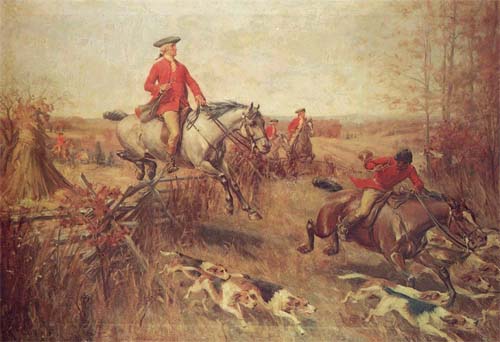
George Washington fox hunting in Virginia.

The case can be made that America might not exist today were it not for "our Founding Terrier."

Robert Brooke of Maryland introduced foxhunting to the United States in 1650, and imported the first pack of foxhounds from Great Britain.

Dr. Thomas Walker of Virginia (who discovered the Cumberland Gap and for whom the Walker Coon Hound is named) imported another pack to Virginia in 1742. The first fox hunting pack maintained for the benefit of a group of foxhunters rather than for a single owner, was instituted by Thomas, Sixth Lord Fairfax, in 1747 in northern Virginia.

Walker and Washington were good friends and business partners, and were co-owners (along with Washington's brother-in-law) of the "Dismal Swamp Land Company" (1763) which was to develop land near present-day Norfolk, Virginia. Walker was probably the person that got Washington started in fox hunting.

Washington moved to Mount Vernon, on the Potomac River just below Washington, D.C., after marrying Martha Dandridge Custis in 1759. It was at Mount Vernon, while still in his 20s, that George Washington first began fox hunting in earnest, setting up a rather lavish set of kennels and carefully breeding a new line of American foxhounds that were faster, lighter and less pack-centered than their English brethren.

In 1768, Washington was appointed as a delegate to the Continental Congress in Philadelphia and managed to fill his need for fox hunting at the Gloucester Hunting Club across the River from Philadelphia in New Jersey near present-day Haddonfield.

It was largely because of social and political connections made while fox hunting that Washington's social prominence rose, and in 1775 George Washington was Congress's unanimous choice as commander of the new Continental Army that was to lead the American forces against the British.

In truth, Washington did not have the forces and equipment to wage a successful fight and hold ground, and his chief battle-field opponent, General William Howe of Great Britain, was a master tactician.

Howe defeated Washington time and time again. In August of 1776 Howe landed on Long Island, captured New York City and defeated Washington at White Plains.

In 1777 Howe defeated Washington again, this time at the Battle of Brandywine (near present-day Chadds Ford, Pennsylvania) and took Philadelphia.

In October of 1777, the Battle of Germantown was waged. This battle took place near Philadelphia, and it too was a defeat for American forces, but it was a turning point in the war.

The turning point occurred when a small fox terrier was found wandering between the battle lines. The little dog was scooped up by American soldiers and the dog's collar identified it as belonging to none other than General Howe.

The dog was brought to Washington as a war prize -- a taunt to use against the British -- but Washington was having none of it.

A true dog-man, who missed his own fox hounds and terriers at Mount Vernon, Washington personally wiped the little terrier clean and brushed its coat. He then dictated a short note to his aide-de-camp, Alexander Hamilton, and secretly tucked a private note of his own tight under the collar of the dog. The dog, and both notes, were then returned to General Howe under a flag of truce.

Washington's private note has not survived, but Howe was extremely pleased by it. The public note, a copy of which has survived (see picture below), reads: "General Washington's compliments to General Howe. He does himself the pleasure to return him a dog, which accidentally fell into his hands, and by the inscription on the Collar appears to belong to General Howe."

After his terrier's return Howe praised Washington's actions as an "honorable act" and historians note that although he continued to win his battles, he never pursued Washington with quite the same vigor.

In fact, when ordered to fight harder and show the rebels no compassion, Howe resigned in protest.

Howe was replaced by General Henry Clinton, who was a poor tactician, and General Charles Cornwallis, who was a poor field commander.

In the end, the United States won the war and Washington returned to his beloved Mount Vernon where he continued breeding fox hounds and chasing foxes at least once a week.

Shortly after returning to Mount Vernon, Washington imported massive hounds from France with the help of his friend the Marquis de Lafayette. American hounds were crossed with these new French imports, and some of the progeny were sent to the Gloucester Foxhunting Club, outside of Philadelphia, where they proved extremely popular due to their speed.

In 1787 Washington headed the Virginia delegation to the Constitutional Convention in Philadelphia, and again his friends at the Gloucester Foxhunting Club lobbied for his election as the first President of the new country.

After the Constitution was ratified, Washington was unanimously elected President and in time the new Capitol was constructed just down river from his Mount Vernon estate.


Draft of note from George Washington to Howe, in the handwriting of aide-de-camp Alexander Hamilton.
.

Tuesday, February 12, 2019

Lincoln’s Poem About Working Terriers


Abraham Lincoln had the first Presidential dog ever photographed -- a dog named "Fido" -- and he is surely the first President to have ever written a poem about a hunting terrier.

Before there were pedigree terriers in America there were cross-bred feists (sometimes spelled "fice" or "fyce") -- small, scrappy dogs with a terrier genetic base. These dogs were used for everything from ratting to fox hunting, and even bear hunting.

The first know written use of the term feist (written "foist") is found in George Washington's diary in 1770 ("A small foist-looking yellow cur.").

Feists were used for squirrel, possum, raccoon, deer, and fox hunting, and found particular favor among bear hunters for their fearlessness and ability to worry a bear enough that they would bolt out of thickets.

Teddy Roosevelt's favorite dog -- Skip -- was a small feist he obtained from John Goff during a 1905 bear hunt, but Abraham Lincoln was the first President to write a poem mentioning the small purely-American hunting dog.

In the poem below, written in 1844 for his friend Andrew Johnston, Lincoln mocks the bragging hunter while giving a nod to the bravery of the hounds and the need to curb "bears [that] preyed on the swine".

Later on William Faulkner would feature a feist as a prominent component of his short novel, "The Bear".

The Bear Hunt

By Abraham Lincoln

A wild-bear chace, didst never see?
Then hast thou lived in vain.
Thy richest bump of glorious glee,
Lies desert in thy brain.

When first my father settled here,
'Twas then the frontier line:
The panther's scream, filled night with fear
And bears preyed on the swine.

But wo for Bruin's short lived fun,
When rose the squealing cry;
Now man and horse, with dog and gun,
For vengeance, at him fly.

A sound of danger strikes his ear;
He gives the breeze a snuff;
Away he bounds, with little fear,
And seeks the tangled rough.

On press his foes, and reach the ground,
Where's left his half munched meal;
The dogs, in circles, scent around,
And find his fresh made trail.

With instant cry, away they dash,
And men as fast pursue;
O'er logs they leap, through water splash,
And shout the brisk halloo.

Now to elude the eager pack,
Bear shuns the open ground;
Th[r]ough matted vines, he shapes his track
And runs it, round and round.

The tall fleet cur, with deep-mouthed voice,
Now speeds him, as the wind;
While half-grown pup, and short-legged fice,
Are yelping far behind.

And fresh recruits are dropping in
To join the merry corps:
With yelp and yell,--a mingled din--
The woods are in a roar.

And round, and round the chace now goes,
The world's alive with fun;
Nick Carter's horse, his rider throws,
And more, Hill drops his gun.

Now sorely pressed, bear glances back,
And lolls his tired tongue;
When as, to force him from his track,
An ambush on him sprung.

Across the glade he sweeps for flight,
And fully is in view.
The dogs, new-fired, by the sight,
Their cry, and speed, renew.

The foremost ones, now reach his rear,
He turns, they dash away;
And circling now, the wrathful bear,
They have him full at bay.

At top of speed, the horse-men come,
All screaming in a row,
"Whoop! Take him Tiger. Seize him Drum."
Bang,--bang--the rifles go.

And furious now, the dogs he tears,
And crushes in his ire,
Wheels right and left, and upward rears,
With eyes of burning fire.

But leaden death is at his heart,
Vain all the strength he plies.
And, spouting blood from every part,
He reels, and sinks, and dies.

And now a dinsome clamor rose,
'Bout who should have his skin;
Who first draws blood, each hunter knows,
This prize must always win.

But who did this, and how to trace
What's true from what's a lie,
Like lawyers, in a murder case
They stoutly argufy.

Aforesaid fice, of blustering mood,
Behind, and quite forgot,
Just now emerging from the wood,
Arrives upon the spot.

With grinning teeth, and up-turned hair--
Brim full of spunk and wrath,
He growls, and seizes on dead bear,
And shakes for life and death.

And swells as if his skin would tear,
And growls and shakes again;
And swears, as plain as dog can swear,
That he has won the skin.

Conceited whelp! we laugh at thee--
Nor mind, that now a few
Of pompous, two-legged dogs there be,
Conceited quite as you.

Lincoln and Darwin: Right on the Money


Today is the 219th birthday of two remarkable men: Abraham Lincoln, and Charles Darwin.

What do they have in common?

  1. Exact same birthday.
  2. Both had beards.
  3. Both appear on money.
  4. They each changed the world.
  5. Both were terriermen in their fashion.

Darwin, of course, was a fox-hunter in his youth, and a dedicated ratter as well. His father said of him:

"You care for nothing but shooting, dogs and rat-catching, and you will be a disgrace to yourself and your family."

Later, Darwin would write of the evolution of dogs into types for specific purposes, and he used his own Pointer to note the genetic basis of coat color.

The Origin of Species, of course, was published in 1859, the same year as the first dog show in the U.K., and it was Darwin's work -- and that of his cousin, Sir Francis Galton -- that shaped so much of the theoretical underpinnings of the modern Kennel Club's closed registry system.

Darwin's life work did not end with The Origin of Species, however. For his entire adult life Darwin had a series of white foxing terriers, all by the name of Polly, and it was one of these dogs which was instrumental in the production of his last great work, on the activity of earthworms.

Over here in America, a young Abraham Lincoln is the first President to write a poem about a terrier.

Written in 1844 for his friend Andrew Johnston, The Bear Hunt is an allegory about those who claim benefits which they have not won for themselves.

A humorous poem, it is the small terrier -- not the hounds that did the work, or the men who pulled the trigger -- that at the end of the day claims the prize of the bear's skin.

With grinning teeth, and up-turned hair--
Brim full of spunk and wrath,
He growls, and seizes on dead bear,
And shakes for life and death.

And swells as if his skin would tear,
And growls and shakes again;
And swears, as plain as dog can swear,
That he has won the skin.


Lincoln's only known dog was named Fido and was a lab-mix type yellow-coated dog that would accompany Lincoln around Springfield, Illinois.

When Lincoln was elected President of the United States in 1860, he decided to leave Fido in Springfield as the dog was around age five and was thought to be "too old" to travel.

Ironically, Fido outlived Lincoln, and was at the Springfield house, in 1865, when his master's body was brought back from Washington. D.C.

Saturday, November 03, 2018

Who Is the Man? Who is the Dog?


Who is this Man? Who is this dog?


And what does any of it have to do with hunting and fishing?

Answer: That's Teddy Roosevelt, one of three honorary terriermen on Mount Rushmore (Who are the other two?)

The dog is Skip, a mutt terrier cross (or feist) owned by legendary bear hunter John Goff. Goff gave Teddy the dog after Skip charged a bear, much to Teddy's delight.

As I note in a previous post entitled Rat Terrier Origins:
In 1905 Goff was hired as a bear hunting guide by President Theodore Roosevelt. During the trip Roosevelt was enchanted by the boisterous bravery of a small black and tan terrier that joined the bear-hunting fray. The dog was named "Skip," and for the remainder of the trip he managed to find himself in Roosevelt's lap or on his saddle.

Goff gave the terrier to Roosevelt at the end of his stay, and Roosevelt brought the dog back to the White House where it found work chasing rats in the basement and served as progenitor of the breed we know today as the American Rat Terrier.

Skip died the year before Roosevelt left the White House and was buried on the back lawn. The dog was so loved, however, that when Roosevelt left he had the dog exhumed and the body reinterred at Sagamore Hill, the family's New York estate.


I give a more detailed accounting of Skip and another terrier called Jack, noting the differences between the two and showing pictures of them each at the White House, in a longer post on Teddie Roosevelt's Terriers. Links are also given in this post to contemporaneous Roosevelt correspondence which showed that Skip was Archie's dog just as Jack Was Kermit's.

The importance of Teddy Roosevelt in the history of American hunting and fishing is not due to his legendary prowess in the field, or the fact that that this man left the Presidency to go on a year-long hunting trip in Africa. No, the importance of Roosevelt is in the fact that he helped establish America's land ethic (one later strengthened by Aldo Leopold) and did it by simply drawing boundaries on a map in order to create 150 new national forest areas in 21 states, four national game preserves, 51 federal bird sanctuaries, and 18 national monuments. No other President, before or since, has done as much to protect the heart and soul of America as Teddy Roosevelt did. For the back story here, read the post entitled Shooting Out the Land.

So who are the other honorary terriermen on Mount Rushmore? Read about one of them here >> Feists: From Washington to Lincoln to Faulkner. Yes, here at Terrierman, we give a hat tip to Old Abe if for no other reason than he wrote a long poem about bear hunting with terriers.

The other honorary terrierman on Mount Rushmore, of course, is George Washington, who helped win a war and forge a nation by a small kindness to a dog and its owner. I write a bit about that in the post entitled America's Founding Terrier.

Bottom Line: All that is great and good about this nation is connected to hunting with terriers. Let us never forget that!
.

Thursday, December 07, 2017

From Pearl Harbor to a Robot Economy


Pearl Harbor, USS Virginia

Today is Pearl Harbor Day, but if you ask a dozen people why Japan bombed Pearl Harbor back in 1941, not one will give you a complete answer.

Here's the short story: Too many people.

The entire War in the Pacific was initiated by overpopulation.

There is no "beginning" to this story, but suffice it to say that Japan was a very isolated country up until the late 19th Century. With the arrival of western influence, Japan began to change and demand for "western" goods such as steel and oil, skyrocketed.

So too did population.

In 1870, Japan's population was estimated to be 33 million. By 1900 it was about 45 million, and by 1930 it was over 64 million. An island nation, Japan's economy and social systems were beginning to show real stress by the second decade of the 20th Century. A key issue was lack of farm land.

Large rural families needed more land to support new families, but new land was simply not available. At the same time, rising urbanization created a new and rapidly growing demand for oil, coal, iron and steel -- commodities Japan had very little of.

Looking across a short stretch of ocean, the Japanese saw a vast amount of farm land and raw resources in northern China. In 1931 Japan invaded that region -- Manchuria -- in order to satisfy their "shortage" of resources which, in reality, was a "longage" of human population.

Japan's invasion of Manchuria led to a U.S. threat of an oil blockade of the island nation. This threat of an oil blockade led to the Japanese "first strike" at Pearl Harbor on December 7, 1941.


World War II is a long story, but the short version is that we won.  Japan had to give up its land grabs in Manchuria, Korea, the Philippines, and elsewhere.

After the defeat of Japan, Gen. Douglas MacArthur encouraged the development of new laws in Japan, including laws to allow women to vote and to hold elective office. In addition, he encouraged the amendment of Japan's pre-World War II pro-natalist law so that it now legalized abortion (which remained illegal in the U.S. until 1973).

Why did MacArthur and the Occupation Forces turn Japan's old "pro-natalist" law into a "pro-choice" law?

Basically, because they understood the causal origins of World War II in the Pacific.

Japan's overpopulation (or over-shoot of its resource base) was seen as a core issue of geo-political consequence. Slowing Japan's rapid population growth rate was, therefore, at the top of both the national and the global agenda. As one Japanese web site (written in semi-fractured English) notes: "How to popularize family planning became the No.1 policy in health care of postwar Japan ..."

With the end of WWII Japan switched from being a pro-natalist country to being a country that was interested in slowing population growth.

After the death and carnage of World War II, no one in Japan needed too much encouragement to consider voluntary family planning as an alternative worthy of consideration and support.

How did fertility fall so quickly in Japan? The mechanics were simple and effective, if not particularly modern or enlightened: Condoms and abortion. To this day, these are the primary birth control options available to Japanese women. Though Japan is on the cutting edge of electronics, they are in the Dark Ages when it comes to contraception. Low-dose oral contraceptives, medicated IUDs, injectables and implants were still not legal in Japan as of 2004, and the diaphragm is no longer produced there due to lack of demand. High-dosage pills and the copper IUD were only approved in Japan in 1999.

Despite the lack of contraceptive options, the Japanese saw rapid and amazing reductions in fertility after 1945. While the rest of the world experienced a Baby Boom, Japan saws its total fertility rate (TFR) fall from over four to two in the space of just 15 years -- a phenomenal rate of reduction even by today's standards.

One factor driving fertility reduction was later age at marriage. Another factor -- too often overlooked -- was crippling poverty after the War. Japan in the late 1940s and 1950s was a miserable place, and few people could afford to have the large families they did prior to World War II.

The real driver of fertility reduction in Japan, however, was a desire for peace and prosperity. While prior to WWII large families had been seen as a source of prestige and economic growth, afterwards they were seen as destructive to the long-term peace and economic self-sufficiency of the nation.

Japan's new small-family ethic was fueled by both central government and local Government commitment to the goal of slowing pre-war rates of human population growth. A system of midwives, nurses, family planning clinics and doctors was put in place and it took root with assistance from the Family Planning Federation of Japan (FPFJ) and the Japan Family Planning Association (JFPA).

While very wide, Japan's family planning program was not very deep. Despite a post-war interest in reducing the number of births, Japan has never really subscribed to what we in the U.S. think of as a "comprehensive" family planning program. Sex education in schools was (and still is) poor, and access to a full range of modern contraceptive choices was (and still is) very limited. In the 1950s, 60s, 70s, 80s, and 90s, the only "modern" contraceptive option was the condom. Though effective most of the time, the condom is not a perfect contraceptive vehicle. To be precise, condoms have a per-use failure rate of about 3%, which means even with "perfect use" the contraceptive device fails about 3 times a year on average (yep, 100 times a year is "average" according to the people that count these things).

In actuality, of course, we do not live in a perfect world with perfect and consistent humans. Due to inconsistent product usage (i.e. situational nonuse) the "real world" pregnancy rate for couples using only condoms is somewhere between 10 to 15 percent (numbers vary depending on the study).

Bottom line: There were (and are) quite a lot of abortions in Japan.

In 1996 the pre-World War II law was further amended and it is now called the "Mother's Body Protection Law" and remains the principle family planning law of Japan.

Today, Japan's total fertility rate is 1.4, one of the lowest in the world.

While Japan's fertility rate fell rapidly after WWII, and reached below-replacement levels by 1970, the nation's absolute population continued to grow. A population that had topped 64 million by 1930 was over 83 million by 1950, was over 103 million by 1970, and was over 123 million by 1990.

The good news is that Japan's population has very nearly topped out. The bad news is that it took 45 years AFTER it hit replacement level fertility (and then went far below it) to achieve this goal. And this is in a country with essentially zero immigration.

Today, across the world, the effect of Japan's post-World War II population growth is felt in the form of massive factory-like fishing fleets that prowl the world's oceans to feed that nation.

In the Southern U.S., massive chip mills pulp our forests to supply pulp for Japanese paper and wood-strand mills.

Forests in Burma, Indonesia, and Vietnam are being chainsawed to supply plywood. Around the world chainsaws and oil derricks crank out product going to a nation that had already "overshot" its resource base by 1931 -- and whose population has doubled since then.

While Japanese fertility declines have yet to translate into a smaller population size (I doubt Japan will ever return to a population small enough that it can actually live within the "carrying capacity" of the nation itself) a great deal of "Global Good" has come out of its lower fertility rates.

One bit of "good news" for Japan and the world was a tightening of labor markets that began to occur in Japan in the late 1970s as the low-fertility rates of the early 1950s moved their way up the population pyramid. As wages of entry-level workers began to rise in Japan due to labor market constraints, Japanese businesses began to export capital overseas in order to take advantage of lower-wage labor pools in developing countries (much as many U.S. businesses are doing today). Much of the "miracle" economic growth of South Korea was, in fact, abetted by Japanese money going overseas due to fertility declines in Japan that had begun 20 and 30 years earlier.

Japanese investment in Korea's economy, in turn, helped improve the status of women there and helped speed urbanization, which in turn helped to reduce fertility rates in that nation.

The same labor market constraints that drove some Japanese businesses to export capital in order to find cheaper labor drove other Japanese companies to automate. Today, Japanese industry has more robots and complex automation systems in place than any other country in the world -- one reason that both Japanese productivity and quality remain quite high.

Are there lessons here for the rest of the world? I think so.

Though far less pronounced than Japan's labor market contractions (due to a very long Baby Boom, higher domestic fertility, and high rates of international immigration here in the U.S.), U.S. capital movements to Mexico and other nations seem to be doing for these nations what Japan's money did for Korea (albeit at a slower rate due to increased diffusion of our capital over a larger area).

At the same time, the very same labor market forces that worked to push automation in Japan are doing the same here at home where timber, steel, and manufacturing plants are producing more products with less labor (and at higher quality) than ever before. Though we may not think factory automation has an environmental component, it most certainly does -- automated plants, as a rule, waste far less than their non-automated counterparts.

The big lesson, however, is that fertility decline is the START, not the end, of bringing the "runaway train" of population growth under control. Even after fertility has fallen to replacement levels, total population numbers continue to rise for decade after decade after decade.

For a country like the U.S., where the total base numbers are already very large, this is a very sobering thought.

In terms of absolute population size, the U.S. is already the third largest country in the world.

In terms of population growth rates we are not yet where Japan was in 1955 thanks to a combination of massive immigration and the highest fertility rates of any country in the industrialized world.

According to the U.S. Census Bureau's middle-series projections, the U.S will add more people to its population in the next 50 years as currently live West of the Mississippi River -- and this is the middle-series (most likely) projection.

Our population growth will not end there, of course.

Once the Population Juggernaut starts to roll, it tends to roll a heck of a long way before it comes to a stop. This has been true for Japan (which had rapid and sustained fertility decline and no immigration) and it will be even truer for the U.S. (which has non-sustained fertility decline and high immigration). It will be even more true for countries in Africa, Asia and Latin America that are still some distance away from achieving replacement levels of fertility.
.
Thursday, January 19, 2017

Shooting Out the Land


Ranger McEntire of the Malheur National Forest (Eastern Oregon), Winter 1912 - 1913
A repost from this blog circa 2005

In 1887, 14 years before he became President, Theodore Roosevelt joined with a distinguished group of sporting Americans -- including George Bird Grinnell, William Tecumseh Sherman, John Lacey, and Gifford Pinchot -- to form the Boone and Crockett Club. The men who created the Boone and Crockett Club were all dedicated hunters. Grinnell was editor of Field and Stream magazine, a hunting and fishing journal, and as editor, he was shocked at the rapid depletion of America’s wildlife due to unregulated market hunting

Though by charter the Boone and Crockett Club numbered only 100 people, it was a very influential group. John Lacey eventually became a Member of Congress from Iowa and, in 1900, just before Roosevelt became President, he managed to get Congress to pass the Lacey Act which made it a federal crime to transport wild game across state lines if had been killed in violation of state laws — the first federal restriction on commercial market hunting in the United States.

Roosevelt, of course, became Vice President and then President upon the assassination of William McKinley. An avid sport hunter, Roosevelt was also an accomplish naturalist, and counted among his friends John Muir, the founder of the Sierra Club, and best-selling wildlife author John Burroughs.

It is hard to overstate the importance of hunting in Roosevelt’s life. Suffice it to say that he chose not to run for President after his second term so that he could go to Africa on a year-long safari, hunting big game and collecting specimens for the Smithsonian Institution.

During his presidency (1901 to 1911), Roosevelt more than tripled the National Forest system to 148 million acres (and made Gifford Pinchot the first Chief of the U.S. Forest Service), oversaw the creation of 150 new national forest areas in 21 states, created four national game preserves, 51 federal bird sanctuaries, and established 18 national monuments. No president, before or since, has created such a sweeping public lands legacy.

In 1911, shortly after Roosevelt left office, Congress passed the Weeks Act to authorize the purchase of forest lands in the east. Much of this land later became part of the National Forest system in the eastern United States.

That same year the American Game Protective Association (AGPA) was founded and funded by gun and ammunition companies such as Winchester. This was the first sportsman-supported organization in the U.S. with a full-time professional staff, and it was later renamed the Wildlife Management Institute. In 1913, the shooting of migratory birds was regulated — the first step toward building back game bird populations deeply impacted by over-hunting.

America’s hunters lead the charge for wildlife habitat protection and the regulation of hunting seasons, providing an intellectual and moral framework now known as “hook and bullet conservation”.

Hook and bullet conservation has produced truly astounding results in the U.S. over the course of the last 100 years. Despite a three-fold increase in the U.S. population since 1900, we now have more bear, cougar, buffalo, turkey, elk, geese, duck, fox, raccoon, possum, alligator, groundhog, bald eagle, pronghorn, wolf, coyote, bobcat, and deer than at any time in the last 100 years. Beaver, turkey and river otter have been reintroduced into areas where they were wiped out, and wolf, elk and cougar are beginning to return to the east.

All of this has been made possible because the land and the forest -- otherwise voiceless -- has a voting constituency among American hunters and anglers. Not all hunters and anglers are good sportsmen who understand the need for conservation, but all good sportsmen are conservationists who understand the value of habitat and self-restraint.
.

Thursday, November 03, 2016

Teddy Roosevelt for President!

Teddy Roosevelt's birthday was earlier this week.

Not only is Teddy one of three terriermen on Mount Rushmore (George Washington and Lincoln are the other two), but he is also the father of public lands conservation in the U.S., the creator of both the National Forest and National Wildlife Refuge system, and a great expander of the National Parks system as well.


During his term in office, Teddy Roosevelt set aside 194 million acres of public land for permanent conservation and protection in this great country of ours.

Teddy Roosevelt was also the putative originator of the American Rat Terrier -- a dog formally launched onto the national stage when Teddy picked up a small feist from John Goff while on a bear-hunting expedition out West. Teddy grew very very fond of this dog with which he hunted rats in the basement of the White House, and though it died while he was in office, Teddy later had the dog dug up and reintered at Sagamore Hills so it would still be close to him, even in retirement.

Teddy Roosevelt, of course, was more than a hunter, conservationist and a lover of working terriers. He was also a consummate politician who framed up the "Square Deal" which was aimed at helping America's middle class being bled dry by Wall Street financiers.

Roosevelt's Square Deal plan called for a progressive tax system of the very kind decried by John McCain.

Teddy Roosevelt thought such a system was the hallmark of patriotism and common sense.

The goal, said Roosevelt in words later to be echoed by Barack Obama, was to "pass prosperity around."


In a 1910 speech entitled
New Nationalism, republican president Teddy Roosevelt set out an agenda which, nearly 100 years later, is just about as current as this morning's headlines:

"We grudge no man a fortune in civil life if it is honorably obtained and well used. It is not even enough that it should have been gained without doing damage to the community. We should permit it to be gained only so long as the gaining represents benefit to the community. … The really big fortune, the swollen fortune, by the mere fact of its size, acquires qualities which differentiate it in kind as well as in degree from what is possessed by men of relatively small means. Therefore, I believe in a graduated income tax on big fortunes, and … a graduated inheritance tax on big fortunes, properly safeguarded against evasion, and increasing rapidly in amount with the size of the estate."

Teddy Roosevelt went on to talk about the economic panics of his day:

"The people of the United States suffer from periodical financial panics to a degree substantially unknown to the other nations, which approach us in financial strength. There is no reason why we should suffer what they escape. It is of profound importance that our financial system should be promptly investigated, and so thoroughly and effectively revised as to make it certain that hereafter our currency will no longer fail at critical times to meet our needs.


Finally, Roosevelt turned to his first love: the land, and our duty to protect it. He said:
"I recognize the right and duty of this generation to develop and use the natural resources of our land; but I do not recognize the right to waste them, or to rob, by wasteful use, the generations that come after us. I ask nothing of the nation except that it so behave as each farmer here behaves with reference to his own children. That farmer is a poor creature who skins the land and leaves it worthless to his children. The farmer is a good farmer who, having enabled the land to support himself and to provide for the education of his children, leaves it to them a little better than he found it himself .... Conservation is a great moral issue, for it involves the patriotic duty of insuring the safety and continuance of the nation."
.

Friday, July 01, 2016

America's Founding Terrier


George Washington fox hunting in Virginia
A repost from this blog, circa 2004.


The case can be made that America might not exist today were it not for "our Founding Terrier."

Robert Brooke of Maryland introduced foxhunting to the United States in 1650 and imported the first pack of foxhounds from Great Britain.

Dr. Thomas Walker of Virginia (who discovered the Cumberland Gap and for whom the Walker Coon Hound is supposedly named) imported another pack to Virginia in 1742. The first fox hunting pack maintained for the benefit of a group of fox hunters rather than for a single owner, was instituted by Thomas, Sixth Lord Fairfax, in 1747 in northern Virginia.

Walker and Washington were good friends and business partners, and were co-owners (along with Washington's brother-in-law) of the "Dismal Swamp Land Company" (1763) which was to develop land near present-day Norfolk, Virginia. Walker was probably the person that got Washington started in fox hunting.

Washington moved to Mount Vernon, on the Potomac River just below Washington, D.C., after marrying Martha Dandridge Custis in 1759. It was at Mount Vernon, while still in his 20s, that George Washington first began fox hunting in earnest, setting up a rather lavish set of kennels and carefully breeding a new line of American foxhounds that were faster, lighter and less pack-centered than their English brethren.

In 1768, Washington was appointed as a delegate to the Continental Congress in Philadelphia and managed to fill his need for fox hunting at the Gloucester Hunting Club across the River from Philadelphia in New Jersey near present-day Haddonfield.

It was largely because of social and political connections made while fox hunting that Washington's social prominence rose, and in 1775 George Washington was Congress's unanimous choice as commander of the new Continental Army that was to lead the American forces against the British.

In truth, Washington did not have the forces and equipment to wage a successful fight and hold ground, and his chief battle-field opponent, General William Howe of Great Britain, was a master tactician.

Howe defeated Washington time and time again. In August of 1776 Howe landed on Long Island, captured New York City and defeated Washington at White Plains.

In 1777 Howe defeated Washington again, this time at the Battle of Brandywine (near present-day Chadds Ford, Pennsylvania) and took Philadelphia.

In October of 1777, the Battle of Germantown was waged. This battle took place near Philadelphia, and it too was a defeat for American forces, but it was a turning point in the war.

The turning point occurred when a small fox terrier was found wandering between the battle lines. The little dog was scooped up by American soldiers and the dog's collar identified it as belonging to none other than General Howe.

The dog was brought to Washington as a war prize -- a taunt to use against the British -- but Washington was having none of it.

A true dog-man, who missed his own fox hounds and terriers at Mount Vernon, Washington personally wiped the little terrier clean and brushed its coat. He then dictated a short note to his aide-de-camp, Alexander Hamilton, and secretly tucked a private note of his own tight under the collar of the dog. The dog, and both notes, were then returned to General Howe under a flag of truce.

Washington's private note has not survived, but Howe was extremely pleased by it. The public note, a copy of which has survived (see picture below), reads: "General Washington's compliments to General Howe. He does himself the pleasure to return him a dog, which accidentally fell into his hands, and by the inscription on the Collar appears to belong to General Howe."

After his terrier's return Howe praised Washington's actions as an "honorable act" and historians note that although he continued to win his battles, he never pursued Washington with quite the same vigor.

In fact, when ordered to fight harder and show the rebels no compassion, Howe resigned in protest.

Howe was replaced by General Henry Clinton, who was a poor tactician, and General Charles Cornwallis, who was a poor field commander.

In the end, the United States won the war and Washington returned to his beloved Mount Vernon where he continued breeding fox hounds and chasing foxes at least once a week.

Shortly after returning to Mount Vernon, Washington imported massive hounds from France with the help of his friend the Marquis de Lafayette. American hounds were crossed with these new French imports, and some of the progeny were sent to the Gloucester Foxhunting Club, outside of Philadelphia, where they proved extremely popular due to their speed.

In 1787 Washington headed the Virginia delegation to the Constitutional Convention in Philadelphia, and again his friends at the Gloucester Foxhunting Club lobbied for his election as the first President of the new country.

After the Constitution was ratified, Washington was unanimously elected President and in time the new Capitol was constructed just down river from his Mount Vernon estate.

My house is about 20 minutes away from Mount Vernon and sits on what would once have been Lord Fairfax's estate. Family legend (via Annie Walker Burns, founder of the Kentucky Mountain Laurel Festival), is that Dr. Thomas Walker is a relation of ours. It might be true too -- in Kentucky, anything is possible.


Draft of note from George Washington to Howe, in the handwriting of aide-de-camp Alexander Hamilton.

Sunday, June 05, 2016

Warbler Politics: How Birds Made Two Presidents


Prothonotary warbler.  This post is mostly recycled from 2007.

The latest news out of Texas this campaign season (June 2016) is that the the U.S. Fish and Wildlife Service has denied a petition to delist the golden-cheeked warbler, a 5-inch, black-and-white bird with a bright yellow face.

This news comes to my door as large number of warblers arrive from the south, delayed a few days perhaps by the rain and cold we have had in the last month.

The weather seems to change every day now, with cold and warm fronts crashing into each other, and the resulting squalls bringing flocks of small birds north on the winds.

The warblers are returning to Virginia in droves. They are more visible now than they will be later on when the foliage will obscure them high up in the trees. You have to look carefully among the mixed flocks of returning chickadees, titmice, and nuthatches to find the warblers, but they are there.

Warblers are very important birds, as they are the primary insect eaters in North America's woods. The bad news is that most warblers are in rapid decline over vast portions of the U.S. due to forest fragmentation which is occuring both in the U.S. and overseas where "our" warblers spend the winter. I have written a bit about that in the past.

Something I have not written about before is how warblers have shaped presidential politics. In fact, it is not too much to say that "warbler controversies" have led directly to two presidents being elected to office.

The first president to have his early career shaped by a warbler was Richard Nixon.

Back in 1948, Whittaker Chambers, a senior editor at Time magazine, and a former Communist spy turned government informer, accused Alger Hiss of being a spy for the communists in the mid-1930s.

Chambers was not exactly a credible witness; he had very little documentation to back up his charges and he admitted at the Hiss trial that he had repeatedly committed perjury on other occasions. Inititially it was not clear he had even met Hiss, much less knew him well.

Chambers claimed he did know Hiss, and backed it up by noting that Hiss was a bird-watcher who was very proud that he had seen a prothonotary warbler near Glenn Echo Park just outside of Washington, D.C.

In cross examination of Hiss before the House Committee on Un-American Activities (HUAC), a young Congressman by the name of Richard Nixon asked a seemingly innocent question: "What hobbies, if any, do you have, Mr. Hiss?"

Hiss answered that his hobbies were "tennis and amateur ornithology." Congressman John McDowell then jumped in an asked Hiss whether he had ever seen a prothonotary warbler?

Hiss walked right into the trap, responding that he had -- "right here on the Potomac."

Slam -- the trap had been tripped. Committee members were now convinced it was Hiss who was lying, not Chambers. After a series of trials, Hiss was sentenced to prison for 5 years based on very sketchy (and still controversial) evidence.

As for Nixon, he managed to use the Hiss affair to propel himself from the U.S. House of Representatives into the Senate, and from the Senate into the Vice Presidency under President Dwight Eisenhower.

The rest, as they say, is history.

The saga was was not quite over, however. In 1952, not quite content to let his 15 minutes of fame pass him by, Whittaker Chambers published his autobiography, which was entitled Witness. Ronald Reagan later credited this book with transforming him from a New Deal Democrat into a conservative Republican.

While shilling for General Electric in the 1950s and early 60s, Reagan made frequent references to Whittaker Chambers in his speeches, and on March 26, 1984 -- 23 years after Chambers had died -- Reagan posthumously gave Whittaker Chambers the nation's highest honor, the Medal of Freedom.

Probably no one has ever deserved it less.


Golden-cheeked warbler.


Another President propelled into office on the wings of a warbler was George W. Bush.

In June of 1994, a memo from the U.S. Fish & Wildlife Service was leaked. The memo outlined a tentative plan to declare hundreds of thousands of acres across 33 counties in Texas hill country as being "critical habitat" for the endangered Golden-cheeked Warbler.

It was feared that, if implemented, "the plan" would have made it virtually impossible to bulldoze Ashe Juniper off of the surrounding hills -- a necessity if those hills were to be turned into nice new housing developments with grass lawns and underground sprinkler systems.

Massive opposition to the informal Fish & Wildlife Service proposal sprang up overnight, with school auditoriums quickly filled to capacity by ranchers, developers, and property owners who were led to believe that the draft proposal was soon going to be made into law overnight, and that it would impact almost all private property.

In fact, the proposal was a mere internal memo within the agency (no rules or regulations had been written or circulated, and no draft Environmental Impact Statement had been initiated), and the designation of critical habitat directly affected only actions that were to be federally funded or authorized, not privately-held lands.

George W. Bush was not a stickler for the facts (then or now) and he jumped on the wave of misinformation circulating through Texas in order to fan the flames of discontent. Positioning himself as a champion of the property rights movement, Bush hammered on the "federal land grab" even after Interior Secretary Bruce Babbitt had disavowed the leaked memo and Texas Governor Ann Richards also voiced her strong opposition.

Richards, of course, was too late. Bush campaign operatives -- including Karl Rove -- had already framed the issue and associated Ann Richards with it -- never mind the facts, or her true position.

Texas being Texas, and modern political discourse being what it is, people believed the Bush Campaign's spin.


In the end, due in no small part to the warbler controversy, George W. Bush was elected Governor of Texas, which he later used as a stepping-stone to the White House.

And the rest, as they say, is history, written in debt, blood, and destruction
.

Thursday, December 03, 2015

The U.S. Now Has More Lions Than Africa


I tossed the latest copy of Earth Dog - Running Dog
magazine into the truck on the way to work this morning, and was flipping through it at a traffic light when I opened it up to see the picture at left. Hey, I know that fellow!

And sure enough I do -- it's John B., who I see once a year at the only dog trial I go to, the JRTCA Nationals.

That's a 200-pound stock-predating Mountain Lion John hunted in Arizona a few years back (subscribe to Earth Dog - Running Dog magazine if you want to read the full story).

John's Mountain Lion got me to thinking about the rise of Cougar populations here in the U.S.

As regular readers might recall, a Mountain Lion was recently shot in Chicago, and roadkills in Iowa prove they have gotten that far east as well.

Rumors of Mountain Lions in Appalachia remain (as yet) unfounded, but it is agreed by all that it is only a matter of time before they come here. With over over 2 million acres of contiguous National Forest in Virginia and West Virginia alone, and plenty of deer, they will not want for food or space!

On a hunch, I did a little research and confirmed what I suspected: there are now more lions in the United States than there are all in all of Africa.

Now granted that Puma concolor and Panthera leo are a different genus of big cat, but a Mountain Lion is no small animal; it is, in fact, the fourth largest big cat in the world.

Right now there are more than 30,000 Mountain Lions in the U.S., and their numbers are slowly growing despite the fact that hunting these large animals is legal (if controlled by permit) in 10 of the 11 western states where they reside.

All in all, about 3,500 Mountain Lions a year are shot by U.S. hunters, and another 800 or so are killed by vehicle impacts.

A slow steady increase in Mountain Lions is excellent news, and the kind of thing we can live with provided the populations are allowed to expand in the right direction (i.e on public lands) and away from farms, ranches and suburbs.

The return of the Mountain Lion (along with the concurrent rise in bear, wolf, coyote, turkey, eagle, hawk, osprey, deer, elk, and beaver populations) is proof-positive that the American way of science-based wildlife management has been a roaring success.

This is not to say, of course, that there will never be human-wildlife conflicts. There always will be with large meat-eating predators.

Problem lions, wolves and bears will always have to be shot, but regulated hunting and culling of these animals does no long-term harm provided the slaughter is not indiscriminate and the wild habitat they require is preserved as large unbroken blocks of land.

The real threat to animals like Mountain Lions is not regulated hunted; it is unregulated population growth which results in more roads, more water consumption, and more sprawl.

If we protect the habitat, the wildlife will generally take care of itself.

But to take care of the habitat, we have to control ourselves.

We cannot allow U.S. population growth (largely driven by immigration) to increase our numbers to the point that humans become like locusts on the land. If we plough and graze fence post to fence post, fragment the forests, drain the rivers and streams for irrigation, and put in roads every mile or two (with shopping centers in between), it is not just Mountain Lion we will lose; it is wild America as we know it and love it.

And, to put on a point on it, it will not take much human population growth in Arizona, where this mountain lion was shot, to wreck things forever.

As John McCain recently noted, Arizona is already so dry the trees have been known to chase the dogs!

So heads up; human population growth is what is killing off Africa's lions.

Now that we have a healthy Mountain Lion population in the American West, let's make sure we do not allow human population growth to kill off our lions as well.

Let's not worry about sustainable levels of hunting, while ignoring unsustainable rates of immigration.

Yet, as far as I can tell, that is exactly what every Mountain Lion and Cougar protection organization in America is now doing. Talk about missing the forest for the trees!
A repost from 2008.
.

Friday, November 13, 2015

The Real Threat to Hunting


A repost from this blog, July 2004.

For hunters, fluttering orange tape and popsicle-colored sticks mean only one thing: Doom.

This is the spoor of the tract-home surveyor. This is the end of the game.

The hill where your terrier worked that fine red fox last season will soon be covered by plastic-sided houses and kiddie swing sets.

The hedgerow you counted on for the occasional raccoon and a steady supply of groundhogs will soon be an asphalt ribbon.

Across the country the same story is playing out, again and again. It is not PETA that is hammering hunters, but real estate developers.

Pheasant, quail and bear are long gone from most areas, as are bobcat, cougar and wolf.

Even if deer and geese manage to thrive on 15-acre tracts, the American hunter will not.

When land is cut up into small parcels, acquiring permissions is difficult and firing a gun impossible. More houses means more roads. It does not take too many roads before a man with working dogs no longer feels comfortable letting them off leash.

Most of us know the big picture: forests are falling to farms, and farms are falling to freeway all over the planet. Across the globe wild rivers are being dammed, and increasing numbers of species are being pushed on to the endangered species list. Cars, factories and electricity-generating power plants are spewing forth greenhouse gases contributing to global warming, even as mile-long gill nets decimate fishing grounds, and raw sewage spills untreated into once pristine waters.

The environment is not committing suicide -- we are killing it. As Pogo so aptly put it, "we have met the enemy, and he is us." The common denominator to every clearcut forest and decimated hedgerow is human population growth.

It’s hard to overstate the speed of human population growth. It took perhaps two million years to add the first billion people to the population of the world -- a number reached about 1830. It took only 100 more years to add the second billion people (1930), and just thirty more years to add the third billion (1960). The global population counter clicked past four billion by 1975, five billion by 1987, and six billion by 1999. World population will climb past seven billion within the next 15 years.

It’s hard to get a handle on such numbing numbers. Let's bring it closer to home to gain a little perspective. Surely, we have nothing to worry about here in the United States, right?

Think again.

Consider what has happened in your own lifetime. Take a look at the table below, and find your approximate age in the far left column. The number next to it is the size of the U.S. population when you were born, and the number to the right of that is the relative population growth that has occurred in the U.S. since then.


Of course, the U.S. population growth that has occurred since you were born is only part of the story.

Let’s think for a minute about the U.S. population growth that will happen over the rest of your lifetime. I will use middle-range Census Bureau projections even though these numbers have consistently been too low for over 50 years because Census Bureau demographers habitually under-estimate illegal immigration and over-estimate emigration (people leaving).

In the table below, look in the left column to find your approximate age -- or the age of your children or grandchildren if you prefer. Now look at the next column to see what the population of the U.S. will be when you (or your children or grandchildren) are age 70. The third column gives the percentage population growth that will occur in the intervening years. Again, these are very conservative numbers.


Another way to think about these numbers: over the course of the next 50 years, using the very conservative mid-range projections of the U.S. Census Bureau, the U.S. will add about 150 million people to its population -- a sum greater than the population of the United States west of the Mississippi River today.

To put it another way, over the course of the next 50 years, the U.S. will add more than twice the current population of the United Kingdom.

Where is all this population growth coming from? Most of it originates overseas.

About 70 percent of all future U.S. population growth will be due to immigration (legal and illegal) and the children and grandchildren of immigrants that have not yet landed on our shores. In a very real sense, America's hunting and angling future is being determined in Karachi, Mexico City, Beijing, Moscow, Dublin and Hanoi.

Most of the organizations that we think of as protecting the environment and sports hunting do not mention the speed of U.S. population growth, not because it is not an issue, but because they are afraid that talking about limits on immigration might harm future membership growth. After all, today's illegal alien is tomorrow's permanent resident alien or U.S. citizen, right? At the top reaches of organizations as divergent as the Sierra Club and the National Rifle Association, success is not defined by what is going on in forest and field, but about what can be done to grow out the membership base now and in the future. Association executives are as enamored with population growth as any real estate agent or strip mall developer.

I suspect it will only be in hindsight that we realize what we have lost and what we have gained. Very few people notice the absence of box turtles or make the connection between population growth, habitat change, and Lyme disease.

Only when we are very old and America has changed to the point where we no longer recognize it will we understand the wisdom of Sioux Chief Ben American Horse, who warned Vice President Alben Barkley, "Be careful of your immigrations laws. We were damn careless with ours."
.

Monday, November 24, 2014

The Archeology of Hunting

.

Humans have spent most of their time on earth hunting, and it is not entirely surprising that there is at least some archaeological evidence of the activity.

In North American before Columbus, there were no metal tools or horses. Hunting was done entirely on foot, and hides and meat were hauled off by humans and dogs pulling travois skids.

In some rare locations a very efficient form of hunting was accomplished by running bison herds off of cliffs or "Buffalo Jumps" -- a fact we know today only because of the enormous piles of bison bones at the base of these cliffs, and the related stone tools and campfires.

Archaeologists have discovered that drive lines were made to direct herds of bison to the jumps. The drive lines consisted of rows of rock piles known as "dead men," arranged like a wide funnel that started up to 8 miles away from the jump site. The funnel gradually narrowed toward the jump end. Hunters hiding behind the "dead men" rock piles would spring out and wave robes and shout in order to frighten the animals and keep them inside the funnel and headed in a stampede towards the jump where they would tumble down, breaking legs and necks as they fell.

In Europe, large Deer Parks were created during the Middle Ages as a way of setting off land for aristocratic hunters and managing sustainable game populations for food. The edges of these parks were often edged by massive earthwork moats and mounds which, in turn, were topped by wooden fences. The moats were on the inside and prevented the deer from getting a foothold or a run-up to the top of the mound which was constructed from the earth taken from the moat excavation. Many UK locations with "Park" in their name are, in fact, old Deer Parks and with careful observation in some locations, you can see parts of remnant ditches and mounds.

As with the ancient Buffalo Jumps, hunting in deer parks was accomplished by driving game through funnel fences to archers who were positioned on the ground or in tree stands.

In the 14th Century there were over 3,000 deer parks in England occupying around 650,000 acres of land (over 1,000 squre miles). These deer parks were managed for wild game and for wood. In the larger deer parks streams were dammed to make small lakes and ponds for fishing and ice making.

Most of the large deer parks fell into disrepair in late Medieval times as the feudal system collapsed under the weight of the Plague, and a new form of hunting -- coursing with horses and dogs -- was imported from France.

Another archaeological remnant of hunting to be found in Europe are rabbit warrens. The rabbit is not naive to the UK -- it was introduced (probably from Spain) by the Romans shortly after the First Century AD. Across the UK ancient artificial warrens can be found to this day. These warrens are called "pillow mounds" or buries and are flat topped, 10 to 20 metres long, 5 to 10 metres wide, and up to a metre high, sometimes surrounded by a shallow ditch. About 2,000 of these ancient buries survive in England, and in some of them artificial runs are covered with stone slabs. Some of the very largest artificial warrens had professional staff (a warrener) and buildings.


*.


Duck and Fish Ponds provide additional archaeological evidence of hunting and angling across the globe. Many of these ponds have artificial islands on them created as spots where ducks and geese can breed free of predators. While the waters of these ponds were stocked with fish, the ponds were often designed with "dog-leg" lagoons, or a narrows on one end, where ducks and geese could be driven and easily netted.

The United States is a very young nation, and much of the Western U.S. was nearly devoid of people only 150 years ago. That said, Americans are industrious and the construction of small ponds and large lakes for water storage and ice-making naturally led to increased still-water angling and duck hunting.

In short order, some people began construction of dams specifically to increase angling and hunting opportunities. One such dam was constructed on the South Fork River near Johnstown, Pennsylvania. The dam itself was a massive earthen affair constructed by the South Fork Fishing and Hunting Club which counted among its 66 wealthy Pittsburgh residents Andrew Carnegie, Henry Clay Frick, Andrew W. Mellon, and Philander Knox.

At the time of its construction, the South Fork Dam was one of the largest in the world, but it was not well constructed. A flawed design was made worse when the Fishing and Hunting Club put screens across the safety spillway to prevent fish from washing over the dam during heavy rains. The spillway screens were constantly clogged with debris, but despite many warnings about the safety of the dam, the rich aristocrats who owned the hunting club continued on, business as usual.

On May 31, 1889, after a period of heavy rain, the dam finally gave way sending a 45-foot-tall wall of muddy water racing down the Conemaugh Valley. More than 2,209 lives were lost and 27,000 people were made homeless -- one of the greatest single losses of human life in the history of the United States.


Civilian Conservation Corps Tree Planters, 1939


The most notable period of U.S. construction for wildlife benefits began with the advent of the Civilian Conservation Corps (CCC) in 1936. The CCC was created as a Depression-era jobs program which eventually put millions of young men to work on reforestation, soil erosion, flood prevention, and trail construction projects across the United States..

The Corps was badly needed -- America had ruined scores of millions of acres of once-forested lands during the rip-rape-and-ruin robber baron era that lasted from 1850-1900.

Massive tracts of forest in our eastern mountains had been swept clean of trees, and streams were choked with silt. Wildlife had been shot out to the point that deer were nearly extinct, all beaver were gone, and ducks and geese were a rarity in areas where they had once been in dense numbers.

The Lacey act of 1907 and the Weeks Act of 1911 were important for protecting wildlife and conserving land, but wild America had been so severely hammered by unrestrained greed that it was to clear that it would take millions of hours of human labor and a lot of time to begin to set things right.

President Franklin Delano Roosevelt started the ball rolling in 1934 with the appointment of Committee on Wild-Life Restoration whose mandate was to prepare a plan to restore America's dwindling wildlife populations. Among its members were the great wildlife manager Aldo Leopold, and cartoonist Ding Darling.

The Wild-Life Committee recommended far-reaching changes to improve habitat for waterfowl, upland game, mammals, and song birds, including the acquisition of millions of acres of additional sub-marginal lands for habitat improvement, and appropriations of $50 million to restore these lands to some semblance of their natural self.

It did not take a genius to see that the Wildlife Restoration Plan and the Civilian Conservation Corps were ideal partners, and under the tutelage of Darling -- a man who later went on to create the Federal Duck Stamp Program and found the National Wildlife Federation -- significant gains were made in record time.

By the end of 1942, national wildlife refuges, national forests, and other public lands across the U.S. had been improved by CCC workers who constructed dams, dikes and fish hatcheries, planted millions of trees to stabilize stream banks and cover over ruined land, and erected numerous buildings, fire towers, telephone lines and support facilities for camping grounds, and improved backcountry-access for hunters and hikers.

Civilian Conservation Corps construction projects remain a significant addition to our National Parks, National Forests and Wildlife Refuge System to this day, and are too-little heralded part of our American wildlife heritage.
.

Tuesday, November 11, 2014

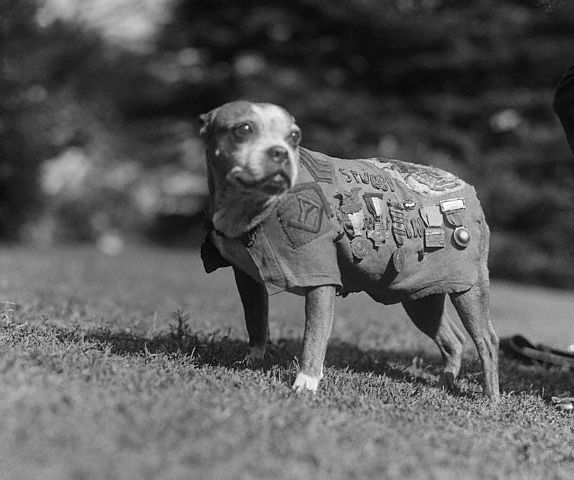
Stubby: Terrier Hero of Georgetown

Georgetown University features a bulldog mascot on their hats and other memorabilia, but in fact the original dog, Stubby, was not a bulldog, but a cross between a boston terrier and a bull terrier.

Stubby, the mixed terrier, was one of the more famous dogs of World War I. He is reported to have trotted onto Yale Field in New Haven, Connecticut when a bunch of soldiers were drilling in preparation for the War. He may, in fact, have been a plant -- a companion dog brought by Corporal Robert Conroy, with whom he quickly became fast friends.

When the troops shipped out, Stubby was hidden on board by Conroy and went to France with the rest of the boys. At Chemin des Dames the soldiers noticed that the artillery fire didn't faze Stubby, but they taught the dog to duck down just the same. In a very little while they noticed the dog ducking before they did -- it turned out that the dog could hear the shells coming long before the men!

One dark night in the trenches, Stubby woke up while the men were sleeping, crept down the trench line and around a corner and found a German spy prowling the trenches in the dark. The soldier let out a howl when the dog bit him hard in the back thigh, and the dog did not let go even after the soldier had been disarmed by Stubby's friends -- they had to pry his jaws off the enemy soldier.

After this bit of service Stubby became famous, and honors were heaped on him by soldiers looking for a bit of humor and story to alleviate the boredom and carnage of trench warfare. At Mandres en Bassigny, Stubby was introduced to President Woodrow Wilson who "shook hands" with him. Stubby received a wound stripe for a grenade splinter he received, and the Marines even made him an honorary Sargent.

After the Armistice was signed, Stubby returned home with Conroy and his popularity seemed to grow. He became a nationally acclaimed hero, and eventually was received by presidents Harding and Coolidge. General John "Black Jack" Pershing, who commanded the American Expeditionary Forces during the war, presented Stubby with a gold medal made by the Humane Society and declared him to be a "hero of the highest caliber." Stubby toured the country leading war parades, and was made an honorary member of the American Red Cross and the American Legion. The YMCA issued him a lifetime membership card good for "three bones a day and a place to sleep."

In 1921, Robert Conroy headed to Georgetown law school and took Stubby along with him.

While at Georgetown Stubby served several terms as mascot to the football team where, between the halves, Stubby would nudge a football around the field, much to the delight of the crowd. Stubby was Georgetown's first canine mascot, and it is his ugly countenance that has somehow been morphed into the English Bulldog emblem of the Hoyas.

Old age finally caught up with Stubby on April 4th, 1926, and he died in Conroy's arms.

Stubby's stuffed body is one of the many artifacts kept by the Smithsonian museum in their vast collection.

This post is recycled from Veterans Day 2004.

Tuesday, March 20, 2012

Dog on Roof Story Gives Romney a Boost


In case you wondered, the "dog on the roof" story is not doing Mitten Romney any harm. According to Public Policy Polling:

Seven percent of the American public say the dog-on-car-roof story makes them more likely to vote for Mr. Romney, and a stunning 14 percent say this is a “humane” way to transport a dog.

Yes, that's what they said.

When asked who would be better for dogs, however, President Obama beat Romney 37 percent to 21 percent. The rest aren’t sure.
.