Tuesday, November 13, 2007

Whatever Happened to the Bubonic Plague?


Eric York on right. The Mountation Lion did not get him, but the Black Rat Flea did.


A wildlife biologist at Grand Canyon National Park has died after coming down with the Bubonic Plague. Eric York, age 37, seems to have contracted the disease while performing a necropsy on a Mountain Lion which tested positive for the disease.

The good news about the Bubonic Plague is that it is now a treatable disease, thanks to antibiotics.

The bad new is that it it still with us.


Whatever Happened to the Bubonic Plague?


In school, no one ever mentions what happened to the Black Death. Nor do they mention that we now have it in this country. Like so much that is fundamental to history (Whatever happened to the Dust Bowl? Why did the Japanese bomb Pearl Harbor?), the question is sidestepped by grade-school teachers.

First, a little history. Plague has probably swept through the Old World time and time again. Plague-like pestilences are mentioned in the Bible (the so-called “scourge of the Philistines”), and at least five great outbreaks are noted by historians.

For modern purposes, however, the "big plague" was the so-called "Black Death" that swept through Europe beginning in the 14th Century and carried forward, with fits and starts, until the middle of the 17th Century.

The first wave of this plague killed off one-third of the population of Europe within two years of its arrival in the port of Messina, Sicily in 1346.

The vector, or transmission agent, for this wave of Bubonic Plague was the Black Rat, Ratus ratus, which was host to the Oriental Rat Flea, Xenopsylla cheopis, which in turn was host to the bacterium Yersinia pestis that actually causes the Plague.

Large-scale incidents of Plague in Europe ended with the arrival of a very aggressive new immigrant to Europe -- Ratus norvegicus, aka the Brown or "Norwegian" Rat.

In fact this rat is in no way Norwegian. It probably originated in Asia, and got to Europe through the Middle East, having first arrived in England on a load of timber from Norway (hence the name given to it by the British).

The Brown Rat and the Black Rat look somewhat similar, but they have very different temperaments. A Brown Rat is not only larger that its Black Rat cousin, it is also far more aggressive.

When the Brown Rat arrived in Europe and began to multiply, it quickly pushed the smaller and more mouse-like Black Rat out of buildings, alleys, storage sheds and sewers. In fact, over time, it pushed the Black Rat almost totally out of existence in the temperate world.


A Flea With an Affinity

Though fleas and lice are opportunists, they tend to gravitate towards, and specialize in, certain hosts. Different species of bird lice, for example, specialize in different species of birds. In fact, many species of bird lice can only be found on specific species of bird.

Many types of flea also gravitate towards, and specialize in, certain kinds of hosts. Though a species of flea may theoretically be able to draw a blood meal from a wide variety of mammalian hosts, most thrive on a specific list of hosts and generally fail to thrive if these particular hosts are not around.

So it is with Xenopsylla cheopis, the Oriental Rat Flea, which is the flea most likely to be implicated in transmission of the Bubonic Plague.

The Oriental Rat Flea thrives on a few species of rodents, including the Black Rat and the Tarvag, or Monglian Marmot , which is found in the dry steppe country of central Asia. It may have been on on Tarvag skins carried along the Silk Road that the Plague first reached the Middle East around 541 AD.

While the Mongolian Marmot was probably the first host of the flea that carries the Bubonic Plague, the Xenopsylla cheopis flea has managed to due well on the Black Rat as well.

With the rapid spread of the Brown Rat, however, the Black Rat was bullied and beaten into extirpation across most of the civilized world.

Today the Black Rat is commonly found only in the tropics. Even there it is most likely to be found high up (running along roofs and feeding at the tops of date palms) in order to avoid running into the neighborhood bully, the Brown Rat.

Bottom line: the Bubonic Plague was brought to Europe by fleas riding on Black Rats, while Brown Rats largely drove that species of rat out of Europe (and much of the rest of the world), thus eliminating the Oriental Rat Flea and the Yersinia pestis bacteria that brought with it the Bubonic Plague. In short, rats not only brought the plague, they also worked to get rid of it.


A young Mongolian sharpshooter with Tarvags bound for the pot.


The Plague Comes to the New World

Plague-carrying Black Rats arrived on the West Coast of the U.S. in 1900 in a load of Chinese illegal aliens smuggled into San Francisco.

The exact date and circumstances are known, because two dead Chinese immigrants tested positive for the disease, and a massive roundup of rats was immediately begun.

Plague cases continued to bubble up in San Francisco for the next few years, but a local war on rats continued unabated, and it is possible the plague might been locally extirpated had the San Francisco earthquake of 1906 not hit.

The earthquake, of course, created a nearly-perfect environment of chaos, spilled food, and social disorder. After the earthquak, the Black Rat population began to climb, and with it the incidence of Plague.

Where was the Brown Rat? Believe it or not, Brown Rats (aka Norwegian rats) did not arrive on the West Coast of the U.S. until around 1940.

Eventually, a combination of poisoning and trapping, along with a massive city-wide cleanup, managed to knock down the Black Rat population of San Francisco and rid the city of the Plague.

Unfortunately, somewhere along the line, a Black Rat caught a train west, and with it Xenopsylla flea rode into the deserts of the American Southwest where it found the smaller, American version of the Tarvag -- the Prairie Dog.

A Prairie Dog, of course, is not a dog, but a type of small, communal-living, marmot.

Communal-living marmots and a dry climate presented the Xenopsylla cheopis flea with ideal living conditions, and it quickly multiplied. As a consequence, and to this day, Bubonic Plague can be found as a permanent feature of Prairie Dog towns (and, to a lesser extent, Richardson's Ground Squirrel colonies) in the American West.

It was, no doubt, from from a Prairie Dog that the Mounain Lion got the Bubonic Plague that was eventually passed on to National Park Sevice biologist Eric York.


Could the Plague Come East?

Could the Plague come East to take up residence in the common Groundhogs? For some reason this has not yet happened. It's hard to know what the barrier is, but the Xenopsylla flea may not find the Groundhog a suitable host -- perhaps they have a bad taste to the flea. As noted earlier, most flea species are very host-specific.

Another problem may be that it is simply too wet for the Xenopsylla flea to thrive in the kind of hedgerows we have here in the Eastern U.S. The Plague bacillus and its host flea generally thrive in desert or near-desert conditions. Though Europe is as cold and wet as the Eastern U.S, the Black Rats of the European Middle Ages tended to live under warm and dry roofs. The Xenopsylla flea apparently found this habitat quite suitable, while the wet and frozen hedgerows of the Eastern United States are the exact opposite of what the Oriental Rat Flea might consider home.


Rat collection station, Philadelphia, date unknown but shortly after 1900.

Sunday, November 11, 2007

The Horrors of Virginia Fox Hunting


Dave M. sends me this picture of Virginia fox hunting. Oh the horrors of it all! The poor bunnies! Thank God there are terriermen in this state to make the world right for vegan rabbits.
.

The Good News Is I Found Me Specticals ...

Yesterday's post on the Humane Society of the U.S. being a direct mail mill started off as a comment, by me, to an excellent piece by Gina Spadafori over at the Pet Connection blog.

Her post, of course was in response to Wayne Pacelle's blog post about the No-Kill movement.

Pacelle's blog post, was in turn, a response to Nathan Winograd's book Redemption and the kind of publicity Gina, Christie Keith, and others have given it.

Read Winograd's book, but I have written a pretty detailed summary of it entitled Beyond the Blue Solution of Dog Shelter Death for those that are book-averse (Shame on you!)

My comments about the Humane Society of the U.S. being a direct mail machine was followed up by a good question from another poster, which I answered in a piece detailing the Direct Mail Economics of the Humane Movement.

To be fair, this post really details the direct mail economics of direct mail fright-factory organizations in general. HSUS is not distinctive in the way it operates, only in its scale of operation.

All of this history, of course, is just an excuse to post a bunch of links, and for me to steal Gina's picture of a terrier with spectacles (posted at top right).

I saw that wonderful little picture, grinned, and thought of the voice over:

"All right now, I've found me spectacles.
Now then, where are me testicles?
"


Trooper, of course, did not think much of the joke. He wouldn't. Poor thing.
.

Saturday, November 10, 2007

Why the Humane Society Will Never Change


Gina Spadafori over at the Pet Connection blog has written a very nice piece about the Humane Society of the U.S., and Wayne Pacelle's efforts to woo her over. Read the whole thing.

The good news is that Gina is appropriately skeptical, and she is (as usual) fair. In short, she says some nice things about some of the HSUS staffers that she has known, even as she questions the intentions, veracity and follow-through of Wayne Pacelle, the head of the Humane Society.

Gina correctly notes that the HSUS is different from PETA. She is right; they are not identical organizations.

PETA, you see, is ideology driven.

Ideologues believe in something, however wrong it might be.

The Humane Society of the U.S., however, is not ideological. It is a pure direct mail machine.

Direct mail mills are not about ideology; they are about 1 percent return rates.

If a direct mail mill's rate of return drops below 1%, it will test a new direct mail package until it finds one that produces better. The story may change (and the the story may in fact be nothing more than a lie heaped on a distortion), but the methods and actions of the organization do not.

How do you write a good direct mail letter? Simple: You follow the age-old direct mail mantra that “the heart out pulls the head,” and you target naïve senior citizens and ask them for their "most generous contribution at this critical time."

It's best if the letters are as emotion-laden as possible. Response rates can be goosed up by adding stickers or pictures of horrors to be avoided, or kittens to be saved. Top it all off with a fake sense of urgency and -- voila -- you have a direct mail package.

But have no illusion: direct mail letters are not necessarily about the truth. They are about return rates.

This is not to say that the Humane Society does not do some good. They do.

Nor is to say that the Humane Society of the U.S. is populated by resident evil. That is not true either.

That said, it is important to understand what this organization is really about, and who has the REAL power within the HSUS.

The Humane Society is mostly about direct mail. The direct mail business is not about saving the lives of cats and dogs but about management contracts, laser printing, #10 carrier envelopes, bar codes, caging operations, business reply envelopes, and rising pre-sorted non-profit postage rates. In short, it's about money.

HSUS's direct mail operation targets senior citizens who are lead to believe they are helping poor dumb animals down at the local shelter.

This is the LIE that the Humane Society of the U.S. has maintained for more than 50 years.

To be fair, Mr Pacelle is simply the latest keeper of this lie. The fact that it is an old lie, however, has not improved its odor.

Gina tell us that the Humane Society of the U.S. is trying to suggest it is no longer serving up the same old bull. Instead, Wayne Pacelle would have us believe his organization is in the process of change because now it is now trying to serve us "elderly male cow” instead.

Gina is skeptical. She suspects Mr. Pacelle is little more than a wordsmith. She is right. But what she may not fully understand is that even if Wayne Pacelle wanted to change the HSUS, he could not.

You see, direct mail is VERY EXPENSIVE and the salaries of the top folks at HSUS are dependent upon keeping HSUS membership numbers up. If membership numbers fall for two years in a row, Mr. Pacelle will be shot out of his seat like a human canon ball.

And so, Mr. Pacelle is focused on keeping membership numbers up. And the only way to keep those numbers up is to by stoking the cash-guzzling flying machine called direct mail.

And so millions of emotion-laden direct mail letters will be sent out this holiday season to elderly Americans in hopes that at least one-in-a-hundred will reach the door of a naïve and poorly informed person who will write a check.

Never mind that the letters are packed with lies, distortions, and contrived crisis.

Never mind that the hard-earned retirement money of America's seniors is not going where people think it is.

Would people donate if they knew 70 cents out of every dollar they gave to HSUS was spent to send out more direct mail?

NO. So the Humane Society does not tell them. Instead, it counts direct mail as a "program cost," under the theory that their main mission is not to help animals through direct action, but to agitate people into giving more money so that more direct mail letters can be sent out.

Would folks continue to donate to HSUS if they knew the organization did almost nothing to help fund local animal shelters?

NO. So this fact is not said.

Instead, the truth is parsed and purged, and the stories are carefully constructed and orchestrated by professional direct mail liars for hire.

The stories change, but the business plan remains the same. The organizational sail may have to be reefed in, let out, or recut to fit the shifting winds of public opinion, but it will always be bent to the twisted timber of the direct mail business. And why is that? Simple. It's because direct mail is core the business of the Humane Society of the U.S.

The bottom line is the bottom line. Wayne Pacelle and his direct mail contractors know they are dependent upon the age-old "say anything" and "do nothing" strategy of all direct mail mills.

The trick is to say anything to keep direct mail returns up, and to do as little as possible that will actually cost any real money beyond the needs of the direct mail machine, and the salary needs of a dozen top HSUS executives.

One way a direct mail organization like HSUS can fool people into thinking they are doing something is to FAKE IT by taking credit for the work being done by others.

That is what Mr. Pacelle and his organization are now doing when it comes to the push to No Kill shelters. Gina says Wayne Pacelle sounds like he is “channeling Maddie’s Fund.” She is being far too kind. In reality Mr. Pacelle is engaged in the intellectual and moral theft of the work of others.

Mr. Pacelle is trying to steal success he did not earn, even as he tries to marginalize those who are actually leading the push for substantive change.

The good news is that HSUS is apparently feeling the heat.

The bad news is that it can never see the light, because it is welded to a direct mail mill business plan based on words, rather than direct action where it really counts.

_ _ _ _ _ _ _ _ _ _ _ _ _

  • READ This Related Post about how the "humane" movement in the U.S. came to be at the forefront of killing over 5 million dogs and cats a year ... and why they continue to ignore ways of changing the way they do business. Read >> Beyond the "Blue Solution" of Dog Shelter Death

Direct Mail Economics of the Humane Movement

In response to the above post about HSUS being a direct mail machine, "2catmom" asks how I figure that 70-75 cents out of every dollar that folks give in response to a Humane Society of the U.S direct mail letter actually goes to underwrite more direct mail.

She notes that "Charity Navigator," a charity-ranking site, says that "only 13.8% of funds raised [by HSUS] goes to support fundraising, and 79% of funds goes to programs."

Good question! There are two answers to this, the short one and the long one. The short answer gives you the whole story, but the long answer answer gives you the illuminating detail which shows you how HSUS and other direct mail mills work -- and why your grandmother's mail box is always so full.

First the short answer. "Charity Navigator" and most other charity-ranking sites allow organizations to claim most of their direct mail costs as a "program expense."

In fact, a huge portion of what is listed as a "program expense" for HSUS is really nothing more than direct mail costs for paper, printing, postage, name acquisition, and consultants to manage the direct mail machine.

Or, to put it bluntly, HSUS and many other nonprofit organizations lie, and charity ranking sites like "Charity Navigator" simply repeat those lies.

Think about it.

HSUS claims it has nearly 10 million members (Google it) and yet it also says it spends only $11.9 million on fundraising?

Those two number cannot sit on the same page with truth.

You cannot send membership renewal and special appeal letters to 10 million people for the expenses they are quoting for fundraising, much less send out prospect mailings to scores of millions of other people across the U.S. to replace all the HSUS members who will not renew their membership this year and every year (a majority of all new members).

Something is clearly wrong with the numbers on the Charity Navigator site, and as a 25-year veteran nonprofit manager I will tell you where the error is: the fundraising expense number.

These things are known lies and charity-ranking sites like Charity Navigator simply wink at the lie.

Why is this kind of cost-shifting allowed? Good question! All I can say for sure is that it is allowed by folks like Charity Navigator, and even by the IRS on their form 990 reports which are the public records you can get on all 501(c)3 nonprofit organizations.

I suppose this should be no surprise. The direct mail "charity" industry is a multi-billion dollar a year business, and like every other business they have written the law to suit their own ends. Never mind that counting most direct mail costs as a "program" expense is a lie.

All of this reminds me of the old Abraham Lincoln riddle:


  • Honest Abe: How many legs does a dog have if you call the tail a leg?

  • Answer: Four. Calling a tail a leg doesn't make it a leg.

  • The fact that the direct mail industry has spent a lot of time, money and influence
    getting the IRS and folks like Charity Navigator to allow them to call direct mail costs a "program expense" does not make it so.

    What it does do, however, is support the essential truth I made in my earlier post: The core business of many nonprofit organizations really IS direct mail. That IS their "program."

    OK, that's the short answer: They lie. See the Lincoln riddle, above.

    What about the long answer? For that, you might want to have paper and pencil ready, as a little math might be involved.

    The first point to know is that the IRS allows nonprofit groups like HSUS to calculate what "percentage" of their direct mail letters are to be counted as "fundraising."

    The calculations to support these numbers are pretty amusing. If they have a 4-page letter (the average length) which sets out "the problem" for 3.5 pages and asks for a gift in the last half page, then 87 percent of the letter is deemed to be "education" and listed as a "program expense," and only 13 percent or so is deemed to be "fundraising."

    If you think this makes sense, you are ready to join the Washington, D.C. nonprofit direct mail industry.

    In fact, a direct mail letter is no more about "education" than a used care salesman's pitch is about auto mechanics. Both exist for one reason: to close the sale and separate you from your wallet.

    In my earlier post I stressed that HSUS and PETA are not so different from many nonprofit organizations that are banging on your mail box this time of year.

    Because that is so, it's worth spending a little time looking at the economics of direct mail, and explaining how it all really works.

    I think, if you follow my narrative, you will see I am really quite conservative when I say 70 to 75 cents out of every dollar most folks give to HSUS will simply go to paying for more direct mail. The real figure, for the average donor to HSUS, is well over 100 percent.


    1. The lowest-cost direct mail solicitation letter will cost about 50 cents a unit if you are printing and lasering in massive quantities (and I mean really big numbers) and doing everything as cheaply as possible. The names and addresses alone will cost you about 10 cents a unit, plus there is the cost of postage, printing, mail merge (the purging of duplicate names acquired from multiple list-vendors), the cost of lasering the addresses and salutation, etc. The figures I am quoting here are VERY conservative and are not up to date. Real package production numbers are likely to top well over 75 cents a unit by now, even if you are printing in volumes that would shut down a landfill. No matter. Let's use the lower number anyway.

    2. The return rate on "new prospect" direct mail is about 1 percent. This means that out of 100 letters that are sent out, only ONE business reply envelope will come back to the sending organization with a donation in it. For environmentalists out there, this means about 6 pounds of paper (which is generally not recyclable due to the use of gummed stickers, window envelopes, coated stock, and staples) will be sent out in order to raise just ONE direct mail donor for a nonprofit organization.

    3. How much money will this ONE donor give to the organization he joins? Not much. The average direct mail donor to an organization like HSUS will give a gift of $25.

    4. Those with a paper and pencil are, no doubt, trying to figure out how anyone can make money on direct mail. After all, based on the numbers I have quoted here, every person that joins a nonprofit organization like HSUS is actually COSTING that organization $20 to $30 per person. How can that be?


    5. The answer is that HSUS and other direct mail organizations make money by going back to their membership again and again asking them to give more and more money. For example, if you joined the Humane Society of the U.S. last year, you are sure to have received a "Special Appeal" from HSUS asking you to give more more money for the "special" cause of dealing with the Michael Vick dog fighting case (never mind that HSUS had nothing to do with those dogs or that case). Special appeals like this are regular fair for every nonprofit organization, and lightning-fast "creative teams" are hired to hammer out the direct mail copy, produce the art, and get the production out and in the mail in very short order.

    6. The response rates for Special Appeals are much higher than for new-membership solicitation pieces (called acquisition or prospect pieces), but they still garner only a 15 percent response rate for even a very successful program and an excellent appeal. The good news here, however, is that a 15 percent response rate for a Special Appeal is a very cash-positive thing. If the average donation to a Special Appeal is $20, and the special appeal costs $1 a unit (Special Appeals generally costs more than acquisition packages due to smaller print runs), then a $100 investment in a direct mail package sent to 100 new members will generate $300, for a net profit of $200. Since the organization will be sending out four Special Appeals a year, this works out to be $800 in to help defray the $2,500 acquisition cost of adding those 100 new members to the organization's roles in the first place. You still have a massive deficit, but we are making progress at reducing it.

    7. More money comes in from Membership Renewals. An organization like HSUS can expect to have 75 percent of its first-time members never renew. In short, 75 out of 100 first year HSUS members are going to be total economic losses for HSUS. On the other hand, 25 percent of HSUS's membership are likely to renew, so that loser of a 1 percent "prospect" mailing becomes a cash-generating machine when it is recycled as a renewal letter. A renewal package will cost about $1 a unit (due to smaller mailing volumes and higher production costs), but a $100 investment here can be expected to bring in $700 or so, for a total "profit" of $600 per 100-person renewal mailing.

    8. Now, if you are following along, you will see that over time we are recouping our money. Though we had huge costs up front, and a massive negative cash flow that first year, by the second year we are beginning to recover some of our money back. We are still running a massive direct mail deficit, but the numbers are starting to go down.

    9. After two years of Special Appeals and two successful renewal cycles, the surviving member/donor to a direct mail organization will become a cash cow in Year Three -- the cash cow that enables the direct mail machine to pump out more direct mail in perpetuity. If everything has gone perfect, our direct mail progam will now have broken even.

    10. But, you will notice, NOT A DIME has yet gone out to support real program work. What was the initial cause we were raising money for again? Helping dogs and cats? Sorry, that's not yet on the agenda. Not yet. Maybe later. Or maybe never.

    11. Now, if you do a leaf-plot of this, or any other nonprofit direct mail cohort, you will see that the average donor to HSUS is actually costing the organization more than he or she ever donates, and that MORE than 100 percent of the money these folks give (i.e. the majority of all donors to the organization) will see their total donations simply spin down the drain to pay for more direct mail. HSUS is not unique in this regard; this is the way it is with most direct mail "fright factory" organizations asking for "your most generous contribution at this critical time."

    12. The direct mail industry describes the system I have layed out here as "prospecting" for members and donors. The analogy is to gold: They put 100 tons of earth (i.e., the names and addresses of people they have bought from a direct mail list vendor)into the front of their gold-sluicing machine , and then they do a hard wash of the dirt to float off as much of scum as possible. What starts out as a ton of earth is actually 99.99999 percent dirt and 00.000001 percent gold. After one pass through the gold-washing machine, however, the remainder is reduced to 99 percent dirt and 1 percent gold. With each pass through the wash, the amount of dirt goes down, and the amount of gold goes up. You never get much lower than 80 percent dirt and 20 percent gold, but 20 percent gold is the stuff of direct mail dreams. Twenty percent gold? Imagine!

    13. The level of dirt washing that goes on inside a direct mail operation is astounding. Nonprofit donors are analyzed with machines that would make a Comstock gold assayor green with envy. Today computers keep careful tabs on such things as "recency, frequency and monetary," and each donor's "highest gift to date." This data, in turn, is used to determine how large a gift to ask for in the next letter, and how often to send any particular donor another letter asking for more money. The goal of every direct mail factory is to move the donors up the "giving ladder" by increasing the frequency of the giving and the amount of each donation. The theory is that anyone who gives $50 can give $100, and that anyone who gives $100 can give $500, etc.

    14. And, of course, you can do more than just milk the living. Organizations like HSUS have active bequest and planned giving programs too. Bequests are really fine things. After all, the dead never complain too loudly about what you are doing with their money!

    15. What does a nonprofit direct mail mill do with all of its "mill tailings" -- the folks who joined the organization in Year One, but have never given again despite four Special Appeals and three to six Renewal notices after that? The names and address of these folks are bundled up and sold or traded with other direct mail organizations. This is how your name and address migrates from one direct mail organization to another. If you stop giving to HSUS, your name will simply be sold off to the Sierra Club, or NOW, or Mothers Against Drunk Driving. Organizations like HSUS will even sell their active donor lists for a price -- the price determined by a "recency, frequency, monetary" calculation. A list of donors who only give small amounts infrequently will be cheaper than a list of donors who give a little more money a little less frequently.


    TO RECAP: Most of the people who write a check to the HSUS are actually costing the organization more money than they are donating. In this sense, 100 percent of their checks (and then some!) are going down the rat hole of direct mail. The same is true for people who join HSUS, give money to a special appeal, and even renew their membership for a second year of direct mail abuse. The average two-year member/donor to HSUS is still costing the organization more money than it is bringing in by having them on the roles. It is only after someone has been a member of HSUS for MORE than two years that the member moves from being a "direct mail cash calf" that sucks money out of the system into being a direct mail "cash cow" that can be miled for profit.

    And to recap, HSUS is not unique in this regard. The same economic engine is at work inside most nonprofit direct mail mills. The distinction of HSUS is not that it is the only nonprofit direct mail mill out there, but that it is one of the largest direct mail mills on earth.

    More money is sucked up for less use at HSUS than almost any other organization in America.

    Now, to answer a final question: Why do direct mail mills target senior citizens?

    Well, for one thing, senior citizens actually sit and read. Younger people tend to listen to I-Pods, watch TV, and run off to the gym to work out before dashing off to the elementary school to pick up their kids.

    Also, seniors are less likely to be educated (or, if you prefer, they are less sophisticated)and are more trusting than younger people.

    Also, as a population ages, it tends to skew more to women. The older a population is, the more women it will have. While women are not quite as likely to be big donors to an organization as men are, they are more likely to respond to direct mail prospect letters, and they are more likely to be frequent donors as well. Women are also more likely to be influenced by emotion-based direct mail appeals; the kind of appeals that the Animal Right crowd specializes in.

    And then, of course, we have seniors who donate to charities because it means at least something can be found in their mail box a couple of times a week. You would be surprised how many lonely old people out there thrill at getting something in the mail that is actually addressed to them. Their own kids never write. At least that nice-looking Mr. Pacelle does.

    And so there it is. That's how it works.

    If Wayne Pacelle or anyone at HSUS wants to go over specific HSUS numbers with me, I am more than happy to do so, as I work right around the corner from their office in Washington, D.C., and I would be only too happy to drop by to pick up a copy of their accounting ledgers.

    In fact, if Mr. Pacelle will give me a copy of their raw direct mail expense and income data (not the processed IRS-990 data, but the real numbers showing the costs of postage, printing, paper, creative consultants, cost of caging operations, etc), I will buy him lunch and we can go over the data and run a cohort analysis to figure out how long it takes for a HSUS member to "go green" and get out of the red.

    My only stipulation is that after I run the data, I can publicize it. After all, who knew truth to suffer in a free and open investigation?

    If am wrong about the fact that 70-75% of all HSUS direct mail money is going out to pay for more direct mail, I will be more than happy to report my error. After all, as Charles Barkley so famously said, "I could be wrong . . . but I doubt it."

    .

    Friday, November 09, 2007

    Nutria: The Tabasco Sauce Rat

    Example

    The Nutria or Coypu (Myocastor coypus) was first brought to the United States from South America by the McIlheny family, of Tabasco Sauce fame. Their idea was to start a fur farm on Avery Island, Louisiana. Unfortunately, in 1941 a hurricane blew in and wrecked the cages, releasing about 150 nutria into the local marshes.

    By 1959, these 150 nutria expanded to a population estimate of 20 million!

    Nutria are considered a serious pest. Wherever they have gone, there has been a steep decline in muskrat populations, with whom they directly compete. In addition, nutria are voracious eaters of vegetation and are capable of cutting huge holes in marshes, leading to increased soil loss, shell-fish deaths, lost fish spawning grounds, and lost song and game bird habitat. Not for nothing are they sometimes called "that rat that ate Louisiana".

    On the up side, there is little doubt that the introduction of the nutria has had a very beneficial impact on the American alligator, whose numbers were pushed perilously close to the edge in the 1960s, but which are now in superabundance thank to better game management laws and a steady supply of nutria (as well as cats, possums, small dogs, raccoons, turtles and fish).

    Efforts are underway to wipe out the nutria in Maryland, where populations have been destroying the Blackwater Wildlife Refuge. In the American South (Louisiana, Florida, Mississippi, Texas, Georgia) it is probably impossible to turn the tide, no matter how many conibear traps are set out.

    Nutria were introduced to England sometime prior to 1944, when a few escaped from a Sussex fur farm, but they were exterminated by 1988 thanks to a concerted trapping campaign.

    The nutria is not considered much of game animal by those that have worked other terrier quarry. Despite the fact that the Jack Russell Terrier Club of America is headquartered about 45 minutes away from very large and thriving nutria colonies where a very aggressive trapping regime is now underway, the JRTCA does not list them as a species they will give a working certification for. I am told that this is because the dens they inhabit are generally so shallow and large that working them is not really earth work. The American Working Terrier Association also does not give a working certification for nutria.

    In The Working Terrier, Brian Plummer notes that nutria make a great deal of noise chattering their teeth, but that this largely bluff.

    “Coypu are not particularly exciting animals to hunt. Their burrows are large and not especially deep, so there is little chance of a dog getting trapped while hunting them. Furthermore, the coypu is reluctant to fight and much prefers to bolt if it encounters a terrier. Bites from coypu are never really serious, though pieces of the incisor sometimes break off and remain in wounds, causing sepsis. Wounds are rarely more than skin deep, for, in spite of its rat-like appearance, the coypu is unable to mete out the savage wounds of which the brown rat is capable. . . . the coypu can scarcely be called a sporting animal.”


    Others, of course, disagree. That's what makes the world go 'round. If they ever stop setting conibear traps at Blackwater Wildlife Refuge, maybe I could find out for myself. Until then, it strictly dry land for the dogs.

    .

    Thursday, November 08, 2007

    Dog Years


    .

    Science Needs More Terriermen


    This is a mammal, recently re-discovered in Cuba, called the Almiqui or Cuban Solenodon (Solenodon cubanus). Since its discovery in 1861, only 37 of these creature have ever been caught.

    The folks that ponder such things have, at various times, thought this animal had slipped into extinction, but in fact it is merely a rare, regionally endemic, nocturnal, burrow-living animal that no one has really spent too much time looking for in a very expert manner. It seems that pondering animals and putting them into taxonomic "clads" is very different from actually going out into the field to find them with shovels, nets, traps, guns and dogs in hand. Hmmm. Who knew?

    On the upside, not everyone in the world of biology is sitting at a typewriter. Dutch biologist Marc van Roosmalen recently went up the Rio Aripuanã river basin in Brazil and discovered a new species of peccary, a type of wild pig. It weighs 90 pounds and is the largest peccary in the world, but it has gone unnoticed by suit-and-tie scientists up to now. The push is on now to protect the area where it lives before it is logged out to make toilet paper and coffee tables.

    Other relatively recent animal discoveries include only the second golden-mantled tree kangaroo ever found (this one in Indonesia, the last one in Papua New Guinea), an odd species of bushy-tailed rat "discovered" in the wild meat markets of Laos, the Arfak Pygmy Bandicoot, the Mountain Brushy-tailed Possum, the Red-bellied Gracile Opossum, the Pygmy Three-toed Sloth, Goodman's Mouse Lemur (very cute!), and the oddly-named "GoldenPalace.com" Monkey whose naming rights were sold for $650,000 which will go to support consevation efforts in Bolivia's Madidi National Park.

    I wonder how many lost or never-discovered animals might be found in the tropical parts of the world if an energetic person with a good working terrier and a shovel were detailed to hunting in the field? Who is really looking for stuff that dens underground?

    If the Smithsonian or National Geographic wants to find out what's out there, the dogs and I are available for travel to exotic locations. Pay my mortgage, slip me a travel stipend, and arrange for a decent retirement and health plan, and I will willingly suffer dysentery and rebel forces in the developing world in the name of science. Operators are standing by!
    .

    Opossums and Rabies

    Any mammal can get rabies, but of course a possum is not a mammal is not an ordinary mammal; it's a marsupial. So can a possum get rabies? The answer is, "yes," but rabies in an opossum is EXTREMELY RARE.

    This may have something to do with the opossum’s low body temperature (94-97º F) making it difficult for the virus to survive in an opossum’s body.

    .

    Quote of Note

    "The fact that you cannot come out of hunting feeling unambiguously good about it is perhaps what should commend the practice to us.... If I've learned anything about hunting and eating meat, it's that it's even messier than the moralist thinks. Having killed a pig and...now looking forward (if that's the word) to eating that pig, I have to say there is a part of me that envies the moral clarity of the vegetarian, the blamelessness of the tofu eater. Yet part of me pities him too. Dreams of innocence are just that; they usually depend on a denial of reality that can be its own form of hubris."
    . . . .
    -Michael Pollan, "The Modern Hunter-Gatherer"

    Go Ahead - Try to Change the World for the Better


    There's no spinning it right is there? In the end, you just end up exhausted for having tried. People are who they are, and they will do what it is they will do. In the end, the best you can hope for is to fence off your own garden and tend it as well as you can. Maybe others will follow by example. That's as good as it's ever going to get.
    .

    Razvodit

    Apparently, the word "razvodit'" in Russian means both "to breed" and "dilute."

    I don't know what to think about that, but I suspect it's just about the right intellectual tension. Feel free to comment or illuminate the semantics here, especially if you speak Russian, as I sure as heck do not!

    .

    Wednesday, November 07, 2007

    AKC Depends on Puppy Mills to Subsidize Shows


    "In order to recoup the money lost from dog shows, the AKC needs to register 666,666 puppy mill dogs a year."

    One of the dirty little secrets of the AKC is that the organization would go bankrupt without puppy mill registration dollars.

    Ron Menaker, Chairman of the AKC's Board of Directors notes in the minutes of the September, 2006 AKC Board meeting (link to PDF file), that the AKC has been registering puppy mill dogs "for the past 122 years" and "we have collected millions of dollars" as a result. He goes on to further observe that "registering puppies that come from these puppy brokers or pet shops" "is not a new phenomenon."

    Why does the AKC snuggle up to the puppy mill industry? The Board of the AKC is rather blunt about the problem: though the AKC made a profit of $5.7 million last year, that is not enough. A core problem, says Jim Stevens Chief Financial Officer of the AKC, is that events "lost approximately ten million dollars in 2005."

    "Events" is a euphemism for dog shows. In short, because rosette-chasing is a money-losing proposition for the American Kennel Club, they have to subsidize dog shows with blood-money derived from puppy mill registrations.

    So how many AKC puppy mill registrations does it take to zero out the deficit created by AKC dog shows?

    The math is simple. It costs $15 to register a puppy with the AKC. In order to recoup the $10 million a year lost from dog shows, the AKC needs to register 666,666 "misery puppies" a year.

    To put it another way, the AKC is losing about $1,175 dollars per event (i.e. per dog show), which means about 78 misery puppies need to be registered to underwrite every AKC event.

    How many rosettes are awarded at an AKC show? I have no idea, and the number shifts, but I think it's safe to say that every breed and performance win requires at least one puppy mill "misery puppy" to be registered.

    So enjoy those dog shows! Take pride in those ribbons, especially those of you who did not breed the dog and then paid a handler to walk it around the ring.

    And remember that with every rosette comes an added bonus -- a little bit of misery in fur huddled in some commercial breeding pen pulled well back from the highway. There the dogs are pregnant for life, and when they are too old to produce more, they are killed to make room for the next generation of breeders. And all of this is AKC-approved and rationalized in your name!


    [ Feel free to cross post ]
    .

    TV Dinners for Dogs Endorsed by the AKC?

    The American Kennel Club is moving heavily into cross-promotion. They have put their logo on plush toys and books, and now they are endorsing veterinarians and pet insurance. They have come out with their own now brand of microchip indentification, and now they are even putting their brand on TV Dinners for dogs.

    TV Dinners for dogs? Yep, that's right. The latest money-grubbing venture of the AKC is to partner with JAKKS Pets to put out a "new line of premium meals for dogs made with natural ingredients and conveniently packaged in a week's supply of single serve portions."

    It seems that some people have too little time to even feed their dog. The AKC does not see this as a problem; more of a business opportunity, and one more way to subsidize money-losing dog shows.

    No doubt the AKC's rationalization is that if they did not endorse TV Dinners for dogs, someone else would; the same rationalization they have found so convenient when registering puppy mill dogs. As for JAKKS, it says it "feels the American Kennel Club stands for premium, high quality products that consumers can trust." Who told them THAT?

    Perhaps the folks at JAKKS should research the American Kennel Club a little more. The head of the AKC has said his organization would register a blind, deaf, three-legged purebred pup with hip dysplasia and green fur. The AKC stands for nothing more than inbreeding and paperwork. It does not promise or guarantee a premium product in dogs or anything else, and never has.

    But maybe that's exactly the kind of quality-control JAKKS is looking for in a branding partner. After all, it's not like this is a company that has ever made pet food products before.

    In fact, this company has no factories at all; their expertise is in designing and marketing action figures, kites, water toys, and other crip-crap mass-produced by companies in China.

    China? Yes, China; the country that most recently brought us toys coated with with lead paint, and toxic dog food that kills our pets. So eat up, lazy AKC people. Maybe these new TV Dinners for dogs will be fine.

    Or not.

    If things go bad, have no fear; you can always get a replacement dog, registered by the AKC, at your nearest pet store or puppy mill. Let the circle of commerce be unbroken!

    .

    Coffee and Provocation

    Disrespecting Tintin:
    Snowy (Milou), Tintin's dog, did not make the first list of inductees into the "Dog Walk of Fame." Dogs that did make the cut, include such lesser canines as Greyfriars Bobby, Gromit of the Wallace and Gromit films, Toto from The Wizard of Oz, Lassie, and Fang from the Harry Potter films. The fact that "Fang" was allowed to beat out Snowy/Milou suggests the whole thing is rigged and certainly a travesty. Adding insult to injury we find Bullseye from the movie Oliver made the cut, as well as two two ne'er-do-well dogs best relegated to a "where are they now?" special: Chance and Shadow from the saccharine-sweet Homeward Bound movies. Upon investigation, it was no surprise to find that the whole thing is a put up job by the U.K. Kennel Club working in conjunction with Sky Movies. You will note that all the dogs are big box-office movie dogs, while Tintin's Milou/Snowy was more of a literary dog (if a comic book can be described as literature, and I think it can). Balto? Gelert? Argos? Hachikō? Cerberus? These barbarians have never heard of them. In any case, the light-weight celluloid dogs that made the cut this year will be honored with a bench and plaque in London's Battersea Park, with more benches and plaques added in subsequent years. Hopefully Tintin, our favorite terrierman, will be added next year. Blistering barnacles!

    Indiana Cougar: Real or Fake?
    I rarely give a nod to incredible assertions, but sometimes an unlikely story is too easily written off. It seems a cougar has been spotted (repeatedly) in Indiana and a photograph has even been taken (a very grainy one). Some folks are quick to dismiss the claim, but not so fast: there are special circumstances here. It seems that a 70-pound female cougar named Donner escaped the Exotic Feline Rescue Center near Center Point just 80 miles away in January. The director of the Exotic Feline Rescue Center says she thinks her escaped cougar is dead, but she has no proof to support this claim, as the escaped cat was never found. It would not be hard for a young cougar to find deer and other food in Indiana, even if it were just roadkill. One wonders if the Center is simply trying to avoid liability and responsibility if something bad occurs. In any case, a naturally occuring wild cougar in Indiana is not out of the range of possibility either; roadkill lions have confirmed their presence in Iowa, and camera traps have confirmed their presence in Minnsesota. Rangers in Michigan and Illinois have seen lions in their states as well.

    He's Dead Either Way:
    There's a Lyle Lovett lyric that goes: "Was that the yacht club/Or just a fishing boat ; Was that the leg of lamb/Or was it a billy goat ; Was that a snail baby/ Or escargot?" Its the kind of lyric Kenton Carnegie might appreciate if he were alive today. Sadly, Carnegie is dead, either the first semi-confirmed person in North American to have been killed by a wolf, or else just one more name in a small sea of people killed by a black bear. No one will ever be sure, as no one witnessed the attack, and wolf and bear experts disagree. An autopsy (if that's what it can be called after someone has been ripped apart by a wild animal) shows Carnegie's stomach, kidneys and intestines had been eaten. Bear experts claim these are the "organs of choice" preferred by black bears, while wolves are supposed to prefer the liver, heart and lungs which have more fat in them. I am pretty certain neither bears nor wolves read such reports. Wolf-kill advocates will note that a coroner's inquest ruled that the killing was by a wolf, but in fact this may have been weighed to some degree by the natural desire of all parties at the inquest to make news and history. This is not to say that a wolf cannot kill a human; they most certainly can, and they have certainly done so in Europe. It's just that in 200 years, there has yet to be a confirmed case of a fatal wolf attack on a human in North America. And, like it or not, there still isn't a confirmed fatal attack by a wolf on a human in this hemisphere. I have no doubt it will happen one day, but it has not yet.

    The Cut and Run Irish:
    In other news, while Ulster boxer John "The Derry Destroyer" Duddy was in America training for a fight, he encountered a black bear on the side of the road. Did he lay down and play dead as he was told to do if he saw a bear? He did not! Did he go "bear knuckle" and punch it out with the bruin? He did not! Instead, he ran like a girl. And probably for no reason. Bears are all over the Poconos, where this occured, and they rarely do anything more violent that rip down a bird feeder and turn over a few garbage cans. More people are killed by golf balls in America every year than are killed by black bears, and it's not like we don't have a huge population of the animals to work with; over 500,000 wild black bears roaming all across the U.S. That works out to be one black bear for every 600 people in America.

    "Crocodile Hunter" on Oz Stamp:
    Australia has put Steve Irwin and family on one of the ugliest stamps ever made which also seems to feature a magazine cover in some sort of strange cross-promotion. Proceeds from the sale of the 50 cent stamp will go to Irwin's conservation charity, Wildlife Warriors, but it seems to me that they have denigrated the Australia's postal system and the memory of Steve Irwin more than they the charity (or the animals) will ever benefit. Enough is enough!

    Good News from the Sudan:
    Good news from the Sudan? Can it be? Well yes. Apparently after an end to 20 years of fighting, the wildlife of Sudan is beginning to return. Sudan's wildlife service estimates that 7,000 elephants have returned, along with an estimated 1,500 giraffes and 500 oryx antelopes. Lions, leopards and a wide variety of gazelles have also returned, and hippo numbers are again starting to rise. Elephants live a long time, and they remember, which means that older elephants have been able to lead younger members of their herds back to their historical haunts from neighboring Uganda. Another bit of good news is that Africa’s elephant population seems to be rebounding a bit thanks to the Convention on International Trade in Endangered Species, or CITES, which outlawed ivory sales worldwide beginning in 1989. Elephant populations across Africa (which is nine time bigger than the U.S.) may now number 400,000..

    .

    Tattoos for Science Geeks


    Science geek tattoos. Check it out. Click on the circled "I" to get more information about the tattoo.

    Leave a note as to which one is your favorite.

    And no, I have no tattoos, I am just fascinated by people ... and a little by science, obsession and committment.

    Tuesday, November 06, 2007

    An Ancient Breed of Dog?


    Genetic research has given legs to something most canine historians knew was true: most breeds are not very old, never mind what Kennel Club breed enthusiast may claim. The supposedly "ancient" Ibizan hound and Pharaoh hound, for example, turn out to have been made up within the last 100 years or so -- no doubt bred to look like the drawings and sculptures of sleek, slender-necked canines with pointy ears and long snouts that were seen on the Pharaonic tombs whose discovery were all the rage at the time of Carter. As for the Norwegian elkhound, which supposedly dated back to Vikings dog, it turns out to have originated no farther back than the past few hundred years. 

    Using 96 distinct patterns in the genes called "microsatellites," genetic researchers compared dogs within breeds, and breeds with one another. In the May 21, 2004 issue of the journal Science, the team concluded that almost every breed was surprisingly distinct genetically. A few suprising gleanings:
    • Ancient dogs included a very motley assortment of dogs found all over the world: the Alaskan malamute, the Siberian husky, the Samoyed, basenji, Saluki, Afghan, Lhasa apso, Pekingese, Shar-Pei, Shih Tzu and Akita.
    • German shepherds, which might have been expected to be in the either the ancient group (due to their resemblance to wolves) or the herding group were found to actually be more closely related to to mastiff-type dogs, such as the bull mastiff, the bulldog and the Rottweiler.
    • Herding dogs, included such obvious members as the collie and the sheepdog, but also the greyhound.
    • Terriers and scent-tracking hounds, such as spaniels and setters and were deemed to be of relatively recent European origin. This should hardly surprise anyone -- almost all of the terrier "breeds" were created after 1800 and most after 1860 and the beginnings of the Kennel Club and livestock shows. For a detailed pictorial history of terriers, see A Pictorial History of Terriers.

    For more information on canine genetic research, see the >> Genome News Network's Dog Page

    .

    Monday, November 05, 2007

    I'm Just Saying There's a Communication Problem


    This is a John Edward's campaign commercial.

    Say what you want about Obama and Huckabee, but you generally come away knowing where they stands on most things.

    I can't say that's true for Hillary, Rudy, Fred or Mitt.

    So far, I suspect whoever wins this next election, America may end up the loser. Again.

    .

    Sunday, November 04, 2007

    Junk Reporting on Junk Science

    If you want to sell newspapers, just put out a headline saying something causes cancer.

    Never mind that it's a claim, based on a single example -- a French Bulldog in Canada, and that its owners had to go all the way to Italy (talk about forum shopping!) to find someone who would assert a (perhaps) causal relationship based on no evidence what so ever!

    Never mind all the controlled studies on the other side showing microchips to be safe.

    Never mind that in the real world, even after millions of years of real-world use in cats and dogs (millions of dogs and cats over more than 15 years), this "phenomenon" has never been reported before.

    "My God, man, what does science have to do with it? There are newspapers to be sold!"

    And so it is with some amusement that I read the latest breathless report from the Associated Press about microchips. It seems that someone, somewhere, says they may have caused a few cases of cancer in mice. Oh the horror! Never mind that it's not the the microchip itself that causes some very small elevation in cancer risk, but the tissue inflammation surrounding some implants.

    And never mind that ANY implant or injection (yes, yes, even a vaccine) increases cancer risk some miniscule amount undetectable in the real world (unlike, say, the number of lost or unrecovered pets, or the number of animals that die every year if they are not vaccinated).

    And never mind that implanting a microchip in a mouse is about equal to implanting two large cell phones in my arm.

    "Hey, no fair! You've been reading the science. And you're using rational thought! We're not trying to make sense, here, we're tying to make headlines."

    Oops. Sorry. My bad.

    "Besides, didn't you see that there is political intrigue involved? Former HHS Secretary Tommy Thompson approved the microchip technology and later joined the board of the company that makes one of the more common brands?"

    Uhhhh . . . you're kidding right? You think the folks at the Food and Drug Administration run their reviews and approvals past the Secretary of HHS on a daily basis?

    And of all items out there that an official might take a kickback for, you think it would be a low-cost low-volume thing like a microchip for cats and dogs, rather than a $4 billion-a year-blockbuster drug? Oh, that's rich!

    Please don't tell me it's new information that corporations often invite former cabinet officials and governors to join their boards of directors? Think it through, eh? Let's not be led (once more) to Panic Street by junk reporting on junk science. Get a grip people!

    But of course, some people are easily concerned about things they do not understand, while ignoring the dangers of the obvious. Did you ever notice how many people drive too fast, eat too much food, drink too much alcohol, don't exercise at all, don't read the instructions before starting a chainsaw, and fail to wear protective eye wear while operating power tools? Yet, these same people can be made to hyperventilate about a nuclear power reactor located some miles away, even as they live in a rock house and work in a concrete building that exposes them to more radiation in a month than they would get in a year if they lived in a wood-frame house located across the street from this same nuclear power plant?

    These people sure are gullible. With too little information at hand, these folks are too easily made to jump through hoops over some contrived crisis. This is particularly frustrating to me because I know, for a fact, that there are real things to worry about.

    You want something to worry about? Here's one: Dihydrogen monoxide. It turns out that most of our foods contain dihydrogen monoxide and that DHMO is a cancer-causing agent! In fact, DHMO has been found to have a role in:
    • Hodgkin's Lymphoma
    • Ewing's Tumor
    • Chondrosarcoma
    • Fibrosarcoma
    • Multiple myeloma
    • Colorectal cancer
    • Leukemia
    • Basal cell carcinoma
    • Squamous cell carcinoma
    • Malignant melanoma.

    DHMO has also been implicated in global warming, acid rain, and can even be found in astounding amounts in our Arctic and Antarctic ice caps.

    Worried about microchips? Not me! I'm worried about vast quantities of cancer-causing dihydrogen monoxide (DHMO) contaminating America's environment and poisoning our bodies.

    This is serious stuff, but instead of dealing with it, our politicians are being paid with your tax dollars, to turn a blind eye as companies stock it on our grocery shelves and pump it in (often leaking) pipes across our great nation.

    In fact, I will bet my mortgage that you have dihydrogen monoxide in your house right now! In fact, dihydrogen monoxide is found in nearly every can and bag of dog food you are now feeding your pets!

    Dihydrogen monoxide is serious stuff. It it is colorless, odorless, and tasteless. It is used as both an industrial coolant and solvent, and it is used in almost all nuclear power plants and chemical plants in this country.

    How toxic is this stuff? This stuff corrodes metal. It is so toxic that, in a very controversial move, the U.S. Government is now using the threat of exposure to it as a way to "aggressively interrogate" possible terrorist prisoners overseas.

    Yet, in this country, dihydrogen monoxide remains a common ingredient in junk foods we feed our kids and pet foods we feed our cats and dogs!

    Yet, this same toxin is also the principle ingredient in most insecticides!

    This is serious stuff, and THIS is something to be worried about! Visit the web site of the U.S. Environmental Assessment Center at DHMO.org to find out the truth about Dihydrogen Monoxide. Please, get informed now, while it's still possible to save yourself, your loved ones, your dogs, your cats, and all your other pets.

    .

    .

    Saturday, November 03, 2007

    The U.K. Hunting Ban Is Not Helping Foxes

    Say what you want about Professor Stephen Harris of Bristol University, author of The Mammal Society's little 24-page monograph on the Red Fox (1994), but the man is at least brave enough to look at the data and state the obvious, which is that the ban on fox hunting with dogs in the U.K. has been a shambles and has not improved the lifespan of fox one iota.

    And why has it not worked? Simple: Because, as Rudyard Kipling observed, the true "blood sport" of England is not chasing fox, but driving too fast on the narrow roads. The thing that kills the most fox in the UK is the automobile, followed by disease and starvation.

    And why should this be a surprise? The same was true before the "ban" on hunting fox. Fox are at biological capacity in the U.K.

    What this means is pretty simple: fox are going to die from something, one way or another. They can die from starvation (often as cubs in the den), or mange, or distemper, or from vehicle impacts. What is not an option is for vixens to have five kits a year forever, and all of them live to ripe old ages.

    It has never happened, it cannot happen due to the laws of physics and demographics, and it will never happen.

    As premier fox biologist David MacDonald has noted in the past, mounted fox hunting and fox hunting with dogs has never made a tinker's damn worth of difference to fox numbers across a wide area anywhere in the world.

    In fact, argues MacDonald, no one has been more beneficial to the fox than the mounted hunts which work to protect habitat across the United Kingdom. The mounted hunts, in fact, were the reason poison and leghold traps (gins) were banned in the U.K. -- to keep fox numbers up for the mounted hunts and dog men. Even before the so-called "ban" on hunting with dogs went into effect, fox were at maximum biological capacity in the U.K.


    EARTHtimes, Fri, 02 Nov 2007

    Hunting Ban Not Helping Foxes in Britain

    LONDON, Nov. 2 A controversial hunting ban in Britain apparently has failed to accomplish its purpose of extending the lifespan of foxes.

    The country's leading expert on the animals, Professor Stephen Harris of Bristol University, said motorists remain the No. 1 killers of foxes in Britain with some 100,000 dying under the wheels of cars and trucks each year, The Independent reported Friday.

    Harris said his studies show that more than 75 percent of foxes are dead by their second year of life with 1.5 percent living as long as six years."

    Only one in every thousand makes it to a decade," Harris told The Independent.

    Supporters of the fox hunting ban now entering its third year had hoped it would extend the lifespan of the average fox."

    A fox is lucky to get passed its first birthday and even luckier to pass its second," wildlife expert John Bryant told The Independent. "It is a combination of factors, chiefly motor vehicles. They are also being shot by farmers, caught in snares and still hunted, despite the ban."

    Friday, November 02, 2007

    Lost: Two Working Terriers

    That got your attention, eh? No worries, though. My dogs are actually fine. What's been lost is the weight of two working terriers off of my never-too-well-toned body. I am down 24 pounds since September 10. My goal is to lose 18 more pounds by Christmas or, to be more precise, the weight of one over-large border terrier. Gonna do it too. The secret is ... wait for it ... less food. Apparently more exercise does not hurt either.

    Someone should really write a book about these little weight-loss secrets. I mean, who knew?

    For the record, I have never gone to a gym before in my life, so this is an entirely new experience for me.

    Here's the good news: Everyone leaves everyone else the hell alone. You just go in, crank like hell for an hour or so, and then walk out a bit wobbly. Nothing to it and nobody bothers you. I never talk to anyone, which is how I like it.

    And no matter what you look like, I guarantee there are a lot of folks at the gym who look even worse than you do or I do. Thankfully, no one cares.

    In fact, the folks I admire most are not the young hard bodies (who I suspect are narcissistic), but three really fat guys who keep showing up day after day. They sweat it out in aerobics classes (they are often the only guys) and come out looking like they walked through a monsoon. And then they stretch some, and hit a few weights.

    To be clear, these guys are enormous -- maybe 180 pounds overweight. But it is their sheer bulk that makes their effort and willingness so extraordinary and heroic in my book. I stand in awe of these guys.

    Their initial size is so big that it's hard for me to tell if they are losing, or how much, but I do know one thing: they are doing something admirable. I do not know what got them into the shape they are currently in, but I do know that something has risen up inside of them, and it is that hard flinty spiritual thing called a willingness to go to any length. It is a force so powerful you could light your own lamp from the glow.

    But, of course, this is not the kind of thing you can tell people to their face. It would sound condescending, creepy, or worse. After all, the subtext is still: "Dude, you are enormous." Which is not the message I want to convey. What I really want to say, is "Your willingness to change is so awesome." And the bigger they are, the more awesome that is.

    These guys may be physical wrecks right now, but if they keep going for six or nine months (they are so big, it is going to take that long), they are going to look very different. The trick to change is time. If the pick up the wreckage every day, and do a little something every day to build something new, you will get a new construction in time. Going the distance is everything.

    Thursday, November 01, 2007

    A Rabbit Almost Slips the Hawk - But Not Quite

    Teddy Moritz sends the three pictures at left of a strange day in the field (click on pictures to enlarge).

    Apparently, Suli the dachshund flushed a rabbit from a brushpile and chased it up a lawn where it tried to dive into this plastic drain pipe -- a good escape route for a small bunny, perhaps, but this fellow had gotten quite a bit bigger since he last tried this escape strategy!

    The result of this ill-fated escape attempt was that the rabbit got stuck head in, and feet out. It was only a second or two before Odessa, the Harris Hawk, slammed into the bolted bunny.

    End result: one dead rabbit.

    Afterwards, Suli checked the pipe hoping that a few more might come out. You never know!

    Teddy uses a Teckel or working miniture dachsund to bolt rabbits to her Harris Hawks. Unlike rabbits in Europe, American rabbits den above ground, like hares, but will tuck into a hole or pipe if pursued by dog or hawk, or if the weather is really terrible out (i.e. freezing rain or really bitter cold).

    The Harris Hawk is a native of the Southwest U.S. through Mexico, Central America and into the northern half of South America.

    A pretty brown and black bird with long legs and a band of white on the end of it tail, it was named by John James Audubon (he called it a "buzzard") after one of his longtime friends and financial supporters, Ed Harris. Audubon also named a sparrow after Harris.

    Unlike most birds of prey, Harris Hawks will hunt in groups in the wild, and this natural tendency may account for why they work so well with humans and dogs. Relatively easy to handle, and often quite affectionate, Harris Hawks are now captive-bred for falconry. I do not believe any birds come from the wild anymore. In fact, it would hardly matter if they did; Harris Hawks are very common, and no one has been a better steward to wild raptors than American falconers who have not only pioneered captive breeding techniques now used all over the world, but who have also been a consistent, powerful and well-educated voice for hawk, falcon and eagle conservation across the globe.

    A mid-sized bird, the Harris Hawk is a good bird to use on cottontail rabbits (which are smaller than European rabbits), pigeons, other small birds such as quail, rodents, or even mid0sized birds such a pheasant.

    A Harris Hawk will typically perch in the tree line as near as possible to where the human and the dog are flushing quarry, following up the field as the hunting team progresses. If a tree is not available, a hawker may provide a perch in the form of a plastic or bamboo T-topped perch pole.

    As you can imagine with four animals in play (hawk, human, dog, and rabbit) there is a lot going on in the field when you are hawking!
    .

    Nonsense With Trail Cams

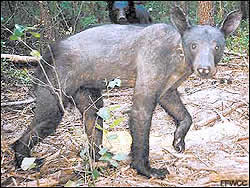
    I got a number of blog hits the other day from folks looking at an earlier picture I put up of a bear with mange (picture at right).

    I thought nothing more of it until this morning when I got the Newshound feed from J.R. Absher's excellent blog, where he reports that some bo-ho is claiming his trail cam picked up a picture of Big Foot in Pennsylvania.

    J.R. is skeptical, and so am I. Bears with mange (along with coyotes with mange, dogs with mange, fox with mange and goats with mange) are not uncommon, and things without hair DO look rather odd and other-worldly.

    Of course, headlines and hype are helped quite a lot by the fact that most "crytozoologists" (who are almost never actual zoologists) have rarely spent too much time in forest or field. Like small children who have just read a book about Kenya, when they hear hoof beats they assume it must be a herd of zebra rather than one small pony.

    It helps for good headlines, of course, if you send your blurry photos (and they are always blurry) to the "Big Foot Research Organization" for identification, rather than to the Division of Natural Resources or State Game Commission.

    .