Showing posts with label rabies. Show all posts

Monday, January 18, 2016

The Population Dynamics of Distemper in Wildlife

Canine distemper is the most common and population-limiting of the viral diseases commonly found in wildlife.

It often sweeps through wild fur bearer populations, such as fox, raccoon, skunk and coyote, leaving behind the stiff carcasses of dead animals who commonly have their lips pulled back in the rictus of a snarl.

Distemper seems to have a particularly devastating effect on raccoon populations, and outbreaks are very common in late Winter and Spring.

While some distemper-related mortality occurs every year, major population crashes are highly correlated to densities, suggesting that in the wild large distemper epidemics may be related to an overshoot of carrying capacity in terms of either food or shelter.

In the Eastern U.S. distemper-related raccoon population crashes seem to occur every four to seven years, depending on food conditions and weather.

Across the U.S., the raccoon population is now somewhere between 15 and about 20 times larger than it was in the 1930s. One reason for this is that the raccoon has dramatically expanded its range northward and westward, across the Plains, across the Rocky Mountains, and up into Canada (where the raccoon is not a native animal). In addition, a deep decline in raccoon trapping, combined with a rise in more fragmented forests bordering houses and cornfields, means that ideal raccoon forage and shelter conditions now exist over much of North America.

Wild North American animals, such as fox, skunk, coyote, wolf, mink, badger and raccoon have very little natural immunity to distemper. The disease itself has varying levels of mortality, ranging from about 50 percent in raccoons to about 90 percent in mink.

Distemper is transmitted from wild animal to wild animal by saliva and urine, and also from occasional contact with the urine or saliva of domestic or feral dogs that have the disease. Along the west coast, sea lions are now coming into contact with distemper -- probably carried to them through raccoon and fox populations patrolling the tidal zone.

Wild animals infected with distemper will present with a wide variety of symptoms, many of which can be very similar to rabies. For example, an animal with distemper will be lethargic, have swollen eyelids, and may have white milky discharge coming from its eyes. The animal will very often have a runny nose and an emaciated look, and will frequently have unkempt fur. At the end stage of distemper, an animal may may also have diarrhea and convulsions, and wander around in daylight with a dazed look. Epileptic-like seizures are not uncommon, and neither are convulsions of the jaw or spasms and rigidity in the back legs.

Death in the wild is not a fun thing, and distemper is a very common and very cruel way for a wild animal to die -- as is rabies and mange, two other population-control diseases common to the Eastern United States.

Though there is no absolute cure for distemper, biologists agree that reducing raccoon population densities through humane hunting and trapping can help reduce the depth of epidemics by relieving the biological stress that occurs when raccoon populations overshoot their carrying capacity in an area (a carrying capacity that may change very rapidly with crop shifts from corn to soy and from soy to oats).

Distemper used to be a major killer of domestics dogs, and it still is among those who do not inoculate litters. That said, beginning in the late 1950s, the prevalence of low-cost distemper vaccines has dramatically improved dog mortality, not only in the U.S., but across the world.

A too-rarely told story is that the creation of this miraculous distemper vaccine came about because of organized fox hunters, and involved not only fox hunters funding the basic research to create the vaccine, but also the use of fox hounds, fox and ferret to create the attenuated virus itself. >> Click here for the rest of that story.
.

Thursday, January 29, 2015

A Short History of Vaccines


The idea of vaccinations to prevent disease dates back to 1796. In that year Edward Jenner, a British physician, noted that dairymaids who had caught cowpox (a minor disease), could not catch smallpox (an often fatal disease in humans).

Jenner took infected matter from the hand of Sarah Nelmes, a local dairymaid who had become infected with cowpox, and inserted this ooze into the cut arm of James Phipps, a healthy eight-year-old boy. The boy then caught cowpox.

Forty-eight days later Jenner injected smallpox matter into the boy. Miraculously, it had no effect. This was the first recorded vaccination.

The term "vaccine" is a reference to the origin of vaccination. "Vacca" is the Latin word for cow.

The term "vaccination" is now generalized to refer to any germ, disease, or injection given to people to prevent a more serious disease from striking the individual.

A few key dates in the history of vaccination:
  • 1798 Smallpox
  • 1885 Rabies
  • 1897 Plague
  • 1923 Diphtheria
  • 1926 Pertussis
  • 1927 Tuberculosis (BCG)
  • 1927 Tetanus
  • 1935 Yellow Fever
  • 1950-1962 Distemper vaccine created and improved upon
  • 1955 Injectable Polio Vaccine (IPV)
  • 1962 Oral Polio Vaccine (OPV)
  • 1964 Measles
  • 1967 Mumps
  • 1970 Rubella
  • 1978 - Parvovirus vaccine for dogs using feline panleukopenia vaccine, later improved on with dedicated canine vaccine.
  • 1981 Hepatitis B

It was not until after World War II
that a reliable vaccine for distemper was developed and made available to the public. Prior to this time, distemper would sweep through breeding kennels and wipe out litter after litter of puppies.

Ironically, one way distemper got into the kennels was through dog shows, where judges and spectators would transmit the virus from one dog to another as they moved through the show petting puppies and adult dogs alike.

Tuesday, June 04, 2013

Raccoons, Rabies & Decapitation


Raccoon head being tested for rabies in Richmond, Virginia.   Original post from 2005.
 
The definitive test for rabies in a wild animal is done by decapitation, and there is even a tool made for the job, as unbelievable as that sounds. The tool is called the "decapitation guillotine" and it looks just like it sounds. The really hard-to-believe part is that it is made by an outfit called --wait for it -- "Animal Care." A guillotine! The sales pitch is as follows:

"When it is necessary to remove the head of a rabies-suspect cadaver, our decapitation Guillotine does the job safely, cleanly, and easily. Features a screw-type mechanism that slowly lowers a cutting blade. Opening is 10"Wx14"H. Heavy steel construction then powder-coated. This is the only guillotine we know of that assures complete operator safety and gets the job done right."

One of the things animal control officers are warned about rabid raccoons is that "Regardless of who does the shooting, it is critical NOT TO SHOOT THE ANIMAL IN THE HEAD, as the rabies virus is concentrated in the brain tissue."

Uh, OK, but if the damn thing is charging can we shoot it in the head anyway?

If you are ever bitten by a raccoon, fox, skunk or any other wild animal, the first thing to do is thoroughly wash the wound or area of exposure with soap and water. This is one of the most effective methods to decrease the chance of infection.

Some people -- animal control officers and trappers, mostly -- get a preventive rabies vaccination. This vaccination -- called pre-exposure prophylaxis -- involves three injections over 3 or 4 weeks. A booster shot every 2 years maintains the vaccination's effectiveness, but it does not prevent you from having to get more shots if you are actually bitten -- it's just reduces the number of shots required from five to three.  A full panel of 5 shots costs between $1,500 and $2,000, with the shot being given over a one-month period.

Each year, an estimated 40,000 people in the United States receive treatment for suspected rabies exposure.
.

Tuesday, June 05, 2012

Red Fox as Weapons of Mouse Destruction


If you use the slightest bit of common sense, the chance of getting rabies from a raccoon, fox, possum, skunk or groundhog is very low, even if you work your terriers to such quarry year-round.

The chance of getting Lyme disease is a little bit higher, but it too is a very rare problem -- far rarer than most people think.

Lyme disease was first identified in Old Lyme, Connecticut in the 1970s. This zoonotic disease is passed to humans by blacklegged deer ticks which are infected with the spiral-shaped Borrelia burgdorferi microbe.

The illness was probably around a long time before being discovered, but prior to the 1970's it was rare enough that no one bothered to name the illness, much less study it.

Then, beginning in the early 1970s, the deer population in the Middle Atlantic and Northeastern United States began to grow rapidly. At the same time, more and more people began moving into the country, generally onto small farms located next to small woods.

Small woods in the Eastern U.S. are often dominated by young oak trees, and these same small woods serve as daytime shelter for fairly dense deer populations of 50-200 animals per square mile (as compared to 25 per square mile in pre-Columbian times).

Very dense deer populations are possible in the eastern U.S. because the deer are able to feed at night in nearby hay, corn and soy fields.

The proximity of houses to shelter-belt forests means deer jungled up in these woods are safe from hunters who cannot legally fire weapons in such close proximity to occupied buildings.

Most people assume deer are the primary reservoir for Lyme disease, but scientists now believe the primary reservoir for is not deer, but something quite a bit smaller -- the whitefooted mouse.

Ticks are not born with Lyme disease. The Borrelia microbe is not passed from female tick to egg, but from Borrelia-infected mammal host to blacklegged deer tick, and from the tick to humans as part of the multiple-host lifestyle of all ticks (for more on that, see >> here).

Almost all whitefooted deer mice have Borrelia coursing through their veins. In addition, almost every tick that bites a whitefooted mouse ends up carrying Borreleia. For reasons not yet understood, other Borrelia-infected animals do not pass Borrelia on quite so easily. While possums, raccoons, fox, coyotes and most birds can carry Borrelia, and often host deer ticks as well, the ticks that feed on these animals become infected with Borrelia only 10% of the time as compared with a 90% infection rate for whitefooted mice.

Clearly, a key component to controlling Lyme disease is reducing the number of whitefooted mice in an area.

Mice populations, it turns out, tend to explode with acorn production which tends to be cyclical. In high-mast years when the ground is littered with vast numbers of acorns, the whitefooted mouse population in small oak woods will explode, and with it the incidence of Lyme disease in an area. Deer coming into these woods pick up the ticks and ensure their dispersal while supplying the tick with a large blood meal (absent a human host).

Obviously, ending acorn production in the Eastern woods is not in the cards. So what else can be done?

One thing that seems to reduce mice populations is to increase the degree of ecological diversity in an area. As the variety of plant sources increase, the popualtions of meso-predators such as possums, raccoons, fox and coyote tends to increase, and with it a decline in mice populations.

Predators, such as fox, are impotant to keeping whitefooted mice populations -- and to some extent Lyme disease -- in check. Fox are highly mobile predators that continuously suppress mice populations all year long. In the absence of mice, fox easily switch to berries, crickets and grasshoppers, young rabbits, voles, and even roadkill and garbage. When mice populations do rise, however, a few red fox can go a long way towards knocking their numbers back down again.

How many mice can a fox eat in a year? If it eats little else, a fox can knock off about 5,000 mice a year. That's not enought to eliminate Lyme disease in an area, but it can have a significant impact, and every little bit helps.

What else can be done? In many areas more deer culling needs to be done, especially of does. With a reduction in deer densities, forest understory has a chance of growing back in, and with it will come an increase in bird populations and other non-mouse fauna.

Such simple precautions such as spraying your pants with bug spray before going out walking in forest and field can help reduce the chance of tick-borne infection quite a lot, as can mowing walking paths short. Move brush piles and firewood stacks away from the house as they are havens for mice populations. After returning from a day in the field, check yourself over for ticks, paying especially close attention to areas you do not normally look at, such as the back of your legs and your back and neck.

If you find a tick, do not worry -- a tick has to feast on you for three days or so before it is able to transmit Borrelia. If a tick bite, or a bite from an unknown bug, develops a large red ring around it, see a doctor immediatly or (if you have doxycline in your vet kit) take a 3-day regime of doxycline. Lyme disease generally very easy to treat in its early stages with a simple one or two-week regime of antibiotics.

And, of course, practice agressive flea- and tick-prevention on your dogs. I hunt most weekends and generally wash the dogs with a low-cost flea shampoo after they return. A few days later I look them over pretty carefully to see if they have any ticks on them that I might have missed while washing them (it helps to have smooth coated dogs!). Other folks use Frontline. Whatever works for you is fine.

The most important element of flea and tick control is vigilance -- paying close attention, on a daily basis, to your dogs. Simply running a hand over their coats once a day will tell you a lot, and not just about ticks, but about weight gain and muscle tone as well.

The Red Fox: the ultimate weapon of mouse destruction.
.

Tuesday, January 24, 2012

The Nonsense of "Pull Dogs"


In The Working Jack Russell Terrier Eddie Chapman writes:

"Something that makes my blood boil is when I hear terrier men talk about dogs they call Caesar dogs. They will show you a Russell type that has been bred too big and say, 'I use him as a Caesar dog'. If I ask what a Caesar dog is, they say it is a dog which will hold the badger, he won't let go,' they say. I have never heard such rubbish in my life. Besides being unnecessary, it is invariably cruel to the dog and more often than not he will be badly bitten for his pains. Besides that, it is unnecessarily cruel to the badger and the sort of behavior that got badger digging banned. I have tried to explain how to remove badgers from a sett without injury to dog or badger. There is nothing clever about getting a hard dog smashed up by a badger. On the contrary, it shows ignorance and a lack of responsibility and feeling. Bravery in a terrier should never be exploited."

I found it quite refreshing to read this passage, as I have often noted that there is little reason to own a "pull dog" if you actually know how to handle things at the end of a dig. The use of "pull dogs" damages dogs and quarry alike and is wasteful as it often necessitates time out of the field and expensive veterinary work.

In the U.S., the use of pull dogs (what Chapman and some others call "Caesar" dogs) is due to the prevalence of too many over-large terriers that cannot go to ground in a real earth. To say you have a "good pull dog," is to say you do not have a dog capable of actually going to ground.

If you have followed the Kennel Club dictates, and embraced a 14 inch tall dog with a 17" or 18" chest (or larger!), you are forced to rationalize a job for it. No matter that it is a stupid job forged in pain. Most people would rather see their dog injured than swallow their pride and admit they have drunk the Koolaid offered up by the Kennel Club know-nothings who think a fox den is as big around as a go-to-ground tunnel.

Another factor is that many people simply have no idea of how to handle quarry and so use the dog to to do the job. Having gotten to the end of a dig, they do not know how to get the animal out of the pipe, nor do they know how to dispatch it. In such a situation, the use of a "pull dog" is ignorance in motion.

The simplest way for a novice to handle quarry is with a snare. You can make your own for about $5, or else buy a pig snare from a feedstore.

Groundhogs can also be tailed out alive -- it is not hard if the groundhog's tail is presented, as it so often is. If very much of the pipe is remaining, however, you may find yourself in a tug-of-war with the groundhog who can jamb up inside a pipe so tightly that even a large man can have difficulty pulling one free.

Always use a snare for raccoons -- they can twist all the way around on their short fat bodies. They can grab you with their hands and have crushing bites. Rabies is not uncommon in raccoons, especially on the East Coast.

If you have entangled a fox in a net, be carefully when extricating the fox. The best advice is to pin the animal to the ground under your boot while removing the net. Work the net off the fox in sections, and then release it to hunt another day.
.

Monday, December 28, 2009

Bo Obama Does Not Have Rabies


Bo Obama does not have rabies, but that hardly matters to the law, which is why he is back at the White House this Christmas vacation, even as Barack, Michelle and the kids jet off to the land of sun, beach, volcanoes and "Dog the Bounty Hunter."

It seems Hawaii has a strict canine quarantine policy, requiring a 5-day isolation and a current blood test (done within the last 120 days) or else there is a 120-day isolation in order to avoid an incidence of rabies ever coming to the island.

Who knew?
.

Thursday, September 10, 2009

American Terrier Work: Just Do It


This post is recycled from 2005.

I started hunting alone, with a dog that was too big, and with a laughable set of tools. I didn’t own a pole snare, barely knew how to work a Deben collar, and had only the vaguest sense of what my options were once I dug down to the quarry.

Most of the terrier books were a wonder -- not one mentioned a bar, none described how to dig a hole deeper than two feet, dispatch was never described, and locating a fox sette was a topic missed entirely.

If nets were mentioned, they did not explain how to set them, nor was the slightest mention made of washing out a dog’s eyes at the end of a dig.

Veterinary advice, if given, seemed to have been gleaned from some 19th Century tome. For example, coal-tar was advised as a curative for mange, but basic antibiotics for lacerations were never suggested.

In the end I did what I had to do: I free-styled and made mistakes. I was pretty sure if I didn’t get it right, those mistakes would cost me the life of a dog, and so I started writing things down as a way of keeping my head focused on what seemed important to remember.

Along the way I got the right-sized dog and went through a half dozen shovels, was given a good bar, got permission on farms, made some equipment I needed, acquired the rest, and slowly learned how to use it all.

After a few hundred digs, I was passably competent and so were the dogs. We learned to trust each other and speak a little of each other’s language.

I mostly dig alone, or perhaps with one other person. There is no macho “hard dog” nonsense. My goal is to keep the dogs healthy and their job is to find the game and keep it bottled until I dig it out.

When the day is done, success is defined by what comes out of the hole, dog and quarry alike. I do not count a wrecked dog as a good day in the field.

It is an odd thing that people who work their dogs will talk a great deal about what is right or wrong with dogs, but they seldom talk about what is right or wrong at their end of the leash.

And yet, true terrier work is a partnership of dog and human.

The dog gains experience only if is taken out into the field.

It gains confidence only if it is brought along correctly and not too fast.

It stays healthy only if the human follows the rules and works to protect it from predictable problems.

In short, at some level, terrier work is about technique, and not just about dogs and tools.

In America, our techniques are different than those in Europe, for the simple reason that our quarry is somewhat different, and our land is sometimes different.

American terrier work is both easier and more difficult than it is in the U.K.

It’s easier because we can hunt all year long and there’s a lot of quarry if you are digging in the east.

It’s easier because our digs are generally fairly shallow, and because we don’t have the political nonsense that stalks fox hunting in Great Britain.

It’s harder because we live in a very big country and regular diggers often live a long way from each other.

We also have more kinds of quarry than they do in Europe, which is a good thing, but it also means we have to learn a few more tricks. If you work your dogs every weekend, year-round, you have to shepherd your dog’s health and know when to stick a shovel in. In the eastern U.S, if you dig just one day every weekend, you can easily dig on 100 critters a year or more — very few people in the world can say that.

No one in the U.K. has to worry about rabies, nor do they have as many tight pipes as we do, nor do those working fox (the only legal quarry left in the U.K.) have to worry about the fox digging away and bottling a dog from behind and suffocating it. Nor do they have the skunk issue — both a misery and a potential killer on this side of the Atlantic.

The point here is that American terrier work is its own bird, and it’s not a bad bird at all -- it’s just a little different, even if most of it is the same.
.

Thursday, June 25, 2009

The Cull of the Wild


This book set out the tenets of wildlife management still in use today.


This post is reprinted from this blog circa June, 2005


Despite a three-fold increase in U.S. population since 1900, the U.S. now has more bear, cougar, buffalo, turkey, geese, duck, fox, raccoon, possum, alligator, groundhog, bald eagle, pronghorn, wolf, coyote, bobcat, and deer than at any time in the last 100 years. Beaver, turkey and river otter have been reintroduced into areas where they were wiped out, and wolf, elk and cougar are beginning to return to the east.

Though animal rights organizations decry sport hunting, the truth is that organizations such as Ducks Unlimited, the Rocky Mountain Elk Foundation, Trout Unlimited, Pheasants Forever, Quail Unlimited, and the National Wild Turkey Federation are the backbone of true wildlife protection in the United States. These organizations, and their state and local affiliates, work to protect and improve habitat across the U.S., as well as fund wildlife reintroduction and research campaigns.

For their part, groups such as the Humane Society of the United States and People for the Ethical Treatment of Animals (PETA) are little more than direct mail mills. Both organizations are entirely absent from all habitat protection efforts in the U.S., and neither organization runs even a single animal shelter in the U.S. despite the scores of millions of dollars they collect from the public. Instead these organizations send out millions of pieces of direct mail every year -- all of it highly emotional and designed to get suburban matrons to part with their "most generous gift of $10, $20 or even $50".

One of the perennial topics of animal rights direct mail campaigns is a push to outlaw trapping. Carefully staged photos and antique traps are used to pluck at the heartstrings, but donor beware! It should serve as a warning that blue-chip environmental organizations such as the National Audubon Society have sued the Humane Society (and won) in order to preserve the use of leghold traps as a wildlife management tool. All of the wolves now in the Yellowstone, for example, are routinely caught in leghold traps in order to inoculate them against rabies and distemper and to switch out the batteries on their radio-tracking collars. Modern leghold traps, properly set, are far more selective and less brutal than those that existed 100 or even 50 years ago -- a fact conveniently omitted from the direct mail literature of animal rights advocates.

Trapping for pelts in the U.S. is now largely independent of wildlife numbers -- when trapping numbers go down it is not because of a dip in the target species population, but because of a dip in pelt prices.

As of this writing, green (untanned) fox or raccoon pelts sell for between $8 and $12 dollars apiece -- not much considering the time and effort it takes to boil, dye and and wax a trap, set it out, check it daily, and skin and flesh the resulting catch.

That said, a surprising number of fox and raccoon are still trapped in the U.S. In the winter of 1999-2000, for example, when pelt prices were quite low, 29,739 fox were trapped in the state of Virginia (15,632 red fox and 14,107 Gray Fox), as well as 83,369 raccoon, 3,304 coyote, and 3,050 bobcat. In Pennsylvania that same year, 63,654 fox were taken (26,794 Gray fox and 36,860 red fox), as well as 107,407 raccoon, 9,508 coyote, and 58 bobcat.

For comparison purposes, the state of Virginia is 42,700 square miles in size, and Pennsylvania is 46,058 square miles in size as compared to England, which is 50,800 square miles and all of the UK which is 94,200 square miles in size.

.

Tuesday, June 23, 2009

The High Cost of Animal Rights Rhetoric


A recycled post from this blog circa February 2005.


What would happen if hunting and trapping were eliminated?

Well, your taxes would go up, for starters.
In addition, wildlife-car collisions would kill and injure many thousands of Americans every year.

The Potential Costs of Losing Hunting & Trapping was compiled by Southwick Associates for the International Association of Fish & Wildlife Agencies in Washington, D.C. Southwick calculates that if hunting and trapping were eliminated, wildlife-auto collisions would result in an additional 50,000 injuries per year and $3.8 billion in additional auto repair costs. Health care and disease control costs would jump by $12.45 billion just for rabies alone and homeowners would see an additional $972 million in damages to homes annually.

Hunters and trappers today provide their wildlife-control services for free to the taxpayer. In the absence of public hunting and trapping, the potential cost of government-run substitutes for hunting and trapping was estimated at $934.2 million to $9.3 billion to control whitetail deer, $132 million to $265 million to control fur-bearers, and $16 million to $32 million annually just to control beaver.

For the complete copy of this report, please visit the Southwick Associates website >> HERE and click on Free Reports and select The Potential Costs of Losing Hunting and Trapping as Wildlife Management Tools (bottom of page).
.

Monday, March 30, 2009

A Rabid Bobcat Walks Into a Bar ...


From The Arizona Republic
:

COTTONWOOD - A bobcat walked into a roadside bar in Cottonwood.

What happened next was not a joke but "pandemonium": two or three minutes of chivalry, cellphone cameras and people jumping on top of pool tables to get out of the way.

When it was over, two people were scratched and bleeding, and the bobcat was gunned down by police in a parking lot on Main Street.

All that's left now is a barroom story that is sure to become legend.

And a series of rabies-vaccine shots.

"This was a rabid animal," said Zen Mocarski of the Arizona Game and Fish office in Kingman. "You've seen the cartoon Tasmanian Devil? That's a bobcat with rabies."

.... At about 11:40, three people walked out of the Chaparral, a neighborhood bar with signs for Schlitz, Budweiser and Coors over the entrance. Tuesday is free-pool night.

"I said goodnight," said bartender Scott Hughes, 41. "Next thing I know, they are running back in, followed by the bobcat.

"One jumped on the pool table, and two more jumped onto the bar."

The bar's video camera recorded what happened next.

The bobcat chased two people around a pool table.

Then, the animal stopped.

That's when people took out their cellphone cameras to get a picture.

Hughes told Kyle Hicks that he should not get too close to the bobcat.

"A bartender is supposed to command authority," Hughes said. "But he didn't listen to me."

In the video, Hughes can be seen reaching down to move Hicks.

That's when the cat jumped on Hicks' face, scratching him under his left eye and behind his right ear.

"Yeah, it didn't feel too good," Hicks said.

Hicks then knocked the animal to the ground.

"Look up 'pandemonium' in the dictionary," Hughes said. "That's what this bar was."

The 20 or so patrons started scrambling toward the back door. But so did the bobcat, which was now looking for a way out.

That's when Derek Oliver showed you can find a good man late at night in a Cottonwood bar.

"He was coming right towards two women," Oliver said. "So, I pushed them out of the way. That's when he got me. It wrapped itself around my leg."

Worse yet, the bobcat was moving up Oliver's leg.

"I punched it in the face real good," Oliver said.

The animal laid still for a moment, then it ran back out the front door.

By this time, police had arrived and found the animal in the parking lot.

"It started walking towards one of my officers," said Sgt. Gary Eisenga of the Cottonwood Police Department.

The officer shot the animal, killing it.

Witnesses said they heard three shots.

"We've had calls to that bar before, but never for a bobcat," Eisenga said.

By Thursday afternoon, Hicks had received his first of five rabies shots.

"In the arm," Hicks said. "They don't do it in the abdomen anymore. Thank God."


To which I can add: Only in America.

Of couse, these things happen. Rabid bobcat attacks make the news again and again. Ditto rabid coyotes, rabid fox, and rabid raccoons.

Me? I have no fear of rabid animals. The trick is to stay out of the bars.
.

Wednesday, February 18, 2009

A Miracle Rabies Test? Maybe Not.


Bernie Madoff was a very good con man ($50 billion up in smoke), and it looks like R. Allen Stanford wasn't so bad either -- it appears he ripped off $8 billion according to yesterday's Wall Street Journal.

So how does a con work?

Well, the first part is to come across as perfectly legitimate. The word "con" comes from the word "confidence," as in "confidence man."

Nothing works better than newspaper clips in this regard, and if they cannot be won legitimately by sustaining the con and getting testimonials from your early marks (as Madoff did), then they can be created quickly by simply putting out a press release with a few golly-gee plausible claims.

They can even be bought if you are willing to put up a few hundred dollars in order to buy a full-page ad masquerading as an article in a local penny-saver advertiser.

And, of course, in this day and age you will need a web site.

To be really effective, the web site should be flashy, but say as little as possible.

The best site will have "get out of jail" language buried in it somewhere -- a line saying the product, diet, get-rich plan or test does not really do what it is supposed to do. "Results may vary." "Examples are for illustrative purposes only." My favorite example is that found in the "Frequently Asked Questions " portion of the Mars WISDOM Panel™ MX test in which they say the test works to identify your breed of dog only if you do not know what breed it is. Perfect!

Remember, con men are not selling steak, they are selling sizzle. They're not selling the pig, they're selling the poke. When you open up the bag, and a cat jumps out, their job is to look you straight in the face and say: "Results may vary."

Now on their web site, and in their press release, it's always good if the con man has a few testimonials and can point to a few credentialed experts or "big names."

Did you know Steven Spielberg parked his money with Bernie Madoff and so too did B'Nai Brith? True!

Now, it would be great if all the testimonials were from real people, and all the credentialed experts were Really Big Names, but there's no reason to get too fussy here. After all, who is going to check? No one!

A PhD in education can be presented as a "Dr." in a medical situation, and you can always pad out a resume with made up expertise in something smart-sounding like "physiology of bio-molecular mechanics" if you cannot find some ancient scientist tottering on the edge of insolvency who will say anything for a few thousand dollars. Can you find a down-on-their heels television star from a minor TV show from the 1960s or 70s? How about a washed out sports figure? There's your perfect spokesperson!

If you are in the business of fishing for dollars, it helps to drop your line in the right waters.

Con men know this, and so they work certain groups very hard. Older Americans are less educated, more trustworthy, and many are also lonely. A perfect mark.

Recent immigrants are also excellent -- if you know their language, they can be plucked like ripe fruit.

Young men and women in emotional distress and searching for answers are often gullible (ask any cult leader), and so too are recent widows and widowers.

Can you establish an affinity through religion or perhaps as an ex-Marine? Praise the Lord! Semper Fie! Perfect.

Of course, the easiest marks are the greedy. Ask any Nigerian grifter working an email scam.

Who doesn't want to get in on the ground floor of the next WalMart, Amazon, or Microsoft?

Who doesn't want to "make millions" with a "wealth building system" based on "winning in the cash-flow business?"

Regular readers of this blog might remember that I have reported before on con men in the world of dogs and cats.

In a post entitled Are Your Gullible? Send Money for Free Test!, I noted that Simon Brodie, the tax cheat who recently started a "Pet Sharing" business has been nailed in court for claiming to have created a "canine influenza" test and a "hypoallergenic cat" which he was only too ready to sell to anyone foolish enough to shell out $4,000 to $7,000 (prices varied).

In fact, as the court noted:

[Brodie] has little background or experience in the market of molecular diagnostic testing. Brodie is unaware of the difference between certain common diagnostic testing techniques, in addition, Brodie testified at deposition that he has never taken a course of a technical or scientific nature, or any courses that focuses on management or business. The evidence shows that any steps Plaintiff took to engage in the proposed business were only preliminary or exploratory in nature. . . In addition, Brodie never developed a formal business plan, Plaintiff had no other employees besides its founder Brodie, Plaintiff never acquired a laboratory or employed a laboratory manager, Plaintiff never contacted an investment bank or venture capital firm to raise capital and Plaintiff never obtained a license to sell the canine influenza test, one of the few products it purported to sell. Furthermore, despite claiming to have a patent pending for its veterinary diagnostic system, aside from Brodie's declaration, Plaintiff has failed to provide the Court with any other evidence regarding the patent."


So what was Brodie's angle?

Hard to say, but I think the goal here was more than selling a few over-priced cats. The goal, I believe, was finding One Perfect Fool who would cough up a lot of "venture capital" money to fund Brodie's pie-in-the-sky "canine influenza test" and "hypoallergenic cat" industries.

What did it matter if there was no market, no science, and no exclusive product?

The goal of a grifter is not to sell steaks; it's to sell sizzle while pocketing steak money.

Was that Brodie's goal? Who knows! The scam never really got off the ground. But if you ask me, that was the mark being played.

OK, but that's yesterday's news. What-cha-got for me today?

Well, I dunno -- you tell me.

You see, a few weeks back, various friends and fellow dog writers lapped down a press release about a new $50 "instant rabies saliva" test.

This test can reduce the number of animals destroyed and save doctors and animal control organizations from the costs associated with traditional testing," said Dyne Immune CEO, Dr. V. James DeFranco, MD.


Hmmmm. Something odd there, but I could not put my finger on it at the moment.

Then, yesterday, Carol Vinzant shot me an email.

Carol is a financial reporter, and a few years back she had called me up when she was writing a story about the high cost of veterinary care. Now she writes on pets for People magazine, and she reads this blog on occasion. She pinged me about something, and I pinged her back about a possible news story (probably a hoax) dealing with Beyonce's dog, Munchie. She was interested. She would check it out. In the interim, what did I know about the company and the people making this new rabies vaccine being touted in the pet press? She mentioned that she had looked up "V. James deFranco, MD" and he appeared to be affiliated with a company selling some sort of oral spray that contained an extract of deer antler velvet "used by movie stars" as well as various products for anti-aging, insomnia, energy and weight loss.

My bullshit meter went through the roof. I suspect Carol knew that it would. She greenlighted me to run with it, and so I did, Googling up a storm in a matter of minutes.

First stop was to check out the original rabies story and the company behind it, "Dyne Immune."

The story had been picked up everywhere, and it all seemed to have been generated by a single press release put out on Marketwire (a pay-to-say press release distribution service).

The press release did not mention a FDA trials, a real research facility, a sponsoring university, or much of anything else.

A quick Google of "Dyne Immune" took me to a very thin web site and a list of characters supposedly affiliated with the company.

I looked for any mention of FDA approval, scientific review, University sponsorship, etc.

Nothing.

Instead, I found a prominent button to an article: "Warwick Valley Humane Society Participates in New Rabies Test."

Eh? That's news?

A quick click on the link, and I found myself looking at an "article" from a local throw-away penny-saver advertiser.

And what did the article say? Nothing! This was not science; this was not even good marketing. It was bad puffery, and it featured a dodgy picture that looked like it was shot in a mobile home.

Terrierman was beginning to smell the familiar odor of rat.

Moving on, I Googled "V. James DeFranco, M.D." and found him affiliated with a company called MaxLife Rewards, but very little else.

That was odd.

You see, according to the Dyne Immune web site, Dr. DeFranco has been everywhere and done quite a lot.

A Google search should have turned up published papers, patents, old speeches, introductory biographies from conference presentations, books, a personal web site, and newspaper clips in which he had been quoted numerous times over the years.

Instead, nothing.

Or almost nothing. I did find a mention of the man as part of tobacco litigation back in 1969 -- 40 years ago.

Hmmm. This was no spring chicken!

Back to "the Google."

What, exactly, is MaxLife Rewards?

Well, it turns out that MaxLife Rewards is a multi-level marketing scheme (i.e. a pyramid scheme) selling dubious health stuff that anyone who is not stupid or insane will stay far away from.

The home page seems to say it all, with a photo of a young slickster giving the "thumbs up" sign, and a little promo squib and a Login/Password box.


Whiskey. Tango. Foxtrot.
This looks like an Enzyte commercial!

A few minutes more, and I found this related site.

As soon as I clicked on it, a Windows box popped up on my computer warning me this was probably a "phishing" site and I should NOT give them any information.

Yow!

Undeterred, I read the sales pitch:

If money were no object, how would your life change?

It is time to unlock the dreams you have kept inside and begin to dream about early retirement, time freedom, a beach-front home, a three-week family vacation each year, or that trip around the world. You may want to use your wealth to help the less fortunate or just spend more time with your children.

Whatever it is you are looking for, MaxLife Research is the vehicle!


Terrierman was definitely starting to smell rodent!

Exploring further, I found that V. James deFranco, MD is affiliated with this very dodgy-looking web site where he is listed as a "staff member."

Eh? This web site has a "staff"?

And then I noticed that this web site refers back to MaxLife Rewards, and that it is looking for someone "who speaks Spanish and has contacts in the Latin market."

Right. Got it now. Latin America. They'll buy anything down there. Not as much education, more trusting of the Internet, a weaker legal system.

Just to confirm my growing suspicions, I Googled the other names associated with Dyne Immune.

First up was "Michael Huchital." A search on the Dyne Immune site found a marketing form and an address at 29 Distillery Rd, Warwick, New York.

A quick search on Zillow confirmed what I suspected: It's a 3-bed, 2-bath house in the rural suburbs of Appalachian New York. No doubt, it's Michael Huchital's home.

I looked back at the Dyne Immune web site and noted that the company said Mr. Huchital was associated with Mount Saint Mary College in New York, but when I looked on that College's web site, his name did not turn up.

Hmmmm.....

I Googled some more and found that Michael A. Huchital was fined $3,750 by USDA for failing to keep rabbits in a minimal standard of care. The court specifically rejected his defense that he ran a research facility.

There is another brief mention of him as being CEO of a startup called Rapid Bio Tests Corporation (assets less than $3,000), but that appears to have fizzled out; Mr. Huchital's employment was terminated after a few months, the company was renamed the Bio-Warm Corporation, and plans were made to begin making some kind of heat-generating cloth.

I Googled Mark L. Anderson (a very common name) and came up with a veterinarian in San Diego, but he is not the right guy. If Dyne Immune's Mark L. Anderson was a veterinarian, you can bet they would have mentioned that fact!

I looked closer at Mr. Anderson's bio on the Dyne Immune web site and noticed that while it describes him as a "toxicologist" it appears his specialty is really the "marketing of dietary supplement products."

Gotcha! A supplements marketing man. The kind of job every toxicologist takes to bolster his reputation in the world of peer-reviewed cutting-edge science.

Or not.

More drilling, and I found this single paper co-written for the "Journal of the International Society of Sports Nutrition" which puports to examine whether a patented herb-remedy could help maintain testosterone levels in men.

I say purported because only 42 males were studied (split groups of 21), diet was not controlled for, the study was funded by an herb-remedy sales company, and the work was done at the University of Yaounde.

Yaounde? In Cameroon? Jesus, who does research in Cameroon? And why? This is a country where the average income is less than $8 a day. Why wasn't this work done in the U.S. or anywhere else that monkey-meat-on-a-stick is not the local version of fast food?

But at least there was my answer: Mark L. Anderson's real job is not COO of Dyne Immune, but Director of Research & Development at Triarco Industries, a company that sells the kind of natural supplements sold to body builders in mall health and nutrition stores. Got it!

Finally, just for grins, I went to the FDA web site.

For a device, drug, or test kit to be approved in the U.S., it has to get FDA approval. I looked at the main FDA web site, and also at the FDA's Veterinary web site.

Nothing listed for Dyne Immune.

So what's going on here?

You tell me. I have no idea.

All I know for sure is what I have reported here, which is that the more you look the less you find and the shakier the story gets.

I am pretty sure there is no miracle rabies test behind all this.

In fact, the Dyne Immune web site itself says a "negative result does not guarantee that rabies is not present."

There it is: the "get out of jail free" language I have come to look for in these kinds of situations. The price you pay is guaranteed; the product is not.

Not that this is necessarily a con. As I said, who knows?

Third World rabies tests based on quick and cheap saliva samples have been around for a while. Perhaps this is simply a repackaging of that not-too-accurate test.

One thing for sure: the whole thing smells fishy.

Clearly, the goal of the press release was to generate a little "positive press" in order to get someone to come out of the woodwork and throw development cash their way.

Not that there is much to develop. It seems they have a "rabies test" which is not a very good test for rabies.

So am I saying it's all a scam? No. "Results may vary."

But let me ask you this: Why do you need to know? Were you thinking of investing?

Do you need a weatherman to tell you which way the wind blows?

I did not think so. A word to the wise is generally sufficient.


.

Tuesday, September 30, 2008

The Epidemiology of Rabies in the U.S.


In any given year about 7,500 cases of rabies in nonhuman animals are reported to the Centers for Disease Control and Prevention. Wild animals account for approximately 93% of all cases of rabies reported -- most of the rest are in domestic/feral cats, dogs and farm animals.

The average human in the U.S. is FAR more likely to be struck dead by lightning than to come down with rabies, much less die from it. That said, most Americans are not encountering (much less handling) raccoons, fox, skunks, groundhogs, possum and feral cats on a regular basis.

Raccoons continued to be the most frequently reported rabid wildlife species (37.2% of all animal cases during 2001), followed by skunks (30.7%), bats (17.2%), foxes (5.9%), and other wild animals, including rodents and rabbits (2.3%).

Raccoons have been recognized as a reservoir for rabies in the southeastern states since the 1950s. An outbreak that began during the late 1970s in the mid-Atlantic states has been attributed to the translocation by hunters of infected raccoons from Florida.

Raccoon rabies is now found in all of the eastern coastal states as well as Alabama, Pennsylvania, Vermont, West Virginia, and Ohio.

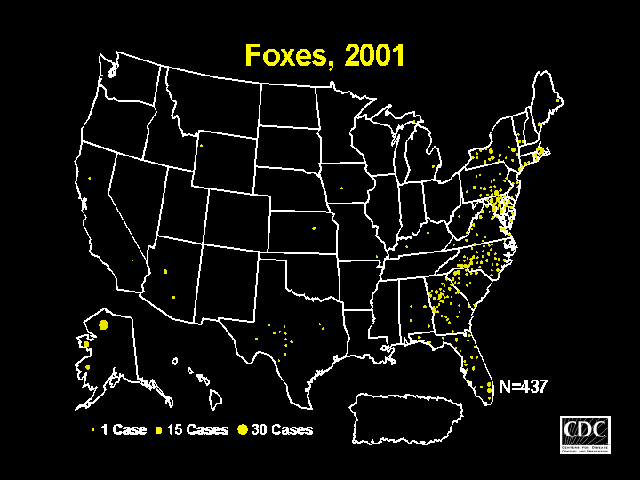
Foxes (mainly Vulpes vulpes) accounted for 5.9% of all cases of rabies in animals reported in 2001. The majority of cases of rabies in foxes (360 out of 437 cases) were reported by states affected by the raccoon-associated variant of the rabies virus. In 2001 Alaska reported 45 cases of rabies in fox, Maryland reported 38 cases, and North Carolina reported 56 cases.

During the past 2 decades, more than 100 million doses of vaccine-laden bait have been distributed over 6 million square kilometers in Europe, with promising results for controlling the disease in red foxes. The use of oral vaccination in Switzerland during the past 20 years resulted in a declaration of rabies-free status in 1998, and a similar declaration was made by France as of the end of 2000.

Air-dropped rabies-vaccine baits are now being dropped in many parts of the Eastern and mid-Western United States, and good-to-excellent results are being observed.

To see a larger view of the CDC incidence map of rabies in fox (2001) >> click here

Friday, August 01, 2008

Sharing Death and Disease Across Species


A zoonotic disease is a disease that originates in wildlife and which has a reservoir in a wild population of animals, but which leaps the species barriers and can be transferred to humans.

Unlike diseases that reside only in humans, diseases that reside in both humans and wild animal populations are just about impossible to eradicate. The bad news is that there are a tremendous number of such diseases, and the number of them is growing every year.

Malaria -- an old zoonotic disease -- still kills 2 million people a year, while HIV/AIDS is a newer pathogen that has killed 25 million people so far, with another 55 million people (or more) infected worldwide.

The Bubonic plague is an old zoonotic disease, while a newer one is Mad Cow disease, to which can be added SARS, West Nile, and Ebola hemorrhagic fever.

When I was a kid there was no such thing as Lyme Disease in either humans or dogs, but now Lyme disease is one of the most commonly diagnosed diseases here in the Eastern United States.

Meanwhile, it seems a day cannot go by when a rabid fox or raccoon story does not appear in the press somewhere in the United States.

The total number of zoonotic diseases is unknown, but of the 1,415 known human pathogens in 2001, 62% were of zoonotic origin. A quick summary of the vectors for some of the more common zoonotic diseases:


  • Bubonic Plague is caused by a bacterium transmitted to humans from black rat fleas. A possible epidemic of bubonic plague is described in the First Book of Samuel, and the so-called Black Death which emerged in the 14th century killed approximately one third of Europe's population. The prairie dog towns of the Western U.S. became infected with the bubonic plague after Chinese immigrants brought the disease to the U.S. after 1900.

  • Rabies was described among hunting dogs in Mesopotamia as early as 2,300 BC, and accounts of the disease can be found in early Chinese, Egyptian, Greek, and Roman records. Any mammal can have rabies, but in the U.S. it is most common in feral cats, skunks, bats, fox and raccoons. That said, a groundhog was recently found in Pennsylvania with rabies.

  • West Nile Virus is a kind of encephalitis and may have been what killed Alexander the Great, as crows were reported to have died at his feet. In 1999, West Nile virus was introduced into the US, thanks to the introduction of the tiger mosquito which came to the U.S. in a load of tires from Asia. West Nile now strikes rare birds in zoos (especially perching western hemisphere birds such as parrots, eagles, hawks and cormorants) as well as bird feeder birds, horses and humans. The disease is named after a section of Uganda where it was first found.

  • Tularemia is transmitted by skin contact with an infested, diseased, or dead hare, rabbit or rodent.

  • Hantavirus is spread from rodents to humans by aerosols composed of dust from rodent scat. It is rare, but a concern in the driest parts of the American southwest, especially after wet (or relatively wet) winters and springs.

  • Salmonella is generally transmitted to humans through contaminated water reserves and can come from a wide variety of animals, but especially turtles and other reptiles and amphibians.

  • Leptospirosis ("rat catcher's jaundice") is generally transmitted to humans who drink water into which a rat has urinated. It can also be transmitted to dogs, pigs and other farm stock.

  • Rift Valley Fever is spread by mosquitoes, as is equine encephalitis, and Japanese encephalitis.

  • Leishmania is spread by sand-flies.

  • Typhimurium occurs endemically in wild birds, causing sporadic cases and small outbreaks in humans.

  • Anthrax is primarily a disease of herbivores, but it can be transmitted from wildlife to humans by contaminated meat or water, or by the spread of spores by flies, vultures, and other scavengers.

  • Lyme disease comes from ticks that feed on rodents and deer.

  • Bovine Tuberculosis can be spread from cattle to humans, and frequently finds a refuge in badgers, possums, wild boar, feral pig, and deer.

  • Echinococcosis comes from tapeworms, and moves easily from canids to humans. Fox are particularly susceptible to this parasite as small rodents are the intermediate host.

  • Monkeypox is a disease caused by a pox virus that typically occurs in Africa where the African squirrel is the natural host. The disease now occurs among prairie dogs in the United States, thanks to the importation of African rodents for the pet trade.

  • Severe acute respiratory syndrome (SARS) is a viral respiratory illness that is believed to have originated in palm civet cats, raccoon dogs, and rats. It has not yet shown up in wild animal populations in the U.S.

  • Influenza (the flu) has been reported in a variety of animal species, including birds, humans, pigs, horses, and sea mammals, but its main reservoir seems to be wild waterfowl, especially ducks.

  • AIDS is caused by the HIV virus, which appears to be a variety of Simian Immune-Virus (SIV) which may have spread to humans from nonhuman primates in West Africa -- perhaps due to consumption of meat, or infection from monkey blood during slaughter.

  • The common cold is a virus that scientists now believe originated in horses.


Humans are not the only species impacted by emerging diseases leaping the species barrier.

Black-footed ferrets have been decimated by distemper that has crossed over from wild dog populations, as have seals and sea lions.

Frogs and many other amphibians around the globe have been decimated by diseases brought into new habitats -- often by scientists coming to study the creatures.

Lowland gorilla populations are being hammered by Ebola hemorrhagic fever, while elk and deer in the western U.S. are falling to chronic wasting disease very similar to Mad Cow disease.

.

Saturday, July 26, 2008

American Genius and Rabies

From the Associated Press:

Authorities say a Levy County man accidentally shot his wife while trying to hit a fox that had attacked her. The couple told deputies they had spotted an animal in their yard Friday morning and went outside to see what it was.

The fox bit the woman on the left leg and wouldn't let go, so she told her husband to get a gun.
The man fired a .22-caliber rifle seven times, killing the animal but also hitting his wife in the lower right leg.

The woman was taken to a nearby hospital for treatment.
The dead fox will be tested for rabies, but authorities say the results won't be available until next week.

Wednesday, May 21, 2008

Rabies Cases Close to Home


News reports are that two northern Virginia women are undergoing rabies treatment after being bitten by rabid foxes this month.

One woman was mowing her lawn in Fredericksburg when a fox latched onto her ankle. The second woman was in Arlington, where I live, when she was bitten while taking out the trash.

Both of the fox bites were from Gray Fox, and both fox were captured and confirmed as having rabies.

There were 438 confirmed cases of animal rabies in Virginia and eight confirmed cases in Arlington between January and July of last year, state records show.
.

Tuesday, March 18, 2008

CDC Says U.S. is Free of Canine Rabies? Not so!


Old Yeller in 5 seconds.


Virginia had 730 reported rabies cases last year -- the highest number since 1982. Most of the rabid animals were wild animals, but 36 cats and five dogs tested positive for the disease statewide.

That's the bad news.

The good news, according to the Center for Disease Control, is that the United States is entirely "Canine-Rabies Free."

Huh? How is that possible? See here for the rather poorly-written CDC pronouncement from September 7 of last year, and this better-than-the-news-release newspaper article from Reuters.

It seems the CDC has narrowly defined canine rabies as "transmission from a dog" to another dog. In short, a dog can still catch rabies from wildlife, and (presumably) a human can still catch rabies from a dog (however unlikely that might be).

Just three years ago, a young man living only one County away from me died from rabies presumably caught from a fox, while in September of last year, a rabid bear was shot in western Maryland.

Since we still have rabid dogs in this state, and since we still have humans occasionally dying of rabies in this state, you will pardon me if I do not celebrate the nonsense now being spouted by the Center for Disease Control on this subject.

The good news, it turns out, is mostly press-release malarkey. Yes, we have a lot fewer rabid dogs running around the country than we used to, but the number is not zero.
.

Thursday, November 08, 2007

Opossums and Rabies

Any mammal can get rabies, but of course a possum is not a mammal is not an ordinary mammal; it's a marsupial. So can a possum get rabies? The answer is, "yes," but rabies in an opossum is EXTREMELY RARE.

This may have something to do with the opossum’s low body temperature (94-97º F) making it difficult for the virus to survive in an opossum’s body.

.

Friday, September 14, 2007

Nannying Idiots Continue to Ignore Real Problems


I got an email tonight from Char (Pearl's first mom and breeder) letting me know that a woman in the U.K. has been jailed for violating the ban on tail docking that exists over there.

For those who do not keep up on such things, the new U.K. law states that only veterinarians can dock puppy tails, and that even then it can only be done if it is deemed to be "medically necessary."

Heads up. In this increasingly interconnected world, even stupid ideas in other countries can quickly creep in over here. A while back, for example, I received an email from Canada suggesting that the idea was gaining ground in that country. My correspondent wrote:

"I am writing you for help in clarifying a long standing dispute among terrier fanciers involved in conformation dog shows. I am involved in several traditionally docked terrier breeds (Lakeland, Fox, Welsh etc.) and it is becoming increasingly common to see these breeds undocked. Is there a functional purpose for docking tails? Is it required to work terriers?


Why I am supposed to be an expert on these things?

I don't know, but I guess I'm as good as the next guy to ask for an opinion. So here goes.

This is a European debate. You remember Europe. Europe is the place where the rivers are so polluted that the eels no longer run up the rivers to spawn, and where carp are considered a game fish. Europe is the place that has shot out almost all its wolves and bears. Europe is the place that colonized Africa and now lets Africans starve due to lack of aid or political intervention.

Europe has ignored these things, and decided that the the real horror in the world is docking puppy dog tails!

What morons.

The Brits were fools to follow Europe in this. Now let's hope Canada does not go follow the Brits, or I may have to burn my Joni Mitchell and Neil Young CD's.

Tail docking is a very minor procedure and does no harm to the dog. It is largely aesthetic and historical with certain breeds. That said, some terriers and other breeds have long thin tails that can be damaged when whipped in brush, worked in rock, etc. so they may benefit, medically, if they are docked. How often an over-thin and fragile tail is a real medical problem depends on the breed, the dog, how it works, where it works (and if it is worked at all).

A terrier's tail, of course, is an essential part of the dog, and I consider it a very stupid thing to dock a terrier tail too short. I always advise people to err on the side of leaving the tail too long. You do not want to lose a good handle on the rear end of a working terrier by being too quick or aggressive with a pair of tail nippers.

That said, a very long tail is of no use to a terrier, and could be a small health liability. A dog often has to exit a hole backwards and around curves. In that situation, a long thin tail could be a problem -- imagine exiting a tight and winding tunnel with a spring-pole stuck out behind you, and you get the idea. And then there are the thin tail tips that bleed when banged against rocks and brush.

Some caveats. At least one breed of working terrier does not have a docked tail -- the border terrier -- and neither do working dachshunds. The tail on a border, however, is a very solid thing and is not easily damaged. If you cannot pick up a border terrier by its tail and throw it over a fence, it's not a true border terrier. A tail that is left intact on a working Jack Russell terrier, however, often ends up being very long and thin, and as a consequence it could be subject to real damage, and so it is generally docked.

Another issue for working dogs is that digging on a dog is not an absolutely precise thing, and so the length, form and placement of the tail becomes an issue. To put it bluntly, a long thin whippy tail trailing behind an underground dog could be subject to being trimmed by a shovel.

Has it ever happened to me or anyone I know? No. I am careful and my dogs rarely come in direct contact with a shovel. That said, it does not take too much imagination to think harm could result if a digger were very inattentive.

All in all, however, and as I said before, tail docking is mostly done for cosmetic and historical reasons.

But so what? We do a lot of things for cosmetic and historical reasons. Why can't tail tail docking be one of them? For God's sake, people, let's use a little common sense!

People circumcise their children, women get themselves nipped for child birth (it's called an episiotomy), and every third teenager has a pierced tongue, nipple, eyebrow or navel.

Whole TV shows are devoted to full-body tattoos.

Women are getting breast implants or breast reductions, and men are getting hair transplants and scalp reductions.

Noses are bobbed, fat is sucked out, teeth are capped, botox is injected, and ears are being pierced, ringed, barbelled, and pinned.

Ever been to a PETA rally? If you look around, you will see a lot of metal hanging out of nostrils, off of eye brows, or rammed through tongues. Every other girl will be showing off her "tramp stamp" tattoo on the small of her back. God only knows what you might find ringed, belled and pierced if you were foolish enough to ever see one of these PETA lunatics standing before you naked. The mind shudders.

Consider PETA spokes-idiot Pamela Anderson, who not only married the walking Erector Set known as Tommy Lee, but who also got her own body repeatedly tucked, sucked, injected, lifted, dyed, bobbed, and implanted. And these people are worried about a ten-second tail nip? What on earth for?

There are real problems in the world, and this is NOT one of them.

The anti-tail docking people have no sensible rationale to oppose tail docking -- it is a ten-second thing done when the dog is one or two days old, and it is over with very little fuss or pain. People who love dogs more than their own lives have been doing it for generations -- proof alone that it is a small thing and does no damage to the dog while sometimes serving a health function in the field.

Here are some real things to worry about with dogs:

  • Closed genetic registries which mean that the genetic diversity of dogs is dramatically reduced in time, and with it the health of every breed with a closed registry (i.e. all Kennel Club breeds);
  • Fat dogs which do not see exercise and which have sad and shortened lives (about 1/3 of all dogs);
  • Slick floors in kitchens which increases the chance of hip dysplasia for all large canines (a serious and sad thing);
  • Poor fencing, poor obedience training, and the complete absence of tags and microchipping which means dogs are easily lost and frequently struck by cars.


These are REAL dog problems. Tail docking does not even come close to making the list of things to be concerned about -- in the world of working dogs or otherwise.

Not everything in the world needs to be legislated, and this is something that fits under the umbrella of "leave it alone and let freedom ring."

If a breeder of nonworking dogs wants to leave the tails on their dog long, so what? If a breeder wants a sensible working dog with a properly docked tail, so what?

What interest, business or concern is it of society?

None.

The tail docking debate is really about a very small but vocal sector of society wanting to be nannies to the rest of us.

As a general rule these people know very little about dogs, know nothing about working dogs, and do not give a rat's behind about honest animal welfare -- if they did, they would pick a real issue to take action on.

And there are a LOT of real animal welfare issues. How about habitat protection? How about disease control in wild animal populations (rabies, distemper, mange, tuberculosis, chronic wasting disease, West Nile)? How about pushing to lower the price of veterinary care and improving access to it as well? These are real issues.

Fair warning, however -- making a change in these arenas might involve actually going out into the environment with mud, bugs, rain and cold (Ugh!).

In addition, a real problem might be inconveniently complex and serious (God forbid!), and actually involve something more involved than self-righteous bullying of ignorant legislators and dog owners.

But of course, the tail-docking debate is not really about dogs, is it? It's about people who want to feel smarter and superior to others. These people will always be with us and I suggest they simply find something new to feel smarter and superior about.

If, faced with all the issues and problems in the world (hunger, violence, hurricanes, disease, lack of health insurance, war, poverty, illiteracy, racism, deforestation, violence against women, animal extinctions, loss of global fisheries, pollution, child abuse, etc.), someone thinks tail docking of well-loved pets and working dogs is a major concern worthy of time and energy, they are idiots.

Nannying idiots.

Nannying European idiots.

.

Thursday, September 06, 2007

Thanks for the Fear J.R.


J.R.' Absher's blog got my attention this morning with his post that an aggressive rabid bear had been shot in Maryland. It was attacking a land owner's goat pen, and then it began attacking the house when the land owner yelled to try to shoo it off. Read all about it on J.R.'s blog at the link, above.

Meanwhile, my boss says the fellow that lives one farm over from him in Virginia lost a calf to a bear the week before last.

Bear populations are on the rise all over; we have about 500,000 of them in the lower-48 right now. But rabid bears is something I have never thought about.

I hunt in Maryland. And while I have assimilated the idea of a rabid raccoon or fox (a lot of us have seen them), even a timid Sunday-going-to-meeting bear that has rabies is enough to give me the willies. Honest; it doesn't even have to be aggressive for me to want to get the hell out of the woods.

We've got some rabid coyotes running around too. Nothing like rabid wolves and bears to put a little mystery and sport back into hunting, eh? Sometimes you get the bear, and sometimes the bear gets you.

.