Showing posts with label possum. Show all posts

Thursday, October 26, 2017

How Many Possums Per Spoon?


Possums are North America's only marsupial and have tremendous numbers of young and more teeth any other furbearer in North America.

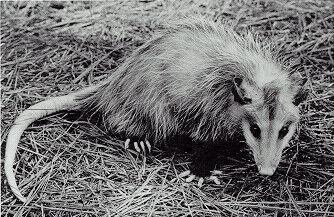
The bottom picture shows 7 baby possums in a tea spoon at about the time they first make it into their mother's pouch. The middle picture shows the location of the pouch. Pouch mortality is fairly high, and usually only five to eight baby possums survive to peek out in the world two months after being born. Most possums die within the first 9 months of life (killed by cats, dogs, cars, fox, poison, disease, traps, and coyotes) and few make it to age three.

A typical female possum will have two litters a year, each with as many as 18 young. The gestation period for a possum is just 13 days -- the shortest gestation period of any mammal in North America.

Opossums prefer low, damp, wooded streams and swamps. They are nocturnal, and will shelter in hollow trees, firewood racks, brush piles, groundhog burrows, and crawl spaces under houses and outbuildings during the day. Possums are very common in suburbia where they often dine on school-yard refuse, dead squirrels in the road, and cat and dog food left out on people's stoops. Complete omnivores, their tracks looks like those of a space-alien, while their scat can come in any shape and color.

Though possums will hiss a great deal, they are not very formidable creatures, as their teeth are too small, their brains too small, and their response time relatively slow when compared to raccoon, fox, or groundhog.

Saturday, December 24, 2011

Predator Fear, Alone, Results in Fewer Birds


Fear of meso-predators, and fear alone, results in fewer successful clutches according to a paper by Liana Zanette entitled "Perceived Predation Risk Reduces the Number of Offspring Songbirds Produce per Year" that appears in the December 8th edition of Science. 
.

Saturday, April 17, 2010

Bassett Hounds at Work in Virginia

No one does it quite like the Mountain Falls Hunt in Winchester, Virginia:

“We don’t chase foxes,” Rudolph said. “They run too fast. We wanted to chase something that just waddled along.”

So, the Mountain Falls Hunt “chases” possums, because they basically just turn around in circles in the road, she said. “And, there are a lot of them out here.”

To make sure the group actually sees a possum, each member has one embroidered on her saddle pad.

Also, the group rides to the “hound,” singular.

A basset hound named Daisy is the hunt’s official dog, but she usually does not attend parades, because the blacktop is too hot for her paws.

A repost from August, 2008, which quotes an article from The Winchester Star.
.

Monday, September 21, 2009

Roadkill Blues

Roadkill is a 20th Century phenomenon, which is to say that we did not have it in the 19th Century when the roads were populated by horses and carriages.

Oh sure, we had some train kills -- deer and moose and cows and buffalo, but that's trackkill, not roadkill. And, of course, some horses died on the road from exhaustion or being shot, but they too were not roadkill as we define it here -- animals dying from vehicle impact on the road.

In fact, roadkill is probably the wrong term, even if it is the one we use. Carkill is what this really is; the road, after all, is simply a passive observer.

The problem with the term "carkill," is that it puts us in the picture. Roadkill, however, is a term that conveniently assigns millions of drive-by deaths to an inanimate object. It is a comforting term that obsolves us of guilt.

Today, the Mercury Cougar (Automobilus detroitus) does some of the pruning work once done by the wolf (Canus lupus). Which is not to say Ford, Chevy, Toyota, Volvo, Mack Truck, and all the rest are not doing their part as well. They are.

Roadkill is not a small biological phenomenon, it is a big one. In my small state of Virginia, there are over 35,000 deer-car impacts a year. In Michigan, deer impacts are so pervasive (over 55,000 a year), that they use deer roadkill data to determine the deer population in the woods. In Pennsylvania, another 40,000 deer a year fall under the wheel. What's the national tally? Who know? The number 350,000 is tossed around, but that seems low. That said, not all states have as many deer as Virginia, Pennsylvania and Michigan, or as many drivers on dark or twising roads. So who knows? Whatever the number, it's clear that it is a lot.

Though I have no doubt that Darwinian forces are slowly playing out between animals and cars, the time-frame is still far too short. As a result, as brilliant as a squirrel is at figuring how to get to, and jimmy open, a bird feeder, it is still completely flummoxed by squealing tires and 4-cylinders. As a result, squirrels die in droves from vehicle impacts -- perhaps 40 million a year according to one back-of-the-napkin bean counter.

A few more sobering roadkills numbers, and some descriptive reasons as to why some animals are more likely to die on our highways than others:

  • Dogs: 1.2 million dogs are killed on U.S. roads every year. Most of these dogs are killed in the daylight while chasing a ball, child, cat, or squirrel. Fences and leashes keep dog alive. No fence and no leash, and the result is predictable.

  • Cats: Cars kill about 5.4 million cats per year -- more cats than are killed in all U.S. animal shelters. Most cats are hit by cars at night.

  • Snakes: Snakes are cold-blooded and will warm themselves on asphalt, especially on poorly-traveled rural roads. Because snakes are small and easily obliterated by tires, there are no good numbers, but they are huge.

  • Opossums: Opossums feast on roadkill, a habit that results in about 19 million opossums a year getting squashed. Possums are naturally slow, come out at night, and will often freeze in the headlights of a car.

  • Skunks: When threatened, a skunk's natural defense is to turn its back and spray -- a technique that does not work too well with cars. Most skunks are hit at night.

  • Groundhogs: An estimated 5 million groundhogs or woodchucks get hit by cars every year. Groundhogs are diurnal, but because so many den along roadside embankments in order to take advantage of soft dirt, good drainage, fewer predators, and good forage, they are often living just yards from traffic. Sure this is maladaptive, but groundhogs have not been programmed with cars in mind.

  • Raccoons: Raccoons frequently scavenge in roadside water ditches, are not too fast, are fairly belligerent, sometimes travel in trailing family groups, and hunt at night. Which is a nice way to say their are a lot of vehicle-raccoon impacts -- perhaps 10 million a year, maybe more.

  • Fox: Red fox are field-and-edge creatures, and are much more likely to be hit be a vehicle than a Gray fox which will generally be found in deeper woods and rocky areas. That said, both Red and Gray fox are night time scavengers, and as such are prone to being struck on the road while feeding on the carcass of a snake, possum, rabbit or squirrel previously struck by traffic. The saving grace of a fox is that they are very fast and extremely wary -- the two chief reasons you see fewer dead fox and coyote than you do dead raccoons and possums.

.

Tuesday, April 07, 2009

No Animals Harmed in the Making of This Movie


I filmed this little clip with the digital point-and-shoot camera, and was running a bit to see if I could catch up at one point. Glad I did, as I got him sliding back into another hole. No shortages of holes in my area!

.

Possum on a Branch


A short clip of Sunday's possum, the last dig of the day. This one was tailed out, and I put her up a thin bush while I sorted the dogs out, and tried to figure out how to work the video mode on the point-and-shoot camera.

I put up this little video clip for the folks in Europe who do not have possums. Possums are pretty slow-witted, and not too formidable. Their real claim to fame is their fecundity; they can easily have 20 or more young a year, and they will eat just about anything. They, in turn, serve as a sort of walking-buffet lunch for fox, coyote, bobcat, owls, hawks, eagles and alligators.

Our only marsupial, possums have more teeth than any other mammal in this hemisphere, but their teeth are not as big as a fox, or a powerful as a raccoon. The average possum only weighs 9-10 pounds, but some will get quite a bit bigger than that, and I have a skull of one that must have tipped 25 pounds when it was alive.

.

Monday, April 06, 2009

Digging on the Dogs


Yesterday was a nice day in the field with perfect weather, and three kinds of quarry dug to -- raccoon, groundhog and possum.


Mountain located a raccoon
in a dirt den underneath a massive brush pile. I will spare you the details, but suffice it to say I managed to burrow down into the brush pile and sink a bore hole between mountain and the raccoon. I then twisted the post hole diggers so they blocked Mountain from reaching the raccoon, and she got the idea and finally came out. Good thing too, as there was no digging her out, and she was not coming off that raccoon any other way!

I leashed up Mountain and we drove to another farm a short way up the road, where we quickly located a groundhog and dispatched it at the farm manager's request.


I estimate I have taken 200 groundhog off of this particular farm, and there are not many left, though the farm manager says he has lost a few turkeys to a coyote, and the farm across the road took an enormous coyote last month -- the largest in the County so far.


The dogs checked a few more holes, and Mountain located a pretty tough-acting possum, which I pulled before Mountain decided to teach it respect. Possums are pretty harmless creatures, and though Dave the farm manager has chickens this fellow was toward the back of the farm, so I released him with nothing more than a stern warning.


This possum was released unharmed.

.

Sunday, March 15, 2009

The Last Thylacine


This is a combined reel showing all the film footage that exists of the last Thylacine, or Tasmanian Tiger.

The Thylacine was a marsupial wolf which weighed 40-70 pounds.

Its skull is remarkably similar to that of the modern wolf (click on picture at right to make bigger), though its lifestyle was quite a bit different, and it was generally lighter in weight as well.

Unlike the wolf, the Thylacine did not have a very good sense of smell, and seems to have relied on sight and sound to locate prey, most of which it caught by stealth and ambush.

In addition, the Thylacine was not nearly as fast a mover as the wolf, as its long stiff tail gave it a somewhat truncated gait.

Unlike wolves, Thylacines do not vocalize much -- a few growls and hisses are all that were ever heard, nor did they hold territory against other Thylacine interlopers. In short, the Thylacine may have looked a bit like a wolf, but it very much acted like a huge possum.

The Thylacine once lived on the Australian mainland, but went extinct there 2,000 years before European settlement due to hunting by humans and their feral dogs (dingoes).

The Thylacine hung on in more remote Tasmania until a decline in the Tasmanian Emu population (a major food source for the Tasmanian Tiger) helped push their numbers down. A general decline in Thylacine number was coupled with an intensive hunting program largely fueled by the misinformation that the Thylacine drank blood and was a threat to livestock. These twin rumors fueled a bounty-hunting campaign, which worked to reduce the Thylacine population to a mere handful.

The last few Thylacines were scooped up by zoos, but the animals were successfully bred only once, and the last living Thylacine died in the Beaumaris Zoo in Hobart, Australia in 1936.

.

Tuesday, September 30, 2008

The Epidemiology of Rabies in the U.S.


In any given year about 7,500 cases of rabies in nonhuman animals are reported to the Centers for Disease Control and Prevention. Wild animals account for approximately 93% of all cases of rabies reported -- most of the rest are in domestic/feral cats, dogs and farm animals.

The average human in the U.S. is FAR more likely to be struck dead by lightning than to come down with rabies, much less die from it. That said, most Americans are not encountering (much less handling) raccoons, fox, skunks, groundhogs, possum and feral cats on a regular basis.

Raccoons continued to be the most frequently reported rabid wildlife species (37.2% of all animal cases during 2001), followed by skunks (30.7%), bats (17.2%), foxes (5.9%), and other wild animals, including rodents and rabbits (2.3%).

Raccoons have been recognized as a reservoir for rabies in the southeastern states since the 1950s. An outbreak that began during the late 1970s in the mid-Atlantic states has been attributed to the translocation by hunters of infected raccoons from Florida.

Raccoon rabies is now found in all of the eastern coastal states as well as Alabama, Pennsylvania, Vermont, West Virginia, and Ohio.

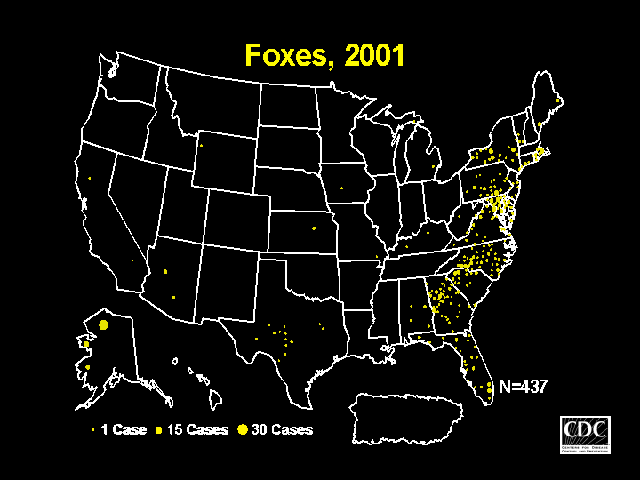
Foxes (mainly Vulpes vulpes) accounted for 5.9% of all cases of rabies in animals reported in 2001. The majority of cases of rabies in foxes (360 out of 437 cases) were reported by states affected by the raccoon-associated variant of the rabies virus. In 2001 Alaska reported 45 cases of rabies in fox, Maryland reported 38 cases, and North Carolina reported 56 cases.

During the past 2 decades, more than 100 million doses of vaccine-laden bait have been distributed over 6 million square kilometers in Europe, with promising results for controlling the disease in red foxes. The use of oral vaccination in Switzerland during the past 20 years resulted in a declaration of rabies-free status in 1998, and a similar declaration was made by France as of the end of 2000.

Air-dropped rabies-vaccine baits are now being dropped in many parts of the Eastern and mid-Western United States, and good-to-excellent results are being observed.

To see a larger view of the CDC incidence map of rabies in fox (2001) >> click here

Saturday, June 14, 2008

Possum Production

In many ways, possums are cursed animals. Not only do they have small brains, they are not very fast, and are easily killed by coyotes, farm dogs, fox and owls.

The possum's competitive edge is in the reproduction arena, and here it is a true champion. A typical female possum will have two litters a year, each with as many as 18 young. The gestation period for a possum is just 13 days -- the shortest gestation period of any mammal in North America.

Possums are the primary transmitter of equine protozoal myeloencephalitis (EPM), the most commonly diagnosed neurological disease in horses. Common horse symptoms include incoordination, with one side usually more pronounced than the other; muscle loss; and weakness. Some horses may die, but even those that aren't severely affected may not be able to run or ride as well as they once did.

About 50 percent of all horses, regardless of breed, show exposure to S. neurona, the parasite which causes EPM, and which has been traced only to the opossum. Only a small number of these infected animals, perhaps one percent, actually get sick, but about 30-40 percent of those that do get sick don't respond well to existing treatments.

The bottom line: any farm that has horses should be glad to see you and your terriers, as you can rid the pasture of groundhogs and their holes which can break a horse's legs, and you can also get rid of possums in the barn and surrounds that might transmit a serious equine disease.
.

Thursday, March 20, 2008

Playing Possum?

Sometimes when opossums are cornered, they will simply keel over into a dead faint. Many predators, such as dogs, don't quite to know what to do with a dead opossum, and will walk away. If the predator does leave, the opossum will eventually raise up its head, look around, and if danger has passed, scurry off to cover.

Research indicates that "playing possum" is not really an act. Instead, the possum suffers a kind of nervous collapse. Since opossums aren't well equipped for fighting, their "delicate nervous system" has adaptated by creating an "over ride" mechanism that pushes them into a kind of temporary catatonia which, ironically enough, can help keep the possum alive.

The reason "playing possum" works is that the attack response in many dogs and other predator is also genetic -- it has nothing to do with being "angry" or being "hungry". The reason a fox will kill as many chickens as it can is that the jerky and fluttering movement of the chicken triggers a "mass murder" response within the fox. If chickens simply "played dead," like a possum often will, a vixen would pluck off one hen and be on her way.

Ironically, another animal that will occassionaly go into catatonic shock when cornered is the red fox. A fox bolted into a net will sometimes slip into a kind of momentary catatonia as it's nervous system shuts down, the body stiffens, and a kind of nervous shock sets in. Again, this is a kind of defense mechanism. It must work well enough, for it is employed by two very different animals that are very successful. The red fox is the most widely distributed carnivore in the world, and the possum is one of the oldest animals on the planet.
.

Thursday, November 08, 2007

Science Needs More Terriermen


This is a mammal, recently re-discovered in Cuba, called the Almiqui or Cuban Solenodon (Solenodon cubanus). Since its discovery in 1861, only 37 of these creature have ever been caught.

The folks that ponder such things have, at various times, thought this animal had slipped into extinction, but in fact it is merely a rare, regionally endemic, nocturnal, burrow-living animal that no one has really spent too much time looking for in a very expert manner. It seems that pondering animals and putting them into taxonomic "clads" is very different from actually going out into the field to find them with shovels, nets, traps, guns and dogs in hand. Hmmm. Who knew?

On the upside, not everyone in the world of biology is sitting at a typewriter. Dutch biologist Marc van Roosmalen recently went up the Rio Aripuanã river basin in Brazil and discovered a new species of peccary, a type of wild pig. It weighs 90 pounds and is the largest peccary in the world, but it has gone unnoticed by suit-and-tie scientists up to now. The push is on now to protect the area where it lives before it is logged out to make toilet paper and coffee tables.

Other relatively recent animal discoveries include only the second golden-mantled tree kangaroo ever found (this one in Indonesia, the last one in Papua New Guinea), an odd species of bushy-tailed rat "discovered" in the wild meat markets of Laos, the Arfak Pygmy Bandicoot, the Mountain Brushy-tailed Possum, the Red-bellied Gracile Opossum, the Pygmy Three-toed Sloth, Goodman's Mouse Lemur (very cute!), and the oddly-named "GoldenPalace.com" Monkey whose naming rights were sold for $650,000 which will go to support consevation efforts in Bolivia's Madidi National Park.

I wonder how many lost or never-discovered animals might be found in the tropical parts of the world if an energetic person with a good working terrier and a shovel were detailed to hunting in the field? Who is really looking for stuff that dens underground?

If the Smithsonian or National Geographic wants to find out what's out there, the dogs and I are available for travel to exotic locations. Pay my mortgage, slip me a travel stipend, and arrange for a decent retirement and health plan, and I will willingly suffer dysentery and rebel forces in the developing world in the name of science. Operators are standing by!
.

Opossums and Rabies

Any mammal can get rabies, but of course a possum is not a mammal is not an ordinary mammal; it's a marsupial. So can a possum get rabies? The answer is, "yes," but rabies in an opossum is EXTREMELY RARE.

This may have something to do with the opossum’s low body temperature (94-97º F) making it difficult for the virus to survive in an opossum’s body.

.

Wednesday, May 02, 2007

Possums and Horses

A possum around the barn could be detrimental to a horse's health because possums are carriers of equine protozoal myeloencephalitis (EPM), a neurological disease they acquire from eating dead birds. The disease itself is caused by a single-celled protozoa by the name of Sarcocystis neurona.

As part of its life cycle, this parasite may travel through a opossum and infects the cells in the animal's gut. It is then passed out of the possum in its feces, which, in turn, can be ingested by horses grazing in the pasture or in hay kept in a loft.

The bad news is that more than 50 percent of all horses are exposed to the parasite.

The good news is that only a few actually become affected by disease, which may require an immunity deficiency in the horse for the disease to actually become fatal.

EPM is hard to diagnose because it mimics other diseases, such as Wobbler's syndrome, equine herpes and West Nile virus.

The disease effects the horse by inflaming tissue around the parasite within the spinal cord.

Eliminating possums around a barn or horse pasture reduces the chances of horses contracting EPM.

The disease is not transmitted between infected horses -- only between possums (and possum scat) and horses.

Bottom line: If your farmer has horses, offer to toss the terriers up into the hayloft a couple if times in the Fall and Winter when possums are most likley to be looking for winter shelter. A warning, however: Be able and ready to move those large round bales should your dog find deep in the stack.

Saturday, January 01, 2005

Last Dig of the Year


Mountain and I went out yesterday, the last day of the year.

As I was alone and scouting, I left the dog in the car for the first two farms, locating new holes in new hedgerows at an old farm, and stopping by a new farm to get permission for the Spring.

That done, Mountain and I walked another large farm and checked out a few large settes but no one was home -- not surprising considering it was 55 degrees out.

At the far end of the farm, just above a creek, Mountain found in a very tight groundhog hole under a stack of mutliflora rose. It looked to be a shallow dig, and though all I had with me was a shovel, we went at it.

Mountain got past the curve in the pipe at about the same time I popped into the den, and within a few seconds the dog was throwing out old bedding and leaves.

I was pretty sure it was a possum, but a cat-like squall came from the hole and then the unmistakable smell of skunk.

Mountain was out of the hole very quickly thanks to an assist from me. The skunk tried to bolt, but I said something to it and, as a consequence, it dove back into the pipe.

Mountain got a pretty light dose, and I buried the skunk. He'll dig himself out, of course, but hopefully he'll have as miserable a time doing that as we will cleaning up from this chemical attack.

I stopped at a pet store on the way home and picked up two bottles of "Nature's Miracle Skunk Odor Remover" which is a different product from "Skunk-Off". With this new stuff you simply put it on the dog and let it dry -- the enzymes are supposed to break down the stink. Aside from the enzymes, most of the rest of the product is alcohol.

We'll see if it works. It it does, it really will be a Miracle. My experience is that it takes about a month for a dog to fully rid itself of skunk smell.


This deer leg was so fresh rigor mortis had not yet set in, and the bit of blood in the hole in the leg was not yet clotted. There were no deer carcas nearby, so my guess is that a fox dropped it and scurreid off as I came into the field. Deer hunters were everywhere today so this leg was probably scrapped from a gut pile on a neighboring farm.


Mountain exits a hole earlier in the day -- no one home.

Thursday, November 18, 2004

Small Possum on a Cold Morning


Here's another picture from Sunday's farm scouting. The dogs found in a small hedge and Mountain was the first in. She didn't open up and bay, but all the dogs were interested and fighting to get in behind her. We pulled and staked them, and boxed Mountain directly under a broken-down barbed wire fence.

A quick two-foot dig, and we popped right between Mountain (who had to dig his way into the hole) and a small possum (who was hiding in the short dirt pipe just past the hole). I think Mountain only reached the possum after we dug in between them.

This little 'possum was released unharmed, but not before it defecated on Mountain who was standing right below him as this picture was being taken.

Possums are not "playing" when they "play possum." The catatonia commonly observed is an involuntary physical reaction to fear -- the possum "blows a fuse" from too much excitement. In 5 to 20 minutes the possum's nervous system will reset itself, but often not before the possum defecates and jettisons anal glands that stink so bad that any attacking animal is led to believe that the animal is dead and already foul with rot.

We placed this little fellow in the fork of a tree where he no doubt recovered before we were out of sight. For more on possums, click here.


Wednesday, November 17, 2004

Tracking in Mud

Earlier this month I posted on the difference between raccoon and fox scat. Basically, one is pointed and has mouse hair in it (fox) and one has square ends and is almost entirely vegetative (raccoon).

What about tracks?

Raccoon and fox tracks are quite distinctive, and you should be able to quickly tell the difference between them.


Raccoon tracks. Note the similarity to a human foot and hand, with five fingers and toes. The back foot print looks like a human foot print, and the front foot print looks like a human foot print, albeit one with claws.


Fox track. Note the four toes. A fox track is flat on the bottom heal and has a ^-shaped palm. A fox track will be more ovoid than a terrier track, which is nearly round, but otherwise is similar. Cat prints never show claw marks, but dog prints always do. A fox is a type of dog, as is a coyote and a wolf.

A simple rule: fox have four toes, and raccoons have five toes. If you come across a track that looks like it must come from a martian (very strange looking!), that's a possum track.

Thursday, January 08, 2004

Virginia Hunting Statistics

For those that are interested, a good historical listing of Virginia trapping stastics is available at http://www.bobpickett.org/FurFileVA.htm, complete with red fox, Gray fox, possum, and raccoon trapping takes.
 
Note that in the last year that data is presenteed (2000), trappers officially took 30,000 fox (red and Gray) and over 83,000 raccoon.  Most fox is now ranched, and most raccoon is shipped to Germany where it is cut down and sold as "imitation mink".
 
Note that these trapping statistics do not have much to due with actual species populations in the state (other than to suggest they are healthy), as much as they do with the price of pelts.
 
A bit of regional wildife trivia: We SHOOT as many deer every year in the state of Virginia as actually reside in the state of Maryland.
 
The bobcat numbers for Virginia are impressive, as is the rapid growth in coyote numbers in recent years.
 
Bear are apparently doing very well.