Showing posts with label dog food. Show all posts

Friday, March 08, 2019

Cruft: The Man That Never Owned a Dog


Charles Cruft was born in 1852 into a family of jewelers. Charles had no interest in his family's business, and upon graduation from college in 1876, took a job with American James Spratt who had set up a new venture in Holborn, London selling "dog cakes".

Charles Cruft did not own a dog, but he was an ambitious dog food salesman, and traveled around England and Scotland drumming up business for Spratt. Cruft's travels brought him in contact with large estates, sporting kennels and the first commercial dog breeders in the UK.

While traveling to Europe in 1878 hawking Spratt's dog biscuits, a group of French dog breeders invited the young Cruft (just two years out of college) to organize and promote the canine section of the Paris Exhibition, which he did.

Upon returning to England in 1886, Crufts took up the management of the Allied Terrier Club Show at the Royal Aquarium at Westminster, with an eye towards making money.

The first formal "Cruft's Show" was booked into the Royal Agricultural Hall, Islington in 1891. This was the first in a long series of dog shows that Crufts held there, each of them making an appealing profit for Cruft, who still did not own a dog himself.

In 1938 Charles Cruft died (still having never owned a dog!) and his widow ran the 1939 Crufts Dog Show. Three years later Mrs Cruft felt the responsibility for running the show too demanding and, in order to perpetuate the name of the show her husband had made world famous, she asked the Kennel Club to take it over and it was sold to them.

The 1948 Crufts Dog Show was the first under the Kennel Club auspices.

Friday, September 14, 2018

Man, Mule, Mutt, and Machine


Plowing with mules and horses is so hard, expensive, and inefficient that when the first motorized vehicles came along. America's farmers leaped at the chance to boost production and ease their work load.


Even the smallest tractor from the 1890s outperformed a mule, and unlike a mule, tractors got bigger and better every year, with new attachments made to drive threshers, log-splitters, saws, and conveyor belts.  Electric light could even be added!


With an explosion of farm tractors and trucks in the 1930s, 40s, and 50s, a glut of old farm horses and mules appeared on the market.  The horse and the mule, once an essential means of production, was now a nearly-useless vestige of another area consuming too much pasture, money, and time.    

The solution? Canned dog food.


Canned dog food was heavily promoted in newspapers and magazines, and the television sets now cropping up in upper-middle class living rooms.

Horse and mule meat was touted as a pure and obviously good food or dogs -- real meat for real dogs.  If people were now eating everything out of cans, surely dogs should too?

Meanwhile, tractors got bigger and too did American farms.

Young adults who had left for war and war production factories never returned to the farm. What might have been a critical shortage of farm labor was in-filled with mechanical labor.  Where it used to take one man to work 20 acres, it now took only one man to work 200 acres or more.


Along with bigger tractors came bigger trucks, plows, discs, winnowers, balers, threshers, separators,  and cultivators.


Tractors not only spurred an increase in the size of American farms, it also increased our agricultural muscle and made the U.S. an essential trade partner the world over. When Russian wheat harvests failed, America stepped in. When Europe went to war, it was the American farmer on his American tractor that not only fed American troops, but much of the populations of Britain and France.


Today, the transition from mule to machine is complete and there are no longer vast herds of redundant horses and mules waiting to be sold for dog food. Sure, there are scores of thousands of wild horses out west that the U.S. government does not know what to do with and which are degrading public lands, but their numbers are not enough to drive a return to canned dog food, even if slaughtering those horses for that purpose were allowed.

Instead, the protein and fat needs of America's dogs are mostly met with grains, vegetables, chicken, and a wide variety of other scrap meat trimmings left over from beef, hog, and other human food production.

Tuesday, May 22, 2018

Murder by Can Opener: How Pet Owners Kill Dogs


In the church parking lot the other night, a woman I know asked me how her dog looked. She was pleased it had lost a little bit of weight, but in truth I could not see much difference.

To be charitable, let me say that the dog had a beautiful red coat that was as sleek as a seal, and it had the kind of massive cinder-block head that proclaimed its origins: a Lab-Pit bull cross as docile as any dog you could possibly hope to find.

I liked this dog, but it was fat -- really fat -- and I told the woman it still needed to lose between 15 and 20 pounds. She was crushed.

In truth, a lot of dogs in America are fat, and so too are a lot of Americans. For all the hand-wringing we are hearing about poisons in dog food, the number one killer and maimer of dogs in this country is the can opener.

Pfizer is now selling a drug to combat canine obesity (I kid you not) but in truth the problem is almost never the dog's genetic fault.

Behind every fat adult dog is a weak human who cannot say "no," or who cannot control others in the household who insist on stepping in to give the dog a treat.

In the latter case the issue is simply making a big damn deal out of it if other people feed your dog without asking your permission. People in your house should fear crossing the line every bit as much as I feared touching my father's trombone as a child. Humans can be taught to leave well enough alone. I can assure you that no man goes into a woman's purse without permission more than once. Feeding a dog should never be a community responsibility -- one person has to have absolute ownership and and authority over what, and how much, the dog eats.

More often than not, however, the reason a dog is fat is not that other people are feeding it but that that the owner thinks that every time he or she eats a meal, the dog must also get a bite or two. Look at those eyes!

But that's not the end of it, is it? The dog also gets to lick the plates, and maybe the kitchen bowls. The dog also gets a little canned food mixed in with his dry food as "a little treat." Anything that falls on the kitchen floor the dog is allowed to have. Plus there's the biscuit the dog gets every night before it goes to bed....

Add it all up, and you have a LOT of calories going into that dog.

And, more often then not, you also have a dog that will die many years sooner than it should, often after having spent the last half of its life lethargic, and more often than not with joint problems.

Unseen are the same kind of diseases that stalk overweight humans: heart disease and clogged arteries, fatty liver disease, diabetes, and certain types of cancer.

A lot of people -- including some veterinarians -- do not really know what the correct weight is for a dog.

Here's the answer: If you cannot easily feel your dog's ribs, it is too fat.

And I don't mean you should have to dig into the flesh to feel those ribs -- you should be able to run your hands down the side of a dog and feel at least three or four of them without even trying.

If you have a smooth-coated adult dog like a pointer or a smooth-coated Jack Russell, you should be able to see at least two or three ribs when the dog breathes after a a short run.

Rest assured that no one who reads dog-oriented web sites and books is ever going to have a dog that is too thin. People who sign up for canine list-servs, buy books on dogs, and read pet columns in the newspaper are much more likely to feed their dogs to death than they are to run their dogs even a pound or two too light.

How do you get the weight off a fat dog? Simple: stop feeding it so much.

Portion control IS weight control.

Step one to getting a fat dog down to the right weight is to cut out ALL canned dog food, all treats, and all table scraps. When you cook or eat your own meals, the dog should always be put outside, in a crate, or in another room on the other side of the house. Do not confuse your meal time with your dog's meal time.

Feed your dog a decent dry bagged kibble like Purina or Pedigree (brands hardly matter, no matter what anyone says), and measure it out carefully. Do not heap up when you measure, and do not give treats of any kind. Have some discipline for God's sake!

My recommendation is to feed your dog small meals twice a day with a small leather chew in the morning to help clean the teeth and give the dog's stomach something to work on during the day.

How much food should you feed? Simple: Feed your dog LESS than the amount the dog food manufacturer recommends on the label.

Remember that the dog food company wants to sell you more food, therefore the label is basically setting out a maximum food intake, not necessarily the correct one. If you live on a farm and the dog is running around a lot as it follows you from field to field on a tractor, that dog food label might be perfect. But if your dog spends almost its entire life sleeping in a sunny spot at the end of the driveway or curled up on the sofa, as most American dogs do, the "recommended" food amount on the label is going to lead to an overweight dog. If your dog is fat it is being over-served. Feed it less; it cannot get simpler than that.

Another tip is to feed your dog according to the weight your dog should be, not to the weight it is now. You would think this is obvious, but it's not to all people. If you feed your overweight 20-pound dog the amount of food the label says a 20-pound dog needs, you will never get a healthy 12-pound dog out of the equation.

Along with portion control, try to increase the amount of exercise your dog gets by walking it, roller blading with it, bicycling with it, or teaching it to retrieve a ball, Frisbee or stick.

Instead of buying love from your dog with food, take time to brush your dog's coat, to brush the dog's teeth, to walk it around the block, or to toss it a ball. Most dog's want attention every bit as much (or more) than they want food.

If you are teaching your adult dog obedience or a few simple tricks, feed the dog only when it is being worked. If you do this, you will find, rather quickly, that a hungry dog is a smart dog.

If you want to boost any dog's intelligence quotient by 50 points, simple don't feed it for a day and see how well it performs the next. Stupid dogs can be made geniuses overnight by simply skipping meals for 24-hours. Amazing, but true.

No dog will ever suffer from missing an occasional day's worth of feeding. In fact, with small dogs, it is so hard to keep them at a proper weight that skipping a meal once in a while is almost required to maintain them in shape.

Finally, remember that ALL fat dogs are ugly, but that almost all dogs at the correct weight (or a bit under) look much better and live longer.

Your dog is not responsible for its own weight -- you are. A certain amount of responsibility comes with an opposable thumb. Live up to it by running your dog on the light side.
.

Friday, March 09, 2018

Charles Crufts Never Owned a Dog


An owner prepares her Chihuahua for the Crufts judges.

Charles Cruft, pictured below, was born in 1852 into a family of jewelers. Charles had no interest in his family's business, and upon graduation from college in 1876, took a job with American James Spratt, who had set up a new venture in Holborn, London selling "dog cakes".


Charles Cruft did not own a dog, but he was an ambitious dog food salesman, and traveled around England and Scotland drumming up business for Spratt. Cruft's travels brought him in contact with large estates, sporting kennels and the first commercial dog breeders in the U.K.

While traveling to Europe in 1878 hawking Spratt's dog biscuits, a group of French dog breeders invited the young Cruft (just two years out of college!) to organize and promote the canine section of the Paris Exhibition, which he did.

Upon returning to England in 1886, Crufts took up the management of the Allied Terrier Club Show at the Royal Aquarium at Westminster, with an eye towards making money.

The first formal "Cruft's Show" was booked into the Royal Agricultural Hall, Islington in 1891. This was the first in a long series of dog shows that Crufts held there, each of them making an appealing profit for Cruft who still did not own a dog himself.

In 1938 Charles Cruft died, still having never owned a dog, and his widow ran the 1939 Crufts Dog Show. Three years later Mrs Cruft felt the responsibility for running the show too demanding and, in order to perpetuate the name of the show her husband had made world famous, she asked the Kennel Club to take it over and it was sold to them.

The 1948 Crufts Dog Show was the first under the Kennel Club auspices.

Tuesday, February 20, 2018

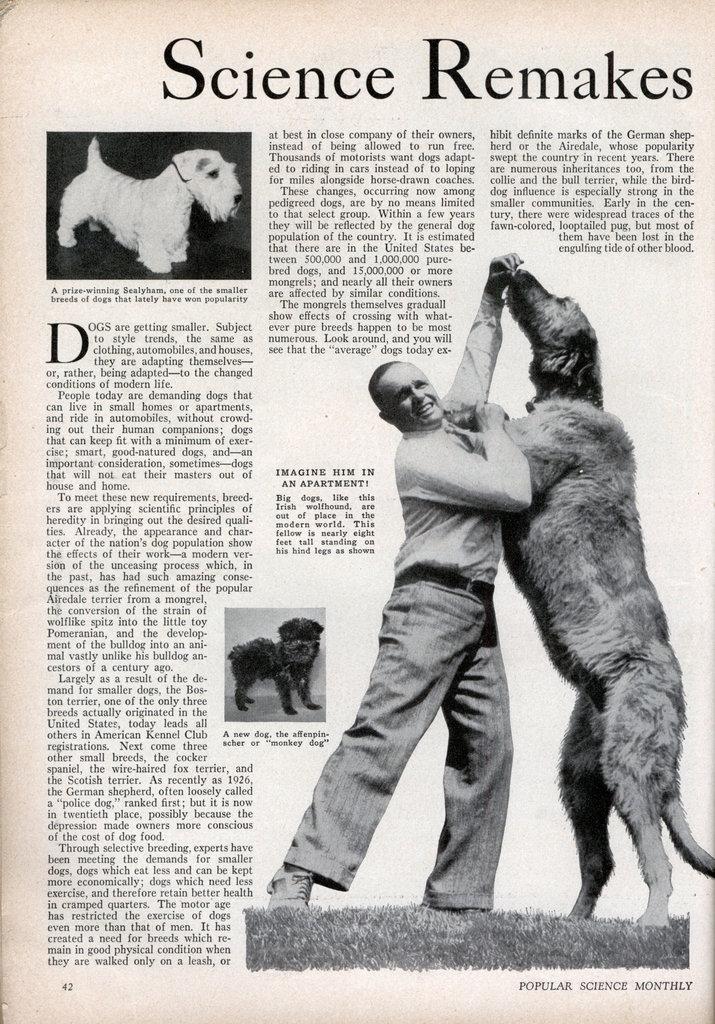
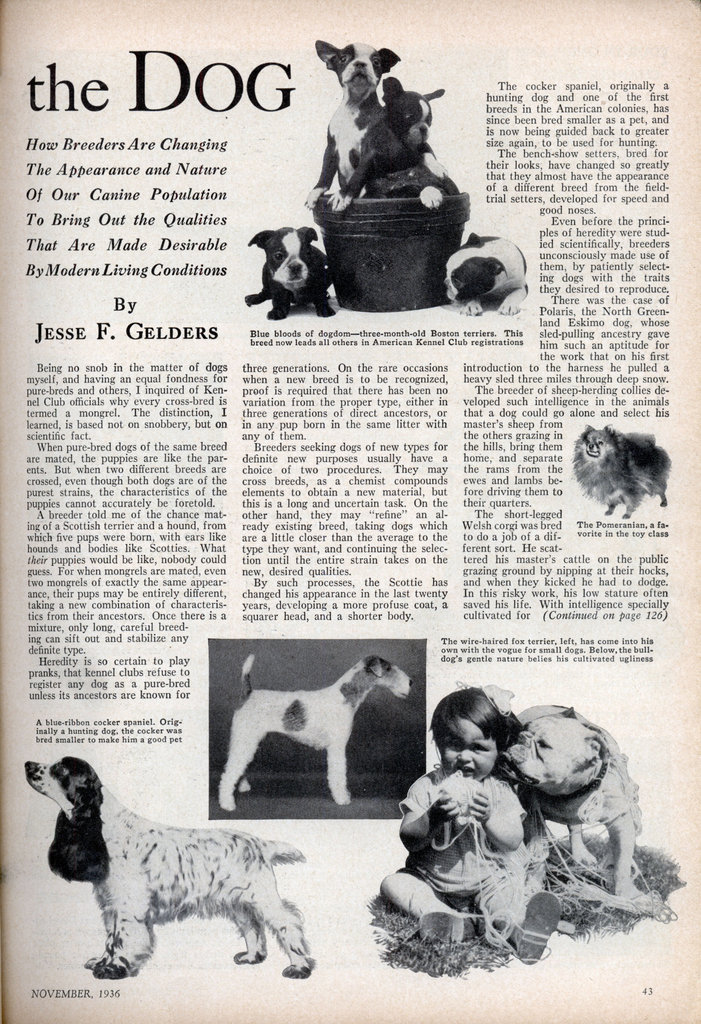
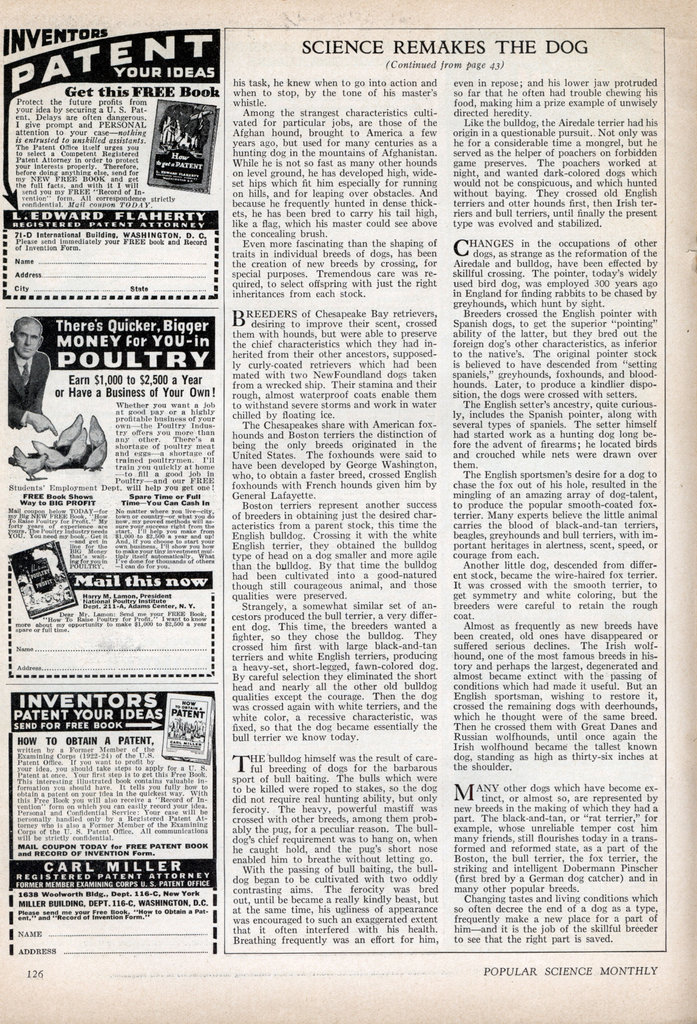
Science Remakes the Dog


An article, from the November 1936 issue of Popular Science magazine is a good representative of the kind of congratulatory back-patting that went on during this period, as show ring and hobby breeders worked overtime to draw more and more working dogs into the Kennel Club.

Not the tone of the article: "Science" is improving dogs so they will be better suited to the modern world of cars, apartments, and limited time for their care and feeding.

In fact, these market forces continue to this day, as I have noted in an earlier post entitled "Robert Bakewell's Apartment."

This Popular Science article was written when the Kennel Club was just 65 years old, but problems already seem to be cropping up.

Notice that the Cocker Spaniel seems to have been "improved" to the point that it no longer hunts.

The Scottish terrier's morphology has been transformed with the "improved" dog having a shorter back, a larger head, and a longer coat -- improvements that made the dog incapable of going down a hole after quarry, ruining it as a true working terrier.

Then you have the various types of setters where bench and field animals had already diverged to the point that they appeared to be different breeds.

Finally, the Afghan is mentioned as a new and exotic breed brought to America. How long before the show-ring variant was wrecked as a coursing dog? Not long!

It should also be noted that some of the "history" given here is Kennel Club bunk. The Airedale, for example, is a modern creation derived from the Otter hound, and bred specifically for the show ring. It was never a "night poacher's dog," being too slow and heavy for rabbit, fox, or deer. Hunting otter is not done at night; it is tough enough to see the things in the daylight!

Similarly, the English Bulldog has very little of the old bull-baiting dog in it, and quite a lot of the monstrous pug to which it is much more closely-related!

As for fox terriers, by the time this article was written, almost no one was using a Kennel Club dog for anything other than a companion dog, as a close reading of Jocelyn Lucas's book Hunt and Working Terriers (published in 1931) will reveal.

Fox-working dogs have not been "improved" by science or show ring breeders; they have only been ruined by the rosette chasers.

The original art for this article can be seen here >> Page 1, Page 2, Page 3


Science Remakes the Dog
How Breeders Are Changing The Appearance and Nature Of Our Canine Population To Bring Out the Qualities That Are Made Desirable By Modern Living Conditions

By Jesse F. Gelders


DOGS are getting smaller. Subject to style trends, the same as clothing, automobiles, and houses, they are adapting themselves— or, rather, being adapted—to the changed conditions of modern life.

People today are demanding dogs that can live in small homes or apartments, and ride in automobiles, without crowding out their human companions; dogs that can keep fit with a minimum of exercise; smart, good-natured dogs, and—an important consideration, sometimes—dogs that will not eat their masters out of house and home.To meet these new requirements, breeders are applying scientific principles of heredity in bringing out the desired qualities.

Already, the appearance and character of the nation’s dog population show the effects of their work—a modern version of the unceasing process which, in the past, has had such amazing consequences as the refinement of the popular Airedale terrier from a mongrel, the conversion of the strain of wolflike spitz into the little toy Pomeranian, and the development of the bulldog into an animal vastly unlike his bulldog ancestors of a century ago.

Largely as a result of the demand for smaller dogs, the Boston terrier, one of the only three breeds actually originated in the United States, today leads all others in American Kennel Club registrations. Next come three other small breeds, the cocker spaniel, the wire-haired fox terrier, and the Scotish terrier. As recently as 1926, the German shepherd, often loosely called a “police dog,” ranked first; but it is now in twentieth place, possibly because the depression made owners more conscious of the cost of dog food.

Through selective breeding, experts have been meeting the demands for smaller dogs, dogs which eat less and can be kept more economically; dogs which need less exercise, and therefore retain better health in cramped quarters. The motor age has restricted the exercise of dogs even more than that of men. It has created a need for breeds which remain in good physical condition when they are walked only on a leash, or at best in close company of their owners, instead of being allowed to run free. Thousands of motorists want dogs adapted to riding in cars instead of to loping for miles alongside horse-drawn coaches.

These changes, occurring now among pedigreed dogs, are by no means limited to that select group. Within a few years they will be reflected by the general dog population of the country. It is estimated that there are in the United States between 500,000 and 1,000,000 purebred dogs, and 15,000,000 or more mongrels; and nearly all their owners are affected by similar conditions.

The mongrels themselves gradually show effects of crossing with whatever pure breeds happen to be most numerous. Look around, and you will see that the “average” dogs today exhibit definite marks of the German shepherd or the Airedale, whose popularity swept the country in recent years. There are numerous inheritances too, from the collie and the bull terrier, while the bird-dog influence is especially strong in the smaller communities. Early in the century, there were widespread traces of the fawn-colored, looptailed pug, but most of them have been lost in the engulfing tide of other blood.

Being no snob in the matter of dogs myself, and having an equal fondness for pure-breds and others, I inquired of Kennel Club officials why every cross-bred is termed a mongrel. The distinction, I learned, is based not on snobbery, but on scientific fact.

When pure-bred dogs of the same breed are mated, the puppies are like the parents. But when two different breeds are crossed, even though both dogs are of the purest strains, the characteristics of the puppies cannot accurately be foretold.

A breeder told me of the chance mating of a Scottish terrier and a hound, from which five pups were born, with ears like hounds and bodies like Scotties. What their puppies would be like, nobody could guess. For when mongrels are mated, even two mongrels of exactly the same appearance, their pups may be entirely different, taking a new combination of characteristics from their ancestors. Once there is a mixture, only long, careful breeding can sift out and stabilize any definite type.

Heredity is so certain to play pranks, that kennel clubs refuse to register any dog as a pure-bred unless its ancestors are known for three generations. On the rare occasions when a new breed is to be recognized, proof is required that there has been no variation from the proper type, either in three generations of direct ancestors, or in any pup born in the same litter with any of them.

Breeders seeking dogs of new types for definite new purposes usually have a choice of two procedures. They may cross breeds, as a chemist compounds elements to obtain a new material, but this is a long and uncertain task. On the other hand, they may “refine” an already existing breed, taking dogs which are a little closer than the average to the type they want, and continuing the selection until the entire strain takes on the new, desired qualities.

By such processes, the Scottie has changed his appearance in the last twenty years, developing a more profuse coat, a squarer head, and a shorter body.

The cocker spaniel, originally a hunting dog and one of the first breeds in the American colonies, has since been bred smaller as a pet, and is now being guided back to greater size again, to be used for hunting.

The bench-show setters, bred for their looks, have changed so greatly that they almost have the appearance of a different breed from the field-trial setters, developed for speed and good noses.

Even before the principles of heredity were studied scientifically, breeders unconsciously made use of them, by patiently selecting dogs with the traits they desired to reproduce. There was the case of Polaris, the North Greenland Eskimo dog, whose sled-pulling ancestry gave him such an aptitude for the work that on his first introduction to the harness he pulled a heavy sled three miles through deep snow. The breeder of sheep-herding collies developed such intelligence in the animals that a dog could go alone and select his master’s sheep from the others grazing in the hills, bring them home, and separate the rams from the ewes and lambs before driving them to their quarters.

The short-legged Welsh corgi was bred to do a job of a different sort. He scattered his master’s cattle on the public grazing ground by nipping at their hocks, and when they kicked he had to dodge. In this risky work, his low stature often saved his life. With intelligence specially cultivated for his task, he knew when to go into action and when to stop, by the tone of his master’s whistle.

Among the strangest characteristics cultivated for particular jobs, are those of the Afghan hound, brought to America a few years ago, but used for many centuries as a hunting dog in the mountains of Afghanistan. While he is not so fast as many other hounds on level ground, he has developed high, wide-set hips which fit him especially for running on hills, and for leaping over obstacles. And because he frequently hunted in dense thickets, he has been bred to carry his tail high, like a flag, which his master could see above the concealing brush.

Even more fascinating than the shaping of traits in individual breeds of dogs, has been the creation of new breeds by crossing, for special purposes. Tremendous care was required, to select offspring with just the right inheritances from each stock.

BREEDERS of Chesapeake Bay retrievers, desiring to improve their scent, crossed them with hounds, but were able to preserve the chief characteristics which they had inherited from their other ancestors, supposedly curly-coated retrievers which had been mated with two New Foundland dogs taken from a wrecked ship. Their stamina and their rough, almost waterproof coats enable them to withstand severe storms and work in water chilled by floating ice.

The Chesapeakes share with American foxhounds and Boston terriers the distinction of being the only breeds originated in the United States. The foxhounds were said to have been developed by George Washington, who, to obtain a faster breed, crossed English foxhounds with French hounds given him by General Lafayette.

Boston terriers represent another success of breeders in obtaining just the desired characteristics from a parent stock, this time the English bulldog. Crossing it with the white English terrier, they obtained the bulldog type of head on a dog smaller and more agile than the bulldog. By that time the bulldog had been cultivated into a good-natured though still courageous animal, and those qualities were preserved.

Strangely, a somewhat similar set of ancestors produced the bull terrier, a very different dog. This time, the breeders wanted a fighter, so they chose the bulldog. They crossed him first with large black-and-tan terriers and white English terriers, producing a heavy-set, short-legged, fawn-colored dog. By careful selection they eliminated the short head and nearly all the other old bulldog qualities except the courage. Then the dog was crossed again with white terriers, and the white color, a recessive characteristic, was fixed, so that the dog became essentially the bull terrier we know today.

THE bulldog himself was the result of careful breeding of dogs for the barbarous sport of bull baiting. The bulls which were to be killed were roped to stakes, so the dog did not require real hunting ability, but only ferocity. The heavy, powerful mastiff was crossed with other breeds, among them probably the pug, for a peculiar reason. The bulldog’s chief requirement was to hang on, when he caught hold, and the pug’s short nose enabled him to breathe without letting go.

With the passing of bull baiting, the bulldog began to be cultivated with two oddly contrasting aims. The ferocity was bred out, until be became a really kindly beast, but at the same time, his ugliness of appearance was encouraged to such an exaggerated extent that it often interfered with his health. Breathing frequently was an effort for him, even in repose; and his lower jaw protruded so far that he often had trouble chewing his food, making him a prize example of unwisely directed heredity.

Like the bulldog, the Airedale terrier had his origin in a questionable pursuit.. Not only was he for a considerable time a mongrel, but he served as the helper of poachers on forbidden game preserves. The poachers worked at night, and wanted dark-colored dogs which would not be conspicuous, and which hunted without baying. They crossed old English terriers and otter hounds first, then Irish terriers and bull terriers, until finally the present type was evolved and stabilized.

CHANGES in the occupations of other dogs, as strange as the reformation of the Airedale and bulldog, have been effected by skillful crossing. The pointer, today’s widely used bird dog, was employed 300 years ago in England for finding rabbits to be chased by greyhounds, which hunt by sight.

Breeders crossed the English pointer with Spanish dogs, to get the superior “pointing” ability of the latter, but they bred out the foreign dog’s other characteristics, as inferior to the native’s. The original pointer stock is believed to have descended from “setting spaniels,” greyhounds, foxhounds, and bloodhounds. Later, to produce a kindlier disposition, the dogs were crossed with setters.

The English setter’s ancestry, quite curiously, includes the Spanish pointer, along with several types of spaniels. The setter himself had started work as a hunting dog long before the advent of firearms; he located birds and crouched while nets were drawn over them.

The English sportsmen’s desire for a dog to chase the fox out of his hole, resulted in the mingling of an amazing array of dog-talent, to produce the popular smooth-coated fox-terrier. Many experts believe the little animal carries the blood of black-and-tan terriers, beagles, greyhounds and bull terriers, with important heritages in alertness, scent, speed, or courage from each.

Another little dog, descended from different stock, became the wire-haired fox terrier. It was crossed with the smooth terrier, to get symmetry and white coloring, but the breeders were careful to retain the rough coat.

Almost as frequently as new breeds have been created, old ones have disappeared or suffered serious declines. The Irish wolfhound, one of the most famous breeds in history and perhaps the largest, degenerated and almost became extinct with the passing of conditions which had made it useful. But an English sportsman, wishing to restore it, crossed the remaining dogs with deerhounds, which he thought were of the same breed. Then he crossed them with Great Danes and Russian wolfhounds, until once again the Irish wolfhound became the tallest known dog, standing as high as thirty-six inches at the shoulder.

MANY other dogs which have become extinct, or almost so, are represented by new breeds in the making of which they had a part. The black-and-tan, or “rat terrier,” for example, whose unreliable temper cost him many friends, still flourishes today in a transformed and reformed state, as a part of the Boston, the bull terrier, the fox terrier, the striking and intelligent Dobermann Pinscher (first bred by a German dog catcher) and in many other popular breeds.

Changing tastes and living conditions which so often decree the end of a dog as a type, frequently make a new place for a part of him—and it is the job of the skillful breeder to see that the right part is saved.
.

Sunday, January 07, 2018

A Brief History of Dog Food


The first commercial dog food was introduced in England about 1860. James Spratt, an electrician from Ohio, was in London selling lightning rods when he saw miserable street dogs ganged up along the piers waiting to being tossed mouldy hardtack biscuits and scraps of rotten food.

This was a very old type of feeding called "trencher feeding" that had existed in the U.K. since before there were dinner plates. A "trencher" was a flat piece of bread once commonly used as a plate or underneath a rough wooden plate. Food was served on this bread and the bread and the table scraps (along with spoiled food and boiled knuckle bones) were then "tossed to the dogs."

Spratt decided he could do better than bread and hard-tack biscuits, and he came up with a biscuit, shaped like a bone, made of wheat, vegetables, beetroot and beef blood. Spratt's dog food company thrived, and around 1890 he took it to the U.S. where it became "Spratt's Patent Limited" which eventually diversified into other feed stocks (such as fish food) as well as veterinary medicines.

In the 1950s Spratt's became part of General Mills, and in 1960 it was bought by "Spillers" dog food company (a UK subsidiary of Purina which is owned by General Mills). Today Spillers makes "
Bonio" bone-shaped biscuits which are very similar to those once manufactured by James Spratt.

Other dog food companies sprang up, many with paid endorsements from veterinarians who shilled for them just as veterinarians shill for Hill's "Science Diet" today. Right from the beginning pet food manufacturers discouraged their clients from supplementing with anything but food out of the box. A culture of dependence was being forged.

In 1907, F.H. Bennett introduced Milkbone dog biscuits as a complete dog food and a direct competitor to Spratt.
Milkbone and Spratt's Dogs Food and Cake dominated pet food manufacturing until the 1920's when canned dog food was first introduced by Ken-L-Ration.

Canned horsemeat was cheap after World War I as huge numbers of horses and mules were being replaced by cars and tractors. The growth in canned dog food really shot up in the 1930s, and by 1941, canned dog food represented 91% of the dog food market in the U.S.

Canned dog food fell out of favor (and supply) during World War II when a shortage of tin made canning difficult and expensive, and as the horse surplus dried up. By 1946, dry dog food was king once again, and it has remained so to this day.

The production of enormous bags of "kibbled" dog foods began in earnest in 1957 when the Purina company began marketing extruded dry dog "chow" through grocery store chains. Purina followed on with cat chow in 1962. Today most grocery stores in the U.S. devote more shelf space to canned and kibbled dog food than they do to breakfast cereal or baby food.

Ralston Purina created the soft-moist pet food category in 1971, and this category now includes such foods as
Purina ONE and Pro Plan.

The rise in kibbled dog food in the U.S. seems to coincide with a rise in canine skin problems arising from canine allergies to corn, wheat and perhaps other additives to dry dog food such as preservatives, coloring, and stabilizers.


Perception is not necessarily reality, of course. In fact, not all canine allergies are due to food. At the same that pet owners were switching to bagged dog food, they were also washing their dogs more (causing dry skin) and bringing them indoors where they came in contact with carpet cleaners, laundry soaps, room fresheners, and a host of other chemicals.

In addition, the aggressive line-breeding of dogs to create new types (almost all of which were created between 1850 and 1930), served to concentrate genetic defects in certain lines of dogs -- including genetic predispositions to skin allergies.

If you think your dog may have a food allergy, the only true test is to switch foods. This is a process, however, not an event. It may take several weeks on a new diet for a dog's skin condition to improve, so it's best to start an "elimination diet" right at the beginning. This can be as simple as feeding your dog table scraps for a few weeks (no salt, no bread) which will increase variety in the diet. Once your dog's skins problems have abated, introduce a new type of food and watch for any recurrence of skin problems.

Price, quality of food and skin allergies are not closely related. Dogs can be allergic to very high-quality ingredients. In fact, the most common food allergy in dogs is an allergy to beef! Whatever food you use, I recommend that all bagged foods be bought from supermarkets or other venues with high-volume sales so that they remain fresh as long as possible.

Above all, be wary of food fads, which are always more about the human than the dog. Your goal should be a balanced diet, a dog that has healthy stools, no allergies, sound teeth, and is on the thin side.

A great deal of what you read on bulletin boards and list-servs about dog food is nonsense. Today's pet food companies and executives are not going to risk their brands, reputations and personal credibility by knowingly putting horrific ingredients in dog food.

Remember, we are talking about companies that are producing 12 million pounds of food an hour (a real number).
This food has to look and taste the same every time that it is produced, which requires a great deal of regimentation, paperwork, inspection and quality control. Dog food companies are not using road kill for ingredients (as some hysterics have claimed), but entire train loads of cheap and readily available corn, wheat, rice, potatoes, soy and beef parts, as well as breathtaking amounts of lamb, chicken and "meal" made from ground up beef, chicken, lamb and turkey (including bones). To this mixture are added vitamins and various additives for color (to please you) and preservatives (because people prefer to buy dog food in big bags that will last several weeks).

For most dogs, bagged kibble supplemented with vegetables and a few special scraps from the kitchen (a few scrambled eggs, a bit of sausage, a few carrots) works fine. Most dogs do not have skin problems of any kind, and most canine skin problems are not food related. I prefer kibbled dog food over semi-soft because I think it is better for the dog's teeth, and because the heat of the extruding process helps sterilizes the ingredients, while the dryness of the product discourages spoilage.

.

Thursday, October 26, 2017

How Many Possums Per Spoon?


Possums are North America's only marsupial and have tremendous numbers of young and more teeth any other furbearer in North America.

The bottom picture shows 7 baby possums in a tea spoon at about the time they first make it into their mother's pouch. The middle picture shows the location of the pouch. Pouch mortality is fairly high, and usually only five to eight baby possums survive to peek out in the world two months after being born. Most possums die within the first 9 months of life (killed by cats, dogs, cars, fox, poison, disease, traps, and coyotes) and few make it to age three.

A typical female possum will have two litters a year, each with as many as 18 young. The gestation period for a possum is just 13 days -- the shortest gestation period of any mammal in North America.

Opossums prefer low, damp, wooded streams and swamps. They are nocturnal, and will shelter in hollow trees, firewood racks, brush piles, groundhog burrows, and crawl spaces under houses and outbuildings during the day. Possums are very common in suburbia where they often dine on school-yard refuse, dead squirrels in the road, and cat and dog food left out on people's stoops. Complete omnivores, their tracks looks like those of a space-alien, while their scat can come in any shape and color.

Though possums will hiss a great deal, they are not very formidable creatures, as their teeth are too small, their brains too small, and their response time relatively slow when compared to raccoon, fox, or groundhog.

Thursday, May 25, 2017

Why Do Dogs Eat Grass?


Why do dogs eat grass?

It's a common question, but in asking the question, an assumption is revealed.

The assumption is that dogs are not supposed to eat grass.

After all, no one asks why we humans eat chicken, corn on the cob, fish, or strawberries.

The short answer is that dogs eat grass because it tastes good and it provides some nutrition.

It is not a sign of worms, an upset stomach, or any kind of nutritional deficit.

That's the short answer.

Now let's look at the question a bit deeper.

Do wolves, fox, coyotes, and dingoes, also eat vegetable matter?

The answer is "yes."

Wolf biologist David Mech notes that grass appears in 14-43% of all wolf scat found in North America and Eurasia. Plant material in fox and coyote scat, including grass, is so common as to be unremarkable.

Leopards, jaguars, mountain lions, and bobcats also eat surprising amounts of grass. A sample of 215 leopard scats collected in the Tai National Forest of the Ivory Coast, for example, found 17% had a considerable amount of grassy vegetable matter.

Bears too eat a lot of plant material. Though classified as the largest carnivores in the world, bears eat more vegetable matter in their diet than flesh, and grass is a major food source.

So why do "carnivores" so often eat grass?

For the same reason you and I eat most of the foods we eat; it tastes good.

Of course the other answer is that it is maladaptive for them not to do so.

Let's explore that idea a bit more.

Specialization in food sources is a terrific idea so long as the world stays exactly the same, day in and day out, season after season, year in and year out.

But, the world is both temperamental and unreliable.

Crippling winters, blistering summers, and poorly timed rains can decimate populations of prey species.

Disease can wipe out herds, migration routes can change without warming, and new species can invade.

Water holes may dry up, salt licks may disappear, and predators can injure themselves in the chase.

And yet every few days, a predator must eat.

And that's the problem: The chain of life is so easily snapped.

For a meat-eating predator, the weakest link is the absence of ready prey, easily caught, day in and day out, in good health and bad, dry season and wet, winter and summer, year after year.

And so wolves, coyotes, dingoes, bears, lions, bobcats and jaguars have all evolved to eat plants, as well as flesh -- a way of "hedging the bet" for a few days against the vicissitudes of life.

Yes these animals will try to bring down a deer- or rabbit-sized meal if they can. But if they cannot, then they will try to catch a few rats or mice, a lizard or a snake, a frog or a turtle.

And if push comes to shove, there's always grasshoppers, crickets, and verdant grass along the creek. And it does not hurt at all that some of that grass actually tastes pretty good!
.

Sunday, September 18, 2016

Don't Buy Dog Food from Hank Petchow

Back in 1995 or 1996, long before there was the kind of "Fake News" we now see everynight on Comedy Central, Saturday Night Live ran a fake dog food commercial starring Will Ferrell.

The visuals were a killer (pun intended) and showed a huge bag of kibble with an emormous picture of Shep the Huskie, and the words "PetChow" written in large letters underneath.

In very small letters, underneath that it said "Rat Poison."

The video is not embeddable, but you can see it here, and read the transcript below:


[Open on Hank Petchow running through the snow with his dog Shep ]Hank Petchow: Come on, Shep! Here we go!

Voiceover: Like most dog owners, I really enjoy playing with my dog.
[ cut to interior, Petchow household ]
Hank Petchow: Hi! I'm Hank Petchow. I love my dog, and I love taking care of him. But as much as I like feeding ol' Shep here every morning, there's some animals I'd rather not feed - rodents, mice, rats. I hate them. That's why I developed this. Petchow Brand Rat Poison. Petchow's the only rat poison deadly enough to carry my name - Petchow. And Petchow's the most powerful rat poison on the market. In fact, it's so strong, it could easily kill an animal much larger than any rat you'll ever see - instant. And rats love Petchow's big meaty pieces. [ Shep jumps up to the bowl of rat poison ] Whoa, no, Shep! That's rat poison! [ moves Shep ] Just add water for a hearty poison gravy that no rat can resist. He'll be dead on the spot. Right, Shep? [ Shep barks and moves closer to the rat poison gravy ] Whoa, Shep! Down, boy, that's not for you! [ laughs ] So, if rats are your problem, choose a name you can trust. Petchow. Just look for the rat poison with a picture of ol' Shep on it.

[ show two dogs sitting on each side of the Petchow package ]

Jingle: "Petchow. Arf arf. Petchow. Arf arf. Petchow. Arf arf. Rat poison."

Announcer: Petchow. The one they can't resist.

Thursday, August 25, 2016

Dog Food: Are You Focused on the Right Thing?


As I have noted in the past, there is NO research anywhere that shows one dog food is better than another.

That said, I recommend a couple of "filters against folly":.

  • Big, Old Companies Are Better:  Buy from a large and established dog food maker that has its own kennels and invests in research, such as Purina. These dog food makers have established feed stock suppliers, have canine nutritionists on staff, and make their own food rather than contract it out.
    .
  • AAFCO Feed Trials Are a Minimum:  Buy dog food that has been subjected to an AAFCO feed trial. No, these are not breathtakingly arduous trials to pass, but what's it say if your dog food maker has not even done this minimal level of testing?
    .
  • Grocery Stores Have Fresher Foods:  Grocery stores sell a lot of everything, including pet food, and as a consequence, packaged goods move from factory to store house to store, and to home in record time. That's important for dry kibble, as the larger the store and the more volume moved, the more likely the food has been properly stored in an air-conditioned warehouse and moved quickly before spoilage.
    .
  • Focus on Keeping Your Dog Slim:  If you are the kind of person who reads articles about dog food, then how much you feed your dog is generally more important than what you feed your dog. So long as the food is from a major AAFCO-feed trial tested brand, and is not too old, the key to nutrition is to not feed too much. If you cannot feel a rib, your dog is too fat!

I am happy to report that Dr. Lisa Freeman, a professor in the Department of Clinical Sciences at the Cummings School of Veterinary Medicine at Tufts agrees.  

In a profile in the Tuft's Daily newspaper she notes that "The most important thing is the manufacturer," and that that a good dog food company should have at least one full−time, qualified nutritionist on board, as well as a research and development department, and that it should operate its own manufacturing plans.

Dr. Freeman says to stay away from dog food manufacturers who contract out with third party manufacturers, who do not have their own nutritionists and research departments, and who do not subject their foods to AAFCO feed trials, but instead assemble a package of kibble based on a recipe. These companies are investing in marketing, not nutrition.

Dr. Freeman also says we can ignore most dog food labels -- they are a kind of advertisement and are not a meaningful window into the actual ingredients in the food or the nutritional needs of your dog.

What about dog foods that advertise themselves as "organic" or which claims they are made of  "human−grade," or "premium" ingredients or which say they are "holistic"? 

It's all meaningless nonsense, designed to separate a gullible public from their wallet.

So what's not nonsense?  

Dr. Freeman says that labels which say they are a "complete" food are telling you something (it's a legally defined term), and so too are labels which are targeted at certain life stages, such as old age and puppies (terms defined by AAFCO).

What about animal byproducts?  Dr. Freeman says there is nothing wrong with them --  they are not poor quality meat, no matter what the chattering masses might claim.  And I guess Dr. Freeman might know -- she's not only a Veterinarian, she also has a Ph.D. from the Friedman School of Nutrition Science and Policy and a Diplomate of the American College of Veterinary Nutrition" (DACVN).

So how can you tell if your dog is too fat?  Dr. Freeman has a perfectly simple instruction tip:

Make a fist and feel your knuckles. If you were feeling your dog or cat's ribs, that's too skinny.

Now flat hand, palm up and feel the base of your fingers. That's overweight.

If you make a flat hand, palm down and feel your knuckles … that's just right. That's what it should feel like, with that amount of pressure.

Nice! A simple instruction tip you can use with dog owners everywhere!

Monday, June 20, 2016

"Trencher Fed" Was Mostly Garbage Dog Food


Link to video

Contrary to what some will tell you, dogs ate relatively little beef in the "good old days." Terriers, lurchers, and hounds were typically trencher fed, a "trencher" being a flat slab of bread that lined a wooden plate.

Trenchers were, for want of a better description, a kind of medieval "paper plate," and the uneaten bits of the trencher (along with gravy, grease, kitchen scraps, and unusable offal) were tossed out to the dogs to finish off.

In the "good old days," bones were boiled white for soup, hides were tanned, fat was turned into soap and lard, and every bit of the cow and pig was used, from intestines (sausage casings) and blood (pudding), to tails (soup), and brains (fried in butter).

Unidentified bits and pieces like snouts, udders and shin meat became sausage -- sold as bangers in one country, and shnitzels in another, and choritzos in a third.

The idea that dogs were commonly fed slabs of pure beef or uncooked poultry wings is a modern fantasy.

At best dogs were fed kitchens scraps, and these scraps were often heavy with salt and smoke (the most common preservatives prior to refrigeration) and therefore not particularly healthy.

The term "trencher fed," is often used in 19th Century literature to refer to the old hound management system in which hounds (and sometimes terriers) were kept by individual farmers at their home and then brought to a meet to form a pack with other hounds on a hunting day.

A "trencher fed pack," then, was a pack of dogs assembled on the day of the fox meet, and raised on a catch-as-catch-can diet of table scraps and kitchen waste.

Today, the most common food problem a dog is likely to face is that it is very likely to be overfed and given too many vitamins.

Modern foods are often calcium-rich and vitamin packed. The result, especially in large dogs, is very rapid growth which can exacerbate pre-existing tendencies to dysplasia.

Is the "natural" diet of the dog prime beef and chicken?

No.

As I note in a previous post, entitled Feed Me Like a Wolf,

The preferred diet of the wolf is not cooked backstrap from the pride of the herd, but raw flesh ripped from the diseased rectum of a downer cow.


You want to know what the "natural diet" of a dog is?

It's garbage -- what Pariah dogs are eating right now, the world over.
.

Tuesday, January 19, 2016

The King of Terriers or the King of Bull?


Click pic to make bigger.

I love this ad for Spratt's Dog Cakes (the beginning of modern dog food and the product sold by Charles Cruft), not for the picture but for the dog-dealer text:

"I enclose for you a photo of 'STIPENDIARY," the King of Terriers, whom I feed entirely on your biscuits. When I tell you he has sired upwards of £20,000 worth of Terriers, you may understand that he is quite the father of his people."


For the record, S.J. Stephens was one of those people who figured he could buy his way to a good kennel.

Work a dog? Know what he was buying or why? There was none of that with Stephens. He simply bought what was winning at the shows, and at one point sent a blank check (by messenger) with the instruction: "Fill in any amount, and it will be fine."

And what did Stephens get out of it?

The same thing people get today for doing exactly the same thing: quick and ready fame, on the cheap, and without any real work or expertise.

For the cost of a decent sailboat, a complete ignorant and fool can buy a kennel of top dogs, and for a few score thousand dollars more he can have a paid handler trot those dogs around the ring while he takes a bow in the press.

Is this done? All the time!

Tuesday, January 12, 2016

Dog Food Recipes Cannot Be Patented


Jane E. Brody interviewed Marion Nestle, a professor of nutrition and food studies at New York University and an author of a book on dog food entitled “Feed Your Pet Right: The Authoritative Guide to Feeding Your Dog and Cat":

[Nestle] noted... that the so-called premium pet foods cost three to four times more than supermarket brands. Within the premium brands, there is also a wide price range, yet when the ingredients lists are compared, they are strikingly similar since all have to meet certain nutritional standards. The first five ingredients of nearly every kind of dog and cat food are generally the same, representing protein, fats and carbohydrates

“All pet foods are made from the byproducts of human food production,” Dr. Nestle explained. “No matter what the package says, your dog is not getting whole chicken breasts, but what remains after the breasts have been removed for human food.”

And, indeed, it is primarily human food companies — Nestlé, Purina, Mars and Procter & Gamble — that make the pet foods sold throughout the world. Of course, in much of the world, domestic dogs and cats survive on table and street scraps, not commercially produced pet foods. In seeking evidence for the added value to health and longevity of commercial pet foods, the authors found almost none with any validity.

No agency requires proof of pet food health claims, and no pet food company is willing to invest in decades of research to determine whether its products keep animals healthier and extend their lives, the authors state. Pet food companies say they do research, but it is rarely done in a scientific fashion, with comparable control and experimental groups. There is, however, ample evidence that, despite claims to the contrary, both dogs and cats “are perfectly able to digest grains if they are cooked,” Dr. Nestle said.

None of this should imply that different pet food products make no difference to individual animals. When my friends’ havanese began licking its paws incessantly, the vet suggested they try a corn-free pet food, which stopped the itching. However, they need not spend $31 for a 12.5-pound bag of premium food free of corn; Costco’s Kirkland Super Premium Dog Food, also free of corn, costs about $15 for a 40-pound bag.

Still, Dr. Nestle suggested, “if one or another brand seems to completely change the way a dog behaves or cures an allergy, when you find something that works for you, stay with it.”

While many pay good money for marketing gimmicks, Dr. Nestle also does not object to people paying for attributes they value. If characteristics like natural, organic, holistic, vegetarian or kosher are important to pet owners, it may be worth it to them to pay top dollar for pet foods that claim to provide the desired attribute, even if there is no official or enforced definition of the claim.

Although some owners insist on cooking for their pets, the authors said animals are more likely to get all the nutrients they need, and in the right amounts, from a commercial product.

“Besides, the pet food industry serves an important ecological function by using up food that would otherwise be thrown out,” Dr. Nestle said. “If everyone cooked human food for the 472 million cats and dogs in America, it would be like feeding an additional 42 million people.”


Strip that down, and what does it mean?

Simple:

  1. No dog food is proven better than any other.
  2. Almost all dog food is more-or-less the same with only slightly different proportions of protein, fats and carbohydrates.
  3. As a rule, dogs do fine on grain-based foods.
  4. Individual dogs may have allergies to certain foods, but price has little or nothing to do with food quality, and even grain-free foods can be had for very little money.
  5. Making your own dog food is not the "Green" way to go; it increases waste in the food chain.


Why have pet food company's never published research showing one food is better that another?

The article does not say, and seems to suggest that billion dollar companies like Purina are too lazy or unscientific to care.

Not true.

The real story is simpler: recipes cannot be patented or copyrighted.

Find a better dog food formula, and everyone will have it and use it.

Of course, the same is true of human food where there is also no scientific evidence to support the notion that one packaged diet is better than another. And yes, there are packaged diets for humans -- ask Jenny Craig!

Which is not to say that a whole lot of food research has not been done.

It has, for both people and dogs.

But what it shows, in both cases, is that what you eat maters a lot less than how much you eat.

Less is more. Run your dog light, and you will run your dog longer. Lean is life.

If a recipe cannot be copyrighted or patented, what's that mean for both human food and dog food?

Simple: in the business of food, minor manufacturing techniques and branding issues matter.

Reese's does not have patent or copyright on the idea of putting peanut butter and chocolate together, but they do have a patent on the machines that make their product, and a copyright on the packaging and even shape of the cup. Ditto for other processed foods.

In fact, one can argue that one reason we eat so much processed food is that food companies stay up all night long trying to think of a patentable or copyrightable food element.

Here, packaging and novelty matters more than content because a package can be copyrighted, and a production machine can be patented, but a recipe is forever unprotected.

What that means for dog food is that what you are mostly getting with higher prices is hype, promotion, nonsense, bunk, novelty and packaging, not nutritionally better food.

Of course, that will not stop some people from spending their money on it, and if that's where you want to do, God bless and God speed. But just be sure to run your dog light. If you cannot easily feel two or three ribs (or see them on a smooth coat after a good run), your dog is too fat. Feed less.

Wednesday, May 06, 2015

A Well Fed Dog is Never Fat

This article was written for the August 2009 issue of Dogs Today.

I am always a bit amused at how many people have strong opinions about dog food, and how few of these opinions are supported by common sense.

For example, most dog food debates are about quality rather than quantity. And yet, quality hardly matters as most dogs (even most working dogs!) can easily have their nutritional needs met by grocery store kibble or carefully selected table scraps.

Which is not to say that everything is fine in the world of dog food. The problem, however, is not too low a quality of food; it's too high a quality of food, and too much of it too.

Fat dogs are not only losing years off of their lives, but they are also costing their owners billions in unnecessary veterinary bills.

Most of the problem is that people are over-feeding their dogs out of guilt for spending too little time with them.

Another factor, however, is that many modern dog foods are packed with calories which means "just a little more" may end up putting on real pounds. Add in chronic lack of exercise, and you have the same prescription for fat pooches as for obese humans.

It's not just too many calories. Modern dog food is also loaded with vitamins and calcium, and this triple combination means many large-breed dogs are growing up faster than God intended, and as a result they are suffering from increasing amounts of nutrition-related dysplasia.

Are canine web sites and list-servs abuzz about the need to feed dogs less in order to keep them in proper weight?

They are not.

It's estimated that 35 percent of the dogs are over-weight and obesity is the number one killer of dogs and people in this country, but that conversation tends to strike a little too close to home.

Put three people in a room and talk about obesity as a health issue, and at least one of those people is going to cop an attitude: Are you talking about me??!

Which circles us back to the issue of dog food. When people ask me what I feed my own dogs, I tell them grocery store kibble. What brand? I feed Purina at the moment, but what brand does not really matter so long as it is the proper amount. There is no research -- not one whit -- that shows that one brand of dog food is better than another.

Nor, might I add, is there any research to show that corn in commercial dog food is bad for dogs, or that pumpkin, millet, barley, deer, beaver or any other exotic mix is good.

Why do I feed my dogs kibble? Simple: Kibble has been treated with fire.

While cooking does not cure all ills, it cures most, and that is especially important with meat. The more you know about meat -- any kind of meat -- the more likely you are to order your steaks "well cooked."

Whatever brand of kibble you choose to use, one thing is almost guaranteed: your dog will end up eating better than you do.

Not only is most grocery store dog food balanced for proteins, fats, and carbohydrates, but it has probably been tested in the real world with scores of thousands of dogs thriving on it for many years.

Can most dog owners say that about the food they eat? I think not!

As for dog food being full of snouts, lungs, udders, and shin meat, it most certainly is. It also has chicken feet ground up in it, as well as bones and beaks, and pieces of tail, testicles and cow privates.

All of this is excellent food, and most of it was "human quality" until very recently.

Of course, in the English-speaking world we mostly turn our nose up at such stuff. We demand that all meat be the very choicest cut served on a white napkin placed on top of a foam plate. The meat must be dyed the right color to make it pleasing to the eye, and the whole thing must be shrink-wrapped, dated, bar-coded and placed in a cold packing crate in the super market. Only then will we buy it.

Blood and guts? Testicles and snout? Entrails and feet? Most people shudder at the thought of eating those parts of a pig or cow that nurtured their grandparents not so long ago. Go overseas into the markets of Eastern Europe, Latin America, Africa and Asia, however, and people are still eating everything, including the squeal. Ox Tail soup? Bones for Ossobuco? Udders, stomachs and lungs for sausage? Testicles for breakfast? All good food.

What is laugh-track funny are the folks who pop up in every dog food debate to talk about the diet of wolves.

You see, whether wolves are chasing caribou in the Arctic, pulling down wild boar in Russia, or stalking buffalo in Kansas, they are all doing the same thing: they are looking for the young, the sick, and the infirm.

A downer cow? To a wolf that's the dinner bell ringing.

Yes, that's right: The preferred diet of the wolf is not cooked backstrap from the pride of the herd, but raw flesh ripped from the diseased rectum of a downer cow.

Funny how that fact never makes it into all these conversations about "natural" dog foods.

Nor is it ever mentioned that wolves eat a lot of rabbit, deer and rats riddles with round worms and other parasites. Disease? A wolf likes nothing better than a diseased animal; they are so much easier to catch.

Unlike your kibble-fed dog, wolves are not eating flesh from healthy animals that have been given vaccines, regular vet checks, dosed with antibiotics, and given unlimited amounts of high-quality feed and clean water.

But that's what our dog food is made out of.

And then, to make it even better, we stir in corn, rice, and wheat in order to increase fiber and add carbohydrates. We also add in vitamins and micronutrients, as well as preservatives to keep the whole thing fresh. Then we grind it all fine, cook it, extrude it, fire it hard into bite-sized nuggets, and put it in hermetically-sealed stay-fresh bags.

Poor dogs! If only they had quality foods!

Bottom line: Relax about what you are feeding your dog.

You are not a bad owner because you feed your dog a commercial kibble bought at the local grocery store.

Nor are you a better owner because you pay a lot more for an expensive product made from exotic ingredients.

Just remember this simple rule: A well-fed dog is never fat. If you truly love your dog, you will never over-feed it.