Showing posts with label conservation organizations. Show all posts

Thursday, January 19, 2017

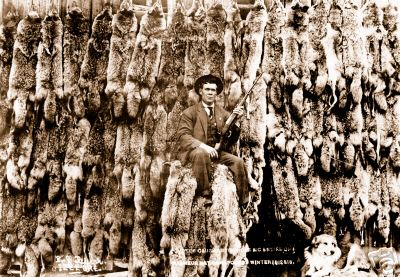
Shooting Out the Land


Ranger McEntire of the Malheur National Forest (Eastern Oregon), Winter 1912 - 1913
A repost from this blog circa 2005

In 1887, 14 years before he became President, Theodore Roosevelt joined with a distinguished group of sporting Americans -- including George Bird Grinnell, William Tecumseh Sherman, John Lacey, and Gifford Pinchot -- to form the Boone and Crockett Club. The men who created the Boone and Crockett Club were all dedicated hunters. Grinnell was editor of Field and Stream magazine, a hunting and fishing journal, and as editor, he was shocked at the rapid depletion of America’s wildlife due to unregulated market hunting

Though by charter the Boone and Crockett Club numbered only 100 people, it was a very influential group. John Lacey eventually became a Member of Congress from Iowa and, in 1900, just before Roosevelt became President, he managed to get Congress to pass the Lacey Act which made it a federal crime to transport wild game across state lines if had been killed in violation of state laws — the first federal restriction on commercial market hunting in the United States.

Roosevelt, of course, became Vice President and then President upon the assassination of William McKinley. An avid sport hunter, Roosevelt was also an accomplish naturalist, and counted among his friends John Muir, the founder of the Sierra Club, and best-selling wildlife author John Burroughs.

It is hard to overstate the importance of hunting in Roosevelt’s life. Suffice it to say that he chose not to run for President after his second term so that he could go to Africa on a year-long safari, hunting big game and collecting specimens for the Smithsonian Institution.

During his presidency (1901 to 1911), Roosevelt more than tripled the National Forest system to 148 million acres (and made Gifford Pinchot the first Chief of the U.S. Forest Service), oversaw the creation of 150 new national forest areas in 21 states, created four national game preserves, 51 federal bird sanctuaries, and established 18 national monuments. No president, before or since, has created such a sweeping public lands legacy.

In 1911, shortly after Roosevelt left office, Congress passed the Weeks Act to authorize the purchase of forest lands in the east. Much of this land later became part of the National Forest system in the eastern United States.

That same year the American Game Protective Association (AGPA) was founded and funded by gun and ammunition companies such as Winchester. This was the first sportsman-supported organization in the U.S. with a full-time professional staff, and it was later renamed the Wildlife Management Institute. In 1913, the shooting of migratory birds was regulated — the first step toward building back game bird populations deeply impacted by over-hunting.

America’s hunters lead the charge for wildlife habitat protection and the regulation of hunting seasons, providing an intellectual and moral framework now known as “hook and bullet conservation”.

Hook and bullet conservation has produced truly astounding results in the U.S. over the course of the last 100 years. Despite a three-fold increase in the U.S. population since 1900, we now have more bear, cougar, buffalo, turkey, elk, geese, duck, fox, raccoon, possum, alligator, groundhog, bald eagle, pronghorn, wolf, coyote, bobcat, and deer than at any time in the last 100 years. Beaver, turkey and river otter have been reintroduced into areas where they were wiped out, and wolf, elk and cougar are beginning to return to the east.

All of this has been made possible because the land and the forest -- otherwise voiceless -- has a voting constituency among American hunters and anglers. Not all hunters and anglers are good sportsmen who understand the need for conservation, but all good sportsmen are conservationists who understand the value of habitat and self-restraint.
.

Friday, November 13, 2015

The Real Threat to Hunting


A repost from this blog, July 2004.

For hunters, fluttering orange tape and popsicle-colored sticks mean only one thing: Doom.

This is the spoor of the tract-home surveyor. This is the end of the game.

The hill where your terrier worked that fine red fox last season will soon be covered by plastic-sided houses and kiddie swing sets.

The hedgerow you counted on for the occasional raccoon and a steady supply of groundhogs will soon be an asphalt ribbon.

Across the country the same story is playing out, again and again. It is not PETA that is hammering hunters, but real estate developers.

Pheasant, quail and bear are long gone from most areas, as are bobcat, cougar and wolf.

Even if deer and geese manage to thrive on 15-acre tracts, the American hunter will not.

When land is cut up into small parcels, acquiring permissions is difficult and firing a gun impossible. More houses means more roads. It does not take too many roads before a man with working dogs no longer feels comfortable letting them off leash.

Most of us know the big picture: forests are falling to farms, and farms are falling to freeway all over the planet. Across the globe wild rivers are being dammed, and increasing numbers of species are being pushed on to the endangered species list. Cars, factories and electricity-generating power plants are spewing forth greenhouse gases contributing to global warming, even as mile-long gill nets decimate fishing grounds, and raw sewage spills untreated into once pristine waters.

The environment is not committing suicide -- we are killing it. As Pogo so aptly put it, "we have met the enemy, and he is us." The common denominator to every clearcut forest and decimated hedgerow is human population growth.

It’s hard to overstate the speed of human population growth. It took perhaps two million years to add the first billion people to the population of the world -- a number reached about 1830. It took only 100 more years to add the second billion people (1930), and just thirty more years to add the third billion (1960). The global population counter clicked past four billion by 1975, five billion by 1987, and six billion by 1999. World population will climb past seven billion within the next 15 years.

It’s hard to get a handle on such numbing numbers. Let's bring it closer to home to gain a little perspective. Surely, we have nothing to worry about here in the United States, right?

Think again.

Consider what has happened in your own lifetime. Take a look at the table below, and find your approximate age in the far left column. The number next to it is the size of the U.S. population when you were born, and the number to the right of that is the relative population growth that has occurred in the U.S. since then.


Of course, the U.S. population growth that has occurred since you were born is only part of the story.

Let’s think for a minute about the U.S. population growth that will happen over the rest of your lifetime. I will use middle-range Census Bureau projections even though these numbers have consistently been too low for over 50 years because Census Bureau demographers habitually under-estimate illegal immigration and over-estimate emigration (people leaving).

In the table below, look in the left column to find your approximate age -- or the age of your children or grandchildren if you prefer. Now look at the next column to see what the population of the U.S. will be when you (or your children or grandchildren) are age 70. The third column gives the percentage population growth that will occur in the intervening years. Again, these are very conservative numbers.


Another way to think about these numbers: over the course of the next 50 years, using the very conservative mid-range projections of the U.S. Census Bureau, the U.S. will add about 150 million people to its population -- a sum greater than the population of the United States west of the Mississippi River today.

To put it another way, over the course of the next 50 years, the U.S. will add more than twice the current population of the United Kingdom.

Where is all this population growth coming from? Most of it originates overseas.

About 70 percent of all future U.S. population growth will be due to immigration (legal and illegal) and the children and grandchildren of immigrants that have not yet landed on our shores. In a very real sense, America's hunting and angling future is being determined in Karachi, Mexico City, Beijing, Moscow, Dublin and Hanoi.

Most of the organizations that we think of as protecting the environment and sports hunting do not mention the speed of U.S. population growth, not because it is not an issue, but because they are afraid that talking about limits on immigration might harm future membership growth. After all, today's illegal alien is tomorrow's permanent resident alien or U.S. citizen, right? At the top reaches of organizations as divergent as the Sierra Club and the National Rifle Association, success is not defined by what is going on in forest and field, but about what can be done to grow out the membership base now and in the future. Association executives are as enamored with population growth as any real estate agent or strip mall developer.

I suspect it will only be in hindsight that we realize what we have lost and what we have gained. Very few people notice the absence of box turtles or make the connection between population growth, habitat change, and Lyme disease.

Only when we are very old and America has changed to the point where we no longer recognize it will we understand the wisdom of Sioux Chief Ben American Horse, who warned Vice President Alben Barkley, "Be careful of your immigrations laws. We were damn careless with ours."
.

Friday, December 23, 2011

22,963 Ducks Land in Laurel, Maryland

Duck wings.

National Georgraphic explains all, in a piece entitled: Hunters: For Love of the Land.  A brief squib:

The great irony is that many species might not survive at all were it not for hunters trying to kill them. All the wings provided to Norman Saake and his colleagues throughout the country come from hunters, who fold them into prepaid envelopes, record the date and place of harvest, and mail them in. It is but one example of how the nation’s 12.5 million hunters have become essential partners in wildlife management. They have paid more than 700 million dollars for duck stamps, which have added 5.2 million acres to the National Wildlife Refuge System since 1934, when the first stamps were issued. They pay millions of dollars for licenses, tags, and permits each year, which helps finance state game agencies. They contribute more than 250 million dollars annually in excise taxes on guns, ammunition, and other equipment, which largely pays for new public game lands. Hunters in the private sector also play a growing role in conserving wildlife.

Read the whole thing.  Excellent.
.

Monday, December 19, 2011

Christmas Bird Count Illuminates an Old Fable


The National Audubon Society is in the midst of its annual "Christmas Bird Count," which is mostly an unscientific "bird feeder" bird count done when those birds which are at greatest risk of decline (i.e. neo-tropical migrants including most grassland birds) are actually down south in Mexico, the Caribbean and Central and South America.

In short, this is the wrong time of year to count birds that are truly at risk!

That said, the 111-years worth of data collected by the "Christmas Bird Count" does have some use, if for no other reason than to prove that one of the biggest fables about Bald Eagles and Osprey is more than a small lie.

What's the story? Simple: that Bald Eagles and Osprey were pushed to the edge of extinction by DDT.

Not quite true. 

In fact, Bald Eagles and Osprey were pushed to the edge of extinction by bullets and leghold traps long before DDT showed up on the scene. See this previous post for more information about that.

This is NOT to say that the ban on DDT was not good for birds, only that the notion that Bald Eagles and Osprey were specifically driven off the map by DDT is simply not true, and obscures an important story about the value of the Bald Eagle Protection Act of 1940, and the Endangered Species Act of 1973.
.

Friday, September 16, 2011

Happy Birthday Greenpeace


Happy 40th Birthday to Greenpeace.  I do not always agree with their tactics, and sometimes I  disagree with their short-term goals, but I am happy they exist, as they generally serve to:
.
  • torment those that would destroy our forests in the name of junk mail and one-sided xerox copies;
    .
  • afflict those that would kill our oceans in the name of all-you-can-eat shrimp at Red Lobster and cheap sushi at trendy fern bars;
    .
  • vex those who would bulldoze our mountains so we can continue to enjoy the "right" to leave the lights burning in our offices while we are sound asleep in our beds.
    .

Thursday, September 30, 2010

Excuse Me, We Are Not Extinct!

Gilbert's Potoroo

Over at Wired Science they are talking about extinction.   It seems a couple of University of Queensland scientists have more-or-less reposted what I wrote a few years back.  No doubt a case of parallel evolution!   As Wired Science notes: 

There may be many more “extinct” mammals waiting to be rediscovered than conservation biologists previously thought.

Categorizing a mammal species as extinct has rested upon two criteria: It has not been seen for more than 50 years, or an exhaustive search has come up empty. But “extinct” species occasionally turn up again, and some species have disappeared more than once. Australia’s desert rat kangaroo, for example, was rediscovered in 1931 after having gone missing for almost a century, only to disappear again in 1935 when invasive red foxes moved into the area of the remaining survivors.

In order to determine how often extinct species had been rediscovered, University of Queensland scientists Diana Fisher and Simon Blomberg created a dataset of 187 mammal species that have been reported extinct, extinct in the wild, or probably extinct since 1500, as well as those which have been rediscovered. They also looked at historical data on the threats that caused species to become extinct — or brought them close to it — including habitat loss, introduced species and overkill by humans.

It turns out that rumors of the extinction of over a third of these species have turned out to be premature, the scientists report in the Proceedings of the Royal Society B September 29. At least 67 species — a little over a third of those presumed to be extinct — were later found again. And in most cases, these were animals that had been hardest hit by habitat loss. Humans and invasive species have been significantly more efficient killers; it’s rare that a species reported extinct due to one of these causes has been seen again.

“If you think that a missing species is extinct and the main cause of decline was introduced predators such as feral foxes, cats or rats, then you are very likely to be right,” Fisher said. But, she added, “If the main cause of decline was habitat loss, you are quite likely to be wrong if you say that it’s extinct, unless it was restricted to a very small area.”

Sound familiar?

In fact I wrote exactly the same thing back when I was director of the Population and Habitat program at the National Audubon Society.

An email memo I wrote in 2003 made it up as post on this blog in 2005 as "Thinking About Species Lost" and again in 2006 as "Condors and Species Lost".  As I noted at the time:

Here's the scoop: Over the course of the last 400 years, only about 820 species of vascular plants and vertebrate animals are listed as having gone extinct by the IUCN Red List. In addition, the IUCN reports several species being "rediscovered" every year after having previously listed them as "lost...

The death of any species is important, but I also want to know the circumstances of the decline or extinction. I consider the loss of the Passenger Pigeon and the Eskimo Curlew (there were once millions of these birds flying over vast areas of this continent) a much more significant tale than the loss of a species of flightless rail on a small island in the Pacific. One extinction signals the total loss of a once very common species that was successful over a very large area. The other signals the total loss of a very rare species that was NOT successful over a very large area. There are very different lessons to be learned from these very different stories.

Most people are surprised to learn that most extinctions are of the latter type (fairly unsuccessful species in very isolated locations) and not the former (fairly successful species in fairly common locations). They are further amazed to discover that habitat loss is a much rarer cause of species extinction than the introduction of rats, cats, goats and pigs -- or of indiscriminate hunting. If you go through the IUCN Redlist of extinct species, for example, you find zeros for most countries (no known endemic species pushed into extinction), but incredible numbers of extinctions for such tiny islands as Mauritius (41 extinct species), Réunion (16 extinct species), Saint Helena (29 extinct species), French Polynesia (67 extinct species), and the Cook Islands (15 extinct species). In fact, these little spots of land, along with Hawaii, account for about 200 of the 812 species pushed into extinction over the course of the last 400 years.

In a 2007 post entitled "Are There More Species Now than Ever Before?," I wrote:

Every year about as many previously "extinct" species are "found" and crossed off the list as are added to the list.

Recent examples include the pale-headed brush-finch, the coontail plant, the Uinta Mountain snail, the Golden-crowned manakin, the Ventura Marsh Milkvetch, the San Fernando Valley Spineflower, the Los Angeles Sunflower, the Bavarian Pine Vole, and Gilbert's Potoroo.

The IUCN notes that "In the last 500 years, human activity has forced 816 species to extinction," yet the IUCN also make regular announcements about formerly "extinct" species being refound.

The question of what to do with animal and plant species that are "created" or "recreated" also muddies the water somewhat. Selective breeding is bringing back the extinct Burchell's zebra and Quagga, for example, while hybridization is occurring so often between plant and animal species that species creation of some kind is clearly occurring at a very rapid rate.

If we are willing to declare the Asian lion a separate species teetering on the edge of extinction even though "the [genetic and visual] difference is less than that found between different human racial groups," why not count the fertile progeny of lion and tiger crosses as a new species as well (ligers and tigons)?

Bird and plant crosses are so frequent that they are almost impossible to list and document.

So are we losing species or gaining? Can it be said -- straight-faced -- that there are now more species than ever before?

Of course, talking about the true nature of species loss is not designed to make you popular in the world of direct-mail nonprofits! 

After my email memo on species loss went out, the Legislative Director at Audubon called me in and said another Big Green nonprofit group was in the process of putting out a massive direct mail piece claiming Pronghorn Antelope were almost extinct!   

The instructions were clear:  Shut up about the science!  Never mind the fact that this was a subspecies whose "pure genetic stock" had been compromised by imports more than 50 years earlier.  Never mind the fact that more than a million Pronghorn were still gamboling around in Wyoming alone.  Shut up!   If we have to salute bad science and myth in order to keep the direct mail returns up at another Green Group, then by God, that is what we we will do.

Message received!


.
Gilbert's Potoroo today.
.

Friday, August 13, 2010

My Old Man and the Forest


You say you love America and want to preserve it as it is?

Good idea, and simple enough: Buy some of it.

Yes, that's right: save land the old fashioned way.

Buy it.

Buy land in a strategic manner, and give it back to the State or the Feds or a local conservation trust or conservancy so that it is part of a larger aggregated whole that can be handed down to your children and grandchildren to come.

People are doing this all over this great nation, and you should suit up and join the effort.

No, you do not have to be rich to help. In parts of this country, you can still buy land for a few hundred dollars an acre, and most everywhere you can still buy it for a few thousand dollars an acre.

Give an acre ... or 10 .... or more.

My father (see below) gave a square mile of land to the Kentucky Natural Lands Trust to help build the Pine Mountain Legacy Project, which aims to connect existing protected areas on Pine Mountain to form a contiguous forest block and migratory corridor from Virginia to Tennessee —- a distance of nearly 110 miles.


First Square Mile for Pine Mountain

David Burns is the first donor of a square mile of land to help preserve old-growth forest and habitat on Pine Mountain in eastern Kentucky.

Burns gave to Kentucky Natural Lands Trust from 1997 to 2007 to purchase a square mile – 640 acres – for the Pine Mountain Legacy Project. KNLT is drawing attention to the First Square Mile to inspire others to give a mile, or a half-, or a fourth-.

Burns, 79, of Washington, D.C., says, "To me, it’s obvious. Kentucky's mountains are beautiful and full of life. If we want mountains for future generations – and our mountains are being blasted away right now – then we must buy the land and protect it. I am not rich, far from it. But I asked myself, is there a goal I might achieve
-- even if I'm able to give only a tiny bit at a time? So I pledged to do it. It was a stretch, and it took ten years, but it happened. This is the most significant thing I have ever done.'

David’s love of Kentucky's mountains developed as a child in Pineville. His ancestors are noted in Families and History [Bell County Historical Society] as early as 1808. His father, Judge Burns, worked for the Railway Express (Dave calls it "the UPS of its time and place.") The L&N depot was daily entertainment.

Dave’s mother, Louise, worked for the Modern Bakery, wrapping cakes (the beginning wage -- ten cents an hour! -- was common in 1940). Sweet cakes were essential for miner’s lunch pails.

Dave's uncle, thanks to intelligence and 'seniority,' eventually rose to superintendent of International Harvester coal operations at Benham.

Another relative, Annie Walker Burns of Wallins Creek, wife of his Dad's cousin, initiated the Mountain Laurel Festival to honor Dr. Thomas Walker. The festival was first held in 1931 at Clear Creek and is now Kentucky’s longest-running festival.

At 15, Burns made his way to Washington, D.C. "I was," he says, "an out-of-control adolescent with no adult supervision. Political patronage saved my life! Alben Barkley, majority leader of the U.S. Senate, gave me a job, and I attended Page School in the basement of The Capitol." Dave later had a second job as copy boy for The Washington Evening Star.

He served 1946-49 in the U.S. Air Force. He never graduated from the first half of tenth grade. He was rejected by the U. of Kentucky (and many other colleges), but was admitted to Princeton. "I wrote long letters to everybody I had ever heard of; I promised the Dean of Admissions 'I won't let you down.'" He graduated with
honors and won a Fulbright for graduate study in France and Austria.

He joined the Foreign Service in 1955, serving at U.S. missions in Damascus, Beirut, Isfahan, Rhodesia, Tunis,Bamako, and Algiers, and studied Arabic for two years in Tangier.

He was Project Director (1978-1990) of the American Association for the Advancement of Science, coordinating scientists around the world to produce scientific studies of causes and effects of greenhouse climate change.

Burns is also a musician and writer. He led the Hot Mustard Quintet (1970-2005), which performed hundreds of gigs in the Washington area (and in Jakarta, Sumatra and Bali), and produced seven CDs. He is a singer and pianist, and also plays trombone, string bass, and tuba. His love of music started as a child in Pineville where, at age 2, he would sing atop marble soda-fountain counters at Rexall and Flocoe drugstores, earning a penny per song.

"I love music. But, really, my obsession is books!" As a child, he set a goal to read every book in the Pineville Public Library. "Well, I might have gotten close -- we didn't have that many books in 1934!" In fifth grade, he read The World Book Encyclopedia, A-to-Z.

The appetite for words led to writing. Dave’s articles and op-eds have been published widely, including The New York Times, Wall Street Journal, Los Angeles Times, and The Washington Post. His book, Gateway: Dr. Thomas Walker and the Opening of Kentucky, is a richly-illustrated account of the first colonial explorer of Virginia's unknown 'wilderness' -- America's first Western frontier.

Burns and his brother donated $10,000 to create a Historical Site to honor their mother. The site is where Walker first saw and named the Cumberland River. A platform provides a dramatic vista through Pine Mountain Water Gap (known locally as "The Narrows.")


Anyone with the desire to join Burns in protecting a square mile, half a square mile, or any amount of natural areas on Pine Mountain, can contact KNLT at 1-877-367-5658 or email us at info@knlt.org.


In Kentucky, West Virginia, Tennessee and Virginia we use to think the mountains would be there forever.

But that's not really true, is it?

Today we have mountain top removal, in which the tops are cut off the mountains, the coal is scooped off, and the toxic slag is pitched into the creeks to poison our fish and communities forever.

The jobs created are few, and the profits are shipped off to New York City.

Kentucky keeps the poison and New York City keeps the cash.

This is the oldest game in America -- what my old friend Garrett Hardin used to refer to as the CC-PP game of privatizing the profit and communizing the costs.

America deserves better, but it will not get better so long as people like you and I sit on our wallets and our asses.

Fight mountain top removal with a click of your mouse.

And donate land, either in Kentucky or closer to home in your own state or community.

Yes, America is worth fighting for and it's certainly worth protecting. But remember that not all the fights are overseas, and not all of those hell-bent on destruction live in far-off lands.


.

Thursday, June 03, 2010

American Hero: Real Hook & Bullet Conservation


This isn't the NRA. This is real hook and bullet conservation.

From Oxford American, the "southern magazine of good writing":

They’re the polluters’ worst nightmare: greens with guns. They hunt, but always eat what they kill. They work within the system, and they’re not afraid to go to court. They punch above their weight in government circles, operating on a budget smaller than your average lobbyist’s bar tab. And despite Florida’s best efforts to drain, pave, and overpopulate itself to death, they are hell-bent on saving it.

The Florida Wildlife Federation is the most effective environmental outfit in the South, maybe in the country. Over the past decade, this eclectic posse of deer hunters and bunny-huggers, backyard Darwins and bird-watchers, dedicated anglers and nouveau Thoreauvians, has become a force to be reckoned with. “We’re agile and we’re lean,” says Manley Kearns Fuller III, president of FWF. “If you’re not selective with what you emphasize, you can get bogged down. You need a plan, win or lose. When you get whipped, you’ve got to have a masterful retreat, like Robert E. Lee after Gettysburg."

.

Monday, March 08, 2010

One Tough Old Bird


In the picture above, taken last Thursday, Florida Bald Eagle No. 512 is released back into the wild after being rescued and rehabilitated for the second time in 19 years.

This bird was first brought into rescue in 1996, after being shot in the leg and through the wing. Released back to the wild in 1998, she thrived until getting mugged by another eagle while attempting to defend her nesting site. It seems a younger female eagle kicked her off her roost in late November, pinned her to the ground, plucked her chest feathers, and then skewered her with her talons.

Rescued after the battle, Bald Eagle No 512 spent the next three months recovering from her injuries at the Audubon Center for Birds of Prey. Now healthy, #512 was re-released at the same exact same location she first flew to freedom in 1998.

How long do Bald Eagles live? In zoos, they have lived as long as 48 years. On average, however, 15-20 years seems to be about average, so Bald Eagle No. 512 is doing pretty well thanks to a little help from her friends.

Friday, February 05, 2010

Obama Administration to Ban Hunting


Completely cowed by the well-flexed political muscle of PeTA and the Humane Society of the United States, the Obama Administration is taking action to ban all hunting on public lands.

The announcement came at a meeting in Washington, D.C. attended by Secretary of the Interior Ken Salazar, Secretary of Agriculture Tom Vilsack, and Montana Governor Brian Schweitzer.

An announcement about the change in policy was issued Friday morning, just as a massive snow storm blew in and closed the city.

The announcement itself was little more than a slap in the face to hunters and anglers everywhere:


“Theodore Roosevelt understood the vital role that hunting plays in American life, as well as the importance of protecting lands and wildlife to sustain that tradition,” said Secretary Salazar. “The early efforts of America’s hunters and anglers to preserve our nation’s wildlife heritage fueled the modern conservation movement and left us the natural bounty we are now entrusted with protecting. In the spirit of Theodore Roosevelt, we are enlisting the help of hunters and anglers to help us confront the conservation challenges of our time so that our children and grandchildren can have the same opportunities to experience wildlife and the great outdoors that have been passed along, generation to generation.”

“Today’s conservation challenges demand that we all step forward and embrace the important work necessary to maintain and conserve the wildlife habitat and water resources that are so important to America’s hunting and angling heritage,” said Secretary Vilsack. “The Wildlife and Hunting Heritage Conservation Council represents an opportunity to expand our partnership with conservation organizations that will improve the health and management of America’s public and private lands.”

The new federal advisory Council will help to promote and preserve America’s hunting heritage for future generations. The Council will also provide a forum for sports men and women to advise the Federal government on policies related to wildlife and habitat conservation endeavors that (a) benefit recreational hunting; (b) benefit wildlife resources; and (c) encourage partnership among the public, the sporting conservation community, the shooting and hunting sports industry, wildlife conservation organizations, the States, Native American tribes, and the Federal government.

Salazar noted that the revenue generated from hunting licenses, duck stamps and excise taxes on firearms, ammunition and archery equipment provides billions of dollars to purchase and maintain habitat for wildlife across the nation. Revenues also provide the principal source of funding for state wildlife agency conservation work.


By now, if you have not figured out I am pulling your leg, there is not much I (or anyone else) can do for you.

As I noted in an earlier post entitled Crying Wolf in Dog and Hunting Debates, "there's no shortage of folks who are gullible."

The gullible fall into three core groups: the lazy, the hazy, and crazy.

What all three groups have in common is that most know little or nothing about hunting, even less about dogs, and are blank slates when it comes to knowing how laws and regulations are made in either sector.

If you hunt you should have some some idea of how many hunters there are in America.

Hunting is here to stay.

If you own a dog, you should know how many dog owners there are in America.

Dogs are here to stay.

If you love this country
you should be participating in democracy and know how local, state and federal laws are made.

America is a federated republic, and it is here to stay.

And yet so many people remain willful, gullible, ignorants who are easily played.

Do you remember how, just one year ago, we were all being told that some mysterious man by the name of Cass Sunstein was going to get rid of all hunting and all dog ownership in America?

Right.

Complete nonsense spouted
by paid apologists for causes that cannot win with the truth -- puppy millers, factory farmers, and the crazy-train arm of the Republican party.

Now, it's one year later, and the Obama family has their own dog (a pure-bred), and the Administration has green-lighted the limited hunting of wolves (not exactly a bunny-hugger-friendly position), and is drawing praise from hunting groups like Ducks Unlimited.

No surprise here.

If it's a surprise to you, my suggestion is to get off your ass and read more and try to think a little bit better.

Because right now, you are part of the problem in this county, not part of the solution.

Thursday, January 21, 2010

Awesome Bird Video

To promote his new illustrated book, Bird, Andrew Zuckerman put together this short video of birds from around the world, all shot against a white background. Terrific!
.

New Leadership in the Green Groups


It looks like there is going to be new leadership in two of the "Big Green Groups" in the U.S.

  • The National Audubon Society Society announced today that President John Flicker will be resigning immediately, and that Board member and ornithologist Frank S. Gill will become interim president as of tomorrow. It's hard to know the cause for this sudden change which comes less than a month after Chief Operating Officer Bob Perciasepe departed to the EPA.

  • The Sierra Club has announced that Rainforest Action Network Executive Director Mike Brune will be taking over from Carl Pope, who has been President of the Sierra Club for 18 years. Brune's ascendancy suggests a new re-invigorated era of grassroots activism for the Club.
    .

Monday, October 19, 2009

Parahawking in Nepal :: As Cool as It Gets


Parahawking involves skydiving while specially-trained birds of prey swarm around you, including vultures, eagles, and falcons. Parahawking is available in Nepal courtesy of a bird rescue group called Himalayan Raptor Rescue.

"Our birds need to be rewarded for guiding us into the thermals. During the flight the passenger will place small morsels of meat onto his gloved hand, the birds will come and gently land on the hand to take the food, and then gracefully fly away to find the next thermal. A perfect symbiotic relationship."


Right. And if you are going, for God's sake take me with you!
.

Monday, July 20, 2009

Population Growth & the Limits of Accommodation

I have, at various times in my life, been a ghost -- the hand inside the sock puppet, the idea and knowledge and voice behind the person with good hair who reads the lines in a speech and gets promoted up the chain of command for giving it.

There are no complaints here, so long as the check clears.

That said, sometimes, long after a speech has been given and no one can quite remember who gave it, I like to dust off a piece and trot it out for the ideas that are in it.

The speech, below, was given to Western land managers in Wisconsin some 5 or 6 years back by someone I will not mention, and it details the complex relationship between U.S. population growth, regulation, and the environment.

I post it here simply to illuminate the rather complex relationships that exists between population growth, economic growth, regulation, and agricultural policy.


The Limits of Accommodation

It's great to be here in Wisconsin, the home state of Aldo Leopold.

It is a true honor to be a stand-in for Senator Gaylord Nelson, the Father of Earth Day.

Senator Nelson was originally asked to speak about the environmental consequences of U.S. population growth for the American west.

I am going to speak on the same topic - a topic too often given short shrift in the environmental movement, but one that remains a core environmental issue.

My comments about population and the environment follow a pretty simple structure -- I am going to talk about where we have been, where we are, and where we are going.

I am not going to give you answers - I am going to give you scenarios and choices and ask you to think about those choices.

Good people can -- and will -- choose different futures for America and for the west.

That is perfectly fine. I am not interested in the choice so much as the process. I want the process to be thought through. I want the issues to be hashed out and mulled over.

And above all, I want the answers to come from the American people - not politicians in Washington or stock traders on Wall Street.

As Wood Guthrie said so well, "this land is your land."

First, let me talk about where we have been.

Well, we've been on Earth.

I make this point not to be flip, but to say that the story of U.S. population growth closely parallels that of world population growth --- at least through the first half of the 20th Century.

Between 1930 and today, world population tripled from 2 billion to 6 billion people.

This is a phenomenal rate of population growth, and it has shaped every thing on this planet, from coastlines to mountaintops, from the jungles of the Amazon to the pack ice of the Arctic.

During the same period of time, the population of the U.S. also grew by leaps and bounds, soaring from 122 million people in 1930 to over 285 million today -- not quite a tripling, but far more than a mere doubling.

Between 1935 and 1965, the U.S. and the world shared a similar population and environment story.

As human populations burgeoned, massive amounts of toxins - from raw sewage to pesticides - were washed into fresh water streams and rivers.

Overgrazing of marginal lands resulted in rapid erosion and desertification on all continents.

Over-fishing, pollution, and coastal development resulted in the systematic depletion of fish stocks and the destruction of reef systems.

New roads were ripped into once pristine areas - from jungles to mountaintops.

As more and more humans spread into new areas of the world, once-natural eco-systems were transformed into human-focused profit centers.

This is the population-environment history of the world, and for a long time it was the history of the United States as well.

Beginning about 1965, however, something interesting began to happen -- the environmental history of the U.S. began to diverge from that of much of the rest of the world.

While population growth continued apace, both in the U.S. and the world, the environmental consequences of population growth seemed to slow here in the U.S.

In the last 30 years our water has actually gotten cleaner

Our air has gotten better.

Much of our most depleted wildlife stock actually recovered.

We have more forest in the U.S. today than we did in 1930.

How is this possible?

The short answer is law, government and urbanization -- the stuff too many pure population pundits never talk about.

In 1911, Congress passed the Weeks Act which resulted in the federal government buying back millions of acres of denuded mountain tops that had been ripped and robbed by timber and coal mining interests. This land is the backbone of the National Forest system we have in the Eastern U.S. today.

At the same time, large-scale farm mechanization and the railroads made marginal farmlands in the eastern U.S. less profitable. Millions of cleared acres were allowed to return to forest.

Even as forests began to regrow back East, a new environmental awareness began to take hold in the U.S.

Led by people like Senator Gaylord Nelson, the nascent environmental ethic that had begun with Teddy Roosevelt and Aldo Leopold, began to take off. By Earth Day 1970, environmentalism had become a mainstream political force - a widely shared common value uniting us across race, religion, political party, class, and geography.

This was a marvelous thing, and marvelous things came out of it. Thanks to the growth of the American environmental movement, new laws were implemented, including the Clean Water Act and the Clean Air Act.

The result was that our air and our water actually got cleaner.

The same divergence that was occurring in terms of forests and clean water and clean air also began to happen with wildlife.

Commercial hunting of wildlife was banned at the turn of the century and, with the passage of the Lacey Act, wildlife hammered to the edge of existence began to slowly recover.

This recovery process was greatly accelerated with the passage of the Endangered Species Act in 1973, and with the rise of a professionally-trained corps of science-based land, water and wildlife managers.

The result of new law and good government was extraordinary: things began to turn around.

And what is more remarkable - or perhaps most remarkable - is that things began to turn around even though the population of the U.S. grew by leaps and bounds.

Consider this: Between 1970 and 2000 we added 100 million people to the population of the United States.

This is a LOT of people. One hundred million people is a population greater than ALL of the current populations of California, Oregon, Washington, Idaho, Colorado, Montana, Arizona, Nevada, New Mexico, Texas, Wyoming, Utah, North Dakota, South Dakota, Nebraska, Kansas, Oklahoma, Minnesota and Wisconsin COMBINED.

It is an extraordinary testament to America's environmental ethic and good government that between 1970 and 2000 we added 100 million people to the population of the U.S. and the water got cleaner ... and the air got cleaner.

Today we have more forests in the U.S. than we did in 1900 or 1930 or even 1970.

Today we have more protected land in the U.S. than we did in 1900, or 1930, or even in 1980.

Whale watching is a growth industry.

Today it is hard to imagine that populations of Canadian geese, whitetail deer, and beaver were once in critical danger. Today the issue for these creatures is control, not protection.

Wild turkey have rebounded too. Today there are more wild turkey in the U.S. than there were when Columbus landed.

The American Bison - almost extinct 100 years ago - is now so abundant the federal government will spend $10 million this year to manage down their numbers.

Elk populations have rebounded nicely too. A small elk herd was recently reintroduced into Kentucky -- where they were last seen in 1850.

Elk are not the only thing showing up in old haunts. Red wolves are back in North Carolina. And in Minnesota there are now over 2,500 gray wolves -- twice the target number the Fish and Wildlife Service hoped to achieve for that state when wolves were first protected back in the 1970s.

The alligator story today is not that they are endangered, but that they are eating the poodles of the retirees in South Florida.

The Bald Eagle may soon be off the endangered species list. The Peregrine Falcon already is.

Blue bird houses have helped restore the eastern blue bird. Wood duck nest boxes have brought back the wood duck.

All of this is great news. And it is great news that occurred despite the fact that we added 100 million people to the population of the U.S. in the last 30 years.

* * * * *


Please don't misunderstand me. I am NOT saying everything is fine with the environment.

We still have very serious environmental problems in the U.S. These include:
  • Phenomenal - even alarming -- wetlands loss across the U.S.

  • A coastal fisheries stock decimated by overfishing.

  • Massive crown fires in our forests out West due to 40 years of Smokey-the-bear fire suppression that wreaked havoc on the natural fire cycles.

  • Migrant bird species in decline over vast portions of the U.S.

  • Many wildlife species are still teetering on the edge - the condor, the ocelot, the lynx, and the grizzly bear - to name just a few.

Having said that, the BIG environmental story of the last 30 years is that we have made a HUGE amount of progress right here at home thanks to the rise of environmental regulation and consciousness-raising over the last 30 or 40 years.

I am very proud to say Audubon was part of that effort - an effort you folks were instrumental in making happen as well.

I am amazed it was possible despite the addition of 100 million more people in the United States.

Population growth did not HELP the situation, but the fact that progress was made DESPITE rapid population growth is a remarkable story.
* * * * *
So that is where we have been.

Now let me tell you where we are.

Right now, in terms of population size, the U.S. is the third largest country in the world -- behind only China and India.

The U.S. has the fastest population growth rate of any industrialized country in the world. No country in Europe has a population growth rate as fast as the U.S., and neither does Japan or Canada or East Asia.

Right now, according to the U.S. Census Bureau, about half of all U.S. population growth is due to immigration from overseas, and about half is due to native-born Baby Boomers moving to complete their own families.

Taken as a whole, the population growth rate of the U.S. is 1.1 percent. This may not sound like much - but it means our current population is on a trajectory to double in about 60 years.

To put it another way, our population growth rate right now is faster than that of China or Argentina, and it is about 10 times faster than the population growth rate of Western Europe.

Right now, we are adding about 3 million people a year to the population of the U.S. To put it another way, in terms of population growth, we are adding the population of Iowa every year.

Of course, U.S. population growth is not uniformly distributed.

Out West - where water is scarce and our last pristine wild lands can be found -- we find population growth rates that are truly sobering.

Nevada's population growth rate is now more than 4.3 percent a year - a population growth far faster than that found anywhere in the less-developed world . . . Faster than that of any country in Africa . . . Faster than that of any country in Asia . . . . Faster than that of any country in Latin America.

And Nevada is desert country.

So too is Arizona, which has an annual population growth rate of 2.8 percent -- the same as Pakistan's . . . the same as Tanzania's . . . the same as Honduras.

Colorado's population growth rate is 2.3 percent per year - a rate of population growth equal to that of Ghana and El Salvador . . . and faster than that of the Philippines.

Texas has an annual population growth of 1.89 percent per year - about equal to that of Mexico, and faster than that of Lebanon or Indonesia.

Of course, the U.S. is not a Third World country - we can pipe water in from vast distances, we can invest in low-flow shower heads and toilets, we can put in drip irrigation systems.

And - if push comes to shove - we can ban golf courses, swimming pools, and grassy front lawns.

In many communities and in many states these measures are already beginning to be put into place as communities find that local population growth has overshot the ability of the region to supply people, business and agriculture with all of their competing water needs.

Water is only part of the problem, of course.

As we were recently reminded with the energy crisis in California and the controversy over drilling in the Alaska National Wildlife Refuge -- and in every twist and turn of Middle East politics -- the U.S. is an oil-importing nation.

The good news is that conservation has done great things in the U.S. in the last 30 years. Our refrigerators, air conditioners and home heating systems are far more efficient that they were just 30 years ago. Our cars get twice as many miles per gallon as they used to.

That's the good news.

The bad news is that U.S. population growth has entirely negated these oil-conservation measures.

Remember those 100 million people that we added to the population of the U.S. between 1970 and 2000?

Those 100 million people are equal to ALL of the population of California, Oregon, Washington, Idaho ... ALL the states west of the Mississippi River COMBINED.

Now think about this: ALL of the cars driven in those states - and all of the homes heated and cooled in those states - represent the oil draw down of just 30 years of U.S. population growth.

Everything the current population of the U.S. west of the Mississippi River consumes, pollutes and builds -- now and into the future and forever - is equal to just the last 30 years of U.S. population growth.

The resource consumption and environmental damage caused by the population growth of the last 30 years is not a one-lifetime phenomenon. It will last for the lifetime of the kids and the grandkids of these 100 million new people. The human impact will NEVER stop. And the impact is huge - it is all of the land, water and resource use of the entire population of the U.S. now living west of the Mississippi River.
* * * * *
So that is where we are.

Now, let me talk about where we are going.

The first point I want to make is that we are going to have more population growth.

The question ahead - at least for the next 50 years or so - is not whether we are going to have population growth, but how much of it there is going to be.

The U.S. Census Bureau puts out three scenarios for the year 2050. The high and the low are outer-boundary possibilities, and the middle scenario is the "least likely to be wildly off the mark."

The Census Bureau's LOW scenario is that over the next 50 years the U.S. will add 35 million people -- or a population equal to that of all of California today. To do that, will require an 80 percent cut in net immigration to the U.S. and a pretty steep drop in the U.S. birth rates.

The Census Bureau's MIDDLE scenario for 2050 is that we will add 125 million people to the population of the U.S. in the next 50 years - a population greater than the entire population of the U.S. west of Mississippi River today. For this to occur, we would have to hold immigration at current rates, and keep birth rates from rising any further.

The Census Bureau's HIGH scenario for 2050 is that the population of the U.S. will nearly double. For this to occur, immigration would have to be allowed to double and then triple (what it has done in the last 50 years) and U.S. fertility rates would have to rise to the levels they were in 1967.

Obviously, adding 270 million new Americans to our population would have global resource implications, not just national, as we are the third largest nation in the world in terms of population and far-and-away the heaviest users of natural resources.

The Census Bureau's middle-series projection is probably closest to what we can expect.

It's basically a status-quo projection, and it would result in the addition of 125 million more people to the population of the U.S. over the next 50 years.

Let me remind you how many people 125 million people is. That's a population equal to ALL of the current population of California, Oregon, Washington, Idaho, Colorado, Montana, Arizona, Nevada, New Mexico, Texas, Wyoming, Utah, North Dakota, South Dakota, Nebraska, Kansas, Oklahoma, Minnesota and Wisconsin COMBINED ... plus the populations of Iowa, Missouri, Arkansas, and Mississippi thrown in for good measure.
* * * * *
OK, those are the numbers.

Now, here's a question: Can the U.S. handle the addition of this many people?

Of course it can!

The U.S. can handle 40 million more people.

It can handle 125 million more people.

It can handle 270 million more people.

The question is not whether the United States can handle this population growth -- but at what price.
What are the limits of accommodation?

You see, if we chose a population of 125 million or 200 million more people, other choices flow naturally from that choice.

As John Muir once observed, "if you pull on any one thing in nature, you will find it is connected to everything else." That is certainly true for population.

With the addition of 125 million more people, we may have to turn increasingly large sections of wild forest into tree farms devoid of most wildlife in order to meet our rapidly growing paper, pulp and wood needs.

With the addition of 125 million more people we may have to discourage sprawl by removing or limiting home-ownership tax incentives for those living outside of major urban beltways.

With the addition of 125 million more people - many of them in the arid West - we may have to ban swimming pools and golf courses and lawns . . . and mandate low-flow everything.

With the addition of 270 million more people, we may not be able to export food to the developing world.

I am not trying to be apocalyptic. I am trying to be honest.

If you chose one thing - continued rates of relatively rapid population growth - you may also be choosing something else as well.
* * * * *
Now, let me be a Devils' Advocate.

I started this talk by noting that we managed to accommodate the LAST 125 million people that we added to the U.S. population. While we lost our wetlands, mismanaged much of our western forests, and hammered our coastal fishing stocks, we also had some huge victories at the level of forest regrowth, clean water, clean air, wildlife reintroduction and wilderness protection.

Why can't we do that again?

Why can't we add ANOTHER 125 million people to the population of the U.S. and STILL have everything work out fine?

Perhaps we can.

In truth, no one knows.

In 20 years we may be flying around in solar-catalyst-enabled hydrogen-fueled cars.
In 20 years we may be growing twice as much food in half as much space.

In 20 years we may find a boundless clean-energy source that enables us to desalinate the ocean and pump it to Arizona for a fraction of a penny a gallon, enabling us to put golf courses and swimming pools in the desert without any perceivable harm to aquifers, streams or rivers.

I doubt that this will happen, but it COULD happen. Who knows?

Even if all that happens, however, I think we have questions to face because some things are NOT going to happen again.

We are not going to be able to make progress by enacting obvious legislative remedies like we did in the 1970s. All of the "easy picking" stuff has been picked. We've already taken most of the slack out of the rope.

Nor are we going to be able to create more political muscle to pull that rope. We are not going to create a new environmental movement in the U.S. We already have a pretty big environmental movement in the U.S. right now -- so big, that the Atlantic magazine notes that "everyone is an environmentalist now."

Let me tell you something else that is not going to happen: We're not going to get more wild western land.

Has anyone been to Yosemite or Zion National Park, or the Grand Canyon recently? God isn't making any more places like those. In Yosemite and Zion and the Grand Canyon we already have to park our cars and ride buses to see the natural wonders.

In National Parks and National Forests across the country we ALREADY have to reserve camping spots parks on line -- as if we were going to a rock concert.

What will it be like with 125 million more people?

How about birds? The birds in the Rocky Mountain west are in pretty good shape because there are still so many large blocks of unbroken forest. If we add 125 million more people to the U.S., however, we can expect to see increasing forest fragmentation due to roads, fires, and private developments. The relationship between forest fragmentation and bird loss is clear. If you fragment the forests you WILL have dramatic declines in many of the songbird species so many of us know and love. Is that OK? And what if some bird species - like the sage grouse - go extinct all together. Is that OK?

And how about fire? This is a hot topic right now - no pun intended. We're spending hundreds of millions of dollars right now to put out fires we might once have let burn. But we can't let them burn now, because there are million dollar homes up there on those timbered ridgelines. We have to suppress the fire to save the real estate. And the more real estate development there is, the more fire suppression we will have to do, and the bigger the fuels accumulation in the woods. Is that an expensive and unnatural cycle that we can live with? (Note: we can log, but the Federal Government LOSES a huge amount of money on logging every year. The more logging, the more money lost).

Anyone here hunt or fish?

Across vast sections of the American West the Mule Deer population is in rapid decline due to increased roading of once wild lands. At the same time our best trout and salmon streams are not only getting fished harder by more anglers, they are suffering from increased siltation due to more roads.
Anyone here believe that adding 125 million more people to the population of the U.S. will help either situation?
In fact, does anyone here believe that adding 100 or 200 million more people to the population of the U.S. will help improve ANY environmental issue we face today?

It's a Socratic question - a rhetorical question.
* * * * *
Now, you may have noticed I have not told you WHAT to think.

I have NOT told you that America will keel over with 100 million more people -- or even 200 million more people.

In fact, I think the PEOPLE will do fine.

I'm not so sure about the wildlife, however.

I'm not so sure about our last great wild places.

I have given you the Census Bureau's possible population scenarios - I have not made them up, I have only spelled them out.

I have NOT told you which one to pick ... only to think about the choices that each scenario may force us into -- as land managers, as environmentalists, as citizens, and as mother and fathers interested in passing on the essence of the American West to our children and grandchildren to come.

I have asked you, in short, to choose your future.

I do not live in the Western part of the U.S., and I am not going to tell you what choices to make. Different people have different values and may have different answers.

I would like to close with the words of Wyoming Governor Jim Geringer, one of the founders of the "EnLibris" platform that seeks to have the western states decide their own future for themselves.

Governor Geringer's writes in his guidebook on conserving Wyoming's open
lands:
"Today, the primary human impact on Western land has shifted from resource development to urban development and subdivisions that can reduce and fragment agricultural land and open spaces.

"Fragmented lands may cause progressive irreversible deterioration to the wildlife, natural resources, economic diversity and culture that define the West.

"Without the scenic views, agricultural land and wildlife habitat that open spaces provide, quality of life in Wyoming will decline.

"Rapid growth has created housing booms in the Rocky Mountain states,diminishing our neighbors' most fertile agricultural land, wildlife habitat and open lands. Strip malls destroy grain fields; housing subdivisions replace meadows. It's like paving the pastures of paradise ..."

* * * *

"It's like paving the pastures of paradise. "

I leave it to each and every one of you to decide if that is a good thing, or not.
43


Thursday, June 25, 2009

The Cull of the Wild


This book set out the tenets of wildlife management still in use today.


This post is reprinted from this blog circa June, 2005


Despite a three-fold increase in U.S. population since 1900, the U.S. now has more bear, cougar, buffalo, turkey, geese, duck, fox, raccoon, possum, alligator, groundhog, bald eagle, pronghorn, wolf, coyote, bobcat, and deer than at any time in the last 100 years. Beaver, turkey and river otter have been reintroduced into areas where they were wiped out, and wolf, elk and cougar are beginning to return to the east.

Though animal rights organizations decry sport hunting, the truth is that organizations such as Ducks Unlimited, the Rocky Mountain Elk Foundation, Trout Unlimited, Pheasants Forever, Quail Unlimited, and the National Wild Turkey Federation are the backbone of true wildlife protection in the United States. These organizations, and their state and local affiliates, work to protect and improve habitat across the U.S., as well as fund wildlife reintroduction and research campaigns.

For their part, groups such as the Humane Society of the United States and People for the Ethical Treatment of Animals (PETA) are little more than direct mail mills. Both organizations are entirely absent from all habitat protection efforts in the U.S., and neither organization runs even a single animal shelter in the U.S. despite the scores of millions of dollars they collect from the public. Instead these organizations send out millions of pieces of direct mail every year -- all of it highly emotional and designed to get suburban matrons to part with their "most generous gift of $10, $20 or even $50".

One of the perennial topics of animal rights direct mail campaigns is a push to outlaw trapping. Carefully staged photos and antique traps are used to pluck at the heartstrings, but donor beware! It should serve as a warning that blue-chip environmental organizations such as the National Audubon Society have sued the Humane Society (and won) in order to preserve the use of leghold traps as a wildlife management tool. All of the wolves now in the Yellowstone, for example, are routinely caught in leghold traps in order to inoculate them against rabies and distemper and to switch out the batteries on their radio-tracking collars. Modern leghold traps, properly set, are far more selective and less brutal than those that existed 100 or even 50 years ago -- a fact conveniently omitted from the direct mail literature of animal rights advocates.

Trapping for pelts in the U.S. is now largely independent of wildlife numbers -- when trapping numbers go down it is not because of a dip in the target species population, but because of a dip in pelt prices.

As of this writing, green (untanned) fox or raccoon pelts sell for between $8 and $12 dollars apiece -- not much considering the time and effort it takes to boil, dye and and wax a trap, set it out, check it daily, and skin and flesh the resulting catch.

That said, a surprising number of fox and raccoon are still trapped in the U.S. In the winter of 1999-2000, for example, when pelt prices were quite low, 29,739 fox were trapped in the state of Virginia (15,632 red fox and 14,107 Gray Fox), as well as 83,369 raccoon, 3,304 coyote, and 3,050 bobcat. In Pennsylvania that same year, 63,654 fox were taken (26,794 Gray fox and 36,860 red fox), as well as 107,407 raccoon, 9,508 coyote, and 58 bobcat.

For comparison purposes, the state of Virginia is 42,700 square miles in size, and Pennsylvania is 46,058 square miles in size as compared to England, which is 50,800 square miles and all of the UK which is 94,200 square miles in size.

.

Monday, December 22, 2008

I Got Me a New Hero


Arches National Park


The Bush Administration has been trying to ram through auction of 149,000 acres (232 square miles) of public lands in southern and eastern Utah without public comment or an Environmental Impact Statement, and in direct opposition to officials at Arches National Park and Cayonlands National Park which borders the BLM land.

The good news is that the kleptocracy that is Bureau of Land Management under George W. Bush was moving so fast they forgot to make sure bidders at this public land sale were actually bonded.


Canyonlands National Park


The result: a 27-year old student was able to derail one of the biggest public lands auctions in U.S. history, and by so doing preserve the integrity of two of our most beautiful National Parks.

From The Salt Lake Tribune


He didn't pour sugar into a bulldozer's gas tank. He didn't spike a tree or set a billboard on fire. But wielding only a bidder's paddle, a University of Utah student just as surely monkey-wrenched a federal oil- and gas-lease sale Friday, ensuring that thousands of acres near two southern Utah national parks won't be opened to drilling anytime soon.

Tim DeChristopher, 27, faces possible federal charges after winning bids totaling about $1.8 million on more than 10 lease parcels that he admits he has neither the intention nor the money to buy -- and he's not sorry.

"I decided I could be much more effective by an act of civil disobedience," he said during an impromptu streetside news conference during an afternoon blizzard. "There comes a time to take a stand."

The Sugar House resident -- questioned and released after disrupting a U.S. Bureau of Land Management lease auction of 149,000 acres of public land in scenic southern and eastern Utah -- said he came to the BLM's state office in Salt Lake City to join about 200 other activists in a peaceful protest outside the building Friday morning. But then he registered with the BLM as representing himself and went to the auction room.

There, he thought about the times he has marched, fired off letters to his congressmen, signed petitions and supported environmental organizations -- all to no avail.

"What the environmental movement has been doing for the past 20 years hasn't worked," DeChristopher said. "It's time for a conflict. There's a lot at stake."

DeChristopher won the bidding on 13 parcels, totaling 22,500 acres of land around Arches and Canyonlands Natioal Parks but then announced he could only afford to pay for a few of those acres.

"He's tainted the entire auction," said Kent Hoffman, deputy state director for the U.S. Bureau of Land Management in Utah.

Which is surely Good News!

Now the parcels of land cannot be sold until after Barack Obama takes office, and so they are unlikely to ever be sold without public comment, an Environmental Impact Statement, and the expressed authorization of the U.S. Park Service which oversees Arches and Canyonlands.

Yes, this land is still your land.

Thanks to Tim DeChristopher.


Link

.

Thursday, November 06, 2008

Obama's Green Team Likely to be Competent


Robert F. Kennedy Jr. with Augur Hawk (Buteo rufofuscus) in Kenya, 1974.

How do you clean house in Washington?

The good news is that it's easier than you think.

The top folks in any Administration are Schedule C appointees, and their tenure is up with the Administration that appointed them

Just below the Schedule C appointees are the folks who really run Washington, year in and year out: the Senior Executive Service or SES.

The Senior Executive Service was created in 1978 to provide continuity of care and institutional memory from one Administration to the next. These are the folks who know how to get things done and who know why certain thing cannot (or should not) be done.

A continuing problem in any Administration is that lower-level Schedule C appointees may try to transfer over to an SES pay grade. This is not always bad (competence comes in all political stripes), but it is generally discouraged.

So what will Barack Obama's cabinet look like?

It is being assembled now, but one thing is clear: The test is competence and expertise, not political cronyism. The word has already gone out that ambassadors will not be recruited from the high-dollar donor list as was done with Bush and others, and the word has also gone out that new blood and news ideas and energy are valued. While we can expect to see quite a few Clinton-era folks in the Obama Administration, I also expect to see a lot of young hyper-educated can-do public policy technocrats running things on a day to day basis.

Look at the Obama campaign for a sign of what is to come: Smart young people you have never heard of working quietly and seamlessly, and with considerable internal discipline, to get things done. "There is no drama with Obama," note the mechanics who have been part of the inner workings of the machine: Messages are designed to support goals, and a task list is developed to achieve the goal. It's not a cook book, but it is a play book followed again and again. There are few surprises, and while the team is energetic and adaptive, it is not easily sidetracked by loud noises or hand wringing from the sidelines.

Individual cabinet appointments are to come, but the initial calls are excellent. No word yet on who will run the U.S. Department of Interior, the U.S. Fish and Wildlife Service, the Bureau of Land Management, the U.S. Department of Agriculture, the U.S. Forest Service, or the U.S. Immigration and Naturalization Service, but you can bet it will be a notable improvement on every score.

Robert F. Kennedy Jr., a Hillary Clinton supporter, may be tapped to run the Environmental Protection Agency.

RFK Jr. has served as an attorney with the Natural Resources Defense Council (an excellent group in my opinion), and used to work for Riverkeepers in New York where his work to protect the Hudson River got him tapped by Time magazine as one of the "Heroes for the Planet."

Of special interest to the folks who read this blog is the fact that Robert F. Kennedy Jr. is a licensed falconer (click for video). He used to be the head of the New York State Falconnry Association, and he wrote the manual and test for falconry used in New York State.

For other names being tossed around, see this piece from The Guardian entitled: Obama's potential green team.
To see how incredibly competetent and on the ball Team Obama is, check out http://Change.gov, which is a website launched by the Obama team's Presidential Transition Project which documents the transition into power and solicits ideas from the public. This was done on Day One.
.
RFK Jr. at the University of Charleston, WV in 2002
.