Showing posts with label groundhog. Show all posts

Friday, February 02, 2018

God, Groundhog Day & Government


The roots of Groundhog Day
go back to the Bible and perhaps even earlier.

The Romans considered February [the name comes from februa, to purify] as "a time of cleansing in preparation for a fresh start" because the the month comes halfway between December 21, the first day of winter in the Northern Hemisphere, and March 21 (the Spring or Vernal Equinox).

The connection to the Bible is that in Hebrew tradition mothers were required to purify their children in the temple 40 days after giving birth.

Mary, mother of Jesus, purified Jesus on Feb. 2nd, 40 days after Jesus's birth, establishing the tradition of the "Feast of the Presentation."

The early Christians, working off of an earlier Roman tradition, associated February 2nd with the lighting of candles (i.e. "the bringing of new light") and established "Candlemas" as a Christian tradition. In the ancient Pagan world, Groundhog Day was known as Imbolc.

A Candlemas rhyme was developed to mark the occasion of the turning of the seasons, and the rhyme suggested that Candlemas itself was a kind of weather predictor:

Somewhere along the way the weather-predictive power of Candlemas came to be associated with badgers. No one is quite sure why, but it is probably due to pre-Christian Germanic tradition that associated the romantic roamings of this large weasel with the start of a slowly lengthening day.

In any case, when German and Dutch immigrants came to Eastern North America there were no badgers to be found, and so they transposed their badger tradition to the groundhog, which also burrowed in the ground and which also came out of hibernation at approximately the same period of time.

In 1887, Clymer H. Freas, city editor of the Punxsutawney Spirit newspaper in Punxsutawney, Pennsylvania came up with the idea of a "Punxsutawney Groundhog Club" as a kind of boosterism for his ill-begotten city (the name Punxsutawney means "place of sand flies").

It was a crazy idea, but perseverence paid off. Over the course of several years, story and ritual were heaped up, and the Punxsutawney Groundhog Club stoked the flames of a myth, claiming that "Punxsutawney Phil" was a legendary groundhog that never died and could predict the weather for six weeks in advance. If Punxsutawny Phil can see his shadow, so the legend goes, then six weeks of winter are supposedly at hand. Of course, that's not too big a leap: six weeks is approximately the time of the Spring Equinox (March 20th.)

In December of 2004, the 100-year-old civic boosterism of Clymer H. Freas came to its latest fruition when Congressman John Peterson (R-Pa.) managed to snake $100,000 in Federal funding out of Congress for a "Punxsutawney Weather Discovery Center".

The "grand opening" of the Punxsutawney Weather Discovery Center was Groundhog Day, 2006, but (you will be relieved to hear) it already has a home on the Web. Just >> Click here.
.
"If Candlemas be fair and bright,
Winter has another flight.
If Candlemas brings clouds and rain,
Winter will not come again."
.

Monday, January 23, 2017

Measurement Informs, Exaggeration Deforms


Because I have measured and weighed a lot of American terrier quarry over the years, I am not swayed in the slightest by the opinions of show ring matrons who have never cut five feet into a den pipe, nor do I place much value on the opinions of "one and done experts" or those who dig on their dogs only once or twice a year.

Similarly, I do not pay too much attention to those who barn hunt and shoot 20 raccoons in a day. Each to his own, I suppose, but by definition true terrier work involves moving earth and rock. I have done a lot of that over the years, and 20 raccoons was never part of the equation. Shooting 20 raccoons in a barn or silo is closer to shooting fish in a barrel than it is to terrier work. I am not trying to be critical, but I am trying to draw a distinction. True terrier work, by definition, involves dirt and a shovel.

As for those Americans who breed dogs for fantasy hunts in England, Scotland and Wales, I will leave them to their fantasy digging. I live in a reality-based world, and I do my digging on real quarry in real soil within 100 miles of my house. Terrier work is, by definition, not fantasy work. It looks suspiciously like digging on real dogs in real earth in the country in which you actually live.

As to "the standard" for any breed of working terrier, it was never written by a human, but always by the quarry being pursued. Because my terriers hunt, and because I value success in the field, I want a small terrier with a chest of around 14 inches or less -- the chest size of a red fox, adult groundhog or raccoon.

If you really want to understand what is needed in a working terrier, invest in a $5 fish scale from K-Mart, and a simple cloth tape measure available from any crafts store. Measure the chest size and weigh the quarry you are actually digging on in your area.

Measurement of quarry informs about the dogs, while exaggeration and fantasy is what deforms and results in the bully-headed, big-chested non-working dogs we find in the Kennel Club ring.

Before scales and tape measures.
.

Friday, January 23, 2015

Record Numbers in the Hedge


This is a repost from 2007. See side bar to this blog to order this, and other designs, on T-shirts, etc. All money goes to support terrier rescue.


AMERICA IS BLESSED with many kinds of quarry
that can be worked by terriers year round: groundhog, raccoon, red fox, possum, gray fox, and badger.

Most terrier quarry is at record levels of abundance, and most folks in the Eastern U.S. and Midwest live within a half hour of excellent hunting opportunities.

Groundhog populations, for example, are much higher now than they were in Colonial times when most of the Eastern U.S. and Midwest was forested. Red fox, of course, is an import, while raccoon populations today are 15 to 20 times larger than they were in the 1930s.

In the U.K. wildlife in the hedge is also doing remarkably well and is at record levels.

Red fox populations, for example, now appear to be at the limits of biological density, with the Mammal Society estimating the late-December fox population to be stable at about 250,000, with about 14% of this population in urban locations.

In the Spring, of course, the fox population of the U.K. soars, with the addition of about 425,000 fox kits, but large numbers of these cubs subsequently die from disease or starvation, while later in the year fox numbers are also thinned by vehicle impact (estimated at 100,000 a year), shooting (estimated at 80,000 a year) and hunting with dogs (estimated at about 20,000 a year in 2004 before the so-called "ban" went into effect). In his excellent book "Running with the Foxes," wildlife biologist David MacDonald has noted that "foxhunting is of minor significance to foxes in particular, or amongst wildlife issues generally."


Red fox population growth, U.K., 1961-2000

As for badger, the Mammal Society reports that there are now more badger in the U.K. than red fox -- an astounding thing considering that red fox are now so common as to be seen as a bit of an urban plague in the U.K.

British badger populations also appears to be at their biological limits, with little or no growth in numbers in recent years, and mortality accomplished chiefly by disease, starvation, vehicle impacts. In addition, DEFRA -- the Department of Environment, Farms and Rural Affairs -- routinely gasses thousands of badgers a year (and has been doing so for more than 30 years) in an effort to eradicate the animals from areas where bovine tuberculosis is a worry.

Monday, January 12, 2015

Cracking Tired Chestnuts About Form and Function


Red fox taxidermy mannequins. There is no red fox taxidermy mannequin anywhere in the world that has a chest span of greater than 14 inches.


At the side of every show ring, there is always some well-dressed individual talking about "the standard" and how "form follows function."

It all sounds good, of course -- wonderful rhetorical chestnuts -- but it's pretty much nonsense.

I mean think about it. A working dachshund is a great little animal in the field and does the same work as a terrier, but it does not look like a terrier, does it?

By the same token, a Patterdale Terrier does not look too much like a Jack Russell, which does not look too much like a Border Terrier. Smooth coats and rough do equally well in the field, as do coats of black or white, red or brown, or any combination in between. A folded ear is the same as a prick ear, a black nose the same as a liver-colored nose. Every working earth dog breed has a different head shape, and many have different tails as well. A perfect scissors bite is not necessary for work.

So when people say "form follows function," what the hell are they talking about?

Let us hope they are not talking about movement. Movement is one of those words show people toss around with a wink and a nod as if they have the secret knowledge of a wine connoisseur.

It is pure bunk. "Movement" may be important to a greyhound, a pulling dog, or even a border collie, but it is not much of a concern as it relates to a working terrier. So long as a dog can walk well, and has decent muscle mass, it can work fine. Hocks in or out hardly matters a whit.

Which is not to say that movement is irrelevant to terrier work. In fact, it is critical. But the important movement is .... wait for it .... an owner that will move off the couch, and move out of the car, and move into a hedgerow, and move a lot of dirt while digging down to a dog that is in full voice with rising adrenaline. That's the only important part of movement that matters. After you have done that a few dozen times, you will know a little more about movement, and terriers in particular.

We hear a great deal of nodding nonsense from folks who talk a good game about "protecting" their breed. But protect it from what? And by what right or qualification do these people think they are particularly well chosen to protect the bred? And what do they intend to protect it with?

In almost every case they are people who do not dig, and who seek to "protect" the terrier with nothing but a scrap of paper proclaiming a show dog "up to the standard."

And who do these people hope to protect the breed from? Why, show ring breeders, of course!

It is all laughable nonsense. And it becomes nonsense on stilts when people begin to talk about "the standard" as if it were a sacred text delivered to Moses on the Mount.

In fact, is there anything standard about "the standard?" I defy you to find a single canine standard that is more than 20 years old that has not been changed at least once.

And then there is the little matter that the standard is not the same from one country to another, or one registry to another. So what is so "standard" about the standard?

Ironically, what is NOT part of any standard in the UK or the US, is a requirement that the dog actually be a proven worker in the field. That, apparently is not "the standard." That function is not required for the rosette. A black nose, is a "Yes," but working a dozen fox, raccoon, badger, or groundhog in the field, is a "No."

The one issue of any importance in "the standard" as it relates to "form follows function," is chest size. Yet on this point, "the standard" is awfully vague, isn't it?

We are told a chest span is a man's hands. Yes, but whose hands? We do not measure a house in cubits, so why are we measuring dogs in "hand spans"? Who but the puppy peddler profits by keeping chest measurements this vague?

The Germans are not so coy and facile about chest size. A standard working dachshund (a "Teckel" in German) has a chest of just under 14 inches. The measurement is precise -- 35 cm -- and it reflects the chest size of the average red fox. The Germans are not ones to shave dice when it comes to working dogs.

It is interesting that the same 14" chest size is named not only by fox biologists, but also by such terriermen as Barry Jones, Ken James, and Eddie Chapman. In fact, if any one thing separates the digger from the rosette chaser, it's clarity on chest size.

The rosette chaser is always a bit vague about what a "span" actually means. A digger knows it means his fingers better well overlap, and if he is working fox in a natural fox-dug earth, it is best if his fingers overlap by more than one joint!

And so we come back to the real meaning of "form follows function" as used by academics in the dog world.

For these folks the "form" being referred to seems to be a paper form showing the pedigree of the animal being displayed. And "the function" is either the rosette from a show judge, or the cash to be gotten from a prospective dog-buyer.

Form follows function, indeed!

Wednesday, November 12, 2014

A Season That Never Ends


For those loading tools and dogs early in the morning and driving out over fog-shrouded or even snow-covered fields, pause for a moment to reflect on how very short the fox season really is -- a few weeks really.

Short fox seasons are the same all over. In warm weather (anything over 30 degrees) the fox will generally choose to lay out above ground rather than find refuge in a den. An exception is if a fox is being chased, but who has 200 horses and 50 hounds to do that with? And what kind of hunting is that -- more like a traveling circus with a large number of personality disorders in attendance.

If all we had to hunt in the U.S. was red fox, terrier work would not account for too much.

We are extremely lucky, here in the Eastern U.S. and Midwest, to be able to legally hunt with terriers all year long and to be welcomed by farmers anxious to get rid of nuisance groundhogs, raccoons and possums.

We are fortunate to be free of the social and class-conscious baggage that surrounds working terriers in the UK, and we are blessed not only with a wide array of suitable quarry, but with rapidly rising and record-density populations of quarry as well.

No country in the world is better for terrier work than the U.S., and no place in the U.S. has more opportunities to work terriers than the Eastern U.S. and MidWest.


To read more on the geography of American working terriers >> click here.
.

Saturday, October 25, 2014

Undiggable Earths


This groundhog sette ran more than 6 feet deep through broken slates mixed with thick tree roots. This is a diggable earth, but one you do not want to tackle solo, as I was this day in the field. This is when you want a dog that will come out rather than force you to dig down to it.


If you dig very much, your dog will eventually enter a sette that, for one reason or another, is undiggable. Perhaps it is a fine-looking earth that, when shovel is put to soil, turns out to be a heap of roofing tin covered over with dirt -- or worse, a mound of steel-belted radial tires! I have had dogs enter settes that ran under huge pieces of broken iron sewage pipe that had been dumped into a ravine, as well as rock settes and massive hay bale stacks that were not going to be shifted without a backhoe.

Sometimes a sette is theoretically diggable, but you really would prefer not to. A 10-foot solo dig for a groundhog? Not if you can avoid it!

What do you do when your dog enters an earth that could only be dug if you were forced to chainsaw down the tree and prize out the roots?

Simple.

Stand back, far away, and sit down. Do not smoke, do not talk, and do not stand up. Do not sit near the sette -- you want to be so far back from the hole that the dog cannot hear you breathe or smell you. Do not shift your weight or bang your tools -- just sit and wait and watch the hole.

How long do you wait? That depends. Most dogs will come out between a half hour and an hour after they enter. What happens if they don't? You wait some more. Do not go back to the sette and do not call the dog.

Waiting is hard, especially if it's a green dog, or you are a green digger. There's a natural desire to do something -- to start digging, to call the dog, to shove a mirror and light down the hole, to walk around topside boxing for location, etc.

If you have really ascertained that the earth is undiggable, resist temptation.

Two or three hours may go by with the dog not coming out. The good news is that most dogs will exit on their own before this amount of time has passed. Be patient.

It is in these undiggable earths that small vocal dogs prove their worth, because these dogs are less likely to get stuck, are more likely to be able to turn around underground, and are less likely to shove dirt behind them that might "bottle them up" from behind.

If the dog is vocal, and you are quiet, you should be able to hear it bay when you are close to the sette (provided it does not have a mouth full of fur).

When the dog does appear, do not walk up to it, but instead turn your back, walk slowly away, and quietly call its name -- the dog will most likely follow. If it does not follow, and instead dives back into the hole, simply sit down and wait some more -- the dog will be out again, soon enough. Now you are simply in a waiting and training game.

An experienced dog will understand, in time, that you are a team and that if you are digging it has to hold ground, but if you are not digging for a long period of time it may be a signal to come out.

Dogs learn, provided we are consistent and give them lots of experience. It is on the experience end that most terrier owners fall down.

Tuesday, March 05, 2013

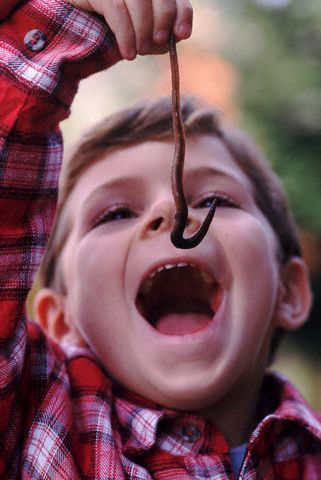
The Earthworm Connection to Terrier Work

What do worms have to do with terrier work? Ah! If you have to ask then ... well I guess you have to ask.

The great fierce badger of European folklore -- the animal that is reported to be the hardest nut to crack in the terrier world -- does not slay deer for a meal; it does not even chase rabbits.

No, the mighty badger is mostly a worm eater, with wasps, beetles and beetle larvae, roadkill and plant material supplying much of the rest.

Fox in the U.K. (and to an unknown extent in the U.S.) also derive a surprising amount of nutrition from worms. The mythical chicken-killer is much more likely to be sucking down a worm on a spring or summer night than he is to be raiding a chicken coop.

According to David MacDonald, the foremost fox biologist in the world and the author of the excellent book "Running with the Foxes," earthworms comprise 20 to 35 percent of fox diet in many pasture-rich areas where worms come up in high densities on moist nights with little wind.

Previous studies of fox diet have missed earthworms as a key component of fox fiet because observers did not have night-visions goggles and did not do microscopic analysis of fox scat to find the thousands of tiny chatae which are the scale-like growths that worms use to move through the soil.

Believe it or not, a great deal of the United States was earth-worm free prior to the arrival of Europeans. No native earthworms occured in the northern portion of the continental United States or anywhere in Canada except for a small section along the coast near the U.S. border. This absence of earthworms is believed to be due to Pleistocene glaciations -- probably the same force that limited the range of the American groundhog to the same eastern region earthworms were once limited to.

Approximately 70 species of native earthworms have been described from the eastern United States and another 28 species from the Pacific region. Another 45 imported species of earthworms are now commonly found in various parts of the U.S.-- mostly on the East Coast and in the Midwest and concentrated in areas with disturbed soils (i.e. regularly plowed fields)..


The native range of American earthworms.

Charles Darwin was the first scientist to show that earthworms had a huge impact on soils and postulated that it was the actions of earthworms which explained why so many ancient ruins were now found buried under layers of rich soil.

Darwin's own intererest in worms was sparked by a very long period of observation -- he noticed the flinty rocks found on the plowed surface of an abandoned field he often walked had been sinking into the ground over many years, and that some large stones had even disappeared from view. Studying the phenomenon, he found that the stones had not been moved -- they had simply sunk below the surface of the soil. How did this happen? Darwin decided that the action was due to worms feeding in the dirt below the stones. Stones on the surface had slowly settled into the thousands of worm tunnels that had been dug beneath the stones over time, while millions of loamy earthworm casts had helped bury the stones from the top.

Darwin's last book, The Formation of Vegetable Mould through the Action of Worms, was published in 1881, just one year before his death. Initially published for specialists, the book has achieved some notoriety due to it's emphasis on the the fact that major changes on earth are often the cumulative action of seemingly small things occuring over a very long period of time.

In fact, we now now that soil, if scene through very rapid time-lapse photography, can be seen to virtually boil under the stirring action of worms.

Worms are not the only thing that turn over the soil, of course. Badger, fox and groundhogs often turn over large amounts of soil during their den building as well. In fact, the typical groundhog burrow represents over 700 pounds of removed dirt!

Added to these faunal excavations are prairie dog colonies (once numbering in the millions of individual animals) and ground squirrel colonies (still vast). In Europe and Australia rabbit warrens represent a significant amount of soil tillage.

To read more about how terrier work, terrier breeds and Charles Darwin are interconnected see >> A Pictorial History of Terriers

.

Thursday, February 28, 2013

Clash of Opinions is Actually a Clash of Knowledge

In Heartsblood: Hunting, Spirituality and Wildness in America, David Peterson notes that back in 1978 Yale University behavioral scientist Stephen Kellert authored a paper entitled "Attitudes and Characteristics of Hunters and Antihunters" in which he summarized his research into the psychology and world-view of these two opposing groups of people.

Kellert breaks hunters down into three core groups:

Utilitarian-meat hunters;
Domination-sport hunters, and;
Naturalist-nature hunters.

Kellert notes that while the groups blur a little at the edges, these three psycho-demographic groups do exist, and represent striking differences of attitude within America's hunting population.

Utilitarian-meat hunters represent about 44 percent of all American hunters. This group tends to talk of "harvesting" game as a renewable resource and many have a "pioneer spirit" forged in self-sufficiency. As a group utilitarian-meat hunters tend to be older, more rural and less educated, but test pretty well when it came to knowledge about wildlife. Few Americans oppose them.

The second group, the domination-hunter, comprise about 38 percent of all hunters. Most domination-hunters are urban men, have served in the military, and see hunting as a way of expressing their manly prowess. Domination hunters know very little about wildlife, and many actually fear it, having an exaggerated "dangerous game" mindset of the kind we often see in pulp hunting magazines ("Mauled by a Grizzly," "When Sharks Attack", "Stalked by a Killer Moose"). Domination hunters showed little interest in wildlife in their youth, and as adults tend to see wild animals as uncontrolled and therefore as "bad" or nuisance animals. The domination hunter is the group non-hunters dislike, and which antihunters try to use to negatively portray ALL hunters.

The third group of hunters -- naturalist hunters -- represent less than 18 percent of all hunters. This group tends to be younger, more educated, and with higher levels of education and income than the other groups. This category also includes more women hunters. Nature hunters tend to backpack, bird watch and camp, as well as hunt. This group also spends more time actually hunting than either of the other two previous groups. Nature hunters have far and away the highest level of knowledge about wildlife and seek an intense involvement with wildlife and do not fear it.

Kellert also goes on to analyze antihunters as a group and finds, not surprisingly, that about 80 percent are women. Most are urban women living on one coast or another.

Antis had very little actual experience with wildlife and, along with domination hunters, had "among the lowest knowledge-of-animals scores of any group included in the study."
In another ironic parallel with domination hunters, "it appeared that antihunters manifested more fear and lack of interest in wildlife" than average Americans.

What was striking to me about reading Kellert's research was how it explains much of the silliness and stupidity we see in the arena of wildlife management today, where antihunters who have never walked a hedgerow clash all with macho-men domination-hunters who would never consider going into the woods without a Bowie Knife as large as medieval falchion.

Neither group seems to have very much knowledge about wildlife. One group does not hunt at all, and the other does not seem to hunt very much.

Left out of the debate -- and too often ignoring it -- are utilitarian-meat hunters and nature-naturalistic hunters which form a majority of the people who actually spend any time in forest or field.

The good news is that in America, unlike in much of Europe, wildlife management decisions tend to be left to an increasingly well-educated groups of professional wildlife managers with degrees in biology, zoology, resource management, forestry, population dynamics, law enforcement and even economics. The watchword in the U.S. is not knee-jerk emotionalism, but sustainability and habitat protection. As a consequence, we have more deer, elk, moose, bear, wolf, fox, alligator, whales, peregrine falcons, bald eagle, osprey, groundhog, raccoon, possum, coyote, bison, beaver and mountain lion today than we have ever had in the last 100 years, and the numbers for all of these species is going up, up, up.
.

Thursday, December 06, 2012

Groundhog Hibernation is Truly Amazing

Groundhog hibernation is a truly amazing thing.

During the summer a groundhog's heart rate is around 80 beats a minute, and it has a temperature of 98 degrees Fahrenheit.

In the coldest parts of winter, however, a groundhog's heartbeat drops to only 5 beats a minute, and its body temperature drops to just 38 degrees.

Groundhog mortality in winter is very high (mostly due to congestion and influenza), but the amazing thing is that they can live at all with such a low heart beat. How do hibernating animals do it? Scientists are still studying that question, in part to figure out how stroke victims might be kept alive.

One answer seems to be that hibernating ground squirrels, such as marmots, shut off their brain's ability to make proteins.

Another trick seems to have something to do with a hibernating animal's ability to store anti-oxidants such as ascorbic acid (Vitamin C) which prevents brain damage when the blood flow starts again.

A third factor seems to be some change in the blood that prevents clotting, and finally, there is the fact that hibernating animals "wake up" every few weeks in order to bring their heart rates back up to normal. This occasional boost of oxygen back into the system appears to be critical, and is common to bears, groundhogs, arctic ground squirrels and a wide array of other hibernating animals.
.

Monday, October 29, 2012

The Architecture of Burrows

A repost from 2005

The list of animals that hibernate in underground burrows, live in burrows or nest in burrows is astounding: fox, badger, turtles, some owls and parrots, ground squirrels and marmots, some penguins and puffins, European rabbits, bears, wolves and dogs, otter, some wild pigs, some wild cats, many snakes and lizards, possums, wombats, frogs and toads, moles, mice and rats, nutria, crayfish, armadillos, skunks, muskrats, meerkats, some large spiders, and several types of bees.

Many of these animals spend a fair amount of time constructing, maintaining, and modifying their den systems which, in turn, are structured in response to changing external circumstances and changing internal needs.

Anatomy, behavior, and distribution of wild animals are all greatly affected by the burrow environment, with temperature, humidity, oxygen, living space, availability of food, and protection from flooding and predation all being influenced by burrow architecture.

Despite this, the burrow structure of almost all subterranean mammals is barely known, and data and descriptions of den structures as they relate to soil composition, drainage, external defenses (rock, wire fences, farm buildings), proximity to food and water sources, is almost entirely non-existent.

All of this make understanding burrow architecture as an adaptive tool a difficult task, but it nonetheless clear, among humans digging to their terriers, that burrows are designed with a reason and that certain "tricks" keep popping up. A few I have noticed in the construction of groundhog and fox dens:

  • Water and the phreatic zone: Dens of fox and groundhogs are designed to keep the animals dry, yet fox in particular like to locate their dens very near water. Shallow dens are sometimes found carved into the sides of small humps or rises in marshy areas, but these are rarely natal dens. The deeper natal dens of fox are generally found on the rises above the flood plains -- on well-drained hillsides near a creek or pond or water-filled ditch. The ideal spot for a pipe is deep enough to be dry from surface water, but not so deep as to be encountering the water table -- the so-called "phreatic zone".

  • The "plumbers pipe" opening: In these settes the pipes run down for two or three feet before rising again and then dropping again. This createa an earthen "water stop" not so very different from the plumbers p-pipe you will find under your kitchen sink. This is a common feature in many animal burrows, from rat to fox.

  • Depth is determined by soil: This is near-truth. The softer the earth and the easier it drains, the deeper the den is likely to be. One of the chief functions of a den is to keep the animal dry, and in soils that are very light, dryness tends to be achieved with some depth. You may cut through very soft stuff for three or four feet, but below that will be the harder stuff -- a layer of hard sand below the soft, or a layer of hard dry clay below much softer and friable soil. The pipe is likely to be in the softer soil just below the hard vein. The hard vein works to structurally support the pipe and to keep out the last bits of water. The one exception that I would note is where a ridge is made almost entirely of small cherts, flints or flaked slate. Here digging by a fox or groundhog is so hard, and the drainage is so rapid, that the den pipe may be very shallow since water runs through the den as fast as it falls. These shallow and breezy loose-rock dens will not be used in winter, but are likely spots in summer.

  • Rocks, roots and barbed wire at the entrance: This is so common that it is clearly a planned design feature. It is not uncommon to find dens exiting inside a stump or hollow tree, or to have a strand or two of barbed wire running along the lip. Groundhog dens frequently start on one side of a barbed wire fence and exit out another. If there is an abandoned vehicle on the edge of a farm, a groundhog will invariably makes its home under the chassis -- a nice shelter from the rain, but also from predators who will have to slow down to a crawl to avoid beaning themselves on the I-beam and suspension. Hard structures not only makes digging out more difficult, it makes a mad dash at the den hole a dangerous and maladaptive strategy for large predators. In addition to hard structures at den entrances and exits, there are "soft structures" such as thickets of multi-flora rose, bramble, poison ivy, and thick wild grape vine.

  • The hard turn after the den entrance: This is a frequent feature of groundhog den entrances and serves two purposes: 1) it makes it difficult for predators to enter, and; 2) water entering the entrance will tend to follow the straight line of gravity and soak into the ground at the end of the pipe rather than run sideways with the turn of the pipe. I have encountered some rather incredible animals that took this "hard turn at the entrance" technique to absurd levels as they never stopped turning -- they corkscrewed their dens in full circles all the way down in a spiral that went four or five feet deep.

  • The pocket room close to the entrance: This is a common feature of groundhogs dens, and I believe these serve as "loafing parlors" where the animal can tuck in out of danger between feeding forays. If you are quiet, and the dog is too, you can often bottle a groundhog in one of these little rooms before it goes deeper into the sette.

  • Right angle turns inside the den pipe: These are very frequent features of groundhog and fox dens and seems to serve two purposes. The first purpose is that they help keep the den dry, as water running down a pipe will tend to follow gravity rather than take a sudden turn to the left or right. The second purpose is clearly defensive; a groundhog or fox can take a stand at a hard corner and slash out at anything coming down the pipe, inflicting considerable damage if the corner is tight, as it invariably is. Often a sette will have several right-angle turns, each providing additional elements of security, like doors on a hallway. A human digging on a dog will often break into a pipe where the dog and quarry are at a standoff at one of these turns, at which point all hell will break loose as the animals grab each other, or else the fox or groundhog will manage to retreat to the next hard corner in the pipe system -- a kind of running battle that can be very frustrating to the digger!

  • Side pipes and stop-end branches: These are common features of both groundhog pipes and fox dens. Some of these represent unfinished den digging, but for a fox they also provide a place where one animal can scoot into in order to let another pass by, where one animal can lay up without getting overheated from the warmth of its mate and where it can get a better supply of air. Earth dens are all about keeping dry, maintaining the right temperature, keeping the air flowing, and staying secure. Side passages increase the options on all counts.

  • Field settes are generally deeper and larger than hedgerow settes, and often harder for the human to dig as a consequence: I believe this is due to a conflux of opportunity and necessity. The opportunity for larger and deeper settes is due to the lack of obstructions like roots and rocks. The necessity is that plowed fields with friable soils require deeper dens to remain dry, while larger more complex settes are an element of security, allowing a groundhog or fox to escape danger in one part of the sette by going to another -- or even bolting out of one entrance into another.

  • Large "race track" settes are fairly common in fields. These large settes circle back on themselves several times and may have several layers of pipe. More commonly they are simply four-, five-, or six-eyed settes with connecting pipes. A groundhog can run around in these large settes, shoveling dirt behind it to block the dog, and effectively preventing the dog from bottling it in a stop end. The solution I employ is to earth stop the den at two or three spots (generally at exits where the pipe goes left and right). If needed I will also allow two experienced dogs that know each other well to enter opposite sides of the settes and work the animal to the middle. This generally prevents the groundhog from digging in and gets the animal pinned against one of the newly-minted stop-ends in short order. Putting two dogs to ground should be left to people who know their dogs well and who are experienced diggers. It is better to lose quarry than a dog. Two very hard dogs to ground, or two dogs in a den occupied by a skunk, could be a disaster! Never enter two dogs on a fox -- it is simply not necessary, as the fox cannot dig away.

  • Winter "fox porches": A fox will often dig out the first three or four feet of a groundhog den and create a kind of "loafing porch" where it can tuck in out of the wind but still not be fully underground. Fox can easily overheat inside the earth, and this "porch" area allows for easy temperature regulation -- go a little deeper if it is very cold, stay right at the entrance if it is warm. The breezeway allows the fox two excellent avenues of escape if danger approaches -- into the nearby woods or thicket, or deeper underground.

  • An observation on what does not dig: Raccoons and possums do not dig earth dens -- they occupy holes made by other animals or find hollow trees, brush piles, rock crevices, hay bales, barns or crawlspaces. Neither animal is equipped to move dirt beyond a little scratching for worms and beetle grubs. Neither animal will modify a den in a significant way (though both will pull plastic bags and other debris into a den in order to improve insulation and provide bedding).


Tuesday, January 24, 2012

The Nonsense of "Pull Dogs"


In The Working Jack Russell Terrier Eddie Chapman writes:

"Something that makes my blood boil is when I hear terrier men talk about dogs they call Caesar dogs. They will show you a Russell type that has been bred too big and say, 'I use him as a Caesar dog'. If I ask what a Caesar dog is, they say it is a dog which will hold the badger, he won't let go,' they say. I have never heard such rubbish in my life. Besides being unnecessary, it is invariably cruel to the dog and more often than not he will be badly bitten for his pains. Besides that, it is unnecessarily cruel to the badger and the sort of behavior that got badger digging banned. I have tried to explain how to remove badgers from a sett without injury to dog or badger. There is nothing clever about getting a hard dog smashed up by a badger. On the contrary, it shows ignorance and a lack of responsibility and feeling. Bravery in a terrier should never be exploited."

I found it quite refreshing to read this passage, as I have often noted that there is little reason to own a "pull dog" if you actually know how to handle things at the end of a dig. The use of "pull dogs" damages dogs and quarry alike and is wasteful as it often necessitates time out of the field and expensive veterinary work.

In the U.S., the use of pull dogs (what Chapman and some others call "Caesar" dogs) is due to the prevalence of too many over-large terriers that cannot go to ground in a real earth. To say you have a "good pull dog," is to say you do not have a dog capable of actually going to ground.

If you have followed the Kennel Club dictates, and embraced a 14 inch tall dog with a 17" or 18" chest (or larger!), you are forced to rationalize a job for it. No matter that it is a stupid job forged in pain. Most people would rather see their dog injured than swallow their pride and admit they have drunk the Koolaid offered up by the Kennel Club know-nothings who think a fox den is as big around as a go-to-ground tunnel.

Another factor is that many people simply have no idea of how to handle quarry and so use the dog to to do the job. Having gotten to the end of a dig, they do not know how to get the animal out of the pipe, nor do they know how to dispatch it. In such a situation, the use of a "pull dog" is ignorance in motion.

The simplest way for a novice to handle quarry is with a snare. You can make your own for about $5, or else buy a pig snare from a feedstore.

Groundhogs can also be tailed out alive -- it is not hard if the groundhog's tail is presented, as it so often is. If very much of the pipe is remaining, however, you may find yourself in a tug-of-war with the groundhog who can jamb up inside a pipe so tightly that even a large man can have difficulty pulling one free.

Always use a snare for raccoons -- they can twist all the way around on their short fat bodies. They can grab you with their hands and have crushing bites. Rabies is not uncommon in raccoons, especially on the East Coast.

If you have entangled a fox in a net, be carefully when extricating the fox. The best advice is to pin the animal to the ground under your boot while removing the net. Work the net off the fox in sections, and then release it to hunt another day.
.

Wednesday, June 22, 2011

Two Let Go for Another Day


This little fellow is a baby groundhog, probably born in the midde of March, at about the same time same as fox kits are born. 

He was in the same hole with his mother, pictured below, and I let them both bolt off to freedom as we were far enough from the fields that they are not likely to do much harm.  This fellow should be just about weaned and will soon be bullied to move out on his own. 

Baby groundhogs and possums are "meals on heels" for fox, coyote and hawks at this time of year.


Mom was a tough little customer, and anxious enough to bolt into the brush after I got her picture.

We bolted another pretty large groundhog right at the start on Sunday, but it got too far up into the tree to get a decent picture.  In fact, I was not sure he was up there until I got him to move a bit with a well-placed bit of  old branch winged up into the greenery!  Groundhogs are members of the squirrel family, and though they are ground squirrels, they can climb trees pretty well when pressed.
.

Saturday, April 17, 2010

Mother Nature's Mistakes


Teddy Moritz sent me this shocking photo of a tiny 5-pound groundhog with a terrible malocclusion of the jaw which resulted in the animal's teeth growing without end. As Teddy notes in her email: "Mother Nature is not always kind."

So why was I shocked by this photo? Well, I first saw it on my cell phone, and the picture was pretty tiny. What? Is that fingernail polish? When I got back to the computer, however, I saw it was just blood. Fine; all is right with the world again. Carry on.
.

Friday, April 16, 2010

Tarvag for Dinner Again?


A young Mongolian sharpshooter with Tarvags bound for the pot.

Two thousand years ago Herodotus told a tale of large furry ants that enriched the Persian empire by burrowing for gold.

According to Herodotus, the "ants were bigger than foxes, but smaller than dogs".

Herodotus's story inspired generations of treasure hunters and explorers going all the way back back to Alexander the Great.

Classical scholars assumed Herodotus was either a liar or a very gullible believer of fables. In fact, Herodotus was right -- it was the translators that were wrong.

It turns out that the "golden ants," were actually marmots that burrow into a gold-bearing stratum of sandy soil that lies just a few feet underground in much of Central Asia. The ancient Persian word for marmot, translates into "mountain ant".

The "Mountain Ant" of Pakistan is a close relative of the the North American Groundhog (Marmota Monax) and the Tarvag (Marmota sibirica).

The Tarvag and other Central Asia Marmots are hunted for food and for their fur, which -- if it is not used locally for fur coats -- is sheared, dyed and exported as "imitation marten."

It was fleas on the shipped hides of Mongolian Tarvag that first brought the Black Plague to Europe. The Tarvag is the natural home of Yersinia pestis -- the bacterium that inhabits the Xenopsylla cheopsis flea that thrives on Tarvag.

When dead Tarvag hides were shipped to Europe, Xenopsylla fleas leaped off the dead hides and reproduced on the Black Rat (Ratus ratus) which it found to be a suitable host.

The Bubonic Plague swept through Europe with the Black Rat until the Black Rat itself was driven out of Europe by another import -- the Norwegian Rat (Ratus norvegicus), which probably originated in the Middle East.

With the arrival of the larger and more aggressive Norwegian Rat, the smaller and more docile Black Rat was pushed out of Europe, and the era of Bubonic Plague infestations in Europe ended.

The bad news is that Tarvag fleas (Xenopsylla cheopis) managed to get to the West Coast of the U.S. around 1900 where they found a home on black rats living in San Francisco. Believe it or not, Norwegian rats did not arrive on the West Coast of the U.S. until around 1940.

The Black Rat and the Xenopsylla flea rode the train into the deserts of the American Southwest shortly after arriving in the U.S., and today the Bubonic Plague is a permanent feature of Prairie Dog towns and, to a lesser extent, Richardson's Ground Squirrel colonies, in the American West.

Could the Plague come East to take up residence on the common Groundhogs? For some reason this has not yet happened. It's hard to know what the barrier is, but the Xenopsylla flea may not find the Groundhog a suitable host -- fleas and lice are often host-species specific, and most will live on only one or two kinds of animals and no others.

Another problem may be that it is simply too wet and cold for the Xenopsylla flea to thrive in an eastern North American hedgerow. The Plague bacillus and its host flea generally thrive in desert or near-desert conditions.

Though Europe is as cold and wet as the Eastern U.S, the Black Rats of the Europeam Middle Ages tended to live under warm and dry roofs. The Xenopsylla flea apparently found this habitat quite suitable, while a wet and frozen hedgerow is the exact opposite of what the flea is looking for.

Another bit of good news is that today the Bubonic Plague to treatable with massive amounts of antibiotics, provided patients seek medical attention and doctors properly diagnose the problem.
This is a repost from January 15, 2005.
.
.

Friday, January 15, 2010

Groundhog Buried In and Fending Off


This is why groundhogs are tough - - they have skulls as thick as a skillet, no necks, and when the dog catches up to them underground, they are likely to burried with nothing but chisel-like teeth facing out. This picture was found on a wayward camera chip in my truck -- I'm not sure when I took it.
.

Friday, September 25, 2009

Graveyard Groundhogs


I have stumbled on rural graveyards with the dogs, but I never dig anywhere near them for obvious reasons.

.

Monday, September 21, 2009

Roadkill Blues

Roadkill is a 20th Century phenomenon, which is to say that we did not have it in the 19th Century when the roads were populated by horses and carriages.

Oh sure, we had some train kills -- deer and moose and cows and buffalo, but that's trackkill, not roadkill. And, of course, some horses died on the road from exhaustion or being shot, but they too were not roadkill as we define it here -- animals dying from vehicle impact on the road.

In fact, roadkill is probably the wrong term, even if it is the one we use. Carkill is what this really is; the road, after all, is simply a passive observer.

The problem with the term "carkill," is that it puts us in the picture. Roadkill, however, is a term that conveniently assigns millions of drive-by deaths to an inanimate object. It is a comforting term that obsolves us of guilt.

Today, the Mercury Cougar (Automobilus detroitus) does some of the pruning work once done by the wolf (Canus lupus). Which is not to say Ford, Chevy, Toyota, Volvo, Mack Truck, and all the rest are not doing their part as well. They are.

Roadkill is not a small biological phenomenon, it is a big one. In my small state of Virginia, there are over 35,000 deer-car impacts a year. In Michigan, deer impacts are so pervasive (over 55,000 a year), that they use deer roadkill data to determine the deer population in the woods. In Pennsylvania, another 40,000 deer a year fall under the wheel. What's the national tally? Who know? The number 350,000 is tossed around, but that seems low. That said, not all states have as many deer as Virginia, Pennsylvania and Michigan, or as many drivers on dark or twising roads. So who knows? Whatever the number, it's clear that it is a lot.

Though I have no doubt that Darwinian forces are slowly playing out between animals and cars, the time-frame is still far too short. As a result, as brilliant as a squirrel is at figuring how to get to, and jimmy open, a bird feeder, it is still completely flummoxed by squealing tires and 4-cylinders. As a result, squirrels die in droves from vehicle impacts -- perhaps 40 million a year according to one back-of-the-napkin bean counter.

A few more sobering roadkills numbers, and some descriptive reasons as to why some animals are more likely to die on our highways than others:

  • Dogs: 1.2 million dogs are killed on U.S. roads every year. Most of these dogs are killed in the daylight while chasing a ball, child, cat, or squirrel. Fences and leashes keep dog alive. No fence and no leash, and the result is predictable.

  • Cats: Cars kill about 5.4 million cats per year -- more cats than are killed in all U.S. animal shelters. Most cats are hit by cars at night.

  • Snakes: Snakes are cold-blooded and will warm themselves on asphalt, especially on poorly-traveled rural roads. Because snakes are small and easily obliterated by tires, there are no good numbers, but they are huge.

  • Opossums: Opossums feast on roadkill, a habit that results in about 19 million opossums a year getting squashed. Possums are naturally slow, come out at night, and will often freeze in the headlights of a car.

  • Skunks: When threatened, a skunk's natural defense is to turn its back and spray -- a technique that does not work too well with cars. Most skunks are hit at night.

  • Groundhogs: An estimated 5 million groundhogs or woodchucks get hit by cars every year. Groundhogs are diurnal, but because so many den along roadside embankments in order to take advantage of soft dirt, good drainage, fewer predators, and good forage, they are often living just yards from traffic. Sure this is maladaptive, but groundhogs have not been programmed with cars in mind.

  • Raccoons: Raccoons frequently scavenge in roadside water ditches, are not too fast, are fairly belligerent, sometimes travel in trailing family groups, and hunt at night. Which is a nice way to say their are a lot of vehicle-raccoon impacts -- perhaps 10 million a year, maybe more.

  • Fox: Red fox are field-and-edge creatures, and are much more likely to be hit be a vehicle than a Gray fox which will generally be found in deeper woods and rocky areas. That said, both Red and Gray fox are night time scavengers, and as such are prone to being struck on the road while feeding on the carcass of a snake, possum, rabbit or squirrel previously struck by traffic. The saving grace of a fox is that they are very fast and extremely wary -- the two chief reasons you see fewer dead fox and coyote than you do dead raccoons and possums.

.

Thursday, June 18, 2009

A Baby Groundhog Discovers Dirt Dens


Cson has been rehabbing an orphaned baby groundhog who seems to get the idea pretty quickly that holes in the ground are very good places to check out. Nice!

Groundhogs are actually members of the squirrel family, and when they are very small, they look quite a bit like regular tree squirrels.

By late Fall, if all goes well, this little fellow will be pushing about 10 pounds, and by the end of its second year, if it has had a good feed, it will weigh in at around 15 pounds.


.

Monday, April 06, 2009

Digging on the Dogs


Yesterday was a nice day in the field with perfect weather, and three kinds of quarry dug to -- raccoon, groundhog and possum.


Mountain located a raccoon
in a dirt den underneath a massive brush pile. I will spare you the details, but suffice it to say I managed to burrow down into the brush pile and sink a bore hole between mountain and the raccoon. I then twisted the post hole diggers so they blocked Mountain from reaching the raccoon, and she got the idea and finally came out. Good thing too, as there was no digging her out, and she was not coming off that raccoon any other way!

I leashed up Mountain and we drove to another farm a short way up the road, where we quickly located a groundhog and dispatched it at the farm manager's request.


I estimate I have taken 200 groundhog off of this particular farm, and there are not many left, though the farm manager says he has lost a few turkeys to a coyote, and the farm across the road took an enormous coyote last month -- the largest in the County so far.


The dogs checked a few more holes, and Mountain located a pretty tough-acting possum, which I pulled before Mountain decided to teach it respect. Possums are pretty harmless creatures, and though Dave the farm manager has chickens this fellow was toward the back of the farm, so I released him with nothing more than a stern warning.


This possum was released unharmed.

.

Monday, March 16, 2009

If You Come Across a Fox Sette This Time of Year


You can never be too careful this time of year, as fox can sometimes be found in groundhog settes that otherwise have little or no evidence of fox occupation.

While a fox in estrus will emit a stink, natal dens often barely smell at all -- a chemical change in the fox, and a natural protective defense after she whelps.

If you do come across a natal den, handle the kits as little as possible and put them back in the den. The mother fox will return very soon and move them, provided you clear out.

You can rest assured she has dug several dens close by, as fox will often move their litters two or three times even if undisturbed -- a way to lose flea and parasite infestations, and also to reduce run marks that might lead a dog, coyote, bobcat or human to the site of the den.

If a kit is harmed by a dog, humanely dispatch it and remove it from the area of the den after returning the unharmed kits to the den. Fox mortality is naturally higher than 50% in the first year, and the loss of one kit, while regrettable, will actually improve the odds of the remainder.

The kit, above, was an accidental run-in at a groundhog sette a few years back. There were five kits inside, and this one was removed unharmed by the dog. She was scooted back inside the sette without a mark on her, and she tumbled back down the pipe. The sette was carefully repaired with a bit of scrap rug found in the hedge, and the cubs were later spotted several weeks later and just one field over.
.