Showing posts with label closed registries. Show all posts

Tuesday, March 30, 2010

Basenji's: A Classic Tale of Kennel Club Defect


Modern African Basenjis after a hunt.


In correspondence this weekend, a reader wrote to note that not all was darkness in the American Kennel Club.

For example, when Basenji's began to present with jaw-dropping rates of hemolytic anemia in the 1970s, a test for the disease was developed and affected animals were then culled.

Unfortunately, the now smaller gene pool came down with a new disorder, an eye problem called persistent pupillary membrane, which was quickly followed by a kidney disease called Fanconi syndrome, and IPSID (a fatal malabsorption syndrome).

To combat these three diseases, it was decided to open up the U.S. Basenji registry to increase genetic diversity within the breed.

That does sound like a positive thing, doesn't it?

Sadly, however, the tale does not survive scrutiny.

In fact, it underscores the real problem with Kennel Club thinking.

To start with, let's state the obvious: the Kennel Club did not create the Basenji.

This breed has been around since before recorded history, and is a landrace dog used for hunting in the tropical jungles and scrub brush regions of central subSaharan Africa.

Point two is as important as point one: this breed is not about to go extinct in its native lands.

Basenjis are still used as hunting dogs throughout central Africa, and it takes little or no effort to find excellent specimens in nearly every local village.

So exactly where is the dog in trouble, and why?

The short answer is that the Basenji is only in trouble in the western industrialized world, and it is only in trouble because of the kennel club's closed registry system.

The full story is told here in a paper from the July 2007 Bulletin of the Basenji Club of America, but suffice to say that in the U.K. the breed was founded with just 7 dogs, while in the U.S., the breed was founded with just 9 dogs.

A few more dogs were added in to the mix over the years but, as the paper notes:

"[T]he Basenji modern population was derived from 18 original progenitors, with varying degrees of gene representation."


Even this overstates the genetic variability found within the modern Basenji, however.

As the Basenji Club of America notes, much of the founding stock in both the U.K. and the U.S. did not contribute much in terms of get. In addition, due to the popular sire effect, the true male "founder" side of the breed is really no more than four or five dogs. In fact, just three dogs -- Bongo of Blean, Wau of the Congo, and Kindu -- are estimated to represent over 95% of the Y chromosomes in modern AKC dogs!

In response to the collapsing and inbred genetic mess that is the Kennel Club Basenji, the AKC has now decided to open up the registry to dogs imported from Africa provided they can pass a 10-step hurdle.

Of course, no one is asking the most obvious question: Why do we need Kennel Club Basenjis at all?

The answer, of course, is that Kennel Club Basenjis are needed so people can win ribbons showing these dogs, and perhaps make a little cash breeding them as well.

Is there any other reason to ever own a Kennel Club dog?

Of course, some folks are always looking for a "project" or a cause, and the Basenji serves them well in that regard.

If they tell the story right, they can convince themselves and others that they are trying to "save" a rare breed, and never mind that the dog is not rare and does not need "saving"!

And so the push is on, once again, to import a few more dogs from the Congo, Benin and Cameroon.

And what will this achieve in the end? Not much.

Yes, the rate of genetic collapse of the Basenji within the AKC may slow down a bit, but the numbers imported are going to be so low that they will only change the velocity, not the direction, of the curve.

And, of course, the registry is not going to stay open forever, is it?

Once it closes, dominant sire selection will again raise its ugly head, and the gene pool will once again choke down, and inbreeding will continue apace.

In the interim, a few dog dealers will have made a profit selling "outcross" dogs imported from Africa, but not much else will have been achieved.

The good news for the Basenji is that the survival of this breed does not depend on Kennel Club "saviors."

Darwin and the hand of God are still working, as they always have, to save and preserve the Basenji. As Susan Shott has noted:


The owners of African Basenjis do not provide veterinary care for their dogs, and they do not interfere with their dogs' breeding. This insures that African Basenjis are subjected to the rigors of natural selection. Dogs with genetic problems that reduce their fitness early will be much less likely to breed than healthy dogs. For this reason, African Basenjis are less likely than American Basenjis to have serious genetic health problems


Right. But there's more to it than that isn't there? You see, the working African Basenji was not created in a closed registry system, and today's healthy dogs are not maintained in a closed registry system.

Let's not forget that.

And let's not forget that today's unhealthy, non-working American and European Basenjis are a byproduct of a closed registry system that has resulted in nothing but genetic defect cropping up within this breed.

But thanks to God and Africa, we can say: No loss. The Basenji is still alive, well and thriving in its native land.

_ _ _ _


End Note:

Novus sends an email (thanks!) with some data (and links!) which I will summarize:

Tuesday, January 26, 2010

For Veterinarians, Silence Has Been Golden


The American Kennel Club is moving to co-opt the veterinary trade by forming alliances between themselves and the pet insurance and pharmaceutical industries.

The goal of this cross-marketing: To make the AKC a veterinary referral and insurance service.

By doing this it is hoped that veterinarians will be beholden to the AKC, both collectively and individually, and continue to "whistle pass the graveyard" as far as the impact of Kennel Club policies that result in diseased, defective and deformed dogs.

And why not, thinks the average veterinarian?

Yes they got into the vet business because of concern and compassion for animals, but it's a free country and people will do what they want to do.

Besides, taking a stand might cost business. People get easily offended if you talk about their broken dogs and suggest that they might be complicit in the problems, either through omission or commission.

And silence sure has been lucrative!

Pencil it out, and the big money in veterinary care is not in once-a-lifetime vaccines, but in the big stuff: shot hips, wrecked eyes, recurring skin conditions, Cesarean births, and mounting rates of cancer.

Best to shut the hell up and pocket the money!

Do all vets feel this way? No, of course not!

But enough do.

And there's no denying that, taken as a whole, the veterinary profession has been extremely timid at challenging the Kennel Club in the past.

Just go to your vet and ask if he or she has a written list of breeds they actively caution against.

It's not going to be there.

Fact sheets on heartworm? Check. Even vets in Maine will have that in hope of maybe making a sale to a gullible customer.

But a fact sheet that says "avoid these breeds which are walking cancer bombs?"

A brochure that says "just say no to anchondroplastic dogs and brachycephalic breeds?"

Not there.

Yet every veterinarian knows that certain breeds are a sack of trouble with predictable (and generally rising) rates of pain and veterinary expense.

  • Dachshunds have serious back problems; fully 45% end up with herniated discs.
  • Collies have a huge incidence of eye problems (retinal degeneration, cataracts, retinal detachment, progressive retinal atrophy).
  • Bernese Mountain dogs, Scotties, Flat-coated Retrievers, Deerhounds, and all the Setters have jaw-dropping levels of cancer.
  • Nearly every toy breed (and especially Yorkshire terriers) have dental problems from too many teeth crowding too-small jaws.
  • German Shepherds, Labrador Retrievers, Golden Retrievers, and St. Bernards commonly have life-limiting hip dysplasia.
  • American Cocker spaniels are besotted with cataracts, glaucoma, dry eye, and ingrown eyelashes.

This is just a smattering of the common canine problems out there.

Vets KNOW what these illnesses cost in terms of cash, and they know the PAIN these diseases, defects and deformities inflict on the animals themselves.

And yet the vets are silent.

There is no wall poster in your Vets Office indicting breed clubs for embracing exaggerated and contrived standards.

There is no petition or tract being handed out at your vets office advising patients to boycott the American Kennel Club until that organization turns away dogs with high Coefficients of Inbreeding.

The vets are nearly silent about the litany of pain, suffering, shortened life, and rising expense from breeding dogs within a closed registry system.

And yet, in this case, Silence Equals Death.

Why isn't the American Veterinary Medical Association at war with the American Kennel Club?

They aren't.

And I can tell you why; they are too busy "partnering" and "cross promoting" with these folks.

Imagine a computer virus maker sitting down for breakfast every morning with the folks from "Geeks On Call," and you have the idea.

Now add in long term physical pain and suffering on the part of the mute and helpless, and simmer for 30 years. That's the American Veterinary profession and the American Kennel Club: See no evil, hear no evil, speak no evil.

So what if a significant proportion of Doberman Pinschers have a bleeding disorder?

Never mind that a mind-numbing percentage of Dalmatians are deaf.

Who cares if scores of thousands of Toy Poodles with epilepsy are on powerful meds to control their seizures?

Why even mention that thousands of Boxers that are put down every year due to tumors and bone cancer?

You've got a dog with a serious genetic disorder?

Too bad. Bad luck.

No, it couldn't possibly have anything to do with breed standards that monumentalize deformity or small closed registries that result in rising levels of inbreeding.

Not that. Think of something else.

And don't talk about puppy mills either, as the AKC is dependent upon them financially, as they have admitted in their own board meeting minutes.

It must be something else.

It must be nameless, faceless "bad breeders."

It's their fault!

But have no fear, because American Kennel Club breeders are only too happy to sell you another dog just like the one you just "lost."

And have no worries, because the American Veterinary Medical Association is only too happy to tell your vet how he or she can maximize your bill while your dog is being treated.

In the "dash for the cash," both sides have come to the same conclusion: Silence is Golden.


.

Saturday, January 16, 2010

The Kennel Club at the Crossroads

This is my column in the February 2010 edition of Dogs Today.

The Internet May Yet Save the Dog

We stand at the beginning of one era,
and the end of another
.

Oddly enough, the history and future of pedigree dogs is inexorably tied to two great information revolutions.

The first occurred during the Victorian era, when a combination of cheap pulp-wood paper, movable metal type, and block plate illustrations helped disseminate old and new scientific theories to the common man.

Out of this first Golden Age of Information came a Victorian fascination with nature, the rise of farm stock shows, and Charles Darwin's theory of evolution.

It is hard to overstate how important cheap paper and movable type were to the spread of scientific inquiry and the explosion of controlled breeding experiments occurring at this time.

Suffice it to say that from before recorded history, until the publication of British Quadrupeds in 1837, fewer than 20 breeds of dogs were recognized in Great Britain.

Of course, that was about to change!

By 1837, Charles Darwin had returned from his voyage around the world, and in 1859 The Origin of Species was published.

That same year, the first dog show was held on Newcastle-on-Tyne.

Within 15 years, the Kennel Club had been formed, and just 20 years after that, it had closed its registry to cross-breeding.

The Gospel of Unnatural Selection

Where Darwin had preached a Gospel of natural selection by the hand of God, the Kennel Club preached a Gospel of unnatural selection at the hand of man.

Surely what God did in leisure, man could improve on in haste?

From the beginning, of course, there were skeptics. Within the first two decades of the Kennel Club's creation, some began to note that inbreeding was already a problem. Others decried the "grim joke" that the Bulldog had become due to the embrace of non-functional standards.

Working dog men noted that breeds brought into the Kennel Club seemed to quickly lose their utilitarian abilities. Luminaries of the dog world such as the Reverend John Russell, famous for his working terriers and hounds, refused to register their own dogs, saying they preferred the "wild eglantine" found in God's fields to the "hot house rose" being paraded in the show ring.

Did this criticism have much effect?

In truth, not much.

The breeding of exotic-looking dogs in a closed registry system had started as an act of faith, but had quickly developed into a kind of fevered obsession as immune to logic as any religion.

It helped, of course, that the Kennel Club was organized around nearly powerless individuals and weak breed clubs that were beholden to a small but powerful oligarchy at the top.

This oligarchy was itself the product of a lifelong catechism into the values of conformation dog shows.

An organization which abhorred cross-breeding, and which valued "conformation," was not a likely prospect for rapid change. Throughout the Twentieth Century, the Kennel Club held tight to its antiquated Victorian theories, as trapped in their own dogma as any insect embedded in Miocene amber.

This was the Kennel Club as it was for more than 100 years. Though critics were sometimes heard mewing on the margins, they were easily dismissed and in truth there were not too many of them.

After all, who wanted to speak too loudly knowing they might jeopardize their chance of winning in the ring, or forfeit any hope of advancement in the Kennel Club's hierarchy?

And if you were not winning? Well, these people did not last too long with the Kennel Club, did they?!

A few cracks in the firmament popped up from time to time, of course -- a critical essay or magazine article or two might note a decline in the health and working abilities of one or more pedigree breeds.

These episodic outbursts of protest had little lasting effect. Like honking in the street during a church service, they did little more than irritate the congregation inside.

The Second Information Age

In the late 1990s, however, something came along that changed everything: the Internet.

It is hard to overstate the impact of the Internet. Suffice it to say that in our own lifetimes, we will see the end of books, newspapers and magazines as we have known them. The era of film cameras, video tape and recorded disks is already past. Many young people today have yet to lick their first stamp, such is the ubiquitous nature of email, voice mail and text messaging in this modern world.

What does this mean for the world of dogs?

Quite a lot.

The Internet, you see, has democratized information and mass communication.

Today, anyone with a computer can read Darwin's notes about canine evolution, research the origins of the Kennel Club, and locate health surveys and veterinary insurance records which illuminate the current and rising crisis in canine health around the world.

When hard-hitting documentaries like the BBC's Pedigree Dogs Exposed are produced, they are no longer seen for a night and forgotten with the morning sun.

Now, thanks to YouTube, anyone with a computer can watch at leisure, and forward the link to scores or even thousands of others via email, list-serv, personal blog, or organizational web site.

Those who want to know more can easily find reams of information, much of it eye-opening. Consider this single line from the August 2009 issue of The Veterinary Journal for example:

"[E]very one of the 50 most popular pedigree breeds of dog in the U.K. were found to have at least one aspect of their physical conformation predisposing it to a heritable defect."


Every one.

Suddenly the dog-buying public was paying attention. A Kennel Club dog was a risky proposition. Canine insurance records and rates underscored the proposition: a cross-bred dog was a better gamble than a pure-bred one.

As more information began to percolate out to the public, those with sick dogs no longer saw their expensive veterinary burdens as a bad stroke of personal luck. Even the most cursory search on the Internet revealed the bitter truth; huge numbers of pedigree dogs were diseased, defective and deformed.

The Kennel Club, it seemed, had forgotten to do right by the dogs.

The Choice Ahead

Now, almost too late, the Kennel Club seems to have woken up to the precarious nature of its position.

In the age of the Internet, creating a new national registry of dogs is no longer a daunting task. If the Kennel Club will not stand for dogs that are healthier and more able than those found down at the local pound, then someone else surely will.

While it took the Kennel Club 130 years and hundreds of millions of pounds to build their current registry, it might take a young Internet-savvy entrepreneur only a few weeks and perhaps 100,000 pounds to build the backbone of a parallel Internet-based registration system that pairs modern email outreach with a dynamic web site, a powerful online date base, and a system of real veterinary-based health checks coupled to product-based discounts on pet food, pet insurance, and veterinary care.

Unlike the Kennel Club, this new registry would have no historical baggage to tote, and would not have to pay homage to petulant prigs and screaming matrons hell-bent on holding on to defective standards and misguided Victorian-era theories.

One thing is for certain: at this point in the game, the Kennel Club cannot afford to dally and play footsie with incrementalism.

The 21st Century will no longer wait for the 19th Century to catch up.


Eric Clapton & Steve Winwood :: Crossroads
.

Friday, November 13, 2009

Blind, Deaf, and Epileptic by Design


This dog is blind, deaf, epileptic, and in joint pain at age 4.


In the July issue of Dog's Today, I give "Terrierman's Top Ten Tips for Avoiding Expense & Misery," pinging off of the story of the tallest dog in the world (a harlequin Great Dane) and the oldest (a 26-year old cross-bred Jack Russell Terrier).

As I noted in that piece, the Great Dane in question died at age seven, euthanized after coming down with cancer -- a very common outcome for this breed.

So who is the "tallest dog in the world now?

According to the Guinness Book of World Records, it is a 4-year old Great Dane named Titan who is "blind, deaf, epileptic and undergoes acupuncture and chiropractic adjustments every three weeks."

Great. A total genetic mess. The only good thing here is that the dog was adopted by its current owner from a Tennessee Great Dane Rescue.

Let's be clear here: Breeding defective dogs that live in pain is a type of systematic animal abuse.

We know how to breed healthier dogs. To not do it is a violence.

Thinking about getting a dog? Think and research before you adopt or buy.
..

Sunday, October 18, 2009

Twice as Many Cancers in Pure Breed Dogs


Maybe we don't need to "cure" cancer; maybe we need to prevent it.

And how can we do that?

Simple: End the Kennel Club's closed registry system.

"In both dogs and cats, pure breeds had almost 2-fold higher incidence of malignant tumours than mixed breeds."


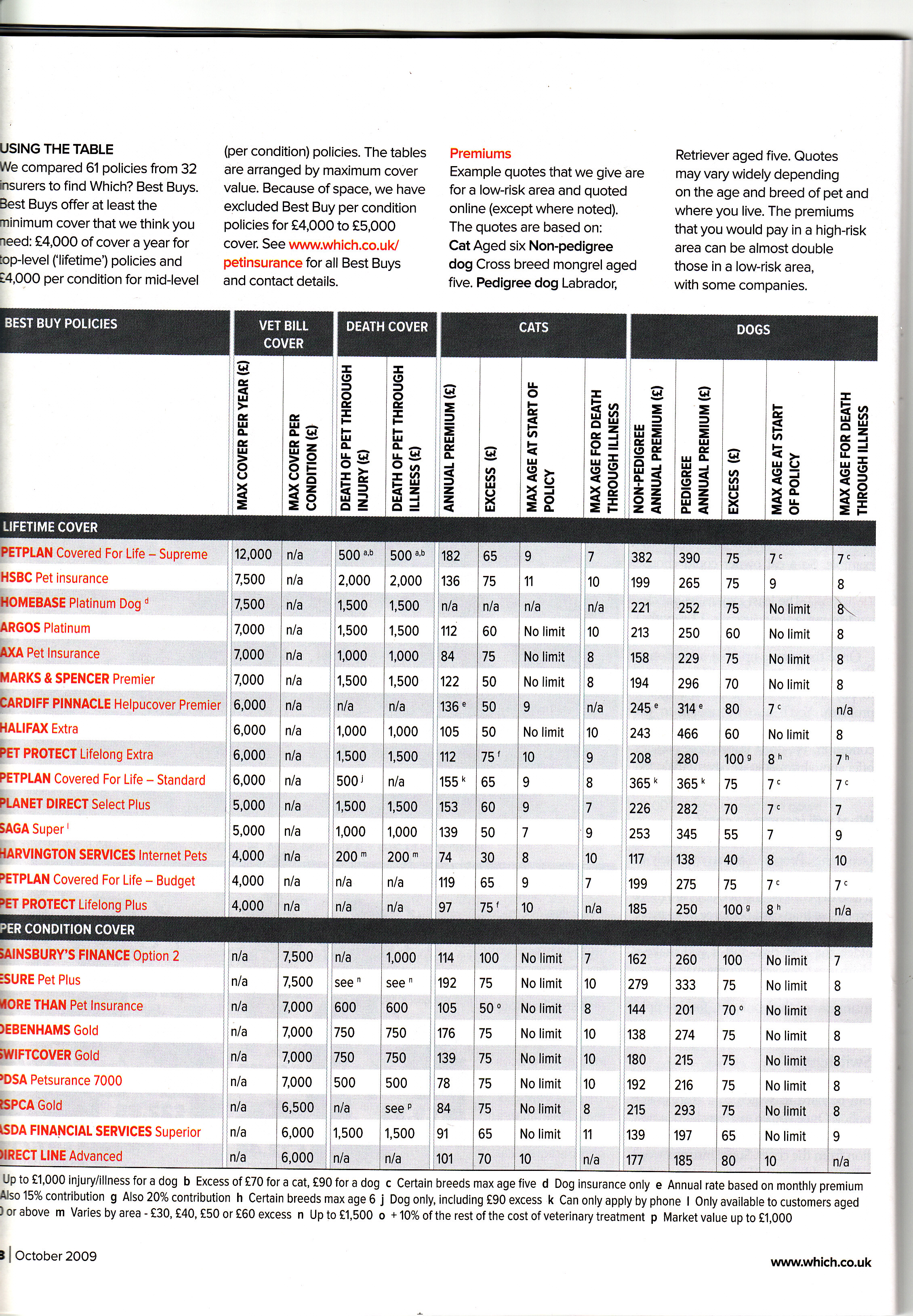
The fact cross-bred dogs are healthier than pedigree dogs is memorialized in most dog health insurance rates. For a table making that point, click here.

.

Friday, September 04, 2009

Kennel Club Monopoly Admits No Responsibility


Over on Dog World, Steven Seymour is a breath of fresh air. He writes:

Just in case those at the Kennel Club have forgotten, let me remind them of a few valid points.

Who is it who has total control and operates a monopoly over the registration of pure bred dogs in the UK?

Who, by its own admission – even though it was a faint and weak admission – knew there were many health issues, yet sat back and chose to ignore them until they were revealed to the nation by Pedigree Dogs Exposed?

Who, to date, has not even implemented the most simple of reforms such as proper identification through microchips or tattoos, let alone any step towards proper health checks?

Who has relied on those lovely words ‘self regulation’ and that other cliché ‘working quietly behind the scenes’, both of which mean ‘do nothing’? Then, when pushed into a corner, who doesn’t admit to its problem, but rather strikes out like an angry child? ....

.... Not once during the past few years have we heard from the KC the slightest admission of being responsible for anything. Each and every issue has been the result of the breed and the clubs rather than a result of its own actions.

Just imagine trying to operate a business and when anything went wrong you blamed the customer, it would not take long until you were out of business; that is unless you had a complete monopoly. Governments today do everything in their power to stop such practices and you can clearly see why.

Read the whole thing!
.

Thursday, December 11, 2008

AKC Registrations Down 53 Percent in 15 Years


In 1987 a reporter for Parade magazine asked William F. Stifel, then the president of the AKC, whether the AKC would register a blind, deaf, three-legged purebred pup with hip dysplasia and green fur. According to Parade, Stifel said, "We would register the dog. AKC [registration] unfortunately does not mean quality."

In the last 15 years, the public is gotten the message, and begun voting with its feet and wallet.

If the American Kennel Club is "just a registry" comprising a stack of papers in a dusty filing cabinet, why pay very much money for that piece of paper?

In fact, why pay anything for it when scientists and dog experts are saying that dogs raised in the American Kennel Club closed registry system with its contrived "standards" and rising coefficients of inbreeding almost guarantee a high percentage of diseased, defective and deformed dogs?

Now comes the latest missive from AKC Chairman Ron Menager in which he bemoans market economics and wonder why the American people are no longer quite so gullible:


The American Kennel Club faces enormous challenges in reversing the continuing decline in registrations. Today, we are losing market share at an alarming rate, especially in the retail sector. We are being challenged competitively and financially. The declining registrations and associated core revenues, if allowed to continue, will fundamentally change our organization going forward. Make no mistake, the very future of the AKC and our sport is at risk. ....

... Today, there are at least 30 All-Breed registries in addition to the AKC, whose combined registration numbers exceed that of the AKC. If This trend is allowed to continue, if we do not stop the hemorrhaging of declining registrations, we will no longer be the premier registry in the world, let alone in our country....

.... AKC used to dominate the marketplace. Even places like Macy's and Gimbels sold AKC puppies. Many pet owners who bought these puppies, and I was one of them, tried their hand at showing and breeding.

For decades we collected millions of registration dollars from AKC pet owners. These millions overwhelmingly subsidized our sport. Today, this scenario no longer exists. Twenty-five years ago almost all of our revenue was registration related. Last year less than one half of our revenues came from registrations. Dog registrations peaked at 1.5 million in 1992. By the end of 2008 it is projected we will register only 725,000 dogs. This is a staggering 53% decline.

... If the current trend continues and dog registrations decline to 250,000 over the next several years, AKC will face an annual revenue shortfall of $40 million. ... a $40 million revenue shortfall would necessitate a reduction of our expenses by two-thirds. This is totally unrealistic.


So what's next? Is the Kennel Club going to go to Congress and ask for a bailout like Ford and GM?


Don't laugh. Everyone else is doing it, and no doubt it is in discussion at the AKC's plush headquarters on Madison Avenue in the heart of New York City.

It is certainly no crazier than their other game plan, which is "partnering" with veterinarians and the pet insurance business in order to leverage more money out of pet owners.

The scam here is simple and tranparent: Get folks to buy pet insurance recommended by the AKC, and then get them to go to veterinarians recommended by the AKC, and then pocket kickbacks from both ends of the deal.

And who is paying for those kickbacks?

You are, in the form of bill padding, more medically unnecessary tests and procedures, and rising pet insurance costs.

Saturday, September 20, 2008

RSPCA Pulling out of Crufts.


The RSPCA says it is pulling out of Crufts. In a statement, the RSPCA says:

    The RSPCA has suspended plans for stands at Crufts next March and Discover Dogs this November and is calling for new measures to tackle the unacceptably high levels of disability, deformity and disease that threaten pedigree dogs.

    In the wake of the BBC documentary Pedigree Dogs Exposed broadcast last month, the RSPCA has become increasingly concerned about the health and welfare of pedigree dogs - and this includes animals entered into 'best of breed' classes in dog shows like Crufts.

    In the past, the RSPCA has staffed a stand at both Crufts and Discover Dogs in order to promote general animal welfare issues.

    Urgent change needed to save the pedigree dog
    RSPCA chief veterinary adviser Mark Evans said: "Dog shows using current breed standards as the main judging criteria actively encourage both the intentional breeding of deformed and disabled dogs and the inbreeding of closely related animals. There is compelling scientific evidence that the health and welfare of hundreds of thousands of pedigree dogs is seriously compromised as a result.

    "From a dog health and welfare perspective, such shows are fundamentally flawed and do our much loved pedigree dogs no favours. Intentionally breeding deformed and disabled animals is morally unjustifiable and it has to stop.

    "We want to see the emphasis shifted away from arbitrary appearance, so that health, welfare and temperament are considered first and foremost.

    "We want to help ensure that pedigree dogs have the best possible chance of being fit, healthy and happy and well suited to the lives they will lead as pets.

    "All those who benefit from pedigree dogs have a collective responsibility to solve what is now a very serious and totally unnecessary animal welfare problem - not just here in the UK, but around the world."

    Possible ways forward
    The RSPCA has commissioned an independent review of the science in this field, and will be discussing its findings with relevant experts and stakeholders later this year.

    Amongst a raft of specific recommendations, the following themes have been identified as possible ways forward.

    4 An overhaul of the rules and requirements for pedigree dog registration and competitive dog showing (including breed standards). Health, welfare and temperament should be prioritised over appearance.

    4The development and implementation of health and welfare-focused breeding strategies for individual breeds. This should include pro-active steps to increase the genetic diversity of dog breeds.

    4 More data collection and scientific analysis on causes of disease and death in dogs.

    4 Education, especially of would-be owners, to encourage demand for dogs which have the best possible chance of leading healthy, happy lives as pets.

    Health and welfare should be paramount
    "We know that hundreds of thousands of dogs are vulnerable to illness, pain, disability and behavioural problems because they're primarily bred for how they look rather than with health, welfare and temperament in mind," Mr Evans added.

    "If things don't change pedigree dogs will continue to suffer unnecessarily, and their welfare will continue to decline - this is totally unacceptable and cannot be allowed to happen. Careful breeding with an emphasis on health, welfare, temperament and quality of life is the only way to ensure a positive future for the pedigree dog."

    .

    Tuesday, August 19, 2008

    Dead Dogs Do Tell Tales


    All things being equal, smaller dogs tend to live longer than larger dogs.

    Of course, not all things are equal, and that is especially true in the dog world.

    Take a look at the two graphs below, for example. Though they may look similar, they are not, as they are actually plotted on different axes.


    It turns out that Cavalier King Charles Spaniels are so unhealthy their mortality cannot be graphed on the same scale as that of the Golden Retriever!

    In fact, in Sweden, where this data comes from, it seems that the Golden Retriever is about as healthy as a mongrel -- and in fact may be a bit healthier.

    As the Swedish longitudinal analysis of over 350,000 dogs in the Agria Insurance data base notes,

    Golden retrievers were at low risk for mortality in this study – only 22% died before 10 years. Golden retrievers were significantly less likely to die of trauma and heart disease and were in the baseline (average) risk group for neurological and tumour causes of death. They were at increased risk in the first age category for locomotor problems, but this effect waned with age as demonstrated by a negative age-breed interaction.


    As the Swedish study notes, breed-specific information gleaned from the insurance data can be extremely useful to people looking to acquire a dog and those trying to determine whether an investment in veterinary treatment is worth the expense.

    Information on the average survival pattern for different breeds is useful clinical information. Prospective owners should understand that in getting, for example, either a Bernese mountain dogs or a golden retriever, the likelihood of the dog living past 10 years of age is very different. Most owners, once their dog becomes seriously ill or dies, are keen to know if the condition is rare or common, in general or in their breed. Many owners are especially concerned if they feel their dog has died prematurely, that is at a younger than average age. Veterinarians and their clients can also use survival statistics as part of informed decision-making regarding expensive veterinary care and for conditions in which quality of life is an issue. For example, an Irish wolfhound that has survived to eight years has a 76% chance of being dead before 10, whereas an eight-year old golden retriever has a 90% chance of surviving to 10.


    .

    Closed Registries Breed the Diseased & Deformed


    The Daily Mail has a nice piece on Pedigree Dogs Exposed which premiers tonight on BBC One):

    Vets describe how virtually all cavalier King Charles spaniels develop life-threatening heart murmurs.

    And a third have syringomyelia, an agonising condition caused by them being bred with skulls too small for their brains.

    Veterinary neurologist Clare Rusbridge said: 'The cavalier's brain is like a size ten foot that has been shoved into a size six shoe; it doesn't fit.

    'It is described in humans as one of the most painful conditions you can have, a piston-type headache. Even a light touch - a collar, for example - can induce discomfort.

    'If you took a stick and beat a dog to create that pain, you'd be prosecuted. But there's nothing to stop you breeding a dog with it.'

    The programme says the drive for perfection has left golden retrievers prone to cancer, labradors with joint and eye problems, West Highland terriers beset with allergies and boxers at high risk of heart disease, epilepsy and cancer.

    Pugs are so inbred that although there are 10,000 in Britain, their DNA could come from just 50.

    The Pekingese's squashed face causes breathing difficulties that lead to some airlines refusing to fly them.

    So serious are the breathing problems that Danny, the 2003 Crufts winner, sat on an ice pack while being photographed afterwards to stop him overheating.

    To ensure desirable traits are passed on, male dogs are being mated with their own daughters, sisters and granddaughters.

    Steve Jones, professor of genetics at University College London, said: 'If dog breeders insist on going further down that road, I can say with confidence that there is a universe of suffering waiting for many of these breeds and many, if not most, will not survive.'
    .

    BBC Considers Cutting Crufts Coverage


    At Crufts.


    The Times of London reports that the BBC, which has had exclusive broadcasting rights to broadcast the Crufts dog show for more than 40 years, is reviewing its coverage in light of a programme (Pedigree Dogs Exposed!) that it had commissioned on canine health which shows that the Kennel Club's program of closed registries and beauty-show conformation standards has resulted in a high incidence of inherited genetic disease which have left many pedigree dog in misery.

    The Times reports that that "the BBC fears it will not be able to defend its coverage of Crufts after the showing."

    Three quarters of Britain’s seven million dogs are pedigree and it is estimated that veterinary bills now amount to £10 million a week to cover what the documentary makers, backed up by evidence from the RSPCA and others, claim are increasing cases of ill health.

    The programme showed a prize-winning Cavalier King Charles spaniel suffering from syringomyelia, a condition that occurs when a dog’s skull is too small for its brain.
    Veterinary neurologist Clare Rusbridge says in the film: “The cavalier’s brain is like a size 10 foot shoved into a size 6 shoe – it doesn’t fit.”

    It also showed boxers suffering from epilepsy, pugs with breathing problems and bulldogs who were unable to mate or give birth unassisted.

    Steve Jones, Professor of Genetics at University College London, told the BBC: “People are carrying out breeding which would be first of all entirely illegal in humans and secondly is absolutely insane from the point of view of the health of the animals. In some breeds they are paying a terrible, terrible price in genetic disease.”

    Selective, or line breeding, is commonplace among pedigree dogs and the Kennel Club has registered dogs bred from brother-to-sister and mother-to-son matings.
    The RSPCA’s chief veterinary adviser, Mark Evans, told the BBC: “The show world is about an obsession, about beauty, and there is a ridiculous concept that that is how we should judge dogs.

    “It takes no account of temperament or fitness for purpose potentially as a pet animal, and that to me makes no sense at all. It is a parade of mutants; a freakish beauty pageant.”


    Dog owners wait to compete at Crufts.
    .

    Monday, August 18, 2008

    Wolfhounds: Dead at Age Seven on Average


    A study of canine mortality among 350,000 insured dogs in Sweden found that 91% of the wolfhounds were dead by age 10, and that 28 percent had died by age 5.

    Half were dead by age seven, and only 37 percent were still alive at age eight.

    And this for a breed that does not stop growing until age three!
    .

    Saturday, August 16, 2008

    Kennel Club Inbreeding: Data Revealed


    Two Cavalier King Charles Spaniels mating. To read about the creation and wreckage of this breed, click here.


    A new study from Imperial College, London has come out supporting the thesis that Kennel Club dogs have been wrecked by 19th Century genetic theories and show practices which remain the foundation stone of The Kennel Club's closed registration system.

    This is bad news for The Kennel Club as the Imperial College study (published in the journal Genetics)
    echoes the conclusions of a one-hour special entitled Pedigree Dogs Exposed to be shown August 19, 2008 and also on the BBC web site.

    Even more damning, the Imperial College study uses The Kennel Club's own data to show how inbred modern purebred dogs have become.

    The study, entitled Population Structure and Inbreeding from Pedigree Analysis of Purebred Dogs (PDF) was co-authored by two researchers from the Imperial College's Department of Epidemiology and Public Health, an expert from the Waltham Centre for Pet Nutrition, and Jeff Sampson of The Kennel Club, who supplied the underlying pedigree data used by the researchers. The research itself was funded by the U.K. Biotechnology and Biological Sciences Research Council.

    For folks interested in learning more about the historical background leading up to current levels of inbreeding (i.e. "How did we get into this mess?") read Inbred Thinking -- a concise history of the historical and intellectual development of the Kennel Club and its closed registry system. A printed version of this article appeared in K-9 Magazine in May of this year under the title of "Will a Closed Registry Lead to Genetic Genocide for Certain Dog Breeds?"

    Back to the Imperial College study: What does it say, what data is it looking at, and what are its conclusions?

    Some summary points:


    1. The study is based on a 10-breed sample of 2.1 million dogs in the Kennel Club's electronic pedigree data base. The Kennel Club's database contained records of a total of 5.7 million dogs from 207 breeds as of the end of 2006. The Kennel Club's electronic data base was begun in 1970.


    2. This is the first systematic attempt to study Kennel Club population structure using The Kennel Club's own pedigree database.

    3. The 10 breeds examined were: the Rough Collie, the Golden Retriever, the Boxer, the English Bulldog, the Chow Chow, the Greyhound, the German Shepherd Dog, the Labrador Retriever, the English Springer Spaniel, and the Akita Inu.

    4. The researchers note that inbreeding condenses and exacerbates genetic disorders with a population:

      "Dog breeds are required to conform to a breed standard, the pursuit of which often involves intensive inbreeding .... This has adverse consequences in terms of loss of genetic variability and high prevalence of recessive genetic disorders. These features make purebred dogs attractive for the study of genetic disorders, but raise concerns about canine welfare."

    5. The researchers note that many dog breeds are associated with specific genetic disorders that have been magnified by inbreeding:

      "Many diseases affecting dogs have high prevalence in one or a few breeds, such as Addison’s disease, common in Portuguese Water Dogs (Chase et al., 2006), interstitial lung disease in West Highland White terriers (Norris et al., 2005), and dermoid sinus in Ridgeback dogs (Salmon Hillbertz et al., 2007)."

    6. The authors found disturbingly high levels of inbreeding within most Kennel Club breeds they looked at:

      "We find extremely inbred dogs in each breed except the Greyhound, and estimate an inbreeding effective population size between 40 and 80 for all but two breeds. For all but three breeds, more than 90% of unique genetic variants are lost over six generations, indicating a dramatic effect of reeding patterns on genetic diversity."

      Or, as the press folks at Imperial College put in in layman's terms: "The researchers' analysis showed that, for example, Boxer dogs were so closely related to one another and had such little genetic variation between them that genetically, 20,000 dogs looked like a population of about 70. In the Rough Collie breed, 12,000 dogs looked in genetic terms like a population of about 50. Such small effective population sizes mean that the chances of a dog breeding with a close relative, resulting in birth defects and genetically inherited health problems, are high."

    7. The number of generations studied ranged by breed from 5.9 in Greyhounds to 9.0 in the German Shepherds, with an average over the ten breeds of 8.0 generations of dogs analyzed.

    8. Popular sires are part of the problem, but not all of the problem.

      "Popular sires (defined here as > 100 recorded offspring) are evident in all breeds except Greyhound. Golden Retrievers have the largest proportion of popular sires (10%), and conversely the lowest proportion (5%) of male dogs that are sires. . . . Highly-prolific dams (> 40 offspring) are concentrated in three breeds: German Shepherd, Golden Retriever and Labrador Retriever. Most dams have just one litter recorded."

    9. A closed registry system is the core of the problem.

      "Dog registration rules have only been rigidly enforced for about 50 years, prior to that occasional outcrossing was still possible."

    10. The Kennel Club needs to change the way it does business.

      "We have found that the loss of genetic diversity is very high, with many breeds losing over 90% of singleton variants in just six generations. On the basis of these results, we concur with Leroy et al. (2006) that remedial action to maintain or increase genetic diversity should now be a high priority in the interests of the health of purebred dogs. Possible remedial action includes limits on the use of popular sires, encouragement of matings across national and continental boundaries, and even the relaxation of breed rules to permit controlled outcrossing."

    o t

    Thursday, August 14, 2008

    Pedigree Dogs Exposed!


    About 18 months ago, or a little more, I got an email from Jemima Harrison a television producer in the U.K. who first came across my name when she was forwarded a copy of Inbred Thinking, a post from this blog.

    We shot some emails back and forth, and talked some on the phone about the rise of the Enclosure Movement, Robert Bakewell, Charles Darwin, Francis Galton, John Henry Walsh (Stonehenge), and the rise of genetic loads.

    She then went on and chased down some good examples of bad outcomes and some smarter people to talk to (no shortage of those!) and has produced a one-hour documentary for BBC One called Pedigree Dogs Exposed.

    I have not see this special yet, but I have been promised a CD in the mail, and the squib is dead-on perfect:

    An in-depth investigation into the health of pedigree dogs. This programme reveals the surprising historical reasons that have contributed to problems in some breeds and explores what might be done to tackle these serious and debilitating health issues.


    The first showing is Tuesday, August 19th from 9:00 pm - 10:00 pm.

    UK and other readers with an international reach
    would do well to tune in and put out the early word on list-servs, etc.

    I think this piece may be an eye-opener for some!

    The Kennel Club already has its knickers in a knot, and it has not even seen it yet. Of course, their cry is that it is all bias!

    Never mind the list of dog diseases by breed.

    Never mind the working dogs that no longer work.

    Forget the shortened faces that cannot breathe, the congential heart defects, the four-legged cancer bombs.

    Let's not talk about the dysplasia, the cataracts, and the Cushing's disease. That would be bias.

    It's also prejudiced to talk about the rise of skin allergies, the broken hind quarters of the German Shepherd, and the Yorkshire Terriers with teeth popping sideways out of their too-small jaws.

    Let's not talk about deafness in Dalmations and Harlequin Great Danes, the advent of "Scottie Cramp" or the rise of "Springer Rage Syndrome."

    Oh No!! All that is prejudice.

    What is not prejudice is believing that coat color is more important than working abilities.

    What is not prejudice is a standard for a border terrier that gives more points to the shape of its head than the size of its chest.

    What is not prejudice is the notion that dogs should be judged on looks rather than on health; on a scrap of paper that says it is of "pure blood" rather than its ability to do it job from youth into old age.

    That's not prejudice, you see. That's the founding mantra of the The Kennel Club!

    It's all about paper and ribbons. It's not about the dogs. It's never been about them.


    .

    Saturday, August 09, 2008

    Dog Food Secrets "They" Don't Want You To Know


    This stuff costs $34 for 4 pounds -- more than prime steak. What's in it? A lot of stuff a wolf never ate. Stuff like sweet potato (the #1 ingredient), carrot, apple, barley greens, broccoli, almonds, watercress, alfalfa, etc. etc. Plus something mysteriously listed as "fiber". Is this stuff "better" than Purina? Nope. And it's not nearly as well tested either.


    DUMP 60 MILLION POUNDS OF TOXIC PET FOOD on to America's shelves, kill a few thousand dogs and cats, and what do you get out of it? Lawsuits and chest-thumping food fadists.

    This piece is not about the lawsuits -- it's about the food fadists.

    To tell you the truth, I could care less what anyone feeds their dog. I figured out a long time ago that a lot of people are pretty silly, and there's no stopping them, even if you wanted to.

    The good news is that most Americans are pretty sensible and moderate, and give their dogs decent bagged food with perhaps a few low-salt table scraps. In almost all cases, the dogs thrive. How could they not? As Tony Buffington, a veterinary professor at Ohio State University, told The Wall Street Journal back in March when the dog food story was still about fat dogs and price-gouging companies ripping off the rubes:

    "The nutritional requirements of neutered, sedentary adult animals are so low that they could be met by anything."


    And yet, we DO have a lot of crackpots on either end of the pet food debate, don't we?

    On the one hand we have the Vegans who want to raise their cats and dogs on tofu and barley sprouts. Good luck with that.

    On the other side we have the folks that lecture everyone that dogs are wolves and should be eating raw meat or some other concoction that they've come up with. Good luck with that too.


    Of course, both sides are espousing pure nonsense. A dog is not a wolf any more than it is a cow. A vegan who wants his dog or cat to eat only tofu has not accepted a dog for what it truly is. By the same token, anyone who thinks their dog is a wolf has also not accepted what their animal really is. A dog is not a wolf. A dog is a dog.

    As I have noted before, most dogs and most wolves do not have the same estrus cycles, do not have the same pack hierarchies, and do not communicate the same way.

    A wolf and a dog will not interbreed except under the most artificial of conditions. When a pack of wolves meets a dog, what occurs next is called lunch, and the dog is served up as the main course.

    What seems to confuse people is that a dog is a carnivore, a pack animal and a canid.

    But so what? A bear is carnivora too. So too is a raccoon, a skunk and a coatamundi. Not all carnivores live on pure meat diets.

    As for being a pack animal, a lot of animals are "pack" animals, from bees and birds, to humans and lions.

    Being a canidae does not tell you much either -- most canids are foxes of one kind or another, and a fox is a true omnivore that will readily eat bread, berries, potatoes, and corn, as well as field mice and baby bunny rabbits.

    At this point in the conversation someone is sure to point out that dogs are classified by some taxonomists as a type of wolf -- Canis Lupus, familiaris.

    But again, so what? Taxonomy is a system invented by humans, and humans are hardly the experts on what an animal is or is not.

    A taxonomer, for example, will tell you that a barred owl and a spotted owl are two different species, but in fact these two birds are not very fussy about this distinction, and will readily interbreed and produce fecund young.

    Meanwhile, a wolf and a dog are quite certain they do not belong to the same family and will attack each on sight. Who is the expert here?

    It is axiomatic, among true dog people, that the dog is the expert and not the theoretician. And a dog will tell you that while it is a canid and a pack animal, it is not a wolf.

    It is not Canis lupus familiaris, as some taxonomists would have it, but Canis familiaris -- it's own distinct species that not only looks different, but acts different at the most basic levels of sexual reproduction and communication.

    Yet, if you listen to the dog food theorists, they would have you believe that packs of poodles once roamed the earth.

    Here's a hint: it never happened.

    You can take 200 dogs of all breeds, toss them into a large pen, and let them go at it for 100 years, but what you will get out of the other end is not a wolf, but a dog.

    And it will not be a large dog, but a "pyedog" or pariah dog about the size of a jackal, but with a rounder body and face.

    Such animals can be found all over the world, scavenging on the edges of dumps, from the Philippines to Oaxaca, from Algeria to Romania, from South Africa to South America.

    What do pariah dogs eat?

    They eat what dogs have eaten since the beginning of time: whatever it is we put in front of them.

    And in most cases, the dogs do quite fine. After all, it's not like a wild dog lives very long.

    Pyedogs die at epic rates from starvation -- same as fox and wolves. Fox kit mortality is about 50 percent and wolf cub mortality is about the same. A wolf that manages to make it into adulthood can be expected to be dead by age 7 or 8, a fox by age three or four.

    This is one of the great ironies missed by the food fadists: If you feed your dog the cheapest store-bought food you can find, it will eat much better that any wolf in the wild.

    But of course food fadists are not really selling common sense and good nutrition, are they? Food fadists are selling "secret knowledge."

    In this sense, food fadists are a bit like Kennedy assassination buffs, UFO junkies and convicted felon Kevin Trudeau who constantly pops up on late-night television selling you "health food secrets that the doctors don't want you to know about."

    Food fadist are to nutrition what "phrenologists" are to neurologists, "astrologers" are to astronomers, and "aromatherapists" are to psychiatrists -- the quack end of the spectrum.

    A food fadist may toss around words like "holistic" and "homeopathy" but these words are meaningless semantic gloss designed to dress up weak philosophies in the trappings of pseudo-science. Go ahead and put rouge on the pig, but don't expect folks not to laugh out loud if you're silly enough to take it to the dance.

    Holistic medicine and homeopathy proponents are, for the most part, inventing potions and mixing them with wild claims and leavening the whole mixture with a little common sense. They are offering nothing that a Nigerian witch doctor will not sell you for a packet of cigarettes and a few naira. When push comes to shove, however, if you get sick in Africa, you had better ditch the witch and get a real medical doctor with access to serious antibiotics. Ditto for your dog.

    The funny thing about a lot of self-styled holistic food experts is that right after they lecture you about how a dog is really just a wolf, they will often turn around and tell you that they feed their own dog a diet of rice and chicken, or rice and lamb, or a mixture of rice, potatoes, peas and carrots.

    What, no mice and rats? No roadkill? Wow -- we sure did leave that "natural" diet behind pretty darn quick.

    In fact, rice is not a "natural" food for a wolf any more than a chicken is. Both are products of tropical Asia. What rice and lamb have got going for them is that they are two of the least reactive foods when it comes to skin allergies in dogs.

    And so now we come to it: skin allergies in dogs.

    Now here's the joker in the deck when it comes to skin allergies: 1) Most skin allergies in dogs have a genetic component, and; 2) The most common type of food allergy is an allergy to beef and milk.

    Beef and milk? Woops -- so much for that "wolf diet" stuff.

    In fact, the main reason we are seeing such a quick rise in skin allergies in dogs is that the genetic base of most dog breeds is now exceedingly narrow and the result is a weaker immune system. That's what happens when you start off with a very limited number of dogs in a closed registry system like we have in the AKC, and then continue to boil down the stock through dominant sire selection.

    This is a topic I have written about before, but it's a topic that the holistic dog folks generally stay away from for fear of alienating their core client base -- folks that are in love with purebred dogs that have skin problems. Shooting the dog is not an option that their client base wants to hear, nor do their clients want to be told that they "bought a lemon" and should have stayed away from the AKC. It's much easier -- and much more lucrative -- to talk about the problems with dog food.

    And so, instead of talking about genetics, the holistic food folks say it's all about diet secrets. How very "Kevin Trudeau" of them! You don't have cancer because of your genetic predisposition -- you have cancer because you didn't buy my book or my diet.

    The good news here, is that most dogs do not have skin allergies, and most dogs do really well on any kind of commercial food given to them.

    The main problem facing dogs in America today is not poor nutrition caused by a lack of calories or essential vitamins and minerals, but obesity caused by too much food and too little exercise.

    Rather than too few vitamins and minerals in the dog food, the problem -- especially in large breed dogs -- is too many vitamins and minerals (especial calcium) which produce too rapid a growth pattern which can exacerbate underlying hip dysplasia and other joint issues.

    So what should dog owners do when it comes to feeding their dogs?

    Whatever they want. That's the point of this post. Read up and look around and use common sense. Billions of dogs have been fed bagged food for more than 100 years, and most seem to have done fine with it.

    That said, if you want to cook up a special meal for your dog every night for the rest of your life, go ahead and do that. If you are a vegan and want to feed your dog only seitan and rice, it will probably live as long as any wolf in the wild. Ditto if you want to feed your dog nothing but fresh deer meat shot in your backyard.

    For those who REALLY want answers, however, I encourage you to order: "Dog Food Secrets "They" Don't Want You To Know About". Operators are standing by, and all proceeds will be donated to help poor children.

    .

    Friday, May 16, 2008

    Annals of the Law


    From: The New Yorker, August 28, 1954, p. 30, "DOGGY" by E. J. Kahn

    Out in Kalamazoo, there has existed since 1898 the United Kennel Club, which registers some 15,000 dogs annually & with which, over the years the A.K.C.s relations have been less than cordial.

    In 1927 the U.K.C., a privately run concern, tried to get an injunction in a federal court to restrain the A.K.C. from taking disciplinary action against individuals who participated in U.K.C.-sponsored shows. While this squabble was in progress the A.K.C., which had had reservations about the reliability of the pedigrees issued by U.K.C., asked the National Better Business Bureau to look into the matter. The Bureau prankishly invented two terriers, gave them spurious ancestors, and submitted them to U.K.C. for registration. The U.K.C. fell into the trap and certified both without question, whereupon the A. K. C. triumphantly made the deception public.

    The U. K. C. dropped its suit soon afterward.


    This post is perhaps a little too "inside baseball" for anyone not boiled in the oil of the politics of the terrier world (something I try to stay clear of myself), but suffice it to say that in October of 2002, the Jack Russell Terrier Club of America was sued over its policy of excluding folks who attempted to register their dogs with the American Kennel Club.

    The JRTCA's position was that a closed registry system, such as that embraced by the American Kennel Club, is antithetical to the long term best interests of working terriers. The suit was defeated in October of 2002, and in May of 2005, the U.S. Court of Appeals for the Ninth Circuit affirmed.

    Today, the Jack Russell Terrier remains a working terrier, while the American Kennel Club dog (which decided to change the name of its dog to the "Parson Russell Terrier") is almost never found working in the field.

    As for registration standards, the JRTCA will only register adult dogs as individuals (entire litters of puppies cannot be registered), and color pictures of the dog from the front and sides must be submitted with each application, along with a four-generation pedigree, a veterinary certificate (the vet must sign the photos), and precise measurements of the adult dog (height, length, and chest size).

    In contrast, the American Kennel Club now allows folks to register entire litters of dogs on line, no photos required, no veterinary checks required, and no measurements required. So long as the check clear, your litter will probably be registered!

    Has stringent recording criteria and a broader conformation standard hurt the Jack Russell Terrier Club of America? Not apparently: the JRTCA remains the largest Jack Russell registry in the world, while the Parson Russell Terrier has fallen from the 65th ranking (2002) to the 75th ranking (2007) in the AKC. What's the 75th ranking in the AKC mean? It means fewer Parson Russell Terriers were registered last year than Silky Terriers, Japanese Chins, or Brussels Griffons.
    .