Showing posts with label chupacabra. Show all posts

Thursday, May 18, 2017

Chupacabra Hunting With Terriers


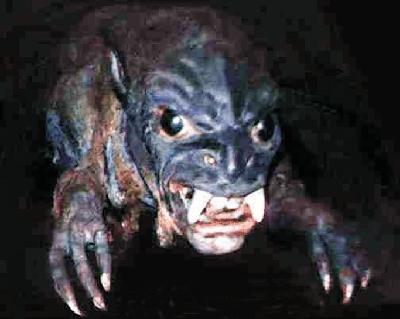
This is a picture of a fake Chupacabra. The dogs caught a REAL one!

The photo, above, is a not-very-good model of a Chupacabra. We sometimes hear of El Chupacabra, but it's very rare to know anyone who has actually seen one in the field, much less been lucky enough to bag one. But that is what the dogs and I did back in 2006, and I have the pictures to prove it.

But I am getting ahead of myself. What, you may ask, is a Chupacabra?

El Chupacabra is an animal that is known to inhabit rural areas of Mexico and parts of Central America. Its name, translated literally from the Portuguese and the Spanish, means "goat-sucker" for its habit of attacking and killing lifestock and draining them of all their blood.

It is not clear when the Mexican Chupacabra first came north to the United States, but by the mid 1990s, it was here. Mexican farmhands in such diverse places as Kentucky, Oklahoma, and Tennessee, would periodically come across dead livestock in the fields with torn windpipes and every ounce of blood drained from their carcases. "El Chupacabra," the migrant workers would whisper. "It has come El Norte with us."

It is easy to write such things off, and, in truth I have always done so myself. Where are the pictures of El Chupacabra? Where does it live during the day? Why does it only come out at night? Where is the proof? There were never any answers. Until now.

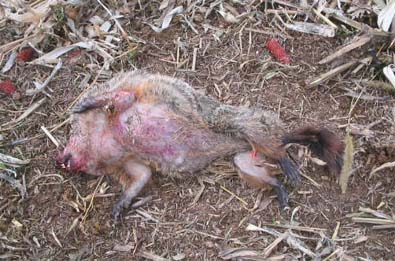
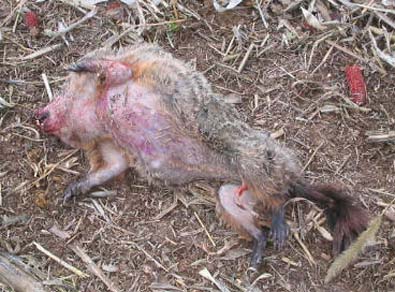
On that Sunday, I was walking the edges of a cut-over corn field with the dogs in tow, when Mountain slid into a hole and opened up to a full bay. A few minutes later, this thing came barreling out of the ground.

Mountain followed it out of the hole and gave chase, and soon caught it by the rear leg. Pearl, still young and full of herself, piled into the scrap too. Both dogs had it above ground and on its back. I ran over and put my boot on the creature so it could not bite the dogs. But ... what the hell was it?

And then, I knew. It was El Chupacabra -- the infamous Mexican goat-sucking blood beast of legend.

By God I had one, and it was not going to get away. And it didn't.

Now there are some who may doubt my story, but I have appended pictures of the Chupacabra below, for anyone to see the horror of this thing.

Clearly, this is not an animal found on earth. This animal is the work of the Devil. This is El Chupacabra.


Saturday, October 31, 2009

Fantasy Creatures and Halloween


This post is recycled from 2004.

People seem to have a need for fantasy. I have written in the past about "fantasty diggers" but perhaps something should be said about fantasy creatures as well.

There is the fellow who claims to be an expert in wildlife who says he hunts blue fox, which he describes as a cross between a red fox and a Gray fox. That would be a fascinating cross (!) as these two animals are not remotely related to each other and cannot mate (nor do they wish to).

The same fellow chimed in that American rabbits den underground and that there are rabbit warrens in America. In fact no American rabbit dens underground. All of our native rabbits are cottontails (which is a genus, not a species) or hares and they nest in the shallowest of scrapes in the dirt. The pygmy rabbit, which lived in a small section of the West and was no bigger than a rat, was the one exception, but it is now believed to be extinct in the wild.

America runs rife with fantasy animals. There is Big Foot and Sasquatch, but also the Chupacabra, the Mothmen of Ohio, the Ozark Howler, various types of vampire dogs and Werewoves, and "Chessie" the Lake Champlain version of the Loch Ness Monster.

The U.K. has the same phenomenon, where loose, sem-feral lurchers and sheep-worrying dogs are described as the "Beast of Bonndwyyn" or some other interesting-sounding place.

Tracks are carefully photographed, and the brave locals point to the big claw marks as proof that a large feral cat (a black panther or jaguar or American cougar) is running loose in the allotmments.

In fact, the claw marks are proof that it is not a big cat -- all cats except cheetahs retract their claws when walking or running. If you see claw marks in a track, you have a dog. A dog that looks a lot like a large wild cat is most probably a lurcher. There may be a few feral swamp cats in the UK (as well as Scottish wild cats) but if you have ever seen one of either species, you will not worry about much livestock being lost -- both are hardly bigger than a large house cat.

Tonight, when you see monsters running through your streets, try to remember it's Halloween, and not Chupacabra hunting season. Fantasy is a fine thing -- so long as it's not confused with reality.

Wednesday, July 11, 2007

The "Beast of Basra" Is Blamed on the British


From The Times of London:


British forces operating around the southern Iraqi city of Basra are being blamed for the arrival of a plague of vicious badgers that stalk the streets at night, attacking livestock and even humans.

Local farmers have caught and killed several of the beasts, but this has done nothing to dispel rumours of a bear-like monster that eats humans and was, according to the local rumour mill, released into the area by UK forces to spread panic.

Major David Gell, a British Army spokesman, said the animals were thought to be a kind of honey badger or ratel - melivora capensis - which can be fierce but are not usually dangerous to humans unless provoked.

The animals are indigenous to Africa and large parts of the Middle East and are about the same size as European badgers but much more aggressive, with long claws and strong jaws. They have been described in the Guinness Book of Records as the world's most fearless animal.

“They are native to the region but rare in Iraq. They’re nocturnal carnivores with a fearsome reputation, but they don’t stalk humans and carry them back to their lair,” Major Gell said.

Iraqi scientists have attempted to calm the public but the story of the British badgers has spread like wildfire through Basra and the surrounding villages.

Mushtaq Abdul-Mahdi, director of Basra’s veterinary hospital, has inspected the corpses of several dead badgers and sought to reassure his fellow citizens that they are not new to the region but had been seen well before Saddam's ouster in 2003.

“Talk that this animal was brought by the British forces is incorrect and unscientific," Mr Abdul-Mahdi told AFP.

But their numbers are increasing, possibly, scientists say, because Iraqi authorities are trying to reflood marshlands north of Basra that were drained under Saddam Hussein.

So far neither the scientists nor the soldiers have been able to calm the populace's fears.

“I was sleeping at night when this strange animal hit me on my head. I have not seen such an animal before. My husband hurried to shoot it but it was as swift as a deer,” said Suad Hassan, a 30-year-old housewife. “It is the size of a dog but his head is like a monkey. It runs so quickly."
Mobile phone video of the badgers circulating in Basra shows a stocky skunk-like animal with long front claws. The honey badger, or ratel, is known as a brave predator capable of killing a cobra. It weighs up to 14kg (30lb),

Sattar Jabbar, a 50-year-old farmer from Abu Sakhar north of Basra, believes the badger can tackle even large prey. “I saw it three days ago at night attacking animals. It even ate a cow. It tore the cow up piece by piece. I tried to shoot it with my gun but it ran away into the orchards. I missed it,” he said.

“I believe this animal appeared following a raid to the region by the British forces,” said Ali Mohsen, a farmer in his 40s from Karmat Ali, near the air base used by the multinational force. “As we are close to the airport, they probably released this animal into the area.”

Amid such tales, there is little experts like Dr Ghazi Yaqub Azzam, deputy dean of the veterinary college, can do to reassure his neighbours. “Its nature is to eat small animals like hens and rats. It has powerful senses of hearing and smell. It gets aggressive if senses danger, but it doesn’t attack man unless threatened,” he said.

Major Gell said that Basrawis should have little to fear from the beast, although he warned them not to get too close, “If you cornered it and poked it with a stick, then the smart money would be on the badger,” he said.

But he added: “We have not released giant badgers in Basra, and nor have we been collecting eggs and releasing serpents into the Shatt al-Arab river."
.

Monday, April 30, 2007

P.T. Barnum and the Beastiaries of the Imagination


Over at the Querencia blog a while back, Matt M. reported that he had been reading a book called Big Foot Exposed, which was written by his wife's first cousin, who happens to be a specialist in primate anatomy and biomechanics. Big Foot data is looked at straight-faced and is -- not too surprisingly -- found wanting.

Meanwhile, over at the Tetrapod Zoology blog, the always-interesting Darren Naish went to a Big Cat conference in the U.K. and seems to have gotten sucked in to believing that there are large mystery cats running around Britain. Well maybe they're not large cats ... maybe they're little ones about the size of a house cat or a Scottish Wild Cat. Hmmmm . . . . could they possible be just house cats and Scottish Wild Cats?

On my end, I have to say I rather enjoy the cryto-zoology crowd because it's an odd alamgam of P. T. Barnum myth makers, city slickers that that have never touched a cow, country rubes easily fooled at the carnival, and regular folks with a deep-seated desire to find (please!) some level of mystery, fantasy and novelty in a world that is pretty well explored and explained.

At some level we all desperately want there to be a Santa Clause, a flying Yogi, a living T-Rex, and an anaconda large enough to swallow a house trailer.

If we canot find it, we will invent it, and who is to say that it does not exist? You cannot prove that the non-existent does not exist -- an interesting fall back position for every kind of fun thing from Sasquatch and Cold Fusion theorists to the Church of the Invisible Pink Unicorn.

It's a bit fun to stoke the fires of misbelief, as anyone who has even taken a troop of cub scouts "Snipe Hunting" at night can tell you. After you have them beat the brush for half an hour looking for a "snipe" (described as an animal that looks like a thin rabbit with a white stripe downs its back) you aim your flashlight up a tree and bounce it around a bit while telling the kids you just saw .... a Ho-Dag!

I plead guilty of pulling a few tricks like this. Regular readers might remember the "Chupacabra" that I reported the dogs killing a while back. The post came complete with pictures, and they were not faked. All I did was take a natural oddity, add a tall tale which I told straight, and presto -- a real Chupacabra.

In fact, my "Chubacabra" was nothing more than a groundhog victimized by four or five very large tumors that had distorted its body to the point that it looked like an alien beast. The purple color was due to the fact that the poor creature was dragging itself over nearby pokeberry plants as it tried to find food in the final days of its misery.

Similar "mystery creatures" are reported all the time, and in almost every case they are nothing more than a mangey fox or coyote, or a bear that has lost its hair or -- in some rare cases -- an escaped exotic pet like a mouflon goat or a wallabee.

The "Beast of Stronsay" turned out to be nothing more than a half-rotted basking shark.

Pulling people's leg is big business. I could point to Big Tobacco here (or the Bush Administration and Haliburton), but let me stick to the natural world and not digress too much.

Phineas T. Barnum made his fortune by parading people into a museum to see a "Feejee Mermaid," which was nothing more than a faked bit of taxidermy combining a monkey and a fish. That gag worked so well, he began parading a pair of retarded dwarf brothers from Connecticut around as the "Wild Men of Borneo," and he found a 5-year old midget he paraded around as an adult named "General Tom Thumb."

Today, thanks to PhotoShop, the gags have never been easier. In the great tradition of western postcards that show Rainbow Trout so large that just one of them fills a wagon pulled by a team of 20 mules, we now have pictures of massive sharks looming over surfers or jumping out of the water to snatch National Guardsmen off of ladders dangling from helicopters. Even video tape can be faked.

And yet, we want to believe. I regularly get interesting bits of stuff sent my way from folks who are sure it is true. After Hurricane Katrina hit New Orleans, an office mate sent me a picture of a giant alligator that was caught in New Orleans' streets. There was just one problem -- the picture was not an alligator, but a crocodile. I tracked down the origin of the picture in a few minutes ... ditto with the enormous snake "in Australia" that I quickly recognized as an African Rock Python.

Some of my favorite tall tales are the myriad "Beast of" stories that come out of the U.K. People who believe in such things are entirely immune to rational thought. Here's a hint: there are about 200 mounted fox hound packs working every inch of a very crowded U.K., and yet they have never turned up a big cat.

Yet people want to believe there is real danger in the English countryside -- never mind that the last wolf in the U.K. was shot dead more than 250 years ago, and the last bear more than 1500. If there is a dead sheep with a torn throat it must be a giant cat, never mind all the sheep-worrying lurchers that regularly get loose and go feral for a few days, weeks or months. Sir Arthur Conan Doyle understood the mind set well when he wrote "The Hound of the Baskervilles."

People want to believe and will suspend all logic to do so, and if it also helps sell a few newspapers and T-shirts, so much the better.

The folks around Loch Ness have a small business selling postcards, tours and trinkets. The same is true around Lake Champlain where the locals have invented their own version of "the monster" which they call "Champ." Add to the mix the Yetti of the Himalayas and the Sasquatch of the Pacific Northwest.

And while we're at it, let's not forget the thousands of "Jackaplope" heads gracing the walls of western bars and tourist stores in Wyoming, Colorado and Montana.

And, of course, if there is ever a Museum of Humbuggery, the alien autopsy gag has to get its own case, as does the running gag known as "crop circles," which turned out to be nothing more than a collection of pranksters with a bit of rope and a couple of two-by-fours.

The real story, however, is that most of the earth has been well-swarmed by biologists, hunters, anglers, explorers, bug collectors, small children, foreign aid workers, and old men. Sadly, on land and in the air, there is no longer too much new under the sun.

Not all mystery is gone, of course. About once every decade we find something as "amazing" as a new small deer or striped rabbit in the forests of Southeast Asia.

Several times a year a scientist or two declares he has found a new species of mouse, frog, large insect, or small bird.

The deep oceans contain a lot of things yet unseen and unnamed. Perhaps the Creature from the Black Lagoon really does exist .... somewhere ... out there.

And even if not, we can still sell a book, a movie, and a few T-shirts about it, eh? What's the harm in believing?


.