Showing posts with label endagered species. Show all posts

Wednesday, October 18, 2017

Gorring's Raccoons


A repost from January 2006

The Monterey Herald reports on Germany's "Unwanted Raccoon Harvest":

California has had its revenge on Germany, the source of wild boars that were stocked to provide game for hunters and have since overrun the state, plowing up fields, gobbling plants and animals, and endangering endangered species.

Germany has raccoons. Lots of them, according to the Times of London. Some studies put the estimate at a million.

Times reporter Roger Boyes reported last week that "Vineyard owners across Germany are hiring bounty hunters to kill furry animals with a taste for grapes.

"Hunters are being hired to prevent a plague of raccoons with Nazi-era ancestry from munching their way through the German wine harvest."

The German wine-growing region of Kassel has become "the raccoon capital of Europe ever since Baron Sittich Von Berlerpsch released two of the animals into the wild in February 1934.

"The move was encouraged by Hermann Goering," he wrote, "the Nazi leader who, apart from being the head of Hitler's air force, was the chief forester of the Third Reich."

The first raccoons were brought from North America in the 19th century, Boyes reported, and their population grew by leaps and bounds when an Allied bomb hit a raccoon farm in 1945, scattering the animals.

Sunday, June 05, 2016

Warbler Politics: How Birds Made Two Presidents


Prothonotary warbler.  This post is mostly recycled from 2007.

The latest news out of Texas this campaign season (June 2016) is that the the U.S. Fish and Wildlife Service has denied a petition to delist the golden-cheeked warbler, a 5-inch, black-and-white bird with a bright yellow face.

This news comes to my door as large number of warblers arrive from the south, delayed a few days perhaps by the rain and cold we have had in the last month.

The weather seems to change every day now, with cold and warm fronts crashing into each other, and the resulting squalls bringing flocks of small birds north on the winds.

The warblers are returning to Virginia in droves. They are more visible now than they will be later on when the foliage will obscure them high up in the trees. You have to look carefully among the mixed flocks of returning chickadees, titmice, and nuthatches to find the warblers, but they are there.

Warblers are very important birds, as they are the primary insect eaters in North America's woods. The bad news is that most warblers are in rapid decline over vast portions of the U.S. due to forest fragmentation which is occuring both in the U.S. and overseas where "our" warblers spend the winter. I have written a bit about that in the past.

Something I have not written about before is how warblers have shaped presidential politics. In fact, it is not too much to say that "warbler controversies" have led directly to two presidents being elected to office.

The first president to have his early career shaped by a warbler was Richard Nixon.

Back in 1948, Whittaker Chambers, a senior editor at Time magazine, and a former Communist spy turned government informer, accused Alger Hiss of being a spy for the communists in the mid-1930s.

Chambers was not exactly a credible witness; he had very little documentation to back up his charges and he admitted at the Hiss trial that he had repeatedly committed perjury on other occasions. Inititially it was not clear he had even met Hiss, much less knew him well.

Chambers claimed he did know Hiss, and backed it up by noting that Hiss was a bird-watcher who was very proud that he had seen a prothonotary warbler near Glenn Echo Park just outside of Washington, D.C.

In cross examination of Hiss before the House Committee on Un-American Activities (HUAC), a young Congressman by the name of Richard Nixon asked a seemingly innocent question: "What hobbies, if any, do you have, Mr. Hiss?"

Hiss answered that his hobbies were "tennis and amateur ornithology." Congressman John McDowell then jumped in an asked Hiss whether he had ever seen a prothonotary warbler?

Hiss walked right into the trap, responding that he had -- "right here on the Potomac."

Slam -- the trap had been tripped. Committee members were now convinced it was Hiss who was lying, not Chambers. After a series of trials, Hiss was sentenced to prison for 5 years based on very sketchy (and still controversial) evidence.

As for Nixon, he managed to use the Hiss affair to propel himself from the U.S. House of Representatives into the Senate, and from the Senate into the Vice Presidency under President Dwight Eisenhower.

The rest, as they say, is history.

The saga was was not quite over, however. In 1952, not quite content to let his 15 minutes of fame pass him by, Whittaker Chambers published his autobiography, which was entitled Witness. Ronald Reagan later credited this book with transforming him from a New Deal Democrat into a conservative Republican.

While shilling for General Electric in the 1950s and early 60s, Reagan made frequent references to Whittaker Chambers in his speeches, and on March 26, 1984 -- 23 years after Chambers had died -- Reagan posthumously gave Whittaker Chambers the nation's highest honor, the Medal of Freedom.

Probably no one has ever deserved it less.


Golden-cheeked warbler.


Another President propelled into office on the wings of a warbler was George W. Bush.

In June of 1994, a memo from the U.S. Fish & Wildlife Service was leaked. The memo outlined a tentative plan to declare hundreds of thousands of acres across 33 counties in Texas hill country as being "critical habitat" for the endangered Golden-cheeked Warbler.

It was feared that, if implemented, "the plan" would have made it virtually impossible to bulldoze Ashe Juniper off of the surrounding hills -- a necessity if those hills were to be turned into nice new housing developments with grass lawns and underground sprinkler systems.

Massive opposition to the informal Fish & Wildlife Service proposal sprang up overnight, with school auditoriums quickly filled to capacity by ranchers, developers, and property owners who were led to believe that the draft proposal was soon going to be made into law overnight, and that it would impact almost all private property.

In fact, the proposal was a mere internal memo within the agency (no rules or regulations had been written or circulated, and no draft Environmental Impact Statement had been initiated), and the designation of critical habitat directly affected only actions that were to be federally funded or authorized, not privately-held lands.

George W. Bush was not a stickler for the facts (then or now) and he jumped on the wave of misinformation circulating through Texas in order to fan the flames of discontent. Positioning himself as a champion of the property rights movement, Bush hammered on the "federal land grab" even after Interior Secretary Bruce Babbitt had disavowed the leaked memo and Texas Governor Ann Richards also voiced her strong opposition.

Richards, of course, was too late. Bush campaign operatives -- including Karl Rove -- had already framed the issue and associated Ann Richards with it -- never mind the facts, or her true position.

Texas being Texas, and modern political discourse being what it is, people believed the Bush Campaign's spin.


In the end, due in no small part to the warbler controversy, George W. Bush was elected Governor of Texas, which he later used as a stepping-stone to the White House.

And the rest, as they say, is history, written in debt, blood, and destruction
.

Friday, November 13, 2015

The Real Threat to Hunting


A repost from this blog, July 2004.

For hunters, fluttering orange tape and popsicle-colored sticks mean only one thing: Doom.

This is the spoor of the tract-home surveyor. This is the end of the game.

The hill where your terrier worked that fine red fox last season will soon be covered by plastic-sided houses and kiddie swing sets.

The hedgerow you counted on for the occasional raccoon and a steady supply of groundhogs will soon be an asphalt ribbon.

Across the country the same story is playing out, again and again. It is not PETA that is hammering hunters, but real estate developers.

Pheasant, quail and bear are long gone from most areas, as are bobcat, cougar and wolf.

Even if deer and geese manage to thrive on 15-acre tracts, the American hunter will not.

When land is cut up into small parcels, acquiring permissions is difficult and firing a gun impossible. More houses means more roads. It does not take too many roads before a man with working dogs no longer feels comfortable letting them off leash.

Most of us know the big picture: forests are falling to farms, and farms are falling to freeway all over the planet. Across the globe wild rivers are being dammed, and increasing numbers of species are being pushed on to the endangered species list. Cars, factories and electricity-generating power plants are spewing forth greenhouse gases contributing to global warming, even as mile-long gill nets decimate fishing grounds, and raw sewage spills untreated into once pristine waters.

The environment is not committing suicide -- we are killing it. As Pogo so aptly put it, "we have met the enemy, and he is us." The common denominator to every clearcut forest and decimated hedgerow is human population growth.

It’s hard to overstate the speed of human population growth. It took perhaps two million years to add the first billion people to the population of the world -- a number reached about 1830. It took only 100 more years to add the second billion people (1930), and just thirty more years to add the third billion (1960). The global population counter clicked past four billion by 1975, five billion by 1987, and six billion by 1999. World population will climb past seven billion within the next 15 years.

It’s hard to get a handle on such numbing numbers. Let's bring it closer to home to gain a little perspective. Surely, we have nothing to worry about here in the United States, right?

Think again.

Consider what has happened in your own lifetime. Take a look at the table below, and find your approximate age in the far left column. The number next to it is the size of the U.S. population when you were born, and the number to the right of that is the relative population growth that has occurred in the U.S. since then.


Of course, the U.S. population growth that has occurred since you were born is only part of the story.

Let’s think for a minute about the U.S. population growth that will happen over the rest of your lifetime. I will use middle-range Census Bureau projections even though these numbers have consistently been too low for over 50 years because Census Bureau demographers habitually under-estimate illegal immigration and over-estimate emigration (people leaving).

In the table below, look in the left column to find your approximate age -- or the age of your children or grandchildren if you prefer. Now look at the next column to see what the population of the U.S. will be when you (or your children or grandchildren) are age 70. The third column gives the percentage population growth that will occur in the intervening years. Again, these are very conservative numbers.


Another way to think about these numbers: over the course of the next 50 years, using the very conservative mid-range projections of the U.S. Census Bureau, the U.S. will add about 150 million people to its population -- a sum greater than the population of the United States west of the Mississippi River today.

To put it another way, over the course of the next 50 years, the U.S. will add more than twice the current population of the United Kingdom.

Where is all this population growth coming from? Most of it originates overseas.

About 70 percent of all future U.S. population growth will be due to immigration (legal and illegal) and the children and grandchildren of immigrants that have not yet landed on our shores. In a very real sense, America's hunting and angling future is being determined in Karachi, Mexico City, Beijing, Moscow, Dublin and Hanoi.

Most of the organizations that we think of as protecting the environment and sports hunting do not mention the speed of U.S. population growth, not because it is not an issue, but because they are afraid that talking about limits on immigration might harm future membership growth. After all, today's illegal alien is tomorrow's permanent resident alien or U.S. citizen, right? At the top reaches of organizations as divergent as the Sierra Club and the National Rifle Association, success is not defined by what is going on in forest and field, but about what can be done to grow out the membership base now and in the future. Association executives are as enamored with population growth as any real estate agent or strip mall developer.

I suspect it will only be in hindsight that we realize what we have lost and what we have gained. Very few people notice the absence of box turtles or make the connection between population growth, habitat change, and Lyme disease.

Only when we are very old and America has changed to the point where we no longer recognize it will we understand the wisdom of Sioux Chief Ben American Horse, who warned Vice President Alben Barkley, "Be careful of your immigrations laws. We were damn careless with ours."
.

Friday, July 02, 2010

Where the Buffalo Roam -- Again


A repost from this blog, circa December 2004.

Thanks to Teddy Roosevelt, Aldo Leopold, Gifford Pinchot, the American environmental movement, the Lacey Act, the Weeks Act, the Clean Water Act, the Endangered Species Act, the Pittman-Roberts Act, the Conservations Reserve Program, the Migratory Bird Conservation Act, and the Duck Stamp Act (to name just a few), America's wildlife is coming back.

All of this legislation has been supported by hunters who understood the value of the land and the wildlife on it. Environmentalists and hunter-anglers have worked hand-in-hand to bring back the wild turkey, to protect bear habitat, to preserve salmon spawning streams, and to shelter riparian areas.

For the terrier enthusiast, the result is plain to see in the hedgerow and forest: a record number of red fox, raccoon, possum and groundhogs spreading out into historically new territory.

Even species once pushed to the edge of extinction are now roaring back from the abyss -- alligators, bald eagles, beaver, Canada geese, wolves, and buffalo.

If the story of 19th Century America was about stripping the land and exterminating every species on it, the story of the 20th Century has been about bringing it all back.

Where the Buffalo Roam -- Again
San Francisco Chronicle, April 22, 2001

________________


Brian Meirs first noticed it a few years ago. The game was coming back.

It was subtle in the beginning - a few more sharp-tailed grouse along the section roads than usual, more deer peering from the margins of the hayfields at night. Then people started noticing there were larger numbers of pronghorn antelope than had ever been seen, and they were hanging around closer to town.

"Even 10 years ago, you never heard of mountain lion or elk around here," said Meirs, a state game warden who works the vast plains and mesa country around Buffalo. "Now they're pretty common. There are even occasional wolf sightings. It's like the wildlife was back there in the shadows, waiting for a change."

The change has been building for decades. The western Great Plains contain the country's greatest demographic anomaly: Its human population is emptying out. The trend, the 2000 census shows, has really gained force over the past decade with the drying up of the ranching economy.

But as people move away, wildlife is starting to fill the vacuum. In an unexpected way, a vision of the Great Plains as a wild commons is taking hold.

"It's funny - Buffalo Commons is really happening," Meirs said, as he sat in his truck on the main drag of Buffalo, a thoroughfare framed by abandoned storefronts. "Not like people thought it would. But it's happening."

The concept of the Buffalo Commons was floated by New Jersey sociologists Frank and Deborah Popper in 1988. The Poppers observed that agriculture had failed miserably on the Great Plains, and noted that the region would probably be almost wholly depopulated save for a few cities by the mid-21st century.


The highest and best use for the area, the Poppers argued, was in its pristine state: A restored prairie cleared of fences and abandoned ranches, reseeded with native bunchgrasses, teeming with wildlife. And foremost among these resurgent animals would be the emblematic beast of the Plains: the buffalo. Back by the tens, perhaps hundreds, of thousands. Plains residents, both white and Native American, would earn their money through ecotourism and franchise hunting, not punching cows and growing dryland wheat.

Because the Poppers' proposal was predicated in part on federal buyouts of private property, it kicked off a howling storm of protest from the Great Plains agricultural community. Ranchers saw it as the most sinister possible example of a federal land grab. Resistance was so great that the idea died aborning.


But that didn't change the reality of Plains demographics - a reality best apprehended from the air.

Fly in a puddle jumper from Denver to Bismarck, N.D., and look down. There are great tracts of Badlands and rolling prairie, huge expanses of "pothole country" spangled with ponds and marshes, entire square miles of dryland wheat and irrigated alfalfa, serpentine brown rivers lined with cottonwoods, the occasional road. Very few ranches, and fewer towns. No cities. The West and East coasts, the intermountain West, the Southwest, the Gulf Coast and the Deep South - they're exploding with development. Even the industrial Northeast, long a laggard in population growth,
is gaining new people.

But not out here where the buffalo once roamed. Nearly three-quarters of Plains counties - 322 of 443 - have lost population since 1930. According to the 2000 census, 272 of 443 of the Plains counties have experienced population declines since 1990.


Demographers estimate that rural counties of the Dakotas could lose an additional third of their population in the next 20 years. From eastern New Mexico through the Texas and Oklahoma panhandles, to large portions of Colorado, Kansas, Nebraska, the Dakotas and Montana, the story is the same.

The depopulation affecting the region is nothing more than the dying of a dream. Or a scheme, at least. At the turn of the century, the western Plains were considered the globe's most promising emerging breadbasket.

Cattle had thrived on the rich prairie bunchgrasses after the subjugation of the Plains Indians and the elimination of the buffalo.


Now, decided the pols in Washington, D.C., the rich black earth beneath the virgin sod would grow the nation's wheat.

The late 19th century and early 20th century were fairly wet on the prairie, reinforcing a popular idea of the time that "rain followed the plow." But years of drought followed, and homesteaders began washing out. The ruins of their farms are all over the Plains, ranging from abandoned dugout hovels to derelict three-story houses that are home to nothing but bats and owls.

"Agriculture around here is changing so fast you won't even recognize it in 10 years," said game warden Meirs as he sat in his truck listening to the wind whistle down Buffalo's main street. "The cattle and sheep are going by the wayside."

Buffalo Commons, it seems, is destined to occur - no matter what it's called, no matter who loves or hates it. But the forging of the Commons isn't a completely passive process.

True, the great federal investment envisioned by the Poppers didn't happen, nor is that likely. Given general public sentiment against extravagant government spending programs, it's inconceivable that Congress would loosen up the purse strings to fund the purchase of tens of millions of acres of bankrupt rangeland.

Instead, Buffalo Commons is becoming a private enterprise. And leading the movement is media mogul Ted Turner, who appears to have made the North American bison his private totem. Turner owns about 1.7 million acres divided among several ranches scattered across the Plains, and that figure is growing.

"I heard tell that Ted Turner wants to be able to ride all the way from Canada to Mexico on his own land," drawled one Nebraska rancher. "And the way he's going, it isn't going to be too long before he can do that." Turner looks for a certain kind of property: One that's in grass rather than croplands, with natural contours intact. He wants good biodiversity - country that supports substantial populations of wildlife of numerous species. And when he buys properties, he more or less follows the same formula: Tear out all the cross fencing and replant pastures with bunchgrasses and other native vegetation. Bring in the buffalo.

Turner believes that ranching can be profitable on the Plains - but not necessarily by raising cattle. He's promoting the sale of buffalo breeding stock and meat, luxury big game and bird hunts and ecotourism tours as the economic saviors of the region.

Unlike many celebrity landowners, Turner isn't gate-happy, and doesn't seem to mind rubberneckers as long as they don't stop to shoot his buffalo. And there are plenty of buffalo to see. Under a sky crowded with lowering gray cumulus, a couple of hundred of the shaggy beasts grazed near a roadside. About a mile away, on the same vast tract of rolling prairie, a similar number fed.

A Lakota hunter could have witnessed precisely this scene in this same place 150 years ago.

And buffalo aren't the only animals thriving on Turner's property. Big coveys of sharp-tailed grouse fly unhurriedly out of the way at the approach of a truck. White-tailed deer bolt from every coulee. Stop to watch scores of blue-winged teal bank and swoop around a pothole, and you catch the eerie, wild yapping of two coyotes singing in antiphony in the distance. Although he is operating on the most ambitious scale, Turner is by no means the only New Age buffalo rancher on the Plains. Many of Turner's compeers don't necessarily share his wildlife habitat goals. But the wildlife is nevertheless reaping the benefits of their bison husbandry.

Kirk Budd, the proprietor of Freshwater Ranch in Nebraska's Sand Hills, has lived the quintessential hardscrabble Plains life. He raised cattle until "they just about starved me out." He was a bush pilot in Canada for years, and was a crop duster until a pesticide accident almost killed him. Things, in short, were looking pretty grim for Budd. He was in danger of busting out, losing his ranch.


Then a few years ago, he bought some buffalo.

"They were cheap then," recalled Budd, crawling out from under an airplane he was repairing at his ranch. "About $400 for a cow. So I figured what the heck." Budd gradually expanded his herd, keeping the heifer calves, selling the bulls. He now owns several hundred buffalo on three ranches totaling 11,000 acres. Many are verging on coal black, and all are huge - much darker and far larger than Turner's brown-and-russet buffalo. His bred heifers sell for about $4,000.

Although Budd doesn't believe bison will utterly supplant cattle on the Plains, he feels buffalo ranching will continue to grow. "The National Buffalo Association says the country's herds are growing at 12 percent a year, but I know it's more than that. I know a lot of people in this business, and everyone is keeping all their heifers. I figure the real figure is more like 40 percent a year."

And compared with cattle, buffalo have been good to his land, Budd notes. Cattle like to wallow in water, tearing up creeks and ponds and trampling vegetation. But buffalo associate water with predators. They all go down at once to drink, then get out right away to higher ground. The creeks stay vegetated, and the water stays clean.

Indeed, the Freshwater Ranch looks markedly different from neighboring properties where cattle are grazed. The forage is in better condition, and the streams and ponds are far more vegetated. A creek that runs by the ranch house looks like prime trout water, and Budd confirms it is full of
large brown trout.

And the ranch burgeons with wildlife. "A lot of critters like being with buffalo," Budd said. "They evolved with them. Deer, elk, antelope, wild turkeys. We even have bighorn sheep on one of our ranches. You can ranch buffalo, maybe even tame some you raise from a bottle. But they're basically wildlife. And you can see that reflected in the condition of the range on any ranch where they're raised."

As bullish as he is on buffalo, Budd doesn't think much of Buffalo Commons. "That will never, never fly out here," he said. "As soon as you start talking big government involvement, people resist. Also, a lot of this land is still irrigated, particularly to the east of the Sand Hills. It's growing soybeans, wheat, corn and alfalfa. "As a general policy, I don't think you should take all that food land out of production for a wildlife park. That's just not good for the nation."

While Plains farmers resist government intervention, they do understand - and appreciate - government subsidies. Federal payouts have been part of America's ranching and farming culture for decades, and although they have diminished in recent years, they're still relied on to make ends meet. Since the mid-1980s, many of those subsidies have been paid to cattle ranchers to conserve wildlife habitat on their lands. In the Dakotas, almost 500,000 acres of upland and wetland habitat have been preserved under these conservation reserve programs, benefiting a variety of species, but particularly migratory waterfowl.

The coteau region - a vast, hilly stretch of glacially carved potholes and ponds in the Dakotas, eastern Montana, Saskatchewan and Alberta - is a duck factory, explained Scott McCleod, a biologist with the northern Plains regional office of Ducks Unlimited in Bismarck. Ducks Unlimited is a conservation organization composed of primarily hunters that preserve wetlands and grasslands prairie. So far, it has saved 8 million acres of habitat essential to waterfowl in the United States and Canada.

"Sixty to 70 percent of the continent's major duck species breed in the prairie pothole region," McCleod said. "During the winter and spring migrations, the potholes serve as critical resting and staging areas for the birds."

The historic temptation for farmers, McLeod said, has been to drain the potholes to increase tillable acreage and plow the grass for relatively profitable crops like wheat, corn and sunflowers. "That's why we like to work with cattle ranchers rather than farmers," said McCleod. "Ranchers are
interested in the same thing we are - preserving the grasslands."

The restoration under way is not necessarily a process that will proceed smoothly and steadily. Federal funds for conservation reserve programs could dry up; a prolonged recession could make the buying of megaranches by conservation-minded billionaires like Turner a thing of the past. But nothing, it seems, will change the bedrock reality of the western Plains: They are not well-suited for agriculture or year-round human habitation.

Native Americans knew how to live on them - by passing through, by following the buffalo that peregrinated from horizon to horizon. The record of permanent settlement on the Plains, on the other hand, has been dismal. One way or another, the Plains will devolve to their earlier condition: To a sea of grass, where people are the transient visitors, wildlife the enduring residents.

Bison are generally considered the emblematic animal of the Great Plains, and reintroduction efforts for the shaggy beasts are almost universally popular. But there's another keystone Plains species essential to grasslands restoration - and it's not nearly as esteemed as the buffalo. Prairie dogs were once the most common mammal in North America. In the late 19th century, about five billion prairie dogs of five species inhabited the Plains from Canada to Mexico. The vast majority were black-tailed prairie dogs, a stocky, buff-colored rodent that weighs between two to three pounds. Their vast towns comprised complete ecologies in their own right: One in Texas measured 100 miles wide, 250 miles long and contained an estimated 400 million dogs.

Prairie dogs shaped the Plains as much as the buffalo, and a considerable array of wild species depended on the rodents for shelter and food. The prairie dogs' various diggings provide
shelter for a great many animals: badgers, foxes, burrowing owls and a tremendous variety of reptiles, amphibians and insects.

The huge quantity of feces and urine produced by the dog towns was a gigantic fertilizing mechanism for the Plains. Today, prairie dogs only inhabit about 1 percent of their former range; the black-tailed prairie dog is a candidate for protection under the U.S. Endangered Species Act. Their decline began shortly after cattlemen moved to the Plains. Seen as competitors with cattle for forage, the dogs were poisoned and shot out.

A coalition of environmentalists is agitating for a return of the dog. "Prairie dogs are decreasing in numbers across their range," said Jonathan Proctor, a program associate with the Predator Coalition Alliance in Bozeman, Mont. Proctor's group was able to secure a temporary ban on poisoning on federal lands through a petition to list black-tailed prairie dogs under the U.S. Endangered Species Act.

But the dogs are still shot in large numbers, often for sport. Such activities are widely condoned by ranchers. "There's no shortage of prairie dogs," said South Dakota rancher Pat Clark, who said the animals compete with cattle for grass and endanger livestock with their burrows. "They're all over the place." But scattered families of prairie dogs are no indication of the general health of the five species, Proctor said. Despite the pressures facing prairie dogs, Proctor said he is guardedly optimistic about their future. Colorado recently banned sport hunting for black-tailed prairie dogs, and South Dakota and Montana are considering similar restrictions, said Proctor.

"Basically, they'll come back if we stop actively killing them," he said.


.

Monday, September 28, 2009

Protecting Box Turtle Memories

A repost from July 2005

Very rarely the dogs and I will come across a box turtle
as we hunt along hedgerow and field.

When I was a kid, box turtles were fairly common -- we would find them under the hedges and under the grape arbor at my grandparents place in Kansas -- or in the woods along the river closer to home here in Virginia.

Now they are very rare.

The decline of box turtles is largely due to the tremendous rise of roads in the U.S., and the increasing habitat fragmentation these roads have produced.

A turtle's hard shell can withstand examination by a dog, but not the crushing load of a car.

Kids collect a lot of turtles as well. Invariably these animals die in salmonella-soaked aquariums, or else they escape from the confines of a backyard and are run over by a car.

Box turtles live longer than any other wild species in the United States -- 100 years or more is certainly in the cards.

The box turtle is not like the sea turtle or the snapping turtle -- this is an animal that lays only four or five eggs a year, and these eggs -- and whatever young actually hatch out -- must survive the onslaught of raccoon and possums, fox and dogs, disease and the ever-present gauntlet of cars and kids.

Turtles have a high degree of fidelity to relatively small areas, living out their long lives in a few dozen acres of woods. This little patch of woods will supply the box turtle with all the worms, insects, leaves, berries, mushrooms and slugs it needs to survive.

The trouble is that very few other turtle-ranges may overlap this little patch of woods. The result is that if even a single male or female box turtle is removed from a parcel of woods, that loss may effectively kill off all reproductive capacity of other turtles in the area.

Unfortunately, transporting a turtle to a new patch of woods generally dooms it. Turtles may not be brilliant animals, but they are dogged, and if moved to a new patch of woods they will spend years wandering about fruitlessly looking for their ancestral homes. The long-distance excursions these animals invariably take result in turtles crossing roads and being killed by oncoming traffic.

The bottom line: if you know of a child that has removed a box turtle from forest or farm, find out exactly where the turtle was collected, and release it back to the wild in the same location.

The precipitous decline of box turtles in the United States was finally recognized in the early 1990s, and in 1995 all U.S box turtles were formally protected from collection and trade under the Convention on International Trade of Endangered Species (CITES).

CITES does not save turtles from cars or kids, however -- only education can do that. If you have kids or have access to a classroom of kids, please pass on the fact that box turtles are an endangered species and should NEVER be collected from the wild or transported out of the woods of their birth.

The box turtle is a tough animal, but a fragile species. For those of us who grew up playing in the woods, it is an icon of our youth -- a great treasure found rummaging through the leaves.

Like so much of what we treasure about this great country, however, it is on the verge of being destroyed by human population growth and the development that such population growth invariably engenders.


Tuesday, April 21, 2009

Coffee and Provocation

Dogs More Like Us Than Chimps?
Are dogs more like us than chimps? Maybe. Jozsef Topal of the Institute for Psychology at the Hungarian Academy of Sciences says so, in any case: "In my view, pet dogs can be regarded in many respects as 'preverbal infants in canine's clothing,'" he says, adding that many dog-owner relationships mirror human parental bonds with children. >> More here

Healthy Dalmatians?
Healthy Dalmatians? There's an idea! Here's the back story for those trying to keep up. Want to help set things right? Here's a start: an ipetition to the AKC asking them to allow backcross Dalmatians to be registered.

The Sibley Guide to Birds is Now Online:
Good news: the Sibley bird guides are now on line. Yes! Yahoo!

The Ironic Death of an Organic Farming Guru & Health Nut:
Jerome Irving Rodale was the founder of the organic food movement, the publisher and creator of Prevention magazine, and the author of a huge book on composting that my father used to own. In 1971, he told interviewer Dick Cavett that he'd live to 100. Moments later, the 72-year old Rodale slumped dead in his chair from a heart attack. That episode of The Dick Cavett Show was never broadcast.

Gouldian Finch:
There are now far more Gouldian Finches in captivity than there are in the wild. How many other animals is this true of? The Siberian Tiger, and most other subspecies of Tiger I think. The Hyacinth Macaw, I am pretty sure. Cotton-top Tamarins. Anything else??

Different Strokes:
The opening of the old TV show, with different music. Yes, music does make a difference!

50 Things Every 18-year-old Should Know:
Basic stuff we should all know. Now, what are the 50 things a 50-year old should know?

God Hates Figs!
Yes, you read that right. God hates figs. See Mark 11: 12-14 and Matthew 21: 18-20 and Jeremiah 29:17 for conformation. I am pretty sure God loves everything else, however!

First Gorillas, Now Orangutans:
National Geographic says a large population of over 2,000 Orangutans has been discovered in Borneo. This follows the new discovery of a very large (100,000) population of Lowland Gorillas found in the Congo last year.

.

Friday, September 05, 2008

Bald Is Beautiful


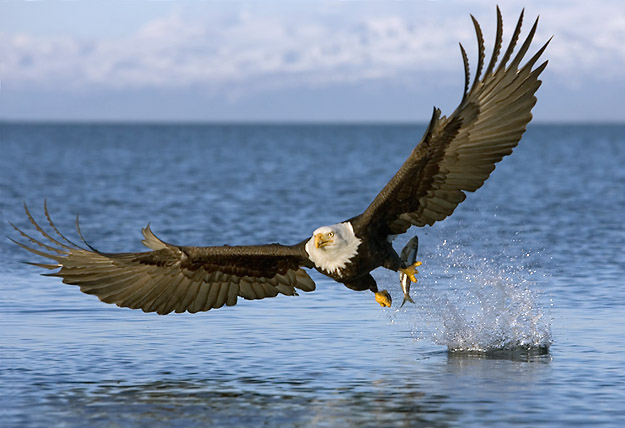
A friend sent me some pretty terrific bald eagle pictures taken in Canada, which got me to thinking about these magnificent birds. When I was kid, there were very few bald eagles left on the East Coast. Today, I only have to drive to Wilson Bridge, about 10 minutes away, to see seven or eight of them (or more) in all their glory.

The return of the Bald Eagle is generally credited to a ban on DDT, but that's a lie. DDT did not kill off the Bald Eagle -- lead poisoning did, in the form of bullets shot from rifles.

The short story here is a common one in American wildlife: as guns became more accurate, cheaper and more powerful between 1850 and 1900, game laws did not keep up. The result was a true wildlife massacre. We not only shot out all of the buffalo that once grazed on the East Coast, we also shot out all the passenger pigeons, Canada geese, beaver, elk, wolves, deer, mountain lions and yes, eagles, osprey and no small number of hawks.

Eagles, osprey and hawks were also decimated by the use of pole traps -- leghold traps set on the top of poles placed around fishing nets and barn yards. Nothing kills hawks and eagles faster or more efficiently than a pole trap.

Native Americans did their fair share of shooting eagles too; it takes a lot of feathers to make a bonnet for the tourist trade, and there was no shortage of bonnets being made and shipped east to museums, collectors, and other wealthy patrons.


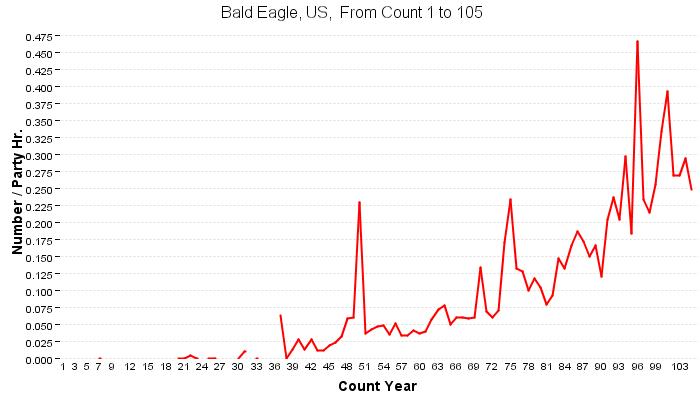
The graph above (click here to see full-sized graph) shows Bald Eagle populations as tracked by the National Audubon Society's Christmas Bird Count, which has tracked bird populations in the U.S. since 1900.

As you can see, by 1900 -- more than 40 years before DDT was invented -- Bald Eagle populations were vanishingly low. The same is true for Osprey -- another bird unlikely to be misidentified by a dedicated bird watcher. You can pick any non-migrating bird you want and track the data by going here >> http://audubon2.org/birds/cbc/hr/table.html (note Osprey migrate in the North but tend to reside year-round in the South).

Ironically, Bald Eagle populations climbed between 1940 and 1970, when DDT was in full use in the U.S. The reason for this is fairly simple: the Bald Eagle Protection Act of 1940 made it illegal to shoot Bald Eagles. This protection was further expanded when the Endangered Species Act was passed in 1973.

Left to their own devices, and protected from unregulated shooting and trapping, Bald Eagle populations took flight and have now soared. Today, there are about about 8,00 nesting pairs of Bald Eagles in the Lower Forty-Eight, and the Bald Eagle is now a candidate for de-listing from the Endangered Species Act.

Another American success story. Add that to the rostrum of success we have achieved through a marriage between hunters and conservationists: the return of the white tail deer, moose, elk, cougar, beaver, Canadian geese, wood ducks, and wolves.
.

Tuesday, April 08, 2008

A Time for Shad


A seasonal repost from this blog.

In my mind, the first week in April is always the start of the local shad run in the Potomac River just below my house.

The shad runs of my youth (not that long ago!) are somewhat reduced -- a function of too much commercial fishing and too much pollution.

In the Potomac, where I dip-netted shad two at a time just 30 years ago (and snag hooked them too, if truth be told), a shad fishing moratorium has been in effect since 1982.

The good news is that there are small signs that shad stocks are rebuilding. While there is still too much silt in the river (a function of a thirty-year construction boom in this area), the water itself is not as chemically polluted as it once was, and many of the smaller tributaries are being cleaned up by local conservation and beautification efforts.

Another bit of goods news is that a fish passage has been built at Little Falls, which is allowing shad to ascend the river to an area that had previously been blocked by a dam for more than 50 years. A million shad fry a year are now stocked in the river, and they are being released above the Falls so they will imprint and return to this upriver location as well as below.

As a consequence of just this little bit of action, the number of adult American shad collected during the Spring brood-stock collection period has more than doubled. One-year-old shad are now far more numerous than they once were, and the size of the shad runs in the Potomac River appear to be growing.

All of this if good news, and not a minute too late. Mother Nature is as tough as an old tire, but it requires that we take our boot off her neck and give her half a chance to thrive.

In plain English, that boils down to habitat protection and respect for basic game laws, especially those that deal with endangered species or species that are declining in number. It also requires us to learn a little more about the environmental interconnections, and our part in shaping them.

America's wildlife and wild lands are the greatest legacy we can pass on to our children. I am happy to say that my generation will pass on most of our wildlife and our wild lands in better condition than we inherited them from our parents and grandparents.

Today we have more whitetail deer and bear in American than we did when I was a kid. We also have more beaver, buffalo, bald eagles, osprey, elk, moose, mountain lions, alligators, whales, falcons, wolves and coyotes.

Only in the area of fish (both fresh water and salt water) have we failed to turn things around.

Support protection of watersheds and riparian areas. Stop eating fish that are bottom-trawled (that includes shrimp), and consider eating domestically farm-raised tilapia, trout and salmon instead. If you fish in the East or any other heavily-fished area of the U.S., practice catch-and-release fishing as much as possible. Above all, demand cleaner water, from mountain headwaters to delta outflows.

Let's bring back the great salmon runs, the sharks, the blue fin and the sail fish, the crab and the paddle fish, bull trout, alligator gar and the flathead. And let's bring back the shad. It's their turn now.
.


Bank-netting shad on the James River opposite Richmond, Virginia around the time of the Civil War.

.

Monday, March 03, 2008

Thriving in America

Example


European naturalists occassionally come over to the U.S. just to see animals that once existed on their side of the Atlantic, but are now extinct over there. For example:


  • Beaver existed in the UK until about 1200, but were then extirpated until very recently when a handful were reintroduced. In the U.S., however, there are so many beaver it is now illegal in most states to trap and move them; they must be killed where found rather than relocated.

  • Bear may have existed in the UK as late as Roman times, but probably disappeared around 500 AD. The bear population of the United States, however, is thriving and now numbers over 500,000 individuals, with the population continuing to rise by about 3% a year (a population doubling time of about 24 years).

  • The last wolf in England was reportedly killed in the 14th Century at Humphrey Head, Cumbria, but wolves survived in Scotland up until 1700 and in Ireland until 1760. The wolf is doing so well in the U.S. today that the Grey wolf was recently removed from the U.S. list of endangered and threatened species. There are about 2,500 Grey Wolves in Minnesota alone, and others in Wyoming, Idaho, Montana, and Michigan, as well as "red" wolves in North Carolina. The red wolf is a naturally occuring hybrid between the gray wolf and the coyote. The coyote (once called the Plains Wolf) is doing so well that it is now found in every mainland state, and their numbers are expanding despite the fact that 500,000 animals a year are shot, trapped or poisoned.
    .

Friday, February 22, 2008

Mass Wolf Kills on the Agenda in Idaho


In 1900 there were only 800 bison left in all of the U.S. Today, however, captive bison are so numerous they are sold as supermarket food, and management of wild populations is required to keep herds stable and healthy.


Gray wolves have been listed as endangered since 1974, and a population of 66 animals were reintroduced to Yellowstone National Park and Central Idaho in 1995 and 1996. These animals have since reproduced to a population of 1,500, and as a consequence the Federal Goverment is now moving to delist wolves in three states -- Montana, Wyoming and Idaho.

In Idaho, a plan is afoot to kill as many as 300 of the 700 wolves believed to be in the state.

The ironic thing (and the thing that reveals the politics behind the delisting initiative) is that Idaho, Wyoming and Montana do not have the largest wolf population in the U.S.; that would be Minnesota.

So what makes Idaho, Montana and Wyoming so special that these states get their very own wolf-killing pass?

The answer: powerful local interests which represent cattle ranchers and big game guides.

These folks want the wolves shot, theorizing that wolves represent a threat to their industries.

Of course the real threat to the cattle industry is something else, as the recent recall of 143 million pounds of meat mixed with "downer" cattle reveals.

As for the elk herd populations, they are still larger than the U.S. Fish and Wildlife Service want on the land. Elk over-population remains Topic One when discussing herd management issues in Idaho, Wyoming and Montana.

Taking the wolf off the Endangered Species list does not necessarily mean that it is open season on wolves or that they can be legally hunted. What it does mean is that wolf abatement will be easier for ranchers, and that drunken rednecks who shoot wolves from their trucks will not longer face Federal charges. All three states will now have to develop, and submit, wolf management plans before any wolf killing-culling-hunting initiatives are begun.

Will the wolves manage to thrive anyway? That's the assessment of the U.S. Fish and Wildlife Service which notes that wolves are both smart and fecund.

The other bit of good news is that wolves exist in states other than Idaho, Montana and Wyoming. Along with a larger wolf population in Minnesota, there is a small population in Michigan, a small but growing population in Wisconsin, a small population of red wolves in North Carolina, and a few wolves in Oregon, etc.

Across the U.S. there might be 4,000 wolves in the wild, out of a national population that was once estimated to top 200,000 animals.
.

.

Tuesday, January 22, 2008

Bald Eagle on Way to Work


My house is back a couple of blocks and on top of a cliff above the Potomac River. I go down a short run along a creek, and then along a 500-yard stretch of George Washington Parkway before I swing back up again to Key Bridge in order to cross into Georgetown and across the river into Washington, D.C. Today, for reasons unknown, the traffic was stop-and-go, and a huge bird sailed in to light in a tree along the Parkway. It was a mature bald eagle.

We have about two dozen bald eagles along this 10-mile stretch of the Potomac River. They tend to like it down by Wilson Bridge a bit more than up near Key Bridge (not sure why), but they sometimes come up this way, and I have seen dark-headed juveniles as well as white-headed adults. A nice thing to see on the way to work.

Related Posts

.

Wednesday, November 14, 2007

David Sibley on Ivory-bills, Science and Priorities


Hawaiian birds, left to right: Kauai O'O (extinct); Kauai Akialoa (extinct); Kauai O'u (extinct) ; Kauai Nukupu'u (extinct); Puaioho (less than 200 left); Kamao (extinct)


The great wildlife illustrator, bird man, and field-book author David Allen Sibley writes of Ivory-bills, sound science and priorities:


I have been skeptical of the Ivory-billed Woodpecker reports since about two weeks after the announcement in April 2005. This view has only become stronger over time and is based on my thorough study of the published evidence, drawing on my 35 years of experience as a birdwatcher and student of bird identification, and on my experience reviewing countless similar rare bird reports.

I find this Draft Recovery Plan fundamentally flawed, as it presumes that there is an urgent need for action based on "convincing evidence of the species' existence" when in fact no independent review finds that evidence convincing. The 2005 claim of "irrefutable proof" was incorrect; and was based on ambiguous evidence misinterpreted through hope and desire (commonly called wishful thinking). The case for the bird's continued existence rests on a few seconds of extremely blurry video (shown to be consistent with Pileated Woodpecker), a handful of fleeting glimpses by observers steeped in expectations, faint audio recordings that more or less resemble Ivory-billed sounds (among other things), and a belief that all of these possibly suggestive bits add up to a compelling body of evidence (1). None of the evidence stands up to scrutiny; there is no proof. Most importantly, hundreds of thousands of person-hours of intensive search efforts since 2005 - which could have confirmed the sight reports - have not produced any confirmation at all.

Based on such weak and ambiguous evidence, the proposal to spend up to $27.7 million of a very limited budget on efforts to find and recover the Ivory-billed Woodpecker is unsupportable. Hundreds of other species with well-documented needs would be better-served by those resources.

Sibley goes on, in the comments section, to note that while attention (and money) is being slathered on "saving" the extinct Ivory-billed woodpecker, dozens of still-living Hawaiian birds are being pushed into extinction without so much as a peep from the public:


The contrast could not be greater between the Ivory-billed fanfare and the relative silence about Hawaiian birds.

Searching the Bird Life database for critically endangered or extinct birds in North America turns up 44 species, 36 of which are Hawaiian endemics! Twenty-two of those Hawaiian birds are listed as extinct, plus Hawaiian Crow which is extinct in the wild with only a few individuals surviving in captivity.

And what is killing off those Hawaiian birds? David Sibley does not mention it, but the main forces of destruction are avian flu and avian pox borne by mosquitoes, and to a lesser extent the predation of rats, and habitat destruction caused by pigs, goats, and humans with chainsaws and development platts. Added to the equation has been some competition with other species of introduced birds.

As odd as it may sound, though Hawaii may have lost more bird species than any other spot on earth it is also home to more introduced bird species than other place on earth, thanks to efforts of a "Bird Lovers Society" (Hui Manu) that began in the 1930s.

A final tip: check out David Sibley's main web site and blog. His field guides really are the best, in my opinion.
.

Thursday, June 28, 2007

Delisting the Bald Eagle a Sign of ESA Success


It looks like the Bald Eagle is going to be delisted today as an endangered species. Have no fear; the bird will still be protected.

Delisting is actually a good thing; it not only means the Bald Eagle has made a substantial recovery, but it gives the lie to the folks that say animals never come off the list and the Endangered Species Act does not work. In fact, the ESA is one of the most important and successful pieces of conservation legislation ever enacted.

This is not to say that everything said about the Bald Eagle is entirely true. The thing that knocked the Bald Eagle over the edge, for example, was not DDT, but lead shot and leghold traps. For more on that, see You Gotta Break Some Eggs to Build a Movement

.

Buy Land, God Ain't Making Any More of That

Will Rogers advised folks to "Buy land because God ain't making any more of that," and some of the richest folks in America are following up on that sage advice and scooping up vast areas in the U.S. for a variety of reasons.

The Wall Street Journal of May 20th, for example, notes that Kentucky native Brad Kelley sold his cigarette manufacturing company, Commonwealth Brands Inc., for $1 billion and promptly bought hundreds of thousands of acres of West Texas ranch land back in 2001. He has also snapped up 60,000 acres of land near Sarasota, Florida where he breeds antelope and critically endangered anoa, a type of wild miniature water buffalo native to Indonesia.

Over in Texas, Amazon.com Inc. founder Jeff Bezos has acquired several ranches that total 300,000 arid acres, some of which he is using to test a developmental vehicle for his space-flight company, Blue Origin LLC.

Up in Maine, Roxanne Quimby, who is the co-founder of "Burt's Bees" cosmetics, has acquired about 80,000 acres from timber companies. She hopes to add even more acreage in the years ahead before she turns the whole thing over to the Federal Government as a new National Park.

Some Maine residents are up in arms because Ms. Quimby has said the land she has bought is now off-limits to all logging, hunting and motorized vehicles. Of course, as the actual owner of the land in question Ms. Quimby is well within her rights, and besides her management rules are pretty similar to those that now govern our National Parks. America in general -- and Maine in particular -- can only benefit from the creation of another National Park. Instead of criticism, Ms. Quimby deserves a little applause!

The nation's largest private landowner, of course, is the wonderfully colorful Ted Turner whose acquisitions include 15 ranches in seven Western states spread over a total of about 2 million acres.

Ted Turner and his son Beau are true hook-and-bullet conservationists and are engaged in some of the best wildlife and wild lands management in this nation.

Turner's land goal has always been to show that environmentally-sensitive lands can be managed at a profit, and so far he has done remarkable things while working to prove his point.

Turner's properties are now home to about 45,000 bison, which are managed as free-range commercial livestock with the meat sold as steaks and burgers through both grocery stores and Turner's restaurant chain, Ted's Montana Grill.

Turner's vast land holdings are also home to elk, moose, mule deer, white tail deer and some other species which are hunted at a price, making a profit for the ranch and ensuring that Turner's large wild land holdings remain well-maintained and well-managed.

Ted Turner has also moved his vision of profitable wild lands management overseas to vast land holdings he has in South America. Some of this land turns a profit as cattle and hunting ranches, and some turns a profit through eco-tourism, but the principles are the same in both in the U.S. and overseas: Keep the land green and balanced, work to preserve wildlife and wild and open spaces, and remain creative in developing an income stream to keep the whole thing self-financing beyond the initial capital outlay. This is not the rip-rape-ruin-and subdivide management of Mobile Oil and small-time land owners. A larger vision and a larger lasting purpose is in action here.

Some narrow-minded folks resent the philanthropic super-wealthy, but in fact some of these truely rich people represent not only business success, but also a deep transformative social and environmental consciousness that is a powerful force for good.

When the dust settles, a lot of America and the world will be protected because of the actions of folks like Ted Turner, Jeff Bezos, Brad Kelley, Roxanne Quimby, Warren Buffet, and Bill Gates.

God bless them for turning their enormous purses to the public good. And what a shame that the Walton family (of WalMart fame) cannot do the same!

The Land Report lists the top 100 private land owners in the U.S. (list searchable by state, by name or by acreage. The Top Twenty from the list is appended below, and a short profile on each of the top 100 land owners can be read >> HERE. For the record, 640 acres is one square mile.


1. Ted Turner - 2 million acres
2. Archie Aldis 'Red' Emmerson - 1.722 million acres
3. Irving Family 1.2 million acres
4. Singleton Family - 1 million + acres
5. King Ranch Heirs - 851,642 acres
6. Pingree Heirs - 850,000 acres
7. Brad Kelley - 789,851 acres
8. Reed Family - 770,000 acres
9. Ford Family - 740,000 acres
10. Huber Family - 600,000 acres
11. Lykes Bros. Heirs - 578,302 acres
12. Dolph Briscoe Jr. - 560,000 acres
13. W.T. Waggoner Estate - 520,000 acres
14. D.M. O'Connor Heirs - 500,000 acres
15. Robert Earl Holding - 400,000 acres
16. J.R. Simplot - 355,746 acres
17. East Family - 350,000 acres
18. Anne Marion - 345,000 acres
19. Gerald Lyda - 320,035 acres
20. Collins Family - 305,313 acres

.

Wednesday, June 27, 2007

The Fish Stinks From the Head Down


Reading The Washington Post this morning, I was reminded of an Italian saying, "The fish stinks from the head down."

The thing that made me think of this was a massive color picture of dead salmon in an article about how Vice President Dick Cheney (ironically code-named "Angler" by the Secret Service), was instrumental in creating the largest fish kill on the Klamath River in order to save a completely redundant hay crop in Oregon. Two snippets are appended below, with a elipse (...) to denote a shortening of the source text.


Because of Cheney's intervention, the government reversed itself and let the water flow in time to save the 2002 growing season, declaring that there was no threat to the fish. What followed was the largest fish kill the West had ever seen, with tens of thousands of salmon rotting on the banks of the Klamath River.
Characteristically, Cheney left no tracks.

The Klamath case is one of many in which the vice president took on a decisive role to undercut long-standing environmental regulations for the benefit of business.

By combining unwavering ideological positions -- such as the priority of economic interests over protected fish -- with a deep practical knowledge of the federal bureaucracy, Cheney has made an indelible mark on the administration's approach to everything from air and water quality to the preservation of national parks and forests.

..... Months later, the first of an estimated 77,000 dead salmon began washing up on the banks of the warm, slow-moving river. Not only were threatened coho dying -- so were chinook salmon, the staple of commercial fishing in Oregon and Northern California. State and federal biologists soon concluded that the diversion of water to farms was at least partly responsible.

Fishermen filed lawsuits and courts ruled that the new irrigation plan violated the Endangered Species Act. Echoing Kelly's objections, the U.S. Court of Appeals for the 9th Circuit observed that the 10-year plan wouldn't provide enough water for the fish until year nine. By then, the 2005 opinion said, "all the water in the world" could not save the fish, "for there will be none to protect." In March 2006, a federal judge prohibited the government from diverting water for agricultural use whenever water levels dropped beneath a certain point.

Last summer, the federal government declared a "commercial fishery failure" on the West Coast after several years of poor chinook returns virtually shut down the industry, opening the way for Congress to approve more than $60 million in disaster aid to help fishermen recover their losses. That came on top of the $15 million that the government has paid Klamath farmers since 2002 not to farm, in order to reduce demand.

.

Sunday, June 24, 2007

Balancing Hawks & Doves in Wildlife Management


A couple of years ago
, the legislative director for a large national bird conservation group stopped by my office, a bit apoplectic at the stupidity of it all.

Well yes, but could you be more specific? A lot of stuff is stupid.

My friend was in a twist because the U.S. Government was going to spend tax dollars to poison two million Red-winged Blackbirds with an avicide called DRC-1339. This was being done to protect the South Dakota sunflower seed crop which was . . . wait for it . . . destined to be sold as wild bird seed.

Yep, you got it. Your tax dollars at work. Public tax dollars were going
to be spent to kill two million Redwing Blackbirds a year for three years in order to protect a private crop of sunflower seeds, which was going to be sold as bird seed.

Such irony is not all that unusual in the world of wildlife management where the most peaceful kind of people can find their dander rapidly rising if their own time, money and animals are at risk from natural (or even unnatural) predation.

In the world of wildlife management, where you stand often depends on where you sit.

For example, it takes a lot of time, energy (and some small outlay of money) to plant a quarter-acre vegetable and flower garden. After you have fed and watered your garden for weeks, and just as your stringbean crop begins to come on line, a groundhog waddles over from the hedgerow and undoes everything.

The next week you come out to find deer have knocked down half the tomatoes and eaten the tops off all the beets. Are you OK with this, or do you set a Havahart trap and build a fence? When the fence is easily jumped by the deer and the Havahart trap is completely ignored by the groundhog, does "Plan B," involve a Remington rimfire?


You see? Where you stand depends on where you sit.


People are capable of changing their opinions quite rapidly if it's their ox that is being gored, and in fact most people are capable of rationalizing some wildlife abatement under the right circumstances.

The question is where do you draw the line.

Take the Roller Pigeon fracas.

What's a Roller Pigeon, you ask? A Roller Pigeon is a pigeon that has a defective gene that causes it to have a small seizure in mid-flight. That seizure, in turn, causes the bird to roll over and tumble in mid-flight -- the very kind of distressed-bird behavior that is most likely to attract hungry hawks and falcons.

It turns out that if you are a Roller Pigeon fancier you get quite upset when you see your birds nailed by raptors.


But should you be upset? Really?

I mean, think about it. If you put out bird seed, shouldn't you expect wild birds to show up? And if you regularly release scores of mutant Chicken McNuggets that cannot fly too well, shouldn't you expect them to be predated on by hungry hawks and falcons?

If you are turning sheep and cattle out on National Forest land in Wyoming without so much as a human attendant, shouldn't you expect a few hungry wolves and bears to show up? Do the wolves and bears have the right of primogenitor on this land, or is this simply a case of "might makes right," in which a few humans, for narrow economic interests, are allowed to remove all wolves (or hawks and falcons) from public lands they do not own?

If you think shooting wolves on public lands in Wyoming in order to protect a few subsidized sheep does not quite pass the smell test, what would you say if, instead of a wolf, it was a coyote eating your dachshund in your very own backyard in Los Angeles? Would you reach for a .22 then?

Suppose you raise goldfish in Texas ponds, or trout in Virginia pools. It is OK to shoot blue herons and every other wading bird that shows up to scarf down your fish fry? How much predation should be allowed, and who should decide? Does it matter if Blue Herons are not endangered and goldfish are not native? Does it matter that goldfish are not a food crop?

Is it OK to shoot Sea Otters that predate on abalone and fish? It it OK to shoot Anhinga and Cormorants that raid fish weirs? How about Sea Lions? Sharks?

OK, now let's swing this around to the Red Fox. Is it OK to trap or shoot Red Fox in order to protect pen-raised game birds set out on a farm for pay-and-shoot hunters? Does it matter if the birds are not native animals? Does it matter if the Red Fox is also not native? Does it matter if both species are exceedingly common and in no danger of even local extirpation? Does it matter how many fox are being killed, or how big an economic engine the bird-shoot business is?

Why is a fox different than a groundhog or a deer? Why are those pen-raised birds different from your vegetable and flower garden?

OK, let's think about Red Fox some more, but this time let's imagine that the birds are indigenous and endangered birds. Is it OK to trap or shoot fox in order to maintain a species that might otherwise be wiped out by the presence of Red Fox? Is it OK to trap and shoot Red Fox, Raccoon and Skunk in the Prairie Pothole Region where they threaten to sharply reduce nesting native ducks which are not an endangered species, but are a major economic engine in the form of sport hunting ?

OK, let's move the debate to crops and land protection. A farmer plows up his land, fertilizes it, and puts in 1,000 acres of corn. With the first rain, excess fertilizer flows into the stream and kills fish. With the first corn sprouts, the farmer begins to spray herbicides to keep down weeds. A spraying of insecticide follows four weeks later in order to keep down Corn Borer. In the end, the stream has no fish and the land itself is green but otherwise as devoid of wildlife as a desert. The corn is subsidized by U.S. taxpayers, and the final product is shipped overseas. Lots of wildlife has been killed or pushed off the land. Is this OK? If so, why? If not, why not?


You see? Right and wrong here are not as simple as black and white. Ethical concerns and aesthetic concerns collide. Rights and responsibilities are in competition. Questions of sustainability arise, as do economic valuations, and the relative merits of native vs. non-native, endangered species vs. common animal, and public land vs. private land, to say nothing of vegetable vs animal, and prey vs. predator.

Should we value apex predators less, or more, than the animals they eat, and that we eat? How many sheep is a wolf worth, and does that equation change if you are being asked to foot the bill? Should the interests of a few hundred ranchers decide wildlife policy for the nation?

Finally, is there such a thing as an assumed risk?

Let's go back to the Roller Pigeon controversy out in California, Washington and Oregon. First the facts: It seems that Roller Pigeon enthusiasts along the Pacific Coast (and for all I know, around the country and around the world), have been systematically killing hawks and falcons that have been predating on their odd-flying birds.

How many hawks and falcons have the Roller Pigeon folks been killing? Quite a lot according to the U.S. Fish and Wildlife Service. Seven people have been arested for
killing or helping to kill 1,000 to 2,000 hawks and falcons a year in the Los Angeles area alone. That may sound like an impossible number, but it's not; that's just 20 to 40 people each killing 50 birds a year. Since one fellow in Oregon bragged to Fish and Wildlife that he had killed 40 hawks in just 30 days, the number is probably not too inflated.

And appparently this is not a new phenomenon; a close reading of the Southern Calfornia Roller Association newsletter suggests that members of this Club have been openly killing raptors for years.

You have to wonder what was going through the heads of these Roller Pigeon folks. If they really found predation of their birds by wild hawks and falcons emotionally painful and economically hurtful, then they could have simply stopped flying pigeons. Or changed the way they flew pigeons. Instead, they made a sport out of shooting, trapping and clubbing hawks and falcons. Apparently they felt no emotional pain from that past time.

And apparently this culture of shooting, trapping and clubbing hawks and falcons is not an abberation by an isolated few. After the recent spate of arrests on the West Coast, a major Roller Pigeon bulletin board shut down for a few days while it went through its archives to remove hawk trap plans and incriminating commentary.

It's too late, of course. The Roller Pigeon community has already by tarred not only by the actions of those who trapped, clubbed and shot hawks and falcons, but also by the inaction of those who said nothing or winked at such widespread carnage.

There is a lesson here for every minority group: State clearly what you are about, and state clearly what you are not about, and do not be shy about framing up a sustainable culture that can survive public scrutiny. Whether you are a hunter, a sunflower seed farmer, a pharmaceutical sales representative or an Eskimo, you should be operating within a set of ethical principles that make sense to the outside world, and which you would not be ashamed to tell your Mother or see on the front page of The New York Times.

As for the U.S. Department of Agriculture, they never did poison all those blackbirds. As soon as their plan was announced, every bird group in America had the same question for Uncle Sam: Are you completely stark-raving crazy??

The USDA got the message, the birds were not poisoned, and sunflowers were still planted out across South Dakota.

Despite the presence of two million fat Red-winged Blackbirds feeding on those sunflower seeds, wild bird seed remains dirt cheap and feeders are full all across America, including a few in my own back yard.


.


Wednesday, June 13, 2007

The Upside of Disaster and Decline

Walter H. sent me an article from The Wichita Eagle on waste land in eastern Kansas that is being snapped up by folks converting it to hunting camps. The story is close to my heart, as my grandfather was raised on a farm near Longton, Kansas (population 394), and it's the spot where I first fell in love with fishing, which in turn has led to a passion for the outdoors, dogs, hunting and the rest. One of my most treasured possessions is on a shelf in the garage -- a 40-year old fiberglass pole that I used as a kid when fishing the family farm pond in Longton. That's me in the picture at top -- fishing at about age 5 or 6 with that same pole. My mother and father returned to Longton some time back to find the farmhouse knocked to the ground and gone, and the wooden barn now covered in metal sheathing to protect it from the elements. The farm is now owned by a fellow who hopes to turn it into a professionally-managed deer and bird hunting concern. Apparently more than a few people are doing the same kind of thing in Kansas these days. As the Wichita Eagle notes about a portion of eastern Kansas that has been ravaged by a combination of coal mining and declining water tables:
"For decades it's been seen as some of the most worthless wasteland in Kansas. Not anymore. Not long ago valued at $300 an acre, some rugged land is now on the market for more than $3,000 an acre. The increased value isn't from a discovery of coal or oil deposits. The new, most valued natural resources wear fur, feathers and fins. "If you love to hunt and fish, you'd be hard pressed to find a better piece of property than this," said Brad Harris, as he toured 900-plus acres near Pittsburg. "It's seriously some of the best in the nation."
Some of the best in the nation? That's a bit of a stretch. That said, there's no shortage of scrub farm land available for less than $1,000 an acre, and that's not too bad a price for property, even if there's not much water to be had. Today Kansas has more land with a population density of 6 people per square mile than it did in 1890. Six people per square mile, for the record, was the standard used by Frederick Jackson Turner in 1893 to gauge how much "frontier" was left in America. While 388 counties west of the Mississippi River could still be said to qualify as "frontier" in 1980, that number had risen to 402 by 2000. What's going on in those always-sparsely-settled sections of the country that are now losing population? Well, for one thing, some chunks of the country are starting to run out of water. We got out of the Dust Bowl thanks, in no small part, to fossil water being pumped out of the ground. Nows those wells, drilled in the 1930s, are starting to run dry, and there's no more 10,000-year-old water to be had. In other parts of the country, once-bustling railroad depots and corridors have fallen silent, replaced by interstate truckers and commercial jets. In the Great Plains, if you're not right along the Interstate, you're nowhere. They don't call this part of America "fly over country" for nothing. Television, education, and mechanization have had their impact too. It's hard to keep people on the farm after they have been raised on a nonstop diet of Miami Vice, MTV, and Beverly Hills 90210, and after they have been sent off to college and graduate school. Adding to the push and pull is the fact that farms are increasingly mechanized, while farm prices continue to plummet in a world in which soy beans are imported from Brazil and wheat glutten is imported from China. If you cannot make a steady income from the land, then you can't make a living from it all. With large areas of the American west slowly depopulating, some have wondered what the "Next Economy" for the region might look like. About 20 years ago, Drs. Frank and Deborah Popper suggested the next economy might look a lot like the one that existed prior to 1820. Calling their idea "the Buffalo Commons" the Poppers suggested that Federal and State governments stop subsidizing farmers to pump fossil water in order to grow crops no one wanted and needed, and instead buy up large tracts of land which would serve as a natural corridor through which bison and other native wildlife could once again roam free. Some people denounced the idea as a crazy left-wing land grab by enviro-lunatics, while others praised the idea for its visionary economic and environmental brilliance. No matter. Good ideas can hardly be stopped and bad ideas rarely fly too far. In this case, what has emerged is not quite what the Popper's imagined, but something quite interesting nonetheless. Instead of buying land outright, the Federal Goverment has decided to lease it. By leasing the land and keeping it fallow under the terms of the Conservation Reserve Program (CRP), which began in 1986, a great deal of the Great Plains (and no small part of land in the East and far West too) has been put under modified protection. The good news is that because of the way it was set up, the CRP program was able to expand very rapidly. CRP land now totals more than 50,000 square miles across the U.S. -- an area about the size of England. Instead of returning things to a kind of unified "American Serengetti" with huge herds of Bison, however, the land has remained a tapestry of private land that has simply been left fallow. The result has been about perfect for deer, coyote, fox, and some game birds, even if it has not done much for the buffalo (which are in no danger of extinction in any case). Example The land in green is fallow CRP land, the land in grey is other federal land (National Forest, National Park, etc.). You can see a larger version of this map at >> http://www.nrcs.usda.gov/technical/land/meta/m5919.html The depopulation of the Great Plains and the return of prairie wildlife is not a complete aberration. It turns out that Mother Nature is a tough old girl, and if we will only take our boot off her throat, she will generally spring up on her feet and heal in time. The problem, of course, is that we now have a lot of boots on her throat. To be specific, we have 600 million boots in this country right now, and we are adding more every day. Across the world there are 12 billion boots, and more are being added every day. With so many boots on the land, a great deal of wildlife and wild places have necessarily been stomped into the ground. Which brings us to "the exceptions that prove the rule" -- places which, for one reason or another, have become (or remain) people-free zones. A look at a sampling of these from around the world suggests there may be (as hard as it is to believe) an upside to disaster and decline:
  • Chernobyl: Prior to 1986, the area surrounding Chernobyl in the Ukraine was an agricultural area populated by about 135,000 people. After an uncontained nuclear power plant accident, however, livestock and crops across a vast area were systematically destroyed, and all of the people within a 2,800 mile area around the nuclear plant were evacuated. With the removal of humans has come the return of some of Europe's most endangered species, including lynx, wolves, cranes, beaver, eagles, hawks, wild boar, roe deer, badger, and otters. Populations of human-dependent animals, such as rats, house mice, sparrows and pigeons, have declined. While some folks may imagine that the Chernobyl site must be filled with two-headed frogs, radioactive fish, and sterile deer, scientists have found relatively few visible wildlife side-effects. Dr. Ron Chesser, a senior research scientist and genetics professor at the University of Georgia's Savannah River Ecology Laboratory (SREL) in Aiken, South Carolina notes that "There are no monsters. The Chernobyl zone is actually a very beautiful place with thriving wildlife communities. Without a Geiger-counter, you wouldn't know you were in a highly contaminated place."
  • The Korean Demilitarized Zone (DMZ): The Korean Demilitarized Zone is about 2.5 miles wide and 155 miles long, stretching across the entire length of the Korean Peninsula. It is one of the largest unmanned areas in northeast Asia. Festooned with barbed wire, landmines, tank traps, sensors, automatic artillery, and patrolled by scores of thousands of soldiers with "shoot-to-kill" orders, the Korean DMZ is also home to hawks, eagles, antelope, two kinds of rare cranes, frogs, black bears, and roe deer. The DMZ is also rumored to be home to the last Korean tigers on earth. In total, more than 20,000 migratory fowl utilize the DMZ border area which encompasses a broad cross-section of Korean ecosystems and landscapes.
  • Military Weapons Production Facilities: Military weapons production facilities in the U.S. have resulted in the creation of several large "no man" zones. In Washington State, for example, the Hanford Nuclear Reservation was created as part of the WWII-era Manhattan Project. Today the 586-square mile site is one of the most contaminated spots on earth due to nuclear waste, but it also contains the best undisturbed "shrub-steppe" habitat in the Columbia River basin, and the only undammed stretch of the Columbia River. The healthiest populations of wild chinook salmon on the river system can be found along the Hanford Reach, and more than 200 species of birds and more than 40 rare plants and animals, such as the long-billed curlew, call it home. In Colorado, the Rocky Flats nuclear weapons facility and the Rocky Mountain Arsenal (which produced and stored vast quantities of chemical weapons) systematically kept out humans for more than 40 years. As a result, the 10-square mile Rocky Flats complex outside of Denver has been described as "a rare biological treasure" -- one of the last remaining Front Range open spaces with natural prairie grassland -- while the Rocky Mountain Arsenal (also just outside of Denver) has thriving colonies of prairie dogs and over 100 overwintering bald eagles, as well as trophy-sized mule deer and impressive populations of ferruginous hawks, burrowing owls and mountain plovers. Both locations, for the record, are now National Wildlife Refuge's. In Georgia, a 300-square-mile property along the Savannah River was set aside for nuclear research and development more than 50 years ago. For most of the Cold War this site produced plutonium and tritium for atomic bombs. While a small part of the complex remains heavily contaminated, most of the area was left in pristine condition as a security buffer zone -- an area that today is home to more than 240 species of birds, 100 species of reptiles and amphibians, and nearly 100 species of freshwater fish. Because Savannah River wildlife was left alone to matures, many state record holders have been caught or trapped here, including the largest South Carolina alligator ever caught (13 feet) and the largest South Carolina largemouth bass. Despite jokes about "glowing frogs," University of Georgia's Whit Gibbons says there is no evidence to date of genetic damage to wildlife. "It's a pretty simple formula," he note, "The best protection for the environment is no people."
  • It's a pretty sobering reality that no amount of barbed wire, spent fuel rods, PCBs, landmines, live ammo, or coal slag is as dangerous to wild animals as the mere presence of humans. So what's next when it comes to the upside of disaster and decline? One word: Katrina. It looks like one of the lasting legacies of Hurricane Katrina is that private insurance companies along the Louisiana and Mississippi coasts are going to change how they do business. Many are pulling out of the region altogether, while others are jacking up the price of their policies so much (and writing in a lot of escape clauses when they write a policy at all) that sensible developers are reevaluating their construction projects. With large parts of the Louisiana and Mississippi coast already saddled with the Cancer Alley monicker due to the previous dumping by the oil and chemical industries, it's a safe bet that coastal land prices are going to remain low for some time, that development will be slow to return where it has been wiped out, and that more wildlife may yet return to some areas. In fact, the best possible outcome for parts of Louisiana and Mississippi may be if Federal and private interests buy up large sections of the coast and simply allow them to return to nature. Maybe -- just maybe -- God was sending us a message. One does not have to a Bible-thumping Christian to read Matthew 7:25-27, as a sensible construction code:
    "And rain came down, and floods came, and winds blew, and the house built according to my teachings did not fall down, for it was founded on stone. "As for the house built on sand, and not according to my teaching, rains came down, and floods came, and winds blew, and hurled against the house, and it fell in a mighty roar."

    .