Showing posts with label immigration. Show all posts

Friday, November 13, 2015

The Real Threat to Hunting


A repost from this blog, July 2004.

For hunters, fluttering orange tape and popsicle-colored sticks mean only one thing: Doom.

This is the spoor of the tract-home surveyor. This is the end of the game.

The hill where your terrier worked that fine red fox last season will soon be covered by plastic-sided houses and kiddie swing sets.

The hedgerow you counted on for the occasional raccoon and a steady supply of groundhogs will soon be an asphalt ribbon.

Across the country the same story is playing out, again and again. It is not PETA that is hammering hunters, but real estate developers.

Pheasant, quail and bear are long gone from most areas, as are bobcat, cougar and wolf.

Even if deer and geese manage to thrive on 15-acre tracts, the American hunter will not.

When land is cut up into small parcels, acquiring permissions is difficult and firing a gun impossible. More houses means more roads. It does not take too many roads before a man with working dogs no longer feels comfortable letting them off leash.

Most of us know the big picture: forests are falling to farms, and farms are falling to freeway all over the planet. Across the globe wild rivers are being dammed, and increasing numbers of species are being pushed on to the endangered species list. Cars, factories and electricity-generating power plants are spewing forth greenhouse gases contributing to global warming, even as mile-long gill nets decimate fishing grounds, and raw sewage spills untreated into once pristine waters.

The environment is not committing suicide -- we are killing it. As Pogo so aptly put it, "we have met the enemy, and he is us." The common denominator to every clearcut forest and decimated hedgerow is human population growth.

It’s hard to overstate the speed of human population growth. It took perhaps two million years to add the first billion people to the population of the world -- a number reached about 1830. It took only 100 more years to add the second billion people (1930), and just thirty more years to add the third billion (1960). The global population counter clicked past four billion by 1975, five billion by 1987, and six billion by 1999. World population will climb past seven billion within the next 15 years.

It’s hard to get a handle on such numbing numbers. Let's bring it closer to home to gain a little perspective. Surely, we have nothing to worry about here in the United States, right?

Think again.

Consider what has happened in your own lifetime. Take a look at the table below, and find your approximate age in the far left column. The number next to it is the size of the U.S. population when you were born, and the number to the right of that is the relative population growth that has occurred in the U.S. since then.


Of course, the U.S. population growth that has occurred since you were born is only part of the story.

Let’s think for a minute about the U.S. population growth that will happen over the rest of your lifetime. I will use middle-range Census Bureau projections even though these numbers have consistently been too low for over 50 years because Census Bureau demographers habitually under-estimate illegal immigration and over-estimate emigration (people leaving).

In the table below, look in the left column to find your approximate age -- or the age of your children or grandchildren if you prefer. Now look at the next column to see what the population of the U.S. will be when you (or your children or grandchildren) are age 70. The third column gives the percentage population growth that will occur in the intervening years. Again, these are very conservative numbers.


Another way to think about these numbers: over the course of the next 50 years, using the very conservative mid-range projections of the U.S. Census Bureau, the U.S. will add about 150 million people to its population -- a sum greater than the population of the United States west of the Mississippi River today.

To put it another way, over the course of the next 50 years, the U.S. will add more than twice the current population of the United Kingdom.

Where is all this population growth coming from? Most of it originates overseas.

About 70 percent of all future U.S. population growth will be due to immigration (legal and illegal) and the children and grandchildren of immigrants that have not yet landed on our shores. In a very real sense, America's hunting and angling future is being determined in Karachi, Mexico City, Beijing, Moscow, Dublin and Hanoi.

Most of the organizations that we think of as protecting the environment and sports hunting do not mention the speed of U.S. population growth, not because it is not an issue, but because they are afraid that talking about limits on immigration might harm future membership growth. After all, today's illegal alien is tomorrow's permanent resident alien or U.S. citizen, right? At the top reaches of organizations as divergent as the Sierra Club and the National Rifle Association, success is not defined by what is going on in forest and field, but about what can be done to grow out the membership base now and in the future. Association executives are as enamored with population growth as any real estate agent or strip mall developer.

I suspect it will only be in hindsight that we realize what we have lost and what we have gained. Very few people notice the absence of box turtles or make the connection between population growth, habitat change, and Lyme disease.

Only when we are very old and America has changed to the point where we no longer recognize it will we understand the wisdom of Sioux Chief Ben American Horse, who warned Vice President Alben Barkley, "Be careful of your immigrations laws. We were damn careless with ours."
.

Friday, December 23, 2011

The Missing Birds of Rock Creek Park


OvenBird
This was written in 2003 for a major environmental organization.

The decline of neotropical migrant song birds in the U.S. was first noticed by birders in Washington, D.C.'s Rock Creek Park, a small federally-protected enclave nestled along a stream bed in Washington, D.C., just 15 miles from Fairfax County.

Breeding Bird Surveys from 1947 through the 1970s, revealed that the yellow-billed cuckoo and yellow-throated vireo -- as well as the northern parula, black-and-white warbler, Kentucky warbler, and hooded warbler -- were disappearing. Six other migrant song birds -- Eastern wood-pewees, Acadian flycatchers, wood thrushes, red-eyed vireos, ovenbirds, and scarlet tanagers -- had declined by more than 50 percent.

What was going on?


Evidence from Overseas

Domestic forest destruction was ruled out, as Rock Creek Park had suffered no substantial encroachment in decades.

An analysis of radar images, done in the early 1980s, however, showed only half as many birds were flying to the U.S. from Mexico's Yucatan as had been migrating just 20 years earlier. Clearly, some part of what was happening to "our" birds was happening overseas. Experts theorized that much of the song bird decline, now being documented across the U.S., was due to forest destruction in Central and South America.

In fact, forest destruction in Central America was proceeding at a very rapid pace, driven in no small part by truly sobering rates of human population growth. In the Peten region of Guatemala, for example, 77% of the original forest cover still existed as recently as 1977. By 1980, however, that number had fallen to 42% and by 1989 just 29 percent of the original forest cover was gone. Scientists now believe as little as 10% of the forest may be left by 2025.


Evidence from the U.S.

By the late 1990s, however, scientists began to realize that forest destruction in Central and South America did not tell all of the story. Analysis of migrant song bird populations at the national level showed that birds loss was not evenly distributed across the U.S.

While most migrant song birds are experiencing clear negative trends east of the Mississippi River, and along the thin coastal strip of the West Coast, neotropical migrants seem to be doing fairly well on large tracts of forested land in the West.

An overlay of neotropical migrant song bird decline and a map of federally protected lands, showed a fascinating pattern: migrant song birds were not in general decline in our national parks, our national forests, or on lands managed by the U.S. Department of Interior's Bureau of Land Management. Migrant song birds were in general decline in the east and in the Midwest, however, where changing agricultural practices and increasing levels of forest fragmentation seemed to be having a real impact.

Scientists looking for clues to song bird loss in Rock Creek Park began to look at the forested areas immediately surrounding the suburbs of Washington, DC, and what they found was pretty startling. Between 1980 and 1995, Fairfax County saw 69 percent of its forests converted to homes and businesses.

While scientists had been puzzling over bird loss in Rock Creek Park, just 15 miles away, Fairfax County's forests had been vanishing under asphalt at an astonishing rate.

Scientists now recognize that these once-vibrant suburban forests were probably the principal "home" of many of the birds that had once been seen in Rock Creek Park. Rock Creek had merely served as way-station between larger forest blocks that once ringed the Washington, DC area.

As new roads and light rail systems continue to be built in the suburbs of Virginia and Maryland, more and more forests are falling to farms and more and more farms are falling to freeways and subdivisions.

Once large blocks of unbroken forest are being shattered into increasingly smaller fragments, allowing such meso-predators as crows, jays, raccoons, possums, feral cats and fox to prey on once-secure migrant song bird nests. In addition, increasingly fragmented forests have enabled the brown-headed cow bird to colonize areas they once would have found unattractive.

Cowbirds nest at the edge of forests and feed in farms fields and pastures. Though native to North America, the brown-headed cowbird was once confined to the forest edges of Midwestern prairies where they fed in grasslands grazed by roaming bison. Today, however, because of widespread forest fragmentation, parasitic cowbirds can be found all across the United States.

The brown-headed cowbird is a parasitic nester, which is to say it builds no nests of its own, but instead lays its eggs in the nests of other birds -- most frequently in the open, cup-shaped nests of neotropical migrants. A single cowbird may lay as many as 80 eggs in a breeding season - one or two eggs per songbird nest. Because cowbird chicks hatch earlier, and are much larger than the offspring of migrant songbirds, they are able to out compete songbird chicks for food, and often simply push them out of the nest altogether.

In the end, a single cowbird may prevent 20 to 30 warblers, finches and vireos from raising their young. If the bird species has a short nesting period, it may not be able to hatch out a second brood that year, in which case that species may fall off rapidly in that area over a relatively short period of time.


Yellow-throated Vireo


More Trouble Ahead?


While a great deal of population-driven environmental damage has already occurred in the suburbs of Virginia, more population growth lies ahead. Fairfax County's population continues to grow rapidly, most of it driven by a combination of internal domestic migration (military and government families coming to support a burgeoning government and high-tech corridor) and international migration.

Fairfax County may be a demographic "canary in a coal mine" signaling where the rest of America may be headed in terms of land use patterns and population growth. With U.S. population growing by more than 3 million people a year, and suburban sprawl gobbling up more than 500,000 acres of forest and farmland every year, the pace of habitat fragmentation is likely to increase rapidly in the years ahead.

Under the Census Bureau's middle-series projection, which assumes that current U.S. immigration and fertility levels will stay about the same, the population of the U.S. will increase by 120 million people over the course of the next 50 years. About 63 percent of this future population growth will be due to immigrants and the children of immigrants that have not yet arrived in the U.S. -- the remaining 37 percent of population growth will be driven by demographic momentum as current U.S. residents move to complete their families.

One hundred and twenty million people is a very large population to add to the U.S. over the course of the next 50 years. To put this number into perspective, this is a population equal to the current populations of California, Oregon, Washington, Idaho, Colorado, Montana, Arizona, Nevada, New Mexico, Texas, Wyoming, Utah, North Dakota, South Dakota, Nebraska, Kansas, Oklahoma, Minnesota, Wisconsin, Iowa, Missouri, Arkansas, and Louisiana combined.

In addition to sprawl directly driven by population growth, the U.S. can expect to see increased forest fragmentation due to more and more folks moving farther and farther out into the countryside, abetted by high-speed internet hookups, satellite television, and light rail systems feeding into an ever-expanding network of four, six and eight lane highways.

As Canadian real estate agent Ozzie Jurock noted in an article for The Vancouver Sun (June 30, 2001),

"People throughout North America are on the move. Population growth in smaller towns is exploding. Californians move to Oregon and Arizona, New Yorkers joke at the rain but moved to Washington. The ski resorts and lakes are teeming with 'former' city slickers clutching cash and the hope for the elusive 'better quality of life."


Even as population growth continues apace in the U.S., the population of Central America continues to grow. Over the course of the next 50 years, Central America and Mexico combined are expected to add 90 million people to their populations -- a 65% percent increase in population.


Why the Fairfax Bird Loss Story is Important


Bird population data are such a robust metric of general environmental health that in the United Kingdom they are used as an official indicator of environmental sustainability.

A broad decline in many wild bird populations in the Western Hemisphere may be an indication that a broad decline in environmental quality is occurring across much of the region.

In the case of neotropical song birds, population-driven habitat decline along the entire migration flyway -- including the United States -- has had a serious impact on U.S. song bird numbers. The decline of songbird species in the U.S. is a powerful reminder that population pressures beyond our borders really do "come home to roost" and that reducing the rates of population growth at home, and abroad, is a real and serious "back yard" environmental issue.

Ironically, even as many bird populations are in decline, the number of Americans interested in birds is on the rise. The National Survey on Recreation and the Environment found that over 71 million Americans are recreational birders, up 250 percent from 1982, making birding the fastest-growing outdoor activity in the U.S.


Black and White Warbler
.

Thursday, April 22, 2010

When Population Growth Comes Homes to Roost

.

Today is Earthday, and it also happens to be that time of year when more than 250 species of neotropical migratory birds are now flying north to spend the Spring and Summer in North America.

Beginning in the early 1970s, scientists began to notice that many of these bird species seemed to be in decline

What was going on?

Scientists have concluded that the decline of neotropical migratory song birds in the United States is closely linked to four issues, which in turn are closely linked to human population growth and habitat destruction.


  1. Tropical Forest Destruction
    The population of Latin America and the Caribbean has doubled in the last 35 years, and with it has come unprecedented destruction of tropical rainforests. As populations have exploded, more landless peasants have colonized forest areas and cleared vegetation, with slash-and-burn cycles becoming progressively shorter. At the same time, logging over wide areas, and the rapid expansion of commercial farming, has accelerated the disappearance of forests and fueled the rapid destruction of once-lush bird habitat. In the Peten region of Guatemala, for example, 77 percent of the land was covered in dense forest in 1960. By 1990, that number had fallen to just 29 percent.

  2. Pesticide Use Overseas
    Neotropical migratory birds are being killed by the heavy use of insecticides, herbicides and fungicides, which are used to boost crop productivity to feed increasing numbers of people in the developing world. In some cases, birds are poisoned outright by chemical application, or by consuming grain and insects that have been sprayed. In other cases, the pesticides accumulate and concentrate within the birds, resulting in deformed chicks or eggshells that are so thin they break before hatching.

  3. Suburban Sprawl and Forest Fragmentation
    As the population of the United States has grown from 76 million in 1900 to over 300 million today, cities and suburbs have sprawled outward. Fairfax, Virginia, for example, a suburb of Washington, D.C., saw 69 percent of its forest converted to homes and businesses between 1980 and 1995. As human populations have risen, and forests have fallen, primary predators such as wolves, bobcats, and cougars have been wiped out, while the ecological niche of meso-predators such as raccoons, possums and foxes has expanded. The result has been massive predation of Neotropical songbirds, which tend to nest in the open and near the ground rather than in tree cavities or higher up in the forest canopy. Along with suburban sprawl has come fragmentation of once unbroken tracts of wild woods. America’s national forest system now contains over 383,000 miles of logging roads — a distance eight times longer than the interstate highway system. With forest fragmentation has come an invasion of native and non-native birds that compete with deep-forest species for food and nesting sites. One example is the brown-headed cowbird. Cowbirds were once confined to the forest edges of mid-western prairies where they fed in grasslands grazed by roaming bison. Today, however, because of widespread forest fragmentation, parasitic cowbirds can be found all across the United States. A single cowbird may lay as many as 20 eggs in a breeding season — one or two eggs per songbird nest. Because Neotropical migrants tend to build open cup-shaped nests, and raise only a single brood a year, they are particularly susceptible to cowbird parasitism.

  4. Intensive U.S. Farming Practices
    As American farmers make increasingly intensive use of their lands, bird populations suffer. Post-to-post cultivation has wiped out hedgerow thickets where many songbirds used to nest, while many farmers now cut hay three times a year where they used to cut just once. The result is that hedgerow and ground-nesting birds like the northern bobwhite, the eastern meadowlark, the vesper sparrow, and the grasshopper sparrow are in rapid decline.

As bad as things are now, they are likely to get worse in the years ahead. The reason: massive immigration, both legal and illegal, which is expected to drive the population of the United States from 300 million to over 500 million by 2050.

This is a repost from April 2004 of a piece written in 2002.

Wednesday, January 27, 2010

One Million More Local Residents


Baltimore-Washington area population growth 1792-2100

Today's Washington Post notes that Washington, D.C. is now among eight metropolitan areas with immigrant populations of 1 million or more. The full litany of cities includes New York, Los Angeles, Miami, Chicago, San Francisco, Houston, Washington and Dallas.

There are limits to all good things, and that is true for population growth, wherever it comes from.

Today, the single greatest threat to hunting in the United States is population growth and its attendant sprawl.

As large farms are cut up and atomized into suburbia and exurbia (the rural "farmettes" beyond the suburbs), more and more Americans are having to drive farther and farther to gain free hunting permissions.

The is not a new topic for me. I have written a little about the demographic growth in the greater Washington-Baltimore area in the past, noting that fox hunting in America started in this area, but that the land is quickly being gut-shot by too rapid population growth. Forest has fallen to farm, and farm has fallen to freeway until at last it has become hard to dig very far from the roar of a road.

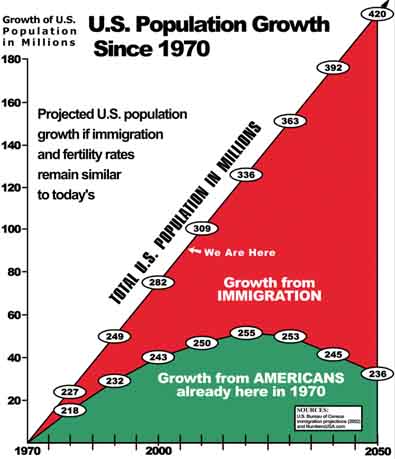
The graph below shows where we have been -- and where we are growing due to a combination of unrestrained immigration and one of the highest fertility rates in the industrialized world.

Post-1970 immigration now accounts for about 98 percent of all U.S. population growth.


This a repost from the blog circa August 2006.
.

Wednesday, May 07, 2008

Beyond the Border of Reason


Nothing hurts America's environmental movement more than nonsense, and the same can be said for America's immigration reform movement.

What piques my ire today? The latest bit of silliness is a post from CNN entitled "Border-fence dispute snares rare jaguars."

Of course, it's all an absurdity. Jaguars are fairly common in large parts of South America, and have never existed, as a resident population, north of the border, though there has always been a small population of about 100-150 animal in Northern Mexico.

So what's the big deal?

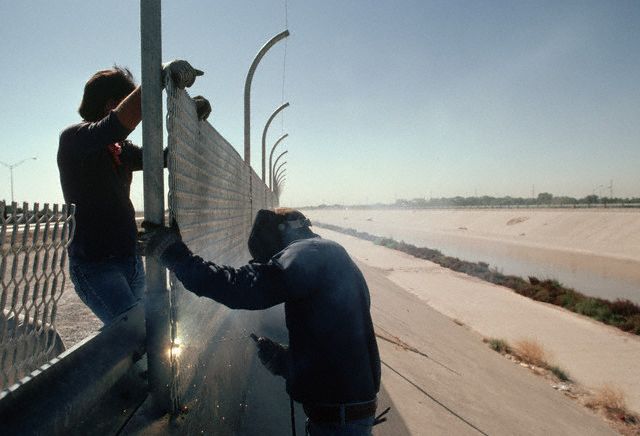
The issue, it seems, is that two environmental groups, Defenders of Wildlife and the Sierra Club, have filed an appeal with the U.S. Supreme Court claiming the new border fence under construction is "unconstitutional." And their rationale is (wait for it) that the fence would prevent the migration of non-existent and not-endangered jaguars!

To which I can only reply: Nonsense.

Pardon me if I do not fall down over this make-weight legal argument. This is not environmentalism; this is left-wing political pandering, and it undermines credibility which, once lost, is not easily repaired.

What is particularly unconscionable here is that the Sierra Club and Defenders of Wildlife have done nothing to help address America's open-border immigration policy which has fueled rapid U.S. population growth over the last 20 years.

And have no illusion as to why our environment is under siege. America's forests, fields, beaches, lakes, rivers and estuaries are not committing suicide; they are being cut down, drained, paved over and poisoned by population growth. As Jim Motavalli notes in E Magazine (Jan-Feb. - 2004):

"With U.S. population growing by three million a year, we lose two acres of farmland every minute, according to the American Farmland Trust. Traffic congestion costs drivers $78 billion a year, says the Road Information Project. A serious water shortage is developing nationwide, with aquifers once considered inexhaustible drying up."

And what is the Sierra Club's answer to rapid U.S. population growth?

Silence.

This is a group that thinks it's fine to talk about population growth overseas, but God forbid that anyone point out that legal and illegal immigration is now fueling more than 90 percent of U.S. population growth at home.

God forbid that anyone note that the U.S. has the fastest population growth rate of any industrialized country in the world today.

God forbid that anyone note the recent USA Today headline: "Expert: U.S. population to hit 1 billion by 2100."

Andy Kerr of the Oregon Natural Resources Conservancy (one of Oregon's foremost environmental activists, and a true warrior for the environment), got it right in 2002 when he called the big "green" groups to task for being silent apologists for runaway U.S. population growth:

Immigration is a very divisive and sensitive issue that nonetheless must be discussed. To those who support generous immigration, I ask you this: Why are you on the same side as Microsoft and the other huge computer corporations, and of Archer Daniels Midland and the rest of the agribusiness lobby? How can you support a policy that helps ensure that our existing poor will never be adequately valued for their labor?

To those who oppose immigration because of racist and/or xenophobic reasons, I say to you: Go to hell. The issue is immigration, not immigrants.

I come to my support of immigration reform from an ecological carrying-capacity perspective. Be it a house, a block, a city, a watershed, a state, a bioregion, a nation, a continent, or a planet; all have a carrying capacity. . . .

The only smart growth is no growth.

Remember Isaiah 5:8: "Woe unto them that join house to house, that lay field to field till there be no place that they may be placed alone in the midst of the Earth."

.... [T]he Oregon we love is like a car speeding toward a cliff. While may disagree on the rate of speed, or the distance left to the cliff, those are details that in the end don't matter.


To which I would add only applause and an "Amen."

Meanwhile our politicians continue to pander as hard and fast as the Sierra Club and Defenders of Wildlife do.

John McCain wants a huge amnesty, and if he's put in office with a Democratic House and Senate (as seems likely), it will be the only thing the two sides can agree on, and it will sail through Congress with the speed of a War Powers Act after Pearl Harbor. Besides, at the advanced age of 71, John McCain is not going to run for President again, so what does he care that an amnesty is unpopular with the American people? He's "Maverick" by God, and he will do what he wants. Besides, he figures, jamming an illegal alien amnesty for 12 million will get in the history books. And, no doubt, he is right on that!

As for Hillary Clinton, if she becomes the Democrat nominee, John McCain will win the presidency. It really is that just that simple.

Which leaves us with Obama.

He too gives a nod to amnesty (all three candidates do), but in reality, I think he will have too many other big agenda items on his plate to ever get this one done.

If elected, Barack is going to be up to his ass ending the war in Iraq, stabilizing and reducing gas prices, fixing our broken trade policy, putting the housing crisis in order, repairing our roads and bridges, and regaining control of our borders. Though he mumbles a little about an amnesty, Barack has consistently said that we need to put immigration law enforcement first and he supports a fence at the border and tough, and enforced, employer sanctions). With Barack, an illegal alien amnesty may be on the agenda (same as with McCain and Hillary), but unlike McCain, it is part of his agenda I do not think he will ever catch up to because bigger, more important, issues will always get in the way.

Monday, January 28, 2008

McCain: Giving Up America Without Firing a Shot?

I really thought I had seen and heard it all as far as U.S. immigration policy is concerned.

But nope. There are some things that are so unbelievable even I have a hard time getting my head wrapped around them.

How about this one: John McCain's Hispanic Outreach Director, Juan Hernandez, is actually a Mexican government official who not only wants open borders, he wants Mexican Americans to have their primary loyalty not to the U.S., but to Mexico.

Don't believe it? Go ahead, look at Mr. Hernandez's very own web site!

So what did John McCain say when he was asked about it?

Well basically, McCain reaffirmed that he remains a "Big Amnesty" kind of guy. As for the Mr. Hernandez's statement that he thinks it's OK to steal your Social Security number, he'll "check in to the information ."

Don't believe it? Check it our yourself: two videos and transcript here.

John McCain: He couldn't secure his campaign. How will he secure the borders?

To read what my friend Mark Krikorian has to say on all this, click here.

End Note: It turns out Jon McCain's National Finance Co-Chair appears to be Jerrold Perenchio, who made a fortune with Univision and has been a major defender of failed bilingual education policies.
.

Monday, July 23, 2007

Beyond Flights of Fancy


A repost from 2006 of this blog.


In his book Stormy Nights and Frosty Mornings,
Paul Dooley writes of going to his first field meet with a hawking club.

He had never been to such an event before and was rather apprehensive as there were a couple of 'names' present who always talked a good game. Later he learned that some of these people, particularly one of the organizers of the meet, had never flown a bird free!

When it came time to actually hunt, nobody in this hawking club wanted to fly their own winged charge at fur or feather -- it was deemed to be "too windy" by some, while another said his bird was an ounce or two over weight and another said his bird "wasn't ready yet". It was Paul -- a novice -- who flew his bird and scored on first flight.

Paul writes: "It was quite an eye opener for me that day. The problem with field meetings for these fake falconers was that there was nowhere to hide. Some of them used to turn up without their birds just to watch. Nothing wrong with that, but why pretend that you hunt a bird when you clearly don't?"

Why pretend indeed! Yet people DO, don't they? And it's not just in the world of hawking.

I mention this paragraph, in part to highlight Paul's book, but also to note that we have the same kind of people in the terrier world, and they exist in other arenas too.

In The Survival of the Bark Canoe author John McPhee writes of Henri Vaillancourt, a maker of traditional Indian birch-bark canoes. For years Vaillancourt had been building canoes based on a mixture of book learning, theory, and pure fantasy. It was only when he asked Vaillancourt to go on a canoeing trip with him that McPhee learned an eye-opening truth: Vaillancourt had never actually paddled his own creations for any distance far from home.

His canoes were beautiful to look at, but the crafts themselves represented design choices unburdened by actual field experience. In the end, McPhee's book is not really about birch bark canoes -- it's about the collision between theory and practical knowledge.

Is it much different in the terrier world?

Not from what I can see. Some people have spent years on Internet bulletin boards, but have never actually dug five feet to a critter. They still do not own a decent shovel, and still do not know what to do with a squalling raccoon at the stop-end of a dirt pipe. Their theory of terrier work is entirely unburdened by field experience. When questions are asked, they do not pay close attention to the answers since it's all romantic abstraction. The purpose of a question is not to solicit an informed answer, but to extend idle chatter. Just as Paul Dooley's fake fliers show up at a hawking meets with birds that have never left a creance, so these fake diggers show up at terrier trials and enter their "one and done" dogs in the working terrier ring.

I was reminded of this collision between reality and fantasy while reading Matt Mullenix's excellent book, In Season, A Louisiana Falconer's Journal.

Matt is not a fantasy flyer. His book is about the reality of hawking -- keeping his bird at the right weight, finding a bit of pasture that has not been mowed flat, painting a cracked talon with Crazy Glue and nail hardener, and balancing the competing interests of job, hawk, children and wife. Every flight is not a glorious thing ending in a brace of rabbits; sometimes it's a soaking rain and a footed sparrow or worse -- mere indifference from a hawk a little too heavy to focus.

With a sense of confession, Matt explains that though his Harris Hawk nails its fair share of swamp rabbits and doves, there are also lot of cotton rats. They are, for better or worse, a primary quarry in his part of the country.

I get it. It's easy to love a rat if you hawk -- just like it's easy to love bluegill and sunfish if you fly fish. Field action of any type beats fantasy and theory seven days of the week.

Matt writes of the rising tension of a group hunt, when there may be too many birds flying, and as a consequence problems can rise up and spin out of control quickly. The same thing occurs with terriers. A solo man and his dog are under no pressure, but put more than three or four dogs in the field at once, and things can move too quickly for the human to avoid real trouble. It only takes one train wreck to ruin a day.

I do not hawk, but I understand Matt because he is actually hunting and his concerns mirror mine even though we hunt different animals on different game in different parts of the country. Matt talks about a hawk's leg turning blue after a run-in with a tree and the calculated risk that two hawks, diving for the same swamp rabbit, will accidentally grip on to each other as well as the rabbit. Is their a digger that does not understand this problem? I have felt the same rising arpeggio of concern, never mind that it is played on a different stage in a slightly different key.

In a small part of the book Matt writes of a man who "has no time for falconry." In two weeks this novice had flown his young bird only once, and then when the bird was over-matched. When Matt points out that it's pretty hard to work a hawk on a weekend-only basis, the novice replies, "but that's the time I have."

Matt does not comment. He does not need to.

What the hawker wants is interesting, but it's not really part of the equation, is it? There are some things that are required in hawking, and time with the bird is clearly one of them. Mullenix does not have time for falconry either, but it does not matter; he steals the time from family and job, from sleep and rest. He feels guilty about the theft (an honest man would), but he steals it anyway. It is what you have to do if you are serious.

With hawks, it's either all the way in or all the way out.

The dog world is a bit easier, and perhaps for that reason we are surrounded by more fakes, novices, romantics and bored housewives than the people in the world of hawking. I do not know. Perhaps I am wrong. Paul Dooley suggests falconry has its share of preening pretenders too.

All I know for sure is that the hawkers are a pretty literate and interesting lot. A tip of the hat to them, and a recommendation for this book.

I close on a slightly troubling note. In the UK, some of the mounted fox hunts are attempting to exploit a loophole in the law that allows riders and packs of hounds to hunt fox with large raptors. The result is that dozens of mounted fox hunts have gone out to purchase Golden Eagles and Eagle-Owls.

This is insanity on stilts. There is no tradition of hunting fox with golden eagles and owls in the UK. Exmoor is not Kazakhstan or Mongolia, no matter how loose the immigration laws get.

Add a novice hawker to the mix, along with a rioting pack of hounds, a couple of dozen spooked horses, a large dog fox, and a few overhead power lines and roads, and you clearly have winged disaster waiting to happen. Already, I have a report that two Golden Eagles have died from the sheer stupidity of it all.

And yet, perhaps God does have a sense of humor. There may yet be a punch line to this joke.

It turns out that after being extirpated from the UK for more than 100 years, once-native Eagle Owls have mysteriously begun to show up and breed in the wild.

I have little doubt these are captive birds that have escaped and hacked themselves back into prosperity on a diet of pigeon, starling and rabbit.

Excellent.

Mother Nature may yet bat last, and if the stupid anti-fox hunting law is repealed (as I believe it must and will be), then a fair number of captive Golden Eagles and Eagle-Owls may be yet be hacked back to the wild.

What a glorious day that will be!


Friday, May 18, 2007

Coffee and Provocation

Immigration and Wildlife:
When Jimmy Carter went to China, he told Deng Xiaoping he wanted the Chinese to allow their political dissidents to leave. Taking a drag on his cigarette, Deng fixed a level look at President Carter. "Fine," he said. "How many million do you want?" The same question is now being debated on Capitol Hill, where our politicians are set to put in motion a plan that will inexorably lead to less access to hunting lands all across the United States as many scores of millions of additional people are added to our population over the next 50 years. Don't believe it? Read this old post which sets out the issues and the numbers. For how all this directly impacts hunting, read this little piece entitled "The Real Threat to Hunting (and Wildlife) in America."

Rachel Carson, Bald Eagles and Osprey:
Rachel Carson was a government public relations hack, and for that reason alone I have a soft spot for her. I am happy to report that The Washington Post has a very nice profile of her in today's paper which details, in some small way, her struggles with breast cancer at the end of her life. What most people don't know is that while DDT is bad for birds and other living things, it was not the reason for bald eagle and osprey decline in the U.S. For more on that topic, read this old post which comes complete with a few links to the Audubon data.

AKC Earthdog Events:
May 26-28 and June 2-3 there will be various Earthdog and Teckel trials at Village Green Farm Earthdog Center, Crosswicks, NJ (i.e. JoAnne Frier-Murza's place). Go to http://www.njbearthdogs.org/ to find details and a calendar of future events.

Friday, August 04, 2006

An Inconvenient Truth


A nice man, a lovely family, and an inconvenient truth.


Over the weekend I went to see "An Inconvenient Truth," Al Gore's global warming documentary. I found the movie extremely well done and not boring. This is a recommended movie, and it is certainly better than most of the pap offered up on the Silver Screen.

Having just given the movie "two thumbs up," however, let me say that there are a few "inconvenient truths" that Al Gore has left out of his documentary.

At the beginning of the movie, Al Gore tells us he has been following global warming issues since he was in college. Me too, and oddly enough for the same reason.

Al Gore was a student of Roger Revelle's at Harvard. It was Revelle who designed some of the first experiments and theories underpinning the nascent science of global climate change.

It so happens that my father was head of the climatology program for the American Association for the Advancement of Science back in the late 1970s and early 1980s, and worked closely with Revelle. In fact, I think my father may have written the first New York Times editorial ever written on global warming.

When Al Gore first met Roger Revelle back in 1966, Revelle was Director of the Center for Population Studies at Harvard -- a position he held from 1964 to 1976.

Gore manages to tell us quite a bit about Roger Revelle and his own youthful conversion to environmental causes without ever mentioning Revelle's demographic concerns, or the size of the Gore nuclear family.

In fact, I would argue this is not an accident. Population growth is an "inconvenient truth" -- the one that underpins global warming, and one that is particularly inconvenient for Al Gore as he tells us his global warming jeremiad.

You see, Al Gore has four children. Think about that for a minute.

If the average woman in the world followed Al Gore's lead, the population of the world would double every 25 years -- FOREVER.

Al and Tipper Gore chose to have more children than the average woman is having today in India, China, Zimbabwe, South Africa, El Salvador, Jamaica, Indonesia, Bangladesh, Vietnam or the Philippines -- to randomly pick from a few of the less developed countries from around the globe.

Al Gore had a choice to make when it came to having a family. He could have had no children. Or one child. He could have chosen to stop at two. He could have built his family through adoption or stopped at three kids. Instead, Al and Tipper Gore chose to double the human load they put on this planet.

It's not like Al and Tipper did not have access to health care and a diverse array of family planning options. Al and Tipper had more information about, and better access to, contraception than almost anyone else on the planet.

It's not like Al and Tipper Gore did not know better. Al and Tipper were married in 1970, at a time when Paul Ehrlich's book "The Population Bomb" was a national best seller, and when the speed of both world and U.S. population growth were core messages of the first Earth Day.

And yet Al Gore ignored it all. Al and Tipper had their first child in 1973, their second in 1977, their third in 1979, their fourth in 1982.

Let's put this story in numerical context. When Al Gore was listening to Roger Revelle at Harvard in 1966, the population of the world was 3 billion. Today it is over 6.2 billion people, and it will be over 12 billion by 2033 if the world follows the Gore model for family planning.

Gore's discussion of global warming shies away from causation. It is an odd but true fact that this very smart man has made an entire movie about global warming and greenhouse gases without once saying where those gases come from.

There's a reason for that. The inconvenient truth is that the world is NOT producing more greenhouse gases per person than it did in 1830 when the world had 1 billion people. Nor is it producing more greenhouses gases per capita than it did in 1930 when the world had 2 billion people.

The inconvenient truth is that the world is producing about the same or less greenhouses gases per person today that it did 50 or 100 years ago. People forget that horses produced serious amounts of greenhouse gases (methane) and so too did homes heated with wood and coal.


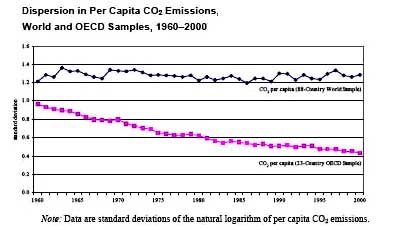
Table 1, page 19 from "Per Capita Carbon Dioxide Emissions Convergence or Divergence?" by Joseph E. Aldy, 2005 published by Resources for the Future (PDF)


The simple fact is that while the atmospheric level of CO2 has increased 30 percent since 1860, world population has more than quadrupled since then. Per capita CO2 emissions in the industrialized world are actually in decline, and have been for quite some time. When we look at all CO2 production, we find that global population growth and CO2 emissions track almost perfectly.

The problem is not that we are driving cars or cooling our beer in refrigerators -- it's that there are too many people. Too many people necessarily results in too many cars, too many refrigerators, and too many coal-fired electrical plants.

There are too damn many of us!


Population growth, energy use and CO2 emissions track perfectly. The causal agent here is human population growth -- an "inconvenient truth" largely glossed over in Al Gore's otherwise excellent movie. Figure 2 is from "Atmospheric Carbon Dioxide as a proxy for growth of the human population? ," 1995, University of Washington


Al Gore is willing to talk about rebuilding power plants,
building nuclear reactors, knocking down or retro-fitting every building on the planet. He is willing to discuss what's wrong with Ford and Chevy, but he is not willing to talk too long or too loudly about population growth for fear his audience might look over his shoulder to see how many people are sitting in his own family room.

Like most people, Al Gore is more comfortable talking about CO2 emissions than he is about IUD's. He would rather talk about the need for a new type of internal combustion engine than about the need for internal self-restraint, birth control pills, and vasectomies. He would rather count carbon molecules than count human noses.

In this sense, Gore (like most politicians) is part of the problem.

A politician is always willing to invest a few billion dollars to subsidize energy research at the local university, or pump a few billion dollars into a program to subsidize new car designs by General Motors. But talk about cutting back on immigration (which is driving nearly 100 percent of U.S. population growth), or pumping a billion dollars a year into Third World contraception programs and .... well, there are a thousand and one excuses to do little or nothing. To be fair, those excuses come from both sides of the political aisle. While people may be the source of greenhouse gas emissions, they are also the fuel of politicians, political parties and corporate sponsors.

And so, in the end, we have a movie about global warming that does not really talk about what causes global warming. How ironic is that?

Al Gore's global warming movie concludes by telling us to turn down the thermostat and to send more letters to Congress. It tells us to ride bicycles and use public transportation. It tells us to use more energy-efficient light bulbs and bring more people to the Al Gore movie.

But it does not tell us to have fewer children.

It does not remind us that an open-border immigration policy in this country has global resource consequences in the form of more greenhouse gases, more energy use, and more pollution.

Al Gore's slide show does not suggest contraception, immigration law enforcement, and communitarian self-restraint, nor does it point out that the science of reproduction is widely understood and that improved access to contraception is extremely popular across all cultures and religions. (Did you know that Catholic countries have the lowest fertility rates in the world? That abortion is legal in Italy? That Iran has below-replacement fertility? Did you know that the U.S. has the fastest population growth rate in the developed world?)

The end result is that Al Gore's movie on global warming offers us little more than hot-air solutions.

The inconvenient truth is that immigration-fueled population growth in the United States is negating every single energy conservation effort we are making in this nation today, and that population growth across the globe is negating every single energy conservation effort being made in the world today.

That's a message you won't hear at the local Multiplex. It's a message that's still a little too "inconvenient."
.

Friday, June 16, 2006

Drawing the Line at the Border for Wildlife's Sake


Road kill is not about vehicle impact. It's about what a road does to the land forever. It is not one animal that dies next to a white line, it is the environment that supported that animal being altered -- and often destroyed by development -- forever.

I have written about population growth and U.S. immigration policy for more than 25 years. I mention this simply to say that this is not my first rodeo on this issue.

If immigration reform is now fashionable, so be it. I got my T-shirt when it was not.

Back in 1980, when I was more-or-less permanently camped at the Select Commission on Immigration and Refugee Policy, the entire immigration reform movement could have fit into the back of a Volkswagen microbus. Back in those days, when I spoke about the impact of U.S. population growth on the environment, not many people were actually listening. Maybe no one.

Things have slowly changed. When I did CNN's Crossfire with Pat Buchanan in February 1989, he was an open-border apologist and I was the liberal opposition "in the crossfire". The next week Buchanan wrote his first column on the need for U.S. border security asking, "Does the United States have the right to engage, if you will, in national family planning for the future ... Or are we obligated, by our values and tradition, to leave such matters to fates, and to the fortunes of guerrilla war in Central America and the business cycle in Mexico City?"

Bingo. Someone was listening. Since the events of September 11, 2001, even more people have paid attention to U.S. immigration policy. No doubt it has helped that I have moved on to other debates.

Of course nothing has really changed (yet). In fact, the number of people coming to our shores keeps going up. Companies still want cheap labor and politicians still want cheap causes. With a wink and a nod both sides of the political aisle find a thousand and one excuses to do nothing.

America is a compassionate place. But having a heart does not mean you have to lose your brains. The United States cannot take all of the world's displeased and dispossesd, nor can we move all of the people of Somalia (or Indonesia or Guatemala or Ireland) to the United States. We have to draw a line somewhere and decide who we will take, how many we will take, and how we will enforce the law. These three questions underpin all immigration policy.

For 25 years I have listened to those on the Far Left and the Far Right answer the first two questions thusly: "More people that look like me."

It is with sadness that I note that the Mexican American Legal Defense Fund, the Congressional Black Caucus, the Ancient Order of Hibernia, and the Ku Klux Klan all find common ground in that one answer.

I do not.

Instead, long before Bill McKibben wrote Maybe Just One, I decided maybe just none. I was born and raised in Africa (a child of American diplomats) and was observant enough to see that children the world over were, quite literally, dying for what I and my wife could offer as parents. So we adopted from overseas -- a simple way of reconciling global population concerns with a personal desire to have a family. No big deal.

I mention this only to say my tribe has never been defined by skin color or ethnic cuisine. Instead, my concerns have been more elemental, shaped by watching young goat herders shimmying up trees in order to hack every limb off the trunk and drop them down to the hungry animals waiting below.


Goats demand forage, and so the desert expands by degrees because people are locusts on the land. The people are not bad (nor are the goats) -- there are just too many of them.

There are too many people all over. Over population is not something that is happening "over there" -- it is right at our doors as well.

Over the years I have listened to a lot of arguments for immigration reform. If unemployment is up, some will argue that immigrants are taking jobs from Americans. If terrorism is the flavor of the day, they will suggest that border security and more immigration law enforcement can make us safer. If the audience seems pissed off that no one speaks English at 7-Eleven anymore, they will talk about how ethnic diversity can lead to social divisiveness.

I will not deconstruct any of these arguments -- they all have their place and they are all, largely or partly, correct.

But they are not the principle reason I have always favored immigration reform. I favor immigration reform because I love America as she is and was.

I love an America where we can hunt and fish and where wildlife is plentiful, and the water is clean. I want an America where forests are not managed solely for timber, and where kids can still play in the creeks.

I would like to live in an America where every beach is not crowded, and where camping grounds and back country shelters do not have to be reserved weeks in advance through Ticketron.

I would like the schools to be less crowded (and the buses, subways and malls as well). I would like to see larger side yards, fewer condominiums, larger woods, and less road widening.

I would like to see more wetlands, fewer culverts, less asphalt, and more people that know the names of their neighbors.

Above all, I want my kids to grow up in a country where there are still places you can walk 20 miles in a day without once crossing a road. Grizzlies, cougars and mule deer need such places. So too do people.


Earlier this month The Washington Post announced that the Senate immigration bill would add 20 million more people to the population of the United States in a decade.

Am I the only one to ask the question: How many Americans do we want? How many Americans would we like there to be at some point in the future? At one point do we say enough?

Right now, more than 33 million legal and illegal immigrants live in the United States.

Thirty-three million is a lot of people. Here are a few comparative numbers to give you an idea of the scale of this population, and its annual environmental impact in the United States:


  • A country with a population of 33 million would be the 34th largest country in the world (out of 227 nations), and would have a population larger than the current population of Canada.

  • 33 million is the combined populations of the 20 largest cities in the U.S in 2000, according to the U.S. Census Bureau (New York City, Los Angeles, Chicago, Houston, Philadelphia, Phoenix, San Diego, Dallas, San Antonio, Detroit, San Jose, Indianapolis, San Francisco, Jacksonville,Columbus, Austin, Baltimore, Memphis, and Milwaukee).

  • 33 million people in the U.S. would require over 12 million housing units, assuming current U.S. average household size.

  • 33 million people in the U.S. means 15.8 million more passenger cars on America's roads, assuming average per capita car use.

  • 33 million people in the U.S. can be expected to consume about 825 million barrels of oil a year (25 barrels per person per year). To put it another way, 33 million Americans will consume all of the economically recoverable oil in the Arctic National Wildlife Refuge (ANWR) in less than four years time.

  • 33 million people can be expected to consume 2.26 billion cubic feet of roundwood per year (80 cubic feet per person) assuming average U.S. consumption patterns. Assuming 35 cubic feet of roundwood grown per acre of forest per year, over 75 million acres of forest will be needed to supply 33 million people with their paper and wood needs. This is an area larger than Pennsylvania, Virginia, West Virginia, and Maryland combined.


Immigration and births to future immigrants will account for 67% of U.S. population growth between 2000 and 2050, according to the U.S. Census Bureau's middle-series projection. If you count births to the foreign-born already here, the number is approaching 100 percent.

Under the Census Bueau's middle-series projection, the population of the U.S. will grow by an additional 120 million people over the course of the next 50 years -- a population nearly four times larger than the foreign-born population enumerated above.

To put this 120-million number in perspective, this is a population greater than the current populations of ALL of the states West of the Mississippi: California, Washington, Oregon, Idaho, Arizona, New Mexico, Wyoming, Colorado, Texas, Kansas, Nevada, Utah, Montana, Oklahoma, Nebraska, South Dakota, North Dakota, Minnesota, Iowa, Missouri, Arkansas, and Louisiana combined -- with Illinois thrown on top.

Of course U.S. population growth will not stop in 2050, but will continue for at least another 50 years under the Census Bureau's middle series projection, rising to over 470 million by 2070.

And this is the Census Bureau's middle series projection, which is probably too low.

Back in 1989, when I was trying to convince Pat Buchanan that U.S. population growth rates might be an important issue, the U.S. Census Bureau's median projection was that the population of the U.S. would "peak" at 302 million in 2040 and then decline from there.

In fact, the population of the U.S. will hit 300 million this October, and will top 302 million by next Spring. The Census Bureau's 1989 "high" components for fertility and immigration are now those used in the Bureau's "middle series" projection.

For more than 50 years, Census Bureau projections have been too low.

Will America fall apart at 400 million, or 500 million or even one billion people?

No, it will survive. It just will not be the America I love today.

If you hunt, you will have to drive farther, and perhaps pay to hunt in a for-profit shooting preserve (some do that now).

As we pave over paradise and put up parking lots, surface water will flow fast and dirty into our rivers and creeks. Cars will become more efficient, but population growth will consume the oil savings, and we will be more dependent on foreign oil than ever before.

More and more creeks will run in culverts, and fewer and fewer children will play in them. Silt from construction sites will clog rivers and streams, and no one you know will have ever caught a five-pound bass or a three-pound trout. You will no longer be allowed to walk down White Oak Canyon in the Shenandoah National Park unless you first bought a ticket at Ticketron.

For me, immigration policy is all about numbing numbers and the inexorable loss of the last best things in America -- a loss that will come with an ever-growing tide of people.

If I could, I would deport some Americans I know, and swap them out for good honest, hard working immigrants. But that's not going to happen anymore than God is going to make more wild lands. It's a cute idea, but in the real world forests are falling to fields, and fields are falling to freeways at a dizzying rate.

Something's got to give, and there's clearly a place to draw the line. Is it too much to ask that we draw the line at the border?


A surveyor's stake cuts through the heart of the land and signals the end of the road for both hunter and wildlife. America's wild lands are not committing suicide -- they are being killed by population growth, the vast majority of which is now being fueled by out-of-control immigration.