Showing posts with label endangered species. Show all posts

Thursday, December 03, 2015

The U.S. Now Has More Lions Than Africa


I tossed the latest copy of Earth Dog - Running Dog
magazine into the truck on the way to work this morning, and was flipping through it at a traffic light when I opened it up to see the picture at left. Hey, I know that fellow!

And sure enough I do -- it's John B., who I see once a year at the only dog trial I go to, the JRTCA Nationals.

That's a 200-pound stock-predating Mountain Lion John hunted in Arizona a few years back (subscribe to Earth Dog - Running Dog magazine if you want to read the full story).

John's Mountain Lion got me to thinking about the rise of Cougar populations here in the U.S.

As regular readers might recall, a Mountain Lion was recently shot in Chicago, and roadkills in Iowa prove they have gotten that far east as well.

Rumors of Mountain Lions in Appalachia remain (as yet) unfounded, but it is agreed by all that it is only a matter of time before they come here. With over over 2 million acres of contiguous National Forest in Virginia and West Virginia alone, and plenty of deer, they will not want for food or space!

On a hunch, I did a little research and confirmed what I suspected: there are now more lions in the United States than there are all in all of Africa.

Now granted that Puma concolor and Panthera leo are a different genus of big cat, but a Mountain Lion is no small animal; it is, in fact, the fourth largest big cat in the world.

Right now there are more than 30,000 Mountain Lions in the U.S., and their numbers are slowly growing despite the fact that hunting these large animals is legal (if controlled by permit) in 10 of the 11 western states where they reside.

All in all, about 3,500 Mountain Lions a year are shot by U.S. hunters, and another 800 or so are killed by vehicle impacts.

A slow steady increase in Mountain Lions is excellent news, and the kind of thing we can live with provided the populations are allowed to expand in the right direction (i.e on public lands) and away from farms, ranches and suburbs.

The return of the Mountain Lion (along with the concurrent rise in bear, wolf, coyote, turkey, eagle, hawk, osprey, deer, elk, and beaver populations) is proof-positive that the American way of science-based wildlife management has been a roaring success.

This is not to say, of course, that there will never be human-wildlife conflicts. There always will be with large meat-eating predators.

Problem lions, wolves and bears will always have to be shot, but regulated hunting and culling of these animals does no long-term harm provided the slaughter is not indiscriminate and the wild habitat they require is preserved as large unbroken blocks of land.

The real threat to animals like Mountain Lions is not regulated hunted; it is unregulated population growth which results in more roads, more water consumption, and more sprawl.

If we protect the habitat, the wildlife will generally take care of itself.

But to take care of the habitat, we have to control ourselves.

We cannot allow U.S. population growth (largely driven by immigration) to increase our numbers to the point that humans become like locusts on the land. If we plough and graze fence post to fence post, fragment the forests, drain the rivers and streams for irrigation, and put in roads every mile or two (with shopping centers in between), it is not just Mountain Lion we will lose; it is wild America as we know it and love it.

And, to put on a point on it, it will not take much human population growth in Arizona, where this mountain lion was shot, to wreck things forever.

As John McCain recently noted, Arizona is already so dry the trees have been known to chase the dogs!

So heads up; human population growth is what is killing off Africa's lions.

Now that we have a healthy Mountain Lion population in the American West, let's make sure we do not allow human population growth to kill off our lions as well.

Let's not worry about sustainable levels of hunting, while ignoring unsustainable rates of immigration.

Yet, as far as I can tell, that is exactly what every Mountain Lion and Cougar protection organization in America is now doing. Talk about missing the forest for the trees!
A repost from 2008.
.

Monday, December 19, 2011

Christmas Bird Count Illuminates an Old Fable


The National Audubon Society is in the midst of its annual "Christmas Bird Count," which is mostly an unscientific "bird feeder" bird count done when those birds which are at greatest risk of decline (i.e. neo-tropical migrants including most grassland birds) are actually down south in Mexico, the Caribbean and Central and South America.

In short, this is the wrong time of year to count birds that are truly at risk!

That said, the 111-years worth of data collected by the "Christmas Bird Count" does have some use, if for no other reason than to prove that one of the biggest fables about Bald Eagles and Osprey is more than a small lie.

What's the story? Simple: that Bald Eagles and Osprey were pushed to the edge of extinction by DDT.

Not quite true. 

In fact, Bald Eagles and Osprey were pushed to the edge of extinction by bullets and leghold traps long before DDT showed up on the scene. See this previous post for more information about that.

This is NOT to say that the ban on DDT was not good for birds, only that the notion that Bald Eagles and Osprey were specifically driven off the map by DDT is simply not true, and obscures an important story about the value of the Bald Eagle Protection Act of 1940, and the Endangered Species Act of 1973.
.

Thursday, November 10, 2011

Flying Rhino's on Video


Yesterday I posted on South Africa's flying black rhino relocation program.

Today we have video from the relocation program and news that the western black rhino (a subspecies of the black rhino that once lived in west Africa) has been declared extinct (though that may change as animals were known to be in the wild only 15 years ago). 

From the video description of last week's South African black rhino move:

A relatively new capture technique was used to airlift some of the rhinos out of difficult or inaccessible areas by helicopter. This entails suspending the sleeping rhino by the ankles for a short trip through the air to awaiting vehicles. "Previously rhinos were either transported by lorry over very difficult tracks, or airlifted in a net. This new procedure is gentler on the darted rhino because it shortens the time it has to be kept asleep with drugs, the respiration is not as compromised as it can be in a net and it avoids the need for travel in a crate over terrible tracks," explains Dr Flamand. "Another advantage is that rhinos can be more easily removed from dangerous situations, for example if they have fallen asleep in a donga or other difficult terrain after being darted. The helicopter translocations usually take less than ten minutes, and the animals suffer no ill effect. All of the veterinarians working on the translocation agreed that this was now the method of choice for the well-being of the animals."
.

Wednesday, November 09, 2011

Flying Rhinos

Click to enlarge.

The World Wildlife Fund transported 19 South African black rhinos 1500 kilometers to new grazing and breeding grounds in the northern Limpopo province of South Africa.
.

Wednesday, October 19, 2011

Does Your Local Zoo Have a Dirty Little Secret?


One of the big stories in the news today is that a depressed and distressed owner of a private zoo in Ohio opened up all the cages to release his bears, lions, tigers, wolves, and other animals on the public.... just before he shot himself in the head.

The call is already going out to ban all private zoos and only salute the public ones.

Not said: much of the stock in those private zoos can be traced back to the breeding and dumping of animals by public zoos and semi-public places like Busch Gardens.

As I noted in a post a few years ago:

Zoos routinely over-breed animals because tiger cubs and baby zebras boost attendance and generate profits. Cute baby animals quickly grow up, however, and that's a problem. It turns out that the world has more caged lions, tigers and zebras than it knows what to do with.

Now to be clear, zoos do not trumpet their actions and their economics. Instead, they trumpet the fact that they have a Species Survival Plan (SSP) which calls for sophisticated program of maintaining "valuable gene pools" so that endangered species "may be preserved for future generations through captive breeding."

O.K. True enough, as far as that goes. But every "Species Survival Plan" produces surplus animals. What happens to them?

Some of these undiscussed animals are moved to other public zoos, but some are sold off to private zoos where they may end up in backyard menageries or even canned hunts after passing through the hands of third-party dealers later on.

This is the dirty little secret of the zoo business, and it's not just a phenomenon of the private zoos, but the public ones too.

To be fair, the Association of Zoos and Aquariums is now working hard to stop over breeding of zoo animals and the sale of excess animals to such venues as circuses. But this push is pretty new. Most of the backyard tigers, lions and Great Apes we have in America today are just one or two generations removed from commercial zoo and circus stock.

There's another problem with getting rid of private zoos in America: they hold a hell of a lot of animals representing a fair amount of genetic diversity. As this article notes:

More than 8,000 tigers live in the U.S., far more than live in the wild globally. Of the 8,000, only a few hundred live in accredited zoos. The rest live in backyards.

So, to put a point on it, getting rid of backyard tigers, in the absence of thousands of more zoos in the United States and around the world, is to green light the killing of more tigers in America than exist in the wild in all the rest of the world.


Are we ready to salute that?  Why? 

Some claim that many of the exotics in private hands are not "pure" subspecies of one type or another, and so they have no value and should be euthanized.

But why is one tiger that has 10% Sumatran blood running through it deemed to be worthless, while another tiger with a "pure" gene stock (cough, cough) is deemed to be priceless? Whiskey, tango, foxtrot. Subspecies are not species, and Mother Nature has no problem with out crosses and diversity, so why are we listening to the people embracing mass-death solutions and forced sterilization for animals that have slightly more diverse pedigrees? Does the Indian tiger with a little Sumatran blood kill a Sambar any differently than a 100% pure-blood animal? If the tigers are not finicky about patrolling their gene pool, and the Sambar are pretty certain it is all the same, and the offspring are all fertile, then isn't this all "theory trumping reality?"

And what about those public zoos? Are they really running picture perfect shops as far as animal welfare?

Nope, not a chance.

Nor are all the private zoos horror shows. Many have caring owners and some have very decent set ups. The notion that taxpayer-funded always equals "good," while privately-funded always equals "bad" is simply not true in the world of animals.

So what's the solution?  

Surely between "shoot them all dead" and "anyone should be able to get one," there is a place for mandatory training, mandatory licensing, mandatory insurance, mandatory inspection, and mandatory cash bonds with some animals still being held in private hands?

The good news is that this seems to be the direction that the world is going.

Will there be a long period of transition until we get there?

Sure.  Elephants live a long time, and so too do many of the big cats and large ungulates.

The transition will not be smooth, and a lot of private menagerie owners and zoo keepers are going to bitch and moan about the cost and the regulation.  I am OK with that

But should we ban all private ownership of all exotics and rush 8,000 tigers to their death prematurely because of this sad case in Ohio?  

Is the proper response to this tragedy to compound senseless death with more senseless death?


.

Saturday, October 01, 2011

Willie Nelson's Guitar


Willie Nelson knows two things about great music: it isn't about the label on the guitar, and it doesn't require killing off endangered species, violating the Lacey Act, or winking at child labor.  

Someone tell Gibson Guitar which seems to think buying tropical hardwoods that are illegally obtained is a "never mind" and that they can hide behind the current economic malaise.  Forget it.  This company needs to clean up or get out.  Is it really that hard to source legal wood?  It isn't. 

As for Willie's guitar, "Trigger," is a Martin N-20 nylon-string acoustic he bought sight unseen in 1969.  Been doing the job ever since.
.

Saturday, November 06, 2010

Harris Hawk X Golden Eagle

Harris Hawk X Golden Eagle in midflight.  Click to enlarge.

As I noted a while back in a post about species loss, a good case can be made that more species are provably being created every year than being driven to extinction. To be clear, I am not saying that species extinction is not a very, very serious problem, only that we should at least mention that useful species and subspecies are being created every day, and in every key type:  fur, fin and feather.   In the history of the world, I am pretty sure the creation of the leghorn chicken is more important than the loss of a subspecies of finch found only on one isolated atoll in the Pacific.

Several examples of speciation (it is a process, not an event) can be found in the world of falconry, where advances in aviary management and artificial insemination have resulted in all kinds of hybrids, such as Gyr/Peregrine and Gyr/Saker crosses that are not only fertile, but which combine the useful characteristics of one species (such as the speed of the Peregrine) with the useful characteristics of another (such as the size and strength of the Gyrfalcon).

The first hybrid falcons were produced in 1971 in western Ireland when falconers Ronald Stevens and John Morris put a male Saker into a moulting mew with a female peregrine. The two young falconers were quite astonished when the birds mated and produced viable hybrid chicks.

Soon other hybrids were being produced, revealing both the extreme plasticity and suspect nature of raptor classification.

One factor driving advances in falcon and hawk hybridization is that in Britain it is now illegal to use wild-caught birds of any kind for falconry. As a consequence, British hawkers and falconers are entirely dependent on captive-bred birds and are eager to fly birds that are demonstrably not wild-born, hence an affinity for hybrids.

Perhaps the most unusual hybrid created in recent years is a cross between a Harris Hawk and a Golden Eagle. These birds have only recently been created by S.&S. Falconry in Canada, and it remains to be seen whether the docile and biddable brain of a Harris Hawk can be reliably placed within the larger body of a Golden Eagle. If so, we will surely end up with the ultimate Jack Rabbit-hunting raptor, as the pictures above, and below, suggest.
.

Success with a Harris Hawk-Golden Eagle hybrid.

What makes this mating so unusual, of course, is that we have not only crossed the species line, but we have crossed the genera and subfamily line as well. 

An eagle crossing with a hawk?  Impossible!   But of course, apparently, it's not.   A Buteoninae (hawk) of the genus Parabuteo and the species unicinctus will produce viable young when crossed with a Aquilinae (eagle) of the genus Aquila and the species chrysaetos.   The mind riots.

And, of course, that's not the only "out-of-bounds" cross that's possible.    Cooper’s hawk (Accipiter cooperii) and Red-tailed hawks (Buteo jamaicensis) will also cross with Harris’s hawks (Parabuteo unicinctus).

None of this is likely to have too much effect on the wild, by the way, other than to make sure that most wild-caught birds are left alone to breed freely. 

Today, most falconers and hawkers, the world over, are using captive-bred birds, and many of the female hybrid crosses lay infertile eggs.  But not all of them.  And, of course, the male birds are generally very fertile. 

So, yes, some introduction of genetic variability into the great web of life is possible, but that has always been true, and it is always happening (at a very low level) in the wild.  A Grizzly bear can mate with a Polar bear and have fertile young, and yes that occasionally happens in northern Canada and Alaska.   Natural Saker and Gyrfalcon crosses are fairly common, and quite fertile, while certain ducks and fish species hybridize all the time.  Cougar and Jaguar hybrids occasionally occur in the wild, along with Lynx and Bobcat hybrids

Most naturally occurring hybrids go nowhere, of course, some because they are infertile, others because they send the wrong mating signals.   In extreme cases, such as crosses between Mule Deer and Whitetail, the result is otherwise maladaptive.  When startled,  mule-whitetail crosses do not know if they are to bounce away like a mule, or run like a whitetail.  The result:  they tend to get so confused they are quickly eaten!

But of course, stable hybrids are found in the wild, no matter how distressing that idea is to armchair theorists.  For example, DNA research has proven what has always been suspected -- that the Eastern Red Wolf in the U.S. is nothing more than a stable hybrid of a Grey Wolf and a Coyote.

Special thanks to Teddy M. for sending the pics and telling me of this unusual raptor cross!  Not sure who the pics are from, but hat's off for the terrific shots and let me know if you don't want them used.

Thursday, October 14, 2010

Exercising the Tigers

Suppose you had a dozen tigers that needed exercise? 

How would go about doing that? 

Answer below.


Asian food for Asian diners.
..

Thursday, October 07, 2010

Childhood Catalogues

Click to enlarge.

When I was a kid and living with my folks in North Africa, I would cruise through catalogues my father would order.  I think he got a lot of the references from Stewart Brand's Whole Earth News and The Last Whole Earth Catalogue, but I'm not sure.

In any case, I lived to flip through the catalogues of Carolina Biological  Supply and Edmund Scientific, and one year we got a copy of the Stromberg company catalogue, which sold all kind of cool things from Squirrel Monkeys to Quail, and from Jagarundis to Ocelots. 

The 1972 Stromberg Catalogue has now been scanned in for everyone to see what I salivated over in my youth (and what I shake my head at in old age). 

Wow.  Seriously?  You could buy black-footed ferrets through the mail??

It was all there for anyone to buy:  live Woolly Monkeys, Skunks, Chimpanzees, Raccoons, Giant Anteaters, Black Bear cubs, Great Horned Owls, Basenjis, live Trout, Afghan Hounds, Black-footed Ferrets, Porcupines, Red Fox, Peacocks, Chipmunks, Spider Monkeys, Beaver, Badger and English Bulldogs too.


Click to enlarge.

No, we never ordered anything.  There are no dead Squirrel Monkey or Giant Ant Eater stories in my house. 

As a kid in Africa I had a goat, a dog, 20 chickens, a hedgehog and a couple of rabbits, and for a while a chameleon and an African Gray Parrot as well.   I did not lack for wildlife, and spent a lot of time collecting beetles and butterflies, as well as slingshot-plinking at cats, chickens and pigeons whenever I was not trapping birds.

But the Stromberg catalogue?  Damn!  That was the thing to spark the imagination of a 12-year old boy, wasn't it?

Click to enlarge.

Friday, October 01, 2010

Good to the Last Dropping

This post was written in very late September of 2007, but I am reposting it now, three years later, because of the development at the ... ummm... end.

So read to the end!

The Camera-Trap Codger went looking for Giant Sulawesi Palm Civets, and made acquaintance with the ratting terriermen of Sulawesi, complete with their garish print shirts, odd hats, and broken tools.

Ah, my kind of people! Click here to read that post.

Now, whenever I think of Palm Civets, of course, I think of coffee. What, you don't?

Ah, well then, you are probably not serious about your coffee. I live on coffee, lots of coffee. And no, I have no idea why I have sleep disorders. Complete mystery.

Anyway, in all the world there is a special coffee. It is better than Blue Mountain, or Kona Joe's, or Colombian Jungle Juice, or East African Mad Dance coffee. This coffee is so ... refined ... it costs $300.00 a pound, and just one cup in a fancy restaurant (if you can find it) will set you back $50.00 or more. This coffee is called Kopi Luwak.

The refining process of this coffee is special. So special that only about 500 pounds of this stuff are produced each year.

So how is it refined? Ah! Well ... ummm ... it is run through a civet. To be specific, it is run through the bowels of a Palm Civet. To be more specific, it is run through the bowels of the Common Palm Civet. If you ran coffee beans through the Giant Sulawesi Palm Civet, which is the kind of animal the Camera Trap Codger was hunting, I have no idea what you would get. Maybe espresso?

In any case, it seems the Common Palm Civet is all over Indonesia. They like to eat coffee fruit, and the beans that can be gleaned from their droppings make for coffee that is "good to the last drop." Or at least good to the last droppings. Or so the People With Too Much Money have been lead to believe by the locals who may be laughing all the way to the bank.

Now there are different theories as to why this coffee is so good. One theory is that the civet is incredibly discerning and only picks the ripest and best berries. No doubt this is true. The civet's gut also seems to remove some caffeine and harsh alkalies, and the bitterness that comes with them. In any case, the coffee that comes from a civet's rectum is supposed to be The Cat's Pajama's. Or at least the Cat's Ass. One idiom seems as good as another in this case.

Of course, to collect the special civet-mellowed beans, you have to find a lot of civet poop, poke through it, extract the beans, sterilize them, and then put them in a coffee mill. The result is supposedly the best cup of coffee in the world.

That said, I have a small question for the first guy in the world to try this: Bahar, what the hell were you thinking??!

And no, I have not yet tried it. But I would. I think. The problem is that about half the Kopi Luwak being sold in the world today is fake. It is not civet-produced. And my position on these kinds of things is very clear: If it's not the real thing, I'm not really interested.

_ _ _ _ _ _

Addendum 2010:  It seems scientists studying the Common Palm Civet, aka Paradoxurus hermaphroditus, have decided that this animal is, in fact, three distinct species.  No word yet on what this will do to Sumatran coffee prices.
_ _ _ _ _  _

  • For more on coffee and the environment (plus birds and the World Bank), see >> here
    .

Thursday, September 30, 2010

Excuse Me, We Are Not Extinct!

Gilbert's Potoroo

Over at Wired Science they are talking about extinction.   It seems a couple of University of Queensland scientists have more-or-less reposted what I wrote a few years back.  No doubt a case of parallel evolution!   As Wired Science notes: 

There may be many more “extinct” mammals waiting to be rediscovered than conservation biologists previously thought.

Categorizing a mammal species as extinct has rested upon two criteria: It has not been seen for more than 50 years, or an exhaustive search has come up empty. But “extinct” species occasionally turn up again, and some species have disappeared more than once. Australia’s desert rat kangaroo, for example, was rediscovered in 1931 after having gone missing for almost a century, only to disappear again in 1935 when invasive red foxes moved into the area of the remaining survivors.

In order to determine how often extinct species had been rediscovered, University of Queensland scientists Diana Fisher and Simon Blomberg created a dataset of 187 mammal species that have been reported extinct, extinct in the wild, or probably extinct since 1500, as well as those which have been rediscovered. They also looked at historical data on the threats that caused species to become extinct — or brought them close to it — including habitat loss, introduced species and overkill by humans.

It turns out that rumors of the extinction of over a third of these species have turned out to be premature, the scientists report in the Proceedings of the Royal Society B September 29. At least 67 species — a little over a third of those presumed to be extinct — were later found again. And in most cases, these were animals that had been hardest hit by habitat loss. Humans and invasive species have been significantly more efficient killers; it’s rare that a species reported extinct due to one of these causes has been seen again.

“If you think that a missing species is extinct and the main cause of decline was introduced predators such as feral foxes, cats or rats, then you are very likely to be right,” Fisher said. But, she added, “If the main cause of decline was habitat loss, you are quite likely to be wrong if you say that it’s extinct, unless it was restricted to a very small area.”

Sound familiar?

In fact I wrote exactly the same thing back when I was director of the Population and Habitat program at the National Audubon Society.

An email memo I wrote in 2003 made it up as post on this blog in 2005 as "Thinking About Species Lost" and again in 2006 as "Condors and Species Lost".  As I noted at the time:

Here's the scoop: Over the course of the last 400 years, only about 820 species of vascular plants and vertebrate animals are listed as having gone extinct by the IUCN Red List. In addition, the IUCN reports several species being "rediscovered" every year after having previously listed them as "lost...

The death of any species is important, but I also want to know the circumstances of the decline or extinction. I consider the loss of the Passenger Pigeon and the Eskimo Curlew (there were once millions of these birds flying over vast areas of this continent) a much more significant tale than the loss of a species of flightless rail on a small island in the Pacific. One extinction signals the total loss of a once very common species that was successful over a very large area. The other signals the total loss of a very rare species that was NOT successful over a very large area. There are very different lessons to be learned from these very different stories.

Most people are surprised to learn that most extinctions are of the latter type (fairly unsuccessful species in very isolated locations) and not the former (fairly successful species in fairly common locations). They are further amazed to discover that habitat loss is a much rarer cause of species extinction than the introduction of rats, cats, goats and pigs -- or of indiscriminate hunting. If you go through the IUCN Redlist of extinct species, for example, you find zeros for most countries (no known endemic species pushed into extinction), but incredible numbers of extinctions for such tiny islands as Mauritius (41 extinct species), Réunion (16 extinct species), Saint Helena (29 extinct species), French Polynesia (67 extinct species), and the Cook Islands (15 extinct species). In fact, these little spots of land, along with Hawaii, account for about 200 of the 812 species pushed into extinction over the course of the last 400 years.

In a 2007 post entitled "Are There More Species Now than Ever Before?," I wrote:

Every year about as many previously "extinct" species are "found" and crossed off the list as are added to the list.

Recent examples include the pale-headed brush-finch, the coontail plant, the Uinta Mountain snail, the Golden-crowned manakin, the Ventura Marsh Milkvetch, the San Fernando Valley Spineflower, the Los Angeles Sunflower, the Bavarian Pine Vole, and Gilbert's Potoroo.

The IUCN notes that "In the last 500 years, human activity has forced 816 species to extinction," yet the IUCN also make regular announcements about formerly "extinct" species being refound.

The question of what to do with animal and plant species that are "created" or "recreated" also muddies the water somewhat. Selective breeding is bringing back the extinct Burchell's zebra and Quagga, for example, while hybridization is occurring so often between plant and animal species that species creation of some kind is clearly occurring at a very rapid rate.

If we are willing to declare the Asian lion a separate species teetering on the edge of extinction even though "the [genetic and visual] difference is less than that found between different human racial groups," why not count the fertile progeny of lion and tiger crosses as a new species as well (ligers and tigons)?

Bird and plant crosses are so frequent that they are almost impossible to list and document.

So are we losing species or gaining? Can it be said -- straight-faced -- that there are now more species than ever before?

Of course, talking about the true nature of species loss is not designed to make you popular in the world of direct-mail nonprofits! 

After my email memo on species loss went out, the Legislative Director at Audubon called me in and said another Big Green nonprofit group was in the process of putting out a massive direct mail piece claiming Pronghorn Antelope were almost extinct!   

The instructions were clear:  Shut up about the science!  Never mind the fact that this was a subspecies whose "pure genetic stock" had been compromised by imports more than 50 years earlier.  Never mind the fact that more than a million Pronghorn were still gamboling around in Wyoming alone.  Shut up!   If we have to salute bad science and myth in order to keep the direct mail returns up at another Green Group, then by God, that is what we we will do.

Message received!


.
Gilbert's Potoroo today.
.

Monday, March 08, 2010

One Tough Old Bird


In the picture above, taken last Thursday, Florida Bald Eagle No. 512 is released back into the wild after being rescued and rehabilitated for the second time in 19 years.

This bird was first brought into rescue in 1996, after being shot in the leg and through the wing. Released back to the wild in 1998, she thrived until getting mugged by another eagle while attempting to defend her nesting site. It seems a younger female eagle kicked her off her roost in late November, pinned her to the ground, plucked her chest feathers, and then skewered her with her talons.

Rescued after the battle, Bald Eagle No 512 spent the next three months recovering from her injuries at the Audubon Center for Birds of Prey. Now healthy, #512 was re-released at the same exact same location she first flew to freedom in 1998.

How long do Bald Eagles live? In zoos, they have lived as long as 48 years. On average, however, 15-20 years seems to be about average, so Bald Eagle No. 512 is doing pretty well thanks to a little help from her friends.

Tuesday, February 02, 2010

An Unintended Lesson About Charles Darwin


You would think I would be the ideal reader for a book about Darwin's Origin of Species written by a veterinarian who was critical of veterinary price-gouging and who also thought the Kennel Club had wrapped dogs around the axle of dysfunction.

I have said the same things a 1,000 times before, and written the same in books, magazine articles, a web site, and a blog.

As for Darwin, I am a huge fan. In book, article, web site, and blog, I have noted that The Origin of Species came out the same year as the first dog show. I have traced the origins of Darwin's work from Robert Bakewell through Erasmus Darwin, and from Charles Darwin to eugenicist Francis Galton (Darwin's cousin) who thought evolution could be put into hyperdrive through unnatural selection at the hand of man.

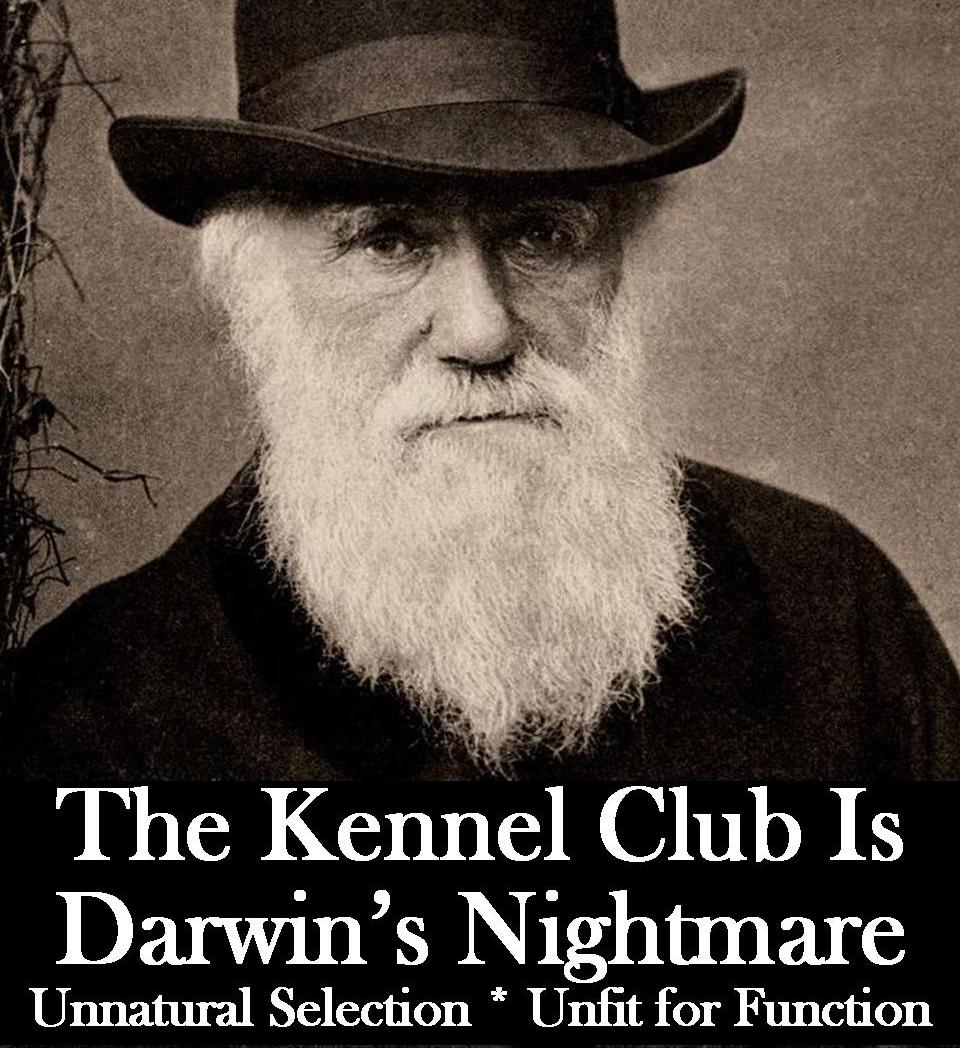
I have even produced a T-shirt noting that The Kennel Club is Darwin's Nightmare.

So imagine my pleasure to be told that a veterinarian in the U.K had produced a book about Darwin that took the Kennel Club to task for selective breeding for dysfunction. Excellent.

Best of all, the book was free. A FREE book?! Double excellent! I went to the link, and you can too.

A quick look at the PDF told me the book was by Matthew Watkinson.

The name sounded familiar, and then it rang a bell -- he had written an article in The Daily Mail a month or so back, talking about the fleecing of customers by veterinarians. There were a few problems with the article, but I blogged the part I liked, said nice things, and moved on.

This new book on Darwin was by the same person? Excellent! This should be good. I dived right in.

The first caution was the cover. The title was a clear rip-off of the title of Darwin's own seminal work.

I suppose Watkinson meant it to be a bit clever, but I found it an affront for someone to more-or-less title their own book as "Volume 2" to Darwin.

Plus, it would be a hard act to pull off. Several hundred books have been written on Darwin and The Origin of Species, many by brilliant writers and thinkers.

No matter, I thought. Let's not judge a book by its cover. Let's read the thing instead.

If the cover of the book had an odor of arrogance, the first 50 pages spoke of some confusion. I scrawled in the margin: What is this book about?

The book did not start with a thesis. It did not start with a historical account of Darwin's works, or even talk much about what Darwin said at all.

Instead, there was a proclamation by the author that unlike everyone else in the world he was going to be "objective" and not "sentimental".

In addition, there was the proclamation by the author that he hated the color "grey" -- he wanted to paint only in black and white, and he was going to eschew any subtle shading.

And finally, there was the note that no one could argue with him about anything, because if they tried they would really be arguing with Charles Darwin (and of course, who has the temerity to do that?).

Hmmmm.....

I carried on. After all, I wanted to like this book. I really did.

In the first 50 pages, there was a nice screed on how Kennel Club dog breeders have too often selected for defect.

The trouble was that the examples given seemed culled directly from the BBC's Pedigree Dogs Exposed and subsequent coverage, and seemed more like a recitation that a real examination.

Surely a trained veterinarian would be able to give other examples of selective breeding for defect -- pigeons, turkeys, chickens, and goldfish, for example?


On the upside, there was a very nice section about dairy cows, but here too I noticed that a lot was left out.

Cattlemen, after all, created the first animal registry in the world, and they were also the first to abandon it in order to outcross to preserve herd health. There was no mention of this, and it seemed a glaring omission.

On page 92 I wrote in the margin: "Was there an outline for this book?"

I wrote the same question three more times as I read to the end, and on page 225 I still wondered what the thesis was supposed to be.

All I knew for certain was that Matthew Watkinson, while sometimes an entertaining writer, did not have a very strong command of the material he sought to claim title to.

Quite simply, he did not do his homework.

The gaps in Watkinson's knowledge and theories are not small -- they are deep and wide.

Consider this: Watkinson has written an entire book on Darwin that never mentions Alfred Russell Wallace, who co-presented (with Darwin) their theory of evolution to the Linnean Society of London in July of 1858.

Watkinson also makes no mention of Darwin's writings on geology (Darwin's necessary proof of an ancient earth), the breeding experiments of Robert Bakewell, or even Erasmus Darwin (Darwin's grandfather), whose own work, Zoonomia, served as Darwin's intellectual chassis.

Watkinson barely mentions the Galapagos Islands, never talks about Darwin's correspondence with dog and pigeon fanciers, or the taxonomic discussions about finches with John Gould (for whom the magnificent Gouldian Finch is named).

In Watkinson's presentation of Darwin's work, in fact, there is no intellectual past, no intellectual development to the present, and truth be told, not much Darwin.

Hundreds of books and treatises have been written about Charles Darwin's theory of evolution, but I do not recall Watkinson quoting a single one.

While Watkinson does manage to squeeze The Descent of Man into two footnotes, he never mentions The Expression of the Emotions in Man and Animals at all, nor does he reference Darwin's other lengthy work on barnacles and worms.

What is Watkinson trying to say in this book? I have no idea.

At one point I noted in the margin that Watkinson seemed to have just discovered death, while later on I noted that he seemed to think there were no other force at work when it comes to natural selection.

At the end of my reading, I set the book aside and let it percolate in my brain for a day or two.

Slowly, an idea dawned in my head. . . . .

The book read as if it was written by a young man who had a Big Idea expand in his mind to fill every empty crack.

Could it be that Watkinson had read only one book -- The Origin of Species -- and then riffed on it for 225 pages without reading anything else or talking to anyone else?

That would be impossible, right?

In fact, believe it or not, that seems to be exactly what happened.

In an interview with a self-publishing website called "BubbleCow" Matthew Watkinson confesses that he began reading Darwin just one year ago, and he decided (in some sort of manic-expressive fever) to begin writing down everything that came into his head.

Quite sadly, this is exactly how the book reads -- as a somewhat sophomoric rant by someone who confuses wild speculation with careful research, and who thinks page numbers are the only structure needed.

Is Watkinson wrong on every page?

Absolutely not.

He is correct that many species are selected for defect by the hand of man. This is not a small point, but it is a point made by many others in the past, and Watkinson hardly treats it with the well-researched treatment that it deserves.

Watkinson is also right that species are too-often split for purely political and self-aggrandizing reasons. Here too, however, he is not saying anything new. The running battle between taxonomic splitters and lumpers is old, but Watkinson does not acknowledge that, much less quote experts or give the reader any guide on how to think straight. Instead we get a kind of stream-of-consciousness in which the chief goal seems to be mock everyone in the world who might actually know the difference between one species and the next.

In fact, this is what Watkinson spends most of his book doing -- serving as a juvenile and cynical sniper plinking at others. And to what purpose? It is not clear. In the end, one is left suspecting that it is all vanity, and with not too much to say (because he does not really have a good command of the material) he has been reduced to doing little more than tossing out one-liners. It is (at best) cleverness masquerading as thought and knowledge. At worst it is a rambling, chaotic bore with wild side trips into poor thought and ignorance.

One small problem is that Watkinson likes to toss words around, but he does not always know what they mean.

For example, he thinks a desert is as good as as a jungle. Anyone who disagrees is not being objective.

He thinks the death of a chicken is the same as the death of a whale. Anyone who disagrees is a racist.

He think the death of an individual animal is the same as the extinction of the entire species. Anyone who says otherwise does not understand Darwin.

In fact, Watkinson is simply an idiot.

Mother Nature does a lot more work in a jungle than a desert, and anyone who thinks the elimination of a species is the same as the death of an individual is laughable.

You could not get through a junior high biology class with that kind of "deep thought."

Watkinson seems to be struggling with the idea of discrimination, but he does not know enough to realize that discrimination is actually one of the driving forces behind evolution.

Why does a Bower Bird prefer one mate over another?

Why does a Lion prefer one mate over another?

Watkinson has no idea -- he does not even know enough to ask the question.


Watkinson's idea that a chicken is equal to a whale, because both are life (and who is to say one is better than another?) is patent nonsense.

A whale is at the top of a food chain. A chicken is not.

Food chain?

What's a food chain?

Right.

That's a word Matthew Watkinson does not type once in 225 pages. He doesn't talk too much about habitat either.

Mother Nature is actually quite objective about what individuals she thinks are important. She make hundreds of millions of mice, but gives them all a very short lifespan. The death of 50,000 mice then, is meaningless in the grand scheme of things. Mother Nature will "infill" that loss in a week.

Mother Nature makes very few lions, however, and gives them a much longer lifespan. The death of 50,000 lions has an enormous impact, and that impact flows downward through the food chain.

In fact, the death of 50,000 African Lions would wipe out that species in the wild, and that impact would reverberate for millenia.

The loss of 50,000 mice, however, would not reverberate for a week.


The fact that Matthew Watkinson misses such basic points speaks to his deep ignorance about wild places and wildlife. Quite simple, he does not know why big fierce creatures are rare.

Watkinson goes on to suggest that all conservation efforts are meaningless and wrong-headed.

And why?

Because, he explains with the wonder of a small child that has just discovered a one-size-fits-all theory, life on the planet cannot be wiped out.

Go on and poison the waters, chainsaw the forests, shoot all the elephants, and harpoon all the whales into extinction.

Dump toxins into the oceans and belch smog and greenhouse gases into the air. It will not matter in the slightest. After all, if earth survived the massive Chixculub meteor-impact that wiped out the dinosaurs, it can probably survive anything.

Right. . . . .

Apparently, it has not occurred to Mr. Watkinson that sending all life back into the basement of existence might not be the goal.

It might be . . . maladaptive.

Which brings me to the real (if unintended) lesson of this book ... and because Darwin himself was a lifelong lover of terriers, I will explain it in terms Darwin himself might have used.

When a small terrier enters a fox's den, the fox will try to bolt out any exit it can.

Failure to do so is "maladaptive" for the fox.

If a fox is pressed hard against a stop end, however, and it has nowhere to go, a wise terrier will stand back a few inches and bay.

Failure to do so is "maladaptive" for the terrier.

The point here is that fear and caution are adaptive mechanisms -- in a world that is "red in tooth and claw," the overly bold are quickly cold.

Nature tends to select for caution, and prune out those who, in arrogance or youthful enthusiasm, get in over their head.

In fact, it was because Darwin understood this so well that he moved so slowly when assembling The Origin of Species.

Darwin knew that while not everything he was talking about was entirely new (Darwin did not invent the idea of evolution), his presentation of the mechanical watchspring that was driving things forward would be fiercely challenged.

While he hoped his writing would eventually lead to illumination, he knew he had to prepare for the white-hot fire that was sure to precede enlightenment.

As a consequence, Darwin talked to everyone, read everything he could find, and corresponded with pigeon fanciers, dog men, chicken experts, and scientists up and down England, Europe, Asia and America for over two decades in order to back plaster his text with examples and authority.

Darwin teased through his own notes and those of others, and he walked around the sand walk at Down House mulling it all over, before going back to his desk to try to hammer it smooth and polish it bright.

Darwin was not going to rush to wreckage.

He was going to build slow, and write for the ages. He was going to organize things carefully and logically, stacking one brick on top of the other and checking it all with level and plumb.

He was not going to be "maladaptive."

Darwin stepped off the HMS Beagle in 1836, but it was not until 1859 that he was ready to roll out his master work for the public -- 23 years later.

Watkinson? I do not think it took him 23 weeks of actual writing.

The story is not over yet, however. You see, while Darwin had an inheritance and a family income which allowed him to live off his investments, Watkinson tells us that "Like a demented robot I remortgaged the house to fund a totally unnecessary search for the truth."

Right.

  • Unnecessary

  • Poorly organized

  • Weakly researched

  • Fatally flawed


In short, "maladaptive."

The ironic lesson here is that like any species, books seek to fill ecological niches.

Whether they succeed or fail has lot to do with whether they are an improvement on the old, or whether they are simply a teratogenic mess whose parts never quite get organized and fused together.

Sadly, Destiny of Species is the latter, not the former.

I had hoped it would be so much better.


* * * *

Of course, one man's opinion is never "the seal of the prophet". Since you can download your very own copy of this book and read it for free you can always do that. Time however is more precious than money, and you might want to do something different instead; actually read the original Darwin (also for free). I assure you it is much better than what Watkinson has too hastily sent up the flagpole. For those who prefer to read their Charles Darwin in hardcover, this looks to be a pretty nice edition.


..

Thursday, September 03, 2009

Idaho Fish and Game Says It Can Manage Wolves


Idaho Fish and Game says it can manage wolves, and they are probably right if the biologists are left to decide free of any influence from lunatic Idaho Governor, Butch Otter.

One of the things America has been doing right for the last 50 years is wildlife management.

One of the things America has been doing wrong for the last 20 years is listening to Black Helicopter Republicans like Butch Otter.
.

Saturday, April 18, 2009

Kiwi Killers


Stoats were first introduced to New Zealand in the 19th century to combat the rapid proliferation of rabbits, another introduced species.

Unable to control the rabbit population, the stoat (aka weasel or ermine) is nonetheless doing a bang-up job killing off young kiwi chicks.

The population of Little Spotted Kiwi (Apteryx owenii) has dropped to 1,200 birds, and the Rowi or Okarito Brown Kiwi (Apteryx rowi) is down to just 300 individuals.

Another introduced species helping push the Kiwi over the edge is the Brush-tailed Possum, introduced from Australia.

.

Friday, February 20, 2009

Tastes Like Chicken


From National Geographic:

A rare quail from the Philippines was photographed for the first time before being sold as food at a poultry market, experts say.

Found only on the island of Luzon, Worcester's buttonquail was known solely through drawings based on dated museum specimens collected several decades ago.


This is the best thing that has ever happened to this bird species.

Not only is it clearly not extinct, but it is rare bird that will now get protection and put into a captive breeding program as well.

God bless the klieg lights of publicity.

Thursday, January 22, 2009

Second Best Headline This Week


From the Helena, Montana Independent Record.

Yes, we are going to have to shoot some problem wolves to keep things under control in some areas, but NO, we are not going back to wholesale extermination of the wolf, thank you very much.

The best headline of the week, of course, was this one (take your pick) First things first.

.

Tuesday, September 16, 2008

Grizzlies Are Coming Back!


Forbes Magazine lets us know that Grizzlies are coming back, even as they remind us (however gently) that John McCain is an idiot:


WASHINGTON - The majestic grizzly bear, once king of the Western wilderness but threatened with extinction for a third of a century, has roared back in Montana. The finding, from a $4.8 million, five-year study of grizzly bear DNA described by Republican presidential candidate John McCain as pork barrel spending, could help ease restrictions on oil and gas drilling, logging and other development.

Researchers with the U.S. Geological Survey announced Tuesday that there are approximately 765 bears in northwestern Montana. That's the largest population of grizzly bears documented there in more than 30 years, and a sign that the species could be at long last recovering.

The first-ever scientific census shattered earlier estimates that said there were at least 250-350 bears roaming an eight-million-acre area stretching from north of Missoula to the Canadian border. More recent data placed the minimum population at around 563 bears.


Back in Jan. of 2001, I ghosted a piece that appeared in Endangered Species Update (published by the University of Michigan School of Natural Resources) in which I noted that the roadless areas of Idaho remained perfect areas for Grizzly and that protecting areas like the Clearwater and Nolo National Forests were vital to ensuring that the Grizzly expand its territory and numbers in the United States.

Now I wonder if it is too crazy to dream that one day there might be Grizzlies in California ... and not just on the state flag.

The last confirmed California Grizzy was dead shot in Fresno County back in 1922.
.