Showing posts with label trees. Show all posts

Saturday, August 25, 2018

The American Enclosure Movement


Female bluebird on barbed wire.


The Enclosure Movement in the U.K. had a profound impact on the land, farms, and people in that country, and set the stage not only for the mounted fox hunts, but also for the social strife that surrounds fox hunting in Great Britain to this day.

For a pictorial history of terriers and their relationship to the Encloser Movement, click here.

The U.S. also had an Enclosure Movement, which was no less dramatic.

Land enclosure in the eastern U.S. was accomplished with split rail fences and stone walls, but when settlers reached the vast open plains of the American west, there were no trees or field stones for fencing. The result was free range cattle and sheep.

The situation was hardly ideal. Cattle were easily rustled or lost, and many fell prey to wolves and cougars. Sheep were "meals on heals" for coyotes and were easily lost as well.

Another problem was that open grazing meant open competition between sheep and cattle, with sheep cutting the grass down too far for the cattle to forage (the U.S. had huge sheep spreads in the second half of the 19th Century).

Finally, there was the problem of what to do about tick fever. Cattle in the far south west, below Oklahoma, were immune to tick fever, but the northern herds were not, and the practice of driving livestock north to Kansas City, Montana and Wyoming brought the scourge of disease into once-clean herds.

Two things changed it all: the rapid demise of the American Buffalo, and the rapid rise of barbed wire.

The buffalo were shot out over an incredibly short period of time, with railroads bringing in marksmen to shoot and skin anything that moved. Vast mountains of skinned flesh and bones were left for feral Indian dogs to consume.

In fact, most of the "wolves" of the Plains were not wolves at all, but feral Indian dogs (they looked just like wolves, but with curved tails) abandoned by a people now being rapidly decimated by war and disease.

With the demise of the buffalo, came the importation of its smaller cousin, the beef cow.

With the cow came the cowboy, many of them ex-Civil War soldiers moving West for opportunity and fortune. This was the brief tenure of the "Wild Wild West," and the thing that brought it to a dragging halt was the rise of barbed wire.

In 1873, Joseph Glidden the 60-year old sheriff of DeKalb, Illinois, attended a county fair where he saw a demonstration of a wooden rail with sharp nails protruding from it hanging inside a smooth wire fence. The design was supposed to keep cattle and horses inside a small perimeter fence, and perhaps help keep dogs and other predatory creatures out.


Joseph Glidden, mutton chops and all.


Glidden was inspired by the board-and-nail device and the potential for cheap and movable fencing. He began to experimented with the idea, and eventually came up with the idea of using a jerry-rigged coffee bean grinder to make spiral points of wire which were then strung at intervals along a smooth wire, with another wire twisting around the first to hold the barbs in a fixed position.

Barbed wire was born.

Glidden applied for a patent, and it was granted, though the patent was later contested. The legal battle that ensued lasted three years, and went all the way to the Supreme Court. Before the smoke cleared, however, there were over 570 patented forms of barbed wire!

From the perspective of many small land owners in the West, barbed wire was a wonderful invention: it was relatively inexpensive, would not rot, was practically unaffected by grass fire, was strong and long-lasting, and was easily erected.

In very short order, thousands of miles of barbed wire fencing were strung -- so much that fence posts were a major export from both the East and West coasts.

Between 1875 and 1885, the national consumption of barbed wire jumped from 300 tons to 130,000 tons.

The arrival of barbed wire in the American West was of immense historical importance, for it ended the era of the Great American Commons of "free grazing". Now people could own land and keep others off it. Equally important, they could control access to water, and keep livestock out of crops, such as wheat and corn.

Barbed wire also meant that sheep and cattlemen could now improve the quality of their herds by stringing barbed wire to keep inferior bulls from mating with their cows.

Fencing disputes pitted cattlemen against farmers and sheep men, and free-grass cattle ranchers against fenced-range cattle raisers.

These conflicts became fierce during times of drought when access to water and grass (green or not) meant the difference between bankruptcy and fortune.

Cattlemen used to driving herds across vast distances to known water and feed pastures would simply cut fences when they found them, and in some areas open warfare broke out.

In the end, of course, common grazing died across most of the American West, just as it had in Great Britain beginning 100 years earlier.

But barbed wire did not stay in the West -- it became a global product stretched around farms, ranches, buildings, prisons, and borders the world over.

In the Eastern United States, where hedge rows are not layed, as they are in Great Britain, barbed wire proved as useful as it was in the West.

Hedges in the Eastern U.S. are little more than strips of uncut forest and secondary growth, often dominated by rapidly-growing weedy trees, such as black cherry, black locust, and black walnut. These trees shade thin tangles of poke berry and wild grape, multiflora rose, kudzu, and honeysuckle. The result is not substantial enough to keep livestock out of crops.

Prior to barbed wired, farmers had to construct stone walls or erect split rail or plank fencing. These kinds of fencing are expensive and enormously labor- and material-intensive, and they also require a lot of maintenance.

With the invention of barbed wire, however, a farmer could simply stretch wire from tree to tree or post to post. The savings, in time and money, was enormous. Maintenance was virtually eliminated, as galvanized wire does not rust, rot, burn, need paint, or fall apart from frost heaving.

The ease of fence construction after the invention of barbed wire meant that new fences lines were easily created. Large farms that had once been open fields were now cut and carved with posts and barbed wire. Along these fence lines weedy strips soon took hold. Over time, many of these weedy strips have been colonized by small trees, bushes and vines, and in many instances full hedgerows have developed, almost always attended by population of groundhogs, fox, raccoon and possum.

Truly, barbed wire is the "Devils' Rope," and yet it is also part of the story of working terriers in America, for barbed wire has created and protected much of the hedgerow habitat where so much of our quarry dens.

If you work terriers in the Eastern United States, you will eventually find your yourself crawling over and under barbed wire. The dogs themselves may occasionally get ripped running over it, and most folks eventually lose the bottom out of one seat of pants or another.

In the end, however, there is very little doubt that without barbed wire we would not have the quality of terrier work we have today.

And so next time we are in a jungle of thick hedge and the dog has just slipped into a hole under a jumble of broken down barbed wire fencing, let us remember that the fence is more than an obstruction -- it is construction that is vital to the habitat we hunt. Barbed wire is our friend.
      :: This is a repost from 2004.
.

Tuesday, November 24, 2015

Coffee, Birds & the World Bank


American Redstart


It is pathetic, but true, that there are 391 Starbuck's coffee houses within an hour's drive from my house (50 miles). Amazingly, all of them seem to have a line of customers at all hours of the day. Could Americans be any more addicted to $4 coffees?

I told you it was pathetic, and as soon as they serve me my coffee, I promise you I'm going to leave.

As I wait for my coffee, I read the paper. Paul Wolfowitz, the current head of the World Bank and one of the architects of the war in Iraq, looks like he may lose his job for promoting his girlfriend to a World Bank job that pays better than Condoleeza Rice's.

The shocking part is not that there are scoundrels in Washington, or waste and corruption at the World Bank, but that Paul Wolfowitz has a girlfriend. Of course he had to pay her, but it's still amazing. Apparently, the human soul knows no limits to depravity.

Coffee and the World Bank.

There is a connection there, and I recall the linkage as I watch the pigeons rearrange themselves on the telephone wire in front of the Safeway food store across the street.

Legend has it that the coffee plant was first discovered in Ethiopia by a goat herder who found his charges a little too animated after eating beans from a local bush. The coffee plant (and the drink) eventually made its way to Yemen and the Arab world via the Sudanese slaves that were forced to paddle boats across the Red Sea to the Arabian Peninsula.

With alcohol banned, coffee quickly became the "drug of choice" in the Arab world. While an alcohol-besotted Europe struggled in a drunken haze through the Dark Ages, the Arab world became caffeinated and invigorated. Soon after they started the first coffee houses in the world, Arabs began creating grand libraries, universities, new mathematical equations, and amazingly complex architectural designs. Such is the power of coffee.

Coffee houses hit Europe around 1600, and there they had the same effect they had in the Arab world -- a spectacular growth in intellectual clarity and output. From the enlightened coffee houses of London grew the first newspaper divisions (business, style, overseas news, etc.), the first organized scientific associations, and Lloyds of London -- the first international insurance cartel.

Coffee consumption took off like a rocket in Great Britain, and in 1796, when the British took over Sri Lanka (Ceylon) from the Dutch, the new settlers began clearing land for coffee plantations.

By the 1860s, Sri Lanka was the largest coffee producer in the world.

In 1869, however, a lethal fungus known as coffee rust had shown up on the island causing premature defoliation of the coffee plants, and dramatically reducing berry yield.

By 1879, the rust fungus had spread across the island and into Indian plantations as well, with the result being a collapse of coffee production across the region.

Unable to grow coffee in the face of a devastating rust fungus epidemic, Ceylonese and Indian plantation owners began to rip out their coffee plants in order to grow tea.

Within a few decades, tea consumption in the U.K. had surpassed coffee consumption, and it has remained so to this day.

While tea is the national drink of Great Britain, coffee remains the national drink of the United States, where we consume vast quantities of it. In fact, though coffee is the second most internationally traded commodity in the world (after oil), the U.S. consumes one-quarter of the world's coffee beans.

Coffee came to the New World via the French, who introduced it into the Caribbean in the mid 1700s, and the Spanish, who brought coffee plants to Latin America a few decades later.

By the mid 1800s, coffee plantations had been planted in Central and South America, and these coffee plantations were greatly expanded after coffee rust decimated production in Sri Lanka and India.

Coffee plantations in Central and South America were diverse operations that grew, rather naturally, out of the multi-storied small-patch gardening operations that had been successfully employed by the native Indians for several thousand years before Columbus.

These small patch gardens were created by removing large trees with little agricultural value, but leaving those that might yield a nut harvest, good wood, seasonal fruits, or which had the lucky property of fixing nitrogen in the soil.

Under these large forest tree were planted shorter citrus and cacao trees, and between these were planted bananas. Underneath and between the bananas were planted coffee bushes and vegetable crops for local food consumption.

Multi-storied "shade coffee" plantations were miracles of production. When coffee prices fell (as they often did), other crops provided sustenance and cash, ensuring that the locals could always eat and pay for things made elsewhere.

Because multiple types of plants were found on shade-grown coffee plots, multiple types of insects and birds were present. The result was not only less overall insect predation on any one crop, but less erosion and slower evaporation as both rain and sunlight filtered through multiple vegetative layers.

Shade-grown coffee plantations were particularly rich in bird life -- especially neo-tropical migrant song birds such as redstarts, Tenessee warblers, Baltimore Orioles, yellow-throated and solitary vireos, wood thrushes, catbirds, ruby-throated hummingbirds, Nashville Warblers, and oven-birds.

All told, more than 150 bird species are known to winter or live year-round in shade coffee plantations, making them the most bird-intensive agricultural areas in the world.

Shade coffee production thrived.  

But something wicked this way drifted. The coffee rust fungus that had been seen in Sri Lanka 100 years earlier, was discovered in Brazil and Nicaragua. This discovery caused a panic, not only in the coffee industry, but also among the economic and political elite that run such major banking and development policy shops as the World Bank, the International Monetary Fund, and the U.S. Agency for International Development.

The fear was that coffee rust would soon sweep through Central and South America. If that happened, not only would the coffee crop be destroyed, but so too would the economic base of entire countries and many millions of people. If that happened, not only would we not have coffee in New York, Paris and Vienna, but billions of dollars of foreign loans would go unpaid.

Something had to be done.

What was done was massive, mechanical, and swift. Under orders from the World Bank, the International Monetary Fund, the U.S. Agency for International Development, and the large cartels that control much of the world's coffee market, coffee plantations in Central and South America were systematically ripped from the ground and replanted.

The idea here was a simple one: by growing coffee in direct sun, rather than in the shade, coffee plants could be made safe from the coffee rust fungus. The prescription for salvation was destruction, and entire mountain sides were plowed clear of their multistory canopies and the detritus burned. In their place was planted dense hedgerows of a dwarf variety of coffee that could withstand direct tropical sunlight.

With the loss of a diversified shade forest cover, bird populations that had once thrived in the rich overstory of coffee plantations plummeted. At the same time, with the absence of trees to provide vegetative nutrients to the soil and hold back erosion, the fertilizer needs of coffee plantations skyrocketed. Mono-cropped sun coffee plantations proved far more susceptible to insect infestations than shade plantations, so insecticide inputs also increased. The open sunny soil between coffee plants proved susceptible to weed infestations, so herbicide use also increased. Finally, though the new coffee plants produced a great number of beans, the plants themselves were not as hardy as the old shade-grown varieties, and an additional expense had to be factored into the equation -- the cost of periodically replanting large numbers of exhausted plants.

Ironically, all of the devastation and destruction was not needed. It turns out that due to the peculiarities of Latin America's climate and the timing of rain, humidity and mountain temperature, coffee leaf rust has not been able to proliferate in either Central or South America.

Adding insult to injury, it turns out that the new dwarf varieties of sun-grown coffee are not less susceptible to coffee leaf rust than the older varieties. When a fungus outbreak does occur, as it sometimes does, it is generally localized and easily treatable with a copper-based fungicide.

Sadly, however, the damage to the once-vibrant shade coffee plantations cannot be rapidly undone. Forests that took decades to grow were razed to the ground in hours, and will now take decades to grow back.

The good news is that some people are re-thinking coffee production in Central and South America, and in time shade-grown coffee may yet make a partial come back.

If so, the folks spearheading the charge will be the aging hippies and eco-freaks that once wore tie-dyed T-shirts and earthshoes. Now older, these folks frequent businesses like Starbucks and Ben & Jerry's Ice Cream, edit newspapers and magazines, start movements, run foundations, and are otherwise a social force to be reckoned with.

For this set, buying coffee has become a political act. From their perspective, if you are not buying shade-grown, organic, free trade coffee, then you are simply giving the "big wink" to American song bird destruction and the poisoning of the soil, people and economies of Latin America.

They have a point, and it's such a good and strong point that companies like Starbucks are working to change their business practices as a consequence.

Working with Conservation International, Starbucks has created a set of Coffee and Farmer Equity practices (CAFE for short ) to guide the growing and purchase of coffee.

This year, Starbucks is supposed to purchase 60 percent of its coffee from suppliers who successfully implement the CAFE guidelines.

The end of this story is not yet written, but it may yet be good news, albeit good news that remains at least 10 or 15 years off due to slow nature of the turn around, and the slow regrowth of shade coffee plantations.

That said, if consumers continue to demand and purchase shade grown coffee grown in Mexico and Central America, we may yet see a turn around in neotropical songbird decline in the United States.

If so, that would certainly make a $4 coffee worth the price.
.

                                                 This is a repost from 2007. .

Monday, October 19, 2015

Monarchs & Mexico

A repost from this blog, 2009.

"I understand more and more how population is the problem. I was asking almost every peasant I met how many children they have. They say 'I have eight, 12, 15, nine.' These people are in their 50s. I ask how many children their children have. They say, 'Oh, senor, there are so many that we can't count them.' And most of them are getting their living from the forest. They want to get permits to log in the forest."
- Homero Aridjis, Mexico's foremost authority on Monarch butterflies

The Monarch butterfly migration, from Canada to Mexico, is now in full swing.

This butterfly migration predates human existence in the western hemisphere. For thousands of years, millions of Monarch butterflies from the United States and Canada east of the Rocky Mountains have flow up to 3,000 miles to overwinter in a small forest area in central Mexico.

Now, however, the Monarch is seriously threatened. The reason: rapid deforestation of Mexico's high-altitude Oyamel fir stands which provide the rare micro-climate necessary to prevent the butterflies from freezing, but keeps them cold enough so that their reproductive systems remain dormant until spring.

The Mexican forest wintering ground of the Monarch was not discovered by scientists until 1975.

By the mid-1980s, scientists realized that rapid deforestation in the Oyamel fir forest was not sustainable, and could drive the Eastern Monarch butterfly to extinction. At that time, the Mexican government created a monarch reserve of approximately 62 square miles that consisted of no-logging zones at five known overwintering sites.

But local residents have largely ignored the restrictions, saying they are too poor to care about the monarch butterfly -- the trees must fall to put food on the table for hungry mouths.

"Maybe it wouldn't be such a bad thing if the butterflies didn't come back. At least we could log," said one campesino.

Ultimately, humans and butterflies are competing for the same forest resources. Unless population growth is stemmed, and alternative economic opportunities are developed, the fate of the Monarch may be sealed.

Aerial photographs of Mexico's forest region where the butterflies hibernate show that that 30 years ago the forest was nearly 2,000 square miles.

Today, only a tenth of it remains. The largest tract today is 20 square miles, five times smaller than the largest tract 30 years ago.


.

Tuesday, June 05, 2012

Red Fox as Weapons of Mouse Destruction


If you use the slightest bit of common sense, the chance of getting rabies from a raccoon, fox, possum, skunk or groundhog is very low, even if you work your terriers to such quarry year-round.

The chance of getting Lyme disease is a little bit higher, but it too is a very rare problem -- far rarer than most people think.

Lyme disease was first identified in Old Lyme, Connecticut in the 1970s. This zoonotic disease is passed to humans by blacklegged deer ticks which are infected with the spiral-shaped Borrelia burgdorferi microbe.

The illness was probably around a long time before being discovered, but prior to the 1970's it was rare enough that no one bothered to name the illness, much less study it.

Then, beginning in the early 1970s, the deer population in the Middle Atlantic and Northeastern United States began to grow rapidly. At the same time, more and more people began moving into the country, generally onto small farms located next to small woods.

Small woods in the Eastern U.S. are often dominated by young oak trees, and these same small woods serve as daytime shelter for fairly dense deer populations of 50-200 animals per square mile (as compared to 25 per square mile in pre-Columbian times).

Very dense deer populations are possible in the eastern U.S. because the deer are able to feed at night in nearby hay, corn and soy fields.

The proximity of houses to shelter-belt forests means deer jungled up in these woods are safe from hunters who cannot legally fire weapons in such close proximity to occupied buildings.

Most people assume deer are the primary reservoir for Lyme disease, but scientists now believe the primary reservoir for is not deer, but something quite a bit smaller -- the whitefooted mouse.

Ticks are not born with Lyme disease. The Borrelia microbe is not passed from female tick to egg, but from Borrelia-infected mammal host to blacklegged deer tick, and from the tick to humans as part of the multiple-host lifestyle of all ticks (for more on that, see >> here).

Almost all whitefooted deer mice have Borrelia coursing through their veins. In addition, almost every tick that bites a whitefooted mouse ends up carrying Borreleia. For reasons not yet understood, other Borrelia-infected animals do not pass Borrelia on quite so easily. While possums, raccoons, fox, coyotes and most birds can carry Borrelia, and often host deer ticks as well, the ticks that feed on these animals become infected with Borrelia only 10% of the time as compared with a 90% infection rate for whitefooted mice.

Clearly, a key component to controlling Lyme disease is reducing the number of whitefooted mice in an area.

Mice populations, it turns out, tend to explode with acorn production which tends to be cyclical. In high-mast years when the ground is littered with vast numbers of acorns, the whitefooted mouse population in small oak woods will explode, and with it the incidence of Lyme disease in an area. Deer coming into these woods pick up the ticks and ensure their dispersal while supplying the tick with a large blood meal (absent a human host).

Obviously, ending acorn production in the Eastern woods is not in the cards. So what else can be done?

One thing that seems to reduce mice populations is to increase the degree of ecological diversity in an area. As the variety of plant sources increase, the popualtions of meso-predators such as possums, raccoons, fox and coyote tends to increase, and with it a decline in mice populations.

Predators, such as fox, are impotant to keeping whitefooted mice populations -- and to some extent Lyme disease -- in check. Fox are highly mobile predators that continuously suppress mice populations all year long. In the absence of mice, fox easily switch to berries, crickets and grasshoppers, young rabbits, voles, and even roadkill and garbage. When mice populations do rise, however, a few red fox can go a long way towards knocking their numbers back down again.

How many mice can a fox eat in a year? If it eats little else, a fox can knock off about 5,000 mice a year. That's not enought to eliminate Lyme disease in an area, but it can have a significant impact, and every little bit helps.

What else can be done? In many areas more deer culling needs to be done, especially of does. With a reduction in deer densities, forest understory has a chance of growing back in, and with it will come an increase in bird populations and other non-mouse fauna.

Such simple precautions such as spraying your pants with bug spray before going out walking in forest and field can help reduce the chance of tick-borne infection quite a lot, as can mowing walking paths short. Move brush piles and firewood stacks away from the house as they are havens for mice populations. After returning from a day in the field, check yourself over for ticks, paying especially close attention to areas you do not normally look at, such as the back of your legs and your back and neck.

If you find a tick, do not worry -- a tick has to feast on you for three days or so before it is able to transmit Borrelia. If a tick bite, or a bite from an unknown bug, develops a large red ring around it, see a doctor immediatly or (if you have doxycline in your vet kit) take a 3-day regime of doxycline. Lyme disease generally very easy to treat in its early stages with a simple one or two-week regime of antibiotics.

And, of course, practice agressive flea- and tick-prevention on your dogs. I hunt most weekends and generally wash the dogs with a low-cost flea shampoo after they return. A few days later I look them over pretty carefully to see if they have any ticks on them that I might have missed while washing them (it helps to have smooth coated dogs!). Other folks use Frontline. Whatever works for you is fine.

The most important element of flea and tick control is vigilance -- paying close attention, on a daily basis, to your dogs. Simply running a hand over their coats once a day will tell you a lot, and not just about ticks, but about weight gain and muscle tone as well.

The Red Fox: the ultimate weapon of mouse destruction.
.

Thursday, December 29, 2011

Signs of Mammoth in Central Park


This is pretty good little lecture about nature, seen and unseen, in Central Park. 

The bit about the Kentucky Coffeetree is reminiscent of my 2006 post, The Mammoth in the Hedge.
.

Friday, December 23, 2011

The Missing Birds of Rock Creek Park


OvenBird
This was written in 2003 for a major environmental organization.

The decline of neotropical migrant song birds in the U.S. was first noticed by birders in Washington, D.C.'s Rock Creek Park, a small federally-protected enclave nestled along a stream bed in Washington, D.C., just 15 miles from Fairfax County.

Breeding Bird Surveys from 1947 through the 1970s, revealed that the yellow-billed cuckoo and yellow-throated vireo -- as well as the northern parula, black-and-white warbler, Kentucky warbler, and hooded warbler -- were disappearing. Six other migrant song birds -- Eastern wood-pewees, Acadian flycatchers, wood thrushes, red-eyed vireos, ovenbirds, and scarlet tanagers -- had declined by more than 50 percent.

What was going on?


Evidence from Overseas

Domestic forest destruction was ruled out, as Rock Creek Park had suffered no substantial encroachment in decades.

An analysis of radar images, done in the early 1980s, however, showed only half as many birds were flying to the U.S. from Mexico's Yucatan as had been migrating just 20 years earlier. Clearly, some part of what was happening to "our" birds was happening overseas. Experts theorized that much of the song bird decline, now being documented across the U.S., was due to forest destruction in Central and South America.

In fact, forest destruction in Central America was proceeding at a very rapid pace, driven in no small part by truly sobering rates of human population growth. In the Peten region of Guatemala, for example, 77% of the original forest cover still existed as recently as 1977. By 1980, however, that number had fallen to 42% and by 1989 just 29 percent of the original forest cover was gone. Scientists now believe as little as 10% of the forest may be left by 2025.


Evidence from the U.S.

By the late 1990s, however, scientists began to realize that forest destruction in Central and South America did not tell all of the story. Analysis of migrant song bird populations at the national level showed that birds loss was not evenly distributed across the U.S.

While most migrant song birds are experiencing clear negative trends east of the Mississippi River, and along the thin coastal strip of the West Coast, neotropical migrants seem to be doing fairly well on large tracts of forested land in the West.

An overlay of neotropical migrant song bird decline and a map of federally protected lands, showed a fascinating pattern: migrant song birds were not in general decline in our national parks, our national forests, or on lands managed by the U.S. Department of Interior's Bureau of Land Management. Migrant song birds were in general decline in the east and in the Midwest, however, where changing agricultural practices and increasing levels of forest fragmentation seemed to be having a real impact.

Scientists looking for clues to song bird loss in Rock Creek Park began to look at the forested areas immediately surrounding the suburbs of Washington, DC, and what they found was pretty startling. Between 1980 and 1995, Fairfax County saw 69 percent of its forests converted to homes and businesses.

While scientists had been puzzling over bird loss in Rock Creek Park, just 15 miles away, Fairfax County's forests had been vanishing under asphalt at an astonishing rate.

Scientists now recognize that these once-vibrant suburban forests were probably the principal "home" of many of the birds that had once been seen in Rock Creek Park. Rock Creek had merely served as way-station between larger forest blocks that once ringed the Washington, DC area.

As new roads and light rail systems continue to be built in the suburbs of Virginia and Maryland, more and more forests are falling to farms and more and more farms are falling to freeways and subdivisions.

Once large blocks of unbroken forest are being shattered into increasingly smaller fragments, allowing such meso-predators as crows, jays, raccoons, possums, feral cats and fox to prey on once-secure migrant song bird nests. In addition, increasingly fragmented forests have enabled the brown-headed cow bird to colonize areas they once would have found unattractive.

Cowbirds nest at the edge of forests and feed in farms fields and pastures. Though native to North America, the brown-headed cowbird was once confined to the forest edges of Midwestern prairies where they fed in grasslands grazed by roaming bison. Today, however, because of widespread forest fragmentation, parasitic cowbirds can be found all across the United States.

The brown-headed cowbird is a parasitic nester, which is to say it builds no nests of its own, but instead lays its eggs in the nests of other birds -- most frequently in the open, cup-shaped nests of neotropical migrants. A single cowbird may lay as many as 80 eggs in a breeding season - one or two eggs per songbird nest. Because cowbird chicks hatch earlier, and are much larger than the offspring of migrant songbirds, they are able to out compete songbird chicks for food, and often simply push them out of the nest altogether.

In the end, a single cowbird may prevent 20 to 30 warblers, finches and vireos from raising their young. If the bird species has a short nesting period, it may not be able to hatch out a second brood that year, in which case that species may fall off rapidly in that area over a relatively short period of time.


Yellow-throated Vireo


More Trouble Ahead?


While a great deal of population-driven environmental damage has already occurred in the suburbs of Virginia, more population growth lies ahead. Fairfax County's population continues to grow rapidly, most of it driven by a combination of internal domestic migration (military and government families coming to support a burgeoning government and high-tech corridor) and international migration.

Fairfax County may be a demographic "canary in a coal mine" signaling where the rest of America may be headed in terms of land use patterns and population growth. With U.S. population growing by more than 3 million people a year, and suburban sprawl gobbling up more than 500,000 acres of forest and farmland every year, the pace of habitat fragmentation is likely to increase rapidly in the years ahead.

Under the Census Bureau's middle-series projection, which assumes that current U.S. immigration and fertility levels will stay about the same, the population of the U.S. will increase by 120 million people over the course of the next 50 years. About 63 percent of this future population growth will be due to immigrants and the children of immigrants that have not yet arrived in the U.S. -- the remaining 37 percent of population growth will be driven by demographic momentum as current U.S. residents move to complete their families.

One hundred and twenty million people is a very large population to add to the U.S. over the course of the next 50 years. To put this number into perspective, this is a population equal to the current populations of California, Oregon, Washington, Idaho, Colorado, Montana, Arizona, Nevada, New Mexico, Texas, Wyoming, Utah, North Dakota, South Dakota, Nebraska, Kansas, Oklahoma, Minnesota, Wisconsin, Iowa, Missouri, Arkansas, and Louisiana combined.

In addition to sprawl directly driven by population growth, the U.S. can expect to see increased forest fragmentation due to more and more folks moving farther and farther out into the countryside, abetted by high-speed internet hookups, satellite television, and light rail systems feeding into an ever-expanding network of four, six and eight lane highways.

As Canadian real estate agent Ozzie Jurock noted in an article for The Vancouver Sun (June 30, 2001),

"People throughout North America are on the move. Population growth in smaller towns is exploding. Californians move to Oregon and Arizona, New Yorkers joke at the rain but moved to Washington. The ski resorts and lakes are teeming with 'former' city slickers clutching cash and the hope for the elusive 'better quality of life."


Even as population growth continues apace in the U.S., the population of Central America continues to grow. Over the course of the next 50 years, Central America and Mexico combined are expected to add 90 million people to their populations -- a 65% percent increase in population.


Why the Fairfax Bird Loss Story is Important


Bird population data are such a robust metric of general environmental health that in the United Kingdom they are used as an official indicator of environmental sustainability.

A broad decline in many wild bird populations in the Western Hemisphere may be an indication that a broad decline in environmental quality is occurring across much of the region.

In the case of neotropical song birds, population-driven habitat decline along the entire migration flyway -- including the United States -- has had a serious impact on U.S. song bird numbers. The decline of songbird species in the U.S. is a powerful reminder that population pressures beyond our borders really do "come home to roost" and that reducing the rates of population growth at home, and abroad, is a real and serious "back yard" environmental issue.

Ironically, even as many bird populations are in decline, the number of Americans interested in birds is on the rise. The National Survey on Recreation and the Environment found that over 71 million Americans are recreational birders, up 250 percent from 1982, making birding the fastest-growing outdoor activity in the U.S.


Black and White Warbler
.

Wednesday, November 24, 2010

Let Us Give Thanks for Wild Turkey and Uncle Sam


Wild Turkey Feathers. This is a repost from Nov. 2008

Let us give thanks to the Wild Turkey, America's largest ground-nesting bird.

Back when my grandfather was born, the Wild Turkey was teetering on the edge of extinction. Today we have more Wild Turkeys in America's woods than existed in pre-Columbian times.

How is that possible?

Good question. But before we get there, let's dwell a little bit longer on the miracle.

You see, it generally requires a lot of forest -- 2,000 acres or more -- to maintain the kind of food crop and cover that Wild Turkey need to thrive.

The reason for this is that in the dead of winter, Wild Turkey depend on acorns and other nuts and seed for survival. This food is only produced in abundance by mature hardwood trees -- oak, beech, dogwood, cherry and gum.

So what's the big deal? We have a lot of forest in America.

True enough now, but not as true a century ago in the Eastern U.S. and much of the Midwest. Back around 1900, virtually all the big stands of large trees had been logged out in the Eastern U.S. and across much of the Midwest as well. As the trees vanished, Wild Turkey populations plummeted.

Wild Turkey populations were further pushed to oblivion by rapid improvements in gun accuracy, and weak game laws that had yet to catch up to the changing dynamics of landscape and technology.

By 1910, there were fewer than 30,000 Wild Turkeys left in America.

Then, an amazing turnaround occurred. That turnaround started with passage of the Lacey Act in 1900. The Lacey Act ended commercial hunting of wild animals.

Commercial hunting is not sport or recreational hunting -- it is the opposite of that. In commercial hunting, the goal is not having a fun day in the field to fill your own freezer with wild meat, but a full year in the field to fill the freezers of 10,000 people whose primary concern is the price per pound.

To put it simply, commercial hunting is to sport hunting what gill-netting is to fly fishing. One comes with a factory ship attached; the other a simple wicker creel.

No single action has done more to improve the status of American wildlife than passage of the Lacey Act. Prior to its passage, commercial hunters bled the land white, shooting everything that moved. Wild game merchants sold pigeons for a penny apiece, and ducks for only a little more.

Hunters, using cannons loaded with shrapnel, would shoot 400 ducks in a day in Maryland's Eastern Shore marshes, while market deer hunters would set up bait stations near roads and shoot 20 deer in a night.

The Lacey Act helped put an end to this kind of unrestricted slaughter of American wildlife, but it did nothing to restore badly degraded habitat.

Wildlife without habitat is a zoo.

Habitat without wildlife is scenery.

America -- still a young nation -- remembered when it had both, and it wanted it all back.

The second steps on the road to wildlife recovery occurred between 1905 and 1911. It was during this period that Theodore Roosevelt set aside 42 million acres as National Forest and created an additional 53 National Wildlife Refuges as well.

It was also during this period that Congress passed the Weeks Act authorizing the U.S. government to buy up millions of acres of mountain land in the East that had been chopped clean of its forest in order to obtain wood for railroad ties, paper, firewood and timber.

With the Depression of the 1930s, and rapid migration of millions of people from the rural countryside to the city, more and more marginal farmland began to revert back to woody plots.

Spontaneous forest regeneration in Appalachia, along with tree-planting by the U.S. Government-funded Civilian Conservation Corps, helped restore more than 6 million acres of hardwood forests on denuded land purchased under the Weeks Act.

In 1937, the Wildlife Restoration Act (aka, the Pittman-Robertson Act) initiated a new tax on rifles, shotguns and ammunition, with this dedicated revenue going to help fund wildlife conservation.

Pittman-Robertson Act funds were used to purchase millions of acres of public hunting lands and to fund wildlife reintroduction efforts for Whitetail Deer, Canada Geese, Elk, Beaver, Wood Duck, Black Bear, and Wild Turkey.

In the case of Wild Turkey, initial restocking efforts were not successful. Turkey eggs were collected from wild birds, and the poults that were hatched were released into the wild. Unfortunately, these pen-raised birds were quickly decimated by predation and starvation.

New tactics were tried. A few adult Wild Turkeys were caught in wooden box traps intended for deer (picture of deer trap at right). These Wild Turkey were then moved to suitable habitat, but these adults birds also perished under the onslaught of predation.

The reintroduction of Wild Turkeys was beginning to look hopeless.

After World War II, game managers began to experiment again. This time, cannon nets -- large nets propelled by black powder rocket charges -- were used. These nets enveloped entire turkey flocks at once.

Moving an entire flock of Wild Turkeys seemed to work. The first few flocks that were relocated out of the Ozarks (the last stronghold of the Wild Turkey) began to thrive, in part because regrown forest provided more food stock for the birds to live on. The millions of acres of mountain land purchased in 1911 under the Weeks Act had, by now, become large stands of maturing hardwoods in the National Forest system.


Turkeys caught in a cannon net.

Systematic restocking of Wild Turkey continued through the 1950s and 60s, and by 1973, when the National Wild Turkey Federation was formed, the population of wild birds in the U.S. had climbed to 1.3 million.

With the creation of the National Wild Turkey Federation, more sportsmen and private land owners were recruited for habitat protection and Wild Turkey reintroduction.

Today, the range of the American Wild Turkey is more extensive than ever, and the total Wild Turkey population has climbed to 5.5 million birds.

Wild turkey hunting is now a billion-dollar-a-year industry, with 2.6 million hunters harvesting about 700,000 birds a year.

And so, when we are giving Thanksgiving this Thursday, let us remember not only the Wild Turkey and America's hunting heritage, but also such "big government" programs as the Weeks Act, the Endangered Species Act, the Pittman-Robertson Act, the National Forest Service, the U.S. Fish and Wildlife Service, and the Clean Water Act.

Without Uncle Sam -- and your tax dollars -- much of America's wildlife would now be gone.

It was Uncle Sam -- and Mother Nature's natural fecundity -- that brought back the Wild Turkey, the Beaver, the Elk, the Whitetail Deer, the Black Bear, and the Bald Eagle. Ted Nugent and the National Rifle Association were nowhere to be seen, and neither were Bass Pro Shops or salesmen pushing Yamaha ATVs.

So next time you are in forest or field, remember Uncle Sam, and thank God for Mother Nature. Whether you know it or not, your hunting and fishing has always depended on both of them.


..
.

Monday, November 02, 2009

The Forest Ozymandias


Recycled from August 2006

Scouting new land on Sunday, Sailor and I came across an old stone farmhouse falling over in ruin. The stones were large and no doubt levered into place without benefit of a crane. Building a stone house is a lot of work.

The farmer, mason or stone cutter putting this house together had thought he was building a house for the ages, but now it was already covered over in forest and drifting leaves, a folly for a small dog and an odd man on a hot day.

I could not help but think of the poem "Ozymandias" by Percy Bysshe Shelley:


Ozymandias

I met a traveller from an antique land
Who said:—Two vast and trunkless legs of stone
Stand in the desert. Near them on the sand,
Half sunk, a shatter'd visage lies, whose frown
And wrinkled lip and sneer of cold command
Tell that its sculptor well those passions read
Which yet survive, stamp'd on these lifeless things,
The hand that mock'd them and the heart that fed.

And on the pedestal these words appear:
"My name is Ozymandias, king of kings:
Look on my works, ye mighty, and despair!"

Nothing beside remains: round the decay
Of that colossal wreck, boundless and bare,
The lone and level sands stretch far away.


In some strange way I am always comforted by ruins. A road, if left unmaintained, will begin to crack up in a few years under the rising pressure of ailanthus roots.

Ailanthus will be followed by larger trees, until at last massive chunks of tarmac are left tilting in the air and the disintegrating road is shaded over in summer and covered by leaves and snow in winter.

After 30 years you can walk across an old blacktop road and barely notice it was once there. After 40 years, the once glorious road to some important destination is reduced to little more than a collection of asphalt concretions lying under soil and leaf litter.

Asphalt is not forever. There is comfort in that.

Perhaps someday the slate will be wiped clean, and humans will get another chance to do it right. The Hindus believe in reincarnation -- that we come back, again and again, until we achieve perfection. Who is to say they are wrong?

Humans have been hammered down before. The Black Plague is but one example. Is the Great Flood of the Bible a myth? Not according to archaeologists at the edge of the Black Sea. Crawl over Anasazi ruins, walk Easter Island, climb up the buried ruins of Tikal, and gaze at the ancient building stones of Zimbabwe, Angkor Watt, Leptis Magna or Pompeii. These people too thought they were building forever.

Perhaps everything we now think is so important will be wiped flat by bombs or pestilence, genetic defect or computer virus. How many hackers would it take to bring down the electrical grid of the U.S.? How many bombs in the oil fields and terminals of Saudi Arabia would it take for cars to grind to a standstill? How many bombs on the subways of New York City, Tokyo, Washington, Mexico City, Seoul, and Paris would have to go off for those transportation grids to come tumbling down -- and with it the world economy?

Crush a few connecting nodes, and I suspect the thin patina we call civilization will wash away like chalk on a sidewalk after a heavy summer rain. People grown soft and dependent will wither like hothouse roses in the real world.

Mother nature always bats last, and she swings a mighty stick. "My name is Ozymandias, king of kings: Look on my works, ye mighty, and despair!"
.

Monday, June 01, 2009

Machete Types, Use and Sharpening

A repost from this blog, circa 2005

One of the tools I use at almost every dig is a machete. In hedgerows, nothing works faster to cut away multiflora rose, kudzu, wild grape, errant brambles, honeysuckle, wild cherry and poke berry. In the middle of a dig, a stray root can simply be loped off with a stroke of the machete. When dispatch time comes, a hard hit to the top of the skull with the dull back edge of the machete blade ends things pretty quickly.

A machete is not an axe. This tool is not designed to cut firewood or trees, but to hack through thickets of soft, fast-growing vegetation of the sort we generally find in hedgerows. No easily-transportable manual tool has ever beat a machete for this type of work.

Even an expensive machete is quite cheap, so get a decent one which should run you around $30-$40. You do not want a "cane knife", which looks like a machete but is too light, nor do you want or a K-Bar knife (too small and light), or any other of the other dizzying substitutes you might come across in a store or online knife shop.

I use an Ontario Machete, and have no complaints. One new style of machete I have seen comes with a saw edge along the back edge, which seems like a good idea if the soft steel of a machete will, in fact, hold a saw edge.

Some people prefer various odd types of machetes, like the kukri, but I prefer a simple straight blade which is easy to pack and useful in more situations than a kukri.

No machete should ever come with a pommel guard -- such a thing is real trouble in the brush. A machete is not a sword or a knife -- it is a machete. They are a perfected design, and you want the version that has stood the test of time.

Machetes are made of soft metal and are designed to be sharpened a lot. When cutting a lot of sugarcane or hard brush, they are sharpened once or twice a day.

Oddly, none of the machetes sold in the U.S. come with a sharp blade, and in fact getting one sharp the very first time takes some effort.

Do not use a grinder or belt sander to get a machete sharp -- there is very little chance you will get it right, and a very high chance you will permanently burn the blade.


What you need to sharpen a machete or shovel is called a "flat bastard" file. Put the machete blade in a vise, and draw the file across the edge of the blade at a 45 degree angle away from the center of the knife. Or do it the other way if you prefer -- put the file in a vice and draw the blade across it.

Putting the first edge on a store-bought machete will take time -- don't be in a hurry. When you have it right, be sure to oil the blade with a little motor oil.

When using a machete, always cut away from yourself. Always. Nothing will ruin your life faster than hacking your leg with a machete -- if you survive it at all.

A machete blade has a tendency to glance off thick vines and branches, which can be dangerous. The trick here is to not to try to cut straight across the vine with a single whack of the blade, but to hit the vine or branch with a scarfing blow, designed to cut along the stem in a kind of flat notch. The second whack will generally cut it through, with the blade in good control the entire time.

Your machete should have come with a scabbard of some type. Some are cloth, some hard plastic, some leather. Many of the old jungle machetes (many of which were made in Connecticut, believe it or not!) had light wood scabbards, but these are rarer now.

I keep my own machete sharp with a $1 D-handle knife sharpener bought at the local Dollar Store. The same sharpener helps keep an edge on my shovels, and can be bought at a kitchen supply store for about $10. Try the Dollar Store first -- why pay more?
.
.

Tuesday, April 22, 2008

Winged Weapons of Mouse Destruction


A young Falco sparverius. The American Kestrel or Sparrow Hawk, sometimes called a "spar", is actually a small falcon.


Humans like to think that we see well -- a vanity we cultivate by comparing ourselves to dogs, rats and other mammals that mostly see in black and white, grays, light yellows, and blues.

In fact, most mammals have a sharply reduced visual spectrum because early mammals went through a very long period when almost all of them lived an entirely nocturnal existence.

Most mammals are still nocturnal. If you wonder where the raccoons, possum, deer and fox are in your area, the answer is that most move about only at night. The rest of the time they are resting up in thick tangles of growth, tucked up into underground dens or hollow trees, slumped into small depressions and wallows, and otherwise "loafing on the couch," just out of eyesight.

Since most humans never stray far from car or path -- and almost never venture into dense tangle or on to even slightly swampy ground -- the critters remain undiscovered.

Animals that are mostly nocturnal do well with eyes that see very little color.

The canine eye is a good example. Though your dog may sleep all night (and half the day too!) it is still only a few thousand years removed from its wolf or proto-wolf progenitor; not enough time for physical evolution of the canine eye to have occurred.

The bottom line is that dogs do not see very well -- not even sight hounds or seeing eye dogs. In fact, dogs seem to see only about one-sixth as well as humans.

Not all mammals see in a reduced spectrum, however. The progenitors of old-world apes experienced a mutation millions of years ago that resulted in more cones and rods being added to their eyes. The result is a wide range of color vision among old-world apes (chimps, gorillas, orangutans) and their cousins, we humans.

Surprisingly, some of the oldest and most primitive animals on the planet have a wider spectral rangethan humans and chimps. This includes reptiles and the likely descendants of dinosaurs -- birds.

Anyone who has tried to stalk a wild turkey knows how incredibly sharp their eyes are. In fact, all birds have remarkable eyesight. It's been estimated that a common sparrow hawk, for example, could read a newspaper from 25 yards away, while an eagle can spot the twitching ears of a rabbit from a distance of two miles.

The reason avian acuity is so high is that a bird's eye is built entirely differently from that of a human or a dog. For one thing, the retina of a bird is enormous.

The retina is the screen at the back of the eye on which an image, coming through the lens, is focused. This screen is composed of light-sensitive rods and cones, with the rods registering shapes and the cones differentiating colors.

On rods alone, the avian eye far eclipses that of the dog or the human. A human eye, for example, has about 200,000 rods, while an eagle has about a million -- five times more.

The true knockout blow for birds, however, is in the cone department. It turns out that many birds, and especially birds of prey, have cones in their eyes that enable them to see a much wider spectrum than we can, and for some birds -- such as the American Kestrel or sparrow hawk (actually a kind of small falcon) -- this spectrum includes ultraviolet light.

What's the benefit of being able to see in the ultraviolet spectrum? Simple: mouse urine glows purple in ultraviolet light (one reason "black light" is used to find old pet urine stains on wooden floors).

When a sparrow hawk hunts along a hedge, it is able to look for urine stains that mark mouse holes, runways and nests.

Mice and rats mark their burrows and runways with urine scent trails because, like most mammals, they do not have very good eyesight. Scent cues help rats and mice orient themselves in the complex world of hedge, forest, field and barn. The result is that a rat or mouse can "run" a scent trail very fast without spending time in the open trying to figure things out.

Experienced human ratters know this about rodents, and so they will drag their boot across the middle of a shed and spin long boards perpendicular to where they have been lying, all in an attempt to break up or disturb invisible scent trails. A few seconds hesitation by a confused and disoriented rat is just the edge a terrier needs to even the odds on the farm.

For a sparrow hawk, visible urine trails enable it to focus on areas where small rodent activity is heaviest. By simply flying over a hedge or field, and then lighting on a fence post, telephone pole, or dead tree near visible urine marks, a sparrow hawk can dramatically increase its chance of finding lunch.

Once activity in the grass is spotted, a sparrow hawk will face into the wind and hover low over a grassy area -- a tactic that earned it the name "windhover" or "wind fucker" in 17th Century Holland, when the terminology was considered a little less offensive that it is today.

As for ultraviolet vision, it's not all about food -- it's about sex too. It seems that all those rather drab-looking birds we see in the hedge look a lot prettier when they are seen through the lens of an ultraviolet-sensitive eye.

Birds species in which male and females look very much alike to us look very different to the birds themselves, as they have twice as many cones in their eyes and so can see shade and colors we miss altogether.

.

Sunday, February 24, 2008

The Geography of American Working Terriers

.
This is a repost. Originally from August 2004.

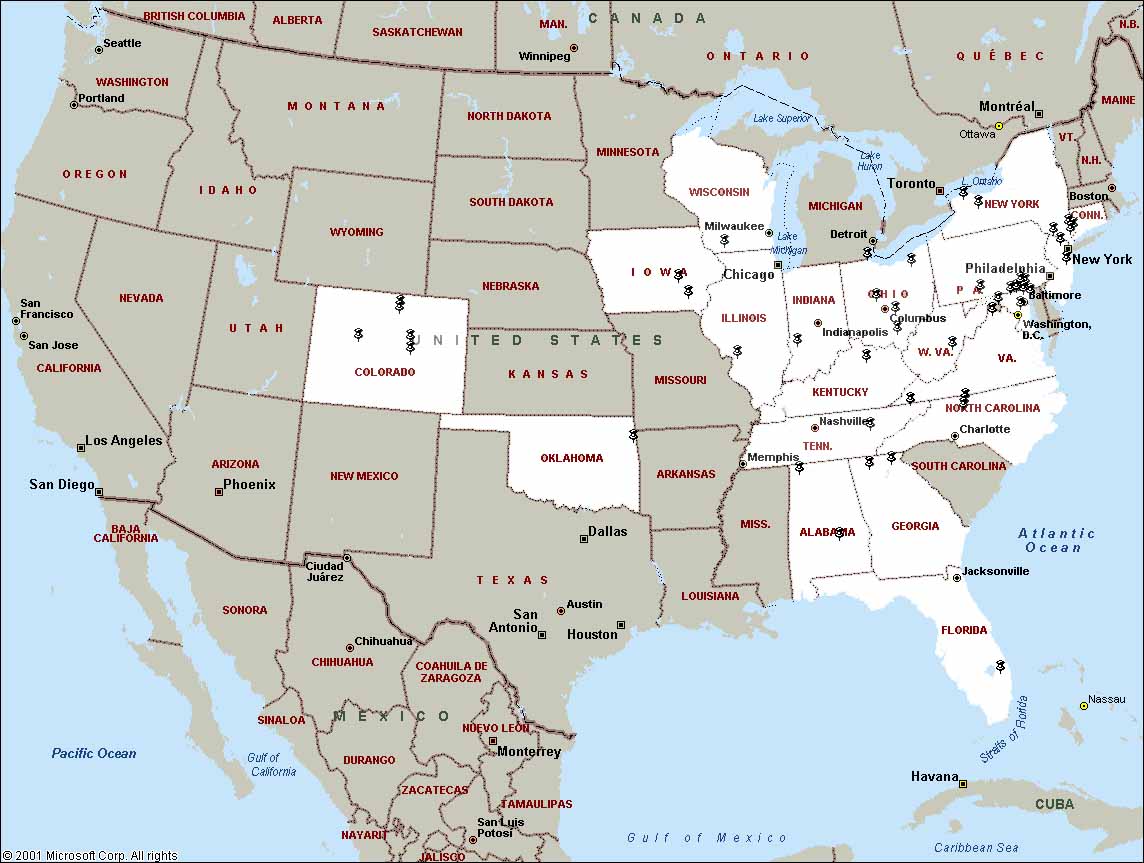
The map, above, is fairly illuminating, as it graphically represents where working judges sanctioned by the Jack Russell Terrier Club of America live.

The states in white are those that have any JRTCA working judges at all. The states that are muddy-grey colored have no JRTCA working judges. A pin (see a larger version of the map by clicking on it) represents the zip code of every JRTCA working judge in the U.S. in the current edition of True Grit magazine.

To get a "bronze medallion" for special merit in the field from the JRTCA, a dog has to work at least three types of quarry underground (fox, raccoon, groundhog, badger or an aggressive possum) operating as if it were out alone, and with the owner doing the digging, and a JRTCA judge has to be in attendance as witness the work. To get a certificate, a dog cannot work quarry in a barn, brush pile, artificial earth or man-made location (such as the crawlspace of an outbuilding).

Jack Russell Terriers are, far and away, the most commonly worked terrier in America. There are very few Fell Terriers in this country, and almost no working Border Terriers at all. Patterdale terriers in the U.S. are still relatively rare, and though some very good dogs are being bred by a handful of reputable breeders, too many over-large dogs are being produced -- many of them cross-bred in the not-too-distant past with small pit bulls in order to get a larger dog that can work game above-ground game -- barn raccoons and feral hogs in particular. There are some excellent Patterdales and a few good Fells in the US, but most of these seem to be owned by people that have had Jack Russell terriers at one time or another -- the dogs they started with before there were any Patterdales or Fells in the U.S.

In short, most working terriers in the U.S. are Jack Russell Terriers, and the map above tells a story.

Why does this JRTCA map look this way?

Some of it has to do with a population bias -- there are more people per square mile in the East and Midwest, and as a consequence associations are easier to maintain.

Another factor is that there are only about 50 pins on the map at all. This paucity of pins is partly a reflection of how few people actually work terriers in the U.S. beyond two-or-three time a year digs, and in part a reflection of the fact that being a working judge is truly a thankless task.

Of course there are more than 50 serious diggers in the U.S. Some of these diggers are ex-JRTCA working judges, some are people that dig a lot but have no desire to sign up for the thankless job of being a working judge, a very few diggers have Kennel Club registered dogs, some folks dig their dogs but have no club affiliation at all. And of course there are the patterdale-only owners, some of whom have joined the new UKC working terrier program or are members of the Patterdale Terrier Club of America.

That said, while this map is clearly not inclusive of everyone that digs their terriers, it is more-or-less geographically representative of the broad TREND of those that that do -- they tend to be in the East and in the Midwest, rather than in the Western United States. For example, of the 15 UKC working judges, as of August 2004, six are not in America, two are in California and come East to hunt, and the rest are in New Jersey, Kentucky, Virginia or Georgia -- states well-represented on the map above.

One of the reasons the map is skewed has to do with quarry availability. In the U.S., the bread-and-butter quarry of the working terrier is the groundhog. Raccoons cannot dig their own dens, and neither can possums. If dirt dens are not available, they will seek other alternatives -- hay lofts, brush piles, hollow trees, farm outbuildings, hay stacks, rock crevices, or old squirrel nests. With the exception of rock dens, these are not locations where a small dog follows quarry to ground and is then dug to. In short, it is not earthwork.

Red fox will dig dens on their own, of course, but in the American west they face real on-the-ground competition in the form of the coyote. A coyote will generally kill a red fox if given half a chance, and they directly compete with red fox for food.

In addition, the red fox is not native to most of the U.S., and its dispersal in the West is uneven as a consequence. While red fox are common in some areas (such as the prairie pothole region) they are quite rare in other areas (such as western Oklahoma).

Weather and time are another important reason fewer people hunt in the West. Fox will not den in warm weather unless they have kits, and in the U.S. we will not put a dog on a vixen with young. Without hounds to drive fox to ground, our fox-digging season is very short -- generally only 10 weeks long, and for most people with jobs this presents a very short period of time to get out into the field.

When people do get out into the field, of course, they have to find your fox! This is easier said than done, and is very hard job for a novice hunter with a novice dog. Red fox densities are variable, but settlement is generally much thinner in the West where there is less food than in the East, and where the fox faces direct competition with coyotes for food and den sites.

Raccoons are not native to the West, though they have spread with humans during the last 50 years, helped immeasurably by the creation of denning shelters in the form of barns, out buildings, road culverts, abandoned cars, and brush piles. A raccoon can expand a ground den a little bit, but it is not really made for digging. A skunk can and will dig its own hole, which is suitable for possum, but too small for anything but the smallest of adolescent raccoons.

Due to the absence of natural forage, raccoons are rarely found above 5,000 feet in the Rocky Mountain, unless they are living in close proximity to humans, though they have been reported at elevations as high as 10,000 feet if a steady food source is available.

Marmots and prairie dogs are found in some locations in the West, but the prairie dog is far too small for a dog to work, while the various species of rock marmots tend to gravitate towards areas with large boulders and talus slopes -- areas very hard to dig. Marmots are also absent from larger parts of the West outside of the Rockie Mountains. That said, if found in the right location, marmots are excellent quarry for working terriers in the Mountain States.

Some states -- notably California -- have very diverse geography and wildlife but also have very restrictive game laws which make working terriers difficult.

The American badger is common in some parts of the West, but more often than not its population is numerically thin on the ground. Badger are also hard to locate, as they will move every few days or so as they eat out, or chase out, a local rodent population (rats, mice, ground squirrels, and prairie dogs). Once the food is gone, so too is the badger. Unlike in Europe, the presence of a badger hole in the U.S. does not mean you have actually found a badger. More likely you have found a blank hole or, in some areas, worse -- a skunk, porcupine or snake.

Porcupines, rattlesnakes and skunks are fairly common in many parts of the West, and all three animals are a very serious threat to a dog. A dog sprayed underground by a skunk can be overpowered and die from anemia if not gotten out of the ground in pretty short order. A porcupine's defense system are barbed quills which can leave a dog wrecked in short order (and the owner's wallet drained after a visit to the vet). A dog bitten by a rattlesnake rarely lives, as the venom from even a small rattler is more than enough to kill a terrier.

In the South there are tens of millions of nutria, but they do not seem to be worked very often. In part this is due to the fact that in many Southern locations where nutria are numerous alligators also tend to be present. Another factor is that neither the American Working Terrier Association nor the JRTCA will give a working certificate to nutria as the holes are too big and shallow to qualify as real earth work. In addition the nutria, like the possum, is an animal whose primary defensive mechanism is bluffing. While AWTA will not give a certificate to possum, and the JRTCA will provided it is an "aggressive" possum, both seem to think the nutria is less than fomidable quarry for a working terrier.

A final obstacle to terrier work in the West is experienced people to show newcomers where to start. While the basics of terrier work are not overly complex, there are things to learn about locating quarry, digging, dispatch, and healthcare. To work any terrier in a safe manner requires several hundred dollars worth of equipment, as well as permissions from land owners. And then, of course, you have to have the desire to hunt, be in relatively sound physical shape, and be willing to devote the time to get out in the field in all kinds of wearther. It turns out all of this is a rare combination.

All of the factors above combine to create a "tipping effect" in much of the West where the chance of finding quarry is lower than in the East, and the chance of getting a dog injured is higher. When combined with a paucity of other working terrier owners, a very short working season, and the abundance of other kind of hunting opportunities, it is not surprising to find fewer working terriers in the Western United States than in the East and Midwest

Many of the western diggers that do exist actually come East to work their dogs, going to the trouble of loading themselves and their dogs into airplanes, trucks and cars for a week or two of hunting where quarry can be found on the ground.

This clearly takes a great deal of work and commitment, making these folks among the most dedicated working terrier enthusiasts in the U.S. A special hats off to them!
.

Wednesday, November 15, 2006

America Wastes a Second Chance


We have a great deal of wildlife in America today -- a situation far different from 100 years ago when our Eastern forests were all but gone, and wild game was entirely shot out by market hunters.

We were given a second chance.

Not everyone else has. Take Scotland.

The Romans called Scotland "Caledonia," a term that means wooded heights. But the forests of Scotland were cut down for pasture, and with the loss of forest came the loss of soil. Short-term profits led to long-term environmental destruction -- destruction that continues to grind the Highlands to this day. With the trees went the soil, and with the soil went any hope and all memory of what once had been.

In the U.S., we were headed down this same road until the Weeks Act -- the first huge Government bail out -- resulted in the U.S. Government buying up all of our denuded eastern slopes in 1911. In time this land reforested itself and become the backbone of the National Forest system in the eastern United States.

Less we pat ourselves on the back too much, however, let's remember that we can quickly lose what we have regained. Today in Appalachia, we are once again ripping up and ruining vast swaths of wild lands.

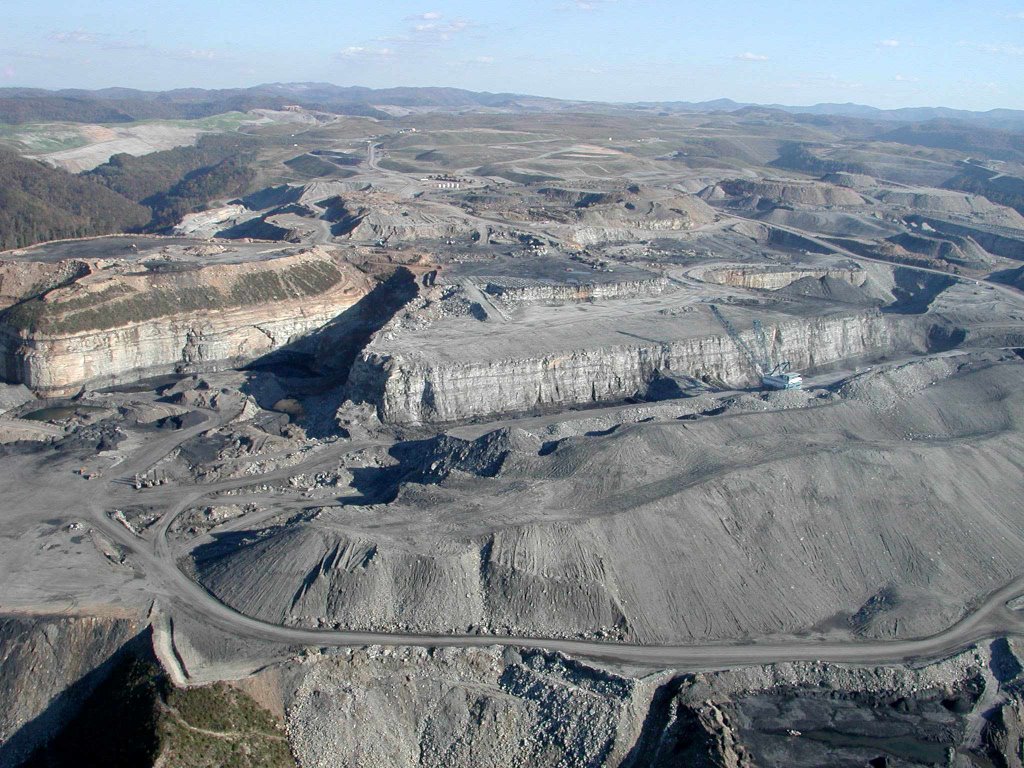
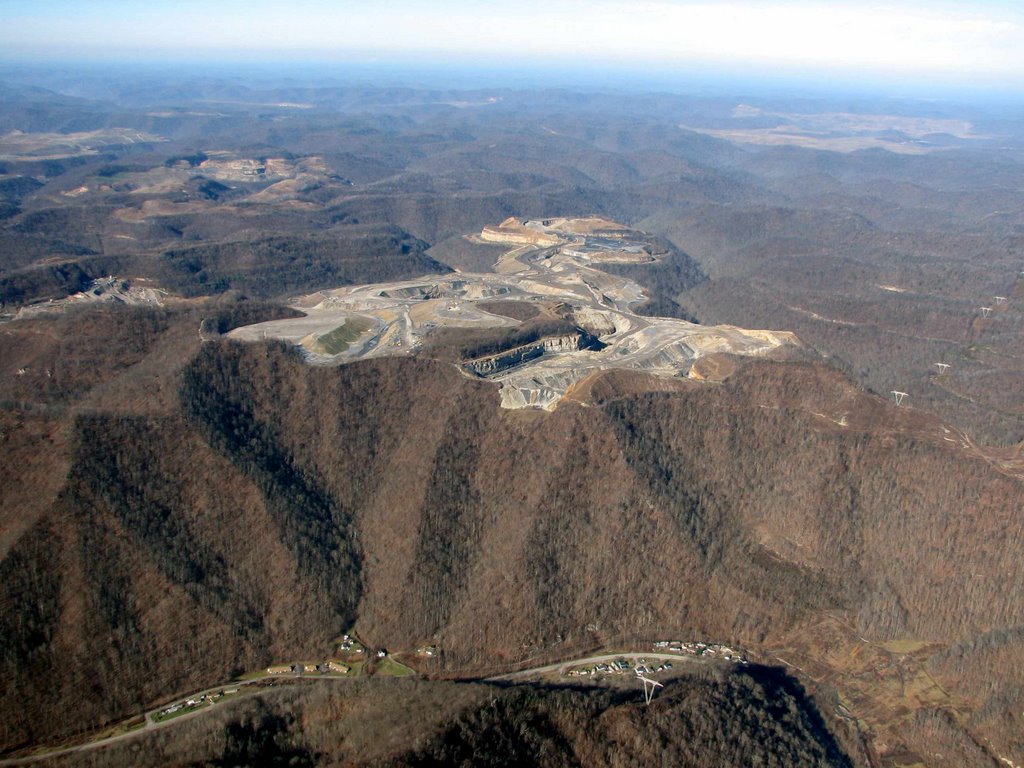
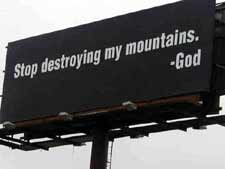
Just take a look at the Mountaintop removal efforts going on in Kentucky and West Virginia.

Mountaintop removal is a radical form of coal mining in which entire mountains are blown up and the overburden is pushed into creeks and hollows, poisoning and suffocating the headwaters of rivers and creeks.

The land is inexorably and permanently altered. Once you have lost a mountain, you have lost it forever.


So far, more than 450 mountains have been destroyed by mountaintop removal coal mining, and more mountains are being targeted every day. The short-term economics of mountaintop removal benefit a small cadre of people who generally live far from the mines.

Almost none of the money stays in the states where it is made -- this is robber baron economics at its worst.

Due to the use of massive machines, automation, and explosive charges, very few jobs are created. This is mining without miners and with almost no economic benefit to the poor people of eastern Kentucky and West Virginia.

Along with massive environmental destruction and the loss of the mountain top itself, the forest too is generally lost. Mountaintop removal sites are "reclaimed" by simply pushing a thin layer of soil over the top of hard rock and rubble and then sprinkling a little nonnative grass seed so that it "hairs over" in a few weeks.

For more information about how we are ruining Eastern Kentucky, West Virginia and parts of Tennessee, and what you can do to help stop it, see >> Appalachian Voices or their sister web site >> http://www.ilovemountains.org/

Saturday, July 22, 2006

A Pileated Woodpecker Was Here

Digging on the dogs today, I came across this dead tree that had been worked over pretty well by a local pileated woodpecker.

A pileated will leave holes like these -- very vertical, and looking a bit like a rectangular mortise.

A pileated woodpecker looks very much like an ivory billed woodpecker, but is a little bit smaller -- about the size of a crow. Like the Ivory Bill, they have a red crest and black and white plumage.

Pileated woodpeckers prefer to nest in large old pine trees, but in this part of the country, they are as likely to be found in a Hickory, Yellow Poplar, Maple, Sycamore, Red Oak, White Oak, Chestnut, or Sweetgum trees.

Monday, April 10, 2006

Knock, Knock, Knocking on Heaven's Door


On Sunday the dogs bottled a groundhog up under the root ball of an American holly tree.
While the dogs were underground baying, a pileated woodpecker got to drumming very near us on a large and hollow log. The sound this bird managed to generate was phenomenal!

The pileated woodpecker is the largest woodpecker in North America (about the size of a crow), and is quite common across the Eastern U.S. The very loud drumming of a pileated woodpecker is used to establish a territory and attract a mate -- an important activity at this time of year. The woodpecker and his mate will stay in the same area all year long, holding a territory much like a fox will.

The pileated woodpecker looks quite a bit like an Ivory Billed woodpecker, which was believed to be extinct until a small remnant population was found in Arkansas last year.

"Pileated," by the way, is just a fancy word for "capped" and refers to the bird's bright red crest. You can tell a pileated woodpecker has been working trees in an area, as the birds will knock out a hole that is shaped like a vertical rectangular slot, almost like a perfect mortise.

.

Tuesday, March 14, 2006

Ted Williams on "Global Releaf" Projects


__________________________________

Trees Can Be Just Another Sacred Cow
by Ted Williams from High Country News __________________________________

Only God can make a tree, but anyone can ruin a prairie. Consider the celebrated 19th century journalist Julius Sterling Morton. On moving to Nebraska from Michigan in 1854, he found he didn’t like the way nature had designed the Great Plains. Accordingly, he summoned forth "a great army of husbandmen… to battle against the timberless prairies."

In 1885, Morton’s birthday became a state holiday we all just noted called "Arbor Day." A statue of him, paid for in part by the pennies, nickels and dimes of school children from all over the world, now stands in Nebraska City. Arbor Day is celebrated throughout our land, and when you join the National Arbor Day Foundation you get 10 free tree seedlings that may or may not belong in your area.

There are or were prairies in most of our nation, not just the plains states. Prairies used to dominate the San Francisco Bay region, but as Arbor Day euphoria swept west, locals planted trees — including eucalyptus, America’s biggest weed — thereby wiping out native ecosystems. By 1949, the trees had killed off the remnant population of the prairie-dependent Xerces blue butterfly, making the Presidio of San Francisco — an old Spanish garrison — the site of the first documented butterfly extinction in North America.

In 2002, American Forests, the nation’s oldest conservation organization, and its "Global ReLeaf" partners, which included such spewers of tree-killing and greenhouse gases as Conoco, Arco Foundation, Baltimore Gas and Electric, Edison Electric Institute, Metropolitan Edison, Texaco, Octane Boost Corp., and Pennsylvania Electric, reached their goal of planting 20 million trees across the United States. There was little thought about what species belonged where and no recognition that lots of places had too many trees already.

Sandra Ross, director of the conservation group Health & Habitat of Mill Valley, Calif., wanted to sign up for Global ReLeaf but couldn’t extract a promise from organizers to plant only indigenous trees, and only in areas that used to have trees.

"I have trouble talking to these people who have this wonderful enthusiasm for planting trees," she told me. "Most of them don’t have any idea of site-endemic situations. ‘We’re gonna plant trees!’ they’ll say, and I’ll ask what kind. And they’ll say, ‘I don’t know; they’re in little pots.’ Mill Valley (in the Bay area) doesn’t need a tree-planting program. It needs a tree-removal program."

Just such a program is under way at the 3,334-acre Union Slough National Wildlife Refuge near Titonka, Iowa, where the U.S. Fish and Wildlife Service is trying to restore a tiny piece of tallgrass prairie, a globally endangered ecosystem supporting 300 plant species per acre and critically important to vanishing grassland birds.

But when managers suggested cutting and burning invasive trees, the public accused them of "playing God" and initiating "a scorched earth policy." School kids blitzed them with e-mails, begging them to desist from arboricide. With the kind of courage that doesn’t get recognized enough in federal service, the staff forged ahead, cutting, burning and educating where it could. Although the locals have more or less quieted down, the refuge finds itself strapped for money and manpower.

"I’m frustrated," declares federal biologist Tom Skilling, who reckons that only 10 or 15 percent of the trees have been removed from the project area.

There’s a notion, old as the Oregon Trail, that trees prevent erosion in prairie habitat. "Not true," says Rich Patterson, director of the Indian Creek Nature Center in Cedar Rapids, Iowa. "As a general statement, dense growths of trees reduce the ground cover of sedges, grasses and forbs, and there’s a lot of sheet erosion in the woods. These ground-huggers do a better job holding soil than trees."

For his radical notions, Patterson used to get pilloried by tree lovers, including state and federal bureaucrats who had devoted their careers to planting trees for "conservation." Now, after 29 years of cutting, burning and educating, he’s got everyone pretty much behind him.

Still, the old mindset dies hard. Even today, the Farm Bill’s Conservation Reserve Program impedes prairie restoration. It requires landowners wanting to enroll marginal riparian pastures to plant trees and shrubs.

Depending on where and how it takes root, a tree can be lovelier than a poem or uglier than a road-killed coyote. I’ll withhold comment on Joyce Kilmer’s verse except to say I prefer the words of Ansel Adams, worth perhaps more than one of his photographs, and with which he helped quash a Boy Scout tree-planting project on California’s Marin headlands: "I cannot think of a more tasteless undertaking than to plant trees in a naturally treeless area," said Adams, "and to impose an interpretation of natural beauty on a great landscape that is charged with beauty and wonder, and the excellence of eternity."

______________

Ted Williams is a contributor to Writers on the Range, a service of High Country News (hcn.org) in Paonia, Colorado. When not roaming the West as an outdoors writer, he lives in Grafton, Massachusetts.