Showing posts with label weeds. Show all posts

Monday, July 04, 2022

A Life Worth Living Comes With Risk


In his book, Edible Wild Plants, John Kallas has a very nice disclaimer that I think is worth giving a tip of the hat to:

If you venture out of your nuclear-proof, earthquake-proof, asteroid-proof bunker into the real world, you might be at risk. Yes, it’s true! You may be hit by a bus or get E coli or staphylococcus poisoning from a church potluck. If you kiss someone, you may get herpes, mono, or worse—a tragic relationship. On the golf course, you may be hit by lightning. If you go ice skating, you may break your neck. If you go on a hike, you may trip on loose rocks, fall over a cliff, and die. Or you might be in the World Trade Center at the wrong time.

Look, you can either curl up under your bed covers and live a safe, dull, insulated life reading about other people doing things you wish you were doing. Or you can join the real world. If you venture into the real world, you risk living your life to its fullest. You risk the rush of climbing that mountain, of dancing all night, of scuba diving in reefs of mind-blowing color, of standing in the rain on an ocean viewpoint, watching huge waves crashing against the rocks, of meeting the partner of your dreams. You risk getting exercise and breathing fresh air. You risk making life worth living.

Perfect!

Kallas' book, by the way, is a nice read and available from Amazon. 

Whether you ever intend to forage or not, this book will at least let you know the names of some of the more common field-weed plants found everywhere in the U.S. and some are quite edible if harvested at the right time and in the righty way.  Wild spinach, chickweed, purslane, sorrel, field mutard, wintercress, dandelion, mallow, and shepherd's purse, are among the possibilities.
.

Saturday, August 25, 2018

The American Enclosure Movement


Female bluebird on barbed wire.


The Enclosure Movement in the U.K. had a profound impact on the land, farms, and people in that country, and set the stage not only for the mounted fox hunts, but also for the social strife that surrounds fox hunting in Great Britain to this day.

For a pictorial history of terriers and their relationship to the Encloser Movement, click here.

The U.S. also had an Enclosure Movement, which was no less dramatic.

Land enclosure in the eastern U.S. was accomplished with split rail fences and stone walls, but when settlers reached the vast open plains of the American west, there were no trees or field stones for fencing. The result was free range cattle and sheep.

The situation was hardly ideal. Cattle were easily rustled or lost, and many fell prey to wolves and cougars. Sheep were "meals on heals" for coyotes and were easily lost as well.

Another problem was that open grazing meant open competition between sheep and cattle, with sheep cutting the grass down too far for the cattle to forage (the U.S. had huge sheep spreads in the second half of the 19th Century).

Finally, there was the problem of what to do about tick fever. Cattle in the far south west, below Oklahoma, were immune to tick fever, but the northern herds were not, and the practice of driving livestock north to Kansas City, Montana and Wyoming brought the scourge of disease into once-clean herds.

Two things changed it all: the rapid demise of the American Buffalo, and the rapid rise of barbed wire.

The buffalo were shot out over an incredibly short period of time, with railroads bringing in marksmen to shoot and skin anything that moved. Vast mountains of skinned flesh and bones were left for feral Indian dogs to consume.

In fact, most of the "wolves" of the Plains were not wolves at all, but feral Indian dogs (they looked just like wolves, but with curved tails) abandoned by a people now being rapidly decimated by war and disease.

With the demise of the buffalo, came the importation of its smaller cousin, the beef cow.

With the cow came the cowboy, many of them ex-Civil War soldiers moving West for opportunity and fortune. This was the brief tenure of the "Wild Wild West," and the thing that brought it to a dragging halt was the rise of barbed wire.

In 1873, Joseph Glidden the 60-year old sheriff of DeKalb, Illinois, attended a county fair where he saw a demonstration of a wooden rail with sharp nails protruding from it hanging inside a smooth wire fence. The design was supposed to keep cattle and horses inside a small perimeter fence, and perhaps help keep dogs and other predatory creatures out.


Joseph Glidden, mutton chops and all.


Glidden was inspired by the board-and-nail device and the potential for cheap and movable fencing. He began to experimented with the idea, and eventually came up with the idea of using a jerry-rigged coffee bean grinder to make spiral points of wire which were then strung at intervals along a smooth wire, with another wire twisting around the first to hold the barbs in a fixed position.

Barbed wire was born.

Glidden applied for a patent, and it was granted, though the patent was later contested. The legal battle that ensued lasted three years, and went all the way to the Supreme Court. Before the smoke cleared, however, there were over 570 patented forms of barbed wire!

From the perspective of many small land owners in the West, barbed wire was a wonderful invention: it was relatively inexpensive, would not rot, was practically unaffected by grass fire, was strong and long-lasting, and was easily erected.

In very short order, thousands of miles of barbed wire fencing were strung -- so much that fence posts were a major export from both the East and West coasts.

Between 1875 and 1885, the national consumption of barbed wire jumped from 300 tons to 130,000 tons.

The arrival of barbed wire in the American West was of immense historical importance, for it ended the era of the Great American Commons of "free grazing". Now people could own land and keep others off it. Equally important, they could control access to water, and keep livestock out of crops, such as wheat and corn.

Barbed wire also meant that sheep and cattlemen could now improve the quality of their herds by stringing barbed wire to keep inferior bulls from mating with their cows.

Fencing disputes pitted cattlemen against farmers and sheep men, and free-grass cattle ranchers against fenced-range cattle raisers.

These conflicts became fierce during times of drought when access to water and grass (green or not) meant the difference between bankruptcy and fortune.

Cattlemen used to driving herds across vast distances to known water and feed pastures would simply cut fences when they found them, and in some areas open warfare broke out.

In the end, of course, common grazing died across most of the American West, just as it had in Great Britain beginning 100 years earlier.

But barbed wire did not stay in the West -- it became a global product stretched around farms, ranches, buildings, prisons, and borders the world over.

In the Eastern United States, where hedge rows are not layed, as they are in Great Britain, barbed wire proved as useful as it was in the West.

Hedges in the Eastern U.S. are little more than strips of uncut forest and secondary growth, often dominated by rapidly-growing weedy trees, such as black cherry, black locust, and black walnut. These trees shade thin tangles of poke berry and wild grape, multiflora rose, kudzu, and honeysuckle. The result is not substantial enough to keep livestock out of crops.

Prior to barbed wired, farmers had to construct stone walls or erect split rail or plank fencing. These kinds of fencing are expensive and enormously labor- and material-intensive, and they also require a lot of maintenance.

With the invention of barbed wire, however, a farmer could simply stretch wire from tree to tree or post to post. The savings, in time and money, was enormous. Maintenance was virtually eliminated, as galvanized wire does not rust, rot, burn, need paint, or fall apart from frost heaving.

The ease of fence construction after the invention of barbed wire meant that new fences lines were easily created. Large farms that had once been open fields were now cut and carved with posts and barbed wire. Along these fence lines weedy strips soon took hold. Over time, many of these weedy strips have been colonized by small trees, bushes and vines, and in many instances full hedgerows have developed, almost always attended by population of groundhogs, fox, raccoon and possum.

Truly, barbed wire is the "Devils' Rope," and yet it is also part of the story of working terriers in America, for barbed wire has created and protected much of the hedgerow habitat where so much of our quarry dens.

If you work terriers in the Eastern United States, you will eventually find your yourself crawling over and under barbed wire. The dogs themselves may occasionally get ripped running over it, and most folks eventually lose the bottom out of one seat of pants or another.

In the end, however, there is very little doubt that without barbed wire we would not have the quality of terrier work we have today.

And so next time we are in a jungle of thick hedge and the dog has just slipped into a hole under a jumble of broken down barbed wire fencing, let us remember that the fence is more than an obstruction -- it is construction that is vital to the habitat we hunt. Barbed wire is our friend.
      :: This is a repost from 2004.
.

Tuesday, May 22, 2018

Field Weeds: Poke Weed


American Goldfinch on mature pokeweed in late-June.


Poke Weed (often written as "pokeweed") is found from Maine to Minnesota and from Florida to Texas. It grows along roadsides and is an especially common weed in the hedgerows where we work our terriers.

The name Poke Weed comes from the Virginia Indian word for the plant -- "pokon" -- which in turn was derived from the Indian word "pak" which means blood. In pre-Colonial times "Pokon" was the term used for any red-juiced plant used as a stain or dye, and today Pokeweed is sometimes called "stain berry," poke berry," or "stain weed".

Though a mature pokeweed plant is the size of a small tree, the thick stems are hollow and very easy to cut. The berries are eaten by raccoon, possums and birds, but the roots are poisonous to pigs and other animals that try to root them up and eat them.

Pokeweed is usually confined to waste areas, but a tall mature plant is an indication that the soil has not been disturbed for three our four years, as it takes about that long for the roots to grow enough to support a full-grown plant which will stand about 7 feet tall or more.

Derivatives of the lowly pokeweed have been found to contain an antiviral protein that could be the most effective agent yet to inhibit HIV, the virus that causes AIDS. Pokeweed antiviral protein (PAP) inhibits HIV from replicating in human cells. PAP also inhibits replication of the herpes simplex virus, among others.
.

Sunday, May 21, 2017

Ghetto Palms In the Hedge


It's a long way from "Tree of Heaven" to "Ghetto Palm," but that's the linguistic path that Ailanthus altissima has taken in this country.

Like so many invasive weeds, such as kudzu and multi flora rose, the Tree of Heaven was first imported as an ornamental. A small easy-to-grow tree, it lent a slightly tropical-air to 19th Century American gardens.

Of course it soon got out of the garden, and has been spreading malevolence across the world ever since. About like Adam and Eve, truth be told.

A mature Ailanthus tree will produce several hundred thousand seeds a year. This little tree is truly invasive -- not only along the edges of fields, but also on median strips, driveways and even the cracks of sidewalks.

The Ailanthus can grow in almost any kind of soil, from clay to hard pan, from swamp to sandy rock, and it is not fazed in the least by thick, oily smoke from the exhaust of a passing bus. This is a tree that thrives on neglect, lack of water, and even physical abuse. They don't call it a "Ghetto Palm" for nothing.

This tree is a living monument to the tenacity of life in a harsh urban environment, and is, in fact, the star of the children's book, A Tree Grows in Brooklyn.

That said, its hardiness is its only redeeming value. Ailanthus produces no wildlife value at all. Deer will not eat it, and unlike the Staghorn Sumac and Black Walnut, both of which it resembles in appearance, it produces no seeds or nuts of any interest to even the smallest creature, not even a mouse.

The Ailanthus, Staghorn Sumac and Black Walnut have long, palm-like compound leaves but the Ailanthus has little white dots on its new branches and a vertical white stripe or ridge on older trunks, while the dots on a Sumac's young trunk and branches are darker. Sumac leaves are light-colored underneath, and this little tree rarely grows much taller than about 25 feet. In winter, the new buds of Sumac look like they are covered in velvet, a little like a deer antler (hence the name), while Ailantus are simple hard points. Ailanthus branches are arrayed in whorled tiers, while a Sumac has Y-shaped crotches. While Ailanthus leaves turn brown or tan in the fall, Sumac leaves turn bright red -- a very nice display. A Black Walnut tree is easy to identify if it has nuts, of course, but also because this tree develops a very rough and dark craggy bark at a young age-- the easiest way to differentiate it from the other two species of tree.

Though an Ailanthus tree can grow to 80 feet in 10 years, the wood is terribly weak, and so light in weight it burns away in minutes. The branches are spaced in such a way they cannot hold up a bird's nest.

While averse to deep forest shade, Ailanthus commonly dominates forest edges and field hedgerows where it forms a weedy understory when mixed with pokeweed and multiflora rose.

A particular problen with Ailanthus is that the roots can run deep and wreck water and sewage pipes. And while a Tree of Heaven in the side yard may looks pretty in summer, in the dead of winter its trunk is stick-like, and only accents the dreariness of the season.

In Virginia, where I live, some folks call the Ailanthus a "stink tree," because if you crush almost any part of the plant, it has an off-putting odor. The scent is not just offensive to the nose -- the plant is a proven allelopath as well, which is just a fancy way of saying the plant seeps chemicals into the dirt that discourage other plants from taking root. Black walnuts and rhodedendrons do the same thing, of course, but they have at least a few noble properties to serve as a counter-weight, such as nuts and flowers and wood. The Ailanthus, truth be told, is good for nothing but sheer tenacity. This is a tree that cannot be killed by merely hacking it to the ground and plowing it under-- you have to put Round-Up on it,and probably do it more than once.

After everything else on this earth is gone, the Ailanthus (I am quite sure) will be thriving. The weedy will inherit the earth.

Tuesday, June 18, 2013

Attack of the Leafy Spurge

This is the post no one will read. At some level, I don't blame them -- it's hard to learn about plants without seeing them, and so many plants look alike. On the other hand, it's a little disconcerting that the average person going into forest and farm cannot name a single common plant or tree. This is not to say I am any good at it either -- but I at least try.

One reason to learn a little about plants is that they can tell you a lot about the water level, the drainage, how recently the soil was disturbed, and what might be grazing in an area. Plants also convey a little environmental history as well.

If you are looking over a field and see a large poke berry thicket rising up in the middle of it, for example, there's a good chance a groundhog den will be located there -- the poke berry will have taken advantage of the disturbed soil at the edge of the den hole to germinate its seed. By looking at the age of poke berry plants in a hedge, you may be able to get some idea of when the area was last plowed or cut over -- the larger the poke berry, the more likely the dens are going to be a bit older and more well-established.

Conversely, if you see the beautiful purple flowers of iron weed growing across a low swale in a field, you can give that area a pass -- it will be too wet for a den.

A lot of the plants we see in our hedges and border areas are non-natives. These included multiflora rose, ghetto palm, Chinese tear-thumb, mimosa, Japanese honeysuckle, kudzu, oriental bittersweet and garlic mustard.

An invasive we found a lot of this last weekend was Leafy Spurge (Euphorbia esula). There are a bunch of spurge types, and they all look different. Leafy Spurge is aggressive even among spurges, and it can quickly suffocate field edges if they have been disturbed by a plow and then left to fend for themselves. This is a plant that was once described to me as "horse tail," but in fact it is not related to that ancient plant; it may simply be a local name for the weed.

Right now, before Leafy Spurge flowers, the 3-foot plants look a lot like tropical aquarium plants, with rosettes of thin upright leaves around central stalks. In a few weeks, the odd yellowish flowers will begin to come on, making the plant appear greenish-yellow -- a bit like a field of turning-to-flower rape seed.

Leafy Spurge is really quite pretty. The down side is that it is quite useless as a forage for cattle, deer, and horses, and it is so aggressive that it tends to drive out everything else that can be eaten by wildlife.

If you break Leafy Spurge in half, a white milkish sap will ooze out. This sap is most common in adult plants, and its presence is what puts off deer, cow and horses. Deer may graze on very young Leafy Spurge shoots in early Spring when there is very little milk sap, but they will give it a pass by mid-Summer when it begins to flow. Turkey and other birds seem to have little or no interest in the seeds.

Leafy Spurge showed up in the U.S. in the early 1800s, first migrating to the U.S. from Eurasia, perhaps as a stow-away in a bag of farm seed. Tumble weed (aka Russian Thistle) arrived on our shores much the same way.

Leafy Spurge was first recorded in Massachusetts in 1827 and it quickly spread west and is now found across the U.S. except for the southeastern U.S. below Virginia.

In Virginia and Maryland, Leafy Spurge seems to be doing quite well -- I assume the slightly hotter and moister climate farther South is too much for it -- at least for now. There appear to be several varieties of Leafy Spurge, and new American hybrids seem to be occurring naturally. Before it's all over, Leafy Spurge may yet find a way to colonize the South.

Leafy Spurge is spread by seeds which readily germinate in disturbed soil. Once this plant takes root, it is very difficult to winkle out by plow and poison.

The root structure of Leafy Spurge is key to its survival -- not only does it have long surface-running roots capable of sucking up lots of water (and creating new colonies of Leafy Spurge), but is also has deep tap roots which can shoot six or seven feet underground in order to tap water unavailable to other plants. No matter how hot and dry the summer is, a field of Leafy Spurge is likely is look prosperous.

Biological control offers some small hope of controlling Leafy Spurge. The U.S. Department of Agriculture has imported six natural enemies from Europe, including a stem and root-boring beetle, four root-mining flea beetles, and a shoot-tip gall midge (whatever that is). Large scale field-rearing and release programs for these insects are being carried out by federal and State agencies in many northern states. While the results are not immediate, they are impressive over time ... so long as pesticides are not used.

Another option that works well to reclaim pastures overgrown with Leafy Spurge, is a herd of goats or sheep. While cows and horses generally prefer grass, and will give Spurge and other forbs a pass, the goats and sheep will readily attack the Leafy Spurge and seem to prefer it over grass. Over time, sheep and goats can transform a field from a "waste case," to grazeable pasture, as the picture below suggests.


A spurge-infested field in Montana is cleaned up by goats and sheep at left -- a job not accomplished by cattle and horses at right.
.

Thursday, February 21, 2013

Hunting the Foreigners

Example
Greg Mousely minking, June 2003

The latest news from Scientific American is that non-native wildlife in Europe wreaks $16 billion a year in damage.

Not said:  Foreign fauna provides considerable sport in the UK and across Europe.

Among the mammal introductions to the U.K.:
  • The Brown or Norwegian Rat, which arrived around 1720.
  • The Grey Squirrel which arrived around 1870.
  • The Sika Deer which arrived around 1870.
  • The Chinese Muntjac Deer which arrived around 1940.
  • The Mink, which was released around 1950.
  • The Rabbit which was introduced by the Romans (or perhaps the Normans) around 1000.
  • Fallow Deer which were introduced by the Normans around 1200.
  • The Muskrat which was introduced around 1927.
  • The Red-necked Wallaby which was introduced around 1940 (and is uncommon)
  • The Coypu or Nutria, which was introduced around 1944 and wiped out by 1988.

In the U.S., most of the animals we commonly hunt and fish are native, with the exception of pheasants, some species of grouse, brown trout, and (of course) almost all the red fox.

The brown or "Norwegian" rat provides terrier sport for some folks, as does the nutria in areas where better quarry is scarce on the ground.

The raccoon can be thought of as a recently introduced species west of Ohio, and north of the Southern Great Lakes.

Many of our most common urban birds are foreign, including starlings, english sparrows, and the common pigeon (aka the Rock Dove).

Our hedgerow are choked with foreign invasive plant species, such as honeysuckle, kudzu and, of course, multiflora rose. This last plant was widely planted after the Great Depression in order to slow erosion in the South, but it also naturalized from abandoned gardens (multiflora rose is the root stock that most of our ornamental roses are grafted on to).

The dandelion is an immigrant ("dent de lion" means "teeth of the lion" and refers to the serrated edges of the leaves) as is Tumble Weed (aka Russian thistle) and, of course, the wild horse and mule.

Our forests, of course, have been decimated by invasive species from the chestnut blight which wiped out our most magnificent Eastern timber and mast-food tree, to dogwood blight which is now doing the same to our most beautiful native flowering tree.

The gypsy moth was introduced to this country by a Frenchman trying to start a silkworm industry, while the newly introduced ash borer beetle may decimate one of our very best sources of clear hardwood.

All in all, relatively few introduced mammals have "made it" in America, as compared to the U.K., and many of the plants, bugs, birds and pestilents that have made it over here have had an entirely negative impact.
.

Friday, February 15, 2013

The Rise of Muliflora Rose


When out digging the dogs, it is not uncommon to find a sette under a thick break of multiflora rose, with perhaps a few broken strands of barbed wire snaking along the ground right next to the hole.

In that little picture is a story.

Multiflora rose originated in Japan
and was imported to Europe around 1862 to serve as a root stock for "rambling" roses.

Rambling roses became a craze with the creation of "Turners Crimson Rambler" in 1893, and this craze lasted for about 30 years until the modern, repeat blooming, large-flowered climbing roses were created.

The first multiflora roses to "go native" in the U.S. were rambling roses that originate during the rose craze of the very early 20th Century. In truth, these feral roses were not much of a problem.

The problem started in the 1930s and extended into the early 1960s as the U.S. Department of Agriculture and various State highway departments promoted multiflora rose as a "cure-all" for many public and farm landscaping problems.

In truth, multiflora rose did seem to be a good solution for a lot of difficult areas. Multiflora was cheap, easy to propagate from cuttings, and was rampant with vigor. Long, arching and pliable canes with thorns were perfect for shielding car lights from oncoming traffic, discouraging humans from entering fields or crossing roadways, and keeping cattle out of riparian areas.

Rose roots seemed to thrive in a large variety of soils, tolerated both drought and wet reasonably well, and they did a commendable job of stabilizing creek banks and slowing erosion on slopes. Rose hips were also eaten by a wide variety of song birds and animals, providing a needed food source in winter.

The U.S. Department of Agriculture and its various state analogues vigorously promoted multiflora rose as a low-cost alternative to barbed wire. Barbed wire had made its way East several generations earlier after first being established in the West.

Unlike western wire, which was typically strung from post to post, eastern wire was often strung from existing trees around the edges of woods, creeks and fields. In time, these the trees grew and absorbed the wire into their trunk. Embedded wire was difficult to remove and made the trees worthless as timber since wire and nails wrecked commercial saw blades and had the potential of turning a chainsaw into a lethal weapon.

Like so many good ideas, the promotion of multiflora rose has unintended consequences. A mature multiflora rose bush can put out half a million seeds a year, and these seeds are easily spread by birds and can live in the soil for 10 years or more.

Farmers found that getting rid of a rose hedge required riping it out with a bulldozer and then plowing and mowing the areas multiple times a year for several years in order to destroy the existing root and seed stock in the soil.

The good news with multiflora rose is that has truly been a boon to wildlife. Rose hips are consumed by robins, grouse, cedar wax wings, pheasants, wild turkeys, fox, chipmunks, white-tailed deer, possums, coyotes, black bears, beavers, rabbits and raccoons. Thick rose breaks provide shelter for deer and bear, as well as groundhogs, possums, fox, rabbits, and raccoons. Rose hedges along stream banks have worked to keep cattle and horses out of riparian areas, resulting in less erosion, cleaner water, and excellent denning sites for raccoons.

Next time you find yourself digging a hole in the middle of a multiflora rose bush with broken barbed wire snaking along the ground, remember that these stabbing obstacles are, in a very real sense, a significant player in the vigorous return of wildlife we see in in the Eastern U.S. today. Though they may be the enemy of the moment, they are the long-term friends of terrier work.

Monday, October 19, 2009

Wild Grape


This post is recycled from 2005.

Wild Grape, sometimes called "fox grape" is one of the most common thick-stemmed woody vines in our eastern woods. These vines can climb 30-50 feet tall, and often grow up with the trees that serve as their hosts. The bark of Wild Grape is brownish-gray and shreds off in thin strips.

There are several species of Wild Grape in Virginia and Maryland, most of which are similar and difficult to tell apart. The most common species are Fox Grape (Vitis labrusca), Summer Grape (Vitis aestivalis), and Riverbank Grape (Vitis riparia).

Wild Grape is very common where wood and pasture meet -- prime locations for fox, raccoon and groundhog dens -- but can also be found in abundance along roadsides, and cascading down from trees along the edges of ponds, or down cliff faces along rivers.

Wild Grape flowers from May to July, but the flowers are small and green and often quite high up and are not noticed. The grapes begin to set on in August and last until October. Wild grapes are very important to wildlife. Groundhogs dens located under thick masses of fruiting wild grapes should be checked for raccoons in September and October.

Wild grapes are also a favorite of many species of song birds, as well as white-tailed deer, black bear, wild turkey, possum, skunk and squirrel.

Tuesday, September 08, 2009

Field Weeds :: Datura


Datura is sometimes called Jimson Weed, Mad Apple, or Devil's Weed, but whatever you call in, it's a common enough plant on disturbed farm land. The picture above shows Datura growing on the edge of a fox sette.

Datura is a very powerful poison, and also one of the most powerful psychotropic plants found anywhere in the world. No one should ever experiment with this drug -- it makes 1500 mics of LSD look like a short beer, and it is not a "nice high" but a nightmare on two legs. The following description describes the symptoms of datura ingestion -- something once practiced by native American shammans, but now given a pass even by them:

Stimulation and/or anxiety. Extreme nausea. Dilated pupils. Blurred or fixed-focus vision. Rapid heartbeat. Extreme disorientation. Loss of memory. Loss of time. Delirium. Profound sensitivity to light and noise. Seamless crossover into a variety of realistic dream states. Extreme uncoordination, loss of body control, and vertigo. Extreme audio, visual, and tactile hallucinations. Apparent astral travel to familiar places. Interaction with friends, relatives, and other random people who are not physically present. Extreme drying and irritation of the mouth, throat, eyes, urinary tract, and other mucous membranes. Potential for uncontrollably emotional or violent activity. Inability to recall anything--even that you are under the effects of a drug--for quite some time.

.

Field Weeds: Iron Weed


Iron weed, any of several purple-flowered plants in the Vernonia genus, are among our most beautiful wild flowers, but a sure sign that you are in the wrong area for terrier work. The reason: Iron weed is almost always found in very wet areas -- areas that even if dry right at that moment, are wet often enough to be places where no self-respecting den-dwelling animal will set up shop.

Iron weed blooms in July and August, and often has large numbers of butterflies flitting about from flower to flower. One of the most common butterflies associated with ironweed is the American Lady (Vanessa virginiensis) for whom it serves as a larval host.

In late fall, the stems of this plant will get rust color -- the source of the name. The plant itself stands waist to shoulder height and has leaves very much like a Viburnum, another plant often called a "butterfly bush".
.

Monday, June 01, 2009

Machete Types, Use and Sharpening

A repost from this blog, circa 2005

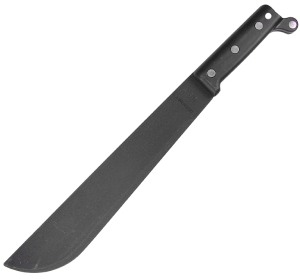
One of the tools I use at almost every dig is a machete. In hedgerows, nothing works faster to cut away multiflora rose, kudzu, wild grape, errant brambles, honeysuckle, wild cherry and poke berry. In the middle of a dig, a stray root can simply be loped off with a stroke of the machete. When dispatch time comes, a hard hit to the top of the skull with the dull back edge of the machete blade ends things pretty quickly.

A machete is not an axe. This tool is not designed to cut firewood or trees, but to hack through thickets of soft, fast-growing vegetation of the sort we generally find in hedgerows. No easily-transportable manual tool has ever beat a machete for this type of work.

Even an expensive machete is quite cheap, so get a decent one which should run you around $30-$40. You do not want a "cane knife", which looks like a machete but is too light, nor do you want or a K-Bar knife (too small and light), or any other of the other dizzying substitutes you might come across in a store or online knife shop.

I use an Ontario Machete, and have no complaints. One new style of machete I have seen comes with a saw edge along the back edge, which seems like a good idea if the soft steel of a machete will, in fact, hold a saw edge.

Some people prefer various odd types of machetes, like the kukri, but I prefer a simple straight blade which is easy to pack and useful in more situations than a kukri.

No machete should ever come with a pommel guard -- such a thing is real trouble in the brush. A machete is not a sword or a knife -- it is a machete. They are a perfected design, and you want the version that has stood the test of time.

Machetes are made of soft metal and are designed to be sharpened a lot. When cutting a lot of sugarcane or hard brush, they are sharpened once or twice a day.

Oddly, none of the machetes sold in the U.S. come with a sharp blade, and in fact getting one sharp the very first time takes some effort.

Do not use a grinder or belt sander to get a machete sharp -- there is very little chance you will get it right, and a very high chance you will permanently burn the blade.


What you need to sharpen a machete or shovel is called a "flat bastard" file. Put the machete blade in a vise, and draw the file across the edge of the blade at a 45 degree angle away from the center of the knife. Or do it the other way if you prefer -- put the file in a vice and draw the blade across it.

Putting the first edge on a store-bought machete will take time -- don't be in a hurry. When you have it right, be sure to oil the blade with a little motor oil.

When using a machete, always cut away from yourself. Always. Nothing will ruin your life faster than hacking your leg with a machete -- if you survive it at all.

A machete blade has a tendency to glance off thick vines and branches, which can be dangerous. The trick here is to not to try to cut straight across the vine with a single whack of the blade, but to hit the vine or branch with a scarfing blow, designed to cut along the stem in a kind of flat notch. The second whack will generally cut it through, with the blade in good control the entire time.

Your machete should have come with a scabbard of some type. Some are cloth, some hard plastic, some leather. Many of the old jungle machetes (many of which were made in Connecticut, believe it or not!) had light wood scabbards, but these are rarer now.

I keep my own machete sharp with a $1 D-handle knife sharpener bought at the local Dollar Store. The same sharpener helps keep an edge on my shovels, and can be bought at a kitchen supply store for about $10. Try the Dollar Store first -- why pay more?
.
.

Tuesday, December 02, 2008

Foreign Invaders in the Hedgerow

There's a horrible little vine you can find in the hedgerows around here that is called "Mile a Minute Weed" or "Chinese Tear-Thumb." A whole page devoted to it can be found here.

This stuff is hell to pull, as the barbs are reversed to rip at your skin.

Mile-a-Minute apparently originated in China, Japan and Korea. In the U.S. it's mostly just found in Maryland, Virginia, West Virginia, and Pennsylvania -- at least so far. I expect it will be everywhere before long.

If you're interested in learning a little more about some of the other invasive species and introduced species in the hedgerow (including the red fox, kudzu, rats, multiflora rose, etc.) click here.
.

Tuesday, November 07, 2006

Datura


The big green prickly seed pods are Datura


Datura is sometimes called Jimson Weed, Mad Apple, or Devil's Weed, but whatever you call in, it's a common enough plant on disturbed farm land. The picture above shows Datura growing on the edge of a field on Sunday.

Datura is a very powerful poison, and also one of the most powerful psychotropic plants found anywhere in the world. No one should ever experiment with this drug -- it makes 1500 mics of LSD look like a short beer, and it is not a "nice high" but a nightmare on two legs.

The following description describes the symptoms of Datura ingestion -- something once practiced by native American shammans, but now given a pass even by them:


Stimulation and/or anxiety.

Extreme nausea. Dilated pupils. Blurred or fixed-focus vision. Rapid heartbeat.

Extreme disorientation. Loss of memory. Loss of time. Delirium.

Profound sensitivity to light and noise. Seamless crossover into a variety of realistic dream states.

Extreme uncoordination, loss of body control, and vertigo. Extreme audio, visual, and tactile hallucinations.

Apparent astral travel to familiar places. Interaction with friends, relatives, and other random people who are not physically present.

Extreme drying and irritation of the mouth, throat, eyes, urinary tract, and other mucous membranes.

Potential for uncontrollably emotional or violent activity. Inability to recall anything -- even that you are under the effects of a drug -- for quite some time.

Tuesday, May 23, 2006

The Multiflora Rose Is In Bloom


When out digging the dogs, it is not uncommon to find a sette under a thick break of multiflora rose, with perhaps a few broken strands of barbed wire snaking along the ground right next to the hole.

In that little picture is a story.

Multiflora rose originated in Japan
and was imported to Europe around 1862 to serve as a root stock for "rambling" roses.

Rambling roses became a craze with the creation of "Turners Crimson Rambler" in 1893, and this craze lasted for about 30 years until the modern, repeat blooming, large-flowered climbing roses were created.

The first multiflora roses to "go native" in the U.S. were rambling roses that originate during the rose craze of the very early 20th Century. In truth, these feral roses were not much of a problem.

The problem started in the 1930s and extended into the early 1960s as the U.S. Department of Agriculture and various State highway departments promoted multiflora rose as a "cure-all" for many public and farm landscaping problems.

In truth, multiflora rose did seem to be a good solution for a lot of difficult areas. Multiflora was cheap, easy to propogate from cuttings, and was rampant with vigor. Long, arching and pliable canes with thorns were perfect for shielding car lights from oncoming traffic, discouraging humans from entering fields or crossing roadways, and keeping cattle out of riparian areas.

Rose roots seemed to thrive in a large variety of soils, tolerated both drought and wet reasonably well, and they did a commendable job of stablizing creek banks and slowing erosion on slopes. Rose hips were also eaten by a wide variety of song birds and animals, providing a needed food source in winter.

The U.S. Department of Agriculture and its various state analogues vigorously promoted multiflora rose as a low-cost alternative to barbed wire. Barbed wire had made its way East several generations earlier after first being established in the West.

Unlike western wire, which was typically strung from post to post, easten wire was often strung from existing trees around the edges of woods, creeks and fields. In time, these the trees grew and absorbed the wire into their trunk. Imbedded wire was difficult to remove and made the trees worthless as timber since wire and nails wrecked commerical saw blades and had the potential of turning a chainsaw into a lethal weapon.

Like so many good ideas, the promotion of multiflora rose has unintended consequences. A mature multiflora rose bush can put out half a million seeds a year, and these seeds are easily spread by birds and can live in the soil for 10 years or more.

Farmers found that getting rid of a rose hedge required riping it out with a bulldozer and then plowing and mowing the areas multiple times a year for several years in order to destroy the existing root and seed stock in the soil.

The good news with multiflora rose is that has truly been a boon to wildlife. Rose hips are consumed by robins, grouse, cedar wax wings, pheasants, wild turkeys, fox, chipmunks, white-tailed deer, possums, coyotes, black bears, beavers, rabbits and raccoons. Thick rose breaks provide shelter for deer and bear, as well as groundhogs, possums, fox, rabbits, and raccoons. Rose hedges along stream banks have worked to keep cattle and horses out of riparian areas, resulting in less erosion, cleaner water, and excellent denning sites for raccoons.

Next time you find yourself digging a hole in the middle of a multiflora rose bush with broken barbed wire snaking along the ground, remember that these stabbing obstacles are, in a very real sense, a significant player in the vigorous return of wildlife we see in in the Eastern U.S. today. Though they may be the enemy of the moment, they are the long-term friends of terrier work.