Showing posts with label migration. Show all posts

Tuesday, November 21, 2017

A Wildlife Transmitter Beats an Arrow In the Neck

Re-posted from 2009.


Remember, when we were kids and people said the birds "flew south" for the winter?

Well, believe it or not, that was about all we knew for a lot of species.

Birds disappeared flying south in the Fall and came back, flying north, in the Spring. Where these birds went, exactly, and what they did when they got there, was a bit of a mystery.

Beginning in the 16th Century or so, some bird owners (pigeon fanciers and falconers mostly) began banding or ringing the legs of select birds to establish ownership.

The first record of a metal band attached to a bird's leg was in 1595, when one of Henry IV's banded Peregrine Falcons was lost in pursuit of a bustard in France. It showed up the next day in Malta, 900 miles away!

In the early 19th Century, the world began to get a glimpse into the scope of avian winter migrations, thanks to an arrow in the neck. Atlas Obscura tells the story:

Until the 19th century, the sudden annual disappearance of white storks each fall had been a profound mystery to European bird-watchers. Aristotle thought the storks went into hibernation with the other disappearing avian species, perhaps at the bottom of the sea. According to some fanciful accounts, “flocks of swallows were allegedly seen congregating in marshes until their accumulated weight bent the reeds into the water, submerging the birds, which apparently then settled down for a long winter’s nap.” A 1703 pamphlet titled “An Essay toward the Probable Solution of this Question: Whence come the Stork and the Turtledove, the Crane, and the Swallow, when they Know and Observe the Appointed Time of their Coming,” argued that the disappearing birds flew to the moon for the winter.


On May 21, 1822, a stunning piece of evidence came to light, which suggested a less extra-terrestrial, if no less wondrous, solution to the quandary of the disappearing birds. A white stork, shot on the Bothmer Estate near Mecklenburg, was discovered with an 80 cm long Central African spear embedded in its neck. The stork had flown the entire migratory journey from its equatorial wintering grounds in this impaled state. The Arrow-Stork, or Pfeilstorch, can now be found, stuffed, in the Zoological Collection of the University of Rostock. It is not alone. Since 1822, some 25 separate cases of pfeilstorches have been recorded.

What happened next? Well, quite a lot.

The 19th Century was a period of explosive scientific discovery, and people began to move beyond simple banding to establish ownership, to banding as a method of tracking birds across time and space.

Among the first to step forward in the name of Science was John James Audubon, who attached small ringlets of silver wire to the legs of a brood of Phoebes near Philadelphia so he could firmly establish that birds raised in one area were the same ones who later returned to nest in that same area.

In 1899, Hans Mortensen, a Danish school teacher, took the idea of bird-banding one step farther, and began banding wild birds with metal rings that had his name and address on them. It was Mortensen that invented the system of bird banding we use today, though it should be said that it was the Smithsonian Institution, here in Washington, D.C., which really popularized bird-banding, and made it an avenue of mainstream scientific inquiry.

For about 100 years, bird banding was how we tracked bird migrations around the world, and to tell the truth, it was not that great a system.

In a world of billions of birds, only a small fraction-of-a-fraction were ever going to be banded, and most of these were ducks or geese which had an obvious economic value. Smaller birds of no obvious value were much less likely to get banded, and only those birds shot or netted ever had any hope of having their identifications seen, much less returned to the proper data-keeper.

The result: until only a decade or so ago, we still had a very imperfect knowledge of where birds went when they "flew south" for the winter, and we knew even less about where they stopped and fed along the way.

The good news is that in the 1990s, the process of electronic miniaturization progressed to the point that scientists could begin to put transmitters on really large birds like hawks and cranes, and data from those transmitters could be uploaded to satellites. Today, the science of miniaturization has progressed to the point that it's possible to put a transmitter on a hummingbird -- even a dragonfly -- although we still need an airplane or car to follow on behind the smallest of transmitters.

It is hard to overstate how important electronic tracking is to wildlife management and protection. A small story, however, might give a clue.

Three of the very first miniature electronic tracking transmitters capable of linking up to a satellite were attached to Swainson's hawks back in 1994. Within a few days, two of the transmitters conked out, but the transmitter on the third bird retained power and showed the hawk traveled from southern Canada down the American Midwest into Mexico, Guatemala, Costa Rica, and past Ecuador into the Pampas region of Venezuela.

Scientists quickly scurried off to see if they could locate the animal.

What they found in Argentina was both amazing and disturbing.

The amazing part was that Swainson's hawks, which are solitary hunters in North America, assembled into large communal flocks of as many as 7,000 birds on their winter hunting grounds.

The disturbing part was that in Argentina Swainson's hawks lived on swarms of locust-like grasshoppers, which were being systematically poisoned by organo-phosphate pesticides.

The bug spray, in turn, was killing off the Swainson's hawks in droves.

As they drove into the area where the hawk's signal had last been heard from, scientists were alarmed to find thousands of hawks already dead under their roosts.

To make a long story short, that year 25 percent of all the Swainson's hawks in the world were killed by pesticides in Argentina -- a phenomenon that would never have been known had it not been for wildlife tracking telemetry.

The good news is that by switching to different types of pesticides, Argentina's farmers were able to sharply reduce grasshopper infestations while doing little serious harm to wildlife --a "win-win" for all sides.

As you might suspect, the brave new world of wildlife transmitters is still giving us a lot of new information, and great stories as well.

For example, one of fifteen Black-tailed Godwits released in the Friesland area of the Netherlands in 2009 arrived in Senegal West Africa three days later. The distance of 2,500 miles (4,000 kilometres), was covered by the bird in two days of nonstop flying.

Today, scientists are able to track bird populations around the globe, and load this information into graphics-based data bases so the general public can follow these epic migrations.

And it's not just birds that migrate, is it?

On every continent mammals, birds, fish and even insects migrate extraordinarily long distances.

It's not just Monarch butterflies that fly south for the winter for example -- it's a lot of dragonflies as well.

And it's not just herring and salmon that migrate out of oceans and up our rivers and streams -- it's perch and eels too. Out in the oceans, shark, tuna, whales, penguins, and sea turtles are swimming vast distances in never-ending seasonal circles, as they have for millions of years. On land we have long-distance migrations by caribou, bison, pronghorn antelope, elephant, wildebeest, and zebra.

How do the animals find their way? No one is quite sure.

No doubt there are a lot of factors that help guide them -- the position of the sun, wind, smell, temperature, sound, and visual landmarks, for starters. We know, for example, that when pigeons get closer to home, pigeons will actually follow roadways, same as you and I.

Migrations at night, when most birds fly really long distances, however, may be due to an internal magnetic compass that is hard-wired into the brain and working off of a bit of superoxide.

And it's not just birds that have this bit of electro-chemistry firing off in their brain -- bats do too.

And if bats (mammals) have electro-magnetic compasses in their brain, why not fish?

The main benefit of wildlife transmitters, of course, is that by tracking animals -- so many of which move about only at night -- we are better able to protect vital wildlife and ancient migration corridors.

That's a benefit for everyone -- the wildlife, hunters, and Mother Nature included.

On a more personal level, of course, the tremendous strides made in wildlife transmitters over the last two decades, have been an enormous benefit for those of us who engage in highly-skilled primitive hunting with dogs, hawks, falcons, and ferrets.

Yes, hawks and falcons are still lost rather routinely, but falconry transmitters and Yaggi locators offer some hope of recovery.

In the world of terriers and ferrets, the development of small low-frequency transmitters means long layups underground and long and dangerous digs are less frequent than they once were.

Even houndsmen and pet owners have benefited, thanks to tracking collars to serve their various needs.

_ _ _ _ _ _ _ _ _

Want to read another amazing bird migration story? Check out A Shearwater's Endless Summer from a March 2007 post to this blog.
.

Tuesday, November 24, 2015

Coffee, Birds & the World Bank


American Redstart


It is pathetic, but true, that there are 391 Starbuck's coffee houses within an hour's drive from my house (50 miles). Amazingly, all of them seem to have a line of customers at all hours of the day. Could Americans be any more addicted to $4 coffees?

I told you it was pathetic, and as soon as they serve me my coffee, I promise you I'm going to leave.

As I wait for my coffee, I read the paper. Paul Wolfowitz, the current head of the World Bank and one of the architects of the war in Iraq, looks like he may lose his job for promoting his girlfriend to a World Bank job that pays better than Condoleeza Rice's.

The shocking part is not that there are scoundrels in Washington, or waste and corruption at the World Bank, but that Paul Wolfowitz has a girlfriend. Of course he had to pay her, but it's still amazing. Apparently, the human soul knows no limits to depravity.

Coffee and the World Bank.

There is a connection there, and I recall the linkage as I watch the pigeons rearrange themselves on the telephone wire in front of the Safeway food store across the street.

Legend has it that the coffee plant was first discovered in Ethiopia by a goat herder who found his charges a little too animated after eating beans from a local bush. The coffee plant (and the drink) eventually made its way to Yemen and the Arab world via the Sudanese slaves that were forced to paddle boats across the Red Sea to the Arabian Peninsula.

With alcohol banned, coffee quickly became the "drug of choice" in the Arab world. While an alcohol-besotted Europe struggled in a drunken haze through the Dark Ages, the Arab world became caffeinated and invigorated. Soon after they started the first coffee houses in the world, Arabs began creating grand libraries, universities, new mathematical equations, and amazingly complex architectural designs. Such is the power of coffee.

Coffee houses hit Europe around 1600, and there they had the same effect they had in the Arab world -- a spectacular growth in intellectual clarity and output. From the enlightened coffee houses of London grew the first newspaper divisions (business, style, overseas news, etc.), the first organized scientific associations, and Lloyds of London -- the first international insurance cartel.

Coffee consumption took off like a rocket in Great Britain, and in 1796, when the British took over Sri Lanka (Ceylon) from the Dutch, the new settlers began clearing land for coffee plantations.

By the 1860s, Sri Lanka was the largest coffee producer in the world.

In 1869, however, a lethal fungus known as coffee rust had shown up on the island causing premature defoliation of the coffee plants, and dramatically reducing berry yield.

By 1879, the rust fungus had spread across the island and into Indian plantations as well, with the result being a collapse of coffee production across the region.

Unable to grow coffee in the face of a devastating rust fungus epidemic, Ceylonese and Indian plantation owners began to rip out their coffee plants in order to grow tea.

Within a few decades, tea consumption in the U.K. had surpassed coffee consumption, and it has remained so to this day.

While tea is the national drink of Great Britain, coffee remains the national drink of the United States, where we consume vast quantities of it. In fact, though coffee is the second most internationally traded commodity in the world (after oil), the U.S. consumes one-quarter of the world's coffee beans.

Coffee came to the New World via the French, who introduced it into the Caribbean in the mid 1700s, and the Spanish, who brought coffee plants to Latin America a few decades later.

By the mid 1800s, coffee plantations had been planted in Central and South America, and these coffee plantations were greatly expanded after coffee rust decimated production in Sri Lanka and India.

Coffee plantations in Central and South America were diverse operations that grew, rather naturally, out of the multi-storied small-patch gardening operations that had been successfully employed by the native Indians for several thousand years before Columbus.

These small patch gardens were created by removing large trees with little agricultural value, but leaving those that might yield a nut harvest, good wood, seasonal fruits, or which had the lucky property of fixing nitrogen in the soil.

Under these large forest tree were planted shorter citrus and cacao trees, and between these were planted bananas. Underneath and between the bananas were planted coffee bushes and vegetable crops for local food consumption.

Multi-storied "shade coffee" plantations were miracles of production. When coffee prices fell (as they often did), other crops provided sustenance and cash, ensuring that the locals could always eat and pay for things made elsewhere.

Because multiple types of plants were found on shade-grown coffee plots, multiple types of insects and birds were present. The result was not only less overall insect predation on any one crop, but less erosion and slower evaporation as both rain and sunlight filtered through multiple vegetative layers.

Shade-grown coffee plantations were particularly rich in bird life -- especially neo-tropical migrant song birds such as redstarts, Tenessee warblers, Baltimore Orioles, yellow-throated and solitary vireos, wood thrushes, catbirds, ruby-throated hummingbirds, Nashville Warblers, and oven-birds.

All told, more than 150 bird species are known to winter or live year-round in shade coffee plantations, making them the most bird-intensive agricultural areas in the world.

Shade coffee production thrived.  

But something wicked this way drifted. The coffee rust fungus that had been seen in Sri Lanka 100 years earlier, was discovered in Brazil and Nicaragua. This discovery caused a panic, not only in the coffee industry, but also among the economic and political elite that run such major banking and development policy shops as the World Bank, the International Monetary Fund, and the U.S. Agency for International Development.

The fear was that coffee rust would soon sweep through Central and South America. If that happened, not only would the coffee crop be destroyed, but so too would the economic base of entire countries and many millions of people. If that happened, not only would we not have coffee in New York, Paris and Vienna, but billions of dollars of foreign loans would go unpaid.

Something had to be done.

What was done was massive, mechanical, and swift. Under orders from the World Bank, the International Monetary Fund, the U.S. Agency for International Development, and the large cartels that control much of the world's coffee market, coffee plantations in Central and South America were systematically ripped from the ground and replanted.

The idea here was a simple one: by growing coffee in direct sun, rather than in the shade, coffee plants could be made safe from the coffee rust fungus. The prescription for salvation was destruction, and entire mountain sides were plowed clear of their multistory canopies and the detritus burned. In their place was planted dense hedgerows of a dwarf variety of coffee that could withstand direct tropical sunlight.

With the loss of a diversified shade forest cover, bird populations that had once thrived in the rich overstory of coffee plantations plummeted. At the same time, with the absence of trees to provide vegetative nutrients to the soil and hold back erosion, the fertilizer needs of coffee plantations skyrocketed. Mono-cropped sun coffee plantations proved far more susceptible to insect infestations than shade plantations, so insecticide inputs also increased. The open sunny soil between coffee plants proved susceptible to weed infestations, so herbicide use also increased. Finally, though the new coffee plants produced a great number of beans, the plants themselves were not as hardy as the old shade-grown varieties, and an additional expense had to be factored into the equation -- the cost of periodically replanting large numbers of exhausted plants.

Ironically, all of the devastation and destruction was not needed. It turns out that due to the peculiarities of Latin America's climate and the timing of rain, humidity and mountain temperature, coffee leaf rust has not been able to proliferate in either Central or South America.

Adding insult to injury, it turns out that the new dwarf varieties of sun-grown coffee are not less susceptible to coffee leaf rust than the older varieties. When a fungus outbreak does occur, as it sometimes does, it is generally localized and easily treatable with a copper-based fungicide.

Sadly, however, the damage to the once-vibrant shade coffee plantations cannot be rapidly undone. Forests that took decades to grow were razed to the ground in hours, and will now take decades to grow back.

The good news is that some people are re-thinking coffee production in Central and South America, and in time shade-grown coffee may yet make a partial come back.

If so, the folks spearheading the charge will be the aging hippies and eco-freaks that once wore tie-dyed T-shirts and earthshoes. Now older, these folks frequent businesses like Starbucks and Ben & Jerry's Ice Cream, edit newspapers and magazines, start movements, run foundations, and are otherwise a social force to be reckoned with.

For this set, buying coffee has become a political act. From their perspective, if you are not buying shade-grown, organic, free trade coffee, then you are simply giving the "big wink" to American song bird destruction and the poisoning of the soil, people and economies of Latin America.

They have a point, and it's such a good and strong point that companies like Starbucks are working to change their business practices as a consequence.

Working with Conservation International, Starbucks has created a set of Coffee and Farmer Equity practices (CAFE for short ) to guide the growing and purchase of coffee.

This year, Starbucks is supposed to purchase 60 percent of its coffee from suppliers who successfully implement the CAFE guidelines.

The end of this story is not yet written, but it may yet be good news, albeit good news that remains at least 10 or 15 years off due to slow nature of the turn around, and the slow regrowth of shade coffee plantations.

That said, if consumers continue to demand and purchase shade grown coffee grown in Mexico and Central America, we may yet see a turn around in neotropical songbird decline in the United States.

If so, that would certainly make a $4 coffee worth the price.
.

                                                 This is a repost from 2007. .

Monday, October 19, 2015

Monarchs & Mexico

A repost from this blog, 2009.

"I understand more and more how population is the problem. I was asking almost every peasant I met how many children they have. They say 'I have eight, 12, 15, nine.' These people are in their 50s. I ask how many children their children have. They say, 'Oh, senor, there are so many that we can't count them.' And most of them are getting their living from the forest. They want to get permits to log in the forest."
- Homero Aridjis, Mexico's foremost authority on Monarch butterflies

The Monarch butterfly migration, from Canada to Mexico, is now in full swing.

This butterfly migration predates human existence in the western hemisphere. For thousands of years, millions of Monarch butterflies from the United States and Canada east of the Rocky Mountains have flow up to 3,000 miles to overwinter in a small forest area in central Mexico.

Now, however, the Monarch is seriously threatened. The reason: rapid deforestation of Mexico's high-altitude Oyamel fir stands which provide the rare micro-climate necessary to prevent the butterflies from freezing, but keeps them cold enough so that their reproductive systems remain dormant until spring.

The Mexican forest wintering ground of the Monarch was not discovered by scientists until 1975.

By the mid-1980s, scientists realized that rapid deforestation in the Oyamel fir forest was not sustainable, and could drive the Eastern Monarch butterfly to extinction. At that time, the Mexican government created a monarch reserve of approximately 62 square miles that consisted of no-logging zones at five known overwintering sites.

But local residents have largely ignored the restrictions, saying they are too poor to care about the monarch butterfly -- the trees must fall to put food on the table for hungry mouths.

"Maybe it wouldn't be such a bad thing if the butterflies didn't come back. At least we could log," said one campesino.

Ultimately, humans and butterflies are competing for the same forest resources. Unless population growth is stemmed, and alternative economic opportunities are developed, the fate of the Monarch may be sealed.

Aerial photographs of Mexico's forest region where the butterflies hibernate show that that 30 years ago the forest was nearly 2,000 square miles.

Today, only a tenth of it remains. The largest tract today is 20 square miles, five times smaller than the largest tract 30 years ago.


.

Friday, December 23, 2011

The Missing Birds of Rock Creek Park


OvenBird
This was written in 2003 for a major environmental organization.

The decline of neotropical migrant song birds in the U.S. was first noticed by birders in Washington, D.C.'s Rock Creek Park, a small federally-protected enclave nestled along a stream bed in Washington, D.C., just 15 miles from Fairfax County.

Breeding Bird Surveys from 1947 through the 1970s, revealed that the yellow-billed cuckoo and yellow-throated vireo -- as well as the northern parula, black-and-white warbler, Kentucky warbler, and hooded warbler -- were disappearing. Six other migrant song birds -- Eastern wood-pewees, Acadian flycatchers, wood thrushes, red-eyed vireos, ovenbirds, and scarlet tanagers -- had declined by more than 50 percent.

What was going on?


Evidence from Overseas

Domestic forest destruction was ruled out, as Rock Creek Park had suffered no substantial encroachment in decades.

An analysis of radar images, done in the early 1980s, however, showed only half as many birds were flying to the U.S. from Mexico's Yucatan as had been migrating just 20 years earlier. Clearly, some part of what was happening to "our" birds was happening overseas. Experts theorized that much of the song bird decline, now being documented across the U.S., was due to forest destruction in Central and South America.

In fact, forest destruction in Central America was proceeding at a very rapid pace, driven in no small part by truly sobering rates of human population growth. In the Peten region of Guatemala, for example, 77% of the original forest cover still existed as recently as 1977. By 1980, however, that number had fallen to 42% and by 1989 just 29 percent of the original forest cover was gone. Scientists now believe as little as 10% of the forest may be left by 2025.


Evidence from the U.S.

By the late 1990s, however, scientists began to realize that forest destruction in Central and South America did not tell all of the story. Analysis of migrant song bird populations at the national level showed that birds loss was not evenly distributed across the U.S.

While most migrant song birds are experiencing clear negative trends east of the Mississippi River, and along the thin coastal strip of the West Coast, neotropical migrants seem to be doing fairly well on large tracts of forested land in the West.

An overlay of neotropical migrant song bird decline and a map of federally protected lands, showed a fascinating pattern: migrant song birds were not in general decline in our national parks, our national forests, or on lands managed by the U.S. Department of Interior's Bureau of Land Management. Migrant song birds were in general decline in the east and in the Midwest, however, where changing agricultural practices and increasing levels of forest fragmentation seemed to be having a real impact.

Scientists looking for clues to song bird loss in Rock Creek Park began to look at the forested areas immediately surrounding the suburbs of Washington, DC, and what they found was pretty startling. Between 1980 and 1995, Fairfax County saw 69 percent of its forests converted to homes and businesses.

While scientists had been puzzling over bird loss in Rock Creek Park, just 15 miles away, Fairfax County's forests had been vanishing under asphalt at an astonishing rate.

Scientists now recognize that these once-vibrant suburban forests were probably the principal "home" of many of the birds that had once been seen in Rock Creek Park. Rock Creek had merely served as way-station between larger forest blocks that once ringed the Washington, DC area.

As new roads and light rail systems continue to be built in the suburbs of Virginia and Maryland, more and more forests are falling to farms and more and more farms are falling to freeways and subdivisions.

Once large blocks of unbroken forest are being shattered into increasingly smaller fragments, allowing such meso-predators as crows, jays, raccoons, possums, feral cats and fox to prey on once-secure migrant song bird nests. In addition, increasingly fragmented forests have enabled the brown-headed cow bird to colonize areas they once would have found unattractive.

Cowbirds nest at the edge of forests and feed in farms fields and pastures. Though native to North America, the brown-headed cowbird was once confined to the forest edges of Midwestern prairies where they fed in grasslands grazed by roaming bison. Today, however, because of widespread forest fragmentation, parasitic cowbirds can be found all across the United States.

The brown-headed cowbird is a parasitic nester, which is to say it builds no nests of its own, but instead lays its eggs in the nests of other birds -- most frequently in the open, cup-shaped nests of neotropical migrants. A single cowbird may lay as many as 80 eggs in a breeding season - one or two eggs per songbird nest. Because cowbird chicks hatch earlier, and are much larger than the offspring of migrant songbirds, they are able to out compete songbird chicks for food, and often simply push them out of the nest altogether.

In the end, a single cowbird may prevent 20 to 30 warblers, finches and vireos from raising their young. If the bird species has a short nesting period, it may not be able to hatch out a second brood that year, in which case that species may fall off rapidly in that area over a relatively short period of time.


Yellow-throated Vireo


More Trouble Ahead?


While a great deal of population-driven environmental damage has already occurred in the suburbs of Virginia, more population growth lies ahead. Fairfax County's population continues to grow rapidly, most of it driven by a combination of internal domestic migration (military and government families coming to support a burgeoning government and high-tech corridor) and international migration.

Fairfax County may be a demographic "canary in a coal mine" signaling where the rest of America may be headed in terms of land use patterns and population growth. With U.S. population growing by more than 3 million people a year, and suburban sprawl gobbling up more than 500,000 acres of forest and farmland every year, the pace of habitat fragmentation is likely to increase rapidly in the years ahead.

Under the Census Bureau's middle-series projection, which assumes that current U.S. immigration and fertility levels will stay about the same, the population of the U.S. will increase by 120 million people over the course of the next 50 years. About 63 percent of this future population growth will be due to immigrants and the children of immigrants that have not yet arrived in the U.S. -- the remaining 37 percent of population growth will be driven by demographic momentum as current U.S. residents move to complete their families.

One hundred and twenty million people is a very large population to add to the U.S. over the course of the next 50 years. To put this number into perspective, this is a population equal to the current populations of California, Oregon, Washington, Idaho, Colorado, Montana, Arizona, Nevada, New Mexico, Texas, Wyoming, Utah, North Dakota, South Dakota, Nebraska, Kansas, Oklahoma, Minnesota, Wisconsin, Iowa, Missouri, Arkansas, and Louisiana combined.

In addition to sprawl directly driven by population growth, the U.S. can expect to see increased forest fragmentation due to more and more folks moving farther and farther out into the countryside, abetted by high-speed internet hookups, satellite television, and light rail systems feeding into an ever-expanding network of four, six and eight lane highways.

As Canadian real estate agent Ozzie Jurock noted in an article for The Vancouver Sun (June 30, 2001),

"People throughout North America are on the move. Population growth in smaller towns is exploding. Californians move to Oregon and Arizona, New Yorkers joke at the rain but moved to Washington. The ski resorts and lakes are teeming with 'former' city slickers clutching cash and the hope for the elusive 'better quality of life."


Even as population growth continues apace in the U.S., the population of Central America continues to grow. Over the course of the next 50 years, Central America and Mexico combined are expected to add 90 million people to their populations -- a 65% percent increase in population.


Why the Fairfax Bird Loss Story is Important


Bird population data are such a robust metric of general environmental health that in the United Kingdom they are used as an official indicator of environmental sustainability.

A broad decline in many wild bird populations in the Western Hemisphere may be an indication that a broad decline in environmental quality is occurring across much of the region.

In the case of neotropical song birds, population-driven habitat decline along the entire migration flyway -- including the United States -- has had a serious impact on U.S. song bird numbers. The decline of songbird species in the U.S. is a powerful reminder that population pressures beyond our borders really do "come home to roost" and that reducing the rates of population growth at home, and abroad, is a real and serious "back yard" environmental issue.

Ironically, even as many bird populations are in decline, the number of Americans interested in birds is on the rise. The National Survey on Recreation and the Environment found that over 71 million Americans are recreational birders, up 250 percent from 1982, making birding the fastest-growing outdoor activity in the U.S.


Black and White Warbler
.

Thursday, November 10, 2011

The Boiling World of Animal Migration


Birds fly south for the winter, by they also fly east and west as well, and some birds, such as penguins, even swim their migration routes.

Sharks, tuna, whales, and turtles circle ocean basins in great seasonal arcs. Plankton chases the sun, and the plankton, in turn, is chased by sardines, which are chased by larger fish and birds.

North American antelope migrate as well as the Arctic caribou and the Africa elephant, the wildebeest and zebra.

Things migrate up and down as well. Elk and bear move from higher altitudes to lower altitudes with changes in season, while squid and jelly fish move from lower depths to the upper layers for daily feeding.

Even insects migrate, from lower elevation to higher, with some, such as monarch butterflies and dragon flies, crossing continents and even oceans.

This planet of ours is boiling with animal migration.  The video at top is just one part of eight segments to Winged Migration.  Check the whole thing out; you will not be disappointed.
.

Tuesday, November 23, 2010

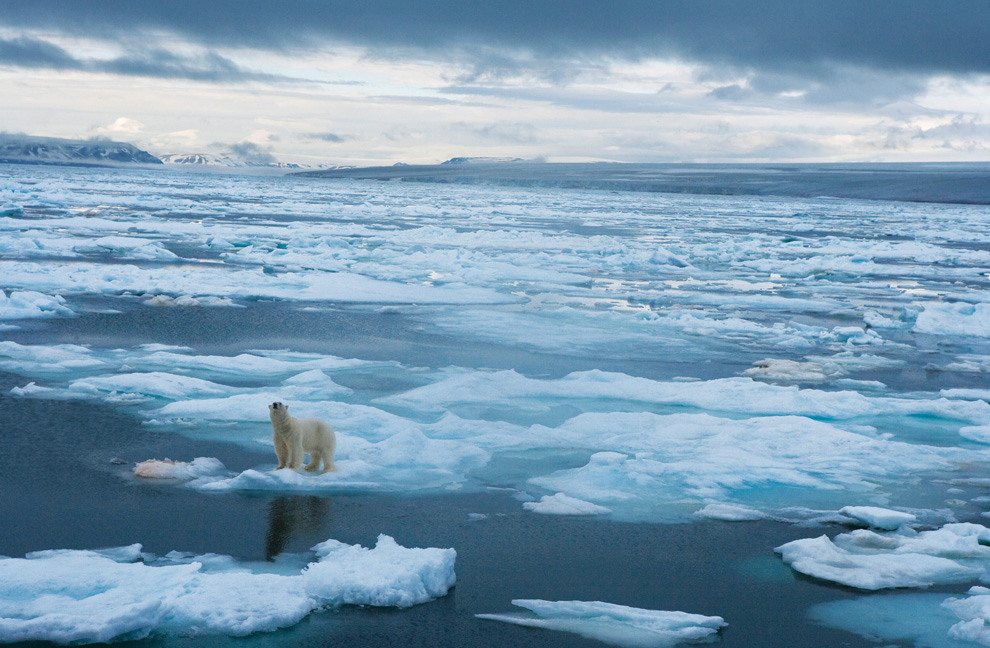
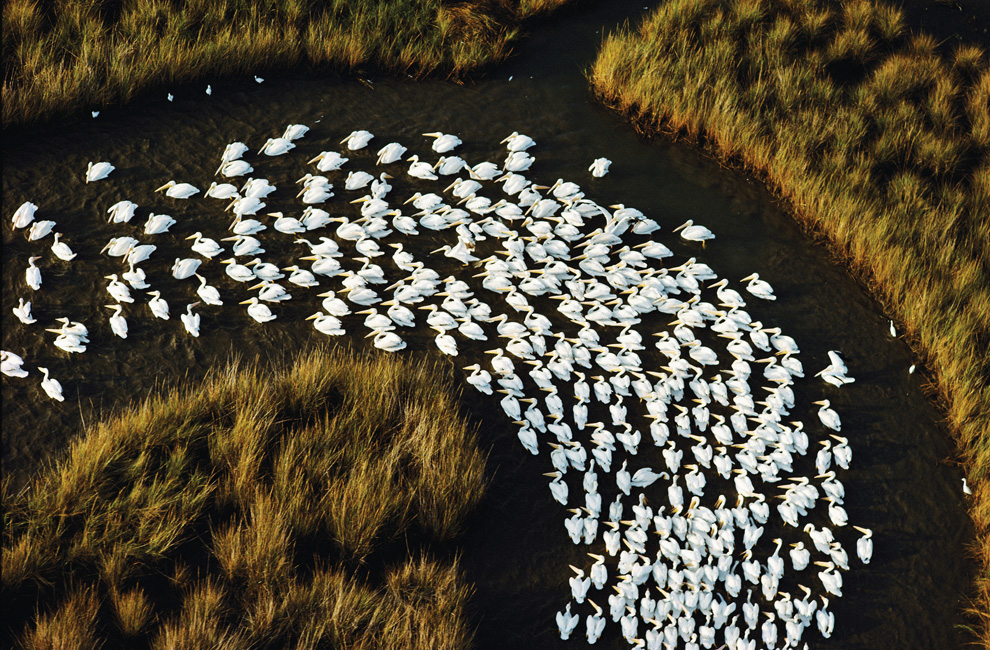
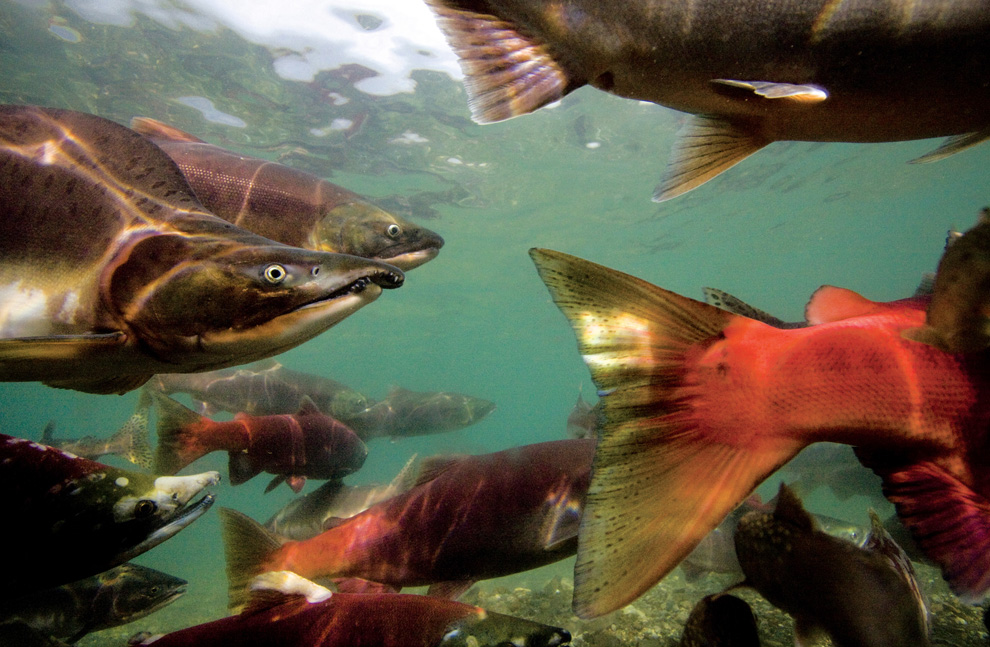
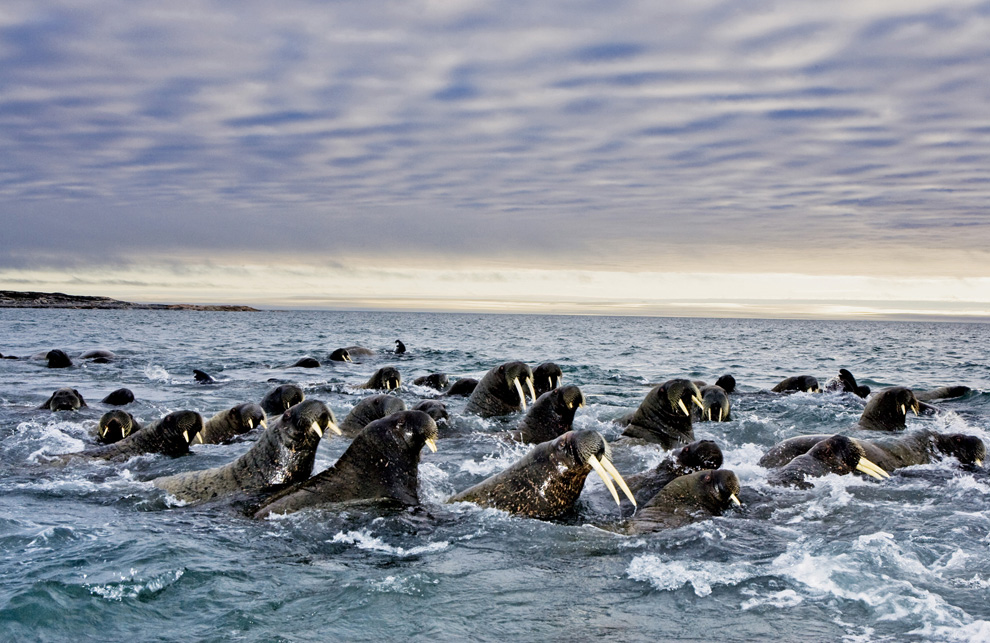
Great American Migrations


Click pictures to enlarge.

Photos from National Geographic via the Big Picture blog

The National Geographic Great Migrations series premiered on Sunday, November 7 on the National Geographic Channel and will be repeated.  A book and CD are also available.
.

Monday, April 12, 2010

Bird Flies from Australia to Aleuts in Eight Days


From Birdlife International comes this map and amazing story of transmitters fitted to four Ruddy Turnstones, one of whom flew from the Aleutian Islands to Austalia in just eight days of flying, and three of whom flew from Australia to Taiwan in just six days of flying:

Four birds fitted with ultra-light geolocators took just six days to fly from Australia to Taiwan before continuing on to northern Siberia. One bird then completed its return trip back to Australia via the Central Pacific - a total round-trip of 27,000 km!

.... The researchers therefore decided to use new 1 gram light-sensor geolocators - supplied by British Antarctic Survey in Cambridge, England - and fitted them to eight Ruddy Turnstone spending their non-breeding season in south-east Australia in April 2009. Four geolocators were eventually retrieved from birds between 20 October 2009 and 8 January 2010.

"All four birds flew 7,600 km non-stop to Taiwan in just over six days, with three apparently travelling together", said Dr Clive Minton. They then flew on to northern Siberia, following separate paths and stopping over at different sites. "By early August, two had moved to Korea and south-eastern Siberia, respectively, but another bird returned to Australia via the Central Pacific!"

The Pacific bird spent 26 July -15 October on the Aleutian Islands before flying 6,200 km across the Pacific in four days to Kiribati, and then it made another four-day, 5,000-km flight to eastern Australia. "Five days later it was back in south-east Australia having completed a 27,000-km round trip", added Ken Gosbell - Chairman of the Australasian Wader Studies Group.


.

Wednesday, April 07, 2010

Round and Round in the Circle Game


May the circle be unbroken.

I found this graphic on my computer today while I was looking for something else. I suspect I saved it a few years back when I was writing about global wildlife migrations and the fact that everything is connected, left to right, up and down, all over the world.

Yes, migration is about more than birds. It includes whales, sharks, tuna, seals, wildebeests, elephants, turtles, pronghorn antelope, butterflies, dragonflies, and even senior citizens going to Florida for the winter.

Of course, the circle game is bigger than that isn't it?

The nuclear molten core of the earth is a bubbling cauldron of magma, and that magma is seething up and cooling down, like boiling water in a pot.

Even as the molten rock goes up and down, it slowly pushes the vast plates of the earth around, and on top of these massive plates of super dense rock floats "the light stuff" like granite, dirt, sand, redwoods, elephants, and us.

And, of course the great nuclear ball that is the sun heats up the oceans which have massive upwellings of water at the equator, and massive downwelling at the poles.

These in turn drive vast ripping ocean currents we call the Gulf Stream or Humboldt's Current, or the Indian Ocean Gyre, and these in turn determine where the fish feed and whether we need to throw another log on the fire in December.

Several times a day the gravity of the moon pulls billions of pounds of water this way or that, driving water backward up rivers, fueling tidal bores, and pushing waves up and down a million miles of crab-speckled beaches.

The atmosphere too boils up and cools down, with massive upwellings and downwellings of air, and vast ripping currents of wind driving themselves around the earth in clear patterns we call the Air Stream or the Trade Winds or the Doldrums, depending on where they are and what they are doing.

The ground we live on also boils with life as worms and groundhogs, ants, plants and fungi, turn over the soil and build upon it, pulling things down and lifting things up.


And on top of this boiling planet we fight the change.

We try to build for permanence and prevent extinctions.

We fear both global warming and global cooling.

We worry about energy and where we will get it.

We are upset when butterfly, bird, mammal and fish migrations change, and we are equally upset when they do not, and the animals pass away in the face of changing circumstances.

As a rule we are oblivious.

Elephants now live in the heat of Africa and Asia, but their cousins once roamed the frozen north, and we do not think to wonder why none are there now.

Birds fly overhead unseen, coming from places we do not wonder about, and going to places we cannot imagine.

We do not know the name of the drainage we live in, or how the creek behind our house makes its way to the ocean.

We do not even know the names of all the trees in our backyard.

Meanwhile, we go to work in our prisons on the road, stuck in traffic, insulated from the weather, our minds spinning; the world's longest playing record, all the grooves running to the great self-obsessed hole in the center.

“Efé children of the Ituri Forest in Zaire (Rep. of Congo, central Africa) begin the Osani game by sitting in a circle, feet touching, all connected. Each child in turn names a round object like the sun (oi), the moon (tiba), a star (bibi) an eye (ue) and then goes on to name a figurative expression of “round” like the circle of the family, togetherness, a baby in the womb, or the cycle of the moon. As players fail to come up with a term that is “circular” they are eliminated from the game. Eventually, only one remains. Tradition has it that this player will live a long and prosperous life.” :: source
.

Tuesday, October 20, 2009

A World Connected and Boiling With Life


Loggerhead turtle migration in the Atlantic.


The entire world is a seething mass of migration.

Sharks, tuna, whales, and turtles migrate, as do eels, salmon, perch and cod, to name a few.

Birds migrate from North to South and from West to East.

Even penguins migrate.

Elephants migrate, along with wildebeest, zebra, caribou, gazelles, pronghorn and buffalo.

Some insects migrate -- ladybugs, dragonflies, butterflies and locusts, for example.

The entire world is connected and boils with life.


Click to enlarge.
.

Sunday, October 11, 2009

Shakespeare in the Park


Starling on fence post showing the distinctive "star" markings that give the bird its name.


Starlings flocking on a warm road in rural Virginia on a cold morning.


Repost from 2005

When out with the dogs in winter, we often see large flocks of starlings, often with cowbirds and blackbirds mixed in, winging down to settle on cut-over corn fields and soy rakes, huddled on the lee side of shed roofs, and even settling on roads in order to make use of the warmth radiating up from the black tarmac.

Believe it or not, the more than 200 million European Starlings found in North America today are direct descendents of approximately 100 birds introduced into New York City's Central Park sometime in the early 1890s.

Sturnus vulgaris owes its presence in this hemisphere to an odd little New York City group called the "American Acclimatization Society" which was dedicated to introducing all of the birds mentioned in William Shakespeare's works into Central Park. Previous attempts to introduce Starlings in the Northeast, Midwest and on the West Coast had failed, but the 1890 release was spectacularly successful, as today's massive winter flocks attest.

You rarely see massive flocks of starlings in the Spring and Summer. During these times of year Starlings are far more solitary, seeking out hollow trees, ledges and building eaves in which to construct their nests.

As a general rule Starlings avoid woodlands, deserts and open grassland, prefering man-altered environments such as cities, suburbs and grassy freeway medians where they can forage for bugs, seeds, berries, and insects.

In Europe the Starling is a migratory bird that forms large winter flocks bound for North Africa. When transported to the U.S., however, the Starling seems to have lost its bearings. Where, exactly, is is supposed to be migrating to? It does not know.

On the East Coast of the U.S., Starlings form winter flocks up to a hundred-thousand birds strong, but these flocks often travel just 50 to 200 miles before settling back down again.

No climate improvement is achieved over such a short distance, but a vague genetic itch has been scratched, and the birds seem to be no worse the wear for overwintering close to home.

Starlings in the Midwest migrate much farther south than those on the East Coast, probably because some individuals were blown farther south during winter storms and learned a migration routes back north by following blackbirds up from Louisiana and Mississippi in the Spring.
.

Thursday, July 16, 2009

Tracking How the Dragons Fly


Each year, millions of dragonflies arrive on the Maldive Islands, but until now no one has known where they came from. 

Now they do. It appears, says Biologist Charles Anderson, writing in The Journal of Tropical Ecology, that the insects are blown to the chain of islands, lying 500 to 1,000 km from the mainland of southern India, by monsoon winds coming from Africa as part of the world's longest insect migration between East Africa and India

The total round-trip distance is 14,000 to 18,000 km, or about twice as far as the migration of monarch butterflies between Mexico and Southern Canada. 

Over 98% of the dragonflies that show up in the Maldives are the aptly named species known as "Globe Skimmers" (Pantala flavescens).

Monday, March 19, 2007

A Shearwater's Endless Summer

The first robins have arrived back north -- a sure sign of Spring on the horizon.

The first robins are always males, as they come before the females in order to establish territories. Like many birds, Robins eat bugs in the spring and summer, but they mostly live off of fruit in the winter.

The robins of Virginia and Maryland only fly as far South as Georgia or Florida, but thanks to new micro-transmitters, we now know that some birds are world-record holders in the migration department.

Sooty shearwaters have been electronically tracked flying across the entire Pacific Ocean in a figure-eight pattern while traveling a 40,000 mile (64,00 km) roundtrip migration.

For more information on the Tracking of Pacific Pelagics, see the terrific TOPP web site, which gives information on the tracking of sharks, whales, seals, birds, turtles, and fish as they roam the Pacific and beyond.

Whales, shark, tuna, seals, turtles, birds, and even insects migrate across and around the Atlantic and Indian oceans as well, and thanks to smaller and more power radio tranmitters we are learning more and more about how life is interconnected around the planet.

A study is going on right now to track the migration patterns of dragonflys as they migrate down the East Coast of the United States.

Though it is hard to believe, each dragonfly carries a small transmitter and battery that lets it transmit a signal for about a week, and though the signal only broadcasts about a mile, it is enough to give scientists data on where the dragonflys are going and where they stop along the way.
.

Wednesday, September 06, 2006

Looking for Bird Flu in Alaska?


Sand Piper, Alaska


The Associated Press reports
that biologists are testing thousands of birds in Alaska, looking for any signs of Avian Flu.

Alaska? Sure -- Alaska. Huge numbers of bird nest in Alaska in the summer, from Peregrine Falcons and Snow Geese to Red Knots. Some of the birds that nest in Alaska are migrants from the tropical areas of Asia where Bird Flu has been somewhat prevalent.

For exanple, the Arctic Warbler nests in Alaska in the summer, and then flies across the Bering Straits, down the coast of Asia, passing through various countries including Korea, Thailand and Vietnam on the way to the Philippines where it spends the winters.

The Yellow Wagtail follows the same general migration path but nests throughout the region.

In theory, avian-flu infected birds could migrate from Asia to Alaska, and then transfer the disease to other birds that then migrated south into the heartland of North America and Latin American.

Bird are not alone in making vast migrations. If you follow migration patterns of animals, you will find that tuna, sharks, whales and turtles migrate vast disatnces North and South, East and West, and some species actually follow great circle migrations around the oceans on a seasonal basis.

Birds, of course fly great distances, and "American" birds migrate as far away as Tanzania, Australia, Tierra del Fuego, and Europe, with vast numbers going to Mexico, Central America, the Caribbean and northern South America.

Even some insects migrate vast distances. Right now Monarch butterflies are on their way south from Canada to their hibernation spot in the Oyamel Fir forests of Mexico.

In addition to monarch butterflies, some species of dragonflies also migrate south for the winter, soaring up into the jet stream to achieve incredible daily distances as they move to the Caribbean and Mexico.


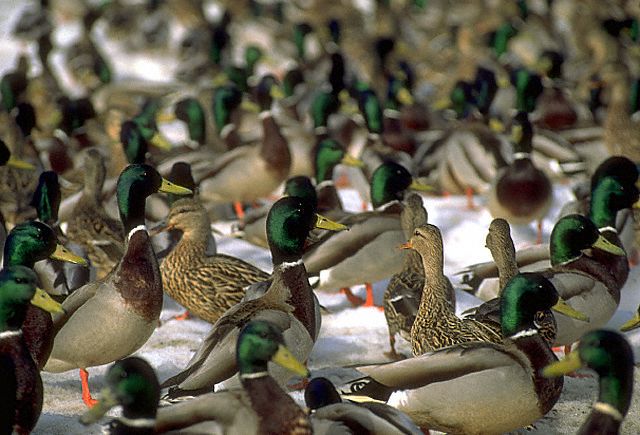
Mallards on snow, Alaska