Showing posts with label Jack Rusell (terrier). Show all posts

Friday, July 22, 2022

Plummer on the Rise of Mute Dogs

A repost from 2005
Forty Years Onwards, By D. Brian Plummer
I believe I have mentioned this before, but in the mid 1960's, Britain experienced 'Fell Fever' a time when a host of Lake District terrier men came south to judge Terrier Shows, They were treated like gods and many southern terrier buffs who had a reputation for being of sound mind suddenly began speaking in a Cumbrian accent. At that time Jack Russell terriers won most of the shows, though from time to time a rather spectacular Border terrier was selected as BIS (Best in show). Quite suddenly all the major prizes went to fell terriers, quite attractive dogs with excellent coats but sometimes over fourteen inches at the shoulder. In 1964 most winning terriers seemed to be twelve inches at the shoulder, but within ten years the winners seemed to be over fourteen inches at the withers. I'm losing the point of my article, so two points to the starboard to correct my drift. Some of the elderly terrier men who came south as savants to judge the shows had a good knowledge of working terriers others, - 'were not good enough to be allowed to carry my ferret box'. Many owned terriers which were devils to worry sheep and were totally uncontrollable in the field, and hence it became fashionable to allow a totally wild terrier to be hunted and stone daft comments such as, 'If he came out when I called him, I'll shoot him'. The reputation of the terrier man suffered greatly and those who owned working terriers were regarded as buffoons by the rest of the field sport fraternity. In the 1960's most terrier men expected their wards to behave while hunting, some terriers even dropped to shot when worked with the gun. Others retrieved to hand -'mine still do', yet the appeal of the self-entering easy to start fell terrier was such that tractability was sacrificed providing the terrier raced to ground and grabbed the fox. Prior to the 1960's hard terriers, those who would go to ground and grapple without giving tongue were not considered worthwhile. Indeed such dogs were sold for a song or given away. Game, but mute terriers which simply engaged the fox in silence were undesirable. Not only was such a dog virtually useless as a bolter of foxes, but it was difficult in the extreme to dig to such a terrier. In the 18th Century Iron-Hard ultra game terriers were mated to beagles, to give the hybrid 'voice' (Memories of The Old Charlton Hunt) Foxes rarely bolt if they are faced with a very hard dog in a natural earth, though a fox encountered in a smooth sided glazed drain will vacate the den quite quickly if faced with a hard dog. In a natural earth, particularly in a den interlaced with tree roots, matters are very different! A 'gentle' dog, one that bays at its fox rather than tackles it will, by dint of its barking, annoy a fox so much that it seeks to leave an earth for the sound of baying is multiplied ten fold in a deep earth. A harder dog races to ground and seizes its fox, foxes quite often adopt the practice of playing dead when attacked or frightened, though in point of fact the condition is closer to catatonia rather than a cleverly thought out plot. Hence the hard dog seizes its fox, which goes into a death like trance, only to find itself in a life and death encounter, when it recovers from its 'fit'. Such a fox cannot bolt and must fight to the death- though most terriers find it surprisingly difficult to kill a large fox in a subterranean struggle. Hence the terrier man of the 1960's did not require a very hard mute dog. Indeed such a dog was a liability where foxes were required to be bolted, yet changes in the way terriers would work foxes were at hand. In the 1960's moves were afoot to develop detectors, which would locate a terrier below ground. Hither to the barking of the terrier guided the digger to the fox (hence the mute terrier was a liability) now even mute terriers could be used providing the terrier was fitted out with a locator collar or the terrier had not engaged with the fox out of range of the locator. Absurd statements such as 'this terrier had never been known to make a sound below ground and I intended to found my strain on the dog' began to appear in the sporting press. Old timers shook their heads at such nonsense, but youngsters not old enough to know better, delighted in such rubbish and sought to buy dogs with similar attributes. The locator also changed the face of ferreting - once the sport of the patient and the silent now became the sport of those eager to catch a rabbit quickly with little regard to damaging the rabbit burrows. Ferrets were simply fitted with locators, put to ground and on encountering their rabbits were dug to in double quick time. If left to its own devices the rabbit would have bolted and hit the nets - with little or no damage to the burrow. Likewise the use of locators in the hunting of foxes. Many fresh foxes - not foxes chased to ground by hounds - will bolt when a terrier goes to ground and engages them. Most will bolt if the terrier engages them for long enough and noisily enough. Now by dent of using locators an amateur terrier man, and a crass amateur at that, is able to locate a fox with almost pinpoint accuracy and puts spade to sod instantly destroying age old earths which have housed a thousand or so foxes. Dan Russell. A savant of the 'old school' once wrote of the dangers of premature digging and not allowing the terrier to work its fox- and possibly bolt it. Sadly no one heeded his advice. Ronald Jones of West Wales, regarded by some as the greatest expert on the management of gun packs, once stated that he has yet to have encountered a terrier, which was too small for bolting foxes. These days a visit to a hunt terrier show will see huge sixteen-inch dogs winning classes - terriers far too large to work the majority of fox earths. Hideously scarred terriers are prized by terrier owners, most of whom seem unable to get a terrier to return to hand and well-trained terriers are noticeable by their absence. This is a study of the evolution of the terrier and its owner over nearly half a century, I confess that its not a pretty picture that has been painted , but never the less a true one. .

Sunday, June 12, 2022

Westminster & the Death of the Fox Terrier

Example
A repost from July 2004


I came across an interesting book in the stacks -- "The Dog Show" By William Stifel (2003, Westminster Kennel Club).
 
This is a very well-done coffee table book celebrating the 125th anniversary of the Westminster Kennel Club, the biggest dog show in the U.S.  
 
I did not buy the book, but I read a bit and discovered an amazing thing that helps explains the very rapid degeneration of the fox terrier between 1900 and World War II. 
 

  • The first "Best in Show" winner at Westminster in New York City was in 1907. This first "Best in Show" winner was a smooth fox terrier that looked very much like today's Jack Russell.

  • Fox terriers won again in 1908, 1909, 1910, 1911, 1915, 1916, 1917, 1926, 1928, 1930, 1931, 1934, 1937 and 1942.

  • A Sealyham (another working breed ruined by the show ring) won in 1924, 1927 and 1936.

  • Airedales made Best in Show in 1912, 1919, 1920, 1933, and 1936.

  • A bull terrier went Best In Show in 1918, and a Welsh Terrier in 1944.

As you can see, almost all the early winners were terriers, and most of them were fox terriers.

It was during this period of time that the face of the fox terrier was elongated and the chest enlarged by show ring breeders.

Prior to World War II, if you were really intent on wining the top award at a dog show, you were into fox terriers.

Probably no breed could have survived such intent attention without being wrecked by fad.

The fox terrier certainly did not. 


Sunday, April 17, 2022

Loopy Lupus Heard by Deaf Man


A Jack Russell terrier was trapped for three days in a warren at Perranporth when a hunt for Easter bunnies took a turn for the worse. 

Eight-year-old Lupus ran away from his owner to investigate the dunes during a walk at Penhale Dunes. He became trapped face down in the corridors of a warren beneath a huge blackthorn bush near The Lost Church. A poster campaign appealing for information about Lupus' whereabouts began. Meanwhile, owner Donna Jones enlisted family and friends to help search for Lupus - which means wolf. The team used a petrol chainsaw to hack through brambles to find the dog. 

Oddly enough, a man who is deaf in one ear heard Lupus whimpering first, because his deaf ear blocked out sounds from the surrounding natural environment. The team called the RSPCA, who then called the Fire Brigade. Crews from Perranporth, Newquay and Redruth used their hands, and shovels to free Lupus from his ordeal. 

 Speaking to the West Briton this week, Mrs Jones said: "Lupus is a very lucky dog. The RSPCA said three days was about all he could survive. "He is a very inquisitive dog and quite a character but this is the first, and last time Lupus will explore the dunes. "He was very subdued afterwards and we had to leave a light on for him for the next few days, when he slept." 

Mrs Jones added that a friend had bought Lupus a chocolate Easter bunny as a present, following his ordeal. Spokesman for the RSPCA Jo Barr said: "This rescue was made possible due to the great team effort with the fire brigade." "Due to their compact size, Jack Russells are well-known for getting themselves into tight fixes."  

From The West Briton, March 31, 2005 

Not said:  whether the chocolate Easter Bunny killed the dog.

Friday, May 18, 2018

Mrs. Jack Russell and Her Dog


The picture above is Penelope Incledon Bury, aka "Mrs Jack Russell".

She married the Reverend John Russell in 1826, and they had two sons, only one of which survived.

The dog pictured to the left of Mrs. Russell is presumably one of her husband's. If that is the case, it is the only photograph that I know of one of the Reverends dogs.

It should be said that Russell was apparently a bit of a dog dealer, and that many terriers and hounds passed through his hands.

Russell gave up his hounds at least twice due to poverty -- he did not have a kennel of terriers in the end as some have suggested. At the end of his life there were only four old arthritic terriers named "Rags", "Sly", "Fuss" and "Tinker".

Thursday, May 17, 2018

Non-Extinct Terriers & Other Mysteries


Many of the terrier breeds that people now lament the "extinction" of never actually existed except in the minds of Victorian picture book makers.

In "The Welsh Terrier Leads the Way," Bardi McLennan recounts the relatively recent origins of the Welsh Terrier.

"In 1800 there were only 15 designated breeds of dogs, and 50 years later there were only 50."

That is of ALL dogs, not just terriers. As late as 1850, a lot of breeds were still not very distinct and several "breeds" were known by different names. For example, in 1851, the Yorkshire Terrier was also known as "the broken-haired scotch terrier." Only in 1870 was a Yorkshire Terrier firmly designated as a breed and breed name. Before then litter mates were often shown in different breed categories -- a situation that occurred with the first prize-winning Jack Russell, which had previously won shows as a "white Lakeland."

The Welsh Terrier and Old English Black and Tan terriers were the same dog -- a type of rough-stock Lakeland dog used in Wales and in the North. These dogs had a fair amount of variation in terms of size and shape, but generally had more color than the "white foxing terriers" preferred in the South.

These rough-coated terriers existed without too much conformity in name or shape (as they still do in the working terrier community in the U.K.), but conformity and a brand name were essential characteristics of Kennel Club registration, and an intrepid history (however fanciful) certainly did not hurt sales.

With the rise of dog shows in the 1860s, the race was on to give every odd-looking dog a name and "improve" them, and terriers were at the top of the list.

One group of Kennel Club breeders decided to embrace a rather ponderous name and an incredible assertion for the brown and black dogs.  They were, they asserted, "the root stock" of all terriers in the British Isles, and they were to be called the "Old English Broken-Haired Black and Tan."

The assertion that these dogs were the root stock of all terriers in the UK is rather laughable -- no one know what the "root stock" was, and in any case there probably was no single "tap root," but instead a fine net of "rootlets" that spread far and wide and included a lot of dogs that were not terriers at all -- dachshunds, whippets, beagles, and lap dogs, for example.

In any case, the Welsh were somewhat outraged to have the English bring down a few of "their" dogs and claim they were an "Old English" anything. These were Welsh dogs, and the Welshmen moved quickly to establish that fact. The Welsh got organized quickly, and in 1884 they held the first dog show with classes just for Welsh Terriers in Pwllheli, North Wales with 90 dogs in attendance -- a rather impressive opening shot in this little "terrier war."

For their part, proponents of the "Old English Black and Tan" moniker could not seem to coalesce into a real club; in fact they could not even agree on a name for their supposedly "Old English" breed. Some called it the Old English Broken-Haired Black and Tan Terrier, some the Old English Wire Haired Black and Tan, some the Broken-Haired Black and Tan, and some just "Black and Tan" -- a color-descriptive name that had been used about as often as "white dog" or "yellow hound".

Whatever they might have called the dogs, this new Kennel Club "breed" was in fact a put-up job comprised of a mix of terrier types and they had difficulty breeding true.

In 1885 a survey of the winning dogs in the ring found that all of them were, in fact, first generation dogs, i.e. not Black and Tans out of Black and Tan sires and dams, but Black and Tans produced out of crosses with other breeds. For example, the winner of the first show in 1884 was a dog named Crib that was a cross between a blue-black rough terrier and a famous smooth fox terrier owned by L.P.C. Ashley called Corinthian.

In 1885, the Kennel Club took a Solomonic approach to the name and breed standard for the dog, featuring both dogs at their 1885 show. On April 5, 1887, however, because the English could not get organized, they were dropped from Kennel Club listings, and the new "Welsh Terrier" breed was born, perhaps propelled forward in popularity a bit by the rise of David Lloyd George, the son of a Welsh cobbler, who himself has risen from humble origins to stand should-to-shoulder with the gentry.

The "Black and Tan" terrier is not the only breed that either never existed (or still exists today, depending on how you look at it).

At the same time that one faction was pushing for the introduction of the "Old English Black and Tan Terrier" another faction was pushing for the introduction of the "English White" terrier which, it should be said, has nothing to do with the old English White molosser dog used as a butcher's dog 150 years earlier.

In fact this new dog was really a toy breed created by crossing a small smooth-coated white foxing terrier with some sort of lap dog, which left the resulting progeny with a propensity towards deafness and a bulging "apple head" like that of many modern Chihuahuas.

Both the "Black and Tan" terrier and the "English White" terrier live on in the fevered minds of the breed-obsessed thanks to a book by Vero Shaw entitled "The Illustrated Book of the Dog."

Printed in 1881, right in the middle of the "terrier wars," this book contains about 100 chromo-lithograph plates and engravings of dog breeds that were being put forth as distinct entities at that time. Shaw rather optimistically included the "Black and Tan" as well as the "English White," betting that the political machinations of English Kennel Club dog breeders would prevail.

He was wrong, which is how two "ancient" breeds of terriers, that in fact never exited, managed to appear on the scene for less than 20 years and then disappear altogether.

Wednesday, January 17, 2018

Jack The Ripper


"Jack Russells are genetically programmed to react to small animals that make high pitched noises and jerky movements -- the exact stimuli associated with very small children."

A December 14, 1991 article entitled "Dogs That Bite" in the British Medical Journal, reports on 146 patients referred for primary treatment of dog bites.

Authors P.C. Shewell and J.D. Nancarrow found that that 54% of their patients were under age 15, and that males and female humans were about equal in their chance of being bit.

The two most common biting dogs were Staffordshire bull terriers (15 cases) and Jack Russell terriers (13 cases).

Of the biting dogs, 85% were male. Most bites occurred in the owner's home or in a friend or neighbor's home. Over 40% of the bites were judged "unprovoked." Of the 146 bite cases, 32 bites were identified as severe, and 11 attacks as sustained.

Conclusion: Most victims are bitten by male dogs which they either own or have had frequent contact with, and the bite occurs in the dog's home.

The injuries consisted of 76 puncture wounds and 304 lacerations, 81 of which involved loss of tissue. One hundred and twenty six of the 146 patients had injuries to their face or head.

Though no explanation is given for the relatively large number of Jack Russell bites, the reason is not hard to tease out if you know very much about small children and working terriers.

The simple fact is that our dogs are genetically programmed to react to small animals that make high pitched noises and jerky movements -- the exact stimuli associated with very small children.

Parents often see a Jack Russell terrier and think "safe poodle-sized dog" without having any knowledge that in fact these are hunting dogs bred for several hundred years to tackle wild game head-to-head.

Almost all Russells are fine 100% of the time with children, but a small number of ALL dogs have a genetic code for fear or prey that is so strong they cannot control it when certain stimuli are cued. The result: a child with a facial laceration. It is not surprising that Jack Russells, a relatively common small breed with a very high drive for prey and hunting, is a frequently-cited dog-bite offender.
.

Thursday, October 26, 2017

Hitler's Jack Russell


Hitler is under the "X". The Jack Russell was his. For another picture.


In World War I, it was common to find terriers in the trenches where they served three purposes: messengers (this was before radios, walkie-talkies and telephones), mortar detectors (a dog can hear an incoming shell long before a human can), and gas detectors (a dog can smell a drifting cloud of mustard or chlorine gas long before a human can).

The picture above shows one of the most famous and infamous veterans of World War I -- Adolph Hitler who was gassed despite the Jack Russell dog to the far right. Young Adolph is the fellow with the ridiculous mustache under the "X". In a later picture, Hitler insisted the dog be photographed sitting at his side.

Hitler's terrier apparently had been the mascot of English soldiers and ventured out into "No Man's Land" sometime in late January or early February of 1915 while chasing a rat. The dog jumped into a German trench where Adolf (himself a messenger) caught the Jack Russell terrier and decided to keep it. Hitler named the dog "Fuchsl" or Little Fox.

Adolph fed and taught Fuchsl tricks, and the Jack Russell terrier never left Adolf's side until August of 1917 when the dog was stolen at a train station, apparently by a railroad official who earlier that day had offered Hitler 200 Marks for the terrier. Hitler said he would not take 200,000 Marks for the dog. "I can look at him like I look at a human being," Adolph had written about the dog. "I am crazy about him."

In 1918, in an incident that might have been avoided had his terrier remained with him, Hitler was temporarily blinded by a British gas attack in Flanders.

Though Hitler's maniacal hatred, paranoia and obsession were already becoming self-evident during WWI, the loss of his dog and subsequent gassing may have contributed to his desire to scapegoat others for his -- and his country's -- failures and defeats.

Monday, October 23, 2017

What's Wrong With Working Dogs as Pets?


A commercial breeder of Jack Russell terriers for pet buyers writes to ask a question.

She says she is very sincere about breeding for health and that she tries to get her hands on as much information as she can, and tests her dogs "for everything available."

She goes on to note that "Temperament is important too... this is what means the most to me."

She writes that she saw a TV segment (ABC's Nightline) in which I said that if people want to breed dogs that don't work, that's fine, but at least they should be breeding healthy dogs.

But she's a bit puzzled.

She always had the impression that I disliked the breeding of "working dogs" for the pet trade.

From her end of the stick, however, it has always seemed to her that in this day and age most dogs are not wanted for work, and most dogs are merely companions.

She concludes:


"I love the JRT and everything about them. And my passion is to genuinely breed proper dogs and skillfully match them up with families. I try to take what I know and apply it to raising nice family terriers. I just do not believe I should be ashamed for breeding them for pets and breeding them as best I know how. Do you have any thoughts for me on what I can and should be doing better?"


A genuine question: What do you need to do to breed a healthy dog? And if a breeder is producing physically healthy dogs, isn't that enough?

Here is my answer ....

There are two aspects to health:


  1. Physical health
  2. Mental health


I will not go into physical health. I have written a lot about that in the past, and there is a search engine on this blog.

That said, I have not talked too much about mental health, and it is the brain that is the most important part of the dog, especially the working dog.

To begin with, let me say that I want all dogs to be self-actualized.

Self-actualized? What do I mean by this?

Simple. I want the dog to live up to its full potential, to be in harmony with its place and circumstances, and to to be free of self-loathing, fear, and long-term psychological conflict.

Step One on this road is to make sure the dog is properly socialized. How do you do this?

Well, look at the word -- there's a hint there.

Socialized.

No dog can be properly socialized without being in society at least a few hours a day, especially during the first 9 months of its life.

What this means is that good breeders do not have 50 breeding dogs in their kennels because they know they cannot properly socialize the progeny of 50-dogs, even if they can feed and water them and keep the kennel clean.

Step Two involves respecting the code that is within the breed.

This is where so many pet breeders -- and buyers -- fall down.

You see, what makes a working dog is not the color of its coat, the lay of its tail, or the shape of its head -- it's the frantic morse-code of stimulus and impulse that is firing off within the dog.

A border collie is not a border collie because of the way it looks, but because of that code.

This is elementary. It is fundamental. It is basic.

The code inside a working collie is different from that inside a working pointer or setter, and it is different from that inside of a working terrier.

A scent hound and a sight hound are not just different looking -- the code inside them is different too.

What does this mean for dog breeders and dog owners?

It means that a dog that has been bred for generations to point birds in tall grass and brush should not be placed in a world of parking lots and city streets far from forest and field.

It means that a working terrier should not be placed in a home with a hamster running endlessly on a tread mill and a caged parrot that squaks and flaps its wings in an inviting manner.

It means that the code inside every working breed of dog should be acknowledged, respected and valued for what it is.

And yet, how many breeders of working dogs are doing this?

By definition, none that are breeding solely for pet homes.

And in that disconnect is a lot of canine misery.

The code inside herding dogs like the Border Collie, the Sheltie, and the Corgi tells them to "gather up the herd" and keep outsiders at bay.

The code inside the Jack Russell tells them to kill the hamster, bark at all squirrels, dig up the yard, and kill the cat which looks and acts amazingly like a red fox.

And yet if these dogs obey these instincts, they get into trouble!

Yet if they ignore these instincts, they are repressing everything they are, and are ever meant to be.

For the dog, it is a lose-lose situation.

The result is predictable: Boat loads of Border Collies, Corgis and Shelties with free-floating anxiety. Flotillas of Jack Russell terriers waiting in rescue for anyone to give them a good home.

Yes, surrogate work can be found for Border Collies and Jack Russell terriers.

I have known collie owners to buy ducks and chickens for their dogs to herd, and for terrier owners to keep pet rats in their garage for their dogs to chase in go-to-ground tunnels buried in the back yard.

More commonly, working terrier and collie owners turn to fly-ball, frisbee and agility to bleed off the steam building up inside their dogs.

There is nothing wrong with fly-ball, frisbee or agility. Excellent stuff and good for the dogs. But let's be honest here, eh? Any dog can do these activities.

What makes a border collie special is not frisbee or flyball -- it is what happens when sheep, cattle, or goats, or ducks are turned loose for them to herd.

What makes a working terrier special is not that it will retrieve a ball -- it is what happens in the field, at the hole, when fomiddable quarry is found at the other end of the pipe.

I am not against dog companion dogs, but if folks are looking for a companion dog, then get a companion dog!

Please.

There are scores of breeds, and millions of mixed breeds, suitable for no other purpose than companionship.

Get one of those. I will not object.

What I do object to is getting a highly charged hunting dog or herding dog and then expecting it to be something else.

That's going to be about as successful as a bridesmaid going to Gay Pride Day in order to find the Man of Her Dreams.

"They are all so handsome," she thinks, "and I KNOW I can convert one of them to my side, if only I love him enough."

Right.

That's a program for misery
, isn't it?

And yet that happens all the time in the world of dogs (and humans too from what I can gather from reading the tabloids) .

Bottom line: It's important for us to accept dogs for what they are.

They are not surrogate children (see this post on that point), nor are they inanimate objects -- mere property.

They are sentient beings, and we have a duty to them. That duty is not simply take care of their bodies while ignoring their minds.

And to repeat and undescore the core point of this piece: The minds of all dogs are not alike.

It's important for us to accept that different breeds of dogs come with different genetic codes, and that those genetic codes deserve to be unleashed.

In short, the duty to dogs is not just to make sure dogs have physical health, but to make sure that they have mental health as well.

In order to be able to deliver on that, we need to accept each breed of dog for what it is, and to not try to change it.

Try not to change it.

This last point is fundamental.

It is about RESPECT.

You cannot tell me you respect America in one breath, and then tell me you want America to give up all its values and history and cultural ideosyncracies in the next.

You cannot tell me you respect Gay people in one breath, and then tell me you want to make them all Straight in the next.

And you cannot tell me that you respect Jack Russell Terriers or Border Collies in one breath, but that you want to breed out everything that is their essence and reason for being on earth.

To Hell with that.

That's where I come from.

That's where I stand.

And that's how I identify my duty to the dogs.

  • Related Links:
** Bad Dog Talk from the JRTCA
** Robert Bakewell's Apartment
** The Real Jack Russell Terrier: A Complete History
** Ten Reasons to Join the JRTCA
** Bad Dog: An Article for Prospective Terrier Owners
** A Question of Breed
** The Transvestite Terriers of Westminster
** Canine Achondroplastic Dwarves
** No, You May Not Pet My Dog

.

Sunday, July 09, 2017

The Good Stuff

A repost from this blog, circa 2004.

Eddie Chapman writes in The Real Jack Russell Terrier (1993) that:

The hunter terrier man [on reaching a nice rambling earth with twenty entrances that run 10 feet deep], when hounds have marked there, will be told either to bolt the Fox or kill it, and in either case he must get the job done as quickly as possible, for his services may be required again, even in minutes sometimes. . . .

With everyone away from the earth, the terrier man picks a really small chested eleven inch dog that he knows can, and will, get right up to the Fox very quickly, and with luck, bolt it out in a matter of minutes. ... [T]he hunt terrier man would not have achieved the quick bolt of the hunt has he used a much bigger terrier, as it would not have been able to negotiate the tight holes so quickly, so forcing the Fox to bolt so fast.

The next situation confronted by the hunt terrier man is a Fox that has been marked in a six inch, one hundred yard field drain, that is running hard with water.

Common sense will tell you immediately that no terrier much over 12 inches will even be able to get into a six inch pipe, and with it running hard with water, an eleven inch one won't fair much better. So the smallest terrier possible will be needed to have any hope at all of pushing Mr. Fox back out again."


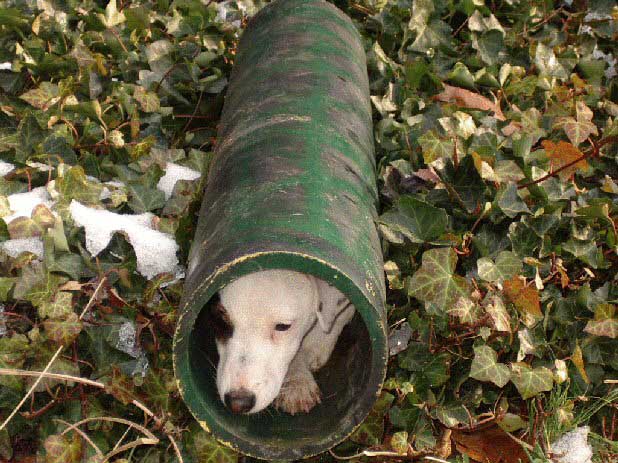
The picture, at top right, is Mountain (12 inches tall) going through a six-inch hard PVC pipe. She was a bit younger then, and could do twenty or thirty feet like this, but I do not think she would have much cared for a hundred yard drain with water flowing in it!

Eddie Chapman's point, however, is that small dogs are what you really want in the field and for a simple reason: a fox is not a coyote.

People who have never dug to a fox and spanned it with a tape measure assume a 14" tall dog has the same chest size as a 14" tall fox.

It does not.

A fox is built more like a cat than a dog, and a 14" tall fox will have a chest of 12 or 13 inches, while a dog of the same height will have a chest of 16, 17, 18 inches, or more.

It says something that red fox taxidermy mannequins start at 11 inch chests and go to 14" chests.

Eddie Chapman knows the value of a small dog, as does anyone who digs on fox, groundhog, raccoon or possum here in the United States.

Some years back, I did a survey of 355 American working terriers and the average size was just over 12 inches tall.

Of the workers surveyed, 200 were bitches and 155 dogs were male dogs -- a skew to female due to the fact that getting a really small male working terrier is very hard to do.

Of all the working dogs counted, only 37 males were 12 inches tall or smaller.

A look at the 2007 Stud Book of the Jack Russell Terrier Club of America finds a continuation of this pattern -- nice looking stud dogs, but only one male under 12" in height, and only two that are 12" tall -- all the other stud dogs listed are taller (some as tall as 15" at the shoulder!)

Chest size of course, is the most important physical attribute of a working terrier, and it is chest size at age 2 or 3 years of age that is really important, not just chest size at 7 months.

The reason for this is simple; chests tend to bow out a bit and get less springy as a dog gets older. A dog that has an acceptable chest at 10 months, may add an inch or two to its circumference in old age. You want a terrier that will go the distance, which is to say you want a small dog if you are interested in digging more than a few times a year for years into the future.

What about folks who say a larger dog will "get there" if it has the will?

Caveat emptor!

Yes, "the fire called desire" is no small thing, and yes a dog is expected to move some earth if needed, but no dog can excavate stone, no dog can excavate root, and no dog can excavate 15 feet of hard packed soil. Anyone who has dug dogs in difficult country knows this.

And let us remind ourselves where all this excavated soil goes to ... behind the dog, and into the pipe where it works to cut off the air supply the dog needs to breathe.

Caveat emptor! No one has ever wanted a bigger dog, but most have wanted a smaller one!

What about the larger dog that is said to have a "disappearing" chest?

There are such things. I have been surprised by good looking taller dogs (12.5 inches is a tall dog in my book) with small chests that still looked smart and fit. But a note of caution; there are sensible limits here.

A large dog (13" or over in height) and a small chest (14") rarely go well together. Such a dog will be reedy-looking and have the feel of an Italian Greyhound about it.

A dog should have a little bone on which it can hang its muscles! A day in the field is not always a walk in the park.
.

Saturday, July 08, 2017

The Nonsense of Pull Dogs

.

This is a repost from this blog, circa Feb 2005:


In "The Working Jack Russell Terrier," Eddie Chapman writes:

"Something that makes my blood boil is when I hear terrier men talk about dogs they call Caesar dogs. They will show you a Russell type that has been bred too big and say, 'I use him as a Caesar dog'. If I ask what a Caesar dog is, they say it is a dog which will hold the badger, he won't let go,' they say. I have never heard such rubbish in my life. Besides being unnecessary, it is invariably cruel to the dog and more often than not he will be badly bitten for his pains. Besides that, it is unnecessarily cruel to the badger and the sort of behavior that got badger digging banned. I have tried to explain how to remove badgers from a sett without injury to dog or badger. There is nothing clever about getting a hard dog smashed up by a badger. On the contrary, it shows ignorance and a lack of responsibility and feeling. Bravery in a terrier should never be exploited."

I found it quite refreshing to read this passage, as I have often noted that there is is little reason to own a "pull dog" if you actually know how to handle things at the end of a dig. The use of "pull dogs" damages dogs and quarry alike and is wasteful as it often necessitates time out of the field and expensive veterinary work.

In the U.S., the use of pull dogs (what Chapman and some others call "Caesar" dogs) is due to the prevalence of too many over-large terriers that cannot go to ground in a real earth. To say you have a "good pull dog," is to say you do not have a dog capable of actually going to ground.

If you have followed the Kennel Club dictates, and embraced a 14 inch tall dog with a 17" or 18" chest (or larger!), you are forced to rationalize a job for it. No matter that it is a stupid job forged in pain. Most people would rather see their dog injured than swallow their pride and admit they have drunk the Koolaid offered up by the Kennel Club know-nothings who think a fox den is as big around as a go-to-ground tunnel.

Another factor is that many people simply have no idea of how to handle quarry and so use the dog to to do the job. Having gotten to the end of a dig, they do not know how to get the animal out of the pipe, nor do they know how to dispatch it. In such a situation, the use of a "pull dog" is ignorance in motion.

The simplest way for a novice to handle quarry is with a snare. You can make your own for about $5, or else buy a pig snare from a feedstore. An alternative is a "coon tong" available from Bill Boatman's raccoon hunting supply catalogue.

Groundhogs can also be tailed out alive -- it is not hard if the groundhog's tail is presented, as it so often is. If very much of the pipe is remaining, however, you may find yourself in a tug-of-war with the groundhog who can jamb up inside a pipe so tightly that even a large man can have difficulty pulling one free.

Always use a snare for raccoons -- they can twist all the way around on their short fat bodies. They can grab you with their hands and have crushing bites. Rabies is not uncommon in raccoons, especially on the East Coast.

If you have entangled a fox in a net, be carefully when extricating the fox. The best advice is to pin the animal to the ground under your boot while removing the net. Work the net off the fox in sections, and then release it to hunt another day.
.

A Well Written Book With Something to Say

RIP Eddie Chapman.  A re-post from 2005

Eddie Chapman's book, The Working Jack Russell Terrier, is one of the best books written on working terriers.

It is a very short book -- just over 100 pages long including 35 illustrations -- but it is enough because Chapman has something to say, and says it plain and without a lot of wind-up.

A key theme of the book is that a useful dog has to be small in the chest. Chapman writes:

"There is one point of a study dog's anatomy which is more important than any other and that is the size of the chest, or rib diameter if you like. The standard states that a Jack Russell should be capable of being spanned by the hands behind the shoulder blades. This, to my mind, is extremely misleading as any adult man and most women have a hand span which is bigger than the chest of an average fox. I am a small man and have reasonably small hands, but in more than 20 years in which I have handled well over 1000 foxes, I have never handled a full grown fox which came anywhere near the span of my hands.... It therefore follows that if I pick up a dog and can only just span him with a squeeze, then the dog cannot get to a fox in a tight place and a dog that cannot get to a fox in a tight place cannot be considered a Jack Russell. Either you are breeding a dog that is suitable to work fox or, if he is too big to get to a fox, you are just breeding for looks. This, of course, is what happened to the pedigree Fox Terrier and look where that has got him!"

Chapman writes later on in the book:

"[The Rev. Jack Russell] hunted the Exmoor area and was master of the North Devon Hounds. I know the country well and have worked my terriers in most of the Exmoor Earths off and on for nearly twenty years and at one time I was there professionally. So I think I can claim to know what sort of terrier is needed to work those earths efficiently. The earths in Exmoor are the same as those in which Mr. Russell worked his dogs. . . .

There are many hunt countries that have earths similar to the Exmoor and so they find it necessary to use the standard, small-chested Russell Terrier. I do not think I would be wrong if I spoke for all their men and said that good small dogs have a definite advantage over good big dogs in their bigger earths. They have more manoeuvreability in the bigger earths and the big dogs are useless in the small earths because of the size of their chests, so they are very limited in their use .... On the working side, I think if we look at the country as a whole, I think we will find that the most used size is between 10 and a half inches and twelve and a half inches."

The Working Jack Russell Terrier can be ordered from Coch-Y-Bonddu Books in Wales. This book is well worth the price, with nice chapters on handling fox, a chapter on locators/bleepers (I find it amazing that so many recent books never even mention them!) and hints on how to breed a proper-sized dog.

For other books on working terriers see Read Country Books. For the only practical book written on American working terriers, go here.
.

Friday, July 07, 2017

If John Russell Were Alive Today ...


A lot of time and energy is spent by people on the show ring circuit culling through pedigrees counting the number of "champions" they can find listed. This is called "selective breeding," by the Kennel Club folks, but what is it they are selecting for?

Among show ring aficionado's working ability is never the primary selection. Since, in the world of working dogs in which John Russell lived, the second slot is selection by size, and the third slot is selection by gender, the show ring breeder is (at best) promoting fourth-string characteristics to prime. This is a recipe for ruin, and it's a recipe the Reverend John Russell watched with concern during the early years of the British Kennel Club. As he noted about his own dogs:

"True terriers they were, but differing from the present show dogs as the wild eglantine differs from a garden rose."

If you do not work your dogs underground often, you have no idea of what you are breeding for when it comes to work.

It is not a matter of working a few weekends. A dog's working qualities and abilities are not made in a day. Nor should yours be, if you are a serious breeder. You need to dig quite a while to know the value of voice, the value of nose, and the nature of the balance point between having a dog that is too hard and too soft. It takes a few dogs and a few winters to fully appreciate the value of a good coat, and to understand the value of a small well-muscled dog.

The people in the AKC like to talk a lot about John Russell, but they manage to leave off the fact that he did not create his dogs in the show ring, but in the field and by testing them in the ground and under a spade. Though he occasionally judged dog shows, he did not register his own dogs as he feared dog shows would be the ruin of working terrier. He was not wrong!

If John Russell were alive today, most of the people who own Jack Russell terriers -- including many of those with working certificates -- could not show him a day in the field with the dogs. I think Russell would be rather embarrassed by that fact, and he would certainly by saddened.

A repost from 2009

Tuesday, January 24, 2017

The Sad Rise of Hard Dogs


Just as the world of rosette-chasers is filled with those chasing an ever-changing image of "the perfect terrier," so too are there those chasing idealized visions of the perfect digging dog.

I myself do not put much stock in theories of perfection, and I generally write off anyone who starts bragging about how wonderfully "hard" their terrier is.

As a rule, these folks are young and have not yet dug too much.

A very hard dog that insists on coming to a grip every time it goes into a hole is a liability if you work your dogs on a regular basis, as a wrecked dog may be out of the field for several weeks or even a month or more.

A dog with brains and experience will generally box and press in the hole, but it will receive little serious abuse, as it will soon learn "butt from breath."

And yet we continue to get folks showing up in the world of working terriers who want to talk about how hard their dogs are.

Where do these people comes from?

Eddie Chapman provides an answer in his book, The Real Jack Russell Terrier:

To put a date on it, the beginning of the sixties was the start of the wage rise boom and in just a few short years people started to find they had money in their pockets for other things than the bare necessities. Working men suddenly had transport, and terrier clubs were formed in the industrial areas because they were no longer confined to their home towns or villages.

Working terriers, it seems, have a strong appeal to young men looking for excitement, and if you have ever been in a pub or club full of beer drinking young terrier enthusiasts you will know what sort of atmosphere can be created by the loud mouths, parading around with their macho-looking battle scared head-badgers, all boasting that they smashed this and smashed that. So impressionable young men could hardly resist when the opportunity arose to become one of the so-called in-brigade, loosely referred to as 'Terrier Men'.

To be one of the lads, it seemed imperative that you had a macho dog to fit the image, and the ultimate test for the macho terrier man's dog was the Badger. To dig Badger you traditionally needed a Baying terrier, so there was suddenly great demand for the best Jack Russell blood, and large prices were paid by these newcomers for the best Jack Russell blood available.

As more and more joined the terrier clubs, the macho image of the harder terrier became almost a cult, and some even traveled to the far north in pursuit of the legendary hard terriers bred exclusively to kill Foxes in the undiggable rocky hills up there, and so the cross-breeding began.... [T]oday, only thirty years on, we find that so much cross-breeding has been done that the original pure-bred strains are in very small minority indeed. The macho terrier men are almost all gone, and the gangs they created, with the image that they portrayed, gave the antis all the fuel they needed to persuade the general public that with literally hundreds of new people suddenly joining the sport, too much pressure was being put on the Badger population, so that it was in danger of being extinct, and 'bang' a Law was passed that protected them from being dug.

So there it is -- a lot of young people who do a small amount of digging and a great deal of drinking and talking.

Ah well! As I said before, each to his own.

I myself do not value too hard a dog.

The most important tool is voice.

Yes, there is a place for teeth to punctuate the paragraphs when needed, but a truely HARD dog? No, I think I will pass on that animal, and pray I do not get another again.

You see, I do not speak from theory, but from experience. A truely hard dog is a sadness waiting to happen.

But why do I want a mixer?

Simple: When you are digging on groundhogs, you cannot afford a dog that will never engage, as otherwise too many groundhogs will get an opportunity to dig away.

A bite in the ass, and the groundhog has to turn around if it wants to defend itself. If the groundhog has turned to face the dog, it cannot dig away. If it will not face the dog, then it will find that a terrier clenched on its ass will sure slow down the digging process!

The ideal dog then is an experienced dog that learns more than one technique and is able to call on those techniques, on the fly, depending on the quarry in the hole, the lay of the land, and the temperment of the animal it has bottled up below.

All that I require of my dogs is that thay they find in the field, go to ground with enthusiasm, locate, notify me of their actions underground with their voice, and prevent the animal in the pipe from digging away if it is able.

Do I require them to stay for 8 hours? No. I have only rarely had a dig last longer than three hours, and most last far less than that.

Sorry, but if you are looking for wild yarns about dogs lost for three days underground, and only free'd with the help of a backhoe and two sticks of dynamite, I am not your person.

Besides, call me a fairy if you want, but I do not call a dog lost to ground for three days a success.

I do not count having to lose work and money on field rescue a mark of experience.

Yes, all my dogs have scars on their muzzles, but here's a little bit of truth: most of those scars were earned when those dogs were still young and learning their craft.

An experienced dog generally uses that experience to avoid injury. And so too does an experienced terrierman.
This post is recycled from 2004.

Tuesday, February 16, 2016

No Tolerance for Diversity


The American Kennel Club has very little tolerance for diversity. The goal of conformation, after all is to conform.

And so, if we follow the history of AKC breeds, we find that the Norwich Terriers could not be shown very long with both ears up and ears down -- they had to be split into two breeds to conform to the AKC's intolerance for diversity.

The Fox Terrier could not come in both smooth coats and wire coats -- they had be split into two breeds.

The Corgis were split into the Cardigan Welsh Corgi and the Pembroke Welsh Corgi.

The retrievers were split into Curly Coated and Flat Coated (to say nothing of all the other divisions).

Cocker Spaniels were split into "American" and "English" varieties, while the Springer Spaniel was split into "English" and "Welsh" varieties.

The Mountain Dog was split into the Bernese Mountain Dog and the Greater Swiss Mountain Dog, while the Cairn Terrier cleaved itself into colored dogs and the all-white "West Highland White."

Can you tell the difference between a show Lakeland Terrier and a show Welsh Terrier? The difference is only a slight shift in color, but it is an intolerable difference to the AKC show ring.

Similar intolerances led to collies being split into Rough and Smooth coated collies (to say nothing of Border Collies).

The Poodle was shattered into three separate breeds based on size (while also being moved from its sporting roots into the "nonsporting" category).

Now, in the AKC, there is a push to split the Akita into two breeds -- the American Akita and the Japanese Akita.

As for the Jack Russell Terrier, the AKC has already split it into two different breeds -- the "Parson Russell Terrier" and the "Russell Terrier," each with their own invented histories.

And what is the point to all this breed atomization? No point higher than the chasing of rosettes.

Does the bird in the field, alive or dead, care about about the registry or "breed" of pointer or retriever?

Does the sheep care what about the registry or "breed" of the herding dog coming up the hill?

Is a cart pulled differently by a Swiss Mountain Dog as compared to a Bernese?  And what does the lay of the ear or the color of the nose have to do with it?

Does the fox, raccoon, groundhog or possum care about the coat color shift between a show Lakeland and a show Welsh Terrier?

Do rats run terrified from Norfolk terriers but give high-fives to Norfolk terriers based on whether their ears are up or down?

It is all pretty absurd and speaks to theory, bigotry and exclusion and rather than experience and practice.

The fox, raccoon, and groundhogs on my farms do not have theories about the shape of working terriers -- they have experience.  Length of leg?  Rough or smooth?  Ears up or down? Lay of shoulder?  It matters not a whit to them.

And so it goes, around the world, with sheep, cattle, hares, duck, quail, and pheasant each having experiences with dogs that are not too heavily impacted by theory.

And, of course, the working people have their opinions too. If you put any three of them in a room, see if at least five schools of thought are not presented on any given subject!

That said, do American houndsmen turn to the AKC to stock their hunts with American Foxhounds?

Do the indigenous people of Greenland consult with an AKC judge before selecting their sled teams?

Are rich gulf-state Bedouins standing ringside at Westminster, Crufts or Hialeah with rolls of money in their hands, so anxious are they to buy the winners at any price?

Nope, nope, and nope.

It's not that folks who work their dogs object to beauty; it's that conformity to patent nonsense is not how they define beauty nor is it a value they are likely to salute.

Friday, November 06, 2015

The Accuracy of the Internet

Example
A repost from this blog circa August, 2004

Some of the stuff on the internet really is amazing. I got a call the other day from a fact checker on the West Coast that is editing some kind of general dog book. They wanted to know if it was true that a Jack Russell terrier had killed 3 tons of rats in one day!

"Uh no, that would be a lie or a very serious mis-statement," I replied. I explained to the woman that Brian Plummer claimed his TEAM of dogs had killed 3 tons of rats over the course of a YEAR in the mid-1970s, and that this was certainly possible, though still impressive and, oddly enough, there were no pictures. Oh. And the dogs were not Jack Russells.

By they way, I inquired, where had she gotten this little nugget of misinformation that she was about to pass on between two bits of cardboard and charge a price for?

She steered me to this web site (link now broken) which describes a Jack Russell Terrier as a dog that weighs 7 pounds and is 10 inches tall. According to this web site the dog originates in Germany, and the prefered color is black, "but black/tan, red or dark gray are also allowed."

According to this site, the Rev. John Russell crossed Trump with bull terriers and pocket beagles to get the modern Jack Russell.

Sure he did. And yes, it's a 7 pound dog from Germany, and the best color is black. Absolutely!

.

Tuesday, January 13, 2015

Reality Comes to the Rally


The 2005 Monetpelier border terrier rally. This is a repost from 2005.

I have done the Border Terrier Rally at Montpelier every year for the last 21 years (one of only two organized events I attend) and in recent years they have put me to work as a rat rangler since I do not show, and Trooper has been banned from racing (after he did it only once and ripped through the welded mesh at the front of the racing box, grabbed the fox tail, and would not let go).

This time I decided to do a little education of the show ring set and I very quietly brought along a hard 6-inch tube about 5-feet long. I set up the "Rally Ratting" event so that at one of the eight stations the dog would have to go at least 18-inches or more down a heavy-duty 6-inch tube (staked hard to the ground and totally immoveable) in order to get at the rats which were in another 4-inch PVC tube drilled with air holes.

Not a dog could do it!

After a dog proved that it could not do it, and before the owner started to explain or complain too much, I pulled out the pictures (below) of a December fox.

First I showed them this picture. Many "oooohs and ahhhs" about how big the fox looked (actually it's a pretty small vixen)


Then I showed them this picture and noted that the woman spanning the fox has completely overlapped her thumbs. Since I dig with this woman quite a lot (I dug this fox with her) I know she is no giant (maybe 5' 6"). This fox was 40 inches from tip of nose to tip of tail, but was only 11.5 inches in the chest.


Then, to put a little icing on the cake, I noted that Camilla Moon (the organizer of the rally) and I had bolted a fine red vixen out of a hole that was no bigger than this pipe just six days earlier.

Almost any vixen in the world can get through a 6-inch pipe if pressed by a dog, but almost no border terrier in America today can negotiate that pipe. People got this lesson one-on-one in a little patch of woods, and I tried to be very relaxed about it and noted (prior to getting to the pipe) that most dogs failed this part of the test. If a dog was anywhere close to being able to get into the pipe (even half its chest!) I said very nice things about it.

Nonetheless, the point was made, and it was a hard landing for some folks who had been on an extended flight of fancy about how they had "working" border terriers even though their dog has never even seen a fox. Some of these folks think a 9" square go-to-ground tunnel is what a fox den looks like!

Was bringing reality to these people a bastardly thing to do? Probably, but if you love the dogs (and I really do love border terriers) someone has to give an occasional lecture in REAL working terrier conformation and a brutal beating about chest size is more than called for at this point.

The fellow in the show ring judging the show dogs, by the way, was a "leading professional handler." Say no more!

I do not breed dogs, but if I did I think my program would depend on two 10-foot sections of 6 inch pipe. The bitch would have to go down the tube to get her food every day. When it came time for breeding, an adult dog (two years of age or over) would have to go down the tube to get to the bitch in order to do the job. No young stud dogs!

I'm absolutely serious about the pipe thing -- it's a tough test but anything too subjective and these breeders will gimmick it to death (as they have).

I am convinced that the human has to be take out of the test, and the fox put back in it. The 6-inch pipe does that job if a fox is not readily about (and how convenient for most breeder that it is not!).


The pipe used at the Border Terrier rally. This is my 12" Jack Russell and she is red-lining for size. I prefer a dog that is a little smaller, as chests tend to spring out and get a little harder in old age. This dog can still get down the pipe at age three and a half, but it is tougher than it used to be.


Same dog pushing through
in a shallow field pipe loaded with roots. The real world is tougher than a smooth pipe, though I had once nice lady trying to tell me otherwise!


Same dog exiting a sette. Fox settes can be quite large or quite small -- sometimes in the same sette! A small dog can get anywhere, while a larger dog is limited to only the largest settes or else has to be dug to at the tight turns. Since prime fox season is only eight weeks long, and there is unlikely to be more than one occupied fox sette in any given 500 acres area, you want to be able to work every fox sette you can find. The goal is to get the dog up to the fox and have the dog have enough room or maneuver. If the dog is getting knackered, it may be because it cannot maneuver!

Monday, January 12, 2015

Cracking Tired Chestnuts About Form and Function


Red fox taxidermy mannequins. There is no red fox taxidermy mannequin anywhere in the world that has a chest span of greater than 14 inches.


At the side of every show ring, there is always some well-dressed individual talking about "the standard" and how "form follows function."

It all sounds good, of course -- wonderful rhetorical chestnuts -- but it's pretty much nonsense.

I mean think about it. A working dachshund is a great little animal in the field and does the same work as a terrier, but it does not look like a terrier, does it?

By the same token, a Patterdale Terrier does not look too much like a Jack Russell, which does not look too much like a Border Terrier. Smooth coats and rough do equally well in the field, as do coats of black or white, red or brown, or any combination in between. A folded ear is the same as a prick ear, a black nose the same as a liver-colored nose. Every working earth dog breed has a different head shape, and many have different tails as well. A perfect scissors bite is not necessary for work.

So when people say "form follows function," what the hell are they talking about?

Let us hope they are not talking about movement. Movement is one of those words show people toss around with a wink and a nod as if they have the secret knowledge of a wine connoisseur.

It is pure bunk. "Movement" may be important to a greyhound, a pulling dog, or even a border collie, but it is not much of a concern as it relates to a working terrier. So long as a dog can walk well, and has decent muscle mass, it can work fine. Hocks in or out hardly matters a whit.

Which is not to say that movement is irrelevant to terrier work. In fact, it is critical. But the important movement is .... wait for it .... an owner that will move off the couch, and move out of the car, and move into a hedgerow, and move a lot of dirt while digging down to a dog that is in full voice with rising adrenaline. That's the only important part of movement that matters. After you have done that a few dozen times, you will know a little more about movement, and terriers in particular.

We hear a great deal of nodding nonsense from folks who talk a good game about "protecting" their breed. But protect it from what? And by what right or qualification do these people think they are particularly well chosen to protect the bred? And what do they intend to protect it with?

In almost every case they are people who do not dig, and who seek to "protect" the terrier with nothing but a scrap of paper proclaiming a show dog "up to the standard."

And who do these people hope to protect the breed from? Why, show ring breeders, of course!

It is all laughable nonsense. And it becomes nonsense on stilts when people begin to talk about "the standard" as if it were a sacred text delivered to Moses on the Mount.

In fact, is there anything standard about "the standard?" I defy you to find a single canine standard that is more than 20 years old that has not been changed at least once.

And then there is the little matter that the standard is not the same from one country to another, or one registry to another. So what is so "standard" about the standard?

Ironically, what is NOT part of any standard in the UK or the US, is a requirement that the dog actually be a proven worker in the field. That, apparently is not "the standard." That function is not required for the rosette. A black nose, is a "Yes," but working a dozen fox, raccoon, badger, or groundhog in the field, is a "No."

The one issue of any importance in "the standard" as it relates to "form follows function," is chest size. Yet on this point, "the standard" is awfully vague, isn't it?

We are told a chest span is a man's hands. Yes, but whose hands? We do not measure a house in cubits, so why are we measuring dogs in "hand spans"? Who but the puppy peddler profits by keeping chest measurements this vague?

The Germans are not so coy and facile about chest size. A standard working dachshund (a "Teckel" in German) has a chest of just under 14 inches. The measurement is precise -- 35 cm -- and it reflects the chest size of the average red fox. The Germans are not ones to shave dice when it comes to working dogs.

It is interesting that the same 14" chest size is named not only by fox biologists, but also by such terriermen as Barry Jones, Ken James, and Eddie Chapman. In fact, if any one thing separates the digger from the rosette chaser, it's clarity on chest size.

The rosette chaser is always a bit vague about what a "span" actually means. A digger knows it means his fingers better well overlap, and if he is working fox in a natural fox-dug earth, it is best if his fingers overlap by more than one joint!

And so we come back to the real meaning of "form follows function" as used by academics in the dog world.

For these folks the "form" being referred to seems to be a paper form showing the pedigree of the animal being displayed. And "the function" is either the rosette from a show judge, or the cash to be gotten from a prospective dog-buyer.

Form follows function, indeed!

Monday, February 24, 2014

A Wrench that Doesn't Fit


Dog histories are always an interesting thing, as are breed standards and the all-breed dog books.

I have found that all of these things seem to copy each other, with one bit of idiocy begating another, so that now about half of the all-breed books say a border terrier is 10 inches tall.

I suppose we will soon discover that John Russell bought a dog named "Milkman" from a man named Trump, and that a Border Terrier was named after the "South of the Border" franchise!

In that vein, I was on the web site of the breeders association for the AKC "Parson" Russell Terrier, and found an interesting history that made me laugh. There are several poorly phrased bits in this history, but I will not quibble with the small parts, but focus on the main.

The PRTAA breed history begins, "The Parson Russell Terrier was first bred in the south of England in the mid-1800's to hunt European red fox ..."

Good up to there, I suppose, though the dog predates John Russell (he had no problem finding a white foxing terrier to mate to Trump!) and was not called a "Russell" terrier (of any type) until after the Reverend was stone dead. In the mid 1800s they were fox terriers or foxing terriers until the Kennel Club ruined the breed and disgraced the name.

I suppose that one should also note that there is not such thing as a "European" red fox; there is only a red fox, and it is the same animal all over the world, from Israel to England, and from Canada to California. The fact that the American red fox is the same as the "European " variety will no doubt come as a surprise to the theorists in the Kennel Club.

The history goes on to note that "Rev. Russell was a founding member of England's Kennel Club in 1873, and in 1874 he judged fox terriers for The Kennel Club."

There is a bit more to say there isn't there? Russell was 78 years old when the Kennel Club was created -- an old man broken by poverty who had been forced to sell off his pack of hounds because he could no longer afford to keep them. He judged one of the very first Kennel Club shows, but his remarks at that show are notable. As he somewhat humorously described his own terriers after going to the show and seeing the Transvestite dogs being paraded around the ring: "True terriers [my dogs] were, but differing from the present show dogs as the wild eglantine differs from a garden rose."

Russell never did register his own terriers with the Kennel Club, noting that the things selected for at shows (color of the nose, placement of the ear, etc.) were of no use to a working terrier in the field. As far as I can tell, he judged only one show, found it an amusing disgrace, and never repeated the mistake!

The PRTAA history goes on: "The first breed Standard was drafted in 1904 by Arthur Heinemann, who founded the Parson Jack Russell Terrier Club in 1914."

In fact what Heinemann founded was the Devon and Somerset Badger Digging Club, and he founded it in 1902, the same year he bought the Cheriton Otterhounds. Heinemann never met Russell (he was only 12 when Russell died) and his dogs were not descended from Russell's dogs (Russell had only only four very old terriers at the end).

The PRTAA web site goes on: "The JRTAA standard was based upon the Heinemann standard and was written to represent the Parson Russell Terrier as a working terrier to red fox and red fox alone."

Really? A digging club called the "Devon and Somerset Badger Club" wrote a breed standard for an animal they were not working??? What an odd thing.

In fact it is pure bunk invented by people who do not dig, and who have have conveniently cut down the history to fit their nonworking dogs.

In the world of show dogs, fantasy feeds more than substance, and more dirt is thrown with a computer keyboard than with a shovel in the field.

The world of the working terrier allows for different sized dogs for different earths, situations and quarries. Different wrenches for different nuts, so to speak.

A badger sette and a fox pipe are not the same size, nor are the animals that dig them. A fox may put up in a badger earth, in which case a larger dog can be used, or it may put up in a drain, in which case a larger dog can be used if the drain is big enough, but a European badger earth and a natural fox den are not the same size. If you are hunting fox you need a dog capable of following an animal with a 14" chest -- it's that simple.

The true history of the AKC breed standard seems to be that they have a breed standard written by a badger digging club that they are now presenting as a breed standard for working red fox in a natural earth.

No wonder there are so few Kennel Club dogs found in the field! It's a bit like an American mechanic showing up at a Volvo factory and wondering why none of his wrenches fit!
.

Thursday, February 23, 2012

How Much Is That Jack Russell in the Window?


I've happily plundered the web site of Embrace Pet Insurance in the past to write about the true cost of Golden Retrievers, German Shepherds, English Bulldogs, and Dachshunds.

Now it's time to talk about the Jack Russell Terrier.  l love this write up from Embrace Pet Insurance. 

Right at the top, Embrace Pet Insurance says most people  do not want one.  No you do not!  Please do NOT get this dog if all you want is a cute lap dog.  Jack Russell Terriers are prey-driven hunting dogs.  They bark, dig, and they are a complete pain-in-the-ass.  Or as Embrace Pet Insurance puts it in their opening paragraph:

No matter how enamored you were of Eddie on Fraser or PBS' Wishbone, the fact is this: The Jack Russell Terrier (or the Parson Russell, as he's known in AKC circles) is almost certainly not the breed for you. That's not because Jack Russells are bad dogs. He was created for active work, and it's what he loves and what he is driven to do. If you have a job in mind for him that will push his limits and engage his full and enthusiastic attention, then you may be that rare person who is right for one of these dogs.

Bingo. And, on behalf of the dogs, THANK YOU Embrace Pet Insurance. The description goes on:

If you're wondering why your Jack Russell isn't as well-behaved as Eddie or Wishbone, it's because the dogs that portray those characters have full-time trainers on staff to keep them in line. More to the point, those dogs had full-time jobs, which is what the JRT wants and needs. His endless desire to be digging, barking and investigating can't and shouldn't be squelched. It should be celebrated by someone who loves the very traits that drive many JRT owners insane.

Bingo again. And again, on behalf of the dogs, THANK YOU Embrace Pet Insurance.

So what about health? Embrace Pet Insurance gets it right there too:

If you look at the list of diseases on the Jack Russell Terrier Club of America website, you'll decide this has to be one of the unhealthiest breeds around. Not so; it's just that most breed clubs aren't as relentlessly thorough about even the rarest health conditions that can affect their dogs.

Yep. Bingo again.

In fact The Jack Russell Terrier is just about the healthiest and longest living "breed" around, but that's not something those of us who love the dog are going to tell everyone, because we do not want people rushing out to acquire a Jack Russell terrier before they have gone into a quiet room to take inventory about themselves -- not who they want to be, but who they really are.

A dog is not a hat to try on and discard with fashion and mood; it is a commitment for life.

Let me suggest to you a simple truth: most people who want a dog need a cat and deserve a gold fish. Damn few people need a Jack Russell Terrier.

The health care costs of a Jack Russell are going to be pretty low, but you might find the fencing costs staggering (this little dog both digs and climbs), and they may eat your furniture if they are bored.

Still thinking about getting one of these dogs? Then please visit Jack Russell Rescue after reading this article twice. And if you are thinking about breeding a Jack Russell (please do not!), be advised that JRTCA members routinely test their breeding dogs for vision, hearing and other health problems, and so should you if you ever hope to find a place for your dogs in the marketplace. And no, Jack Russells do not sell for much money, so there's no big dollar puppy business to be had here. If that's your dream, can I suggest AKC toy poodles rather than JRTCA Jack Russells?

The Jack Russell Terrier Club of America (JRTCA) stands for the dogs, it stands for canine health, and it stands against the puppy peddlers who oversell other breeds. The JRTCA runs ads in almost every all-breed magazine every month telling people NOT to buy a Jack Russell terrier, with links to the "Bad Dog" page. This is what a breed club should be doing, but so far as I know, the JRTCA is the only dog breed club in the world that actually does it.

If your take-away message from reading this little post is that Jack Russell terriers owners are fierce about protecting their dogs as healthy working dogs and keeping them out of rescue, then I have only two words to say to you: Damn right.
.