Showing posts with label sparrow. Show all posts

Monday, January 07, 2019

Sparrows with Wine-Colored Heads


House Finch (male) aka the "Hollywood Finch". This is a repost from August 2007.

The House Sparrow, (or "English Sparrow" as it is sometimes called) was first introduced to the U.S. in the 1850s and promoted to city officials across the East and Midwest as an effective form of pollution control -- sparrows were supposed to clean up the horse droppings littering America's streets.

Mayors, city councils and park officials heralded the release of sparrow colonies in much the same way they heralded the arrival of gas lights and indoor plumbing -- as a sign of America's coming of age. The House Sparrow was, quite literally, a kind of "equine catalytic converter" designed to make our increasingly crowded cities a cleaner place to live.

Within 20 years after its introduction, the booming population of House Sparrows in the U.S. was perceived to be having a negative impact on some native song bird populations, especially eastern bluebirds, tufted titmice, and various chickadees.

The friction between the immigrant and native birds was largely due to the aggressive nature of the House Sparrow which simply out-competed some native birds for housing and (to a lesser extent) food.

The rise of the House Sparrow created one of the more interesting environmental battles of the late 19th and early 20th Century. Dr. Thomas Mayo Brewer -- a great friend of John James Audubon and a co-author of the first modern catalog of American birds -- thought the House Sparrow was a wonderful and determined little bird and that, in time, it would prove to be one of America's favorites.


English Sparrow or House Sparrow, male and female

Opposing Dr. Brewer's love of the House Sparrow was Dr. Elliott Coues, whose "Key to North American Birds" remains one the most important works of American ornithology. Dr. Coues advocated an open war on House Sparrows, saying they were a peril to native birds. Dr. Coues described the House Sparrow as "sturdy little foreign vulgarians," and "animated manure machines ... without a redeeming quality."

This fray between naturalists was, believe it or not, a minor cause celebre, and was enjoined by the likes of Harriet Beecher Stowe (on the side of Brewer) and the very young Theodore Roosevelt (on the side of Coues).

In 1883, the American Ornithologists' Union (AOU), a newly formed organization made up of the most eminent men in the field of birding, resolved at their first meeting to decide "the eligibility or ineligibility of the European House Sparrow in America," i.e., should the sparrow be granted the right to be called a naturalized American bird?

In the end, the AOU concluded that the House Sparrow could not be admitted as an American species.

Despite this ruling, the House Sparrow eventually made its way into the AOU's "Check List of North American Birds," as an "introduced" species. By 1931 this distinction had evaporated, and the House Sparrow was added to the AOU check list without any quibbling or further notation.

The House Sparrow had, for all intents and purposes, been assimilated and was now a "North American Bird" (though, it should be said, it remains one of the few birds that can be trapped and exterminated without a license).

At about the same time that the American Ornithologists' Union was removing the asterisk next to the House Sparrow's name, House Sparrow populations began to decline as automobiles replaced horses in America's streets. Changes in farming practices further reduced the amount of grain spillage and horse manure available for avian gleaning. By the end of the 1940s, the first "house sparrow" reduction had occurred.

A second reduction in House Sparrow populations occurred in the 1970s and 1980s. The reason for this reduction was the rise of another bird in the eastern United States: the House Finch.

The House Finch is native to the American west. A pretty bird (it looks like a sparrow dipped up to its neck in red wine), House Finches were live-trapped in California after World War I and sold in eastern pet stores as "Hollywood Finches."

In 1940, however, the sale of domestic-caught wild songbirds was banned in the U.S. Caught with a small inventory of now illegal "Hollywood" Finches, a pet store in Long Island simply released them out the back door. From this modest and impromptu introduction sprang the millions of rose-headed finches we now have storming our bird feeders across the East.

The House Finch proved to be aggressive enough to "beat back" the House Sparrow, and a kind of detente now exists, with each bird helping to hold down the other's population.


Male and female House Finch

What about the birds that were once in decline due to competition with House Sparrows?

Ironically, they are doing fine and probably exist is numbers larger than they did in pre-Columbian time when the east was entirely in forest.

Edge-habitat-loving populations of Eastern Bluebirds, Tufted Titmice, and Chickadees are back up with the help of thousands of bluebird boxes constructed and placed in parks, on fence posts, and along nature trails by a generation of school children, boy scouts and dedicated birders.

As for Brewer -- the "winning" side of the house sparrow war -- "Brewer's Sparrow" is named after him. Ironically it is a native bird.

A bird is also named for Elliot Coues. Coues' Flycatcher, however, is mostly found in Mexico and Central America and can only be seen in the U.S. in the mountains of Arizona and New Mexico. Adding insult to injury, the AOU recently decided to change the name of Coues' Flycatcher to "Greater Peewee".

Clearly when you lose a war -- even a "sparrow war" -- your monuments do not last for long.
.

Friday, December 23, 2011

Bird Species Decline in the U.S


In large parts of the U.S., over half of our songbird species are in decline. Scientists say habitat destruction is largely to blame.

Across the United States, more than 250 species of neotropical migratory birds fly south for the winter.

Beginning in the early 1970s, scientists began to notice that many species seemed to be in decline

What was going on?

Scientists have concluded that the decline of neotropical migratory song birds in the United States is closely linked to four issues closely linked to human population growth and habitat destruction:


  • Tropical Forest Destruction
    The population of Latin America and the Caribbean has doubled in the last 35 years, and with it has come unprecedented destruction of tropical rainforests. As populations have exploded, more landless peasants have colonized forest areas and cleared vegetation, with slash-and-burn cycles becoming progressively shorter. At the same time, logging over wide areas and the rapid expansion of commercial farming has accelerated the disappearance of forests and fueled the rapid destruction of once-lush bird habitat. In the Peten region of Guatemala, for example, 77 percent of the land was covered in dense forest in 1960. By 1990, that number had fallen to just 29 percent.

  • Pesticide Use Overseas
    Neotropical migratory birds are being killed by the heavy use of insecticides, herbicides and fungicides, which are used to boost crop productivity to feed increasing numbers of people in the developing world. In some cases, birds are poisoned outright by chemical application, or by consuming grain and insects that have been sprayed. In other cases, the pesticides accumulate and concentrate within the birds, resulting in deformed chicks or eggshells that are so thin they break before hatching.

  • Suburban Sprawl and Forest Fragmentation
    As the population of the United States has grown from 76 million in 1900 to over 280 million today, cities and suburbs have sprawled outward. Fairfax, Virginia, for example, a suburb of Washington, D.C., saw 69 percent of its forest converted to homes and businesses between 1980 and 1995. As human populations have risen, and forests have fallen, primary predators such as wolves, bobcats, and cougars have been wiped out, while the ecological niche of meso-predators such as feral cats, raccoons, possums and foxes has expanded. The result has been massive predation of Neotropical songbirds, which tend to nest in the open and near the ground rather than in tree cavities or higher up in the forest canopy.

    With forest fragmentation has come an invasion of native and non-native birds that compete with deep-forest species for food and nesting sites. One example is the brown-headed cowbird. Cowbirds were once confined to the forest edges of mid-western prairies where they fed in grasslands grazed by roaming bison. Today, however, because of widespread forest fragmentation, parasitic cowbirds can be found all across the United States. A single cowbird may lay as many as 20 eggs in a breeding season - one or two eggs per songbird nest. Because Neotropical migrants tend to build open cup-shaped nests, and raise only a single brood a year, they are particularly susceptible to cowbird parasitism.

  • Intensive U.S. Farming Practices
    As American farmers make increasingly intensive use of their lands, bird populations suffer. Post-to-post cultivation has wiped out edge-row thickets where many songbirds used to nest, while many farmers now cut hay three times a year where they used to cut just once. The result is that hedgerow and ground-nesting birds like the northern bobwhite, the eastern meadowlark, the vesper sparrow, and the grasshopper sparrow are in rapid decline.

Thursday, December 22, 2011

Cowbirds, Mesopredators, & Grass Nesting Birds


The National Audubon Society's Christmas bird count is a pretty good organizing tool, but a little weak on science, since it is mostly counting bird-feeder birds that are not in too much danger of loss.

So what birds are in decline in the U.S.? Mostly neo-tropical migrants and grassland-nesting birds. More on neo-tropical migrants tomorrow. For now, let's look at grassland birds.

U.S. populations of Henslow's Sparrow, Cassin's Sparrow, Grasshopper Sparrow, Field Sparrow, Savannah Sparrow, and Vesper Sparrow exist in numbers only a fraction of what they did in the 1850s when the tall grass prairies had yet to fall under the plow.

Over the course of the last 20 years alone, the Breeding Bird survey has enumerated a very rapid decline in these birds that seems unrelated to loss of land across the U.S. Other grassland birds also seem to be in decline, especially such sparrow-like birds such as the Bobolink, the Dicksissel, and the Western Meadowlark (the state bird of Kansas, Montana, Nebraska, North Dakota, Oregon and Wyoming).

What is going on? The short answer is industrial agriculture.

As human population numbers have increased in the U.S. and across the world, more and more pressure has been put on America's farm land -- the source of 15% of the world's cereal production.

The good news is that record crops are being produced despite the fact that less and less land is being put under the plow.

The bad news is that this increased production has required more automation, less fence-row cover, and more intensive management of farm habitat than ever before.

A good example of what is going on can be seen by taking a look at America's hayfields. While 40 years ago a hay field might have been harvested once a year, most hayfields are cut three times a year now, thanks to automation. The second and third hay harvests typically occur just as grassland birds are breeding.

The good news is that while we are farming our most productive lands more intensively, we are putting a lot of marginal farm land into a Conservation Reserve Program (CRP) started in 1982.

The CRP has worked to take more than 32 million acres of farmland out of production in order to slow top soil loss and exhaustion, and to provide habitat for native plants and animals. CRP lands now total more than 50,000 square miles across the United States, and make up vast stretches of some prairie states.

Unfortunately, despite the extensive acreage put into the CRP program, it has not been enough to reverse the decline of some grassland bird species.

One problem is that much of the land in the CRP program is in relatively small blocks, often bordered by working farms. This "edge" habitat is perfect for deer, fox, raccoon, raptors, pheasant, grouse and turkey, but it is not always conducive to the successful breeding of grassland birds, many of which only do well in very large blocks of prairie devoid of trees.

In fact, because the population of medium-size predators such as fox, raccoon, possum and hawks is high in edge habitat, grassland nest mortality of small grass-nesting birds is often unnaturally high in small-acreage CRP locations.

In addition, the tree cover provided by old farm windbreaks and shelterbelts provides a near-perfect habitat for the brown-headed cowbird.

The brown-headed cowbirds is a brood parasite species which lays its eggs in nests of other birds and leaves them for the host bird to raise.

Because cowbird eggs hatch a few days before those of their hosts, the larger cowbird chick is able to push out the eggs and chicks of the host bird, thereby winning all the food resources for itself.

The destructive capacity of the brown-headed cowbird is hard to overestimate: a single female can destroy the clutches of 20 or more song birds in a single season.

Would I advocate shooting a cowbird? In a minute.

In fact, in some areas the only way to get native bird species back up to acceptable levels is with Larsen Traps designed to catch cowbirds. To learn how to build a cowbird trap (a good project for a boy scout !) click here.
.

Thursday, April 22, 2010

When Population Growth Comes Homes to Roost

.

Today is Earthday, and it also happens to be that time of year when more than 250 species of neotropical migratory birds are now flying north to spend the Spring and Summer in North America.

Beginning in the early 1970s, scientists began to notice that many of these bird species seemed to be in decline

What was going on?

Scientists have concluded that the decline of neotropical migratory song birds in the United States is closely linked to four issues, which in turn are closely linked to human population growth and habitat destruction.


  1. Tropical Forest Destruction
    The population of Latin America and the Caribbean has doubled in the last 35 years, and with it has come unprecedented destruction of tropical rainforests. As populations have exploded, more landless peasants have colonized forest areas and cleared vegetation, with slash-and-burn cycles becoming progressively shorter. At the same time, logging over wide areas, and the rapid expansion of commercial farming, has accelerated the disappearance of forests and fueled the rapid destruction of once-lush bird habitat. In the Peten region of Guatemala, for example, 77 percent of the land was covered in dense forest in 1960. By 1990, that number had fallen to just 29 percent.

  2. Pesticide Use Overseas
    Neotropical migratory birds are being killed by the heavy use of insecticides, herbicides and fungicides, which are used to boost crop productivity to feed increasing numbers of people in the developing world. In some cases, birds are poisoned outright by chemical application, or by consuming grain and insects that have been sprayed. In other cases, the pesticides accumulate and concentrate within the birds, resulting in deformed chicks or eggshells that are so thin they break before hatching.

  3. Suburban Sprawl and Forest Fragmentation
    As the population of the United States has grown from 76 million in 1900 to over 300 million today, cities and suburbs have sprawled outward. Fairfax, Virginia, for example, a suburb of Washington, D.C., saw 69 percent of its forest converted to homes and businesses between 1980 and 1995. As human populations have risen, and forests have fallen, primary predators such as wolves, bobcats, and cougars have been wiped out, while the ecological niche of meso-predators such as raccoons, possums and foxes has expanded. The result has been massive predation of Neotropical songbirds, which tend to nest in the open and near the ground rather than in tree cavities or higher up in the forest canopy. Along with suburban sprawl has come fragmentation of once unbroken tracts of wild woods. America’s national forest system now contains over 383,000 miles of logging roads — a distance eight times longer than the interstate highway system. With forest fragmentation has come an invasion of native and non-native birds that compete with deep-forest species for food and nesting sites. One example is the brown-headed cowbird. Cowbirds were once confined to the forest edges of mid-western prairies where they fed in grasslands grazed by roaming bison. Today, however, because of widespread forest fragmentation, parasitic cowbirds can be found all across the United States. A single cowbird may lay as many as 20 eggs in a breeding season — one or two eggs per songbird nest. Because Neotropical migrants tend to build open cup-shaped nests, and raise only a single brood a year, they are particularly susceptible to cowbird parasitism.

  4. Intensive U.S. Farming Practices
    As American farmers make increasingly intensive use of their lands, bird populations suffer. Post-to-post cultivation has wiped out hedgerow thickets where many songbirds used to nest, while many farmers now cut hay three times a year where they used to cut just once. The result is that hedgerow and ground-nesting birds like the northern bobwhite, the eastern meadowlark, the vesper sparrow, and the grasshopper sparrow are in rapid decline.

As bad as things are now, they are likely to get worse in the years ahead. The reason: massive immigration, both legal and illegal, which is expected to drive the population of the United States from 300 million to over 500 million by 2050.

This is a repost from April 2004 of a piece written in 2002.

Friday, March 27, 2009

Malthus and the Sparrow

Example

When Rev. Thomas Malthus wrote "An Essay on the Principle of Population as it Affects the Future Improvement of Society" in 1798, the population of Britain was about 11 million.

At the time Malthus thought Britain was pretty close to its agricultural production threshold and that a doubling of Great Britain's population to 22 million was "probably a greater increase than could with reason be expected."

To suppose that Britain could feed a population double this size again (or 44 million people), would be "impossible to suppose," said Malthus, and this impossibility "must be evident to those who have the slightest acquaintance with agricultural subjects".

Of course, Malthus was wrong about agriculture.

Rev. Malthus failed to anticipate the degree to which outputs could be increased in Great Britain -- and all over the world -- thanks to machinery, fertilizer, modern farming practices, genetic improvements, and irrigation.

Today Great Britain has a population of over 60 million people and they are not starving. In fact, all over the world food production has risen faster than population growth, and this has been true for most of the last 200 years.

While increased agricultural outputs have been good for humans (less starvation) and generally good for wildlife (less wild lands put under the plow), there are increasing signs that not all is well.

Across the world many species of once-common wild birds are in decline. This is true not only in North America but in Europe as well.

The British are certainly taking a hard look at the situation. The British government monitors wild bird populations as a key measure of environmental health and they have noted fairly precipitous declines in their field and forest birds.

Now comes the latest news: reports from across Europe that populations of common house sparrows are in rapid decline. In fact, the decline in the house sparrow population has been so steep that it has now been put on the "red list" in the U.K.

No one is quite sure why house sparrows are in decline.

An observed decline in the number of eggs in house sparrow nests is an important clue. The size of the clutches of songbirds (passerines) and most raptors rises and falls in direct relationship to how much food is available (yes, birds understood and believed Malthus long before we did). A small clutch of eggs is typically a sign of a decline in one or more critical food components. One theory of house sparrow decline is that the phenomenon is linked to loss of critical insectivorous habitat. Insects are a critical component of house sparrow diets immediately after hatching.

Why are the insects disappearing?

One factor may be the rapid decline in British hedgerows. During a single 10-year period (1984-1993), more than one-third of all of the hedgerows in the United Kingdom were lost -- a whopping 121,875 miles of destruction. At least another 96,000 miles of hedgerow were lost in England from 1945 to 1984.

British hedgerows are fabulously vibrant ecosystems supporting myriad plant and insect species in dense thickets. An analysis of hedgerows has found a close correlation between the age of a hedgerow and its plant diversity, with some British hedgerows estimated to be as much as 1,000 years old. As hedgerows have vanished, so too have seeds and insects that once sprang from these hedgerows.

Why are the hedgerows disappearing so rapidly?

Much of the blame lies with agricultural policy and the desire to boost agricultural outputs by plowing edge-to-edge with ever-larger farm machinery. In addition, as more and more people have moved into the countryside to live on mini-estates, hedgerows have fallen to new housing developments and road widening.

Though a 1997 law was enacted in the U.K. to try to slow hedgerow destruction, the bulldozers continue to do their work. The decline in hedgerows across much of Europe may, in fact, prove to be a critical factor pushing the house sparrow over the edge.

The good news is that the population growth in Europe which first spurred the push to boost agricultural productivity, is finally slowing. The U.K., with a population of 60 million today, is expected to effectively achieve zero population growth around 2025. Much of the rest of Europe is headed the same way.

The bad news is that human population growth has pushed a great deal of the natural landscape of Europe right to the edge and changing land use patterns may be pushing it past the tipping point in some areas.

As more and more people move out of urban cores and into far off suburbs and once-rural areas, less and less land is available for agricultural production. In order to keep food production up, the land must be farmed more and more intensively in order to wrestle the same outputs from a declining number of acres.

The result, as we see in both the U.K, and the U.S., is the loss of hedgerows and shelter belt forests, increased incursions into the few large blocks of forest that remain, and a steady decline in forest and field bird species across much of the temperate-zone regions of the world.
.

Friday, October 24, 2008

Hedgerow Loss in the U.K. and the U.S.


Hedge laying in the UK.

During a single 10-year period (1984-1993), more than one-third of all hedgerows in the United Kingdom were lost -- a whopping 121,875 miles of destruction (see data table here) . At least another 96,000 miles of hedgerow were lost in England from 1945 to 1984.

British hedgerows are fabulously vibrant ecosystems supporting myriad plant and insect species in dense thickets.

An analysis of hedgerows has found a close correlation between the age of a hedgerow and its plant diversity, with some British hedgerows estimated to be as much as 700 years old.

As hedgerows have vanished, so too have seeds and insects that once sprang from these hedgerows. One result is a very rapid decline in sparrow populations in the UK.

Why are the hedgerows disappearing so rapidly? Much of the blame lies with agricultural policy and the desire to boost agricultural outputs by plowing edge-to-edge with ever-larger farm machinery.

In addition, as more and more people have moved into the countryside to live on mini-estates, hedgerows have fallen to new housing developments and road widening.

Though a 1997 law was enacted in the U.K. to try to slow hedgerow destruction, the bulldozers continue to do their work there as they do here.

Last week I was driving a section of Maryland countryside which I had hunted on six or seven years earlier.

Since then, hedge and field have been bulldozed clear and replaced with plastic houses and font laws. "Possum Ridge" it was once called, but there were no possums there now; just plastic toys, playground equipment, fresh cut lawns and asphalt driveways.

To read more about what is happening to the land around Washington and Baltimore (and why) read The Fox Versus the Stork.
.


.

Tuesday, April 22, 2008

Winged Weapons of Mouse Destruction


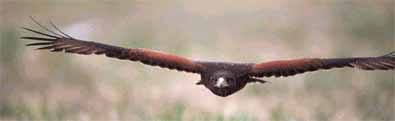
A young Falco sparverius. The American Kestrel or Sparrow Hawk, sometimes called a "spar", is actually a small falcon.


Humans like to think that we see well -- a vanity we cultivate by comparing ourselves to dogs, rats and other mammals that mostly see in black and white, grays, light yellows, and blues.

In fact, most mammals have a sharply reduced visual spectrum because early mammals went through a very long period when almost all of them lived an entirely nocturnal existence.

Most mammals are still nocturnal. If you wonder where the raccoons, possum, deer and fox are in your area, the answer is that most move about only at night. The rest of the time they are resting up in thick tangles of growth, tucked up into underground dens or hollow trees, slumped into small depressions and wallows, and otherwise "loafing on the couch," just out of eyesight.

Since most humans never stray far from car or path -- and almost never venture into dense tangle or on to even slightly swampy ground -- the critters remain undiscovered.

Animals that are mostly nocturnal do well with eyes that see very little color.

The canine eye is a good example. Though your dog may sleep all night (and half the day too!) it is still only a few thousand years removed from its wolf or proto-wolf progenitor; not enough time for physical evolution of the canine eye to have occurred.

The bottom line is that dogs do not see very well -- not even sight hounds or seeing eye dogs. In fact, dogs seem to see only about one-sixth as well as humans.

Not all mammals see in a reduced spectrum, however. The progenitors of old-world apes experienced a mutation millions of years ago that resulted in more cones and rods being added to their eyes. The result is a wide range of color vision among old-world apes (chimps, gorillas, orangutans) and their cousins, we humans.

Surprisingly, some of the oldest and most primitive animals on the planet have a wider spectral rangethan humans and chimps. This includes reptiles and the likely descendants of dinosaurs -- birds.

Anyone who has tried to stalk a wild turkey knows how incredibly sharp their eyes are. In fact, all birds have remarkable eyesight. It's been estimated that a common sparrow hawk, for example, could read a newspaper from 25 yards away, while an eagle can spot the twitching ears of a rabbit from a distance of two miles.

The reason avian acuity is so high is that a bird's eye is built entirely differently from that of a human or a dog. For one thing, the retina of a bird is enormous.

The retina is the screen at the back of the eye on which an image, coming through the lens, is focused. This screen is composed of light-sensitive rods and cones, with the rods registering shapes and the cones differentiating colors.

On rods alone, the avian eye far eclipses that of the dog or the human. A human eye, for example, has about 200,000 rods, while an eagle has about a million -- five times more.

The true knockout blow for birds, however, is in the cone department. It turns out that many birds, and especially birds of prey, have cones in their eyes that enable them to see a much wider spectrum than we can, and for some birds -- such as the American Kestrel or sparrow hawk (actually a kind of small falcon) -- this spectrum includes ultraviolet light.

What's the benefit of being able to see in the ultraviolet spectrum? Simple: mouse urine glows purple in ultraviolet light (one reason "black light" is used to find old pet urine stains on wooden floors).

When a sparrow hawk hunts along a hedge, it is able to look for urine stains that mark mouse holes, runways and nests.

Mice and rats mark their burrows and runways with urine scent trails because, like most mammals, they do not have very good eyesight. Scent cues help rats and mice orient themselves in the complex world of hedge, forest, field and barn. The result is that a rat or mouse can "run" a scent trail very fast without spending time in the open trying to figure things out.

Experienced human ratters know this about rodents, and so they will drag their boot across the middle of a shed and spin long boards perpendicular to where they have been lying, all in an attempt to break up or disturb invisible scent trails. A few seconds hesitation by a confused and disoriented rat is just the edge a terrier needs to even the odds on the farm.

For a sparrow hawk, visible urine trails enable it to focus on areas where small rodent activity is heaviest. By simply flying over a hedge or field, and then lighting on a fence post, telephone pole, or dead tree near visible urine marks, a sparrow hawk can dramatically increase its chance of finding lunch.

Once activity in the grass is spotted, a sparrow hawk will face into the wind and hover low over a grassy area -- a tactic that earned it the name "windhover" or "wind fucker" in 17th Century Holland, when the terminology was considered a little less offensive that it is today.

As for ultraviolet vision, it's not all about food -- it's about sex too. It seems that all those rather drab-looking birds we see in the hedge look a lot prettier when they are seen through the lens of an ultraviolet-sensitive eye.

Birds species in which male and females look very much alike to us look very different to the birds themselves, as they have twice as many cones in their eyes and so can see shade and colors we miss altogether.

.

Monday, July 23, 2007

Beyond Flights of Fancy


A repost from 2006 of this blog.


In his book Stormy Nights and Frosty Mornings,
Paul Dooley writes of going to his first field meet with a hawking club.

He had never been to such an event before and was rather apprehensive as there were a couple of 'names' present who always talked a good game. Later he learned that some of these people, particularly one of the organizers of the meet, had never flown a bird free!

When it came time to actually hunt, nobody in this hawking club wanted to fly their own winged charge at fur or feather -- it was deemed to be "too windy" by some, while another said his bird was an ounce or two over weight and another said his bird "wasn't ready yet". It was Paul -- a novice -- who flew his bird and scored on first flight.

Paul writes: "It was quite an eye opener for me that day. The problem with field meetings for these fake falconers was that there was nowhere to hide. Some of them used to turn up without their birds just to watch. Nothing wrong with that, but why pretend that you hunt a bird when you clearly don't?"

Why pretend indeed! Yet people DO, don't they? And it's not just in the world of hawking.

I mention this paragraph, in part to highlight Paul's book, but also to note that we have the same kind of people in the terrier world, and they exist in other arenas too.

In The Survival of the Bark Canoe author John McPhee writes of Henri Vaillancourt, a maker of traditional Indian birch-bark canoes. For years Vaillancourt had been building canoes based on a mixture of book learning, theory, and pure fantasy. It was only when he asked Vaillancourt to go on a canoeing trip with him that McPhee learned an eye-opening truth: Vaillancourt had never actually paddled his own creations for any distance far from home.

His canoes were beautiful to look at, but the crafts themselves represented design choices unburdened by actual field experience. In the end, McPhee's book is not really about birch bark canoes -- it's about the collision between theory and practical knowledge.

Is it much different in the terrier world?

Not from what I can see. Some people have spent years on Internet bulletin boards, but have never actually dug five feet to a critter. They still do not own a decent shovel, and still do not know what to do with a squalling raccoon at the stop-end of a dirt pipe. Their theory of terrier work is entirely unburdened by field experience. When questions are asked, they do not pay close attention to the answers since it's all romantic abstraction. The purpose of a question is not to solicit an informed answer, but to extend idle chatter. Just as Paul Dooley's fake fliers show up at a hawking meets with birds that have never left a creance, so these fake diggers show up at terrier trials and enter their "one and done" dogs in the working terrier ring.

I was reminded of this collision between reality and fantasy while reading Matt Mullenix's excellent book, In Season, A Louisiana Falconer's Journal.

Matt is not a fantasy flyer. His book is about the reality of hawking -- keeping his bird at the right weight, finding a bit of pasture that has not been mowed flat, painting a cracked talon with Crazy Glue and nail hardener, and balancing the competing interests of job, hawk, children and wife. Every flight is not a glorious thing ending in a brace of rabbits; sometimes it's a soaking rain and a footed sparrow or worse -- mere indifference from a hawk a little too heavy to focus.

With a sense of confession, Matt explains that though his Harris Hawk nails its fair share of swamp rabbits and doves, there are also lot of cotton rats. They are, for better or worse, a primary quarry in his part of the country.

I get it. It's easy to love a rat if you hawk -- just like it's easy to love bluegill and sunfish if you fly fish. Field action of any type beats fantasy and theory seven days of the week.

Matt writes of the rising tension of a group hunt, when there may be too many birds flying, and as a consequence problems can rise up and spin out of control quickly. The same thing occurs with terriers. A solo man and his dog are under no pressure, but put more than three or four dogs in the field at once, and things can move too quickly for the human to avoid real trouble. It only takes one train wreck to ruin a day.

I do not hawk, but I understand Matt because he is actually hunting and his concerns mirror mine even though we hunt different animals on different game in different parts of the country. Matt talks about a hawk's leg turning blue after a run-in with a tree and the calculated risk that two hawks, diving for the same swamp rabbit, will accidentally grip on to each other as well as the rabbit. Is their a digger that does not understand this problem? I have felt the same rising arpeggio of concern, never mind that it is played on a different stage in a slightly different key.

In a small part of the book Matt writes of a man who "has no time for falconry." In two weeks this novice had flown his young bird only once, and then when the bird was over-matched. When Matt points out that it's pretty hard to work a hawk on a weekend-only basis, the novice replies, "but that's the time I have."

Matt does not comment. He does not need to.

What the hawker wants is interesting, but it's not really part of the equation, is it? There are some things that are required in hawking, and time with the bird is clearly one of them. Mullenix does not have time for falconry either, but it does not matter; he steals the time from family and job, from sleep and rest. He feels guilty about the theft (an honest man would), but he steals it anyway. It is what you have to do if you are serious.

With hawks, it's either all the way in or all the way out.

The dog world is a bit easier, and perhaps for that reason we are surrounded by more fakes, novices, romantics and bored housewives than the people in the world of hawking. I do not know. Perhaps I am wrong. Paul Dooley suggests falconry has its share of preening pretenders too.

All I know for sure is that the hawkers are a pretty literate and interesting lot. A tip of the hat to them, and a recommendation for this book.

I close on a slightly troubling note. In the UK, some of the mounted fox hunts are attempting to exploit a loophole in the law that allows riders and packs of hounds to hunt fox with large raptors. The result is that dozens of mounted fox hunts have gone out to purchase Golden Eagles and Eagle-Owls.

This is insanity on stilts. There is no tradition of hunting fox with golden eagles and owls in the UK. Exmoor is not Kazakhstan or Mongolia, no matter how loose the immigration laws get.

Add a novice hawker to the mix, along with a rioting pack of hounds, a couple of dozen spooked horses, a large dog fox, and a few overhead power lines and roads, and you clearly have winged disaster waiting to happen. Already, I have a report that two Golden Eagles have died from the sheer stupidity of it all.

And yet, perhaps God does have a sense of humor. There may yet be a punch line to this joke.

It turns out that after being extirpated from the UK for more than 100 years, once-native Eagle Owls have mysteriously begun to show up and breed in the wild.

I have little doubt these are captive birds that have escaped and hacked themselves back into prosperity on a diet of pigeon, starling and rabbit.

Excellent.

Mother Nature may yet bat last, and if the stupid anti-fox hunting law is repealed (as I believe it must and will be), then a fair number of captive Golden Eagles and Eagle-Owls may be yet be hacked back to the wild.

What a glorious day that will be!


Monday, May 28, 2007

Making a Coat-Hanger Sparrow Trap

Back in April, I posted a short squib about human-wildlife conflicts and the fact that some people do not see such things as unhappy problems, but as an opportunity to score dinner.

As part of that post, I mentioned that when my brother and I were young and living in North Africa with my parents, we would amuse ourselves by trapping sparrows using a jaw trap made from a weak spring and an old coat hanger wire.

The traps we used were store-bought (and probably Italian made), but I have made a few poor copies since coming to the U.S. and a reader in Japan (an American falconer) wanted to know how to build one. The instructions are below.

Expect a bit of fit-and-fiddle work putting one of these together; it probably will not go together smoothly the first time. That said, it's not quite rocket science, and if you are handy with wire and a little bit patient and willing to try again, you should be able to assemble your own.

These traps live-catch the sparrows -- the wire "jaws" close down around the sparrow's neck, but the spring is very weak (snap it on your thumb to make sure it is not too hard) and the feathers on the bird cushion the blow. The bird is trapped by the neck and unable to fly solely due to the trap's small weight. Note that if a cat is around, it will steal both your birds and your traps, while if a heavier bird or a rat is caught it may be able to fly or crawl away with your trap. Staking a trap with a short piece of fishing line can prevent trap loss.

A Tunisian fellow was over at the house on Saturday repairing a window, and I showed him my trap and asked him if he had used them when he was a kid -- he had. Sadly, kids in Morocco, Algeria and Tunisia these days no longer use these traps much -- they have TV now. Ask any middle-aged North African, however, and he will remember the Good Old Days, when kids spent a lot of time shooting marbles, playing with wooden tops, catching sparrows, and saving up money for a real leather soccer ball.


Tools.
Note small store-bought springs in middle. Use one spring per trap.


  1. The thick blue line sketch is a drawing showing the main "frame" of the trap. The pencil-lead part of the sketch is of the swinging jaw of the trap -- the "C-jaw". Starting with a drawing is a good idea, as you need to make sure that the tongue of the trap (the long extension drawn in blue) will extend past the hinging jaw (outlined in pencil).

  2. All three of the main parts of the trap are made from heavy-duty coat hanger wire and are shown cut and ready to assemble. The very light-wire part of the trigger is not shown, but two inches of any light wire will do the trick. The last photo shows how the trigger assembly works.

  3. The spring has been put on the "frame" of the trap. You use one spring and split it into two parts, with the middle bit of the straightened spring affixed in the gap as shown. You need to put the spring on before you bend over the ends of the coat hanger frame to hold them fast together.

  4. The straight piece of coat hanger wire with the little hook on the end is part of the catch. The hook is affixed to the loop at the end of the long tongue of the trap, and then the bar is pulled over the hinged C-jaw, and the end of the catch is then caught on a small light-wire hook affixed to the straightened part of the spring that is in the gap at the center of the trap frame.


The assembled trap is shown above. This picture shows a professionally-made trap, and not the poorly made one-off affair show at the very top and below. Give me time, a proper jig to bend the wires, and 100 practice runs assembling these things, and my craftsmanship is sure to improve!


The trigger mechanism is show in the close up, above. Note that the brake bar is barely held by the light wire hook in the middle of the trap. The trap is baited by sliding a little piece of bread over the light wire hook.
.