Showing posts sorted by relevance for query Joe Bowman. Sort by date Show all posts

Thursday, December 07, 2006

Joe Bowman's Patterdale

Joe Bowman, the Ullswater Huntsman, from Foxes, Foxhounds & Foxhunting by Richard Clapham, published in 1923.

Most of the folks that write books on dogs
would like their breeds to be ancient and have romantic and mysterious origins. Pick up any book on Jack Russell Terriers, for example, and Trump will be presented as the first white foxing terrier on earth -- never mind that the young John Russell selected it for looks alone and had no problem finding another white foxing terrier to mate with it.

The Border Terrier folks have wrapped the story of their dog completely around the axle in an attempt to give it an ancient origin. In fact this breed was created at about the same time as the Kennel Club was created, and it was pulled on to the Kennel Club roles as quickly as could be.

As for the Patterdale Terrier, quite a few people claim one person or another created the dog, and yet all seem quite confused as to the shape of the head. Where did that come from?

In fact it is no mystery, and the true story of the Patterdale is not too deeply buried or very old.

In 1873, the Patterdale and Matterdale hunts were combined to form the Ullswater Foxhounds. In 1879 Joe Bowman (just 22 years old) was made master of the Ullswater, a position he held (with a few short interruptions) until 1924, when he was replaced by Joe Wear who held the position for then next 47 years. Joe Bowman died in 1940 -- one of the most famous huntsmen of all time (there is even a song about him).

Joe Bowman was an early Border Terrier breeder, and he was also the first person to cross up a blue-black Border Terrier with a black and tan Fell Terrier (also called a working Lakeland) to create what he called a Patterdale Terrier. 

In Jocelyn Lucas' book, Hunt and Working Terriers, a table at the back notes that the United Hunt preferred a "Lakeland, Patterdale, from J. Boroman's strain (Ullswater kennels)."

In fact, "J. Boroman" is a typo, and the real man was Joe Bowman.


From Appendix II of Jocelyn Lucas' Hunt and Working Terriers (1931).


Lucas published his book in 1931, and the information in it was collected between 1925 and 1930. The Patterdale Terrier was clearly a type (if not a widely used type) by the 1920s, and it centered on the Ullswater Hunt and Joe Bowman.

With that knowledge, it was not too difficult a thing (but not too easy either!) to lay a hand on Foxes, Foxhounds & Foxhuning by Richard Clapham, published in 1923. Here we find not only a good picture of Joe Bowman (see top), but the picture reproduced below with caption. Click on the picture for a larger image.


"One of the 'Patterdale' breed." Click on the picture for a larger version.

Now we can see that the Patterdale name goes back to at least the Nineteen-teens, a period just before the Border Terrier (which, like the Patterdale, started out as little more than what we would call today a Fell terrier today) was pulled into the show ring. To see what Border Terriers looked like in 1915, click here.

At about the time that Joe Bowman was fading out of the dog breeding business, in the 1930s, a young Cyril Breay was stepping up. Breay, like Bowman, had been a Border Terrier breeder. 

In the early 1930s Breay met Frank Buck, when Buck rescued one of Breay's dogs that had gotten stuck in a deep rock cleft and Buck -- an expert at dynamite -- had blasted it free. 

Bucks own line of dogs at the time were descended from Ullswater terriers kept by Joe Bowman, and Breay and Buck soon became fast friends with Breay breeding black dogs from Frank Buck into his line, and Buck crossing tight Border Terrier coats into his. Over time, the dogs of the two men devolved to a type as lines were crossed and condensed. 

Cyril Breay was always adamant that the Patterdale Terrier was not made by crossing in Bull Terrier, and he was not lying. The Patterdale head is no mystery to a border terrier owner - the same broad cranial outlines are evident in both breeds.

Brian Nuttall began breeding Patterdales in the late 1950s, and says that his dogs are very much like those his father kept in the 1930s. It would not surprise me a bit to find that Nuttal's father got his dogs from Bowman, or from intervening hands that had gotten their dogs from Bowman. What is clear is that the Patterdale Terrier was already a recognized type by the time Nuttall's father owned his dogs.

The fact that Joe Bowman started the Patterdale strain and named it takes nothing away from folks like Cyril Breay, Frank Buck and Brian Nuttall, all of whom did quite a lot to popularize the breed, maintain it as a working dog, and perhaps improve and stabilize its looks. It is an easy thing to name a new breed (it's done every day by puppy peddlers), but quite another to find a market and a following for the dogs based on their performance in the field. 

I mention all of this (I have told the story before and it is in the book), because I found a rather interesting old obituary on the internet the other day. Note the byline. With some amusement I note that "Greystoke Castle" was (supposedly) the ancestral home of Tarzan:


September 1956 PATTERDALE - One of Ullswaterside’s oldest residents, Mrs. Esther Pattinson, Broadhow, Patterdale, died at the age of 85. Formerly Miss Bowman, Matterdale, she hailed from a noted hunting family — her uncle was the celebrated Joe Bowman, huntsman of the Ullswater foxhounds for 42 years, while her great-grandfather, Joe Dawson, was for many years huntsman of the one-time Matterdale foxhounds. Mrs. Pattinson was only 13 years of age when she was hired as a farm girl, later working at Lyulph’s Tower for Mr. James Wood, who was agent for Lady Mabel Howard, Greystoke Castle.


In the end, it turns out that Joe Bowman was born in Patterdale
-- a perfectly good reason for him to give a nod to the spot. It was, no doubt, an added bonus that Patterdale was also the old name of the Hunt that was both his employer and his passion. Finally, it should be noted that Patterdale was also the town where Joseph Dawson Bowman died, at the age of 88. .

Friday, December 08, 2006

A Bit More on the Border-Patterdale Connection


In the last post, I talked of how Joe Bowman, Huntsman for the Ullswater, was the person to coin the term "Patterdale Terrier," and that he had also been an early breeder of Border Terriers. 

In previous posts, I have noted that the Border Terrier is itself a relatively young breed, created from Fell Terriers at about the time the Kennel Club was first created. 

To add a point to the pencil, it's worth putting a few pictures side-by-side and fleshing out the relationships and history a little bit more. The picture at top is an early "Patterdale Breed" terrier. This picture comes from Foxes, Foxhounds & Foxhunting by Richard Clapham, published in 1923. 

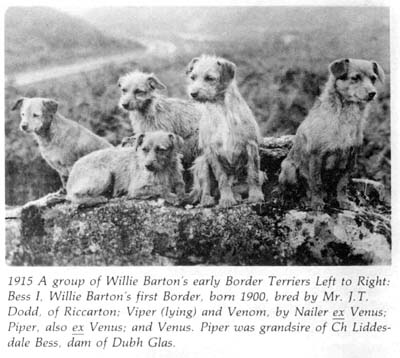
The picture below is of a group of early Border Terriers, taken in 1915. This picture is from Walter Gardner's book, About the Border Terrier.


The first Border Terrier entered on to Kennel Club roles to win a working certificate was a dog by the name of Ivo Roisterer, born on August 12, 1915, and receiving his working certificate in 1920. His pedigree is appended below, and clearly shows his great grand sire and great grand dam were from the Ullswater Hunt at a time when Joe Bowman was Huntsman.


The picture, appended below, shows Joe Weir, the Ullswater Huntsman that replaced Jow Bowman. Like Bowman, he held his position for an incredibly long period of time, from the 1924-1971 -- a period of 47 years. The dog in Joe Weir's arms is "Butcher" -- a picture apparently taken after a rescue. This photo, taken sometime in the late 1940s or 1950s, shows a dog very much like Joe Bowman's "Patterale Breed" and also very much like the early Border Terriers. It says quite a lot that this dog could be called a Border Terrier, a Patterdale Terrier, a "Fell Terrier," or a "Working Lakeland" -- evidence enough that all of these breeds are so closely related, and so recently differentiated, as to be interchangeable just a generation ago.

Of course, now we have generally decided that a "Patterdale" is a smooth or slape-coated black dog, while a "black Fell" is a rough-coated black dog.

Perhaps some day we will do away with names all together and simply divide the world of terriers as they should be cleaved: Dogs that work (regardless of color, coat or name) and those that don't. If we look at what we see in the field today, we can broadly state that Border Terriers tend to line up in the latter camp, while Patterdale Terriers tend to still reside in the former.


Friday, June 03, 2016

A Five Shilling Lump Becomes Legend


The fat lump at the far right in the picture above was, by some accounts, the dog that started the Patterdale Terrier.

As the caption suggests, the dog was a "sport" with a hard smooth coat, and a large head, that popped up in a litter of early border terriers (before Kennel Club registration it should be noted).

From The Fell Terrier by Brian Plummer:

"Bradley (grandfather of John Winch) bought the Border type of terrier called Rip from Newcastle dog market for five shillings (25 p), a ferocious, utterly game terrier with no pedigree, incredible nose, and sense underground. This terrier was mated to numerous hunt terriers in the north repeatedly, including one of the Percy Hunt terriers, bred by George Sordt, who bred many of the best working Borders in the north. It is my opinion that this carrier is responsible for the massive head out to the modern strains of fell terrier."

In fact, the pool of colored dogs in the North of England was not much speciated at this point, and it still isn't if you are honest about it. Have you really looked at the wide variation that pass for Patterdale Terriers today? Not too much conformation. These are still working dogs, and that's a good thing!

But of course dog dealers are always dog dealers, and so everyone is working hard to sell a story, a brand, and a "stamp."

Apparently, it's not enough that people are happy with the dogs they have, or the experiences they have in the field. Every breed must have a storied past, and be associated with a mysterious, mythical, or storied origin. Every dog must be descended from "Rock", "Turk", "Nitro," or "Flint".

I always find that part of it a bit humorous, and I have detailed the origins of many less-known breeds on this blog, including the Kill Devil Terrier, the Bactrian Terrier, the Carter Pocket Terrier, the Scarlett Point Terrier, the North American Pocket Lurcher, the Genessee Valley Beaver Dog, the Tort Terrier, and the Short-horned Terrier, to name just a few.  

And so, it should come as no surprise that I find it refreshing to chase down the actual story of a breed's origin and it turns up that it was a bought for 25 pence  (5 shillings) at the Newcastle Dog Market.

Allegedly.

Of course, not everyone wants to give a nod to low origins, and so dog dealers invent histories, or purposefully muddy the waters. Cyril Breay, for example, always whistled past the origins of his own line of dogs. To hear some tell the tale, they sprang full-blown from this brow of Zeus!

Without a thread of a story to pull on, there were endless debates about Patterdale origins. Was it some sort of a cross with a bull terrier?

I am happy to report that most of this nonsense stopped some years back, after I stumbled across an odd note at the back of Jocelyn Lucas' book on working terriers. There, at the very back, in an appendix table detailing the breeds of terriers used by over 120 hunts between 1925 and 1930, was a single note about a single hunt using a "Patterdale" terrier bred by a "J. Boroman.'

The name swirled through my head.  I smiled. Right. Thick sods. That's not J. Boroman, That's Joe Bowman.

A little more targeted drilling and there it was -- a picture of an early Patterdale used by Joe Bowman.


This was a lanky and hairy dog, perhaps dark brown. Some Patterdales still look like this, though most of what we see in the market today are coal black smooth-coated dogs that look very much like a smooth Jack Russell dipped in a vat of black ink.  All good. I like the look of the modern Patterdale very much.

But do I salute the nodding notion that Patterdales were "bred to kill underground" and Jack Russell were are "all bayers." That's a sentence that smells more of the lamp than the field.

Dig more.
 

There is more variation within the world of Patterdales, and within the world of Jack Russells, than there is between them. Terriers cannot be pigeon-holed quite as easily or reliably as some would have you believe.

I have yet to meet a terrier that has read a manual of theory or a breed standard. Every dog is different, and genes are only part of the equation. Too many people discount time in the field for both dogs and diggers. It is a mistake.

Let me close with this little bit of straightforward description of what, in 1921, was already being called an "old breed." From W.C. Skelton’s Reminiscences of Joe Bowman and the Ullswater Foxhounds, published by Atkinson and Pollitt:

“I have a great feeling about keeping to the old breed of what has sometimes been called the Patterdale terrier: brown or blue in colour with a hard wiry coat, a narrow front, a strong jaw, not snipey like the present show fox terrier, but at the same time not too bullet-like to show a suspicion of bulldog cross – a short strong back, and legs which will help him over rough ground and enable him to work his way underground."

And Joe Bowman?
He died in 1940, at the age of 88, and was buried in St Patrick church burial ground in Patterdale.  He was replaced by Joe Weir, who was the Ullswater huntsman for 47 years (1924-1971), and who used almost identical dogs.


UNDER the wide and starry sky
Dig the grave and let me lie:
Glad did I live and gladly die,
And I laid me down with a will.

This be the verse you 'grave for me;
Here he lies where he long'd to be;
Home is the sailor, home from the sea,
And the hunter home from the hill.

Tuesday, April 01, 2014

Rare Breed Appreciation Day: The Kill Devil Terrier


The first Kill Devil Terrier was acquired by Orville and Wilbur Wright in 1902 at Kill Devil Hills, North Carolina while they were waiting out the weather to test their second big glider.

The dog came to the Wright camp with a load of food rations. The old man who drove the food wagon out to the dunes came out with the dog, and no one noticed he did not leave with it until very late in the evening, when the dog appeared over a dune, just in time to lick the pots clean from the evening meal.

It was two weeks before the wagon returned with another provision of food, and during that time, Wilbur and Orville became very fond of the dog who not only kept rats and Grey Fox out of the rations, but who also served as a quick and ready wind sock.

Years later, Orville would note,

"The dog was key. Without him, we might have died long before we got off the ground, for we were terrible at gauging wind velocity. It was Wilbur who noticed that we never had any real success unless the fine fur along the dog's ears was riffling out in the wind. After that, we never flew without asking the dog's permission."

In fact,the absence of a Kill Devil Terrier at Fort Myers, Virginia is said by some to have been the cause of the first avian fatality in the world. While some blamed the crash on a crack in the right propeller, it was properly pointed out that everything was smashed after the crash, and that the absence of the dog, named Flyer, was only real variable from earlier successful flights.

After that, of course, it was considered bad luck by early fliers not to have some sort of representative of a Kill Devil Terrier with them at all times.

Some simply carried a small stuffed dog, or painted a small picture of a Kill Devil Terrier near their landing gear, but others -- particularly early barnstomers -- had the real thing with them whenever they traveled.

Over time, as technology progressed and superstition subsided, fewer and fewer avaiators took real dogs with them in their airplanes, and today many flyers have never even heard of a Kill Devil Terrier.

The last pure Kill Devil Terrier known to exist, prior to a remnant population discovered in 2009 near the Kill Devil Hills, was owned by Amelia Earhart, who disappeared with her dog while flying over the Pacific in 1937.

Monday, May 05, 2014

Who Put the Border in the Collie & the Terrier?

John Gilchrest, 1948 International, with Ben and Spot.

Who put the border in Border Collie?

Who put the border in Border Terrier?

The border in question,
of course is the border between Scotland and England and is, to put a finer point on it, the Cheviot Hills.

I have detailed, in an earlier post, the origin of both the Border Terrier and the Patterdale Terrier which is descended from the "blue" or "blue-black" versions of the Border.

But what about the Border Collie?

The term "Border Collie" is not as old as some imagine,
and appears to have become popular around 1900 to differentiate it from the non-working or pet collies that began appearing at about that time (though the term is older, it was not in common use before about 1900).

The world is a small and inbred place, and perhaps nowhere more so than in the border area of Scotland where the population is not thick, and the names tend to swim together.  Consider the Cheviot Sheep prize-winners list, below, from The Farmer's Magazine (July-December) of 1850.


Look carefully at the names. If you are very familiar with the true history of the Border Collie and the Border Terrier, two names will jump out at you from the swirling ink.

Yes indeed, that is Thomas Elliott, Hindhope, Jedburgh, listed with John Dodd of Catcleugh one the 1857 founders of the Border Hunt!

Who is Thomas Elliott, and how does he factor into the development of the Border Collie? 

Well quite directly.  You see, it was Thomas Elliott who supplied Queen Victoria with her much-loved dog, Noble, through the Duke of Roxburghe at Floors Castle, for whom he managed stock.

Noble was given to Queen Victoria when the dog was about one year old, and he lived with her as her favorite dog for more than 15 years, passing away at Balmoral on September 18, 1887 at aged 16.  It should be noted that this was not the first herding dog for Queen Victoria -- "Sharp," who looked very similar to Noble, was with her from 1866 to 1879.  That said, it was Noble that catapulted the "Collie" onto the front page of the dog world, as it was Queen Victoria's most loved dog the year that the Kennel Club was founded (1873), and for the next 14 years, as the Kennel Club developed. 

John Elliot, William Elliott's son, was born in 1858 and he went on to become a famous breeder and supplier of Cheviot sheep in his own right.

Here too we find the laced roots of Border Terriers and Border Collies in the form of this page of prize postings from Transactions of the Highland and Agricultural Society of Scotland (1894):


The John Robson listed here, of course, is none other than the famous Border Hunt man whose son, Jacob Robson, helped shepherd (pun intended) the Border Terrier into the ranks of the Kennel Club.


Sunday, June 28, 2009

The Kill Devil Terrier


Some people seem to have all the luck.

First, Luisa over at Lassie Get Help, manages to find a genuine Shenandoah Mountain Cur -- a breed first made famous by Custer who had two of them during his Virginia campaign, one of them named Smoky, and the other Fire. Fire died at the Little Big Horn, but Smoky (the better dog, and a gift to Custer from Queen Victoria through Lord Buckley) survived. Until Luisa's magical find, I was sure the Shenandoah Mountain Cur was extinct.

Now Doug, over at the Harris Hawk Blog has managed to find what must surely be one of the last Kill Devil Terriers in existence -- a dog made famous by Orville and Wilbur Wright.

The first Kill Devil Terrier was acquired by Orville and Wilbur in 1902 at Kill Devil Hills, North Carolina while they were waiting out the weather to test their second big glider.

The dog came to the Wright camp with a load of food rations. The old man who drove the food wagon out to the dunes came out with the dog, and no one noticed he did not leave with it until very late in the evening, when the dog appeared over a dune, just in time to lick the pots clean from the evening meal.

It was two weeks before the wagon returned with another provision of food, and during that time, Wilbur and Orville became very fond of the dog who not only kept rats and Grey Fox out of the rations, but who also served as a quick and ready wind sock.

Years later, Orville would note,

"The dog was key. Without him, we might have died long before we got off the ground, for we were terrible at gauging wind velocity. It was Wilbur who noticed that we never had any real success unless the fine fur along the dog's ears was riffling out in the wind. After that, we never flew without asking the dog's permission."

In fact,the absence of a Kill Devil Terrier at Fort Myers, Virginia is said by some to have been the cause of the first avian fatality in the world. While some blamed the crash on a crack in the right propeller, it was properly pointed out that everything was smashed after the crash, and that the absence of the dog, named Flyer, was only real variable from earlier successful flights.

After that, of course, it was considered bad luck by early fliers not to have some sort of representative of a Kill Devil Terrier with them at all times.

Some simply carried a small stuffed dog, or painted a small picture of a Kill Devil Terrier near their landing gear, but others -- particularly early barnstomers -- had the real thing with them whenever they traveled.

Over time, as technology progressed and superstition subsided, fewer and fewer avaiators took real dogs with them in their airplanes, and today many flyers have never even heard of a Kill Devil Terrier.

The last pure Kill Devil Terrier known to exist prior to Doug's discovery was owned by Amelia Earhart, who disappeared with her dog while flying over the Pacific in 1937.

What an amazing thing to rediscover a remnant population of these dogs still in existance, and just 10 miles from Kill Devil Hills, too!

Saturday, July 11, 2009

Looking for a Working Terrier?


In the world of working terriers, there seems to be quite a few more dog dealers than terrier diggers.

"Kennel reduction" sales seem to be as common as ticks in August, and "Bay Dogs Online" always seems to have a perpetual advertisement up from some Patterdale or Jagd Terrier person anxious to sell off another dog to a gullible public. Perhaps the dogs are all fantastic. Who knows? Caveat emptor, is all I can say!

The folks I know that work their dogs do not have massive kennels, as it takes too long to make an honest worker in the field, and a pregnant dog is a dog out of commission for too long. Plus, everyone has a real job these days, don't they? There are not too many professional terriermen and game keepers left who dig on their own dogs three days a week and muck out 20 kennel runs at night! Here in the U.S., there are none!

Of course, in this world of one-minute rice, most dog dealers cannot be bothered with actually working their own dogs, can they?

Why work a dog yourself when you can simply buy two dogs from some "name" and then claim your own excellent stock is descended from so-and-so?

And why dig on the dogs at all, when you can simply live-trap a raccoon and toss it on to a barn floor where you can snap a picture or two of it being ripped at by two, three, or even six dogs?

What is fascinating to me is that this reprehensible behavior seems to be centered around a few owners of only one particular terrier breed: the Patterdale Terrier.

You do not find wannabe dog fighters in the Jack Russell Terrier community, among owners of working Teckels, among Border Terrier owners, or among Plummer Terrier breeders. Most Patterdale terrier owners and workers are fine upstanding people too, but if you do find a twisted person in the world of working terriers, you can be sure they will be selling Patterdales.

What is the attraction of the Patterdale Terrier? The answer, I think, is that it is different. Everyone wants to be different, and in this way everyone is exactly the same. You can walk a Patterdale on a leash and no one at the park or coffee shop is going to know what it is. When asked, you get to tell the tale of how special your dog is -- a certified fox killer that can bore through cast iron on will power alone.

Then, of course, there are the get-rich-quick folks and the rosette chasers, both of whom have been anxious to get in early "before the market gets flooded."

But, of course, the market is already flooded isn't it? Patterdales are now being swapped for replacement auto parts by guys like this fellow, who so very clearly wants to be a dog-fighting man. This numskull proudly shows off a picture of his daughter's pet pig, killed by his own incompetence as a kennel manager. Below that he shows off three of his terriers baiting a live raccoon caught in a trap.

This is the legacy of Joe Bowman, Cyril Breay, Frank Buck and Brian Nuttal? I don't think so!

People sometimes ask me for breed or breeder recommendations, and I am generally noncommittal.

You see, I am less interested in the breed of terrier or kennel name, than I am in the size of the dog, its demeanor in the field, and what kind of real work its dam or sire has done. Size is particularly critical: If the dog is too big, I could care less what breed it is, who bred it, or what storied names are claimed in the pedigree.

People who value paper pedigrees seem to think you can buy a working terrier, but I know that the provenance and track record of the sire and dam only tell part of the story. The rest is determined by how the dog is entered and how much experience it is given in the field.

I do not require an exceptional and storied lineage to get decent results. After all, terrier work is not all about the dog, is it? But you would think so to listen to the theorists. If a dog does not work out, they complain about how they bought a crap dog. You never hear the slightest introspection about themselves as being crap terriermen.

Which brings me to the real problem in the world of working terriers: Too few people are actually digging on their dogs, and too many people are peddling puppies. Why is this?

Perhaps it is because working a terrier is suspiciously like work. There are tools to be bought, farm permissions to be obtained, and basic knowledge to be acquired. All of this is easier now than it was a twenty years ago. At least one working terrier book has practical advice, but it still requires some effort, doesn't it?

And how many people will stick with it? Not many!

For most, the theory of terrier work is more romantic and interesting than the reality which comes with freezing winds, scorching sun, sore muscles, muddy boots, and lots of scratches and bug bites.

And then, of course, there is the rare, but big, veterinary bill. Spend enough time in the field, and you will find that terrier work will eventually come with a veterinary tag attached to it. Are you prepared for an expense that could easily tip past a $1,000 due to a run in with barbed wire, a skunk, a porcupine, or a very serious bite? If not, then terrier work is not for you.

You see, if you are taking a dog into the field, then you have a duty to the dog.

Just as a terrierman does not expect his dog to cut and run at the first sign of difficulty in the hole, neither should the dog see its owner cut and run as soon as there is an out-sized veterinary expense.

If you are serious about terrier work, then you need to be prepared to stand with the dog with your credit card in hand if that is ever needed. Will you need to do that very often? No -- not if you learn some basic veterinary skill. That said, when push comes to shove, everyone who digs will eventually have to reach deeper into their pocket than they are comfortable with. Be willing to pay up when needed, or get out. It's that simple.

OK, now for some advice. You say you are looking for a working terrier? Fine: Here's a guide to how to think about breeders and (perhaps) where to find a decent dog:

  1. Consider an adult dog, especially one from Jack Russell Terrier Rescue.
    4With an older dog, you will actually know the chest size of the dog, which is critical. Most of the time there is nothing wrong with a terrier in rescue other than the fact that it is an honest working dog with real energy and prey drive. In short, Jack Russell Rescue probably has what you want!

  2. Focus on chest size. If the person trying to sell you a dog does not know the chest size of his or her dogs, keep looking.
    4Only chest size is verifiable by sight alone, and nothing else is more important to the success (and health in the field) of a working terrier. You want a dog with a chest of 14 inches (the same as a fox). Most properly proportioned working terriers with correct chest sizes will stand between 11 and 12.5 inches tall at the shoulder. Females will almost always be smaller than males.

  3. If the person trying to sell you a dog does not own a locator collar, a $60 shovel, a digging bar, and a veterinary box, keep looking.
    4If you must get a puppy from a breeder, that breeder should be regularly digging on his or her own dogs. Anyone who claims they are selling working terriers, and who does not have proper digging tools, is a liar. Never buy a dog from a liar.

  4. If the person trying to sell you a dog is putting a lot of emphasis on show ring rosettes or the "brand names" to be found on a paper pedigree, or on the work he or she claims the sire or dam did for someone else "long ago and far away," keep looking.
    4A working terrier is not defined by rosettes or scraps of paper, but by the work it has done in the field for the current owner.

  5. If the person trying to sell you a dog does not have pictures of his or her dogs working dirt dens in the country you live in, and on the quarry you intend to hunt, keep looking.
    4The work of a terrier is underground, and real work is done close to home, not across an ocean in a land far away. You are looking for real work, not romance. If you do not intend to work brush piles and barns, stay away from brush pile dog dealers.

  6. If the person trying to sell you a dog has a web site which shows pictures of his dogs staked out to massive chains, keep looking.
    4Dogs staked to heavy chains are a sign you have run into a wannabe dog fighting man who is starting a get-rich-quick scheme. Run (don't walk) away from such people.

  7. If the person trying to sell you a dog tells you his dogs are mute or "as hard as iron," keep looking.
    4An honest terrierman (or woman) is not digging three times a year, and has no use for a dog that will not communicate and that will get wrecked in the hole. Terrier work has more to do with nose, nerve, voice, and brains than it does with teeth, muscle and aggression.

  8. If the person trying to sell you a dog tells you the breed or color of a dog matters, keep looking.
    4Working terriers come in all colors and many breeds; anyone who says different is selling you nonsense. There is more variation within working terrier breeds than between them.

  9. If the person trying to sell you a dog will sell it to you sight unseen, and with no knowledge of your home or kennel set up, keep looking.
    4A true dog man or woman cares about his pups and is not doing a mail-order business to nameless, faceless people.

  10. If you demand that your dog be a puppy, and you are also serious about work, the first dog to consider is a Jack Russell Terrier or working dachshund (i.e. a Teckel).
    4There is nothing wrong with a good Patterdale, and if that is your heart's desire go with it. Just be aware that there are too many people breeding these dogs now, and as a consequence the delicate balance needed in a successful working terrier is too often absent. Caveat emptor! As for Border Terriers, most are too big to work and even fewer actually do work. If you are looking for a small working terrier out of working stock, a Border Terrier that fits the bill will be exceedingly difficult to find. Jack Rusell Terriers have one advantage: the Jack Russell Terrier Club of America which keeps a track record not only of the size of terriers in their registry, but also of the work that at least some of the dogs are doing. Working Teckels are rare in the U.S. but a miniature dachshund from working lines always has a chest small enough to get to ground, and they are blessed with fine noses and good voices as well. Their only drawback is that short legs can present problems in certain situation (most notably very tall and thick grass or very steep rock).


Wednesday, September 14, 2011

A Co-Owner Agreement That Does Not Exist


What is really needed to protect a working breed is not a pedigree written by blue-blazer rosette chasers, but a sales contract with potential owners that says "NO WORK, NO SALE."

You cannot "protect" a working breed by placing your dogs with people that are afraid to work them, or are physically incapable of working them.

How many people "co-own" dogs with a requirement that the dog be shown?

How many "co-own" dogs with a demand that the dog be worked?

There's the problem!  

You want to know why Border Terriers, Irish Setters and so many other show breeds have gone into the toilet?

It's simple:  There are a thousand and one co-owner and sales agreements that require dogs be shown (example here for a border terrier), but not one that says the co-owned dog is required to work.

.

Friday, May 02, 2008

Rise Up Ye Black and Tans


This is The Wolf Tones singing "Rise Up Ye Black and Tans."

"Come out ye Black and Tans
come out and fight me like a man.
Show your wife how you won medals out in Flanders.
Tell her how the IRA
made you run like hell away
from the green and lovely lanes in Killeshandra."


For those who do not know, the "Black and Tans" refer to the Royal Irish Constabulary Reserve Force which were put together by the British to suppress the Irish Republican Army.

Peggy Noonan (Ronald Reagan's speech writer) made reference to them today in her excellent piece in today's edition of The Wall Street Journal about why Jeremiah Wright doesn't get her Irish up. Read the whole thing at the link, above

And, to swing it around to terriers, a "Black and Tan" terrier is the old name for what we now refer to as a red-and-black fell terrier, or non-pedigree Welsh or Lakeland terrier, or even (in some circles) a "rough-coated Patterdale."

Saturday, November 12, 2005

A Brief History of the Patterdale Terrier


It’s amazing how mixed up and convoluted a breed history can become, and even more amazing that it can be confounded so quickly.

Consider, for example, the Patterdale.

First, there is the question of whether it is a breed at all, or simply a black smooth-coated Fell Terrier.

If one wants to argue that a Patterdale is simply a smooth coated black Fell Terrier, that’s fine. We could also say that a Jack Russell is a white Fell Terrier, couldn’t we? In any case, people who know Patterdales know one when they see one. Is there any other meaningful definition of a terrier breed ?

The use of the Patterdale name for a type of terrier goes back to at least the 1930s. Jocelyn Lucas notes that the United Hunt said it preferred to use Lakeland Terriers and “Patterdales from J. Boroman’s strain at the Ullswater Kennels”.

The characteristics of these 1930s Patterdales is not known, but it is worth noting that the Ullswater Kennels were famous for Border Terriers and the Patterdale breed, as we know it today, first sprang up in the 1950s in the breeding program of Cyril Breay who had been a Border Terrier breeder.

While the 1930s Patterdales are reported to have been shaggy black Fells, Breay’s early dogs are described as slape-coated black-ticked dogs with massive heads. Could these “Patterdale Terriers” have been genetic sports descended from a “blue and tan” Border Terrier? We will never know, as Cyril Breay kept no records, though he swore there was no Bull Terrier in his dogs.

Breay was a slight man and did not work his dogs himself, leaving that part of the job to his friend Frank Buck. Buck’s own line of dogs were descended from the Ullswater terriers kept by Joe Bowman (no doubt the “J. Boroman” noted by Lucas), and the dogs of the two men began to devolve to a type as lines were crossed and condensed.

Whatever their origin, the dog that showed up in the field in the 1960s, and continuing today, is a smooth, hard-coated dog of variable size and looks, and with a good track record of honest work. Patterdales have a reputation as being enthusiastic self-starters.

Though still a pure working dog, the future of the Patterdale is precarious. On one side are the show ring pretenders who value looks over utility, while on the other side are young fools crossing Patterdales with Bull Terriers and Pit Bulls, resulting in dogs that are too big and overly hard.

The good news is that there are a handful of breeders trying to keep the dogs right-sized and well-balanced between the ears. Some of these breeders have been breeding good dogs for decades, but it is a tough job and it is not clear that the next generation of terriermen is up to the task. Time will surely tell.

Tuesday, September 15, 2009

Old and New Border Terriers?

Reposted from February 2005

Border terriers owners go to extraordinary lengths to claim that their dogs are an ancient breed, despite all evidence to the contrary -- they point to indistinct dogs tucked into the corners of oil paintings, and talk of everyone from Caius to Walter Scott.

In fact, there is little evidence to suggest the Border Terrier existed before the start of the Kennel Club era which began in the 1860s, and it was not until 1920 that the border terrier made it into the formal Kennel Club roles in the U.K. -- a late entry due to the fact that, up until then, it was not very distinct from the non-pedigree fell terrier which had previously been incorporated into the Kennel Club as the "Welsh Terrier" after an attempt to claim it as an "English Black and Tan Terrier" failed. See here for more on this tale.

One of the more bizarre examples of reaching for history can be seen on pages four and five of Walter Gardner's book "About the Border Terrier." This book is notable -- as are all border terrier books -- for not having a single picture of a border terrier working a fox.

Gardner does, however, devote two full pages to two pictures of "The Old" and "The New." The picture on the left ["The Old (1879)"] shows "The Dandie Dinmont 'Doctor' with Dr. Hemmings' Bedlington Terrier 'Geordie'" The picture on the right ["The New (1973)"] shows "John Jardine of Dandie Dinmont Fame with one of his terriers and Miss M. Edgar with her Border Terrier."

The Old and the New? What? The dogs being compared are not even the same breed!

What is amazing here is the suggestion that the Border Terrier is nothing more than an 1879 Bedlington. This is patent nonsense.

The origins of the border terrier are not complex or deeply hidden -- they are a type of modified fell terrier -- a breed with which they are routinely crossed in working circles to this day.

.

Monday, January 28, 2013

One Hundred Years of Border Terriers

This is a repost from 2008, on the occasion of the 100th Anniversary of the first Border Terrier registered by the Kennel Club in 1913.
________________________


Pictures from Walter Gardner's book About the Border Terrier

The two pictures, above, show what Border Terriers looked like around 1916-1920. I think if these dogs were in the field today most people would not call them Border Terriers -- they would be presented as Fell Terriers.

Though some claim an ancient history for the Border Terrier, no breed of terrier is very old and the Border Terrier is no exception, first appearing around 1860, and being so undifferentiated from other rough-coated terriers that they were not admitted to the UK Kennel Club until 1920 -- after first being rejected in 1914.

The true history of the Border Terrier is exceedingly short and simple despite all the efforts to muddy the water with talk of Walter Scott, Bedlingtons, gypsies, and dark dogs seen in the muddy corners of obscure oil paintings. Such stuff is pure bunk.

The Border Terrier was a kennel type of rough-coated terrier of the Fell type bred by the Robson family. John Robson founded the Border Hunt in Northumberland in 1857 along with John Dodd of Catcleugh who hunted his hounds near the Carter Fell. It was the grandson's of these two gentlemen -- Jacob Robson and John Dodd -- who tried to get the Border Hunt's little terrier-type popularized by the Kennel Club.

The first Kennel Club Border Terrier ever registered was "The Moss Trooper," a dog sired by Jacob Robson's Chip in 1912 and registered in the Kennel Club's "Any Other Variety" listing in 1913. The Border Terrier was rejected for formal Kennel Club recognition in 1914, but won its slot in 1920, with the first standard being written by Jacob Robson and John Dodd. Jasper Dodd was made first President of the Club.

For a terrier "bred to follow the horses" the Border Terrier does not appear to have been overly-popular among the mounted hunts. The Border Terrier Club of Great Britain lists only 190 working certificates for all borders from 1920 to 2004 -- a period of 84 years. Considering that there were over 250 mounted hunts operating in the UK during most of this period (there are about 185 mounted hunts today), this is an astoundingly small number of certificates for a period that can be thought of as being over 15,000 hunt-years long. Even if one concedes that borders were worked outside of the mounted hunts, and not all borders got certificates that were recorded by the Border Terrier Club of Great Britain, the base number is so low that adding a generous multiplier does not change the broad thrust of the conclusion, which is that Border Terriers never really had a "hay day" for work among the mounted hunts.

The relative lack of popularity of the Border Terrier as a working terrier is borne out by a careful review of Jocelyn Lucas' book Hunt and Working Terriers (1931). In Appendix I Lucas provides a table listing 119 UK hunts operating in the 1929-1930 season, along with the types of earths found (sandy, rocky, etc.) and the type of terrier used.

Only 16 hunts said they used Borders or Border crosses, while about 80 hunts said they preferred Jack Russells, white terriers or some type of fox terrier. Lakelands and Sealyhams, or crosses thereof, were mentioned by some, with quite a few noting "no preference"(hunts are double-counted if they mention two kinds of terriers or crosses of two types).

The Border Terrier does not appear to be faring any better today, with even fewer workers found in the field than in Lucas' times. In fact, there is not a single Border Terrier breed book that shows a border terrier with its fox -- an astounding thing considering the age of the breed and the ubiquitous nature of the camera from the 1890s forward.


A STAGED PHOTO: William Carruthers poses in a photographers studio with a stuffed otter. The dogs shown are "Allen Piper", "Jean" and "Tally Ho," and the picture was taken sometime after 1923


There is some disagreement as to why the border terrier is not more popular in the working terrier community. Some mention the fact that the dogs are often slow to mature. Others note that the dogs are very expensive, while others note that borders are getting too big. Still others note that the dog is now so rarely worked that it is nearly impossible to get a pup out of two real workers.

To say that the border is not popular in the field does not mean that it has fallen out of favor in the show ring or in the pet trade, however! Border terriers are among the top 10 breeds in the UK Kennel Club, and nearly 1,000 border terriers were registered with the American Kennel Club last year -- up about 100 dogs from the previous year.

* * *

Two final notes:
  It's worth mentioning that John Dodd of Catcleugh is a name that shows up in the border sheep records of the 1850s, a fact I noted in 2011 in a post entitled Who Put the Border in Border Collie?   I believe I am the first person to go back to the original records to find that the two men who more-or-less made the modern Border Terrier and the modern Border Collie were both frequenting the same sheep shows and auctions in 1850!

Another historical stone I believe I was the first to lift was to show that the roots of the Patterdale Terrier can be traced back to the "blue" (aka black) Border Terriers bred by Joe Bowman.  Bowman called his black Border Terrier variant a "Patterdale" after his place of birth, and also to give a tip of the hat to the fact that the Ullswater Foxhounds which he became master of in 1879 at the age of 22, and been formed in 1873 by combining the Patterdale and Matterdale hunts. 

Today, non-registered Patterdale Terriers, along with non-registered Jack Russells, are the preeminent working terriers in the world.
.

Friday, April 04, 2008

The Beam in the Eye of Kennel Club Breeders


I notice that some of the AKC Border Terriers folks are all atwitter over the fact that Oprah Winfrey is going to be doing a segment on puppy mills.

It seems that Mainline Animal Rescue sponsored a billboard four blocks from Oprah Winfrey's Harpo Studios in Chicago, which got Oprah and her producers interested in exposing the puppy mill industry in America.

Now some of the Border Terrier folks are suggesting "Oprah's new cause has the potential to negatively impact responsible breeders."

Which has me rolling on the floor laughing.

Responsible breeders in the American Kennel Club? It's an oxymoron.

The closed registry system of the American Kennel Club is one of the primary reasons the quality of Kennel Club dogs is going into the toilet.

I have written about this at some length in a post entitled Inbred Thinking, but I am hardly the first. Time magazine devoted a whole cover article to it.

So are the Border Terrier folks pushing for an open registry? They are not.

Are they pushing to pull their dog out of the AKC? They are not.

And yet, it was an open registry that created the Border Terrier, was it not?

And, for the record, it's an open registry that keeps the Patterdale Terrier a working terrier and keeps the Jack Russell Terrier working too. Just look at the "Parson Russell Terrier" if you want to see how fast the Kennel Club can wreck a breed. Astounding!

Most folks who hunt any breed of dog generally run away from Kennel Club stock. As I have noted in the past:


"The number of working dogs ruined by the AKC grows every year. Irish setters, once famed at finding birds, are now so brain-befogged they can no longer find the front door. Cocker spaniels, once terrific pocket-sized birds dogs, have been reduced to poodle-coated mops incapable of working their way through a field or fence row. Fox terriers are now so large they cannot go down a fox hole. Saint Bernards, once proud pulling dogs, are now so riddled with hip dysplasia that it's hard to find one that can walk without surgery in old age."


And don't kid yourself; it wasn't "puppy mills" or "unscrupulous backyard breeders" that did this. It was the same kind of people who are on every AKC breed list-serv; folks who do not work their dogs, and who judge a dog mostly by how many times the word "champion" shows up in its pedigree.

And so I have to laugh out loud. The Border Terrier folks are concerned that Oprah Winfrey's little show "might negatively impact responsible breeders"?!

Right. Let's be honest here for a minute, eh?

The Border Terrier community is part of the problem when it comes to the wreckage of dogs in America.

This is a Border Terrier community where almost no one actually hunts their dogs.

This is a Border Terrier community where "protect and preserve" the breed really means protect and preserve the price structure, not the true working abilities of the dogs.

And these folks now want to take inventory of Mainline Animal Rescue which seems to simply be looking to find good homes for dogs in serious distress?

Ha!

When will they take inventory of their very own AKC which subsidizes every dog show with revenue from puppy mill misery pups?

And so pardon me if I do not hyperventilate over what Mainline Animal Rescue is all about.

There is no way they could be doing any more harm to dogs than the American Kennel Club and its rosette chasers are already doing.

Of course, as is so often the case, the fish stinks from the head down. As I wrote in piece for Just Terriers magazine some years back, the "experts" you find judging AKC terrier trials are, for the most part, a laughable group of fantasists.


In the AKC, for example, most judges are experts in a half dozen breeds. In the terrier ring, it's almost a guarantee none has ever owned a Deben collar or cut a shoulder into a trench in order to get down another two feet. As a rule these authorities are experts by dint of having spent far too many nights in bad hotels attending show trials. In 20 years of owning dogs, they have logged a thousand miles bouncing around show rings in plaid skirts and blue blazers. They may have driven to the moon and back to pick up rosettes, but few have driven 10 miles out into the country to even see a fox den, much less put a dog down one or dig to it.

A few will claim expertise because they have bought an airplane ticket and attended a mounted hunt or two in the U.K.. They have seen "the real thing" they will tell you, and know what is required of a working dog thanks to their two-week vacation in Scotland! Just don't ask them how to extract quarry from the stop-end of a pipe or how to treat a bite wound.


And so you will pardon me if I am laughing because the Border Terrier community is all atwitter over the fact that Oprah would dare to talk about puppy mills.

My God, she she might talk about the long-standing nexus between puppy mills and the American Kennel Club.

She might talk about how many AKC misery pups it takes to subsidize an AKC rosette.

Damn, I hope so! Bring it on Oprah!!

I do not fear Oprah's expose of the dog breeding business in this country, any more than I fear the morons and lunatics at PETA. Oprah, at least, might do a little good.

No, I do not fear Oprah.

What I fear are rosette chasers at the American Kennel Club and the scores of thousands of nodding know-nothings and "hump and dump" breeders who say their goal is to "protect and preserve" a breed with a closed registry system.

God save us from them!

_ _ _ _ _ _ _ _ _ _ _


44Some related posts on this blog:


.