Showing posts with label Joe Bowman. Show all posts

Friday, May 02, 2008

Rise Up Ye Black and Tans


This is The Wolf Tones singing "Rise Up Ye Black and Tans."

"Come out ye Black and Tans
come out and fight me like a man.
Show your wife how you won medals out in Flanders.
Tell her how the IRA
made you run like hell away
from the green and lovely lanes in Killeshandra."


For those who do not know, the "Black and Tans" refer to the Royal Irish Constabulary Reserve Force which were put together by the British to suppress the Irish Republican Army.

Peggy Noonan (Ronald Reagan's speech writer) made reference to them today in her excellent piece in today's edition of The Wall Street Journal about why Jeremiah Wright doesn't get her Irish up. Read the whole thing at the link, above

And, to swing it around to terriers, a "Black and Tan" terrier is the old name for what we now refer to as a red-and-black fell terrier, or non-pedigree Welsh or Lakeland terrier, or even (in some circles) a "rough-coated Patterdale."

Friday, December 08, 2006

A Bit More on the Border-Patterdale Connection


In the last post, I talked of how Joe Bowman, Huntsman for the Ullswater, was the person to coin the term "Patterdale Terrier," and that he had also been an early breeder of Border Terriers. 

In previous posts, I have noted that the Border Terrier is itself a relatively young breed, created from Fell Terriers at about the time the Kennel Club was first created. 

To add a point to the pencil, it's worth putting a few pictures side-by-side and fleshing out the relationships and history a little bit more. The picture at top is an early "Patterdale Breed" terrier. This picture comes from Foxes, Foxhounds & Foxhunting by Richard Clapham, published in 1923. 

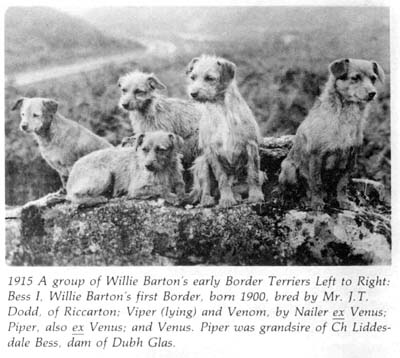
The picture below is of a group of early Border Terriers, taken in 1915. This picture is from Walter Gardner's book, About the Border Terrier.


The first Border Terrier entered on to Kennel Club roles to win a working certificate was a dog by the name of Ivo Roisterer, born on August 12, 1915, and receiving his working certificate in 1920. His pedigree is appended below, and clearly shows his great grand sire and great grand dam were from the Ullswater Hunt at a time when Joe Bowman was Huntsman.


The picture, appended below, shows Joe Weir, the Ullswater Huntsman that replaced Jow Bowman. Like Bowman, he held his position for an incredibly long period of time, from the 1924-1971 -- a period of 47 years. The dog in Joe Weir's arms is "Butcher" -- a picture apparently taken after a rescue. This photo, taken sometime in the late 1940s or 1950s, shows a dog very much like Joe Bowman's "Patterale Breed" and also very much like the early Border Terriers. It says quite a lot that this dog could be called a Border Terrier, a Patterdale Terrier, a "Fell Terrier," or a "Working Lakeland" -- evidence enough that all of these breeds are so closely related, and so recently differentiated, as to be interchangeable just a generation ago.

Of course, now we have generally decided that a "Patterdale" is a smooth or slape-coated black dog, while a "black Fell" is a rough-coated black dog.

Perhaps some day we will do away with names all together and simply divide the world of terriers as they should be cleaved: Dogs that work (regardless of color, coat or name) and those that don't. If we look at what we see in the field today, we can broadly state that Border Terriers tend to line up in the latter camp, while Patterdale Terriers tend to still reside in the former.


Thursday, December 07, 2006

Joe Bowman's Patterdale

Joe Bowman, the Ullswater Huntsman, from Foxes, Foxhounds & Foxhunting by Richard Clapham, published in 1923.

Most of the folks that write books on dogs
would like their breeds to be ancient and have romantic and mysterious origins. Pick up any book on Jack Russell Terriers, for example, and Trump will be presented as the first white foxing terrier on earth -- never mind that the young John Russell selected it for looks alone and had no problem finding another white foxing terrier to mate with it.

The Border Terrier folks have wrapped the story of their dog completely around the axle in an attempt to give it an ancient origin. In fact this breed was created at about the same time as the Kennel Club was created, and it was pulled on to the Kennel Club roles as quickly as could be.

As for the Patterdale Terrier, quite a few people claim one person or another created the dog, and yet all seem quite confused as to the shape of the head. Where did that come from?

In fact it is no mystery, and the true story of the Patterdale is not too deeply buried or very old.

In 1873, the Patterdale and Matterdale hunts were combined to form the Ullswater Foxhounds. In 1879 Joe Bowman (just 22 years old) was made master of the Ullswater, a position he held (with a few short interruptions) until 1924, when he was replaced by Joe Wear who held the position for then next 47 years. Joe Bowman died in 1940 -- one of the most famous huntsmen of all time (there is even a song about him).

Joe Bowman was an early Border Terrier breeder, and he was also the first person to cross up a blue-black Border Terrier with a black and tan Fell Terrier (also called a working Lakeland) to create what he called a Patterdale Terrier. 

In Jocelyn Lucas' book, Hunt and Working Terriers, a table at the back notes that the United Hunt preferred a "Lakeland, Patterdale, from J. Boroman's strain (Ullswater kennels)."

In fact, "J. Boroman" is a typo, and the real man was Joe Bowman.


From Appendix II of Jocelyn Lucas' Hunt and Working Terriers (1931).


Lucas published his book in 1931, and the information in it was collected between 1925 and 1930. The Patterdale Terrier was clearly a type (if not a widely used type) by the 1920s, and it centered on the Ullswater Hunt and Joe Bowman.

With that knowledge, it was not too difficult a thing (but not too easy either!) to lay a hand on Foxes, Foxhounds & Foxhuning by Richard Clapham, published in 1923. Here we find not only a good picture of Joe Bowman (see top), but the picture reproduced below with caption. Click on the picture for a larger image.
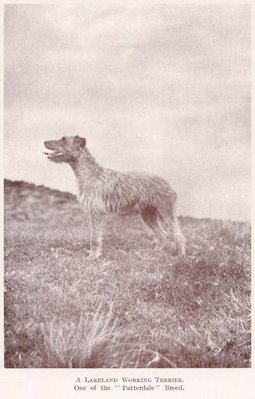
 

"One of the 'Patterdale' breed." Click on the picture for a larger version.

Now we can see that the Patterdale name goes back to at least the Nineteen-teens, a period just before the Border Terrier (which, like the Patterdale, started out as little more than what we would call today a Fell terrier today) was pulled into the show ring. To see what Border Terriers looked like in 1915, click here.

At about the time that Joe Bowman was fading out of the dog breeding business, in the 1930s, a young Cyril Breay was stepping up. Breay, like Bowman, had been a Border Terrier breeder. 

In the early 1930s Breay met Frank Buck, when Buck rescued one of Breay's dogs that had gotten stuck in a deep rock cleft and Buck -- an expert at dynamite -- had blasted it free. 

Bucks own line of dogs at the time were descended from Ullswater terriers kept by Joe Bowman, and Breay and Buck soon became fast friends with Breay breeding black dogs from Frank Buck into his line, and Buck crossing tight Border Terrier coats into his. Over time, the dogs of the two men devolved to a type as lines were crossed and condensed. 

Cyril Breay was always adamant that the Patterdale Terrier was not made by crossing in Bull Terrier, and he was not lying. The Patterdale head is no mystery to a border terrier owner - the same broad cranial outlines are evident in both breeds.

Brian Nuttall began breeding Patterdales in the late 1950s, and says that his dogs are very much like those his father kept in the 1930s. It would not surprise me a bit to find that Nuttal's father got his dogs from Bowman, or from intervening hands that had gotten their dogs from Bowman. What is clear is that the Patterdale Terrier was already a recognized type by the time Nuttall's father owned his dogs.

The fact that Joe Bowman started the Patterdale strain and named it takes nothing away from folks like Cyril Breay, Frank Buck and Brian Nuttall, all of whom did quite a lot to popularize the breed, maintain it as a working dog, and perhaps improve and stabilize its looks. It is an easy thing to name a new breed (it's done every day by puppy peddlers), but quite another to find a market and a following for the dogs based on their performance in the field. 

I mention all of this (I have told the story before and it is in the book), because I found a rather interesting old obituary on the internet the other day. Note the byline. With some amusement I note that "Greystoke Castle" was (supposedly) the ancestral home of Tarzan:


September 1956 PATTERDALE - One of Ullswaterside’s oldest residents, Mrs. Esther Pattinson, Broadhow, Patterdale, died at the age of 85. Formerly Miss Bowman, Matterdale, she hailed from a noted hunting family — her uncle was the celebrated Joe Bowman, huntsman of the Ullswater foxhounds for 42 years, while her great-grandfather, Joe Dawson, was for many years huntsman of the one-time Matterdale foxhounds. Mrs. Pattinson was only 13 years of age when she was hired as a farm girl, later working at Lyulph’s Tower for Mr. James Wood, who was agent for Lady Mabel Howard, Greystoke Castle.


In the end, it turns out that Joe Bowman was born in Patterdale
-- a perfectly good reason for him to give a nod to the spot. It was, no doubt, an added bonus that Patterdale was also the old name of the Hunt that was both his employer and his passion. Finally, it should be noted that Patterdale was also the town where Joseph Dawson Bowman died, at the age of 88. .

Saturday, November 12, 2005

A Brief History of the Patterdale Terrier


It’s amazing how mixed up and convoluted a breed history can become, and even more amazing that it can be confounded so quickly.

Consider, for example, the Patterdale.

First, there is the question of whether it is a breed at all, or simply a black smooth-coated Fell Terrier.

If one wants to argue that a Patterdale is simply a smooth coated black Fell Terrier, that’s fine. We could also say that a Jack Russell is a white Fell Terrier, couldn’t we? In any case, people who know Patterdales know one when they see one. Is there any other meaningful definition of a terrier breed ?

The use of the Patterdale name for a type of terrier goes back to at least the 1930s. Jocelyn Lucas notes that the United Hunt said it preferred to use Lakeland Terriers and “Patterdales from J. Boroman’s strain at the Ullswater Kennels”.

The characteristics of these 1930s Patterdales is not known, but it is worth noting that the Ullswater Kennels were famous for Border Terriers and the Patterdale breed, as we know it today, first sprang up in the 1950s in the breeding program of Cyril Breay who had been a Border Terrier breeder.

While the 1930s Patterdales are reported to have been shaggy black Fells, Breay’s early dogs are described as slape-coated black-ticked dogs with massive heads. Could these “Patterdale Terriers” have been genetic sports descended from a “blue and tan” Border Terrier? We will never know, as Cyril Breay kept no records, though he swore there was no Bull Terrier in his dogs.

Breay was a slight man and did not work his dogs himself, leaving that part of the job to his friend Frank Buck. Buck’s own line of dogs were descended from the Ullswater terriers kept by Joe Bowman (no doubt the “J. Boroman” noted by Lucas), and the dogs of the two men began to devolve to a type as lines were crossed and condensed.

Whatever their origin, the dog that showed up in the field in the 1960s, and continuing today, is a smooth, hard-coated dog of variable size and looks, and with a good track record of honest work. Patterdales have a reputation as being enthusiastic self-starters.

Though still a pure working dog, the future of the Patterdale is precarious. On one side are the show ring pretenders who value looks over utility, while on the other side are young fools crossing Patterdales with Bull Terriers and Pit Bulls, resulting in dogs that are too big and overly hard.

The good news is that there are a handful of breeders trying to keep the dogs right-sized and well-balanced between the ears. Some of these breeders have been breeding good dogs for decades, but it is a tough job and it is not clear that the next generation of terriermen is up to the task. Time will surely tell.