Showing posts with label wildlife management. Show all posts

Thursday, January 11, 2018

Aldo Leopold on Gadgets and Fox Hunting


Aldo Leopold

Aldo Leopold, who was born on this day in 1887, was one of the most important people in the history of U.S. conservation. A 1909 graduate of the Yale Forestry School, Leopold wrote the first book on Game Management (it is still in print and it is still used at a text book), and was the first person to predict that the widespread extirpation of wolves through poison and trapping would result in an explosion in the deer population that, in turn, would wipe out much of the understory of American forests. Most famous for his eco-philosophical journal A Sand County Almanac, about his Wisconsin farm, Leopold also explored the role of wilderness and hunting in American culture.

In an early essay entitled Wildlife in American Culture, Leopold noted that even in the era before World War II, "the gadgeter, otherwise known as the sporting-goods dealer," was dominating the sporting press and warping America's understanding of the outdoors.

The phenomenon is very easy to see today, with hunting and fishing magazines centered less on wildlife and wild places than on the Quad Bikes, scent sprays, lures, bait, and expensive guns, rods, and reels that we are told we will need before we even think about going into the woods.

This ethos has now expanded into the world of camping and hiking, where everything has to be rip-stop, multi-fuel, Goretex, and composite construction. Not only must everything be lighter weight, there must be more luxury and options than ever before. As Leopold noted in this 1940-era essay, describing the beginning of the modern ethos:

"Then came the gadgeteer, otherwise known as the sporting-goods dealer. He has draped the American outdoorsman with an infinity of contraptions, all offered as aids to self-reliance, hardihood, woodcraft, or marksmanship, but too often functioning as substitutes for them. Gadgets fill the pockets, they dangle from neck and belt. The overflow fills the auto trunk, and also the trailer. Each item of outdoor equipment grows lighter and often better, but the aggregate poundage becomes tonnage. The traffic in gadgets adds up to astronomical sums, which are soberly published as representing 'the economic value of wildlife.' But what of cultural values?"

The great thing about fox hunting and terrier work is that, with the exception of the locator collar, the equipment we use to today would need no explanation to Jaques Du Fouilloux (1560) or Sir Walter Scott (1810). Nothing much has changed, and very little has gone "high tech," in large part because the intervening variable -- the dog -- is immune to mechanical intervention.

At its core, the fox hunter is a primitive hunter and the dog is a primitive animal. As Leopold noted about mounted American fox hunting (which has never included killing the animal being chased):

"Fox-hunting with hounds, backwoods style, presents a dramatic instance of partial and perhaps harmless mechanized invasion. This is one of the purest of sports; it has real split-rail flavor; it has man-earth drama of the first water. The fox is deliberately left unshot, hence ethical restraint is also present. But we now follow the chase in Fords! The voice of Bugle-Anne mingles with the honk of the flivver! However, no one is likely to invent a mechanical foxhound, nor to screw a polychoke on the hound's nose. No one is likely to teach dog-training by phonograph, or by other painless shortcuts. I think the gadgeteer has reached the end of his tether in dogdom."
.

Vicious: Wolves and Men in America


Despite a lot of talk and unfounded rumor, there is only one record of a non-rabid wolf killing a human in North America since the arrival of Europeans.

Yet humans have killed wolves wholesale, using poison, traps, clubs, rifles, and even laying out mackerel hooks inside lumps of meat and fat. Nothing was too brutal in the quest to exterminate the wolf, and by 1880 a large part of America was wolf-free.

The wolf hung on into the 20th Century, however, in large part because the bounty system did not pay enough for people to spend months tracking down the last western wolves which were smarter and more trap-shy than most. When the Government began paying a professional cadre of wolfers to exterminate the last of their kind, however, the fate of the wolf was sealed.

Ironically, one of the last Government wolfers was Aldo Leopold, whose birthday it is today.  Aldo was a wolfer when he was a young man working for the U.S. Forest Service in New Mexico. Leopold went on to write the first book on Game Management in the U.S., and became, posthumously, an icon of the modern environmental movement with his memoir, A Sand County Almanac.

Buried in that little book is an essay called "Thinking Like a Mountain," and within it a section in which Leopold observes the dying of a "fierce green fire" within a wolf as it bleeds out on on rock after being shot.

Up until that hunt, Leopold had thought what he had been doing was good for deer and the mountain, but after seeing the wolf die he suspected neither the deer nor the mountain agreed with that view.


In time, as deer overgrazed sections of the West and East, Leopold began to fully understand the importance of keeping top predators in the eco-system. "A thing is right," he wrote "when it tends to preserve the integrity, stability, and beauty of a biotic community. It is wrong when it tends otherwise."

But Leopold came to this conclusion many decades after shooting out the last wolves of New Mexico, and in his youth he was among the cadres of Government wolfers who told stories about wolf hunts in order to help raise cash to support the public extermination effort.

Government-sponsored wolfers created traveling displays of wolf pelts and wolf skulls. These displays and stories memorialized the last of the western wolves and gave them names: The Custer Wolf, Old Three Toes, Old Lefty, and Old Rags the Digger, among them.

By giving individual wolves names and personalities, Government trappers helped break down the wall between wolf myth and wolf reality. The wolf, which had once seemed threatening, dangerous and mysterious, now became the outlaw hero of the story, and an emblem of the last days of the romantic (and dying) American frontier.

This is the essential plot structure of Jon T. Coleman's book "Vicious: Wolves and Men in America."

The book is not a text on wolf biology, but a history book that analyzes the gaps and nexus between wolf myth and wolf reality. Though well-written, it is more than a little burdened by the weight of being overly-academic and spending perhaps too much time on folklore and not enough on basic wolf biology. No matter -- if you have ever wondered how the wolf went from pariah to paragon in the space of 50 years, this book tells the tale.

Coleman suggests that the wolf reintroduction efforts of the 1990s (which have been quite successful) occurred because America is now mostly urban and has little contact with farm animals which now come from protected feed lots rather than the free-range forests and fields where wolf, ranchers, farmers and livestock once battled.

"Human predation has become so technical and abstract [in the lat 20th Century] that the consumers of animal protein no longer feel emotionally connected to the beasts they ingest...
Reintroduced wolves have thrived in a cultural environment that accepts the scientific extermination of millions of domestic animals but rejects violence towards a handful of wild creatures."

Would the wolf have been reintroduced if Americans still lived on grass-fed beef?

Perhaps not.

Did cows have to fatten in feed lots in order for America to returns its large predators to their spot on the ecological ladder?

Perhaps.

It is an uncomfortable kind of tradeoff.


Wednesday, June 28, 2017

Glad to Be American With Wilderness and Wildlife


Aldo Leopold :: This is a repost from 2010.


There is something vaguely ridiculous about European hunting with its dress-up clothes and potted birds.

Even some of the descriptions of terrier work can border on the absurd. Does every fox have to be described as a "lamb killer"? I suppose so in a country that has no coyote, wolf, bobcat, mountain lion, black bear, alligator, or grizzly! When your biggest game animal eats worms and bulbs, and your largest predator dines on mice, you may have to dress up your rationale for the hunt every bit as much you dress up yourself. Mere sport with dogs cannot do!

In America, of course, such a claim would be met with laughter. A red fox threatens your farm? A badger? Please! We have real predators from one end of this country to another. No need for tales of Beowulf here! A country full of bears and coyotes does not need to invent dragons.

To be clear, what makes America special is not some extra gene coursing through our blood. What makes American special is the land, and the fact that, unlike Europe, we have not killed off everything big enough to kill a cat.

No one ever said it better than Aldo Leopold who, back in 1925, wrote an essay called "Wilderness As a Form of Land Use," in which he reminded us of what we were (American), and warned us of what we might become (European):

The day is almost upon us when canoe travel will consist in paddling up the noisy wake of a motor launch and portaging through the back yard of a summer cottage. When that day comes canoe travel will be dead, and dead too will be a part of our Americanism. Joliet and LaSalle will be words in a book, Champlain will be a spot on a map, and canoes will be merely things of wood and canvas, with a connotation of white duck pants and bathing "beauties."

The time is almost upon us when a pack-train must wind it’s way up a graveled highway and turn it’s bell-mare in the pasture of a summer hotel. When that day comes, the pack-train will be dead, the diamond hitch will be merely rope, and Kit Carson and Jim Bridger will be names in a history lesson. And thenceforth the march of empire will be a matter of gasoline and four wheel brakes.

European outdoor recreation is largely devoid of the thing that wilderness areas would be the means of preserving in this country. Europeans do not camp, cook or pack in the woods for pleasure. They hunt and fish when they can afford to, but their hunting and fishing is merely hunting and fishing, staged in a set of ready-made hunting lodges, elaborate fare, and hired beaters. The whole thing carries the atmosphere of a picnic, rather than that of a pack trip. The test of skill is confined almost entirely to the act of killing, itself. Its value as a human experience is reduced accordingly.

There is a strong movement in this country to preserve the distinctive democracy of our field sports by preserving free hunting and fishing, as distinguished from the European condition of commercialized hunting and fishing privileges. Public shooting grounds and organized cooperative relations between sportsmen and landowners are the means proposed for keeping these sports within reach of the American of moderate means. Free hunting and fishing is a most worthy objective, but it deals with only one of the distinctive characteristics of American sport. The other characteristic is that our test of skill is primarily the act of living in the open, and only secondarily the act of killing game. It is to preserve this primary characteristic that public wilderness playgrounds are necessary."


Read the whole essay which I have linked to here [PDF].

Are we there yet? Is our land so gut-shot with people that we have lost the wild and become European?

Not quite.

The coyote population is growing, and so too is the population of mountain lion, wolf, black bear, grizzly, and alligator.

We are not yet European, thank God!

Yet we may get there if we do not do more to slow population growth, most of which is now fueled by unbridled legal and illegal immigration. We cannot take all of the world's displeased and dispossesed, and it's high time we stopped trying.

Above all, we need to remember that we need to fight to continue to preserve large blocks of wild lands, including wilderness.

Preserving wilderness and wild lands is about nothing less than preserving America's soul.

Save it now, or someday soon, it may be gone forever.
.

Angeles Requiem from Tocho on Vimeo. The above video is not just amazing because the camere trap survived a forest fire, or because of what it else it got on tape (thanks Chaz!). It's amazing because it was all filmed by a single camera trap in Angeles National Forest just a 30-minute drive from downtown Los Angeles. Thiry minutes from downtown L.A.! This is still America as God intended, a country made by bear and lion, fire and rain, buffalo and deer. This land is your land. This land was made for you and me. .

Thursday, January 19, 2017

Shooting Out the Land


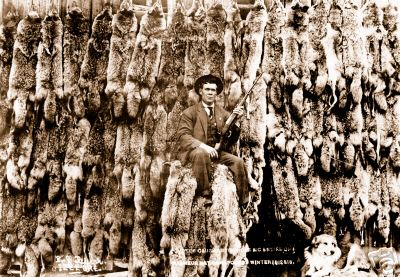
Ranger McEntire of the Malheur National Forest (Eastern Oregon), Winter 1912 - 1913
A repost from this blog circa 2005

In 1887, 14 years before he became President, Theodore Roosevelt joined with a distinguished group of sporting Americans -- including George Bird Grinnell, William Tecumseh Sherman, John Lacey, and Gifford Pinchot -- to form the Boone and Crockett Club. The men who created the Boone and Crockett Club were all dedicated hunters. Grinnell was editor of Field and Stream magazine, a hunting and fishing journal, and as editor, he was shocked at the rapid depletion of America’s wildlife due to unregulated market hunting

Though by charter the Boone and Crockett Club numbered only 100 people, it was a very influential group. John Lacey eventually became a Member of Congress from Iowa and, in 1900, just before Roosevelt became President, he managed to get Congress to pass the Lacey Act which made it a federal crime to transport wild game across state lines if had been killed in violation of state laws — the first federal restriction on commercial market hunting in the United States.

Roosevelt, of course, became Vice President and then President upon the assassination of William McKinley. An avid sport hunter, Roosevelt was also an accomplish naturalist, and counted among his friends John Muir, the founder of the Sierra Club, and best-selling wildlife author John Burroughs.

It is hard to overstate the importance of hunting in Roosevelt’s life. Suffice it to say that he chose not to run for President after his second term so that he could go to Africa on a year-long safari, hunting big game and collecting specimens for the Smithsonian Institution.

During his presidency (1901 to 1911), Roosevelt more than tripled the National Forest system to 148 million acres (and made Gifford Pinchot the first Chief of the U.S. Forest Service), oversaw the creation of 150 new national forest areas in 21 states, created four national game preserves, 51 federal bird sanctuaries, and established 18 national monuments. No president, before or since, has created such a sweeping public lands legacy.

In 1911, shortly after Roosevelt left office, Congress passed the Weeks Act to authorize the purchase of forest lands in the east. Much of this land later became part of the National Forest system in the eastern United States.

That same year the American Game Protective Association (AGPA) was founded and funded by gun and ammunition companies such as Winchester. This was the first sportsman-supported organization in the U.S. with a full-time professional staff, and it was later renamed the Wildlife Management Institute. In 1913, the shooting of migratory birds was regulated — the first step toward building back game bird populations deeply impacted by over-hunting.

America’s hunters lead the charge for wildlife habitat protection and the regulation of hunting seasons, providing an intellectual and moral framework now known as “hook and bullet conservation”.

Hook and bullet conservation has produced truly astounding results in the U.S. over the course of the last 100 years. Despite a three-fold increase in the U.S. population since 1900, we now have more bear, cougar, buffalo, turkey, elk, geese, duck, fox, raccoon, possum, alligator, groundhog, bald eagle, pronghorn, wolf, coyote, bobcat, and deer than at any time in the last 100 years. Beaver, turkey and river otter have been reintroduced into areas where they were wiped out, and wolf, elk and cougar are beginning to return to the east.

All of this has been made possible because the land and the forest -- otherwise voiceless -- has a voting constituency among American hunters and anglers. Not all hunters and anglers are good sportsmen who understand the need for conservation, but all good sportsmen are conservationists who understand the value of habitat and self-restraint.
.

Sunday, July 24, 2016

Hunting Ethics and Terriers


A repost from June 2005.

The hunting community has given a LOT of serious thought to ethical hunting and perhaps this is a topic over-due for discussion in the arena of working terriers.

As the folks at Boone and Crockett note:
"We live in a democracy where in the rules by which we live are determined by majority vote. For those who value hunting, it is fortunate that the majority of the population who do not hunt tolerate or accept hunting. If hunting is to survive to be practiced by future generations, we must preserve, enhance, and protect the image of hunting, hunters, and land stewards as a positive force in wildlife conservation."


Every person will come to their own place when it comes to ethical hunting. I do not like canned bird shoots, for example, while others may find nothing wrong with them. Each to his own.

I broach the topic of ethical hunting, not so we reach the same place, but so people will think about this topic a bit more. How do we represent our sport? How do we do right by the dogs and by the quarry?

As stewards for a type of hunting that is hundreds of years old, how do we make sure terrier work is passed down, intact, to the next generation?

There should always be respect for honest differences of opinion, of course, but opinion should be grounded in thought and information.

I am always amazed that so few people in the U.S. know the history of hunting and wildlife management in this country. A small start at education can be had by visiting the "Fair Chase" web site which notes that:

"As hunters and land managers, we are in the 'image business' - even more so now than at the turn of the century when 'fair chase' was proposed as the underlying foundation for hunter ethics. For sportsmen to continue to be the dominant force in setting wildlife resource policies we must, and foremost understand our role as conservationists. We should take pride in accomplishments and recognize, and assume the responsibilities that have been passed to us by our hunting forefathers. If we don't stand up for wildlife and its habitats, who will? We are, in the end, a 'band of brothers and sisters' in that what we do individually affects us all."

Standing up for wildlife and habitats is not something we hear much about in the terrier world for some reason. Perhaps knowledge of quarry and habitats is what is missing.

Perhaps it is what should be added.

I am always amazed to find hunters
who have never taken the time to learn about the animals they hunt. For these people, terrier work is not a commune with nature, but a proxy for dog fighting or a paper certificate. A deer is nothing but a target and a trophy. A duck is just a feathered clay pigeon.

The true hunter knows the difference between a rat and a raccoon, a squirrel and a fox, a groundhog and a possum. They know what each animal eats, how often they breed, their population densities in various habitats, and their natural mortality rates.

A true hunter knows that you cannot hunt out all the rats on a dairy farm or shoot out all the squirrels in a 200-acre oak woods, but that you can knock all the raccoon or fox off a farm in a single weekend.

An ethical hunter does not bleed the land white.

A smart hunter thinks twice before dispatching a fox or a raccoon. Is it really necessary to terminate this animal? What harm is this animal really doing? If it is a nuisance animal for some reason, make dispatch swift and offer no apologies. But think it through. A released raccoon and fox can be hunted again. If the animal is not a true pest, and it otherwise unscathed, releasing it is more than good ethics -- it is also good hunting.

A lot of ethical hunting is just good manners -- close fences you open, don't trespass, fill holes you dig in the fields, park out of the way, don't rut the fields, and keep a low profile.

Ethical hunting is mostly about respect -- respect for the farm and the farmers, respect for the crops and the livestock, and even respect for people that do not hunt (waving a bloody shirt is no way to preserve hunting).

Respect extends to dogs and quarry. Respect for the dogs means that you work to reduce the incidence of injury to the animal. Once you get down to the quarry and it can be reached, you pull the terrier and do the job YOU are supposed to do, which is swift dispatch or quick release.

A seriously injured dog is not treated as a "red badge of courage" but as a failure of either the dog or the digger to work in a sustainable manner. Routine injury is not a sustainable way to hunt -- and the goal of the serious digger is to hunt next week, as well as this.

Respect for the quarry means you dispatch it as quickly and humanely as possible, and if pictures are taken for posterity, they are tasteful. Remember that killing the enemy is part of war, but displaying disrespectful pictures of the dead and wounded is a war crime. There is a lesson there, and the ethical hunter gets it.

An ethical hunter is the opposite of the slob hunter. The slob hunter drives his truck down the middle of the field and mows down the hedgerow. He leaves gates open and drives into the 7-Eleven with a bleeding doe in full view in the back of his pickup truck. The slob hunter does not know the difference between a gray fox and a red fox, and does not spend more than 30 minutes tracking his gut-shot deer.

Ethical hunters tend to be better hunters than slob hunters for the same reason that people who handicap themselves in golf tend to be better players than people who want a "gimme" at every hole.

I am happy to report that ethical hunting is on the ascendancy in the U.S. As wildlife has roared back from the edge of extinction and finding game has become easier, more and more people are affirming the hunting experience by turning to black powder and bow. When Colorado decided to ban hunting bear over bait (steel drums filled with jelly donuts and pizza), bear hunting increased because it was no longer seen as "slob shooting" but real hunting that required wood craft and skill.

Those that fish will understand. When we were five years old our fathers or grandfathers took us to a stocked trout pond and we were guaranteed a catch (paid per pound). A few years later we were mad fishermen killing everything we caught. As over-enthusiastic youth, we used live bait, tail-snagged fish during Spring runs, and bought packages of hooks with multiple barbs.

As we got better at fishing, most of us turned to catch-and-release and artificial lures. The best of us crushed the barbs off our hooks. We may have turned to fly fishing. No one bought a fish finder.

There is nothing wrong with killing -- it's part of hunting, but as we get older and better at wood-craft we realize that killing is not hunting in and of itself. We do not say a slaughterhouse worker is hunting, though we say a man who returns without a buck has been out hunting hard and "better luck tomorrow".

Those of us who love this land and the creatures on it recognize that hunting is a necessary part of game management and an important economic and political engine protecting America's wild places and farms. That said, we also need to recognize that just as it is important to protect the land and the streams, so too is it important to instill in the next generation a sense of hunting history and hunting ethics, and a sense of decorum when dealing with the non-hunting public.

It is sad, but true, that honorable minority communities are often scandalized and victimized by ugly and criminal elements within their midst. That is true for immigrant communities and racial minorities, but it also true for hunters.

It has been said that a minority community knows it has come of age when the worst acts of a few can no longer be used to characterize the larger whole. The good news is that we may be there with hunting in general. It remains to be seen as to whether we will get there with terrier work in particular.

Friday, January 23, 2015

Record Numbers in the Hedge


This is a repost from 2007. See side bar to this blog to order this, and other designs, on T-shirts, etc. All money goes to support terrier rescue.


AMERICA IS BLESSED with many kinds of quarry
that can be worked by terriers year round: groundhog, raccoon, red fox, possum, gray fox, and badger.

Most terrier quarry is at record levels of abundance, and most folks in the Eastern U.S. and Midwest live within a half hour of excellent hunting opportunities.

Groundhog populations, for example, are much higher now than they were in Colonial times when most of the Eastern U.S. and Midwest was forested. Red fox, of course, is an import, while raccoon populations today are 15 to 20 times larger than they were in the 1930s.

In the U.K. wildlife in the hedge is also doing remarkably well and is at record levels.

Red fox populations, for example, now appear to be at the limits of biological density, with the Mammal Society estimating the late-December fox population to be stable at about 250,000, with about 14% of this population in urban locations.

In the Spring, of course, the fox population of the U.K. soars, with the addition of about 425,000 fox kits, but large numbers of these cubs subsequently die from disease or starvation, while later in the year fox numbers are also thinned by vehicle impact (estimated at 100,000 a year), shooting (estimated at 80,000 a year) and hunting with dogs (estimated at about 20,000 a year in 2004 before the so-called "ban" went into effect). In his excellent book "Running with the Foxes," wildlife biologist David MacDonald has noted that "foxhunting is of minor significance to foxes in particular, or amongst wildlife issues generally."


Red fox population growth, U.K., 1961-2000

As for badger, the Mammal Society reports that there are now more badger in the U.K. than red fox -- an astounding thing considering that red fox are now so common as to be seen as a bit of an urban plague in the U.K.

British badger populations also appears to be at their biological limits, with little or no growth in numbers in recent years, and mortality accomplished chiefly by disease, starvation, vehicle impacts. In addition, DEFRA -- the Department of Environment, Farms and Rural Affairs -- routinely gasses thousands of badgers a year (and has been doing so for more than 30 years) in an effort to eradicate the animals from areas where bovine tuberculosis is a worry.

Thursday, February 28, 2013

Clash of Opinions is Actually a Clash of Knowledge

In Heartsblood: Hunting, Spirituality and Wildness in America, David Peterson notes that back in 1978 Yale University behavioral scientist Stephen Kellert authored a paper entitled "Attitudes and Characteristics of Hunters and Antihunters" in which he summarized his research into the psychology and world-view of these two opposing groups of people.

Kellert breaks hunters down into three core groups:

Utilitarian-meat hunters;
Domination-sport hunters, and;
Naturalist-nature hunters.

Kellert notes that while the groups blur a little at the edges, these three psycho-demographic groups do exist, and represent striking differences of attitude within America's hunting population.

Utilitarian-meat hunters represent about 44 percent of all American hunters. This group tends to talk of "harvesting" game as a renewable resource and many have a "pioneer spirit" forged in self-sufficiency. As a group utilitarian-meat hunters tend to be older, more rural and less educated, but test pretty well when it came to knowledge about wildlife. Few Americans oppose them.

The second group, the domination-hunter, comprise about 38 percent of all hunters. Most domination-hunters are urban men, have served in the military, and see hunting as a way of expressing their manly prowess. Domination hunters know very little about wildlife, and many actually fear it, having an exaggerated "dangerous game" mindset of the kind we often see in pulp hunting magazines ("Mauled by a Grizzly," "When Sharks Attack", "Stalked by a Killer Moose"). Domination hunters showed little interest in wildlife in their youth, and as adults tend to see wild animals as uncontrolled and therefore as "bad" or nuisance animals. The domination hunter is the group non-hunters dislike, and which antihunters try to use to negatively portray ALL hunters.

The third group of hunters -- naturalist hunters -- represent less than 18 percent of all hunters. This group tends to be younger, more educated, and with higher levels of education and income than the other groups. This category also includes more women hunters. Nature hunters tend to backpack, bird watch and camp, as well as hunt. This group also spends more time actually hunting than either of the other two previous groups. Nature hunters have far and away the highest level of knowledge about wildlife and seek an intense involvement with wildlife and do not fear it.

Kellert also goes on to analyze antihunters as a group and finds, not surprisingly, that about 80 percent are women. Most are urban women living on one coast or another.

Antis had very little actual experience with wildlife and, along with domination hunters, had "among the lowest knowledge-of-animals scores of any group included in the study."
In another ironic parallel with domination hunters, "it appeared that antihunters manifested more fear and lack of interest in wildlife" than average Americans.

What was striking to me about reading Kellert's research was how it explains much of the silliness and stupidity we see in the arena of wildlife management today, where antihunters who have never walked a hedgerow clash all with macho-men domination-hunters who would never consider going into the woods without a Bowie Knife as large as medieval falchion.

Neither group seems to have very much knowledge about wildlife. One group does not hunt at all, and the other does not seem to hunt very much.

Left out of the debate -- and too often ignoring it -- are utilitarian-meat hunters and nature-naturalistic hunters which form a majority of the people who actually spend any time in forest or field.

The good news is that in America, unlike in much of Europe, wildlife management decisions tend to be left to an increasingly well-educated groups of professional wildlife managers with degrees in biology, zoology, resource management, forestry, population dynamics, law enforcement and even economics. The watchword in the U.S. is not knee-jerk emotionalism, but sustainability and habitat protection. As a consequence, we have more deer, elk, moose, bear, wolf, fox, alligator, whales, peregrine falcons, bald eagle, osprey, groundhog, raccoon, possum, coyote, bison, beaver and mountain lion today than we have ever had in the last 100 years, and the numbers for all of these species is going up, up, up.
.

Monday, December 14, 2009

Hook and Bullet Conservation Results in More Game

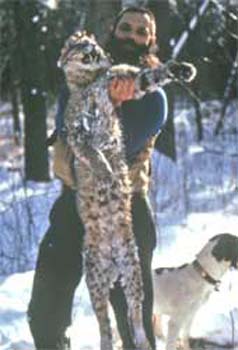
The picture at right is an American bobcat taken in Michigan. We have bobcats all over the U.S., and in surprisingly large numbers -- over 3,000 were shot last year in the little state of Virginia alone (37th largest out of our 50 states), where we also shot over 1,000 black bear last year and have a bounty on coyote (our eastern coyote is quite a bit bigger than the western variety). Depite (or because of it), all game numbers continue to rise due to excellent game management.

Bear, lion and bobcat are often hunted with dogs in the U.S., and increasingly large numbers of coyotes are being hunted with hounds and lurchers.

Black bear numbers are on the increase over much of the U.S., and probably top 500,000, while cougar numbers are skyrocketing in the West, and pushing young male animals further east every year.

Coyote are now found in every state, and wolves are at carrying capacity in Minnesota with rising numbers in Wyoming, Montana and Idaho.

The return of top-end predors to our forests and mountains is due to hook and bullet conservation -- the marriage of land and habitat protection with regulated hunting based on scientific census of animal populations. Hook and bullet conservation was pioneered by people like George Bird Grinell, Theodore Roosevelt, Gifford Pinchot, William Tecumseh Sherman, and John Lacey -- all founding members of the Boone and Crockett club which remains the official recorder of big game trophy animals and the "keeper of the flame" as far as Fair Chase hunting in America.

Nothing has helped America's wildlife recover and flourish as much as hook and bullet conservation which has given forest a voice, and wildlife a vote.

This post recycled from 2005.
.

Saturday, November 21, 2009

Sheryl Crow is an Idiot

Sheryl Crow is an idiot.


There is a reason we do not ask rock stars, celebrities and politicians about their theories of wildlife management.

On this, and on so many other issues, we need to be leaving management of our public lands to our wildlife and wild lands professionals.

Ted Willams tells us why in "Horse Sense," an article in Audubon magazine.
.

Friday, October 16, 2009

Artificial Dens, Big Dogs and Fair Chase


Concrete liners wait to be assembled into an artificial fox earth in Germany. This is an "in and out" design where the barking dog comes down the right section of pipe and bolts the fox into the left section of the pipe. The two sections are connected at the notches seen in the foreground. The left section then feeds back into into the main pipe stem and the fox bolts out.

In an article entitled The Rabbit and the Go to Ground Tunnel, I detailed the 20th-Century rise of artificial fox earths in the UK.

These artificial fox dens have their origin in ancient rabbit "burries" created by the Romans who introduced the rabbit to the UK about 1,000 years ago.

The artificial fox earths of the UK served as the model for the over-large "Go to Ground" tunnels we see at American Kennel Club, Jack Russell Terrier Club of America, and American Working Terrier Association trials.

Go-to-ground trials are not close approximations of field work (a caged rat is the only "quarry," and it only has to be "worked" for a minute or two) but people who do not own a deben collar or a decent shovel often think a 9" by 9" square den liner is approximately the same size as a real fox den. This misperception helps fuel a common belief held by portly matrons at dogs shows that a red fox is as big as a coyote or small wolf. As I have noted:

A large dog is almost always a liability. While a small dog can enter and work a large den, a large dog cannot enter a small earth. If a large dog is able to squeeze itself into the den pipe at all, it will find it has little room to maneuver away from the slashing jaws of the fox, raccoon or groundhog, and that it is nearly impossible to get behind the quarry in order to bolt it out of the den.

Despite this liability, some large terriers in Britain continue to find success bolting fox due to the prevalence of artificial dens or "drains" created by the mounted hunts as a way to keep fox populations stable on hunt lands. These artificial fox dens are typically 9 inches square, brick-lined, and slate-topped with two or three possible entrances.

While the construction of artificial dens or “drains” was sufficiently common at the turn of the century that Sir Jocelyn Lucas provided tips on their construction in his 1931 book, Hunt and Working Terriers, they became even more prevalent after the introduction of the myxoma virus in Great Britain in the early 1950s.

Myxomatosis was purposefully imported from South America as a way of "controlling" the U.K.’s rabbit population, which was considered a major agricultural pest. The myxoma virus was a frightfully efficient killer, wiping out 98 percent of all rabbits in Great Britain within a decade of its introduction. One result of this unhappy turn of events was that the ancient rabbit warrens that had once served as natal dens -- and sources of food -- for breeding fox simply vanished.

In order to help out Mother Nature, and improve the chance that a fox would take up residence on hunt land, many hunts constructed new artificial dens out of bricks or 9-inch drainage pipes.

At about the time that the very first artificial fox dens were being constructed in the 1920s, Kennel Club dog shows began to grow in popularity. New terrier breeds were admitted to Kennel Club rosters with some frequency, and old breeds were regularly "improved" for coat color, the set of the ear, the length of the leg, the shape and size of the head, the set of the tail, and a dozen other characteristics that barely matter in the hunt field.


The rest, as they say, is history.

It is with some interest -- and alarm -- that I note that the use of artificial dens seems to be growing in Germany. Here we find concrete and PVC pipes used in the construction of artificial fox earths. These earths are hunted about once a month in season, with the dog being entered in the pipe, and the fox easily bolted out due to the design of the artificial den.

The bolted fox is then blasted with a shotgun.

This is pretty far from genuine terrier work in my opinion, and is only a little bit better than a canned hunt. Woodcraft does not have to be very high to find a fox in this manner -- just visit the artificial dens you have previously constructed (and perhaps stocked). The dog is then entered, and the fox bolts. The dog is unlikely to face much of a fight since the fox has an easy exit. Nor does the terrier owner have to dig to the dog. These are 5 minutes affairs, not three-hour digs. As for shooting a fox with a shotgun as it exits a pipe -- could there be anything easier?

I am at a loss to understand this permutation of terrier work which is so very different from what we do in the U.S.

If we set aside the ethics of this kind of hunting and ask only what might be happening to the dogs, more alarm bells sound.

Are the Germans turning to artificial dens because their dogs are too large to work tight and twisting natural earths?

That may, in fact, be part of the impetus behind the rise of artificial earths in Germany. While the German standard for a working dachshund (teckel) calls for a dog with a small chest, the Germans insisted on creating their own brand of terrier during the strange period leading up to the rise of Nazi Germany.

I have documented the true history of the German Hunt terrier (the Jagdterrier or Jagd terrier) in previous posts and noted that this "all rounder" is too small to easily retrieve bird, and often too big to easily go to ground on fox. It is a dog that, when bred to the middle of the standard, is "betwixt and between".

You know there are problems with Jagd Terrier size when the problem becomes institutionalized in the form of a cartoon Jagd Terrier struggling to exit an artificial earth. Cartoons require an audience to "get the joke" -- to say out loud that which is widely known, even if seldom stated.


The Germans have always been an engineering and industrious people, and so it is no surprise to find they have put a lot of effort into "improving" the old "three-brick-high with a slate roof" design that characterize so many artificial earths in the UK.

Modern German earths are often made of cast concrete or even plastic pipe assembled in sections and attached to special "bedding kettles". Though there are various designs for these earths, they all feature ready exits so that a barking dog can easily bolt the fox.

Carefully designed earths mean the dog may never come face-to-face with a fox at all -- a good way to keep a dog injury-free, but also a set-up that prevents a dog from ever being in a situation where it has to demonstrate locating abilities in a complicated sette, staying power while it is being dug to over several hours, or the drive and "bottle" needed to hold a fox in a stop-end.

In fact, these German earths are designed so well that I suspect a barking Tea-cup Poodle could bolt a fox!


Artificial dens are simply not used in the United States. One reason for this is that our mounted hunts are not in the business of killing foxes -- once a fox goes to earth, the hounds are praised and the field rides off until another fox is found, and then the chase is on again. This is not drag hunting, but it is not vermin control either. Perhaps it is game management. A fox caught by the hounds above ground is a very rare thing, and such a stupid, slow or sick fox is best weeded from the gene pool.

Another reason we do not have artificial earths in the U.S. is that in the Eastern U.S., where red fox are most common, there are so many groundhog holes that an artificial den is unlikely to be used by a fox, no matter how well it is located.

Perhaps the most important reason we do not have artificial dens in the U.S., however, has to do with our concept of "fair chase".

"Fair chase" is a modern idea and has been framed in response to a fixed amount of wildlife and a rising tide of people and technology.

In pre-historical time you took game any way you could, but with the development of modern weapons, mankind found it could shoot out all the game and "bleed the land white" in just a few years time.

As amazing as it sounds, for example, the people of the United States killed off almost every type of large wildlife in this country between 1850 and 1900 when ethics and common sense failed to keep pace with rapid improvements in gun technology and traps.

Bison, elk, wolf, white tail deer, pronghorn, moose, turkey, eagles, beaver, and many species of ducks, geese and crane were nearly wiped off the American landscape.

In response to this devastation, the U.S. developed the concept of "fair chase". Artificial bird-calling machines were banned, as were live decoys, and the commercial sale of wild game was prohibited. Hunting of most species was limited to clear seasons and defined bag limits, and some types of hunting (such as canons loaded with shrapnel designed to kill whole flocks of geese with a single shot) were banned outright.

Today, thanks to sane wildlife laws, ethical hunters, and the finest game management professionals in the world, most forms of American wildlife can now be found in record abundance.

Other countries have set in place their own laws, regulations and customs governing "fair chase". In the UK, for example, leghold traps are considered a horror, in no small part because the British have no experience with modern off-set-jaw traps, and in part because the mounted hunts have demonized traps and poison which proved to be so efficient during Victorian times that fox were often rare and many mounted hunts were reduced to chasing stag and rabbit.

In fact, the demonization of traps, poison and guns for fox control reached such a frothy state that a legal term was coined for the crime -- Vulpicide -- which means the killing of fox by any method other than horse, hound, and terrier.

Will Germany and other countries develop their own sense of fair chase, and will it include the rejection of artificial dens or -- perversely -- their embrace?

Time will tell, but so far artificial dens seem to be gaining ground in Germany. One "sales point" for these contraptions is that they are safe for the dog, which is unlikely to tangle with the fox in any serious way. In addition, the dog can always be easily located and cave-ins are an impossibility.

It should be noted, of course, that the real reason artificial dens may be finding favor in Germany is that they are a profit center on hunting-club and farm lands in much the same way that pen-raised pheasants are a profit center at other locations.

There is clearly a demand in Germany for simple and easy "sport" among those who want to "test" their dogs and show that their dogs still have what it takes. Never mind that the test is somewhat rigged and the dogs may be a bit too big to do the job in a natural fox earth.

A red fox running free in a concrete pipe, is certainly a better test than a white rat in a welded cage at the end of a wooden tunnel! Who are we -- Americans who invented the white rat "test" -- to disagree?

Of course there are still some of us who like the other option -- the slow slogging hunt for natural dens and the back-breaking labor of digging to the dogs through marl, root and rock. This is fair chase, and it is what terrier work is really all about.


For more pictures of German artificial fox den construction, see
>> http://www.jaeger-wesermarsch.de/sonstiges/kunstbau.html
.

Thursday, July 09, 2009

U.S. Government Fox Bait

If you want to fully understand the difference between the U.K. and the U.S. when it comes to wild lands and wildlife management, take a tour of the various State Department of Natural Resources (DNR) web sites.

For example, consider this pamphlet entitled North Dakota Furtakers Educational Manual, put out by the North Dakota Game & Fish Department and available on line from the Northern Prairie Wildlife Research Center (part of the USGS).

The table of contents is as follows:


In the U.K. they have banned all trapping, and instead of collecting taxes from trappers, they pay their government to go out and pump poison gas down tens of thousands of badger settes in order to control brucellosis Bovine Tuberculosis.

Here in the U.S., we regulate and license hunting and trapping with real seasons, bag limits, and a solid tradition of habitat protection. In fact, most states that have legal trapping actually produce manuals on how to trap (as does the National Audubon Society).

And what helpful hint does North Dakota Furtakers Educational Manual suggest for trapping red fox? Just this:

SUGGESTED BAITS: Fresh or tainted flesh such as rabbits, mice, ground squirrels, birds, etc.; partly decomposed flesh of house cats, fish, woodchucks, mice or small mammals.


Imagine DEFRA in the U.K. suggesting baiting a leghold trap for fox with a bit of "partly decomposed flesh of house cats!"

Thursday, June 25, 2009

The Cull of the Wild


This book set out the tenets of wildlife management still in use today.


This post is reprinted from this blog circa June, 2005


Despite a three-fold increase in U.S. population since 1900, the U.S. now has more bear, cougar, buffalo, turkey, geese, duck, fox, raccoon, possum, alligator, groundhog, bald eagle, pronghorn, wolf, coyote, bobcat, and deer than at any time in the last 100 years. Beaver, turkey and river otter have been reintroduced into areas where they were wiped out, and wolf, elk and cougar are beginning to return to the east.

Though animal rights organizations decry sport hunting, the truth is that organizations such as Ducks Unlimited, the Rocky Mountain Elk Foundation, Trout Unlimited, Pheasants Forever, Quail Unlimited, and the National Wild Turkey Federation are the backbone of true wildlife protection in the United States. These organizations, and their state and local affiliates, work to protect and improve habitat across the U.S., as well as fund wildlife reintroduction and research campaigns.

For their part, groups such as the Humane Society of the United States and People for the Ethical Treatment of Animals (PETA) are little more than direct mail mills. Both organizations are entirely absent from all habitat protection efforts in the U.S., and neither organization runs even a single animal shelter in the U.S. despite the scores of millions of dollars they collect from the public. Instead these organizations send out millions of pieces of direct mail every year -- all of it highly emotional and designed to get suburban matrons to part with their "most generous gift of $10, $20 or even $50".

One of the perennial topics of animal rights direct mail campaigns is a push to outlaw trapping. Carefully staged photos and antique traps are used to pluck at the heartstrings, but donor beware! It should serve as a warning that blue-chip environmental organizations such as the National Audubon Society have sued the Humane Society (and won) in order to preserve the use of leghold traps as a wildlife management tool. All of the wolves now in the Yellowstone, for example, are routinely caught in leghold traps in order to inoculate them against rabies and distemper and to switch out the batteries on their radio-tracking collars. Modern leghold traps, properly set, are far more selective and less brutal than those that existed 100 or even 50 years ago -- a fact conveniently omitted from the direct mail literature of animal rights advocates.

Trapping for pelts in the U.S. is now largely independent of wildlife numbers -- when trapping numbers go down it is not because of a dip in the target species population, but because of a dip in pelt prices.

As of this writing, green (untanned) fox or raccoon pelts sell for between $8 and $12 dollars apiece -- not much considering the time and effort it takes to boil, dye and and wax a trap, set it out, check it daily, and skin and flesh the resulting catch.

That said, a surprising number of fox and raccoon are still trapped in the U.S. In the winter of 1999-2000, for example, when pelt prices were quite low, 29,739 fox were trapped in the state of Virginia (15,632 red fox and 14,107 Gray Fox), as well as 83,369 raccoon, 3,304 coyote, and 3,050 bobcat. In Pennsylvania that same year, 63,654 fox were taken (26,794 Gray fox and 36,860 red fox), as well as 107,407 raccoon, 9,508 coyote, and 58 bobcat.

For comparison purposes, the state of Virginia is 42,700 square miles in size, and Pennsylvania is 46,058 square miles in size as compared to England, which is 50,800 square miles and all of the UK which is 94,200 square miles in size.

.

Tuesday, June 23, 2009

The High Cost of Animal Rights Rhetoric


A recycled post from this blog circa February 2005.


What would happen if hunting and trapping were eliminated?

Well, your taxes would go up, for starters.
In addition, wildlife-car collisions would kill and injure many thousands of Americans every year.

The Potential Costs of Losing Hunting & Trapping was compiled by Southwick Associates for the International Association of Fish & Wildlife Agencies in Washington, D.C. Southwick calculates that if hunting and trapping were eliminated, wildlife-auto collisions would result in an additional 50,000 injuries per year and $3.8 billion in additional auto repair costs. Health care and disease control costs would jump by $12.45 billion just for rabies alone and homeowners would see an additional $972 million in damages to homes annually.

Hunters and trappers today provide their wildlife-control services for free to the taxpayer. In the absence of public hunting and trapping, the potential cost of government-run substitutes for hunting and trapping was estimated at $934.2 million to $9.3 billion to control whitetail deer, $132 million to $265 million to control fur-bearers, and $16 million to $32 million annually just to control beaver.

For the complete copy of this report, please visit the Southwick Associates website >> HERE and click on Free Reports and select The Potential Costs of Losing Hunting and Trapping as Wildlife Management Tools (bottom of page).
.

Friday, April 17, 2009

When To Shoot a Wolf


April 13, 2009 photo, Oregon Department of Fish and Wildlife. Two wolves standing over 2 dead sheep, previously killed by these same wolves in Baker County, Oregon

I have not been shy about the stupidity of shooting wolves on National Forest lands in order to protect sheep grazing allotments on those lands. It is stupid, stupid, stupid.

Sheep on National Forest land costs U.S. taxpayers more money than they bring in, and if there is one place in the world where wolves should be allowed to run free, it's in our National Forests, on BLM lands, and in our National Parks.

That said, there is a place to shoot wolves, and that is when they venture on to private property and begin a campaign of systematic stock predation.

I have always said so, and I say it again now.

Oregon has had wolves for over a decade, and there has never been any stock lost -- until now.

Recently a small contingent of wolves in Baker County, Oregon has discovered that sheep are nothing more than lamb chops on the hoof. In less than two weeks, 23 sheep have been killed on a single ranch.

Proper response: a bullet to the brain of the offending wolves.

No debate, not question, no protest.

Wolves have their place and their rights, and so too do stock owners. Both sides need to have a place where they can live in peace.

The rules of engagement are not hard to discern: Get sheep out of public lands and get wolves out of private lands when they threaten ranching stock.

Wednesday, October 15, 2008

Red Fox as Litmus Test

.

In "Management by Majority," conservation writer Ted Williams writes for Audubon magazine about the need to control wildlife, including the red fox, and he takes to task the modern Animal Rights movement for spreading disinformation steeped in emotional arguments.

Williams notes that:


Animal rights groups have told the California Department of Fish and Game that eastern red foxes are 'native' because they've been in the state for more than a century and that they should not be killed but caught in humane box traps (even though they won't go into them) and sent to 'other states' (even though the other states have said no thanks).

Five years ago noted ornithologist and ecologist Lloyd Kiff called alien red foxes the 'litmus test that determines whether people are conservationists or animal rights people' and went on to make this prophetic observation:

"If not checked soon, [red foxes] will account for more extinctions of bird species in the state [of California] than any other single factor in history. These people would rather have red foxes than all these 'weird' birds. If it were put to a vote, I don't know whether we could win this one.'"


The good new is that Audubon went to court against the Humane Society, and won. As a consequence the use of leghold traps on federal land is legal in California, where they are still used to protect nesting bird colonies in wildlife refuges.

The bad news is that the state largely banned fox trapping on all the land that they controlled, saying they feared that if trapping of non-native red fox were allowed, it might result in accidental deaths of Sierra Nevada fox and San Joaquin Kit Foxes, both protected species.

After a few years went by, however, the state of California rethought its position and now trapping of red fox is aggressively pursued in any location where threatened or endangered species nest or are being reintroduced.

As the California Division of Fish and Game now notes on its web site:


Cute and capable of arousing a strong emotional response in some people, the non-native red fox is, nevertheless, unnatural in California ecosystems and a threat to some native wildlife. Because of the severity of non-native red fox predation and the ineffectiveness of other management activities, the Department's only recourse at some locations is to reduce or eliminate local red fox populations. Only a very small percentage of California's non-native red foxes are eliminated in this manner. . . .

Only one subspecies occurs naturally in California: the Sierra Nevada red fox (Vulpes vulpes necator). The range of the Sierra Nevada red fox is limited to the conifer forests and rugged alpine landscape of the Sierra Nevada and Cascade ranges between 4,000 feet and 12,000 feet—mostly above 7,000 feet. The Sierra Nevada red fox is so uncommon that the California Fish and Game Commission declared it threatened in 1980. Populations of red foxes are found elsewhere in California but these animals are not native; they have been introduced by people.

Non-native red foxes were brought to California by people interested in recreation and profit. The earliest known red fox introduction occurred in southern Sacramento Valley lowlands during the 1870s, probably soon after the completion of the railroad connecting the eastern United States to the west. Early settlers imported and released eastern red foxes for fox hunting and fur trapping. These highly adaptable carnivores fit into an environment unprepared for their predatory skills and diverse appetites—and the first non-native red fox populations became established in California's lowlands.

After World War I, red foxes were also imported for fur farming and by the 1940s, California had 125 fox farms. Some foxes escaped and others were released during periods when fox hunting or fur farming were in decline. By the 1970s, non-native red fox populations were firmly established in the Sacramento Valley, expanding into the San Joaquin Valley, and appearing in other isolated regions of the state.

Non-native red foxes were observed occasionally at a few south coast locations during the 1940s. Their numbers increased during the 1970s and ten years later, they were common at many Orange and Los Angeles county coastal sites. Non-native red foxes were not observed at Monterey and San Francisco bay marshes until the 1980s but they have become well-established in barely one decade. . . .

Examples of Non-Native Red Fox Problems

Savvy, successful, and even endearing to some people, non-native red foxes are, nevertheless, well-documented killers of water birds, ground-nesting birds, and rodents. They are clearly jeopardizing the survival of many threatened and endangered species that are the subject of vigorous protection and restoration programs. Numerous studies, field observations, and analyses of kill sites document predation and link declines in some wildlife populations directly to the non-native red fox. Here are some specific examples:

4El Segundo Dunes: Red foxes reduced populations of or eliminated nearly 20 species of snakes, lizards, rodents, and mammals.

4 Moss Landing: Red foxes prevented several shorebird and gull species from nesting. During 1989 and 1990, they frightened nursing adult harbor seals from the beach and many completely abandoned their recently born pups.

4 San Francisco Bay National Wildlife Refuge: The non-native red fox is largely responsible for furthering the decline of endangered California clapper rails—from 1,200 to 1,500 rails in the 1980s to less than 500 today. A radiotelemetry study documented that the foxes kill nestlings, adult rails, and take eggs. Also at risk are endangered salt marsh harvest mice and California least terns and threatened snowy plovers. At nearby Bair Island, the foxes decimated the bay's largest nesting colony of egrets and herons, ravaging about 500 nests.

4 Monterey Bay: Non-native red foxes appeared in 1985 and their numbers increased dramatically. This area includes a major nesting site for threatened snowy plovers that has been studied for twenty years. During 1990, 205 plover nests were counted and 137 nests were destroyed. Red foxes were responsible for the predation of 60 of the destroyed nests.

4 Seal Beach National Wildlife Refuge: Non-native red foxes appeared in Orange County in 1979. The foxes preyed heavily on one of the state's last large populations of the endangered light-footed clapper rails and by 1986, only five pairs remained. During 1988, foxes penetrated a fenced, three-acre nesting area for endangered California least terns and took eggs from 44 of the 69 nests.

4 Ballona Wetlands: The foxes made their first appearance at this small, Los Angeles County marsh after 1981. Eventually, red fox numbers soared and posed a serious threat to many native marsh birds and mammals, including threatened snowy plovers and endangered Belding's savannah sparrows. An owner/developer is preserving and restoring 350 acres of the wetland in conjunction with approved development of the area. To protect vulnerable marsh species, the DFG authorized a fox trapping and euthanasia program, with limited relocation of some foxes to research facilities. Trapping and restoration efforts were intermittently stymied because animal rights activists harassed trappers, obstructed trapping efforts, damaged property, and threatened people involved with the project. Harassment continued despite court orders to stop such behavior and one of the group's officers was indicted and found guilty.

4 San Joaquin Valley: Non-native red foxes have moved into the range of the San Joaquin kit fox, a threatened species. There are expanding populations near Bakersfield and Fresno. Non-native red foxes have killed some of their threatened cousins inhabiting the Carrizo Plain.

It is the Department's mission to manage and protect California's diverse fish and wildlife and the habitats on which they depend. Because non-native red fox numbers and the extent of their range are so large, management efforts normally focus only on areas where these non-natives pose a significant threat. Some local populations are simply being monitored and no action has been taken. Clearly, the Department does not intend to eradicate all non-native red foxes.

However, aggressive red fox management has been required at coastal wetlands where habitat has been specifically preserved for threatened and endangered wildlife. These beaches, lagoons, and estuaries are intensively managed ecosystems where tidal barriers are artificially breached, freshwater flows are regulated, and artificial islands are built for nesting species. Red fox management is just another factor to be considered in balancing the ecosystem.
.

Thursday, July 17, 2008

Bear Population Growth

Example

The newest wildlife species to see a starling population explosion in the U.S. is the black bear.

The black bear population of the United States is estimated to have grown by up to 35 percent between 1988 and 1995, from a population range of 253,000 to 375,000 bears in 1988, to a population of 339,000 to 465,000 bears by the mid-1990s.

Since the mid-1990s, the black bear population in the U.S. has continued to grow very rapidly, and its range is extending into areas where it had once been extirpated (such as Ohio and North Dakota).

All of this is good news, and a sign of nation-wide environmental improvement. As rough as we have been on the environment, Mother Nature really is as tough as an old boot and generally will recover if we stop beating her to death. A country with half a million black bear is country with a lof of land left for fox, possum. groundhog, coyote, wolf, deer, moose, alligator, badger, beaver, pine marten, hawk and eagle.

A sustained black bear population growth of 3 percent per year (which seems to be occurring despite legal bear hunting in 27 states) could mean that the U.S. black bear population might rise to nearly one million bears by 2025.

States with the largest black bear populations include Alaska (which has about 100,000 black bears), Maine, Idaho, California, Minnesota, Montana, New Hampshire, New Mexico, New York, Oregon, Pennsylvania, Virginia, Wisconsin, Oregon, Washington, and West Virginia.

As an "indicator species," the dramatic increase in the black bear population of the U.S. suggests that wildlife and habitat management is improving in much of the U.S., and that there are still quite a few large blocks of relatively unspoiled habitat left.

Depending on the type of land (wetland, dry forest, riparian area, etc.) and climate conditions, individual black bears typically have a home range of 5,000 to 30,000 acres, while bear biologists estimate that a healthy reproducing population of black bears requires a minimum of 500,000 acres of land.

In the state of Virginia (my home), we shoot about 1,500 black bear a year and the population is slowly growing.

Monday, March 31, 2008

Otter Ironies


One of the ironies of wildlife management is that the very devices that pushed so much wildlife to the edge of extinction -- guns and traps -- are the very things that are now working to bring wildlife back.

The difference between today and 120-years ago is the rise of hunter-conservationists who understand the value of hunting seasons, the need for limits, and the necessity of wildlife habitat conservation and reclamation.

In earlier posts, I have detailed the history behind the return of the wild turkey which, in the space of 50 years, went from teetering on the edge of extinction to a population of 5.5 million birds distributed over a greater range than occurred even in pre-Columbian times.

Wild turkey hunting is now a billion-dollar-a-year industry, with 2.6 million hunters harvesting about 700,000 birds a year.

The article below is about the return of the river otter to Middle America. As Audubon magazine noted just a few years ago, "More than 2,000 river otters have been caught in legholds in the South and released virtually unscathed in Midwestern states where the species had been extirpated."

Back in the 1990s, when the river otter was being reintroduced in Ohio, Audubon was not only defending the use of leghold traps as necessary for the reintroduction of species like the river otter, but also for management of such species as the wolf and nuisance abatement of other species such as beaver, raccoon, and red fox.

For those interested in the foundation history of wildlife management in America, Aldo Leopold's book on Game Management is still in print more than 70 years after its first publication. Chapter 10 is on predator control. >> Click here to buy


January 21, 2005

Ohio wildlife officials consider allowing otter trapping after success of reintroduction programs

By: Carrie Spencer, Associated Press

_____________________

The wily and playful river otter was once on the verge of extinction in Ohio. Now they're thriving - and causing so much damage that wildlife officials are considering allowing hunters to trap them.

It's a situation other states have had with other animals. In Florida and New Jersey, it's the black bear. The Rockies and Alaska have the gray wolf. Nearly everywhere else, it's the white-tailed deer and Canada goose.

"In a human-dominated landscape, it's really tough to keep wildlife in the numbers we feel are appropriate," said Greg Butcher, a zoologist with the Washington-based National Audubon Society. "We have affected the environment so much that a lot of natural checks and balances are gone."

The otter's numbers have soared in just two decades - from 123 to about 4,300 - and Ohio wildlife officials are proposing a permit-only two-month trapping season. The Ohio Wildlife Council will vote on the proposal in April.

The U.S. Department of Agriculture estimates that wildlife causes US$1 billion ([euro]770 million) in crop and livestock damage each year, while deer collisions injure about 29,000 motorists a year and cost another $1 billion ([euro]770 million). Bird collisions cost the aviation industry $740 million ([euro]572 million) annually.

The otter's story is familiar. Fur trapping drove the native species from Ohio by the early 1900s, but their reintroduction - starting in 1986 and lasting seven years - has been so successful that farmers are starting to complain. A family of otters can eat half the fish in a privately stocked pond before the owner gets wind of their visits.

"If they find a nice trout farm, they're pretty happy with that," said C. Greg Anderson, assistant biology professor at the University of the Pacific in Stockton, Calif.

Otters used to be in every U.S. state except Hawaii but were wiped out over 70 percent of their range, Anderson said. Reintroduction programs began in the 1980s in 21 states, all successes. Missouri, one of the first with 19 otters released in 1982, now has more than 10,000 and allows trapping, he said. Kentucky began its first otter season this winter, running through February.

Government-sanctioned hunting of all kinds of animals is proliferating across the country.

Starting in February, private landowners in Montana and Idaho won't need written approval to kill gray wolves harassing livestock, while Wyoming is suing the federal government to get its wolf management plan approved. From about 30 wolves introduced 10 years ago, 825 or more now live in the three states.

Florida wildlife officials reported a record number of sightings of threatened black bears in 2004 because of sprawling development and busier roads. The state is studying the bear population and could lift its protected status this year.

New Jersey's second annual bear hunt was called off this year amid a dispute over the state's management plan. New Jersey has more than 3,000 bears, up from fewer than 100 in the 1970s.

Hunting groups once feared the disappearance of white-tailed deer, but management encouraging reproduction worked too well. Last fall, the Cleveland suburb of Solon became the latest Ohio community to hire sharpshooters to cull the prolific landscape munchers.

Few success stories compare with that of the giant strain of Canada goose, which was nearly extinct in the 1960s because of hunting and lack of their preferred grassland habitat.

In the Midwest, restrictions on hunting coincided with the explosion of office parks with manicured lawns and lush golf courses. The birds, with their 6-foot wingspans, are now fouling picnic spots and hissing and nipping at golfers. States from North Dakota to Pennsylvania have expanded hunting allowances.

While some see overpopulation as triumph over extinction, the Animal Protection Institute sees it as failure on the part of wildlife officials. Reintroduction of a native animal requires planning to prevent an overrun, said Barbara Schmitz of the Sacramento, California-based institute.

"A lot of times, lethal solutions are looked at first," Schmitz said. "It is possible for them to become part of the balance of nature again."
.