Showing posts with label wolves. Show all posts

Friday, August 03, 2018

The Wolf in the Dog House

A re-post from January 2012.

A reader writes to ask about the putative origin of dogs.

It seems she was listening to Science Friday and they referenced this story from PlosOne: Evidence of the Earliest Domestication Disrupted by the Last Glacial Maximum

She wonders how the transformation from wolf to dog could have occurred in so many diverse geographical areas. If one wolf pup was taken in by humans in Nome, Alaska another in Brittany, France, and another in the Fertile Crescent of Iraq, wouldn't they have a lot of genetic differences?

Here's an interesting question!

Let's start with a simple point: DNA and mDNA are not as good as a license plate. DNA can tell you if this blood or hair came from that animal, but population DNA is a little more complex and a little less clear, and that is especially true for animals that routinely make 1,000 mile migrations and which can jump human-constructed taxonomic fences as if they were little more than chalk lines on a black board.

So what are all these papers about that are proclaiming some scientist or another has just discovered "the first dog"?

Mostly, nonsense.

What is going on here, is that some underfunded and overlooked dirt scraper in some God-forsaken location has come across a canid skull in a cave.

That's it.

But, of course, there has to be more, and so measurements are taken, tests are run, and speculation runs rampant as people desperate for more funding look for a headline, a first, a discovery, a whole new way of looking at the world.

Carbon dating will be done, of course, and in the paper they will note the presence of a possible fire pit nearby, the bones of dozens of other animals, and maybe a few cut marks on a few bones. The scientists will measure the teeth and claim the animal they found has teeth ever so slightly different from some putative "norm" for wolves, and they may also say the muzzle was ever so slightly shorter than some other putative norm.

This "study" has been done again and again, all over the world, with only slightly different wording. So far scientists have boldly proclaimed that the first dogs came from China, the Middle East, France, Ethiopia, Oregon, and ... wherever.

It is all nonsense. They have no idea, and in fact the folks making these claims have no real understanding of wolves, dogs, species or even evolution. Hard to believe, but absolutely true.

Let's start with the basics: The differences between wolves, dogs, Coyotes, and Golden Jackals are so slight that they can ALL interbreed and produce fertile young.

Let's take a look at a few pictures:

Coyote

Tibetan wolf

New Guinea Singing Dog

Red Wolf

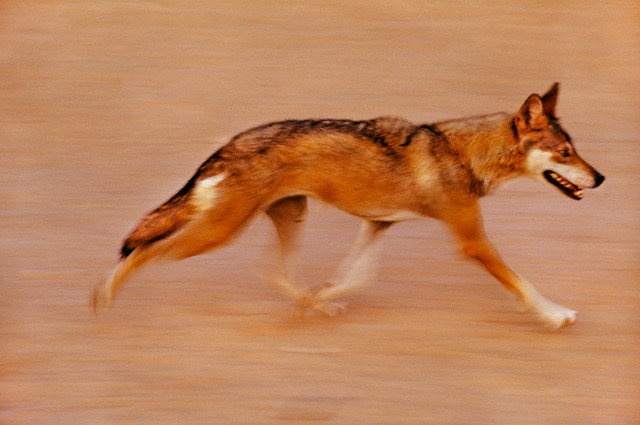
Negev Desert wolf

Italian wolf

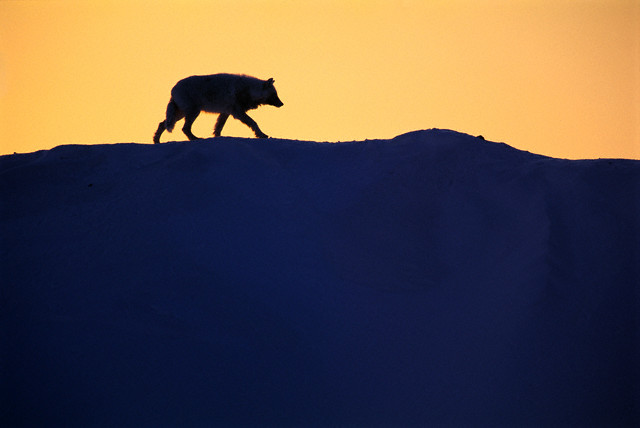
Arctic wolf

Australian Dingo

Golden Jackal

Egyptian stray dogs
Greenland sled dogs

Ethopian wolf

Romanian wolf

Chinese village dog

Philippines Village Dog

Coyote

French wolves

Shave these animals down to account for coat differences due to climate variance, and color them all the same, and there is not a biologist in the world that can reliably say which is dog, wolf, jackal or coyote based on simply looking at them. There are differences in size, but those differences are arrayed on a continuum and there is no obvious break moving from one animal to another.

This is not to say dogs, Coyotes, Golden Jackals, and wolves are not different.

Wolves and coyotes howl and almost never bark, while dogs bark and almost never howl.

Male and female alpha wolves lift their legs to pee, while all other wolf pack members squat to pee. With dogs, almost all males lift their legs, and almost all females squat.

With wolves, estrus occurs only once a year in January or February, while with most non-primitive dogs, estrus occurs twice a year, and can occur at any time.

There are other differences too -- physical differences. Wolves have a pre-caudal gland while dogs do not, and there is also a very small bone difference in the feet of one wolf sub-species.

But can a scientist, anywhere, pick up the skull of an ancient canid and definitely and reliably say this one is a coyote, and this one is a red wolf, and this one is an Arabian wolf, and this one is a dog, and this one is a Golden Jackal and nothing has ever been crossed?

No.

The morphology and biology of dogs, wolves, coyotes, and Golden Jackals is simply too plastic for that kind of facile work based on single skull samples.

In fact, the very nature of the claim being made is flawed at its core.

The assumption is that dogs were created from wolves. It's far more accurate to say dogs ARE being created from wolves. The world of canids is one in which speciation is occurring and has not yet fully occurred. It is still a process, not an event.

And it is a process in which man is still very much stirring the pot.

In Alaska, Kazakhstan, Spain and Romania, there are still wolf pups being snatched from the wild and raised as dogs. These animals are so unreliable as pets that there are laws in almost every country prohibiting their ownership, but their ownership is so common that there's also a entire lexicon of language where the dogs are described as "Malamutes." In fact, many of the animals bought as wolves are Malamutes! Such is the plastic nature of dogs and wolves.

In Italy, Alaska, Minnesota, Spain, Ethiopia and the Middle East, wolves are occasionally crossing with dogs to create small unstable hybrids with the result being mostly wolf, but with sizable doses of dog coursing through the bloodstream.

Here in the U.S. no one knows what to make of the giant coyotes that have appeared in New York and Maine. They appear to be mostly wolf, but there's a little dog in there too.

And, of course, there is the Red Wolf, which has always been nothing more than a stable and self-replicating hybrid of a wolf and a coyote.

The point here is that the world needs to stop saluting this notion that there was a "magic moment" when a wolf became a dog, or that there is even a bright-line morphological difference between Wolves, Dogs, Coyotes, and Golden Jackals.

Bones, by themselves, do not actually tell us all that that much in this instance.

Malaysian feral dog

Native Siberian dog

Leonhard Sepalla and his sled dogs

Golden Jackal

Turkish Wolf

Thursday, May 25, 2017

Why Do Dogs Eat Grass?


Why do dogs eat grass?

It's a common question, but in asking the question, an assumption is revealed.

The assumption is that dogs are not supposed to eat grass.

After all, no one asks why we humans eat chicken, corn on the cob, fish, or strawberries.

The short answer is that dogs eat grass because it tastes good and it provides some nutrition.

It is not a sign of worms, an upset stomach, or any kind of nutritional deficit.

That's the short answer.

Now let's look at the question a bit deeper.

Do wolves, fox, coyotes, and dingoes, also eat vegetable matter?

The answer is "yes."

Wolf biologist David Mech notes that grass appears in 14-43% of all wolf scat found in North America and Eurasia. Plant material in fox and coyote scat, including grass, is so common as to be unremarkable.

Leopards, jaguars, mountain lions, and bobcats also eat surprising amounts of grass. A sample of 215 leopard scats collected in the Tai National Forest of the Ivory Coast, for example, found 17% had a considerable amount of grassy vegetable matter.

Bears too eat a lot of plant material. Though classified as the largest carnivores in the world, bears eat more vegetable matter in their diet than flesh, and grass is a major food source.

So why do "carnivores" so often eat grass?

For the same reason you and I eat most of the foods we eat; it tastes good.

Of course the other answer is that it is maladaptive for them not to do so.

Let's explore that idea a bit more.

Specialization in food sources is a terrific idea so long as the world stays exactly the same, day in and day out, season after season, year in and year out.

But, the world is both temperamental and unreliable.

Crippling winters, blistering summers, and poorly timed rains can decimate populations of prey species.

Disease can wipe out herds, migration routes can change without warming, and new species can invade.

Water holes may dry up, salt licks may disappear, and predators can injure themselves in the chase.

And yet every few days, a predator must eat.

And that's the problem: The chain of life is so easily snapped.

For a meat-eating predator, the weakest link is the absence of ready prey, easily caught, day in and day out, in good health and bad, dry season and wet, winter and summer, year after year.

And so wolves, coyotes, dingoes, bears, lions, bobcats and jaguars have all evolved to eat plants, as well as flesh -- a way of "hedging the bet" for a few days against the vicissitudes of life.

Yes these animals will try to bring down a deer- or rabbit-sized meal if they can. But if they cannot, then they will try to catch a few rats or mice, a lizard or a snake, a frog or a turtle.

And if push comes to shove, there's always grasshoppers, crickets, and verdant grass along the creek. And it does not hurt at all that some of that grass actually tastes pretty good!
.

Wednesday, November 23, 2016

The Stolen Wolves of Kazakhstan


As I noted in an earlier post,

Wild wolves are still being domesticated every day.

Why?

Simple enough: for pets.

The same trend is true for every other animal under the sun: coyotes, red fox, monkeys, apes, hyenas, tigers, lions, tapirs, sloths, crows, hawks, parrots, badgers, fenecs, servals, raccoons, cheetahs, bears, bobcats, rats, agoutis, possum, groundhogs... the list is endless. We routinely make pets of them all, in modern culture as well as primitive.

In the picture, at top, we see modern Kazak hunters who have raided a wolf den to steal away the cubs. These wolf cubs are then raised and later sold to dog fighters or killed for their skins.


How close can a Kazak dog be to a wolf? That obviously depends a lot on the particular dog, but take a look at the Kazak dog below (source) and compare and contrast with the images, above.


Kazakhstan has the largest wolf population in the world, with about 90,000 animals spread over about a million square miles. For comparison purposes, Canada has a about 60,000 wolves spread over a land mass that is over three times larger.
.

Monday, July 25, 2016

Oops. There Really IS Dominance in Wolves


We all make mistakes.  I make 'em every once in a while, and you do too.

The true test is not whether you make a mistake, but whether you own it, and by that test Lee Charles Kelley comes out alright.

I don't know Kelley.  Never read him before.  We might disagree on nothing, or disagree on almost everything.  I have no idea.  That said, I give him a small nod for cowboying up for a serious error.  It would be nice if other dog trainers would follow suit. 

Kelley writes in Psychology Today online:

A Mea Culpa to Mech, an Apology to Bekoff

When it comes to understanding canine behavior, Dr. David Mech — the world's leading expert on wolves — and Dr. Mark Bekoff — the world's leading expert on coyotes and canine play — are two of my biggest heroes. So imagine my chagrin to discover that they're both irritated with me....

I wrote a piece last week titled "Deconstructing the Dominance Myth (Again...)," which was a response to a personal blog post written by Dr. Roger Abrantes, posted on another part of the internet, far, far away. The main thrust of my article wasn't that dominant behaviors don't exist, but that the terms we're using to describe them are anthropomorphic, and that saddling dogs with these labels is harmful to any dogs whose behaviors may, in fact, be the result of stress or anxiety, not dominance. I now realize, and freely admit, that I made mistakes in my article, mistakes I wasn't aware of until Dr. Bekoff pointed them out to me here.

My first mistake was referring to the concept of dominance as a myth. That's a charged word, one that carries with it the implication that scientists who have dedicated their lives to understanding animal behavior are all operating under some kind of mass delusion. I deeply regret making that insinuation, however unintentionally. In recent years, it's become fairly common in the dog training world for some of us to talk about "the myth of dominance" in a somewhat cavalier way. What's generally meant by this is that the idea of dominating a dog, as the basis for a training system, isn't based on real science and can be harmful to the human-canine bond.

Dr. Bekoff also took me to task for the following passage:

"Dr. David Mech, the world's leading expert on wolves, says that in 13 years of studying the wolves on Isle Royale in Michigan he never saw any displays of dominance. In other packs Mech says that dominance displays are so rare as to be almost nonexistent."

I turns out that this isn't exactly true. I was basing what I said on the following passage from a 1999 paper ("Alpha Status, Dominance, and Division of Labor in Wolf Packs," Canadian Journal of Zoology.): "In natural wolf packs, the alpha male or female are merely the breeding animals, the parents of the pack, and dominance contests with other wolves are rare, if they exist at all. During my 13 summers observing the Ellesmere Island pack, I saw none." (I made another mistake by getting the geographical location of Mech's studies wrong.)

Dr. Bekoff apparently sent a copy of my post to Dr. Mech, who responded with the following: "A quick scan of the Kelley article reveals much misinformation attributed to me. This misinterpretation and total misinformation like Kelley's has plagued me for years now. I do not in any way reject the notion of dominance."

In his post, Dr. Bekoff pointed me (and other readers) to a 2010 paper written by Dr. Mech and H. Dean Cluff ("Prolonged Intensive Dominance Behavior Between Gray Wolves, Canis lupus") in which they write: "Dominance is among the most pervasive and important behaviors of wolves in a pack."

Clearly, I'm not keeping up on my research. So I was wrong to insinuate, here and in other pieces I've written on dominance, that Mech believes dominance is rare or doesn't exist at all in wild wolf packs. I apologize for my mistake and will attempt to make corrections to all the pieces I've written that contain this outdated view (there are a lot of them).

But wait. It gets worse!

My thesis about the cause of dominance and submission—as outlined briefly in my post—is that they're primarily the result of a wolf's internal tension and stress. But in the comments section of Dr. Bekoff's post, Simon Gadbois, from the Canid Behaviour Laboratory at Dalhousie University in Halifax, wrote: "My PhD thesis was on social stress in wolves... Jane Packard, that had done the stress studies with Mech in the 80's was on my committee. Here I can tell you that your interpretation is wrong because you are over-generalizing. We simply do not have enough data to jump to the conclusions that you get to."

Read the whole thing, but let me be clear that I am applauding Kelley for owning up to his error, setting the record right, and putting it in print.

Contrast that to another person who will remain unnamed, but who was the subject of a blog post about dominance (in which David Mech weighs in -- see the comments) authored by Dr. Mark Johnson.  Read that post here: Is Dominance Always Bad?  And, of course, the answer is NO. I featured excerpts from Dr. Johnson's post on this blog some years ago (see here) and even featured video of wolf dominance filmed by Dr. David Mech and Dean Cluff (see here).  For those who like video-enhanced story, I put up a post entitled Dominance Creates and Maintains Wolf Packs which told the story of the rise and fall of the Druid Wolf pack -- the largest wolf pack in the world at the time it was being filmed. 

And yet we still have this nonsense about dominance in wolves and dogs as a "myth."  Why is that?

Mostly it's because a small slice of dog trainers have decided that in order to differentiate themselves in the world of dog training they need to brand what everyone else is doing as "abusive" while proclaiming "their" method (click-and-treat) as the only one that is "scientific."  

This is the Internet School of Dog Training where Lee Charles Kelley has apparently been hanging out and drinking the Koolaid, and it seems he has simply not bothered (up to now) to actually read the sources that he and others have been referencing. 

Even now he cannot quite let go of the nonsense, writing that what he meant "is that the idea of dominating a dog, as the basis for a training system, isn't based on real science and can be harmful to the human-canine bond."

Um.  Mr. Kelley, you still don't get it.  Dominance is not violent.  It is not bad.  It is simply taking control and establishing respect and leadership on your part and establishing respect and followship on the part of the dog. It is not a threat to the human-canine bond, it is the essence of it.  And, to be clear, dominance occurs every day and not only with wolves, but also with dogs, people, elk, bison, and pretty much every other animal that lives in social groups (as well as many that do not). Dominance makes the world go around.

Kelley, describes himself as as a "neo-Freudian" dog trainer. I have no idea what that means, but he seems to think it has something to do with prey drive. I guess I know a little about prey drive in dogs since I have working terriers with the scars to prove it, but I have never felt any need to quote Freud. Let us remember that the real experts on dogs have tails. 

I have to say I find it amusing that Kelley says words like "dominance" and "submission" are "anthropomorphic" and then turns around and calls himself a "neo-Freudian" dog trainer.  Whiskey-Tango-Foxtrot.  Not too much self-awareness there!

So what is this contrived and entirely fake controversy about dominance in dogs about? 

It is about marketing. 

Remember that dog trainers are trying to sell a service and so they are trying to differentiate themselves.

In order to differentiate themselves, a dog trainer may claim to be neo-Freudian or "gentle" or "natural" or "positive" or "holistic" or "balanced." 

Casting about for a rationale for why people should choose their training methods as opposed to their competitors, many of these folks have done two things simultaneously:

  1. Mis-characterized scientific work on wolves and dogs, including and perhaps especially the work of David Mech, and;
    .
  2. Mis-characterized the training methods of thousands of years of dogs trainers, including and perhaps especially the work of Cesar Millan, who happens to be the most famous dog training personality on television these days (a spot previously held by Barbara Woodhouse).

Since the previous text straightens out much of this mis-characterization of Mech, let me address the second one -- the mischaracterization of Cesar Millan. 

In Cesar's Rules, Millan and co-author Melissa Jo Peltier write about what Millan actually does and what he has actually written:

My co-author tells me that on occasion someone will say to her, “I don’t approve of Cesar’s training methods.” When she tells the person that what I’m doing isn’t dog training but dog rehabilitation, he or she often grudgingly admits to having watched only one or two episodes of the show or a one-minute clip on YouTube and typically has not read any of my books or seen my videos. When my co-author asks, “What do you think his methods are?” the answer invariably is something like, “Oh, all the choke chains and the e-collars and the alpha rolls.”

Well, any regular viewer of Dog Whisperer knows that these tools don’t fairly represent what such a critic would call “my methods.” Curious about this, our producers did a show-by-show breakdown, watching hundreds of hours of television and counting when a particular technique was used in any given episode. At the time the breakdown was done, we’d filmed 140 shows, covering over 317 separate cases of problem dog behavior.

The person who doesn’t approve of my “methods” might be surprised to learn that the number one thing I advocate nearly every show is simply leadership (in 98 percent of the episodes), which I teach as the calm-assertive energy that any leader, teacher, parent, or other positive authority figure projects to her followers. I’ve used the word dominance to describe the energy of leadership, but in the animal world dominance doesn’t mean “brutality,” and assertive certainly doesn’t mean “aggressive.” I believe that good leadership never involves bullying or intimidating; instead, it depends on confidence, knowing what you want, and sending clear, consistent messages about what you want.

The number two method I advocate, according to the producers’ breakdown, is body language (91 percent), which is a primary way in which leadership is projected in most animal species. My third top “method” is exercise — walk your dog properly at least twice a day (72 percent). And what is the fourth most common “method” I’ve used on Dog Whisperer episodes?

This one may shock a few people. I used positive reinforcement in one form or another 67 percent of the time in the first 140 shows. As Barbara De Groodt reminds us, positive reinforcement doesn’t have to mean cookies. It can mean anything that a dog likes and that becomes a motivator or reward for the dog.

Personally, I don’t think I have a specific “method” or “system” that I apply in order to change or improve a dog’s behavior. For me, there is no magic formula. I believe in trusting my instincts and in treating each dog as an individual.

So there you go: those are Millan's "methods," and if you oppose them, then you are telling me and the world that you oppose leadership, exercise, body language, and positive reinforcement.

There is much more in the book of course, but you will have to actually buy the book and read it.  Since a quick glance through Lee Charles Kelley's previous writings tells me he has not actually read Cesar Millan either, he might take a hint and do a little reading there too. 

Does reading books (and not just Internet bulletin boards and Facebook posts) make me an "old school" dog trainer?  

If so, then I am very old school, and I have the T-shirt to prove it


This post is from Feb 24, 2012

Friday, March 16, 2012

Isle Royale Wolves on Thin Ice


In an earlier post entitled Islands of Wolves, Rats, Lions and Dogs, I detailed the different social-demographic-and genetic loads and problems that occur when different species occupy islands or otherwise suffer from extremely isolated (and therefore inbred) populations. 

As I noted, what species an animal is, where it feeds on the pyramid, and how it lives and loves are very important issues so far as genetic health and long-term population viability are concerned.

To illuminate that point I compared the extreme genetic isolation of the Isle Royale Wolves in Michigan to what has occurred when rats, and lions have found themselves on similar sized islands.

Now comes word that scientists are worried that the Isle Royale Wolves may go extinct

Isle Royale National Park's gray wolves, one of the world's most closely monitored predator populations, are at their lowest ebb in more than a half-century and could die out within a few years, scientists said Friday.

Only nine wolves still wander the wilderness island chain in western Lake Superior and just one is known to be a female, raising doubts they'll bounce back from a recent free-fall unless people lend a hand... There were 24 wolves — roughly their long-term average number — as recently as 2009.... The only intact pack had six members. One wolf wandered alone, while a couple — including the only known female — staked out territory and apparently mated.

Should the Isle Royale Wolves be allowed to go extinct?

If that happens, what will happen to the moose population, and what will that mean for the island's vegetation?

To be clear here, there is no great decision to be made here. 

We have many thousands of wild wolves all over the lower-48 now, and extremely healthy wolf populations  exist all over Canada and Alaska as well.  The wolf is an animal that is not only off the Endangered Species List, but is allowed to be hunted in a few states. 

The fate of a dozen wolves on Isle Royale, then is largely a philosophical debate, and not necessarily one of great import or permanence.  After all, wolves did not exist on Isle Royale at all just 70 years ago.  Even if all the wolves on the island died out this year (a very unlikely scenario), a hard freeze over Lake Superior next winter might return a new population from the mainland soon enough.
.

Wednesday, February 29, 2012

An Alpha Wolf Kills Another Alpha Wolf???


What?

An "alpha" wolf kills another alpha wolf? But that never happens!

But, of course, it happens all the time.

Wolf-on-wolf violence is one of the most common reasons wolves die in the wild.

From today's edition of The New York Times:

[T]oday, the alpha wolf of the Chippewa Harbor Pack and I are most likely recalling memories of the same event, even if we experienced it from wildly different perspectives....

One year ago, minus four days, I hiked over this same ridge and then just a quarter of a mile beyond. It was warm and sunny, like today. On a sled behind me, I hauled the 85-pound carcass of the alpha male of the Middle Pack; two days earlier, he had been killed by the alpha male of the Chippewa Harbor Pack.

In the year since, the Chippewa Harbor wolves have not had to defend their territory, as they are the only surviving pack on Isle Royale....

Tuesday, December 13, 2011

Dominance, Submission and Evolution


Evolutionary biologist Roger Abrantes, author of Dog Language, writes about dominance among wolves and dogs, dissecting the arguments made and holding them up to the light of observation as an evolutionary biologist.  He writes on his blog:

Dominance and submission are beautiful mechanisms from an evolutionary point of view. They are what enables (social) animals to live together, to survive until they reproduce and pass their (dominant and submissive) genes to the next generation. Without these mechanisms, we wouldn’t have social animals like humans, chimpanzees, wolves and dogs among many others.

Abrantes describes dominance and submission as the sustainable versions of their unsustainable corollaries, aggression and fear.

In the long run, it would be too dangerous and too exhausting to constantly resort to aggression and fear to solve banal problems. Animals show signs of pathological stress after a time when under constant threat, or constantly needing to attack others. This suggests that social predators need mechanisms other than aggressiveness and fear to solve social animosities.

Of course, anyone who has been around dogs for a long time, especially groups of dogs, has seen dominance and submission, provided they were really observing the dogs.

This last point is important, because often people see, but do not observe and dominance and submission are rarely in explosive display. As Abrantes notes:

Hierarchies work because a subordinate will often move away, showing typical pacifying behavior, without any obvious signs of fear. Thus, the dominant animal may simply displace a subordinate when feeding or at a desirable site. Hierarchies in nature are often very subtle, being difficult for an observer to uncover. The reason for this subtlety is the raison d’être of dominance-submission itself: the subordinate animal generally avoids encounters and the dominant one is not too keen on running into skirmishes either.

Dr. Mark R. Johnson has said almost exactly what Abrantes has said here, and his opinion carries additional weight because he has handled wild wolves and feral dogs both in the U.S. and around the world.  

David Mech weighs in and says Johnson has it just about right.

And, of course, wolf expert and film-maker Bob Landis, has spent years filming wolf packs in the Lamar Valley of the Yellowstone. You can read (and see!) what happened to the Druid pack (the largest wolf pack in the world at that time) at this link.  And yes, dominance and submission has quite a lot to do with the way things play out in the real world of wolves in the Lamar Valley!

Now is dominance a very useful idea in the world of dog training, and what does it mean in that context? That's another post. For now, let's simply come to terms with a simple fact: that dominance and submission are behaviors that do exist, and they exist not only in wolves and dogs, but also in chickens, horses, bison, prides of lions, walrus, seal, elk, deer, elephants, and nearly every other social higher-order communal animal, including humans.
.

Tuesday, December 06, 2011

Islands of Wolves, Rats, Lions and Dogs

Isle Royale, Michigan.  An island of wolves.

In the real world, population bottlenecks are not always quite as big a problem as some people imagine, nor are they quite as easy to correct as some people hope. 

If that sounds like two statements in direct opposition, then you have grasped a core message of this post, which is that not all animal populations are the same, that few real-world cases line up squarely with simple theory, and that there are multiple facets to both genetic isolation and genetic rescue.

In order to understand a little more, let's look at four real-world animal populations:
Imagine a pregnant rat jumps ship on to a large island that is 200 square miles in size.  The population of rats multiplies very rapidly but without any apparent long term problems due to inbreeding.  How is that possible?  Answer:  With rats, massive population numbers within a short period of time are possible, and a mid-sized island of 200 square miles (over 259,000 acres) can easily hold a million rats.  In this situation, genetic drift and mutation will eventually result in a population with little or no obvious genetic dysfunction.  On an island with 1,000,000 rats, in which each rat lives for a year or so, a 100-year old population of theoretically "inbred" rats will have very low coefficients of inbreeding, no inbreeding depression, and no discernible early mortality due to genetic weakness.  To be clear, this is not a theory; rats have colonized almost every island in the world exactly this way.

Now imagine that a pregnant wolf lands on an island that is 200 square miles in size.  The wolf whelps five pups, and the pups interbreed and the population grows for a time until it hits some sort of food-availability threshold.  A boreal island that is 200 square miles in size and with a sizable moose population can, for a while, feed a population of 50 wolves, but eventually that population can be expected to collapse down to as few as dozen individuals before it rises again and falls again due to the vagaries of disease and weather which will impact prey species such as moose, deer and rabbit.  After 75 years, the population of wolves on this island will be very inbred, and infecundity and disease will be common.  The reason for this is simple:  wolves typically live between six or seven years in the wild, and the smaller number of wolves on the island, combined with the smaller number of generations, means that there will be very little room for genetic drift or mutation.  Is is possible to import a single individual wolf to achieve a "genetic rescue" of this heavily inbred wolf population?  A single wolf, sadly, is not likely to do it.  The reason for this is simple:  the small number of wolves on the island (a population of 24, on average) and their high rate of infecundity due to inbreeding, means that the genes of the new male wolf will quickly dominate.  Inbreeding will then continue as before.  Though there may be a short temporal  improvement in population health, that may not be observed if there is a counter-balancing downtick in food sources occurring at the same time.  To be clear, this scenario is not one I have made up; it appears this is exactly what happened with the wolves on Isle Royale, Michigan.

Now imagine a large population of lions that has been reduced by hunting to just 30 individuals living on an isolated isthmus 200 square miles in size.  The population is so isolated that the coefficients of inbreeding within the lion population begin to rise, and a rise of infecundity and an increase in genetic defect is feared.   The good news, however, is that this isthmus is not at carrying capacity for lion, and so eight completely unrelated female lions are imported from another country more than 1,000 miles away -- a 25% population boost representing a massive increase in genetic diversity.  What happens?   A rather significant improvement in species health and fecundity seems to occur, and the lions begin colonizing more space on the isthmus.  Why did this genetic rescue work?  Well, for one thing, the original 30-lion population was more diverse than it at first appeared.  Remember that these 30 lions did not actually spring from a closed registry of two individuals, but were the remainder left from a massive population that once numbered scores of thousands.  While inbreeding to failure appeared to threaten this lion population, the actual genetic diversity beating under the hood was likely to be quite a bit more expansive than a purely mathematical population model would suggest.  Factor in the relative size of the genetic infusion coming from the other side of the country, and the ground is set up for a successful genetic rescue.  To be clear, this scenario is not one I have made up; this is exactly what happened with the lions of Southern Florida (aka, the Eastern Puma, Florida Panther, or Eastern Mountain Lion).

Now imagine a pair of dogs that are mated and their pups are then inbred to each other for 25 years at which time another dog is added to the population and the result is further inbred for another 40 years.  The result is a population of about 180 potential breeding dogs (30 dogs are born a year, and not all dogs will be bred) which have a Coefficient of Inbreeding of 80 percent.  What would it take to have a successful genetic rescue here?  If we use the Florida Panther model as a guide, we would need to see an addition of 45 new dogs to the gene pool.  Would the addition of  one or two dogs be enough to turn the tide?   Probably not.   The addition of only a handful of dogs in a show-breed situation, where dominant sire selection will continue unabated, will not provide the genetic fix needed to turn things around.  Remember we are starting here with a very high COI, and the public demand for these dogs is apparently quite low; this is a breed that hits its consumer "carrying capacity" with just 30 to 40 puppies a year.  To be clear, this scenario is not one I have made up; the dog presented here is the Cesky terrier, a breed that has never been very popular.

So what's the point? 
 
The point is this:  the issues associated with population bottle necks are not quite as simple as some imagine.  Yes, the relative size of the founding population matters, but so too does the genetic health of the founding population, the total number of animals bred, the number of generations it took for the population to achieve a large size, and whether the animal in question was breeding randomly or within an organized scheme that encouraged (or discouraged) genetic diversity.

Consider, for a moment, a dog breed that was drawn into a closed registry 120 years ago with 150 dogs in its foundation registry.  The breed grew rather quickly so that after 40 years it had a worldwide population of 125,000 dogs; a population it has maintained for the last 80 years.  Coefficients of inbreeding in the modern population of this dog will, on the whole, be quite low, and though the apparent "effective population size" may have dropped from 150 dogs to 80 dogs due to dominant sire selection, effective population size is quite a meaningless number when you have bred well north of 1 million dogs over a 100-year span.  In a situation like this diversity is not destroyed over time, but created through the sheer beat of numbers over vast distances.
 
Of course, there is another factor in all this, and it is an important one, and one that is too often left out.

You see, in the world of Kennel Club dogs there has always been a little "pedigree leakage."  

Pedigree leakage may be small or even nonexistent in a very rare breed where everyone knows everyone else, and the dog in question is likely to look a bit odd or extreme and not have an obvious analog in another breed or cross-breed.

But what of the other more popular breeds, where there are a lot more dogs in the wind, and only a small number are likely to ever see the inside of a show ring, and analogs exist all over? 

In a situation like this, instead of a reduction in effective population size, there may actually be a little growth! 

After all, a Labrador Retriever with five-generation pedigree papers from the AKC may, in fact, have a Flat-coated sire, or even be whelped by a cross-bred dog of "pedigree unknown." 

A Miniature Poodle may have a little Maltese coursing through its veins only a generation or two back. 

And what does it matter?  Not a whit if the cross was a sound one and did not add a new or heavier genetic load to the mix.


The bottom line is that there is more to population genetics than any one number, and while it's important to be worried, and to take action to increase breed genetic diversity, it's equally important to recognize that one can fall in love with less than robust genetic theory and falsely specific numbers just as easily as one can fall in love with cocked up doggy histories and the romance of breed purity.   In the end, population science and genetics is about more than one number; it's about a small stack of numbers meeting a real gene pool coursing through the flesh and blood of a real population that is living in a real environment (whether wild or artificial, free-feeding or subsidized).

Yes, let us work to increase diversity, but let us also look towards Mother Nature as well. 

Remember that while Mother Nature abhors closed breed pools, she also manages to work out solutions for most of those that wash up as single or paired animals on tropical islands or are introduced to foreign lands.  Observe the birds in the park.  How many Starlings did we start off with here in America?  How many English Sparrows?  How many Red Fox?   How many wolves in Yellowstone?  They are clearly thriving.  How is that possible?  And, of course, the answer is that they colonized in vast numbers over a vast space of land, and in the slow beat of numbers and space they managed forge their own genetic health.
..

Monday, October 17, 2011

The Sounds of a Wolf Hunt

A pair of northern European wolves.

Wolves' wild boar hunting (Canis lupus lupus) by nordicnature


The annotated sound tape, above is of a pair of wolves in Sweden hunting, first an elk and then, when that did not go so well, wild pig which appeared on the scene. From the web location where this audio was found comes this description from HÃ¥kan Olsson, who recorded it:

I was out photographing/recording. It was late, but the full moon helped lighting up my surroundings. I had the recorder in rec/pause and my headphones on, so all sounds around me was amplified like I usually have.

Since I was trying to photograph animals. I had my camouflage clothes on. I rarely use a hide. Suddenly I heard that the ducks, lapwings and other birds to the left of me flew up in the air worried about something. I looked in that direction with my binocular and then I saw two wolves coming in my direction. They were about 200m from me. The female (smaller) was about 50m ahead of the male. She stopped when she was about 40m from me a little to the left. She probably “sensed” that I was there… She sat down and looked around. The male wolf came straight at me since he was to the right of the female from my view. He stopped at about 30m from me. He stared at me or in my direction for 5 minutes… I was leaning to the left in a not so comfort position so I said to myself, please go now… my back hurts, but he didn’t. Instead, he lay down in the grass… and he continued staring at me (or my not camouflaged mic). I was completely still and after a few minutes he started to look around instead. The female passed him and lay down further away to the right of me. After 10-15 minutes he joined her. They changed positions a few times and seemed to be in no hurry. Then the female started to target a red deer bull. She crawled on her stomach closer and closer. The male followed about 30m behind her. She got closer and closer and when she had about 50m left to the red deer she got in to full attack. The male wolf followed and they both attacked the red deer bull. The deer defended himself really well with his big horns. He attacked the wolves so they had to back off a few times. The wolves continued their attack from two directions for a while, but then they gave up and lay down in the grass. After a while they tried again, but the deer still defended himself really well. He didn’t make the mistake to try and run. They gave up again and the walked away to the edge of the field and lay down just inside the forest. After about 20 minutes I heard a familiar sound. Wild boar heard was incoming…

Here my posted recording at soundcloud starts, since there was just breathing sounds and sounds when wolves and deer move in the grass previously, so not much to listen to.

A very special thanks to Anton Woldhek for sending this to me! Fantastic!

Wild boar crossing road, Sweden.

Tuesday, October 04, 2011

Obama FWS Tells NYT to Try Science


Remember when the Obama Administration was going to take away all our guns, put an animal rights loon in charge of taking away all our dogs, and then ban all hunting?

That really was the nonsense being spewed by the far right, to which they also added that Obama was really foreign-born and was a closet whitey-hater.

Ah well,there is nothing more horrible than the murder of a beautiful theory by a brutal gang of facts! 

Here we are, three years later, and there are more lawfully-owned guns in America than ever before, and the Obama Administration even lifted long-standing restrictions on guns in national parks.

Dogs?  Obama got one himself, and so far no one has come knocking on my door or yours to take away our dogs.

The "radical Animal Rights" folks in the Obama Adminisration are going to end hunting? Yeah right.  Maybe not so much

The latest from the Obama Administration comes in the form of a letter from Dan Ashe, the Director of the U.S. Fish and Wildlife Service.  Mr. Ashe, writing in response to an editorial in The New York Times about the status of wolves in the northern Rocky Mountains, notes that the wolf has fully recovered in that part of the U.S.

Your Sept. 23 editorial “Way of the Wolf in Wyoming” implies that Interior Secretary Ken Salazar and the Fish and Wildlife Service have somehow betrayed the species we worked so hard to recover. And it is recovered. Today, more than 1,650 wolves, in 244 packs, occupy the northern Rocky Mountains, exceeding recovery goals for 11 consecutive years.

We understand the emotional reaction to wolf hunting, but the facts don’t support your conclusions. Wyoming’s plan will maintain a healthy wolf population above the wildlife service’s recovery goals and set up an extensive monitoring program to ensure that this remarkable success is maintained.

Wolves will remain completely protected in Yellowstone and Grand Teton National Parks and within the National Elk Refuge. Outside of these areas, the wolf will be managed as a trophy game species subject to regulated hunting in nearly all remaining suitable wolf habitat in Wyoming. More than 90 percent of the population lives within these areas.

The Endangered Species Act has done its job for the wolf. It’s time to recognize and celebrate this environmental success and get to work on other species that truly need our help.

Regardless of what you think about wolf magagement
in this country, I think we can all agree that no one in the Obama Administration is letting Wayne Pacelle of the Humane Society of the U.S., or Ingrid Newkirk of PeTA, sit at the public policy table!

The Obama Adminsitration is working on science, not sentiment.   Little wonder then that those on the far right, or the far left, cannot  understand it!

Saturday, September 10, 2011

The First Dogs and and Genetic Drift


From Inbreeding and Genetic Diversity in Dogs: Results from DNA Analysis by Claire M. Wade:

The projected number of wolf founders of domestic dogs is 51 if the foundation event was closer to 16,000 years ago and could be as high as several hundred maternal founders if domestication was at the recent end of the projected range. This difference in estimates arises because time allows new mutations to accumulate, providing an alternative explanation for the diversity of haplotypes observed. It should be recognised that even founder females are likely to have carried a mixture of mitochondrial haplotypes

As this paragraph suggests, and as I have noted in the past, time, numbers, breeding habits, and generation length have a great deal to do with genetic variability. This is as true in dogs as it is in wolves.

The wolf-dog nexis is a particularly problematic fork to put a date on, as the wolf is:
  1. a top predator, and big fierce predators are always rare due to their place in the food chain;
  2. because only the top male and top female in a wolf pack will mate, and;
  3. because wolves will only mate once a year.

Of course the domestication of the wolf at the hand of man has done several things.  It has:

  1. increased the density of proto-wolves (i.e dogs and dog-morphs) on the landscape thanks to their association with man;
  2. it has freed most domestic dog "packs" from the tyranny of having only the top male and top female mate, and;
  3. it has increased the number of estrus's from one to two for most domestic dogs.

What's that mean?  Simply put it means if you are trying to pick a date for wolf-dog divergence, you are either going to have to pick a very wide time range, or you are going to have to make some assumptions for which there is, as yet, very little concrete evidence.

In fact, by at least one measure of speciation, a dog-wolf fork has not yet been made. After all, wolves, coyotes, domestic dogs, dingo, golden jackals, and New Guinea singing dogs can all interbreed and produce fertile young.
.
.

Saturday, September 03, 2011

Who Domesticated Whom? And Why?

Greenland natives with pet wolf on deck of S.S. Diana, 1898.  Source.

How did wolves become dogs?

A lot of nonsense has been written on this topic. Some folks, for example, seems to be captivated by the notion that wolves self-domesticated by approaching ever-closer to our camp fires until at last they rested their heads on our laps. There's a "Just So" story if I have ever heard one!

Another story commonly offered up is that humans domesticated wolves and turned them into dogs in order to use them to hunt.

Nonsense.

Wolves still exist all over the world today, but no one is domesticating wolves in order to turn them into hunting partners. In fact, most primitive people do not use dogs to hunt at all, and for a very good reason: dogs are more likely to alert game than find it, and dogs are not all that easy to train to a high degree of command.

Look at the the techniques used to bring home the bacon in primitive cultures all over the world, and you are more likely to find stealth, snares, traps, poison, and human drivers rather than dogs. Trained wolves used to hunt? They exist nowhere.

Yet wild wolves are still being domesticated every day.

Why?

Simple enough: for pets.

The same trend is true for every other animal under the sun: coyotes, red fox, monkeys, apes, hyenas, tigers, lions, tapirs, sloths, crows, hawks, parrots, badgers, fenecs, servals, raccoons, cheetahs, bears, bobcats, rats, agoutis, possum, groundhogs... the list is endless. We routinely make pets of them all, in modern culture as well as primitive.

Pet hyena with Nigerian street performers.


Children with pet coyote.

So why have we heaped special creation myths on the dog-to-wolf conversion? What's the subtext there?

The subtext may be that when it comes to the origin of dogs, we would rather tell ourselves a lie than the truth.

The truth is that our first relationships with dogs was not forged in their desire to return a tossed ball to hand, but in out brutal masacre of their mothers and fathers, and their kidnapping to a strange and alien world where they grew dependent upon us for food, affection and any semblance to freedom.

And why did we do this? For our own amusement, and nothing more.

Our first relationships with wolves and dogs, then, was not forged in some notion of benign, mutual co-dependecy, but in blood and fear.

No wonder we created another story to hide the shame!


Adolph Murie and family with pet wolf, Mount McKinley, Alaska, 1940.

.