Showing posts with label wilderness. Show all posts

Thursday, January 11, 2018

Aldo Leopold on Gadgets and Fox Hunting


Aldo Leopold

Aldo Leopold, who was born on this day in 1887, was one of the most important people in the history of U.S. conservation. A 1909 graduate of the Yale Forestry School, Leopold wrote the first book on Game Management (it is still in print and it is still used at a text book), and was the first person to predict that the widespread extirpation of wolves through poison and trapping would result in an explosion in the deer population that, in turn, would wipe out much of the understory of American forests. Most famous for his eco-philosophical journal A Sand County Almanac, about his Wisconsin farm, Leopold also explored the role of wilderness and hunting in American culture.

In an early essay entitled Wildlife in American Culture, Leopold noted that even in the era before World War II, "the gadgeter, otherwise known as the sporting-goods dealer," was dominating the sporting press and warping America's understanding of the outdoors.

The phenomenon is very easy to see today, with hunting and fishing magazines centered less on wildlife and wild places than on the Quad Bikes, scent sprays, lures, bait, and expensive guns, rods, and reels that we are told we will need before we even think about going into the woods.

This ethos has now expanded into the world of camping and hiking, where everything has to be rip-stop, multi-fuel, Goretex, and composite construction. Not only must everything be lighter weight, there must be more luxury and options than ever before. As Leopold noted in this 1940-era essay, describing the beginning of the modern ethos:

"Then came the gadgeteer, otherwise known as the sporting-goods dealer. He has draped the American outdoorsman with an infinity of contraptions, all offered as aids to self-reliance, hardihood, woodcraft, or marksmanship, but too often functioning as substitutes for them. Gadgets fill the pockets, they dangle from neck and belt. The overflow fills the auto trunk, and also the trailer. Each item of outdoor equipment grows lighter and often better, but the aggregate poundage becomes tonnage. The traffic in gadgets adds up to astronomical sums, which are soberly published as representing 'the economic value of wildlife.' But what of cultural values?"

The great thing about fox hunting and terrier work is that, with the exception of the locator collar, the equipment we use to today would need no explanation to Jaques Du Fouilloux (1560) or Sir Walter Scott (1810). Nothing much has changed, and very little has gone "high tech," in large part because the intervening variable -- the dog -- is immune to mechanical intervention.

At its core, the fox hunter is a primitive hunter and the dog is a primitive animal. As Leopold noted about mounted American fox hunting (which has never included killing the animal being chased):

"Fox-hunting with hounds, backwoods style, presents a dramatic instance of partial and perhaps harmless mechanized invasion. This is one of the purest of sports; it has real split-rail flavor; it has man-earth drama of the first water. The fox is deliberately left unshot, hence ethical restraint is also present. But we now follow the chase in Fords! The voice of Bugle-Anne mingles with the honk of the flivver! However, no one is likely to invent a mechanical foxhound, nor to screw a polychoke on the hound's nose. No one is likely to teach dog-training by phonograph, or by other painless shortcuts. I think the gadgeteer has reached the end of his tether in dogdom."
.

Wednesday, June 28, 2017

Glad to Be American With Wilderness and Wildlife


Aldo Leopold :: This is a repost from 2010.


There is something vaguely ridiculous about European hunting with its dress-up clothes and potted birds.

Even some of the descriptions of terrier work can border on the absurd. Does every fox have to be described as a "lamb killer"? I suppose so in a country that has no coyote, wolf, bobcat, mountain lion, black bear, alligator, or grizzly! When your biggest game animal eats worms and bulbs, and your largest predator dines on mice, you may have to dress up your rationale for the hunt every bit as much you dress up yourself. Mere sport with dogs cannot do!

In America, of course, such a claim would be met with laughter. A red fox threatens your farm? A badger? Please! We have real predators from one end of this country to another. No need for tales of Beowulf here! A country full of bears and coyotes does not need to invent dragons.

To be clear, what makes America special is not some extra gene coursing through our blood. What makes American special is the land, and the fact that, unlike Europe, we have not killed off everything big enough to kill a cat.

No one ever said it better than Aldo Leopold who, back in 1925, wrote an essay called "Wilderness As a Form of Land Use," in which he reminded us of what we were (American), and warned us of what we might become (European):

The day is almost upon us when canoe travel will consist in paddling up the noisy wake of a motor launch and portaging through the back yard of a summer cottage. When that day comes canoe travel will be dead, and dead too will be a part of our Americanism. Joliet and LaSalle will be words in a book, Champlain will be a spot on a map, and canoes will be merely things of wood and canvas, with a connotation of white duck pants and bathing "beauties."

The time is almost upon us when a pack-train must wind it’s way up a graveled highway and turn it’s bell-mare in the pasture of a summer hotel. When that day comes, the pack-train will be dead, the diamond hitch will be merely rope, and Kit Carson and Jim Bridger will be names in a history lesson. And thenceforth the march of empire will be a matter of gasoline and four wheel brakes.

European outdoor recreation is largely devoid of the thing that wilderness areas would be the means of preserving in this country. Europeans do not camp, cook or pack in the woods for pleasure. They hunt and fish when they can afford to, but their hunting and fishing is merely hunting and fishing, staged in a set of ready-made hunting lodges, elaborate fare, and hired beaters. The whole thing carries the atmosphere of a picnic, rather than that of a pack trip. The test of skill is confined almost entirely to the act of killing, itself. Its value as a human experience is reduced accordingly.

There is a strong movement in this country to preserve the distinctive democracy of our field sports by preserving free hunting and fishing, as distinguished from the European condition of commercialized hunting and fishing privileges. Public shooting grounds and organized cooperative relations between sportsmen and landowners are the means proposed for keeping these sports within reach of the American of moderate means. Free hunting and fishing is a most worthy objective, but it deals with only one of the distinctive characteristics of American sport. The other characteristic is that our test of skill is primarily the act of living in the open, and only secondarily the act of killing game. It is to preserve this primary characteristic that public wilderness playgrounds are necessary."


Read the whole essay which I have linked to here [PDF].

Are we there yet? Is our land so gut-shot with people that we have lost the wild and become European?

Not quite.

The coyote population is growing, and so too is the population of mountain lion, wolf, black bear, grizzly, and alligator.

We are not yet European, thank God!

Yet we may get there if we do not do more to slow population growth, most of which is now fueled by unbridled legal and illegal immigration. We cannot take all of the world's displeased and dispossesed, and it's high time we stopped trying.

Above all, we need to remember that we need to fight to continue to preserve large blocks of wild lands, including wilderness.

Preserving wilderness and wild lands is about nothing less than preserving America's soul.

Save it now, or someday soon, it may be gone forever.
.

Angeles Requiem from Tocho on Vimeo. The above video is not just amazing because the camere trap survived a forest fire, or because of what it else it got on tape (thanks Chaz!). It's amazing because it was all filmed by a single camera trap in Angeles National Forest just a 30-minute drive from downtown Los Angeles. Thiry minutes from downtown L.A.! This is still America as God intended, a country made by bear and lion, fire and rain, buffalo and deer. This land is your land. This land was made for you and me. .

Saturday, February 18, 2017

Faulkner's Feist


I find that some paragraphs need shattering.

A case in point is this one from William Faulkner's The Bear in which he writes of the little bear-hunting terrier.

The words are all Faulkner, but the carriage returns are my own.

Apologies if the addition of space to the text is an irritation, but this is such an intricate piece of work done in such dense rhetorical wood,  that I fear the good bits may get lost if presented too quickly as a whole.


..[A]nd a little dog,

nameless and mongrel and many-fathered,

grown

yet weighing less than six pounds,

who couldn't be dangerous

because there was nothing anywhere much smaller,

not fierce

because that would have been called just noise,

not humble

because it was already too near the ground to genuflect,

and not proud

because it would not have been close enough

for anyone to discern what was casting that shadow,

and which didn't even know it was not going to heaven

since they had already decided it had no immortal soul,

so that all it could be was brave

even though they would probably call that too

just noise.
.

Wednesday, February 10, 2010

Love, Actually


"Love is a powerful tool, and maybe, just maybe, before the last little town is corrupted and the last of the unroaded and undeveloped wildness is given over to dreams of profit, maybe it will be love, finally, love for the land for its own sake and for what it holds of beauty and joy and spiritual redemption that will make [wilderness] not a battlefield but a revelation."

– T.H. Watkins, Redrock Chronicles: Saving Wild Utah

Friday, October 10, 2008

National Geographic's Phony "Wolf Man" Stunt

Two re-posts today from more than a year ago, as the "A Man Among Wolves" series is back on TV with a new load of dreck to amaze small children.

_ _ _ _ _ _ _ _
_ _ _ _ _ _ _ _

Here's what National Geographic does not tell you about Shaun Ellis and "A Man Among Wolves" premiering on television tonight:


  • The whole thing was shot in a less-than two acre cage in a 25-acre theme park in Devon, England. The main attraction of the theme park is animated dinosaurs.

  • Shaun Ellis is not a scientist of any kind. He is not a biologist, nor is he a trained animal behaviorist. He is not even an accredited zoo keeper.

  • The wolves are not wild - they are put on daily viewing for the public, where Shaun's main theme-park job is putting on a "daily howling exhibit."

  • Wolves are raised up by humans all the time. It is a stupid thing to do, but a lot of stupid things are done all the time. Just as you can buy a baby cougar or baby black bear in this country, you can also buy a baby wolf (legal or not). All it takes is a little bit of money and no common sense at all.

  • The wolves are doomed to captivity and will never be released into the wild. The reason? They have been acclimated to humans. A human-acclimated wolf is a dead wolf in every country in the world unless it is kept in a cage. The best these wolves can hope for is to be placed in a larger cage and far from Shaun Ellis.

  • Shaun Ellis has nothing to teach a wolf. He cannot teach them how to hunt, he cannot teach them how to have sex, and he cannot teach them how to seriously fight among themselves. Think about it. Ellis is too slow to chase down a rabbit. More to the point, the wolves do not have near enough room to run down a deer or elk on their own (not that there are any elk in the U.K.). So what does Ellis "teach" the wolves to do instead? He teaches them to ... wait for it ... fish with a few mackeral and trout he steals from the seal exhibit next door. Oh goodie! Talk about Through the Looking Glass.

  • The idea of raising wolves in a cage in not even original. Jim and Jamie Dutcher lived with wolves in a 15-acre cage for three years, and not only filmed the whole thing and put in on the Discovery channel, they produced a companion book as well. After the filming was finished, those wolves were moved to another large cage in Idaho (not to the wild), where they continue to live to this day.

  • Real wolf experts exist, and so too do experts at releasing wolves into the wild. In fact, less than a day's drive from National Geographic's main office in Washington, D.C. can be found the Alligator National Wildlife Refuge where once-captive red wolves were successfully re-introduced into a marshy wilderness. As for howling, it is innate and instinctive with wolves and coyotes, and both wolves and coyotes will readily respond to almost any human howling at dusk, as park rangers routinely demonstrate with truely wild wolves in the Alligator.


In the end of watching "A Man Among Wolves," we are left with only one important question: What moron agreed to put this dreck on TV and make a laughing stock of the valuable National Geographic brand?

Friday, October 26, 2007

Coffee and Provocation

Going to Hell in a Handbasket
The United Nations has put out another report saying the world's environment is going to hell in a handbasket due to rapid and sustained human population growth. That's exactly what I have been saying for 27 years. There's just one little problem with this story board as a policy-making tool: the folks that vote and read United Nations reports are humans, and for the human race (taken as a whole) things are actually better now than they were 20, 50, 100, or 150 years ago based on almost any metric you would like to choose (longevity, neonatal mortality, income, access to clean water, food intake, sanitation, women's rights, etc.). Yes, things are often worse for wildlife (though not always), but wildlife and wild places don't get a vote in this human-dominated world of ours. To bad, we may think, but that's the sum total of the world's environmental problems in a nutshell. 

Time to Cull the Badgers
The British Government's chief scientific advisor, Sir David King, has said culling badgers is the "best option available at the moment to reduce the reservoir of tuberculosis infection in wildlife," and that a cull will start in a few months. I am not sure how this is news: DEFRA, the Department of Environmental and Rural Affairs in the U.K., has been gassing scores of thousands of badgers in TB-plagued areas of the U.K. for years. Nonetheless, the badger population in the U.K. is at historical records, and in fact there are now reported to be more badgers in the U.K. than fox!

Protecting Virginia Wilderness
The Virginia Ridge and Valley Act, which will permanently protect as wilderness almost 55,000 acres in Virginia's Jefferson National Forest, has passed the House of Representatives. Let us hope the Senate is next. To read more about the region

National Geographic in Praise of Hunters
The National Geographic has come out with a piece in praise of hunters! About time they recognized the conservation history here. The article, entitled Hunters: For the Love of the Land, gets it just about right. 

HSUS Says It's the Ignorant Public's Fault 
Read this piece from the folks at the National Animal Interest Alliance about the Humane Society of the U.S. is concerned. Patti Strand of the National Animal Interest Alliance notes that, "HSUS calls itself a mainstream advocacy group, hiding or downplaying the fact that it ... is all about promoting vegan diets - no meat, no dairy - and ending traditional human-animal relationships across the board, from agriculture to biomedical research. . . . Mr. Pacelle [of the HSUS] seems baffled that anyone would go after HSUS for not having shelters because as he stated, 'We never said we run - local animal shelters.' This is vintage HSUS. They call themselves a humane society and then blame the public for being confused. By calling itself the Humane Society of the United States, HSUS rides into every situation on a 'case of mistaken identity' - an identity that, oops, just happens to raise millions of dollars: the mistaken impression for many Americans being that it is a humane society rather than a giant propaganda, lobbying and fundraising machine." Of course, what Strand does not mention is that her organization is a professional apologist for the puppy mill industry and factory farming, while she herself is on the board of the AKC where she works to make sure the Dalmatian registry is kept firmly closed so that the deep (and painful) health problems of that breed are not rectified through outcrossing. Nice! Talk about calling the kettle black! 

Drunk and Disorderly in India: In India, a herd of about 40 wild Asian elephants in Chandan Nukat, in northeast India, got drunk on beer kept outside in casks by local villagers, and then proceeded to run through a nearby paddy field where one of them struck an electrical pole and came in contact with a very powerful electrical wire. Writhing in pain while being juiced by electricity, other elephants tried to come to its aid, and a total of 6 elephants ended up being electrocuted. The report is that there would have been even more elephant deaths had not villagers, awakened by the cries of the animals, not chased them away to protect them. For the record, this was not the first time drunken elephants have rioted in Chandan Nukat -- it happened three years ago. Perhaps now is a good time to suggest leaving the beer kegs inside

Electrocuting Elephants With Thomas Alva Edison: In turn out that drunken elephants in India story (see above) is not the first time an elephant has been electrocuted. Believe it or not, the first elephant electrocution was orchestrated as a stunt in 1903 by none other than Thomas Alva Edison who was looking for a shocking (pun intended) publicity ploy to show that the alternating current (AC) system being proposed by George Westinghouse and Nikola Tesla was dangerous and could kill people, while his direct current (DC) system could not. The gruesome elephant-killing publicity stunt was even filmed, but guess what? It didn't work! We have AC in our houses today, and DC is what runs all those little battery-operated thinga-ma-jigs we get at Best Buy.

Thank You Blowhards! A special shout-out to the folks at 2Blowhards who gave us a very nice atta-boy for a couple of posts on this blog. Considering the rather stellar and far-reaching content of their blog, I am pleased as punch by their compliments.

.

Thursday, February 01, 2007

Wild, Wilder, Wilderness

The return of large numbers of large predators to the North American landscape is a phenomenon that has occured in our life time, even as their demise was a phenomenon that occured in the lifetime of our great grandparents.

Today, across the United States, the black bear population approaches 500,000, while the cougar (mountain lion) population is over 30,000.

Coyotes are now found everywhere -- from the suburbs of Los Angeles to the South Bronx.

Alligators are so common in Florida and many other southern states that it is hard to imagine they were teetering on the edge of extinction just 40 years ago.

Wolves are no longer found only in Minnesota. The red wolf was reintroduced to North Carolina (current population around 100), and the gray wolf was reintroduced to Yellowstone where it has prospered and is spreading west to Oregon.

While Wyoming, Montana and Idaho are estimated to have had only 1 wolf between them in 1980, imports from Canada helped that number climb to 33 in 1990. By 2000, the three states counted 437 wolves between them, and by 2005, that number had climbed to 1,020. The wolf population of Minnesota, Wisconsin and Michigan is now estimated at about 4,000 animals, with about 2,600 of this population in Minnesota. In Arizona and New Mexico, the Mexican Gray Wolf has been reintroduced from captivity, and the total population in those two states now numbers between 30 and 50 inviduals.

The New York Times reports that the grizzly bear population of the Yellowstone Basin is now about 600 animals -- the most it can hold -- and that the population of these enormous bears is growing at about 5 percent a year -- a doubling time of about 12 years. While there are a few grizzlies in the Yaak, most of Idaho remains griizzly-free for now, but it is only a matter of time before that changes as Idaho's National Forest system offers plenty of excellent habitat to absorb expanding populations.

The growth of large predators means that in the not-very-distant future man is going to have to re-examine its relationship with its wild competition. While black bears are fairly docile herbivores, and coyotes are small enough that they pose no serious problem to an animal larger than a cat or a terrier, cougars, wolves and grizzly bears are top-end predators, and they live on prey quite a bit larger than mice and cats.

Should we kill a cougar, wolf or grizzly because it kills a sheep or cow grazing on national forest land? Not in my book, but I am willing to debate the issue and discuss the competing values and costs. I am confident that in such a debate the cow and sheep will lose, and the lion, wolf and grizzly will win. Am I willing to shoot a mountain lion to protect populations of seriously endangered desert bighorn sheep? Perhaps, but shooting may not be the only option in an era in which we have modern and safe leghold snares, traps and dart guns which give us the option of relocating animals to areas of true wilderness. I am not (yet) of the opinion that we have a longage of mountain lions or grizzly bears.

When push comes to shove, however, we are going to get to a place in the next 20 years or so when conservation and preservation of predator species is going to be less of a concern than sensible management.

This will be a good thing, beause it will mean that we have a viable top-end predator population in the United States again. Unlike Europe, our wild will not be an emasculated place, but a countyside with gradients of wild, wilder and wilderness. Or, as one movie hero remarked, "The closer you get to Canada, the more things'll eat your horse."

I bring this up the wake of a recent cougar attack on two elderly walkers in California. The good news is that both Jim and Nell Hamm survived. The day after the attack, trackers with hounds shot and killed a female and a male mountain lion within a quarter mile of where the attack had occured.

I am not second-guessing the removal of those mountain lions; no sensible person would. That said, it does take you down the path to risk analysis and response. A 70-year old man, like Mr. Hamm, is far more likely to die from cholesterol-choking cheese, a car accident, or alcohol poisoning than from a cougar attack, and yet we do not ban these products -- we heavily promote them.

Cougar, wolf and grizzly bears are inherently dangerous animals -- they will attack and kill you under certain circumstances. That said, those circumstances are sufficiently rare that it is very clear that it does not take too much effort to tip the scale to the point that the lion, bear or wolf thinks better of the arrangement. You can do things to reduce attack, and you can take precautions. At at some point, I think, we need to talk about human responsibility and assumed risk.

When I go into the woods in deer season on a Saturday, I assume the risk of being shot. I lower that risk if I wear an orange hat or vest. When I walk solo through the Smokies just as black bears are leaving their dens in the spring, I assume the risk of a chance encounter. I lower that risk if I sing loudly as I go up the trail, and occassionally bang my walking stick against a rock. If I mountain bike alone, I assume the risk of pitching down a ravine and bleeding out. I lower that risk if I travel with someone else, wear a helmet, and carry a cell phone.

The point is that similar steps can dramatically reduce your risk in cougar, bear and wolf country, and those steps are not particularly onerous. Carry a walking stick and wear a hat and know the value and use of both. Do not engage in long-distance running or biking on brushy slopes in cougar country, and pack your food and pans away from your tents, and up a tree, in bear country.

Above all, however, realize that the chance of attack is extremely remote and that your odds of attack can be reduced to near-zero by taking a few common-sense precautions.

You cannot teach a wolf or cougar to be a vegetarian, but you can teach humans a few common sense tips that dramatically reduce the risk of attack.

Finally, remmeber this: When you are in the woods, you are far more likely to be killed by a swarm of bees, a falling tree, or a lightning bolt than you are by a bear, lion or wolf. If you want to live in fear, live in fear of bees.

Thursday, September 07, 2006

Finding Common Ground in Wild America


From the Casper Wyoming Star-Tribune
Unlikely environmentalists
From staff and wire reports Monday, August 21, 2006

JACKSON -- Gary Amerine doesn’t look like an environmentalist.

He doesn’t wear Birkenstocks, tie-dye shirts or a peace sign tied around his neck with a length of hemp rope. He looks and talks more like a rancher, with a cowboy hat and a weathered face.

Amerine doesn’t really act like an environmentalist either. Instead of ambushing mink coats with cans of spray paint, he makes a living leading hunters into the woods to kill elk, deer, moose, antelope and mountain lions.

However, Amerine in fact does represent a recent addition to the environmental movement. Ever since the U.S. Forest Service earmarked his hunting grounds in the Wyoming Range for oil and gas development, the owner of Greys River Trophies has joined a growing coalition of sportsmen working to preserve the wild lands where they work and play.

Fearing that energy development sweeping through the Rockies could permanently scar the landscape, hunters and anglers are forming alliances with environmental groups such as the Wilderness Society and Sierra Club. The two sides, which have sparred in the past, are trying to protect such areas as the Wyoming Range, Colorado's Roan Plateau, Montana's Rocky Mountain Front, and New Mexico's Valle Vidal.

Amerine has teamed with fellow outfitter Dustin Child in a quest to protect the Wyoming Range from oil and gas leases that could, they say, turn the Wyoming Range into another Jonah Field, one of the densest gas fields in the nation.

For these outfitters, protecting this land isn’t just a moral duty -- it’s a matter of survival, they say. Many of the hunters who pay top dollar to hunt big game at Child’s and Amerine’s hunting camps said they wouldn’t return if wells marred the landscape.

“No one in their right mind would pay to take a scenic pack trip through oil and gas wells,” Amerine said. “The Wyoming Range is on the front burner right now. It’s gonna set a precedent for a lot of other areas.”

Joining the outfitters are other sportsmen's groups, including Sportsmen for Fish and Wildlife and Trout Unlimited.

"For the last three years, we've been organizing hunters and anglers all over the West on energy-related issues because there's just been an unprecedented amount of gas and oil development going on all over the West in some of our last remaining wild places," said David Stalling, Trout Unlimited's Western field coordinator based in Missoula, Mont.

'Marriage of convenience'

The efforts have been noticed. At a recent energy forum in Denver, Ken Wonstolen of the oil and gas association called the alliance of outdoors groups and environmentalists "an effective marriage of convenience right now."

"It's something we have to address very seriously," Wonstolen said.

Politicians have noticed, too.

In Wyoming, Republican Sen. Craig Thomas joined Democratic Gov. Dave Freudenthal in objecting to further oil and gas leases in the Wyoming Range.

Bill Ritter, the Democratic gubernatorial candidate in Colorado, has sent letters to sportsmen, pledging to be a good steward of public lands. His Republican opponent, Rep. Bob Beauprez, has also met with hunting and fishing groups.

Sen. Conrad Burns, R-Mont., locked in a tight re-election race, has introduced legislation to ban new oil and gas drilling on federal land along the Rocky Mountain Front, valued by hunters and environmentalists alike. Two years ago, he advised groups opposed to drilling there to raise private money to buy the federal leases.

In June, Republican Rep. Heather Wilson of New Mexico co-sponsored a bill prohibiting energy development in the Valle Vidal after her Democratic challenger signed a pledge opposing drilling. Environmentalists and sportsmen have long urged protection for the 101,794-acre valley in northern New Mexico.

Sen. Ken Salazar and Rep. John Salazar, both Colorado Democrats, have said the top of the Roan Plateau shouldn't be drilled.

This kind of bipartisan opposition in the West helped scuttle a plan by the Bush administration to sell 300,000 acres of national forest, said Daniel Kemmis, a senior fellow at the Center for the Rocky Mountain West at the University of Montana. Supporters said the sale would raise money for rural schools.

"That was as stillborn a proposal as you could find, in large part because so many Western Republicans opposed it," Kemmis said. "They saw these broad-based coalitions that are now just too politically potent to ignore."

Working with activists

Alliances among environmentalists, loggers, ranchers and hunters have evolved as environmental groups realized they needed local support, Kemmis said. He said he believes more industries will follow timber companies in working with grass-roots activists.

"I think it would be very good for the West if we begin to see more of that kind of cooperation," Kemmis said.

That's exactly what the executive director of Wyoming Sportsmen for Fish and Wildlife has proposed for the Wyoming Range.

Bob Wharff recently proposed forming a sportsmen's coalition to work with landowners, oil and gas industry officials, and state and federal agencies to help protect wildlife in the Wyoming Range.

"We can have both world-class wildlife and an economically viable mineral industry," Wharff said. "However, (his group) believes that we should cease adding additional leases on Forest Service lands in the Wyoming Range and forestall any drilling on forest lands until we can be collectively assured that our combined activities are not furthering the decline of big game populations."

Energy industry officials have said that drilling in the area can be done in an environmentally sensitive manner and without significant harm to wildlife. They contend that drilling in areas such as the Wyoming Range provides stability for job growth, provides the state with a stable revenue source and helps the country be less dependent on foreign oil for energy production.

Wharff said the Wyoming Range is an important enough area to warrant "further review of the accumulative impacts" that are limiting the recovery of big game populations.

Friday, July 14, 2006

Anti-Hunters Kill with Misplaced Kindness


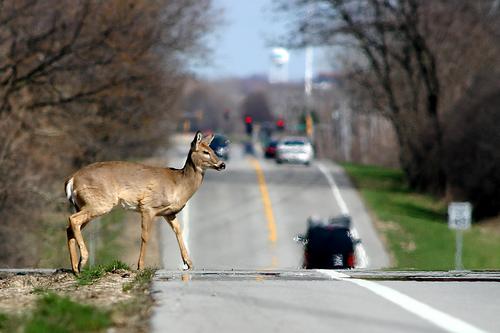
A deer tries to cross a road near Washington, D.C.
If you oppose hunting, you guarantee a rise in deer-vehicle impacts.


In a piece written for Audubon magazine, entitled "Public Menace," Ted Williams writes:


"There’s only one way to protect yourself, your family, and native ecosystems from the most dangerous and destructive wild animal in North America, an animal responsible for maiming and killing hundreds of humans each year, an animal that wipes out whole forests along with most of their fauna. You have to kill it with guns.

I’m talking about the white-tailed deer. In what Gary Alt, one of the nation’s most respected wildlife biologists, calls “the greatest mistake ever made in wildlife management,” deer are being allowed to overpopulate to the point of destroying the ecosystems they’re part of and depend on. The annual mortality of roughly 1.5 million deer via collisions on the nation’s highways doesn’t make a dent, save in motor vehicles and their operators-damage that costs the insurance industry about $1.1 billion a year.

There are major or minor deer problems in all 50 states-if not with whitetails then with blacktails, mule deer, elk, and such aliens as axis deer. In virtually every case the reason is that natural predators have been eliminated or reduced to the point where they can’t effect control.

The situation is especially grim in the East. No state is worse than Pennsylvania, but vast tracts in Connecticut, New York, New Jersey, Maryland, and Virginia have been stripped of low vegetation. There are so many deer in South Carolina that bag limits are set by the day rather than by the season. On most of the coastal plain you can kill as many bucks as you want-every day for 140 days, using dogs, if you so choose. (The joke is that the deer are so stunted that the dogs retrieve.) Despite this superabundance, hunters burn and plant private land to encourage even more deer. Georgia, which also allows hunting with dogs in some areas, is so overrun with deer that it has set a seasonal bag limit of 12 (only two of which may have antlers) during two and a half months of rifle hunting. And yet, in order to manipulate national forestland to make room for even more deer, the state’s Department of Natural Resources opposes federal wilderness designation

>> To read more


Not every deer makes it ... and neither does ever driver. In the state of Virginia, there are about 37,000 reported deer-vehicle strikes a year, and across the U.S. about 100 people a year die as a consequence of collisions with deer.

Wednesday, September 28, 2005

Garbaging for Bears


In my opinion, Ted Williams is one of the finest hook-and-bullet writers in America today. He is smart, articulate, does the research, and thinks for himself.

In short, to ideologues on either end of the spectrum he is a dangerous man.

The piece below comes from High Country News, which is one of the better small publications in the United States, and it goes to the heart of the manipulation of the American public by both the "animal rights" movement and by those who would similarly milk America's hunters and anglers.


Whem Hunters Close Ranks and Close Minds, by Ted Williams

In a few states it is still legal to attract bears with bait for the purpose of shooting them. I call it "garbaging for bears," and, as an avid hunter, find it repulsive - basically assassination. But this is not an article about garbaging for bears. It is an article about the slow, painful maturation of hook-and-bullet journalism in America and about the main force impeding it - demagoguery masquerading as conservation.

"To continually brand all criticism as anti-hunting rhetoric and all critics as anti-hunters only serves to paint us into an ever smaller corner," wrote ardent hunter and Colorado bear biologist Tom Beck in a commentary on hunting black bears over bait. The piece, titled "A Failure of the Spirit," was adapted for the September 1996 issue of Outdoor Life from a pre-publication copy of A Hunter’s Heart, a collection of essays compiled and edited by David Petersen. "How fulfilling is it to shoot a bear with its head in a barrel of jelly-filled doughnuts?" read Outdoor Life’s subhead.

Having once had the job of translating into people-talk what fish and wildlife biologists write, I was flabbergasted by Beck’s piece. It was not at all the sort of thing I’d come to expect from his profession. It sang. The prose was eloquent and lean, the arguments clear and compelling.

I’ll even take some of the credit for steering the piece to a wider readership, since I had tipped off Petersen that huge changes were under way at the 99-year-old magazine.

Out was the old editorial regime, which had seen an "anti-hunter" behind every glacial erratic, which believed that there were certain facts that Outdoor Life’s 1.3 million subscribers shouldn’t know, and for which "conservation" meant tooting around the nation in a 29-foot gas-guzzling "Pledgemobile" entreating the unenlightened and, of course, unsubscribed masses to mouth an ancient mantra called the "Outdoor Life Conservation Pledge."

In were editor-in-chief Stephen Byers and executive editors Will Bourne and Bob Brown, smart, tough journalists who understood the real threats to fish and wildlife, who wanted to teach sportsmen how to help themselves, who were committed to challenging readers to thought and action even if it meant making them mad.

"You don’t lose readers by pissing them off," Byers told me. "You lose readers by boring them."

If you are now rummaging through the September 1996 Outdoor Life for "A Failure of the Spirit," you’ll not find it. The essay was pulled by a bureaucrat at Times Mirror Magazines, publisher of Outdoor Life, on July 24 at virtually the last possible instant. According to The New York Times, the bureaucrat was senior vice president Jason Klein, but Mr. Klein declined to speak with the The New York Times reporter, and Outdoor Life’s publisher, Michael Rooney, referred all calls to Mr. Klein.

Times Mirror had been frightened into its decision by the Ohio-based Wildlife Legislative Fund of America, a group claiming to defend hunting and wildlife management. The Wildlife Legislative Fund had accused Beck of revealing facts sportsmen shouldn’t know and expressing opinions sportsmen shouldn’t hear. And it had prognosticated that his comments on bear baiting would be useful to the vile and ubiquitous "antis." It told sportsmen to complain to Outdoor Life.

Sportsmen responded as if they had been invaded by body snatchers, deluging Byers with faxes, letters and e-mail messages, all of which he showed to his superiors. "I thought sitting on them would be deceptive," he says.

So Byers and Bourne resigned from Outdoor Life, protesting Times Mirror’s beta-wolf tradition of licking the muzzles of paranoid readers, then rolling on its back and urinating on itself (HCN, 10/28/96). I was refreshed to see outdoor editors with integrity. They reminded me that hook-and-bullet journalism doesn’t have to be an oxymoron.

Of course, the Wildlife Legislative Fund had never read what Tom Beck had to say. But Beck, a hunter and a professional wildlife manager in Colorado, was known to harbor incorrect and seditious ideas.

For example, he had dared to question the moribund sport of garbaging for bears, arguing that there can’t be much thrill of the chase if there is no chase. He had suggested that the sport itself - not criticism of it - is fodder for the antis who are forever holding it up as an example of all hunting. He had revealed that spring baiting results in orphaned cubs. And he had opined that baiting at any time of year trains bears to lose their wildness and self-sufficiency, transmuting them into trash-can-bashing, beehive-smashing vagabonds.

In Beck’s own censored words for Outdoor Life: "I firmly believe that baiting creates "nuisance" bears. Black bears are naturally wary, instinctively avoiding close contact with humans. But large amounts of tasty food, easily obtained, defeats this wariness. By baiting, we create lazy bears who have been rewarded, not punished, for overcoming their fear of humans."

According to the Wildlife Legislative Fund, Beck had helped poison the minds of his fellow Coloradans, who in 1992 voted three-to-one to ban bear baiting. Then he had expressed his dangerous opinions in Idaho, where 45 percent of all bear hunters oppose baiting. Clearly, argued the fund’s directors in Ohio, he needed to be silenced.

I would have appreciated Beck’s essay even if I’d disagreed with it. The value of such writing is that it gets sportsmen thinking and exchanging ideas, something Outdoor Life readers hadn’t done a whole lot of before the new editors took over.

The late Canadian angling author Roderick Haig-Brown’s critique of the mass-circulation hook-and-bullet press is, if anything, more applicable today than when he wrote it a generation ago: "Its faults are timidity and conformity. It dare not shock or extend its readers, it must not frighten them with abstract or deeply considered ideas, it must somehow catch and hold even the dullest mentality - or risk a reduction of the advertising rates. With so much at stake (articles) are mainly staff written or else edited into inoffensive inanity."

Equally applicable are Aldo Leopold’s words, older still: "The sportsman has no leaders to tell him what is wrong. The sporting press no longer represents sport; it has turned billboard for the gadgeteer."

Even in 1981, when Gray’s Sporting Journal sent me to Maine to observe one of the last hunts in the state’s last spring bear season, there was no clear consensus among sportsmen about garbaging for bears. Hunters were united only in the strength of their opinions, most saying, "Hell, yes!" and "Hell, no!" A reader poll by The Maine Sportsman, the state’s leading hunting-and-fishing publication, had just revealed that 52 percent of the respondents opposed bear baiting in spring or fall.

Back then managers liked baiting lots more than they do today and lots more than hunters ever did. The "concluding comments’ of participants of a bear-management conference at Kalispell, Mont., read as follows: "Because bear habitat is thick woods, cedar swamps, etc., and the black bear is elusive, bait hunting is a necessary harvest method. Without this method in remote areas, successful hunting would be very difficult."

Imagine how that line of reasoning would have set with the late dean of Atlantic salmon angling, Lee Wulff, who, in pursuing the most challenging of all game fish, purposely handicapped himself by using tiny dry flies and wispy trout rods: "Because Atlantic salmon habitat is thick woods, cold, wild, hard-to-get-to rivers, etc., and the Atlantic salmon is elusive and apt to shun flies, spearing it is a necessary harvest method. Without this method in remote areas, successful fishing would be very difficult."

So that I would not be accused of unfairness, I sought out the bear-baiting outfitter with the best reputation - Jack Hegarty of Jackman, Maine, a gentleman and a conservationist. During his gun-safety pep talk to his clients, Hegarty produced a huge pair of skivvies with a hole in the exact center of a skillet-sized circle of dried blood. The hole had been excavated the previous year when the former owner of the skivvies had accidentally discharged his holstered .45 automatic.

When Hegarty found him, he was standing wide-eyed in the road, swaying. "I think," declared the hunter, "that I have shot myself."

Hegarty asked for and was granted permission to have a look. "He had a fat ass," mused Hegarty, superfluously. "And I grabbed one of the cheeks and pulled it up, and I said, "Hey, you did shoot yourself! ’ ’The bullet hadn’t hit anything important.

So Hegarty got a doctor to sew up the new hole in the guy’s gluteus maximus, and he was back watching garbage the next morning.

For five hours and 16 minutes I watched garbage with an 18-year-old hunter I’ll call George, from Paeonian Springs, Va. Besides 500,000 black flies, the only wildlife I saw was a red squirrel. George, who only heard it, thought it was "a bear for sure." George had saved his money for this dream hunting trip, and all he got to see of the storied north woods was one acre around an onion sack full of rotten meat hanging from a tree 80 feet from a dirt road.

According to the Wildlife Legislative Fund, this is hunting, and anyone who says different is abetting the antis and needs to have a sock jammed in his mouth.

What astonished me about the Outdoor Life fiasco was not the demagoguery of a group that purports to speak for hunters, but sportsmen’s reaction to it. They made cyberspace resonate with outrage, disgust and amazement, as if this were somehow aberrant behavior. It wasn’t. The Wildlife Legislative Fund does this sort of thing all the time. When New Mexico banned spring bear hunting four years ago, the fund spewed shrill action alerts, warning that "the antis were successful in their efforts to influence the New Mexico Department of Game and Fish to drastically curtail bear hunting" and that "the antis are busy doing what they are good at - knocking down the wall, one brick at a time."

Not a word was true. Still, it generated an Outdoor Life piece in which hunting editor Jim Zumbo warned readers that states are abolishing bear-hunting opportunities "under unremitting pressure from animal-rights organizations."

There was "unremitting pressure" all right, but it was coming from enlightened wildlife professionals worried about the resource. As Bill Montoya, then director of the New Mexico Department of Game and Fish, wrote the fund: "(Your) article is a great disservice to the sportsmen of our state and to all of your readers ... We have strong indications that hunters were removing bears faster than bears were being recruited into the population as yearlings. That cannot be allowed and our concern is not new ... Some individual hunters opposed the changes, but sportsmen as a group understood the need and recognized the necessity for reduction in bear harvest ...

"Significantly, during the entire months-long route the recommendations took through these hearings, none of your imaginary "antis’ were present or heard from ... Your article, however, has done more for the cause of the "antis’ than any adjustments we could have made to the bear season. Without their saying a word or lifting a finger, you have given them complete credit for eliminating a season when in fact they were not involved ... We have observed the groups you purport to oppose using demagoguery to increase membership and raise funds, but are very disappointed that the fund apparently is using the same tactics of paranoid disinformation."

Montoya’s admonition produced no change in behavior. When Mollie Beattie, the late director of the U.S. Fish and Wildlife Service, settled a lawsuit brought by the National Audubon Society, the Wilderness Society and other environmental groups by signing an agreement to end such incompatible activities on national wildlife refuges as jetskiing and waterskiing, the fund told sportsmen to send it money so it could stop her from also banning hunting and fishing.

Like corpses in Night of the Living Dead, sportsmen, including many of my fellow outdoor writers, marched to their checkbooks and word processors. This, despite the fact that hunting and fishing weren’t even mentioned in the suit, and no one at the Fish and Wildlife Service had ever dreamed of banning these legitimate, compatible uses.

Playing Howdy Doody to the fund’s Buffalo Bob, Vin Sparano (Byers’ predecessor at Outdoor Life) editorialized that Beattie’s refuge stewardship "puts hunting, fishing and trapping in danger on 100 million acres’ but that "all is not lost" because groups like the fund are pressuring the Fish and Wildlife Service "to continue hunting and fishing programs within the National Wildlife Refuge System."

When Mollie Beattie opened 15 additional hunting programs and six additional fishing programs - something she had planned to do all along - the fund bragged that it had "bloodied" the service and had "forced it to shelve its plans to restrict hunting on the national wildlife refuges."

Outdoor writers by the drove interviewed the pooh-bahs of the Wildlife Legislative Fund. I asked Refuge Division chief Rob Shallenberger - the person in charge of America’s 510 national wildlife refuges - how many outdoor writers had talked to him.

"I would say less than half a dozen," he told me. "And I had to do some of that on my own. I used to write articles for outdoor magazines, and I have a lot of friends in that community. And I frankly was disappointed in the rapidity with which outdoor writers sucked up all the material they got. They didn’t ask for clarification or comment. Some of that stuff that got printed was almost inexcusable. A lot of us were personally affronted by that. Wait, folks, at least give us the courtesy of a phone call."

Even if the fund’s supporters don’t have a problem with the organization trying to shut up an honest journalist, they ought to have a problem with it wasting their money on a fool’s errand. At least since the time of Socrates, the attempted silencing of presumed heretics has only amplified their voices. So it has been with Tom Beck. People who never even thought about bear baiting - readers of The New York Times and High Country News, for example - are now tuned in.

Meanwhile, I have not quite given up on Outdoor Life. Fortunately, Bob Brown remains on the staff, and he prevailed on Times Mirror to let him publish Beck’s essay in the November 1996 issue. With it appeared an opposing view by Craig McLaughlin, a respected bear biologist from Maine with credentials almost identical to Beck’s and who had neither seen A Hunter’s Heart (now in print) nor been shown Beck’s Outdoor Life piece. It’s not that Times Mirror found courage; it’s just that the bad press frightened it even more than the gas and wind from the fund.

The incident has even helped forge a policy statement by the American Society of Magazine Editors, stipulating that editors "need the maximum possible protection from untoward commercial or other extra-journalistic pressures’ and that when they are pushed around by outside interests the society’s board will investigate and possibly suspend the publication from the National Magazine Awards.

So, for all the wrong reasons, Times Mirror finally made the right decision. At least on one issue, the result will be dialogue, an exchange of ideas, a challenge to thought and action. Maybe it will be the start of something new.
.

Thursday, September 08, 2005

Delisting Wolves in Minnesota


I post this picture, lifted some time back from a place now forgotten, because it gives folks some idea of the size differential between wolves, coyote and red fox.


I am always amazed at the notion, among some slob-hunters, that environmentalists are some sort of lock-step automatons, or that good people cannot disagree about wildlife management plans. The article below, written by the great wildlife writer Ted Williams, details the controversy over "delisting" the Grey Wolf from the Endangered Species Act in Minnesota and several other states. The article originally appeared in Audubon magazine. The picture (above) did not come from the magazine.


Audubon magazine

_________________

Living With Wolves
_________________

Wolves are thriving in the Midwest's north woods--and killing dogs and calves in the adjacent farmlands. Is it time to take Minnesota's wolves off the endangered-species list?

By Ted Williams


Wolves have inspired, haunted, and eluded me most of my life. I've looked for them in Russia, Canada, Alaska, Montana, and Idaho, mingled my prints with theirs across a dozen wilderness meadows, picked through hair and bone chips in their scat. Once, in the Bitterroot Range, I heard a wolf howl and was on a high for an hour until another hiker informed me that he had just met a biologist who, on a search for wolves himself, had been trying to "howl one up." Despite all my efforts, I didn't encounter a wild wolf until August 16, 2000, and on that day I saw three.

The first was from a pack that hunts the eastern edge of the Red River Valley, where Minnesota's boreal forest opens into the sparsely grassed bed of ancient Lake Agassiz. She had green eyes, a thin face, long black guard hairs on her back, brown fur on her legs and belly, and a collar of blood where Bill Paul of the U.S. Department of Agriculture's Wildlife Services had shot her.

He'd baited his leghold trap with rotten moose liver and concealed it in dirt excavated by pocket gophers. The brush was torn up, but I could see that the struggle had been brief, probably because she'd chewed on the trap and ingested the tranquilizer tab. We weighed her, hanging her upside down from a scale lashed to a shovel handle and raising the ends high above our heads so her muzzle wouldn't touch the earth. Then Paul sliced open her gut cavity, pulled out her stomach, and retrieved the base of the tranquilizer tab along with calf hide still bearing fur.

At 58 pounds, this wolf, probably last year's pup, was not the "killing machine" that rancher Gary Mathis of Gonvick, Minnesota, had said she was. And that was part of the problem. Older, more experienced wolves like the three Paul had trapped here earlier in the summer will generally kill a calf cleanly. But this one had been making a bad job of it. Mathis showed me the results--four gravely wounded calves. A fifth had been put down when his abdomen filled with urine. Three of the survivors looked as if they might make it, but the fourth--with a raw, grapefruit-size divot on her rump--appeared terminal. The state would compensate Mathis for the dead stock but not for his vet bills.

Paul killed another wolf 60 miles to the northwest in the town of Grygla, and cattle rancher Terry Cleven brought his young son out to see it. The kid, wearing a Minnesota Timberwolves basketball shirt, was considerably less interested than his dad, who had grown up farming this land. Cleven, too, referred to wolves as "killing machines." This animal, scarcely bigger than the first, had apparently given birth the previous spring because her nipples were black, but they weren't swollen, so the pups probably hadn't lived long. Paul started trapping this farm 15 years ago when Terry's father, Albert, ran it. Since then Paul and his colleagues have killed about 20 wolves here. In this part of the state you can remove an entire pack and the area will be recolonized in a year or two.

Earlier in the week I'd visited Longville, Minnesota, where not a whole lot happens, unless you're a wolf. "Welcome to Longville, pop. 224," read the sign. "Building permits required. Turtle race every Wednesday--2:00 p.m." Bob Lewis, who drives a cement truck, and his girlfriend, Terri Winger, met me at the One Stop, where Terri works. On the morning of March 13, 1998, they had let their two-year-old poodle, Jake, out to do his business when two wolves appeared by the garden. "I hollered and clapped my hands, and they took off, but then they turned around and came right back," said Lewis. "Terri started yelling at them, too."

"One grabbed Jake by the head and the other had him by the rear end, and they killed him," Winger added. "Bob's got kids, but I don't. So what I did was lose my child."

Lewis and Winger directed me to the former sheep farm of their friend Buzz Lilyquist, a large, white-haired man with a Navy anchor tattooed on his left forearm. He'd just come in from hanging garbage in front of stands he rents to bear hunters. Jelly doughnuts work best, he says; scraps from the butcher shop are a close second, but he quit using them because they attracted wolves, which he thinks scared off the bears. The wolves, Lilyquist claimed, had run him out of the sheep business. "In 1996 I lost 10 head; in 1997 I lost 30," he said. "You lose 30 head when you're operating with less than 100 ewes, and you just can't keep going. I think we should reserve a section of Minnesota for wolves--I would suggest the Boundary Waters [Canoe Area]--and maintain a population there so we could say, ‘Yes, we have wolves in Minnesota.' But beyond that I say get rid of them. Who needs them?"

Midwesterners are going to have to learn to live with wolves. Each spring, 2,000 pups are born in Minnesota alone, and the 150 to 225 wolves Wildlife Services takes from the population each year won't even make a squiggle on the expansion graph. The Minnesota Department of Natural Resources (DNR) believes that the state has never had more wolves. That is because there have never been more deer. In fact, the deer population now provides more meat per acre than the wolves' historical prey base of caribou, moose, elk, and bison. Moreover, 30 to 50 percent of the total wolf population would have to be removed annually just to keep it from expanding. That probably couldn't be done without bounties and an all-out, 1950s-style air and poison war, a political and legal impossibility.

While wolves are expanding their range elsewhere--particularly in Montana, Wyoming, Idaho, Wisconsin, and Michigan--they've become major nuisances only where humans and their livestock ulcerate the big woods of Minnesota. Unless the state comes up with an effective management plan, the political climate in America will be such that wolf restoration, now under consideration in northern New England and New York, will have little chance.

Most pet and livestock owners in Minnesota haven't lived with wolves for long, and they're not very good at it. According to a report in the Minnesota Outdoor News, wolves killed 23 dogs last winter and spring along the shore of Lake Superior in the 15 miles between Hovland and Grand Portage. When deer are driven here by the brutal northern winter, people provide them with food. That keeps them around houses and attracts wolves. Without prompting, Terri Winger, Bob Lewis, and Buzz Lilyquist all proudly informed me that they feed deer in winter. Bill Paul tells ranchers how important it is to bury their dead stock. But carcasses keep getting tossed over fences, setting the table for wolves and giving them a taste for beef and mutton.

Many of the people in Minnesota who are losing pets and livestock to wolves blame the Endangered Species Act. For them, at least, it has worked too well. In 1974, just nine years after the state did away with its $35 wolf bounty, Minnesota's wolves--at that time the only viable population in the contiguous United States--were listed as endangered. Even Wildlife Services wasn't allowed to kill them. Instead they had to be trapped and transported to the northeastern part of the state, where they were released in occupied wolf range, a practice arguably less humane than shooting them, because they were killed, maimed, or driven out by established packs.

Four years later Minnesota's wolves were downlisted to threatened. This meant that federal agents could kill depredating animals, a response that was favored by knowledgeable advocates of wolf restoration because pups can learn from their elders the dangerous and somewhat aberrant behavior of killing domestic stock. But until the wolf is delisted, private citizens who encounter wolves attacking their animals have no legal recourse other than to shout and clap their hands the way Winger and Lewis did.

When the wolves south of Alaska and Canada were listed as endangered 26 years ago, the population in Minnesota was thought to be between 750 and 950, and there was no known pack activity in Wisconsin or Michigan. In due course, a federally appointed team of the nation's foremost wolf biologists set the following recovery goals: Minnesota would need between 1,251 and 1,400 wolves, and Wisconsin and Michigan a combined population of 100 for five consecutive years. At that point the Minnesota wolf would be delisted (taken off the federal threatened list with management passed to the state), and the Wisconsin and Michigan wolves would be downlisted from endangered to threatened.

In 1998 the most sophisticated census methods available to the Minnesota DNR revealed a state population of 2,450. A year later Wisconsin's wolf population was estimated to be between 197 and 203, Michigan's between 175 and 200. With wolves thoroughly recovered in these three states and with roughly twice as many animals as were needed to ensure their viability, the recovery team urged the Interior Department to cancel all Endangered Species Act protection for western lake-state wolves. Nothing happened. "It's like The Wizard of Oz," comments recovery-team member Mike Don Carlos of the Minnesota DNR. "You get the ruby slippers, you make it to the Emerald City, and you still don't get to go to Kansas."

In 1998 the Interior Department had said it was going to delist wolves in all three states. Now it is talking only about downlisting Michigan and Wisconsin wolves to threatened status. Spooked by the prospect of endless, grossly expensive litigation, the department has a long record of not delisting recovered species when it gets pressured by groups committed to permanent protection of all species and all individuals of all species. The court battles bleed away limited resources, thereby denying effective protection to creatures that really might vanish from our planet. Interior Secretary Bruce Babbitt recognizes the problem. "This program is like an emergency room and a recovery ward in a hospital," he declared. "Once the patient's trauma is past and recovery is progressing well, it's time for the patient to get on with life. We are at that point with some of our wolf populations. Our goal is not to keep them in the hospital indefinitely. Perpetual protection is not the goal; seeing species reach the point that they can survive in the wild, on their own, is."


One of the strongest voices for wolf recovery has been that of U.S. Geological Survey senior scientist L. David Mech, North America's most experienced wolf biologist and a member of the recovery team.The worst thing we can do to wolves, Mech submits, is to let them become pests. What he fears most is a backlash--currently in the making--from the politically powerful livestock industry. "Wolves have filled up all of the wilderness and the semiwilderness in Minnesota," he told me, "and now they're getting into the agricultural land. In Poland wolves have been exterminated three times and overprotected three times. So the Poles have gone through three cycles."

Having experienced one such cycle and hoping to avoid others, the Minnesota DNR created a "roundtable" in 1998. It worked about as well as King Arthur's. Thirty-three citizens representing every conceivable interest, notion, and superstition about wolves--from ranchers to trappers to deer hunters to environmentalists to animal-rights zealots--were instructed to hatch a plan for managing the state's wolves, a plan that would placate everyone and at the same time convince the federal government that wolves could be safely delisted. All members of the roundtable had to be in favor of the plan; one "nay" and it would be scuttled. The legislature would then ratify the plan, and the DNR would live by it.

The roundtable process was doomed from the start. The representative of HOWL (Help Our Wolves Live) successfully intimidated the other members into not even discussing hunting or trapping by the public. At the 59th minute of the 11th hour, all hands agreed to a plan that would do nothing to slow wolf expansion into farm country but would at least allow people to shoot wolves caught in the act of attacking their pets or livestock. All roundtable members promised to stand by the plan, including the HOWL representative, although she burst into tears and claimed she'd been bullied into signing. At least the animal-rights people kept their word. The cattlemen, on the other hand, quickly reneged, and unsuccessfully pushed their own bill, which would have cut the current wolf population in half.

The one thing worse than management by public opinion is management by politician. After an agonizing two-year gestation, the roundtable plan was discarded by the Minnesota legislature, which then came up with its own version. If and when the federal government delists Minnesota wolves, the legislature's bill, signed by Governor Jesse Ventura on May 15, will divide the state into two management zones. In the northern third, where 90 percent of the wolves still abide, people will be able to legally destroy a wolf seen "in the act of stalking, attacking, or killing" pets or livestock. In the southern two-thirds of the state, people will be entitled to state-sponsored wolf trapping if their pets or livestock "were destroyed by a gray wolf within the previous five years," and "a person may shoot a gray wolf on land owned, leased, or managed by the person at any time to protect the person's livestock, domestic animals, or pets." In other words, you get to decide what the wolf might be up to. If you think it looks hungry, that's good enough. Few people ever see wolves, hungry-looking or otherwise, so the bill won't affect the population. But even some of its most conservative backers worry that it's a lousy precedent and a lousy lesson. Still, given the public's passions about wolves, maybe it's the best that can be done. Mech thinks it will at least satisfy the Interior Department so that it can delist the wolf and get on with its important work of saving genuinely endangered species.

That may not be enough. Though Minnesota Audubon, the National Wildlife Federation, and other conservation organizations agree that the wolves have recovered here and actively support delisting, other groups are fighting it. On August 17 the North Star chapter of the Sierra Club, the Humane Society of the United States, Defenders of Wildlife, the Minnesota Wolf Alliance, and the Friends of Animals and Their Environment announced that they were filing a lawsuit to overturn Minnesota's wolf bill. According to the Sierra Club, the 2,450 population figure is "based on questionable estimates of average pack sizes and a survey of hunters and wildlife managers in northern Minnesota which asked them how many wolves they thought were living in their area!"

"True?" I asked Mech, who didn't hesitate to pummel the DNR in the press for trying to manage wolves by public opinion.

"Not true," he said. "The survey was state-of-the-art. They looked at average pack size and average territory size in five intensive study areas. And then they sent questionnaires to professionals in the field--not hunters--outside those areas to see if wolves were present."

The DNR's Mike Don Carlos had this to say: "The methodology we use to survey wolves in Minnesota was plenty good enough for these people when it showed low numbers. The attack on the science only occurs when the science doesn't support a political agenda."


Passions about wolves are more easily acquired than knowledge, something I was reminded of repeatedly during my day in the field with Wildlife Services biologist Bill Paul. Not that Paul is without such passions; I believed him when he told me he likes wolves and regrets having to kill those that deviate from their normal diet. But he understands wolves, too, and he understands his role as a buffer between old prejudices and a rapidly expanding wolf population. He says he'd like to save wolves from a Polish-style treadmill of complete protection and near-total extermination.

Paul, a lean, fit man who has been a federal biologist since 1975, is happy for his gray beard and hair because, finally, people don't say he's too young to know much about wolves. I watched him inside a farmhouse in Puposky, doing some of his most important work--sitting at a table, drinking coffee, listening, talking, sounding authoritative but not scientific or professorial, and speaking genuine northern Minnesotan, you betcha. The coffee server was John Gilbertson, who had just lost three sheep. Through his kitchen window I looked out at the 526-acre patch of green shaved out of the northern wolf woods. The place is a magnet for deer and therefore wolves, and periodically some of these wolves--like the two Paul had killed here yesterday--sample domestic ungulates. At relevant points in the conversation, Paul would slip in information about how to live with wolves--such as the importance of burying dead animals and making sure pregnant ones give birth inside a barn. It was clear to me that Gilbertson thought this Fed was okay. It was also clear that neither Gilbertson nor any of the ranchers I met that day would be taking the law into their own hands.

But Paul's effectiveness is going to diminish fast. He has but five assistants for the entire state, and because federal wolf killing is so hated by the general public, it's one of the first programs to get its funding slashed.

Paul and his crew will respond to a complaint only if the stock owner can produce a carcass. Usually, they can tell if the animal has been dispatched by a wolf instead of a coyote, bear, or bobcat. "We try to investigate all complaints within 24 or 48 hours," says Paul. "It's real important to get out there right away. We look for tracks, skin out the animal, and check the size of the canine-tooth holes. Then we'll look at the feeding pattern. Wolves are heavy feeders. They'll tear a whole carcass apart, and they can crush the big leg bones."


Learning to live with wolves is a good idea not just because there is no other choice but because it is profitable--in fact, a huge net gain. In 1999 Minnesota paid $64,918.50 in wolf-damage claims verified on 87 farms, or about one percent of the farms in wolf range. Known livestock losses (and there were surely many others that were unreported and unverified) amounted to 20 cows, 7 yearlings, 79 calves, 3 sheep, and 897 turkeys. Meanwhile, in 1999, about 50,000 tourists who came to the North Woods town of Ely visited the International Wolf Center--a wolf museum with dioramas, all manner of scientific data displayed in easily understood formats, prints and text defining wolf lore and attitudes through the ages, artifacts, lectures, videos, and live wolves. Each nonmember adult paid an entrance fee of $5.50.

Sixteen miles east of the Wolf Center, I stopped in to see my friend Jim Brandenburg, the wildlife photographer--a man made prosperous by Minnesota's wolves. One wolf you may have seen staring at you from books and magazines (including the cover of this issue of Audubon) essentially paid for the log house Brandenburg built on his 1,500-acre inholding in the Superior National Forest. As we sipped scotch in the living room, I could hear the brook through the photo-quality glass windows as it crashed over a ledge and flowed west and north through wilderness rivers and lakes to Voyageurs National Park, Lake Winnipeg, and Hudson Bay. Ravenwood, as Brandenburg calls his place, is wilder than some of the surrounding national forest and the nearby Boundary Waters Canoe Area because it is essentially tourist-free. "It represents my cathedral, my dream, my sanity," he wrote in his book Brother Wolf. "I come here to work and think, and it is very cherished for all of that, but more so because it is a place where wolves live."

We put down our glasses and wandered out into a windless night fragrant with balsam and wet forest duff. The northern lights glowed faintly through solid cloud cover, and loons yodeled from Moose Lake. We drove to ridges around Ravenwood where we could make out the jagged tops of northern conifers wrapped like torn crepe paper around the margins of obsidian lakes. Each time we dismounted from the van there was no sound save our breathing and the whine of mosquitoes, and then Brandenburg would cup his hands around his mouth and howl--a long wail like the distant whistle of a Canadian-Pacific locomotive. At five locations within 30 square miles, wolves answered him. He didn't have to howl from Fernberg Lookout; two lonely pups with high-pitched voices were conversing from opposite ends of the valley.

You don't need to hear or see wolves to appreciate them. Just knowing they're out there, coursing through unroaded forests, leaving prints in mud or snow, flowing around or over lakes and muskeg, silhouettes against starlight, sensed or imagined--that's enough for me, and for thousands of people who come to northern Minnesota to find strength and renewal in wilderness. As Brandenburg puts it, "If a country is wild enough for wolves, then it is wild enough for the human spirit."

It had all been better than I could reasonably have expected. But then something happened that I'd known was about impossible. At midnight a wolf answered Brandenburg from the road, very loud and close. "We may be able to see that one," he whispered. "Don't slam the door." He drove slowly toward it for maybe three-quarters of a mile, and there was our wolf--trotting along a ditch beside the Fernberg Trail, no bigger than the two I'd seen earlier in the day and just as brown. It crossed 30 feet ahead of us, and Brandenburg spun the wheel to keep it in the headlights. Then it melted into the infinite North Woods, and in that instant, at least, all was right in wolf country.

________________________


Ted Williams has yet to perfect his wolf howl, but he is trying.

--------------------------------------------------------------------------------

Sidebar

What You Can Do

Living with wolves is a fact of life in Minnesota, the first U.S. state where wolves have been supported in agricultural areas. Many conservation groups worry that if the wolf population here is not managed correctly, there will be a public backlash against wolves elsewhere.

"We strongly support delisting wolves," says Tim Dawson, a representative of Minnesota Audubon who lives in the heart of wolf range and worked on the state's wolf roundtable. "Wolf recovery has been a success here; it proves the Endangered Species Act works. If they are delisted, the current management plan passed by the legislature won't threaten the existence of wolves in Minnesota, but it will need to be very carefully monitored by the Fish and Wildlife Service."

Minnesota Audubon advocates management by the state, compensating farmers for losses, and supporting efforts to reduce depredation. Farmers can help prevent wolf trouble by burying dead livestock, not feeding deer, and using guard animals.
If you have problems with wolves on your land, call a conservation officer with the DNR or with the U.S. Department of Agriculture's Wildlife Services at 218-327-3350. For tips on protecting pets and livestock, contact the Minnesota Department of Agriculture (651-296-0591; blane.white@state.mn.us) and ask for a copy of "Wolves in Farm Country." To find out more about wolves or to follow progress on the management plan and delisting debate, visit the International Wolf Center in Ely, Minnesota, or go to the center's web site, www.wolf.org .

.

Sunday, April 03, 2005

Rain on the River


This is Great Falls on the Potomac, just up the river from my house. After the heavy rains yesterday, this is what the river will look like -- a mad rushing torrent.

The Potomac at Great Falls offers hardcore white water riffs for experienced kayakers. A lot of America's best Olympic kayakers live in Washington, D.C. just to work this stretch of white water which is easily accessible to all.

Steep cliffs on each side of the river protect a wooded flood plain which offers a 200-mile long stretch of "accessible wilderness" for anyone that care to walk it.

Tuesday, September 07, 2004

Economics & Politics of Hunting


With bird in hand.


"As a life-long hunter and fisherman, I am proud to be among the millions of American sportsmen and sportswomen who are dedicated to conserving fish and wildlife and passing along the American hunting and fishing heritage to the next generation." - Sen. John Kerry


There are no vegans on Mount Rushmore -- but there is Teddy Roosevelt who hunted rats with his terriers in the basement of the White House.

Major on-the-rack magazines and TV shows in the U.S. are devoted to hunting, and several members of the Supreme Court are either hunters or anglers (or both).

Both John Kerry and George W. Bush hunt, while the Congressional Sportsman's Caucus and Foundation are among the most powerful bipartisan groups on Capitol Hill.

Here in Virginia the public decided that hunting, fishing and harvesting game should be considered a right, and that right is now in the State Constitution -- similar language is being embraced in other states. Meanwhile, in West Virginia, the ACLU is suing so people can hunt on Sunday.

The most important part of the politics of hunting, however, is grounded in the economics of hunting.

Click here to read a well-written study on the economics of hunting packed with solid numbers you can use in debates, letters to the editor, and when teaching others about the economic value of hook-and-bullet conservation.

The simple truth is that hunting and wildlife viewing are worth more to the American economy than many major industries. In fact, economists now recognize that there is no amount of timber that can be extracted from our National Forests that comes close to equaling the value of those forests as recreational centers.

Yet, the U.S. Forest Service continues to LOSE over $1 billion a year selling our timber and our wildlife heritage to for-profit timber companies, even as we taxpayers foot the bill for ripping new roads into wilderness areas.

Why does this travesty continue? Simple: Payola politics. The current head of the U.S. Forest Service is a timber and paper company lobbyist who is setting policy because because a handful of big timber companies slipped over $4 million into the campaign coffers of George W. Bush during the year 2000 election cycle. As a direct result of this kind of "Crony Capitalism," a paper company lobbyist is now in charge of our National Forest system.

Republicans interested in moving beyond crony capitalism to embrace the land ethic of Teddy Roosevelt (who created the U.S. Forest Service, the National Wildlife Refuge Systsem, and the National Parks system) and the positive environmental record of Richard Nixon (who created the Environmental Protection Agency and signed into law the Endangered Species Act, the Clean Water Act, and the National Environmental Policy Act) are encouraged to see the web site of Republicans for Environmental Protection.