Showing posts sorted by relevance for query Science Remakes the Dog. Sort by date Show all posts

Tuesday, February 20, 2018

Science Remakes the Dog


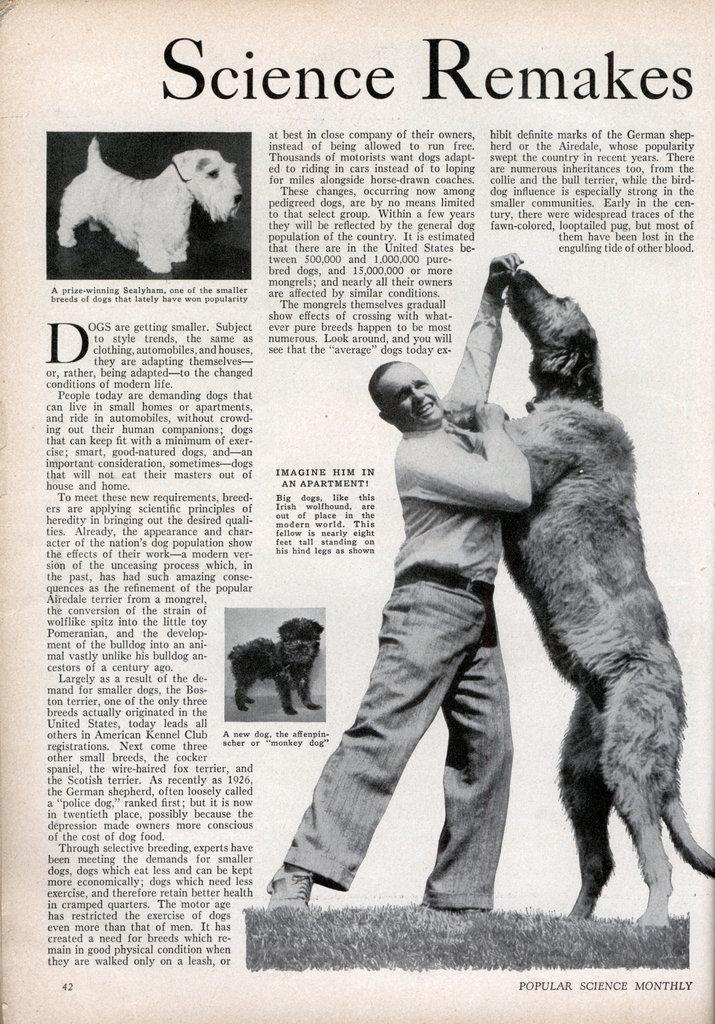
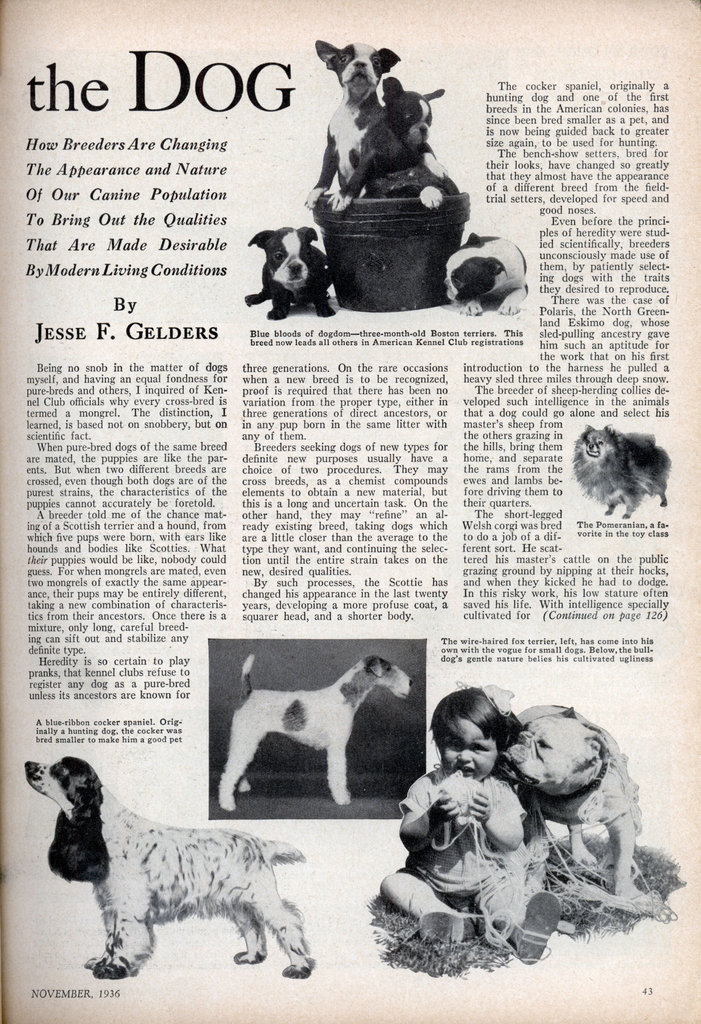
An article, from the November 1936 issue of Popular Science magazine is a good representative of the kind of congratulatory back-patting that went on during this period, as show ring and hobby breeders worked overtime to draw more and more working dogs into the Kennel Club.

Not the tone of the article: "Science" is improving dogs so they will be better suited to the modern world of cars, apartments, and limited time for their care and feeding.

In fact, these market forces continue to this day, as I have noted in an earlier post entitled "Robert Bakewell's Apartment."

This Popular Science article was written when the Kennel Club was just 65 years old, but problems already seem to be cropping up.

Notice that the Cocker Spaniel seems to have been "improved" to the point that it no longer hunts.

The Scottish terrier's morphology has been transformed with the "improved" dog having a shorter back, a larger head, and a longer coat -- improvements that made the dog incapable of going down a hole after quarry, ruining it as a true working terrier.

Then you have the various types of setters where bench and field animals had already diverged to the point that they appeared to be different breeds.

Finally, the Afghan is mentioned as a new and exotic breed brought to America. How long before the show-ring variant was wrecked as a coursing dog? Not long!

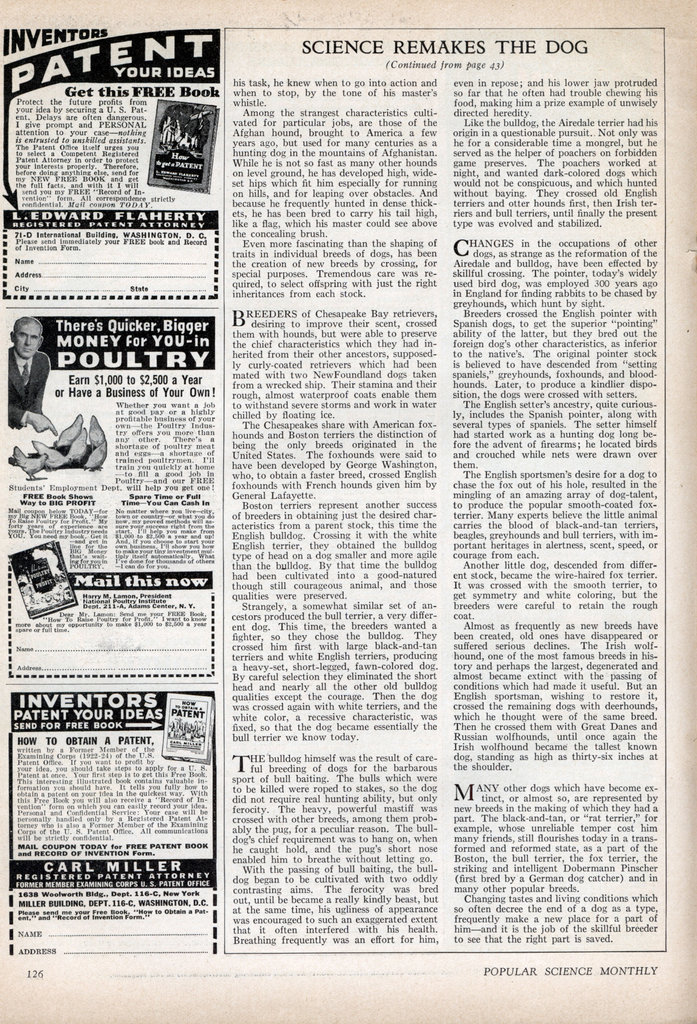
It should also be noted that some of the "history" given here is Kennel Club bunk. The Airedale, for example, is a modern creation derived from the Otter hound, and bred specifically for the show ring. It was never a "night poacher's dog," being too slow and heavy for rabbit, fox, or deer. Hunting otter is not done at night; it is tough enough to see the things in the daylight!

Similarly, the English Bulldog has very little of the old bull-baiting dog in it, and quite a lot of the monstrous pug to which it is much more closely-related!

As for fox terriers, by the time this article was written, almost no one was using a Kennel Club dog for anything other than a companion dog, as a close reading of Jocelyn Lucas's book Hunt and Working Terriers (published in 1931) will reveal.

Fox-working dogs have not been "improved" by science or show ring breeders; they have only been ruined by the rosette chasers.

The original art for this article can be seen here >> Page 1, Page 2, Page 3


Science Remakes the Dog
How Breeders Are Changing The Appearance and Nature Of Our Canine Population To Bring Out the Qualities That Are Made Desirable By Modern Living Conditions

By Jesse F. Gelders


DOGS are getting smaller. Subject to style trends, the same as clothing, automobiles, and houses, they are adapting themselves— or, rather, being adapted—to the changed conditions of modern life.

People today are demanding dogs that can live in small homes or apartments, and ride in automobiles, without crowding out their human companions; dogs that can keep fit with a minimum of exercise; smart, good-natured dogs, and—an important consideration, sometimes—dogs that will not eat their masters out of house and home.To meet these new requirements, breeders are applying scientific principles of heredity in bringing out the desired qualities.

Already, the appearance and character of the nation’s dog population show the effects of their work—a modern version of the unceasing process which, in the past, has had such amazing consequences as the refinement of the popular Airedale terrier from a mongrel, the conversion of the strain of wolflike spitz into the little toy Pomeranian, and the development of the bulldog into an animal vastly unlike his bulldog ancestors of a century ago.

Largely as a result of the demand for smaller dogs, the Boston terrier, one of the only three breeds actually originated in the United States, today leads all others in American Kennel Club registrations. Next come three other small breeds, the cocker spaniel, the wire-haired fox terrier, and the Scotish terrier. As recently as 1926, the German shepherd, often loosely called a “police dog,” ranked first; but it is now in twentieth place, possibly because the depression made owners more conscious of the cost of dog food.

Through selective breeding, experts have been meeting the demands for smaller dogs, dogs which eat less and can be kept more economically; dogs which need less exercise, and therefore retain better health in cramped quarters. The motor age has restricted the exercise of dogs even more than that of men. It has created a need for breeds which remain in good physical condition when they are walked only on a leash, or at best in close company of their owners, instead of being allowed to run free. Thousands of motorists want dogs adapted to riding in cars instead of to loping for miles alongside horse-drawn coaches.

These changes, occurring now among pedigreed dogs, are by no means limited to that select group. Within a few years they will be reflected by the general dog population of the country. It is estimated that there are in the United States between 500,000 and 1,000,000 purebred dogs, and 15,000,000 or more mongrels; and nearly all their owners are affected by similar conditions.

The mongrels themselves gradually show effects of crossing with whatever pure breeds happen to be most numerous. Look around, and you will see that the “average” dogs today exhibit definite marks of the German shepherd or the Airedale, whose popularity swept the country in recent years. There are numerous inheritances too, from the collie and the bull terrier, while the bird-dog influence is especially strong in the smaller communities. Early in the century, there were widespread traces of the fawn-colored, looptailed pug, but most of them have been lost in the engulfing tide of other blood.

Being no snob in the matter of dogs myself, and having an equal fondness for pure-breds and others, I inquired of Kennel Club officials why every cross-bred is termed a mongrel. The distinction, I learned, is based not on snobbery, but on scientific fact.

When pure-bred dogs of the same breed are mated, the puppies are like the parents. But when two different breeds are crossed, even though both dogs are of the purest strains, the characteristics of the puppies cannot accurately be foretold.

A breeder told me of the chance mating of a Scottish terrier and a hound, from which five pups were born, with ears like hounds and bodies like Scotties. What their puppies would be like, nobody could guess. For when mongrels are mated, even two mongrels of exactly the same appearance, their pups may be entirely different, taking a new combination of characteristics from their ancestors. Once there is a mixture, only long, careful breeding can sift out and stabilize any definite type.

Heredity is so certain to play pranks, that kennel clubs refuse to register any dog as a pure-bred unless its ancestors are known for three generations. On the rare occasions when a new breed is to be recognized, proof is required that there has been no variation from the proper type, either in three generations of direct ancestors, or in any pup born in the same litter with any of them.

Breeders seeking dogs of new types for definite new purposes usually have a choice of two procedures. They may cross breeds, as a chemist compounds elements to obtain a new material, but this is a long and uncertain task. On the other hand, they may “refine” an already existing breed, taking dogs which are a little closer than the average to the type they want, and continuing the selection until the entire strain takes on the new, desired qualities.

By such processes, the Scottie has changed his appearance in the last twenty years, developing a more profuse coat, a squarer head, and a shorter body.

The cocker spaniel, originally a hunting dog and one of the first breeds in the American colonies, has since been bred smaller as a pet, and is now being guided back to greater size again, to be used for hunting.

The bench-show setters, bred for their looks, have changed so greatly that they almost have the appearance of a different breed from the field-trial setters, developed for speed and good noses.

Even before the principles of heredity were studied scientifically, breeders unconsciously made use of them, by patiently selecting dogs with the traits they desired to reproduce. There was the case of Polaris, the North Greenland Eskimo dog, whose sled-pulling ancestry gave him such an aptitude for the work that on his first introduction to the harness he pulled a heavy sled three miles through deep snow. The breeder of sheep-herding collies developed such intelligence in the animals that a dog could go alone and select his master’s sheep from the others grazing in the hills, bring them home, and separate the rams from the ewes and lambs before driving them to their quarters.

The short-legged Welsh corgi was bred to do a job of a different sort. He scattered his master’s cattle on the public grazing ground by nipping at their hocks, and when they kicked he had to dodge. In this risky work, his low stature often saved his life. With intelligence specially cultivated for his task, he knew when to go into action and when to stop, by the tone of his master’s whistle.

Among the strangest characteristics cultivated for particular jobs, are those of the Afghan hound, brought to America a few years ago, but used for many centuries as a hunting dog in the mountains of Afghanistan. While he is not so fast as many other hounds on level ground, he has developed high, wide-set hips which fit him especially for running on hills, and for leaping over obstacles. And because he frequently hunted in dense thickets, he has been bred to carry his tail high, like a flag, which his master could see above the concealing brush.

Even more fascinating than the shaping of traits in individual breeds of dogs, has been the creation of new breeds by crossing, for special purposes. Tremendous care was required, to select offspring with just the right inheritances from each stock.

BREEDERS of Chesapeake Bay retrievers, desiring to improve their scent, crossed them with hounds, but were able to preserve the chief characteristics which they had inherited from their other ancestors, supposedly curly-coated retrievers which had been mated with two New Foundland dogs taken from a wrecked ship. Their stamina and their rough, almost waterproof coats enable them to withstand severe storms and work in water chilled by floating ice.

The Chesapeakes share with American foxhounds and Boston terriers the distinction of being the only breeds originated in the United States. The foxhounds were said to have been developed by George Washington, who, to obtain a faster breed, crossed English foxhounds with French hounds given him by General Lafayette.

Boston terriers represent another success of breeders in obtaining just the desired characteristics from a parent stock, this time the English bulldog. Crossing it with the white English terrier, they obtained the bulldog type of head on a dog smaller and more agile than the bulldog. By that time the bulldog had been cultivated into a good-natured though still courageous animal, and those qualities were preserved.

Strangely, a somewhat similar set of ancestors produced the bull terrier, a very different dog. This time, the breeders wanted a fighter, so they chose the bulldog. They crossed him first with large black-and-tan terriers and white English terriers, producing a heavy-set, short-legged, fawn-colored dog. By careful selection they eliminated the short head and nearly all the other old bulldog qualities except the courage. Then the dog was crossed again with white terriers, and the white color, a recessive characteristic, was fixed, so that the dog became essentially the bull terrier we know today.

THE bulldog himself was the result of careful breeding of dogs for the barbarous sport of bull baiting. The bulls which were to be killed were roped to stakes, so the dog did not require real hunting ability, but only ferocity. The heavy, powerful mastiff was crossed with other breeds, among them probably the pug, for a peculiar reason. The bulldog’s chief requirement was to hang on, when he caught hold, and the pug’s short nose enabled him to breathe without letting go.

With the passing of bull baiting, the bulldog began to be cultivated with two oddly contrasting aims. The ferocity was bred out, until be became a really kindly beast, but at the same time, his ugliness of appearance was encouraged to such an exaggerated extent that it often interfered with his health. Breathing frequently was an effort for him, even in repose; and his lower jaw protruded so far that he often had trouble chewing his food, making him a prize example of unwisely directed heredity.

Like the bulldog, the Airedale terrier had his origin in a questionable pursuit.. Not only was he for a considerable time a mongrel, but he served as the helper of poachers on forbidden game preserves. The poachers worked at night, and wanted dark-colored dogs which would not be conspicuous, and which hunted without baying. They crossed old English terriers and otter hounds first, then Irish terriers and bull terriers, until finally the present type was evolved and stabilized.

CHANGES in the occupations of other dogs, as strange as the reformation of the Airedale and bulldog, have been effected by skillful crossing. The pointer, today’s widely used bird dog, was employed 300 years ago in England for finding rabbits to be chased by greyhounds, which hunt by sight.

Breeders crossed the English pointer with Spanish dogs, to get the superior “pointing” ability of the latter, but they bred out the foreign dog’s other characteristics, as inferior to the native’s. The original pointer stock is believed to have descended from “setting spaniels,” greyhounds, foxhounds, and bloodhounds. Later, to produce a kindlier disposition, the dogs were crossed with setters.

The English setter’s ancestry, quite curiously, includes the Spanish pointer, along with several types of spaniels. The setter himself had started work as a hunting dog long before the advent of firearms; he located birds and crouched while nets were drawn over them.

The English sportsmen’s desire for a dog to chase the fox out of his hole, resulted in the mingling of an amazing array of dog-talent, to produce the popular smooth-coated fox-terrier. Many experts believe the little animal carries the blood of black-and-tan terriers, beagles, greyhounds and bull terriers, with important heritages in alertness, scent, speed, or courage from each.

Another little dog, descended from different stock, became the wire-haired fox terrier. It was crossed with the smooth terrier, to get symmetry and white coloring, but the breeders were careful to retain the rough coat.

Almost as frequently as new breeds have been created, old ones have disappeared or suffered serious declines. The Irish wolfhound, one of the most famous breeds in history and perhaps the largest, degenerated and almost became extinct with the passing of conditions which had made it useful. But an English sportsman, wishing to restore it, crossed the remaining dogs with deerhounds, which he thought were of the same breed. Then he crossed them with Great Danes and Russian wolfhounds, until once again the Irish wolfhound became the tallest known dog, standing as high as thirty-six inches at the shoulder.

MANY other dogs which have become extinct, or almost so, are represented by new breeds in the making of which they had a part. The black-and-tan, or “rat terrier,” for example, whose unreliable temper cost him many friends, still flourishes today in a transformed and reformed state, as a part of the Boston, the bull terrier, the fox terrier, the striking and intelligent Dobermann Pinscher (first bred by a German dog catcher) and in many other popular breeds.

Changing tastes and living conditions which so often decree the end of a dog as a type, frequently make a new place for a part of him—and it is the job of the skillful breeder to see that the right part is saved.
.

Tuesday, September 27, 2011

Labradoodles, Blindness and Dog Dealing


Wally Conron, now retired at age 81, writes in the Australian edition of Reader's Digest about what happened when he decided to solve a very specific problem for a blind woman in Hawaii, and then found himself tumbling down the slope to creating a contrived breed with a mostly-contrived set of attributes.

While working with the Royal Guide Dog Association of Australia as its puppy-breeding manager in the early ’80s, I received a request from Hawaii. A vision-impaired woman there, whose husband was allergic to dog hair, had written to our centre in the hope that we might have an allergy-free guide-dog.

"Piece of cake," I thought. The standard poodle, a trainable working dog, was probably the most suitable breed, with its tightly curled coat. Although our centre bred and used labradors, I didn’t anticipate any difficulties finding a suitable poodle.

It turned out I was wrong: after rejecting countless poodles with various problems, some two years and 33 disappointing trials later, I still hadn’t found an appropriate dog for the job.

In desperation, I decided to cross a standard poodle with one of our best-producing labradors.

The mating was successful, but it produced only three pups. We sent coat and saliva samples of each pup to the Hawaiian couple, and the husband found one sample allergy-free. At last we were getting somewhere, but a big job lay ahead. The pup had to grow up and prove suitable for guiding work; and then it had to be compatible with the visually impaired client. We had a long way to go.

With a three to six-month waiting list for people wishing to foster our pups, I was sure we’d have no problem placing our three new crossbred pups with a family. But again I was wrong: it seemed no-one wanted a crossbred puppy; everyone on the waiting list preferred to wait for a purebred. And time was running out – the pups needed to be placed in homes and socialised; otherwise they would not become guide-dogs.

By eight weeks of age, the puppies still hadn’t found homes. Frustrated and annoyed with the response to the trio of crossbreeds I had carefully reared, I decided to stop mentioning the word crossbreed and introduced the term labradoodle instead to describe my new allergy-free guide-dog pups.

It worked – during the weeks that followed, our switchboard was inundated with calls from other guide-dog centres, vision-impaired people and people allergic to dog hair who wanted to know more about this “wonder dog”.

A simple cross was now a "wonder dog."

Of course, it was all nonsense. The first cross was fine, so far as it went, but the next cross was a great deal less so.... not that the puppy peddlers cared in the slightest:

I quickly realised that I’d opened a Pandora’s box when our next litter of ten labradoodles produced only three allergy-free pups.

I began to worry, too, about backyard breeders producing supposedly "allergy-free" dogs for profit. Already, one man claimed to be the first to breed a poodle-Rottweiler cross!

Nothing, however, could stop the mania that followed. New breeds began to flood the market: groodles, spoodles, caboodles and snoodles. Were breeders bothering to check their sires and bitches for heredity faults, or were they simply caught up in delivering to hungry customers the next status symbol? We’ll never know for sure.

Today, some strains of "Labradoodle" breed more-or-less true, but fly-by night crosses are as common as rainwater and ALL of the "hypoallergenic" claims are simply untrue. Yes, some people are less reactive to some dogs which may shed less, or even have less hair, but ALL dogs shed, and ALL dogs have hair or fur.  Bottom line: If you are truly and seriously allergic to dog hair, then do not get a dog of any kind!

And what about Wally Conron?  Today he says:

''All these backyard breeders have jumped on the bandwagon and they're crossing any kind of dog with a poodle. They're selling them for more than a pure-bred is worth and they're not going into the backgrounds of the parents of the dogs. There are so many poodle crosses having fits, problems with their eyes, hips and elbows; a lot have epilepsy. There are a few ethical breeders but very, very few.''

Conron says that despite the fact the dogs have helped so many blind people, he regrets creating the first cross-breed. "I released a Frankenstein.... People say 'aren't you proud of yourself?' and I say, 'not in the slightest. I've done so much harm to pure breeding.'"

Of course, Conron did not really harm pure breeding at all, did he? Nope, not in the slightest. Purebred poodles are as common as rainwater, and some lines have a mess of health problems due to inbreeding.

But the notion that outcrossing is a surefire gateway to health?

Nope that's simply not true. If you are outcrossing to stock you do not know and have not bothered to investigate you may be buying into, or creating, problems.

So where did it really go wrong?

Where it went wrong is that Conron coined a name for this cross-breed and imbued it with miraculous powers that the dogs never had.

What happened next was that other people took his myth and his marketing and paired it with greed.

But isn't that what's happening with every breed all the time?

Yes, the world is full of "-oodle" crosses that do not breed true and have health problems, but health problems are legion in almost every "pure" Kennel Club breed, and most folks are not interested in breeding dogs to a standard, so how much new harm has been done?

No, Conron's cross did not change the world of dog breeding, but that was not his goal, was it? Did he forget what he set out to do? It wasn't to change the world of dogs; it was to find one specific dog for one specific customer. Did he do that? He did. His mistake was not in doing a cross for a purpose; it was engaging in a little dog dealing in order to get rid of his overage. Like the Sorcerer's Apprentice he discovered he was working with a force -- dog dealers -- that he could not control. But did Conron invent dog dealers? He did not. They have always been with us.
.

Monday, February 10, 2014

Hitler at the Dog Show


Sterilization and gas chambers for the unfit?

A fixation on color and blood purity?

Just-invented mythical histories of former glory?

Surely you knew the Kennel Club and the Nazis had more than a little in common?

What you might not have known was that the world went from Bassets to Auschwitz in only 50 years, and that Hitler himself wrote one of the AKC's most lauded authors, praising the veterinarian for his book, which advocated the forced sterilization of 10 million Americans. 

There is nothing quite as amusing as the Kennel Club saying it has had nothing to do with Eugenics.

Really?

Let us look at their own history.

The year is 1897, some 14 years after Sir Francis Galton first coined the term "Eugenics," and just 11 years before Galton founded the British Eugenics Society in 1907.

What's going on at the Kennel Club?

Well, for starters they are firmly closing the registry for all dogs except new breeds just being enrolled for the first time.

In the 1905 publication The Kennel Club: Its History and Record of Its Work, Edward William Jaquet, secretary of the Kennel Club writes about the 1897 debate over what to do about the declining health of Scottish Deerhounds.


And so there it is: The question of health versus purity is raised, and put front and center.

And what is the Kennel Club's answer? Simple: Quash all questions of health in favor of maintaining breed "purity."

And what about health? The Kennel Club had a solution for that: euthanasia of the unfit, and sterilization of all but the most exemplary as decided by appearance alone.

It is important to understand that the Kennel Club's decision to close its registry did not occur in isolation. The core ideas underpinning the eugenics movement were already more than 30 years old, and these values, in turn, had been shaped and reinforced by those who pointed to the "progress" being made by the "scientific" breeding of dogs, pigeons, and livestock for the show ring. One idea fed off another, and rationalized and excused the other.

A time line shows the progress:

  • Plato was the first to propose state-sponsored eugencis, suggesting that in his ideal Republic "The best men must have intercourse with the best women as frequently as possible, and the opposite is true of the very inferior." In Plato's scheme, the fittest and best would be determined by a points systems.
  • In the late 1770s, Robert Bakewell began to rapidly improve farm stock through sire selection and control, a feat made possible by the rise of the Enclosure System. Bakewell's fame and fortune spread rapidly and soon countless farmers had embraced his animal husbandry techniques
  • Stock shows grew up out of a desire of farmers to show off and sell their new and improved "scientifically bred" animals. At some of these early stock shows, dogs were also featured, but more as an afterthought than anything else.
  • It was at the new farm stock shows that Erasmus Darwin, Charles Darwin's father, first began to get an inkling of the power of the selection process -- an idea he expounded on in a book entitled Zoonomia.
  • Charles Darwin published The Origin of Species in 1859, noting that while un-natural selection worked very quickly to improve farm stock, natural selection did much the same thing in the wild, albeit more slowly.
  • The same year that The Origin of Species was published, the first formal dog show was held. John Henry Walsh (aka "Stonehenge") was a judge.
  • In 1865, the first modern work on eugenics was written by Francis Galton, Charles Darwin's cousin. In a long essay entitled "Hereditary Talent and Character," Galton said human intelligence was a product of breeding, and suggested that through selective breeding humans could be bred to be be more (or less) intelligent. Galton specifically noted that dogs seemed to have been bred for stupidity and obsequiousness, as man wanted a "slave."
  • In his 1869 book Hereditary Genius, Galton expanded on his earlier essay, noting:  "I propose to show in this book that a man's natural abilities are derived by inheritance, under exactly the same limitations as are the form and physical features of the whole organic world. Consequently, as it is easy, notwithstanding those limitations, to obtain by careful selection a permanent breed of dogs or horses gifted with peculiar powers of running, or of doing anything else, so it would be quite practicable to produce a highly-gifted race of men by judicious marriages during several consecutive generations."
  • In 1867, John Henry Walsh (aka Stonehenge) and his friends adopted Plato's "point sytem" for grading breeding stock, and used it for grading dogs at shows based solely on looks. When the Kennel Club was created in 1873, it adopted this points system as its own.
  • In 1880, the Kennel Club put into place the first formal rules governing the naming of dogs so as to avoid double registrations and confusion. This was the start of the Kennel Club's registry system.
  • In 1897, the Kennel Club formally closed its registry, disallowing cross breeds and outcrosses to other breeds.
  • That same year Francis Galton began using Kennel Club breed records to support his genetic theories, noting in his Memoir (chapter XX): "I had thought of experimenting with mice, as cheap to rear and very prolific,and had taken some steps to that end, when I became aware of the large collections of Basset Hounds belonging to the late Sir Everard Millais. He offered me every facility. The Basset Hound records referring to his own and other breeds had been carefully kept, and the Stud Book he lent me contained accounts of nearly 1,000 animals, of which I was able to utilise 817. All were descended from parents of known colours; in 567 of them the colours of all four grandparents were also known. Wherever the printed Stud Book was deficient, Sir Everard Millals supplied the want in MS from the original records. My inquiry was into the heredity of two alternative colours, one containing no black, the other containing it; their technical names were lemon-white and tri-colour (black, lemon, white) respectively. I was assured that no difficulty was felt in determining the category to which each individual belonged. These data were fully discussed in a memoir, published (1897) in the Proceedings of the Royal Society, on what is now termed the "Ancestral Law," namely, that the average contribution of each parent is ¼, of each grandparent, and so on. Or, in other words, that of the two parents taken together is ½, of the four grandparents together ¼, and so on. My data were not as numerous as is desirable, still the results were closely congruous, and seem to be a near approximation to the truth. The conclusions have been much discussed and criticised, and they have been modified by Professor Karl Pearson; but they have not been seriously shaken, so far as I know."


Of course, as new dog breeds came into the fold
, individual dog registries were not always closed on Day One. That said, as a general rule they do not seem to have stayed open for very long, with the Kennel Club door generally being slammed shut within a year or two, and often with just two or three dozen dogs listed on the roles.


In 1907, Galton created the Eugenics Education Society and that same year Indiana passed a State Sterilization Law.

That same year the Germans created their own Eugenics Society, the "Internationale Gessellschaft fuer Rassenhygiene."

To give a little flavor to the intellectual debate taking place at this time, it's worth reading this little piece from the September 1914 issue of Atlantic magazine entitled "Eugenics and Common Sense":

There seems no objection to Eugenicists classing themselves with cabbages and dogs and cats, but does the rest of the world accept this for itself? Are you content to be described and treated as a beast, and a beast only? Each reader will answer that for himself no doubt, and I need not elaborate the point. It is the cheerful and veracious foundation of Eugenics.

Let us continue. The Eugenist takes man purely as a plant or as an animal; he wants to breed him just as animals are bred, so let us consider how plants and animals are bred and what the result has been. He says: 'Surely the human product is superior to poultry,'—the very foundation of his whole argument is that it is not; however, let us go on,—'and as we may now predict with precision the characters of the offspring of a particular pair of pedigreed poultry so it may be some time with man.'

Still, let us go on. Let us assume with the Eugenists that we really are no different from cabbages and roses, or horses and dogs,—that every rule which applies to them applies to us, and let us see what the scientific breeding of plants and animals has effected. What has been the result?

Well, the result has been astonishing. The simple little wild Persian rose, for instance, has been improved into the gorgeous blooms of our gardens: the small, rather sour apple has become the Albemarle Pippin; the wild dog has become the great Dane, the mastiff, the bull-dog, the pug; and the barb mixed with the Frisian horse has become the thoroughbred. In size, in beauty, in variety, in qualities useful to mankind, plants and animals have been improved out of recognition.

That is quite true. But what of the other qualities? What, for instance, of health and intelligence? Have these also increased pari passu with the increase in size? Go to a nursery gardener, to a racing stable, to a dog-fancier, and inquire. You will learn this: the extraordinary improvement In size and shape has been gained at the cost of all other qualities. Thoroughbred plants and animals are very tender, they require most assiduous attention, they have to be nursed like babies. They have no stamina, and they have no brains. They are so delicate that unless they are continually protected and doctored they are devoured by disease. A rose-grower's outfit now includes innumerable medicines without which his blooms would be destroyed. If you abandon a garden of any cultivated flowers for a few years, the vigorous and hardy wild plants will choke all your improved stock; nothing will be left save perhaps a few lucky plants which have managed to evolve as it were backwards and regain some of their virility by abandoning their acquired splendor. In free competition the improved plant does not stand the ghost of a chance with its unimproved brothers. The struggle ends inevitably and tragically.

It is exactly the same with improved birds and animals. In open competition for a livelihood thoroughbred stock would be doomed. It has no constitution, it cannot get a living for itself, cannot bear exposure, must be cared for like an invalid. Read for instance the history of the cavalry and mounted infantry horses in the Boer War. The fine-bred stock from England was useless. It died in heaps. It was only horses from places where they are brought up semi-wild, as in the Argentine and Australian runs, that were of any use. Even they did not compare with the Boer ponies.

A further fact, and one still more important to remark, is that all tame is incomparably inferior in intellect to wild stock. There is so little opportunity for people of civilized nations nowadays to observe wild animals that this fact is often overlooked. But the difference is startling. Look at a pack of wild dogs, as I often have. They hunt with a science and precision that tame fox-hounds have no idea of, even when directed by huntsmen and whips. A pack of wild dogs will mark down a stag—they always select stags with big heads if possible—in a piece of forest surrounded by grass. They will post sentries at the exits and the rest of the pack will go to the end and beat the jungle through. When the stag breaks, the sentries at the exit give tongue and warn the rest who immediately run to their call.

There is no one who like myself has kept both wild and domesticated animals as pets who has not noticed that the latter are fools to the former. It is a commonplace of knowledge. Here is a story in illustration, from the life of the elder Dumas.

He had a dog and a fox both chained up near the house. One day he gave a bone to each, putting it just out of reach, to see what would happen. Well, at first, both acted in the same way, they strained at the chain. The fox, however, soon found out the uselessness of this and sat down to consider. Then he got up, turned round so as to add the length of his body to that of the chain, reached the bone with his hind leg, and having scraped it within reach, sat down to eat it. But the dog not only could not think of this himself, but even when he saw the fox do it, he could not imitate it.

The more scientifically bred animals are, the less brain they have. If you want a dog who will be an intelligent and sympathetic companion, which do you choose, the dog bred by 'science' or the dog bred by the natural selection of mutual love, the thoroughbred or the mongrel? All experience says the latter. Therefore, suppose the Eugenists had their way and established a state, what would the inhabitants of that state be like in a few generations? They would be tall, broad, muscular, beautiful, delicate to a degree, useless save for athletic contests or beauty shows, always in the doctor's hands—Eugenic doctor of course,—brainless, incapable of affection, almost wanting in courage, to a great extent sterile; and in the end, if the state did not die of inanition first, some more virile and intelligent race, say the Hottentots or Andamese, would come and eat its inhabitants. The Eugenic Utopia would end in the digestive apparatus of a savage. Sic transit gloria Eugeniae. Nothing could be more certain than that.

And where did it go from here? Well, not to common sense!

Galton died in 1911, but his ideas did not die with him.

The American Eugenics Society was formally started in 1923, and veterinarian and celebrated dog man Leon F. Whitney was put in as its secretary.

As I have noted in a previous post entitled "The Eugenics Man and the Kennel Club", Whitney was a very prolific author of popular dog books, many of which are still available and in print to this day.

Throughout the 1920s and 1930s, Leon Whitney was also a famous popularizer of eugenics thought.


In Whitney's mind -- and in the minds of many of this contemporaries -- eugenics thought and dog breeding were very compatible ideas and comparable pastimes.

In fact, they were self-reinforcing to the point that Whitney and others in the American eugenics movement decided to create a "dog show for people" which they called
"Fitter Family" contests.

In these contests, which were held at State Fairs all across the U.S., four generations of families would be paraded out and put into competition with each other to win a prize.


"Fitter Family" contest winners in Topeka, Kansas.


In 1931, Leon F. Whitney began writing
The Case for Sterilization a book designed to encourage the passage of more state-based sterilization laws in the U.S. and around the world.

The Case for Sterilization was finally published in 1934 and noted, with some approval, that Adloph Hitler had already sterilized one percent of the population of Germany. Whitney saw this as a good start.

In his own book, Whitney advocated the sterlization of 10 million Americans!

One of Hitler's staff wrote Whitney, asking him for an autographed copy of his new book so that the Fuhrer himself might read it.


Whitney, of course, complied immediately, and shortly thereafter he received back a personal letter of thanks from Hitler who, records show, was fascinated by the American and British eugenics movements to the point that in 1935 he modeled some of his own Lebensborn program after their ideas.

In 1935 Alexis Carrell, the French scientist who had won the 1912 Nobel Prize for medicine, published a best-selling book entitled L'Homme, Cet Inconnu (Man, The Unknown) which took Whitney's ideas one step further, advocating a forced eugenics system to be controlled by the state, and facilitated by gas chambers.

"A euthanasia establishment, equipped with a suitable gas, would allow the humanitarian and economic disposal of those who have killed, committed armed robbery, kidnapped children, robbed the poor or seriously betrayed public confidence.... Would the same system not be appropriate for lunatics who have committed criminal acts?"

In the 1936 edition of the same book, Carrel praised the Third Reich's eugenics policies, and noted that more could be achieved if they used gas chambers. Later, when questioned by a magazine interviewer about his theories, Carrel explained in a rather matter-of-fact way:

"Perhaps it would be effective to kill off the worst and keep the best, as we do in the breeding of dogs."

And so there it is -- from Bassets to Auschwitz in 50 years.

Did the Kennel Club invade the Sudetenland? No, of course not.

But did the Kennel Club walk arm in arm and shoulder to shoulder with the eugenics movement right from the beginning? Absolutely. One could not have happened without the other. They are as intertwined as the grape vine and the trellis.

And, of course, the Kennel Club still warmly embraces eugenics theories based on a closed registry system that elevates to prime importance such useless attributes as coat and nose color, while kicking to the curb such vital issues as health and working ability.

Of course, even as the Kennel Club holds tight to "racial purity" breeding, the farm world has moved forward, discovering the benefits of hybridization and outcrosses.

Today, most beef cattle, dairy cattle, chickens, corn, and soy are hybrid animals and plants.

Only in the show ring, where there is no true axis of production, is racial purity still valued.


Monday, November 16, 2009

From Bassets to Auschwitz in 50 Years


There is nothing quite as amusing as the Kennel Club saying it has had nothing to do with Eugenics.

Really?

Let us look at their own history.

The year is 1897, some 14 years after Sir Francis Galton first coined the term "Eugenics," and just 11 years before Galton founded the British Eugenics Society in 1907.

What's going on at the Kennel Club?

Well, for starters they are firmly closing the registry for all dogs except new breeds just being enrolled for the first time.

In the 1905 publication The Kennel Club: Its History and Record of Its Work, Edward William Jaquet, secretary of the Kennel Club writes about the 1897 debate over what to do about the declining health of Scottish Deerhounds.


And so there it is: The question of health versus purity is raised, and put front and center.

And what is the Kennel Club's answer? Simple: Quash all questions of health in favor of maintaining breed "purity."

And what about health? The Kennel Club had a solution for that: euthanasia of the unfit, and sterilization of all but the most exemplary as decided by appearance alone.

It is important to understand that the Kennel Club's decision to close its registry did not occur in isolation. The core ideas underpinning the eugenics movement were already more than 30 years old, and these values, in turn, had been shaped and reinforced by those who pointed to the "progress" being made by the "scientific" breeding of dogs, pigeons, and livestock for the show ring. One idea fed off another, and rationalized and excused the other.

A time line shows the progress:

  • Plato was the first to propose state-sponsored eugencis, suggesting that in his ideal Republic "The best men must have intercourse with the best women as frequently as possible, and the opposite is true of the very inferior." In Plato's scheme, the fittest and best would be determined by a points systems.
  • In the late 1770s, Robert Bakewell began to rapidly improve farm stock through sire selection and control, a feat made possible by the rise of the Enclosure System. Bakewell's fame and fortune spread rapidly and soon countless farmers had embraced his animal husbandry techniques
  • Stock shows grew up out of a desire of farmers to show off and sell their new and improved "scientifically bred" animals. At some of these early stock shows, dogs were also featured, but more as an afterthought than anything else.
  • It was at the new farm stock shows that Erasmus Darwin, Charles Darwin's father, first began to get an inkling of the power of the selection process -- an idea he expounded on in a book entitled Zoonomia.
  • Charles Darwin published The Origin of Species in 1859, noting that while un-natural selection worked very quickly to improve farm stock, natural selection did much the same thing in the wild, albeit more slowly.
  • The same year that The Origin of Species was published, the first formal dog show was held. John Henry Walsh (aka "Stonehenge") was a judge.
  • In 1865, the first modern work on eugenics was written by Francis Galton, Charles Darwin's cousin. In a long essay entitled "Hereditary Talent and Character," Galton said human intelligence was a product of breeding, and suggested that through selective breeding humans could be bred to be be more (or less) intelligent. Galton specifically noted that dogs seemed to have been bred for stupidity and obsequiousness, as man wanted a "slave."
  • In his 1869 book Hereditary Genius, Galton expanded on his earlier essay, noting:  "I propose to show in this book that a man's natural abilities are derived by inheritance, under exactly the same limitations as are the form and physical features of the whole organic world. Consequently, as it is easy, notwithstanding those limitations, to obtain by careful selection a permanent breed of dogs or horses gifted with peculiar powers of running, or of doing anything else, so it would be quite practicable to produce a highly-gifted race of men by judicious marriages during several consecutive generations."
  • In 1867, John Henry Walsh (aka Stonehenge) and his friends adopted Plato's "point sytem" for grading breeding stock, and used it for grading dogs at shows. When the The Kennel Club was created in 1873, it adopted this points system as its own.
  • In 1880, the Kennel Club put into place the first formal rules governing the naming of dogs so as to avoid double registrations and confusion. This was the start of the Kennel Club's registry system.
  • In 1897, the Kennel Club formally closed its registry, disallowing cross breeds and outcrosses to other breeds.
  • That same year Francis Galton began using Kennel Club breed records to support his genetic theories, noting in his Memoir (chapter XX): "I had thought of experimenting with mice, as cheap to rear and very prolific,and had taken some steps to that end, when I became aware of the large collections of Basset Hounds belonging to the late Sir Everard Millais. He offered me every facility. The Basset Hound records referring to his own and other breeds had been carefully kept, and the Stud Book he lent me contained accounts of nearly 1,000 animals, of which I was able to utilise 817. All were descended from parents of known colours; in 567 of them the colours of all four grandparents were also known. Wherever the printed Stud Book was deficient, Sir Everard Millals supplied the want in MS from the original records. My inquiry was into the heredity of two alternative colours, one containing no black, the other containing it; their technical names were lemon-white and tri-colour (black, lemon, white) respectively. I was assured that no difficulty was felt in determining the category to which each individual belonged. These data were fully discussed in a memoir, published (1897) in the Proceedings of the Royal Society, on what is now termed the "Ancestral Law," namely, that the average contribution of each parent is ¼, of each grandparent, and so on. Or, in other words, that of the two parents taken together is ½, of the four grandparents together ¼, and so on. My data were not as numerous as is desirable, still the results were closely congruous, and seem to be a near approximation to the truth. The conclusions have been much discussed and criticised, and they have been modified by Professor Karl Pearson; but they have not been seriously shaken, so far as I know."


Of course, as new dog breeds came into the fold
, individual dog registries were not always closed on Day One. That said, as a general rule they do not seem to have stayed open for very long, with the Kennel Club door generally being slammed shut within a year or two, and often with just two or three dozen dogs listed on the roles.


In 1907, Galton created the Eugenics Education Society and that same year Indiana passed a State Sterilization Law.

That same year the Germans created their own Eugenics Society, the "Internationale Gessellschaft fuer Rassenhygiene."

To give a little flavor to the intellectual debate taking place at this time, it's worth reading this little piece from the September 1914 issue of Atlantic magazine entitled "Eugenics and Common Sense":

There seems no objection to Eugenicists classing themselves with cabbages and dogs and cats, but does the rest of the world accept this for itself? Are you content to be described and treated as a beast, and a beast only? Each reader will answer that for himself no doubt, and I need not elaborate the point. It is the cheerful and veracious foundation of Eugenics.

Let us continue. The Eugenist takes man purely as a plant or as an animal; he wants to breed him just as animals are bred, so let us consider how plants and animals are bred and what the result has been. He says: 'Surely the human product is superior to poultry,'—the very foundation of his whole argument is that it is not; however, let us go on,—'and as we may now predict with precision the characters of the offspring of a particular pair of pedigreed poultry so it may be some time with man.'

Still, let us go on. Let us assume with the Eugenists that we really are no different from cabbages and roses, or horses and dogs,—that every rule which applies to them applies to us, and let us see what the scientific breeding of plants and animals has effected. What has been the result?

Well, the result has been astonishing. The simple little wild Persian rose, for instance, has been improved into the gorgeous blooms of our gardens: the small, rather sour apple has become the Albemarle Pippin; the wild dog has become the great Dane, the mastiff, the bull-dog, the pug; and the barb mixed with the Frisian horse has become the thoroughbred. In size, in beauty, in variety, in qualities useful to mankind, plants and animals have been improved out of recognition.

That is quite true. But what of the other qualities? What, for instance, of health and intelligence? Have these also increased pari passu with the increase in size? Go to a nursery gardener, to a racing stable, to a dog-fancier, and inquire. You will learn this: the extraordinary improvement In size and shape has been gained at the cost of all other qualities. Thoroughbred plants and animals are very tender, they require most assiduous attention, they have to be nursed like babies. They have no stamina, and they have no brains. They are so delicate that unless they are continually protected and doctored they are devoured by disease. A rose-grower's outfit now includes innumerable medicines without which his blooms would be destroyed. If you abandon a garden of any cultivated flowers for a few years, the vigorous and hardy wild plants will choke all your improved stock; nothing will be left save perhaps a few lucky plants which have managed to evolve as it were backwards and regain some of their virility by abandoning their acquired splendor. In free competition the improved plant does not stand the ghost of a chance with its unimproved brothers. The struggle ends inevitably and tragically.

It is exactly the same with improved birds and animals. In open competition for a livelihood thoroughbred stock would be doomed. It has no constitution, it cannot get a living for itself, cannot bear exposure, must be cared for like an invalid. Read for instance the history of the cavalry and mounted infantry horses in the Boer War. The fine-bred stock from England was useless. It died in heaps. It was only horses from places where they are brought up semi-wild, as in the Argentine and Australian runs, that were of any use. Even they did not compare with the Boer ponies.

A further fact, and one still more important to remark, is that all tame is incomparably inferior in intellect to wild stock. There is so little opportunity for people of civilized nations nowadays to observe wild animals that this fact is often overlooked. But the difference is startling. Look at a pack of wild dogs, as I often have. They hunt with a science and precision that tame fox-hounds have no idea of, even when directed by huntsmen and whips. A pack of wild dogs will mark down a stag—they always select stags with big heads if possible—in a piece of forest surrounded by grass. They will post sentries at the exits and the rest of the pack will go to the end and beat the jungle through. When the stag breaks, the sentries at the exit give tongue and warn the rest who immediately run to their call.

There is no one who like myself has kept both wild and domesticated animals as pets who has not noticed that the latter are fools to the former. It is a commonplace of knowledge. Here is a story in illustration, from the life of the elder Dumas.

He had a dog and a fox both chained up near the house. One day he gave a bone to each, putting it just out of reach, to see what would happen. Well, at first, both acted in the same way, they strained at the chain. The fox, however, soon found out the uselessness of this and sat down to consider. Then he got up, turned round so as to add the length of his body to that of the chain, reached the bone with his hind leg, and having scraped it within reach, sat down to eat it. But the dog not only could not think of this himself, but even when he saw the fox do it, he could not imitate it.

The more scientifically bred animals are, the less brain they have. If you want a dog who will be an intelligent and sympathetic companion, which do you choose, the dog bred by 'science' or the dog bred by the natural selection of mutual love, the thoroughbred or the mongrel? All experience says the latter. Therefore, suppose the Eugenists had their way and established a state, what would the inhabitants of that state be like in a few generations? They would be tall, broad, muscular, beautiful, delicate to a degree, useless save for athletic contests or beauty shows, always in the doctor's hands—Eugenic doctor of course,—brainless, incapable of affection, almost wanting in courage, to a great extent sterile; and in the end, if the state did not die of inanition first, some more virile and intelligent race, say the Hottentots or Andamese, would come and eat its inhabitants. The Eugenic Utopia would end in the digestive apparatus of a savage. Sic transit gloria Eugeniae. Nothing could be more certain than that.

And where did it go from here? Well, not to common sense!

Galton died in 1911, but his ideas did not die with him.

The American Eugenics Society was formally started in 1923, and veterinarian and celebrated dog man Leon F. Whitney was put in as its secretary.

As I have noted in a previous post entitled "The Eugenics Man and the Kennel Club", Whitney was a very prolific author of popular dog books, many of which are still available and in print to this day.

Throughout the 1920s and 1930s, Leon Whitney was also a famous popularizer of eugenics thought.


In Whitney's mind -- and in the minds of many of this contemporaries -- eugenics thought and dog breeding were very compatible ideas and comparable pastimes.

In fact, they were self-reinforcing to the point that Whitney and others in the American eugenics movement decided to create a "dog show for people" which they called
"Fitter Family" contests.

In these contests, which were held at State Fairs all across the U.S., four generations of families would be paraded out and put into competition with each other to win a prize.


"Fitter Family" contest winners in Topeka, Kansas.


In 1931, Leon F. Whitney began writing
The Case for Sterilization a book designed to encourage the passage of more state-based sterilization laws in the U.S. and around the world.

The Case for Sterilization was finally published in 1934 and noted, with some approval, that Adloph Hitler had already sterilized one percent of the population of Germany. Whitney saw this as a good start.

In his own book, Whitney advocated the sterlization of 10 million Americans!

One of Hitler's staff wrote Whitney, asking him for an autographed copy of his new book so that the Fuhrer himself might read it.


Whitney, of course, complied immediately, and shortly thereafter he received back a personal letter of thanks from Hitler who, records show, was fascinated by the American and British eugenics movements to the point that in 1935 he modeled some of his own Lebensborn program after their ideas.

In 1935 Alexis Carrell, the French scientist who had won the 1912 Nobel Prize for medicine, published a best-selling book entitled L'Homme, Cet Inconnu (Man, The Unknown) which took Whitney's ideas one step further, advocating a forced eugenics system to be controlled by the state, and facilitated by gas chambers.

"A euthanasia establishment, equipped with a suitable gas, would allow the humanitarian and economic disposal of those who have killed, committed armed robbery, kidnapped children, robbed the poor or seriously betrayed public confidence.... Would the same system not be appropriate for lunatics who have committed criminal acts?"

In the 1936 edition of the same book, Carrel praised the Third Reich's eugenics policies, and noted that more could be achieved if they used gas chambers. Later, when questioned by a magazine interviewer about his theories, Carrel explained in a rather matter-of-fact way:

"Perhaps it would be effective to kill off the worst and keep the best, as we do in the breeding of dogs."


And so there it is -- from Bassets to Auschwitz in 50 years.

Did the Kennel Club invade the Sudetenland? No, of course not.

But did the Kennel Club walk arm in arm and shoulder to shoulder with the eugenics movement right from the beginning? Absolutely. One could not have happened without the other. They are as intertwined as the grape vine and the trellis.

And, of course, the Kennel Club still warmly embraces eugenics theories based on a closed registry system that elevates to prime importance such useless attributes as coat and nose color, while kicking to the curb such vital issues as health and working ability.

Of course, even as the Kennel Club holds tight to "racial purity" breeding, the farm world has moved forward, discovering the benefits of hybridization and outcrosses.

Today, most beef cattle, dairy cattle, chickens, corn, and soy are hybrid animals and plants.

Only in the show ring, where there is no true axis of production, is racial purity still valued.


Tuesday, February 02, 2010

An Unintended Lesson About Charles Darwin


You would think I would be the ideal reader for a book about Darwin's Origin of Species written by a veterinarian who was critical of veterinary price-gouging and who also thought the Kennel Club had wrapped dogs around the axle of dysfunction.

I have said the same things a 1,000 times before, and written the same in books, magazine articles, a web site, and a blog.

As for Darwin, I am a huge fan. In book, article, web site, and blog, I have noted that The Origin of Species came out the same year as the first dog show. I have traced the origins of Darwin's work from Robert Bakewell through Erasmus Darwin, and from Charles Darwin to eugenicist Francis Galton (Darwin's cousin) who thought evolution could be put into hyperdrive through unnatural selection at the hand of man.

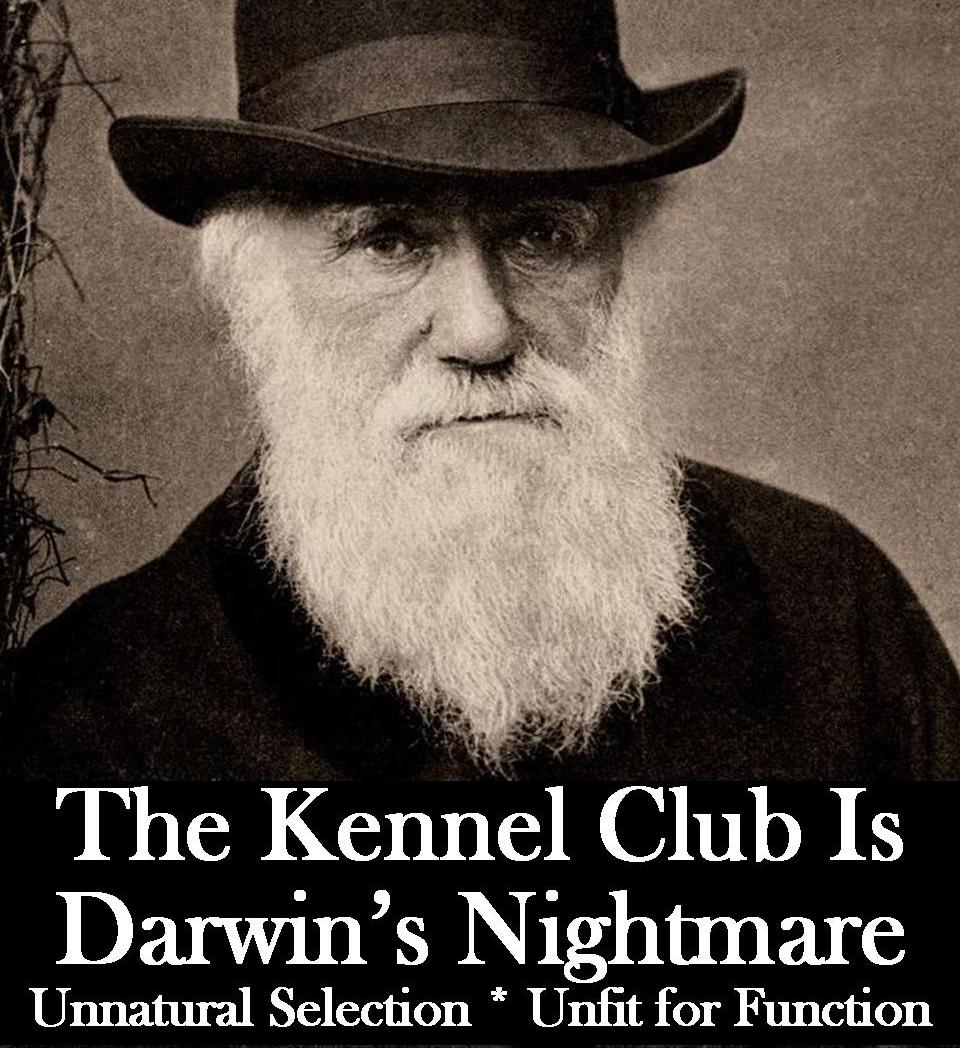
I have even produced a T-shirt noting that The Kennel Club is Darwin's Nightmare.

So imagine my pleasure to be told that a veterinarian in the U.K had produced a book about Darwin that took the Kennel Club to task for selective breeding for dysfunction. Excellent.

Best of all, the book was free. A FREE book?! Double excellent! I went to the link, and you can too.

A quick look at the PDF told me the book was by Matthew Watkinson.

The name sounded familiar, and then it rang a bell -- he had written an article in The Daily Mail a month or so back, talking about the fleecing of customers by veterinarians. There were a few problems with the article, but I blogged the part I liked, said nice things, and moved on.

This new book on Darwin was by the same person? Excellent! This should be good. I dived right in.

The first caution was the cover. The title was a clear rip-off of the title of Darwin's own seminal work.

I suppose Watkinson meant it to be a bit clever, but I found it an affront for someone to more-or-less title their own book as "Volume 2" to Darwin.

Plus, it would be a hard act to pull off. Several hundred books have been written on Darwin and The Origin of Species, many by brilliant writers and thinkers.

No matter, I thought. Let's not judge a book by its cover. Let's read the thing instead.

If the cover of the book had an odor of arrogance, the first 50 pages spoke of some confusion. I scrawled in the margin: What is this book about?

The book did not start with a thesis. It did not start with a historical account of Darwin's works, or even talk much about what Darwin said at all.

Instead, there was a proclamation by the author that unlike everyone else in the world he was going to be "objective" and not "sentimental".

In addition, there was the proclamation by the author that he hated the color "grey" -- he wanted to paint only in black and white, and he was going to eschew any subtle shading.

And finally, there was the note that no one could argue with him about anything, because if they tried they would really be arguing with Charles Darwin (and of course, who has the temerity to do that?).

Hmmmm.....

I carried on. After all, I wanted to like this book. I really did.

In the first 50 pages, there was a nice screed on how Kennel Club dog breeders have too often selected for defect.

The trouble was that the examples given seemed culled directly from the BBC's Pedigree Dogs Exposed and subsequent coverage, and seemed more like a recitation that a real examination.

Surely a trained veterinarian would be able to give other examples of selective breeding for defect -- pigeons, turkeys, chickens, and goldfish, for example?


On the upside, there was a very nice section about dairy cows, but here too I noticed that a lot was left out.

Cattlemen, after all, created the first animal registry in the world, and they were also the first to abandon it in order to outcross to preserve herd health. There was no mention of this, and it seemed a glaring omission.

On page 92 I wrote in the margin: "Was there an outline for this book?"

I wrote the same question three more times as I read to the end, and on page 225 I still wondered what the thesis was supposed to be.

All I knew for certain was that Matthew Watkinson, while sometimes an entertaining writer, did not have a very strong command of the material he sought to claim title to.

Quite simply, he did not do his homework.

The gaps in Watkinson's knowledge and theories are not small -- they are deep and wide.

Consider this: Watkinson has written an entire book on Darwin that never mentions Alfred Russell Wallace, who co-presented (with Darwin) their theory of evolution to the Linnean Society of London in July of 1858.

Watkinson also makes no mention of Darwin's writings on geology (Darwin's necessary proof of an ancient earth), the breeding experiments of Robert Bakewell, or even Erasmus Darwin (Darwin's grandfather), whose own work, Zoonomia, served as Darwin's intellectual chassis.

Watkinson barely mentions the Galapagos Islands, never talks about Darwin's correspondence with dog and pigeon fanciers, or the taxonomic discussions about finches with John Gould (for whom the magnificent Gouldian Finch is named).

In Watkinson's presentation of Darwin's work, in fact, there is no intellectual past, no intellectual development to the present, and truth be told, not much Darwin.

Hundreds of books and treatises have been written about Charles Darwin's theory of evolution, but I do not recall Watkinson quoting a single one.

While Watkinson does manage to squeeze The Descent of Man into two footnotes, he never mentions The Expression of the Emotions in Man and Animals at all, nor does he reference Darwin's other lengthy work on barnacles and worms.

What is Watkinson trying to say in this book? I have no idea.

At one point I noted in the margin that Watkinson seemed to have just discovered death, while later on I noted that he seemed to think there were no other force at work when it comes to natural selection.

At the end of my reading, I set the book aside and let it percolate in my brain for a day or two.

Slowly, an idea dawned in my head. . . . .

The book read as if it was written by a young man who had a Big Idea expand in his mind to fill every empty crack.

Could it be that Watkinson had read only one book -- The Origin of Species -- and then riffed on it for 225 pages without reading anything else or talking to anyone else?

That would be impossible, right?

In fact, believe it or not, that seems to be exactly what happened.

In an interview with a self-publishing website called "BubbleCow" Matthew Watkinson confesses that he began reading Darwin just one year ago, and he decided (in some sort of manic-expressive fever) to begin writing down everything that came into his head.

Quite sadly, this is exactly how the book reads -- as a somewhat sophomoric rant by someone who confuses wild speculation with careful research, and who thinks page numbers are the only structure needed.

Is Watkinson wrong on every page?

Absolutely not.

He is correct that many species are selected for defect by the hand of man. This is not a small point, but it is a point made by many others in the past, and Watkinson hardly treats it with the well-researched treatment that it deserves.

Watkinson is also right that species are too-often split for purely political and self-aggrandizing reasons. Here too, however, he is not saying anything new. The running battle between taxonomic splitters and lumpers is old, but Watkinson does not acknowledge that, much less quote experts or give the reader any guide on how to think straight. Instead we get a kind of stream-of-consciousness in which the chief goal seems to be mock everyone in the world who might actually know the difference between one species and the next.

In fact, this is what Watkinson spends most of his book doing -- serving as a juvenile and cynical sniper plinking at others. And to what purpose? It is not clear. In the end, one is left suspecting that it is all vanity, and with not too much to say (because he does not really have a good command of the material) he has been reduced to doing little more than tossing out one-liners. It is (at best) cleverness masquerading as thought and knowledge. At worst it is a rambling, chaotic bore with wild side trips into poor thought and ignorance.

One small problem is that Watkinson likes to toss words around, but he does not always know what they mean.

For example, he thinks a desert is as good as as a jungle. Anyone who disagrees is not being objective.

He thinks the death of a chicken is the same as the death of a whale. Anyone who disagrees is a racist.

He think the death of an individual animal is the same as the extinction of the entire species. Anyone who says otherwise does not understand Darwin.

In fact, Watkinson is simply an idiot.

Mother Nature does a lot more work in a jungle than a desert, and anyone who thinks the elimination of a species is the same as the death of an individual is laughable.

You could not get through a junior high biology class with that kind of "deep thought."

Watkinson seems to be struggling with the idea of discrimination, but he does not know enough to realize that discrimination is actually one of the driving forces behind evolution.

Why does a Bower Bird prefer one mate over another?

Why does a Lion prefer one mate over another?

Watkinson has no idea -- he does not even know enough to ask the question.


Watkinson's idea that a chicken is equal to a whale, because both are life (and who is to say one is better than another?) is patent nonsense.

A whale is at the top of a food chain. A chicken is not.

Food chain?

What's a food chain?

Right.

That's a word Matthew Watkinson does not type once in 225 pages. He doesn't talk too much about habitat either.

Mother Nature is actually quite objective about what individuals she thinks are important. She make hundreds of millions of mice, but gives them all a very short lifespan. The death of 50,000 mice then, is meaningless in the grand scheme of things. Mother Nature will "infill" that loss in a week.

Mother Nature makes very few lions, however, and gives them a much longer lifespan. The death of 50,000 lions has an enormous impact, and that impact flows downward through the food chain.

In fact, the death of 50,000 African Lions would wipe out that species in the wild, and that impact would reverberate for millenia.

The loss of 50,000 mice, however, would not reverberate for a week.


The fact that Matthew Watkinson misses such basic points speaks to his deep ignorance about wild places and wildlife. Quite simple, he does not know why big fierce creatures are rare.

Watkinson goes on to suggest that all conservation efforts are meaningless and wrong-headed.

And why?

Because, he explains with the wonder of a small child that has just discovered a one-size-fits-all theory, life on the planet cannot be wiped out.

Go on and poison the waters, chainsaw the forests, shoot all the elephants, and harpoon all the whales into extinction.

Dump toxins into the oceans and belch smog and greenhouse gases into the air. It will not matter in the slightest. After all, if earth survived the massive Chixculub meteor-impact that wiped out the dinosaurs, it can probably survive anything.

Right. . . . .

Apparently, it has not occurred to Mr. Watkinson that sending all life back into the basement of existence might not be the goal.

It might be . . . maladaptive.

Which brings me to the real (if unintended) lesson of this book ... and because Darwin himself was a lifelong lover of terriers, I will explain it in terms Darwin himself might have used.

When a small terrier enters a fox's den, the fox will try to bolt out any exit it can.

Failure to do so is "maladaptive" for the fox.

If a fox is pressed hard against a stop end, however, and it has nowhere to go, a wise terrier will stand back a few inches and bay.

Failure to do so is "maladaptive" for the terrier.

The point here is that fear and caution are adaptive mechanisms -- in a world that is "red in tooth and claw," the overly bold are quickly cold.

Nature tends to select for caution, and prune out those who, in arrogance or youthful enthusiasm, get in over their head.

In fact, it was because Darwin understood this so well that he moved so slowly when assembling The Origin of Species.

Darwin knew that while not everything he was talking about was entirely new (Darwin did not invent the idea of evolution), his presentation of the mechanical watchspring that was driving things forward would be fiercely challenged.

While he hoped his writing would eventually lead to illumination, he knew he had to prepare for the white-hot fire that was sure to precede enlightenment.

As a consequence, Darwin talked to everyone, read everything he could find, and corresponded with pigeon fanciers, dog men, chicken experts, and scientists up and down England, Europe, Asia and America for over two decades in order to back plaster his text with examples and authority.

Darwin teased through his own notes and those of others, and he walked around the sand walk at Down House mulling it all over, before going back to his desk to try to hammer it smooth and polish it bright.

Darwin was not going to rush to wreckage.

He was going to build slow, and write for the ages. He was going to organize things carefully and logically, stacking one brick on top of the other and checking it all with level and plumb.

He was not going to be "maladaptive."

Darwin stepped off the HMS Beagle in 1836, but it was not until 1859 that he was ready to roll out his master work for the public -- 23 years later.

Watkinson? I do not think it took him 23 weeks of actual writing.

The story is not over yet, however. You see, while Darwin had an inheritance and a family income which allowed him to live off his investments, Watkinson tells us that "Like a demented robot I remortgaged the house to fund a totally unnecessary search for the truth."

Right.

  • Unnecessary

  • Poorly organized

  • Weakly researched

  • Fatally flawed


In short, "maladaptive."

The ironic lesson here is that like any species, books seek to fill ecological niches.

Whether they succeed or fail has lot to do with whether they are an improvement on the old, or whether they are simply a teratogenic mess whose parts never quite get organized and fused together.

Sadly, Destiny of Species is the latter, not the former.

I had hoped it would be so much better.


* * * *

Of course, one man's opinion is never "the seal of the prophet". Since you can download your very own copy of this book and read it for free you can always do that. Time however is more precious than money, and you might want to do something different instead; actually read the original Darwin (also for free). I assure you it is much better than what Watkinson has too hastily sent up the flagpole. For those who prefer to read their Charles Darwin in hardcover, this looks to be a pretty nice edition.


..