Showing posts sorted by relevance for query Birds Using Tools to Hunt. Sort by date Show all posts

Wednesday, August 15, 2018

Hunting Puffins with Gordon Ramsey


Where to start?

It seems a handful of Lundehund owners and puppy peddlers are terribly upset that I posted on the fact that Lundehunds are a genetic mess due to inbreeding, and that the famed six toes (preserved by inbreeding) of these dogs is actually not necessary for catching puffins.

Someone by the name of Pia Suopanki tells me, for starters, that I am using the wrong term for the illness plaguing Lunderhund which she says is "IL /PLE."  She sniffs that "I (unlike you) used correct accurate terms when discussing the illnesses."

Right.

Might I suggest she try using "the Google"?   I even provided a link to a simple Google search for Lundehund gastroenteropathy, the term I used in the blog post.

She came back immediately, of course, not bothering to click on anything:

I have lost 3 dogs to said illness, so one could say I know quite a bit about it. Of course I read / heard / discussed it before any unfortunate personal experience of it, as well. IN LAYMAN'S TERMS it is referred to as Lundehund gastroenteropathy, but that is not the proper scientific term for the illnesses. And yes, it does matter. Also for someone who claims to have researched it thoroughly, you seem to have a very poor understanding of it.

Right. 

She is an expert by dint of repeatedly failing to acquire a healthy pet.  God save us from this kind of "expert"! And she read up on the disease before acquiring this breed?  And she sniffs about "layman's terms" preferring the gibberish of an alphabet soup?  Oh Lord, save us from Finnish puppy peddlers!

I went to the first link on the first article in the Google search I provided to her; an article from VetFolio entitled "Gastroenteropathy in Norwegian Lundehunds" and quoted it back to her:

In the past, this disease has been referred to merely as protein-losing enteropathy (PLE), although it is now well established that gastric abnormalities are present as well. Lundehund syndrome, as described in this article, may include components of gastritis, PLE, intestinal lymphangiectasia, inflammatory bowel disease (IBD), and malabsorption and has been described in the Lundehund populations of Europe and North America.

In short, Lundehund gastroenteropathy is the correct term, and it is a collection of serious issues, with dogs presenting with diarrhea (76.7%), vomiting (72.1%), ascites (46.5%), edema (44.2%), weight loss (32.6%), and lethargy (20.9%).

To be clear, this was not a new article; it came out in 2007 and so the terms have been quite well defined for over a decade.

Read the article
and you will also see that the history of the breed is pretty well documented, and it is not too complicated.

I am not sure how having three dogs that died from this disease makes Ms. Suopanki an expert. It might make her a slow learner or a lunatic. It certainly makes her a strange person with a diminished sense of empathy.

Who would knowingly encourage the breeding of defective dogs that, in effect, starve to death? This is the kind of psychopathic behavior that is driving the embrace of laws against Torture Breeding.

So what's going on here? What's the kerfuffle all about?

It's a very simple and common thing. People love stories and they love freaks. If you are selling dogs, it pays to combine the two. If you do that, you might end up with a "very special dog for very special people," and never mind if the dog is actually broken and defective, has serious congenital issues, or if the story itself is a near-complete fabrication.

Remember you are NOT selling dogs to people who are actually going to be using them to hunt Puffins!  Good Lord, no!  You think Kennel Club Rhodesian Ridgebacks are sold to hunt lions or Irish Wolf Hounds  are used to hunt wolves?  You think  Kennel Club German Shepherds are used to herd sheep? No, no, and nope!

The business of selling dogs does not have much to do with functional dogs at all. 

It's about selling story to people who are as common as turnip tops but who want to feel special about themselves, and who want to present themselves as interesting and unusual.

And so the all-breed books slather on the icing. 

Did you know that this particular dog has a direct connection to Kings, Vikings, Gypsies, and the battle of whatever?

Did you know this toy poodle was bred to hunt wild boar and crocodiles in Africa? 

And so it goes, with one fanciful tale after another told and copied from book to book.

Once folks have chosen a storied breed, it now becomes THEIR breed and their story, with their personal identity too often wrapped up in the dog.

And how does it end?  Too often it's that their first [insert name of breed] died early of  [insert disease name]. 

"No problem," say the puppy peddlers; they have another dog just like the last one to sell you. 

Not sure you want to do that again? Well, they patiently go, this breed really does need rescuing.  How about you RESCUE THE BREED?  Please buy another dog to help "rescue the breed"!

And so people plop down their credit cards, again and again, buying a noble story, an identity, and perhaps a cause too.

I have mocked the phenomenon in the past with the creation of the Kill Devil Terrier, the Management Shepherd, the North American Pocket Lurcher, and about a dozen other breeds that I have knitted up with "Just So" stories.

So what's the truth about the Lundehund?

It's certainly true it is a genetic and inbred mess, descended from less than a half dozen dogs, and plagued with a serious and too often life-threatening disease called Lundehund gastroenteropathy.

It is also true that you do not need Lundehunds to hunt Puffins, as you can see from the video of Gordon Ramsey doing it old school at the top.


It is also true that Puffins exist in large colonies across the North Atlantic, and are typically hunted with long-poled nets and long-poles with nooses.

The total Atlantic Puffin population is somewhere between 9.5 and 12 MILLION birds. Vast nesting colonies of these birds exist and nowhere does anyone use Lundehunds to hunt them.

Did they ever use Lundehunds to hunt Puffins?

Hard to say.

All we know for certain is that while we have a lot of video tape and pictures of the Lochness Monster and Big Foot, there is a strange paucity of film or pictures of anyone hunting Puffins with Lundehunds. I am not saying it never occurred. What I am saying is that dogs were never necessary, and still aren't, as the film at top makes clear.  The film below illuminates why:


The short story is that Puffins only make land during their nesting season, during which time the adult birds fly off and return, again and again, with small fish to feed themselves, their mate, and their young.

The business of catching Puffins then is about catching adult birds to eat, and that's best done with nets and nooses at crowded communal nesting sites. You do not have to run around too much if you are in the right place; the birds will simply fly into you. And, for the record, the biggest threat to Puffins is not hunting, but non-native rats; a fact true for nesting island birds the world over.

The Lundehund breeders are quite comical in their insistence that I have it ALL wrong, but they are somewhat at a loss as to how I have it all wrong.  They offer no links and no pictures or video tape of Lundehunds hunting puffins.

One Jason Leach sent me an email saying "Please remove your article about the Norwegian Lundehund. It is filled with errors, false hoods, mis-interpretations of the truth," and then he goes on to say he will graciously help me "rewrite the article so it is factual."

Right.  Mr Leach is from Delaware and apparently a rug merchant.  He does not use his dogs to hunt anything, I assure you.

Mr. Leach goes on to NOT name a single error, falsehood, or mis-representation of the truth! Instead, he says "DNA tests confirm that the Lundehund is likely the oldest purebred dog, though there may be an argument for Dingos and New Guinea Singing Dogs. If you respond, I can provide data from a DNA study done by the canine genetics lab at UC Davis for your information."

Um... no? I really have no interest in conversing with people who cannot read.

I do not talk about the putative age of the genetic stock of the Lundehund at all.

Spitz dogs (the Lundehund is simply a not-too attractive spitz-type) are among the ancient types.

But so what? It doesn't make the Lundehund healthy, and it doesn't make the dog necessary for catching Puffins. And as for that extra dew claw (see picture here) it really is not much help in climbing.

Mr. Leach then tells me, in another missive on Facebook, that the Puffins were collected for their down, not their meat, and that the dogs on these remote islands were heavily taxed because the down collectors were so rich.

Nope. Taxes on small islands are almost never collected on anything. That's true today, and was more true in the 17th, 18th, and 19th centuries. Norwegians on islands and on the mainland dress in wool which keeps you dry when wet, and they did that in the 17th, 18th, and 19th centuries, and they still do that today.  Is there a Puffin down business anywhere in the world where they still hunt Puffins?  If not, then that might tell you something about the non-existence of this trade, as tools generally do not go extinct.

Whats funny here is that the very word PUFFIN refers to the cured meat of the bird. It has an an Anglo-Norman origin and the Middle English word is pophyn or poffin  which refers to the cured carcasses.  It's not a deeply hidden bit of information!

I could go on and give other fantastic stories told by Lundehund folks:  that the dogs came to the islands before the last Ice Age, that the dogs are actually a more recent creation that came after the Vikings, that the Vikings sent the dogs to England where they became Corgis, that the Vikings never left southern Norway and Sweden and Denmark and never hunted Puffins or had Lundehunds at all... 

The fables and counter-fables go on and on
.

In truth, the dog dealers have no idea when six toes showed up in their very common-looking spitz dogs, or how those six toes are actually beneficial to hunting Puffins since not one of them actually hunts Puffins.

The dogs dealers are at a loss to explain why six-toed dogs are not seen elsewhere where Puffins are hunted, or even (it appears) why Puffins were and are hunted.

They would like folks to think that a sea-faring people with a great product never managed to export that product to any other location in the world where Puffins were, and are, being actively hunted

But doesn't that seems odd?

Every other working dog has traveled the world.

We have Mongolian running dogs chasing hares in Montana, English terriers going to ground in Virginia, and Scottish sheep dogs moving flocks in New Zealand.

We have German dachshunds cornering badger in France, Australian sheep dogs gathering wool in California, and Alaskan sled dogs pulling carts in Yorkshire.

We have French dogs used to gather truffles in Italy, American dogs used to bring down feral pigs in Australia, and all kinds of pointers, setters, and retrievers working from one corner of the world to the other. 

But despite the fact that there are 12 million Puffins in the world, no one seems to be using Lundehunds anywhere for anything. They are not even used to ferret out other birds that nest underground (such as the Kea in New Zealand). 

Instead, all we've got are dog dealer stories that circle again and again around inbreeding which results in deformity and crippling defect.

So how to end this?

Let me close with advice I wrote some years back for an article in Dogs Today: 

Avoid any breed with a disease named after it.  If the breed under consideration has a disease named after it, consider that fair warning! Almost all breeds carry a genetic load of some kind, but some loads are much heavier than others. The last thing you want to discover is that your breed is "really prone" to cancer, hip dysplasia, heart problems, "eye anomaly," epilepsy, or congenital skin conditions.

Bingo. I could not say it better today.

Friday, March 12, 2010

How to Train a Scent Hound


Gone to Earth by Thomas Woodward.


Over at Field & Stream's excellent Field Notes blog, Chad Love put up a post about South Carolina "fox pens" which are large multi-acre enclosures where fox and coyote are released in order to (supposedly) train hounds.

Chad is a little uneasy about fox pens, but he readily admits he is not a houndsman, and he wonders where to draw the line on using live critters for training purposes.

Where I’m stuck is this: Is it inherently more "cruel" to use live coyotes to train a coyote dog than it is to use live birds to train bird dogs? Rabbits for beagles? Coons for coon hounds? Where do you draw the line?


There was some palaver from people who do not hunt fox or coyotes with dogs, and who were trying to fit the fox pen question into some sort of "us versus them" hunters-versus-animal-rights-lunatics frame.

Then I weighed in, noting that while I hunted fox with dogs:

Surely we can say no to canned hunts of a predator in a fenced enclosure? Surely American sportsmen have not come down to this.

Has it ever been easier to hunt in the last 100 years? We have better cars and trucks, more free time, better weapons, and more game than our fathers, grandfathers or great grandfathers did. More public lands too, thanks to Pittman- Robertson.

And yet we still have folks who think we need PENS to "teach" a hound to hunt? We do not! They do not use such nonsense in the crowded U.K. or in France or anywhere else in the world where they hunt with hounds, and that includes most of America. And NO we do not need them here in Virginia, North Carolina or South Carolina.


Of course there was a bit more palaver.

Some folks did not seem to know that most of these "training" facilities operate as canned hunts at least some of the time.

Some folks too quickly embraced the notion that "a-pigeon is-a-rabbit-is-a-fox-is-a-coyote," seemingly unaware that this is the same "a chicken-is-a-pig-is-a-dog-is-a-child" line warmly embraced by Ingrid Newkirk of PeTA.

Mostly, however, folks seemed flummoxed. If you did not have a fox or a coyote in a pen, how would you train a dog?

And then it occurred to me: No one reading this fox pen story actually knew how to train a scent hound! They think this is how it is done.

No problem. I do know how to train a scent hound. And this is NOT how it's done. So let me set it right.

To start with, let me point out that working terriers operate as diminutive scent hounds.

In fact, the work of a terrier is indistinguishable in the field from that of a dachshund (a true scent hound).

Both dogs find their quarry by sniffing the air and the ground until they happen to cut across a "hot" trail leading to a hot hole.

Most folks who work terriers find they do not have to do too much to actually get their dogs operational.

The same is true for most scent hound hunters. Scent is a powerful stimulus for dogs, and they will naturally follow a "sweet" scent out of curiosity, or some small hope of food, sex, or excitement.

So how do you amplify and channel this natural trait?

For starters, get a bottle of fox, raccoon or coyote pee from a mail-order vendor like Bill Boatman Supply or Mark Junes' Lures & Trapping Supplies. Most hunting stores also carry fox, raccoon and coyote pee -- ask a salesman.

Next you need to make a drag out of an 18" inch square piece of heavy cloth or leather chamois (available at any auto-supply store).

Tie a 15-foot piece of cord to your scent drag, and slide a small stack of metal washers or fishing weights down the cord so the drag now has a small amount of weight attached to it.

Now load some of your store-bought critter pee into a cheap spray bottle, being sure not to get any on your hands.

Finally, obtain a package of hot dogs.

Got it all?

Good. Now we are almost ready to go train the dog!

Before we do that, however we want to get your dog well-motivated, and the secret here is to not feed the dog for a full 24 hours. You want that dog sharp! A hungry dog is a brilliant dog.

Now load everything into your truck or car and go out to a farm area where a grassy field or meadows borders a forest.

Leave your dog crated up in the car or truck while you walk down the edge. You should have the leather drag with you, along with the hot dogs, and the spray bottle with the critter pee in it.

About 200 feet from the vehicle, stop and spray the leather drag with critter pee, coating it well, but not getting any on yourself.

Now drop the drag in the middle of the trail (you can spritz the trail itself if you want) and walk perpendicular to the edge habitat, heading up into the grassy field.

As much as possible, you want to make an obvious trail in the grass, dragging the pee-scented leather or cloth behind you.

At the end of a straight 30-foot drag, stop and leave half a hot dog right in the middle, where it is quite clearly visible.

Pick up the drag and walk back the way you came to the exact spot where you took off perpendicular to the path.

From this spot, continue down the edge another 150 feet and then drop the drag and cut across the trail again, this time going 40 feet going into the woods side, dragging the pee-scented leather or cloth behind you as before.

Scuff logs and break a little brush as you go. An easily visible trail with a lot of scent is not a bad thing to have early on in the training process.


At the end of this straight 40-foot drag, leave the other half of the hot dog in plain site.

Continue down this math, making scent trails this way until you have run out of hot dogs, each time making the distance to the hot dog a little longer, curving the trail, and perhaps making the trail a little less obvious.

Now take the dog out on a leash and walk down the path you started. You can slow down a little at the spot where the first "trail" goes off into the grass. Give the dog a chance to succeed, but do not shove the dog or make suggestions. Be calm and mellow. The scent is supposed to do the work, not you.

Once the dog starts down the path (you will wait at this spot until it does), quietly encourage the dog. When the hot dog has been found, and after it has been gobbled up, make a big happy production out of it with a little play and a scratch behind the ears. Good dog!

Now let's see if we can do that again another 150 feet down the hedge.

Repeat this process a dozen times an outing over the next few weeks, extending the trail, curving the trail and even cutting off at sharp angles.

Instead of a hot dog, you can also use a favorite toy, such as a ball, or even a piece of fur.

In only a few outings, your dog will quickly "get it." The smell of a critter means hot dogs and play! Critter smells are FUN to follow.

Now you have a dog that follows scent trails. Be aware, however, that your dog may not be too discerning and may end up following any type of animal scent they find in the woods. In fact that is not a problem for a working terrier, and most fox hounds are not trained beyond this point either. But they can be.

To do that you need to get the dog to follow fox and never follow raccoon. The instruction here is simple: one type of smell is "good" and the other type of smell is "bad".

How do you do that?

With several kinds of pee. After your dog is following fox pee well, start making some "false trails" with raccon pee. Make sure your dog never finds food when it follows a raccoon scent, but always finds food at the end of a fox scent.

Do that often enough, and your dog may stop responding to raccoon scent at all, choosing instead to only follow fox. This is what is called "extinguishing" a behavior in operant conditioning.

A note of caution here, however. Is a few rounds of extinguishing going to stop a dog from having all interest in the smell of raccoons?

No, probably not.

The reason for this is that animal scent reaches deep into the hidden recesses of the canine brain. Scent is one of the most powerful of canine stimuli.

Because scents are such a powerful stimulus for a dog, there is a very real chance that even if there is no known "payoff" at the end, your dog will still want to follow a raccoon scent at least some of the time. If your dog does that often enough, he or she will eventually find a live raccoon at the other end of the trail, and a live raccoon is a massive "jackpot" reward for any dog. It is the very definition of FUN on four legs. Big problem.

So what can you do, right at the start, to make sure your dog never follows raccoon scent?

The answer is that you get the dog to associate raccoon smell with a negative consequence -- a hard "whoa" on a check cord, or a small tap on an e-collar.

If either correction is used on a dog that has previously learned that raccoon scent never means food at the end of the trail, the dog is very likely to stay on the straight and narrow rather quickly, and you will end up with a dedicated fox hound.

Now, are you looking for a simple summary of what I have presented here?

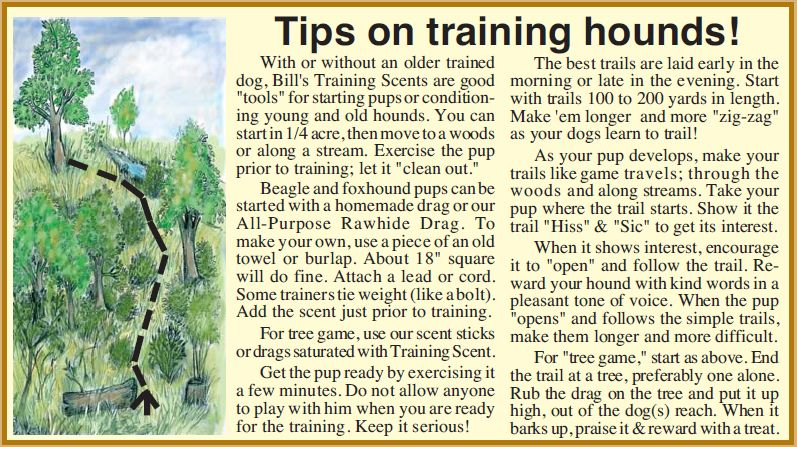
If so, the good news is that the 2010 Bill Boatman catalogue has a nice short training summary, which I have clipped out just for you. Enjoy!

Of course, none of this will stop the lazy and incompetent from wanting their fox pens. These are the guys with one or two dogs, who have no horse, and who have no access to land because they have never gone out and gone door to door at farms.

They have not trained their dogs at all -- they keep them in a kennel behind the house and pretty much ignore them 50 weeks out of the year.

In short these folks are just like the pay-and-shoot bird gunners who take their shotgun and barely trained birds dog out to some place where a fellow releases a few chickens pheasant out into a field to be blasted by the pay-to-shoot guy an hour or two later. We're hunting now! Look at my excellent bird dog.

Of course this is how they hunt birds in England, isn't it? If you are going to import a non-native tropical bird to hunt, like a pheasant, then you are going to have to stock them. You cannot release them into the wild to thrive on their own, any more than you can let a chicken "return to the wild".

But a fox? No, not even in England would they think to put a fox in a big pen with a hound and call it hunting. Or training. Or anything but a fat slob, without the proper tools, trying to do a job on the cheap that he should not have started to begin with.


.

Sunday, January 23, 2022

Archeologists Need to Know More About Hunting


One of my pet peeves are archeologists who do not know what the hell they are talking about when it comes to wildlife and hunting.

Take the dog.  

Please spare me the notion that wolves were first domesticated to aid in hunting. Complete nonsense. 

As any hunter will tell you, dogs are more likely to ruin hunting for big game than aid in it.  

How do you hunt deer?  Simple: shoot from a high stand or low hide with a bow and arrow.  That's the way it's done today, and it's the way it's always been done.  

What about small game? What about it? A wolf used as a dog is going to ruin far more rabbit hunts than help in them, and they are going to eat you out of cave and hut as well. Wolves are not bird dogs, and they do not train very easily.  Every circus has trained horses, bears, and lions, but none has trained wolves. 

The latest example of archeologist nonsense is the notion that Clovis points, found in New Mexico could not possibly have been used to hunt Mastodon because they are too brittle and could not pierce Mastodon or Mammoth hide and tissue deep enough to hit internal organs.

Right.  Idiocy.

As with hunting with dogs, one need only look up and ask a simple question:  How's it work TODAY among primitive people?

To put a point on it, while there are no primitive people using wolves to hunt game, there ARE primitive people hunting elephants -- and even whales -- with arrows and spears.

They do this TODAY.

How's that work?  

Simple:  Poison.  


Yes, Elephants are hunted today with poison arrows and spears. 

In fact, about 70 percent of the elephants poached in Kenya's Tsavo National Park are killed with poison arrows, and the killing crews are often just one or two people.  

Even whales were once killed with Wolfsbane (aka Monkshood). 

As the Smithsonian Institute notes in a squib on a slate spear point in their Alaska Natives Collection:

Hunters armed with poison-tipped darts or spears set out in kayaks to kill humpback and fin whales. These men were ahhuhsulet, shamans who summoned spiritual power for the hunt through songs, talismans, and secret rituals. The poison they used was made from the roots of the monkshood flower. Whale poison, which was smeared on slate blades like this one, was considered to be so strong and dangerous that if birds flew over a place where it was stored they would drop dead from the sky.


Why would primitive people hunt big game?  For the same reason the San people (bushmen) of South Africa hunt Eland, Buffalo, and Elephants today:  a single kill can feed a village and provide vast amounts of dried meat to last through hard times.

With a poison arrow or spear, it's not much harder to kill an Elephant, Mammoth, or Giant Sloth than it is to kill a rabbit, deer, or seal.  And yes, even in primitive cultures, time was money.  Why spend a month killing 30 rabbits when you can spend a day killing and butchering a Mastodon or Elephant that might provide a ton of meat as well as a tough hide for shelter and shields, and heavy bone and ivory for tools? 

So, back to the Clovis points.

Big points can carry big amounts of poison
, such as boiled down Wolfsbane.

It's really just that simple.

Wednesday, September 30, 2009

Birds Using Tools to Hunt


A Green Heron does a little bait fishing. An amazing bird. If no bread is around, they will us insects. Another example is below.

In summer, this bird is found everywhere in the U.S. east of the Mississippi River, and it winters in Mexico, Central America, and northern South America.


.

Tuesday, August 12, 2014

A Fully Self-Actualized Falconer


I used to be surprised at the diversity of people I met through working dogs, but no more.

I think I have taken every kind of person there is out into the field to dig on the dogs: desk-bound albino and farming redneck, black cops and African American e-commerce professionals, Hispanics and Asians, immigrants and natives, tourists and ex-pats, British working class and London posh, women and men, gay and straight, single and married, fat and thin, old and young, chatty and dour. I have even stooped to taking out a few Republicans!

If you can carry tools, love the land, and don't spread hate or talk too much about dog show politics, you are welcome.

That said, people who are eager to carry tools and dig on the dogs are rare, and so too are genuine sheep dog people, running dog people, and falconers, another primitive hunting-with-animals people.

Which is why I was so delighted to read this article in The Root entitled Black Woman in Falconry.
It all started in the overgrown fields of Inkster, Mich., in the 1970s. Summers of organized butterfly hunts with friends led to a lifelong passion for critters and a love of the great outdoors.

That turned into a career and hobbies that make me a little different from what many people think of as your typical black woman. My undergraduate degree is in fisheries and wildlife. I’m a former fisheries biologist, certified scuba diver, keeper and breeder of tropical fish, manufacturer of an organic plant food made from fish-hatchery wastes called Fish it and, oh yeah, a master falconer. Falconry—using trained birds of prey to hunt small game—is often called the sport of kings. But while few of its enthusiasts these days are royalty, my race and gender, nonetheless, make me stand out among them.

I blame my mother and father equally for my embrace of this unusual pastime. My father is a lifelong hunter, fly fisherman and taxidermist. I didn’t stand a chance. While most girls were playing with dolls, I was catching turtles on Ford’s Dam in Ypsilanti, Mich. My mother was a stay-at-home phenom, who made taking care of a home and raising two children (including one with severe attention deficit hyperactivity disorder) look easy.

Yup, I’m a product of the much-applauded nuclear family — we even had the dog. Mom never wasted a chance to teach me life lessons on being a free thinker and living a life by the standards I set. As a result, I’ve been cursed with individuality, leading to many side-eyes from blacks and whites alike and a more-than-occasional, “Where are you from?”

I was a 24-year-old fisheries biologist working for the state of Florida when falconry entered the picture. A biologist in the next office had an American kestrel, the smallest of the falcons. After asking a million questions, I learned she was a master falconer, meaning she climbed through the ranks in falconry from apprentice to general to master class. It was a conversation that changed my life.

People may stare when they see me lugging around a hawk, but that’s not something you see every day, right? At the ripe young age of 44, I now embrace my strangeness, and that’s what Morpheus represents in my life. He’s my 1-year-old Harris hawk, and he is an amazing flier and hunter. I never thought I could love another hawk as I did Nietzsche, but I was wrong. I finally embraced just being me, and now I’m loving life. Today, spending time doing what I love is a requirement; fitting in is not.

Boom.  

Started chasing butterflies? Yep. Me too. That and fishing. I still have my beetle and butterfly collections from 45 years ago... and the old bass pole my grandfather kept in his garage too.

Tiffany M. White, I bet we have common friends. If you are ever down Washington. D.C.-way and have time to spend a day knocking around on fields and farms digging on the dogs, consider it a standing invite! I suspect we're cut from the same bolt of cloth.

Sunday, September 01, 2019

Disney Dog Training and Contrived Controversy


Fifty-five years ago, Walt Disney filmed a movie called Big Red featuring a show-bred Irish Setter that wanted to hunt, and a contrived crisis about dog training between an older English-speaking Canadian (played by Walter Pigeon) and a younger French-speaking orphan who wanted to teach the dog using "gentler" methods.

The movie begins at a dog show at the Montreal Kennel Club where Big Red wins first prize and Walter Pigeon's "kennel man" is instructed to spend as much as $5,000 to acquire Big Red -- a cash equivalent of over $35,000 in today's dollars.

In the next scene we see the improbable situation where a show dog has been bought by a shooting dog man, and the shooting man with show dogs also has many breeds rather than specializing in just one.

We then get introduced to the orphan, dressed in beautiful clothes and dripping in pancake makeup, who slurs grade-school French.  Welcome to the wonderful world of Disney!

Finally, we learn that just one month after being acquired, Big Red is supposed to go to the Westminster Dog Show in New York where, if he wins, he will be "the best dog in North America, perhaps in the whole world" and his cash-value will then double.

As the movie rolls forward, we see the horror of aversive training techniques -- Walter Pigeon cuffs the dog under the jaw so that it will hold its head unnaturally high in the show ring.

Of course the boy is shocked -- this is abuse!

But Walter Pigeon explains, setting up the essential conflict of the movie, that "a dog is an animal, he is governed by conditioned reflexes.  Dogs are not people, they do not have human reactions, and the only way to handle them is with a firm voice and tight lead."

And with that -- all of two seconds of training done with horrible timing -- Walter Pigeon gives up on the dog for the day. "We'll try again tomorrow" he tells the kennel man.


Walter Pigeon explains to the Orphan that Big Red is a "bench dog" and that "his kind are not used for any practical purposes any more" because they were bred for looks rather than work.

This little scene is designed to reinforce our dislike of the older man, who has just said he bought a useless dog at an extravagant price solely to make money.  This is, quite obviously, the antithesis of  good red-blooded American values.  And besides, Big Red is not useless!

Welcome to Disney, where every story is a morality tale.

The movie takes obvious plot twists and turns as it progresses, with the poor Orphan Boy somehow becoming an expert trainer in less than a month (a miracle!), and the fellow with the expensive shotguns and kennel full of dogs, somehow not knowing his ass from his elbow.  And yes there is the obligatory run-in with a mountain lion, with Big Red and the Orphan Boy saving the day.


What's interesting about this story, from a historical point of view, is that it shows how long the  battle between "abusive" trainers and "gentle" trainers has been going on.

In fact, working dog men like Montague Stevens were training dogs with food long before the parents of Karen Pryor or Victoria Stilwell were born. 

Food rewards as a dog training method are older than Jesus, and it's hard to find a 19th Century book on dog training that does not talk about the practice. 

But you cannot train everything with a food reward, which is why God gave porcupines their quills, and skunks their spray.  The real world is full of consequences of all kinds, and they are not all positive, are they?

The dog trainer who was actually used in this movie is none other than William Koehler, who is often demonized as an abusive trainer simply because he did not shower his dogs with biscuits and then turn around to whine that they were now all fat. 

This is not to say that all of of William Koehler's techniques would be saluted today.  Long lines?  Yes. Tossing a light choke chain at a dog?  OK.  But Koehler also saluted the idea that with some dogs a very powerful aversive, done once, was less cruel that mincing about with half measures for months.  Was Koehler right?  The bull in the pasture that does not test his electric fence says "maybe."  But do most dog trainers really need to use strong aversives?  The answer is no.  Most dog owners are pet owners who will never see their dog running free off leash, and most are training dogs starting as puppies, before bad behaviors have been deeply ingrained because they were (unintentionally) rewarded for years.

Koehler, of course, did run his dogs off-leash and unlike so many in the world of dog training, he did not start by training fat suburban dogs owned by owners too lazy to walk them. 

Like so many dog trainers of his era, Koehler started off in the military in World War II where the dogs acquired were almost all large adults and given (read abandoned) to the military because they often already had discipline and temperament issues. And yet, in the military, a dog that does not obey a command can cost lives, both human and canine.  To this day, the U.S. military uses very strong aversives for certain parts of its training regime.  When a bomb-detecting dog is told to "stop" this is not to be taken as a suggestion!  A dog that barks while on patrol can kill an entire platoon.

Yes, most military dogs "will work for Kong" and other toys and small rewards, but these dogs have also learned  that there are certain never acts, and some of those (such as barking on patrol) may be counter to their internal code.

The year that Big Red came out, William Koehler published The Koehler Method of Dog Training which became a staple of AKC obedience competitors.

A variation of the "Koehler method" of dog training was brought to television in the late 1970s by Barbara Woodhouse, who featured basic Koehler methods in her own book, "No Bad Dogs."

Of course, most people who opine about Koehler today have never actually read a Koehler book, and have no idea that he trained dogs in Hollywood or that he trained dogs for this "anti-abuse" movie in particular.   When they do look to defame Koehler, they generally do so by quoting from the very end of one of his books -- and leaving out the fact that this section is very clearly labeled as one that is only to be consulted when all else has failed and the next stop for the dog is the gas chamber. 

Death before discomfort?  That's the rallying cry of a lot of "pure positive" dog trainers today, who are only too willing to declare a dog untrainable if they cannot get it to changes it ways with nothing more than a few cubes of cheese.

Did William Koehler believe in unearned rewards, or effusive baby talk to dogs?  No, but neither do most sensible trainers.

Did William Koehler prance about in a dominatrix outfit while showering dogs with biscuits and screaming at their owners?  No, but neither do most sensible trainers. 

William Koehler was a balanced trainer.  He knew dogs needed exercise (as can be seen in this movie), and that for a working dog there were few more powerful forces at work than the code that explodes (as can be seen when Big Red pings on birds when out in the field with the Orphan Boy). 

Koehler also knew that in the real world of off-lead dog work, a dog that obeyed only some of the time had a higher-than acceptable chance of ending up dead. 

That's still true today, whether the dog is an explosives detection dog in the Army, a police dog in Detroit, or a companion dog that escapes the yard in California.

William Koehler worked with dogs for 50 years, was employed by Walt Disney for 20 years, and over the course of his life he trained more than 25,000 dogs according to his obituary.

Compare his record with anyone else, and you are likely to find his credentials and experience without peer. 

Does that mean you have to train your dog the Koehler way?  Of course not!.  Train your dog any way you want.  But do everyone a favor, eh?  Admit that William Koehler had a long and remarkable career training very happy dogs (as did other Hollywood dog trainers, such Rudd Weatherwax, the trainer of Lassie), and that William Koehler was dealing with a lot of dogs that were not Labrador retrievers, that were not puppies, and which required a performance standard a little bit higher than "sometimes he'll do it if he feels like it and I have his toy or a chunk of cheese."

Monday, May 01, 2017

Disney Dog Training with Contrived Controversy


Fifty-five years ago, Walt Disney filmed a movie called Big Red featuring a show-bred Irish Setter that wanted to hunt, and a contrived crisis about dog training between an older English-speaking Canadian (played by Walter Pigeon) and a younger French-speaking orphan who wanted to teach the dog using "gentler" methods.

The movie begins at a dog show at the Montreal Kennel Club where Big Red wins first prize and Walter Pigeon's "kennel man" is instructed to spend as much as $5,000 to acquire Big Red -- a cash equivalent of over $35,000 in today's dollars.

In the next scene we see the improbable situation where a show dog has been bought by a shooting dog man, and the shooting man with show dogs also has many breeds rather than specializing in just one.

We then get introduced to the orphan, dressed in beautiful clothes and dripping in pancake makeup, who slurs grade-school French.  Welcome to the wonderful world of Disney!

Finally, we learn that just one month after being acquired, Big Red is supposed to go to the Westminster Dog Show in New York where, if he wins, he will be "the best dog in North America, perhaps in the whole world" and his cash-value will then double.

As the movie rolls forward, we see the horror of aversive training techniques -- Walter Pigeon cuffs the dog under the jaw so that it will hold its head unnaturally high in the show ring.

Of course the boy is shocked -- this is abuse!

But Walter Pigeon explains, setting up the essential conflict of the movie, that "a dog is an animal, he is governed by conditioned reflexes.  Dogs are not people, they do not have human reactions, and the only way to handle them is with a firm voice and tight lead."

And with that -- all of two seconds of training done with horrible timing -- Walter Pigeon gives up on the dog for the day. "We'll try again tomorrow" he tells the kennel man.


Walter Pigeon explains to the Orphan that Big Red is a "bench dog" and that "his kind are not used for any practical purposes any more" because they were bred for looks rather than work.

This little scene is designed to reinforce our dislike of the older man, who has just said he bought a useless dog at an extravagant price solely to make money.  This is, quite obviously, the antithesis of  good red-blooded American values.  And besides, Big Red is not useless!

Welcome to Disney, where every story is a morality tale.

The movie takes obvious plot twists and turns as it progresses, with the poor Orphan Boy somehow becoming an expert trainer in less than a month (a miracle!), and the fellow with the expensive shotguns and kennel full of dogs, somehow not knowing his ass from his elbow.  And yes there is the obligatory run-in with a mountain lion, with Big Red and the Orphan Boy saving the day.


What's interesting about this story, from a historical point of view, is that it shows how long the  battle between "abusive" trainers and "gentle" trainers has been going on.

In fact, working dog men like Montague Stevens were training dogs with food long before the parents of Karen Pryor or Victoria Stilwell were born. 

Food rewards as a dog training method are older than Jesus, and it's hard to find a 19th Century book on dog training that does not talk about the practice. 

But you cannot train everything with a food reward, which is why God gave porcupines their quills, and skunks their spray.  The real world is full of consequences of all kinds, and they are not all positive, are they?

The dog trainer who was actually used in this movie is none other than William Koehler, who is often demonized as an abusive trainer simply because he did not shower his dogs with biscuits and then turn around to whine that they were now all fat. 

This is not to say that all of of William Koelher's techniques would be saluted today.  Long lines?  Yes. Tossing a light choke chain at a dog?  OK.  But Koehler also saluted the idea that with some dogs a very powerful aversive, done once, was less cruel that mincing about with half measures for months.  Was Koelher right?  The bull in the pasture that does not test his electric fence says "maybe."  But do most dog trainers really need to use strong aversives?  The answer is no.  Most dog owners are pet owners who will never see their dog running free off leash, and most are training dogs starting as puppies, before bad behaviors have been deeply ingrained because they were (unintentionally) rewarded for years.

Koelher, of course, did run his dogs off-leash and unlike so many in the world of dog training, he did not start by training fat suburban dogs owned by owners too lazy to walk them. 

Like so many dog trainers of his era, Koehler started off in the military in World War II where the dogs acquired were almost all large adults and given (read abandoned) to the military because they often already had discipline and temperament issues. And yet, in the military, a dog that does not obey a command can cost lives, both human and canine.  To this day, the U.S. military uses very strong aversives for certain parts of its training regime.  When a bomb-detecting dog is told to "stop" this is not to be taken as a suggestion!  A dog that barks while on patrol can kill an entire platoon.

Yes, most military dogs "will work for Kong" and other toys and small rewards, but these dogs have also learned  that there are certain never acts, and some of those (such as barking on patrol) may be counter to their internal code.

The year that Big Red came out, William Koehler published The Koehler Method of Dog Training which became a staple of AKC obedience competitors.

A variation of the "Koehler method" of dog training was brought to television in the late 1970s by Barbara Woodhouse, who featured basic Koehler methods in her own book, "No Bad Dogs."

Of course, most people who opine about Koehler today have never actually read a Koehler book, and have no idea that he trained dogs in Hollywood or that he trained dogs for this "anti-abuse" movie in particular.   When they do look to defame Koheler, they generally do so by quoting from the very end of one of his books -- and leaving out the fact that this section is very clearly labeled as one that is only to be consulted when all else has failed and the next stop for the dog is the gas chamber. 

Death before discomfort?  That's the rallying cry of a lot of "pure positive" dog trainers today, who are only too willing to declare a dog untrainable if they cannot get it to changes it ways with nothing more than a few cubes of cheese.

Did William Koehler believe in unearned rewards, or effusive baby talk to dogs?  No, but neither do most sensible trainers.

Did William Koehler prance about in a dominatrix outfit while showering dogs with biscuits and screaming at their owners?  No, but neither do most sensible trainers. 

William Koehler was a balanced trainer.  He knew dogs needed exercise (as can be seen in this movie), and that for a working dog there were few more powerful forces at work than the code that explodes (as can be seen when Big Red pings on birds when out in the field with the Orphan Boy). 

Koehler also knew that in the real world of off-lead dog work, a dog that obeyed only some of the time had a higher-than acceptable chance of ending up dead. 

That's still true today, whether the dog is an explosives detection dog in the Army, a police dog in Detroit, or a companion dog that escapes the yard in California.

William Koehler worked with dogs for 50 years, was employed by Walt Disney for 20 years, and over the course of his life he trained more than 25,000 dogs according to his obituary.

Compare his record with anyone else, and you are likely to find his credentials and experience without peer. 

Does that mean you have to train your dog the Koelher way?  Of course not!.  Train your dog any way you want.  But do everyone a favor, eh?  Admit that William Koehler had a long and remarkable career training very happy dogs (as did other Hollywood dog trainers, such Rudd Weatherwax, the trainer of Lassie), and that William Koehler was dealing with a lot of dogs that were not Labrador retrievers, that were not puppies, and which required a performance standard a little bit higher than "sometimes he'll do it if he feels like it and I have his toy or a chunk of cheese."