Showing posts with label raptor. Show all posts

Friday, July 25, 2014

Vultures Are Vomiters, Not Raptors


For years, it was believed that all vultures were raptors, members of the order Falconiformes.

In 1994, however, it was discovered that vultures on this side of the Atlantic actually share a common ancestor with storks and ibises. Now, New World vultures are recognized as Ciconiiformes, in the family Cathartidae, while European, African, and Asian vultures are recognized as Old World vultures (family Accipitridae, subfamily Aegypiinae). There are 15 species of Old World Vultures and 7 Species of New World Vultures.

What is a buzzard?

In the U.S. vultures are often called "buzzards," but in actually a buzzard is a European member of the hawk family. The European buzzard, Buteo buteo, is closely related to the American red tailed hawk.

Almost all the vultures you see in the U.S. are Turkey Vultures. Black Vultures also exist in the South, but they do not have the graceful flight of the Turkey Vulture and are not as common. California Condors (a type of vulture) have been retintroduced in California and Arizona, but are so rare you are unlikely to see one in your entire life unless you make a special trip to the remote areas where they have been released.

Turkey Vultures got their name from their bald red heads. The lack of feathers on their head are an adaptive mechanism -- when a vulture is eating a dead animal, it often sticks its head inside the carcass to reach the meat. Feathers on the head would trap unwanted flesh and blood, along with bacteria. A bald head, then, is an adaptive mechanism for cleanliness, as is the vulture's habit of urinating down its own legs -- another way to clean off clinging bits of flesh and bacteria.

Turkey Vultures have few predators, other than man. Their nests are scratched out of bare patches of soil on cliff faces and out of the rotting wood at the tops of broken trees. They will often nest in the sides of abandoned farm buildings as well -- old silos being a favorite location. Vulture nests are subject to predation by raccoons, but the vulture as a fairly effective defensive mechanism -- it vomits up a large masses of semi-digested meat along with very acidic digestive juices. The smell of Turkey Vulture Vomit is rather astounding, and the stomach acid is acidic enough to burn a raccoon's eyes.

You will rarely see Turkey Vulture flying in the early morning, as they launch themselves from trees, cliffs, powerlines, barns and silos only after the morning air has warmed up. A Vulture will fly into a thermal uplift, ride it up in a wide circle, and then glide across the sky at speeds of up to 50 miles per hour gently falling until they reach the next thermal which they in turn ride up again -- repeating the process adinfinitum. On a good day, a Turkey Vulture can glide for four of five hours without flapping its wings.

The feet of a Turkey Vulture are very weak and are built a bit like a chicken's -- they cannot catch small prey like a rabbit. Road kill is their primary food source, and the rise in deer, raccoon, possum and groundhog populations has meant a rise in turkey vultures. Vultures are also common on river banks where they scavenge washed-up fish.

Thursday, April 09, 2009

A Real Eagle-Eye View of the World


Link

So here's the concept: Strap a tiny video on top of an eagle and then see the world as she see its. This was shot in Spain, I believe. The web site is of falconer Jose Luis Ortiz. Nice!

.

Friday, September 05, 2008

Bald Is Beautiful


A friend sent me some pretty terrific bald eagle pictures taken in Canada, which got me to thinking about these magnificent birds. When I was kid, there were very few bald eagles left on the East Coast. Today, I only have to drive to Wilson Bridge, about 10 minutes away, to see seven or eight of them (or more) in all their glory.

The return of the Bald Eagle is generally credited to a ban on DDT, but that's a lie. DDT did not kill off the Bald Eagle -- lead poisoning did, in the form of bullets shot from rifles.

The short story here is a common one in American wildlife: as guns became more accurate, cheaper and more powerful between 1850 and 1900, game laws did not keep up. The result was a true wildlife massacre. We not only shot out all of the buffalo that once grazed on the East Coast, we also shot out all the passenger pigeons, Canada geese, beaver, elk, wolves, deer, mountain lions and yes, eagles, osprey and no small number of hawks.

Eagles, osprey and hawks were also decimated by the use of pole traps -- leghold traps set on the top of poles placed around fishing nets and barn yards. Nothing kills hawks and eagles faster or more efficiently than a pole trap.

Native Americans did their fair share of shooting eagles too; it takes a lot of feathers to make a bonnet for the tourist trade, and there was no shortage of bonnets being made and shipped east to museums, collectors, and other wealthy patrons.


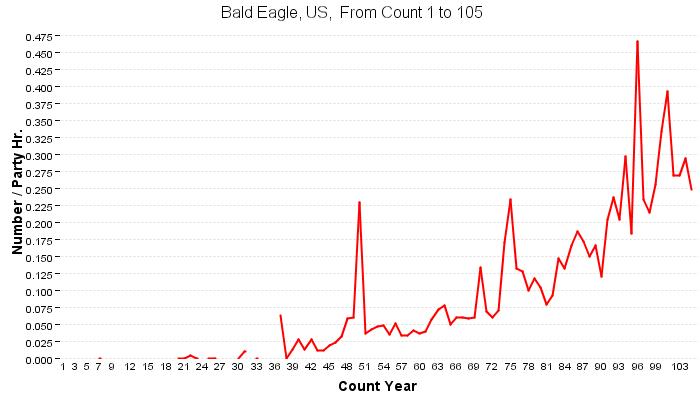
The graph above (click here to see full-sized graph) shows Bald Eagle populations as tracked by the National Audubon Society's Christmas Bird Count, which has tracked bird populations in the U.S. since 1900.

As you can see, by 1900 -- more than 40 years before DDT was invented -- Bald Eagle populations were vanishingly low. The same is true for Osprey -- another bird unlikely to be misidentified by a dedicated bird watcher. You can pick any non-migrating bird you want and track the data by going here >> http://audubon2.org/birds/cbc/hr/table.html (note Osprey migrate in the North but tend to reside year-round in the South).

Ironically, Bald Eagle populations climbed between 1940 and 1970, when DDT was in full use in the U.S. The reason for this is fairly simple: the Bald Eagle Protection Act of 1940 made it illegal to shoot Bald Eagles. This protection was further expanded when the Endangered Species Act was passed in 1973.

Left to their own devices, and protected from unregulated shooting and trapping, Bald Eagle populations took flight and have now soared. Today, there are about about 8,00 nesting pairs of Bald Eagles in the Lower Forty-Eight, and the Bald Eagle is now a candidate for de-listing from the Endangered Species Act.

Another American success story. Add that to the rostrum of success we have achieved through a marriage between hunters and conservationists: the return of the white tail deer, moose, elk, cougar, beaver, Canadian geese, wood ducks, and wolves.
.

Tuesday, April 22, 2008

Winged Weapons of Mouse Destruction


A young Falco sparverius. The American Kestrel or Sparrow Hawk, sometimes called a "spar", is actually a small falcon.


Humans like to think that we see well -- a vanity we cultivate by comparing ourselves to dogs, rats and other mammals that mostly see in black and white, grays, light yellows, and blues.

In fact, most mammals have a sharply reduced visual spectrum because early mammals went through a very long period when almost all of them lived an entirely nocturnal existence.

Most mammals are still nocturnal. If you wonder where the raccoons, possum, deer and fox are in your area, the answer is that most move about only at night. The rest of the time they are resting up in thick tangles of growth, tucked up into underground dens or hollow trees, slumped into small depressions and wallows, and otherwise "loafing on the couch," just out of eyesight.

Since most humans never stray far from car or path -- and almost never venture into dense tangle or on to even slightly swampy ground -- the critters remain undiscovered.

Animals that are mostly nocturnal do well with eyes that see very little color.

The canine eye is a good example. Though your dog may sleep all night (and half the day too!) it is still only a few thousand years removed from its wolf or proto-wolf progenitor; not enough time for physical evolution of the canine eye to have occurred.

The bottom line is that dogs do not see very well -- not even sight hounds or seeing eye dogs. In fact, dogs seem to see only about one-sixth as well as humans.

Not all mammals see in a reduced spectrum, however. The progenitors of old-world apes experienced a mutation millions of years ago that resulted in more cones and rods being added to their eyes. The result is a wide range of color vision among old-world apes (chimps, gorillas, orangutans) and their cousins, we humans.

Surprisingly, some of the oldest and most primitive animals on the planet have a wider spectral rangethan humans and chimps. This includes reptiles and the likely descendants of dinosaurs -- birds.

Anyone who has tried to stalk a wild turkey knows how incredibly sharp their eyes are. In fact, all birds have remarkable eyesight. It's been estimated that a common sparrow hawk, for example, could read a newspaper from 25 yards away, while an eagle can spot the twitching ears of a rabbit from a distance of two miles.

The reason avian acuity is so high is that a bird's eye is built entirely differently from that of a human or a dog. For one thing, the retina of a bird is enormous.

The retina is the screen at the back of the eye on which an image, coming through the lens, is focused. This screen is composed of light-sensitive rods and cones, with the rods registering shapes and the cones differentiating colors.

On rods alone, the avian eye far eclipses that of the dog or the human. A human eye, for example, has about 200,000 rods, while an eagle has about a million -- five times more.

The true knockout blow for birds, however, is in the cone department. It turns out that many birds, and especially birds of prey, have cones in their eyes that enable them to see a much wider spectrum than we can, and for some birds -- such as the American Kestrel or sparrow hawk (actually a kind of small falcon) -- this spectrum includes ultraviolet light.

What's the benefit of being able to see in the ultraviolet spectrum? Simple: mouse urine glows purple in ultraviolet light (one reason "black light" is used to find old pet urine stains on wooden floors).

When a sparrow hawk hunts along a hedge, it is able to look for urine stains that mark mouse holes, runways and nests.

Mice and rats mark their burrows and runways with urine scent trails because, like most mammals, they do not have very good eyesight. Scent cues help rats and mice orient themselves in the complex world of hedge, forest, field and barn. The result is that a rat or mouse can "run" a scent trail very fast without spending time in the open trying to figure things out.

Experienced human ratters know this about rodents, and so they will drag their boot across the middle of a shed and spin long boards perpendicular to where they have been lying, all in an attempt to break up or disturb invisible scent trails. A few seconds hesitation by a confused and disoriented rat is just the edge a terrier needs to even the odds on the farm.

For a sparrow hawk, visible urine trails enable it to focus on areas where small rodent activity is heaviest. By simply flying over a hedge or field, and then lighting on a fence post, telephone pole, or dead tree near visible urine marks, a sparrow hawk can dramatically increase its chance of finding lunch.

Once activity in the grass is spotted, a sparrow hawk will face into the wind and hover low over a grassy area -- a tactic that earned it the name "windhover" or "wind fucker" in 17th Century Holland, when the terminology was considered a little less offensive that it is today.

As for ultraviolet vision, it's not all about food -- it's about sex too. It seems that all those rather drab-looking birds we see in the hedge look a lot prettier when they are seen through the lens of an ultraviolet-sensitive eye.

Birds species in which male and females look very much alike to us look very different to the birds themselves, as they have twice as many cones in their eyes and so can see shade and colors we miss altogether.

.

Friday, February 01, 2008

A Single Transmitter Made a World of Difference

Remember, when we were kids and people said that the birds "flew south" for the winter?

Well, believe it or not, that was about all we knew for a lot of species. Birds disappeared flying south in the Fall and came back, flying north, in the Spring. Where these birds went, exactly, and what they did when they got there, were a bit of a mystery.

All of that changed with the devopment of very small micro-transmitters capable of uploading information to satellites.

Three of the very first transmitters capable of being carried by a bird were attached to Swainson's hawks back in 1994. Within a few days, two of the transmitters conked out, but the transmitter on the third bird retained power and showed the hawk traveled from southern Canada down the American Midwest into Mexico, Guatemala, Costa Rica, and past Ecuador into the Pampass region of Venezuela.

Scientists quickly scurried off to see if they could locate the animal.

What they found in Argentina was both amazing and disturbing.

The amazing part was the Swainson's hawks (which are solitary hunters in North America) assembled into large communal flocks of as many as 7,000 birds on their winter hunting grounds.

The scary part was that in Argentina Swainson's hawks lived on swarms of locust-like grasshoppers, which were being systematically poisoned by organo-phosphate pesticides.

The bug spray, in turn, was killing off the Swainson's hawks in droves.

As they drove into the area where the hawk's signal had last been heard from, the scientists were alarmed to find thousands of dead hawks already dead under their roosts.

To make a long story short, that year 25 percent of all the Swainson's hawks in the world were killed by pesticides in Argentina -- a phenomenon that would never have been known had it not been for wildlife tracking telemetry.

The good news is that by switching to different type of pesticides, Argentina's farmers were able to sharply reduce grasshopper infestations while doing little serious harm to wildlife --a "win-win" for all sides.

The two tracking transmitters at the top of this post are made by an outfit that specializes in micro-tramsitters for bats, birds and other wildlife . The very smallest of birds can now carry tracking trasmitters glued or harnessed onto their backs or tail feathers, with batteries providing power for 30 days or more.

The tiny collar, pictured at right, holds the even tinier dot-like transmitter next to it.

The transmitter pictured at the very top of this post is even smaller than the one at right, and is arrayed for a tail mount on a very small bird. This is a complete rig with battery, transmitter and aerial, believe it or not.

Either one of the two micro-transmitters shown have an above-ground trackable range of 1-2 kilometres. .

4 For more information on wildlife and terrier transmitters on this blog, click here.
.

Monday, July 23, 2007

Beyond Flights of Fancy


A repost from 2006 of this blog.


In his book Stormy Nights and Frosty Mornings,
Paul Dooley writes of going to his first field meet with a hawking club.

He had never been to such an event before and was rather apprehensive as there were a couple of 'names' present who always talked a good game. Later he learned that some of these people, particularly one of the organizers of the meet, had never flown a bird free!

When it came time to actually hunt, nobody in this hawking club wanted to fly their own winged charge at fur or feather -- it was deemed to be "too windy" by some, while another said his bird was an ounce or two over weight and another said his bird "wasn't ready yet". It was Paul -- a novice -- who flew his bird and scored on first flight.

Paul writes: "It was quite an eye opener for me that day. The problem with field meetings for these fake falconers was that there was nowhere to hide. Some of them used to turn up without their birds just to watch. Nothing wrong with that, but why pretend that you hunt a bird when you clearly don't?"

Why pretend indeed! Yet people DO, don't they? And it's not just in the world of hawking.

I mention this paragraph, in part to highlight Paul's book, but also to note that we have the same kind of people in the terrier world, and they exist in other arenas too.

In The Survival of the Bark Canoe author John McPhee writes of Henri Vaillancourt, a maker of traditional Indian birch-bark canoes. For years Vaillancourt had been building canoes based on a mixture of book learning, theory, and pure fantasy. It was only when he asked Vaillancourt to go on a canoeing trip with him that McPhee learned an eye-opening truth: Vaillancourt had never actually paddled his own creations for any distance far from home.

His canoes were beautiful to look at, but the crafts themselves represented design choices unburdened by actual field experience. In the end, McPhee's book is not really about birch bark canoes -- it's about the collision between theory and practical knowledge.

Is it much different in the terrier world?

Not from what I can see. Some people have spent years on Internet bulletin boards, but have never actually dug five feet to a critter. They still do not own a decent shovel, and still do not know what to do with a squalling raccoon at the stop-end of a dirt pipe. Their theory of terrier work is entirely unburdened by field experience. When questions are asked, they do not pay close attention to the answers since it's all romantic abstraction. The purpose of a question is not to solicit an informed answer, but to extend idle chatter. Just as Paul Dooley's fake fliers show up at a hawking meets with birds that have never left a creance, so these fake diggers show up at terrier trials and enter their "one and done" dogs in the working terrier ring.

I was reminded of this collision between reality and fantasy while reading Matt Mullenix's excellent book, In Season, A Louisiana Falconer's Journal.

Matt is not a fantasy flyer. His book is about the reality of hawking -- keeping his bird at the right weight, finding a bit of pasture that has not been mowed flat, painting a cracked talon with Crazy Glue and nail hardener, and balancing the competing interests of job, hawk, children and wife. Every flight is not a glorious thing ending in a brace of rabbits; sometimes it's a soaking rain and a footed sparrow or worse -- mere indifference from a hawk a little too heavy to focus.

With a sense of confession, Matt explains that though his Harris Hawk nails its fair share of swamp rabbits and doves, there are also lot of cotton rats. They are, for better or worse, a primary quarry in his part of the country.

I get it. It's easy to love a rat if you hawk -- just like it's easy to love bluegill and sunfish if you fly fish. Field action of any type beats fantasy and theory seven days of the week.

Matt writes of the rising tension of a group hunt, when there may be too many birds flying, and as a consequence problems can rise up and spin out of control quickly. The same thing occurs with terriers. A solo man and his dog are under no pressure, but put more than three or four dogs in the field at once, and things can move too quickly for the human to avoid real trouble. It only takes one train wreck to ruin a day.

I do not hawk, but I understand Matt because he is actually hunting and his concerns mirror mine even though we hunt different animals on different game in different parts of the country. Matt talks about a hawk's leg turning blue after a run-in with a tree and the calculated risk that two hawks, diving for the same swamp rabbit, will accidentally grip on to each other as well as the rabbit. Is their a digger that does not understand this problem? I have felt the same rising arpeggio of concern, never mind that it is played on a different stage in a slightly different key.

In a small part of the book Matt writes of a man who "has no time for falconry." In two weeks this novice had flown his young bird only once, and then when the bird was over-matched. When Matt points out that it's pretty hard to work a hawk on a weekend-only basis, the novice replies, "but that's the time I have."

Matt does not comment. He does not need to.

What the hawker wants is interesting, but it's not really part of the equation, is it? There are some things that are required in hawking, and time with the bird is clearly one of them. Mullenix does not have time for falconry either, but it does not matter; he steals the time from family and job, from sleep and rest. He feels guilty about the theft (an honest man would), but he steals it anyway. It is what you have to do if you are serious.

With hawks, it's either all the way in or all the way out.

The dog world is a bit easier, and perhaps for that reason we are surrounded by more fakes, novices, romantics and bored housewives than the people in the world of hawking. I do not know. Perhaps I am wrong. Paul Dooley suggests falconry has its share of preening pretenders too.

All I know for sure is that the hawkers are a pretty literate and interesting lot. A tip of the hat to them, and a recommendation for this book.

I close on a slightly troubling note. In the UK, some of the mounted fox hunts are attempting to exploit a loophole in the law that allows riders and packs of hounds to hunt fox with large raptors. The result is that dozens of mounted fox hunts have gone out to purchase Golden Eagles and Eagle-Owls.

This is insanity on stilts. There is no tradition of hunting fox with golden eagles and owls in the UK. Exmoor is not Kazakhstan or Mongolia, no matter how loose the immigration laws get.

Add a novice hawker to the mix, along with a rioting pack of hounds, a couple of dozen spooked horses, a large dog fox, and a few overhead power lines and roads, and you clearly have winged disaster waiting to happen. Already, I have a report that two Golden Eagles have died from the sheer stupidity of it all.

And yet, perhaps God does have a sense of humor. There may yet be a punch line to this joke.

It turns out that after being extirpated from the UK for more than 100 years, once-native Eagle Owls have mysteriously begun to show up and breed in the wild.

I have little doubt these are captive birds that have escaped and hacked themselves back into prosperity on a diet of pigeon, starling and rabbit.

Excellent.

Mother Nature may yet bat last, and if the stupid anti-fox hunting law is repealed (as I believe it must and will be), then a fair number of captive Golden Eagles and Eagle-Owls may be yet be hacked back to the wild.

What a glorious day that will be!


Thursday, December 14, 2006

You Gotta Break Some Eggs to Build a Movement


As we approach Christmas, I'm reminded that it's also time for the National Audubon Society's "Christmas Bird Count," which Audubon describes as "the oldest and largest citizen science event in the world."

What's fascinating about the Christmas bird count is that Audubon's own "citizen science" data does not support one of Audubon's core stories: that a decline in Bald Eagles and Oprey populations in the U.S. was due to DDT.

In fact, DDT did not kill off the Bald Eagle -- lead poisoning did, in the form of bullets shot from rifles.

The short story here is a common one in American wildlife: as guns became more accurate, cheaper and more powerful between 1850 and 1900, game laws did not keep up.

The result was a true wildlife massacre. We not only shot out all of the buffalo that once grazed on the East Coast, we also shot out all the passenger pigeons, Canada geese, beaver, elk, wolves, deer, mountain lions and -- yes -- eagles, osprey and large numbers of hawks as well.

Eagles, osprey and hawks were also decimated by the use of pole traps -- leghold traps set on the top of poles placed around fishing nets and barn yards. Nothing kills hawks and eagles faster, or more efficiently, than a pole trap.

Native Americans did their fair share of shooting of eagles too. It takes a lot of feathers to make a "war bonnet" for the tourist trade, and there was no shortage of demand for such things by museums, collectors, and wealthy tourist patrons.


The graph above (click here to see full-sized graph) shows Bald Eagle populations as tracked by the National Audubon Society's Christmas Bird Count, which has tracked bird populations in the U.S. since 1900.

As you can see, by 1900 -- more than 40 years before DDT was invented -- Bald Eagle populations were vanishingly low. The same story is true for the Osprey -- another bird unlikely to be misidentified by a dedicated bird watcher participating in the National Audubon Society's Christmas Bird Count. As with Bald Eagles, Osprey were hammered by guns and pole traps, but large numbers were also killed when they collided with pound nets set in coastal fishing areas such as the Chesapeake Bay.

Ironically, Bald Eagle populations climbed between 1940 and 1970, when DDT was in full use in the U.S. The reason for this is fairly simple: the Bald Eagle Protection Act of 1940 made it illegal to shoot Bald Eagles. This protection was further expanded when the Endangered Species Act was passed in 1973.

Left to their own devices, and protected from unregulated shooting and trapping, Bald Eagle populations took flight and have now soared. Today, there are about about 8,00 nesting pairs of Bald Eagles in the Lower Forty-Eight, and the Bald Eagle is now now a candidate for de-listing from the Endangered Species Act.

Another American success story. Add that to the rostrum of success we have achieved through a marriage between hunters and conservationists: the return of the white tail deer, moose, elk, cougar, beaver, Canadian geese, wood ducks, and wolves.

For the record, and to be clear, I am NOT saying DDT did no harm to bird populations. Nor am I saying that DDT should be legalized. A ban on DDT was a good thing, and helped many bird populations rebound.

What I am saying is that DDT is routinely blamed for the decimation of two bird populations -- the Bald Eagle and the Osprey -- that it had little impact on. And what is most interesting is that the The National Audubon Society's own data tells this story, even though the National Audubon Society continues to obscure this story in its popular literature.

Is their evil intent here? Is it all a big conspiracy? Not exactly.

What happened was that the push to ban DDT in the late 1960s and early 1970s happened to coincide with the rise of computerized direct mail lists. Direct mail requires organizations to have recent victories, and the ban on DDT was a convenient example that could be trotted out by executives across the environmental movement. What was doubly delicious for direct mail copy writers was the opportunity to link the salvation of an icon -- the Bald Eagle -- with the organization's recent political success.

And it worked. In 1969, the National Audubon Society claimed a membership of 88,000, but just 10 years later its membership had risen to over 330,000, due in no small part to victories touted in a massive direct mail campaign.

Other environmental organizations quickly jumped on to the direct mail bandwagon. The Sierra Club, which had a membership of 33,000 in 1965, saw its own membership rise to over 113,000 by 1970, and top 200,000 by 1980.

Did Audubon and the Sierra Club do anything wrong by growing their membership using truncated and not--quite-complete stories? Not really.

Let's face it, you cannot squeeze all of the truth in this great world into a four page direct mail letter. And without that letter, not only would people not join movements, they would not become activated or motivated to learn more. The natural state of man, I am afraid to say, is prone before a television set.

The totality of what has come out of those direct mail campaigns is a true wonder -- massive amounts of land protection, cleaner air, cleaner water, the return of endangered species, and decreases in such once-common toxins as PCBs and lead.

When my grandfather was born, almost all the wildlife had been shot out, the air was black, and the rivers were dead.

Things were not too much better in 1970. It always shocks people when I tell them that we imported deer into parts of Virginia as late as 1965. Today, the "deer problem," in this state is that we have too many of them.

In fact, across the U.S. we have more of nearly every type of wildlife than we did 30 years ago, 50 years ago, 75 years ago, or 100 year ago. The National Rifle Association did not do that, Exxon did not do that, Boise Cascade did not do that, and the American Chemical Society did not do that. What did that were rank-and-file Americans organized and activated by massive direct mail campaign that began in the late 1960s and that continue to this day.

I am not a fan of the too-simple truths of direct mail, but I am not so naive that I do not think they have their place. So when people tell me that DDT wiped out the Bald Eagle, I tend to smile and nod.

Sometimes a simple fable is more powerful than a complicated truth.
____________

For anyone that wants to play with Christmas Bird Count data, see >> http://audubon2.org/birds/cbc/hr/table.html

Saturday, December 02, 2006

Condors and Species Lost


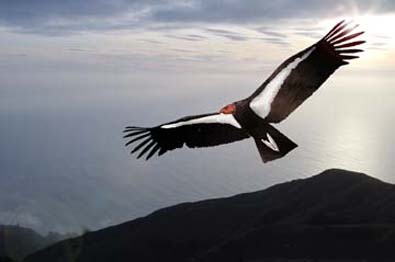
The North American condor's range was reduced to coastal California for reasons that had nothing to do with modern man.


A healthy email discussion yesterday about condors, lead shot and bullets, and the strengths, limits and pitfalls of environmental advocacy reminded me of an older post, appended below, from April of 2005, in which I suggest some caution is needed before the world swallows the extinction hyterics of some environmentalists (such as entomologist E.O. Wilson) who like to proclaim that we are now in the "era of mass extinctions."

I suggest one can be very concerned about extinction (I am), without tossing science and data overboard or engaging in out-and-out distortions about the data. Truth and data are not lesser values, and should not be abandoned by advocates looking to score cheap debating points.

In the case of condors, I am for doing whatever it is we can to ensure their survival and increase their numbers, including baning lead shot and bullets, if necessary (background article here on this controversy).

Having said that, let's acknowledge that this is a bird that was on the decline long before there were guns anywhere in the world.

During the time of mammoths, some 15,000 years ago, there were condors all over North America, but as the herds of these and other giant pre-Columbian animals declined and then slid into extinction, the condor's range was reduced to a narrow part of California (hence the name California Condor).

What few folks are willing to talk about, in a frank and unsentimental kind of way, is that the era of the condor was closing long before the Santa Maria left Spain. The reason for this is not too hard to explain: The condor is a huge, poorly conceived, "line of sight" meat scavenger. It was too specialized to make it.

And yes, God does make mistakes (the Whooping Crane, for example, is simply an "Edsel" Sandhill Crane) and He has plenty of "discontinued models". It is neither sacrilegious to say this, nor bad science: It is plain truth.

Not only is a condor a huge animal (a 9-foot 6-inch wingspan) that requires a lot of meat to keep it in the air, but it is also an animal that cannot kill that meat itself. The feet of a condor are closer in structure to those of a chicken than those of a hawk or eagle -- it cannot lift a rabbit, much less a lamb.

Unlike the turkey vulture, whose population numbers are huge and rising, the California Condor cannot smell rotting flesh from miles away. It is a pure line-of-sight scavenger. What this means is that if a condor does not see a large pile of dead flesh every couple of days for its entire life, it is going to die of starvation. The condor may have survived in coastal California only because of dead whales and seals washing up along the coast -- an easy-to-patrol carrion line.

Another factor in the demise of the condor, even before man showed up, is that it is a very poor and slow breeder, laying only one egg every other year, and not breeding at all until the age of 6 or 7. This is a bird that does not build a nest -- it needs caves and cliff ledges which, as a general rule, are in short supply.

Put it all together, and you have a very maladaptive kind of animal -- an animal whose internal biological problems were, and are, so serious that its range and numbers were shrinking long before the gun, the powerline, or DDT. Which is not to say guns, powerlines and DDT did not push things over the edge. They most assuredly did. Sadly, things on the edge are a little too easily tipped over in this over-fast, too-crowed and intensely-machined modern world.

In the end, the last pair of wild condors were caught and put in a captive breeding program with 20 others back in 1987. Since then, I am happy to report, the population of condors has grown from 22 to about 280, and there are now about 140 condors in the wild, and another 140 birds in captive breeding.

In addition to restocking condors in the shrinking wilds of California, where powerlines and windmills remain a very serious problem, the California Condor has also been restocked in Arizona.

All of this is good news, and it is about as good as it is ever going to get. There will never be large numbers of condors in America because this an animal adapted for a pre-Ice Age era that no longer exists. That said, poisoning from lead (the isotopes from shells has been traced into the dead birds themselves) has killed a large number of the condors released into the wild. If paying a few more dollars for shells will help reverse that phenomenon (while also spurring shel and bulletmakers to do more to develop new composite-type loads), I am all for that.


_ _ _ _ _ _ _ _ _ _ _ _ _ _ _ _ _ _ _ _ _ _ _ _ _ _ _ _ _ _ _ _
Reposted from the April 29, 2005 edition of this blog.
_ _ _ _ _ _ _ _ _ _ _ _ _ _ _ _ _ _ _ _ _ _ _ _ _ _ _ _ _ _ _ _

Thinking About Species Lost

The rediscovery of the Ivory-billed woodpecker in the hardwood swamps of Arkansas reminds me of how much we hear about wildlife species loss, but how rarely such species loss is quantified, defined, or given proper causation.

Whenever I hear about species loss, I naturally ask five key questions --and I often find the answers surprising.


1. Do the animals exist at all?

This may sound like an odd question, but it's a pretty important one because a lot of what is written about species extinction is totally unsupported by observed data.

Here's the scoop: Over the course of the last 400 years, only about 820 species of vascular plants and vertebrate animals are listed as having gone extinct by the IUCN Red List. In addition, the IUCN reports several species being "rediscovered" every year after having previously listed them as "lost".

Though the IUCN cannot report on what has not been discovered, we have clearly discovered most of the mammals, birds, fish, snakes, frogs, shrubs, vines, grasses and trees in the world. While new species of wildlife are being discovered every day, there is no evidence to support the notion that even 50 vertebrates and vascular plants are going extinct every year, much less the 20,000 number commonly cited (invertebrates and fungi are very difficult to push into extinction as any farmer can tell you).

As odd as it may sound, even physical evidence of the existence of a species does not necessarily mean that this species has ever existed. Here, I am specifically talking about birds, where it turns out some "extinct" species are based on single skins collected in the 19th or early 20th Century. The cone-billed tanager is a good example (to read more about the hunt for this "extinct species" read "The Ghost With Trembling Wings" by Scott Weidensaul).

The problem with birds is that they hybridize a lot, and bird species are not always very distinct from each other. Along with the cone-billed tanager, for example, there are several species of hummingbirds that we know of only due to single examples collected for the millenary trade. These
so-called "Bogotá Skins" (for their central shipping point out of South America to Europe) may in fact represent evidence of a new species of now extinct hummingbirds -- or they could simply represent hybrids of other hummingbirds. With about 10 percent of all bird species known to cross the "species barrier," it's hard to know.


2. Is the animal being described really a species?

In fact a lot of stories about species decline are NOT about the decline of a species, but about the decline of a SUB-species in a very specific area.

A sub-species is, by definition, NOT a species. In fact most subspecies are nothing more than slightly different colored animals that exhibit no other behavior differences and that freely breed with populations of other animals in their species (animals whose populations may in fact be quite large and growing).

Sub-species are an interesting thing. I have always found it ironic that many environmentalists place little value on the prolific creation of thousands of new subspecies of apples, potatoes, pigs, cattle, and chickens, but assign tremendous value to subspecies of cougars, lions and pronghorns (to give just three examples). In fact, mmany sub-species of wild animals are little more than political artifices designed to boost the careers or egos of the people naming them.

In some cases there is another less vanity-centered reason to name a subspecies -- you can "up list" an animal (and its habitat) for protection by simply singling it out. The Sonoran pronghorn appears to be an example -- an animal made "rare" despite the fact it appears to be little more than a light-colored variant of an animal that actually numbers in the million.


3. Was the species ever very common?

Some threatened and endangered species are animals that were always rare and not very successful to begin with. Take the Whooping Crane, for example. DNA analysis suggests Whoopers never numbered more than about 5,000 individuals. The 1850 population of the bird (when most of the American West was still unsettled and very wild) is estimated to have been just 1,500 individuals. There are now 500 Whoopers in the world, with about 350 of them in the wild. I am very glad the Whooper was pulled back from the edge of extinction, but the fact that the bird was never common or genetically successful is not an inconsequential part of its story (though it is rarely told).

The Florida Manatee is another animal that was probably never terribly common. The Manatee population of Florida before there were outboard motors is estimated to have been around 10,000 or so. By the 1980s, the manatee population had declined to about 800, but it has since risen to over 3,000.

Again, bringing the American manatee (Trichechus manatus) back from extirpation in the U.S. is excellent, but we should not expect the population to ever get really huge. Note that the American manatee also exists in many other Caribbean countries south to Brazil, but it is a rare animal there due to hunting by indigenous people .


4. What is the population of the species now?

I am always interested in both the percent decline or increase in a species and the total number of individuals that exist (and existed). For example, if I am told that 97% of all pronghorn antelope are gone, I am shocked. But if I am told that this 3 percent totals 1 million animals, I begin to feel a
little better. I begin to feel pretty good when I know that in Wyoming the pronghorn population is estimated to equal the human population of the states, and even better when I learn that the human population of Wyoming is actually declining.

The point here is that numbers are only meaningful within context. Do I wish there were more pronghorn in America? Sure! But one million pronghorn -- up from just 13,000 individuals at the Turn of the 20th Century -- is pretty good news and one we should be celebrating!


5. What has really caused the decline (or increase) of this species?

The death of any species is important, but I also want to know the circumstances of the decline or extinction. I consider the loss of the Passenger Pigeon and the Eskimo Curlew (there were once millions of these birds flying over vast areas of this continent) a much more significant tale than the loss of a species of flightless rail on a small island in the Pacific. One extinction signals the total loss of a once very common species that was successful over a very large area. The other signals the total loss of a very rare species that was NOT successful over a very large area. There are very different lessons to be learned from these very different stories.

Most people are surprised to learn that most extinctions are of the latter type (fairly unsuccessful species in very isolated locations) and not the former (fairly successul species in fairly common locations). They are further amazed to discover that habitat loss is a much rarer cause of species extinction than the introduction of rats, cats, goats and pigs -- or of indiscriminate hunting. If you go through the IUCN Redlist of extinct species, for example, you find zeros for most countries (no known endemic species pushed into extinction), but incredible numbers of extinctions for such tiny islands as Mauritius (41 extinct species), Réunion (16 extinct species), Saint Helena (29 extinct species), French Polynesia (67 extinct species), and the Cook Islands (15 extinct species). In fact, these little spots of land, along with Hawaii, account for about 200 of the 812 species pushed into extinction over the course of the last 400 years.

Is the loss of an "unsuccessful species" a bad thing? I think so. But it may not be quite as horrible or as unprecedented as it is commonly made out to be. In fact it may be part of the order of things. After all, instead of a living at a time when there is a "biodiversity bottleneck," as some texts would have you believe, we are actually living at a time of incredible genetic diverity. As the folks at the World Resources Institute note, "Global biological diversity is now close to its all time high. Floral diversity, for example, reached its highest level ever several tens of thousands of years ago. Similarly, the diversity of marine fauna has risen to a peak in the last few million years." In short, we live in a very bio-diverse time, and with diversity will come a lot of failure which is every bit as much a part of Darwin's evolutionary equation as success (if not more so).

It's also worth remembering that even as we are losing species, we are also gaining them -- new types of chickens, pigs, apples, corn, and trees. New hybrids of canaries, geese, ducks, pigeons, cattle, horses, falcons, eagles, dogs and cats. And we are doing it with wild birds too.

The last time I flipped through a Sibley's Audubon guide to birds, I counted one extinct species of parrot (the Carolina parakeet), but 27 new species of introduced parrots that are found in wild flocks in the U.S. (65 species have been encountered in Florida alone). In California and Florida these wild-flocking parrots are already creating new hybrids. Wild parrot colonies are not just found in warm climates by the way -- they are found near my home in suburban Virginia, and in downtown parks in Seattle and Chicago. One hundred and fifty years from now my great grandchildren may find hybridized variations of these same birds listed as entirely new "American" species of parrots (the Sibley guide already notes the presence of many Amazon hybrids in Florida and California).

Food for thought.

Wednesday, November 29, 2006

Whippet Good


Matt Mullenix and Rina the Whippet, with Rina's first brace of rabbits. The title to this post was stolen from an email from Matt -- a reference to an old Devo song.


One of the unplanned benefits of this blog is that I have met, online, some pretty cool people who, though they may hunt differently than I do, share the same three- and four-species trials, tribulations and thrills of making it all work in the field while hunting.

Along with the folks that hunt with ferrets are the long-doggers and, perhaps most interesting of all, the hawkers and falconers. This last group is, without a doubt, the most literate group of complex-primitive hunters.

The picture, above, is of Matthew Mullenix and his young whippet Rina. There was a hawk in this hunt, of course, but as Matt explains it (quoting Gregg Barrow, another online friend), "The first season belongs to the dog," and these rabbits are purely Rina's.

The first season, of course, refers to the dog's first season -- not the hawk's or the human's. Matt's well-written and insightful journal this season is more about Rina the whippet (at least so far) than his veteran hawk Smash.

It was on Matt's blog that I learned that his old bird, Charlie, is now in stud at the Coulson's down in Louisiana (Tom and Jennifer Coulson are Harris Hawk breeders, fliers and mentors par excellence) and that Charlie had sired the new Harris Hawk that digger and hawker Teddy Moritz is now flying in New Jersey. A small universe, eh? Teddy's new hawk nailed its first bunny back in mid-October -- a development I learned on Matt's blog.

Matt took a long hawking swing around America recently. To read a little about his visit at Steve Bodio's, see the Querencia blog where he and Reid Farmer also blog with Steve.

Steve Bodio and Reid Farmer are another pair of interesting writers I stumbled upon due to this blog -- the kind of people who write about Turkish pigeons (No Dear, not Turkish prisons, Turkish pigeons), and the commonalities found among petroglyphs across the world. Three voices and three interests make for a rich gumbo at Querencia -- with occassional dashes of good stuff from other bloggers, naturalists, hawkers and doggers to spice it all up.

OK, back to dogs -- specifically hawking dogs.

I observe that a very rich and diverse variety of canines are found in the hawking world, and that the choice of dog may have less to do with the hawk than with the countryside being hawked and the collateral game than can be had in non-hawking seasons.

Teddy Mortiz, for example, hawks under a small pack of long-coated miniature dachshunds -- dogs that are useful for busting rabbits out of the tight thick stands of multiflora rose that are found in the East, but which also do double dirt dog duty on groundhog, fox, raccoon and possum.

Steven Bodio, who lives on one of the high flat stretches of upland New Mexico, has a love affair with the type of Turkish long-dog know as a Tazi -- a function of the jack rabbits, coyotes, and vast open spaces he has in his neck of the woods.

Hawker Rebecca O'Connor recently acquired a nice red Brittany. Her first Brittany was so well acclimated it licked the Falcon on the face and the bird actually tolerated it. A small all-pupose bird dog, Brittany's do well in a wide variety of cover -- a good all-rounder for California.

In other parts of the country, Jack Russells and beagles are popular for busting bunnies out of brush, while down in Louisiana, Matt has a fondness for whippets which are good warm-weather dogs for swamp rabbits and cotton rats as well as for busting birds out of tall tropical grasses.

For more on the subject, see >> Rabbit Hawker's Dogs.


A young male Harris Hawk and a longhaired dachshund named Fitz (as in Fitz-in-dens) which has an 11 inch inch chest, both owned and hunted by Teddy Moritz. The young tiercel Harris has been doing the business on eastern cotton tails.

Sunday, September 04, 2005

Watched in the Hedgerow


Sailor gets her groundhog. This one lost its tail in the scuffle.

The dogs and I had a friendly watcher at the first dig of the day -- a hawk flew in to see if we might be scaring up a few mice as well as a whatever else we were doing.

This sette was right at the base of this tree, so the hawk was straight above us. My camera does not have a telephoto (only good for close snaps), but you can see the hawk on the branch to the right of the trunk, below -- a Redtail.

Monday, April 04, 2005

Return of the Bald Eagle


Bald Eagles near Wilson Bridge, Washington, D.C.

An article in today's paper notes that Bald Eagles in Homer, Alaska are known to attack white cats and small white dogs, such as Jack Russell's. Apparently, the eagles, which flock in large numbers on the outskirts of the town due to a nearby fish canning operation, think anything small and white and running around must be a rabbit and assume it is fair game.

Closer to home, it turns out that Rosalie Island, a small man-made spit of land at one end of Wilson Bridge outside of Washington, D.C is one of the best places in the lower-48 to spot Bald Eagles.

The reason for this appears to be the profuse amount of fish in the river, drawn to this particular spot by algae blooms and "nutrients" pumped into the river from the nearby Blue Plains Wastewater Treatment Plant. Despite the 200,000 cars that pass by the bridge daily, somewhere between 12 and 20 Bald Eagles call the Maryland side of the bridge home.

Bald Eagles have made a spectacular return in the last 30 years, and there are now more than 7,000 nesting pairs in the lower-48, with an additional 25,000 nesting pairs in Alaska, and even more in Canada.

Though DDT is often blamed as the sole cause of Bald Eagle decline, the truth is that the birds were nearly wiped out by shooting and leghold traps mounted on poles for "chicken hawks".

DDT did not arrive on the scene until after World War II, and was banned by 1972. Yet, a close look at the National Audubon Society's own Christmas Bird Count data shows that Bald Eagles were very rare as far back as 1900, and that their number rose (albeit slowly) during the years DDT was being sprayed in the U.S. The same is true for Osprey -- another bird hard to misidentify, but which was decimated both by shooting and by pole-net fishing weirs. It turns out that the decline of Ospreys had more to do with the large birds breaking their necks stooping on fish caught in pole-mounted weirs than it did with the rise of DDT.

This is not to say the DDT had no effect on bird populations (it most certainly did), simply that it was not the determinant variable in the decline (or rise) in Bald Eagle, Osprey, Peregrine Falcon and Golden Eagle populations, as is commonly believed (and reported by organizations such as Audubon).

Thursday, January 20, 2005

Winter Hawks & Chicken Hawks


It's inaugeration day, with snow on the ground, and therefore a perfectly good day to write about Chicken Hawks and winter hawks.


Five species of common hawks are commonly found across Virginia and Maryland, and recognition can generally be done at a distance based on size and habitat. In addition to the five hawks listed below, we have Ospreys (sea hawks or sea eagles), Bald Eagles, two kinds of vultures (aka "buzzards"), various types of owls and occasional stray migrants from the north.

8 Red-tailed Hawks are the hawks you are most likely to see when out with the dogs, as they are present all winter long, and are large birds commonly found in areas where we hunt our dogs.

The Red-tail Hawk is sometimes called a "chicken hawk" and is commonly seen along roadsides.

Redtail populations have increased in the past few decades, largely due to the increased acres of open land that is in short grass due to tripple hay harvests, and the increasing numbers of small woods that break up farm country.

Red-tails primarily feed on mice, rats and voles, but will also eat snakes and frogs if they can catch them. Small birds make up a significant portion of their diet. Young rabbits are taken in the spring, but adult cotton tails are a bit large for this hawk and they tend to feed a little close to cover for this hawk to depend on them as a food source.

The Red-tail does most of its hunting from a perch overlooking areas of short vegetation, and they are a common sight at the edge of small woods bordering fields and roadways, and commonly hunt powerline corridors.


8The Red-shouldered hawk is slightly smaller and darker than the Red-tail, and is more likely to be found in low-lying marshy areas. It too eats mostly mice, rats and voles, but also takes many frogs, small birds and even insects. If you see a hawk in a marshy forested area, rather than next to a large open field, it is probably a Red-shouldered hawk.

8 The Cooper's Hawk has shorter and more rounded wings, and a longer tail which allows it to be extremely quick and agile in flight. Cooper's Hawk generally hunts on the wing, and the majority of its prey are small birds taken in flight. If you have a hawk poaching birds at a feeder, it is probably a Cooper's Hawk or a Sharp-shinned Hawk (see below). Most Cooper's Hawks will migrate South for the winter, but occassionally one or two will stay around all winter.

8 The Sharp-shinned Hawk is very much like a small Cooper's Hawk, with short wings and a longer tail. Sharp-shins also feed on small birds, but are more likely to be found in hedgerows, wooded strips and fields where they nail birds moving from cover areas to feeding areas. If you see a small hawk (much smaller than a Red-tail) working a hedgerow, it is probably a Shap-shin. Sharp-shins are also very common predators at bird feeders. Sharp-shins migrate South for the winter.

8 The Sparrow Hawk, or American Kestrel, is a very small hawk about the size of a mourning dove. They can be seen on telephone lines and perched on fence posts, especially in winter. If you see a very small hawk hovering over a roadside ditch looking for a grasshopper or small mouse, it is a Sparrow Hawk. Unlike the other hawks, which open nests in crotches of trees, the Sparrow Hawk, or Kestrel, nests in cavities. >> Click here to build a kestrel nesting box.
.

Wednesday, October 06, 2004

A Hawking & Dirt Dog Combination


Teddy Moritz with miniture dachshund, Harris Hawk and seven nice cotton tales -- a good day in the field!

The miniature dachshund is an undervalued dog in the field, where its keen nose, small size, booming voice and ability to stay out of serious trouble make it invaluable when hunting week in and week out.
Lancaster News, Lancaster, Pennsylvania, February 17, 2002
Miniature hounds do a big job in the field

By: John McGonigle

__________________

Teddy Moritz of Rockaway, N.J., is a real piece of work. I mean hard-core. And I mean it in the best possible way.

No Janie come lately, Moritz has been involved with falconry since 1966.

Married, with grown children, Moritz quit her various naturalist and Fish and Wildlife agency positions because work was interfering with her hunting.

"My husband is a saint," Moritz said of her active hunting schedule.

As if hawks are not enough work, Moritz became involved with miniature longhair dachshunds in 1976.

"Only the hunting kind," Moritz said quickly. "All my dogs have Field Champion titles and American Working Terrier Association Natural Hunting certificates."

While it is evident that her dog's titles and certificates are important, Moritz said pointedly, "The dogs have to satisfy my criteria."

Which, by watching the way her dogs work, appear high.

Moritz is also an American Kennel Club judge for field trials and earth-dog trials. Earth dogs are terriers and other dogs bred to enter underground dens, or burrows, to oust concealed wildlife.

Moritz's hunting clothes reveal a lot about her. The colors are muted, well worn and
tough.

She is soft-spoken in the field, as hunters should be. She has no false modesty and speaks highly of her dogs while they ably demonstrate the good qualities she conveys. Moritz is resolute and confident as she follows her small hounds with her Harris hawk. The day's events affirm her confidence.

The miniature longhair dachshunds Moritz breeds, trains and hunts are genuine, realistic hunting dogs. Though I generally have no use for very small dogs, these 7-to-10-pounders opened my eyes. I would guess their legs at six inches, maximum, but they move them, and keep moving them. They have a lot of heart.

Don't misunderstand me; these miniatures are not fast. But they are fast enough to push a rabbit from the brush, keep on its tail and keep it moving. That is all that is needed for either falconry or regular rabbit hunting.

While following Moritz's miniature hounds (remember, they weigh 7-10 pounds each) near an apartment complex, we rounded a corner of a woodlot and saw three boys, probably about fourth graders, running for their collective lives with about five miniature longhair dachshunds chasing them.
Moritz called her dogs and they broke off the chase, not that their little legs could ever catch the youngsters. It was the funniest thing I have ever seen while hunting.

The youngsters approached us, cautiously at first, to see the small dogs and found them not only harmless, but also lovable. We added three more (little) brush beaters to the group.

Moritz's hounds were black and tan, colored and marked very similarly to a Gordon setter. The dogs are cute little things and are definitely functional hunters.

Teddy Moritz and her miniature hounds added a great deal to our falconry experience. They made an already great day better.

Sunday, August 29, 2004

Extreme Fox Hunting


This is a picture of the Golden Eagle Festival & Competition in Mongolia. The competitors gather on the mountain tops that rise over the plains.

Below, a rider drags the body of a dead fox skin, imitating the movements of a living animal - a perfect lure for the eagle perched on the nearby summit. When the eagle's owner lifts the hood, the eagle's task is to set off in search of it's (false) prey on the ground.

The bird's are judged on their rapidity and prowess, and the trainers on their artistry skills. Hesitancy, slow responses and heads that turn in the opposite direction disqualify the feathered competitors.

The competition mimics what still occurs in the field in Mongolia -- the hunting of red fox with Golden Eagles.