Saturday, September 30, 2017

Moxie Pulls a Dead Groundhog


The dog does not do the killing if it needs to be done. The dog locates, bays, forces a bolt, and prevents the animal from digging away. 

In this house, fox are always released, and most other animals are too. In those cases where the farmer wants a groundhog gone, dispatch is done quickly with a blow to the head.  In this the blow came from a 5-pound digging bar. A hard blow to the head is immediate death, and there is no chance of accidentally shooting a dog.

Show Vs Working Lines: Dachshund


A show-line longhaired miniature dachshund, versus two working longhaired dachshunds owned by falconer and dirt-dog digger Teddy Moritz.  Note the difference not only in leg length and coat length and thickness, but also in the feet.  Another of Teddy's dachshunds is pictured, below.


Field Flowers

\

Friday, September 29, 2017

Squad Goals

Puerto Rico's Stray Dog Packs Killed by Hurricane


The dogs of “Dead Dog Beach” in Puerto Rico are no more. The location -- famous as a dumping ground for abused and abandoned dogs -- was home to packs of feral dogs, some of which were rescued by the "Sato Project" and flown to the mainland US for adoption.  Word has it that the beach and surrounding areas was destroyed and that the dogs were swept out to sea, drowned, and smashed.

The Great John McPhee


Who do I recommend as I writer?

I always recommend John McPhee. Same recommendation for 40 years.

The New York Times Magazine has a profile of Mr. McPhee which hints at why:

McPhee has built a career on such small detonations of knowledge. His mind is pure curiosity: It aspires to flow into every last corner of the world, especially the places most of us overlook. Literature has always sought transcendence in purportedly trivial subjects — “a world in a grain of sand,” as Blake put it — but few have ever pushed the impulse further than McPhee. He once wrote an entire book about oranges, called, simply, “Oranges” — the literary cousin of Duchamp’s urinal mounted in an art museum. In 1999, McPhee won a Pulitzer Prize for his 700-page geology collection, “Annals of the Former World,” which explains for the general reader how all of North America came to exist. (“At any location on earth, as the rock record goes down into time and out into earlier geographies it touches upon tens of hundreds of stories, wherein the face of the earth often changed, changed utterly, and changed again, like the face of a crackling fire.”) He has now published 30 books, all of which are still in print — a series of idiosyncratic tributes to the world that, in aggregate, form a world unto themselves.

McPhee is a structuralist as all good writers are, in my opinion.

Much of the struggle, for McPhee, has to do with structure. “Structure has preoccupied me in every project,” he writes, which is as true as saying that Ahab, on his nautical adventures, was preoccupied by a certain whale. McPhee is obsessed with structure. He sweats and frets over the arrangement of a composition before he can begin writing. He seems to pour a whole novel’s worth of creative energy just into settling which bits will follow which other bits.

The payoff of that labor is enormous. Structure, in McPhee’s writing, carries as much meaning as the words themselves. What a more ordinary writer might say directly, McPhee will express through the white space between chapters or an odd juxtaposition of sentences. It is like Morse code: a message communicated by gaps.

I have a fair number of books in my study
, but one shelf is reserved for the greats: Hemingway's Green Hills of Africa, several works by Faulkner, Eugene O'Neill's best plays, several books of lesser quality that were deeply influential to me from my childhood (Swiss Family Robinson) to my young adulthood (Black Like Me). And there is a section for the best of McPhee: Encounters with the Archdruid, The Curve of Binding Energy, Pieces of the Frame.  I have not yet read Draft No. 4. I clearly need to.

Theory Vs. Practice in the World of Dogs


Show line black lab at top.

Working lab at bottom.

In theory, in the world of dogs theory and practice are the same, but in practice, they are not.

The Owl Was the Killer?


From Audubon magazine:

The 15-year-old legal proceedings against author Michael Peterson for the alleged murder of his wife, Kathleen, constitute one of the more notorious and extensively documented criminal cases of our time. It has provided fodder for two Dateline segments, a Lifetime movie, an expansive documentary film series, and dozens of true-crime television episodes and podcasts. It is lurid, tinged with drugs and alcohol, replete with an ongoing extramarital affair with a prostitute, and soaked in blood—lots of blood. It also spawned a criminal defense theory that sounds like a punch line: The owl did it.

But it’s not a joke. And even though the "Owl Theory," which states that a Barred Owl is responsible for the chain of events that led to Kathleen Peterson's eventual demise, hasn't made it to trial yet, depending what happens next in the case, there's a slight chance it could still be presented....

... Kathleen Peterson's autopsy revealed seven lacerations, including very deep ones in the back of her scalp, and pine needles stuck to one of her hands, which both held clumps of her own hair.

If it weren’t for this misstep by the prosecution, the case might have gone in a wildly different direction—blame the owl. But how exactly could an owl be responsible for the death of Kathleen Peterson? The Owl Theory essentially posits that a Barred Owl attacked Peterson, got entangled in her hair, and inflicted serious injuries, including the removal of part of her scalp, which triggered a series of events that led to her death after falling down a flight of stairs. The theory first came to light in late 2009, after attorney Larry Pollard, a friend and neighbor of Peterson’s, took a fresh look at the evidence. Her autopsy revealed seven lacerations, including very deep ones in the back of her scalp, and pine needles stuck to one of her hands, which both held clumps of her own hair. As Pollard discovered, the strands in the victim’s left hand contained three small feathers. Also, as Pollard and several ornithological experts noted, the pattern and shape of the cuts on Kathleen Peterson’s head suggest a weapon quite unlike a fireplace tool. If the culprit was an intruder, the finger points to the Barred Owl, a common species in and around Durham.

“When you look at her injuries, they do appear consistent with being made by an owl’s talons,” Peterson’s defense attorney Mary Jude Darrow tells Audubon.....

After delving into the evidence, Davis was convinced that an owl had attacked Kathleen Peterson, setting into motion the events that would lead to her death at the bottom of the stairs. She based her decision on the shape and placement of the victim’s wounds (a match to how the owl's talons would strike), the timing of the attack (in December, when owls are mating and highly territorial), the presence of the tiny feather (owl feet are covered with them), and the force of the impact. A 2014 study published in the Journal of Experimental Biology notes that an owl weighing less than a pound can pounce on a mouse with force equivalent to 150 times the weight of the rodent. If a 175-pound human were struck with the same intensity, it would feel like being hit by a 13-ton truck.

An owl strike can definitely cause blunt force trauma.

Mrs. Peterson weighed 120 pounds and the suspect bird in the Owl Theory, an adult Barred Owl, weighs between one and two-and-a-half pounds and can fly at speeds of up to 40 miles an hour. Of course, the truck analogy is outside the limits of a raptor’s power, but the point is clear: An owl strike can definitely cause blunt force trauma. What's more, the raptors are known to dive-bomb humans when they feel threatened, almost always targeting the head. For example, in 2015, there were repeated Barred Owl attacks on joggers in a park in Salem, Oregon. The victims of those strikes, which earned the bird(s) the name “Owlcapone,” suffered from multiple half-inch talon cuts.

Davis also points out that the victim would have been taken by surprise because the shape of an owl’s feathers—serrated on one side to cut through the air, and fringed along the other edge—make it silent in flight.

In a 25-minute interview with Raleigh news station WRAL in March, Pollard laid out the Owl Theory in great detail. “The other wounds that are on her body seem to give a compelling case to this having been done by an owl,” he said. “The injuries to the eyes, and the injuries to the elbows, and the little pock marks on her wrists, here and here, all are consistent with her having her hands over her head, holding onto her hair, because something is grasping that hair.”

Pollard’s timeline shows that Kathleen Peterson had been drinking wine with her husband by the backyard pool at night, and then headed through the house and into the front yard for reasons unknown. (Toxicology reports also found anti-anxiety and muscle-relaxant medication in her blood.) That’s where the raptor attacked. Peterson was out of earshot while his wife fought off the bird. The victim then walked into the house; blood was found on the front steps and smeared on the inside of the door. After all of this, while buzzed on wine and pills, she climbed the stairs, presumably en route to the master bedroom. But when she reached the last step, she fell backwards and tumbled to the bottom of the staircase. A crime scene photo shows her with her neck bent severely to the left, her head resting on the bottom stair, and her body splayed on the floor in a massive pool of blood.

If Peterson’s team succeeds in having the case dismissed on Monday, the sordid tale will end, and the Owl Theory will remain just that—a theory. Either way, Davis remains convinced that it is true.

“The owl didn’t kill Kathleen Peterson,” Davis says. “The owl just knocked her in the head. She would have been fine if she’d gone up and crawled into bed and slept it off.”

Fish on Friday

Thursday, September 28, 2017

Show Line vs Work: The Irish Setter


At top is an American "Show Line" Irish Setter. In the middle is a UK "Show Line" Irish Setter (this dog is from Northern Irish lines). At bottom is an American Working Line Irish Setter.

One of these dogs can actually get through the brush.  The other two are dog for frustrated hair dressers who have not yet worked out their barbie issues.

Dirt Dog


He's ready to come home now.

Coffee and Provocation


RIP Hugh Hefner
Along with ripping the wrapping off the idea that humans are sexual beasts, Hugh Hefner, who died yesterday at age 91, also stood up for the First Amendment, published a lot of good writers who needed the money, and put women in management slots inside his own company. Was Hefner also a sexist pig? Oh sure. Not often mentioned, is that it was Hugh Hefner who gave Dick Gregory the money to find the slain Mississippi Civil Rights workers back in 1964. It only happened because Dick Gregory asked, of course, but Hugh Hefner wrote the check immediately.

The Continuing Crisis
Sexual competition among ducks wreaks havoc on penis size.

How Was Facebook to Know?
The Russians paid Facebook in rubles!

Not Patriots
NASCAR threatens to fire drivers who protest the national anthem while welcoming Confederate flags at races.  Not patriots; racists.

MAGA
The Republican tax plan could cost the country $2.2 trillion in lost revenue over 10 years, according to a new study by a leading conservative group. That a jaw-dropping amount of debt the "fiscal conservatives" want to pass on to you and your children so that the rich and big corporations can get a tax cut, even as it eliminates many middle-class and low-income tax deductions (i.e. this bill will probably raise your taxes).

The Continuing Crisis
The FBI seized over 3,000 human penises during a raid at a morgue employee's home. My own pizzle stick collection was larger, until it was consumed by dogs.  But if it's size you want, see this fellow (totally safe for work).

How to Spot a Russian Troll Bot

Wednesday, September 27, 2017

Bringing in Backyard Fox


Interested in bringing in backyard wildlife for a game camera shots?  It's pretty simple stuff.

First you, will need a decent game camera. There are a lot of makes and models and price ranges, but I like a real white-light picture, and not an infra-red image. I'm also cheap. I have gone through a number of game camera models over the years, but  the current camera is a 14 Megaxpixel Moultrie D-80 White Flash Trail Game Camera.  Place the cameras low -- fox and raccoon are only about a foot off the ground, and a deer is about 30 inches off the ground at center mass.

No matter what they say on the box, I do not recommend leaving any camera out for weeks at a time in the rain.

How do you get fox, raccoon, possum, or deer to show up? You don't need to go to the woods or a farm to see red fox. If you live in an American suburb that has a portion of the yard free of hard fences, you probably have red fox, possum, and raccoon in your yard at night right now, especially if you have bird feeders and a small bit of water in a pan.  Even if you are in a city, if you have a large park nearby, or a wooded creek, you may have fox and raccoon nearby.

Spilled bird seed is eagerly lapped up by fox, raccoons, and possum, and a few handfuls of kibbled dog food, old bread, pizza crust, bacon grease (deer love it!), or hard boiled eggs will attract wildlife in short order.  Cheap women's perfume is supposed to be an especially powerful attractant for fur bearers, though I have never used it.

You do not not need to feed every night; if you only put out a little food every week or two, wildlife will come around every night to see if they got lucky.  Only an occasional "jackpot" is needed to train wildlife to play the "come to my yard" game.

The Red Fox in your neighborhood may be living under decks or inside or under old storage sheds, under old wheelbarrows or canoes forgotten at the back of a property, in dry storm drains, hollow logs, and old groundhog burrows. They will tuck in anywhere it is warm and dry, and often sleep above ground if it's above freezing and not raining hard, curling up tight under dense bushes and brush. Raccoons may den in hollow trees, crawl spaces under houses, and inside attics, as well as find refuge in storm drains and under firewood piles,

Absent your food offerings, red fox live happily on mice and kitchen trash, road kill, garden vegetables, spilled bird seed, bird eggs, snakes, chipmunks, rats, frogs, bugs, earthworms, grass, berries, acorns, and the occasional rabbit, possum or baby bird.

Bake at 400 Degrees for Two Hours

Tuesday, September 26, 2017

Solar Cells and Electric Bikes in DC


Four new bike-share companies arrived in the streets of Washington, D.C. this weekend. One of them features an electric assist bike, and the others are dockless bikes that can take you straight to your destination. The electric bike is also dockless, but it has to be locked to any regular bike stand.

Spin, LimeBike, and Mobike are each launching 400 dockless bikes in D.C., putting them in direct competition with the Capital Bikeshare program which now boasts 3,700 bikes and 440 bike docking stations in the District, Maryland, and Virginia.

LimeBike, Mobike, and Spin bikes can be left at any curb side. The bikes locks themselves electronically with their own on-frame lock, and they have an internal GPS-tracking system to discourage theft and ease location-finding for riders and for maintenance.  Unlocking the frame-mounted lock is as simple as opening the app and pointing the phone’s camera at a QR code mounted on the bike you want to rent.

How's it work?  Well, for starters there is a solar panel in the front basket of each LimeBike and Mobike which charges the internal battery for the GPS and bike lock mechanism.  You pay for the bike rental through a smart phone app which scans the QR code on your bike, same as if you were using a local parking meter. Once you’re done riding, you lock the bike just about anywhere within the right of way (i.e curbside near the street), but not in a park, on the Mall, on private property, or near the Capitol complex.


The cost is only $1 for a 30-minute ride hour.  All of the bikes ask for a credit card, phone number, and access to your location — necessary to pay for your rides and to help you locate the nearest GPS-equipped bike with the help of the phone app.

Because the bikes will track rides and locations, they will be able to provide the city with solid data for smart bicycle infrastructure investments in the future -- a win-win for city residents.

Ending a ride is as simple as sliding the lock’s lever, but you have to be careful where you park. In their user agreements, the companies tell you to leave the bike in an appropriate parking place — such as next to the curb of the sidewalk.  Do not park the bike on the Mall, at the White House or Capitol complexes, in a city park, or on private property or your bike ride will cost you a $100.

A fourth bike-sharing company is also entering the D.C. market with an electric-assist bike.

Jump DC bikes have an electric motor in the front wheel and a battery concealed in the frame. When you pedal, the bike senses your effort and supplements it with a little e-power of its own. While you can pay for Jump DC bikes through a cell phone app, JUMP bikes can also sync with D.C.'s SmarTrip card to let people without smartphones access the bikes.

Unlike the three previously mentioned dockless bikes, which can be left on the edge of any sidewalk, Jump DC bikes must be locked to any regular bike rack with an integrated U-lock that’s held magnetically to the frame. Jump says it will be swapping out the bikes’ batteries every three days, and this maintenance (along with the smoother less-energy ride) means the cost of this bike ride is $2 for 30 minutes.

Coffee and Provocation


Death Wish Coffee
Death Wish Coffee, which claims to make the strongest coffee in the world, is pulling all cans of its 11-ounce Nitro Cold Brew because of the slight risk of botulism.

Roadless Forest Protection Is Protected
I worked on roadless forest protection for a couple of years. When I went to the signing of the bill in 2001 at the National Arboretum, in a snow storm, with Bill Clinton doing the honors (and introduced by Gaylord Nelson) I thought it was secure. Nope. The good news is that this week a Washington, D.C. district court rejected Alaska’s latest attempt to scrap the 16-year-old rule which protects over 50 million acres of wild national forest in 37 states.

The AKC's Reefer Madness
The AKC Canine Health Foundation is funding a clinical trial to study the use of marijuana (aka "cannabidiol") to treat epilepsy in dogs. What the AKC Canine Health Foundation is NOT doing is leading the charge to end the AKC's embrace of closed registries and the inbreeding which actually results in the doubling down of recessive genes that cause epilepsy.

Fordlandia
In 1928, Henry Ford decided to grow his own rubber trees in South America. To that end, he secured 10,000 square kilometers of land in Brazil's Amazon rainforest, and shipped in a team of managers and their families with everything they needed to build a complete American town. "Fordlândia" was an idealized pre-Jazz age midwestern town in the jungle which lasted about 6 years before falling apart. Pictures then, and now, available here.

Firestone and the Warlord Cannibal
Forlandia (see above) was only one massive American rubber plantation. In 1926, the Firestone Tire and Rubber Company opened a massive rubber plantations in Harbel, Liberia, West Africa, spanning more than 1 million acres. Firestone ran the plantation as a country within a country until the outbreak of the First Liberian Civil War in September 1990 when psychopathic rebel leader and cannibal Charles Taylor seized the Harbel plantation. From 1992 to 2003, the plantation was more or less not in operation, but in 2003, at the conclusion of the Second Liberian Civil War, Firestone invested over $100 million in restoring and rebuilding its Liberian facilities.

The Police State Which Ruins Lives
Over 653,000 people were arrested in the US last year for simple marijuana possession despite the fact that marijuana is a substance that is objectively safer than alcohol.

Life Deep Beneath Our Feet
Swedes searching for a nuclear waste storage site stumbled on a pocket of fungus 2,500 feet underground that may reveal a huge hidden reservoir of life deep beneath our feet.

This Fanny Pack Is the Best
Perfect for someone.

Killing Rats Brings Life
The nesting calls of Storm Petrels have been recorded on the Shiant Islands in the Outer Hebrides of Scotland for the first time in decades thanks to an aggressive campaign of rat extermination.

Barbed Wire Telephones
Barbed wire was invented in 1873 in the U.S. and for a time was occasionally used as a rural telephone line, connecting western homesteads together over as many as 20 farms.

This Zebra Is Every One of Us

Monday, September 25, 2017

An Electric Bike for the Field?


DelFast’s says its electric bicycle can be used unassisted for up to 236 miles (378 km) on a single charge, thanks in part to its regenerative braking. Fat tires and tough construction means it can be taken off-road.  Sadly, this is a $2,500 Kickstarter, so it's not around the corner or cheap.

Not Digging on the Dogs


I could barely find the holes in the thick matts of vegetation today, but the wee beasts had less trouble and bolted two. Funny to watch the groundhogs bounce out of the holes and then disappear under the vegetation again. Like fish in the sea.

Family Planning Is Financial Planning


Sunday, September 24, 2017

A Message to Donald Trump


A message to Donald Trump from team sports, team dog, team human race.

Saturday, September 23, 2017

Bayou Blend Blueshit


Blue Buffalo is a scam dog food company that cocks up over-priced dog food for gullible rubes with too much money.

As I have noted, in the past, Blue Buffalo is a howling liar who thinks its consumers are idiots and who ended up paying $32 million for their lies in order to avoid paying even bigger fines.

The latest bit of excrement from this company is "Bayou Blend" which is made of the guts and bones left over from skinned and de-fleshed alligators (farmed or wild) and whatever part of the catfish that is left over after the fillets have been cut out (skin, head, guts, tail, bone).

One of the main ingredients is shrimp meal, which is mixed in with an odd assortment of exotic-sounding but low-cost and mechanically harvested farm produce: sweet potatoes, peas, potatoes, blueberries, cranberries, and carrots.

In short, this is just regular old dog food with an exotic sounding label and a jaw dropping price: $54 for 22 pounds.

The search for exotic-sounding proteins is quite humorous: duck, quail, salmon, turkey, rabbit, goat, tuna, bison, venison, guinea fowl, beaver, kangaroo, and ostrich for example.

These are foods cocked up for people who foolishly buy inbred Kennel Club dog with skin issues.

The funny part is that the dog's skin problems may not even be due to a food allergy; it's that the owner is tossing Febreze and other toxic chemicals from one end of the house to another while not washing the dog once a week with a decent pyretherin-based dog shampoo. You think it's a miracle I've never had a dog with a skin issue? It's not!

Intrigued by the term "shrimp meal," however, I looked that stuff up. My guess is that the supplier is IQI Pet Food which says that:

For North Sea shrimp we go all the way to Morocco. That’s where the shrimps are peeled, and that’s where we came up with the idea of creating this exclusive premium meal. Teaming up with some of the biggest shrimp processors, we’ve managed to turn an otherwise useless product into a valuable claim-ingredient.

I used to live in Tangier, Morocco, and I assure you that "North Sea Shrimp" do not come from Morocco. These are small brown-grey shrimp harvested by Dutch trawlers in the North Sea and sent to Morocco where low-wage sweat-shop workers peel them and the hard shells and stray bit of leg and guts, which are waste, are tossed into a bucket where they are carted off to be dried and (apparently) made into dog food.

No problem here, but don't you love the term "valuable claim-ingredient"? It's not a valuable ingredient. It's a "valuable CLAIM-ingredient".  The value is in the name claim, not the stuff itself.  It sounds so exotic! Consumers of Bayou Blend probably think their dogs are eating Shrimp Scampi rather than "mud bug" legs and shells.

And speaking of bugs, is that the next thing to go into dog food?

I notice that IQI Pet Food says it sells insect meal for pet food.

The benefits of eating insects are multifold. They’re tasty, nutritious and packed with protein. And what’s more, you can grow and harvest the product in a completely controlled environment. By doing so, and by offering you our first self-bred product, IQI takes the lead in product innovation.

Again, no problem here. My dogs dined out for weeks on Brood X cicadas the last time they erupted around here, and they actually gained a pound or two. Food is food, and dogs lick their own butts and eat their own poop. Let's not get too precious about dog food, eh?

That said, if a company will lie to you about another company's dog food, and does not know what is going into its own dog food, and is charging consumers three times more than they should for the privilege, I would consider other options. Blue Buffalo will never have a customer in this house.

Good News About U.S. Dogs


Six Quick Bits:

1. We still love dogs.
There are more dogs in the U.S. than ever before. Americans have far more dogs, per capita, than folks in Latin American, Europe, Africa, or Asia.

2. There is more, and better, dog training information than ever before.
American dogs have more access to better dog training options and information than ever before. Not all dog training advice and methods are equal, of course, but the average cell phone has more information, videos, and local contacts than the largest library just 20 years ago. Your cell phone is also the largest online pet and equipment store in the world.

3. Fewer dogs are being killed in shelters.
Fewer dogs are ending up in shelters or being euthanized today thanks to spay-neuter education, persuasion, subsidies, and laws. Spay neuter laws prevent millions of canine and feline deaths a year, and untold misery.
More dogs are being adopted.

4. More dogs are being adopted from shelters and through rescues.
Dogs from states where dogs are in surplus (the South and Midwest) are now screened, sorted, and sent to areas where there are fewer shelter dogs (cities and suburbs, especially on the coast).

5. American consumers are turning away from the AKC.
Consumers have figured out that "American Kennel Club" dogs are too often diseased, deformed, and dysfunctional, a product of mandatory breeding within a closed registry, and zero show ring points given to health, temperament, or working ability. Many AKC breed standards actually require selection for structural deformity. As a result, AKC registrations have fallen from over 1.5 million dogs a year to about 400,000 -- a decline of 74%.

6. Pet shop puppy sales have fallen to very small numbers.
The trouble here is up-river from the pet shop; commercial breeders ganging up large numbers of dogs, often in small pens with wire bottoms and little socialization, freedom, or exercise. Here breeding bitches are "bred until dead" and their puppies scooped up at the age of 6 to 7 weeks and whisked off to contract middle-men transporters such as Hunte. Here puppies from a dozen locations, and from dozens of litters, are co-mingled before vaccine immunity has reliably kicked in. The result: a predictable number of dogs with parvo, distemper, eye infections, and kennel cough.

Friday, September 22, 2017

Coffee and Provocation


God Spelled Backwards

Dogs are sacred in the Zoroastrian religion.  Other notes on the role of dogs in various religions are at the link.

Dogs Recognize Themselves By Smell, Not Sight
A dog needs a mirror like a fish needs a bicycle.

Naked, Cold and Out of the Clouds
The first men who flew across the English Channel in 1785 landed in France naked.

Reefer Madness
Marijuana is now more popular among teens than tobacco or e-cigarettes.

Sauce for the Goose?
Trump's voter fraud commission members are (wait for it) using private emails to conduct public business.

Snow Leopards
Snow Leopards have moved from endangered to vulnerable, which is a step up.

A Squirrel is Probably More Organized That You Are
Squirrels use a system that organizes stored nuts by size and species.

The Conquistadors Saw a Tower of Human Skulls
Not a myth, apparently.

A Dinosaur Mummy?
The 3,000-pound animal with skin, armor, and even some of its guts intact.

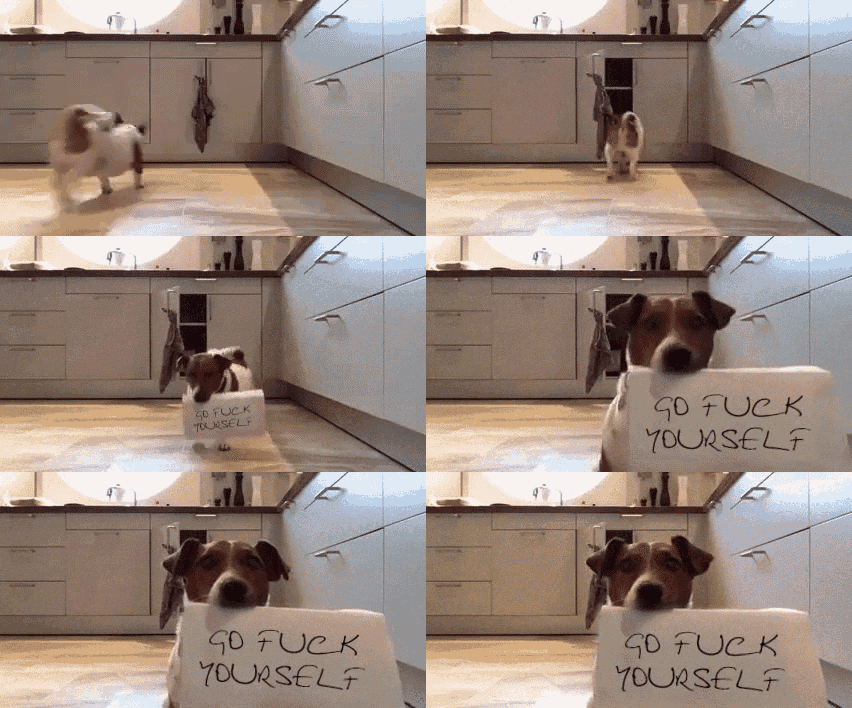
Moxie Slides In


This was made with a couple of shots with the iPhone which are downloaded to Google Photos, which puts them together as a gif file. That file is then loaded up to a server and can be put on blogger or Facebook.

The Countryside March: 15 Years Ago Today


The Countryside Alliance March of September 22, 2002 (15 years ago today) was the largest political protest in British history, but its seeds were sown several hundred years earlier.

The Enclosure Movement which began in 1750 and which lasted for about 100 years, swept much of rural England clean of subsistence agriculture and human settlement. Most large woods were cut down, and the land was repopulated by sheep hemmed in by stone walls and thick hedges.  It has been described, quite accurately, as a "revolution of the rich against the poor."

The idyllic beauty of today's British landscape obscures the grinding suffering that occurred as a direct result of the Enclosure Movement. Every part of the United Kingdom was effected by this "rich man's land grab" including England, Scotland, and Ireland. In England some 6 million acres, or one-quarter of the cultivated acreage, was enclosed by direct act of parliament. Another 4 to 7 million acres are estimated to have been enclosed privately.

With the Enclosure Movement, came restrictions on hunting on lands that had once been part of "the commons." The Game Laws of 1816 limited the hunting of game to landowners: pheasant, partridge, hares and rabbits. The penalty for poaching was "transportation" for 7 years. i.e. you were sent overseas, and if convicted a second time you were never allowed to return.

The Poor Law Amendment Act of 1834 -- An Act for the Amendment and better Administration of the Laws relating to the Poor in England and Wales -- is one of the most significant laws in British history. After the rural poor were forced off of the land that they depended on for survival, this law set up Dickensian work houses designed to dampen down the the social unrest that was was the byproduct of shifting an entire nation from subsistence agriculture to a wool-exporting economy.

Across England hundreds of thousands of people died premature deaths from diseases that flourished in the rat-infested squalor of cities where sewage, water and trash systems were incapable of keeping up with rural-to-urban migration pressures.

Reverend John Russell counted among his most important work the raising of money for the North Devon Infirmary which provided health care to many of the people made poor made by the seizure of lands to form large estates. Ironically, it was on these same large land holdings that the Reverend Russell often hunted.

With the importation of cheap cotton from the United States and cheap wool from Australia and the US, the British wool economy faltered and began to collapse. What was to replace it? A lot of field crops, of course, but also potted bird shoots and mounted hunts. The stone walls and laid hedges proved perfect for jumps, and the rise of trains and improved guns meant that more and more urban rich and idle country squires could take the to the field for entertainment.

One small problem of the Victorian era was that there were not a lot of fox about. Back when there were poor people in the country, free-range chickens and ducks were common, and so fox were trapped and poisoned with abandon. Now, with the countryside cleared of people, there were not enough fox for the mounted hunts. What do do? Why protect fox, of course! And so the mounted hunts worked to pass laws to discourage free-agent fox-culling by farmers. Look up the word "vulpicide" in the Oxford English Dictionary and you will see it is defined as as "One who kills a fox otherwise than by hunting it with hounds."

Even as fox were being protected so they could be chased, the rise of dog shows was creating new dog breeds. A newly emerging middle class in the UK and the United States wanted to bestow status, prestige and exclusivity on themselves. What better way to do that than to invent a breed with a contrived, romantic, and intrepid history? And is there a cheaper breed to raise and produce for sale than a terrier? And so a "terrier craze" swept the show dog world from 1870 to the start of World War II. Most of the terrier breeds we know today were either created or "improved and standardized" at this time.

In 1950 the Myxomatosis virus was imported to the UK to control rabbit numbers, and it resulted in the death of 98% of all rabbits in the country. Fox populations collapsed, and ancient rabbit warrens and fox earths caved in from non-use. In order to provide sheltering dens for what fox remained, and in order to encourage these fox to stay on hunt lands, many new artificial earths were created. These artificial earths are a great deal bigger and easier to negotiate than a natural fox earth, and the availability of larger drains and artificial den pipes led to increased tolerance for larger dogs.

The first push to ban fox hunting in the UK began shortly after World War II.  A few dates:

1949 - Two private member's bills to ban, or restrict, hunting fail to make it onto the statute books. One is withdrawn, the other is defeated on its second reading in the Commons. The Labour government appoints a committee of inquiry to investigate all forms of hunting. The committee concludes: "Fox hunting makes a very important contribution to the control of foxes, and involves less cruelty than most other methods of controlling them. It should therefore be allowed to continue."

1970 - The House of Commons votes for legislation to ban hare coursing. However, the bill runs out of time when the general election is called.

1992 - A private member's bill to make hunting with dogs illegal is rejected by the Commons. The Wild Mammals (Protection) Bill, proposed by Labour MP Kevin McNamara, is defeated on its second reading.

1993 - Labour MP and animal rights campaigner Tony Banks fails in his attempt to get Parliament to pass his Fox Hunting (Abolition) Bill.

1995 - Labour MP John McFall is unsuccessful with his private member's bill to ban hunting with hounds. The Wild Mammals (Protection) Bill passes its second reading in the Commons. But it is heavily amended before it falls in the Lords.

May 1997 - The Labour Party wins the general election. In its manifesto it promises: "We will ensure greater protection for wildlife. We have advocated new measures to promote animal welfare, including a free vote in Parliament on whether hunting with hounds should be banned."
November 5, 1997 - Labour MP Michael Foster publishes a private member's bill to ban hunting with dogs. The government delivers a blow to the chances of the bill becoming law by refusing to grant the legislation any of its Parliamentary time.

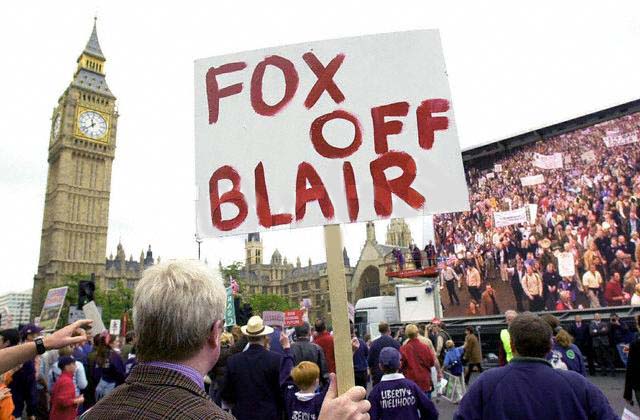
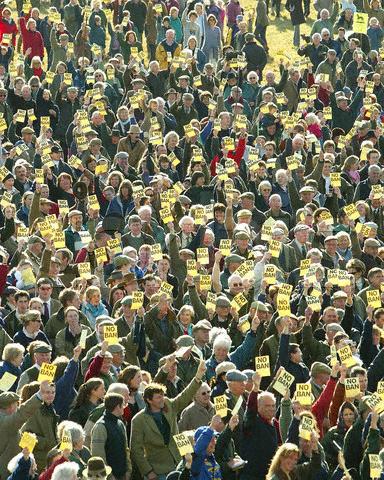
March 1, 1998 - After the Foster bill passes its second reading in the Commons, the pro-hunting Countryside Alliance organises a massive protest rally in London. An estimated 250,000 people join the countryside march to protest against the bill and threats to other aspects of rural life.

March 13, 1998 - Hunt supporters celebrate as the Foster bill runs out of time during its report stage in the Commons. The bill is talked out by hunt-supporting MPs who table hundreds of amendments to block the legislation's progress. Mr Foster pledges to fight on.

July 3, 1998 - Mr Foster withdraws his bill citing the "cynical tactics" of his opponents. He insists that to carry on would deprive other valuable legislation, such as a law on puppy farms, of valuable Parliamentary time. He predicts that fox hunting will still be banned during this Parliament. But he says it is now up to the government to see the job through.

July 8, 1999 - Prime Minister Tony Blair makes a surprise announcement that he plans to make fox hunting illegal and before the next general election if possible.

July 12, 1999 - Labour denies that Mr Blair's pledge is connected to an extra £100,000 donation it had received from an anti-hunt pressure group. The Political Animal Lobby (PAL), had previously given £1m to the party before the 1997 election. PAL had also made donations to the Tories and the Liberal Democrats.

July 12, 1999 - Labour MSP Mike Watson announces plans to put forward a private member's bill in the Scottish Parliament to ban hunting with dogs in Scotland. He predicts the bill could come into force by Spring 2000.

September 15, 1999 - Hunt supporters set up a national body, the Independent Supervisory for Hunting, to ensure hunting is carried out in a "proper and humane manner".

October 1, 1999 - Tony Blair insists he can deliver his promise to ban fox hunting before the next election, despite claims that it will have to wait until the House of Lords is reformed.

November 11, 1999 - The government announces it will support a backbenchers' bill on fox hunting.

November 14, 1999 - Home Secretary Jack Straw announces an inquiry into the effect of a fox hunting ban on the rural economy, to be led by Lord Burns.

March 2000 - MSP Mike Watson's bill starts its passage through the Scottish Parliament.

April 2000 - Mr Straw looks at producing a bill where MPs choose between the three options of an outright ban, no change and stricter regulation of hunting.

May 30, 2000 - Labour backbenchers urge the government to put its weight behind a hunting ban or risk losing voters, and Labour MP Gordon Prentice proposes an amendment to the Countryside and Rights of Way Bill to ban the sport.

June 2000 - The Burns inquiry says between 6,000 and 8,000 jobs would be lost if hunting was banned, half the number suggested by some pro-hunt groups. It finds no conclusive evidence that foxes suffer physical pain when pursued, but accepts they do not die immediately.

February 2001 - Hunting suspended because of the foot-and-mouth disease outbreak.

February 20, 2001 - MPs vote by a majority of 179 for an outright ban as the hunting bill clears the Commons

March 26, 2001 - House of Lords votes by 317 to 68 against the ban. The hunting bill runs out of time when the general election is called.

June 2001 - The Queen's Speech promises another free vote for MPs on hunting.

October 2001 - More than 200 MPs back a Commons motion calling on the government to honour its promises and make time for a vote on banning hunting.

February 2002 - Scottish Parliament bans hunting in Scotland.

February 28, 2002 - Ministers ready to set out timetable for a hunting bill.

March 2002 - The House of Commons and the House of Lords are asked to choose between three options: a complete ban, the preservation of the status quo and the compromise of licensed fox hunting. The Commons opted for a complete ban while the Lords chose the "Middle Way" option.

September 22, 2002: The Countryside Alliance organized a massive march in central London to promote the interests of rural Britain and especially to oppose a ban on hunting with dogs. The British National Party tries to co-opt the march, but the Countryside Alliance issues a statement: "Everything we stand for is the opposite of what they believe in." Over 400,000 people attend the March, still the largest political march in British history.

December 3, 2002 - Rural Affairs Minister Alun Michael unveils the Hunting Bill, which would allow some fox hunting to continue under a strict system of licensing but would outlaw hare coursing and stag hunting. Mr Michael says he hopes the compromise would avoid further lengthy battles between the pro-hunting Lords and the anti-hunting Commons.

June 26, 2003 - Commons Leader Peter Hain tells MPs he has been advised that major amendments to the bill - such as moves towards a complete ban on hunting - could mean it has to be sent to a standing committee and cause delays.

June 30, 2003 - An amendment from Labour MP Tony Banks proposing a complete ban is passed by 362 votes to 154.

July 1, 2003 - Alun Michael says that he would be surprised if there was not a ban on fox hunting, with a few exemptions, by 2005. MPs vote to turn the Hunting Bill into an outright ban on hunting with dogs after five hours of intense Commons debate by 362 votes to 154.

July 10, 2003 - Hunting Bill clears the House of Commons after MPs give the measure, which makes no provision for compensation, a third reading by 317 votes to 145.

October 21, 2003 - The bill returns to the House of Lords for its committee stage. A cross-party group of peers throws out MPs' plans for a complete ban and replace them with a licensing regime for fox and stag hunting, as well as hare coursing. But anti-hunting MPs vote for the bill to be re-written to become a wholesale ban on hunting with dogs in England and Wales. The House of Lords then rejects that call in a vote and the legislation runs out of parliamentary time.

September 8, 2004 - The government announces plans to give MPs a free vote on the Hunting Bill by the end of the parliamentary session in November. The Bill is similar to the one originally proposed and would lead to an outright ban on fox hunting. Rural minister Alun Michaels says the fox hunting issue has already taken too much parliamentary time and the government is prepared to deploy the little-used Parliament Act to over-rule the Lords if peers try to block it. But Commons leader Peter Hain says, if the bill becomes law, an actual ban on fox hunting would not come into force for two years. This would allow people involved in hunting to wind down their businesses, but also avoids pro-hunting demonstrations during 2005's expected general election campaign.

Fish on Friday

Thursday, September 21, 2017

Happy in the Field

The Last of the Kill Devil Terriers?


Doug Potter writes to let me know that Gordon, one of the very last Kill Devil Terriers, was killed by a large Canebrake Rattlesnake yesterday while out in the yard. I am gutted. Gordon was a fun and happy little dog with a great family who loved him. My condolences to Doug, his wife, and their kids.

The Kill Devil Terrier was first launched back in 1902 when Orville and Wilbur Wright did their second glider test at Kill Devil Hills, North Carolina.

Goodbye Gordon. You were much loved, and nothing loved is every lost.

Date Night in the Back Yard