Showing posts sorted by relevance for query digging. Sort by date Show all posts

Thursday, June 13, 2019

Is Digging Every Fox Necessary?

From The Graphic, 1891:  "Digging Out a Fox"

From The Graphic, November 10, 1909:

THE PRACTICE OF DIGGING FOXES by Basil Tozer


Of late years there has been a growing tendency in a number of hunting countries to dig out foxes even when they have shown good sport.

In nearly all these countries the masters are men who, realising that they are hardly equal to the task of hunting hounds themselves, leave all practical work to the huntsman. And it being to the huntsman's interest to show at the close of the season as good a record as possible of foxes killed, he naturally has little hesitation in digging upon occasions when the majority of the field would, were their opinion asked, vote in favour of allowing a fox that has saved his brush by getting to ground at the end of a good run to live to run another day.

This question of digging is one that often gives rise to a good deal of controversy, not only because most hunting men detest to be kept waiting about while the tedious business of digging is in progress, but also because an increasing number of men and women who ride to hounds would like to see the practice altogether abandoned. Most emphatically is this the case in Ireland, where the feeling of all Irishmen who are keen about the sport is against the practice of digging, which, to use the common phrase, they don't consider "cricket," save on rare occasions. Indeed, the remarks the writer has heard made in more than one part of Ireland, concerning this question, have been far from flattering to some of our own hunts.

The man who knows nothing about hunting, labours, of course, under the impression that to dig a fox out under any circumstances is an unfair proceeding, and that to dig him out at the end of a good run must necessarily be the height of barbarity. There are, however, good reasons for occasionally digging, which some of us are inclined to over look. A mangy fox, for instance, ought to be killed by any means and under any circumstances, especially now that mange is so rampant in certain countries and that of recent years it has spread so rapidly. Then, it is an axiom that hounds must be blooded from time to time if they are to remain staunch, while if in some of our cramped countries where meadows are small and woodland is plentiful foxes were never dug, the hounds would seldom taste blood. Indeed a kill in the open in such districts, or, for that matter, a kill in cover, happens comparatively seldom. Lastly and this, perhaps, is the strongest plea of all in favour of digging. The farmers, to whose friendliness we are indebted for so much of the sport we get, are generally only too ready to complain if foxes are not killed, especially if hen-roosts have been robbed. And in this connection it is a curious coincidence that, nine times out of ten, when a fox starts upon a marauding expedition he selects the very finest birds the farmer whom he elects to rob has ever raised. The farmers will tell you that themselves. And they ought to know!

When that much has been said in favour of digging, however, there remains no further plea for the practice, and emphatically there can be no excuse for digging out two foxes on the last day of the season, and that before one o'clock in the day, a thing that occurred last season, to the openly expressed indignation of the field. Had that happened in Ireland, the Master who countenanced it would most likely have found a stigma attaching to his name to this day.

Then there is a custom that has crept in of late years in several hunting countries, which consists in bolting foxes with the help of fire squibs. Whether this is or is not playing the game is a matter of individual opinion, and the same may be said of several other practices in connection with the bolting of foxes, which have had a temporary vogue in various countries, but have eventually been abandoned.

The writer numbers among his personal acquaintance fourteen masters of hounds who are sportsmen of what we are pleased to call the old school though they are by no means old men, and one or two who are not. Some of the former have kindly expressed their opinion upon the subject now under notice, and it is significant that all but three are strongly opposed to digging, except when circumstances render it necessary. Digging is almost always overdone in countries where the huntsman is given his head," the veteran Master of a well-known pack remarked in answer to an inquiry, and he went on to name half a dozen countries where the Master is notorious for his anxiety to dig upon slight provocation. "Personally," he went on, "I am not in sympathy with such men. Sport means fair play, and there is nothing fair about digging a fox or letting hounds chop him when it can be avoided. In this country, during all the time I have been Master, I have not dug out, I suppose, more than a dozen foxes at most. And if you want to know what sport this pack has shown, also the feeling that exists among the farmers, any member of the hunt will tell you."

And yet the country referred to is one where there would be some excuse for digging frequently. Plentifully wooded, and well supplied with foxes, undulating and somewhat cramped, good hunting runs are there commoner than long, fast runs, except towards the end of the season when hounds hit the line of a travelling fox, which, in one particular district, they do with unusual frequency. During the first three months of the season, however, their kills are all too rare yet these hounds do not appear to grow less keen, and certainly the farmers seldom complain. More over, the poultry and damage fund is not an excessively large one. Perhaps the wonderful popularity of this M.F.H. may account for his farmers' friendship for foxes, in spite of raided hen-roosts.

Wednesday, May 29, 2019

Arthur Heinemann Writes of Badger Bagging in 1907


Arthur Heinemann was born in the US in 1871, and was besotted with dogs and hunting — a rare enough thing in any group, but particularly rare in the Jewish community.

Immigrating to the UK as a child
, Heinemann became interested in badger digging when he was in his very early 20s.

In 1894, he created the Devon and Somerset Badger Digging Club -- a small regional club composed of similar like-minded friends. In 1902 he bought the Cheriton Otterhounds, but he sold them in 1905. He died in 1930, at the age of 60, after catching pneumonia while out coursing his dogs on a cold and miserable January day.

The article, below, is from “The Illustrated Sporting and Dramatic News” of November 9, 1907.

———————————-

BADGER-DIGGING by Arthur Heinemann


“IGNOTUM omne pro mirifico" is nowhere better exemplified than in badger-digging and otter-hunting, and there are more fallacies popularly held about both the otter and the badger themselves, and their pursuit as well, than about any other beast of the chase.

Even today there are many people to whom badger-digging with terriers, or badger-hunting with hounds, conveys nothing more than badger-baiting, that word being in the popular mind indissolubly associated with poor Uncle Brock, just as there are many who, to this day, picture to themselves otter-hunters sallying forth armed with long-poled spears on which to impale hapless Lady Lutra.

Yet for many years
badger-baiting has been an obsolete and illegal sport (if ever sport it was), and for half a century or more the otter-hunter has ceased to use the unsportsmanlike spear, though for his own safety in fording rivers and fathoming their depths, he still carries the harmless pole to which the spear used to be attached at the psychological moment. Not as one ingenuous maiden once suggested to me, with the object of prodding the otter and making him go faster!

About the badger's habits and formation especially are fallacies rife.

I have a print or two in which they are depicted with cloven feet, for there were supposed to be two sorts of badger, the ordinary and the swine-badger; and perhaps it is from this that we get the term of boar and sow for the male and the female badger.

Nor is it an uncommon experience for yokels to ask me to show them which is the shorter leg the badger is held to possesses to enable him to travel the better on sidling ground.

Then most keepers will tell you badgers suck eggs, quite forgetting to mention the very many other articles of diet that appeal more to them: young rabbits, slugs, snails, beetles, wasp-grubs, underground nuts and roots of wild arum lily, hyacinth, buttercup, etc.

And it is because this oldest and most retiring of British mammals today extant shuns the fierce light of day and publicity as well that those who know little or nothing about him have thus given rein to the wildest flights of their imagination, for there are even modern natural history textbooks which will tell you badgers kill lambs, and to stink like a badger is a saying that is a gross libel on one of the most cleanly animals imaginable in all his habits.

Poor Brocky every man's hand seems to be against you, and the crime of vulpicide is (often wrongly) laid at your door.

Yet, thanks to your nocturnal habits and the skill you show as an architect of labyrinthine mazes below ground in some impregnable rocky tree-trunked fastness, you can still hold your own in many parts of the kingdom, your presence often unsuspected, till one who runs to read the book of Nature slots your plantigrade imprint in the soft soil of moorland track or covertside.

Lovers of Nature and all her children are still to be found in this over-populated land of ours who hold their protecting aegis over Uncle Brock, while many a badger-digger, by rousing local interest and showing himself merciful even in the hour of victory, does much to ensure the preservation of the bold British badger.

It is no uncommon experience for keepers to ask me to spare the sow badgers, and for farmers to ask me to give some fresh-caught captive his liberty on their farm, that they, equally with their neighbors, may have another year a badger colony to provide the sport of a day's dig. And so it has come about that following in the footsteps of several of my predecessors of like benevolence towards the badgers, I have been enabled to change badgers from Devon to Somerset, and vice-versa, thus ensuring a healthy stock and enabling me to dig out literally hundreds.

The great trouble is that there is no close-time provided by law for the badger, who lays down her cubs in February and March, and even earlier I have reason to believe, though ‪February 1st‬ is the earliest date on which I have actually found cubs. And then too, with the close of the shooting season, keepers have more time to devote to the destruction of vermin, as they too often regard badgers, so that many a badger-dig is, to suit their convenience, put off till the very time when Mrs. Brock is busy with her nursery duties and anxieties.

There may be some who ask what is the object of badger-digging if you are a friend of the badger? Well, I can only say that if there was no fun to be had out of a dig the farmers and others would not preserve badgers, as so many of them do so well, and trap and poison would soon play havoc in their ranks. I know of districts where badgers are neither hunted nor dug, with the result that they are barbarously stifled with sulphur in their earths. A badger-dig satisfies the bloodthirsty farmer, who sees the badger dug out and bagged and carried away, though he may not see him "slipped" on the way home, and on the principle of the heart not grieving over what the eye does not see, all parties are contented while for a pleasant meeting of neighbors, some exciting sport, a pleasant alfresco lunch, and a friendly chat and joke, there is no time or place like a badger-dig.

Those great fox earths that save so many foxes from being found, or are the despair of huntsmen and the disgust and disappointment of hounds after a long run, are so bisected by badger-diggers that the hunt terriers can easily bolt a fresh or beaten fox from them, thus conferring a boon on the fox-hunting community, who could not, give a day to digging a fox.

Not but what great care is necessary not to put too hard a terrier or more than one to ground, till you are sure a badger is the sole tenant of an earth, and not to bury or smother a fox if one is found there.

If you stop digging ‪on February 1st‬, you will not run much risk of chopping fox cubs, but accidents will happen, though rarely even in the best regulated families. I have only had two in twenty years.

But any accidental harm done is surely atoned for by the goodwill towards fox-hunting a hunting man badger-digging can promote by word and deed. It is a famous opportunity of meeting and entertaining your farmers, and to fill up the dull days of a period of frost and snow.

I remember once hearing a farmer say, "I hope its a fox." "I hope it isn't," answered the badger-digger. "Oh! I'm no friend to a fox," said the farmer. "I'm sorry to hear that, said B, before all the company, “you had better go to the parish-room yonder, where they're conducting a. mission, and get converted." Needless to say, the laugh was against "anti-fox."

Perhaps badger-digging as a sport is strong meat for weak stomachs, caviar to the multitude, to use more elegant language, but certainly it is full of wildly exciting incidents. Again, there is no finer school for working terriers.

One might posses a hundred terriers and not know their worth were it not for badger-digging, which demands not only pluck on the terrier's part, but also the quality of threading the intricate maze of Brock's underground galleries in search of the quarry, and many a terrier will scamper through an earth and reappear with the verdict -- blank -- writ large to locate his quarry, who is lying all the time in some butt-hole or cul de sac, or on some shelf or ledge above his head.

Then, when once located, you want a terrier who possesses doggedness enough to lay up to him, baying every second when fronting the foe -- hard words -- to tell you where to dig, and giving him, when he turns, hard blows or nips to prevent his digging on or burying himself before bisgay and shovel shall have reached the scene of conflict.

Certain terriers have all these qualities bred in them for generations, but practice makes perfect, and badger-digging develops them to the pitch of perfection, as running with foxhounds or otterhounds can never do, for to give only one instance, these sports do not allow of the necessary delays required.

Badger-baiting, when the badger is once unearthed, is, apart from its cruelty, quite useless in the training of terriers, either making them too hard or cowing them altogether.

In badger-digging there is no cruelty unless it be in disturbing the peaceful slumbers of such a sleepy old gentleman as Uncle Brock, for no terrier's teeth can hurt his tough hide, and I have only once known him come to a bad end, and that was when he had buried himself to reach a branch pipe, only to find another badger in front of him, blocking ventilation. The result was fatal to Mr. Brock, though Mrs. Brock was taken out alive and well. But this was one of those unfortunate and unforeseen accidents that will happen in the best regulated families.

The most interesting part of badger-digging is the reconnoitering of the "terrain," the day before, or harbouring, to borrow a stag-hunting phrase -- the high-heaped pile of stones and earth -- the well-worn path padded by the plantigrade beast -- the litter of moss, ferns, twigs, or grass, he has drawn in to make his luxurious bed -- the tree-trunk beside the earth smeared with the mud the badger always wipes off his feet -- the long black hairs with their grey tips that are to be picked up at the entrance to his subterranean stronghold.

And then the dig itself; eager terriers straining on their chains, eyes fixed expectantly on their master, the old depending dog selected to draw the earth, to the disappointment of his fellows. Men lying prone, ear to ground, to catch the opening challenge; then horn and voice ring out, cheering to the echo old Bingo or some other local champion. Then the plying of bigsay, shovel, and pick, sinking trench after trench, mine and countermine, till the badger is cornered, and the scene of conflict is laid bare. Deeper and deeper retreats Uncle Brock, undismayed and undisturbed at these onslaughts on his stronghold, until he can go no further, and with teeth gnashing to right and left he emerges into the trench, and is promptly tailed and dropped into the bag, only, maybe, to be turned out when darkness descends on his native wilds, or to be transported to some more distant district and given his liberty, as he bundles off in the gathering gloom with his ungainly gait.

The terriers alone are the sufferers, for they have not made any impression on his tough hide, but if dressed at once with the writer's recipe (not to be given away with a pound of tea!) there will be little swelling next day, and no ill-effects. More often the badger remains master of the situation, having defied perhaps ‪from noon to midnight‬, as once happened this winter, the best efforts of men, tools, and terriers to unearth him.

February and March, April, too, if possible, should be allowed as a time of grace to Mrs. Brock, and badgers in winter are in all their pride of grease and coat, though I know a man who says a summer badger is livelier than a winter one. Your terriers, however, will work better below ground in winter than in the stifling heat of summer.

Last winter badgers were unusually plentiful in Devon and Somerset, twenty-three digs yielding thirty-eight badgers, four of which were cubs. One earth held five, another earth four (I have in years past unearthed six full-grown badgers from one earth, and have heard of seven being brought to light). Of these thirty-eight no less than twenty-three were sows; there were also thirteen boars, and two whose sex was not ascertained. Seven of the boars who were weighed turned the scale at 32 lb 30 lb, 30 lb., 29 lb, 24 lb, 19 lb, 19 lb. Fourteen of the sows- - 32 lb, 31 lb, 31 lb, 30 lb, 28 lb, 27 lb, 27 lb, 25 lb, 24 lb, 24 lb, 24 lb, 23 lb, 22 lb, 21 lb. Of the thirty-eight only nine were killed, six escaped, and the rest were transported into fresh districts.

Tuesday, April 19, 2011

Digging Bars are a Necessity, Not a Nicety


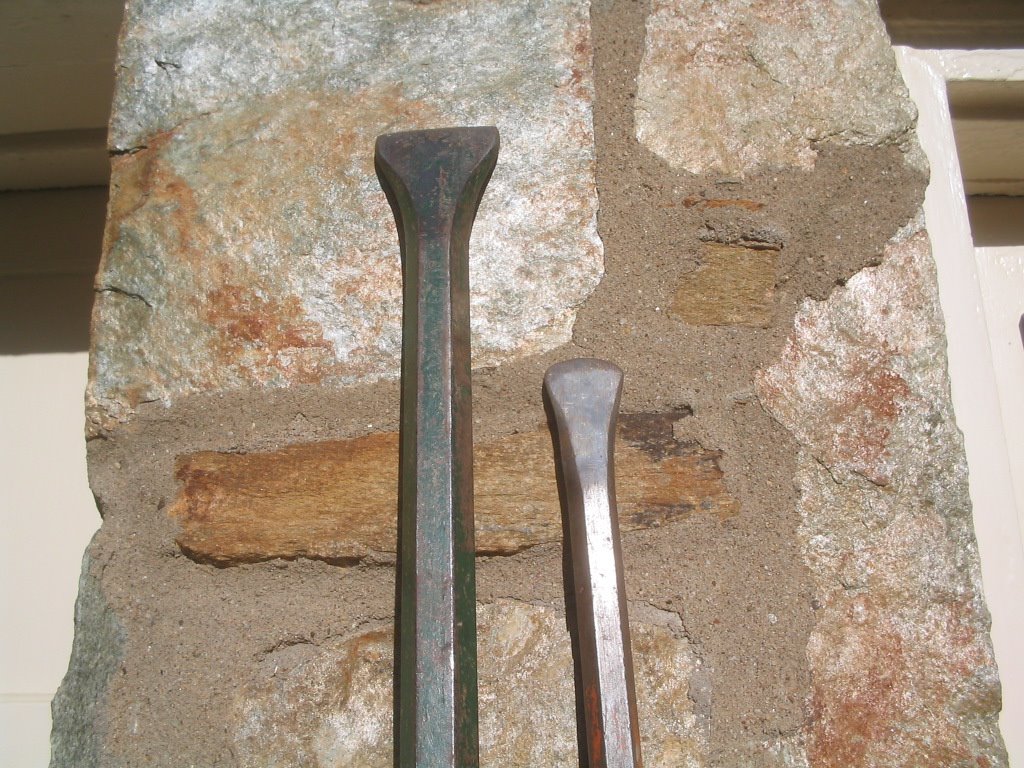
The heavy bar, at left, rarely leaves the truck, while the lighter bar, to the right, is used on almost every dig.


My digging bar is 3/4 inch hex steel with a blunt point on one end
, and a chisel tip forged into the opposite end. The bar has been hardened for about 20 inches or so on each end. This bar was a gift from veteran terrierman Larry Morrison, and has been much used. I am proud to say that this bar is as straight as the day he gave it to me -- I value this tool and do not abuse it. With proper care, I expect it to be used to dig my grave. A similar bar can be made by any welding shop -- 3/4" hex bar is off-the-shelf stock steel.

My digging bar is 6 feet long, and I consider it the proper length and shape for good digging. I find a T-bar transfers too much vibration back into my hands and is too jarring to use when being hammered through shale, marl or rock. A bar that is too short cannot be used to reach deep in order to shatter rock or cut the edge off a hole that is four feet down (a frequent need).

The digging bar to the left of my regular digging bar is the heavier type of bar you might find at Home Depot or some other hardware store. The point end of this bar is attached to a cut down drain spade head to serve as a "Bertha," spoon, or heavy grafter (all the same thing). This heavy tool can cut through solid igneous rock -- and has. It almost never leaves the truck, but when it does, serious digging of very hard stuff has to be done.

I do not believe in going into the field with too light a bar -- it's a matter of safety for the dog. Though dogs can almost always exit places they can enter, there are times when you want to get down fast. In those rare occasions where a rock has slipped behind a dog, or a stump root prevents an easy exit, you should be able to call up the heavy artillery and get the dog out without having to call for reinforcements.

I use my light bar on almost every dig, and consider it a necessity, not a nicety.

A bar slammed deep into the ground behind a critter can be rattled to make it bolt to a snare, while a blow from a chisel point can quickly dispatch an animal in a hole. And, of course, a bar can be used as a listening device.

The primary job of bar, of course, is to break up hard packed rock and marl. When a bar is absolutely needed, nothing else will do.
.

Friday, July 28, 2017

How to Dig a Hole


An instruction piece on how to dig a hole?

I would not write such a piece if I had not seen it done poorly often enough.

Let's start at the beginning: Slow down.

As odd a piece of advice as that sounds, that's where to start when it comes to digging holes. Most people are too quick to dig, and don't give their dog enough time to push quarry to a stop end or a bolt hole. If you've dug to your dog only to find it has moved farther down the pipe, you are probably guilty of digging too soon -- welcome to the club!

Once you think the dog has worked the quarry to a stop end, and you've located the spot with the locator box, drive the bar into the ground a foot or two, and give it a good rattle. Stomp on the ground. Then wait a few seconds and box again. If the dog and the quarry are still in the same place, you're ready to dig.

If the box suggests the den pipe may be only two to three feet down, I would recommend using the bar to make sure you have the exact location of the den pipe fixed.

Using a digging bar as a probe is not difficult, but it’s not quite as obvious as it sounds either. The trick to getting a bar through two, three or even four feet of dirt and small stones is to repeatedly slam the bar into the first bar hole you create, and then widen that hole with a strong stirring motion, after which you slam deeper into the soil.

SLAM, slam, stir, stir. SLAM, slam, stir, stir.

Sideways pressure on the bar should put strong pressure on the bottom side, and top edge, of the hole. The goal is to use repeated strong persuasion, and not brute sideways force. You do not want to ruin a good bar by bending it!

As you get close to the depth of where the dog is located, bar more slowly and methodically -- you do not want to slam the bar into the dog, which can kill it. Slower beats faster at this stage!

In normal soil, you should be able to tell when the bar breaks through, as the bar will suddenly pass through a 6- to 12-inch void. Bang -- you found the den pipe! It's not quite so easy if the soil is as soft as cake batter.

Digging a hole sounds simple enough, but sometimes it isn't. In the U.S., most holes are shallow, which is why we can get away with posthole diggers much of the time. They are a nicety in the dense roots and brush of a hedgerow, but many still prefer to dig with a shovel alone, and on a dig deeper than three feet, shovel excavation is always required.

If your box shows a depth of up to three feet, the quickest way to get to the dog, and still have the room you will need to work, is to trench across the pipe about 3 feet long and a shovel-head-and-a-half wide. When you get down to within a foot of the pipe, use your bar to locate it, and then use a posthole digger or the shovel to carefully cut down into the pipe. A posthole digger is excellent here because it will remove the dirt cleanly. You will have to overlap the cutting circle of the posthole digger to cut an earth hole that is 10 to 12 inches across or more. I recommend digging deeper than the pipe and allowing the dog to push any extra dirt into the small "well" that results. Your final result should be a clean hole that is large enough that you can easily pull the dog when it is time to do that.

In truth, most digs require two holes. Often the terrier and the quarry move a bit farther up the pipe just as you break through. This is not a case of the dog moving backwards, but of the dog moving forwards -- often past a turn in the pipe where it had been stymied by the slashing teeth of the quarry.

If you find you need to dig another hole, do so, but again wait until the dog has pushed the quarry as far as it can. Pound on the ground one more time before you dig; you want to avoid a third hole if you possibly can.

If you are up to the quarry, it's important to block off the back end of the pipe before you pull the dog. If you fail to do so, the critter will bolt back into the rest of the sette as soon as the dog is pulled clear. Blocking off the back of the sette can be accomplished by either collapsing the pipe or by blocking it with dirt, rocks, shovel, or posthole digger.

Once you pull the dog, be careful the critter does not bolt out right over your foot and up your pants leg! Put in a shovel head if you have to step out of the hole for a minute.

Once you have pulled the dog, you may realize you have to cut the pipe back another 8 or 10 inches to get right up to the quarry in order to either see it for dispatch, to get a snare on it, or to encourage it to bolt.

One way to encourage a bolt is to drive a bar down behind the animal, and give the bar a good rattle. This is often enough to startle the quarry considerably. If the quarry is right there, simply place a branch or shovel handle in the hole, and give it a few minutes to gather its courage for the dash to freedom.

One thing I find distasteful are people who allow a dog to “work” quarry once the animal is firmly fixed in a stop end and has nowhere to go. This is baiting, and morally wrong, as well as dangerous to the dog. The job of the terrierman is to locate the quarry and dig down to it, not to “test” the dog by allowing it to subject a scared animal to more stress, or to allow the dog to become over-adrenalized to the point it may end up taking foolish risks and harming itself. There is a place to slip in the shovel and put up the dog, and that point is as soon as the quarry is firmly bottled in a short stop end.

Holes deeper than three and a half feet require a different approach, as you will need to be able to get into the hole to pull the dog and dispatch the quarry, otherwise you will find, at the end of the dig, that your arms are too short to reach.

At a depth of four feet, you should be digging a hole that is at least four feet around. When digging deeper than five feet, I recommend a square hole that is at least five feet on each side, as you will have to get the shovel sideways in the hole in order to toss out the dirt. You may want to make the hole a little bit longer than it is wide so that you have room to stand on one side of the hole while digging out the other side.

The deeper the hole, the more important it is to keep the sides square, and to level off the bottom of the hole as you dig. At depths greater than five feet, the danger of collapse has to be paid attention to, as does the logistics of clearing the hole with the dirt. Having someone topside to move spoil back from the edge is an excellent idea.

In holes that are deeper than six feet, you will want to cut footholes into the wall in order to be able to get out. In addition, you will need to cut a deep bench in one side of the hole so that the primary digger, at the bottom of the hole, can toss dirt up to a halfway point. Another digger will then stand on this bench and toss dirt clear of the hole.

If you are unlucky enough to hit running sand, you will need to put in a stick to keep track of the den pipe as you dig, and it will help if you come in from the side, rather than straight on top of the dog.

After a dig, take time to fill in holes, and in hedgerows or forest settes, jam sticks and branches crosswise into the hole so the den pipe is not packed solid with dirt when refilled.

Most dens will eventually be reoccupied, and the more dens that remain intact, the more likely your farms will remain productive for seasons to come.

Sunday, November 04, 2018

How to Dig a Hole


T shirt available here


An instruction piece on how to dig a hole?

I would not write such a piece if I had not seen it done poorly often enough.

Let's start at the beginning: Slow down.

As odd a piece of advice as that sounds, that's where to start when it comes to digging holes. Most people are too quick to dig, and don't give their dog enough time to push quarry to a stop end or a bolt hole. If you've dug to your dog only to find it has moved farther down the pipe, you are probably guilty of digging too soon -- welcome to the club!

Once you think the dog has worked the quarry to a stop end, and you've located the spot with the locator box, drive the bar into the ground a foot or two, and give it a good rattle. Stomp on the ground. Then wait a few seconds and box again. If the dog and the quarry are still in the same place, you're ready to dig.

If the box suggests the den pipe may be only two to three feet down, I would recommend using the bar to make sure you have the exact location of the den pipe fixed.

Using a digging bar as a probe is not difficult, but it’s not quite as obvious as it sounds either. The trick to getting a bar through two, three or even four feet of dirt and small stones is to repeatedly slam the bar into the first bar hole you create, and then widen that hole with a strong stirring motion, after which you slam deeper into the soil.

SLAM, slam, stir, stir. SLAM, slam, stir, stir.

Sideways pressure on the bar should put strong pressure on the bottom side, and top edge, of the hole. The goal is to use repeated strong persuasion, and not brute sideways force. You do not want to ruin a good bar by bending it!

As you get close to the depth of where the dog is located, bar more slowly and methodically -- you do not want to slam the bar into the dog, which can kill it. Slower beats faster at this stage!

In normal soil, you should be able to tell when the bar breaks through, as the bar will suddenly pass through a 6- to 12-inch void. Bang -- you found the den pipe! It's not quite so easy if the soil is as soft as cake batter.

Digging a hole sounds simple enough, but sometimes it isn't. In the U.S., most holes are shallow, which is why we can get away with posthole diggers much of the time. They are a nicety in the dense roots and brush of a hedgerow, but many still prefer to dig with a shovel alone, and on a dig deeper than three feet, shovel excavation is always required.

If your box shows a depth of up to three feet, the quickest way to get to the dog, and still have the room you will need to work, is to trench across the pipe about 3 feet long and a shovel-head-and-a-half wide. When you get down to within a foot of the pipe, use your bar to locate it, and then use a posthole digger or the shovel to carefully cut down into the pipe. A posthole digger is excellent here because it will remove the dirt cleanly. You will have to overlap the cutting circle of the posthole digger to cut an earth hole that is 10 to 12 inches across or more. I recommend digging deeper than the pipe and allowing the dog to push any extra dirt into the small "well" that results. Your final result should be a clean hole that is large enough that you can easily pull the dog when it is time to do that.

In truth, most digs require two holes. Often the terrier and the quarry move a bit farther up the pipe just as you break through. This is not a case of the dog moving backwards, but of the dog moving forwards -- often past a turn in the pipe where it had been stymied by the slashing teeth of the quarry.

If you find you need to dig another hole, do so, but again wait until the dog has pushed the quarry as far as it can. Pound on the ground one more time before you dig; you want to avoid a third hole if you possibly can.

If you are up to the quarry, it's important to block off the back end of the pipe before you pull the dog. If you fail to do so, the critter will bolt back into the rest of the sette as soon as the dog is pulled clear. Blocking off the back of the sette can be accomplished by either collapsing the pipe or by blocking it with dirt, rocks, shovel, or posthole digger.

Once you pull the dog, be careful the critter does not bolt out right over your foot and up your pants leg! Put in a shovel head if you have to step out of the hole for a minute.

Once you have pulled the dog, you may realize you have to cut the pipe back another 8 or 10 inches to get right up to the quarry in order to either see it for dispatch, to get a snare on it, or to encourage it to bolt.

One way to encourage a bolt is to drive a bar down behind the animal, and give the bar a good rattle. This is often enough to startle the quarry considerably. If the quarry is right there, simply place a branch or shovel handle in the hole, and give it a few minutes to gather its courage for the dash to freedom.

One thing I find distasteful are people who allow a dog to “work” quarry once the animal is firmly fixed in a stop end and has nowhere to go. This is baiting, and morally wrong, as well as dangerous to the dog. The job of the terrierman is to locate the quarry and dig down to it, not to “test” the dog by allowing it to subject a scared animal to more stress, or to allow the dog to become over-adrenalized to the point it may end up taking foolish risks and harming itself. There is a place to slip in the shovel and put up the dog, and that point is as soon as the quarry is firmly bottled in a short stop end.

Holes deeper than three and a half feet require a different approach, as you will need to be able to get into the hole to pull the dog and dispatch the quarry, otherwise you will find, at the end of the dig, that your arms are too short to reach.

At a depth of four feet, you should be digging a hole that is at least four feet around. When digging deeper than five feet, I recommend a square hole that is at least five feet on each side, as you will have to get the shovel sideways in the hole in order to toss out the dirt. You may want to make the hole a little bit longer than it is wide so that you have room to stand on one side of the hole while digging out the other side.

The deeper the hole, the more important it is to keep the sides square, and to level off the bottom of the hole as you dig. At depths greater than five feet, the danger of collapse has to be paid attention to, as does the logistics of clearing the hole with the dirt. Having someone topside to move spoil back from the edge is an excellent idea.

In holes that are deeper than six feet, you will want to cut footholes into the wall in order to be able to get out. In addition, you will need to cut a deep bench in one side of the hole so that the primary digger, at the bottom of the hole, can toss dirt up to a halfway point. Another digger will then stand on this bench and toss dirt clear of the hole.

If you are unlucky enough to hit running sand, you will need to put in a stick to keep track of the den pipe as you dig, and it will help if you come in from the side, rather than straight on top of the dog.

After a dig, take time to fill in holes, and in hedgerows or forest settes, jam sticks and branches crosswise into the hole so the den pipe is not packed solid with dirt when refilled.

Most dens will eventually be reoccupied, and the more dens that remain intact, the more likely your farms will remain productive for seasons to come.

Monday, November 29, 2004

Two Piece Pack Shovel


This two-piece shovel fits invisibly inside a pack, and can be quickly shortened for deep hole digging where a shovel with a one-foot handle is needed.

Making the shovel is suprisingly simple. The new handle is made of half-inch galvanized pipe fittings from Home Depot. The shovel head is from an old long-handled shovel I had in the garage. This was a cheap stamped-metal shovel, but it should be fine since I intend to use it only as an occasional "poachers shovel" rather than my main digging tool.

To begin construction, I cut the old handle off the shovel, ground off the side rivet, drilled as much of the old wooden handle out of the socket as possible, and hammered what remained of the wood out of the throat with a bit of rebar driven backward up the slot.

The key to the pipe handle connection is to use an in-line pipe connector with a short piece of pipe extending down into the throat of the shovel socket. This pipe extension (see top picture) provides metal-to-metal contact inside the shovel socket, and gives the epoxy a lot of surface area to hold on to.

The pipe connector and short pipe extension are screwed together and slathered with PC-7 epoxy which is the consistency of tar. PC-7 is very strong epoxy and I used this same glue for making my Bertha-spoon which has held up to a lot of abuse.

The pipe connector and pipe extension are slid into the hollow throat of the shovel head (pipe connector out, pipe in), with care taken to keep the epoxy well away from the threaded hole where the pipe handle will be later be fitted.

Once the pipe connector socket is fitted flush with the shovel socket, it's time to thread on the full pipe handle. Once this is done, twist the "T" handle tight so that it lines up right for digging. The handle should be twisted in very tight because you will want the handle tight when digging.

Once the handle is lined up right, set the whole thing aside for at least 48 hours so that the epoxy can completely cure.

Once dry, the shovel can be disassembled and the pipe threads given a shot of oil to lubricate them. A plastic sleeve cap should be fitted over the threads of the shovel handle, and a rubber cork put into the shovel head, in order to keep out dirt. Another alternative is to tape them over with the same kind of plastic tape used on a deben collar.

This shovel digs fairly well. The pipe handle gives the shovel some weight which helps make digging easier. The pipe handle is a bit thin and a bit cold in your hand, but it is a strong handle and digging with it has been no problem.

Tuesday, January 24, 2017

The Sad Rise of Hard Dogs


Just as the world of rosette-chasers is filled with those chasing an ever-changing image of "the perfect terrier," so too are there those chasing idealized visions of the perfect digging dog.

I myself do not put much stock in theories of perfection, and I generally write off anyone who starts bragging about how wonderfully "hard" their terrier is.

As a rule, these folks are young and have not yet dug too much.

A very hard dog that insists on coming to a grip every time it goes into a hole is a liability if you work your dogs on a regular basis, as a wrecked dog may be out of the field for several weeks or even a month or more.

A dog with brains and experience will generally box and press in the hole, but it will receive little serious abuse, as it will soon learn "butt from breath."

And yet we continue to get folks showing up in the world of working terriers who want to talk about how hard their dogs are.

Where do these people comes from?

Eddie Chapman provides an answer in his book, The Real Jack Russell Terrier:

To put a date on it, the beginning of the sixties was the start of the wage rise boom and in just a few short years people started to find they had money in their pockets for other things than the bare necessities. Working men suddenly had transport, and terrier clubs were formed in the industrial areas because they were no longer confined to their home towns or villages.

Working terriers, it seems, have a strong appeal to young men looking for excitement, and if you have ever been in a pub or club full of beer drinking young terrier enthusiasts you will know what sort of atmosphere can be created by the loud mouths, parading around with their macho-looking battle scared head-badgers, all boasting that they smashed this and smashed that. So impressionable young men could hardly resist when the opportunity arose to become one of the so-called in-brigade, loosely referred to as 'Terrier Men'.

To be one of the lads, it seemed imperative that you had a macho dog to fit the image, and the ultimate test for the macho terrier man's dog was the Badger. To dig Badger you traditionally needed a Baying terrier, so there was suddenly great demand for the best Jack Russell blood, and large prices were paid by these newcomers for the best Jack Russell blood available.

As more and more joined the terrier clubs, the macho image of the harder terrier became almost a cult, and some even traveled to the far north in pursuit of the legendary hard terriers bred exclusively to kill Foxes in the undiggable rocky hills up there, and so the cross-breeding began.... [T]oday, only thirty years on, we find that so much cross-breeding has been done that the original pure-bred strains are in very small minority indeed. The macho terrier men are almost all gone, and the gangs they created, with the image that they portrayed, gave the antis all the fuel they needed to persuade the general public that with literally hundreds of new people suddenly joining the sport, too much pressure was being put on the Badger population, so that it was in danger of being extinct, and 'bang' a Law was passed that protected them from being dug.

So there it is -- a lot of young people who do a small amount of digging and a great deal of drinking and talking.

Ah well! As I said before, each to his own.

I myself do not value too hard a dog.

The most important tool is voice.

Yes, there is a place for teeth to punctuate the paragraphs when needed, but a truely HARD dog? No, I think I will pass on that animal, and pray I do not get another again.

You see, I do not speak from theory, but from experience. A truely hard dog is a sadness waiting to happen.

But why do I want a mixer?

Simple: When you are digging on groundhogs, you cannot afford a dog that will never engage, as otherwise too many groundhogs will get an opportunity to dig away.

A bite in the ass, and the groundhog has to turn around if it wants to defend itself. If the groundhog has turned to face the dog, it cannot dig away. If it will not face the dog, then it will find that a terrier clenched on its ass will sure slow down the digging process!

The ideal dog then is an experienced dog that learns more than one technique and is able to call on those techniques, on the fly, depending on the quarry in the hole, the lay of the land, and the temperment of the animal it has bottled up below.

All that I require of my dogs is that thay they find in the field, go to ground with enthusiasm, locate, notify me of their actions underground with their voice, and prevent the animal in the pipe from digging away if it is able.

Do I require them to stay for 8 hours? No. I have only rarely had a dig last longer than three hours, and most last far less than that.

Sorry, but if you are looking for wild yarns about dogs lost for three days underground, and only free'd with the help of a backhoe and two sticks of dynamite, I am not your person.

Besides, call me a fairy if you want, but I do not call a dog lost to ground for three days a success.

I do not count having to lose work and money on field rescue a mark of experience.

Yes, all my dogs have scars on their muzzles, but here's a little bit of truth: most of those scars were earned when those dogs were still young and learning their craft.

An experienced dog generally uses that experience to avoid injury. And so too does an experienced terrierman.
This post is recycled from 2004.

Monday, October 24, 2011

Digging on the Dogs

I took Mountain and Gideon out to the farms for a little digging on a glorious Fall Day, with the leaves just beginning to turn, and the corn just starting to come off.

It had been dry for the last few days and it was cool with a light breeze, but far from cold. 

In short, perfect digging weather! 

On the downside, however, I got out of the house late, and it was 10 am before I pulled on to the place where I intended to dig.

Adding to my guilt was the fact that I had a few chores at home to do. 

Ah well -- Fall is digging weather.  The chores would wait, and never mind if one of them was rewiring the thermostat so the heat would actually come on!

We piled out of the truck and I taped up the collars, and off we went. The dogs know their business, and they were on their toes at the first two big settes but after snarfing around above ground for a few minutes, they decided no one was home. 

At the end of the hedgerow, I let them choose which direction to go, and they decided to jog left up to a wet area between the corn fields, where it is never plowed, and is generally too boggy to hold. 

I was not expecting them to find (stupid dogs!) but I was wrong; they opened up to a full bay.

I jogged through the scraggly growth of Sumac, Poke Weed and Multiflora Rose to find Gideon in the ground baying up a storm and Mountain checking possible bolt holes on top.  Nice.

I downed tools and heard the unmistakable growl of a raccoon.   Yahoo! 

I let Mountain patrol for a bolt while I took out the machete and cleared off some of the Multiflora Rose and Sumac from where I would be digging.  Then I leashed up Mountain and tied her well back out of the way.  She hated being tied up, but with Gideon in the ground, and a very noisy raccoon giving her a lot of stick, I needed as little chaos as possible.

I boxed with the locator, and located Gideon about three feet down.  I took a few feet of dirt off the top and then barred into the den to make sure I had got it right.  Bang -- spot on.  I post holed out a clean bore hole and I saw Gideon.  Excellent. She would have plenty of air with that hole right next to her head. 

I followed the direction of her body, accounted for the length of the raccoon, and took off another few feet of dirt before checking again with the bar. Once the den pipe was located again, I post-holed down and popped in right behind the raccoon.  Perfect.

Coming in right behind the raccoon had upset it quite a lot, however, and as I broke through it charged Gideon, who scooted back a foot or two to avoid a bite.  I put the shovel in the second hole I had dug to block it, and I swung around to the first hole.  Gideon was right next to this hole now, and so I grabbed her by the tail and pulled her out.  We would let the raccoon bolt off free.  While we waited for that to occur, I unholstered my camera for a shot of the escape.

Of course we make plans and God laughs! 

For some reason, when I pulled Gideon, the raccoon decided to bolt out the other hole that was behind it, and never mind the shovel that was stuck in the hole!  The raccoon, once free from the earth, ran like hell, and without too much planning.  Unfortunately, it ran straight into Mountain who was tied up next to a small stand of Sumac!

To say the next few seconds was animated does not do it justice. 

I dropped Gideon, who promptly flew down to join the melee between Mountain and the raccoon.  Without pausing, I slipped my camera in my pocket, grabbed up the machete from a dirt pile, and stepped forward to put a boot on the raccoon before it did too much damage to the dogs.  I got in a boot pretty quickly, but the dogs would not back off to allow me to dispatch the raccoon with one clean blow.  A few seconds later -- and after with one of the dogs went sailing through the air back onto the earth works behind us (I am not sure which dog, as I was moving pretty fast) the raccoon was sent off to heaven. 

I relaxed and checked over the dogs.  Not a scratch.  Excellent.

While the dogs entertained themselves with the dead raccoon, I filled in the holes. 

We had not been out very long at all, but I decided to call it a day and get back to the chores at the house.  I had started the day late, but I was going to end it early and get my chores done.

And the thermostat?  It's working fine now, much to the wife's utter amazement.  No need to tell her it only needed two AA batteries!


Gideon with the one that did not get away, though we sure tried!
.

Friday, November 07, 2014

Finding Your First Fox


So you want to go digging on fox .... Well, good luck with that!

You have, of course, been digging on the dogs before?

If not, fox hunting is not (yet) for you.

Instead, take the time to collect the proper tools (including a locator collar and box, a decent shovel and digging bar, a proper vet kit, and a copy of American Working Terriers).

Spend at least a season working your terrier to groundhog and learning how to use a bar, shovel, posthole digger and locator box.

If you have spent the last spring, summer and fall working groundhogs and have found a possum or raccoon or two, you may be thinking you are now ready for fox.

And perhaps you are!

I consider fox easier than groundhog in many ways.

For one, a fox cannot dig away from you!

And, to be honest, no matter how eager you are to find a fox that first season, there's a very good chance you will come up blank.

Which is not necessarily a bad thing. Both dogs and humans can learn a lot by spending more quality time in the field observing.

A blank day is not a wasted day, provided you have kept your eyes opened. At the very least, you are learning to appreciate the craft of finding wild game. The sport is called hunting (and not finding) for a reason!

But let me try to be helpful.

What is it that you should be looking for, and how do you go about improving your odds?

Well, to start with, let's talk about those odds.

In fertile corn and soybean country in the Middle Atlantic (some of the very best red fox country in the U.S.A.) fox densities are about one for every square mile or so (600-700 acres).

It is true that in the rolling hills of suburbia, fox densities can be higher than this, but it is also true that it is exceedingly hard to get permission to dig in people's suburban yards. And as for the notion of digging in suburban park land bordering a housing development -- this is strictly verboten unless you want to make unpleasant acquaintance with local officials eager for their own story to tell!

Then, there is the little matter of the weather. If you are looking for fox, you want it really cold and preferably windy as well.

If the weather is above 35 degrees and not blowing, the chance of finding a fox to ground plummets, as most fox will lie out on top rather than go to ground.

Was there a massive ice storm last night? Is it now blowing 20 miles per hour? Perfect! Now if only the roads were safe enough for you to get out to the farms ....

The bottom line is that even successful fox hunting promises a long walk in fairly unpleasant weather carrying heavy tools. No surprise then to find that this activity is not quite a growth sport!

Fox work in my area runs from the first of January to the end of February and, for the record, I do not dispatch fox but let them bolt off unharmed. Unlike groundhogs, fox are not a pest unless free-range chickens and ducks are around, and most of the time they are a very powerful force for good, as they reduce white-footed deer mice populations (which are the primary host of Lyme disease).

OK, you have some experience working your terriers to other quarry, and you have made peace with walking a couple of miles in rotten weather while carrying heavy tools. Now what?

Think about the farms you have hunted on in the last year.

As a general rule, fox like to den within a few hundred yards from a water source. That water source may be very slight -- something as small as a permanent puddle in the lowest part of a field swale. If there is no water anywhere on a farm, however, you are not likely to find a fox den -- or at least that has been my experience.

Now think about drainage and soil quality. Fox demand dens that are dry, and so they tend to prefer areas with good drainage. A small slope is good. If the den is on flat ground, it will probably be in a cut-over corn field where previous plowing has made the soil relatively friable and free of stone. Expect dens on flat ground to be deeper than most of the groundhog dens you have dug this year -- four or five feet is a good guess, but six or seven is not out of the question.


OK, so you have thought about your farms and picked a few likely prospects in your mind. Now what?

Well, the first thing is to shut the hell up -- no slamming of truck doors, banging of tools, loud talking or calling the dogs. As much as possible, communicate with hand signs.

Why is this? Simple: even in bad weather, fox are often jungled up at the edge of their holes, nose out, and only lightly dozing. A loud noise is just enough to let them know you are coming down the hedgerow or across the field -- more than enough time for them to slide out of the hole and disappear into a thicket.

Once you have found a hole, how do you know if it is a fox den or not?

Well, it helps a hell of a lot if the terrier enters and begins to bay!

That said, not all fox dens are occupied, and no matter how quiet you try to be, you will often come across a fox den that has been abandoned only a few minutes before.

How can you tell?

Well, for one thing, in December, January and the first week or two of February, an active fox den will smell slightly skunky. This is the musky scent of the female fox, and it serves both to attract the male and to stake out the territory from rival females.

This foxy scent will fade off rather abruptly in mid-February, and by the time the pups are born around the second week of March , there will be no scent whatsoever.

Look for scat at the edge of a fox den. A fox will typically leave a little souvenir as his or her "calling card" at the edge of the den.

What's a fox turd look like? Well, they are tapered on both ends, and are about at thick as your little finger or ring finger, and just about as long as well. If you look closely at the ends, or break it open, you will see numerous mouse hairs inside.

The most obvious sign of a fox den, of course, is that there has been recent digging.

Raccoon and possum do not dig their own dens, and in January all of the groundhogs will be hibernating. Those few groundhogs that might wake up for a quick "latrine dump" in early February will just push their dirt "clean out" plug to the lip and no farther.

A fox, on the other hand, will kick dirt behind it in a rather vigorous plume extending some distance from the hole.

A fox digs just like a dog, and there will be no attempt to pack down the earth. In fact if you have had the presence of mind to leash up the dogs before actually getting to the hole, you may find fox tracks in the kickout dirt itself.

If you check a fox den and there is no one home, do not come back for two weeks; you want the scent of the dog to disappear and the fox to feel comfortable with this den location.

That said, be aware that a fox will not necessarily occupy all the dens excavated. Some dens are "safety" dens dug in case a primary den floods, collapses, or becomes flea-infested. Yes, it's true; fox have a "lair and a spare" plan for life.

Beginning in mid-January the chance of finding a fox to ground will rise as pregnant females become less eager to travel and spend longer and longer periods to ground.

If you have followed directions, and kept quiet while approaching a fox den, I advise you to continue to keep quite while fox nets are set. Then release a single terrier to go to ground.

Most of the time, a fox will bolt to the nets pretty quickly if it hears a working terrier behind it, and nothing chattering away topside.

If the fox bolts to the net, be careful freeing the fox, working from the back feet towards the head while keeping a boot firmly on the body if you are doing this alone. It helps to have another pair of hands, but it can be done alone without losing a finger provided you are careful and hold firmly to the neck scruff and one ear while dislodging the last bit of net at the head.

If you are digging, remember to make the hole big enough. The rule is simple: as big around on at least one side as the dig is deep. Keep the sides square and the bottom flat. If the hole is deeper than four feet, I personally prefer a square hole about five feet on a side, as it gives me room to move.

When you get down to the dog, pull it and stake it out of the wind if you can, being careful to put in a shovel to prevent the fox from bolting. The dog's job is done when it has found the fox and bottled it in a stop end. Protecting the dog from unnecessary injury is the very essence of sound terrier work.

At this point, you will probably have to dig a bit more up the pipe to get a good view of the fox. When that is done, you can then net the hole and drive a bar behind the fox encouraging it to to bolt (this will not always work), walk away from the hole and wait for the fox to bolt on its own (this will not take long if you are at least 30 feet back and remain quiet), or you can dig down to where you can see the fox clearly and then let it bolt to a pole snare.

In the U.K, some brave souls will reach in and scruff a fox out by hand, but in my area, where rabies is very common, I do not consider this "best practice."

All intentional fox work should cease on March 1st.

Fox cubs are generally whelped in early- to mid-March, at which point a vixen will generally move her cubs from an open-field den to a smaller, less conspicuous den in a hedgerow. This den may be nothing more than an old groundhog hole without any significant dirt kick-out at all. There will be no fox smell -- the pheromones will have long since fallen away.

If you are digging on groundhogs in March and April, a sure-sign that you have a fox den, and should back away, is that along with a little fox scat at the den hole, you may also have a few dead voles, a bird wing or a few feathers, an old bone, or a piece of deer hide or two.

These are the remnants of food brought back from the field, and some pieces, such as bits of hide, bone, and an old bird wing, may serve as toys for the fox pups. I have actually found a pet store dog chew toy at a fox den located near a farm house -- stolen from the neighborhood dog no doubt!

If you dig down and find fox pups, simply roll them back into the den unharmed and cover the den over as best you can with pieces of bark and brush. The vixen is not far off and is watching, and as soon as she is sure you have left, she will return and move the pups to another groundhog den nearby.

Fox mortality is naturally high, with an average of 4-5 pups born per vixen, and only three making it to the age of six months, and only two making it to the age of nine months. Starvation, disease (such as distemper and mange), and vehicle impact are the three primary killers of fox, and annual mortality is about 60 percent.

Dog foxes will be driven out of their natal areas by the age of nine months, while young vixens will generally be allowed to stay in the area as "satellite vixens" to help out in the next year -- if they do not go off on their own with a "just passing through" male.

Satellite vixens will not mate or have pups; only the alpha female and the dog fox will do that.

If the alpha vixen is killed or dies of disease, a satellite vixen may take her place, but since male fox rarely live past age four, there is very little deep inbreeding in wild fox populations as the gene pool is always rolling forward and moving out.
.

Monday, October 29, 2012

The Architecture of Burrows

A repost from 2005

The list of animals that hibernate in underground burrows, live in burrows or nest in burrows is astounding: fox, badger, turtles, some owls and parrots, ground squirrels and marmots, some penguins and puffins, European rabbits, bears, wolves and dogs, otter, some wild pigs, some wild cats, many snakes and lizards, possums, wombats, frogs and toads, moles, mice and rats, nutria, crayfish, armadillos, skunks, muskrats, meerkats, some large spiders, and several types of bees.

Many of these animals spend a fair amount of time constructing, maintaining, and modifying their den systems which, in turn, are structured in response to changing external circumstances and changing internal needs.

Anatomy, behavior, and distribution of wild animals are all greatly affected by the burrow environment, with temperature, humidity, oxygen, living space, availability of food, and protection from flooding and predation all being influenced by burrow architecture.

Despite this, the burrow structure of almost all subterranean mammals is barely known, and data and descriptions of den structures as they relate to soil composition, drainage, external defenses (rock, wire fences, farm buildings), proximity to food and water sources, is almost entirely non-existent.

All of this make understanding burrow architecture as an adaptive tool a difficult task, but it nonetheless clear, among humans digging to their terriers, that burrows are designed with a reason and that certain "tricks" keep popping up. A few I have noticed in the construction of groundhog and fox dens:

  • Water and the phreatic zone: Dens of fox and groundhogs are designed to keep the animals dry, yet fox in particular like to locate their dens very near water. Shallow dens are sometimes found carved into the sides of small humps or rises in marshy areas, but these are rarely natal dens. The deeper natal dens of fox are generally found on the rises above the flood plains -- on well-drained hillsides near a creek or pond or water-filled ditch. The ideal spot for a pipe is deep enough to be dry from surface water, but not so deep as to be encountering the water table -- the so-called "phreatic zone".

  • The "plumbers pipe" opening: In these settes the pipes run down for two or three feet before rising again and then dropping again. This createa an earthen "water stop" not so very different from the plumbers p-pipe you will find under your kitchen sink. This is a common feature in many animal burrows, from rat to fox.

  • Depth is determined by soil: This is near-truth. The softer the earth and the easier it drains, the deeper the den is likely to be. One of the chief functions of a den is to keep the animal dry, and in soils that are very light, dryness tends to be achieved with some depth. You may cut through very soft stuff for three or four feet, but below that will be the harder stuff -- a layer of hard sand below the soft, or a layer of hard dry clay below much softer and friable soil. The pipe is likely to be in the softer soil just below the hard vein. The hard vein works to structurally support the pipe and to keep out the last bits of water. The one exception that I would note is where a ridge is made almost entirely of small cherts, flints or flaked slate. Here digging by a fox or groundhog is so hard, and the drainage is so rapid, that the den pipe may be very shallow since water runs through the den as fast as it falls. These shallow and breezy loose-rock dens will not be used in winter, but are likely spots in summer.

  • Rocks, roots and barbed wire at the entrance: This is so common that it is clearly a planned design feature. It is not uncommon to find dens exiting inside a stump or hollow tree, or to have a strand or two of barbed wire running along the lip. Groundhog dens frequently start on one side of a barbed wire fence and exit out another. If there is an abandoned vehicle on the edge of a farm, a groundhog will invariably makes its home under the chassis -- a nice shelter from the rain, but also from predators who will have to slow down to a crawl to avoid beaning themselves on the I-beam and suspension. Hard structures not only makes digging out more difficult, it makes a mad dash at the den hole a dangerous and maladaptive strategy for large predators. In addition to hard structures at den entrances and exits, there are "soft structures" such as thickets of multi-flora rose, bramble, poison ivy, and thick wild grape vine.

  • The hard turn after the den entrance: This is a frequent feature of groundhog den entrances and serves two purposes: 1) it makes it difficult for predators to enter, and; 2) water entering the entrance will tend to follow the straight line of gravity and soak into the ground at the end of the pipe rather than run sideways with the turn of the pipe. I have encountered some rather incredible animals that took this "hard turn at the entrance" technique to absurd levels as they never stopped turning -- they corkscrewed their dens in full circles all the way down in a spiral that went four or five feet deep.

  • The pocket room close to the entrance: This is a common feature of groundhogs dens, and I believe these serve as "loafing parlors" where the animal can tuck in out of danger between feeding forays. If you are quiet, and the dog is too, you can often bottle a groundhog in one of these little rooms before it goes deeper into the sette.

  • Right angle turns inside the den pipe: These are very frequent features of groundhog and fox dens and seems to serve two purposes. The first purpose is that they help keep the den dry, as water running down a pipe will tend to follow gravity rather than take a sudden turn to the left or right. The second purpose is clearly defensive; a groundhog or fox can take a stand at a hard corner and slash out at anything coming down the pipe, inflicting considerable damage if the corner is tight, as it invariably is. Often a sette will have several right-angle turns, each providing additional elements of security, like doors on a hallway. A human digging on a dog will often break into a pipe where the dog and quarry are at a standoff at one of these turns, at which point all hell will break loose as the animals grab each other, or else the fox or groundhog will manage to retreat to the next hard corner in the pipe system -- a kind of running battle that can be very frustrating to the digger!

  • Side pipes and stop-end branches: These are common features of both groundhog pipes and fox dens. Some of these represent unfinished den digging, but for a fox they also provide a place where one animal can scoot into in order to let another pass by, where one animal can lay up without getting overheated from the warmth of its mate and where it can get a better supply of air. Earth dens are all about keeping dry, maintaining the right temperature, keeping the air flowing, and staying secure. Side passages increase the options on all counts.

  • Field settes are generally deeper and larger than hedgerow settes, and often harder for the human to dig as a consequence: I believe this is due to a conflux of opportunity and necessity. The opportunity for larger and deeper settes is due to the lack of obstructions like roots and rocks. The necessity is that plowed fields with friable soils require deeper dens to remain dry, while larger more complex settes are an element of security, allowing a groundhog or fox to escape danger in one part of the sette by going to another -- or even bolting out of one entrance into another.

  • Large "race track" settes are fairly common in fields. These large settes circle back on themselves several times and may have several layers of pipe. More commonly they are simply four-, five-, or six-eyed settes with connecting pipes. A groundhog can run around in these large settes, shoveling dirt behind it to block the dog, and effectively preventing the dog from bottling it in a stop end. The solution I employ is to earth stop the den at two or three spots (generally at exits where the pipe goes left and right). If needed I will also allow two experienced dogs that know each other well to enter opposite sides of the settes and work the animal to the middle. This generally prevents the groundhog from digging in and gets the animal pinned against one of the newly-minted stop-ends in short order. Putting two dogs to ground should be left to people who know their dogs well and who are experienced diggers. It is better to lose quarry than a dog. Two very hard dogs to ground, or two dogs in a den occupied by a skunk, could be a disaster! Never enter two dogs on a fox -- it is simply not necessary, as the fox cannot dig away.

  • Winter "fox porches": A fox will often dig out the first three or four feet of a groundhog den and create a kind of "loafing porch" where it can tuck in out of the wind but still not be fully underground. Fox can easily overheat inside the earth, and this "porch" area allows for easy temperature regulation -- go a little deeper if it is very cold, stay right at the entrance if it is warm. The breezeway allows the fox two excellent avenues of escape if danger approaches -- into the nearby woods or thicket, or deeper underground.

  • An observation on what does not dig: Raccoons and possums do not dig earth dens -- they occupy holes made by other animals or find hollow trees, brush piles, rock crevices, hay bales, barns or crawlspaces. Neither animal is equipped to move dirt beyond a little scratching for worms and beetle grubs. Neither animal will modify a den in a significant way (though both will pull plastic bags and other debris into a den in order to improve insulation and provide bedding).


Wednesday, January 09, 2019

Finding Your First Fox

A repost from 2010.

So you want to go digging on fox .... Well, good luck with that!

You have, of course, been digging on the dogs before?

If not, fox hunting is not (yet) for you.

Instead, take the time to collect the proper tools (including a locator collar and box, a decent shovel and digging bar, a proper vet kit, and a copy of American Working Terriers).

Spend at least a season working your terrier to groundhog and learning how to use a bar, shovel, posthole digger and locator box.

If you have spent the last spring, summer and fall working groundhogs and have found a possum or raccoon or two, you may be thinking you are now ready for fox.

And perhaps you are!

I consider fox easier than groundhog in many ways.

For one, a fox cannot dig away from you!

And, to be honest, no matter how eager you are to find a fox that first season, there's a very good chance you will come up blank.

Which is not necessarily a bad thing. Both dogs and humans can learn a lot by spending more quality time in the field observing.

A blank day is not a wasted day, provided you have kept your eyes opened. At the very least, you are learning to appreciate the craft of finding wild game. The sport is called hunting (and not finding) for a reason!

But let me try to be helpful.

What is it that you should be looking for, and how do you go about improving your odds?

Well, to start with, let's talk about those odds.

In fertile corn and soybean country in the Middle Atlantic (some of the very best red fox country in the U.S.A.) fox densities are about one for every square mile or so (600-700 acres).

It is true that in the rolling hills of suburbia, fox densities can be higher than this, but it is also true that it is exceedingly hard to get permission to dig in people's suburban yards. And as for the notion of digging in suburban park land bordering a housing development -- this is strictly verboten unless you want to make unpleasant acquaintance with local officials eager for their own story to tell!

Then, there is the little matter of the weather. If you are looking for fox, you want it really cold and preferably windy as well.

If the weather is above 35 degrees and not blowing, the chance of finding a fox to ground plummets, as most fox will lie out on top rather than go to ground.

Was there a massive ice storm last night? Is it now blowing 20 miles per hour? Perfect! Now if only the roads were safe enough for you to get out to the farms ....

The bottom line is that even successful fox hunting promises a long walk in fairly unpleasant weather carrying heavy tools. No surprise then to find that this activity is not quite a growth sport!

Fox work in my area runs from the first of January to the end of February and, for the record, I do not dispatch fox but let them bolt off unharmed. Unlike groundhogs, fox are not a pest unless free-range chickens and ducks are around, and most of the time they are a very powerful force for good, as they reduce white-footed deer mice populations (which are the primary host of Lyme disease).

OK, you have some experience working your terriers to other quarry, and you have made peace with walking a couple of miles in rotten weather while carrying heavy tools. Now what?

Think about the farms you have hunted on in the last year.

As a general rule, fox like to den within a few hundred yards from a water source. That water source may be very slight -- something as small as a permanent puddle in the lowest part of a field swale. If there is no water anywhere on a farm, however, you are not likely to find a fox den -- or at least that has been my experience.

Now think about drainage and soil quality. Fox demand dens that are dry, and so they tend to prefer areas with good drainage. A small slope is good. If the den is on flat ground, it will probably be in a cut-over corn field where previous plowing has made the soil relatively friable and free of stone. Expect dens on flat ground to be deeper than most of the groundhog dens you have dug this year -- four or five feet is a good guess, but six or seven is not out of the question.


OK, so you have thought about your farms and picked a few likely prospects in your mind. Now what?

Well, the first thing is to shut the hell up -- no slamming of truck doors, banging of tools, loud talking or calling the dogs. As much as possible, communicate with hand signs.

Why is this? Simple: even in bad weather, fox are often jungled up at the edge of their holes, nose out, and only lightly dozing. A loud noise is just enough to let them know you are coming down the hedgerow or across the field -- more than enough time for them to slide out of the hole and disappear into a thicket.

Once you have found a hole, how do you know if it is a fox den or not?

Well, it helps a hell of a lot if the terrier enters and begins to bay!

That said, not all fox dens are occupied, and no matter how quiet you try to be, you will often come across a fox den that has been abandoned only a few minutes before.

How can you tell?

Well, for one thing, in December, January and the first week or two of February, an active fox den will smell slightly skunky. This is the musky scent of the female fox, and it serves both to attract the male and to stake out the territory from rival females.

This foxy scent will fade off rather abruptly in mid-February, and by the time the pups are born around the second week of March , there will be no scent whatsoever.

Look for scat at the edge of a fox den. A fox will typically leave a little souvenir as his or her "calling card" at the edge of the den.

What's a fox turd look like? Well, they are tapered on both ends, and are about at thick as your little finger or ring finger, and just about as long as well. If you look closely at the ends, or break it open, you will see numerous mouse hairs inside.

The most obvious sign of a fox den, of course, is that there has been recent digging.

Raccoon and possum do not dig their own dens, and in January all of the groundhogs will be hibernating. Those few groundhogs that might wake up for a quick "latrine dump" in early February will just push their dirt "clean out" plug to the lip and no farther.

A fox, on the other hand, will kick dirt behind it in a rather vigorous plume extending some distance from the hole.

A fox digs just like a dog, and there will be no attempt to pack down the earth. In fact if you have had the presence of mind to leash up the dogs before actually getting to the hole, you may find fox tracks in the kickout dirt itself.

If you check a fox den and there is no one home, do not come back for two weeks; you want the scent of the dog to disappear and the fox to feel comfortable with this den location.

That said, be aware that a fox will not necessarily occupy all the dens excavated. Some dens are "safety" dens dug in case a primary den floods, collapses, or becomes flea-infested. Yes, it's true; fox have a "lair and a spare" plan for life.

Beginning in mid-January the chance of finding a fox to ground will rise as pregnant females become less eager to travel and spend longer and longer periods to ground.

If you have followed directions, and kept quiet while approaching a fox den, I advise you to continue to keep quite while fox nets are set. Then release a single terrier to go to ground.

Most of the time, a fox will bolt to the nets pretty quickly if it hears a working terrier behind it, and nothing chattering away topside.

If the fox bolts to the net, be careful freeing the fox, working from the back feet towards the head while keeping a boot firmly on the body if you are doing this alone. It helps to have another pair of hands, but it can be done alone without losing a finger provided you are careful and hold firmly to A tight neck scruff while dislodging the last bit of net at the head.

If you are digging, remember to make the hole big enough. The rule is simple: as big around on at least one side as the dig is deep (up to about 7 feet). Keep the sides square and the bottom flat. If the hole is deeper than four feet, I personally prefer a square hole about five feet on a side, as it gives me room to move.

When you get down to the dog, pull it and stake it out of the wind if you can, being careful to put in a shovel to prevent the fox from bolting. The dog's job is done when it has found the fox and bottled it in a stop end. Protecting the dog from unnecessary injury is the very essence of sound terrier work.

At this point, you will probably have to dig a bit more up the pipe to get a good view of the fox. When that is done, you can then net the hole and drive a bar behind the fox encouraging it to to bolt (this will not always work), walk away from the hole and wait for the fox to bolt on its own (this will not take long if you are at least 30 feet back and remain quiet), or you can dig down to where you can see the fox clearly and then let it bolt to a pole snare.

In the U.K, some brave souls will reach in and scruff a fox out by hand, but in my area, where rabies is very common, I do not consider this "best practice."

All intentional fox work should cease on March 1st.

Fox cubs are generally whelped in early- to mid-March, at which point a vixen will generally move her cubs from an open-field den to a smaller, less conspicuous den in a hedgerow. This den may be nothing more than an old groundhog hole without any significant dirt kick-out at all. There will be no fox smell -- the pheromones will have long since fallen away.

If you are digging on groundhogs in March and April, a sure-sign that you have a fox den, and should back away, is that along with a little fox scat at the den hole, you may also have a few dead voles, a bird wing or a few feathers, an old bone, or a piece of deer hide or two.

These are the remnants of food brought back from the field, and some pieces, such as bits of hide, bone, and an old bird wing, may serve as toys for the fox pups. I have actually found a pet store dog chew toy at a fox den located near a farm house -- stolen from the neighborhood dog no doubt!

If you dig down and find fox pups, simply roll them back into the den unharmed and cover the den over as best you can with pieces of bark and brush. The vixen is not far off and is watching, and as soon as she is sure you have left, she will return and move the pups to another groundhog den nearby.

Fox mortality is naturally high, with an average of 4-5 pups born per vixen, and only three making it to the age of six months, and only two making it to the age of nine months. Starvation, disease (such as distemper and mange), and vehicle impact are the three primary killers of fox, and annual mortality is about 60 percent.

Dog foxes will be driven out of their natal areas by the age of nine months, while young vixens will generally be allowed to stay in the area as "satellite vixens" to help out in the next year -- if they do not go off on their own with a "just passing through" male.

Satellite vixens will not mate or have pups; only the alpha female and the dog fox will do that.

If the alpha vixen is killed or dies of disease, a satellite vixen may take her place, but since male fox rarely live past age four, there is very little deep inbreeding in wild fox populations as the gene pool is always rolling forward and moving out.
.