Showing posts sorted by relevance for query Leon F. Whitney. Sort by date Show all posts

Tuesday, December 09, 2008

The Eugenics Man and the Kennel Club


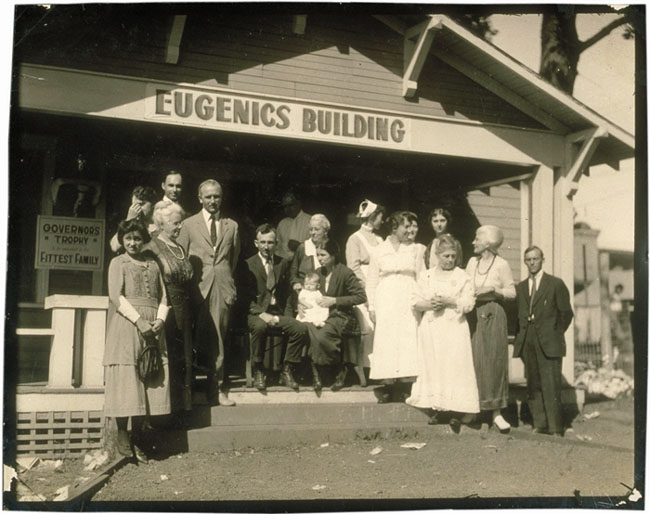
The human show at the Kansas State Fair. This family won the "Governor's Trophy" for being "the fittest family."


Ever hear of Leon F. Whitney?

He was a veterinarian, and prolific dog writer who wrote books like The Complete Book of Dog Care (still in print), How to Breed Dogs, Dog Psychology: The Basis of Dog Training, Groom Your Dog, The Coon Hunter's Handbook, Animal Doctor: The History and Practice of Veterinary Medicine and This is the Cocker Spaniel, among others.

Leon was a dog man's dog man, going so far as to collect early breed types and have them taxidermied for the ages.

His skinned-and-stuffed dog collection is still housed at Yale University.

In fact, Leon Whitney was such a big and famous dog man that when the American Kennel Club published Our Dogs: A Century of Images and Words from the AKC Gazette in 2003, they specifically included an essay by Leon F. Whitney despite the fact that this 151-page book was already crowded with more than 100 color photos.

If the AKC Gazette was going to monumentalize itself, it had to have an essay by Leon F. Whitney!

One of the things a lot of dog folks don't know about Leon Whitney is that he was also a radical eugenicist, and secretary of the American Eugenics Society.

How radical?

Consider this: In 1934, Leon F. Whitney called for the sterilization of ten million defective Americans at a time when the U.S. population was just 126 million.

Ten million people!

So what does this have to do with dogs? Where am I going with this?

Simple: against all reason, the leadership of the British Kennel Club has expressed dismay and outrage that the producers of Pedigree Dogs Exposed have referenced the eugenics movement origins of the Kennel Club.

Outrageous! But surely they know it is true?

In fact, the very idea of eugenics is British. It was a term first coined by Francis Galton, a cousin of Charles Darwin (his face is on the 10 pound note) to memorialize an idea that Galton had been developing since the 1860s, and which grew out of Darwin's work which, in turn, drew from the works of Erasmus Darwin, Robert Bakewell and Thomas Malthus.

The braiding together of dog breeding, evolution, genetics, and human social status was common at the turn of the Century. Darwin did it, and so did Alfred Russel Wallace and Francis Galton.

Right from the beginning possible links between dog breeding, human genetics, and individual social status were deduced, in part because Darwin's Origin of Species happened to be published in 1859, the very year the first dog show was held in the U.K.

Of course dogs and human social status had been mixed up long before then!

In fact, in the very first treatise Of English Dogges, published in 1570 (in Latin) by John Caius, six main types of dogs are noted: Greyhounds or sight hounds, scent hounds, bird dogs, terriers, mastiffs, and shepherd dogs – and Caius emphasizes that each breed had its own designated social role to play.

Ten years later (1580) Sir Philip Sidney noted that there were three broad types of dogs "Greyhounds, Spaniels and Hounds; whereof the first might seem the Lords, the second the Gentlemen, and the last the Yeoman of dogs".

By William Shakespeare's day (approximately 1604) the relationship between human social status and dog breeding was sufficiently understood that Shakespeare could make a ready parallel between the social stratification of men and the growing divisions then occurring among dogs.

First Murderer: We are men, my liege.

Macbeth: Ay, in the catalogue ye go for men,
As hounds and greyhounds, mongrels, spaniels, curs,
Shoughs, water-rugs, and demi-wolves are clept
All by the name of dogs.


Galton first sketched out his theory of controlled breeding for humans in an 1865 article entitled "Hereditary Talent and Character," in which dogs were mentioned as an example of successful breeding for improved function, and Galton elaborated on his proposal for humans in 1869 in his book Hereditary Genius.

And so, it was no mistake that when the English Kennel Club was founded in 1873 it was shaped by the twin forces of ancient canine class consciousness and the new population, genetic and selection theories of men like Charles Darwin, Alfred Russel Wallace and Francis Galton.

Darwin and Wallace argued that if you were intent on creating a new breed of animal, it was vital that you controlled the mixing of genes, for if you did not there was a very good chance that the animal in question would devolve back to the wild ancestral type.

In fact, in in their first lecture on evolution in 1858, they stressed this point, noting that:

Our quickly fattening pigs, short-legged sheep, pouter pigeons, and poodle dogs could never have come into existence in a state of nature, because the very first step towards such inferior forms would have led to the rapid extinction of the race; still less could they now exist in competition with their wild allies. The great speed but slight endurance of the race horse, the unwieldy strength of the ploughman's team, would both be useless in a state of nature. If turned wild on the pampas, such animals would probably soon become extinct, or under favourable circumstances might each lose those extreme qualities which would never be called into action, and in a few generations would revert to a common type, which must be that in which the various powers and faculties are so proportioned to each other as to be best adapted to procure food and secure safety,—that in which by the full exercise of every part of his organization the animal can alone continue to live. Domestic varieties, when turned wild, must return to something near the type of the original wild stock, or become altogether extinct.


This simple idea of segregation to preserve breed type was embraced with enthusiasm by early Kennel Club breeders who latched on to it as if it were a religion.


1890 Dog Show


Dogs types that had been cross-bred and yet preserved for hundreds of years were now deemed to be "pure breeds" whose "improvement" required the breeding of the animals within a closed registry in order to exclude even one drop of "foreign" or "mongrel" blood.

Francis Galton, Charles Darwin's cousin (and the inventor of the dog whistle) carried the idea of a closed registry further, arguing that the best outcome for farm stock, dog or man could be achieved through a system he called eugenics -- the "cleansing" of populations of any defects or sub-par individuals, and the planned (and even forced) mating of "the best to the best."

If farm stock could be rapidly improved by the hand of man, Galton postulated, then why not man himself?

Galton formed the British Eugenics Society in 1908 and made himself President.

In 1911 he turned over the role to Leonard Darwin, Charles Darwin's son who, in 1913, spoke of the bright social promise he saw for a
national system of eugenics based on sterilization of the "unfit":

"The effects of eugenic reform, if successful, would be to lower taxation, to raise real wages, to facilitate commercial competition, and to increase the security of the country in time of war. In things wholly immaterial, great benefits would moreover be felt; for a diminution in the number of the insane, the feebleminded, the criminal, and the wastrels annually brought into the world would mean the removal of a terrible burden of unmerited misery; whilst an increase in the output of men and women of character and ability would not only add to the reputation of our country, but would also add to its happiness in many ways. These are the benefits we hold to be in the power of this generation to bestow on our country in the future by now resolutely grappling with the problem of human heredity."


Close readers who exam the source text cited above will note that the quote comes from the Journal of Heredity published by the American Genetic Association (aka the American Breeders Association) in 1914, and that on page 226 of this same tome there is a translated article on The Effect of Inbreeding first published in Germany in 1880 (just seven years after the start of the UK Kennel Club). On page page 244 of the same publication, we have a treatise on Coat Color in Pointer Dogs, and on page 368 we have an article on the relative merit of inbreeding terriers to improve chances in the show ring.

Clearly the world of dog breeding and human eugenics were bound together; what worked for one (dogs or human) was surely good for the other!

Into this thought-scape entered the Kennel Club with their demand for racial purity and a rigid non-performance "breed standard" which, truth be told, is little more than a "master race" blue print for each type of dog.

As luck would have it, one of the earliest and most prolific writers about the genetics of pedigree dogs and the new "science" of human eugenics was Leon F. Whitney.

Whitney would write about the genetics of canine coat color one day, and the need to sterilize millions of people the next.

For example, in 1928 we find Whitney writing in the Journal of Heredity on The Inheritance of a Ticking Factor in Hounds while at the same time carrying on a fast and furious correspondence with the leaders of the American and British eugenics movements.

Leon Whitney was more than a cheerleader for eugenics; he was also one of the chief architects of "human dog shows" in which families would compete at state fairs to win a prize as "the fittest family."

"Not unlike dog shows today, Fitter Family contests pitted American citizens against one another in a battle to determine whose facial characteristics, posture, health, and habits judges deemed the most fit."

It would be hard to overstate the intellectual, political and financial support the eugenics movement received between 1870s and 1930. As one observer noted:

Adolescent popular culture was ... filled with eugenic messages. On a given Saturday evening in the 1920s, for example, school students could go to the movies to see the pro-euthanasia film The Black Stork. The following morning, while attending church services, they might listen to a eugenically oriented sermon recommending marriages of “best” with “best.” On Monday, the newspaper might warn of a “rising tide of feeblemindedness” and recommend restricting immigration from Eastern and Southern Europe. On Tuesday, the press could report on the attractive winners of “better babies contests.” Sitting in class on Wednesday, these same students might open their biology textbooks to a chapter on eugenics. Finally, on Thursday and Friday, while visiting a state fair with their hygiene class, they could participate in a Fitter Families competition. If they were judged as having superior heredity, they might return home bearing a medal with a biblical inscription (Psalms 16.6), “Yea, I have a goodly heritage”.


Eugenics was not considered a crack pot theory in the first two or three decades of the Twentieth Century.

In fact, it was considered a potentially powerful force for social good and such American luminaries as Teddy Roosevelt, Franklin Delano Roosevelt, Woodrow Wilson, Oliver Wendell Holmes, Emma Goldman, and Margaret Sanger embraced it, along with such British luminaries as Havelock Ellis, H. G. Wells, William Beveridge, John Maynard Keynes, Arthur Balfour and Winston Churchill.

In short, eugenics was not a thesis put out by bad people trying to do evil, but by misguided people trying to do good.

That said, it should also be noted that the road to hell is paved with good intentions.

And so, we find in this case in which forced sterilization laws were quickly embraced as a kind of "cleansing" of the gene pool.

Indiana was the first state to mandate forced sterilization of citizens it considered a problem, followed by Washington, Connecticut, Virginia, and California. Sometimes sterilization surgery was performed without the victims' knowledge, and it was not uncommon for poor women to be admitted for one illnesses only to wake up with their tubes tied without so much as a consultation.

In 1934, having already served as head of the American Eugenic Association for a decade, Leon F. Whitney authored "The Case for Sterilization" which was written as a popular "platform piece" for encouraging the passage of more state-based sterilization laws.

The book noted, with some approval, that Hitler had already sterilized 1 percent of the population of his nation, and so it was not too surprising that one of Hitler's staff wrote to Leon Whitney and asked him for a copy of Whitney's book so the Fuhrer could read it for himself.

Whitney, of course, complied immediately, and shortly thereafter he received back a personal letter of thanks from Adolf Hitler who, records show, was fascinate by the American and British eugenics movements and modeled some of his own lebenborn and forced sterilization campaigns on their work.

Leon Fradley Whitney, born in 1894, died in 1973 never apologizing for anything he did as part of the American eugenics movement and never renouncing either the actions of Nazi Germany or Adolph Hitler.

I recount this history not as an indictment against the Kennel Club (either American or British), but simply to set the record straight.

The breeding of pure bred dogs within a closed registry to narrow and contrived non-performance standards is a direct descendant of both the British and American eugenics movements, sharing not only the same intellectual roots and methods, but also key and influential personnel.

The fact that the Kennel Club is not comfortable talking about their intellectual history, their current closed-registry breeding regimes, their contrived breed standards, or the rising level of serious genetic defect now occurring in breed after breed does not change the facts, nor is it a recipie for reform.

What is needed now is for the Kennel Clubs to think anew.

Their old business model is crashing on the rocks, and only one thing is certain: If the Kennel Clubs keeps on doing what they have always done (too little, too late) then they will only get more of what they have right now: broken dogs and a public that is sick and tired of having defective, diseased and deformed dogs that break the heart and the wallet with equal vigor.

_ _ _ _ _ _ _ _ _ _ _
    Related Links:

Monday, March 13, 2017

Crufts Dog Show Is International Laughing Stock


The Crufts dog show makes itself an international laughing stock (again!) by putting up an American Cocker Spaniel with an deformed head, sloped back, and a coat only a hair dresser could love.

This is a gun dog? It's an insult to dogs, to work, and to Americans.

Only the AKC could create this kind of canine wreckage.

And, of course the babbling pretender Caroline Kisko, the Kennel Club's flak, is trying to defend it by saying many of the gun dogs at Crufts don't actually work! No, of course they don't, and Pinocchio is not a real boy.

The Telegraph headline says it all: Crufts Best in Show 2017 branded a 'joke' as fans say American cocker spaniel looks nothing like a working dog.

Not said: the American Cocker Spaniel is a perfect recapitulation of the everything wrong with the American Kennel Club and the British Kennel Club, as it was largely created by OB Gilman and Hitler-correspondent Leon F. Whitney.

In 1934, Leon F. Whitney was a frequent writer for the American Kennel Club who also happened to be calling for the sterilization of ten million defective Americans at a time when the U.S. population was just 126 million.

It was about this same time that American Cocker Spaniel creator OB Gilman, who was getting old, decided to dump all of his dogs on Leon Whitney, a man he greatly admired.

What happened next?

I told the tale back in 2008: Of the 100 dogs delivered to Leon F. Whitney by OB Gilman, 50 were dead within a few days, put down by a veterinarian who saw dogs as little more than a cash machine and a chance to experiment with coat color and race politics.

Was it gas or gun?  Were ovens involved or a backhoe?  The details are lost, but here we see how Kennel Club thinking helped the world quickly transition from Bassets to Auschwitz in 50 years. As I noted back in 2009:

[T]he Kennel Club still warmly embraces eugenics theories based on a closed registry system that elevates to prime importance such useless attributes as coat and nose color, while kicking to the curb such vital issues as health and working ability.

Of course, even as the Kennel Club holds tight to "racial purity" breeding, the farm world has moved forward, discovering the benefits of hybridization and outcrosses.

Today, most beef cattle, dairy cattle, chickens, corn, and soy are hybrid animals and plants.

Only in the show ring, where there is no true axis of production, is racial purity still valued.

That last line is not quite true, though, is it? Racists are on the rise again in both Europe and in the U.S., and Kennel Club spokesperson Caroline Kisko is herself married to someone who appears on the roles of the British National Party. The fear of foreign blood has not yet gone away.

And yet it becomes quite laughable doesn't it?

Steve Bannon and Donald Trump are models of genetic superiority?


This non-working American Cocker Spaniel with a deformed head that is being paraded around the ring at Crufts is the finest gun dog in the world?


Absurd.  No wonder the world is laughing.

Friday, July 10, 2026

America Is Threatened By Morons!

Wrestling with my insomnia, I plugged "Leon F. Whitney" the AKC-celebrated dog man and former head of the American Eugenics Society into Google press archives.

Along with a 1932 New York Times headline noting that "Eugenics Leader Hails Hitler as Statesman," I came across the April 1932 New York Times article below about the first meeting of the Population Association of America. 

See >> https://www.nytimes.com/1932/04/23/archives/peak-of-population-is-seen-in-25-years-dr-oe-baker-says-decline.html

At the top, of course, we discover that America's population is going to peak in 25 years, and then it will decline and our power and economy will wither with it. 

Right.  What really happened?

Well, we had both a Baby Boom and open-border immigration.  As a result, the population of the United States went from 112 million in 1932, to over 347 million today.  As for economic decline, we are the most powerful economy in the world, with the most powerful military in the world. 

Now look at the second headline in the picture.  Here we have Leon F. Whitney, who was NOT a demographer, not a geneticist, and not a sociologist (he was a small-animal veterinarian, and big-time pamphleteer) telling us that "America's major social problems arise from borderline morons," and that we have 5,000,000 people who are "feeble minded" and need to be pruned from the gene pool.

Now, to be clear, I would agree that America's problems can be traced to morons, but perhaps not in the same way that Leon F. Whitney might mean!

Wednesday, September 03, 2014

America Threatened by Morons!

Wrestling with my insomnia the other night, I plugged "Leon F. Whitney" the AKC-celebrated dog man and former head of the American Eugenics Society into Google press archives.

Along with a 1932 New York Times headline noting that "Eugenics Leader Hails Hitler as Statesman," I came across the April 1932 New York Times article below about the first meeting of the Population Association of America.
.


At the top, of course, we discover that America's population is going to peak in 25 years, and then it will decline and our power and economy will wither with it. 

Right.  What really happened?

Well, we had both a Baby Boom and open-border immigration.  As a result, the population of the United States went from 125 million in 1932, to over 310 million today, and it's projected to top 420 million by 2050.  As for economic decline, we are the most powerful economy in the world, with the most powerful military in the world. 

Now look at the second headline in the picture at top.  Here we have Leon F. Whitney, who was not a demographer, not a geneticist, and not a sociologist (he was a small-animal veterinarian, and big-time pamphleteer) telling us that "America's major social problems arise from borderline morons," and that we have 5,000,000 people who are "feeble minded" and need to be pruned from the gene pool.

Now, to be clear, I would agree that America's problems can be traced to morons, but perhaps not in the same way that Leon F. Whitney might mean!

.

Thursday, January 14, 2010

A Fear of Foreign Blood


This article was written for the January 2010 issue of Dogs Today.

When the BBC Documentary Pedigree Dogs Exposed was released in August of 2008, the effect was immediate, as the Kennel Club scurried to get in front of the story which showed the phenomenal health impact caused by selective breeding of dogs in a closed registry.

What could the Kennel Club say to try to rebut what people could see with their own eyes?

Not much.

But the collective leadership of the Kennel Club valiantly tried to find one, and at last they expressed outrage that the documentary had suggested that the Kennel Club's breeding theories were not so different from the eugenics system embraced by Adolph Hitler.

"What," they screamed?!! "The Kennel Club did not invade the Sudetenland!"

Of course not; no one said they did.

But surely the Kennel Club knows it own history?

No?

All right then, let's start at the beginning.


Plato's Point System


The core eugenics idea -- that the scientific breeding of people might improve human capabilities -- was first proposed by Plato, who suggested that human breeding be regulated by the state, with the best being bred to the best, based on a numerical ranking system.

Several thousand years later, this same idea was proposed for canines by John Henry Walsh who created the dog show points system still used by the Kennel Club today -- a point system in which brains, talent, and health are given no points, and appearance alone is valued.

What most people may not know is that the Kennel Club did not originally embrace a closed registry system. That idea came later -- over Walsh's initial objection.

What was the driving force behind the Kennel Club's embrace of a closed registry?

In part, it was economic; breeders sought to create artificial markets for their show dogs, and by so doing they hoped to drive up the price.

Another factor, however, was the notion that race-mixing was bad, and that racial purity, in and of itself, was a desirable thing. Monarchs should only marry other members of royal families. Whites should not marry blacks, Jews should not inter-marry with Christians.

After all, had Darwin not suggested things were the way they were for a reason?

His cousin, Francis Galton, had said what was true in nature followed with humans.

If people were rich and privileged, were they not "better," than those who were not?

If so, then clearly "contaminating" human genetic stock by mixing one class with another was a bad idea.

And if it was a bad idea for people, was it not bad for dogs as well?

It did not take much for the idea to seep over into the Kennel Club where the "better" dogs were deemed to be those winning ribbons. It was best to keep out the rougher types still working out in the field, said the breeders. After all, so many were of "pedigree unknown."

Eugenics was a popular idea in the 40-year period straddling either side of the 20th Century.   Such British luminaries as Havelock Ellis, H. G. Wells, William Beveridge, John Maynard Keynes, Arthur Balfour, and Winston Churchill embraced it. So too did such American luminaries as Teddy Roosevelt, Franklin Delano Roosevelt, Woodrow Wilson, Oliver Wendell Holmes, Emma Goldman, and Margaret Sanger.

These were not bad people trying to do evil -- they were good people who thought a new, supposedly scientific, theory might hold promise.


A Human Dog Show

In America, the embrace of Kennel Club breeding theories and eugenics policies came together most visibly in the person of Leon F. Whitney.

Leon Whitney was a veterinarian and prolific dog writer who wrote books like The Complete Book of Dog Care (still in print), How to Breed Dogs, and Animal Doctor: The History and Practice of Veterinary Medicine, among many others.

Whitney was a "dog man's dog man," going so far as to collect early breed types and have them taxidermied for the ages. His stuffed dog collection is still housed at Yale University.

In fact, Leon Whitney was such a famous dog man that when the American Kennel Club published Our Dogs: A Century of Images and Words from the AKC Gazette in 2003, they included an essay of his, despite the fact that this 151-page book was already crowded with more than 100 color photos.

What's not often mentioned in dog show circles is that Leon Whitney was also a radical eugenicist, and secretary of the American Eugenics Society.

The braiding together of canine and human eugenics theories was complete with Whitney. In 1928 we find Whitney writing in The Journal of Heredity on "The Inheritance of a Ticking Factor in Hounds" while at the same time carrying on a fast and furious correspondence with the leaders of the American and British eugenics movements.

In the 1930s, Whitney went so far as to create a human version of the dog show. Whitney called these "Fitter Family" contests, and held them at state fairs, where families would compete for prizes to
determine who had the best facial characteristics, posture, health, and habits.

In 1934, having already served as head of the American Eugenic Association for a decade, Whitney authored The Case for Sterilization, which was written as a popular "platform piece" for encouraging the passage of state-based eugenic sterilization laws. The book noted, with some approval, that Hitler had already sterilized one percent of the population of Germany. Whitney saw this as a good start.

One of Hitler's staff wrote Whitney, asking him for an autographed copy of his new book so that the Fuhrer himself might read it.

Whitney, of course, complied immediately, and shortly thereafter he received back a personal letter of thanks from Hitler who, records show, was fascinated by the American and British eugenics movements and modeled some of his own Lebensborn program, started in 1935, based on their ideas.

Leon Fradley Whitney died in 1973 never apologizing for anything he did as part of the American eugenics movement, and never renouncing either the actions of Nazi Germany or Adolph Hitler.

The American Kennel Club, to this day, salutes him as a great mind and important influence in the world of dogs.


The Fear of Foreign Blood

Today, most of the world has renounced the idea that people are better or worse based on skin color.

No thinking person salutes sterilization or infanticide as a way to improve the human race, nor do they honor the notion that we should have centralized control of breeding in order to achieve racial purity.

"Fitter family" contests have gone the way of the buggy whip. The "one drop of foreign blood" test of racial identity has faded into obscurity.

Even on our farms cattle, chickens and sheep are more likely to be hybrids than not.

Everywhere, except in the world of dogs.

In the world of dogs, The Kennel Club and the AKC still hold "breed purity" as the be-all and end-all of their existence.

Here coat color and texture still matter more than physical health or performance in the field.

If some of the puppies in your litter are not quite up to show quality, sterilization is the answer. A "spay-neuter contract” is the term of art in the Kennel Club.

Change "the standard" of some breeds to get rid of dapple or merle coats associated with congenital deafness?

Never!

Outcross to improve health?

No!

Coat color matters. Breed purity matters. Sterilization and euthanasia are the solution.

And if anyone asks about the history of all this, express outrage.

The Kennel Club did not invade the Sudetendland!
.

Monday, January 19, 2009

Barack Obama, Ordinary Consumer


Sometimes you are President of the United States, and sometimes you are just one more confused guy on the bus.

That's what Barack Obama is learning as he struggles to select the only Presidential appointment which has a better-than-zero chance of crapping on his carpet in the oval office.

Like most good consumers, Barack and family have gone out and gotten an all-breed book to help them with the selection effort. Because Malia has allergies, and because Barack does not want a small yappy dog, the choice has predictably come down to two breeds: a Portuguese Water Dog and a Labradoodle.

Both dogs are, at their core, curly-coated hunting retrievers of nearly identical lineage.

In 1981 the Portuguese Water Dog was listed in the Guinness Book of World Records as the rarest breed of dog on earth. It was just about that time that an American vacationing in Portugal discovered the dog, brought a few back to the U.S., bred them, got them registered with the America Kennel Club, and their number skyrocketed.

What happened next is predictable: the dogs became deeply inbred, and a doubling down of recessive genes resulted in congenital defect and disease bubbling to the surface.

The first disease to rear its head was Gangliosidosis, or storage disease, which attacks the nerve cells of young puppies and causes a loss of coordination and body functions which kills the dog.

No sooner was this recessive gene discovered, than Addison's Disease reared its ugly head -- an endocrine disease in which the dog loses weight, energy and muscle mass.

As bad as these two problems are, more health care problems lie in wait for the Portuguese Water Dog as inbreeding within the American Kennel Club's closed registry system is required for a dog with so few numbers.

And yet, the Labradoodle and the Portuguese Water Dog look so much alike than one is hard pressed to differentiate one from another.


Why is this?

The answer lies in the fact a Portuguese Water Dog is little more than an unimproved Standard Poodle, while a Labradoodle is nothing more than a Standard Poodle that has been crossed with a Labrador Retriever to degrade the dog back to its less refined prototype -- a Portuguese Water Dog.

So how are the dogs different?

Simple: their registry (or lack thereof).

While the Portuguese Water Dog is a American Kennel Club registered dog that started with less than two dozen members bred within a closed registry system, the Labradoodle is a planned hybrid, with many scores of thousands of potential dams and sires on each side of its family tree, and no inbreeding at all as a consequence. The result is, by and large, a healthier dog that is unlikely to be burdened by a doubling down of negative recessive genes leading to epidemic levels of congenital defects. The same cannot be said for the Portuguese Water Dog.

The genetic benefits of hybrids -- both in terms of health and production -- are widely known, and in fact most of our agricultural plants and animals on our farms are hybrid animals for that reason.

Why hybrids? Simple: A long time ago, it was found that purebred animals kept in closed gene pools suffered drops in production over time. In some cases, the animals became unfecund, in others they ended up with weak hocks, thin structure, or a propensity to die from minor illnesses. A simple outcross generally put things right again.

But outcrosses are banned in the American Kennel Club which still embraces a "not a drop of foreign blood" theory of breed purity. The fact that this phrase sounds so much like that used by white supremacists, is not an accident.

The U.K. and American Kennel Clubs are built on the eugenics theories of Francis Galton, a cousin of Charles Darwin.

The American Kennel Club simply copied the structure and standards of the British Kennel Club and added their own eugenics man to help sell the deal -- Leon F. Whitney, a veterinarian and prominent dog writer who went on to become head of the American Eugenics Society.

Whitney is so important to the history of the AKC that when the American Kennel Club published Our Dogs: A Century of Images and Words from the AKC Gazette in 2003, they specifically included an essay by Whitney despite the fact that the 151-page book was already crowded with more than 100 color photos. Rarely said: Whitney was so focused on eugenics theories that he called for the sterilization of one in twelve Americans -- an idea that was praised by no less a sociopath than Adolph Hitler.

Science, of course, moves forward, and the eugenics theories of Francis Galton and Leon F. Whitney did not survive World War II.

But the American Kennel Club has held on to its closed registry system.

Why?

The answer is largely economic.

Let's look at the Dalmatian, by way of example. Here is a dog with very serious health problems, chief among them a jaw-dropping level of congenital deafness, and also a tendency to build up uric acid crystals leading to blockage which often requires veterinary attention. In chronic cases in male dogs, a uresthrostemy is necessary. This is a procedure in which the scrotum of the dog is removed and the urinary tract of the dog is permanently relocated to the base of the penis so that the male dog urinates like a female.

Ouch!

The good news is that about 30 years ago, a backcross program with Pointers was put in place in order to create a dog that is visually and temperamentally indistinguishable from Kennel Club registered Dalmatians, but which do not have the same deafness and uric acid problems.

Though these dogs are healthier -- and are Dalmatians in every way -- the Kennel Club will not allow these dogs to be registered. Why? Simple: allowing "healthy Dalmatians" into the marketplace would make the less-healthy dogs that are owned by the top breeders of the Dalmatian Club less valuable. What customer wants to buy a dog from an "unhealthy" gene pool? No one!

And yet, today so many Kennel Club dogs are unhealthy that most Americans are now turning elsewhere for pets.

The graph below shows Kennel Club registrations.


Over 15 years, there has been a 53 percent decline. This is due to many factors, but a large part of the problem has been of the Kennel Club's own making.

For decades, the Kennel Club has ignored or stiff-armed critics who point out that dogs that were once working breeds are no longer found in the field.

AKC Greyhounds cannot be found at the track, AKC Huskies are not valued in Alaska, show ring terriers are laughed at by true diggers, no sheep man would think of buying an AKC collie to tend his flock, and entire registries have been developed to preserve working gundogs against the vagaries of show ring pretenders.

At the same that the working ability of AKC dogs has plummeted, rates of disease and congenital defect seem to have leaped through the roof.

Today breed after breed of AKC dog is riddled with serious health problems ranging from congenital heart and liver disease to juvenile cataracts, shot hips, and epilepsy.

Added to this stack of problems are serious health problems caused by intentionally breeding dogs for defect: brachycephalic dogs with faces so flat they cannot breathe (Pugs, Boston Terriers, English Bulldogs, and Cavalier King Charles Spaniels for example) and dogs suffering from achondroplasia, a kind of dwarfism linked to heart defects and joint ailments (Dachshunds, Bassetts, Glen of Imaal Terriers for example). And then we have the giant breeds, which are cancer bombs on four legs and which routinely die from gastric torsion, as well as the tiny "tea cup" breeds as their associated neurological, bone, and dental problems.

The AKC has fended off all critics, on both fronts, with a single line: "We are just a registry."

If there are problems, AKC officials sniff, then complaints should be directed to the breed clubs.

But the breed clubs are largely powerless within the Kennel Club's structure, and they are dominated by show dog breeders more interested in blue ribbons and green cash than they are in long-term canine health and welfare.

To hear these breeders talk, the health problems of pedigree dogs are never in their own kennels; they are in their competitions.

Oh sure, a dog or two of their own may come down lame, have juvenile cataracts, or die of cancer or liver disease at age three, but those problems are generally waved away. These things happen, they will say, ignoring the fact that they happen a LOT with Kennel Club dogs.

Ironically, the Kennel Club's "just a registry" defense sounded a lot like a business plan to many small-time entrepreneurs in middle America.

Armed with personal computers, and offering nothing more than a scrap of paper and no health guarantees, these new registreis said they would provide exactly that the AKC did -- a piece of paper -- for less.

And they did. And so, as quick as you can say "Bob's your uncle," dozens of new canine and pet registries sprang up.

Today, along with the American Kennel Club and the United Kennel Club, we have:


  • The National Kennel Club

  • The Continental Kennel Club

  • The American Canine Association

  • The American Hybrid Canine Club

  • American Rare Breed Association

  • The American Dog Breeders Association

  • The American Canine Registry

  • The American Purebred Association

  • America's Pet Registry Inc.

  • The World Kennel Club

  • The Animal Research Foundation

  • The Universal Kennel Club International

  • The North American Purebred Dog Registry

  • The Dog Registry of America

  • The American Purebred Registry

  • The United All Breed Registry

  • The American Canine Association

  • The World Wide Kennel Club

  • The Federation of International Canines

  • Animal Registry Unlimited

With the American Kennel Club offering no health guarantees for their dogs, there did not not appear to be any reason for the public not to turn to these registries.

Adding fuel to the fire was the advent of the Internet. Dog owners and concerned dog breeders could now find each other through an endless litany of list-servs, breed bulletin boards, web sites, and blogs.

There was no longer any hiding the defects in Kennel Club dogs, even if the general public did not yet know the full extent of the problems.

A game changer occurred in August of 2008, however.

The good news for the American Kennel Club is that it happened in Britain.

The revolution was sparked by a BBC documentary called Pedigree Dogs Exposed. This television documentary did little more than put on film what canine experts had been talking about for decades, but putting it on film made all the difference.

Now the general public -- dog owner and non-dog owner alike -- could see what the Kennel Club had done done to the German Shepherd, a once-proud dog that in its show ring manifestation cannot walk around a ring without a wobble.

A Crufts-winning Pekingese was exposed as being so seriously compromised by its flattened face and excessive coat that at the ringside trophy photo-shoot, it was sitting on an icepack so it did not overheat.

Disturbing pictures of breeds suffering from serious and widespread congenital neurological defects were also shown. And though the producers of the BBC have been castigated by the Kennel Club for being "sensationalistic," the producers, in fact, held back.

They chose not to show the "rape racks" that female English Bulldogs are put into because they and their stud dogs are so grossly out of shape they cannot have sex unassisted or whelp without a veterinarian being present.

They did not show the fox terrier which is now so large in the chest it cannot reach its fox in the hole, nor did they make mention of cancer, which now strikes down over 40 percent of some breeds such as Scotties and Bernese Mountain Dogs.

But apparently they showed enough.

Due to the tremendous public response to the BBC special, the British Kennel Club has found itself reeling and on the ropes.

First denying there were any problems at all, they then said they had long known there were a few problems within a few breeds -- an obvious lie underscored by the finding of their own breed health surveys.

Now the U.K. Kennel Club has come out with mild modification to dozens of breed standards, and has also banned incestuous father-daughter/mother-son/brother-sister matings.

But here in the United States, the American Kennel Club has not taken even these baby steps forward.

Instead, AKC Chairman Ron Menaker has said that the American Kennel Club intends to aggressively reach out to back yard breeders and the puppy mill community.

Menaker says there is nothing wrong with puppy mills or dogs sold in pet stores or department stores -- he himself got started in dogs with a puppy purchased at Macys.

And as for puppy mills, he notes that the AKC has been registering puppy mill dogs "for the past 122 years" and "we have collected millions of dollars" as a result. Nothing new here! Full speed ahead, and never mind if it is into the rocks.

Which brings us back to Barack Obama and his lovely family.

If they choose a Portugese Water Dog, not only will they be choosing a seriously inbred dog at significant risk for health problems, but their choice is likely to speed up the incidence of those problems due to overbreeding which will occur to fill the market of "copycat purchasers".

On the other hand, if the Obamas chose a Labradoodle, they will be stepping outside of the closed-registry eugenics-based Kennel Club system to embrace a dog which cannot be damaged by that system, as it is not a registered breed.

It will also be another signal that the American Kennel Club has to change its business model -- something that the very top of the AKC seems to realize, but which it is nonetheless confused by.

In his missive to the American Kennel Club in September, AKC Chairman Ron Menaker noted that:

Today, we are losing market share at an alarming rate, especially in the retail sector. We are being challenged competitively and financially. The declining registrations and associated core revenues, if allowed to continue, will fundamentally change our organization going forward. Make no mistake, the very future of the AKC and our sport is at risk.

We can all remember some of the premier “name brands” and companies of the past, leaders in their field. The ones that we thought would be around forever. These giants, these household names, held the same standing as the AKC. Companies such as: Westinghouse, Pan American Airlines, Standard Oil Company, EF Hutton,
Woolworth’s, Montgomery Ward, just to name a few.

Sadly, Chairman Menaker seems to have no good idea of how to fix the problem,

Put out a better product? You must be kidding!

Only register adult dogs that have passed basic health tests? Good Lord NOoo!

Require lower Coefficients of Inbreeding? What's wrong with inbreeding?

Scrap standards that require deformity? But exagerations and deformities define so many breeds!

Open up closed registries so that healthy genes can be allowed to come in? But then we wouldn't have a purebreed --we'd just be selling .... mutts!

And so it goes, around and around, proving once again that the problems at the Kennel Club are deeper than inbred dogs.
.

Thursday, November 12, 2009

Fearing Foreign Blood at the Kennel Club?


The BNP's Nick Griffin is seen wearing a Kennel Club BNP rosette.

I was at coffee some weeks back, editing a magazine piece I have tentatively entitled The Kennel Club Fears Foreign Blood.

You will have to wait until that piece comes out, but suffice it to say that the blood in question is CANINE blood.

That said, the article in question does detail the connection between Adolph Hitler's Lebensborn plan, created in 1935, and a book published in 1934 and written by celebrated dog man Leon F. Whitney, who was head of the American Eugenics Society.

In his book, Whitney suggested that the sterilization of 10 million "defective" Americans would be a good start, and he praised the work of Adolph Hitler who was already headed down that road in Germany.

Hitler not only read Whitney's book -- he sent him a fan letter!

Whitney liked dog shows, and he thought the idea had great promise for people too, going so far as to hold "Fitter Family" contests at state fairs across the U.S. as a way of showcasing eugenics theories.

I was writing down this little story when I remembered that a while back a list of British National Party members had been leaked to the press. Hmmm.... I wondered if anyone from the Kennel Club was on the list?

Now, for those wondering, the British National Party is a far-right, whites-only political party in the United Kingdom. The constitution of the group says the organization is "committed to stemming and reversing the tide of non-white immigration and to restoring, by legal changes, negotiation and consent the overwhelmingly white makeup of the British population that existed in Britain prior to 1948."

In short, this is not an organization that simply wants to restore "order at the border" and put an end to illegal immigration. This is an affirmatively racist organization that puts skin color front and center.

No big deal, I suppose.

Skinheads, neo-Nazis, Klansmen, biggots and haters of one stripe or another exist from one end of the world to another. BNP members are simply a variation on a theme.

That said, I got to wondering: Was anyone associated with the Kennel Club on the British National Party membership list?

A quick Google search found the list over at WikiLeaks, and a quick scan found that Ronnie Irving, the Kennel Club's Chairman is not listed (very good), nor is Lord Graham Kirkham, the owner of DFS furniture and the sponsor of DFS Crufts (also very good).

What about Caroline Kisko? She's the Kennel Club's spokesperson, and the only other name I knew off the top of my head without doing a Google search.

Nope, she's not in there either.

But her husband is.


Click to enlarge.


What did that mean?

I had no idea.

Perhaps Chris Kisko simply signed up to get on the information list, and is actually an underscover agent infiltrating the British National Party on behalf of MI5.

Perhaps Chris Kisko abhors the most extreme parts of the British National Party, but thinks having an organization on the far right helps counter those on the far left.

Hard to know.

For the record, I do not think anyone can seriously argue that the U.S. and the U.K. do not need immigration reform. We cannot afford to take in all the world's displeased and dispossesed, and we really ought to stop trying.

But voicing support for "order at the border" is a far cry from signing up for a far-right whites-only political party, isn't it?

I would hope so!

Now, to be fair, the Kennel Club is not Caroline Kisko, and Caroline Kisko is not Chris Kisko. And to be equally fair, Chris Kisko has the right to free thought, free speech, and free association.

That said, it's odd that out of a U.K. population of 60 million people, and a British National Party list of 10,000, I could check just three names associated with the Kennel Club and find a hit.

What are the odds of that? By my rough calculation, about one in 2,000.

So what did I do with my information?

Nothing. Not a thing.

I sat on it, and it went nowhere. Then, this morning, I discover that this same information has turned up in The London Times. It seems Kennel Club Chairman Ronnie Irving has been asked about the politics of The Kennel Club's chief spokesperson and he assures us that:

“Mrs Kisko is not and has never been a member of the BNP and does not share its views.”

Excellent.


Caroline Kisko is not a member of the British National Party. Hear that! Anyone who was wondering about such a thing, can now rest assured.

Her husband? A booming silence there, but let's overlook that. There is a right to free speech and free association. The Kennel Club is not Caroline Kisko, and Caroline Kisko is not Chris Kisko. And Chris Kisko, just to set it straight, has every right to be a member of the racist British National Party if he wants.

And we, of course, have every right to loathe every part of that, and to see the clear historical connections at play in the Kennel Club, where selection for coat color is prime, where sterilization of the imperfect is still the watchword, and where a fear of "foreign" blood requires the breeding of dogs in a closed registry.


It's all about messaging.


So how did Chris Kisko's membership in the BNP come up in the press? It seems that Ofcom -- an "oh you got your feelings hurt" emotional salve unique to Britain -- decided to hold back their review of Pedigree Dogs Exposed.

What seems to be the problem? Hard to know exactly, but from what I can gather, it seems that Ofcom reviewer Kath Worrall is a former Kennel Club show judge.

What?!!

The Ofcom reviewer is a former Kennel Club show judge?! How the hell did that happen?

Surely the management of Ofcom could see a problem there? Did the BBC know? Did the BBC and Ofcom not understand how far up the backside of the Kennel Club you have to be to be a Kennel Club judge?

Of course, there is more.

It seems this former Kennel Club judge was not willing to give weight to all the evidence submitted by the BBC. She rather imperiously decided that it was "too late for the truth" and never mind getting all the facts.

Of course the BBC went supernova at that, and on the eve of a ruling in which 17 of the 20 complaints were tossed out, the BBC sent some sort of barnburner of a letter to Ofcom about the last three.

The result? Ofcom decided to pull back and take a second look at how the game was being played within their own organization.

Broadcast Now reports that:


BBC sources claimed Ofcom asked “odd” questions in its call for evidence, and then would not allow the corporation to submit any additional material which would have supported its argument. They also raised concerns that Ofcom’s Kath Worrall oversaw both the initial complaint and the appeals process as a member of the media regulator’s content board as well as chair of its fairness committee.

“They got the same person to be judge and jury. It took a record time for Ofcom to rule on and there was an unprecedented level of protest to Ofcom, right up until the last minute,” a source said.

According to Broadcast Now, things are now sufficiently wrapped around the axle that "It is understood has Ofcom restructured its appeals process following the complaints."

And what has the Kennel Club said to all this?

Well, they are none too happy! In fact, Kennel Club Chairman Ronnie Irving has said that he and the Kennel Club have "have to admit a loss of confidence in the Ofcom complaints process."

Right.

I would have to agree that the whole thing is a shambles.

But you know what is not a shamble?

Simple: Pedigree Dogs Exposed.

Go ahead and watch the whole thing at this link, and judge for yourself.

And know this: From everything I read in the newspapers, no one has suggested a single thing was gotten wrong in this documentary. The core charges are that that two dog breeders got their feelings hurt.

What? Two dog breeders got their feelings hurt? Poor things!

And the third charge?

Well, believe it or not, the third charge is that a comparison between dog breeding and Nazi eugenics might be over-wrought.

Hmmmm . . . . Really?

Considering the history here -- old and new -- perhaps the Kennel Club might not want to open up that can of worms?

Just a suggestion. A word to the wise is generally sufficient.

Now to be clear, no one is bashing the Kennel Club about what they did in 1873 or 1880 or 1910, or even 1930.

The Kennel Club is being bashed for what it continues to do today, which is warmly embrace eugenics theories based on a closed registry system that elevates to prime importance such useless attributes as coat and nose color, while kicking to the curb such vital issues as health and working ability.

That is the indictment.

And on that charge, the Kennel Club stands 100 percent guilty.


Friday, November 23, 2018

How to Make Big Buck$$ In Puppy Mills


I’m packing up books for a move, and I am coming across a few novelties lost in my stacks. This book, by veterinarian, eugenicist, Hitler correspondent, and proponent of mass sterilization of 10 million Americans, was Leon F. Whitney’s book encouraging folks to make big buck$$$$ in the dog breeding and dog food business. Let’s have more puppy mills. When the AKC wrote it’s own history, they made sure Whitney got his own laudatory chapter.


And how do you make money with a puppy mill?
According to the great AKC hero Leon F. Whitney, you raised them in crowded pens and on wire so their feces fell through, while putting as little money as possible into food.

Walking and training the dogs? Bathing them? All that cuts into profits.


Thursday, January 27, 2022

Dog Show Rosettes and Holocaust Stars of David


Today is Holocaust Memorial Day.

One of the things not taught in our schools, is that eugenics, forced sterilization, and gas chambers were ideas first popularized by American dog breeders like Leon F. Whitney, who influenced (and corresponded with) Hitler.  

Story >> here.

In 1935 Alexis Carrel, the French scientist who won the 1912 Nobel Prize for medicine, published a best-selling book entitled “L'Homme, Cet Inconnu” (Man, The Unknown) which took Leon F Whitney's ideas further, advocating a forced eugenics system to be controlled by the state.

Carrel even suggested mass killing, using gas, writing: “A euthanasia establishment, equipped with a suitable gas, would allow the humanitarian and economic disposal of the [unwanted and undesirable]… Perhaps it would be effective to kill off the worst and keep the best, as we do in the breeding of dogs."


Gas chambers, of course, were first developed to kill dogs.  This rolling gas chamber (see above) was put into operation by the "Animal Protective Association" of Washington, D.C., and was featured in the November 1937 issue of Popular Science magazine.


Dog breeders also got into the act. The German Shepherd was created in 1899 by Max Von Stephanitz, a rabid antisemite who saw his new breed as a possible tool of the state; a biddable neo-wolf to be used by the police and military to “feast on the entrails of slaughtered enemies".


Today, the modern Kennel Clubs salute eugenics, praise blood purity, cheer sterilization of mixed- and cross-breeds, and judge dogs on coat color… even as scientific farmers embrace hybrids for better health and improved production.

Monday, November 16, 2009

From Bassets to Auschwitz in 50 Years


There is nothing quite as amusing as the Kennel Club saying it has had nothing to do with Eugenics.

Really?

Let us look at their own history.

The year is 1897, some 14 years after Sir Francis Galton first coined the term "Eugenics," and just 11 years before Galton founded the British Eugenics Society in 1907.

What's going on at the Kennel Club?

Well, for starters they are firmly closing the registry for all dogs except new breeds just being enrolled for the first time.

In the 1905 publication The Kennel Club: Its History and Record of Its Work, Edward William Jaquet, secretary of the Kennel Club writes about the 1897 debate over what to do about the declining health of Scottish Deerhounds.


And so there it is: The question of health versus purity is raised, and put front and center.

And what is the Kennel Club's answer? Simple: Quash all questions of health in favor of maintaining breed "purity."

And what about health? The Kennel Club had a solution for that: euthanasia of the unfit, and sterilization of all but the most exemplary as decided by appearance alone.

It is important to understand that the Kennel Club's decision to close its registry did not occur in isolation. The core ideas underpinning the eugenics movement were already more than 30 years old, and these values, in turn, had been shaped and reinforced by those who pointed to the "progress" being made by the "scientific" breeding of dogs, pigeons, and livestock for the show ring. One idea fed off another, and rationalized and excused the other.

A time line shows the progress:

  • Plato was the first to propose state-sponsored eugencis, suggesting that in his ideal Republic "The best men must have intercourse with the best women as frequently as possible, and the opposite is true of the very inferior." In Plato's scheme, the fittest and best would be determined by a points systems.
  • In the late 1770s, Robert Bakewell began to rapidly improve farm stock through sire selection and control, a feat made possible by the rise of the Enclosure System. Bakewell's fame and fortune spread rapidly and soon countless farmers had embraced his animal husbandry techniques
  • Stock shows grew up out of a desire of farmers to show off and sell their new and improved "scientifically bred" animals. At some of these early stock shows, dogs were also featured, but more as an afterthought than anything else.
  • It was at the new farm stock shows that Erasmus Darwin, Charles Darwin's father, first began to get an inkling of the power of the selection process -- an idea he expounded on in a book entitled Zoonomia.
  • Charles Darwin published The Origin of Species in 1859, noting that while un-natural selection worked very quickly to improve farm stock, natural selection did much the same thing in the wild, albeit more slowly.
  • The same year that The Origin of Species was published, the first formal dog show was held. John Henry Walsh (aka "Stonehenge") was a judge.
  • In 1865, the first modern work on eugenics was written by Francis Galton, Charles Darwin's cousin. In a long essay entitled "Hereditary Talent and Character," Galton said human intelligence was a product of breeding, and suggested that through selective breeding humans could be bred to be be more (or less) intelligent. Galton specifically noted that dogs seemed to have been bred for stupidity and obsequiousness, as man wanted a "slave."
  • In his 1869 book Hereditary Genius, Galton expanded on his earlier essay, noting:  "I propose to show in this book that a man's natural abilities are derived by inheritance, under exactly the same limitations as are the form and physical features of the whole organic world. Consequently, as it is easy, notwithstanding those limitations, to obtain by careful selection a permanent breed of dogs or horses gifted with peculiar powers of running, or of doing anything else, so it would be quite practicable to produce a highly-gifted race of men by judicious marriages during several consecutive generations."
  • In 1867, John Henry Walsh (aka Stonehenge) and his friends adopted Plato's "point sytem" for grading breeding stock, and used it for grading dogs at shows. When the The Kennel Club was created in 1873, it adopted this points system as its own.
  • In 1880, the Kennel Club put into place the first formal rules governing the naming of dogs so as to avoid double registrations and confusion. This was the start of the Kennel Club's registry system.
  • In 1897, the Kennel Club formally closed its registry, disallowing cross breeds and outcrosses to other breeds.
  • That same year Francis Galton began using Kennel Club breed records to support his genetic theories, noting in his Memoir (chapter XX): "I had thought of experimenting with mice, as cheap to rear and very prolific,and had taken some steps to that end, when I became aware of the large collections of Basset Hounds belonging to the late Sir Everard Millais. He offered me every facility. The Basset Hound records referring to his own and other breeds had been carefully kept, and the Stud Book he lent me contained accounts of nearly 1,000 animals, of which I was able to utilise 817. All were descended from parents of known colours; in 567 of them the colours of all four grandparents were also known. Wherever the printed Stud Book was deficient, Sir Everard Millals supplied the want in MS from the original records. My inquiry was into the heredity of two alternative colours, one containing no black, the other containing it; their technical names were lemon-white and tri-colour (black, lemon, white) respectively. I was assured that no difficulty was felt in determining the category to which each individual belonged. These data were fully discussed in a memoir, published (1897) in the Proceedings of the Royal Society, on what is now termed the "Ancestral Law," namely, that the average contribution of each parent is ¼, of each grandparent, and so on. Or, in other words, that of the two parents taken together is ½, of the four grandparents together ¼, and so on. My data were not as numerous as is desirable, still the results were closely congruous, and seem to be a near approximation to the truth. The conclusions have been much discussed and criticised, and they have been modified by Professor Karl Pearson; but they have not been seriously shaken, so far as I know."


Of course, as new dog breeds came into the fold
, individual dog registries were not always closed on Day One. That said, as a general rule they do not seem to have stayed open for very long, with the Kennel Club door generally being slammed shut within a year or two, and often with just two or three dozen dogs listed on the roles.


In 1907, Galton created the Eugenics Education Society and that same year Indiana passed a State Sterilization Law.

That same year the Germans created their own Eugenics Society, the "Internationale Gessellschaft fuer Rassenhygiene."

To give a little flavor to the intellectual debate taking place at this time, it's worth reading this little piece from the September 1914 issue of Atlantic magazine entitled "Eugenics and Common Sense":

There seems no objection to Eugenicists classing themselves with cabbages and dogs and cats, but does the rest of the world accept this for itself? Are you content to be described and treated as a beast, and a beast only? Each reader will answer that for himself no doubt, and I need not elaborate the point. It is the cheerful and veracious foundation of Eugenics.

Let us continue. The Eugenist takes man purely as a plant or as an animal; he wants to breed him just as animals are bred, so let us consider how plants and animals are bred and what the result has been. He says: 'Surely the human product is superior to poultry,'—the very foundation of his whole argument is that it is not; however, let us go on,—'and as we may now predict with precision the characters of the offspring of a particular pair of pedigreed poultry so it may be some time with man.'

Still, let us go on. Let us assume with the Eugenists that we really are no different from cabbages and roses, or horses and dogs,—that every rule which applies to them applies to us, and let us see what the scientific breeding of plants and animals has effected. What has been the result?

Well, the result has been astonishing. The simple little wild Persian rose, for instance, has been improved into the gorgeous blooms of our gardens: the small, rather sour apple has become the Albemarle Pippin; the wild dog has become the great Dane, the mastiff, the bull-dog, the pug; and the barb mixed with the Frisian horse has become the thoroughbred. In size, in beauty, in variety, in qualities useful to mankind, plants and animals have been improved out of recognition.

That is quite true. But what of the other qualities? What, for instance, of health and intelligence? Have these also increased pari passu with the increase in size? Go to a nursery gardener, to a racing stable, to a dog-fancier, and inquire. You will learn this: the extraordinary improvement In size and shape has been gained at the cost of all other qualities. Thoroughbred plants and animals are very tender, they require most assiduous attention, they have to be nursed like babies. They have no stamina, and they have no brains. They are so delicate that unless they are continually protected and doctored they are devoured by disease. A rose-grower's outfit now includes innumerable medicines without which his blooms would be destroyed. If you abandon a garden of any cultivated flowers for a few years, the vigorous and hardy wild plants will choke all your improved stock; nothing will be left save perhaps a few lucky plants which have managed to evolve as it were backwards and regain some of their virility by abandoning their acquired splendor. In free competition the improved plant does not stand the ghost of a chance with its unimproved brothers. The struggle ends inevitably and tragically.

It is exactly the same with improved birds and animals. In open competition for a livelihood thoroughbred stock would be doomed. It has no constitution, it cannot get a living for itself, cannot bear exposure, must be cared for like an invalid. Read for instance the history of the cavalry and mounted infantry horses in the Boer War. The fine-bred stock from England was useless. It died in heaps. It was only horses from places where they are brought up semi-wild, as in the Argentine and Australian runs, that were of any use. Even they did not compare with the Boer ponies.

A further fact, and one still more important to remark, is that all tame is incomparably inferior in intellect to wild stock. There is so little opportunity for people of civilized nations nowadays to observe wild animals that this fact is often overlooked. But the difference is startling. Look at a pack of wild dogs, as I often have. They hunt with a science and precision that tame fox-hounds have no idea of, even when directed by huntsmen and whips. A pack of wild dogs will mark down a stag—they always select stags with big heads if possible—in a piece of forest surrounded by grass. They will post sentries at the exits and the rest of the pack will go to the end and beat the jungle through. When the stag breaks, the sentries at the exit give tongue and warn the rest who immediately run to their call.

There is no one who like myself has kept both wild and domesticated animals as pets who has not noticed that the latter are fools to the former. It is a commonplace of knowledge. Here is a story in illustration, from the life of the elder Dumas.

He had a dog and a fox both chained up near the house. One day he gave a bone to each, putting it just out of reach, to see what would happen. Well, at first, both acted in the same way, they strained at the chain. The fox, however, soon found out the uselessness of this and sat down to consider. Then he got up, turned round so as to add the length of his body to that of the chain, reached the bone with his hind leg, and having scraped it within reach, sat down to eat it. But the dog not only could not think of this himself, but even when he saw the fox do it, he could not imitate it.

The more scientifically bred animals are, the less brain they have. If you want a dog who will be an intelligent and sympathetic companion, which do you choose, the dog bred by 'science' or the dog bred by the natural selection of mutual love, the thoroughbred or the mongrel? All experience says the latter. Therefore, suppose the Eugenists had their way and established a state, what would the inhabitants of that state be like in a few generations? They would be tall, broad, muscular, beautiful, delicate to a degree, useless save for athletic contests or beauty shows, always in the doctor's hands—Eugenic doctor of course,—brainless, incapable of affection, almost wanting in courage, to a great extent sterile; and in the end, if the state did not die of inanition first, some more virile and intelligent race, say the Hottentots or Andamese, would come and eat its inhabitants. The Eugenic Utopia would end in the digestive apparatus of a savage. Sic transit gloria Eugeniae. Nothing could be more certain than that.

And where did it go from here? Well, not to common sense!

Galton died in 1911, but his ideas did not die with him.

The American Eugenics Society was formally started in 1923, and veterinarian and celebrated dog man Leon F. Whitney was put in as its secretary.

As I have noted in a previous post entitled "The Eugenics Man and the Kennel Club", Whitney was a very prolific author of popular dog books, many of which are still available and in print to this day.

Throughout the 1920s and 1930s, Leon Whitney was also a famous popularizer of eugenics thought.


In Whitney's mind -- and in the minds of many of this contemporaries -- eugenics thought and dog breeding were very compatible ideas and comparable pastimes.

In fact, they were self-reinforcing to the point that Whitney and others in the American eugenics movement decided to create a "dog show for people" which they called
"Fitter Family" contests.

In these contests, which were held at State Fairs all across the U.S., four generations of families would be paraded out and put into competition with each other to win a prize.


"Fitter Family" contest winners in Topeka, Kansas.


In 1931, Leon F. Whitney began writing
The Case for Sterilization a book designed to encourage the passage of more state-based sterilization laws in the U.S. and around the world.

The Case for Sterilization was finally published in 1934 and noted, with some approval, that Adloph Hitler had already sterilized one percent of the population of Germany. Whitney saw this as a good start.

In his own book, Whitney advocated the sterlization of 10 million Americans!

One of Hitler's staff wrote Whitney, asking him for an autographed copy of his new book so that the Fuhrer himself might read it.


Whitney, of course, complied immediately, and shortly thereafter he received back a personal letter of thanks from Hitler who, records show, was fascinated by the American and British eugenics movements to the point that in 1935 he modeled some of his own Lebensborn program after their ideas.

In 1935 Alexis Carrell, the French scientist who had won the 1912 Nobel Prize for medicine, published a best-selling book entitled L'Homme, Cet Inconnu (Man, The Unknown) which took Whitney's ideas one step further, advocating a forced eugenics system to be controlled by the state, and facilitated by gas chambers.

"A euthanasia establishment, equipped with a suitable gas, would allow the humanitarian and economic disposal of those who have killed, committed armed robbery, kidnapped children, robbed the poor or seriously betrayed public confidence.... Would the same system not be appropriate for lunatics who have committed criminal acts?"

In the 1936 edition of the same book, Carrel praised the Third Reich's eugenics policies, and noted that more could be achieved if they used gas chambers. Later, when questioned by a magazine interviewer about his theories, Carrel explained in a rather matter-of-fact way:

"Perhaps it would be effective to kill off the worst and keep the best, as we do in the breeding of dogs."


And so there it is -- from Bassets to Auschwitz in 50 years.

Did the Kennel Club invade the Sudetenland? No, of course not.

But did the Kennel Club walk arm in arm and shoulder to shoulder with the eugenics movement right from the beginning? Absolutely. One could not have happened without the other. They are as intertwined as the grape vine and the trellis.

And, of course, the Kennel Club still warmly embraces eugenics theories based on a closed registry system that elevates to prime importance such useless attributes as coat and nose color, while kicking to the curb such vital issues as health and working ability.

Of course, even as the Kennel Club holds tight to "racial purity" breeding, the farm world has moved forward, discovering the benefits of hybridization and outcrosses.

Today, most beef cattle, dairy cattle, chickens, corn, and soy are hybrid animals and plants.

Only in the show ring, where there is no true axis of production, is racial purity still valued.