Showing posts with label maladaptive. Show all posts

Monday, October 16, 2017

Maladaptive Pigeons at the Hand of Man


The Rock Dove or Rock Pigeon, from which all domestic pigeons derive.

Dogs are not the only animals that have been selected for function and dysfunction at the hand of man.

For more than a thousand years, pigeons have been bred to express an amazing amount of genetic variation, from beautiful to grotesque, and from whimsical to functional.

The litany of pigeon breeds is truly jaw-dropping and reflects a global fraternity of breeders.

There are Aachen Lacquer Shield Owl pigeons, Aachen Pouter pigeons, and Aargau Peak Crested pigeons.

There is the Absy Egyptian Swift, the Afghan Sherazi, African Owl pigeon, Agaran Boinije, Ahmar Gohzar, Alpine Swift, Altenburger Trumpeter, American Bohemian Pouter, American Flying Baldhead, American Flying Flight, American Flying Tumbler, American Giant Homer, American Giant Rumbler, and the American Giant Runt (love that name!).

We have the Anatolian Ringbeater, the American Strasser, Anbary Asmar Egyptian Swift, Ancient Tumbler, Antwerp Pigeon, Antwerp Smerle, Arabian Trumpeter, Arad Barred Highflier, Archangel, Armenian Tumbler, and Asiatic Crack Tumbler.

We have Australian Saddleback Tumbler, the Barb, Bavarian Pouter, Beak-Crested Jacobin, Belgian Ringbeater, and the Berlin Medium Face Tumbler (which also comes in Long Face and Short Face varieties).

We have the Bernburg pigeon, the Berne Half Beak, Berne Peak Crested, Bernhardin Magpie, Birmingham Roller, and the Blondinette.

We have the Blue Tumbler of Cluj, Bohemian Pouter, the Bohmentaub, the Bokhara Trumpeter, the Bolk Egyptian Swift, Boston Blue Tumbler, Bremen Tumbler, British Show Racer, and Brunner Pouter.

We have the Bucharest Ciung Highflier, the Bucharest Show Tumbler, the Buda Grizzle, Budapest Short Face Tumbler, and the Budapest Highflier (to say nothing of the Budapest Muffed Tumbler and Budapest Muffled Stork).

We have the Cassel Tumbler, the Catalonian Head and Neck Tumbler, the Central Asiatic Roller, Chinese Nasal Tuft, Chinese Owl, Clean Legged Fullhead, Clean Legged Spot Swallow, Coburg Lark, Colillano Pouter and Cologne Tumbler.

We have the Czech Ice Pouter, Czech Muffed Tumbler, Czech Trumpeter, the Dragoon, and the Damascene.

We have the Danish Suabian, Danish Tumbler, the Danzig Highflyer, the Escompadissa Tumbler, the Dewlap, the Donek, the Double Crested Priest, the Duchess, the Egyptian Swift, the Eichbuhl, the Elster Pouter, and the Elster Purzler, to say nothing of the English Carrier, English Fantail, English Longface Muff Tumbler, English Magpie, and English Owl.

We have the Exhibition Flying Tippler, the Fat Shan Blue, Felegyhazer Tumbler, and the Fish Eye Roller.

We have the Florentine pigeon, Flying Oriental Roller, Flying Saddle Homer, Flying Tippler, Fork-Tailed pigeon, Franconian Heart Magpie, Franconian Toy Self, and the Franconian Velvet Shield, to say nothing of the French Bagdad, French Mondain, Frillback, Gaditano Pouter, Galaţi roller, German Beak-Crested, the German Modena, German Nun, and German Shield Owl.

We have the Ghent Cropper, Giant American Crest, Giant Mallorquina Runt, Giant Show Runt, the Gier pigeon, the Gorguero Pouter, Groninger Slenke, the Hamburg Sticken, Hana Pouter, Hanover Tumbler, Helmet pigeon, Hindi Fantail, Hollander pigeon, Hungarian Buga Pigeon, the Hungarian Giant House Pigeon, Hungarian Giant Pouter, and the Hungarian Short.

We have the Huppé Picard, the Hyacinth pigeon, Ice pigeon, Indian Fantail, Indian Gola, Indian Mondain, Iran Roller, Italian Owl Jacobin, and the Jiennense Pouterm as well as the Indian Fantasy pigeon (love that name!),

There is the Kaluga Turmani pigeon, the Karakand Fantail, Karakandy Egyptian Swift, Kazan Tumbler, Kelebek, Kiev Tumbler, King pigeon, Kiskunfelegyhaza Tumbler, Kojook Egyptian Swift, Konigsberg Moorhead, Lucerne Gold Collar, and the Lebanon pigeon.

There is the Lucerne Gold Collar, the black Magpie, Macedonian Turbit, Majorcan Bort Runt, Maltese pigeon, Mariola pigeon, Martham pigeon, and the Memel Highflier.

We have the Mesawed Egyptian Swift, Micholaiyvski Shield Tumbler, Miniature American Crested, Mookee, Montauben, Moravian White Head, Moscat, Moscovite Tumbler, Moulter, New York Danish Flying Tumbler, Norwegian Tumbler, Norwich Cropper, and the Novi Sad Short Face Tumbler (what a name!).

We have the Nun pigeon, Nuremberg Lark, Old Dutch Capuchine, Old Fashioned Oriental Frill, Old German Cropper, Old German Owl, Ostrava Bagdad, Pakistani Highflier, Parlor Roller, Pheasant Pigeon, and the Ukrainian Skycutter (love that name!).

We have the Pomeranian Show Crest, Posen Colored Head Tumbler, Poster pigeon, Prague Medium Face Tumbler, Oriental Frill, Quet Roller, Racing Homer, Rhine Ringbeater, Roller Pigeon, Romanian Argintiu Tumbler, Romanian Blind Tumbler, Romanian Blue Barred Whitetail, Romanian Naked-Neck Tumbler, Russian Martini, Saddle Homer, Saint Louis Arch Crested Fantail, Saxon Breast pigeon, Saxon Monk, Saxon Stork, and Silky Fantail.

We have the Single Crested Priest, South German Charcoal Lark, Spaniard pigeon, Spanish Flamenca Runt, Spanish Frillback Bagadette, Spanish Owl Pouter, and Spanish Thief Pouter.

We have the Sverdlovsk blue-gray mottle-headed pigeon, Swiss Crescent, Swiss Mondain, Syrian Bagdad, Syrian Coop Tumbler, Syrian Swift pigeon, Syrian Turbiteen, Texan Pioneer, Thai Fantail, Thai Laugher, Thuringian Breast Pigeon, Thuringian Spot, Thuringian Wingpigeon, Tiger Swallow, Tippler, and the Transylvanian Double-Crested Tumbler (love that name!).

We have the Ural Striped Maned pigeon, the Tung Koon Paak, Valencian Giant Tenant pigeon, Valencian Magany Homer, Vogtland pigeon, Volga Russian Tumbler, Warsaw Schmetterling, the West of England Tumbler and the Zurich White Tail.

And yes, this is just a partial list!


As I noted some years back
, there is a breed of pigeon called a "roller" where flocks go into a kind of synchronized neurological fit causing them to roll over and tumble in mid-air -- the kind of activity that tends to attract hawks. Talk about maladaptive!

In addition to rollers, there are racing or homing pigeons which look very much like natural rock doves (i.e. wild pigeons), but which may have a little more speed and slightly better orienteering skills.


Of course, as with dogs, many of these breeds are only slighty different variations from others of a very similar type, while others look suspiciously like odd-looking versions of the common feral form you might see in any city park, while still others look like diseased mutants.

But isn't that true of dog breeds as well?!


Some of the pigeons that have been crafted
by the hand of man are truely beautiful and fly very well, while others are bizarre looking and fly less successfully.

In the bizarre catagory is the Blue Pouter, pictured below, which is an ornamental breed with long legs, an extruded body, and an amazing inflatable crop.


There are quite a few types of Pouters, and the function of one type, the "Horseman" Pouter is to serve as a "thief" bird. It turns out that a swollen crop is a bit of a turn on to female pigeons, and so female pigeons can sometimes be seduced to follow the Horseman Pouter back to his coop.


Charles Darwin was quick to notice the amazing varieties of livestock being produced by breeders in his day, and he was especially attentive to chicken and pigeon breeders as he himself had first noticed wide variation from an intermediate type when observing finches on the Galapagos Islands.

When Darwin came back to Britain in 1836, he began to correspond with dog, chicken, sheep, cattle and pigeon breeders from around the world as he worked out his theories of speciation through natural selection.

In 1855, he built his own pigeon loft and began raising a wide variety of pigeons himself.

For the rest of that story I recommend a lengthy tour through the excellent web site, Darwin's Pigeons.


A final note: the beautiful pigeon illustrations shown here are the work of Gary Romig, and are for sale at his web site.

They are redone versions of illustrations which first appeared in Robert Fulton's The Illustrated Book of Pigeons, published in 1878. A companion volume, by Lewis Wright, was called The Illustrated Book of Poultry.
,

Thursday, May 25, 2017

Why Do Dogs Eat Grass?


Why do dogs eat grass?

It's a common question, but in asking the question, an assumption is revealed.

The assumption is that dogs are not supposed to eat grass.

After all, no one asks why we humans eat chicken, corn on the cob, fish, or strawberries.

The short answer is that dogs eat grass because it tastes good and it provides some nutrition.

It is not a sign of worms, an upset stomach, or any kind of nutritional deficit.

That's the short answer.

Now let's look at the question a bit deeper.

Do wolves, fox, coyotes, and dingoes, also eat vegetable matter?

The answer is "yes."

Wolf biologist David Mech notes that grass appears in 14-43% of all wolf scat found in North America and Eurasia. Plant material in fox and coyote scat, including grass, is so common as to be unremarkable.

Leopards, jaguars, mountain lions, and bobcats also eat surprising amounts of grass. A sample of 215 leopard scats collected in the Tai National Forest of the Ivory Coast, for example, found 17% had a considerable amount of grassy vegetable matter.

Bears too eat a lot of plant material. Though classified as the largest carnivores in the world, bears eat more vegetable matter in their diet than flesh, and grass is a major food source.

So why do "carnivores" so often eat grass?

For the same reason you and I eat most of the foods we eat; it tastes good.

Of course the other answer is that it is maladaptive for them not to do so.

Let's explore that idea a bit more.

Specialization in food sources is a terrific idea so long as the world stays exactly the same, day in and day out, season after season, year in and year out.

But, the world is both temperamental and unreliable.

Crippling winters, blistering summers, and poorly timed rains can decimate populations of prey species.

Disease can wipe out herds, migration routes can change without warming, and new species can invade.

Water holes may dry up, salt licks may disappear, and predators can injure themselves in the chase.

And yet every few days, a predator must eat.

And that's the problem: The chain of life is so easily snapped.

For a meat-eating predator, the weakest link is the absence of ready prey, easily caught, day in and day out, in good health and bad, dry season and wet, winter and summer, year after year.

And so wolves, coyotes, dingoes, bears, lions, bobcats and jaguars have all evolved to eat plants, as well as flesh -- a way of "hedging the bet" for a few days against the vicissitudes of life.

Yes these animals will try to bring down a deer- or rabbit-sized meal if they can. But if they cannot, then they will try to catch a few rats or mice, a lizard or a snake, a frog or a turtle.

And if push comes to shove, there's always grasshoppers, crickets, and verdant grass along the creek. And it does not hurt at all that some of that grass actually tastes pretty good!
.

Tuesday, November 18, 2014

The Balancing Points of a Working Terrier

A repost from 2005.


The ideal working terrier, if there is such a thing, represents a set of balancing points. Above all it must be small enough to easily negotiate an earth and follow the quarry wherever it goes. At the same time it has to be large enough and strong enough to spend an entire day in the field, often in miserable weather.

Balancing points do not end with size, of course. There is also the issue of temperament. A very hard dog is likely to come away from too many encounters with gashes to the muzzle. This is not only painful for the dog, it can also be expensive in terms of time and money spent on antibiotics and veterinary care.

Another factor with very hard dogs is that many of them are mute or nearly-mute. A dog without voice is a serious liability because you never know if it has found its quarry or is merely stuck in the pipe.

It is worth remembering that a fox, groundhog or raccoon can see nothing underground. Nada, zip, zilch. The darkness is complete and the picture for both dog and quarry is pure blackness. For an experienced dog, this is less of a liability than for the quarry. The dog, after all, knows what a groundhog is, what a fox is, and what a raccoon is. This is not the dog's first rodeo.

For the quarry, however, this is probably the first time it has encountered a dog in its den. It has no idea what to expect, and its first inclination is to flee -- a response that rises rapidly if the dog is barking and growling just a foot up the pipe.

It is very rare for a fox, groundhog, possum or raccoon not to flee from a baying dog, as standing to fight is a very maladaptive strategy for a small animal. Unless there are young in the den, there is nothing in the pipe to defend, and in most cases a fox, raccoon or groundhog will simply abandon their young to the dog since self-preservation is a genetically encoded response.

A dog that goes in silently and grips the quarry is not allowing the animal to flee, but forcing it to stand and fight. While some terriers do learn to grip a fox by the throat and push it to asphyxiation, most do not, and most dogs take a pounding if they try to grip in every situation -- a bit like a boxer who knows only how to slug. Such fighters do indeed have wins, but they do not have great careers.

A dog that approaches all quarry in every pipe as if it can muscle its way to success is a dog that is going to take a beating over time. Under most circumstances, a groundhog cannot be killed underground -- they have no necks and skulls as thick as a breakfast skillet.

A raccoon is another serious animal with very good canines and a crushing bite. A fox has a very light build, but sharp canines which can leave deep muzzle punctures and take out an eye. If the rip is particularly serious, it may be two or three weeks before a dog can see action in the field -- a lot of time away from work, especially in a foxing season that may last no more than eight weeks in its prime, and offer perfect weather conditions for just a fraction of that.

The baying dog, on the other hand, is like a boxer with a full array of skills. If the dog understands its job -- and the digger understands his -- it will use voice and grit (and yes, this means the occassional use of tooth) to move the quarry to a bolt or a stop end, at which point the owner will dig down and either release or dispatch the quarry as required.
.

Monday, October 29, 2012

The Architecture of Burrows

A repost from 2005

The list of animals that hibernate in underground burrows, live in burrows or nest in burrows is astounding: fox, badger, turtles, some owls and parrots, ground squirrels and marmots, some penguins and puffins, European rabbits, bears, wolves and dogs, otter, some wild pigs, some wild cats, many snakes and lizards, possums, wombats, frogs and toads, moles, mice and rats, nutria, crayfish, armadillos, skunks, muskrats, meerkats, some large spiders, and several types of bees.

Many of these animals spend a fair amount of time constructing, maintaining, and modifying their den systems which, in turn, are structured in response to changing external circumstances and changing internal needs.

Anatomy, behavior, and distribution of wild animals are all greatly affected by the burrow environment, with temperature, humidity, oxygen, living space, availability of food, and protection from flooding and predation all being influenced by burrow architecture.

Despite this, the burrow structure of almost all subterranean mammals is barely known, and data and descriptions of den structures as they relate to soil composition, drainage, external defenses (rock, wire fences, farm buildings), proximity to food and water sources, is almost entirely non-existent.

All of this make understanding burrow architecture as an adaptive tool a difficult task, but it nonetheless clear, among humans digging to their terriers, that burrows are designed with a reason and that certain "tricks" keep popping up. A few I have noticed in the construction of groundhog and fox dens:

  • Water and the phreatic zone: Dens of fox and groundhogs are designed to keep the animals dry, yet fox in particular like to locate their dens very near water. Shallow dens are sometimes found carved into the sides of small humps or rises in marshy areas, but these are rarely natal dens. The deeper natal dens of fox are generally found on the rises above the flood plains -- on well-drained hillsides near a creek or pond or water-filled ditch. The ideal spot for a pipe is deep enough to be dry from surface water, but not so deep as to be encountering the water table -- the so-called "phreatic zone".

  • The "plumbers pipe" opening: In these settes the pipes run down for two or three feet before rising again and then dropping again. This createa an earthen "water stop" not so very different from the plumbers p-pipe you will find under your kitchen sink. This is a common feature in many animal burrows, from rat to fox.

  • Depth is determined by soil: This is near-truth. The softer the earth and the easier it drains, the deeper the den is likely to be. One of the chief functions of a den is to keep the animal dry, and in soils that are very light, dryness tends to be achieved with some depth. You may cut through very soft stuff for three or four feet, but below that will be the harder stuff -- a layer of hard sand below the soft, or a layer of hard dry clay below much softer and friable soil. The pipe is likely to be in the softer soil just below the hard vein. The hard vein works to structurally support the pipe and to keep out the last bits of water. The one exception that I would note is where a ridge is made almost entirely of small cherts, flints or flaked slate. Here digging by a fox or groundhog is so hard, and the drainage is so rapid, that the den pipe may be very shallow since water runs through the den as fast as it falls. These shallow and breezy loose-rock dens will not be used in winter, but are likely spots in summer.

  • Rocks, roots and barbed wire at the entrance: This is so common that it is clearly a planned design feature. It is not uncommon to find dens exiting inside a stump or hollow tree, or to have a strand or two of barbed wire running along the lip. Groundhog dens frequently start on one side of a barbed wire fence and exit out another. If there is an abandoned vehicle on the edge of a farm, a groundhog will invariably makes its home under the chassis -- a nice shelter from the rain, but also from predators who will have to slow down to a crawl to avoid beaning themselves on the I-beam and suspension. Hard structures not only makes digging out more difficult, it makes a mad dash at the den hole a dangerous and maladaptive strategy for large predators. In addition to hard structures at den entrances and exits, there are "soft structures" such as thickets of multi-flora rose, bramble, poison ivy, and thick wild grape vine.

  • The hard turn after the den entrance: This is a frequent feature of groundhog den entrances and serves two purposes: 1) it makes it difficult for predators to enter, and; 2) water entering the entrance will tend to follow the straight line of gravity and soak into the ground at the end of the pipe rather than run sideways with the turn of the pipe. I have encountered some rather incredible animals that took this "hard turn at the entrance" technique to absurd levels as they never stopped turning -- they corkscrewed their dens in full circles all the way down in a spiral that went four or five feet deep.

  • The pocket room close to the entrance: This is a common feature of groundhogs dens, and I believe these serve as "loafing parlors" where the animal can tuck in out of danger between feeding forays. If you are quiet, and the dog is too, you can often bottle a groundhog in one of these little rooms before it goes deeper into the sette.

  • Right angle turns inside the den pipe: These are very frequent features of groundhog and fox dens and seems to serve two purposes. The first purpose is that they help keep the den dry, as water running down a pipe will tend to follow gravity rather than take a sudden turn to the left or right. The second purpose is clearly defensive; a groundhog or fox can take a stand at a hard corner and slash out at anything coming down the pipe, inflicting considerable damage if the corner is tight, as it invariably is. Often a sette will have several right-angle turns, each providing additional elements of security, like doors on a hallway. A human digging on a dog will often break into a pipe where the dog and quarry are at a standoff at one of these turns, at which point all hell will break loose as the animals grab each other, or else the fox or groundhog will manage to retreat to the next hard corner in the pipe system -- a kind of running battle that can be very frustrating to the digger!

  • Side pipes and stop-end branches: These are common features of both groundhog pipes and fox dens. Some of these represent unfinished den digging, but for a fox they also provide a place where one animal can scoot into in order to let another pass by, where one animal can lay up without getting overheated from the warmth of its mate and where it can get a better supply of air. Earth dens are all about keeping dry, maintaining the right temperature, keeping the air flowing, and staying secure. Side passages increase the options on all counts.

  • Field settes are generally deeper and larger than hedgerow settes, and often harder for the human to dig as a consequence: I believe this is due to a conflux of opportunity and necessity. The opportunity for larger and deeper settes is due to the lack of obstructions like roots and rocks. The necessity is that plowed fields with friable soils require deeper dens to remain dry, while larger more complex settes are an element of security, allowing a groundhog or fox to escape danger in one part of the sette by going to another -- or even bolting out of one entrance into another.

  • Large "race track" settes are fairly common in fields. These large settes circle back on themselves several times and may have several layers of pipe. More commonly they are simply four-, five-, or six-eyed settes with connecting pipes. A groundhog can run around in these large settes, shoveling dirt behind it to block the dog, and effectively preventing the dog from bottling it in a stop end. The solution I employ is to earth stop the den at two or three spots (generally at exits where the pipe goes left and right). If needed I will also allow two experienced dogs that know each other well to enter opposite sides of the settes and work the animal to the middle. This generally prevents the groundhog from digging in and gets the animal pinned against one of the newly-minted stop-ends in short order. Putting two dogs to ground should be left to people who know their dogs well and who are experienced diggers. It is better to lose quarry than a dog. Two very hard dogs to ground, or two dogs in a den occupied by a skunk, could be a disaster! Never enter two dogs on a fox -- it is simply not necessary, as the fox cannot dig away.

  • Winter "fox porches": A fox will often dig out the first three or four feet of a groundhog den and create a kind of "loafing porch" where it can tuck in out of the wind but still not be fully underground. Fox can easily overheat inside the earth, and this "porch" area allows for easy temperature regulation -- go a little deeper if it is very cold, stay right at the entrance if it is warm. The breezeway allows the fox two excellent avenues of escape if danger approaches -- into the nearby woods or thicket, or deeper underground.

  • An observation on what does not dig: Raccoons and possums do not dig earth dens -- they occupy holes made by other animals or find hollow trees, brush piles, rock crevices, hay bales, barns or crawlspaces. Neither animal is equipped to move dirt beyond a little scratching for worms and beetle grubs. Neither animal will modify a den in a significant way (though both will pull plastic bags and other debris into a den in order to improve insulation and provide bedding).


Tuesday, May 03, 2011

Un-Natural Selection for FAIL... and WIN


Understanding mutation is basic to understanding evolution and dogs.

The concentration of mutation is what "selective breeding" is all about, but in the case of dog breeders it is UN-natural selection rather than natural selection.

Dog breeders are generally selecting for FAIL -- the thing that is rare in nature because it is maladaptive in natural dogs (i.e. it causes them to die or fail to thrive).

The good news for dogs (as well as horses, chickens, cows and other domesticated breeds) is that most mutations are very minor -- an odd coat color, an odd-shaped head, a particular behavior trait -- which are not fatal in the sheltering wake of free food and shelter provided by humans.

Return the dog, chicken, horse, or cow to the wild, however, and devolution quickly occurs as unsuccessful mutations are culled out in the absence of human protection and food subsidy.

Of course one of the mutations that has made dogs different from wolves is a small mutation in temperament -- brains capable of more trust and less aggression. 

If we look around the world today, we find primitive and not-so-primitive people routinely bringing wild-caught baby animals into their huts and tents -- monkeys, parrots, tapirs, pigs, cheetahs, hawks, fox, badger, and coyote.  

Some wild animals, if caught young enough and trained the right way, settle into an uneasy life of captive bondage, but most do not.  Wolves are a species that teeters on the cusp.  Out of 1,000 wolves caught as pups, perhaps one is calm enough that, if trained in a primitive manner, it can survive into adulthood as a kind of semi-feral camp wolf living among primitive people without chain leash or iron cage. 

Without vaccines or medicine, of course, life for this tame wolf will be short, and finding a mate with a similarly relaxed outlook on life is not too likely. 

In all probability, it was only after scores of thousands of years that a small line of "tame wolves" was created and became large enough, and useful enough, to be a self-sustaining feature among some primitive camp people. 

This was the first dog.

The genes that control fear and aggression are not single-function bits of code.  Like all genes, they control quite a few other things as well.  In this instance they appear to control morphology -- coat color, ear shape, facial shape, and tail carriage, as we see in the Russian Fox experiment, below.


And so we are on our way. With new expressions of coat color, ear shape, and tail carriage we now start breeding for external appearance.

Over time, the natural scenting and prey drives of dogs are also harnessed and refined to chase rabbits, point bird, scent badger, and chase deer. While some dogs are bred for a kind of phlegmatic biddability (think retrievers and lap spaniels), others are bred for a little more rev in the engine (think working terriers and butcher's dogs).

Over all this time, the human population of the world is growing. It took two million years for the population of the world to hit one billion (1830) but only 100 years to add the next billion (1930). By 1960, just 30 years later, we had added our third billion. Subsequent billion-mark human population thresholds were crossed in 1975 (4 billion), 1987 (5 billion) and 1999 (6 billion). The world's population will click past 7 billion this year.

As a consequence of human population growth, the world has less space for wolves. Humans have roaded, channeled, plowed, fenced, logged, and restocked the world with those domesticated versions of wildlife that it finds useful. The wolf is from another time. It is wild and untamed. It is not useful and so, like a weed in a corn field, it is cut out even as its domesticated version -- the dog -- is brought in to sit next to us by the fire. Un-natural selection for FAIL in the natural world of the past has proven to be selection for WIN in the tamed, roaded and track-homed world of today.
.

Wednesday, February 03, 2010

Maladaptive Is a Two-Way Street


This story is repost from August 2008.

"Maladaptive" is one of those nice words that skirts over a wide range of bad outcomes in predator behavior -- anything from a lost tooth or torn claw for tackling too large a piece of game, to a torn flank if gored or ripped by a large animal, to death -- the most maladaptive outcome of them all.

In this case, the maladaptive behavior occurred when a mountain lion, about 15 miles outside of Denver, entered the open French doors off the backyard of a family's main bedroom. Inside was an adult couple with their two dogs asleep on the floor at their feet.

The big cat ignored the couple and went for the family's 12-year-old yellow Labrador Retriever, which was killed, partially eaten, and its body left partially covered over under a nearby pine tree.

When the 135-pound mountain lion later returned to finish his meal, a shooter for the Colorado Division of Wildlife put a bullet through its brain.

It's one thing for a cougar to snatch a lamb, cat or farm dog from the remote edge of a farm; it's quite another for a lion to have so little discretion around humans that it feels secure enough to enter a bedroom or living room. There's no coming back after that, and a bullet to the brain is always going to be the response, as it always has been.

That said, I bet these folks never sleep with the doors wide open again, and I bet they never leave their pets outside unguarded in mountain lion country.

Lions are not the only thing being trained in this story; so too are the humans.

"Maladaptive" is a two-way street!

Tuesday, February 02, 2010

An Unintended Lesson About Charles Darwin


You would think I would be the ideal reader for a book about Darwin's Origin of Species written by a veterinarian who was critical of veterinary price-gouging and who also thought the Kennel Club had wrapped dogs around the axle of dysfunction.

I have said the same things a 1,000 times before, and written the same in books, magazine articles, a web site, and a blog.

As for Darwin, I am a huge fan. In book, article, web site, and blog, I have noted that The Origin of Species came out the same year as the first dog show. I have traced the origins of Darwin's work from Robert Bakewell through Erasmus Darwin, and from Charles Darwin to eugenicist Francis Galton (Darwin's cousin) who thought evolution could be put into hyperdrive through unnatural selection at the hand of man.

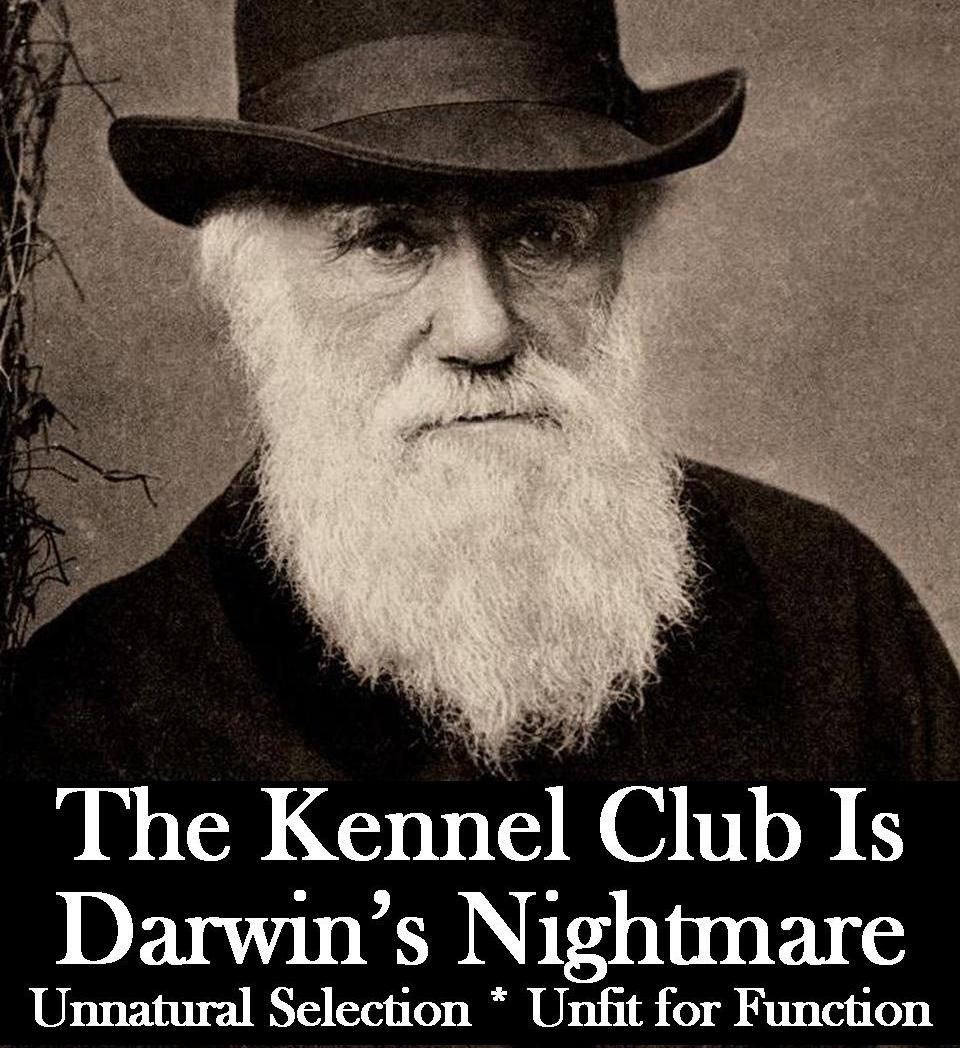
I have even produced a T-shirt noting that The Kennel Club is Darwin's Nightmare.

So imagine my pleasure to be told that a veterinarian in the U.K had produced a book about Darwin that took the Kennel Club to task for selective breeding for dysfunction. Excellent.

Best of all, the book was free. A FREE book?! Double excellent! I went to the link, and you can too.

A quick look at the PDF told me the book was by Matthew Watkinson.

The name sounded familiar, and then it rang a bell -- he had written an article in The Daily Mail a month or so back, talking about the fleecing of customers by veterinarians. There were a few problems with the article, but I blogged the part I liked, said nice things, and moved on.

This new book on Darwin was by the same person? Excellent! This should be good. I dived right in.

The first caution was the cover. The title was a clear rip-off of the title of Darwin's own seminal work.

I suppose Watkinson meant it to be a bit clever, but I found it an affront for someone to more-or-less title their own book as "Volume 2" to Darwin.

Plus, it would be a hard act to pull off. Several hundred books have been written on Darwin and The Origin of Species, many by brilliant writers and thinkers.

No matter, I thought. Let's not judge a book by its cover. Let's read the thing instead.

If the cover of the book had an odor of arrogance, the first 50 pages spoke of some confusion. I scrawled in the margin: What is this book about?

The book did not start with a thesis. It did not start with a historical account of Darwin's works, or even talk much about what Darwin said at all.

Instead, there was a proclamation by the author that unlike everyone else in the world he was going to be "objective" and not "sentimental".

In addition, there was the proclamation by the author that he hated the color "grey" -- he wanted to paint only in black and white, and he was going to eschew any subtle shading.

And finally, there was the note that no one could argue with him about anything, because if they tried they would really be arguing with Charles Darwin (and of course, who has the temerity to do that?).

Hmmmm.....

I carried on. After all, I wanted to like this book. I really did.

In the first 50 pages, there was a nice screed on how Kennel Club dog breeders have too often selected for defect.

The trouble was that the examples given seemed culled directly from the BBC's Pedigree Dogs Exposed and subsequent coverage, and seemed more like a recitation that a real examination.

Surely a trained veterinarian would be able to give other examples of selective breeding for defect -- pigeons, turkeys, chickens, and goldfish, for example?


On the upside, there was a very nice section about dairy cows, but here too I noticed that a lot was left out.

Cattlemen, after all, created the first animal registry in the world, and they were also the first to abandon it in order to outcross to preserve herd health. There was no mention of this, and it seemed a glaring omission.

On page 92 I wrote in the margin: "Was there an outline for this book?"

I wrote the same question three more times as I read to the end, and on page 225 I still wondered what the thesis was supposed to be.

All I knew for certain was that Matthew Watkinson, while sometimes an entertaining writer, did not have a very strong command of the material he sought to claim title to.

Quite simply, he did not do his homework.

The gaps in Watkinson's knowledge and theories are not small -- they are deep and wide.

Consider this: Watkinson has written an entire book on Darwin that never mentions Alfred Russell Wallace, who co-presented (with Darwin) their theory of evolution to the Linnean Society of London in July of 1858.

Watkinson also makes no mention of Darwin's writings on geology (Darwin's necessary proof of an ancient earth), the breeding experiments of Robert Bakewell, or even Erasmus Darwin (Darwin's grandfather), whose own work, Zoonomia, served as Darwin's intellectual chassis.

Watkinson barely mentions the Galapagos Islands, never talks about Darwin's correspondence with dog and pigeon fanciers, or the taxonomic discussions about finches with John Gould (for whom the magnificent Gouldian Finch is named).

In Watkinson's presentation of Darwin's work, in fact, there is no intellectual past, no intellectual development to the present, and truth be told, not much Darwin.

Hundreds of books and treatises have been written about Charles Darwin's theory of evolution, but I do not recall Watkinson quoting a single one.

While Watkinson does manage to squeeze The Descent of Man into two footnotes, he never mentions The Expression of the Emotions in Man and Animals at all, nor does he reference Darwin's other lengthy work on barnacles and worms.

What is Watkinson trying to say in this book? I have no idea.

At one point I noted in the margin that Watkinson seemed to have just discovered death, while later on I noted that he seemed to think there were no other force at work when it comes to natural selection.

At the end of my reading, I set the book aside and let it percolate in my brain for a day or two.

Slowly, an idea dawned in my head. . . . .

The book read as if it was written by a young man who had a Big Idea expand in his mind to fill every empty crack.

Could it be that Watkinson had read only one book -- The Origin of Species -- and then riffed on it for 225 pages without reading anything else or talking to anyone else?

That would be impossible, right?

In fact, believe it or not, that seems to be exactly what happened.

In an interview with a self-publishing website called "BubbleCow" Matthew Watkinson confesses that he began reading Darwin just one year ago, and he decided (in some sort of manic-expressive fever) to begin writing down everything that came into his head.

Quite sadly, this is exactly how the book reads -- as a somewhat sophomoric rant by someone who confuses wild speculation with careful research, and who thinks page numbers are the only structure needed.

Is Watkinson wrong on every page?

Absolutely not.

He is correct that many species are selected for defect by the hand of man. This is not a small point, but it is a point made by many others in the past, and Watkinson hardly treats it with the well-researched treatment that it deserves.

Watkinson is also right that species are too-often split for purely political and self-aggrandizing reasons. Here too, however, he is not saying anything new. The running battle between taxonomic splitters and lumpers is old, but Watkinson does not acknowledge that, much less quote experts or give the reader any guide on how to think straight. Instead we get a kind of stream-of-consciousness in which the chief goal seems to be mock everyone in the world who might actually know the difference between one species and the next.

In fact, this is what Watkinson spends most of his book doing -- serving as a juvenile and cynical sniper plinking at others. And to what purpose? It is not clear. In the end, one is left suspecting that it is all vanity, and with not too much to say (because he does not really have a good command of the material) he has been reduced to doing little more than tossing out one-liners. It is (at best) cleverness masquerading as thought and knowledge. At worst it is a rambling, chaotic bore with wild side trips into poor thought and ignorance.

One small problem is that Watkinson likes to toss words around, but he does not always know what they mean.

For example, he thinks a desert is as good as as a jungle. Anyone who disagrees is not being objective.

He thinks the death of a chicken is the same as the death of a whale. Anyone who disagrees is a racist.

He think the death of an individual animal is the same as the extinction of the entire species. Anyone who says otherwise does not understand Darwin.

In fact, Watkinson is simply an idiot.

Mother Nature does a lot more work in a jungle than a desert, and anyone who thinks the elimination of a species is the same as the death of an individual is laughable.

You could not get through a junior high biology class with that kind of "deep thought."

Watkinson seems to be struggling with the idea of discrimination, but he does not know enough to realize that discrimination is actually one of the driving forces behind evolution.

Why does a Bower Bird prefer one mate over another?

Why does a Lion prefer one mate over another?

Watkinson has no idea -- he does not even know enough to ask the question.


Watkinson's idea that a chicken is equal to a whale, because both are life (and who is to say one is better than another?) is patent nonsense.

A whale is at the top of a food chain. A chicken is not.

Food chain?

What's a food chain?

Right.

That's a word Matthew Watkinson does not type once in 225 pages. He doesn't talk too much about habitat either.

Mother Nature is actually quite objective about what individuals she thinks are important. She make hundreds of millions of mice, but gives them all a very short lifespan. The death of 50,000 mice then, is meaningless in the grand scheme of things. Mother Nature will "infill" that loss in a week.

Mother Nature makes very few lions, however, and gives them a much longer lifespan. The death of 50,000 lions has an enormous impact, and that impact flows downward through the food chain.

In fact, the death of 50,000 African Lions would wipe out that species in the wild, and that impact would reverberate for millenia.

The loss of 50,000 mice, however, would not reverberate for a week.


The fact that Matthew Watkinson misses such basic points speaks to his deep ignorance about wild places and wildlife. Quite simple, he does not know why big fierce creatures are rare.

Watkinson goes on to suggest that all conservation efforts are meaningless and wrong-headed.

And why?

Because, he explains with the wonder of a small child that has just discovered a one-size-fits-all theory, life on the planet cannot be wiped out.

Go on and poison the waters, chainsaw the forests, shoot all the elephants, and harpoon all the whales into extinction.

Dump toxins into the oceans and belch smog and greenhouse gases into the air. It will not matter in the slightest. After all, if earth survived the massive Chixculub meteor-impact that wiped out the dinosaurs, it can probably survive anything.

Right. . . . .

Apparently, it has not occurred to Mr. Watkinson that sending all life back into the basement of existence might not be the goal.

It might be . . . maladaptive.

Which brings me to the real (if unintended) lesson of this book ... and because Darwin himself was a lifelong lover of terriers, I will explain it in terms Darwin himself might have used.

When a small terrier enters a fox's den, the fox will try to bolt out any exit it can.

Failure to do so is "maladaptive" for the fox.

If a fox is pressed hard against a stop end, however, and it has nowhere to go, a wise terrier will stand back a few inches and bay.

Failure to do so is "maladaptive" for the terrier.

The point here is that fear and caution are adaptive mechanisms -- in a world that is "red in tooth and claw," the overly bold are quickly cold.

Nature tends to select for caution, and prune out those who, in arrogance or youthful enthusiasm, get in over their head.

In fact, it was because Darwin understood this so well that he moved so slowly when assembling The Origin of Species.

Darwin knew that while not everything he was talking about was entirely new (Darwin did not invent the idea of evolution), his presentation of the mechanical watchspring that was driving things forward would be fiercely challenged.

While he hoped his writing would eventually lead to illumination, he knew he had to prepare for the white-hot fire that was sure to precede enlightenment.

As a consequence, Darwin talked to everyone, read everything he could find, and corresponded with pigeon fanciers, dog men, chicken experts, and scientists up and down England, Europe, Asia and America for over two decades in order to back plaster his text with examples and authority.

Darwin teased through his own notes and those of others, and he walked around the sand walk at Down House mulling it all over, before going back to his desk to try to hammer it smooth and polish it bright.

Darwin was not going to rush to wreckage.

He was going to build slow, and write for the ages. He was going to organize things carefully and logically, stacking one brick on top of the other and checking it all with level and plumb.

He was not going to be "maladaptive."

Darwin stepped off the HMS Beagle in 1836, but it was not until 1859 that he was ready to roll out his master work for the public -- 23 years later.

Watkinson? I do not think it took him 23 weeks of actual writing.

The story is not over yet, however. You see, while Darwin had an inheritance and a family income which allowed him to live off his investments, Watkinson tells us that "Like a demented robot I remortgaged the house to fund a totally unnecessary search for the truth."

Right.

  • Unnecessary

  • Poorly organized

  • Weakly researched

  • Fatally flawed


In short, "maladaptive."

The ironic lesson here is that like any species, books seek to fill ecological niches.

Whether they succeed or fail has lot to do with whether they are an improvement on the old, or whether they are simply a teratogenic mess whose parts never quite get organized and fused together.

Sadly, Destiny of Species is the latter, not the former.

I had hoped it would be so much better.


* * * *

Of course, one man's opinion is never "the seal of the prophet". Since you can download your very own copy of this book and read it for free you can always do that. Time however is more precious than money, and you might want to do something different instead; actually read the original Darwin (also for free). I assure you it is much better than what Watkinson has too hastily sent up the flagpole. For those who prefer to read their Charles Darwin in hardcover, this looks to be a pretty nice edition.


..

Friday, January 22, 2010

Kennel Club Dogs: Unnatural Selection for Defect


Over at Science Daily, they are reporting on a new study by biologists Chris Klingenberg, of The University of Manchester, and Abby Drake, of the College of the Holy Cross in the U.S., on the extreme morphological variation to be found in the world of dogs.

The core findings, published earlier this week in the peer-reviewed journal, The American Naturalist, are that:

  1. When the skull shapes of domestic dogs were compared to those of entirely different species across the order Carnivora (which includes cats, bears, weasels, civets, seals, and walruses), the extremes of diversity were farther apart in domestic dogs than in the rest of the order. This means, for instance, that a Collie has a skull shape that is more different from that of a Pekingese than the skull shape of a cat is from that of a walrus.

  2. Almost all of the morphological variation in dogs has come through selective breeding in the last few hundred years, most of it since the rise of dog shows in 1859.

  3. What is going on with dogs is unprecedented in the history of the world in terms of the degree of selection for the unfit at the hand of man. As Dr. Klingenberg notes, "Domestic dogs don't live in the wild so they don't have to run after things and kill them -- their food comes out of a tin and the toughest thing they'll ever have to chew is their owner's slippers. So they can get away with a lot of variation that would affect functions such as breathing and chewing and would therefore lead to their extinction."

  4. Purely pet dogs are the most likely to be selected for maladaptive defect and deformity, while working dogs, such as hunting, herding, and guarding dogs are less likely to be saddled with extreme morphological variation. Notes Dr. Drake: "[Companion and pet] dogs are bred for their looks, not for doing a job, so there is more scope for outlandish variations, which are then able to survive and reproduce." In short, Kennel Club companion dogs are a product of unnatural selection and are often unfit when looked at in the most basic of Darwinian terms.

Study citation: Chris Klingenberg, Abby Drake, 'Large-scale diversification of skull shape in domestic dogs: Disparity and modularity. The American Naturalist', January 2010

Monday, November 09, 2009

Deer v. Lion at National Zoo in D.C.


A wild deer from Rock Creek Park jumped into the lion exhibit at the National Zoo on Sunday afternoon.

One word: maladaptive.

A female lion went after the deer, mashed it to the ground, and then let it go. The deer dived into the moat and got got away. Zoo officials cleared visitors from the area and rescued the deer, but its injuries were too serious and it was euthanized.

Monday, October 12, 2009

So You Want a Dog?

This piece is from the July issue of Dogs Today.


Terrierman's Top Ten Tips for Avoiding Expense & Misery


Two stories recently crossed my desk almost simultaneously.

The first was how the tallest dog in the world, a Great Dane living in Southern California, was dead at age 7.

The second was about how the oldest dog in the word, a cross-bred Jack Russell in Louisiana, was still kicking at age 26.

I was not too surprised by either story.

You see, the health and longevity of dogs is directly related to such things as size, breed, and gene pool diversity.

Pick the wrong breed of dog to love, and heartache and jaw-dropping veterinary bills are likely to follow.

Follow a few simple rules, however, and you may save a lot of money, as well as avoid a lot of pain and heartache.


10 simple tips for selecting a happier and healthier canine companion:

  1. Rethink the dog.
    Do you really want a dog? This is the first question that needs to be asked. You see, most people want a puppy; they do not want a dog. A puppy is cute and triggers both maternal and paternal instincts. They seem like no problem at all. A dog, on the other hand, will get you up at the crack of dawn, will bark in the back yard, will eat your couch, and may occasionally urinate or defecate on your rug. Here's a test: If you will not consider getting an adult dog from a local shelter or over-stocked breeder, you do not want a dog. You want a puppy. And what you need is a cat.

  2. Don't become breed-fixated.
    Having decided to get a dog, most people start flipping through the pages of an all-breed book trying to decide which breed. Big mistake. Deciding to get a specific breed can dramatically increase your chance of getting a dog with serious health issues. Dog insurance records show pedigree dogs are less healthy, as a group, than cross-bred dogs. Canine health surveys show that 40 percent of Kennel Club dogs in the U.S. have genetic defects of one kind or another -- hip dysplasia, heart murmurs, deafness, cataracts, spinal problems, glaucoma, Cushings disease, autoimmune disorders, hypothyroidism, epilepsy, congenital skin conditions, polyarthritis, progressive renal atrophy, and genetic predispositions to cancer, to name a few. Instead of focusing on a breed of dog, consider focusing on a broad type of dog: a terrier, running dog, lap dog, guard dog, herding dog, retriever, or pointer, for example. After that, look for either a cross breed of the type, or get the healthiest breed of that type.

  3. Avoid giant breeds.
    The larger the dog the shorter the life, and the more expensive the care and maintenance. This is particularly true for giant breeds like Wolfhounds, Deerhounds, Great Danes and Mastiffs, which often come with expensive veterinary bills and short lives due to cancer and gastric torsion (bloat). Other common health issues associated with giant breeds are heart problems, and spinal injuries due to massive heads being supported on overly long necks. Along with sobering veterinary bills, also expect to pay more for fencing, crates, food, and boarding. Finally, after shelling out a lot of money, expect a really giant dog to be dead by age seven or eight.

  4. Avoid "tea cup" dogs.
    Tea cup dogs generally come with a host of problems. Their jaws are almost always over-crowded with teeth, and their bones can be so small and brittle they may break if the dog jumps off the couch. Another common problem is hydrocephaly (water on the brain) caused by too much cerebellum crammed into too-tiny skulls, leading to domed-shaped heads and skull plates that do not completely close over.

  5. Try to get a dog weighing less than 40 pounds.
    Cruciate ligament and other expensive joint problems are far less likely in dogs that weigh less than 40 pounds. By going with a dog that weighs less than this limit, you remove some of the most common, and most expensive, health care problems from the table.

  6. Avoid dogs with misshaped bodies.
    Dogs that are out of proportion tend to have higher-than-normal health care issues, whether these dogs have massive heads (like English Bulldogs), or tiny legs (like Dachshunds and Basset Hounds). A lot of truly misshaped dogs suffer from a kind of dwarfism called "achondroplasia" which not only stresses joints, but is also associated with serious back and heart problems.

  7. Avoid flat-faced dogs.
    Dogs that have extremely flat-faces are called brachycephalic breeds, and they typically have a hard time breathing, get winded and overheat easily, and often have soft palate issues which may require corrective surgery. In addition, due to the flatness of their faces, English Bulldogs, Pugs, Pekingese and other flat-faced breeds are especially prone to eye injuries.

  8. Avoid merle-coated dogs, dogs with pure white coats, spotted dogs, and dog with blue eyes.
    The genetics here are complicated, and change a bit from breed to breed, but as a general rule dogs that have spotted coats (such as Dalmatians), merle coats, pie- bald coats, all white coats, or blues eyes, are best avoided if you want to decrease your chance of getting a deaf dog.

  9. Avoid dogs with exaggerated features.
    Exaggerated features are almost always maladaptive, which is why they are not found in natural dogs. Dogs with deep skin wrinkles, long pendulous ears, and extra long backs all come with health problems associated with those conditions. As for "hair dresser dogs" with long, thick coats, remember that they rarely look as good at home as they do when on display at ringside or in a book. Do you really want to spend more time and money on your dog's hair than on your own?

  10. Avoid any breed with a disease named after it.
    If the breed under consideration has a disease named after it, consider that fair warning! Almost all breeds carry a genetic load of some kind, but some loads are much heavier than others. The last thing you want to discover is that your breed is "really prone" to cancer, hip dysplasia, heart problems, "eye anomaly," epilepsy, or congenital skin conditions.


What about that Great Dane, dead at age seven?
He was euthanized after coming down with cancer -- a very common outcome for this breed.

Of course the sadness with this dog probably started right at birth. You see, this was a Harlequin Great Dane. About one in four Harlequin Great Danes are born deaf, and most of these dogs are put to sleep -- something a professional breeder might "take care of" on their own by simply slipping a new-born puppy into the freezer.

Buy a Harlequin Great Dane or a Dalmatian, and you become complicit in the routine and predictable euthanasia of puppies born with these kinds of preventable problems. Who wants to be part of that?

And what about that cross-bred Jack Russell?

Most terriers are small dogs and, as noted, smaller dogs live longer. Cross-bred working terriers like Jack Russell's are particularly hearty due to their genetic heterogeneity. When small size, genetic diversity, and a low-calorie diet are combined, a terrier's lifespan routinely reaches 15.

A 26-year old dog? Clearly, this dog is a very special case. That said, it's no surprise that the world's longest-living dog is not Kennel Club registered, is a moderately small dog, has a normal body shape, has a pointed face, and does not have a spotted or merle-coat.

Bottom line: Canine health and longevity are not an accident. By following just a few basic "rules of thumb" when selecting your dog, you and your family can avoid a lot of unnecessary pain, heartache and expense.
.

Monday, September 21, 2009

Roadkill Blues

Roadkill is a 20th Century phenomenon, which is to say that we did not have it in the 19th Century when the roads were populated by horses and carriages.

Oh sure, we had some train kills -- deer and moose and cows and buffalo, but that's trackkill, not roadkill. And, of course, some horses died on the road from exhaustion or being shot, but they too were not roadkill as we define it here -- animals dying from vehicle impact on the road.

In fact, roadkill is probably the wrong term, even if it is the one we use. Carkill is what this really is; the road, after all, is simply a passive observer.

The problem with the term "carkill," is that it puts us in the picture. Roadkill, however, is a term that conveniently assigns millions of drive-by deaths to an inanimate object. It is a comforting term that obsolves us of guilt.

Today, the Mercury Cougar (Automobilus detroitus) does some of the pruning work once done by the wolf (Canus lupus). Which is not to say Ford, Chevy, Toyota, Volvo, Mack Truck, and all the rest are not doing their part as well. They are.

Roadkill is not a small biological phenomenon, it is a big one. In my small state of Virginia, there are over 35,000 deer-car impacts a year. In Michigan, deer impacts are so pervasive (over 55,000 a year), that they use deer roadkill data to determine the deer population in the woods. In Pennsylvania, another 40,000 deer a year fall under the wheel. What's the national tally? Who know? The number 350,000 is tossed around, but that seems low. That said, not all states have as many deer as Virginia, Pennsylvania and Michigan, or as many drivers on dark or twising roads. So who knows? Whatever the number, it's clear that it is a lot.

Though I have no doubt that Darwinian forces are slowly playing out between animals and cars, the time-frame is still far too short. As a result, as brilliant as a squirrel is at figuring how to get to, and jimmy open, a bird feeder, it is still completely flummoxed by squealing tires and 4-cylinders. As a result, squirrels die in droves from vehicle impacts -- perhaps 40 million a year according to one back-of-the-napkin bean counter.

A few more sobering roadkills numbers, and some descriptive reasons as to why some animals are more likely to die on our highways than others:

  • Dogs: 1.2 million dogs are killed on U.S. roads every year. Most of these dogs are killed in the daylight while chasing a ball, child, cat, or squirrel. Fences and leashes keep dog alive. No fence and no leash, and the result is predictable.

  • Cats: Cars kill about 5.4 million cats per year -- more cats than are killed in all U.S. animal shelters. Most cats are hit by cars at night.

  • Snakes: Snakes are cold-blooded and will warm themselves on asphalt, especially on poorly-traveled rural roads. Because snakes are small and easily obliterated by tires, there are no good numbers, but they are huge.

  • Opossums: Opossums feast on roadkill, a habit that results in about 19 million opossums a year getting squashed. Possums are naturally slow, come out at night, and will often freeze in the headlights of a car.

  • Skunks: When threatened, a skunk's natural defense is to turn its back and spray -- a technique that does not work too well with cars. Most skunks are hit at night.

  • Groundhogs: An estimated 5 million groundhogs or woodchucks get hit by cars every year. Groundhogs are diurnal, but because so many den along roadside embankments in order to take advantage of soft dirt, good drainage, fewer predators, and good forage, they are often living just yards from traffic. Sure this is maladaptive, but groundhogs have not been programmed with cars in mind.

  • Raccoons: Raccoons frequently scavenge in roadside water ditches, are not too fast, are fairly belligerent, sometimes travel in trailing family groups, and hunt at night. Which is a nice way to say their are a lot of vehicle-raccoon impacts -- perhaps 10 million a year, maybe more.

  • Fox: Red fox are field-and-edge creatures, and are much more likely to be hit be a vehicle than a Gray fox which will generally be found in deeper woods and rocky areas. That said, both Red and Gray fox are night time scavengers, and as such are prone to being struck on the road while feeding on the carcass of a snake, possum, rabbit or squirrel previously struck by traffic. The saving grace of a fox is that they are very fast and extremely wary -- the two chief reasons you see fewer dead fox and coyote than you do dead raccoons and possums.

.