Showing posts sorted by relevance for query population control. Sort by date Show all posts

Monday, July 20, 2009

Population Growth & the Limits of Accommodation

I have, at various times in my life, been a ghost -- the hand inside the sock puppet, the idea and knowledge and voice behind the person with good hair who reads the lines in a speech and gets promoted up the chain of command for giving it.

There are no complaints here, so long as the check clears.

That said, sometimes, long after a speech has been given and no one can quite remember who gave it, I like to dust off a piece and trot it out for the ideas that are in it.

The speech, below, was given to Western land managers in Wisconsin some 5 or 6 years back by someone I will not mention, and it details the complex relationship between U.S. population growth, regulation, and the environment.

I post it here simply to illuminate the rather complex relationships that exists between population growth, economic growth, regulation, and agricultural policy.


The Limits of Accommodation

It's great to be here in Wisconsin, the home state of Aldo Leopold.

It is a true honor to be a stand-in for Senator Gaylord Nelson, the Father of Earth Day.

Senator Nelson was originally asked to speak about the environmental consequences of U.S. population growth for the American west.

I am going to speak on the same topic - a topic too often given short shrift in the environmental movement, but one that remains a core environmental issue.

My comments about population and the environment follow a pretty simple structure -- I am going to talk about where we have been, where we are, and where we are going.

I am not going to give you answers - I am going to give you scenarios and choices and ask you to think about those choices.

Good people can -- and will -- choose different futures for America and for the west.

That is perfectly fine. I am not interested in the choice so much as the process. I want the process to be thought through. I want the issues to be hashed out and mulled over.

And above all, I want the answers to come from the American people - not politicians in Washington or stock traders on Wall Street.

As Wood Guthrie said so well, "this land is your land."

First, let me talk about where we have been.

Well, we've been on Earth.

I make this point not to be flip, but to say that the story of U.S. population growth closely parallels that of world population growth --- at least through the first half of the 20th Century.

Between 1930 and today, world population tripled from 2 billion to 6 billion people.

This is a phenomenal rate of population growth, and it has shaped every thing on this planet, from coastlines to mountaintops, from the jungles of the Amazon to the pack ice of the Arctic.

During the same period of time, the population of the U.S. also grew by leaps and bounds, soaring from 122 million people in 1930 to over 285 million today -- not quite a tripling, but far more than a mere doubling.

Between 1935 and 1965, the U.S. and the world shared a similar population and environment story.

As human populations burgeoned, massive amounts of toxins - from raw sewage to pesticides - were washed into fresh water streams and rivers.

Overgrazing of marginal lands resulted in rapid erosion and desertification on all continents.

Over-fishing, pollution, and coastal development resulted in the systematic depletion of fish stocks and the destruction of reef systems.

New roads were ripped into once pristine areas - from jungles to mountaintops.

As more and more humans spread into new areas of the world, once-natural eco-systems were transformed into human-focused profit centers.

This is the population-environment history of the world, and for a long time it was the history of the United States as well.

Beginning about 1965, however, something interesting began to happen -- the environmental history of the U.S. began to diverge from that of much of the rest of the world.

While population growth continued apace, both in the U.S. and the world, the environmental consequences of population growth seemed to slow here in the U.S.

In the last 30 years our water has actually gotten cleaner

Our air has gotten better.

Much of our most depleted wildlife stock actually recovered.

We have more forest in the U.S. today than we did in 1930.

How is this possible?

The short answer is law, government and urbanization -- the stuff too many pure population pundits never talk about.

In 1911, Congress passed the Weeks Act which resulted in the federal government buying back millions of acres of denuded mountain tops that had been ripped and robbed by timber and coal mining interests. This land is the backbone of the National Forest system we have in the Eastern U.S. today.

At the same time, large-scale farm mechanization and the railroads made marginal farmlands in the eastern U.S. less profitable. Millions of cleared acres were allowed to return to forest.

Even as forests began to regrow back East, a new environmental awareness began to take hold in the U.S.

Led by people like Senator Gaylord Nelson, the nascent environmental ethic that had begun with Teddy Roosevelt and Aldo Leopold, began to take off. By Earth Day 1970, environmentalism had become a mainstream political force - a widely shared common value uniting us across race, religion, political party, class, and geography.

This was a marvelous thing, and marvelous things came out of it. Thanks to the growth of the American environmental movement, new laws were implemented, including the Clean Water Act and the Clean Air Act.

The result was that our air and our water actually got cleaner.

The same divergence that was occurring in terms of forests and clean water and clean air also began to happen with wildlife.

Commercial hunting of wildlife was banned at the turn of the century and, with the passage of the Lacey Act, wildlife hammered to the edge of existence began to slowly recover.

This recovery process was greatly accelerated with the passage of the Endangered Species Act in 1973, and with the rise of a professionally-trained corps of science-based land, water and wildlife managers.

The result of new law and good government was extraordinary: things began to turn around.

And what is more remarkable - or perhaps most remarkable - is that things began to turn around even though the population of the U.S. grew by leaps and bounds.

Consider this: Between 1970 and 2000 we added 100 million people to the population of the United States.

This is a LOT of people. One hundred million people is a population greater than ALL of the current populations of California, Oregon, Washington, Idaho, Colorado, Montana, Arizona, Nevada, New Mexico, Texas, Wyoming, Utah, North Dakota, South Dakota, Nebraska, Kansas, Oklahoma, Minnesota and Wisconsin COMBINED.

It is an extraordinary testament to America's environmental ethic and good government that between 1970 and 2000 we added 100 million people to the population of the U.S. and the water got cleaner ... and the air got cleaner.

Today we have more forests in the U.S. than we did in 1900 or 1930 or even 1970.

Today we have more protected land in the U.S. than we did in 1900, or 1930, or even in 1980.

Whale watching is a growth industry.

Today it is hard to imagine that populations of Canadian geese, whitetail deer, and beaver were once in critical danger. Today the issue for these creatures is control, not protection.

Wild turkey have rebounded too. Today there are more wild turkey in the U.S. than there were when Columbus landed.

The American Bison - almost extinct 100 years ago - is now so abundant the federal government will spend $10 million this year to manage down their numbers.

Elk populations have rebounded nicely too. A small elk herd was recently reintroduced into Kentucky -- where they were last seen in 1850.

Elk are not the only thing showing up in old haunts. Red wolves are back in North Carolina. And in Minnesota there are now over 2,500 gray wolves -- twice the target number the Fish and Wildlife Service hoped to achieve for that state when wolves were first protected back in the 1970s.

The alligator story today is not that they are endangered, but that they are eating the poodles of the retirees in South Florida.

The Bald Eagle may soon be off the endangered species list. The Peregrine Falcon already is.

Blue bird houses have helped restore the eastern blue bird. Wood duck nest boxes have brought back the wood duck.

All of this is great news. And it is great news that occurred despite the fact that we added 100 million people to the population of the U.S. in the last 30 years.

* * * * *


Please don't misunderstand me. I am NOT saying everything is fine with the environment.

We still have very serious environmental problems in the U.S. These include:
  • Phenomenal - even alarming -- wetlands loss across the U.S.

  • A coastal fisheries stock decimated by overfishing.

  • Massive crown fires in our forests out West due to 40 years of Smokey-the-bear fire suppression that wreaked havoc on the natural fire cycles.

  • Migrant bird species in decline over vast portions of the U.S.

  • Many wildlife species are still teetering on the edge - the condor, the ocelot, the lynx, and the grizzly bear - to name just a few.

Having said that, the BIG environmental story of the last 30 years is that we have made a HUGE amount of progress right here at home thanks to the rise of environmental regulation and consciousness-raising over the last 30 or 40 years.

I am very proud to say Audubon was part of that effort - an effort you folks were instrumental in making happen as well.

I am amazed it was possible despite the addition of 100 million more people in the United States.

Population growth did not HELP the situation, but the fact that progress was made DESPITE rapid population growth is a remarkable story.
* * * * *
So that is where we have been.

Now let me tell you where we are.

Right now, in terms of population size, the U.S. is the third largest country in the world -- behind only China and India.

The U.S. has the fastest population growth rate of any industrialized country in the world. No country in Europe has a population growth rate as fast as the U.S., and neither does Japan or Canada or East Asia.

Right now, according to the U.S. Census Bureau, about half of all U.S. population growth is due to immigration from overseas, and about half is due to native-born Baby Boomers moving to complete their own families.

Taken as a whole, the population growth rate of the U.S. is 1.1 percent. This may not sound like much - but it means our current population is on a trajectory to double in about 60 years.

To put it another way, our population growth rate right now is faster than that of China or Argentina, and it is about 10 times faster than the population growth rate of Western Europe.

Right now, we are adding about 3 million people a year to the population of the U.S. To put it another way, in terms of population growth, we are adding the population of Iowa every year.

Of course, U.S. population growth is not uniformly distributed.

Out West - where water is scarce and our last pristine wild lands can be found -- we find population growth rates that are truly sobering.

Nevada's population growth rate is now more than 4.3 percent a year - a population growth far faster than that found anywhere in the less-developed world . . . Faster than that of any country in Africa . . . Faster than that of any country in Asia . . . . Faster than that of any country in Latin America.

And Nevada is desert country.

So too is Arizona, which has an annual population growth rate of 2.8 percent -- the same as Pakistan's . . . the same as Tanzania's . . . the same as Honduras.

Colorado's population growth rate is 2.3 percent per year - a rate of population growth equal to that of Ghana and El Salvador . . . and faster than that of the Philippines.

Texas has an annual population growth of 1.89 percent per year - about equal to that of Mexico, and faster than that of Lebanon or Indonesia.

Of course, the U.S. is not a Third World country - we can pipe water in from vast distances, we can invest in low-flow shower heads and toilets, we can put in drip irrigation systems.

And - if push comes to shove - we can ban golf courses, swimming pools, and grassy front lawns.

In many communities and in many states these measures are already beginning to be put into place as communities find that local population growth has overshot the ability of the region to supply people, business and agriculture with all of their competing water needs.

Water is only part of the problem, of course.

As we were recently reminded with the energy crisis in California and the controversy over drilling in the Alaska National Wildlife Refuge -- and in every twist and turn of Middle East politics -- the U.S. is an oil-importing nation.

The good news is that conservation has done great things in the U.S. in the last 30 years. Our refrigerators, air conditioners and home heating systems are far more efficient that they were just 30 years ago. Our cars get twice as many miles per gallon as they used to.

That's the good news.

The bad news is that U.S. population growth has entirely negated these oil-conservation measures.

Remember those 100 million people that we added to the population of the U.S. between 1970 and 2000?

Those 100 million people are equal to ALL of the population of California, Oregon, Washington, Idaho ... ALL the states west of the Mississippi River COMBINED.

Now think about this: ALL of the cars driven in those states - and all of the homes heated and cooled in those states - represent the oil draw down of just 30 years of U.S. population growth.

Everything the current population of the U.S. west of the Mississippi River consumes, pollutes and builds -- now and into the future and forever - is equal to just the last 30 years of U.S. population growth.

The resource consumption and environmental damage caused by the population growth of the last 30 years is not a one-lifetime phenomenon. It will last for the lifetime of the kids and the grandkids of these 100 million new people. The human impact will NEVER stop. And the impact is huge - it is all of the land, water and resource use of the entire population of the U.S. now living west of the Mississippi River.
* * * * *
So that is where we are.

Now, let me talk about where we are going.

The first point I want to make is that we are going to have more population growth.

The question ahead - at least for the next 50 years or so - is not whether we are going to have population growth, but how much of it there is going to be.

The U.S. Census Bureau puts out three scenarios for the year 2050. The high and the low are outer-boundary possibilities, and the middle scenario is the "least likely to be wildly off the mark."

The Census Bureau's LOW scenario is that over the next 50 years the U.S. will add 35 million people -- or a population equal to that of all of California today. To do that, will require an 80 percent cut in net immigration to the U.S. and a pretty steep drop in the U.S. birth rates.

The Census Bureau's MIDDLE scenario for 2050 is that we will add 125 million people to the population of the U.S. in the next 50 years - a population greater than the entire population of the U.S. west of Mississippi River today. For this to occur, we would have to hold immigration at current rates, and keep birth rates from rising any further.

The Census Bureau's HIGH scenario for 2050 is that the population of the U.S. will nearly double. For this to occur, immigration would have to be allowed to double and then triple (what it has done in the last 50 years) and U.S. fertility rates would have to rise to the levels they were in 1967.

Obviously, adding 270 million new Americans to our population would have global resource implications, not just national, as we are the third largest nation in the world in terms of population and far-and-away the heaviest users of natural resources.

The Census Bureau's middle-series projection is probably closest to what we can expect.

It's basically a status-quo projection, and it would result in the addition of 125 million more people to the population of the U.S. over the next 50 years.

Let me remind you how many people 125 million people is. That's a population equal to ALL of the current population of California, Oregon, Washington, Idaho, Colorado, Montana, Arizona, Nevada, New Mexico, Texas, Wyoming, Utah, North Dakota, South Dakota, Nebraska, Kansas, Oklahoma, Minnesota and Wisconsin COMBINED ... plus the populations of Iowa, Missouri, Arkansas, and Mississippi thrown in for good measure.
* * * * *
OK, those are the numbers.

Now, here's a question: Can the U.S. handle the addition of this many people?

Of course it can!

The U.S. can handle 40 million more people.

It can handle 125 million more people.

It can handle 270 million more people.

The question is not whether the United States can handle this population growth -- but at what price.
What are the limits of accommodation?

You see, if we chose a population of 125 million or 200 million more people, other choices flow naturally from that choice.

As John Muir once observed, "if you pull on any one thing in nature, you will find it is connected to everything else." That is certainly true for population.

With the addition of 125 million more people, we may have to turn increasingly large sections of wild forest into tree farms devoid of most wildlife in order to meet our rapidly growing paper, pulp and wood needs.

With the addition of 125 million more people we may have to discourage sprawl by removing or limiting home-ownership tax incentives for those living outside of major urban beltways.

With the addition of 125 million more people - many of them in the arid West - we may have to ban swimming pools and golf courses and lawns . . . and mandate low-flow everything.

With the addition of 270 million more people, we may not be able to export food to the developing world.

I am not trying to be apocalyptic. I am trying to be honest.

If you chose one thing - continued rates of relatively rapid population growth - you may also be choosing something else as well.
* * * * *
Now, let me be a Devils' Advocate.

I started this talk by noting that we managed to accommodate the LAST 125 million people that we added to the U.S. population. While we lost our wetlands, mismanaged much of our western forests, and hammered our coastal fishing stocks, we also had some huge victories at the level of forest regrowth, clean water, clean air, wildlife reintroduction and wilderness protection.

Why can't we do that again?

Why can't we add ANOTHER 125 million people to the population of the U.S. and STILL have everything work out fine?

Perhaps we can.

In truth, no one knows.

In 20 years we may be flying around in solar-catalyst-enabled hydrogen-fueled cars.
In 20 years we may be growing twice as much food in half as much space.

In 20 years we may find a boundless clean-energy source that enables us to desalinate the ocean and pump it to Arizona for a fraction of a penny a gallon, enabling us to put golf courses and swimming pools in the desert without any perceivable harm to aquifers, streams or rivers.

I doubt that this will happen, but it COULD happen. Who knows?

Even if all that happens, however, I think we have questions to face because some things are NOT going to happen again.

We are not going to be able to make progress by enacting obvious legislative remedies like we did in the 1970s. All of the "easy picking" stuff has been picked. We've already taken most of the slack out of the rope.

Nor are we going to be able to create more political muscle to pull that rope. We are not going to create a new environmental movement in the U.S. We already have a pretty big environmental movement in the U.S. right now -- so big, that the Atlantic magazine notes that "everyone is an environmentalist now."

Let me tell you something else that is not going to happen: We're not going to get more wild western land.

Has anyone been to Yosemite or Zion National Park, or the Grand Canyon recently? God isn't making any more places like those. In Yosemite and Zion and the Grand Canyon we already have to park our cars and ride buses to see the natural wonders.

In National Parks and National Forests across the country we ALREADY have to reserve camping spots parks on line -- as if we were going to a rock concert.

What will it be like with 125 million more people?

How about birds? The birds in the Rocky Mountain west are in pretty good shape because there are still so many large blocks of unbroken forest. If we add 125 million more people to the U.S., however, we can expect to see increasing forest fragmentation due to roads, fires, and private developments. The relationship between forest fragmentation and bird loss is clear. If you fragment the forests you WILL have dramatic declines in many of the songbird species so many of us know and love. Is that OK? And what if some bird species - like the sage grouse - go extinct all together. Is that OK?

And how about fire? This is a hot topic right now - no pun intended. We're spending hundreds of millions of dollars right now to put out fires we might once have let burn. But we can't let them burn now, because there are million dollar homes up there on those timbered ridgelines. We have to suppress the fire to save the real estate. And the more real estate development there is, the more fire suppression we will have to do, and the bigger the fuels accumulation in the woods. Is that an expensive and unnatural cycle that we can live with? (Note: we can log, but the Federal Government LOSES a huge amount of money on logging every year. The more logging, the more money lost).

Anyone here hunt or fish?

Across vast sections of the American West the Mule Deer population is in rapid decline due to increased roading of once wild lands. At the same time our best trout and salmon streams are not only getting fished harder by more anglers, they are suffering from increased siltation due to more roads.
Anyone here believe that adding 125 million more people to the population of the U.S. will help either situation?
In fact, does anyone here believe that adding 100 or 200 million more people to the population of the U.S. will help improve ANY environmental issue we face today?

It's a Socratic question - a rhetorical question.
* * * * *
Now, you may have noticed I have not told you WHAT to think.

I have NOT told you that America will keel over with 100 million more people -- or even 200 million more people.

In fact, I think the PEOPLE will do fine.

I'm not so sure about the wildlife, however.

I'm not so sure about our last great wild places.

I have given you the Census Bureau's possible population scenarios - I have not made them up, I have only spelled them out.

I have NOT told you which one to pick ... only to think about the choices that each scenario may force us into -- as land managers, as environmentalists, as citizens, and as mother and fathers interested in passing on the essence of the American West to our children and grandchildren to come.

I have asked you, in short, to choose your future.

I do not live in the Western part of the U.S., and I am not going to tell you what choices to make. Different people have different values and may have different answers.

I would like to close with the words of Wyoming Governor Jim Geringer, one of the founders of the "EnLibris" platform that seeks to have the western states decide their own future for themselves.

Governor Geringer's writes in his guidebook on conserving Wyoming's open
lands:
"Today, the primary human impact on Western land has shifted from resource development to urban development and subdivisions that can reduce and fragment agricultural land and open spaces.

"Fragmented lands may cause progressive irreversible deterioration to the wildlife, natural resources, economic diversity and culture that define the West.

"Without the scenic views, agricultural land and wildlife habitat that open spaces provide, quality of life in Wyoming will decline.

"Rapid growth has created housing booms in the Rocky Mountain states,diminishing our neighbors' most fertile agricultural land, wildlife habitat and open lands. Strip malls destroy grain fields; housing subdivisions replace meadows. It's like paving the pastures of paradise ..."

* * * *

"It's like paving the pastures of paradise. "

I leave it to each and every one of you to decide if that is a good thing, or not.
43


Thursday, December 07, 2017

From Pearl Harbor to a Robot Economy


Pearl Harbor, USS Virginia

Today is Pearl Harbor Day, but if you ask a dozen people why Japan bombed Pearl Harbor back in 1941, not one will give you a complete answer.

Here's the short story: Too many people.

The entire War in the Pacific was initiated by overpopulation.

There is no "beginning" to this story, but suffice it to say that Japan was a very isolated country up until the late 19th Century. With the arrival of western influence, Japan began to change and demand for "western" goods such as steel and oil, skyrocketed.

So too did population.

In 1870, Japan's population was estimated to be 33 million. By 1900 it was about 45 million, and by 1930 it was over 64 million. An island nation, Japan's economy and social systems were beginning to show real stress by the second decade of the 20th Century. A key issue was lack of farm land.

Large rural families needed more land to support new families, but new land was simply not available. At the same time, rising urbanization created a new and rapidly growing demand for oil, coal, iron and steel -- commodities Japan had very little of.

Looking across a short stretch of ocean, the Japanese saw a vast amount of farm land and raw resources in northern China. In 1931 Japan invaded that region -- Manchuria -- in order to satisfy their "shortage" of resources which, in reality, was a "longage" of human population.

Japan's invasion of Manchuria led to a U.S. threat of an oil blockade of the island nation. This threat of an oil blockade led to the Japanese "first strike" at Pearl Harbor on December 7, 1941.


World War II is a long story, but the short version is that we won.  Japan had to give up its land grabs in Manchuria, Korea, the Philippines, and elsewhere.

After the defeat of Japan, Gen. Douglas MacArthur encouraged the development of new laws in Japan, including laws to allow women to vote and to hold elective office. In addition, he encouraged the amendment of Japan's pre-World War II pro-natalist law so that it now legalized abortion (which remained illegal in the U.S. until 1973).

Why did MacArthur and the Occupation Forces turn Japan's old "pro-natalist" law into a "pro-choice" law?

Basically, because they understood the causal origins of World War II in the Pacific.

Japan's overpopulation (or over-shoot of its resource base) was seen as a core issue of geo-political consequence. Slowing Japan's rapid population growth rate was, therefore, at the top of both the national and the global agenda. As one Japanese web site (written in semi-fractured English) notes: "How to popularize family planning became the No.1 policy in health care of postwar Japan ..."

With the end of WWII Japan switched from being a pro-natalist country to being a country that was interested in slowing population growth.

After the death and carnage of World War II, no one in Japan needed too much encouragement to consider voluntary family planning as an alternative worthy of consideration and support.

How did fertility fall so quickly in Japan? The mechanics were simple and effective, if not particularly modern or enlightened: Condoms and abortion. To this day, these are the primary birth control options available to Japanese women. Though Japan is on the cutting edge of electronics, they are in the Dark Ages when it comes to contraception. Low-dose oral contraceptives, medicated IUDs, injectables and implants were still not legal in Japan as of 2004, and the diaphragm is no longer produced there due to lack of demand. High-dosage pills and the copper IUD were only approved in Japan in 1999.

Despite the lack of contraceptive options, the Japanese saw rapid and amazing reductions in fertility after 1945. While the rest of the world experienced a Baby Boom, Japan saws its total fertility rate (TFR) fall from over four to two in the space of just 15 years -- a phenomenal rate of reduction even by today's standards.

One factor driving fertility reduction was later age at marriage. Another factor -- too often overlooked -- was crippling poverty after the War. Japan in the late 1940s and 1950s was a miserable place, and few people could afford to have the large families they did prior to World War II.

The real driver of fertility reduction in Japan, however, was a desire for peace and prosperity. While prior to WWII large families had been seen as a source of prestige and economic growth, afterwards they were seen as destructive to the long-term peace and economic self-sufficiency of the nation.

Japan's new small-family ethic was fueled by both central government and local Government commitment to the goal of slowing pre-war rates of human population growth. A system of midwives, nurses, family planning clinics and doctors was put in place and it took root with assistance from the Family Planning Federation of Japan (FPFJ) and the Japan Family Planning Association (JFPA).

While very wide, Japan's family planning program was not very deep. Despite a post-war interest in reducing the number of births, Japan has never really subscribed to what we in the U.S. think of as a "comprehensive" family planning program. Sex education in schools was (and still is) poor, and access to a full range of modern contraceptive choices was (and still is) very limited. In the 1950s, 60s, 70s, 80s, and 90s, the only "modern" contraceptive option was the condom. Though effective most of the time, the condom is not a perfect contraceptive vehicle. To be precise, condoms have a per-use failure rate of about 3%, which means even with "perfect use" the contraceptive device fails about 3 times a year on average (yep, 100 times a year is "average" according to the people that count these things).

In actuality, of course, we do not live in a perfect world with perfect and consistent humans. Due to inconsistent product usage (i.e. situational nonuse) the "real world" pregnancy rate for couples using only condoms is somewhere between 10 to 15 percent (numbers vary depending on the study).

Bottom line: There were (and are) quite a lot of abortions in Japan.

In 1996 the pre-World War II law was further amended and it is now called the "Mother's Body Protection Law" and remains the principle family planning law of Japan.

Today, Japan's total fertility rate is 1.4, one of the lowest in the world.

While Japan's fertility rate fell rapidly after WWII, and reached below-replacement levels by 1970, the nation's absolute population continued to grow. A population that had topped 64 million by 1930 was over 83 million by 1950, was over 103 million by 1970, and was over 123 million by 1990.

The good news is that Japan's population has very nearly topped out. The bad news is that it took 45 years AFTER it hit replacement level fertility (and then went far below it) to achieve this goal. And this is in a country with essentially zero immigration.

Today, across the world, the effect of Japan's post-World War II population growth is felt in the form of massive factory-like fishing fleets that prowl the world's oceans to feed that nation.

In the Southern U.S., massive chip mills pulp our forests to supply pulp for Japanese paper and wood-strand mills.

Forests in Burma, Indonesia, and Vietnam are being chainsawed to supply plywood. Around the world chainsaws and oil derricks crank out product going to a nation that had already "overshot" its resource base by 1931 -- and whose population has doubled since then.

While Japanese fertility declines have yet to translate into a smaller population size (I doubt Japan will ever return to a population small enough that it can actually live within the "carrying capacity" of the nation itself) a great deal of "Global Good" has come out of its lower fertility rates.

One bit of "good news" for Japan and the world was a tightening of labor markets that began to occur in Japan in the late 1970s as the low-fertility rates of the early 1950s moved their way up the population pyramid. As wages of entry-level workers began to rise in Japan due to labor market constraints, Japanese businesses began to export capital overseas in order to take advantage of lower-wage labor pools in developing countries (much as many U.S. businesses are doing today). Much of the "miracle" economic growth of South Korea was, in fact, abetted by Japanese money going overseas due to fertility declines in Japan that had begun 20 and 30 years earlier.

Japanese investment in Korea's economy, in turn, helped improve the status of women there and helped speed urbanization, which in turn helped to reduce fertility rates in that nation.

The same labor market constraints that drove some Japanese businesses to export capital in order to find cheaper labor drove other Japanese companies to automate. Today, Japanese industry has more robots and complex automation systems in place than any other country in the world -- one reason that both Japanese productivity and quality remain quite high.

Are there lessons here for the rest of the world? I think so.

Though far less pronounced than Japan's labor market contractions (due to a very long Baby Boom, higher domestic fertility, and high rates of international immigration here in the U.S.), U.S. capital movements to Mexico and other nations seem to be doing for these nations what Japan's money did for Korea (albeit at a slower rate due to increased diffusion of our capital over a larger area).

At the same time, the very same labor market forces that worked to push automation in Japan are doing the same here at home where timber, steel, and manufacturing plants are producing more products with less labor (and at higher quality) than ever before. Though we may not think factory automation has an environmental component, it most certainly does -- automated plants, as a rule, waste far less than their non-automated counterparts.

The big lesson, however, is that fertility decline is the START, not the end, of bringing the "runaway train" of population growth under control. Even after fertility has fallen to replacement levels, total population numbers continue to rise for decade after decade after decade.

For a country like the U.S., where the total base numbers are already very large, this is a very sobering thought.

In terms of absolute population size, the U.S. is already the third largest country in the world.

In terms of population growth rates we are not yet where Japan was in 1955 thanks to a combination of massive immigration and the highest fertility rates of any country in the industrialized world.

According to the U.S. Census Bureau's middle-series projections, the U.S will add more people to its population in the next 50 years as currently live West of the Mississippi River -- and this is the middle-series (most likely) projection.

Our population growth will not end there, of course.

Once the Population Juggernaut starts to roll, it tends to roll a heck of a long way before it comes to a stop. This has been true for Japan (which had rapid and sustained fertility decline and no immigration) and it will be even truer for the U.S. (which has non-sustained fertility decline and high immigration). It will be even more true for countries in Africa, Asia and Latin America that are still some distance away from achieving replacement levels of fertility.
.

Wednesday, September 07, 2016

Tree Huggers Discover the Best Way to Go Green


Over at Tree Hugger they have discovered the obvious: The Best Way You Can Go Green: Have Fewer Children:

Forget changing your lightbulbs, driving a car with high fuel efficiency, adopting a vegetarian diet or even switching to green power. If you live in the United States and really want to reduce your carbon emission legacy, perhaps the single largest change you can make to your life is commit to have fewer children.


The story goes on to quote a LiveScience article entitled Save the Planet: Have Fewer Kids

For people who are looking for ways to reduce their "carbon footprint," here's one radical idea that could have a big long-term impact, some scientists say: Have fewer kids.

A study by statisticians at Oregon State University concluded that in the United States, the carbon legacy and greenhouse gas impact of an extra child is almost 20 times more important than some of the other environment-friendly practices people might employ during their entire lives - things like driving a high mileage car, recycling, or using energy-efficient appliances and light bulbs.

"In discussions about climate change, we tend to focus on the carbon emissions of an individual over his or her lifetime," said study team member Paul Murtaugh. "Those are important issues and it's essential that they should be considered. But an added challenge facing us is continuing population growth and increasing global consumption of resources."

Reproductive choices haven't gained as much attention in the consideration of human impact to the Earth, Murtaugh said. When an individual produces a child - and that child potentially produces more descendants in the future - the effect on the environment can be many times the impact produced by a person during their lifetime.

Under current conditions in the United States, for instance, each child ultimately adds about 9,441 metric tons of carbon dioxide to the carbon legacy of an average parent - about 5.7 times the lifetime emissions for which, on average, a person is
responsible.

The impact doesn't only come through increased emissions of carbon dioxide and other greenhouse gases - larger populations also generate more waste and tax water supplies.


Of course births are NOT the main driver of U.S. population growth. Immigration is, and this has been true since the beginning, as the graph, below makes clear.


As John Chamie at Yale Global Online notes,

Contrary to popular thought, the dominant force fueling America’s demographic growth is not natural increase, but immigration. This is because immigrants not only add their own numbers to the nation’s overall population, but also contribute a disproportionate number of births whose effects are compounded over time.


Next time some vegan spouts nonsense to you about how the world is going to hell in a hand cart because there are too many people eating cows and chickens, do what I do: Suggest they get themselves sterilized and that they support immigration reform.

If that sounds harsh, be advised that voluntary sterilization is the most common form of birth control in the world. And yes, I advocate men get the procedure as it's a simple in-and-out operation for us.

Also be advised, that 82% of U.S. population growth is due to immigration, and that this immigration is negating ALL other savings being made through conservation.

Bottom Line: Stop talking about what other people should be doing (you cannot do a damn thing about them), and take direct action on the one thing you actually control.
You say you are an environmentalist? Prove it! Stop at none ... or one ... or two. And support immigration control.

.

Tuesday, March 15, 2011

Turning Japanese

Click to enlarge.

U.S. blood and treasure are spent propping up oil-soaked totalitarian regimes in the Middle East, but no one ever suggests that population growth is part of the problem. Instead, the problem is "consumption" or "the oil companies" or "the politicians," but never lack of birth control, or pro-natalist policies that subsidize large families, or runaway open-border immigration back home. It's a horrible bloody mess in the Middle East, but what are we to do?

In Asia, wildlife habitat is pushed to the edge but no one ever blames population growth as the core problem or suggests family planning as the solution.  What has happened to the tiger and the panda is ascribed to "habitat loss" -- a generalized problem without a causal agent. So sad, but what can anyone do?

Now, in Japan, we have four failing nuclear reactors spewing radiation. We are told the causal agent is an earthquake and a tsunami.

Well yes, but why does Japan need nuclear energy at all?  

And the answer, of course, is the same reason we have nuclear reactors in the U.S., and why we have strip mining and mountain top removal in Kentucky, and offshore oil drilling in Louisiana, and aquatic life-killing electrical power dams in Maine.

We rip down the mountains and push them into creeks in Kentucky. We soak our fuel rods in water pools and bury our nuclear waste in mountain caves. We strike another species off the endangered list and add another to the extinction roster.

It's unfortunate, but what can we do? 

One thing we cannot do is talk about population growth. 

Al Gore made an entire movie about global warming while never once mentioning population growth.  

We have entire television channels dedicated to every obscure battle of World War II, but not once do these stations explain why Japan bombed Peal Harbor or what that had to do with the invasion of Manchuria.

And so it's Groundhog Day all over again.

Talking about population growth is too personal. We might bruise someone's feelings. We might bump into someone's life mistakes, or their religious views, or their self-centered, ego-besotted, rationalizations for procreation. 

If we talk about population growth, things might get a little uncomfortable at some point. 

So instead of having an uncomfortable conversation, we push our rubble into landfills and buy bottled water because we are worried our dumps might be leaching toxins into the groundwater.

We send our sons and daughters to die in the desert, and then we collect our dead and wounded and fly them 6,000 miles back to the U.S. 

We clear-cut our forests in order to make the paper needed to send a million direct mail letters to people decrying the speed of species loss.

We snake long plastic booms along the shore to try to contain the oil spills, and we dump chemicals into the ocean to try to disperse it even as we dream of problem-free nuclear reactors that will bring us unlimited power forever.

But we do not talk about population. 

The ironic part about the nuclear mess in Japan is that after World War II Japan slowed its population growth. 

But, of course, the country was already over-crowded, wasn't it?  

A country that had a population of 45 million in 1900 was so crowded with a population of 65 million in 1931 that it sought to invade lands beyond its borders. 

By 1985, however, Japan's population had climbed to over 125 million, and it is even larger today.

And so, in order to deal with this press of flesh, the Land of the Rising Sun is now ringed not only with earthquake-prone slip faults, but also with nuclear reactors. 


This morning the talk is all about nuclear engineering.... how if only the Japanese had only put the generators on higher ground, or put the fuel rod containment pools further away, then everything might have been different.

Right. 

Talk about anything. 

But whatever you do, don't talk about why the reactors are there at all.  That conversation might get a little uncomfortable.

And, of course, it's not just about Japan, is it?   

No one in the U.S. wants to talk about why we continue to prop up Middle East dictators, or why we rip down our own mountains, or why we poison our own waters, or why we feel the need to build more nuclear reactors. 

U.S. population growth?  That's mostly fueled by immigration, and immigration is a conversation that is a little to uncomfortable for us to have right now, isn't it?

Sure, we couldn't take care of our own energy needs when we had a population of 200 million, and we are doing worse with 300 million, and we are quickly headed to 500 million by 2050, but let's not talk about that.   The crisis of the moment isn't here in the U.S. is it?  it's over there in Japan.  How come those people couldn't see this horror coming?  Talk about myopic!  Talk about bad planning!
.

Wednesday, May 07, 2008

Beyond the Border of Reason


Nothing hurts America's environmental movement more than nonsense, and the same can be said for America's immigration reform movement.

What piques my ire today? The latest bit of silliness is a post from CNN entitled "Border-fence dispute snares rare jaguars."

Of course, it's all an absurdity. Jaguars are fairly common in large parts of South America, and have never existed, as a resident population, north of the border, though there has always been a small population of about 100-150 animal in Northern Mexico.

So what's the big deal?

The issue, it seems, is that two environmental groups, Defenders of Wildlife and the Sierra Club, have filed an appeal with the U.S. Supreme Court claiming the new border fence under construction is "unconstitutional." And their rationale is (wait for it) that the fence would prevent the migration of non-existent and not-endangered jaguars!

To which I can only reply: Nonsense.

Pardon me if I do not fall down over this make-weight legal argument. This is not environmentalism; this is left-wing political pandering, and it undermines credibility which, once lost, is not easily repaired.

What is particularly unconscionable here is that the Sierra Club and Defenders of Wildlife have done nothing to help address America's open-border immigration policy which has fueled rapid U.S. population growth over the last 20 years.

And have no illusion as to why our environment is under siege. America's forests, fields, beaches, lakes, rivers and estuaries are not committing suicide; they are being cut down, drained, paved over and poisoned by population growth. As Jim Motavalli notes in E Magazine (Jan-Feb. - 2004):

"With U.S. population growing by three million a year, we lose two acres of farmland every minute, according to the American Farmland Trust. Traffic congestion costs drivers $78 billion a year, says the Road Information Project. A serious water shortage is developing nationwide, with aquifers once considered inexhaustible drying up."

And what is the Sierra Club's answer to rapid U.S. population growth?

Silence.

This is a group that thinks it's fine to talk about population growth overseas, but God forbid that anyone point out that legal and illegal immigration is now fueling more than 90 percent of U.S. population growth at home.

God forbid that anyone note that the U.S. has the fastest population growth rate of any industrialized country in the world today.

God forbid that anyone note the recent USA Today headline: "Expert: U.S. population to hit 1 billion by 2100."

Andy Kerr of the Oregon Natural Resources Conservancy (one of Oregon's foremost environmental activists, and a true warrior for the environment), got it right in 2002 when he called the big "green" groups to task for being silent apologists for runaway U.S. population growth:

Immigration is a very divisive and sensitive issue that nonetheless must be discussed. To those who support generous immigration, I ask you this: Why are you on the same side as Microsoft and the other huge computer corporations, and of Archer Daniels Midland and the rest of the agribusiness lobby? How can you support a policy that helps ensure that our existing poor will never be adequately valued for their labor?

To those who oppose immigration because of racist and/or xenophobic reasons, I say to you: Go to hell. The issue is immigration, not immigrants.

I come to my support of immigration reform from an ecological carrying-capacity perspective. Be it a house, a block, a city, a watershed, a state, a bioregion, a nation, a continent, or a planet; all have a carrying capacity. . . .

The only smart growth is no growth.

Remember Isaiah 5:8: "Woe unto them that join house to house, that lay field to field till there be no place that they may be placed alone in the midst of the Earth."

.... [T]he Oregon we love is like a car speeding toward a cliff. While may disagree on the rate of speed, or the distance left to the cliff, those are details that in the end don't matter.


To which I would add only applause and an "Amen."

Meanwhile our politicians continue to pander as hard and fast as the Sierra Club and Defenders of Wildlife do.

John McCain wants a huge amnesty, and if he's put in office with a Democratic House and Senate (as seems likely), it will be the only thing the two sides can agree on, and it will sail through Congress with the speed of a War Powers Act after Pearl Harbor. Besides, at the advanced age of 71, John McCain is not going to run for President again, so what does he care that an amnesty is unpopular with the American people? He's "Maverick" by God, and he will do what he wants. Besides, he figures, jamming an illegal alien amnesty for 12 million will get in the history books. And, no doubt, he is right on that!

As for Hillary Clinton, if she becomes the Democrat nominee, John McCain will win the presidency. It really is that just that simple.

Which leaves us with Obama.

He too gives a nod to amnesty (all three candidates do), but in reality, I think he will have too many other big agenda items on his plate to ever get this one done.

If elected, Barack is going to be up to his ass ending the war in Iraq, stabilizing and reducing gas prices, fixing our broken trade policy, putting the housing crisis in order, repairing our roads and bridges, and regaining control of our borders. Though he mumbles a little about an amnesty, Barack has consistently said that we need to put immigration law enforcement first and he supports a fence at the border and tough, and enforced, employer sanctions). With Barack, an illegal alien amnesty may be on the agenda (same as with McCain and Hillary), but unlike McCain, it is part of his agenda I do not think he will ever catch up to because bigger, more important, issues will always get in the way.

Saturday, February 13, 2010

For Valentine's Day: A Field Guide to Contaceptives


The single greatest threat to wildlife and wild places in the world today is unrestrained population growth and the poverty that is maintained by that population growth.

For far too long, environmentalists have wrung their hands and talked too vaguely about "development," "industry," "mining," "drilling,' "over-fishing," "factory-farming" and "consumption."

All of these are symptoms of the same disease: too many people.

Even as environmentalists have shied away from naming the problem, too many others remain entirely ignorant about the mechanics of the solution.

Here's a hint: it's not bio-diesel or backyard chickens, grass-fed beef or nuclear energy.

It's contraception.

The litany of birth control methods that follow is a thumbnail guide to some of the options women and men have today ... and might have tomorrow.

The good news is that today women have more birth control options than ever before.

The bad news is that there are precious few male contraceptive methods available, other than condoms and vasectomies, and many tried and true contraceptive methods, such as Norplant, are being taken away from U.S. women.

Research into male contraception is simply NOT getting the funding it deserves, and clinical trials are too small even when they produce promising results.

Please be advised that the list below is NOT comprehensive, nor is it designed to endorse any particular method of birth control. This list is simply a 'field guide' to some of the contraceptive options out there, and should not serve as a substitute for a physician's advice or your own research.


A FIELD GUIDE TO CONTRACEPTIVE OPTIONS

  • Male and Female Surgical Sterilization: Surgical sterilization is the most common form of birth control, both in the United States and overseas. In the U.S., among ever-married women ages 15-44 years, 41 percent now rely on surgical sterilization for contraception. Of this 41 percent, 26 percent report having had a tubal ligation, 7 percent had a hysterectomy, and 12 percent were currently living with a husband or partner who had a vasectomy. The above numbers do not quite add up, as some couples were double-covered, i.e. one partner had a vasectomy and the other had a hysterectomy or tubal ligation. Click here for more data showing the increase in surgical sterilization over the last 20 years. This trend is likely to continue as the population ages and as easier methods of sterilization are made available (see Essure and Quinacrine in the list below).

  • Essure: Essure is a type of permanent, FDA-approved contraception that does not require any incisions, and is inserted into a woman's fallopian tubes in less than 30 minutes in a doctor's office with only local anesthesia. Most women are able to resume their normal activities the next day. How does Essure work? Basically, a net-like sleeve is inserted into each fallopian tube, and the fallopian tubes, aided by the micro-insert, seal shut over the course of a three-month period during which time other types of birth control are used. The Essure inserts do not contain hormones, and are made out of the same nickel-titanium metal and polyethylene fibers that hold open Dick Cheney's heart vessels. Data from clinical testing shows that Essure is 99.8% effective in preventing pregnancy after two years of follow-up (the same as for a vasectomy or tubal ligation). 98% of women who relied on Essure rated their long-term satisfaction with the method was "good" to "excellent". Essure is not reversible. Essure was FDA approved in November of 2002.

  • FemCap and Lea's Shield: the FDA approved FemCap in April of 2003; it's been available in Europe for years. FemCap is a cervical cap used in conjunction with spermicide and it can be left in place for up to 48 hours. FemCap is not as reliable as an intrauterine device or hormonal methods of contraception and is reported to have a one-year failure rate of 20%. Lea's Shield, another barrier method, was approved by the FDA in March of 2002. Lea's Shield is a reusable, vaginal contraceptive made of medical-grade silicone rubber. One size fits all, and failure rates are reported to be about 15 percent over 12 months. Lea's shield has been in use in Germany, Austria, Switzerland, and Canada since 1983.

  • Ortho Evra Patch: The Ortho Evra patch was FDA approved in November of 2001, and is 99% effective in women that weigh less than 198 pounds. The patch is 1.75 inches square and is to be placed on the buttocks, abdomen, upper torso or outer part of a woman's arm. The patch releases progestin and estrogen hormones into the bloodstream to stop a woman from getting pregnant. A new patch in applied every week for three weeks, and the woman is supposed to go patch-free during the fourth week. The patch can withstand bathing, showering and exercising, and comes in a beige color that looks very much like a band-aid.

  • NuvaRing: The NuvaRing is a soft, flexible ring, about 2 inches in diameter that slowly releases estrogen and progestin after a woman inserts it into her vagina. The product is left in place for three weeks, and the woman is supposed to then go ring-free for the fourth week. NuvaRing was FDA approved in October of 2001, and is about as effective as hormonal oral contraceptive.

  • Mirena: Mirena is a hormone-releasing intrauterine device that can prevent pregnancy for up to five years. Marketed as "birth control for moms" Mirena is a plastic-T design, and like other intrauterine devices is a reversible form of contraception. Mirena was FDA approved in December of 2000.

  • ParaGard: ParaGard is a "Copper-T" intrauterine device that does not contain hormones and can be left in place for up to 10 years. A copper-T IUD can be used as emergency contraception if inserted within 5 days of having sex, and is a reversible but long-lasting form of birth control. Copper-T IUDS have been in use for more than 20 years, and more than 50 million have been distributed in over 70 countries around the world. The FDA first approved the marketing of the Copper T in the United States in 1984.

  • Seasonale is a series of active birth control pills taken for 84 straight days instead of the usual 21. The result of this regime is that a woman on Seasonale has periods only four times a year. FDA approval of Seasonale is expected within the next few months. A continuous regime of active birth control pills is expected to help women who suffer from heavy periods, bad cramps or endometriosis. Many women already use standard birth control pills in an "off-label" protocol to achieve these same results.

  • Depo-Provera and Lunelle: Depo-Provera is injectable progestin that inhibits ovulation, prevents sperm from reaching the egg, and prevents the fertilized egg from implanting in the uterus. It is effective for up to 12 weeks. Depo-Provera was FDA approved in 1992, and is now used all over the world. A similar product, Lunelle, provides contraception for one month, and is a combination of progestin and estrogen.

  • Norplant: Norplant consists of six silicone implants that continuously release synthetic progestin in order to provide contraceptive coverage for up to 5 years. First used in Finland in 1983, Norplant was approved for use in the U.S. in December of 1990 and is now used in over 44 countries around the world. U.S. sales of Norplant were discontinued in 2000 due to threats of litigation by a small number of women who claimed hair loss and depression caused by Norplant use. Though this litigation never came to fruition, in July of 2002 "due to limitations in component supplies" the manufacturer of Norplant decided to permanently discontinue the sale of this very effective reversible form of contraception in the U.S.

  • Today Sponge: The Today sponge prevents pregnancy by covering the cervix with a sponge containing a spermicide. The Today sponge was taken off the market in 1995 due to manufacturing problems at the plant. The Today sponge is now available again in Canada (it is now made in a new factory in New Jersey) and is expected to be available in the U.S. without a prescription in 2004. With a failure rate of about 10 percent, the Today sponge is not as reliable as an intrauterine device or hormonal methods of contraception, but is inexpensive (about $36 for a dozen) and women can use it only when they intend to have sex.

  • Implanon and Jadelle: Implanon is an implant placed into the under side of the upper arm and it protects against pregnancy for two to three years. Implanon works very much like Norplant, but has only one rod instead of six. Implanon has not always been injected correctly by inexperienced doctors. A minor change in the manufacturing process and delivery method is expected fix this. Not yet available in the U.S., FDA approval of Implanon is expected in 2004. Note that FDA approval does not mean the product will ever reach our shores. A similar product, called Jadelle, is a two-rod levonorgestrel implant that has been approved for use up to 5 years by the FDA, but is not yet on the market in the U.S.

  • Emergency Contraception: Two dedicated emergency contraceptive products are available: Preven and Plan B. Both work by delaying or inhibiting ovulation, inhibiting fertilization or inhibiting implantation of a fertilized egg. Preven and Plan B are little more than high-doses of normal birth control pills. Plan B is a progestin-only pill, while Preven is a progestin-estrogen combination. In California, Alaska, and Washington State, some pharmacies will provide emergency contraceptive pills without requiring you to see anyone except the pharmacist. In addition, emergency contraception is available over the counter in Quebec. If Preven or Plan B are not available, women can get the same results by taking several active birth control pills at once (see here for protocols). In addition to hormone-base methods of emergency contraception, the insertion of an IUD within 5 days of having sex, can also work.

  • Female Condom: The female condom is a lubricated polyurethane sheath with a flexible ring on the closed end, which is inserted into the vagina. The female condom is difficult to use and not very popular; the FDA reports a 22% failure rate (i.e. number of pregnancies expected per 100 women per year) as compared to 11% for male condoms.

  • Male Condoms: The male condom and the female condom, are the only two barrier methods which prevent the transmission of the HIV virus. Latex or polyurethane condoms do not allow the HIV virus to pass through. Breakage and slippage rates for latex condoms range from 2 to 6 percent, and may be higher among inexperienced users or those unable to read the directions. Condom breakage is related to how packages are open, how they are rolled on, whether and what types of lubricants are used, and the age and storage of the product. Due to slippage, breakage and inconsistent use, couples typically report a 10 to 15% annualized pregnancy rate with condoms.

  • Diaphragms with Spermicides: Diaphragm use has fallen off rapidly in recent years due to the product's high failure rate as a contraceptive (17% according to the FDA) and the fact that it also offers no protection from sexually transmitted diseases.

  • Quinacrine Sterilization: Quinacrine sterilization is achieved using quinine tablets (the same quinine tablets used for Malaria). Two quinine insertions, made one month apart, result in a chemical reaction which leads to a sealing over of the fallopian tubes, very much like what occurs with the FDA-approved Essure (see above). While Essure is fairly expensive, quinacrine sterilization can be done for very little money and few negative side effects have been reported. Over 100,000 women in 20 countries have been sterilized using quinacrine without a single fatality. With surgical sterilization, several deaths from general anesthesia or from surgical complication would have been expected in this number of procedures. Because quinacrine is such a cheap and easy method of achieving sterility, some human rights activists have raised the specter of mass sterilizations of the uninformed. In fact, quinacrine is much more likely to liberate women: female sterilization is the most common form of birth control in many countries, and would probably be even more popular if women were not incapacitated from work and did not have to notify their husbands before getting the procedure. An alternative to quinacrine sterilization, using erythromycin as a method of transcervical sterilization, is being researched by Family Health International which patented this methodology in March of 1999.

  • Abstinence: Periodic abstinence is the least effective method of birth control available. According to the FDA, the failure rate (number of pregnancies expected per 100 women per year) is at least 20 percent.

  • RISUG or SMA: RISUG stands for Reversible Inhibition of Sperm Under Guidance. In essence this is a method that coats the male vas deferans glands with styrene malic anhydride (SMA) mixed with the solvent DMSO (think of it as glue). RISUG does not completely close the vas deferens, but when sperm passes through the coated walls, an ionic charge is created that ruptures the sperm membranes causing them to be incapable of fertilizing an egg. RISUG has completed some small clinical trials, but it unlikely to be seen in the U.S. any time soon. A single injection of 60 milligrams of RISUG is thought to be able to provide contraception for up to 10 years, and the method is reportedly reversible.

  • Birth Control Pills: Birth control pill are safer and more effective today than ever before, and are available in a dizzying array of brands. Birth control pills, also called oral contraceptives (OCs), come in two basic forms: a combined pill consisting of two synthetic hormones, estrogen and progestin; and, the "minipill," which consists solely of progestin. The combination pill works by suppressing the natural hormones in the body that stimulate ovulation; the progestin-only pill works by thickening the cervical mucus and preventing the egg from implantation in the uterus. If taken consistently, both forms of birth control pills are very effective forms of contraception, with combination pills being somewhat more effective than progestin-only pills. The failure rate of combination pills is less than 1 per one hundred women using this method of contraception for a year. "The pill" is the most popular reversible contraceptive in use in the United States, with about 27 percent of all women that are having sex and using contraception choosing the Pill as their contraceptive option.

  • Vas Deferens Plugs: In China over 500,000 men have received polyurethane or silicone injections into their vas deferens. These injections harden to form a plug. Tests show a 98% effectiveness rate, and all the men who have had their plugs removed for at least four years have fathered children, most within the first year. Another kind of plug is the "shug," which is a made up of two non-injectible silicone plugs with nylon tails to help anchor the plugs to the vas. The Shug is also reversible, and is in clinical trials in China. Neither method is FDA approved in the U.S.

  • Male Hormonal Contraceptives: Several types of hormonal pills for men are currently being tested with mixed results. It appears that about 10% of all men simply do not respond to hormonal pills, and researchers are not sure why. Another problem is delivery: the male hormone pill has to be taken 3 times a day to keep androgen levels consistent, and if delivered as a shot it must be given as often as every 10 days. Male hormonal contraceptives have also produce some unpleasant side effects (such as nausea and weight gain). Contraceptive patches for men have yet to deliver enough hormones to be effective. Research is ongoing, but underfunded.

  • Gossypoll / Cottonseed Oil: Gossypoll is a substance derived from cottonseed oil. Large-scale studies done in China in the 1970s showed gossypol provided reliable contraception, could be taken orally as a tablet, and did not upset men's hormonal balance. Unfortunately, between 5 and 25 percent of the men who took Gossypoll for long periods of time remained infertile for up to a year after stopping treatment. In addition, gossypoll lowered potassium levels and strained kidney functions. Due to a combination of high infertility rates and renal interactions, research into gossypoll has largely been abandoned.
    .
.

Wednesday, May 25, 2016

A Truth Still Too Inconvenient for Al Gore


A nice man, a lovely family, and an inconvenient truth.


Ten years ago, I went to see "An Inconvenient Truth," Al Gore's global warming documentary.

I found the movie extremely well done and not boring.  I recommended the movie, noting that "it is certainly better than most of the pap offered up on the Silver Screen."

Having just given the movie "two thumbs up," however, I noted that there were a few "inconvenient truths" that Al Gore has left out of his documentary.

At the beginning of the movie, Al Gore tells us he has been following global warming issues since he was in college. Me too, and oddly enough for the same reason.

Al Gore was a student of Roger Revelle's at Harvard. It was Revelle who designed some of the first experiments and theories underpinning the nascent science of global climate change.

It so happens that my father was head of the climatology program for the American Association for the Advancement of Science back in the late 1970s and early 1980s, and worked closely with Revelle. In fact, I think my father may have written the first New York Times editorial ever written on global warming.

When Al Gore first met Roger Revelle back in 1966, Revelle was Director of the Center for Population Studies at Harvard -- a position he held from 1964 to 1976.

Gore manages to tell us quite a bit about Roger Revelle and his own youthful conversion to environmental causes without ever mentioning Revelle's demographic concerns, or the size of the Gore nuclear family.

In fact, I would argue this is not an accident. Population growth is an "inconvenient truth" -- the one that underpins global warming, and one that is particularly inconvenient for Al Gore as he tells us his global warming jeremiad.

You see, Al Gore has four children. Think about that for a minute.

If the average woman in the world followed Al Gore's lead, the population of the world would double every 25 years -- FOREVER.

Al and Tipper Gore chose to have more children than the average woman is having today in India, China, Zimbabwe, South Africa, El Salvador, Jamaica, Indonesia, Bangladesh, Vietnam or the Philippines -- to randomly pick from a few of the less developed countries from around the globe.

Al Gore had a choice to make when it came to having a family. He could have had no children. Or one child. He could have chosen to stop at two. He could have built his family through adoption or stopped at three kids. Instead, Al and Tipper Gore chose to double the human load they put on this planet.

It's not like Al and Tipper did not have access to health care and a diverse array of family planning options. Al and Tipper had more information about, and better access to, contraception than almost anyone else on the planet.

It's not like Al and Tipper Gore did not know better. Al and Tipper were married in 1970, at a time when Paul Ehrlich's book "The Population Bomb" was a national best seller, and when the speed of both world and U.S. population growth were core messages of the first Earth Day.

And yet Al Gore ignored it all. Al and Tipper had their first child in 1973, their second in 1977, their third in 1979, their fourth in 1982.

Let's put this story in numerical context. When Al Gore was listening to Roger Revelle at Harvard in 1966, the population of the world was 3 billion. Today it is over 6.2 billion people, and it will be over 12 billion by 2033 if the world follows the Gore model for family planning.

Gore's discussion of global warming shies away from causation. It is an odd but true fact that this very smart man has made an entire movie about global warming and greenhouse gases without once saying where those gases come from.

There's a reason for that. The inconvenient truth is that the world is NOT producing more greenhouse gases per person than it did in 1830 when the world had 1 billion people. Nor is it producing more greenhouses gases per capita than it did in 1930 when the world had 2 billion people.

The inconvenient truth is that the world is producing about the same or less greenhouses gases per person today that it did 50 or 100 years ago. People forget that horses produced serious amounts of greenhouse gases (methane) and so too did homes heated with wood and coal.


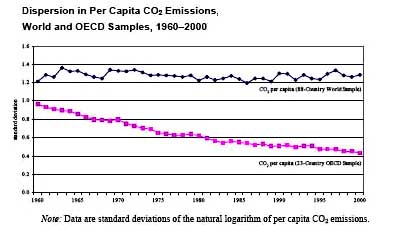
Table 1, page 19 from "Per Capita Carbon Dioxide Emissions Convergence or Divergence?" by Joseph E. Aldy, 2005 published by Resources for the Future (PDF)


The simple fact is that while the atmospheric level of CO2 has increased 30 percent since 1860, world population has more than quadrupled since then. Per capita CO2 emissions in the industrialized world are actually in decline, and have been for quite some time. When we look at all CO2 production, we find that global population growth and CO2 emissions track almost perfectly.

The problem is not that we are driving cars or cooling our beer in refrigerators -- it's that there are too many people. Too many people necessarily results in too many cars, too many refrigerators, and too many coal-fired electrical plants.

There are too damn many of us!


Population growth, energy use and CO2 emissions track perfectly. The causal agent here is human population growth -- an "inconvenient truth" largely glossed over in Al Gore's otherwise excellent movie. Figure 2 is from "Atmospheric Carbon Dioxide as a proxy for growth of the human population? ," 1995, University of Washington


Al Gore is willing to talk about rebuilding power plants,
building nuclear reactors, knocking down or retro-fitting every building on the planet. He is willing to discuss what's wrong with Ford and Chevy, but he is not willing to talk too long or too loudly about population growth for fear his audience might look over his shoulder to see how many people are sitting in his own family room.

Like most people, Al Gore is more comfortable talking about CO2 emissions than he is about IUD's. He would rather talk about the need for a new type of internal combustion engine than about the need for internal self-restraint, birth control pills, and vasectomies. He would rather count carbon molecules than count human noses.

In this sense, Gore (like most politicians) is part of the problem.

A politician is always willing to invest a few billion dollars to subsidize energy research at the local university, or pump a few billion dollars into a program to subsidize new car designs by General Motors. But talk about cutting back on immigration (which is driving nearly 100 percent of U.S. population growth), or pumping a billion dollars a year into Third World contraception programs and .... well, there are a thousand and one excuses to do little or nothing. To be fair, those excuses come from both sides of the political aisle. While people may be the source of greenhouse gas emissions, they are also the fuel of politicians, political parties and corporate sponsors.

And so, in the end, we have a movie about global warming that does not really talk about what causes global warming. How ironic is that?

Al Gore's global warming movie concludes by telling us to turn down the thermostat and to send more letters to Congress. It tells us to ride bicycles and use public transportation. It tells us to use more energy-efficient light bulbs and bring more people to the Al Gore movie.

But it does not tell us to have fewer children.

It does not remind us that an open-border immigration policy in this country has global resource consequences in the form of more greenhouse gases, more energy use, and more pollution.

Al Gore's slide show does not suggest contraception, immigration law enforcement, and communitarian self-restraint, nor does it point out that the science of reproduction is widely understood and that improved access to contraception is extremely popular across all cultures and religions. (Did you know that Catholic countries have the lowest fertility rates in the world? The abortion is legal in Italy? That Iran has below-replacement fertility? Did you know that the U.S. has the fastest population growth rate in the developed world?)

The end result is that Al Gore's movie on global warming offers us little more than hot-air solutions.

The inconvenient truth is that immigration-fueled population growth in the United States is negating every single energy conservation effort we are making in this nation today, and that population growth across the globe is negating every single energy conservation effort being made in the world today.

That's a message you won't hear at the local Multiplex or in too many discussions about "An Incovenient Truth" 10 years on.

It's a message that's still a little too "inconvenient."
_________________

Fun Facts:  Between 2006 and 2016, the world added more people than the entire population of the North America, South America and the Caribbean.  Or to put it another way, in the same period of time, we added more people to the world than the population of the United States, Canada, and all of Western Europe.