Showing posts with label wolfhound. Show all posts

Tuesday, February 20, 2018

Science Remakes the Dog


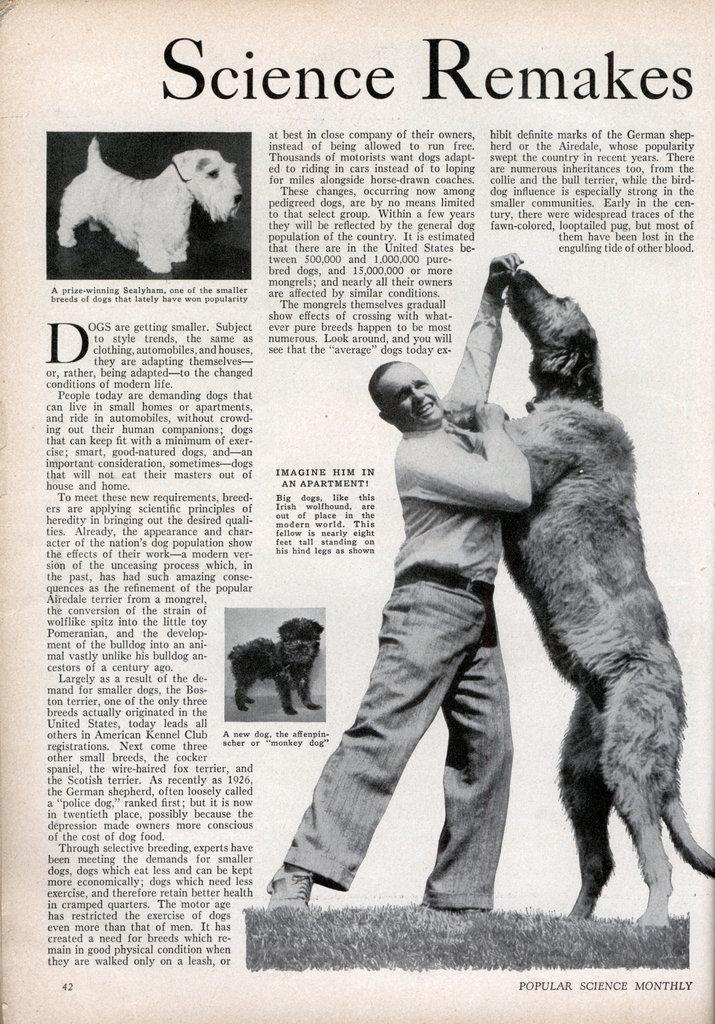
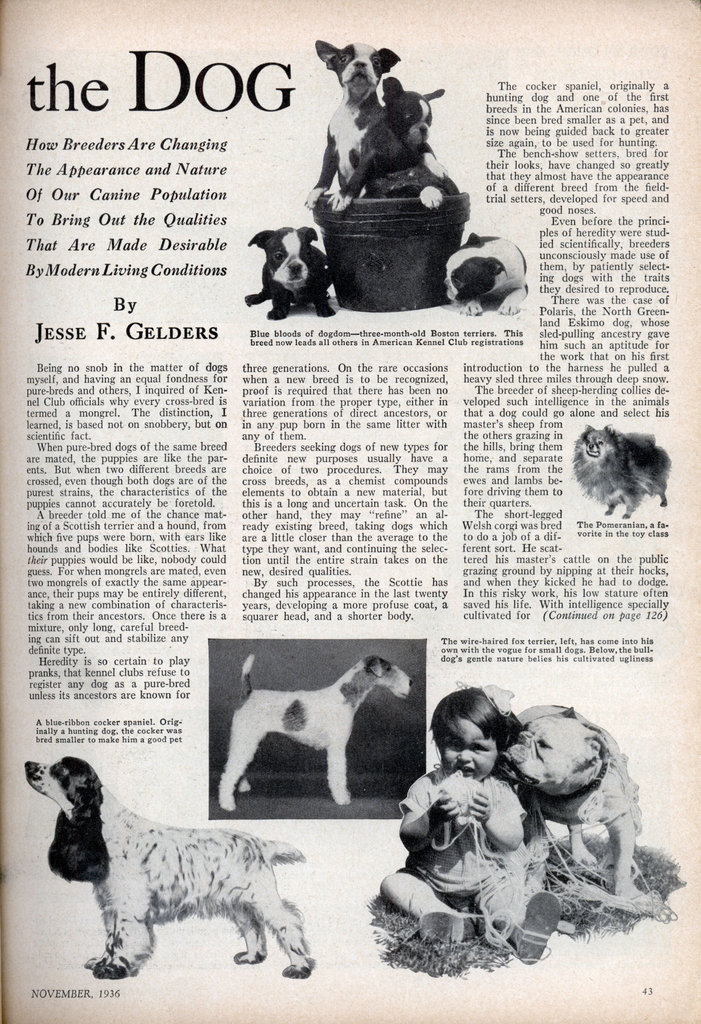
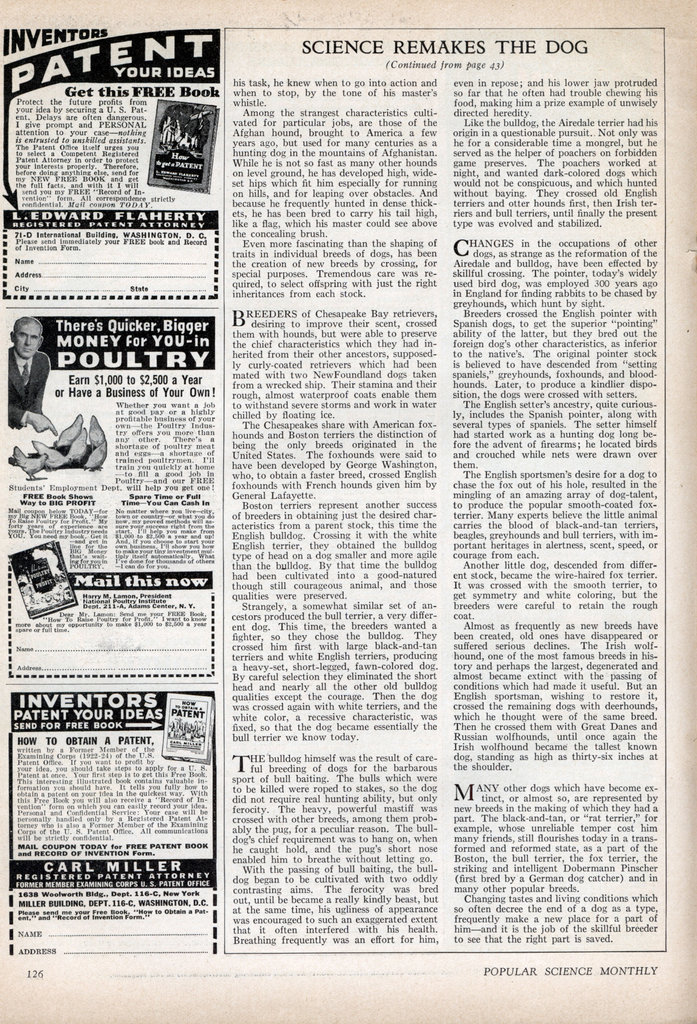
An article, from the November 1936 issue of Popular Science magazine is a good representative of the kind of congratulatory back-patting that went on during this period, as show ring and hobby breeders worked overtime to draw more and more working dogs into the Kennel Club.

Not the tone of the article: "Science" is improving dogs so they will be better suited to the modern world of cars, apartments, and limited time for their care and feeding.

In fact, these market forces continue to this day, as I have noted in an earlier post entitled "Robert Bakewell's Apartment."

This Popular Science article was written when the Kennel Club was just 65 years old, but problems already seem to be cropping up.

Notice that the Cocker Spaniel seems to have been "improved" to the point that it no longer hunts.

The Scottish terrier's morphology has been transformed with the "improved" dog having a shorter back, a larger head, and a longer coat -- improvements that made the dog incapable of going down a hole after quarry, ruining it as a true working terrier.

Then you have the various types of setters where bench and field animals had already diverged to the point that they appeared to be different breeds.

Finally, the Afghan is mentioned as a new and exotic breed brought to America. How long before the show-ring variant was wrecked as a coursing dog? Not long!

It should also be noted that some of the "history" given here is Kennel Club bunk. The Airedale, for example, is a modern creation derived from the Otter hound, and bred specifically for the show ring. It was never a "night poacher's dog," being too slow and heavy for rabbit, fox, or deer. Hunting otter is not done at night; it is tough enough to see the things in the daylight!

Similarly, the English Bulldog has very little of the old bull-baiting dog in it, and quite a lot of the monstrous pug to which it is much more closely-related!

As for fox terriers, by the time this article was written, almost no one was using a Kennel Club dog for anything other than a companion dog, as a close reading of Jocelyn Lucas's book Hunt and Working Terriers (published in 1931) will reveal.

Fox-working dogs have not been "improved" by science or show ring breeders; they have only been ruined by the rosette chasers.

The original art for this article can be seen here >> Page 1, Page 2, Page 3


Science Remakes the Dog
How Breeders Are Changing The Appearance and Nature Of Our Canine Population To Bring Out the Qualities That Are Made Desirable By Modern Living Conditions

By Jesse F. Gelders


DOGS are getting smaller. Subject to style trends, the same as clothing, automobiles, and houses, they are adapting themselves— or, rather, being adapted—to the changed conditions of modern life.

People today are demanding dogs that can live in small homes or apartments, and ride in automobiles, without crowding out their human companions; dogs that can keep fit with a minimum of exercise; smart, good-natured dogs, and—an important consideration, sometimes—dogs that will not eat their masters out of house and home.To meet these new requirements, breeders are applying scientific principles of heredity in bringing out the desired qualities.

Already, the appearance and character of the nation’s dog population show the effects of their work—a modern version of the unceasing process which, in the past, has had such amazing consequences as the refinement of the popular Airedale terrier from a mongrel, the conversion of the strain of wolflike spitz into the little toy Pomeranian, and the development of the bulldog into an animal vastly unlike his bulldog ancestors of a century ago.

Largely as a result of the demand for smaller dogs, the Boston terrier, one of the only three breeds actually originated in the United States, today leads all others in American Kennel Club registrations. Next come three other small breeds, the cocker spaniel, the wire-haired fox terrier, and the Scotish terrier. As recently as 1926, the German shepherd, often loosely called a “police dog,” ranked first; but it is now in twentieth place, possibly because the depression made owners more conscious of the cost of dog food.

Through selective breeding, experts have been meeting the demands for smaller dogs, dogs which eat less and can be kept more economically; dogs which need less exercise, and therefore retain better health in cramped quarters. The motor age has restricted the exercise of dogs even more than that of men. It has created a need for breeds which remain in good physical condition when they are walked only on a leash, or at best in close company of their owners, instead of being allowed to run free. Thousands of motorists want dogs adapted to riding in cars instead of to loping for miles alongside horse-drawn coaches.

These changes, occurring now among pedigreed dogs, are by no means limited to that select group. Within a few years they will be reflected by the general dog population of the country. It is estimated that there are in the United States between 500,000 and 1,000,000 purebred dogs, and 15,000,000 or more mongrels; and nearly all their owners are affected by similar conditions.

The mongrels themselves gradually show effects of crossing with whatever pure breeds happen to be most numerous. Look around, and you will see that the “average” dogs today exhibit definite marks of the German shepherd or the Airedale, whose popularity swept the country in recent years. There are numerous inheritances too, from the collie and the bull terrier, while the bird-dog influence is especially strong in the smaller communities. Early in the century, there were widespread traces of the fawn-colored, looptailed pug, but most of them have been lost in the engulfing tide of other blood.

Being no snob in the matter of dogs myself, and having an equal fondness for pure-breds and others, I inquired of Kennel Club officials why every cross-bred is termed a mongrel. The distinction, I learned, is based not on snobbery, but on scientific fact.

When pure-bred dogs of the same breed are mated, the puppies are like the parents. But when two different breeds are crossed, even though both dogs are of the purest strains, the characteristics of the puppies cannot accurately be foretold.

A breeder told me of the chance mating of a Scottish terrier and a hound, from which five pups were born, with ears like hounds and bodies like Scotties. What their puppies would be like, nobody could guess. For when mongrels are mated, even two mongrels of exactly the same appearance, their pups may be entirely different, taking a new combination of characteristics from their ancestors. Once there is a mixture, only long, careful breeding can sift out and stabilize any definite type.

Heredity is so certain to play pranks, that kennel clubs refuse to register any dog as a pure-bred unless its ancestors are known for three generations. On the rare occasions when a new breed is to be recognized, proof is required that there has been no variation from the proper type, either in three generations of direct ancestors, or in any pup born in the same litter with any of them.

Breeders seeking dogs of new types for definite new purposes usually have a choice of two procedures. They may cross breeds, as a chemist compounds elements to obtain a new material, but this is a long and uncertain task. On the other hand, they may “refine” an already existing breed, taking dogs which are a little closer than the average to the type they want, and continuing the selection until the entire strain takes on the new, desired qualities.

By such processes, the Scottie has changed his appearance in the last twenty years, developing a more profuse coat, a squarer head, and a shorter body.

The cocker spaniel, originally a hunting dog and one of the first breeds in the American colonies, has since been bred smaller as a pet, and is now being guided back to greater size again, to be used for hunting.

The bench-show setters, bred for their looks, have changed so greatly that they almost have the appearance of a different breed from the field-trial setters, developed for speed and good noses.

Even before the principles of heredity were studied scientifically, breeders unconsciously made use of them, by patiently selecting dogs with the traits they desired to reproduce. There was the case of Polaris, the North Greenland Eskimo dog, whose sled-pulling ancestry gave him such an aptitude for the work that on his first introduction to the harness he pulled a heavy sled three miles through deep snow. The breeder of sheep-herding collies developed such intelligence in the animals that a dog could go alone and select his master’s sheep from the others grazing in the hills, bring them home, and separate the rams from the ewes and lambs before driving them to their quarters.

The short-legged Welsh corgi was bred to do a job of a different sort. He scattered his master’s cattle on the public grazing ground by nipping at their hocks, and when they kicked he had to dodge. In this risky work, his low stature often saved his life. With intelligence specially cultivated for his task, he knew when to go into action and when to stop, by the tone of his master’s whistle.

Among the strangest characteristics cultivated for particular jobs, are those of the Afghan hound, brought to America a few years ago, but used for many centuries as a hunting dog in the mountains of Afghanistan. While he is not so fast as many other hounds on level ground, he has developed high, wide-set hips which fit him especially for running on hills, and for leaping over obstacles. And because he frequently hunted in dense thickets, he has been bred to carry his tail high, like a flag, which his master could see above the concealing brush.

Even more fascinating than the shaping of traits in individual breeds of dogs, has been the creation of new breeds by crossing, for special purposes. Tremendous care was required, to select offspring with just the right inheritances from each stock.

BREEDERS of Chesapeake Bay retrievers, desiring to improve their scent, crossed them with hounds, but were able to preserve the chief characteristics which they had inherited from their other ancestors, supposedly curly-coated retrievers which had been mated with two New Foundland dogs taken from a wrecked ship. Their stamina and their rough, almost waterproof coats enable them to withstand severe storms and work in water chilled by floating ice.

The Chesapeakes share with American foxhounds and Boston terriers the distinction of being the only breeds originated in the United States. The foxhounds were said to have been developed by George Washington, who, to obtain a faster breed, crossed English foxhounds with French hounds given him by General Lafayette.

Boston terriers represent another success of breeders in obtaining just the desired characteristics from a parent stock, this time the English bulldog. Crossing it with the white English terrier, they obtained the bulldog type of head on a dog smaller and more agile than the bulldog. By that time the bulldog had been cultivated into a good-natured though still courageous animal, and those qualities were preserved.

Strangely, a somewhat similar set of ancestors produced the bull terrier, a very different dog. This time, the breeders wanted a fighter, so they chose the bulldog. They crossed him first with large black-and-tan terriers and white English terriers, producing a heavy-set, short-legged, fawn-colored dog. By careful selection they eliminated the short head and nearly all the other old bulldog qualities except the courage. Then the dog was crossed again with white terriers, and the white color, a recessive characteristic, was fixed, so that the dog became essentially the bull terrier we know today.

THE bulldog himself was the result of careful breeding of dogs for the barbarous sport of bull baiting. The bulls which were to be killed were roped to stakes, so the dog did not require real hunting ability, but only ferocity. The heavy, powerful mastiff was crossed with other breeds, among them probably the pug, for a peculiar reason. The bulldog’s chief requirement was to hang on, when he caught hold, and the pug’s short nose enabled him to breathe without letting go.

With the passing of bull baiting, the bulldog began to be cultivated with two oddly contrasting aims. The ferocity was bred out, until be became a really kindly beast, but at the same time, his ugliness of appearance was encouraged to such an exaggerated extent that it often interfered with his health. Breathing frequently was an effort for him, even in repose; and his lower jaw protruded so far that he often had trouble chewing his food, making him a prize example of unwisely directed heredity.

Like the bulldog, the Airedale terrier had his origin in a questionable pursuit.. Not only was he for a considerable time a mongrel, but he served as the helper of poachers on forbidden game preserves. The poachers worked at night, and wanted dark-colored dogs which would not be conspicuous, and which hunted without baying. They crossed old English terriers and otter hounds first, then Irish terriers and bull terriers, until finally the present type was evolved and stabilized.

CHANGES in the occupations of other dogs, as strange as the reformation of the Airedale and bulldog, have been effected by skillful crossing. The pointer, today’s widely used bird dog, was employed 300 years ago in England for finding rabbits to be chased by greyhounds, which hunt by sight.

Breeders crossed the English pointer with Spanish dogs, to get the superior “pointing” ability of the latter, but they bred out the foreign dog’s other characteristics, as inferior to the native’s. The original pointer stock is believed to have descended from “setting spaniels,” greyhounds, foxhounds, and bloodhounds. Later, to produce a kindlier disposition, the dogs were crossed with setters.

The English setter’s ancestry, quite curiously, includes the Spanish pointer, along with several types of spaniels. The setter himself had started work as a hunting dog long before the advent of firearms; he located birds and crouched while nets were drawn over them.

The English sportsmen’s desire for a dog to chase the fox out of his hole, resulted in the mingling of an amazing array of dog-talent, to produce the popular smooth-coated fox-terrier. Many experts believe the little animal carries the blood of black-and-tan terriers, beagles, greyhounds and bull terriers, with important heritages in alertness, scent, speed, or courage from each.

Another little dog, descended from different stock, became the wire-haired fox terrier. It was crossed with the smooth terrier, to get symmetry and white coloring, but the breeders were careful to retain the rough coat.

Almost as frequently as new breeds have been created, old ones have disappeared or suffered serious declines. The Irish wolfhound, one of the most famous breeds in history and perhaps the largest, degenerated and almost became extinct with the passing of conditions which had made it useful. But an English sportsman, wishing to restore it, crossed the remaining dogs with deerhounds, which he thought were of the same breed. Then he crossed them with Great Danes and Russian wolfhounds, until once again the Irish wolfhound became the tallest known dog, standing as high as thirty-six inches at the shoulder.

MANY other dogs which have become extinct, or almost so, are represented by new breeds in the making of which they had a part. The black-and-tan, or “rat terrier,” for example, whose unreliable temper cost him many friends, still flourishes today in a transformed and reformed state, as a part of the Boston, the bull terrier, the fox terrier, the striking and intelligent Dobermann Pinscher (first bred by a German dog catcher) and in many other popular breeds.

Changing tastes and living conditions which so often decree the end of a dog as a type, frequently make a new place for a part of him—and it is the job of the skillful breeder to see that the right part is saved.
.

Tuesday, August 28, 2012

The Beast of Exmoor and Other Nonsense

A repost from February 2009

Stories of feral "beasts" lurking in the darkness of the English countryside have been around for hundred of years, and were already old when Sir Arthur Conan Doyle used such a tale as the basis of The Hound of the Baskervilles.

The stories persist, of course.

Here are a few contemporary descriptions of various U.K. beasties:
  • Beast of Muchty: "I was travelling to my work at 04:30 when a cat the size of a Lurcher, jet black, small head, very slim with a long tail ran in front of my car (about fifty yards). The whole incident was over in 2 seconds ... "
  • Beast of Bont: "The main evidence for the existence of these sharp-clawed, but mysterious stalkers has been the death toll among vulnerable herds of sheep."
  • Beast of Barford: "It is twice the size of a dog print and clearly shows three huge claws and a large pad at the back. Wildlife experts believe the print is the most conclusive evidence yet that big cats are roaming Warwickshire."
  • The Beast of Gloucester and The Black Beast of Inkeberrow: "A 'huge black beast' ran in front of Ray Lock's car on the other side of the river near Lydney... one evening near Monmouth where it was described as 'jet black and about the size of a large dog.'"
  • Beast of Burford: "A £5,000 reward has been offered for the capture of a 'big cat' which has been terrorising a farming community ..... Pc Ray Hamilton, wildlife crime officer at Thames Valley Police, admitted there had been several sightings - but said this was not unusual. 'We've had sightings of everything you could imagine - pink flamingos, lions, dingos, wolves and even a giant ant-eater in Pangbourne.'"

The human desire to create imaginary "beasts" seems to have some correlation to the loss of large predators and true wilderness.

With the extinction of the bear and the wolf, the U.K. has lost all large predators and now has to suffice with two rather unimpressive meso-predators, the fox (average weight 15 pounds and living almost entirely off of mice) and the badger (average weight around 25 to 30 pounds and living almost entirely off of worms, beetle grubs, and small bulbs).

So what are these large feral "beasts" seen in the English countryside, and why is it that they are never actually found?

The short answer is that these "beasts" are nothing more than large escaped lurchers (coursing dog crosses) that have taken to livestock-worrying. As an article on the Beast of Osset notes:

"On a parkland estate in rural Yorkshire a poacher's lurcher (a fast greyhound-like hunting dog) was at large for six months but was sighted only once during that period. The gamekeepers knew it was there because they found the roe deer that it had killed, but it took a concerted effort with volunteers to flush it out of the wood."


In fact, sheep worrying is a serious problem
in the U.K., and while any dog can end up attacking sheep, it is the larger dogs such as Lurchers and Bandogs (mastiff crosses) that do the damage that lead some to think a large cat or lion is loose in the English countryside.


Sheep worrying by lurcher.


In fact, a lurcher really does look like a large cat if seen in the dark or fog, and especially if it is seen only briefly from a moving car, as most "big cat" sightings are.

A Bandog (what the Hound of the Baskervilles was) really does look like a lion if seen under the same circumstances.

What is amazing about the "big cat" stories in the U.K., however, is how easy they are disprove, and yet how utterly resistant people are to having their bubbles burst.

Take the issue of "big cat footprints". Most of these footprints are clearly large dog prints. How can we be sure? Simple -- all the footprints show claw marks. All the large cats, except the cheetah, however, walk with retracted claws, otherwise they would quickly dull


This foot print of the "Beast of Barford"
is held up by a young hopeful.


The other issue has to do with hounds -- the U.K. is crawling with fox packs, and yet none has ever chased and cornered a large cat other than the now very rare native Scottish Wildcat, which is not much larger than a tabby.

You can be sure that if the big cats were out there, British fox hounds would have found them by now! In the U.S., small teams of less experienced hounds manage to track down marauding farm-country cougars in only a few hours time.

Finally, we come to the issue of rub strips -- bits of carpet and tacks impregnated with a mixture of catnip and beaver castoreum -- that have failed to turn up any positive large cat hits in the U.K.

Wherever these rub strips are used -- whether in North America, South American, Europe, Africa, or Asia -- they are quickly found and rubbed against by large cats and other predators.

A DNA analysis of fur caught on the hooks of the carpet tacks can not only identify what species of animal has left it behind, it can identify what specific animal has come by in the night.

Rub strips are so accurate they are now routinely used to survey population densities of such elusive large cats as leopard, lynx, cougar, and jaguar, as well as badger, wolverine, bear, wolf, coyote and bobcat.

Of course, "Beast of" stories are not unique to the U.K.

Here in the United States we have Sasquatch and some local tales of little green men, swamp creatures, and even a werewolf or two (all delivered with a wink to small children).

In truth, however, we have far fewer fantasy "Beast" stories than the U.K. for a simple reason: we have more real top end predators.

In states like Minnesota, Wyoming, Idaho, Montana and North Carolina we really do have wolves prowling the remote sections.

In Florida, Louisiana and South Carolina we really do have 12 foot lizards slithering out of drainage ditches and quite capable of eating an old lady alive.

Mountain lions really do prowl the remote sections of Idaho, Wyoming, Montana, New Mexico, Colorado and even Texas, and are now being found as far east as Iowa.

Black bears number well over 400,000 in the lower 48 states, and there are over 100,000 more in Alaska.

Bobcats are everywhere, as are coyotes -- the later so common that there are bounties on them, including in my home state of Virginia.

No one living in a large America city today lives more than two hours away from a major top-end predator of some kind.

This is a glorious thing, and something we should count among our greatest national treasures.

But a "Beast of Bondwynn?" No, we don't have that.

In a world in which top-end predators are still common, there is no reason to invent ghost stories.

.

Tuesday, August 19, 2008

Dead Dogs Do Tell Tales


All things being equal, smaller dogs tend to live longer than larger dogs.

Of course, not all things are equal, and that is especially true in the dog world.

Take a look at the two graphs below, for example. Though they may look similar, they are not, as they are actually plotted on different axes.


It turns out that Cavalier King Charles Spaniels are so unhealthy their mortality cannot be graphed on the same scale as that of the Golden Retriever!

In fact, in Sweden, where this data comes from, it seems that the Golden Retriever is about as healthy as a mongrel -- and in fact may be a bit healthier.

As the Swedish longitudinal analysis of over 350,000 dogs in the Agria Insurance data base notes,

Golden retrievers were at low risk for mortality in this study – only 22% died before 10 years. Golden retrievers were significantly less likely to die of trauma and heart disease and were in the baseline (average) risk group for neurological and tumour causes of death. They were at increased risk in the first age category for locomotor problems, but this effect waned with age as demonstrated by a negative age-breed interaction.


As the Swedish study notes, breed-specific information gleaned from the insurance data can be extremely useful to people looking to acquire a dog and those trying to determine whether an investment in veterinary treatment is worth the expense.

Information on the average survival pattern for different breeds is useful clinical information. Prospective owners should understand that in getting, for example, either a Bernese mountain dogs or a golden retriever, the likelihood of the dog living past 10 years of age is very different. Most owners, once their dog becomes seriously ill or dies, are keen to know if the condition is rare or common, in general or in their breed. Many owners are especially concerned if they feel their dog has died prematurely, that is at a younger than average age. Veterinarians and their clients can also use survival statistics as part of informed decision-making regarding expensive veterinary care and for conditions in which quality of life is an issue. For example, an Irish wolfhound that has survived to eight years has a 76% chance of being dead before 10, whereas an eight-year old golden retriever has a 90% chance of surviving to 10.


.

Monday, August 18, 2008

Wolfhounds: Dead at Age Seven on Average


A study of canine mortality among 350,000 insured dogs in Sweden found that 91% of the wolfhounds were dead by age 10, and that 28 percent had died by age 5.

Half were dead by age seven, and only 37 percent were still alive at age eight.

And this for a breed that does not stop growing until age three!
.

Wednesday, August 06, 2008

Wolfhound and Mastiff Versus Black Bear


The owners of Irish Wolf Hounds like to drink deeply from the romantic notion that their massive breed was once used to course wolves.

Never mind that there is not a single documented case of that ever happening in Ireland, much less anywhere else on the planet that I can find.

And never mind that when people have needed to get rid of wolves the world over, they have almost never turned to dogs. Poisons, snares, leghold traps, and bullets are far more effective and efficient. That is true now, as it was then.

Is anyone using Irish Wolfhounds to hunt wolves in Alaska, Russia, Europe or the U.S. today? Has anyone ever done so at any time in the last 100 years?

No? Hmmmm. . . . . .

So what happens when romance meets reality in the world of dogs? About what you would expect!

ABC News shows what happens when an Irish Wolfhound and an English Mastiff (together!) are called on to protect their owner from a small black bear.

"I could feel the blood ... the wetness. I could see it dripping, I could hear it wooshing. And the thing that is most vivid to me was watching that little bugger spit my teeth out."
The good news (::cough, cough::) is that the dogs seem to have come out of the ordeal without a scratch. They did nothing but bark and wag their tails!

So much for the power and bravery of the mighty warrior breeds called Irish Wolfhounds and English Mastiffs! No wonder you never find these breeds in lion- and bear-dog packs here in the U.S. It seems they cannot do the job!!
.

Sunday, June 01, 2008

Running Dogs in Tank Suits


Spectators braving a light drizzle.

The wife and I got up to the American Sighthound Field Association's International Invitational at Morven Park just as the rain started to really come down, so we looped up to the mansion for a private showing of what little is available to see at the Museum of Hounds and Hunting while the big mansion is undergoing a major rehabilation.

Apparently the enormous old mansion was built in about 30 different pieces (and without a real foundation!) and has gone through more facelifts than the Gabor sisters. They are doing it up right this time, however, and in about a year and a half it should be spectacular.

The ground at Morven Park, like the grounds at Oatlands just up the road (where they will be holding the sheep dog trials in October) is expansive and well maintained, and at Morven Park they also include a major veterinary hospital and rehabilitation center for horses.

And this is Horse and Hound country -- the movie theatre in Leesburg is called the "Talley Ho," which should give you some idea.


A pair of whippets in their racing colors wait for a chance to run.


Setting up for lure coursing.


And they're off!


The ASFA trail had lots of fast Whippets, Greyhounds and Salukis, and the occassional Sloughi, Borzoi, and Azawakh thrown in. I only saw one Wolfhound and no Deerhounds, but I think a lot of dogs were jungled up in crates due to the rain.

I was rather suprised to see quite a few Pharaoh Hounds and Ibizan Hounds, which I do not really count as sighthounds (they are more general hunters than running dogs in my opinion), and a Rhodesian Ridgeback which can only be called a sighthound if you ignore the fact that they are not very fast runners at all.

I also saw quite a few dogs that left me stumped as to their breed until I got home and discovered there is a wire-haired version of the Ibizan Hound. I had no idea, as I have only seen the smooth ones up to now. I had thought they might be the large versions of Portugese Podengos, but I did not think there were very many Podengos in the U.S.

I stopped by the Shot on Site mobile home and office, and met Margaret briefly, but she was in the middle of doing photography business (great shots of Salukis!) and said Dan was up shooting the Whippets, which was where I was headed, but I never saw anyone with a camera, and so we missed each other.

The wife enjoyed the whippets a lot, and I could see her mind whirling as she is trying to figure out what the next dog is going to be (after Trooper goes to the Big Hunt in the Sky).


We headed off to Leesburg after a few hours only to discover that out favorite coffee place in that town is still there, but that the massive old German antique coffee roaster is not.

What happened, I joked, did it set the building on fire?

Well yes, actually it did. The half of the building I was looking at was a replacement.

My joke was not quite a guess -- I could see the problem last time I was there -- a big iron 19th Century roaster without any of that silly OSHA safety stuff, a weak wooden floor, a wooden building, tremendous heat and open flame in the roaster, and beans so smoking hot they would set newspaper print on fire dumped when into an open cooling tray. It was an accident waiting to happen.

The good news is that the old German roaster is still in business up the road a ways, in a building with brick walls, a concrete floor and a fire-proof roof. There's nothing to burn so things are pretty safe.

We rolled up to Lucketts to visit the strange antique place up there, and we ended up picking up a pretty nice coffee table for my son ($29) who will be setting up in his own apartment soon, and a small chair ($19) and a small white table for the wife's paints ($39).

As always I saw a few things I liked but did not get, such as a taxidermy groundhog in bride regalia (pictured above right) and an enormous old cowl from a long-gone passenger ship (pictured above left).


.

Wednesday, March 07, 2007

Should Crufts Be Banned?

Should Crufts Be Banned? That's the title of this piece (appended below) by Beverley Cuddy from The Daily Telegraph .

As I have noted in previous posts, Crufts was created by a man who never owned a dog himself and who put on the show as a money-making proposition. Nothing has changed as far as I can tell: It is still not about the dogs, and it's still all about human ego and money.


Editor: Dirty tricks and eccentric topiary are one thing. But on the eve of Britain's biggest dog show, Beverley Cuddy asks whether we are endangering man's best friend
_____

We're all suckers for puppy dog eyes. Maybe that's why the BBC has, for the second year running, allowed Ben Fogle to present its Crufts coverage, which begins again tomorrow. It obviously doesn't matter that he can't tell his Affenpinschers from his Estrelas; most of his audience will drool in any case.

Unfortunately, for the excessively jowled breeds like the St Bernard, Newfoundland and Bloodhound, the drooling will continue long after the credits stop rolling.

I'm far from immune to canine charms, but increasingly I find myself wondering whether it would not be better if Crufts were banned. After all, what good does it do? For me, showing dogs must have some higher purpose than simply accumulating rosettes. I'm no killjoy - the exhibitors can all have their bit of fun with the silly walks and eccentric topiary - but surely someone has to look after our best friend's best interests.

We've all had a snigger over the past few years at the bizarre goings-on in the show world: the poison pen letters that led to the Best in Show judge resigning in 2004; the drugging of rivals' dogs; even the case of the terrier that had three testicles -the owner had implanted a fake one (just one of the dog's testicles had descended into the scrotum and the judges require two on display), only to have the retained testicle drop during the show. As a result, the owner was banned from showing dogs for several years.

But behind the outward eccentricities of the owners and trainers, real dogs' lives are being increasingly affected by this seemingly mad and ferociously competitive world.

Sadly, health concerns seem to be close to the bottom of the show dog agenda for the canine governing bodies in Britain and America. There are just over 200 pedigree breeds in Britain and, shockingly, more than 150 of them have significant hereditary diseases.

At the moment in the UK, testing dogs for health issues is purely a matter of personal conscience. Most people believe all the beautiful dogs at Crufts are perfectly healthy. I'm afraid many are anything but.

Let's put Crufts into a historical context. Dog and man have been best friends for 100,000 years or so. Dogs helped us catch our dinner; they protected us while we slept. In return they shared our food and homes. Over time, the genetically elastic dog was changed into different shapes to help us more. Thankfully, our dabbling with eugenics didn't harm the dog, as we selected for function not fashion.

With industrialisation, the dog's employment opportunities started to dry up. It was around this time that Britain invented the dog show and Kennel Clubs. The face of British dogs was to change as the concept of human beauty became the reason to breed. In an era where bearded ladies were considered interesting, many oddities were prized when they should have been avoided. Physical traits such as hairlessness and squashed faces were encouraged.

When the first Kennel Club was formed in 1873, the gene pools for hundreds of pedigree dogs were soon to be sealed. It wouldn't have taken a genius to predict that there would be trouble ahead as relatively small numbers of dogs were then mated together for the next 150 years.

There are now more than 30,000 genetic defects identified in pedigree dogs, with a new one being discovered every month. As well as the inevitable in-breeding caused by the cult of pedigree, dogs' health has been further challenged by the peculiar fashions and foibles of the show world, which has kept "improving" the appearance of breeds.

The Bulldog is the obvious example of a breed changed almost beyond recognition. Show judges began to favour a massive head, so it grew ever larger, unchecked. However, the pelvis remained the same size, meaning Caesarean births became the norm. Almost every breed has been changed to a degree - the Chow used to have fairly normal eyes, but the judges took to favouring tiny eyes, with devastating results.

Many Chows now have to have their painful in-growing eyelashes removed. The judges liked the Dachshund to have a longer back and shorter legs - unsurprisingly, spinal problems resulted. It has not taken long for 100,000 years of breeding for function to be undone.

If you wanted to breed from a dog that's deaf, blind, crippled with hip dysplasia or suffering from a heart condition, you'd probably expect the Kennel Club to refuse to take your money. Sadly, you'd be wrong. At the moment - I think shamefully - KC registration is no mark of quality. It'll proudly compare itself to Debrett's. It'll say it is paid to record lineage, not intelligence or health. But it doesn't have to be this way.

Twenty or more years ago the Swedish Kennel Club decided to reform its practices and made health tests mandatory. It also ensured that breeders took notice of the results by simplifying the complex systems of testing for hereditary diseases, so people had clear guidelines on what to breed with what.

It even came up with ways of ensuring the breadth of the gene pool was preserved by establishing quotas so that no stud dog could be overused - unlike in Britain and America, where a top winning stud dog can sire an unlimited number of litters, meaning that almost every dog in the breed can end up a half brother or sister.

The Kennel Club (as the British KC likes to be known), however, has left it to the breeders to police themselves. It has softened a few words in the breed standards that constitute the blueprint which the judges are meant to aim for - but hasn't disciplined any judges for continuing to favour the unhealthy exaggerations that make even breathing hard work for many breeds.

Over the past 50 years, our pedigree breeds have been growing increasingly unhealthy, life expectancies have fallen drastically and some breed characteristics have become exaggerated almost beyond recognition. For example, the Bernese Mountain Dog, a breed that increasingly suffers from cancer, is now lucky to reach the age of seven. The Irish wolfhound, selectively bred for its massive size, has been left susceptible to bone cancer and has a similar life expectancy. Your average mongrel will live two or three times as long.

Those who sport the hallowed KC members' badge at dog shows radiate pride. But while everyone wants to wear the badge, few seem to want to reform the system. Maybe history has taught them to keep their heads down. About 20 years ago, the Kennel Club decided to expel one of its members for publicly saying it should do more to prevent health problems in dogs.

That member was Dr Malcolm Willis, probably the world's leading expert on hip dysplasia in dogs. The club has taken him back now, but sadly no one listens to his demands for mandatory health testing in dogs that will be bred from and are disposed to hip dysplasia.

Similarly, no one at the KC seems interested in the British government ratifying the European Convention for the Protection of Pet Animals. To date, 21 countries have signed this, including Turkey.

As well as laying down minimum requirements for good animal welfare, the convention highlights a list of breed characteristics that need to be modified for the dogs' best interests. The KC argues that we don't need Europe telling us what to do - the breeds are safe in its hands, it says; it has got it all under control.

The KC's expensive Clarges Street offices in London are hung with beautiful canine art from an era before the show world distorted the shape of so many of our wonderful breeds. The dogs in those pictures left the destiny of their pups to the KC - and it has let them down very badly.

I'll still watch Crufts. After all, I'm an optimist. I'm just hoping someone will soon stand up and start making Crufts not just the biggest dog show in the world, but the best.
_ _ _ _ _ _ _ __ _ _ __ _ _
Beverley Cuddy is editor of Dogs Today magazine

Wednesday, December 14, 2005

FrankenFido


William Saletan, one of Slate's national correspondents, wrote the piece below, which I hope folks will circulate widely as it may get people to thinking about where closed dog registries lead -- concentrated genetic defects without hope of outcross.

I suppose the breed clubs will have their own spin on this: "show ring breeders help cure cancer." And of course, it will be true, though not the whole story by any measure. . . .

By William Saletan, Slate Magagine, Dec. 14, 2005


Dogs: Made to order

Have you heard the latest news? We've decoded the DNA of dogs. Here's how the media-approved version of the story goes: We're showing our love for "man's best friend" by discovering and treating the genetic causes of his ailments. In return, we'll learn to treat the same ailments in ourselves.

It's a heartwarming story, but it's a fraud. The reason we targeted the dog genome for decoding is that it's useful for genetic research. The reason it's useful for genetic research is that dogs are neatly divided into breeds, each of which is plagued by specific diseases. And the reason dogs are divided into diseased breeds is that we made them that way. Dogs are the world's longest self-serving, ecologically reckless genetic experiment, perpetrated by the world's first genetically engineering species: us.

Dogs were just a loose category of wolves until around 15,000 years ago, when our ancestors tamed and began to manage them. We fed them, bred them, and spread them from continent to continent. While other wolf descendants died out, dogs grew into a new species. We invented the dog.


We didn't pick just any wolves for this project. We picked the ones that could help us and get along with us. Dogs are dumber than monkeys and other mammals in many ways, but they excel at one thing: interpreting human behavior. Three years ago, scientists tested this talent in wolves, adult dogs, puppies raised in households, and puppies raised in kennels. The wolves couldn't read humans well, but the puppies could — even the puppies raised in kennels. Through selection, we've hardwired human compatibility into dogs. We've made a species in our image.

But that wasn't enough. We had specific needs. We bred hunting dogs, herding dogs, sled dogs, and guard dogs. (We also tried a few unauthorized uses.) We turned reproductive separation and inbreeding into a science, multiplying and dividing the species into more than 400 breeds. The American Kennel Club sorts them into the Sporting Group, Working Group, Herding Group, Hound Group (whose ancestors were "used for hunting"), Terrier Group (whose ancestors "were bred to hunt and kill vermin"), and Toy Group. "The diminutive size and winsome expressions of Toy dogs illustrate the main function of this Group: to embody sheer delight," says the club's Web site. Every dog has his duty.

Each need, each breed, called for special traits. We bred collies for vigilance, Rottweilers for aggression, retrievers for obedience. In a span of decades, we bred ferocity into Dobermans and then, with equal deliberateness, bred it out. We treated dogs like guns. We designed and bought them for protection, then complained when they hurt us. When cities banned pit bulls, we bought Rottweilers. It was as easy as replacing an illegal assault weapon with a legal one.

Not all our designs were utilitarian. We made some breeds just for fun. Some, like the Pharaoh Hound, were thought to be ancient because they looked like dogs drawn on Egyptian tombs. But last year, when we checked their DNA, we found no evidence they were older than modern breeds. Apparently, breeders crafted them by mating dogs that looked like the drawings. Life imitated art.

In the course of engineering dogs to look, feel, and act as we wanted, we ruined millions of them. We gave them legs so short they couldn't run, noses so flat they couldn't breathe, tempers so hostile they couldn't function in society. Even our best intentions backfired. Nature invented sexual reproduction to diversify gene pools and dilute bad variants. By forcing dogs into incest (which we ban among humans, in part for biological reasons), we defied nature. We concentrated each bad gene in a breed, magnifying its damage: epilepsy for springer spaniels, diabetes for Samoyeds, bone cancer for Rottweilers. That's why the dog genome is so nifty: We can find disease genes just by comparing one breed's DNA to another's.

Well, too bad for the dogs. But three cheers for us and our experiment. "The dog genome is a wonderful playground for geneticists," exults the New York Times. "A treasure trove," says the San Francisco Chronicle. "A convenient laboratory," agrees Reuters.

Man's best friend, indeed.

Saturday, May 07, 2005

Hair of the Wolf that Bit 'Ya


The Associated Press and the Jackson Hole Star-Tribune of Wyoming reports that three bear hounds were killed by a wolf pack in Northern Idaho.

Sorry, but it seems to me that's the breaks when you hunt bears in the Spring when they have cubs and so too do other large animals like wolves.

The man was running bear on public land too -- while making a private profit selling these hunts to his clients. This is not "a guy" hunting his own dogs for sport, but a commercial business ($2,000 or more per day) chasing bears at a time when they should reasonably be left alone.

This wolf and hound "alteraction" occured in the Frank Church-River of No Return Wilderness which has a population of about 350 wolves.

You would think someone hunting a place called "The River of No Return Wilderness" would get the hint that there is an implied risk, and that this risk is multiplied if you are chasing bear, but you would be wrong. This smart fellow says the wolves are to blame for protecting their pups and that they should all be shot or moved .... so that he can continue to make a private profit off of public lands without any risk from wolves at all.

"If my livestock or animals get off of my property and endanger anybody, hurt anybody, or destroy any private property, I'm liable for it," Travis Reggear the owner of the hounds said. "I'd like them (state and federal officials) to be responsible for their animals' actions."

Apparently this fellow does not understand that the wolves were not off of "their" property -- they were in a Federally protected wilderness area where motorized vehicles of any kind are prohibited. And they are wild animals, not sheep dogs or hounds.

Mr. Reggear does not seem to understand that he left his house that morning with a truck load of hounds, guns and tracking equipment to chase wild and fierce animals over the American wilderness. That wilderness did not get up that morning with any intention of chasing him or his dogs around his living room. If bad things happen when people take dogs into wilderness areas, that's the breaks. The risk is assumed by the man (if not by the dogs).

As to the irony of the fact that Mr. Reggear's hounds were bit by the "hair of the dog" they were chasing -- well you know that went right over his head.
.