Showing posts with label Robert Bakewell. Show all posts

Tuesday, February 20, 2018

Science Remakes the Dog


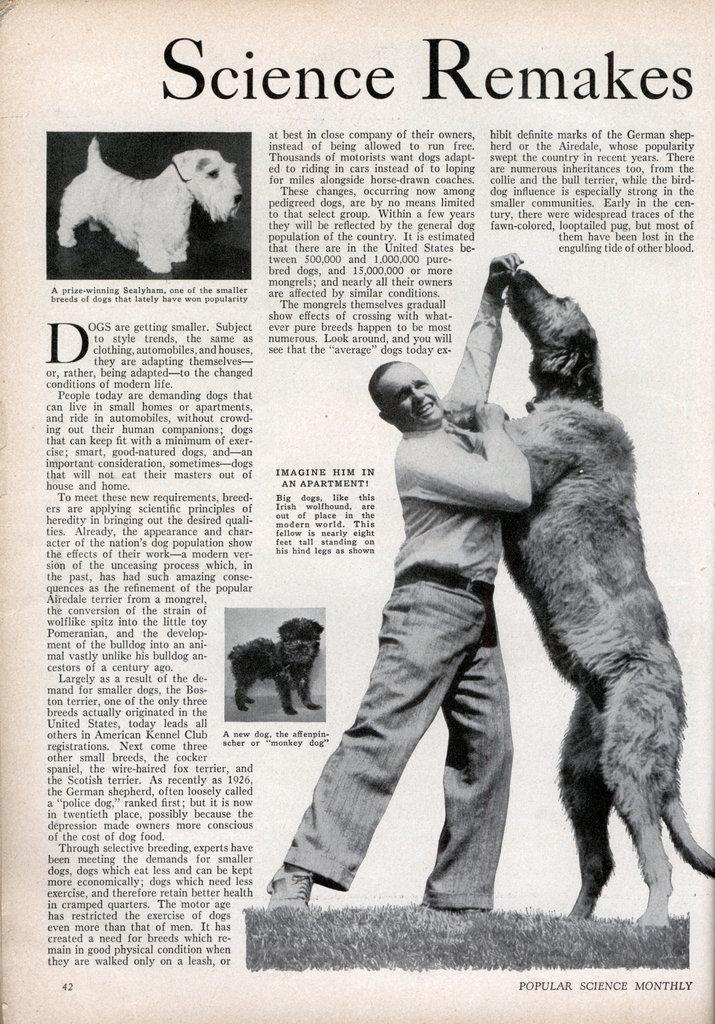
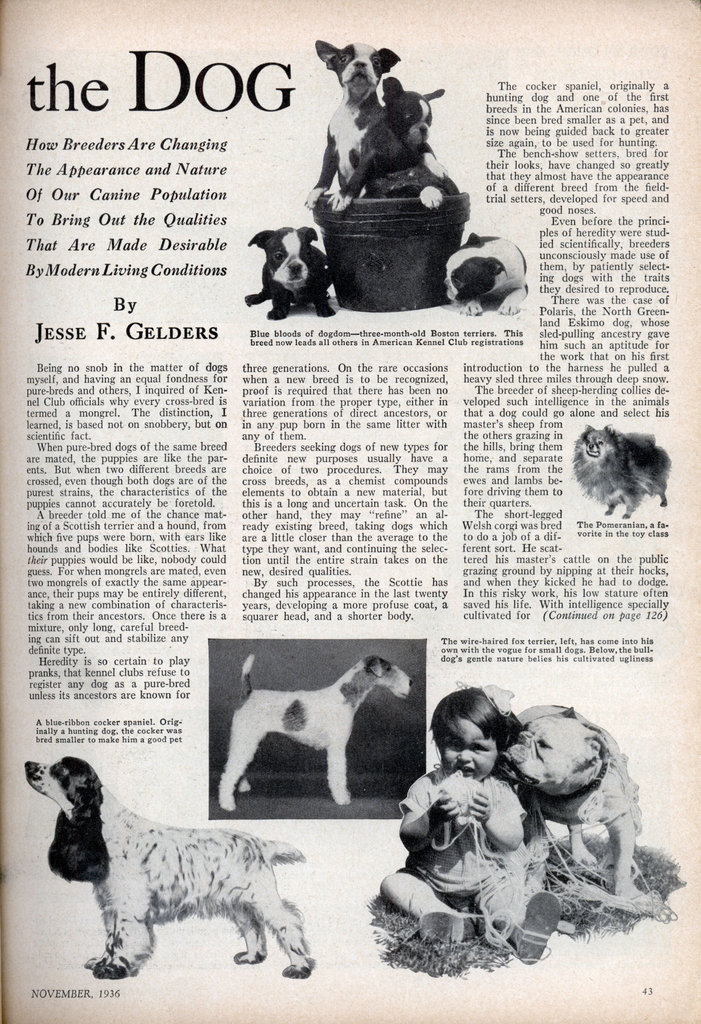
An article, from the November 1936 issue of Popular Science magazine is a good representative of the kind of congratulatory back-patting that went on during this period, as show ring and hobby breeders worked overtime to draw more and more working dogs into the Kennel Club.

Not the tone of the article: "Science" is improving dogs so they will be better suited to the modern world of cars, apartments, and limited time for their care and feeding.

In fact, these market forces continue to this day, as I have noted in an earlier post entitled "Robert Bakewell's Apartment."

This Popular Science article was written when the Kennel Club was just 65 years old, but problems already seem to be cropping up.

Notice that the Cocker Spaniel seems to have been "improved" to the point that it no longer hunts.

The Scottish terrier's morphology has been transformed with the "improved" dog having a shorter back, a larger head, and a longer coat -- improvements that made the dog incapable of going down a hole after quarry, ruining it as a true working terrier.

Then you have the various types of setters where bench and field animals had already diverged to the point that they appeared to be different breeds.

Finally, the Afghan is mentioned as a new and exotic breed brought to America. How long before the show-ring variant was wrecked as a coursing dog? Not long!

It should also be noted that some of the "history" given here is Kennel Club bunk. The Airedale, for example, is a modern creation derived from the Otter hound, and bred specifically for the show ring. It was never a "night poacher's dog," being too slow and heavy for rabbit, fox, or deer. Hunting otter is not done at night; it is tough enough to see the things in the daylight!

Similarly, the English Bulldog has very little of the old bull-baiting dog in it, and quite a lot of the monstrous pug to which it is much more closely-related!

As for fox terriers, by the time this article was written, almost no one was using a Kennel Club dog for anything other than a companion dog, as a close reading of Jocelyn Lucas's book Hunt and Working Terriers (published in 1931) will reveal.

Fox-working dogs have not been "improved" by science or show ring breeders; they have only been ruined by the rosette chasers.

The original art for this article can be seen here >> Page 1, Page 2, Page 3


Science Remakes the Dog
How Breeders Are Changing The Appearance and Nature Of Our Canine Population To Bring Out the Qualities That Are Made Desirable By Modern Living Conditions

By Jesse F. Gelders


DOGS are getting smaller. Subject to style trends, the same as clothing, automobiles, and houses, they are adapting themselves— or, rather, being adapted—to the changed conditions of modern life.

People today are demanding dogs that can live in small homes or apartments, and ride in automobiles, without crowding out their human companions; dogs that can keep fit with a minimum of exercise; smart, good-natured dogs, and—an important consideration, sometimes—dogs that will not eat their masters out of house and home.To meet these new requirements, breeders are applying scientific principles of heredity in bringing out the desired qualities.

Already, the appearance and character of the nation’s dog population show the effects of their work—a modern version of the unceasing process which, in the past, has had such amazing consequences as the refinement of the popular Airedale terrier from a mongrel, the conversion of the strain of wolflike spitz into the little toy Pomeranian, and the development of the bulldog into an animal vastly unlike his bulldog ancestors of a century ago.

Largely as a result of the demand for smaller dogs, the Boston terrier, one of the only three breeds actually originated in the United States, today leads all others in American Kennel Club registrations. Next come three other small breeds, the cocker spaniel, the wire-haired fox terrier, and the Scotish terrier. As recently as 1926, the German shepherd, often loosely called a “police dog,” ranked first; but it is now in twentieth place, possibly because the depression made owners more conscious of the cost of dog food.

Through selective breeding, experts have been meeting the demands for smaller dogs, dogs which eat less and can be kept more economically; dogs which need less exercise, and therefore retain better health in cramped quarters. The motor age has restricted the exercise of dogs even more than that of men. It has created a need for breeds which remain in good physical condition when they are walked only on a leash, or at best in close company of their owners, instead of being allowed to run free. Thousands of motorists want dogs adapted to riding in cars instead of to loping for miles alongside horse-drawn coaches.

These changes, occurring now among pedigreed dogs, are by no means limited to that select group. Within a few years they will be reflected by the general dog population of the country. It is estimated that there are in the United States between 500,000 and 1,000,000 purebred dogs, and 15,000,000 or more mongrels; and nearly all their owners are affected by similar conditions.

The mongrels themselves gradually show effects of crossing with whatever pure breeds happen to be most numerous. Look around, and you will see that the “average” dogs today exhibit definite marks of the German shepherd or the Airedale, whose popularity swept the country in recent years. There are numerous inheritances too, from the collie and the bull terrier, while the bird-dog influence is especially strong in the smaller communities. Early in the century, there were widespread traces of the fawn-colored, looptailed pug, but most of them have been lost in the engulfing tide of other blood.

Being no snob in the matter of dogs myself, and having an equal fondness for pure-breds and others, I inquired of Kennel Club officials why every cross-bred is termed a mongrel. The distinction, I learned, is based not on snobbery, but on scientific fact.

When pure-bred dogs of the same breed are mated, the puppies are like the parents. But when two different breeds are crossed, even though both dogs are of the purest strains, the characteristics of the puppies cannot accurately be foretold.

A breeder told me of the chance mating of a Scottish terrier and a hound, from which five pups were born, with ears like hounds and bodies like Scotties. What their puppies would be like, nobody could guess. For when mongrels are mated, even two mongrels of exactly the same appearance, their pups may be entirely different, taking a new combination of characteristics from their ancestors. Once there is a mixture, only long, careful breeding can sift out and stabilize any definite type.

Heredity is so certain to play pranks, that kennel clubs refuse to register any dog as a pure-bred unless its ancestors are known for three generations. On the rare occasions when a new breed is to be recognized, proof is required that there has been no variation from the proper type, either in three generations of direct ancestors, or in any pup born in the same litter with any of them.

Breeders seeking dogs of new types for definite new purposes usually have a choice of two procedures. They may cross breeds, as a chemist compounds elements to obtain a new material, but this is a long and uncertain task. On the other hand, they may “refine” an already existing breed, taking dogs which are a little closer than the average to the type they want, and continuing the selection until the entire strain takes on the new, desired qualities.

By such processes, the Scottie has changed his appearance in the last twenty years, developing a more profuse coat, a squarer head, and a shorter body.

The cocker spaniel, originally a hunting dog and one of the first breeds in the American colonies, has since been bred smaller as a pet, and is now being guided back to greater size again, to be used for hunting.

The bench-show setters, bred for their looks, have changed so greatly that they almost have the appearance of a different breed from the field-trial setters, developed for speed and good noses.

Even before the principles of heredity were studied scientifically, breeders unconsciously made use of them, by patiently selecting dogs with the traits they desired to reproduce. There was the case of Polaris, the North Greenland Eskimo dog, whose sled-pulling ancestry gave him such an aptitude for the work that on his first introduction to the harness he pulled a heavy sled three miles through deep snow. The breeder of sheep-herding collies developed such intelligence in the animals that a dog could go alone and select his master’s sheep from the others grazing in the hills, bring them home, and separate the rams from the ewes and lambs before driving them to their quarters.

The short-legged Welsh corgi was bred to do a job of a different sort. He scattered his master’s cattle on the public grazing ground by nipping at their hocks, and when they kicked he had to dodge. In this risky work, his low stature often saved his life. With intelligence specially cultivated for his task, he knew when to go into action and when to stop, by the tone of his master’s whistle.

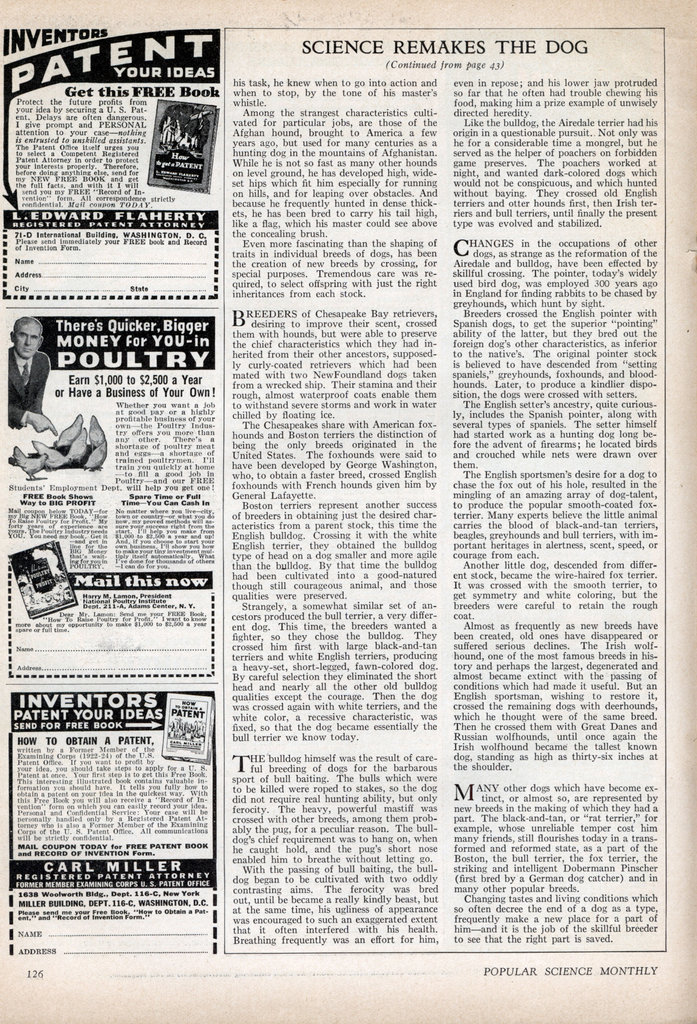
Among the strangest characteristics cultivated for particular jobs, are those of the Afghan hound, brought to America a few years ago, but used for many centuries as a hunting dog in the mountains of Afghanistan. While he is not so fast as many other hounds on level ground, he has developed high, wide-set hips which fit him especially for running on hills, and for leaping over obstacles. And because he frequently hunted in dense thickets, he has been bred to carry his tail high, like a flag, which his master could see above the concealing brush.

Even more fascinating than the shaping of traits in individual breeds of dogs, has been the creation of new breeds by crossing, for special purposes. Tremendous care was required, to select offspring with just the right inheritances from each stock.

BREEDERS of Chesapeake Bay retrievers, desiring to improve their scent, crossed them with hounds, but were able to preserve the chief characteristics which they had inherited from their other ancestors, supposedly curly-coated retrievers which had been mated with two New Foundland dogs taken from a wrecked ship. Their stamina and their rough, almost waterproof coats enable them to withstand severe storms and work in water chilled by floating ice.

The Chesapeakes share with American foxhounds and Boston terriers the distinction of being the only breeds originated in the United States. The foxhounds were said to have been developed by George Washington, who, to obtain a faster breed, crossed English foxhounds with French hounds given him by General Lafayette.

Boston terriers represent another success of breeders in obtaining just the desired characteristics from a parent stock, this time the English bulldog. Crossing it with the white English terrier, they obtained the bulldog type of head on a dog smaller and more agile than the bulldog. By that time the bulldog had been cultivated into a good-natured though still courageous animal, and those qualities were preserved.

Strangely, a somewhat similar set of ancestors produced the bull terrier, a very different dog. This time, the breeders wanted a fighter, so they chose the bulldog. They crossed him first with large black-and-tan terriers and white English terriers, producing a heavy-set, short-legged, fawn-colored dog. By careful selection they eliminated the short head and nearly all the other old bulldog qualities except the courage. Then the dog was crossed again with white terriers, and the white color, a recessive characteristic, was fixed, so that the dog became essentially the bull terrier we know today.

THE bulldog himself was the result of careful breeding of dogs for the barbarous sport of bull baiting. The bulls which were to be killed were roped to stakes, so the dog did not require real hunting ability, but only ferocity. The heavy, powerful mastiff was crossed with other breeds, among them probably the pug, for a peculiar reason. The bulldog’s chief requirement was to hang on, when he caught hold, and the pug’s short nose enabled him to breathe without letting go.

With the passing of bull baiting, the bulldog began to be cultivated with two oddly contrasting aims. The ferocity was bred out, until be became a really kindly beast, but at the same time, his ugliness of appearance was encouraged to such an exaggerated extent that it often interfered with his health. Breathing frequently was an effort for him, even in repose; and his lower jaw protruded so far that he often had trouble chewing his food, making him a prize example of unwisely directed heredity.

Like the bulldog, the Airedale terrier had his origin in a questionable pursuit.. Not only was he for a considerable time a mongrel, but he served as the helper of poachers on forbidden game preserves. The poachers worked at night, and wanted dark-colored dogs which would not be conspicuous, and which hunted without baying. They crossed old English terriers and otter hounds first, then Irish terriers and bull terriers, until finally the present type was evolved and stabilized.

CHANGES in the occupations of other dogs, as strange as the reformation of the Airedale and bulldog, have been effected by skillful crossing. The pointer, today’s widely used bird dog, was employed 300 years ago in England for finding rabbits to be chased by greyhounds, which hunt by sight.

Breeders crossed the English pointer with Spanish dogs, to get the superior “pointing” ability of the latter, but they bred out the foreign dog’s other characteristics, as inferior to the native’s. The original pointer stock is believed to have descended from “setting spaniels,” greyhounds, foxhounds, and bloodhounds. Later, to produce a kindlier disposition, the dogs were crossed with setters.

The English setter’s ancestry, quite curiously, includes the Spanish pointer, along with several types of spaniels. The setter himself had started work as a hunting dog long before the advent of firearms; he located birds and crouched while nets were drawn over them.

The English sportsmen’s desire for a dog to chase the fox out of his hole, resulted in the mingling of an amazing array of dog-talent, to produce the popular smooth-coated fox-terrier. Many experts believe the little animal carries the blood of black-and-tan terriers, beagles, greyhounds and bull terriers, with important heritages in alertness, scent, speed, or courage from each.

Another little dog, descended from different stock, became the wire-haired fox terrier. It was crossed with the smooth terrier, to get symmetry and white coloring, but the breeders were careful to retain the rough coat.

Almost as frequently as new breeds have been created, old ones have disappeared or suffered serious declines. The Irish wolfhound, one of the most famous breeds in history and perhaps the largest, degenerated and almost became extinct with the passing of conditions which had made it useful. But an English sportsman, wishing to restore it, crossed the remaining dogs with deerhounds, which he thought were of the same breed. Then he crossed them with Great Danes and Russian wolfhounds, until once again the Irish wolfhound became the tallest known dog, standing as high as thirty-six inches at the shoulder.

MANY other dogs which have become extinct, or almost so, are represented by new breeds in the making of which they had a part. The black-and-tan, or “rat terrier,” for example, whose unreliable temper cost him many friends, still flourishes today in a transformed and reformed state, as a part of the Boston, the bull terrier, the fox terrier, the striking and intelligent Dobermann Pinscher (first bred by a German dog catcher) and in many other popular breeds.

Changing tastes and living conditions which so often decree the end of a dog as a type, frequently make a new place for a part of him—and it is the job of the skillful breeder to see that the right part is saved.
.

Tuesday, October 24, 2017

The Always New and Continuing Evolution of Dogs


A repost from this blog, circa February 2007.

A lot of people want the undifferentiating affection of a dog, but are not entirely willing to pay the price: forced awakenings at 7 am, expensive fencing, veterinary care, shedding coats, barking, and strange smells in the living room.

Dogs are small tyrants that crap on your rug, chew up your glasses and steal your sandwiches.

If you own a dog, you can still ride off into the sunset, but you better be back by 8:30 to feed it, and by midnight to put it to bed for the evening.

In the era of schooners and candles, when people lived on large farms with slow traffic, things were probably a little bit easier. Back then a large dog could sleep in the barn and roam more-or-less at will.

Now a lot of folks live in condominiums and multi-story apartment buildings surrounded by six-lanes of traffic. Others are retirees looking for less work. The result is a growing market for small dogs that are as easy to take care of as a cat.

In fact, what is wanted today is a dog that acts like a cat, and a cat that acts like a dog.

Towards that end breeders on both ends of the spectrum are working towards a middle ground, with cats that have affectionate personalities and legs too short to jump up on the furniture, and dogs that do not shed, rarely bark, and are so small they can be tucked inside a handbag.

I suppose all of this is simply a logical extension of Robert Bakewell's earlier efforts to control sires in order to produce animals for a particular function.

Cats, of course, were slow to domesticate as prior to the rise of the "indoor" cat, felines were free to roam and cross-breed at will.

Dogs, on the other hand, have been the product of controlled breeding for so long that most Kennel Club breeds now seem to specialize in two or three genetic defects. As a consequence, more and more prospective pet owners are are now looking at cross breeds in some hope of avoiding expensive veterinary work to "fix" defective canine hips, eyes, knees and teeth.

Another factor, of course, is that a lot of the small "toy" breeds are so fru-fru that no self-respecting heterosexual man is eager to be seen walking one. A Toy Poodle? A Papillon? Please.

A cross-bred small dog at least offers the potential dignity of being something a little "outside the box."A small dog described as a "little mutt" or "attack rat" by the husband, can be described by the wife as a Shitpoo (a Shih Tzu crossed with a Toy Poodle), a Cockapoo (a Cocker Spaniel crossed with a Toy Poodle), a Schnoodle (a Schnauzer crossed with a poodle), a Bagel (a Beagle crossed with a Bassett Hound) or a Puggle (a Pug crossed with a Beagle).

Pardon me if I do not join the Kennel Club crowd which clucks and moans about "little mongrels" being cranked out by puppy millers and "back yard breeders".

How, I would ask, does that differentiate these new dogs from most Kennel Club breeds? After all, most of the dog breeds on earth today are less than 140 years old, and most were invented by puppy peddlers doing their business between 1860 and 1900.

The harsh truth is that most canine breeds were not forged by honest field work, but by professional breeders seeking to sell dogs for the pet trade.

In short, the true history of most dog breeds is one of "backyard breeders" creating contrived names and fake histories for their dogs and producing enough of the dogs in a short enough period (a puppy mill by any name) to create a "class" of dogs to fill a Kennel Club ring.

And it's not like Kennel Club breeds cannot be improved by a little outcrossing!

The Yorkie has such serious teeth problems that they invariably require attention from expensive veterinary dentists.

The Pug's bulging eyes make it prone to eye injury, and nearly every one of them is born caesarian.

The Toy Poodle is a barker and often mentally unbalanced.

Dachshunds are prone to serious back and joint problems.

Papillons and Chihuahuas have all kinds of health problems, not the least of which are that their bones may be so light they can break jumping off the couch.

The Lhasa Apso is a walking mop requiring more grooming than a Hollywood starlet, and is often a mental case as well.

Of course, most cross-breeds are not all that successful, and only a very few show a marked advantage over a common pound dog.

That said, enough crosses are working out that a few crosses are developing into regular replicable breeds. The most obvious candidate for "new breed" distinction is the "Labradoodle" -- a cross between a Labrador Retriever and a Standard Poodle. In Australia, this very tractable dog has been standardized and now breeds true after more than 15-years of focused work. In the U.S., however, most "Labradoodles" remain hybrids which, when crossed with each other, throw a wide array of very different-looking pups.

Contrary to what many hybrid dog advocates will tell you, a hybrid dog is not always healthier that its purebred cousin. Genetic loads are never revealed in one breeding, and "hybrid vigor" is not a perfect curative for all canine ills.

A final note is that when dogs are combined, the positive characteristics of a breed are not necessarily those that are transfered.

The tale is told of the time when Marilyn Monroe met Albert Einstein and coyly mewed, "Professor Einstein, we should get together. With my looks and your brains, think of the wonderful babies we could produce."

To which Einstein is supposed to have replied: "Yes, but what if they have my looks and your brains? That too is an equal possibility."
.

Tuesday, February 12, 2013

Darwin at the Westminster Dog Show


Charles Darwin was born 209 years ago today.

One hundred and fifty three years ago, Charles Darwin published The Origin of Species, one of the most important books in the history of the world. That same year, the first organized dog show was held, and the world of dogs has not been the same since.

Below is a short excerpt from Chapter One of American Working Terriers. The text that precedes this is about the origin of dogs and the rise of the Enclosure Movement, and the text that follows details the rise of animal rights rhetoric, early organized terrier work in the U.K., the RSPCA's new cause, the entry of young wanna-be tough guys into the world of terrierwork in the 1960s and 70s, and the destruction of hedgerows and the push to ban fox hunting in the U.K.

Of course, history never stands still, and the good news is that a push is now on to get the Kennel Club to drop the eugenics theories of Francis Galton (Darwin's cousin) and instead embrace a "Dog First" standard that puts canine health front and center. Let us hope that good things are yet to come!

From American Working Terriers:
.... One of the people who noticed the rapid transformation of British livestock was naturalist Erasmus Darwin who devoted an entire chapter in Zoonomia to the rapid changes he observed being made to British farm animals.

For his part, Erasmus’ son, Charles Darwin, was so besotted with country sport that his father despaired he would ever amount to much of anything.

"You care for nothing but shooting, dogs and rat-catching, and you will be a disgrace to yourself and your family," Erasmus wrote to Charles.

In fact Charles Darwin turned out all right.

After washing out of medical school and the seminary, and then letting a romantic relationship drift away (due to his being more infatuated with beetles than women), young Charles signed on as naturalist aboard the Beagle, a survey boat on a voyage around the world.

Darwin returned to Britain in 1836, but it was not until 1859 that he wrote The Origin of Species, and then only after reading Reverend Thomas Malthus’s work on the role of "natural" limits to population growth.

Darwin’s ruminations about evolution were greatly influenced by the amazing varieties of livestock being produced by farmers and fanciers in the U.K. at this time. He was especially fascinated by pigeon breeders who were able to rapidly express all kinds of peculiar variation from the common rock dove — rollers, pouters, fantails, barbs, tumblers, and carriers, to name a few.

It was not much of a leap to speculate that the forced selection being done by pigeon breeders might have a parallel in "natural selection" among finches on a remote volcanic island in the Pacific.

Thus was borne the Theory of Evolution.


Jack Russell and the First Working Terriers

It might seem that I have strayed rather far afield in the previous section. What, in God’s name, does the Enclosure Movement, Malthus and Darwin have to do with the rise of working terriers?

Actually, quite a lot.

Mounted fox hunting requires relatively large amounts of open land in the hands of a relatively few number of people.

Squatters and inholders made hunting on common land difficult prior to the Enclosure Movement. Once people had been moved off the land and replaced with sheep and cattle, however, the only real obstacle to the mounted hunts were the stone fences and hedgerows keeping the sheep and cattle in — obstacles that provided excellent sport for competent riders.

Britain’s sheep economy proved less stable than hoped, however. Several busts in the wool business (brought on by cheap imports of wool and cotton from the Continent, Australia, and the U.S.) forced marginal sheep ventures to look for other sources of income.

Rapid improvements in shotguns, combined with relatively easy escape from the city by train, created a new form of leisure sport — the driven bird shoot in which partridge and pheasants were raised in large mesh pens and released "into the wild" a few days prior to the arrival of "the guns".

After the birds acclimated themselves for a few days or weeks, beaters and dogs joined the guns in a long line, flushing birds out of cover. Hundreds of birds — at a set price per bird — were shot over the course of a few hours time.

Both the mounted fox hunts and the organized bird shoots required a certain number of working terriers, but for slightly different reasons.

The mounted hunts employed terriermen to find and "earthstop" fox and badger dens so that fox were forced to run long distances when raised by the hounds. If a fox did manage to go to ground, a terrierman was called to bolt the fox from the earth for another chase, or to dig down for dispatch. In some cases, an animal was bagged in order to replenish fox extirpated from other hunt lands.

Terriers were also used to protect pheasants and partridges being raised in netted enclosures for the shoots.

For gamekeepers, the primary tools for fox eradication were poison and leghold traps (gins), which were fast, efficient and cheap. Secondary tools were low-cost snares, long dogs (lurchers) and long guns used over bait at night. These last methods are still used today in the U.K.

Fox eradication with terrier and spade, while far and away the most humane form of fox control, is slow and inefficient. In addition, because fox rarely lay up in warm weather unless driven to ground by pursuing hounds, terrier work offers a frustratingly short season for a gamekeeper to eradicate fox over a large shooting estate. Gun, snare, traps and poison, however, can be used all year long.

In the early 1800s, the era of stocked bird shoots had not yet begun. Though mounted fox hunting had been spreading across Great Britain for nearly 200 years, the practice was not yet ubiquitous in the British countryside. Terriers used by farmers and mounted hunts alike remained a catch-as-catch can affair.

That was about to change.

At about the time Walter Scott was writing Guy Mannering, a young man by the name of John Russell was attending Exeter College, Oxford.

Looking out the window one day, he spied a bitch terrier tied to a passing milkman’s cart. Something about the dog struck Russell’s fancy, and he bought the dog based on looks alone. The year is variously given as 1815 or 1819.

When Russell bought the dog he could not have known whether the dog would work but, lucky for him, it did. Russell later claimed this bitch, named Trump, was the model for all the terriers that were to follow.

Russell’s story, and the story of Trump, are subject to more myth than fact (see the Appendix for a chronology of Russell’s life). For the moment, it is enough to say that Russell was one of the very first, and certainly one of the most dedicated and longest-riding, fox hunters of the 19th Century.

Though Russell seems to have bought and sold a great number of dogs, he apparently kept a vision of Trump in his mind’s eye — a small, white, wiry-coated terrier with a fierce voice and a strong desire to pursue fox to ground.

It should be remembered that this was an era of free-range poultry. Fox were seen as a threat to sustenance and treated accordingly by farmers. It did not take much effort — or expense — to lace rabbit entrails and chicken heads with strychnine, or set a few foothold traps around a chicken coop, rabbit hutch, or pheasant pen.

In the early 19th Century and through the Victorian Era, traps and poison were so brutally efficient and common that the Reverend Russell spent much of his early years trying to get people to stop killing fox so their populations would increase and he could find a little sport.

Russell was not alone in this endeavor.

In fact, fox protection was so deeply entrenched in the culture of the mounted hunts of the 19th Century that the concept made its way into the English language. The Oxford English Dictionary defines "vulpicide" as "One that kills a fox other than by hunting it with hounds."

The crime of vulpicide was seen as a crime against the aristocracy. God forbid that individual farmers, for the sole purpose of putting food on the table, threaten the weekend pastime of hundreds of wealthy aristocrats!


Classy People and Their Classy Dogs

Beginning in the 1860s, two phenomenon began to take hold in the U.K., both of which were to have long-term ramifications for working terriers.

The first was the rise of dog shows.

In 1800, there were only 15 designated breeds of dogs, but by 1865 that number had grown to more than 50 and was due to expand a great deal more.

The growth in breeds was partly due to the desire, during the Victorian era, to sort out the natural world. The kind of taxonomic classification that young Darwin had been doing with beetles and birds, others were now doing with fish, mammals, and every manner of domestic stock, including dogs.

In addition, the animal husbandry theories of Robert Bakewell and others had taken hold. Record keeping and the careful selection of sires produced variety and improvement at startling speeds.

With the development of new breeds of sheep, cattle, and chickens came livestock shows to display these wondrous new animals and market their services. A particularly spectacular tup (male sheep) might rent for 1,000 guineas a season, a bull 25 guineas per covered cow.

It was not all about meat, however. Stock shows became great social occasions, and were frequently sponsored by the aristocracy which, quite conveniently, also had the money to buy the best breeding stock for their own programs.

A problem developed, however. While Bakewell’s goal had been to breed better sheep and cattle for greater production and profit, stock show prizes were often awarded on the basis of size alone, regardless of the animal’s value as a meat or milk producer.

Show breeders defended this practice, noting that size alone could be judged honestly and easily in the ring. Feed-to-weight ratios could not be proven, nor could the quality of the meat, the amount of milk produced, or the number of eggs laid.

The size of an animal does not speak to the end product of steaks, milk and eggs, of course — a defect that became readily apparent when production was tracked on the farm. After a brief flurry of interest in the show ring, utility-minded farmers returned to longitudinal "pounds-and-pence" evaluation of animals.

For dogs, the deficiencies of show ring evaluation were not so obvious. Most dogs produced little more than excrement and amusement. For nonworking dogs, the social and economic value of ribbons remained unencumbered by any requirement that the dog produce a product of value or perform a specialized task.

Dogs were occasionally displayed and sold at farm shows in the 1830s and 40s, but the first dedicated dog show was held in Newcastle in 1859, the year Darwin’s The Origin of Species was published.

In 1863 the first really big dog show — with more than 1,000 entries — was held in Chelsea, and that same year the first international dog show was held in London.


As noted earlier, this was a period of rapid "speciation" within the world of dogs. The rapid creation — or assertion — of new dog breeds created some confusion, especially when breeds were not yet distinct, or several breeds were lumped into one, or when true breeds were known by several different names.

In 1851, for example, the Yorkshire Terrier was also known as "the Broken-haired Scotch Terrier." It was not until 1870 that the Yorkshire Terrier was firmly designated as both a breed and a breed name. Before then littermates were often shown in different breed categories — a situation that also occurred with the first prize-winning Jack Russell, which had previously been shown as a prize-winning "white Lakeland."

In the manic days of early dog shows, such confusions were common. Some were intentional.

The "Old English Black and Tan Terrier," for example, was simply a ploy by English breeders attempting to appropriate Welsh Terriers (a show ring version of the Fell Terrier). The dog was "correctly" labeled after the Kennel Club intervened, but by then the "Black and Tan" had already been featured in a catalogue compiled by Vero Shaw.

A similar story can be told for the "English White Terrier," also featured by Shaw, which was nothing more that a smooth, white, foxing terrier crossbred with a lap dog.

The dog show world of the late Victorian era quickly outgrew and overwhelmed the much smaller, less flamboyant, world of the working terrier. Dog shows became social scenes, with middle class matrons insinuating themselves into Society by purchasing "purebred" puppies. As one Victorian periodical noted, "nobody now who is anybody can afford to be followed about by a mongrel dog."

It is hard to imagine what Reverend John Russell thought of all this.

When the first dog show was held in 1859, Russell was 64 years old. He was 78 when the Kennel Club was formed in 1873 — an old man who, due to poverty and age, had given up his beloved hounds for the last time two years earlier.

Though quite old, the Reverend was famous for his knowledge of hounds and terriers, and his ability, in former years, to ride 12 hours at a stretch. This was the Grand Old Man of Fox Hunting, and everyone knew he had been at it since the beginning.

With terriers front and center in the show ring world, it was a natural for the newly forming Kennel Club to ask Russell if he would be a founding member. He agreed, no doubt flattered by a position of status, but also because it offered an opportunity to keep up with the dogs.

Russell was a judge at the Crystal Palace dog show in 1874 — one of the first large Kennel Club shows. He admired the look of the dogs, but alarm bells were apparently clanging in his head, for he somewhat humorously described his own dogs as "true terriers ... but differing from the present show dogs as the wild eglantine differs from a garden rose."

Russell never did allow his own terriers to be registered, noting that the qualities selected for in the show ring were of little use in the field.

No matter. The show ring was not interested in working dogs except as a theory untested by experience. The raison d’etre of dog shows was not dogs but people — people who, it turned out, were ready, willing and able to spend significant sums of money chasing ribbons.

By 1883 a magazine entitled The Fox Terrier Chronicle was being produced which covered the terrier elite the way other periodicals covered High Society. By 1886, Charles Cruft — a dog food salesman who never owned a dog himself — had taken over the Allied Terrier Show as a money-making vehicle.

The rapid differentiation between show dogs and working dogs, which the Reverend John Russell had already observed, became more pronounced as time went by. Increasing numbers of people bought terriers, bred terriers, wrote standards, or changed them. Points were given for the set of a dog’s tail, colorful markings on coats, the color of the eye, and even a dog’s "expression." By 1893 Rawdon Lee was writing in his book, Modern Dogs, that:
"I have known a man act as a judge of fox terriers who had never bred one in his life, had never seen a fox in front of hounds, had never seen a terrier go to ground ... had not even seen a terrier chase a rabbit."

After almost half a century of formal shows, the author of a manual for dog owners noted that "the sportsman will as a rule have nothing to do with the fancier’s production."

The split between working terriers and show dogs was virtually complete.

If you want to read the text that precedes this or the text that follows, order your very own copy of American Working Terriers.