Showing posts with label war terriers/dogs. Show all posts

Friday, July 01, 2016

America's Founding Terrier


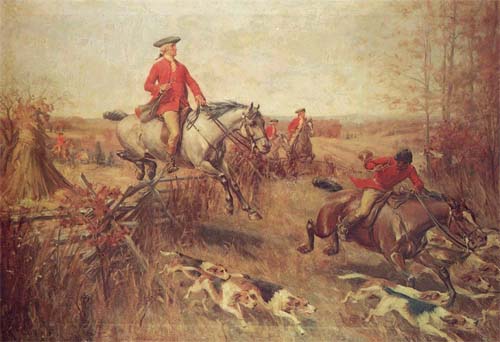
George Washington fox hunting in Virginia
A repost from this blog, circa 2004.


The case can be made that America might not exist today were it not for "our Founding Terrier."

Robert Brooke of Maryland introduced foxhunting to the United States in 1650 and imported the first pack of foxhounds from Great Britain.

Dr. Thomas Walker of Virginia (who discovered the Cumberland Gap and for whom the Walker Coon Hound is supposedly named) imported another pack to Virginia in 1742. The first fox hunting pack maintained for the benefit of a group of fox hunters rather than for a single owner, was instituted by Thomas, Sixth Lord Fairfax, in 1747 in northern Virginia.

Walker and Washington were good friends and business partners, and were co-owners (along with Washington's brother-in-law) of the "Dismal Swamp Land Company" (1763) which was to develop land near present-day Norfolk, Virginia. Walker was probably the person that got Washington started in fox hunting.

Washington moved to Mount Vernon, on the Potomac River just below Washington, D.C., after marrying Martha Dandridge Custis in 1759. It was at Mount Vernon, while still in his 20s, that George Washington first began fox hunting in earnest, setting up a rather lavish set of kennels and carefully breeding a new line of American foxhounds that were faster, lighter and less pack-centered than their English brethren.

In 1768, Washington was appointed as a delegate to the Continental Congress in Philadelphia and managed to fill his need for fox hunting at the Gloucester Hunting Club across the River from Philadelphia in New Jersey near present-day Haddonfield.

It was largely because of social and political connections made while fox hunting that Washington's social prominence rose, and in 1775 George Washington was Congress's unanimous choice as commander of the new Continental Army that was to lead the American forces against the British.

In truth, Washington did not have the forces and equipment to wage a successful fight and hold ground, and his chief battle-field opponent, General William Howe of Great Britain, was a master tactician.

Howe defeated Washington time and time again. In August of 1776 Howe landed on Long Island, captured New York City and defeated Washington at White Plains.

In 1777 Howe defeated Washington again, this time at the Battle of Brandywine (near present-day Chadds Ford, Pennsylvania) and took Philadelphia.

In October of 1777, the Battle of Germantown was waged. This battle took place near Philadelphia, and it too was a defeat for American forces, but it was a turning point in the war.

The turning point occurred when a small fox terrier was found wandering between the battle lines. The little dog was scooped up by American soldiers and the dog's collar identified it as belonging to none other than General Howe.

The dog was brought to Washington as a war prize -- a taunt to use against the British -- but Washington was having none of it.

A true dog-man, who missed his own fox hounds and terriers at Mount Vernon, Washington personally wiped the little terrier clean and brushed its coat. He then dictated a short note to his aide-de-camp, Alexander Hamilton, and secretly tucked a private note of his own tight under the collar of the dog. The dog, and both notes, were then returned to General Howe under a flag of truce.

Washington's private note has not survived, but Howe was extremely pleased by it. The public note, a copy of which has survived (see picture below), reads: "General Washington's compliments to General Howe. He does himself the pleasure to return him a dog, which accidentally fell into his hands, and by the inscription on the Collar appears to belong to General Howe."

After his terrier's return Howe praised Washington's actions as an "honorable act" and historians note that although he continued to win his battles, he never pursued Washington with quite the same vigor.

In fact, when ordered to fight harder and show the rebels no compassion, Howe resigned in protest.

Howe was replaced by General Henry Clinton, who was a poor tactician, and General Charles Cornwallis, who was a poor field commander.

In the end, the United States won the war and Washington returned to his beloved Mount Vernon where he continued breeding fox hounds and chasing foxes at least once a week.

Shortly after returning to Mount Vernon, Washington imported massive hounds from France with the help of his friend the Marquis de Lafayette. American hounds were crossed with these new French imports, and some of the progeny were sent to the Gloucester Foxhunting Club, outside of Philadelphia, where they proved extremely popular due to their speed.

In 1787 Washington headed the Virginia delegation to the Constitutional Convention in Philadelphia, and again his friends at the Gloucester Foxhunting Club lobbied for his election as the first President of the new country.

After the Constitution was ratified, Washington was unanimously elected President and in time the new Capitol was constructed just down river from his Mount Vernon estate.

My house is about 20 minutes away from Mount Vernon and sits on what would once have been Lord Fairfax's estate. Family legend (via Annie Walker Burns, founder of the Kentucky Mountain Laurel Festival), is that Dr. Thomas Walker is a relation of ours. It might be true too -- in Kentucky, anything is possible.


Draft of note from George Washington to Howe, in the handwriting of aide-de-camp Alexander Hamilton.

World War I Rat Hunters in the Trenches


World War I Trench Hunters: Photo from a German newsmagazine with a not too-subtle remark on sanitary conditions: "The result of 15 minute's rat-hunting in a British trench."

Note the Jack Russell Terrier in the gentleman's arms at left. Click on picture to enlarge. Photo from Great War in a Different Light.

Another photo from the same site, below, shows French rat hunters in the French trenches. Again, note the terriers.


The illustration, below, comes from the British Magazine, The War Budget. Again, note the Jack Russell Terrier in full pursuit.
.


For other stories about terriers in World War I, see:
.

Tuesday, November 11, 2014

Hilter's Stolen Jack Russell


Hitler is under the "X". The Jack Russell was his. >> For another picture

In World War I, it was common to find terriers in the trenches where they served three purposes: messengers (this was before radios, walkie-talkies and telephones), mortar detectors (a dog can hear an incoming shell long before a human can), and gas detectors (a dog can smell a drifting cloud of mustard or chlorine gas long before a human can).

The picture above shows one of the most famous and infamous veterans of World War I -- Adolph Hitler who was gassed despite the Jack Russell dog to the far right. Young Adolph is the fellow at the far left with the ridiculous mustache under the "X". In a later picture, Hitler insisted the dog be photographed sitting at his side.

Hitler's terrier apparently had been the mascot of English soldiers and ventured out into "No Man's Land" sometime in late January or early February of 1915 while chasing a rat. The dog jumped into a German trench where Adolf (himself a messenger) caught the Jack Russell terrier and decided to keep it. Hitler named the dog "Fuchsl" or Little Fox.

Adolph fed and taught Fuchsl tricks, and the Jack Russell terrier never left Adolf's side until August of 1917 when the dog was stolen at a train station, apparently by a railroad official who earlier that day had offered Hitler 200 Marks for the terrier. Hitler said he would not take 200,000 Marks for the dog. "I can look at him like I look at a human being," Adolph had written about the dog. "I am crazy about him."

In 1918, in an incident that might have been avoided had his terrier remained with him, Hitler was temporarily blinded by a British gas attack in Flanders.

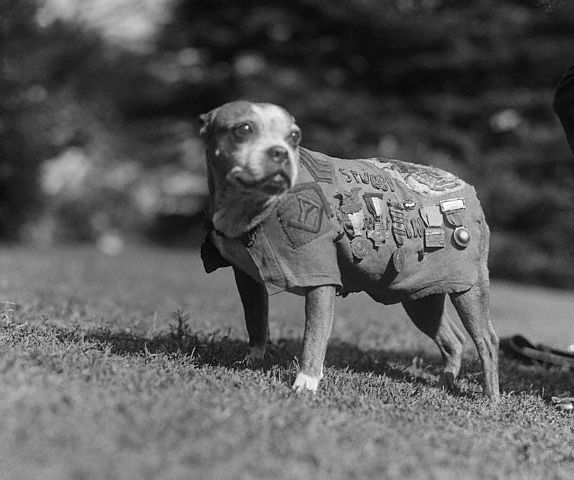
Stubby: Terrier Hero of Georgetown

Georgetown University features a bulldog mascot on their hats and other memorabilia, but in fact the original dog, Stubby, was not a bulldog, but a cross between a boston terrier and a bull terrier.

Stubby, the mixed terrier, was one of the more famous dogs of World War I. He is reported to have trotted onto Yale Field in New Haven, Connecticut when a bunch of soldiers were drilling in preparation for the War. He may, in fact, have been a plant -- a companion dog brought by Corporal Robert Conroy, with whom he quickly became fast friends.

When the troops shipped out, Stubby was hidden on board by Conroy and went to France with the rest of the boys. At Chemin des Dames the soldiers noticed that the artillery fire didn't faze Stubby, but they taught the dog to duck down just the same. In a very little while they noticed the dog ducking before they did -- it turned out that the dog could hear the shells coming long before the men!

One dark night in the trenches, Stubby woke up while the men were sleeping, crept down the trench line and around a corner and found a German spy prowling the trenches in the dark. The soldier let out a howl when the dog bit him hard in the back thigh, and the dog did not let go even after the soldier had been disarmed by Stubby's friends -- they had to pry his jaws off the enemy soldier.

After this bit of service Stubby became famous, and honors were heaped on him by soldiers looking for a bit of humor and story to alleviate the boredom and carnage of trench warfare. At Mandres en Bassigny, Stubby was introduced to President Woodrow Wilson who "shook hands" with him. Stubby received a wound stripe for a grenade splinter he received, and the Marines even made him an honorary Sargent.

After the Armistice was signed, Stubby returned home with Conroy and his popularity seemed to grow. He became a nationally acclaimed hero, and eventually was received by presidents Harding and Coolidge. General John "Black Jack" Pershing, who commanded the American Expeditionary Forces during the war, presented Stubby with a gold medal made by the Humane Society and declared him to be a "hero of the highest caliber." Stubby toured the country leading war parades, and was made an honorary member of the American Red Cross and the American Legion. The YMCA issued him a lifetime membership card good for "three bones a day and a place to sleep."

In 1921, Robert Conroy headed to Georgetown law school and took Stubby along with him.

While at Georgetown Stubby served several terms as mascot to the football team where, between the halves, Stubby would nudge a football around the field, much to the delight of the crowd. Stubby was Georgetown's first canine mascot, and it is his ugly countenance that has somehow been morphed into the English Bulldog emblem of the Hoyas.

Old age finally caught up with Stubby on April 4th, 1926, and he died in Conroy's arms.

Stubby's stuffed body is one of the many artifacts kept by the Smithsonian museum in their vast collection.

This post is recycled from Veterans Day 2004.

Monday, May 28, 2012

Looking for Jack's Collar


This post recycled from Veteran's Day 2007.

The area in which I live, hunt, and go to work is steeped in history. I live about a mile from the Pentagon, on part of what used to be the old Lord Fairfax estate (Fairfax started the first fox hunt in the U.S.), and just a 15-minute drive down the river from Mr. Vernon, George Washington's old home.

Arlington Cemetery, the former estate of Civil War General Robert E. Lee, is a congenial walk down the bike path, while at lunch I can walk to the White House or the Vietnam Veteran's memorial.

The sign, pictured above, is near Frederick, Maryland on the edge of one of the locations I hunt -- an 1,800 acre tract bound by farm fields. The sign notes that this immediate area was part of the Antietam Campaign of the Civil War -- the most vicious campaign of a very violent and bloody period in American history.

The sign does not mention Jack at all.

Jack was a brown and white Pit Bull terrier that learned to understand the bugle calls of his regiment, the 102nd Pennsylvania Infantry, which was largely composed of volunteer firemen from Pittsburgh.

After every Civil War battle of his regiment, Jack would search out the dead and wounded -- a trick he repeated across Virginia and Maryland.

Jack was wounded at the battle of Malvern Hill, but recovered and was captured by Confederates at Savage's Station.

The dog managed to escape and he survived the battle of Antietam on Sept 17, 1862, in which over 23,000 were killed, missing or wounded.

Jack's was severely wounded at Fredericksburg three months later, but was nursed him back to health. Then, at Salem Church, he was again taken prisoner by the Confederates. The value of the dog was such, however, that he was exchanged for a prisoner at Belle Isle six months later.

Jack stayed with his regiment through the Wilderness and Spotsylvania Campaigns and the Siege of Petersburg.

On the evening of Dec. 23, 1864, Jack disappeared from his regiment, which was on furlough at Frederick, Maryland just four miles from where this sign (top picture) is located.

Though an entire regiment looked for the dog, and even offered a substantial award, he simply vanished, and was never seen or heard from again.

It could be that Jack was stolen or murdered for his new collar, which was emblazed with silver and which cost (at the time) the astounding price of $75.

Or perhaps Jack succumbed to a bullet, poison, trap, or some other wayward thing, and simply expired ignominiously on hallowed ground -- his silver collar waiting to be dug up by a lucky groundhog hunter.


The original "Jack" circa 1863 or 1864. This dog looks very much like today's Pit Bull Terrier..

Thursday, May 26, 2011

Breeding Dogs and Other Critters to Kill Us

Training air-scenting dogs in 1930s Germany, with pulleys to kept feet off ground.

Someone should probably write a book about the use of animals in war.

We tried to use bats to firebomb Japan.

We have used "killer" porpoises, seals, and walruses to patrol harbors, locate mines, and retrieve lost equipment.

We have used dogs as four-legged tank-killer bombs as well as beasts of burden hauling machine guns and rolls of razor-wire.

We have trained pigeons to deliver wartime messages, and also guide wartime bombs.

We have used dead cats to spread plague, as well as used pots of poisonous snakes to spread fear.

We have used giant rats to locate mines and the Bible even mentions Sampson tying burning torches to the tails of 300 foxes in order to have them set fire to the fields (Judges 15:4)
.
War dogs with gas masks, Germany, World War I.

More recently, the U.S. miltary has experimented with using 'spy crows' to locate terrorists, and honey bees to help locate hidden drugs and explosives.

So what's the latest? 

The latest is that the Germans, during World War II, were interested in breeding smarter dogs and testing the limits of their sensing abilities.  A British tabloid framed the story as breathlessly as possible:

In his new book Amazing Dogs: A Cabinet of Canine Curiosities, Cardiff University historian Jan Bondeson mines obscure German periodicals to reveal the Nazis' failed attempt to breed an army of educated dogs that could read, write and talk. "In the 1920s, Germany had numerous 'new animal psychologists' who believed dogs were nearly as intelligent as humans, and capable of abstract thinking and communication," he writes. "When the Nazi party took over, one might have thought they would be building concentration camps to lock these fanatics up, but instead they were actually very interested in their ideas."

Of course, it's easy to see crackpot ideas looking backwards, but a bit harder to see them when they sit straight ahead.

For example, how about tracking dogs?  Can a dog really track a lost person six months or a year after they have crossed through field or forest?  Not a chance, and never mind if canine fraudsters have made the claim and people have believed them to the point that people were sent to jail.

Not all fraud is intentional, of course. 'Clever Hans' the counting horse was probably not a deliberate fraud -- simply a case of a very perceptive animal picking up on un-noticed cues being telegraphed by a human handler.

More recently, Psychology Today did a piece on drug- and bomb-sniffing dogs marking on locations where no bombs or drugs had ever been placed.  What was going on?  Simple:  the handlers were told that drugs and explosives were about and that was enough to trigger false positives by the dogs -- another case of the "Clever Hans" effect.
Dog guards sleeping soldier, Iwo Jima, 1945.
.

Wednesday, May 25, 2011

Barkers for Britain

This is a "Fala Tag" given out as part of the "Bundles for Britain" program created in December of 1939.

Fala, of course, was Franklin Delano Roosevelt's famous Scottish terrier.

The Bundles for Britain program was created by Mrs. Wales Latham, a New York Society lady who organized Americans to knit garments for British sailors fighting the Nazis in the North Atlantic.

The Bundles program focused on producing and shipping needed knitting supplies, instead of collecting money. Storefront drop-in centers were set up to collect knitted goods, and volunteers at these drop-in centers would also sort and repair good cast-off clothing that was being donated to the effort. 

When a little money to ship supplies was eventually needed, Mrs. Latham and her friends created the "Barkers for Britain" which sold 30,000 Fala dog tags at a price of 50 cents apiece -- enough to cover the very low operating costs of this earlly war-time effort.
.

Thursday, November 11, 2010

Yorkie Doodle Dandie


Various types of terriers have had cameo roles in war. This is another one of those tales.

The dog in question is a 4-pound Yorkshire terrier by the name of "Smoky" whose famous feat is that she carried a line through a 70-foot-long drainpipe beneath an airplane runway in the South Pacific in World War II. Why this was important is not entirely clear.

In any case, "Smoky" also flew 12 combat missions with former Cleveland Plain Dealer photographer Bill Wynne, was one of the first therapy dogs in the U.S., and starred in a postwar television show as well as a book on her exploits.

Believe it or not, this little dog already has monuments erected to it in Eastlake and Columbus, Ohio as well as Tennessee, Missouri and Hawaii. Now a sixth monument is to be erected in Cleveland, this one a bronze statue of the dog wearing a helmet.

Bill Wynne, Smoky's owner, taught Smoky to play dead, run between his legs as he walked along, walk on a drum, peddle a small scooter, walk on a tight wire blindfolded, and spell out her own name using letters cut out of cardboard.

After the War, Smoky and Bill were in show business for 10 years doing tricks, and Bill spent some time training and handling dogs in major studios.

This post is recycled from March 2005.
.

Friday, February 15, 2008

Patton's Willie


General Patton bought the first of many white bull terriers just after World War I for his daughters, Beatrice and Ruth Ellen.

Patton's first bull terrier was named "Tank" and turned out to be stone deaf. Patton's daughters called him by thumping on the floor.

The most famous bull terrier owned by General Patton was named Willie -- short for "William the Conqueror."

Willie was purchased in 1944 and followed Patton everywhere, with little bells on his collar to let people know he was coming and where he was. Willie also had regular GI "dog tags" issued to him.
.

Saturday, December 03, 2005

The Death of the Fox Inn


The Death of Fox Inn is now a private residence.

In 1768, Washington was appointed as a delegate to the Continental Congress in Philadelphia and managed to fill his need for fox hunting at the Gloucester Hunting Club across the River from Philadelphia in New Jersey near present-day Haddonfield. It was largely because of the social and political connections made while fox hunting that Washington's social prominence rose, and in 1775 Washington was Congress's unanimous choice as commander of the new Continental Army that was to lead the American forces in their fight against the British.

In 1774, one year before Washington was tapped to lead the fledgling Continental Army, William Eldridge began a tavern at 217 Kings Highway (aka County Road 551), in Mount Royal, New Jersey. The tavern was known as Eldridge's Tavern or "The Death of the Fox Inn".

The name is derived from the fact that the hunters of the Gloucester Fox Hunting Club (1766 to 1818) often gathered at the inn after the chase.

Fox hunting shaped several key components of the Revolutionary War. A fox terrier owned by British General Howe was found during the middle of a battle, and was later returned to him by General Washington. Some historians believe this later led Howe to resign when told he must show the American forces no mercy.

After the revolution, it was the members of the Gloucester Fox Hunting Club, meeting at "The Death of the Fox Inn" that engineered Washington's selection as the first President of the United States.

Great nations from tiny fox hunting clubs are borne.

Monday, May 02, 2005

Giant Rat Mine Detectors


NY TIMES NEWS SERVICE , GONDOLA, MOZAMBIQUE, Wednesday, May 19, 2004

Rats Take Over From Man's Best Friend

Just about every method of detecting land mines has a drawback. Metal detectors cannot tell a mine from a tenpenny nail. Armored bulldozers work well only on level ground. Mine-sniffing dogs get bored, and if they make mistakes, they get blown up.

The Gambian giant pouched rat has a drawback, too: It has trouble getting down to work on Monday mornings. Other than that, it may be as good a mine detector as man or nature has yet devised.

Just after sunup on one dewy morning, on a football-field-sized patch of earth in the Mozambican countryside, Frank Weetjens and his squad of 16 giant pouched rats are proving it. Outfitted in tiny harnesses and hitched to 10m-long clotheslines, their long tails whipping to and fro, the rats lope up and down the lines, whiskers twitching, noses tasting the air.

Wanjiro, a sleek two-year-old female in a bright red harness, pauses halfway down the line, sniffs, turns back, then sniffs again. She gives the red clay a decisive scratch with both forepaws. Her trainer, Kassim Mgaza, snaps a metal clicker twice, and Wanjiro waddles to him for her reward -- a mouthful of banana and an affectionate pet.

A Gambian giant pouched rat searches for a landmine in a field where several defused landmines are buried at the Apopo training project in Gandola, Mozambique. The rat may be as good a mine detector as man or nature has yet devised.

"What Pavlov did with his dogs is exactly what we're doing here -- very basic conditioning," said Weetjens, a lanky, 42-year-old Belgian who works for an Antwerp demining group named Apopo. "TNT means food. TNT means clicking sound, means food. That's how we communicate with them."

Wanjiro has been rewarded for sniffing out a TNT-filled land mine, one of scores buried a centimeters below ground in the training field where she works out five days a week. Like all the training mines, this one was defused. But if the Mozambican authorities approve, she and her companions will move at year's end from dummies to live minefields -- the world's first certified, professional mine-detecting rats.

Indeed, in a test last November along a southern Mozambique railway that was heavily mined during this country's 17-year civil war, teams of three giant pouched rats found every one of 20 live mines in a previously unsurveyed 1,310m2 swatch of land.

"Animal detection, with dogs in particular, has increased very much in the last three or four years," Havard Bach, the top expert on demining methods for the Geneva International Center for Humanitarian Demining, said in a telephone interview. But in many cases, he said, "it would probably be better to use rats than dogs."

Rats are abundant, cheap and easily transported. At 1.3kg, they are too light to detonate mines accidentally. They can sift the bouquet of land-mine aromas far better than any machine. Unlike even the best mine-detecting dog or human, they are relentlessly single-minded.

"Throw a stick for a dog to fetch, and after 10 times the dog will say, `Get it yourself, buddy,"' Weetjens said. "Rats will keep working as long as they want food."

Plenty of work awaits them. The International Campaign to Ban Land Mines estimates that 100 million mines have been laid worldwide, from anti-personnel and anti-tank mines hidden underground to above-ground mines triggered by tripwires. Although Mozambique's civil war ended nearly 12 years ago, sappers here still discovered and destroyed more than 10,100 mines last year alone, and mine explosions killed or injured 14 people.

Experts say that the pace of land-mine detection has slowed globally in recent years, in part because the death of its celebrity spokeswoman, Princess Diana, has robbed the cause of publicity and support. But there is also a shortage of land-mine specialists, and a true dearth of sure-fire methods to find buried mines.

Human detection -- steel-nerved workers with metal detectors and probes -- remains the preferred technique. But metal detectors are hard put to distinguish mines from other metal objects and even from some nonmetals, like mixtures of dirt and charcoal. Moreover, in areas where exploded mines have scattered metal fragments, rooting out false readings can be daunting.

Dogs, with their strong noses and affinity for people, are increasingly popular; about 200 are working now in heavily mined Afghanistan. But they are hard to keep healthy, especially in tropical Africa. They tend to bond with trainers, making it hard to switch them from one handler to another.

And they so badly want to please that a simple misreading of their trainers' body language can lead them to indicate a mine's presence where none exists or, far worse, ignore a real one.

Then there are rats, which don't give a fig about people but will do anything for bananas and peanuts. "All a rat wants to do is find the target and get his reward," said Bach, of the Geneva demining center. "They're almost mechanical in the way they work."

Mine-sniffing rats are the sole focus of Apopo, a Flemish acronym for "product development geared toward the demining of anti-personnel mines." The group is the brainchild of Weetjens' brother Bart, a college friend, Christophe Cox, and a University of Antwerp professor, Mic Billet, now Apopo's chairman.

The three decided in the late 1990s that so-called biosensor animals with great noses were the future of land-mine detection, but that there must be creatures better suited for the task than dogs.

With a grant from the Belgian government, they began hunting for an animal with a dog's sense of smell, but none of its drawbacks. They approached Ron Verhagen, the head of the university's biology department, for help. "And that," Weetjens said, "is where rats came along."

More specifically, along came Cricetomys gambianus, also known as the Gambian and African giant pouched rat. Up to 76cm-long, it thrives in most of sub-Saharan Africa, lives up to eight years in captivity and is "savage" in the wild, Weetjens says, but so docile when bred that some people keep them as pets.

Most important, the pouched rat (so named because it stores food, hamster-style, in its cheeks) buries what it does not immediately eat and sports a nose honed to bloodhound status by aeons of searching for buried food stashes. Persuading the giant pouched rat to hunt for land mines, therefore, is as simple as convincing him that TNT is just another tasty treat waiting a few inches underground.

Each rat gets to sweep a 10m2 of land on which two defused mines or TNT scents have been hidden. Finding the mine or scent earns a click and a bite of banana or peanuts. Failure generally earns a second try. Some rats try to game the system, scratching the earth randomly in hopes of getting free treats. But the trainers feed them and sound a click to signal success only when they scratch the right spots.

Bananas and peanuts, after all, are what drives Gambian giant pouched rats to excel. Which is why they are often at their worst on Monday morning.

"During the week, they're on a diet. They have to work for their food," Weetjens said. "But on weekends, they get to eat as much as they want. On Mondays, they just aren't as hungry."
This story has been viewed 1197 times.

Wednesday, January 05, 2005

Baden-Powell: Fox Hunting as Cavalry School


Robert Baden-Powell was the founder of the world-wide Boy Scout movement and, before that, was a cavalry man in South Africa and in the Crimean War.

Around the the turn of the Twentieth Century Baden-Powell noted that the sport of fox hunting was one reason Britain was able to do so well with mounted regiments -- many in the cavalry had gotten their best training running to hounds.

"Fox-hunting, when you come to think of it, is really a very wonderful institution. Although it has come to be quite an artificial sport in a wholly civilised country it still keeps going in every part of England in spite of the War, in spite of the decline in horse-breeding, and in spite of heavy taxes and heavier costs. It is one of the few old institutions left which still keeps us in touch to-day with the traditions and spirit of the former Old England.There is another point about it too. Having seen most of the cavalries of the world I have no doubt in my mind as to which is the most efficient for its work in war, and equally I have no doubt that fox-hunting is to a large extent responsible for that efficiency.

The nation really owes much to fox-hunting for what it has done to help our cavalry to compensate for its small quantity by its excellence in quality, and this without any extra call upon the taxpayer—for once!

The ex-Kaiser fully recognised this even before he had tasted its quality in the Great War, and he had established at Hanover a pack of hounds as part of the establishment of the Cavalry School there.

Of course, it was militarised, having a Captain as Master, a Sergeant-Major as huntsman, a Sargeant as first whip, and so on downwards.

Undoubtedly fox-hunting has proved a school for training men in riding fearlessly across country of all descriptions; it has taught them practical horsemastership, in economising the powers of the horse, and judging when to nurse him and when to let him go. It has also trained in them that invaluable attribute, 'an eye for country,' and not through dry lectures or boring field-days, but through a sport which appeals to their enthusiasm and gives them at once health and enjoyment."