Showing posts with label pit bulls. Show all posts

Wednesday, September 12, 2018

What If Dog Licensing Meant Something?


John Wade makes a nice analogy about the folks who think owning a pug is the same as owning a large game-bred molosser breed.

Ms Clifton’s article illustrated a classic example of what I refer to as a mini-van level driving skills person buying a Ferrari because they “love them” without considering that the investment of competence and commitment that will suffice with one will not affect the other. A Rottweiler is not a mini-van breed. In the many assessments I’ve done where behaviour is going off the rails, it is often enough due to the person end of the leash rather than instability in the dog.

Some breeds require more driving skill, maintenance knowledge and time to invest than others. Inappropriately matched, it should come as no surprise when a mini-van rated driver ends up rolling the Ferrari, either wrecking themselves, the vehicle or an innocent bystander.

Bingo. Read the whole thing.

I have come to more or less the same conclusion when it comes to Pit Bull, and have offered a suggestion, short of a ban, that I think would reduce the number of Pit Bulls acquired in haste and abandoned to death by the folks who "love" them.


The sad truth... is most Pit Bulls in America do not end up in the right hands. This is a breed that tends to attract "the wrong types" to the point that research has shown that U.S. Pit Bull owners are far more likely to have criminal records than other dog owners.

The predictable result of too many boisterous Pit Bulls meeting up with too many ill-prepared and unstable owners is that the dogs suffer.

And in America, Pit Bulls suffer terribly.

Nearly a million Pit Bulls were euthanized in American shelters in 2009 -- more than the sum of all dogs of all breeds registered by the American Kennel Club last year.

In the last decade, about 8,000,000 Pit Bulls were euthanized in U.S. animal shelters -- approximately four hundred million pounds of dead Pit Bull.

What makes this particularly distressing is that Pit Bull euthanasia rates in the U.S. have been on the rise for 30 years, even as all other canine impounds and euthanasias have been on a steady and steep decline.

What's going on with Pit Bulls?

The problem is not Pit Bull haters.

Ironically enough, the problem is Pit Bull lovers.

After all, it's the Pit Bull "lovers" that are breeding these dogs.

It's the Pit Bull "lovers" that are acquiring these dogs.

It's the Pit Bull "lovers" that are too often abusing the dogs through ignorance and neglect before abandoning them to their death a year or two after acquisition.

You mean Pit Bull "haters" are not the problem?

No, they are not.

The problem is young numbskulls who acquire these dogs in ignorance and haste, discover that they are too much dog to handle, and who then abandon them at leisure.

So what to do?

One of the most obvious ways forward, is to do with Pit Bulls what we have done for hawks, guns, and and cars in the U.S.: require a license conditional upon passing a basic training course.

When "hunter safety" courses were mandated in the U.S., accidental shootings fell to the point that golf and tennis are now deemed to be more dangerous than hunting.

When falconers were required to serve two-year apprenticeships, the longevity of captive birds soared, and concerns about raptor abuse plummeted.

And, of course, driving courses and driver's licenses have been in place since the beginning. Do accidents still happen? Sure, but no one argues that driver's license enforcement is not Step One to improved highway safety.

With dogs, however, the assumption is that everyone knows everything they need to know about dogs at birth -- and never mind if that is demonstrably wrong, especially for large game-bred breed like Pit Bulls.

And the consequence of this crazy idea?

Millions of dead dogs.

What is bizarre here, is that you would think there would be a natural constituency for a simple Canine Safety and Responsibility Course.

After all, teaching such a course could be a small money-maker for sponsoring groups such as the Kennel Club, Dogs Trust, the RSPCA, and dog-activity clubs.

Would a Canine Safety and Responsibility Course solve every Pit Bull (or dog) problem in the world?

No, of course not.

But it would solve a lot of them, and it would also serve as the "edge of the wedge" when it comes to tackling the human problems that too many dogs face -- ignorance about costs, responsibility, health, and training.

Monday, July 18, 2016

Does the Breed Standard Require a Rape Rack?


Remember when Michael Vick got busted for dog fighting, and they found "rape racks" in his basement?

What's a rape rack?

It's exactly what it sounds like -- a rack to which a female dog is bound while a male dog mounts her from behind.

In the case of Pit Bulls, the rape racks are supposedly necessary because "some females don't want to be mounted by any old male." Imagine!

Of course, a rape rack is not just used on "awkward bitches," is it?

No, it turns out that's it's also used on dogs that are so deformed they cannot even have sex on their own.

Take a look at the picture at top, or the score posted here where this breed-blind fellow has come up with his own version of a rape rack for British Bulldogs.

Of course he doesn't call it a "rape rack" does he?

No, the more politically correct term is "mating cradle."

And why do you need such a thing? Simple: because the British Bulldogs is a complete and utter mess. As I noted in an earlier post:
"The famed English Bull Dog ... is mostly Chinese pug -- a show ring creation with legs so deformed it can barely walk, a jaw so undershot it cannot grab a Frisbee, and with a face so bracycephalic it cannot breathe. Add to these problems a deformed intestinal system (a by-product of chondroplasia or dwarfism) which makes the dog constantly fart, and a pig tail prone to infection, and you have a dog that considers its own death a blessed relief."

But wait, there's more.

Did you know that the Bulldog is now a "Top Ten Breed" in the American Kennel Club?

True!

And for those know-nothings who claim it's only recent "exaggerations" that have led the British Bulldog to be incapable of having sex, giving birth, or actually running across a field, consider this from Rawdon Lee, an authority on bulldogs writing in 1894:

"It is known that time plays grim jokes on historical monuments.

There has probably never been a dirtier joke, however, than the one played on our national symbol, the English Bulldog.... The lunacy of breeding for extreme exaggeration, for extreme foreheads and huge skulls, for totally exaggerated low-slung front legs, for shoulders pointing outwards at almost a right angle, for Bulldogs with a front wider than that of the opposing bull. None of this used to be the case and only recently came into fashion."

So there you have it: the British Bulldog has been a basket case for more than 115 years!

And what has the Kennel Club (either American or British) done about it?

Nothing!

To which I would only ask one question .... Does the breed standard require a rape rack?


Saturday, January 30, 2016

Pit Bulls In the River


A slightly modified tale:

One summer in the village, the people gathered for a picnic. As they shared food and conversation, someone noticed a Pit Bull in the river, struggling and flailing about. The dog was going to drown!

Someone rushed to save the dog. Then, they noticed another yowling Pit Bull in the river, and they rushed in to pull that dog out. Soon, more dogs were seen drowning in the river, and the townspeople were pulling them out as fast as they could. It took great effort, and they began to organize their activities in order to save the Pit Bulls as they came down the river. As everyone else was busy in the rescue efforts to save the dogs, two of the townspeople started to run up the shore of the river.

“Where are you going?” shouted one of the rescuers. “We need you here to help us save these dogs!”

“We are going upstream to stop whoever is throwing them in!”


And who is throwing them In?

Not Pit Bull haters. Pit Bull lovers.

Almost a million Pit Bulls a year are being killed in animal shelters across the U.S.

All of these dogs were bred by people who said they loved Pit Bulls.

All of these dogs were bought or acquired as puppies by people who said they loved Pit Bulls.

And almost all of these dogs were relinquished to the pound or "shelter" when their owners found out that an adult Pit Bull comes with a lot of responsibility.

Pit Bulls are not being pushed into the river by breed specific laws.

Cities that do not have such laws are killing dogs wholesale.

In fact, some of the cities with the lowest Pit Bull kill rates are cities that have banned the dogs, such as Denver.

Others, like San Francisco, have not banned Pit Bulls but have seen a marked decline in Pit Bull euthanasias after implementing a mandatory Pit Bull sterilization law coupled to free Pit Bull spay-neuter programs.

One thing is clear: Pit Bulls have breed specific problems.

Perhaps their biggest problem is that so many Pit Bull breeders and owners are young, irresponsible adults who have unstable lives and who are acquiring their first dog -- a Pit Bull -- for much the same reason that they might acquire a big-bore motorcycle, a sports car, or a "hummer".

Is it an accident that Pit Bull owners are much more likely to have problems with the law than the average dog owner? I don't think so.

The responsible people who are adopting Pit Bulls from shelters deserve unending applause for their efforts.

But have no illusion: the good work they do will never be enough so long as so many people stand silent while so many people breed Pit Bulls, and so many others are acquiring puppies from these breeders only to "thrown them in the river" in just a year's time.

Pit Bulls have a breed specific problem.

At what point, do we begin to recognize that these dogs need a breed specific solution?

At what point do we say we are sick and tired of killing nearly a million Pit Bulls a year?

At what point do we agree that if we want something different, we need to do something different?

At what point do we run up the river bank, and start at least talking about all those people who are throwing the dogs in the river?


The graphic, above, shows how many Pit Bulls are killed in America EVERY DAY because the Pit Bull community has failed the Pit Bull.

Nearly one million Pit Bulls a year are killed in shelters across the U.S. every year -- 2,400 dead Pit Bulls a day.
.

Thursday, November 14, 2013

Is It Time to Dump the Bulldog?

Art for Dogs Today by the always-terrific Kevin Brockbank.
This article appears in the February 2012 issue.
 

Is it time to drop the English Bulldog as national mascot, and replace it with a healthier alternative?

The case to be made is obvious and straightforward. The modern English Bulldog is mostly Chinese pug -- a show ring creation with legs so deformed it can barely walk, a jaw so undershot it cannot grab a Frisbee, and with a face so bracycephalic it can barely breathe.

Add to this a deformed intestinal system which makes the dog fart constantly, a pig tail prone to infection, and serious eye problems due to excessive facial wrinkles, and you have a dog that considers its own death a blessed relief.

Is this a dog any patriot would choose as a symbolic representative of his or her country?

I think not!


The Replacement in the Wings

The good news is that a replacement dog is ready available, and this breed is not only healthy, active and brave, but British to the bone and readily available at your local shelter or rescue.

The dog in question, of course, is the Staffordshire Bull Terrier. This dog represents half of all dogs now going to shelters in the U.K., and most of the healthy dogs on death row waiting to be put down for no other reason than they are not puppies.

Some may bridle at the notion of replacing the English Bulldog. Why not simply make a few minor changes to that breed’s standard, and keep it as it is?

Well, for starters, a few minor changes will not solve this breed’s problems! This dog is a complete morphological wreck, and trying to “save it” now is a bit like trying to raise the Titanic in order to start a cruise line venture. Only a fool tries to save a fantasy while reality is being killed at his feet.

And to be clear, the English Bulldog really is a fantasy production.

As early as 1894, Rawdon Lee, noted that the bulldog was bred "for extreme exaggeration, for extreme foreheads and huge skulls, for totally exaggerated low-slung front legs, and for shoulders pointing outwards at almost a right angle."

The dog Lee describes is not a dog with any historical roots. It was never a stock dog or a bull fighter. Instead, from the beginning, this dog was a dog dealer’s dream -- an animal to be sold to pretenders at a high price, and with a rapid turnover due to high rates of mortality.


A Defective Disposable Dog Designed to Die

And yet, the English Bulldog has remained popular – a top twenty breed in the Kennel Club, and a top ten in the American Kennel Club.

Why?

One reason is that the English Bulldog is a perfect fit for modern couch potatoes who spend five hours a night in front of their television sets and six hours a day in front of their computers.

These folks do not want a dog that is too physically demanding, and the English Bulldog certainly fits that bill. This is a dog with a face so smashed in, and a trachea so reduced, that it often gets winded just walking from the backyard into the kitchen. A one-mile jog around the lake? That might kill it!

Dog breeders also like the bulldog because there is a steady demand for replacement dogs when an owner’s first dog dies. If you are in the puppy peddling business, a dog that lives for only six years is more than twice as useful as a dog that lives to age fifteen!

It helps too that Bulldogs are such anatomical basket-cases that they cannot conceive or whelp on their own. The average casual owner is not likely to own a bulldog "rape rack,” (commercially sold as a “mating cradle”) nor are they going to feel entirely comfortable going to a veterinarian and paying them a few hundred pounds to masturbate their dog into a collection plate for later artificial insemination into a bitch in heat.

And once a litter is conceived, that’s not the end of medical intervention, is it? Not by a long shot. Almost all English Bulldogs are the product of a surgical procedure called a caesarian section. Try to avoid going to the vet and whelp an English Bulldogs at home, and you are likely to end up with a litter of dead puppies stuck in the canal, and a dead bitch too!

So, to put a point on it, in order to breed bulldogs you have to have money, experience, and certain coldness in your heart. No wonder that the supply of these dogs is not dramatically higher than the demand!


What’s Wrong with Staffies?

So what’s wrong with Staffies?

Well, not a thing if you want a real dog that wants and needs to be walked around the block two or three times a day.

Is that you? If so, then a Staffordshire Bull Terrier may be your cup of tea!

Another problem for Staffies, rather than with Staffies, is that because they are not anatomical freaks, they can breed and whelp on their own.

What that means is that any young fool in a Council House flat can squeeze out a litter on their own in the hope of quick cash.

Sadly, that happens too often, and with predictable results: a flood of poorly-homed dogs that end up in “rescue” with thousands of healthy, friendly dogs being killed every year for the crime of no longer being a puppy.

Another issue, of course, is that the Staffordshire Bull Terrier is not a fantasy dog that arrives completely denatured.

While the English Bulldog is as closely related to pit and stock dogs as a Chihuahua to an Arctic Wolf, the Staffordshire Bull Terrier of today is remarkably unchanged from the days of yore.

Does that mean this dog is dangerous? No, but it does mean that this breed, more than most, needs the kind of proper socialization, exercise and training that can only be provided by a steady home life and a hands-on owner. Sadly, this is the opposite of what so many Staffie owners have to offer.

So, to circle back, is it time to reconsider Britain’s canine mascot? Do you really want a half-Chinese dog that cannot move well, cannot breathe well, and cannot mate or whelp on its own as a national symbol? Or do you want a dog that is British to the bone, as healthy as they come, and is as tough as an old shoe?

In the world of dogs and politics, making a new choice would send a powerful message to the world.

  • NOTE:  This article was written for a British publication, but the same could be said for the ridiculous Marine Corps mascot -- a foreign dog that can barely move and cannot perform in the field. Is this the right image for America's fighting forces?  Is this the right image for the University of Georgia?  How about any of these other schools and teams across the world? 
.

Monday, May 28, 2012

Looking for Jack's Collar


This post recycled from Veteran's Day 2007.

The area in which I live, hunt, and go to work is steeped in history. I live about a mile from the Pentagon, on part of what used to be the old Lord Fairfax estate (Fairfax started the first fox hunt in the U.S.), and just a 15-minute drive down the river from Mr. Vernon, George Washington's old home.

Arlington Cemetery, the former estate of Civil War General Robert E. Lee, is a congenial walk down the bike path, while at lunch I can walk to the White House or the Vietnam Veteran's memorial.

The sign, pictured above, is near Frederick, Maryland on the edge of one of the locations I hunt -- an 1,800 acre tract bound by farm fields. The sign notes that this immediate area was part of the Antietam Campaign of the Civil War -- the most vicious campaign of a very violent and bloody period in American history.

The sign does not mention Jack at all.

Jack was a brown and white Pit Bull terrier that learned to understand the bugle calls of his regiment, the 102nd Pennsylvania Infantry, which was largely composed of volunteer firemen from Pittsburgh.

After every Civil War battle of his regiment, Jack would search out the dead and wounded -- a trick he repeated across Virginia and Maryland.

Jack was wounded at the battle of Malvern Hill, but recovered and was captured by Confederates at Savage's Station.

The dog managed to escape and he survived the battle of Antietam on Sept 17, 1862, in which over 23,000 were killed, missing or wounded.

Jack's was severely wounded at Fredericksburg three months later, but was nursed him back to health. Then, at Salem Church, he was again taken prisoner by the Confederates. The value of the dog was such, however, that he was exchanged for a prisoner at Belle Isle six months later.

Jack stayed with his regiment through the Wilderness and Spotsylvania Campaigns and the Siege of Petersburg.

On the evening of Dec. 23, 1864, Jack disappeared from his regiment, which was on furlough at Frederick, Maryland just four miles from where this sign (top picture) is located.

Though an entire regiment looked for the dog, and even offered a substantial award, he simply vanished, and was never seen or heard from again.

It could be that Jack was stolen or murdered for his new collar, which was emblazed with silver and which cost (at the time) the astounding price of $75.

Or perhaps Jack succumbed to a bullet, poison, trap, or some other wayward thing, and simply expired ignominiously on hallowed ground -- his silver collar waiting to be dug up by a lucky groundhog hunter.


The original "Jack" circa 1863 or 1864. This dog looks very much like today's Pit Bull Terrier..

Wednesday, February 08, 2012

What Two Skulls Can Tell You


Skulls will tell you a lot if you will take the time to look and learn.

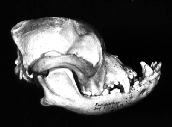
For example, these two skulls are from my collection and both are bulldogs. 

One is an English Bulldog, and the other a large American Pit Bull.

Look at these two skulls carefully and pay special attention to the area where the brain would sit (I will measure true cranial volume in another post).

Look at the smooth dome on top of the English Bulldog as compared the occipital and saggital crest that comes with the American Pit Bull. 

What's that mean? 

What does it tell you about the relationship between brain size and jaw strength?


I am adding another skull for comparison -- two pictures of the same skull, below. This is an average-sized red fox skull.  Notice the relative size of the brain case and the lack of a saggital crest.  What does this tell us about the brain to jaw-strength ratio? 


.

Friday, December 16, 2011

How Did Dog Shelters Become Slaughter Houses?


 From the December 2011 edition of Dogs Today.  Illustration by Kevin Brockbank.


Why do we call places that kill dogs ‘shelters’ or ‘rescues’?

Like so many things, the answer goes back to the Victorian era.

The goal back then was to eradicate rabies, and the most obvious place to start was to round up all the stray dogs and kill them as quickly as possible.

Pet dog owners were instructed to always have their dogs muzzled, and to never have them off leash, which meant any dog found un-muzzled or off-leash was fair game for the dog catcher.

In the U.K. and in the U.S., dog catchers and dog pounds were subsidized by taxpayer funds, and budgets were always thin. Pound operators were told to keep overhead costs low or risk cutting salaries, and the simplest way to do that was to rush dogs to their death, thereby lowering food and staff costs.

And so, within a week of being caught, most stray dogs were summarily shot, gassed, clubbed, or drowned in wire cages shoved off the dock.


SELLING DEATH FOR 100 YEARS

The good news is that rabies was eradicated from the U.K. by 1903. The bad news is that by then dog pounds were institutions with budgets, employees, real estate, and a fully developed ethos. Animal welfare had become a social cause and a business, and while improved treatment of horses and cattle was a concern, it was the plight of dogs and cats that really opened up the purses.

Of course one had to treat the issue gingerly! One could not be raising money to help subsidize a canine slaughterhouse, and so a new term was coined – a ‘shelter’ or “rescue’. Let people guess what actually happened there!

It should be said that from the beginning the ‘humane movement’ and the Kennel Club had a detente.

The Kennel Club did not decry the movement for pocketing taxpayer money for killing hundreds of thousands of healthy dogs, while the humane movement did not criticize the Kennel Club for encouraging the breeding of pedigree puppies. Both groups recognized that they were trying to milk the same group of upwardly mobile middle class and high-value donors, and both found it convenient to pitch their messages along class lines. Better people had pedigree dogs, while loose mutts and cross-breeds were the unfortunate canine flotsam cast up by the actions of the ignorant and the lower class.

In fundraising appeals, the humane movement always suggested that more money could ‘save’ a dog or a cat down at the ‘shelter” or ‘rescue,’ but the mechanics of such an operation were always vague, and for a very good reason; only a small percentage of money was ever spent on dog and cat welfare. Instead, the large humane organizations became almost pure legislative and political organizations. Stray dogs and cats? That was the job of the City pound, and never mind if that job involved endless killing.

If a consumer actually wanted to get a dog from the pound, of course, he or she had to cross the railroad tracks, pass by the town dump, and go down a dirt road or trash-strewn street to a nondescript building. There they would find a double row of cages filled with barking dogs. Each of these dogs had only a few hours or a few days to live before they were to be shot, gassed, drowned, or injected. If you wanted a particular dog, it was best to take it with you now!

Of course, the average person looking to get a pet for their child never considered subjecting them to the horror of such an experience. Instead most picked up an all breed book, flipped through the glossy pictures and romantic canine descriptions, and then thumbed through the local newspaper and dog magazine advertisements to find a breeder. Then, on a Saturday afternoon, the family headed off to a house or farm where cash was exchanged for a wiggling eight-week old package of fur.

What about the dogs at the pound, which had now been rebranded as a ‘shelter’? Out of sight and out of mind, they were dead and on the land fill.


THE GOOD NEWS IS THINGS ARE CHANGING:

The good news is things are changing.

In the last decade or so, the world of dog shelters has changed, and it is still changing.

To start, people have come to understand that the big direct mail organizations do very little at the local level to help shelter dogs and cats. If you are interested in helping those animals, stay clear of the national organizations and give to a local shelter where you have some chance of knowing where the money actually goes.

Second, the shelters themselves have come to realize that they need to be in the ‘sales” business. To that end they are creating more “store front” rescues and shelters which are less depressing and more attractive to young families with children.

Third, the social cues we now give each other about pedigree dogs and about cross-breeds have changed. While pedigree dogs were once seen as a sign of an upscale and informed consumer, the message going out now is that pedigree dogs are more likely to be expensive, inbred health messes, and ownership of such dogs is more likely a sign of pretension than sophistication.

Fourth, more and more people are spaying and neutering their dogs, and fewer unaltered dogs are running around at large. As a consequence, the number of unplanned litters has dropped remarkably in the last 20 years.

Fifth, the Internet has made it easy for shelters and rescues to post pictures and descriptions of available dogs online, where people are free to look through them without the terrifying emotional pressure of going to a shelter and choosing one among a hundred to save.

All of this is terrific news, and a true sea-change in the world of dogs.


THE BAD NEWS ABOUT STAFFIES

The bad news is that while things are generally looking up for shelters dogs, that is not true for ‘Staffordshire Bull Terrier types,’ -- what we in America call ‘Pit Bulls’.

More Pit Bulls are killed in U.S. shelters every year than ALL dogs registered by the American Kennel Club and the United Kennel Club combined.

But it's not just an American story is it?

Last year less the Battersea Dogs and Cats Home put down more than 800 "Staffordshire Bull Terrier types".

That's more dead dogs of a single type at one shelter than the total number of Neopolitan Mastiffs, Pekingese, Chinese Cresteds, Portuguese Water Dogs, or Boston Terriers registered by the Kennel Club that same year.

And why are so many "Staffordshire Bull Terrier types" put down?

Simple: Because no one wants them.

And yet these dogs are still being bred by people who say they love them, and they are still being acquired by people who say they want them.

What happens next, however, is all too predictable: about half of these dogs end up on death row because they prove to be too much for their owners.

What is the dog writing community, saying about all this?

Not much.

The silence is pretty deafening.

And why is that?

Mostly it’s because folks who talk about “the Staffie problem” end up being aggressively bullied whenever they raise the issue.

"Blame the deed not the breed" the apologists for death wail.

But they don't mean the deed of actually breeding these dogs for cash, do they?

No, that's a sacred cow.

Talk about a ban on advertising these dogs for sale, and suddenly there is no concern at all about the dogs.

Now it's all about property rights. Now it’s all about business.

The dead dogs?

They offer up no solutions for them.

In the world of Staffies, at least, it’s capitalism that is being defended, not the dogs.
.

Wednesday, November 30, 2011

Seven Pups for Seven People


Watch this video.  It's long, but it's worth it.

This kind of autopsy on what really happens to litters of puppies is too rarely done.

From what I can tell, most "dog breeders" are little more than "hump and dump" dog dealers.

Yes, there are people who will REALLY take back a dog any time it needs to be re-homed, but NO, those people are NOT the norm in the world of dog sales, and there is a LOT of difference between saying it and actually doing it.

The simple truth is that about 20 percent of all dogs born in the U.S. every year are abandoned to their death, and an equal or higher number end up being bounced from their first "forever" owner to their second or third owner, without any continuity of care or training.

One of the few writers to ever give an unblinking look at what really happened to a litter that they themselves bred, was J.R. Ackerley, the author of My Dog Tulip

Ackerley starts off breeding his dog with all good intent, but in the end the litter that is produced is whelped by a temperamentally poor bitch (Tulip) to a stud dog of no consequence. 

The eight pups that result quickly overwhelm Ackerley and his apartment to the point that, despite all apparent intention of doing the right thing at the front end, on the back end he ends up abandoning the pups to anyone with a fiver who will walk one out the door.

What happens next is predictable:  disease, disappearance, abandonement and death. 

And this was J.R. Ackerley!  He was not a mean person, a knuckle-dragger, an illiterate, or a person without some means. 

This was simply one more person who did not understand the full responsibility that comes when you bring a living thing into this world.  When faced with shouldering that responsibility he failed.  Yes, he lost a little of his dignity but those pups lost their life.


Responsibility. 

It's the R-word no one really wants to talk about too much in the world of dogs.  

Instead, people want to talk about property rights and ribbons.  But responsibility to the dog?  Responsibility to the puppies being whelped? 

When was the last time anyone said too much about that?
.

Monday, November 28, 2011

Killing Dogs at Battersea


At Battersea Dogs and Cats Home outside of London, they are killing bull-staffie crosses left and right.  

Watch the whole video, above.  It's important and worth it.

Why is the Battersea "shelter" killing so many pit-bull type dogs? 

The short answer is because people continue to breed these dogs indiscriminately, and no one wants them in the number they are being bred.  That's as true in the U.K. as it is in the U.S.

Of course, this is not the story the Panorama TV crew started off to film!  They started off to say that these dogs were being put down because of the Dangerous Dogs Act.  And yes, they did find a few dogs that were put down merely for what they looked like.  On the main, however, they found something different:  that bull staffie crosses (i.e. pit bulls) and butcher dogs of other types (Rottweiler- and Boxer-crosses) were being bred and dumped indiscriminately in the U.K.,  same as they are in the U.S.  The dogs being put down are healthy and available, but no one wants them, and at Battersea perfectly fine dogs are coded "aggressive" just to make the whole thing a little easier to deal with

What's going on? 

What's going on is SILENCE in the pit bull and staffie community, and in the dog community in general, when it comes to the wholesale slaughter of these dogs.

Silence.  No one is talking about the FAILURE of the Pit Bull and staffie communities to spay-neuter their dogs, and as a consequence no breed is being killed as often.  Let me say it plain:
 
Silence = Death 


Look at the numbers above, which show how few Pit Bulls are neutered.  There's the Pit Bull problem -- both for the the dogs and for people.

San Francisco, which has mandatory spay-neuter for Pit Bulls has seen a steep decline in the number of Pit Bulls that are coming in to their shelters, and the numbers they are having to put down.

San Francisco appears to have found a solution. Since 2005, when the city adopted a mandatory spay-neuter law for pit bulls in the wake of the mauling death of 12-year-old Nicholas Faibish, the number of pit bulls impounded and euthanized has dropped dramatically, according to animal control officials.

"It's absolutely made a difference," said Capt. Vicky Guldbech of San Francisco's animal control department. "When I started this job, pit bulls were feared. We were afraid of them. Now when I see pit bulls in the field, they have cute wagging tails."

The shelter has seen a 25 percent decline in seized pit bulls at the shelter, and a 33 percent drop in pit bulls that are euthanized, according to animal control Director Rebecca Katz.

That's a story that the property-rights Pit Bull crowd do not mention too often.

Nor do the property-rights Pit Bull crowd talk about what happened outside of San Francisco with an un-neutered Pit Bull owned by a vocal supporter of BadRap.   Anyone want to guess what happened there?   No, it was not pretty.

But of course, the Wall of Silence remains.

We cannot talk about the nearly one million dead Pit Bulls that are killed every year in this country.

We cannot talk about the failure of the Pit Bull community to spay-neuter.

We cannot talk about the success of mandatory spay-neuter with this dog.

All we can do is bury the dead in silence, dog and human alike.

.

Tuesday, November 22, 2011

Time to Scuttle the English Bulldog

This ship was a failure.  Let us not celebrate it.

If you are serious about crossing the Atlantic, you do not start by trying to raise the Titanic from the grave while a million fine ships a year are being burned at the wharf.

The New York Times asks Can the Bulldog Be Saved?

It is a silly question. 

Save the English Bulldog?

Save it from what?

Pretenders? Puppy peddlers?

A little late for that!  

Besides, the people who now say they want to "save" the English Bulldog are just more pretenders and puppy peddlers.  Who do they want to save the English Bulldog from? Why, from people who are just like themselves!

The English Bulldog is not a species created by God, but a Kennel Club creation designed to lay about the house and die young. 

In that sense, it is a perfect dog, combining the lazy owner's need for a dog that does not want to take a walk around the block, with the dog dealer's desire to sell a replacement product a few years down the line.  No wonder this is a top 10 breed in the AKC!

The selection for defect here is entirely intentional:  a flat face, narow hips, a massive head, short legs, a heavy body, deeply wrinked skin, and a pig tail.    The result is a dog that cannot breath well, cannot walk well, has a hard time having sex without a helping hand, and cannot give birth without surgical assistance.

And, of course, it is a dog that has had no work since the beginning.  The modern English Bulldog is about as closely related to stock and pit dogs as the tea cup Chihuahua is to the Artic Wolf.  Neither one could consumate a relationship with it's supposed ancestor!  The purpose of this dog is sale and vanity, and that is as true for today's slightly modified versions as it is for the old.

You want a REAL bulldog? A truly healthy and functional model? No problem. We kill almost a million of those dogs a year in this country, but if an American Pit Bull is put in the right hands (people with stable lives, real jobs, fenced yards, and a desire to excercise and teach the dog on a daily basis) they can become well-loved pets. 

Bottom Line:   The bulldog is wreckage and there is no saving it, nor should we even try.  If you are serious about crossing the Atlantic, you do not start by trying to raise the Titanic from the grave while a million fine boats a year are being burned at the wharf.  Only a fool tries to save a fantasy while reality is being killed at his feet.
.
.