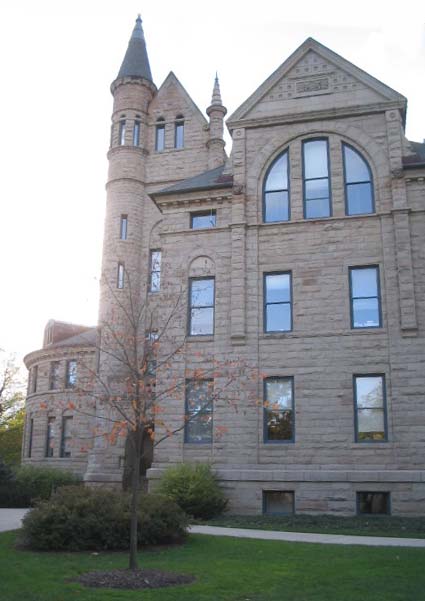
 I stopped off at Oberlin, Ohio on the way back from picking up the dog. Oberlin College
 is a small school for common-as-ditchwater kids that are pretty smart and a little odd. The school boasts an impressive conservatory and a history of leftist social activism that is a source of pride for both the school and the alumni.
Oberlin was the first school in the country to admit women and also the first school in the country to admit blacks. It's motto is "Learning and Labor," and the typical Obie (if there is such a thing) grows up in the spirit of service and with an eye to changing the world just a little bit for the better.
All of this is theory, of course. Diversity at Oberlin includes every odd thing imaginable, but it does not often stretch to having a conservative born-again Christian in the classroom. It's not that Oberlin would not welcome such people (they would), but that such people tend to get uncomfortable around blue-haired girls with nose piercings, and inter-racial lesbian couples, and people who talk passionately about the evil that was (and is) the KKK.
Their loss, if you ask me -- there are some fascinating creatures at Oberlin. You do not have to actually wrestle with the bears to watch them and even admire them for their struggle to exist. In fact, most of the people at the school pass for entirely normal; it takes only 50 truely odd people out of 3,000 for it to feel like a parade.
The college and the town have not changed too much in 25 years. A few new buildings, a few new stores in old buildings, one old store in a new building, etc. There was one very odd sign that made even this alumnus pause, scratch his head, and reconsider annual giving. Such is the march of progress.
 Tappan Square is a 14-acre park on the edge of campus
 and it looked pretty much the same, except that the Oberlin Rocks seemed to have grown smaller.
Barney, my late great terrier, was painted on to the side of one of the Rocks for a while, when he was "lost." It turned out he was not lost, but instead had been stolen by the dispatcher for the local Police Department. I marched right over, picked up my dog, and committed no bodily harm only because the police and I had met before.
Let it be said that somewhere in my files at Oberlin is a notation about me and the dog. "The dog is very well behaved, but Mr. Burns is not. It is best to ignore the dog and act as if it is invisible." I have not actually seen this note, but I was told it was there by someone who managed Wilder Hall. In those days, my terrier was (in theory)
persona non grata on campus, but I am not one for authority if it makes no sense. At Oberlin, you learn to push back against oppression in any form.
I was, at times, strapped for cash in College, and I well-remember a month when I figured I would save a little money and buy Barney generic dog food. He would not touch the stuff, but I figured that would change when he got hungry enough. At the time I was pinching pennies myself and living off of raw rye (from a feed store bag in the lab) and yeast (also from the lab), and washing it down with a pitcher of beer an evening at the Celler in the basement of Wilder (I was broke, but beer was a prioity). While I was in the Cellar, Barney was tied to a bench in the hall. Generally he slept there and no one paid him a mind.
Weeks went buy and Barney did not seem to be losing weight, but he was not eating that generic dog food either.
All was explained one evening, when I came out to find one of the older woman who worked the grill stroking Barney's head. "Is this your dog?," she asked. "I give him a T-bone steak every night."
Barney just looked up at me and laughed, comfortable in the old lady's lap. I tried to give the dog a reproachful look, but I suspect it came out as grin. Barney and I always admired anything that got by on grace and cleverness alone.
I certainly admired that smart little dog.While going to the book store to look for a few things on my little excursion back to college, I noticed that a huge old tree on Tappan Square was gone, replaced by a small grouping of low shrubs. The tree had been planted by Professor George Jones' kindergarten class -- a fact that Professor Jones himself had told me when he was 92 years old.
George Jones was introduced to me by David Miller, another biology professor, and I remember well the day that Professor Jones and I went mushrooming for morels. This was a big day for me, not only because I was in the hands of an expert (though I was not a complete slouch, which is why Professor Milller had introduced me to Professor Jones), but because mushroom hunters are not ones to show others where the best ones lie, lest they might poach the best grounds. Going out with George Jones was like getting 70 years of local mushroom lore dumped in my lap. Only later did it occur to me that a 92-year old might not worry too much that others might steal his mushroom grounds in future years. At 92, you should be so lucky to live that long. But George Jones
was lucky -- he lived to the age of 101.
I walked around Campus and stopped by a couple of places where I used to live. I even went inside Wilder, which seemed more-or-less the same. I drove out to the reservoir, and Spice -- the new dog -- and I walked around it together.
I walked this reservoir I lot when I was in college, as it was just a short walk from Johnson House where I lived my last year -- a huge pink, Queen Anne Style house with an attached farm with land that ran clear to the reservoir.
How good was that? I even had an original Picasso in my room that year -- a loaner from Allen Memorial Art Museum. It was not a great and important piece (Picasso sometimes did 75 drawings in a day), but it was a Picasso all the same.
I remembered Reefer -- the large Pit Bull Alan G. had adopted off the streets of Oberlin, just as I had adopted Barney, my little terrier. One cold winter day, Alan and the dogs and I walked the reservoir, which had been frozen for weeks, but had begun to thaw a little after three or four days of warm weather. Water stood on top of the ice, and in the middle of the reservoir someone had hacked a hole for a couple of ducks to bob around in and feed. Reefer took off after those ducks, and in the darkness and moonlight, it was a truely surreal moment, as the massive dog seemed to be walking on water, busting the ducks into flight out over the ice and the bright white snow.
More than 25 years later, I remember it like it was yesterday. At the Ben Franklin, where they sell a better selection of used books
 than any you will find in most big city book stores, I mentioned that the large organic garden that we used to have at Johnson House was no longer there, and that I found that a little odd considering the huge new Environmental Science building that had been constructed since I left.
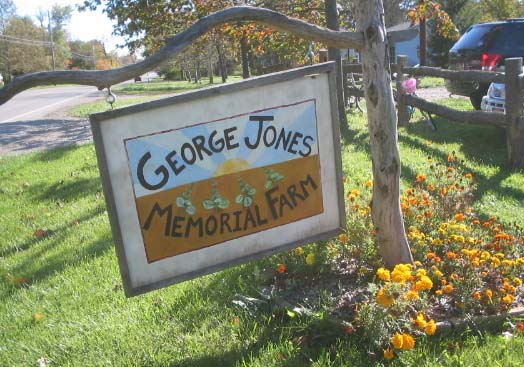
"Oh, all the farmers are out at the George Jones Memorial Farm," said the cashier.
Ah! So the giant tree is gone, but Professor Jones lives on in the land forever. All is good and right with the world.


 Tappan Square is a 14-acre park on the edge of campus and it looked pretty much the same, except that the Oberlin Rocks seemed to have grown smaller.