Showing posts with label cows. Show all posts

Monday, August 01, 2016

The Radical Notion of Consequences

Balance is achieved by counter-balancing self-reinforcing behaviors.


School should be fun for both students and teachers, and the same can be said for dog training.

Dogs and children learn quickly when educational elements are interspersed with play, and when well-timed rewards and praise clearly signal when success has been achieved.

Well-timed rewards and praise are the basis of most training.

But not all learning is accompanied by rewards, is it?

For humans, domestic animals, and even wild animals, powerful aversive experiences also educate.

A fox may get a ripped muzzle, a cow a shock from an electric fence, a horse a mouth full of nettles, a young man a police arrest or black eye.

Live and learn. Such is life.

Ask any man or woman to show you their scars, and they will remember what caused them.

Fox, cow and dog are no different.


Three Shocks Change a Life

Aversives, when strong enough and well-timed, make a powerful impression and can fix a lot of problems before they start.

Imagine if, when you were sixteen years old, you had been shocked just as you reached out to touch that first can of purloined beer.

Would you have reached for a second? A third? Would you have ever drunk a six pack?

And if you had not, would you have done better in school? Would you have married a different girl or gotten a different job?

Would three or four well-timed shocks have changed the entire trajectory of your life?

Probably.

But, of course, that's not what happened, is it?

Instead, you drank the first beer, and the first beer drank the second beer, and before you can say "Bob's your Uncle" you had downed a six pack and discovered the joys of being drunk with members of the opposite sex.

Of course, when people drink, bad things eventually happen. People get sick, they say or do something they shouldn't, they embarrass themselves.

And yet, people still drink. We humans are slow learners and quick forgetters.

Why? Why are we slow learners when it comes to things like booze?

Well, to put it bluntly, beer, fate and society are not very good animal trainers.

All three elements allow for long periods of self-reinforcing pleasure punctuated by episodic (and sometimes apparently random) negative outcomes.

Often these negative outcomes are not all that painful. We survive hangovers, clean up the vomit, make our apologies, and we do not change our behavior too much.

Of course, alcohol intoxication is only one form of self-reinforcing behavior. Others include driving too fast, coming to work late, leaving work early, and spending more money than we actually have.

Provided nothing really bad happens, these bad behaviors will not go away.

Only when we "feel the heat" do we "see the light." Even then, the heat must be consistent and far enough outside our comfort zone to counter-balance the reward implicit to any self-reinforcing behavior.

The good news is that if a well-timed and consistent aversive experience is delivered, we learn quickly.

In fact, if we were all given a mild shock every time we went over the speed limit (rather than a random ticket we pay later), I think most of us would stop speeding in short order, and thousands of lives a year might be saved. Lesson learned, and it would not take a long time to learn it!


Cold Hand Meets Hot Stove

This last point is important: It would not take long time to learn it.

Electric fences work because they ALWAYS deliver a jolt when touched, and the shock cannot be brushed aside. The jolt of an electric fence is memorable even to a one-ton bull.

An electric fence is not designed to torture cows; it's designed to train them.

Training here is done with perfect timing and an assured, predictable, and memorable consequence.

Bad habits are never reinforced, and they are never ignored. It only takes a few well-timed applications of a powerful negative consequence for the cow to "get it" and stay away from the fence. After that it may never get jolted again.

The point here is that aversive training is not torture; it is the opposite of torture.

Torture occurs when punishment is random, unpredictable, or incessant.

Aversive training is NOT "randomly shocking the food bowl" to create psychosis in an animal.

Aversive training is NOT long periods of permissive indifference punctuated by sudden and unexplained periods of overlording, intolerance, or pain.

Nor is aversive training always painful.

It is simply an unwanted but memorable consequence that is consistently applied to counterbalance what would otherwise be an unwanted, but self-reinforcing, behavior.

For some timid animals the counter-balancing aversive that is needed may be as simple as a loud voice, a light jerk on a leash, or a loud rattle-can tossed in their direction.

As a general rule, the younger the animal, the less ingrained the habitat, and/or the weaker the positive stimulus provided by the animal's unwanted behavior, the weaker the aversive stimulus needed to serve as a counterbalance.


Training Is Not Torture

Why are so many people frantic in their assertion that negative consequences should never be levied when training an animal?

I cannot prove it, but I suspect some of this reaction is the pentimento of bad parenting long ago inflicted on confused children.

Adults raised as children in unstable homes sometimes have a hard time, later in life, differentiating between simple discipline and abuse.

In their own childhood, long periods of lackadaisical parenting may have been punctuated by overly-severe application of consequences, with new rules invented overnight and maintained for only a day or two before being abandoned without explanation, or honored only in the breach.

Of course, what has gone on here has not been discipline and training, but the opposite of that.

Where there should have been consistency, there was no consistency.

Where there should have been positive attention there was instead weeks of indifference.

Where rules should have been clear, there was only confusion.

People raised in these kind of households often have trust and communication problems, and people with trust and communication problems often gravitate to the world of animals, and especially to dogs.


Feeding, Seeding & Weeding

In a healthy household, the ratio of positive to negative consequences is always high, and it remains high.

There is no magic here; positive or pleasurable consequences, as well as consistency, are the backbone of all successful teaching.

Of course, we do not click and treat our children with little lumps of cheese or hotdog!

Instead, we use words, body language, short written notes, text messages, grades, privileges, time and attention, toys, play opportunities, money, fancy clothes, and increased responsibility to signal our approval.

Nor do we ignore bad behavior. Here the theories and methods range all over the map depending on culture, location, time and temperament. Some parents use a strap, some spank, some put kids in time out, most lecture, some humiliate, some withhold privileges, some slam doors and make threatening noises, some hold back toys and fun activities, some impose hard work or even fines.

Does it all work? Of a fashion. One problem is that parents are notoriously inconsistent (espcially when there is more than one parent), and the ability to time consequences so they are associated with bad action is hard.

If a child is started early, raised in attention and love, and attuned to the fact that well-timed and consistent consequences will follow, however, bad behavior rarely gets too far out of hand.

Yes, there will always be some bad behavior, but it does not take much to set the child right.

And what is true of children is, generally true of dogs and lawns.

Lawns?

Yes, lawns.

In many ways, raising children and raising dogs is a bit like growing a lawn; It's all about feeding, seeding, and weeding.

The feeding is your positive daily interaction with the dog.

A healthy lawn needs sunlight, water, and fertilizer. A strong system of roots prevents a lot of problems, and tends to keep weeds at bay on its own.

This is true of children and dogs as well.

The seeding is the introduction of trained behaviors.

Some folks want kids and dogs to "grow naturally" and so, to extend the lawn metaphor, they allow the grass to grow tall and self-seed, and they let the edges of the lawn run a bit wild.

Others want children and dogs to follow a very prescribed set of behaviors and so the lawn is cut sharp twice a week, edged once a week, and overseeded on a regular basis.

Weeding, of course, is simply the elimination of certain unwanted plant species which, if left ignored, would self-propagate and ruin the lawn.

No matter how strong the lawn and how judicious your seeding and fertilizing, every lawn eventually has a problem weed or two, and woe is the homeowner who does not take the time to grub them out.

You see, weeds self-propagate. They are as self-reinforcing as some bad behaviors.

Can you feed your way out of a weed problem?

No, not generally. There's a reason every lawn keeper has a weed tool, and every dog owner has has a leash and a collar. Sometimes you just have to say NO, and mean it.

This is a repost from May 2010.

Sunday, August 10, 2014

Nazi-bred Super Cattle in the U.K.


"Nazi-bred Super Cows Roam Farm in Devon"

That's the title of an article in The Guardian about Lutz and Heinz Heck's recreation of the Auroch, a type of wild cow, seen in the cave paintings at Lascaux, France.

Lutz and Heinz Heck were German zoologists who recreated the Auroch, by "back breeding" primitive-looking cattle until, at last, they got a cow that looked right for the part.

This was, quiet literally, "breeding to a picture," which is the basis of most Kennel Club breeding programs today, in which work and ability are given the hind leg.

The caves of Lascaux, of course, were discovered by a terrier by the name of Rocket.

And as for Lutz Heck, he was was instrumental in creating the Jagd Terrier, aka the German Hunt Terrier, a fact I uncovered based on a hunch that it would be the kind of thing a Nazi zoologist like Lutz Heck would do. And guess what? I was right!

Today, many of the Jagd Terrier web sites mention the Lutz Heck connection, even if they whistle past any real description of who Lutz Heck was.

So let's set that right, eh? Here's a short decription, which I think puts the man in time and place. It comes from a New York Times review of The Zookeeper’s Wife, a book about how the director of the Warsaw Zoo and his wife saved the lives of 300 Jews by hiding them in the zoo during the war.

The Zookeeper’s Wife proceeds chronologically, starting before the war, when the Warsaw Zoo was as esteemed as any in Europe. Soon the Nazis destroyed the zoo with bombs and guns. Led by the criminal zoologist Lutz Heck, they carted off the best animals for their own collections. Then Heck and the SS held a shooting festival on New Year’s Eve, 1939, to finish the job. Their brutality at the zoo foretold their brutality in the war, as Antonina intuited in her diary, which Ackerman draws on heavily for her book. “How many humans will die like this in the coming months?” Antonina asks herself, watching the Nazi shooting spree.


Friday, July 02, 2010

Where the Buffalo Roam -- Again


A repost from this blog, circa December 2004.

Thanks to Teddy Roosevelt, Aldo Leopold, Gifford Pinchot, the American environmental movement, the Lacey Act, the Weeks Act, the Clean Water Act, the Endangered Species Act, the Pittman-Roberts Act, the Conservations Reserve Program, the Migratory Bird Conservation Act, and the Duck Stamp Act (to name just a few), America's wildlife is coming back.

All of this legislation has been supported by hunters who understood the value of the land and the wildlife on it. Environmentalists and hunter-anglers have worked hand-in-hand to bring back the wild turkey, to protect bear habitat, to preserve salmon spawning streams, and to shelter riparian areas.

For the terrier enthusiast, the result is plain to see in the hedgerow and forest: a record number of red fox, raccoon, possum and groundhogs spreading out into historically new territory.

Even species once pushed to the edge of extinction are now roaring back from the abyss -- alligators, bald eagles, beaver, Canada geese, wolves, and buffalo.

If the story of 19th Century America was about stripping the land and exterminating every species on it, the story of the 20th Century has been about bringing it all back.

Where the Buffalo Roam -- Again
San Francisco Chronicle, April 22, 2001

________________


Brian Meirs first noticed it a few years ago. The game was coming back.

It was subtle in the beginning - a few more sharp-tailed grouse along the section roads than usual, more deer peering from the margins of the hayfields at night. Then people started noticing there were larger numbers of pronghorn antelope than had ever been seen, and they were hanging around closer to town.

"Even 10 years ago, you never heard of mountain lion or elk around here," said Meirs, a state game warden who works the vast plains and mesa country around Buffalo. "Now they're pretty common. There are even occasional wolf sightings. It's like the wildlife was back there in the shadows, waiting for a change."

The change has been building for decades. The western Great Plains contain the country's greatest demographic anomaly: Its human population is emptying out. The trend, the 2000 census shows, has really gained force over the past decade with the drying up of the ranching economy.

But as people move away, wildlife is starting to fill the vacuum. In an unexpected way, a vision of the Great Plains as a wild commons is taking hold.

"It's funny - Buffalo Commons is really happening," Meirs said, as he sat in his truck on the main drag of Buffalo, a thoroughfare framed by abandoned storefronts. "Not like people thought it would. But it's happening."

The concept of the Buffalo Commons was floated by New Jersey sociologists Frank and Deborah Popper in 1988. The Poppers observed that agriculture had failed miserably on the Great Plains, and noted that the region would probably be almost wholly depopulated save for a few cities by the mid-21st century.


The highest and best use for the area, the Poppers argued, was in its pristine state: A restored prairie cleared of fences and abandoned ranches, reseeded with native bunchgrasses, teeming with wildlife. And foremost among these resurgent animals would be the emblematic beast of the Plains: the buffalo. Back by the tens, perhaps hundreds, of thousands. Plains residents, both white and Native American, would earn their money through ecotourism and franchise hunting, not punching cows and growing dryland wheat.

Because the Poppers' proposal was predicated in part on federal buyouts of private property, it kicked off a howling storm of protest from the Great Plains agricultural community. Ranchers saw it as the most sinister possible example of a federal land grab. Resistance was so great that the idea died aborning.


But that didn't change the reality of Plains demographics - a reality best apprehended from the air.

Fly in a puddle jumper from Denver to Bismarck, N.D., and look down. There are great tracts of Badlands and rolling prairie, huge expanses of "pothole country" spangled with ponds and marshes, entire square miles of dryland wheat and irrigated alfalfa, serpentine brown rivers lined with cottonwoods, the occasional road. Very few ranches, and fewer towns. No cities. The West and East coasts, the intermountain West, the Southwest, the Gulf Coast and the Deep South - they're exploding with development. Even the industrial Northeast, long a laggard in population growth,
is gaining new people.

But not out here where the buffalo once roamed. Nearly three-quarters of Plains counties - 322 of 443 - have lost population since 1930. According to the 2000 census, 272 of 443 of the Plains counties have experienced population declines since 1990.


Demographers estimate that rural counties of the Dakotas could lose an additional third of their population in the next 20 years. From eastern New Mexico through the Texas and Oklahoma panhandles, to large portions of Colorado, Kansas, Nebraska, the Dakotas and Montana, the story is the same.

The depopulation affecting the region is nothing more than the dying of a dream. Or a scheme, at least. At the turn of the century, the western Plains were considered the globe's most promising emerging breadbasket.

Cattle had thrived on the rich prairie bunchgrasses after the subjugation of the Plains Indians and the elimination of the buffalo.


Now, decided the pols in Washington, D.C., the rich black earth beneath the virgin sod would grow the nation's wheat.

The late 19th century and early 20th century were fairly wet on the prairie, reinforcing a popular idea of the time that "rain followed the plow." But years of drought followed, and homesteaders began washing out. The ruins of their farms are all over the Plains, ranging from abandoned dugout hovels to derelict three-story houses that are home to nothing but bats and owls.

"Agriculture around here is changing so fast you won't even recognize it in 10 years," said game warden Meirs as he sat in his truck listening to the wind whistle down Buffalo's main street. "The cattle and sheep are going by the wayside."

Buffalo Commons, it seems, is destined to occur - no matter what it's called, no matter who loves or hates it. But the forging of the Commons isn't a completely passive process.

True, the great federal investment envisioned by the Poppers didn't happen, nor is that likely. Given general public sentiment against extravagant government spending programs, it's inconceivable that Congress would loosen up the purse strings to fund the purchase of tens of millions of acres of bankrupt rangeland.

Instead, Buffalo Commons is becoming a private enterprise. And leading the movement is media mogul Ted Turner, who appears to have made the North American bison his private totem. Turner owns about 1.7 million acres divided among several ranches scattered across the Plains, and that figure is growing.

"I heard tell that Ted Turner wants to be able to ride all the way from Canada to Mexico on his own land," drawled one Nebraska rancher. "And the way he's going, it isn't going to be too long before he can do that." Turner looks for a certain kind of property: One that's in grass rather than croplands, with natural contours intact. He wants good biodiversity - country that supports substantial populations of wildlife of numerous species. And when he buys properties, he more or less follows the same formula: Tear out all the cross fencing and replant pastures with bunchgrasses and other native vegetation. Bring in the buffalo.

Turner believes that ranching can be profitable on the Plains - but not necessarily by raising cattle. He's promoting the sale of buffalo breeding stock and meat, luxury big game and bird hunts and ecotourism tours as the economic saviors of the region.

Unlike many celebrity landowners, Turner isn't gate-happy, and doesn't seem to mind rubberneckers as long as they don't stop to shoot his buffalo. And there are plenty of buffalo to see. Under a sky crowded with lowering gray cumulus, a couple of hundred of the shaggy beasts grazed near a roadside. About a mile away, on the same vast tract of rolling prairie, a similar number fed.

A Lakota hunter could have witnessed precisely this scene in this same place 150 years ago.

And buffalo aren't the only animals thriving on Turner's property. Big coveys of sharp-tailed grouse fly unhurriedly out of the way at the approach of a truck. White-tailed deer bolt from every coulee. Stop to watch scores of blue-winged teal bank and swoop around a pothole, and you catch the eerie, wild yapping of two coyotes singing in antiphony in the distance. Although he is operating on the most ambitious scale, Turner is by no means the only New Age buffalo rancher on the Plains. Many of Turner's compeers don't necessarily share his wildlife habitat goals. But the wildlife is nevertheless reaping the benefits of their bison husbandry.

Kirk Budd, the proprietor of Freshwater Ranch in Nebraska's Sand Hills, has lived the quintessential hardscrabble Plains life. He raised cattle until "they just about starved me out." He was a bush pilot in Canada for years, and was a crop duster until a pesticide accident almost killed him. Things, in short, were looking pretty grim for Budd. He was in danger of busting out, losing his ranch.


Then a few years ago, he bought some buffalo.

"They were cheap then," recalled Budd, crawling out from under an airplane he was repairing at his ranch. "About $400 for a cow. So I figured what the heck." Budd gradually expanded his herd, keeping the heifer calves, selling the bulls. He now owns several hundred buffalo on three ranches totaling 11,000 acres. Many are verging on coal black, and all are huge - much darker and far larger than Turner's brown-and-russet buffalo. His bred heifers sell for about $4,000.

Although Budd doesn't believe bison will utterly supplant cattle on the Plains, he feels buffalo ranching will continue to grow. "The National Buffalo Association says the country's herds are growing at 12 percent a year, but I know it's more than that. I know a lot of people in this business, and everyone is keeping all their heifers. I figure the real figure is more like 40 percent a year."

And compared with cattle, buffalo have been good to his land, Budd notes. Cattle like to wallow in water, tearing up creeks and ponds and trampling vegetation. But buffalo associate water with predators. They all go down at once to drink, then get out right away to higher ground. The creeks stay vegetated, and the water stays clean.

Indeed, the Freshwater Ranch looks markedly different from neighboring properties where cattle are grazed. The forage is in better condition, and the streams and ponds are far more vegetated. A creek that runs by the ranch house looks like prime trout water, and Budd confirms it is full of
large brown trout.

And the ranch burgeons with wildlife. "A lot of critters like being with buffalo," Budd said. "They evolved with them. Deer, elk, antelope, wild turkeys. We even have bighorn sheep on one of our ranches. You can ranch buffalo, maybe even tame some you raise from a bottle. But they're basically wildlife. And you can see that reflected in the condition of the range on any ranch where they're raised."

As bullish as he is on buffalo, Budd doesn't think much of Buffalo Commons. "That will never, never fly out here," he said. "As soon as you start talking big government involvement, people resist. Also, a lot of this land is still irrigated, particularly to the east of the Sand Hills. It's growing soybeans, wheat, corn and alfalfa. "As a general policy, I don't think you should take all that food land out of production for a wildlife park. That's just not good for the nation."

While Plains farmers resist government intervention, they do understand - and appreciate - government subsidies. Federal payouts have been part of America's ranching and farming culture for decades, and although they have diminished in recent years, they're still relied on to make ends meet. Since the mid-1980s, many of those subsidies have been paid to cattle ranchers to conserve wildlife habitat on their lands. In the Dakotas, almost 500,000 acres of upland and wetland habitat have been preserved under these conservation reserve programs, benefiting a variety of species, but particularly migratory waterfowl.

The coteau region - a vast, hilly stretch of glacially carved potholes and ponds in the Dakotas, eastern Montana, Saskatchewan and Alberta - is a duck factory, explained Scott McCleod, a biologist with the northern Plains regional office of Ducks Unlimited in Bismarck. Ducks Unlimited is a conservation organization composed of primarily hunters that preserve wetlands and grasslands prairie. So far, it has saved 8 million acres of habitat essential to waterfowl in the United States and Canada.

"Sixty to 70 percent of the continent's major duck species breed in the prairie pothole region," McCleod said. "During the winter and spring migrations, the potholes serve as critical resting and staging areas for the birds."

The historic temptation for farmers, McLeod said, has been to drain the potholes to increase tillable acreage and plow the grass for relatively profitable crops like wheat, corn and sunflowers. "That's why we like to work with cattle ranchers rather than farmers," said McCleod. "Ranchers are
interested in the same thing we are - preserving the grasslands."

The restoration under way is not necessarily a process that will proceed smoothly and steadily. Federal funds for conservation reserve programs could dry up; a prolonged recession could make the buying of megaranches by conservation-minded billionaires like Turner a thing of the past. But nothing, it seems, will change the bedrock reality of the western Plains: They are not well-suited for agriculture or year-round human habitation.

Native Americans knew how to live on them - by passing through, by following the buffalo that peregrinated from horizon to horizon. The record of permanent settlement on the Plains, on the other hand, has been dismal. One way or another, the Plains will devolve to their earlier condition: To a sea of grass, where people are the transient visitors, wildlife the enduring residents.

Bison are generally considered the emblematic animal of the Great Plains, and reintroduction efforts for the shaggy beasts are almost universally popular. But there's another keystone Plains species essential to grasslands restoration - and it's not nearly as esteemed as the buffalo. Prairie dogs were once the most common mammal in North America. In the late 19th century, about five billion prairie dogs of five species inhabited the Plains from Canada to Mexico. The vast majority were black-tailed prairie dogs, a stocky, buff-colored rodent that weighs between two to three pounds. Their vast towns comprised complete ecologies in their own right: One in Texas measured 100 miles wide, 250 miles long and contained an estimated 400 million dogs.

Prairie dogs shaped the Plains as much as the buffalo, and a considerable array of wild species depended on the rodents for shelter and food. The prairie dogs' various diggings provide
shelter for a great many animals: badgers, foxes, burrowing owls and a tremendous variety of reptiles, amphibians and insects.

The huge quantity of feces and urine produced by the dog towns was a gigantic fertilizing mechanism for the Plains. Today, prairie dogs only inhabit about 1 percent of their former range; the black-tailed prairie dog is a candidate for protection under the U.S. Endangered Species Act. Their decline began shortly after cattlemen moved to the Plains. Seen as competitors with cattle for forage, the dogs were poisoned and shot out.

A coalition of environmentalists is agitating for a return of the dog. "Prairie dogs are decreasing in numbers across their range," said Jonathan Proctor, a program associate with the Predator Coalition Alliance in Bozeman, Mont. Proctor's group was able to secure a temporary ban on poisoning on federal lands through a petition to list black-tailed prairie dogs under the U.S. Endangered Species Act.

But the dogs are still shot in large numbers, often for sport. Such activities are widely condoned by ranchers. "There's no shortage of prairie dogs," said South Dakota rancher Pat Clark, who said the animals compete with cattle for grass and endanger livestock with their burrows. "They're all over the place." But scattered families of prairie dogs are no indication of the general health of the five species, Proctor said. Despite the pressures facing prairie dogs, Proctor said he is guardedly optimistic about their future. Colorado recently banned sport hunting for black-tailed prairie dogs, and South Dakota and Montana are considering similar restrictions, said Proctor.

"Basically, they'll come back if we stop actively killing them," he said.


.

Thursday, May 27, 2010

My Justice Would Be Swift and Done With a Sword


A reader of this blog writes:

I read your blog every day and while I haven't as yet commented on any posts I am always interested in what you have to say. My daughter is a sophomore at The Ohio State University and is majoring in animal science. This is an email she sent me. I hope that you will read this and investigate this story. If what Mercy for Animals did to this dairy farm family is true, I am outraged! I told my daughter that this dairy farm could not stay in business for 80 years if they treated their animals the way you see them treated on this horrible video. I do not for a minute believe it and yet so many people will look at the video and they WILL believe it. Please help. Thank you for your time.

Feeling a little uneasy, I scrolled down to find an email allegedly written by Mariette C. Benage, Coordinator, Student Success, Department of Animal Sciences at Ohio State University. The email reads:

Dear Students,

Here is a story that I just learned about after class today. I'm passing it along to you as an example of both direct pressure and animal activist techniques that you, as young adults, need to be aware of. My personal opinions about this are unprintable!

All:

Ryan Conklin, a senior in our department, has asked me to put out this email to you to make you aware of a situation involving his family farm in Plain City. At 11:00 today there will be a news conference that will show terribly graphic footage their animals being mis-treated on their dairy farm. Ryan told me that a man was hired to work on their dairy last month that turned out to be an under-cover investigator for a group called Mercy For Animals, an affiliate-I believe-of HSUS. Ryan told me that this man from Mercy For Animals coordinated the video footage with another person working at the dairy, and he is the one seen causing the abuse on the video. The person recording the footage is the Mercy For Animals advocate, and he quit his position at the dairy on Sunday. The young man seen in the video was released of his duties at 6 am this morning.

I know some of you in the department know Ryan and his family very well, and I can tell you that they are very honorable people and that they would NEVER condone any of these actions. I believe they’ve been in the dairy business for close to 80 years, and they are certainly people that genuinely care about the well-being of their animals. This appears to be a trap that HSUS has set up to gain voter support in the state at the expense of a well-known dairy. This is a very difficult time for the family, and I know Ryan would appreciate any support that we can offer.

For those of you that are interested, here is the link to the video: http://www.mercyforanimals.org/ohdairy/

I will warn you…it’s not easy to see.

Now I was beginning to really feel uneasy.

You see, here was an employee of Ohio State University writing to students about an explosive and legally actionable issue, and suggesting to them that there was a smear campaign being waged against an "honorable" family farm that had never abused animals.

And yet this Ohio State University employee had quite obviously not taken a minute's time to actually investigate the situation!

"Who are you going to believe, me who has not bothered to investigage anything at all, or your lying eyes," she seems to be asking.

Wow! The stupidity of this email was dizzying.

Bracing myself, I went to the video tape.

When it comes to abuse, I thought I had seen it all. Apparently not.


I wrote back to the regular reader of this blog, trying to measure my words as carefully as possible.

How could anyone see this video tape and frame the story as if the dairy operator was the victim? My mind boggled:

Sorry, but this one does not pass the smell test and I will be going in the opposite direction.

I cannot speak to what the farm management knew or did not know (a court will decide that), but a couple of points need to be made here:

  1. No one is going to voluntarily appear in a video showing this kind of abuse. The suggestion that this was a put-up-job is complete nonsense. What is shown in the video is extreme, shocking and totally unnecessary violence to animals, the kind that gets you a prison sentence in a place where your teeth are pounded out with a bar, and your assh*l* is stretched by your bunk mate. No one signs up for that tour. No one. Ever.

  2. This is not just one person doing violence, and this video tape was not shot in one day. This video tape shows at least two people doing criminal violence to animals, and the change in clothing makes clear it was shot over at least six or seven days.

  3. If farm management did not know what was going on here, they are criminally negligent. The employees shown here are overt sadists and sick twisted souls, and this fact would have been self-evident over even a brief period of time. The fact that this farm hired these people and retained them, speaks to negligent omission at best, and criminal comission at worst. They better get a damn good defense lawyer and throw the people on the video tape under the bus!

I do not feel sorry for this farm<; I feel sorry for these cows and the honest and hard-working dairy industry of Ohio which has been tarred by this horror. You want me to defend this farm and suggest Mercy for Animals or HSUS (allegedly, by inference and suggestion) put up some kind of fabrication? Nope. Sorry, but I am not blind or stupid. Very clearly, the managers, owners and administrators of this dairy, however, are. It is a horror. It is a sadness. And YES, someone needs to go to jail.

Put me on the jury and I assure you they will.

Any question of where I stand?

Just because I stand for farmers, do not salute every inanity of the animal rights community, and will not wink at the direct mail pettifoggery of the Humane Society of the U.S., does NOT mean I will ever defend true animal abuse.

Put me on the jury, and make me jury foreman, and I will see to it that the men in this video get the electric chair if that is at all possible.

Sadly, however, it is not.

You see, one of the people on this video tape has already been arrested.

But guess what?

The people beating and stabbing these poor cows and calfs are only going to be charged with a second-degree misdemeanor punishable by up to 90 days in jail and a fine of up to $750.

Outrageous!

If an animal abuse case ever cried out for criminal prosecution with real jail time, this is it.

But in Ohio, farm animals apparently have no real protection even from this kind of wanton and horrific cruelty.

Should that change? Very clearly, YES.

.

Tuesday, August 25, 2009

Farming Like People are Hungry


From The Altoona Mirror, in Pennsylvania:

Farmers will face a 100 percent increase in demand for food worldwide by 2059, and researchers in the dairy industry say genetic technology will be the key to stepping up production.

Of the United Nations' projection that 100 percent more food is needed, 20 percent of it will come from increasing agricultural production land and 10 percent will come from upping the production intensity of existing land, said Lisa Holden, a Penn State associate professor of dairy and animal science.

"And the other 70 percent? It will come from utilizing science and new technology," Holden said. "We'll learn how to do things better."

Better, of course, means hybrid plants and animals that produce more, mature faster, grow longer, and are easier to plant and harvest.

How will that be done? Is is possible?

We shall see.

Recombinant DNA will certainly be used (it is already part of every meal you eat), but old methods of boosting production have their place too.

To read more see:

Sunday, June 14, 2009

Green Cows Produce More White Milk

Earlier this week, I put up a blog post entitled Inbreeding and the Axis of Production, detailing how famers are very careful to keep coefficients of inbreeding low in their dairy cow herds.

Why do farm managers work to keep inbreeding values low? Simple: the higher the inbreeding score, the less milk produced. Inbreeding is bad for dairy production.

So how are today's dairies doing, in terms of production?

Extremely well! In fact, modern dairies produce far more milk per cow than their analogs did 25, 50 or 100 years ago.

Consider these numbers from Cornell University's Journal of Animal Science, and what they mean for a greener, cleaner world:


[T]he carbon footprint for a gallon of milk produced in 2007 was only 37 percent of that produced in 1944. Improved efficiency has enabled the U.S. dairy industry to produce 186 billion pounds of milk from 9.2 million cows in 2007, compared to only 117 billion pounds of milk from 25.6 million cows in 1944. This has resulted in a 41 percent decrease in the total carbon footprint for U.S. milk production.

Efficiency also resulted in reductions in resource use and waste output. Modern dairy systems only use 10 percent of the land, 23 percent of the feedstuffs and 35 percent of the water required to produce the same amount of milk in 1944. Similarly, 2007 dairy farming produced only 24 percent of the manure and 43 percent of the methane output per gallon of milk compared to farming in 1944.

Which beggars the question: If famers can make better cows without inbreeding them to death, how come the Kennel Clubs cannot do the same for dogs?

And the answer is quite simple: They can!

But to do so, they are going to be have to abandon 19th century eugenics theories that put a premium on breed and race purity.
.

Wednesday, June 10, 2009

This Farm Milks 32,000 Cows a Day


And it's all on public display! A single farm produces enough milk needs to fill the needs of 8 million people. Hat tip to Paul H. for this one!
.

Tuesday, June 09, 2009

Inbreeding and the Axis of Production


In an earlier post entitled Inbred Thinking, I noted that the cattle industry was the first to create a formal registry of breeding stock, and that this industry was also the first to note that milk and meat production dropped when animals were inbred very deeply or for very long.

Because farmers had a clear "steak and eggs" axis for evaluation of stock, they were ready and willing to outcross to achieve the best results for their needs and their land. Consumers, after all, do not much care what breed of chicken their eggs come from, or what "champion" bull sired their steak.

Through experimentation, farmers discovered that outcrosses and hybrids of two "pure" types produce as well or better, while remaining more disease resistant, more fecund, and longer-lived than deeply homogeneous stock.


Of course, what was true 150 years ago is still true today!

Anyone who wants to look at the deleterious effect of inbreeding animals beyond the single-digit threshold need only look at performance records for racing animals or farm stock where there is a real axis for evaluation.

As I have noted in the past, winning race horses are not heavily inbred, nor are winning Greyhounds.

In both animals, a Coefficient of Inbreeding of less than 5% is the norm.

What about production farm animals? Here too we find rising levels of inbreeding correlating perfectly with declining performance. As The Dairy Site notes:

The effects of inbreeding have been so much more negative than positive in animal breeding that the term "inbreeding depression" was coined. Table 1 shows inbreeding depression for lifetime and individual lactation traits of Holsteins from a recent study by Smith, et al. at Virginia Tech. The changes are expressed "per 1% increase in inbreeding." This means that the lifetime economic loss for a mating producing 6.25% inbreeding would be $24 X 6.25 = $150 expected loss from such a mating. Notice that, with the exception of somatic cell score where inbreeding has no apparent effect, all consequences of inbreeding in Table 1 are undesirable. Age at first freshening goes up, length of productive life goes down, all production traits are reduced, and first calving interval is lengthened as inbreeding increases.


The table referenced in the paragraph, above, is appended below:


What about egg production and beef cattle?

Here too we find exactly what we have found with racing dogs, racing horses, and mik cows: increased inbreeding results in less productivity.

The bottom line is a simple one: breeding any animal beyond the single-digit threshold is a recipe for infecundity and sickness.

As Heather Lorimer, associate professor of genetics at Youngstown State University notes:

Mammals, most other animals, and higher plants as well, have evolved mechanisms to avoid inbreeding of any sort. Some, like sweet cherries, have even evolved elaborate biochemical mechanism to ensure that their flowers can not be fertilized by themselves or by very genetically similar individuals.

Most pack animals (like lions, primates, and dogs), kick young males out of the pack so as to prevent them from mating with female relatives. Humans have very strong taboos against mating with relatives. Even fruit-flies apparently have a sensing mechanism to avoid too close of inbreeding; even in a closed population they maintain more genetic diversity than they ought to by random mating.


Professor Lorimer goes on to detail a quick list of the negative consequence of inbreeding:

  1. Elevated incidence of recessive genetic diseases
  2. Reduced fertility both in litter size and in sperm viability
  3. Increased congenital defects such as cryptorchidism, heart defects, cleft palates.
  4. Fluctuating assymetry (such as crooked faces, or uneven eye placement and size).
  5. Lower birthweight
  6. Higher neonatal mortality
  7. Slower growth rate
  8. Smaller adult size, and
  9. Loss of immune system function.


And what are the positive benefits
according to Kennel Club rosette chasers?

Simple: They can incrementally increase their chance of winning a $2 rosette made in China.

That's it!

Want to read more? Try these links:

  • Dairy Crossbreeding: Why and How: There has been renewed interest in dairy crossbreeding as new advantages come to light.... Crossbreeding is more widely practiced by dairy producers every year.

  • Inbreeding in Cattle: Inbreeding does not create undesirable recessive genes, but it does tend to bring to light these unfavorable genetics. This leads to a decline in average phenotypic performance called inbreeding depression. This phenomenon is well documented in all the major livestock species....
    .

Friday, April 24, 2009

Playing God With Milk Cows

The Washington Post reports this morning that scientists have managed to sequence the entire genome of an eight-year old Hereford cow living in Montana, the first time a farm animal's entire genome has been published.


Hidden in her roughly 22,000 genes are hints of how natural selection sculpted the bovine body and personality over the past 60 million years, and how man greatly enhanced the job over the past 10,000.

As with other species, genes governing the immune system, the metabolism of nutrients and social interaction appear to be where much of the evolutionary action has occurred. The result is an animal that lives peacefully in herds and grows large on low-quality food, thanks to the billions of bacteria it carries around....


So what? How does a sequenced gene lead to anything positive?

The short answer is that a sequenced gene should enable cattle breeders to create more productive cattle faster because they will be able to find sires with the correct genetic outputs without having to go through the time-wasting (and expensive) process of actually crossing cows and tracking their production over a lifetime.


Traits carried by bulls are important in determining how much milk a cow produces. Because bulls don't make milk, however, a bull's "performance profile" has to be sketched by observing the milk production of his daughters -- a process that takes about six years and costs $25,000 to $50,000. Now, male calves can be tested at birth for milk-enhancing traits using gene-chip technology.
Of course, the great thing about cows and chickens and sheep, is that they actually have a milk, meat, and eggs axis upon which to evaluate the animal.

In the dog world
, a true axis for performance is largely gone. You can find it in the world of racing greyhounds, and (arguably) in the world of working terriers, sled dogs, and border collies. But Chihuahuas and Bulldogs, Scotties and German Shepherds?

Not so much.


Monday, September 04, 2006

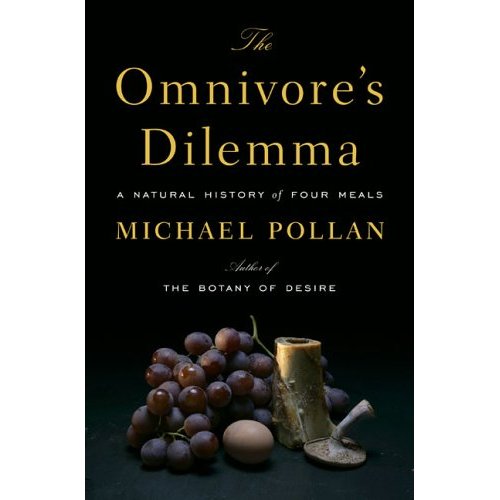
The Omnivore's Dilemma


My father used to subscribe to a publication called Organic Gardening put out by Rodale press, and he also had this huge book on composting.

This may not seem like such an odd thing in this day and age, but in 1969 it was an almost subversive thing to subscribe to this kind of publication. It meant, at some level, that you were either a hippie, a free thinker or a bit strange.

What was particularly odd about it is that I have never once seen my father with a hoe in his hand (or even a paint brush), and we were living in North Africa at the time. Whatever organic gardening was about, it did not seem to have too much to do with turning over the soil. It seemed to have something to do with thought -- a way of looking at the world.

As for a 400-page book on compost, that was clearly either madness or a mistake.

At age 10 I did not quite get it, but by age 20 I did. By then I was a pretty good mushroom collector. I even took a course in fungus in college, and once served wild mushroom omelets (clitocybe nuda) with apple sauce (made from found apples) to 100 folks at an eating co-op on campus. No one got sick, the omelets and applesauce were proclaimed excellent, and the total cost was $20 bucks.

A few folks gave me strange looks when they later found out I had collected the mushrooms from a leaf mulch pile near where I had constructed a dog run for my terrier, but what could they say? The food was good and they were very much alive.

Life moved on.

Bob Marley died, the hippies disappeared, eating co-ops vanished into the sucking tide of individuality, and I got a job that required a suit, a tie and wingtips.

One day in the 1990s I looked up and it seemed every independent store in America had fallen under the rip tide of corporate America, with Bed, Bath and Beyonds, Starbucks and Best Buy stores shoe-horned into every strip mall. Nothing was "mom and pop" anymore -- it was all Big Corporate.

Meanwhile, something weird was happening to the food. It was subtle. At first it was the ever-expanding sodas and bags of popcorn at the local movie theatre. The cups were now so large they would not fit in the holders.

Hamburgers, which had been discrete human-sized items wrapped in paper, were now so large they were served in Styrofoam boxes. A "Whopper" -- once one of the biggest hamburgers imaginable -- was replaced by the Double Whopper. McDonald's came out with the Big Mac and the Quarter Pounder.

Meanwhile, the grocery store produce section no longer seemed to have seasons. You could get grapes year round, and oranges too. New varieties of fruits and vegetables started showing up. What the hell was Bok Choy and Star Fruit?

On trips across America, I would see fewer and fewer cows and horses. I almost never saw a pig.

Sometime in the 1990s tobacco disappeared in Maryland and Virginia and North Carolina. Only two crops seemed to be grown now: corn and soy. A great deal of land in the Baltimore-Washington corridor, and all along I-95 South seemed to be lying fallow. Old pastures of thick grass reverted to weeds and small bushes.

Flying down the road you could not help but notice that a lot of land was being colonized by dense stands of Virginia cedar.

I would never have thought all this was connected, but after reading Michael Pollan's excellent new book Omnivore's Dilemma, I can see that it is.

When I first heard about this book, I was not all that interested. It was clearly a book written by a “foodie,” and I am pretty much done with food-fadists who think bread is evil, and so too are beef, eggs, milk, and …. My God are you eating an apple? They have Alar on them!

But Fate intervened when I came across the book at a local book store. Reading the back of the book, I realized Pollan was the same fellow who had written "The Botany of Desire" -- a book I found quite well written and entertaining. I flipped through his newest book and saw a section on mushroom hunting. I was in.

My money was well spent. The Omnivore's Dilemma is a terrific book. Roughly structured around four meals, Pollan attempts to trace the food back to its origins. How was this stuff grown? What are the ecological, economic, health, and social trade-offs to eating conventional food from the local grocery store versus "Fresh Fields" (industrial organic), versus artisan foods (local organic) and even hunting and foraging?

The book starts with a chapter on corn, which is so astounding that it alone is worth the price of the book.

And let me hasten to say that while Pollan is squeamish (and almost vegetarian), he went on his first hunt (for pig) while writing this book, and his conclusions are pleasantly surprising. There is only one “perfect” meal in this book, and it does not come from Whole Foods.

The power of Pollan's book is that he connects a lot of disparate pieces into a greater whole.

One small fact-filled mosaic after another is slipped into the frame until at last you have a larger picture of what is happening, not only on America's farms, but also in politics, economics and kitchens.

I had seen bits and pieces of this story myself, but only after reading this book did I understand the big picture of what has been going on all around me my whole life. Good stuff. Not just good writing, but good thinking.

Pollan is not a polemicist, and he does not tie it all up with a "this is what you need to do" kind of ending (thank God!)

In fact, he does not need to. If you read this book, you will get the point and you may actually change what you buy. Grass-fed beef may show up in your cart as well as locally grown vegetables. You may discover the joys of returning to seasonal food selection.

Pollan does not seem to think everyone has to eat the same way, and he does not begrudge those who want to continue to eat as they are eating now.

He suspects, however, that if people knew more about the economics and ecology of corn, and the fakery behind much of the "organic" food being hawked to us today, more people would eat locally, seasonally and healthier (even if not entirely organic).

Suffice it to say, that he made a believer out of me, and I was not a likely convert.

And, for the record, he confirmed what I already knew: My Old Man is a pretty smart cookie and more than a little bit ahead of the curve.

Monday, February 14, 2005

The Cow and the Derrick

Example

I hunt several farms where corn and soy are grown and beef cattle are raised. One farm is entirely organic, and the cattle there are grass-fed Angus. Another farm has a mixed herd of cross-bred beef cattle, and they too are grass fed. A third farm has few cattle, but they raise over 1,500 acres of soy and roast it for cattle feed. All three farms also grow corn.

I mention this because in many ways these farms are oddities. When I was a young boy, almost all beef cattle were grass-fed, but today most beef comes to the table not from the farm, but the feed lot. You can drive a long way in parts of America today and see mile after mile of corn without ever seeing a cow.

A corn field is a lovely thing, but if you know what you are looking at it's easy to have mixed emotions. If you walk through a modern American cornfield today, you will find no weeds; almost all corn is now "Roundup Ready," which means it has been genetically engineered to be immune to the powerful herbicide "Roundup". Most soy is now Roundup Ready as well.

It has been said that the rise of modern feed lots has transformed cows from natural solar-powered ruminants into artificial fossil-fuel-guzzling hamburgers on the hoof. Because corn depends on fertilizers, pesticides, and herbicides -- and machines to harvest, plant, and transport it -- it has a high "oil price." It takes about 1.2 gallons of oil to grow a bushel of corn which is then converted into a few ounces of beef.

Corn, and to a lesser extent soy, are the main live stock feeds used today because they are so cheap and plentiful. This is due, in part, to federal crop subsidies (in the form of cheap water, low-cost loans, and price support programs), genetic engineering, and petrochemical fertilizers. It is also due to the tremendous natural potential of America's lands, and the expertise of American farmers.

As a result of our tremendous corn-and-soybean glut, the USDA encourages farmers to find a new markets for corn and soy, and -- absent a new market to dispose of it -- that means turning as much of it as possible into animal feed.

Compared with grass or hay, corn is a compact and portable, making it possible to feed tens of thousands of animals on small plots of land -- the modern American feedlot.

We are not going back to grass-fed beef, for the simple reason that there are too many people in the U.S. and they are too demanding. Grass-fed beef tends to be harvested in late Fall, after fattening up all summer, and before the grass grows dormant in winter, while corn-fed beef can be harvested all year round. People want to eat McDonalds, and they do not want to eat beef "in season" like sweet corn and tangerines.

.