Showing posts with label Keller and Marian Breland. Show all posts

Monday, August 29, 2016

They Invented Animal Training


This article was written for the June 2010 issue of Dogs Today magazine. Illustration by Kevin Brockbank.

Who invented animal training and what can we learn from them?

The question may seem silly. Animal training is older than the hills. For certain, it is as old as the dog.

That said, most of what we call animal training today fits into the folder of "operant conditioning," a term first coined by American psychologist B.F. Skinner in the early 1930s.

Chase it around the room, and operant conditioning is simply learning from consequences.

Skinner codified the basic principals of operant conditioning, and he invented a laboratory-based mechanical-training machine which rewarded animals with food when they pulled levers and pecked at spots.

Skinner's real claim to fame in the world of dogs, however, is that he hired Keller and Marian Breland -- two young assistants who more or less invented the modern art of animal training.

Teaching Pigeons to Bowl

The Breland's made their first big discovery while working with Skinner in 1943.

As odd as it sounds, the goal on this occasion was to train pigeons to "bowl" a ping-pong ball down a short alley to knock down a few pins. Keller Breland decided to use a hand-held switch to trigger a food reward, rather than a purely mechanical device. A small problem was that the pigeons had no interest in pecking at the ping-pong ball! Though Keller waited for hours for the right behavior to express itself, it never happened. In frustration, Keller decided to give the pigeons a reward for doing anything approximating movement in the right direction. To his amazement, the pigeons caught on pretty quickly, and the completed trick was learned in short order.

Thus was born "shaping," or progressive rewards based on approximating a task.

The second big development occurred in 1945. By this time, B. F. Skinner had left the University of Minnesota, and the Brelands had decided to strike out on their own as professional animal trainers.

While shaping tricks, the Brelands noticed that the animals themselves seemed to be paying attention to the noises made by the hand-held food-reward switches.

Keller and Marian Breland soon discovered that an acoustic secondary enforcer, such as a click or whistle, could communicate to an animal the precise action being rewarded, and it could do so from a distance.

The Brelands called this a "bridging stimulus," (now generally called a bridge) and it dramatically sped up animal training by increasing the amount of information going to an animal.

Thus was born clicker training.

The Rise of Commercial Animal Acts

By now the Brelands had created their own animal training company -- Animal Behavior Enterprises. Their first contract, with General Mills, was so successful that other contracts with movies, circuses, museums, fairs, and zoos soon followed.

Over the next several decades, the Brelands trained more than 15,000 animals representing more than 140 species. At one point, the Brelands had more than 1,000 animals under training at a single time -- a jaw-dropping level of production.

The Brelands did not just train animals; they also trained other animal trainers who went on to work at such venues as Busch Gardens, Disney World, and Sea World. The Brelands themselves signed contracts with such major amusement parks as Marineland of Florida, Marineland of the Pacific, Parrot Jungle, and Six Flags.

Rewards-based clicker training worked so well that in 1951, the Brelands authored an article in American Psychologist, in which they said they thought rewards-based clicker training might work on any animal to train just about anything.

And then something happened. They noticed that clicker training was, in certain circumstances, beginning to fail in ways they could no longer overlook.

When Clicker Training Failed

In a 1961 paper entitled, The Misbehavior of Organisms, Keller and Marian Breland described their first experience with the failure of reward-based operant conditioning.

It seems that when working with pigs, chickens and raccoons, the animals would often learn a trick and then begin to drift away from the learned behavior and towards more instinctive, unreinforced, foraging actions.

What was going on?

Put simply, instinct was raising its inconvenient head.

Though Skinner and his disciples had always maintained that performance was driven by external rewards or punishments, here was clear evidence that there was an internal code that could not always be ignored.

The Brelands wrote:

These egregious failures came as a rather considerable shock to us, for there was nothing in our background in behaviorism to prepare us for such gross inabilities to predict and control the behavior of animals with which we had been working for years.... [T]he diagnosis of theory failure does not depend on subtle statistical interpretations or on semantic legerdemain - the animal simply does not do what he has been conditioned to do.


The Brelands did not overstate the problem, nor did they quantify it. They simply stated a fact: instinct existed, and sometimes it bubbled up and over-rode trained behaviors.

Clearly, every species had different instincts, and just as clearly, a great deal of animal training could be done without ever triggering overpowering instinct. Still, the Brelands noted,

After 14 years of continuous conditioning and observation of thousands of animals, it is our reluctant conclusion that the behavior of any species cannot be adequately understood, predicted, or controlled without knowledge of its instinctive patterns, evolutionary history, and ecological niche.


The Problem with Dogs

What does this have to do with dogs?

Quite a lot. You see a small, but vocal and militant group of clicker trainers believe everything a dog does is learned by external rewards, and internal drives are "old school" fiction.

While the Brelands argued that a species could not be adequately controlled without “knowledge of its instinctive patterns, evolutionary history, and ecological niche," the most extreme militants in the world of clicker training now seek to minimize and disavow the very nature and history of dogs.

Dog packs? There are no such things, we are told.

Dominance? It does not exist in feral dogs or in wolves, and never mind the experts who disagree.

Prey drive? Not too much said about that!

Of course, instinctive behaviors and drives do not disappear simply because they are inconvenient.

As Keller and Marian Breland put it,

[A]lthough it was easy to banish the Instinctivists from the science during the Behavioristic Revolution, it was not possible to banish instinct so easily.


Of course, one must be careful to qualify the role of instinct.

Yes, dogs have instincts, but the history of dog breeding has largely been about reducing instinctive drives. As a consequence, most breeds have instinctive drives that are sufficiently attenuated that they are not much of an impediment to basic rewards-based training.

That said, not all dog breeds are alike. Not every dog is a blank slate, as the owner of any herding dog or game-bred terrier will tell you. Prey drive does not disappear because you want it to. Many problematic behaviors in dogs -- especially behaviors in hard-wired working dogs that are being raised as pets -- are self-reinforcing behaviors that express themselves without any external reinforcement at all!

Clicker training, the Brelands remind us, cannot solve everything.

Is rewards-based training the most important tool in any trainer’s box of tricks and methods?

Absolutely. There is not much debate there.

But the Brelands remind us that dogs do not come to the trainer as a tabula rasa, nor should we think of all dog breeds as being more or less the same, or that all responses are equally conditionable to all stimuli.

Dogs and other animals, it turns out, are a bit more complicated that white rats, and the real world is not a laboratory.

In the wild and on the farm, animals have managed to learn, all by themselves, since the Dawn of Time and long before clickers came on the scene. How did they do that? Does the real world have as much to teach us as the lab? Keller and Marian Breland thought it did.

Tuesday, June 23, 2015

How to Train a Cheetah


A rabbit-coursing Cheetah in the UK, circa 1937.

I am always a bit amused by the folks who talk about scientific dog training.

What they are trying to suggest is that there was no good dog training before B.F. Skinner (or Karen Pryor) and that they have discovered a secret science.

Now I am a big fan of B.F. Skinner. A great man.

I am an even bigger fan of Keller Breland and Marian Breland, who studied with Skinner, and with Bob Bailey who married Marian Breland after Keller died and who went on to helpe popularize reward-based animal training here in the U.S.  Karen Pryor will tell you most of what she knows she learned from Bob Bailey, who will tell you most of what he knows originated with Marian and Keller Breland who, in turn, learned a great deal from Skinner.

That said, B.F. Skinner did not invent operant conditioning, any more than Newton invented gravity.

Operant conditioning predates Skinner by many millenia, and not just in training dogs.

Consider this text from an 1865 publication entitled "Dog Breaking: the Most Expeditious, Certain and Easy Method".


Hey, that's operant conditioning!

Well yes it is. And in a book called "Dog Breaking" no less.

Hmmmm.... What's that about?

Well, it has more to do with language than technique. Language, you see has always been a problem in dog training.

The term "breaking," as used here, is simply a term moved over from the world of horses. It does not mean you are beating a dog into submission. Far from it, if you actually take the time to read the text.

But of course, when a rival publication came out in 1882, the term "breaking" was the new bogey man (every new product needs to first demonize the old).

Breaking? That must mean beating the dog to death right?

Who wants something that is broken? No one!

The new publication was entitled, "Practical Dog Training: or, Training vs. Breaking" and it wanted everyone to know that you could actually train a dog with a bit of food and a check cord.

And never mind if that was the the exact same message of the earlier text!

The "dog training wars" had started, and YES, it was mostly nonsense right from the start.

Of course, when B.F. Skinner's disciples came along, they too promised a new "scientific" system to replace the "old coercive" system of dog training that they said had preceded them.

They had just learned, they said, that animals could be taught to come for a piece of food, and that they could be taught to avoid things that made them uncomfortable.

Really? Tell us more!

Of course when Skinner showed up, he did not clarify things much in terms of language, did he?

In fact, he made an even bigger muddle of the language by using words like "punishment".

Punishment? Who wants to punish a dog? No one!

In fact what was being meted out most of the time was not "punishment" as we commonly use that term, but a simple instruction that says "we need less of that."

What Skinner called "reinforcement" was simply instruction that "we could use a little more of that."

Language continues to obscure, of course.

When Cesar Millan talks about "dominance," he is not talking about beating a dog as some assume; he is saying the human needs to be setting the agenda. The human needs to decide what food is served, when it is served, who gets it, and in what quantities. The human needs to decide when a walk starts, where it goes, and when it ends. The human needs to decide the rules of the house, not the dog.

Of course words like "dominance" tend to set off a lot of folks, just as words like "punishment" do.

Most of the time these folks have not actually bothered to read B.F. Skinner or Cesar Millan, much less page through old dog training books by Barbara Woodhouse or William Koehler, or the even older texts on "dog breaking."

It's so much easier to demonize stuff if you have not actually read it!

OK, enough about that. Point made (if a point is to be made).

I promised a lesson in how to train a Cheetah. Where is that?

The paragraphs below come from that earlier-named 1865 text on "Dog Breaking," and once again we find operant conditioning at work:

The education of the cheeta is no less progressive than that of the dog; and whatever patience the latter may require from his instructor, the former demands far greater; not so much from want of docility, as from the nearly total absence of all the feelings of attachment so conspicuous in the canine race.

The cubs when they are very young are stolen from the rocky fastnesses where they are usually bred. They are immediately hooded, and allowed no other exercise than what they can take when they are led about by their keeper. While he is feeding them, he invariably shouts in a peculiar key. In a month or so their eager looks, animated gestures, and possibly cheerful purr-ing, testify that they comprehend its import as fully as a hungry young ensign does "the roast beef of old England." They are then slightly chained, each to a separate bandy (bullock-cart), and habituated to its motion. They are always fed during the drive. They thus learn to expect a good meal in the course of their airing.

After a time the keeper, instead of feeding a promising pupil while he is a prisoner, goes to a little distance from the bandy and utters the singular cries now so joyfully heard, upon which an attendant slipping off the chain and hood the liberated cheeta runs to his trainer to be fed. By degrees this is done at increased distances. He is always conducted back to the carriage by the keeper's dragging at the lump of meat of which the animal retains a firm hold.

The next step is to for the man to again commence feeding near the cart, but without making any noise -- the removal of the hood being the only thing to tell the spotted beast to begin to look about him for his dinner. The last step is the substitution of a kid or wounded antelope ... His education is now completed; but for many months he is never unhooded at a herd unless the driver has managed to get the cart with a very favoring distance."


If you are a hawker or falconer, this all might sound pretty familiar.

Indeed, falconers had been training and flying wild birds for a millenia before B.F. Skinner trained a pigeon, or Bob Bailey noted that "you cannot choke a chicken."

But don't tell that to the "modern scientific" trainers. They still have something "new" to sell!
.

Thursday, April 01, 2010

Some Animals are More Hardwired Than Others


In an earlier post I dared to ask "Who invented animal training?" and went on to detail the work of Keller and Marian Breland who not only discovered "shaping" and bridging stimulus, but also invented clicker training.

Keller and Marian Breland trained animal acts featured in movies, circuses, museums, fairs, zoos and amusement parks across the nation, and also trained many of the trainers that worked in these facilities as well.

By 1951, the Brelands had trained thousands of animals from dozens of species, and in an article for American Psychologist, they said they thought rewards-based clicker training might work on any animal to train just about anything.

And then something happened.

They noticed that clicker training was, in certain circumstances, beginning to fail in ways that they could no longer overlook.

In a 1961 paper entitled, The Misbehavior of Organisms, Keller and Marian Breland described their first experience with the failure of reward-based operant conditioning.

It seems that when working with pigs, chickens and raccoons, the animals would often learn a trick, but then begin to drift away from the learned behavior and towards more instinctive, unreinforced, foraging actions.

What was going on?

Put simply, instinct was raising its inconvenient head.

Though Skinner and his disciples had always maintained that performance was driven by external rewards or punishments, here was clear evidence that there was an internal code that could not always be ignored.

The Brelands wrote:

These egregious failures came as a rather considerable shock to us, for there was nothing in our background in behaviorism to prepare us for such gross inabilities to predict and control the behavior of animals with which we had been working for years.... [T]he diagnosis of theory failure does not depend on subtle statistical interpretations or on semantic legerdemain - the animal simply does not do what he has been conditioned to do.


The Brelands did not overstate the problem, nor did they quantify it. They simply stated a fact: instinct existed, and sometimes it bubbled up and over-rode trained behaviors.

Clearly, every species had different instincts, and just as clearly, a great deal of animal training could be done without ever triggering overpowering instinct. Still, the Brelands noted,

After 14 years of continuous conditioning and observation of thousands of animals, it is our reluctant conclusion that the behavior of any species cannot be adequately understood, predicted, or controlled without knowledge of its instinctive patterns, evolutionary history, and ecological niche.


What does this have to do with dogs?

Quite a lot.

You see a small but vocal group of clicker trainers believe everything a dog does is learned by external rewards, and internal drives are nothing but "old school" fiction.

While the Brelands argued that a species could not be adequately controlled without “knowledge of its instinctive patterns, evolutionary history, and ecological niche," the most extreme militants in the world of clicker training now seek to minimize and disavow the very nature and history of dogs.

Dog packs? There are no such things, we are told.

Dominance? It does not exist in feral dogs or in wolves, and never mind the experts who disagree.

Prey drive? Not too much said about that!

Of course, instinctive behaviors and drives do not disappear simply because they are inconvenient.

As Keller and Marian Breland put it,

[A]lthough it was easy to banish the Instinctivists from the science during the Behavioristic Revolution, it was not possible to banish instinct so easily.


Of course, one must be careful to qualify the role of instinct.

Yes, dogs have instincts, but the history of dog breeding has largely been about reducing instinctive drives. As a consequence, most breeds have instinctive drives that are sufficiently attenuated that they are not much of an impediment to basic rewards-based training.

That said, not all dog breeds are alike. Not every dog is a blank slate, as the owner of any herding dog or game-bred terrier will tell you. Prey drive does not disappear because you want it to. Many problematic behaviors in dogs -- especially behaviors in hard-wired working dogs that are being raised as pets -- are self-reinforcing behaviors that express themselves without any external reinforcement at all.

Clicker training, the Brelands remind us, cannot solve everything.

Is rewards-based training the most important tool in any trainer’s box of tricks and methods?

Absolutely. There is not much debate there.

But the Brelands remind us that dogs do not come to the trainer as a tabula rasa, nor should we think of all dog breeds as being more or less the same, or that all responses are equally conditionable to all stimuli.

Dogs and other animals, it turns out, are a bit more complicated that white rats, and the real world is not a laboratory.

In the wild and on the farm, animals have managed to learn, all by themselves, since the Dawn of Time and long before clickers came on the scene.

How did they do that? Does the real world have as much to teach us as the lab? Keller and Marian Breland thought it did.


.

Wednesday, March 31, 2010

Catching a Mexican Wolf With a Y Pole


Link

A few weeks ago I posted a bit lifted from Dr. Mark Johnson's excellent Feral Dog blog about dominance in wolves. It turns out there is some!

In fact Mark is smart enough to understand exactly what Marian and Keller Breland were talking about when they said:

"[T]he behavior of any species cannot be adequately understood, predicted, or controlled without knowledge of its instinctive patterns, evolutionary history, and ecological niche."


So how do you control a wolf if you have to routinely handle them for vaccines and captive breeding programs?

Well, as I have noted in the past, if the animal is a wild wolf that you have to trap for the occasional distemper or rabies vaccine (yes, many of our wild wolves are vaccinated), you might have to employ an offset leghold trap or snare.

With captive wolves, however, Mark has discovered that you can use the natural dominance-and-submission behaviors of the wolf to some advantage, as the video clip, above, suggests.

There are some nice lines in here.

"Feel how tense you are. If you're tense, the animal can feel how tense you are. So calm yourself down, breathe well, bring your energy down to your belly. That will calm the wolf..."

"The focus is to greet the animal, and my energy should be a combination of dominance and compassion."


One of the things that is going on here, of course, is extinguishing behavior -- the pole works best when biting the pole produces no draw back from the pole holder. Or, as Mark puts it, biting the pole produces no affirmation.

Extra points here for taking the rectal temperature and doing the microchipping. It appears that with a Y pole on a wolf, this can be done as easily as with a dog. Amazing.

Mark says this video will become part of a longer Y pole training video currently being produced by Global Wildlife Resources, Inc.
.

Wednesday, March 24, 2010

Who Invented Animal Training?


Marian Breland and Keller Breland, March 15, 1955. Source

Who invented animal training?

The question is silly on its face. Animal training is older than the hills. For certain, it is as old as the dog.

That said, most of what we call animal training today is what the fancy talkers call "operant conditioning," a term first coined by psychologist B.F. Skinner in the early 1930s in an effort to dress up an even older concept -- learning from consequences.

B.F. Skinner did not invent operant conditioning any more than Newton invented gravity.

That said, Skinner DID codify the basic principals of operant conditioning, and he did invent mechanical-based operant conditioning, i.e. the "Skinner box" a mechanical device that awarded animals with food for pulling levers, pecking at spots, and doing other slightly more complicated learned behaviors.

Perhaps just as importantly, B.F. Skinner brought into the world of operant conditioning several people who helped shape the way we train animals today.

In fact, I do not think it is too much to say that two of his students -- Marian Ruth Kruse and Keller Breland -- invented modern animal training.

The story begins in the very early 1930s when B. F. Skinner was a researcher at Harvard working on something he called an "operant conditioning chamber" -- a device which measured the response of animals to stimulus. This later became the first "Skinner box" or animal teaching machine.

In 1936, Skinner left Harvard to teach at the University of Minnesota, where he began expanding on his earlier work.

In 1938, he took on his second student assistant, a young 18-year old girl by the name of Marian Ruth Kruse.

In 1940, Skinner added Keller Breland to his team of graduate student assistants.

Keller Breland and Marian Rught Kruse fell in love, and in 1941 they were married.

Marian and Keller Breland learned the basics of operant conditioning from B.F. Skinner, and helped him to train thousands of rats and pigeons used in various experiments and projects.

Once particularly important project began in 1941, when Skinner and his assistants were hired by the U.S. Navy to see if pigeons could be trained to guide bombs to their targets.

While pigeon-guided bombs never made it to the battle field, the operant conditioning techniques learned during this period of stable Navy funding suggested to Mariann and Keller Breland a possible business opportunity.

Was there a market for trained animals? They thought there might be.

When, in 1945, B.F. Skinner was lured away from Minnesota to teach at the University of Indiana, they Brelands decided to see if they could make a go of it on their own as commercial animal trainers and contract researchers and consultants.

It seemed an unlikely way to make a fortune.

Skinner had mostly trained rats and pigeons. If the Brelands were to support themselves as animal trainers, however, they would have to train higher animals than that!

Yes, the basic elements of operant conditioning had been used, off and on, and in a largely chaotic way, to train many species around the world over a thousand years. But most of this real-world experience was now lost to time and was little more than rumor or anecdote.

Could the basics of rat and pigeon training be scaled up and used across a wide variety of species? And if it could, would there be a market for such a thing? Would it be a large enough market to put food on the table, and gas in the car?

No one knew, least of all the Brelands. They took the plunge, nonetheless, buying a small farm in Mound, Minnesota and forming a company they called Animal Behavior Enterprises (ABE).

ABE's goals were three-fold and reflected their slightly tenuous business plan: to produce trained animals in profusion for an unknown commercial market, to engage in contract research if they could find anyone willing to underwrite that, and to consult on operant conditioning if they could find anyone willing to pay for their advice.

To say bravery was involved in this economic venture is an understatement. To those on the outside, including family and friends, it seemed sheer madness.

The Brelands had a secret, however: they were pretty good animal trainers, and they also had a growing body of evidence that suggested operant conditioning was a very robust training methodology.

In 1943, the Brelands, working with B.F. Skinner, had discovered the power of shaping behaviors by using a simple hand-held food-delivery switch. Now, instead of being rewarded for actually completeting the task, an animal could be rewarding for "approximating" the task -- a behavior that could be "shaped," by degrees, to the actual desired behavior.

A simple hand-held food delivery switch was, in effect, the first massive leap forward beyond the Skinner Box.

By 1945, the Brelands had gone even further. The mechanical construction of Skinner boxes had led the Brelands to a new idea; that small noises, such as those produced by the mechanical apparatus inside a Skinner box, or the noise made by a hand-held switch, might be an important part of the training process itself.

Experimenting with this idea, Keller and Marian Breland discovered that an acoustic secondary enforcer, such as a click or whistle, could communicate to an animal what precise action was being done that was actually resulting in a food reward.

Keller and Marian called this a "bridging stimulus," and found it dramatically sped up animal training by increasing the amount of information going to an animal. Most importantly of all, it seemed to work well with all animals. Important stuff!

In 1946, Animal Behavior Enterprise's got its first animal training contract with General Mills. The assignment was to train farm animals to appear in feed advertisements.

This first successful contract led to more contracts, first for in-store promotional animals, and then for animals to be used in movies, circuses, museums, and zoos.

In addition to providing trained animals, the Brelands were also asked to train workers and producers in how to work with those animals when they were sent on location.

From the beginning, "training the trainers" became an adjunct business to providing the trained animals themselves.

While the Brelands had worked almost exclusively with rats, pigeons and chickens when employed by Skinner, they now found themselves training everything: dogs, cats, pigs, cattle, chickens, goats, sheep, raccoons, rabbits, ducks, parrots, ravens, deer, and monkeys.

At one point, the Brelands had more than 1,000 animals under training at a single time. Over the course of a lifetime, scores of thousands of animals, representing more than 140 species, were trained by the Brelands.

Of course, it did not take too long for the Brelands to outgrow their small Minnesota farm, and it took even less time for them to realize that long, cold Minnesota winters were not too conducive to animal training outside of a laboratory setting.

In 1951 the Brelands moved to Hot Springs, Arkansas, a central location well-served by the railroads, where land was cheap and the weather was not too bad.

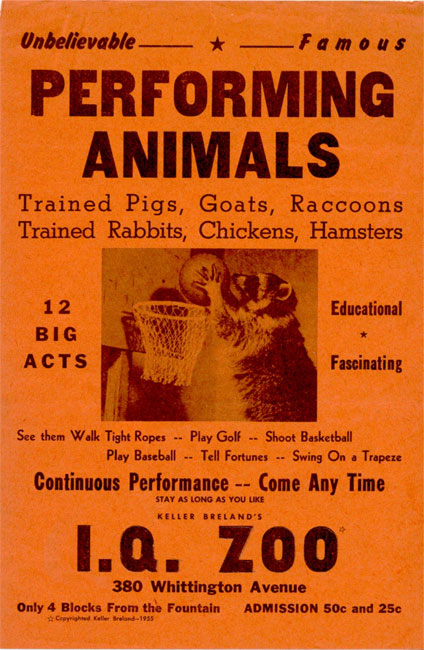
There they continued to train animals and animal trainers, and they also started a cash-concern they called the "IQ Zoo" which featured various animals doing amusing tricks, from basketball-playing raccoons and drum-playing ducks, to a printing press operated by reindeer and a chicken that would take on all comers in games of tick-tack-toe.

Though Keller and Marian Breland were equals at ABE, their division of labor suited their personalities and the flavor of the times.

Keller was the public face who traveled and did most of the show presentations and who promoted and expanded on the theory, while Marian was the engineer who made sure everything ran like a clock and actually operationalized everything at the level of fur, fin and feather.

Throughout the 1950s and 60's business was booming, with the Brelands signing contracts with Marineland of Florida, Parrot Jungle, and Six Flags.

In 1955, the Brelands produced the first trained dolphin show at Marine Studios in St. Augustine, Florida, and in 1957 they produced the first trained-whale shows at Marine Studios in Florida, and Marineland of the Pacific in Palos Verdes, California.

The work of the Brelands did not go unnoticed. Not only did the Brelands train other animal trainers who went on to places like Busch Gardens and Disney World, and Sea World, but they were also contracted with by the U.S. Navy to see if dolphins could be trained to do surveillance and salvage work.

It was during this time, that Keller and Marian Breland met Bob Bailey, who was the first Director of Training for the U. S. Navy Marine Mammal Program.

In 1965, Keller Breland died of a heart attack, leaving Marian with three semi-grown children, and Bob Bailey stepped up as as General Manager of ABE.

Marian and Bob continued on with ABE, signing a contract with the U.S. Navy to manage their Marine Mammal Facility in Key West, Florida from 1967 to 1969.

Along the way love blossomed between Bob Bailey and Marian Breland, and they married in 1976, adding Bob's six young children (three sets of twins!) to the now rapidly growing family.

In the 1980s, the Baileys began to phase out the commercial subdivisions of Animal Behavior Enterprises in order to simplify their life and devote more time to teaching. After a 1989 fire destroyed a lifetime of research, including thousands of hours of historical film, the Baileys decided to close ABE for good.

Marian Breland Bailey died on September 25, 2001, in Hot Springs Arkansas, and her ashes were taken to Bush Key, seventy miles west of Key West, Florida, where she had spent so much time training dolphins.

Bob Bailey continues to train teachers in the basics of operant conditioning, and his own contribution to animal and human training will be featured in a later post.

Suffice it to say that if you have heard of clicker training, it's due in no small part to Bob Bailey, whether you know that or not!

And if you have ever trained an animal in the last 40 years, you have stood on the shoulders of Marian and Keller Breland and Bob Bailey, whether you know that or not.

When the history of animal training is written let it be said that these three remarkable individuals invented or perfected so much of what we take for granted today.

Thursday, February 14, 2008

A Short History of Dog Training


People tend to think the way things are done now is how they were done forever. Not entirely so, especially in the arena of dog training.

A few key dates in the history of canine communication show that while operant conditioning is pretty old stuff, the mix of methods has changed and become better understood over time:
_ _ _ _ _ _ __

1700s: Truffle hunters learn to give their dogs bread when they locate truffles, which turns out to be cheaper than using pigs which cannot be stopped from eating all the truffles they locate.

1885: S.T. Hammond, a writer for Forest and Stream magazine advocates in his columns and in a book entitled Practical Training, that dogs should be praised and rewarded with meat when they do something right.

1880s: Montague Stevens trains his New Mexico bear dogs by rewarding them with pieces of bread instead of beating and kicking them as others of that era were generally doing. Stevens is a famous bear hunter and friend of Teddy Roosevelt and the sculptor Frederic Remington.

1886: Edward Thorndike develops a theory of learning based on stimulus and response. Thorndike shows that "practice makes perfect" and that if reinforced with positive rewards, animals can learn quickly.

1899: The first canine school for police dogs is started in Ghent, Belgium using Belgian Shepherds, which had recently been established as a breed.

1903: Ivan Pavlov publishes his experiments with dogs and digestion, noting that animals can be trained to have a physical response to stimuli. Pavlov called this learning process "conditioning," and in 1904 he was awarded the Nobel Prize for his research.

1903: The Germans begin schutzhund work, a competition devoted to obedience, protection, tracking and attack work.

1907: Police begin patrolling New York City and South Orange, New Jersey with Belgian Shepherds and newly reconstructed Irish wolfhounds.

1915: Baltimore police begin using Airedales from England to patrol the streets. The police suspend use of Airedales in 1917 as the dogs had helped make no arrests. The police failed to notice that no robberies had occurred where the dogs were on patrol.

1915: Edwin Richardson trains dogs for the military during WWI using some positive reinforcement, and the dogs prove to be quick studies. Many dogs are used for communication and for guard duty.

1917: The Germans begin to formally use dogs to guide soliders blinded in mustard gas attacks. The French soon follow suit.

1918: U.S. Army Corporal Lee Duncans find an abandoned war dog station in Lorraine, France which has five young puppies in a kennel. Duncan takes one of the pups and names it "Rin Tin Tin" after the finger dolls that French children were giving to the soldiers at the time. The dog travels to California, proves easily trainable, and is soon employed making movies that are so successful it saves Warner Brothers studio from bankruptcy. The dog dies in 1932 in neighbor Jean Harlowe's arms, and is buried in Paris, but its descendents work in the movies throughout the 1950s, inspiring many people to try to train their own dogs to do simple tricks.

1925: One of the very first German-trained guide dogs for the blind is given to Helen Keller.

1926: Propelled in large part by the popularity of Rin Tin Tin, the German Shepherd population in the U.S. explodes, and by 1926 it accounts for 36 percent of all the dogs in the AKC -- 21,659 animals. Due to rapid inbreeding and poor selection, however, the American German shepherd quickly degenerates and is soon deemed inferior.

1929: Dorothy Harrison Eustis establishes the Seeing Eye Foundation to train guide dogs for the blind. Eustis goes to Switzerland to get a better stock of German Shepherds than she can find in America. This same year the AKC tries to ban the importation of foreign purebred dogs in order to protect domestic dog breeders, but the plan fails.

1930: About 400 dogs are employed as actors in Hollywood, the majority of them mongrel terriers which prove to be small enough for indoor scenes, rugged enough for outdoor scenes, and exceedingly smart.

1938: B.F. Skinner begins research into operant conditioning as a scientifically-based learning model for animals and humans. His special focus is on teaching pigeons.

1939: The AKC begins obedience competitions designed by Helen Whitehouse Walker who wants to prove that her standard poodles can do something other than eat food.

1942: The U.S. military says it needs 125,000 dogs for the war, and asks people to donate their large breeds. The military manages to train only 19,000 dogs between 1942 and 1945. The Germans reportedly had 200,000 dogs in service.

1943: In 1943, Marion Breland and her husband Keller Breland form a company called Animal Behavior Enterprises (ABE) to teach animals for shows. The Brelands had been students of B.F. Skinner (see 1938) and began teaching animals to peform tricks for shows and for commercial clients such as dog-food maker General Mills. They pioneer the use of a "clicker" to teach animals at a distance and to improve timing for affirmations and delayed rewards. The Brelands were the first people in the world to train dolphins and birds using operant conditioning.

1943: The movie "Lassie Comes Home" is filmed, featuring a purebred male collie playing the female staring role. Ironically, the U.S. military considered purebred (i.e., AKC ) collies so stupid that they were specifically excluded from military service in World War II, while herding farm collies were actively recruited.

1947: The Brelands (see 1943) begin using chickens as learning subjects with which to train other trainers, as they are cheap, readily available, and "you can't choke a chicken."

1953: Austrian animal behaviorist Konrad Lorenz writes "Man Bites Dog" and "King Solomon's Ring," books which popularize animal behaviorism.

1954: Baltimore reestablishes its police dog program, and today it remains the oldest police K-9 program in the country.

1960s: During the early part of the 1960s, Marian and Keller Breland (see 1943) were hired by the U.S. Navy to teach other animal trainers how to train dolphins. The Navy was interested in using dolphins to patrol harbors, retrieve lost gear, and guide bombs (i.e. "suicide bomber" dolphins). During their work with the Navy, the Breland's meet Bob Bailey, the Navy's first director of animal training, and they began a partnership with him. Keller Breland dies in 1965, and in 1976 Marian and Bob Bailey are married.

1962: William Koehler publishes "The Koehler Method of Dog Training" which becomes a staple of AKC obedience competitors. Though often criticized today, Koehler's methods are the core of a lot of effective dog training systems still in use.

1970s: The U.S. Customs Service begins to use dogs to detect drugs, and they are subsequently employed to sniff out explosives and fire-starting chemicals.

1978: Barbara Woodhouse publishes "No Bad Dogs" one of the first popular books on basic dog training. It relies heavily on proper use of a choke chain, and says most "bad dogs" have inexperienced owners who are not training their dogs properly by being consistent, firm and clear.

1984: The U.S. Dept. of Agriculture begins to use beagles to patrol airports for contraband food and other perishable items.

1985: Dolphin trainer Karen Pryor publishes Don't Shoot the Dog: the New Art of Teaching and Training which focuses on timing, positive reinforcements and shaping behavior, and draws heavily on the work of Marian Breland Bailey and Robert Bailey (see 1943 and 1960s). Her book promotes "clicker training" of dogs to improve timing and to allow trainers to communicate and "reward" their dogs from a distance.

1995: The U.S. Dept. of Agriculture begins using Jack Russell Terriers to locate and kill invasive brown tree snakes on the island of Guam.

2000 and beyond: Various cable television shows feature various dog training and rehabilitation methods. The notion that there are "new" and "old" dog training methods obscures the fact that ALL dog training methods involve some form of operant conditioning which is, in fact, pretty old stuff (as old as dogs). None of the dog training shows actually explain the core principles of operant conditioning or their relative worth in different training situations.
.