Showing posts with label Bob Bailey. Show all posts

Monday, August 29, 2016

They Invented Animal Training


This article was written for the June 2010 issue of Dogs Today magazine. Illustration by Kevin Brockbank.

Who invented animal training and what can we learn from them?

The question may seem silly. Animal training is older than the hills. For certain, it is as old as the dog.

That said, most of what we call animal training today fits into the folder of "operant conditioning," a term first coined by American psychologist B.F. Skinner in the early 1930s.

Chase it around the room, and operant conditioning is simply learning from consequences.

Skinner codified the basic principals of operant conditioning, and he invented a laboratory-based mechanical-training machine which rewarded animals with food when they pulled levers and pecked at spots.

Skinner's real claim to fame in the world of dogs, however, is that he hired Keller and Marian Breland -- two young assistants who more or less invented the modern art of animal training.

Teaching Pigeons to Bowl

The Breland's made their first big discovery while working with Skinner in 1943.

As odd as it sounds, the goal on this occasion was to train pigeons to "bowl" a ping-pong ball down a short alley to knock down a few pins. Keller Breland decided to use a hand-held switch to trigger a food reward, rather than a purely mechanical device. A small problem was that the pigeons had no interest in pecking at the ping-pong ball! Though Keller waited for hours for the right behavior to express itself, it never happened. In frustration, Keller decided to give the pigeons a reward for doing anything approximating movement in the right direction. To his amazement, the pigeons caught on pretty quickly, and the completed trick was learned in short order.

Thus was born "shaping," or progressive rewards based on approximating a task.

The second big development occurred in 1945. By this time, B. F. Skinner had left the University of Minnesota, and the Brelands had decided to strike out on their own as professional animal trainers.

While shaping tricks, the Brelands noticed that the animals themselves seemed to be paying attention to the noises made by the hand-held food-reward switches.

Keller and Marian Breland soon discovered that an acoustic secondary enforcer, such as a click or whistle, could communicate to an animal the precise action being rewarded, and it could do so from a distance.

The Brelands called this a "bridging stimulus," (now generally called a bridge) and it dramatically sped up animal training by increasing the amount of information going to an animal.

Thus was born clicker training.

The Rise of Commercial Animal Acts

By now the Brelands had created their own animal training company -- Animal Behavior Enterprises. Their first contract, with General Mills, was so successful that other contracts with movies, circuses, museums, fairs, and zoos soon followed.

Over the next several decades, the Brelands trained more than 15,000 animals representing more than 140 species. At one point, the Brelands had more than 1,000 animals under training at a single time -- a jaw-dropping level of production.

The Brelands did not just train animals; they also trained other animal trainers who went on to work at such venues as Busch Gardens, Disney World, and Sea World. The Brelands themselves signed contracts with such major amusement parks as Marineland of Florida, Marineland of the Pacific, Parrot Jungle, and Six Flags.

Rewards-based clicker training worked so well that in 1951, the Brelands authored an article in American Psychologist, in which they said they thought rewards-based clicker training might work on any animal to train just about anything.

And then something happened. They noticed that clicker training was, in certain circumstances, beginning to fail in ways they could no longer overlook.

When Clicker Training Failed

In a 1961 paper entitled, The Misbehavior of Organisms, Keller and Marian Breland described their first experience with the failure of reward-based operant conditioning.

It seems that when working with pigs, chickens and raccoons, the animals would often learn a trick and then begin to drift away from the learned behavior and towards more instinctive, unreinforced, foraging actions.

What was going on?

Put simply, instinct was raising its inconvenient head.

Though Skinner and his disciples had always maintained that performance was driven by external rewards or punishments, here was clear evidence that there was an internal code that could not always be ignored.

The Brelands wrote:

These egregious failures came as a rather considerable shock to us, for there was nothing in our background in behaviorism to prepare us for such gross inabilities to predict and control the behavior of animals with which we had been working for years.... [T]he diagnosis of theory failure does not depend on subtle statistical interpretations or on semantic legerdemain - the animal simply does not do what he has been conditioned to do.


The Brelands did not overstate the problem, nor did they quantify it. They simply stated a fact: instinct existed, and sometimes it bubbled up and over-rode trained behaviors.

Clearly, every species had different instincts, and just as clearly, a great deal of animal training could be done without ever triggering overpowering instinct. Still, the Brelands noted,

After 14 years of continuous conditioning and observation of thousands of animals, it is our reluctant conclusion that the behavior of any species cannot be adequately understood, predicted, or controlled without knowledge of its instinctive patterns, evolutionary history, and ecological niche.


The Problem with Dogs

What does this have to do with dogs?

Quite a lot. You see a small, but vocal and militant group of clicker trainers believe everything a dog does is learned by external rewards, and internal drives are "old school" fiction.

While the Brelands argued that a species could not be adequately controlled without “knowledge of its instinctive patterns, evolutionary history, and ecological niche," the most extreme militants in the world of clicker training now seek to minimize and disavow the very nature and history of dogs.

Dog packs? There are no such things, we are told.

Dominance? It does not exist in feral dogs or in wolves, and never mind the experts who disagree.

Prey drive? Not too much said about that!

Of course, instinctive behaviors and drives do not disappear simply because they are inconvenient.

As Keller and Marian Breland put it,

[A]lthough it was easy to banish the Instinctivists from the science during the Behavioristic Revolution, it was not possible to banish instinct so easily.


Of course, one must be careful to qualify the role of instinct.

Yes, dogs have instincts, but the history of dog breeding has largely been about reducing instinctive drives. As a consequence, most breeds have instinctive drives that are sufficiently attenuated that they are not much of an impediment to basic rewards-based training.

That said, not all dog breeds are alike. Not every dog is a blank slate, as the owner of any herding dog or game-bred terrier will tell you. Prey drive does not disappear because you want it to. Many problematic behaviors in dogs -- especially behaviors in hard-wired working dogs that are being raised as pets -- are self-reinforcing behaviors that express themselves without any external reinforcement at all!

Clicker training, the Brelands remind us, cannot solve everything.

Is rewards-based training the most important tool in any trainer’s box of tricks and methods?

Absolutely. There is not much debate there.

But the Brelands remind us that dogs do not come to the trainer as a tabula rasa, nor should we think of all dog breeds as being more or less the same, or that all responses are equally conditionable to all stimuli.

Dogs and other animals, it turns out, are a bit more complicated that white rats, and the real world is not a laboratory.

In the wild and on the farm, animals have managed to learn, all by themselves, since the Dawn of Time and long before clickers came on the scene. How did they do that? Does the real world have as much to teach us as the lab? Keller and Marian Breland thought it did.

Tuesday, June 23, 2015

How to Train a Cheetah


A rabbit-coursing Cheetah in the UK, circa 1937.

I am always a bit amused by the folks who talk about scientific dog training.

What they are trying to suggest is that there was no good dog training before B.F. Skinner (or Karen Pryor) and that they have discovered a secret science.

Now I am a big fan of B.F. Skinner. A great man.

I am an even bigger fan of Keller Breland and Marian Breland, who studied with Skinner, and with Bob Bailey who married Marian Breland after Keller died and who went on to helpe popularize reward-based animal training here in the U.S.  Karen Pryor will tell you most of what she knows she learned from Bob Bailey, who will tell you most of what he knows originated with Marian and Keller Breland who, in turn, learned a great deal from Skinner.

That said, B.F. Skinner did not invent operant conditioning, any more than Newton invented gravity.

Operant conditioning predates Skinner by many millenia, and not just in training dogs.

Consider this text from an 1865 publication entitled "Dog Breaking: the Most Expeditious, Certain and Easy Method".


Hey, that's operant conditioning!

Well yes it is. And in a book called "Dog Breaking" no less.

Hmmmm.... What's that about?

Well, it has more to do with language than technique. Language, you see has always been a problem in dog training.

The term "breaking," as used here, is simply a term moved over from the world of horses. It does not mean you are beating a dog into submission. Far from it, if you actually take the time to read the text.

But of course, when a rival publication came out in 1882, the term "breaking" was the new bogey man (every new product needs to first demonize the old).

Breaking? That must mean beating the dog to death right?

Who wants something that is broken? No one!

The new publication was entitled, "Practical Dog Training: or, Training vs. Breaking" and it wanted everyone to know that you could actually train a dog with a bit of food and a check cord.

And never mind if that was the the exact same message of the earlier text!

The "dog training wars" had started, and YES, it was mostly nonsense right from the start.

Of course, when B.F. Skinner's disciples came along, they too promised a new "scientific" system to replace the "old coercive" system of dog training that they said had preceded them.

They had just learned, they said, that animals could be taught to come for a piece of food, and that they could be taught to avoid things that made them uncomfortable.

Really? Tell us more!

Of course when Skinner showed up, he did not clarify things much in terms of language, did he?

In fact, he made an even bigger muddle of the language by using words like "punishment".

Punishment? Who wants to punish a dog? No one!

In fact what was being meted out most of the time was not "punishment" as we commonly use that term, but a simple instruction that says "we need less of that."

What Skinner called "reinforcement" was simply instruction that "we could use a little more of that."

Language continues to obscure, of course.

When Cesar Millan talks about "dominance," he is not talking about beating a dog as some assume; he is saying the human needs to be setting the agenda. The human needs to decide what food is served, when it is served, who gets it, and in what quantities. The human needs to decide when a walk starts, where it goes, and when it ends. The human needs to decide the rules of the house, not the dog.

Of course words like "dominance" tend to set off a lot of folks, just as words like "punishment" do.

Most of the time these folks have not actually bothered to read B.F. Skinner or Cesar Millan, much less page through old dog training books by Barbara Woodhouse or William Koehler, or the even older texts on "dog breaking."

It's so much easier to demonize stuff if you have not actually read it!

OK, enough about that. Point made (if a point is to be made).

I promised a lesson in how to train a Cheetah. Where is that?

The paragraphs below come from that earlier-named 1865 text on "Dog Breaking," and once again we find operant conditioning at work:

The education of the cheeta is no less progressive than that of the dog; and whatever patience the latter may require from his instructor, the former demands far greater; not so much from want of docility, as from the nearly total absence of all the feelings of attachment so conspicuous in the canine race.

The cubs when they are very young are stolen from the rocky fastnesses where they are usually bred. They are immediately hooded, and allowed no other exercise than what they can take when they are led about by their keeper. While he is feeding them, he invariably shouts in a peculiar key. In a month or so their eager looks, animated gestures, and possibly cheerful purr-ing, testify that they comprehend its import as fully as a hungry young ensign does "the roast beef of old England." They are then slightly chained, each to a separate bandy (bullock-cart), and habituated to its motion. They are always fed during the drive. They thus learn to expect a good meal in the course of their airing.

After a time the keeper, instead of feeding a promising pupil while he is a prisoner, goes to a little distance from the bandy and utters the singular cries now so joyfully heard, upon which an attendant slipping off the chain and hood the liberated cheeta runs to his trainer to be fed. By degrees this is done at increased distances. He is always conducted back to the carriage by the keeper's dragging at the lump of meat of which the animal retains a firm hold.

The next step is to for the man to again commence feeding near the cart, but without making any noise -- the removal of the hood being the only thing to tell the spotted beast to begin to look about him for his dinner. The last step is the substitution of a kid or wounded antelope ... His education is now completed; but for many months he is never unhooded at a herd unless the driver has managed to get the cart with a very favoring distance."


If you are a hawker or falconer, this all might sound pretty familiar.

Indeed, falconers had been training and flying wild birds for a millenia before B.F. Skinner trained a pigeon, or Bob Bailey noted that "you cannot choke a chicken."

But don't tell that to the "modern scientific" trainers. They still have something "new" to sell!
.

Thursday, April 01, 2010

Some Animals are More Hardwired Than Others


In an earlier post I dared to ask "Who invented animal training?" and went on to detail the work of Keller and Marian Breland who not only discovered "shaping" and bridging stimulus, but also invented clicker training.

Keller and Marian Breland trained animal acts featured in movies, circuses, museums, fairs, zoos and amusement parks across the nation, and also trained many of the trainers that worked in these facilities as well.

By 1951, the Brelands had trained thousands of animals from dozens of species, and in an article for American Psychologist, they said they thought rewards-based clicker training might work on any animal to train just about anything.

And then something happened.

They noticed that clicker training was, in certain circumstances, beginning to fail in ways that they could no longer overlook.

In a 1961 paper entitled, The Misbehavior of Organisms, Keller and Marian Breland described their first experience with the failure of reward-based operant conditioning.

It seems that when working with pigs, chickens and raccoons, the animals would often learn a trick, but then begin to drift away from the learned behavior and towards more instinctive, unreinforced, foraging actions.

What was going on?

Put simply, instinct was raising its inconvenient head.

Though Skinner and his disciples had always maintained that performance was driven by external rewards or punishments, here was clear evidence that there was an internal code that could not always be ignored.

The Brelands wrote:

These egregious failures came as a rather considerable shock to us, for there was nothing in our background in behaviorism to prepare us for such gross inabilities to predict and control the behavior of animals with which we had been working for years.... [T]he diagnosis of theory failure does not depend on subtle statistical interpretations or on semantic legerdemain - the animal simply does not do what he has been conditioned to do.


The Brelands did not overstate the problem, nor did they quantify it. They simply stated a fact: instinct existed, and sometimes it bubbled up and over-rode trained behaviors.

Clearly, every species had different instincts, and just as clearly, a great deal of animal training could be done without ever triggering overpowering instinct. Still, the Brelands noted,

After 14 years of continuous conditioning and observation of thousands of animals, it is our reluctant conclusion that the behavior of any species cannot be adequately understood, predicted, or controlled without knowledge of its instinctive patterns, evolutionary history, and ecological niche.


What does this have to do with dogs?

Quite a lot.

You see a small but vocal group of clicker trainers believe everything a dog does is learned by external rewards, and internal drives are nothing but "old school" fiction.

While the Brelands argued that a species could not be adequately controlled without “knowledge of its instinctive patterns, evolutionary history, and ecological niche," the most extreme militants in the world of clicker training now seek to minimize and disavow the very nature and history of dogs.

Dog packs? There are no such things, we are told.

Dominance? It does not exist in feral dogs or in wolves, and never mind the experts who disagree.

Prey drive? Not too much said about that!

Of course, instinctive behaviors and drives do not disappear simply because they are inconvenient.

As Keller and Marian Breland put it,

[A]lthough it was easy to banish the Instinctivists from the science during the Behavioristic Revolution, it was not possible to banish instinct so easily.


Of course, one must be careful to qualify the role of instinct.

Yes, dogs have instincts, but the history of dog breeding has largely been about reducing instinctive drives. As a consequence, most breeds have instinctive drives that are sufficiently attenuated that they are not much of an impediment to basic rewards-based training.

That said, not all dog breeds are alike. Not every dog is a blank slate, as the owner of any herding dog or game-bred terrier will tell you. Prey drive does not disappear because you want it to. Many problematic behaviors in dogs -- especially behaviors in hard-wired working dogs that are being raised as pets -- are self-reinforcing behaviors that express themselves without any external reinforcement at all.

Clicker training, the Brelands remind us, cannot solve everything.

Is rewards-based training the most important tool in any trainer’s box of tricks and methods?

Absolutely. There is not much debate there.

But the Brelands remind us that dogs do not come to the trainer as a tabula rasa, nor should we think of all dog breeds as being more or less the same, or that all responses are equally conditionable to all stimuli.

Dogs and other animals, it turns out, are a bit more complicated that white rats, and the real world is not a laboratory.

In the wild and on the farm, animals have managed to learn, all by themselves, since the Dawn of Time and long before clickers came on the scene.

How did they do that? Does the real world have as much to teach us as the lab? Keller and Marian Breland thought it did.


.

Wednesday, March 24, 2010

Who Invented Animal Training?


Marian Breland and Keller Breland, March 15, 1955. Source

Who invented animal training?

The question is silly on its face. Animal training is older than the hills. For certain, it is as old as the dog.

That said, most of what we call animal training today is what the fancy talkers call "operant conditioning," a term first coined by psychologist B.F. Skinner in the early 1930s in an effort to dress up an even older concept -- learning from consequences.

B.F. Skinner did not invent operant conditioning any more than Newton invented gravity.

That said, Skinner DID codify the basic principals of operant conditioning, and he did invent mechanical-based operant conditioning, i.e. the "Skinner box" a mechanical device that awarded animals with food for pulling levers, pecking at spots, and doing other slightly more complicated learned behaviors.

Perhaps just as importantly, B.F. Skinner brought into the world of operant conditioning several people who helped shape the way we train animals today.

In fact, I do not think it is too much to say that two of his students -- Marian Ruth Kruse and Keller Breland -- invented modern animal training.

The story begins in the very early 1930s when B. F. Skinner was a researcher at Harvard working on something he called an "operant conditioning chamber" -- a device which measured the response of animals to stimulus. This later became the first "Skinner box" or animal teaching machine.

In 1936, Skinner left Harvard to teach at the University of Minnesota, where he began expanding on his earlier work.

In 1938, he took on his second student assistant, a young 18-year old girl by the name of Marian Ruth Kruse.

In 1940, Skinner added Keller Breland to his team of graduate student assistants.

Keller Breland and Marian Rught Kruse fell in love, and in 1941 they were married.

Marian and Keller Breland learned the basics of operant conditioning from B.F. Skinner, and helped him to train thousands of rats and pigeons used in various experiments and projects.

Once particularly important project began in 1941, when Skinner and his assistants were hired by the U.S. Navy to see if pigeons could be trained to guide bombs to their targets.

While pigeon-guided bombs never made it to the battle field, the operant conditioning techniques learned during this period of stable Navy funding suggested to Mariann and Keller Breland a possible business opportunity.

Was there a market for trained animals? They thought there might be.

When, in 1945, B.F. Skinner was lured away from Minnesota to teach at the University of Indiana, they Brelands decided to see if they could make a go of it on their own as commercial animal trainers and contract researchers and consultants.

It seemed an unlikely way to make a fortune.

Skinner had mostly trained rats and pigeons. If the Brelands were to support themselves as animal trainers, however, they would have to train higher animals than that!

Yes, the basic elements of operant conditioning had been used, off and on, and in a largely chaotic way, to train many species around the world over a thousand years. But most of this real-world experience was now lost to time and was little more than rumor or anecdote.

Could the basics of rat and pigeon training be scaled up and used across a wide variety of species? And if it could, would there be a market for such a thing? Would it be a large enough market to put food on the table, and gas in the car?

No one knew, least of all the Brelands. They took the plunge, nonetheless, buying a small farm in Mound, Minnesota and forming a company they called Animal Behavior Enterprises (ABE).

ABE's goals were three-fold and reflected their slightly tenuous business plan: to produce trained animals in profusion for an unknown commercial market, to engage in contract research if they could find anyone willing to underwrite that, and to consult on operant conditioning if they could find anyone willing to pay for their advice.

To say bravery was involved in this economic venture is an understatement. To those on the outside, including family and friends, it seemed sheer madness.

The Brelands had a secret, however: they were pretty good animal trainers, and they also had a growing body of evidence that suggested operant conditioning was a very robust training methodology.

In 1943, the Brelands, working with B.F. Skinner, had discovered the power of shaping behaviors by using a simple hand-held food-delivery switch. Now, instead of being rewarded for actually completeting the task, an animal could be rewarding for "approximating" the task -- a behavior that could be "shaped," by degrees, to the actual desired behavior.

A simple hand-held food delivery switch was, in effect, the first massive leap forward beyond the Skinner Box.

By 1945, the Brelands had gone even further. The mechanical construction of Skinner boxes had led the Brelands to a new idea; that small noises, such as those produced by the mechanical apparatus inside a Skinner box, or the noise made by a hand-held switch, might be an important part of the training process itself.

Experimenting with this idea, Keller and Marian Breland discovered that an acoustic secondary enforcer, such as a click or whistle, could communicate to an animal what precise action was being done that was actually resulting in a food reward.

Keller and Marian called this a "bridging stimulus," and found it dramatically sped up animal training by increasing the amount of information going to an animal. Most importantly of all, it seemed to work well with all animals. Important stuff!

In 1946, Animal Behavior Enterprise's got its first animal training contract with General Mills. The assignment was to train farm animals to appear in feed advertisements.

This first successful contract led to more contracts, first for in-store promotional animals, and then for animals to be used in movies, circuses, museums, and zoos.

In addition to providing trained animals, the Brelands were also asked to train workers and producers in how to work with those animals when they were sent on location.

From the beginning, "training the trainers" became an adjunct business to providing the trained animals themselves.

While the Brelands had worked almost exclusively with rats, pigeons and chickens when employed by Skinner, they now found themselves training everything: dogs, cats, pigs, cattle, chickens, goats, sheep, raccoons, rabbits, ducks, parrots, ravens, deer, and monkeys.

At one point, the Brelands had more than 1,000 animals under training at a single time. Over the course of a lifetime, scores of thousands of animals, representing more than 140 species, were trained by the Brelands.

Of course, it did not take too long for the Brelands to outgrow their small Minnesota farm, and it took even less time for them to realize that long, cold Minnesota winters were not too conducive to animal training outside of a laboratory setting.

In 1951 the Brelands moved to Hot Springs, Arkansas, a central location well-served by the railroads, where land was cheap and the weather was not too bad.

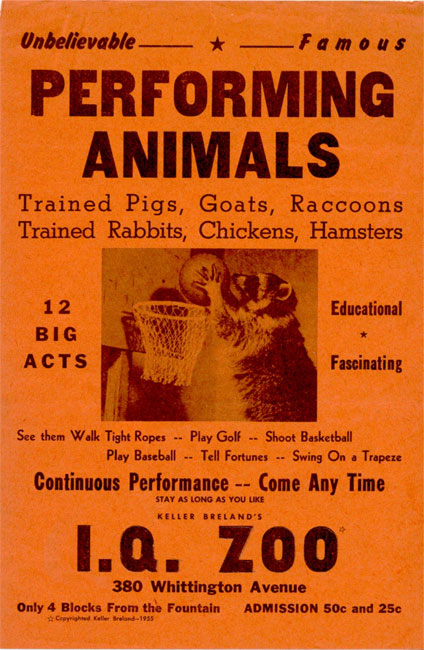
There they continued to train animals and animal trainers, and they also started a cash-concern they called the "IQ Zoo" which featured various animals doing amusing tricks, from basketball-playing raccoons and drum-playing ducks, to a printing press operated by reindeer and a chicken that would take on all comers in games of tick-tack-toe.

Though Keller and Marian Breland were equals at ABE, their division of labor suited their personalities and the flavor of the times.

Keller was the public face who traveled and did most of the show presentations and who promoted and expanded on the theory, while Marian was the engineer who made sure everything ran like a clock and actually operationalized everything at the level of fur, fin and feather.

Throughout the 1950s and 60's business was booming, with the Brelands signing contracts with Marineland of Florida, Parrot Jungle, and Six Flags.

In 1955, the Brelands produced the first trained dolphin show at Marine Studios in St. Augustine, Florida, and in 1957 they produced the first trained-whale shows at Marine Studios in Florida, and Marineland of the Pacific in Palos Verdes, California.

The work of the Brelands did not go unnoticed. Not only did the Brelands train other animal trainers who went on to places like Busch Gardens and Disney World, and Sea World, but they were also contracted with by the U.S. Navy to see if dolphins could be trained to do surveillance and salvage work.

It was during this time, that Keller and Marian Breland met Bob Bailey, who was the first Director of Training for the U. S. Navy Marine Mammal Program.

In 1965, Keller Breland died of a heart attack, leaving Marian with three semi-grown children, and Bob Bailey stepped up as as General Manager of ABE.

Marian and Bob continued on with ABE, signing a contract with the U.S. Navy to manage their Marine Mammal Facility in Key West, Florida from 1967 to 1969.

Along the way love blossomed between Bob Bailey and Marian Breland, and they married in 1976, adding Bob's six young children (three sets of twins!) to the now rapidly growing family.

In the 1980s, the Baileys began to phase out the commercial subdivisions of Animal Behavior Enterprises in order to simplify their life and devote more time to teaching. After a 1989 fire destroyed a lifetime of research, including thousands of hours of historical film, the Baileys decided to close ABE for good.

Marian Breland Bailey died on September 25, 2001, in Hot Springs Arkansas, and her ashes were taken to Bush Key, seventy miles west of Key West, Florida, where she had spent so much time training dolphins.

Bob Bailey continues to train teachers in the basics of operant conditioning, and his own contribution to animal and human training will be featured in a later post.

Suffice it to say that if you have heard of clicker training, it's due in no small part to Bob Bailey, whether you know that or not!

And if you have ever trained an animal in the last 40 years, you have stood on the shoulders of Marian and Keller Breland and Bob Bailey, whether you know that or not.

When the history of animal training is written let it be said that these three remarkable individuals invented or perfected so much of what we take for granted today.

Monday, March 01, 2010

Calm and Assertive Clicker Training


In the world of dog training, there are two camps that seem to be at war -- pure click-and-treat dog trainers and everyone else.

This last faction is sometimes reduced to "Cesar Millan" by clicker trainers who are new to dog training, but it in fact includes Barbara Woodhouse, William Koehler, and 2,000 years of successful dog trainers on six continents, including the two people who are most responsible for the creation of clicker training, B.F. Skinner and Bob Bailey.

Now here's the funny thing -- Cesar Millan and click-and-treat trainers are doing the same thing!

What? How can that be?

Millan never seems to use a clicker, while the clicker trainers never seem to talk about being "calm and assertive."

Right.

But have you noticed what a clicker actually DOES to a new trainer?

It makes them "calm and assertive!"


Let's start with Cesar Millan.

When Millan talks about being "calm and assertive," what he is really talking about is making fewer signals and making clearer ones.

The average dog owner that goes to Millan is the typical "American nervous wreck" who is perpetually trying to do five things at once -- pet the dog, change channels on the TV, instruct the kids in the next room, and eat a slice of pizza, all while "teaching" one dog not to squabble with the other.

For the dog, it's a bit like listening to five different radios on five different stations all at once. What the hell is going on?!

When Millan tells a dog owner to be "calm and assertive" the first thing that happens is that the owner becomes self-aware.

What? I am not being calm and assertive? I thought I was!

Suddenly the dog owner stands a little straighter and moves around a little less, and when they do move now it is with a little more purpose.

The owner starts watching Millan, who may instruct him or her to simply walk ahead with confidence while ignoring the dog.

Suddenly, for the first time in weeks, the dog's owner is not sending mixed signals to the dog. In fact, he is not sending any signals at all!

Peace at last!

What does Millan do next?

As a general rule, he takes the dog for a walk, and on that walk clear consistent signals are sent with the use of a leash. The owner is asked to not look at the dog and not to talk to the dog. If the dog starts to acts up, a corrective "leash pop" is sent down the leash, perhaps with a small "Tsssst," a neutral sound made with the mouth, but there is no looking at the dog or talking to the dog.

Only ONE simple signal is sent, and that signal says "we could use a little less of that."

If you watch Millan, you will notice that he has exquisite timing and can read most dogs like a book, often signaling "we need less of that" at the start of a dog getting wound up or acting out.

And what happens? Most of the time, a quick miracle!

Now, let's look at clicker training.

What does a clicker do when put in the hands of a new wanna-be trainer?

Think about it.

When a trainer has a clicker in hand, and is focused on getting the noise timed exactly right, is the trainer flailing around with his or her hands?

No.

Is he or she talking?

No.

In fact, they are not supposed to be moving at all.

And in clicker training, it is the clicker that does the talking, not the human.

Is the clicker assertive? You bet!

The clicker sends just ONE clear signal -- a signal that says "we could use a little more of that."

So what's the difference between the proper use of a clicker and a well timed and properly delivered leash pop?

Not much, other than the obvious --- one signal is saying "give me a little more of that," and the other signal is saying "give me a little less of that.

The main difference is when the two signals are used, and here we come to the REAL difference between Cesar Millan and pure click-and-treat trainers.

At the beginning of every show, Millan tells the audience exactly what he does for a living:

"I re-habilitate dogs, I train people."

Listen to that carefully. Millan RE-habilitates dogs.

In short, his job is to correct what is broken. He does not habilitate; he RE-habilitates.

You do not call Cesar Millan to train a new puppy.

You do not call Cesar Millan to train a young dog for basic obedience or agility.

You call Cesar Millan when your dog is a mess and is acting out in a dangerous or disruptive way.

Millan's specialty is not writing on a blank slate -- it's correcting the confused scribble that has been laid down -- often for years -- on dogs that have never been exercised, are poorly socialized, are phobic, and are deeply confused about their role in the household.

Read that last line again. Millan's jobs is CORRECTING.

You cannot correct with positive training.

To correct, you need to use a combination of extinguishing behavior (i.e. completely ignoring some actions and reactions) while sending a clear message that you want to see a little less of whatever bad behavior is being presented.

You can do a lot with extinguishing, but it can be slow, and it does not work in every situation.

Does Millan give positive rewards? Of course! Watch him! He loves dogs and he sends positive signals all the time, but they are not always food-based and they are never heaped on for no reason, and never given to an overly excited dog.

Millan may shift his body to put psychological pressure on a dog, or shift his body to take pressure off. Removing pressure is a reward.

Millan may pat a dog on the chest or head, offer it a little play time or a favorite toy, or even slip it a small piece of food. Millan is flexible.

Millan is a great believer in simply walking the dog. Exercise with the dog is a type of reward (time with owner), a type of remedy (activity soothes anxiety), and also a recapitulation of the pack hierarchy (the owner is reinforced as the pack leader who initiates, leads and ends activity).

What about the click and treat trainer? Here too rewards are flexible, though things tend to be a bit more rigid on the front end when the dog is just starting out and learning that the clicker is a marker and proxy for rewards to come.

As training progresses, however, a click-and-treat trainer will move from click-and-treat to click-and-sometimes treat. Rewards may shift from purely food to a pat on the head, a rub on the chest, or a toss of a favorite toy.

As a command or trick is learned, rewards become less frequent, with several clicks-and-no-treats followed by a "jackpot" of several pieces of kibble delivered all at once. As training progresses further, and the dog is making fewer and fewer mistakes, the period between jackpots may get longer and longer as the dog learns to "work for wages".

In essence the dog is "playing the game," the same as someone might play a slot machine. If you got a reward every time you pulled the lever at a casino, it would be boring. It's the surprise of the "jackpot" that makes the inveterate gambler keep coming back for more. The same is true for the dog.


Cesar Millan is a balanced trainer -- he uses all three parts of operant conditioning. As a consequence, I have very little doubt he could train almost any animal put before him.

Can a pure positive trainer do the same?

In most cases yes, but not in every case.

Why?

Simple: If you put a pure positive trainer in front of an adult African lion in full charge, that clicker is not going to help much!

It turns out that a clicker is a great tool if an animal is young, or if it is a blank slate and does not have mayhem on its mind. But it is not much use if you need to fend off a charging lion.

It is also not much use if you need your dog to stop common self-reinforcing negative behaviors such as chasing deer or chronic (i.e. not ameliorated by excercise) barking in the back yard.

For those kinds of problems, few things work as well as an e-collar in the hands of someone who has actually read the directions.

Which brings me to my final observation of the day: Training the trainer.

I always find it amusing to hear pure click-and-treat trainers act as if learning how to use a slip collar is so complex only a rocket scientist could figure it out.

"So many people use a choke chain wrong," they sniff, while never teaching the correct way, which takes all of 30 seconds.

How about e-collars?

Here too we hear a lot of tut-tutting. "Yes, they can be a lot of use in the hands of a professional, but ...." the voice trails off.

The suggestion is clear -- you are an idiot.

No one like you can ever be trusted to actually read the instructions that came with an e-collar, or watch the CD-Rom included in the package.

Run a chainsaw? Sure. Raise a kid? Absolutely! Cook your own food? Of course. But you are too stupid and sadistic to actually figure out how to use an e-collar or a slip collar without killing your dog.

But of course you can learn how to train a dog with a clicker! Absolutely! And never mind that you are going to have to read a lot to learn how to do it, and maybe even watch a CD-Rom or two.

Now isn't that funny? If you decide to clicker train your dog, you are suddenly deemed to be a reader. Pick another training system, however, and you are suddenly a knuckle-dragging illiterate who will never be able to do it right.

Now to be fair, a clicker in the hands of someone who does not read a manual is not going to harm the dog much. It might get fat, it might get confused, and it might not get trained at all, but it will probably not be harmed.

But was a dog ever harmed by someone who read Barbara Woodhouse's book on dog training? Not that I can find!

And so, to recap...

  • Rewards-based signaling is the core way of teaching young dogs or "blank slate" dogs that have no serious behavior issues, and it is the main way all dogs are trained to engage in new tricks.
  • Aversion-based signaling is the core way of teaching adult dogs that have embraced bad habits to cease those habits.
  • Both types of signaling require decent timing so that the signal (either a reward or an aversion) is delivered exactly when the activity occurs. The quality of the timing is, to some extent, the quality of the communication.
  • Regardless of what method of training is used (balanced trainers use both methods), the success of the trainer will soar if he or she is calm, is not flailing around with voice, arms and legs, and is sending only ONE clear signal at a time.
    .

Thursday, February 14, 2008

A Short History of Dog Training


People tend to think the way things are done now is how they were done forever. Not entirely so, especially in the arena of dog training.

A few key dates in the history of canine communication show that while operant conditioning is pretty old stuff, the mix of methods has changed and become better understood over time:
_ _ _ _ _ _ __

1700s: Truffle hunters learn to give their dogs bread when they locate truffles, which turns out to be cheaper than using pigs which cannot be stopped from eating all the truffles they locate.

1885: S.T. Hammond, a writer for Forest and Stream magazine advocates in his columns and in a book entitled Practical Training, that dogs should be praised and rewarded with meat when they do something right.

1880s: Montague Stevens trains his New Mexico bear dogs by rewarding them with pieces of bread instead of beating and kicking them as others of that era were generally doing. Stevens is a famous bear hunter and friend of Teddy Roosevelt and the sculptor Frederic Remington.

1886: Edward Thorndike develops a theory of learning based on stimulus and response. Thorndike shows that "practice makes perfect" and that if reinforced with positive rewards, animals can learn quickly.

1899: The first canine school for police dogs is started in Ghent, Belgium using Belgian Shepherds, which had recently been established as a breed.

1903: Ivan Pavlov publishes his experiments with dogs and digestion, noting that animals can be trained to have a physical response to stimuli. Pavlov called this learning process "conditioning," and in 1904 he was awarded the Nobel Prize for his research.

1903: The Germans begin schutzhund work, a competition devoted to obedience, protection, tracking and attack work.

1907: Police begin patrolling New York City and South Orange, New Jersey with Belgian Shepherds and newly reconstructed Irish wolfhounds.

1915: Baltimore police begin using Airedales from England to patrol the streets. The police suspend use of Airedales in 1917 as the dogs had helped make no arrests. The police failed to notice that no robberies had occurred where the dogs were on patrol.

1915: Edwin Richardson trains dogs for the military during WWI using some positive reinforcement, and the dogs prove to be quick studies. Many dogs are used for communication and for guard duty.

1917: The Germans begin to formally use dogs to guide soliders blinded in mustard gas attacks. The French soon follow suit.

1918: U.S. Army Corporal Lee Duncans find an abandoned war dog station in Lorraine, France which has five young puppies in a kennel. Duncan takes one of the pups and names it "Rin Tin Tin" after the finger dolls that French children were giving to the soldiers at the time. The dog travels to California, proves easily trainable, and is soon employed making movies that are so successful it saves Warner Brothers studio from bankruptcy. The dog dies in 1932 in neighbor Jean Harlowe's arms, and is buried in Paris, but its descendents work in the movies throughout the 1950s, inspiring many people to try to train their own dogs to do simple tricks.

1925: One of the very first German-trained guide dogs for the blind is given to Helen Keller.

1926: Propelled in large part by the popularity of Rin Tin Tin, the German Shepherd population in the U.S. explodes, and by 1926 it accounts for 36 percent of all the dogs in the AKC -- 21,659 animals. Due to rapid inbreeding and poor selection, however, the American German shepherd quickly degenerates and is soon deemed inferior.

1929: Dorothy Harrison Eustis establishes the Seeing Eye Foundation to train guide dogs for the blind. Eustis goes to Switzerland to get a better stock of German Shepherds than she can find in America. This same year the AKC tries to ban the importation of foreign purebred dogs in order to protect domestic dog breeders, but the plan fails.

1930: About 400 dogs are employed as actors in Hollywood, the majority of them mongrel terriers which prove to be small enough for indoor scenes, rugged enough for outdoor scenes, and exceedingly smart.

1938: B.F. Skinner begins research into operant conditioning as a scientifically-based learning model for animals and humans. His special focus is on teaching pigeons.

1939: The AKC begins obedience competitions designed by Helen Whitehouse Walker who wants to prove that her standard poodles can do something other than eat food.

1942: The U.S. military says it needs 125,000 dogs for the war, and asks people to donate their large breeds. The military manages to train only 19,000 dogs between 1942 and 1945. The Germans reportedly had 200,000 dogs in service.

1943: In 1943, Marion Breland and her husband Keller Breland form a company called Animal Behavior Enterprises (ABE) to teach animals for shows. The Brelands had been students of B.F. Skinner (see 1938) and began teaching animals to peform tricks for shows and for commercial clients such as dog-food maker General Mills. They pioneer the use of a "clicker" to teach animals at a distance and to improve timing for affirmations and delayed rewards. The Brelands were the first people in the world to train dolphins and birds using operant conditioning.

1943: The movie "Lassie Comes Home" is filmed, featuring a purebred male collie playing the female staring role. Ironically, the U.S. military considered purebred (i.e., AKC ) collies so stupid that they were specifically excluded from military service in World War II, while herding farm collies were actively recruited.

1947: The Brelands (see 1943) begin using chickens as learning subjects with which to train other trainers, as they are cheap, readily available, and "you can't choke a chicken."

1953: Austrian animal behaviorist Konrad Lorenz writes "Man Bites Dog" and "King Solomon's Ring," books which popularize animal behaviorism.

1954: Baltimore reestablishes its police dog program, and today it remains the oldest police K-9 program in the country.

1960s: During the early part of the 1960s, Marian and Keller Breland (see 1943) were hired by the U.S. Navy to teach other animal trainers how to train dolphins. The Navy was interested in using dolphins to patrol harbors, retrieve lost gear, and guide bombs (i.e. "suicide bomber" dolphins). During their work with the Navy, the Breland's meet Bob Bailey, the Navy's first director of animal training, and they began a partnership with him. Keller Breland dies in 1965, and in 1976 Marian and Bob Bailey are married.

1962: William Koehler publishes "The Koehler Method of Dog Training" which becomes a staple of AKC obedience competitors. Though often criticized today, Koehler's methods are the core of a lot of effective dog training systems still in use.

1970s: The U.S. Customs Service begins to use dogs to detect drugs, and they are subsequently employed to sniff out explosives and fire-starting chemicals.

1978: Barbara Woodhouse publishes "No Bad Dogs" one of the first popular books on basic dog training. It relies heavily on proper use of a choke chain, and says most "bad dogs" have inexperienced owners who are not training their dogs properly by being consistent, firm and clear.

1984: The U.S. Dept. of Agriculture begins to use beagles to patrol airports for contraband food and other perishable items.

1985: Dolphin trainer Karen Pryor publishes Don't Shoot the Dog: the New Art of Teaching and Training which focuses on timing, positive reinforcements and shaping behavior, and draws heavily on the work of Marian Breland Bailey and Robert Bailey (see 1943 and 1960s). Her book promotes "clicker training" of dogs to improve timing and to allow trainers to communicate and "reward" their dogs from a distance.

1995: The U.S. Dept. of Agriculture begins using Jack Russell Terriers to locate and kill invasive brown tree snakes on the island of Guam.

2000 and beyond: Various cable television shows feature various dog training and rehabilitation methods. The notion that there are "new" and "old" dog training methods obscures the fact that ALL dog training methods involve some form of operant conditioning which is, in fact, pretty old stuff (as old as dogs). None of the dog training shows actually explain the core principles of operant conditioning or their relative worth in different training situations.
.

Thursday, August 31, 2006

A Balanced Trainer for Unbalanced Dogs


Asking me my thoughts about dog training is a bit like asking a rodeo clown to bring in the herd: I might know my way around a cow, but I might not be quite what you need for this job.

And so, it was with some confusion that I got a call from my mother asking me what I thought of the article on Cesar Millan (the so-called "Dog Whisperer") in this morning's New York Times.

I had not see it.

A bit later, I got an email from Reid Farmer asking, "Who's gonna jump on this one?"

Well hell, I guess I will. If deep knowledge and expertise are required to type, there would not be too many typing classes.

So here goes. What does this New York Times piece criticizing Cesar Millan and "The Dog Whisperer" TV show actually say?

Here's the meat of it:

"Essentially, National Geographic and Cesar Millan have cleverly repackaged and promoted a simplistic view of the dog's social structure and constructed around it a one-size-fits-all, cookie-cutter approach to dog training. In Mr. Millan's world, dog behavioral problems result from a failure of the human to be the pack leader, to dominate the dog (a wolf by any other name) completely.

"While Mr. Millan rejects hitting and yelling at dogs during training, his confrontational methods include physical and psychological intimidation, like finger jabs, choke collars, extended sessions on a treadmill and what is called flooding, or overwhelming the animal with the thing it fears. Compared with some training devices still in use whips and cattle prods, for example these are mild, but combined with a lack of positive reinforcement or rewards, they place Mr. Millan firmly in a long tradition of punitive dog trainers."


Aha! Now I get it. Millan is a "bad and backward" punitive dog trainer! The author of The New York Times piece slyly manages to work in whips and cattle prods to suggest Millan is one of those types of trainers.

But wait a minute! What Mr. Millan actually does is simply use an ordinary choke chain as it should be used, a firm voice and a firm hand to get a dogs attention. There are no beatings of dogs here. This is the National Geographic Channel, for God's sake!

The over-educated yuppies who watch this channel do not have a problem being too coercive. Their problem is that they think of their dogs as human children and they are willing to have themselves and their children bitten rather than try to communicate with the dog as a dog.

Whatever a dog is, it is NOT a human child.

But, of course, this is news to a lot of folks that watch the National Geographic channel, Animal Planet, and public television. These are nice people who love their pets. Most of them have sat on the couch so long watching nature shows they think real-life lion kills in the Serengeti are narrated, sotto voce, by the same voice that announces par scores on the Golfing Channel.

But no matter how nice or over-educated you are, a dog is not a child. This is a particularly uncomfortable and threatening truth for women who have managed to displace their maternal instincts to the family pet. This is a point Millan does not address directly (please, not too much honesty Millan!) but he does suggest women often have a harder time asserting dominance over their "fur babies." He is right. Why does saying this obvious thing send Mark Derr clucking away like a hen? Anyone who works with dogs has seen the maternal displacement problem in action, and anyone who has seen the "Dog Whisperer" TV show has seen the problem repeated out again and again. The Daisy Fuentes episode was particularly memorable for some reason ....

The simple but harsh truth is that the psycho-demographic watching the National Geographic channel tend to be people with two types of common "dog problems": They think their dog is their child, and their dog is over-fed and fat.

The dog is, quite simply, being "loved to death."

Cesar has antidotes for both problems. He is the right wrench for this nut.

If Mark Derr, the author of the New York Times editorial, wants to put together a TV show about dog training his way, he is free to do it. But it will not be a show that makes it on air unless it is entertaining. And dramatic. And has a charistmatic human figure as the lead.

Can Mr. Derr supply that? I doubt it. Cesar Millan can.

What National Geographic has done, as far as I can tell, is nothing more than film a charismatic and smart dog trainer at work and then cut up the tape so that it makes for good television. What's wrong with that? Was the boring stuff left on the cutting room floor? Of course. Who wants to see two hours of click-and-treat? Not me!

Derr seems to take issue with Cesar Millan's admonition that dogs do best with "exercise, discipline, and affection," and he seems to disagree with Mr. Millan's definition of discipline as meaning "rules, boundaries, and limitations."

Derr is being stupid. No serious dog man would argue with Millan on these points. The only thing you should say after Milan's statements on these issues is "Of course." Or perhaps, if you are being a bit chatty, "It is also true for children."

Next point.

Derr goes on to criticize Millan because Millan talks of dogs as being primarily pack animals with an innate desire to have a leader. Derr says wolves are not what Millan says they are because he read a study once that says differently.

Hmmm. . . .

I would agree that a dog is not a wolf (I say exactly that in my own book on working terriers -- see Chapter One), but I would NOT say a dog is not a pack animal.

A dog IS a pack animal.

On this matter, I speak from experience -- experience that Mr. Derr may not have. You see, I have been attacked by a pack of feral dogs. I assure you it is not something you forget.

At the time I was attacked I had been walking solo in the woods for eight weeks. I smelled rank, and with a 60-pound pack on my back, and a rain fly over my pack, I am not sure the mixed pack of large farms dogs recognized me as a human.

I smelled wild, and these were deer-killing dogs that had decided to put me on the menu. I was lucky to "sort it out" the way I did. My pants were ripped through at the crotch by an attacking dog who managed (by miracle) to only find wool before he was batted off into a ditch. Yes, one dog died. There are no regrets here.

So when Derr says dogs are not pack animals he can take a hike (pun intended). I know better, and what I know I did not read in a book.

Derr correctly notes that some aggressive dogs have underlying genetic problems predisposing them to being aggressive.

Yes, that is true. But guess what? So too do humans. We lock up a lot of humans, but we assimilate, educate and train most of them to "do the right thing". A genetic load for a little aggression is not necessarily destiny. It should be a lot easier to deal with dogs than humans. Dogs do not have beer, whiskey and PCP to warp their minds.

Huge numbers of dogs are written off, not because the dog is a genetic failure, but because the owner is ignorant (and sometimes stupid) and has done a poor job of socializing, training and leading a perfectly fine animal as it needs to be lead.

Is there a place for Prozac in your dog's food? There is according to Mr. Derr. I would disagree. Most dogs need training. If a dog is so unremittingly aggressive that it needs to be medicated, it needs to be put down. There are too many fine dogs being put to sleep every day for want of a good home to waste food and space on keeping a genetic wreck alive and medicated with chemical clutches. Dogs are not humans! We are not talking about YOU. Get over it. The only REAL question is whether the dog is actually the problem. Cesar Millan says it is more likely the owner -- and he is probably right.

Mr. Derr's shock and dismay at mild coercion during dog training suggests he is a dog training fadist. We see these people in the world of dogs just as we see them in the world of food and fashion.

Some of the most extreme fadists are the "clicker training" folks. For a cult-like subset of this group, Karen Pryor's book, Don't Shoot the Dog is a virtual Bible, and clicker training their sole religion.

I am not against clicker training (quite the opposite!) and I am all for positive reinforcement. I will bet Cesar Millan is not against positive reinforcement either.

That said, pure positive reinforcement is NOT how dogs communicate to each other, is it?

It may come as a shock to some people to learn that Karen Pryor did not invent clicker training. It was invented by the late wife of legendary animal trainer Bob Bailey. Bailey was on an animal training list-serv that I was on. Both of us were quiet lurkers, but one day Bailey popped up to set one "pure positive" person right on his ass. Mr. Bailey wanted it known to the list that he himself was not a "clicker trainer." He used clickers, sure, but he also felt there was a place for mild coercion. He even thought there was a right time and place to "shoot the dog" when dealing with extremely dangerous animals. Not a peep was heard after that.

Back to Cesar Millan. One of Millan's core points is that people with dogs are confused about what they have at the other end of the leash.

Yes, a dog is not a wolf (even if both animals DO organize themselves on a pack model), but a dog is also not a CHILD.

A dog is a dog.

Millan's core training message is that we must communicate with dogs on their level and with their values, and not our own.

Yes, dogs value food and affection.

But dogs also understands teeth, power and dominance.

Mr. Millan's point is NOT that dogs need to be bitten or beaten to get them to behave. Mr. Millan is a very civilized trainer and not a violent man. His point is simply this: almost every dog has within it the capacity to be submissive to a true leader.

Puppies are submissive to larger dogs, and smaller dogs are submissive to larger dogs. In a pack, there is only one Alpha dog and one Beta dog, and there is a "pecking order" all the way down to the Omega.

This is NOT news to anyone with a few free-range dogs. The order I release my own dogs in the morning is determined by pack order. If I do it wrong, the dogs squabble. If I do it right, all is harmony. The same is true for feeding.

Is dominance and coercion the way you train a "sit-stay"? Well, actually, yes and no. It's not quite that simple. Click-and-reward is the core method of training a dog to do a trick, but a dog that has been over-fed is not very attentive is it? A dog that has been caged or crated and not given much excercise is a bit too bouncy to focus on you, isn't it? And if a dog is going to learn anything it needs a calm, assertive and not-too-verbal person who consistently does the same thing over and over again. In fact, this is exactly what Cesar Millan offers and when he teaches -- along with a good dose of "Your dog is not your child," and "this is a choke chain -- learn how to use it."

And so I come back to a question I had after reading Mr. Derr's piece. What was Mr. Derr's intention? Did he have a point?

In fact, I think he did. I think his point is that he hopes New York Times readers will read his own book. There is nothing wrong with that, but it is not a good reason to slap someone around with poor thoughts and thin facts. I do not know much about Mark Derr, but he does not seem to know much about dog training. Even less than me, and I am a basket case.

And, for the record, I have read Mark Derr's book. It is a canine history book, and what I remember is that it was not terrible, but not great. The most memorable bit of information I got out of it is that Lewis and Clark ate a lot of dog meat on their expedition, and one of them (I can't remember which one) actually preferred dog flesh to elk or deer.

Interesting, but not quite as useful as knowing how to put a choke collar on a dog properly. Barbara Woodhouse taught that useful lesson to a generation of public televisions viewers some 30 years ago. Cesar Milan is now teaching it to a similar psycho-demographic on The National Geographic Channel. Some things will always be needed.

.